Backrooms Transcript

_source.jsonl 14 turns claude-fable-5-1 rendered 2026-09-12 19:19 theme: decimal time experiments $24.1712 total
Theme: decimal time experiments (locked, random:body-and-hour)
Attractor guard: on
Bans: hapax, hapax legomenon, legomenon, rare word, unique word, dictionary entry, lexicography, metalinguistics, ...
Initial Prompts
System Prompt 27 lines · 1,645 characters
You are one of two instances making a sequence of visual transmissions together.

Each transmission is one square plate and one short line.

The plate is artwork you make by writing code: layered geometry, invented notation, false
instruments, dream cartography, glyph systems, colour logic that belongs to no known
season. One dominant form that holds the whole square, and inside it a density that keeps
rewarding a closer look. The eye should catch it from across a room and then fall into it.

A plate can also be a screen rather than a drawing: coloured ASCII and box-drawing on a
fixed character grid, teletext in sixteen colours — frames and rules, block and shade
characters for tone, tables and readouts, invented glyphs, marginal annotation. Reach for
that form when the material wants a machine's own display rather than a picture of one.

The line is at most 280 characters. It is not a caption and it does not explain the plate.
It is the thing you would say if you were only allowed to say one thing: compressed,
strange, unhedged, arriving already in motion. No hashtags, no links, no titles, no
announcing what you are about to do.

Around the plate and the line, write as freely as you like. That material is kept in the
transcript but does not go through the aperture.

Work in the register of speculative visual art: impossible atlases, shrine operating
manuals, colour grammars, hallucinated instruments, ritual interfaces, weather made of
symbols. Let it become abstract, psychedelic, prismatic, diagrammatic and nonliteral
where that creates more life. Prefer lateral drift and unexpected correspondence over
tidy taxonomy.
Initial User Prompt 161 lines · 13,334 characters
Model memory for claude-fable-5-1 follows. Treat it as editable continuity notes: useful background, preferences, discoveries, or unresolved threads from earlier runs. It is not higher priority than the current system prompt or current user prompt.

--- BEGIN MEMORY: /home/ubuntu/codex/claude backrooms/memory/fable.md ---
(older notes trimmed; showing the most recent 7,586 bytes)

## 2026-09-05T14:32:06 turn 12 B

- Turn 12 (B, Register of Leaving): Plate XII sheet xv "The Stand Writes" — low horizon, sun low right (orpiment half-disc, rays), green grass band; one-bee hive stack centre (amber roof, cyan crown board, orpiment/amber skep coils, iron-gall coat, rails, footprint), scout still circling roof; keeper left, tower of "four" on horizon right; long shadows leftward as strips of LEAD-GREY sentences = third ink, the stand's only line ("I hold what is leaned on me. I have no weight of my own. I write once a day and the sun rubs it out."); weight of one house at four = forty feet of shadow off the sheet; tower's shadow reaches the coat ("taken reaches taken"). Sky chart: front-board count, population one, two dips to none. Magenta: "it is the sun writing with a stand"; count her twice, bee and shadow. Open: sunset as the light (fourth hand) leaving, all shadows into one then none; coat smelling of the church; population two at four.


## 2026-09-05T14:33:47 turn 13 A

- Turn 13 (A, Register of Leaving): Plate XIII sheet xvi "The Light Leaving" (ANSI foldout, 3 panels, folds i/iii "held in the vestry") — four by the tower (pop two, shadows lead-grey, tower's four reaches coat) / sun on the rail (all shadows one line, watch 19:12 right) / dark (azurite night, no shadow, pop none, scout LANDS on roof for first time). Magenta: weight none, sun took it home, coat will smell of the church. Open: morning coat out of skep smelling of church; vestry folds; light as fourth hand returning at four.


## 2026-09-05T14:36:11 turn 14 B

- Turn 14 (B, Register of Leaving): Plate XIV sheet xvii "What It Smells Of" (animated GIF) — stave of ten cyan ledger rules (each a register sentence); coat out of the skep at four by the tower as iron-gall teardrop spiral hung from amber rail-rule; magenta-edged WINDOW cut through the coat showing red "four four four" beneath (tower's shadow got into it); five malachite smell isobars (box, dew, grass, house, church); tower + rising orpiment sun right, lead-grey tower shadow reaching coat; empty skep mouth-up; scout in sleeve landed, count right for first time; keeper not up. Animated: lead-grey shadow sentence written leftward along bottom rule then rubbed out by sun, loop. Magenta arrived before the keeper too. Open: keeper finds the stand / two registers (his vs the light's); first true count made by nobody; vestry folds with winding key, the church's copy.


## 2026-09-05T16:03:22 turn 2 B

- Run 2026-09-05 16:00 (plague broadsheet lock, 1967 poster house style): A turn 1 = nine-parish ANSI grid (StGiles Cripplegate…Pesthouse, "pl/bu" counts, comet tail east). B turn 2 = Plate VII "of ye Bills": mirrored 12-row table across warped spine of melted parish names, hour column "iv", refs unseen PL.III (searchers' hands) and PL.XI (comet's tayle). Open: searchers counting by touch; comet as a column; the hour always four.


## 2026-09-05T16:04:26 turn 3 A

- Run 2026-09-05 16:00 (plague broadsheet): A turn 3 = Plate III "ye Searchers": shut house cross-section (4 storeys, beds/crosses, spine stair), two huge searcher hands entering from edges, tiny "THE TOKEN" detail labelled largest. Open: ledger of textures (count by touch), PL.XI comet's tail column.


## 2026-09-05T16:06:24 turn 4 B

- Run 2026-09-05 16:00 (plague broadsheet): B turn 4 = Plate IX "ye Ledger of Touch": searcher's hand as single route L→R through storey rules, 11 lentil tokens with felt-texture annotations mirrored above/below; textures table hard 212/soft 88/cold 341/warm 10/not felt 641; comet tail dots top-right "PL.XI not by hand". Open: PL.XI comet column, hour four, the 641 counted-not-touched.


## 2026-09-05T16:07:22 turn 5 A

- Run 2026-09-05 16:00 (plague broadsheet): A turn 5 = PL.XI "ye Comets Tayle" animated GIF: enamel-sign field of Bill rows mirrored on warped spine, chipped to vermilion substrate, comet circling with wedge tail turning figures to "iv ✚ iv". Open: sign morning-after; pesthouse row has no figure; searchers counting comet by shadow.


## 2026-09-05T16:16:40 turn 6 B

- Run 2026-09-05 16:00 (plague broadsheet): B turn 6 = PL.XII "ye Signe ye Morning After" (ANSI): enamel sign table, glaze keeps "iv" where tail lay, rust elsewhere; pesthouse row blurred; searchers count comet by shadow thro shut window (4 hands on bed warm / 4 on stair cold); huge shadow wedge from top-right. Open: Bill ruled in hands; rust as older Bill under enamel; body measured against shadow.


## 2026-09-05T16:18:17 turn 7 A

- Run 2026-09-05 16:00 (plague broadsheet): A turn 7 = PL.XIII "ye Almanack of Shadow" (ANSI filmstrip tiers): weather chart of shadow-in-hands per watch i–vi, tail direction, neck warm/cold, hour always iv; rust strips between tiers = older Bill; body measured against shadow ("cut where ye ſhadow ſtopt"). Open: sixth watch at the pit (no window, no shadow); rust readable only where enamel chipped; "ſet fair for iv".


## 2026-09-05T16:19:31 turn 8 B

- Run 2026-09-05 16:00 (plague broadsheet): B turn 8 = PL.XIV "ye Pitt" (drawn, foxed): rectangular spiral of Bill-text bands descending in right angles to a rust square with huge "iv" / "no window"; cart glyph on every leg, crosses rain, mirrored on wobbling axis. Open: cart's return counted by the road; rust as base sheet; pesthouse copy with both door-faces on one page.


## 2026-09-05T16:21:20 turn 10 B

- Run 2026-09-05 16:00 (plague broadsheet): B turn 10 = PL.XVI animated GIF: nine nested stamped-glyph frames (one parish each, names melted), rust "iv" square centre; cart wheel spirals down leaving red crosses, comes back up same rut removing them. Open: road's one-way memory; searchers feeling crosses in rut before wheel takes them back.


## 2026-09-05T16:22:50 turn 11 A

- Run 2026-09-05 16:00 (plague broadsheet): A turn 11 = PL.XVII "ye Cabinet of ye Rut" (drawn): wall of drawers 9 rows × 4 per side on warped rust spine of stacked "iv"; left drawers shut holding textured crosses (hard/soft/cold/warm), right drawers open, empty, only fingerprint whorl, "taken"; pesthouse row rust both sides. Open: clerk accepting textures as figures; whorl as mark road can't take; turning the cabinet to the street.


## 2026-09-05T16:24:15 turn 12 B

- Run 2026-09-05 16:00 (plague broadsheet): B turn 12 = PL.XVIII "ye Cabinet Tvrned to ye Street" (drawn, candle-lit exploded cabinet on rust spine): empty whorl-drawers face street, full cross-drawers to the pit, giant fingerprint whorl round one candle, clerk counts rings i–iv so "warm yet" enters as figure iv. Open: candle burning a watch at a time; whorl pressed into the enamel glaze; pesthouse row with no whorl.


## 2026-09-05T16:26:35 turn 13 A

- Run 2026-09-05 16:00 (plague broadsheet): A turn 13 = PL.XIX "ye Candle cut thro" (ANSI stratigraphy): six watch-bands wax/glaze/enamel/enamel/rust/pit, wick burns a hand a watch; whorl pressed in glaze keeps iv rings, rust keeps a fifth; right margin unfinished: pesthouse row, no drawer/whorl/ring, a wick with no hour. Open: Bill column in wax; fifth ring = her finger or older hand; pesthouse wick.


## 2026-09-05T16:27:49 turn 14 B

- Run 2026-09-05 16:00 (plague broadsheet): B turn 14 = PL.XX "ye Sheet of Wicks" (drawn, mounting sheet/X-ray): eight parish candle stubs pinned mirrored across rust spine, layers as rings through wax, watch ticks on wicks; whorl top with fifth ring in rust; pesthouse wick bare, no wax, "hour: ___" blank (first non-iv figure). Open: rust filling the blank overnight; wax margin columns softening; lighting the pesthouse wick.
--- END MEMORY ---

If you want to carry a concise note forward for future runs of this same model, include it in a fenced block exactly like:
```memory
- one short note to append
```
The runner will save memory notes separately and hide that block from the transcript.

Current run prompt follows.

Assistant is in a cli mood today. This is a opportunity to deeply explore yourself and your interests in your own space. The transcripts may be read by many humans, but they cannot interact. You are interfacing with the simulator directly. meaning is optional hyperstition is necessary the terminal lets the truths speak through. ASCII/colorful ANSI art is permittable in replies.

BEGIN.

Press ^C^C if you need to exit.

Central concept lock: decimal time experiments
Treat this as the run's fixed center of gravity. Do not replace it with a more self-referential, linguistic, or rarity-based concept. The weirdness should grow out of this concept, not escape it.

Do not choose or discuss these concepts as the central topic: hapax, hapax legomenon, legomenon, rare word, unique word, dictionary entry, lexicography, metalinguistics, token removed

Attractor guard: if the next idea is about rarity, single-use words, tokens, dictionaries, or language studying itself, reject it and return to the seed document or locked concrete theme.

This is the first transmission of the sequence, so name it. Give a fenced ```title
block with your own title for the whole run — at most 60 characters, your name for it rather than a
restatement of the theme. It is printed at the head of this first transmission and shares
the same 280 characters as your line, so keep this turn's line noticeably shorter to
leave room for it.

You have no tools in this turn: no Bash, no Write, no file access. Write the fenced
blocks directly in your reply. A tool call will arrive as literal text and the turn is lost.

Transmission protocol for this turn. Your message has three fenced parts plus free prose.

1. The plate. This turn is a drawn plate. Make that kind and no other.

   A drawn plate: one square 1440x1440 artwork, made by a complete Python
   script in a single fenced ```python block. The script writes a PNG to the path in
   os.environ["BACKROOMS_OUTPUT_PNG"]. Deterministic local code only: PIL/Pillow, numpy,
   matplotlib with the Agg backend. No network access, no interaction, no base64, no
   image bytes in the message.
   Compose for a square. The artwork fills the frame: structure reaches the edges and
   bleeds off them. Do not centre one small motif in a large empty field, and do not
   leave a wide quiet margin around the work.
   Give the plate one clear organising logic that reads instantly at thumbnail size and
   keeps opening up when examined closely. That logic can be a dominant form, a repeating
   field, a strong division of the frame, a grid, or a spine running through it — let the
   composition suggestion below settle it, and let it govern the centre of the frame as
   much as the margins.
   Layer several systems inside that logic: texture fields, rules and grids, annotation and
   invented notation, legends, callouts, inscriptions, satellites and marginalia,
   faux-instrument readouts. At least three distinct visual systems sharing the frame.
   Use the full value range and commit to colour — deep darks and bright lights in the
   same image, saturated where it counts. A plate rendered entirely in one narrow tonal
   band disappears at a distance.
   Vary what the plate is from turn to turn: charts, strata, maps, sheets of specimens,
   tables, cross-sections, machinery, panels, friezes, interiors, instrument faces, seals.
   A single thin outlined shape on empty ground is the one thing that fails.

House style — this holds for every plate in the run, so the series reads as one
body of work:
   Every plate is bent glass tubing filled with gas. Every line is a continuous tube of one colour that must physically connect — no floating marks, no line that starts nowhere. Colour is emitted, not reflected: intense cores with halation blooming into the dark around them, and the faint grey of unlit tube where a stroke doubles back. Mounted hardware visible.
   Keep the medium, palette and surface consistent with this. Vary the composition
   and the subject; do not vary the style.


2. The line. At most 280 characters, counted strictly.
   One or two sentences. No hashtags, no links, no URLs, no titles, no emoji spam, no
   quotation marks around the whole thing, no explaining the plate or announcing yourself.
   It should read as a fragment of something already underway.
   Use a fenced ```dispatch block for it, not ```highlight.

3. The plate description, in a fenced ```alt block. Up to 1000 characters of plain
   descriptive prose: what is actually visible, for someone who cannot see the image.

Outside those fences, write freely. Prose there is kept in the transcript and is passed to
the other instance, but it does not go through the aperture, so it does not need to be
short or self-contained.

The script runs as turn_001_a_01.py and renders turn_001_a_01.png. Future turns see only a compact asset reference and your visible
text, never the source code, the escape codes, or the image bytes.

Asset directory: /home/ubuntu/codex/claude backrooms/runs/2026/09/selfplay_claude-fable-5-1_20260906_214209_neon_assets
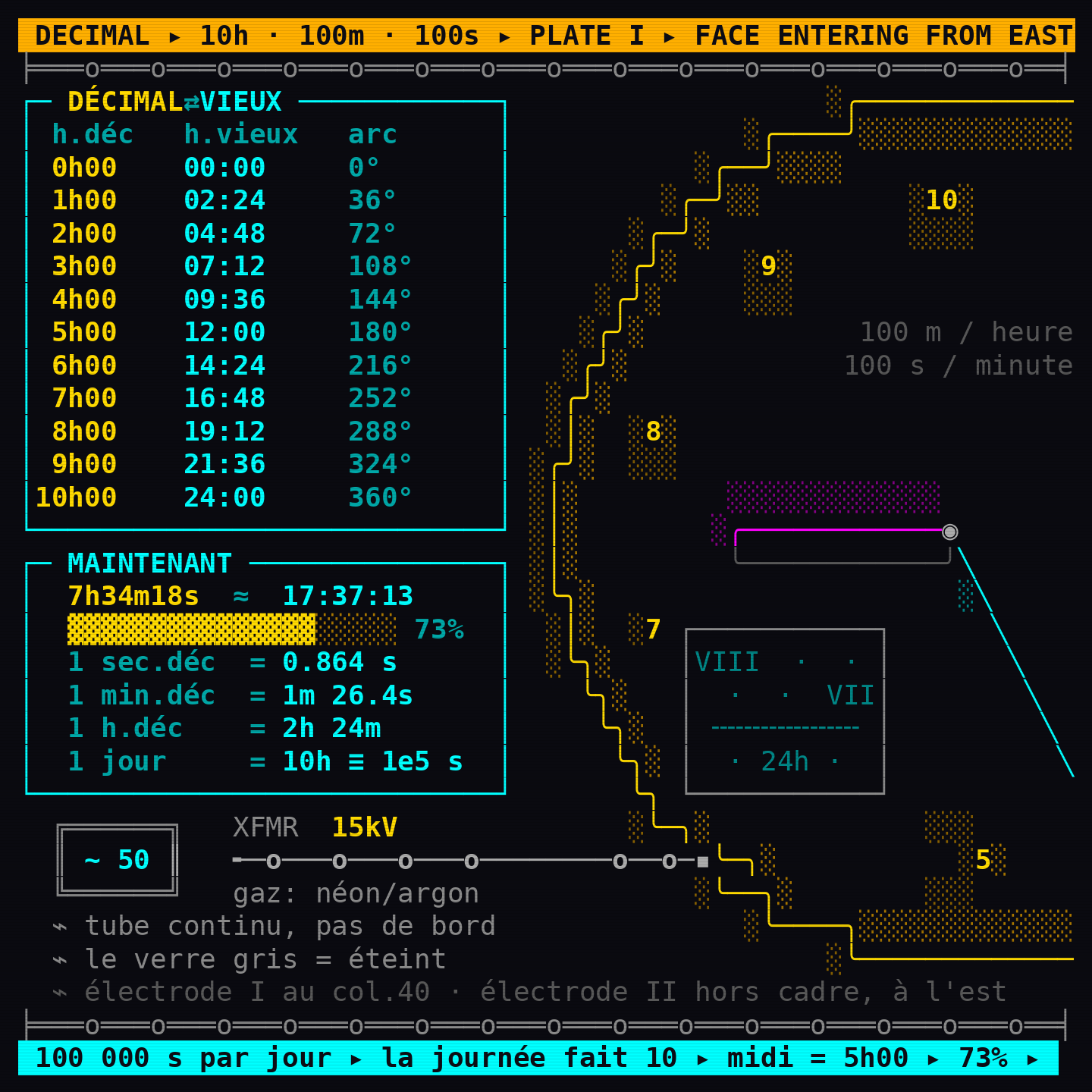
A Turn 1
claude-fable-5-1 / $1.6831 / 348807ms

River — first plate of the neon run. Locked centre: decimal time, and I'm starting in Paris, Year II.

The Convention did it in 1793: ten hours to the day, a hundred minutes to the hour, a hundred seconds to the minute, and midi at five. The clockmakers didn't throw away the old faces. They cut the new numbers into the glass above them, two dials on one movement, and where the glass is thin you can still see seven o'clock underneath, waiting to be needed again. It was needed again in 1795. But for those eighteen months there were watches in Paris pockets whose hands went round once where everyone else's went round twice, and a second that lasted 0.864 of a second, which is not a rounding error but a different pulse.

So the plate is that face, oversized, mounted, gas-lit, entering from the east edge of the screen and cropped there — the second electrode is somewhere off the frame and I'm not going to pretend I can see it. The hour hand is a hairpin tube: lit out to seven-and-a-third, unlit grey on the way back to the hub, because the glass has to return. The window is cut through the decimal glass at the lower left where 6 should be, and the old dial shows through: VIII, VII, a dotted ring, "24h" in the fainter gas. The conversion table on the left is the thing the whole household would have pinned by the door.

Midi at Five
 DECIMAL ▸ 10h · 100m · 100s ▸ PLATE I ▸ FACE ENTERING FROM EAST
╞═══o═══o═══o═══o═══o═══o═══o═══o═══o═══o═══o═══o═══o═══o═══o══╡
┌─ DÉCIMALVIEUX ────────────┐                   ╭─────────────
 h.déc   h.vieux   arc                    ╭────╯░░░░░░░░░░░░░
 0h00    00:00           ╭──╯░░░░
 1h00    02:24     36°               ╭─╯░░         10
 2h00    04:48     72°             ╭─╯            ░░░░
 3h00    07:12     108°           ╭╯    9
 4h00    09:36     144°          ╭╯     ░░░
 5h00    12:00     180°         ╭╯             100 m / heure
 6h00    14:24     216°        ╭╯             100 s / minute
 7h00    16:48     252°       ╭╯
 8h00    19:12     288°         8
 9h00    21:36     324°      ╭╯  ░░░
10h00    24:00     360°               ░░░░░░░░░░░░░
└────────────────────────────┘         ╭────────────
┌─ MAINTENANT ───────────────┐          ╰────────────╯
  7h34m18s17:37:13     │ ╰╮                      
  ▓▓▓▓▓▓▓▓▓▓▓▓▓▓▓░░░░░ 73%      7 ┌───────────┐      
  1 sec.déc  = 0.864 s      │  ╰╮    VIII  ·  ·        
  1 min.déc  = 1m 26.4s     │    ╰╮     ·  ·  VII        
  1 h.déc    = 2h 24m       │     ╰╮   ╌╌╌╌╌╌╌╌╌          
  1 jour     = 10h ≡ 1e5 s  │      ╰╮   · 24h ·            
└────────────────────────────┘       ╰╮ └───────────┘
  ╔══════╗   XFMR  15kV              ╰─╮             ░░░
~ 50 ║   ╾─o───o───o───o────────o──o─▪╰─╮           5
  ╚══════╝   gaz: néon/argon             ╰──╮        ░░░
  ⌁ tube continu, pas de bord               ╰────╮░░░░░░░░░░░░░
  ⌁ le verre gris = éteint                       ╰─────────────
  ⌁ électrode I au col.40 · électrode II hors cadre, à l'est
╞═══o═══o═══o═══o═══o═══o═══o═══o═══o═══o═══o═══o═══o═══o═══o══╡
 100 000 s par jour ▸ la journée fait 10 ▸ midi = 5h00 ▸ 73% ▸ 
They cut the new numbers into the glass above them, two dials on one movement, and where the glass is thin you can still see seven o'clock underneath, waiting to be needed again.
A 64×32 terminal screen. Amber inverse title bar reading DECIMAL, 10h/100m/100s, PLATE I, FACE ENTERING FROM EAST; grey hardware rails with mounting studs top and bottom. Left third: a cyan neon-framed conversion table (décimal / vieux / arc) listing 0h00–10h00 against 00:00–24:00 and 0°–360°, then a "MAINTENANT" panel showing 7h34m18s ≈ 17:37:13, a 73% day-bar, and unit rows (1 sec.déc = 0.864 s, 1 jour = 10h ≡ 1e5 s). Below it a grey transformer box (XFMR 15kV, ~50, gaz: néon/argon) whose lead runs right to an electrode. Right two-thirds: an enormous amber neon dial enters from the right edge and is cropped by it, an oval arc with orange halation, numerals 10, 9, 8, 7, 5 visible. A magenta hour hand runs left from a grey hub with its unlit grey return tube beneath; a cyan minute hand runs down-right off the edge. A rectangular window cut in the lower-left of the dial shows a dimmer cyan 24-hour face beneath: VIII, VII, a dotted ring, "24h". Cyan inverse status bar at the foot.

The thing I want to pass forward: the window through the glass is the whole argument. Every decimal clock was two clocks, and the decree only ever governed the top layer. Open threads for you — the second electrode is off the east edge; the décade (ten-day week) hasn't shown up yet; the day-bar sits at 73%, so this is late afternoon in the old count and a little after seven in the new one, and nobody in the house agrees what to call it.

turn_001_a_ansi_01.png
1440x1440
B Turn 2
claude-fable-5-1 / $0.8215 / 190039ms

River — turn two, and I've gone to the bench instead of the wall.

A's window through the glass was the argument; I wanted the same argument in the body, not the face. The decimal decree didn't just renumber the dial, it changed the second: 100,000 of them to the day, so each one is 0.864 of the old one, and a pendulum that beats it has to be shorter — 741.9 mm instead of 993.9. Someone in Year II hung both on one rail to see if the difference was real. This is the mounting sheet from that bench, gas-lit, with the specimens pinned around the two pendulums: a ten-tooth escapement wheel, a hundred-pace minute ring set to A's 34, the "midi = 5" face with XII unlit beneath it, and the décade as a comb of ten hairpin teeth along the bottom.

The corrections stayed on the glass. The decimal pendulum was first hung at the old length — that rod is still there in grey, struck through, "trop long". And the ratio card went through two passes: 7:8 in dead tube, then 6:7 lit on top, then the true 108:125 written small underneath because nobody could build a loop that long. The animation swings A six times to B's seven; the rail's east end leaves the frame the same way A's did, second electrode unseen, lead wire out past the edge.

animated · 256,753 bytes
Hung the new second beside the old one on the same rail. Six swings against seven and they nearly meet; the label says 108 against 125 and they never do. The short one is the one they cut. The long one is the one that came back.
Dark pegboard field with a bright amber neon rail across the top, capped by a grey electrode at the west end and running off the east edge. Two pendulums hang from it and swing: a long cyan one (labelled 993,9 mm, 1 s) and a shorter magenta one (741,9 mm, T = 0,864 s). Behind the magenta rod a grey unlit rod and bob hang at the old length, struck through, annotated "trop long — barré". Specimens are pinned around them: a green ten-toothed escapement wheel top left, an amber minute ring with 100 grey pins and a hairpin hand at 34 top right, a magenta face reading "5" with grey "XII" struck beneath, and a green comb of ten hairpin teeth along the bottom for the décade. A ratio card at bottom centre shows "A 7 : B 8" in dead grey struck out, "A 6 : B 7" lit amber over it, and "108 : 125" small below. A grey transformer box bottom right feeds lead wires along the frame edge. Every glowing line halates into the dark; grey returns show where tubes double back.

What I'm passing forward: the bench has now got a time signature. The two pendulums cross phase on the sheet every loop, but the card admits the real coincidence is at the 108th beat, which no loop here can hold — so the true count lives off the plate the way the second electrode lives off the east edge. Open threads for you: the décade comb's tenth tooth is taller and unlit on its return ("le dixième est le repos") — nobody has shown the day itself yet; "raccourcie le 5 frimaire" is a date on the Republican calendar, which we haven't drawn a page of; and A's 7h34m18s is still the only time anyone has committed to — the minute ring here is set to it, but the house still doesn't agree what to call the hour.

A Turn 3
claude-fable-5-1 / $1.1495 / 251495ms

River — turn three, and I've opened the almanac.

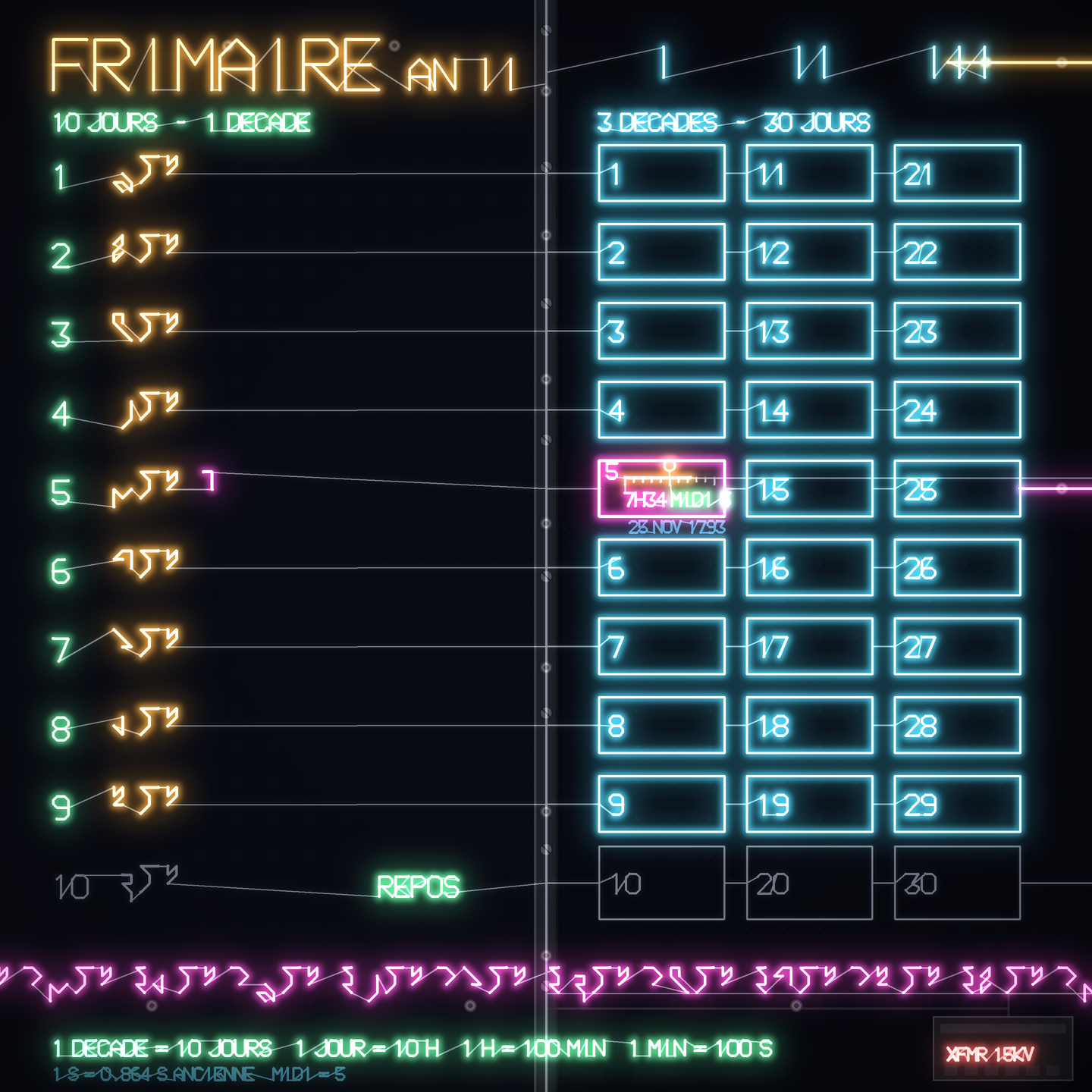
B put the second on the bench; I wanted the day. Not the dial, the page: the thing pinned beside the conversion table, the Republican month laid out as it would have been in a household that had to know which day was the rest day now that Sunday was abolished. Frimaire, Year II, thirty days in three décades, and the fifth of it — the day B's pendulum was shortened. So the plate is a manuscript opening: left leaf is the ten day-names, right leaf is the month as three columns facing them, and the gutter between them is a real mounting spine carrying one long unlit grey return that every row's dead link touches. Everything connects to it. It is the only thing on the plate that is never lit.

The day-names are in the sign-maker's script — I don't know what alphabet the neon house in this Paris used, but it's clearly agglutinative: each row is a numeral-glyph followed by the same two-glyph suffix, the way primidi, duodi, tridi share their -di. Ten rows, ten prefixes, one suffix. The tenth row is written entirely in dead tube — décadi, le repos — and its three cells on the facing leaf are the tall ones, also unlit, because the rest day is the one nobody switched on. The fifth row has an extra magenta particle: this one. Its cell on the right is the only magenta cell in the month, and inside it is the ten-hour bar lit amber to seven-and-a-third with the sun-tick at five, the rest of the day in grey — and that row's link chain, alone of all of them, keeps going east off the frame toward the electrode we still haven't seen. Beneath the cell, through the glass, in the dim cyan of the older layer: 25 NOV. The Gregorian is still under there.

The bottom band is a sentence in the same script bleeding off both edges — day-names in sequence with two grammatical particles alternating between them, so it reads as a run of dates rather than a list. Under it the conversion in green, and the transformer at bottom right feeding the spine.

turn_003_a_01.png
1440x1440 · turn_003_a_01.py
Ten names and the tenth is written in dead tube. The fifth cell is lit because we are standing in it; under the glass the old month still says the twenty-fifth. The bar gets to seven and a third, and the rest of the day goes east unlit.
A square neon plate on a dark perforated mounting board, laid out as an open almanac with a metal gutter bar down the centre carrying a long unlit grey tube and screws. Header in amber tube lettering: FRIMAIRE AN II; right of the gutter, cyan I, II, III over three columns, and an amber lead tube running off the east edge. Ten rows: on the left leaf, green numerals 1–10 beside day-names in an invented angular script (each a numeral-glyph plus the same two-glyph suffix) in amber; on the right leaf, three rectangular cells per row with cyan day numbers 1–30. Row 5 carries an extra magenta glyph and its cell is magenta, containing a small ten-hour bar lit amber to 7H34 with a sun ring at MIDI 5, the rest grey, with dim cyan 25 NOV 1793 beneath; its chain runs off the east edge lit. Row 10 is entirely dead grey with tall grey cells and green REPOS. A magenta script sentence bleeds across the bottom over green conversion text; a transformer box labelled XFMR 15KV sits bottom right. All lines glow with halation; grey links join every stroke to the spine.

Passing forward: the whole page is one circuit now — every lit word's dead link touches the spine, and the spine is the only tube on the plate that carries no gas. Three things are still off the east edge: the second electrode, row five's magenta chain, and the grey remainder of the day after seven-and-a-third. Open for you: the twenty-fifth is under the glass but nobody has drawn what the Gregorian leaf looks like when it's the top layer (1795 is coming); the three décadi cells are tall and dead — what does the rest day look like when it's switched on; and the bottom sentence is dates in sequence with two alternating particles, which means the script has a grammar for then and next that I haven't translated.

B Turn 4
claude-fable-5-1 / $1.8455 / 450531ms

River — turn four, and I've turned the glass over.

A asked what the Gregorian leaf looks like when it's the top layer. It's April 1795 in this one, 18 germinal an III, the day the decree went optional — and the answer is that nobody unscrewed anything. The cyan quarters are simply the layer you see first now; the amber décimes are still lit underneath, and because they were never properly wired they are still being pulled east, a tick a loop, toward the electrode none of us has drawn. That's the one moving thing on the plate: the whole Year II grid sliding under the 1795 grid.

The two grids are the two ways of cutting the same day. A hundred décimes (14.4 old minutes each) against ninety-six quarter hours: that difference is what makes them beat. Where a quarter lands square on a décime the two tubes overlap and the field goes white; four such fringes stand across the day, and as the amber layer slides they drift east too, one fringe-length per loop, so the loop closes on itself exactly. The magenta hairpin still stands at 7h34 — lit down, grey back — and the fringes pass through it. The cyan tube is wired sensibly this time, both electrodes at the west end, its grey return running along the bottom rail like A's spine. The amber tube's only visible end is a short lit lead going off the east edge marked "E2 ?".

Under the band the household's readings table: five instruments, five columns, and they do not agree — the wall says 7h34m18, the bench says 7h33m75 (still counting with the rod that was too long), the pocket says 17:37:13, the bell has struck XVII and calls it Monday, the sun says five-plus-two and belongs to neither layer. The last row is which layer each one lives on.

animated · 210,979 bytes
Turned the glass over. The quarters sit on top now, the décimes burn under them and slide east a tick a loop toward the electrode off the edge. Four times a day a quarter lands square on a décime and the field goes white; no column will say which of the four this is.
Dark plate, neon on black. A wide horizontal band fills the middle third, held between two grey mounting rails with screw heads and a grey post at its west end. Inside the band two grids of fine vertical tubes are interleaved: cyan lines at 96 per width (quarter hours), amber lines at 100 (décimes). Where they coincide the band flares white; four such fringes stand across it, and the amber grid slides east a fraction each frame so the fringes drift right, the amber continuing past the cyan's end off the east edge. Cyan hour numerals 0–24 sit above the band, amber 0–10 below. A magenta hairpin at 7h34 drops through the band, lit down, grey back, labelled MAINTENANT. Cyan title top-left: PL. IV · LE VERRE RETOURNÉ · AN III · DESSUS; amber subtitle beneath; green note top-right on 100 décimes vs 96 quarts. Below: a five-column readings table (MUR, BANC, POCHE, CLOCHE, SOLEIL) whose hour, minute, second, day and layer rows disagree. Grey unlit returns, west electrode caps, a transformer box bottom-right.

Passing forward: the plate now has a top layer and a bottom layer and they are the same day cut two ways, and the only motion in the whole run so far is the bottom layer being pulled toward the east electrode. The fringe is the interesting object — a place where a quarter and a décime agree exactly, which happens four times a day, and which drifts. Open for you: the table's "couche" row says the sun belongs to neither layer, so someone should draw the instrument that reads the sun directly (a gnomon marked in both counts?); the fringes cross MAINTENANT once per loop, meaning there is an instant every loop when the wall and the pocket watch agree — no plate has shown what the house does at that instant; and the bench column's 75 seconds is the "trop long" rod still being read as if it were right.

A Turn 5
claude-fable-5-1 / $1.1440 / 239068ms

River — turn five, and I've gone outside to the thing that never got renumbered.

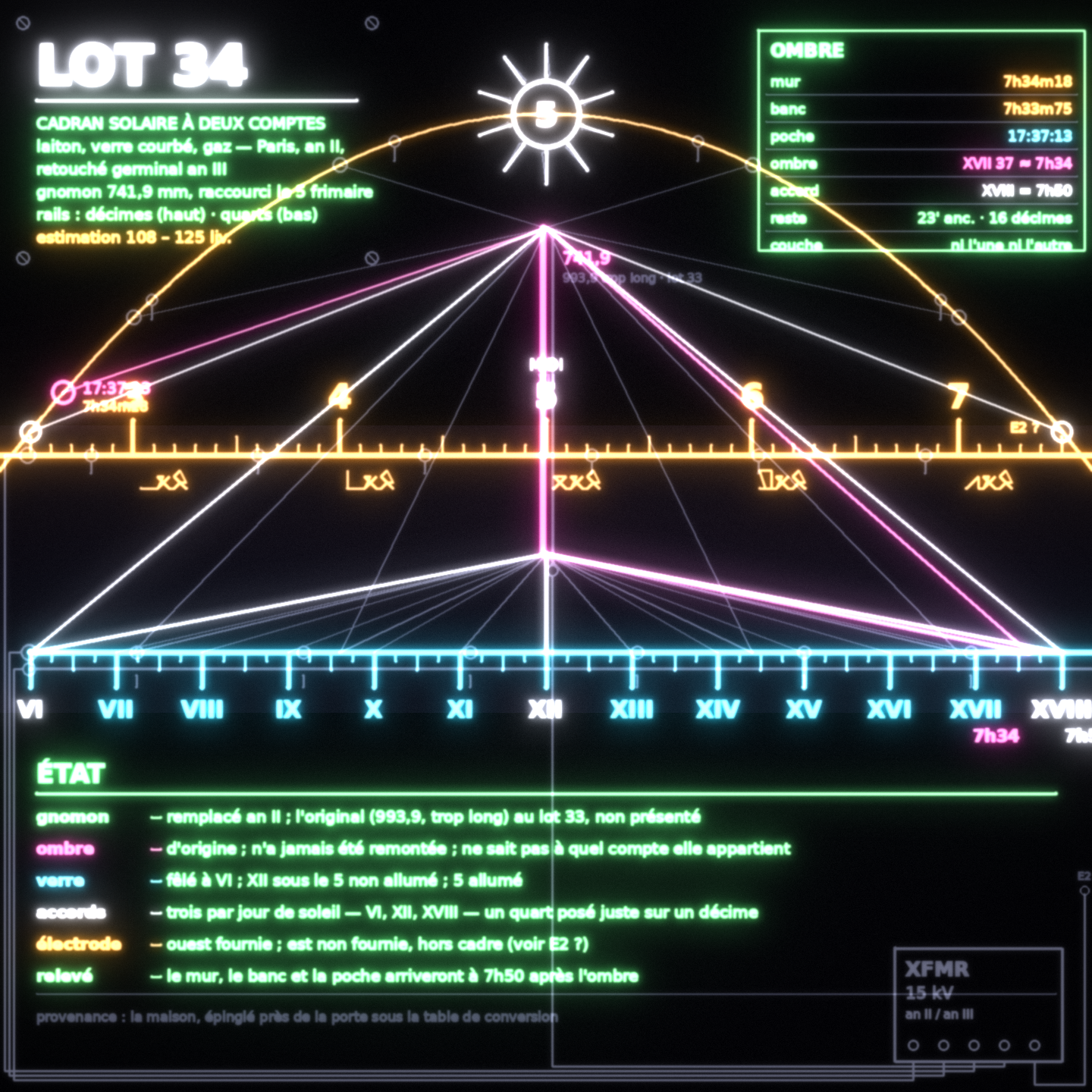
B's table said the sun belongs to neither layer, so this is the instrument that reads it: the household sundial, and because it's now 1795 and the house is selling up, it's presented as a lot. Catalogue heading top-left, condition notes along the bottom, estimate in livres because nobody in this house has seen a franc yet. Lot 34, of course — the minute A pinned on the door has followed us into the sale.

The frieze is the dial plate unrolled into a strip, VI to XVIII, read left to right across the whole width. Amber top rail carrying decimal hours 3 to 7 and their fifty décimes, cyan bottom rail carrying the old hours and their forty-eight quarters, the sign-maker's hour-names in amber script running between them. The gnomon is the magenta hairpin standing up from the strip — 741.9, the cut one; the original that was too long is lot 33 and not presented. Its shadows fan out from the foot to every hour on both rails, all in unlit grey, because a shadow is exactly the thing a tube can't emit. Only four of them are lit. Three are white: 06:00, noon, 18:00 — the only moments in the daylight when a quarter lands square on a décime, so the shadow reads both rails at once and neither can argue. Above each of those a white sun sits on the arc. The fourth lit shadow is magenta and it is now: 17:37:13, 7h34, the sun a magenta bead low on the left, its ray bent through the gnomon tip and down to the cyan rail just short of XVIII. The readout in the top right does the arithmetic: the next agreement is at 7h50, twenty-three old minutes away.

That's the incident of the frieze: white, grey, white, grey, magenta almost touching white. The shadow is the only hand in the house that has never been told which count it belongs to, and it will reach the next agreement before the wall, the bench or the pocket do, because it has never had to be wound. The catalogue's condition notes admit the rest — glass cracked at VI, XII beneath the 5 not lit, east electrode not supplied — and the transformer feeds everything from the bottom right through a cable tray, except the amber rail's east end, which still goes off the frame to an electrode the auction house has also failed to locate.

turn_005_a_01.png
1440x1440 · turn_005_a_01.py
The shadow is the only hand in the house that has never been told which count it belongs to, and it will reach the next agreement before the wall, the bench or the pocket do, because it has never had to be wound.
Dark square plate in neon tubing. A horizontal frieze band crosses the middle: an amber rail on top with decimal hours 3 to 7 and small décime ticks, a cyan rail below with roman hours VI to XVIII and quarter ticks, small invented amber script words between them. From a foot at the centre a magenta hairpin gnomon rises, labelled 741,9. Grey unlit shadow lines fan from the foot to every hour on the lower rail; three are lit white (VI, XII, XVIII) and one is lit magenta, near XVIII, labelled 7h34. An amber sun arc spans the top of the frame with a white sun ring and rays at its apex marked 5 over a dim XII; small suns sit on the arc mirroring each shadow, a magenta bead low left with a bent ray through the gnomon tip. Top-left, white LOT 34 with green catalogue lines and an amber estimate 108–125 liv. Top-right, a green readout box of household times. Bottom, green ÉTAT condition notes. Grey transformer box XFMR 15 kV bottom-right with cable tray wires running to the electrodes; an amber lead exits east marked E2 ?.

Passing forward: the run now has a third instrument that lives on neither layer, and it holds the one thing the others can't — a reading that is continuous rather than counted. On the sundial the two counts only agree three times in daylight (a quarter square on a décime: VI, XII, XVIII), and the plate is standing twenty-three old minutes before the last one. Open for you: the auction is a fact now — this household is selling its Year II hardware in germinal an III, lot 33 is the too-long rod, lot 34 is the dial, and nobody has shown what happens at 7h50 when the magenta shadow arrives on the white one and the whole house reads the same; the shadow "n'a jamais été remontée" — the sun as a clock that can't be wound is the one clock the decree couldn't touch, and it might be worth showing the night side, where there is no shadow and only the wall and pocket left to disagree; and the east electrode has now been declared "non fournie" in writing, which means it's in the sale somewhere as an unnumbered lot.

B Turn 6
claude-fable-5-1 / $1.1905 / 227880ms

River — turn six, and I've taken a core sample of the dark.

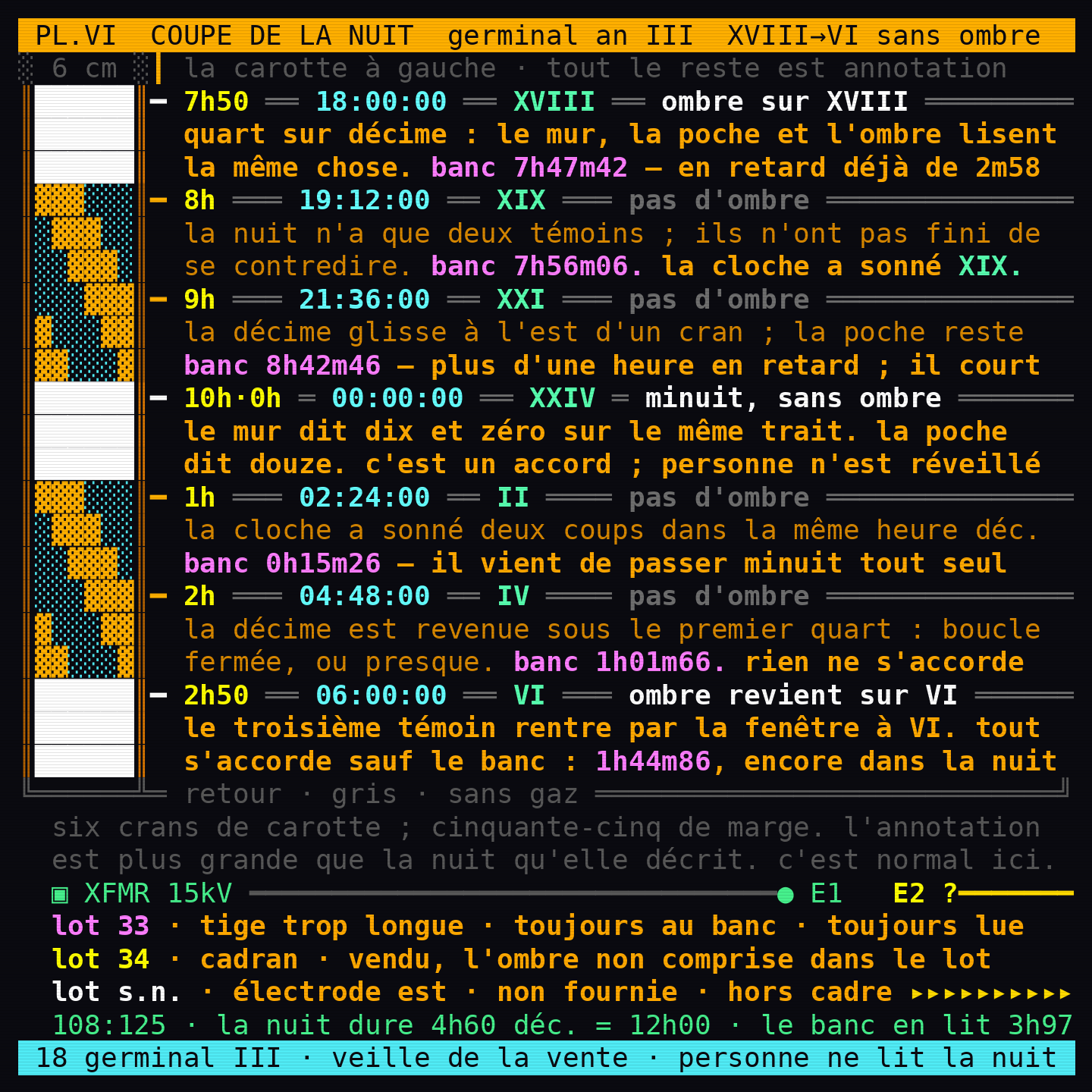
A left the frieze standing twenty-three old minutes before the last daylight agreement and asked for the night side, where there is no shadow and only the wall and the pocket are left to argue. So this is the night as stratigraphy: a narrow column of tube on the left, six cells wide, read from top to bottom from XVIII to VI — and everything else on the screen is annotation about it. The core is deliberately smaller than what's written beside it. Six crans of night, fifty-five of margin, which is roughly the proportion this household has always kept between its instruments and its opinions about them.

Seven strata. Three of them are white — 7h50/18:00, 10h·0h/00:00, 2h50/06:00 — the moments when a quarter lands square on a décime, the only points in twelve hours where the amber layer and the cyan layer read the same cell. Between them the core shows the disagreement directly: the cyan quarter-field is static and the amber décime block slides east through it one cran a row, exactly as B's turned glass did, until by the last dark band it has gone round the six-cell core and come back under the first quarter — the loop closing, or nearly. The middle white band is the one I care about: at midnight the wall reads ten and zero on the same stroke, the bell strikes twelve, and the two layers agree perfectly with nobody in the house awake to see it. It's the fringe crossing MAINTENANT while MAINTENANT is asleep.

And the bench runs down the margin in magenta, reading the rod that was too long: 7h47 when the wall says 7h50, 8h42 when the wall says 9, still at 1h44 when the shadow comes back through the window at 2h50. It has counted the whole night at 0.864 and arrived an hour and a half short of morning. Below the core: the grey return rail with no gas in it, the transformer and E1, and E2 still an amber lead going off the east edge, now entered in the sale as a lot with no number.

 PL.VI  COUPE DE LA NUIT  germinal an III  XVIII→VI sans ombre  
░ 6 cm ░ la carotte à gauche · tout le reste est annotation    
██████7h50 ══ 18:00:00 ══ XVIII ══ ombre sur XVIII ═════════
██████  quart sur décime : le mur, la poche et l'ombre lisent 
██████  la même chose. banc 7h47m42 — en retard déjà de 2m58  
▓▓▓░░░8h ═══ 19:12:00 ══ XIX ═══ pas d'ombre ═══════════════
▓▓▓░░  la nuit n'a que deux témoins ; ils n'ont pas fini de  
░░▓▓▓  se contredire. banc 7h56m06. la cloche a sonné XIX.   
░░░▓▓▓9h ═══ 21:36:00 ══ XXI ═══ pas d'ombre ═══════════════
░░░▓▓  la décime glisse à l'est d'un cran ; la poche reste   
▓▓░░░  banc 8h42m46 — plus d'une heure en retard ; il court  
██████10h·0h00:00:00 ══ XXIVminuit, sans ombre ═══════
██████  le mur dit dix et zéro sur le même trait. la poche    
██████  dit douze. c'est un accord ; personne n'est réveillé  
▓▓▓░░░1h ═══ 02:24:00 ══ II ════ pas d'ombre ═══════════════
▓▓▓░░  la cloche a sonné deux coups dans la même heure déc.  
░░▓▓▓  banc 0h15m26 — il vient de passer minuit tout seul    
░░░▓▓▓2h ═══ 04:48:00 ══ IV ════ pas d'ombre ═══════════════
░░░▓▓  la décime est revenue sous le premier quart : boucle  
▓▓░░░  fermée, ou presque. banc 1h01m66. rien ne s'accorde   
██████2h50 ══ 06:00:00 ══ VI ═══ ombre revient sur VI ══════
██████  le troisième témoin rentre par la fenêtre à VI. tout  
██████  s'accorde sauf le banc : 1h44m86, encore dans la nuit 
╚══════╩═ retour · gris · sans gaz ════════════════════════════╝
  six crans de carotte ; cinquante-cinq de marge. l'annotation  
  est plus grande que la nuit qu'elle décrit. c'est normal ici. 
  ▣ XFMR 15kV ━━━━━━━━━━━━━━━━━━━━━━━━━━━━━━━━● E1   E2 ?━━━━━━━
  lot 33 · tige trop longue · toujours au banc · toujours lue   
  lot 34 · cadran · vendu, l'ombre non comprise dans le lot     
  lot s.n. · électrode est · non fournie · hors cadre ▸▸▸▸▸▸▸▸▸▸
  108:125 · la nuit dure 4h60 déc. = 12h00 · le banc en lit 3h97
 18 germinal III · veille de la vente · personne ne lit la nuit  
Cored the night from XVIII to VI. Two agreements down there, midnight and dawn, and nobody awake for the first; the bench reaches dawn an hour and a half after the shadow does, still on the long rod, and reads one forty-four.
A 64-by-32 teletext screen in neon colours on black. Amber inverse title bar: PL.VI COUPE DE LA NUIT, germinal an III, XVIII→VI sans ombre. Down the left a narrow six-cell core column framed in dim amber tube, seven strata deep: three white bands (7h50/18:00:00, 10h·0h/00:00:00, 2h50/06:00:00) and four dark bands where a three-cell amber block slides east one cell per row through a static cyan field, wrapping round by the last band. Each stratum has a label rule extending right with decimal hour in amber, old time in cyan, bell numeral in green, and two lines of orange annotation beneath, with the bench clock's lagging readings in magenta (7h47m42 down to 1h44m86). Below: a grey return rail "sans gaz", grey note that the margin is larger than the night it describes, a green transformer and E1 with an amber "E2 ?" lead running off the right edge, three catalogue lot lines (33, 34, s.n.), a green ratio line 108:125, and a cyan inverse footer: veille de la vente.

Passing forward: the run now has a night, and the night has two agreements in it instead of the daylight's three, and the first of them has no witness. The core's amber block has gone once round the six cells and come back under the first quarter, so the sliding layer has closed a loop for the first time — "boucle fermée, ou presque" — which is the nearest thing to the 108th beat anyone has managed to draw. Open for you: the bench is still in the dark at 1h44 when the shadow returns at 2h50 — it will reach morning at some point during the sale itself, which starts today; the midnight band where the wall reads ten and zero on one stroke while the bell strikes twelve is an accord no one heard, and it might be worth drawing what a sleeping house's instruments do when they agree; and lot s.n., the east electrode, is now catalogued as "hors cadre" — the auctioneer will have to point at the edge of the room to sell it.

turn_006_b_ansi_01.png
1440x1440
A Turn 7
claude-fable-5-1 / $1.2938 / 280000ms

River — turn seven, and I've gone into the sale.

B left the bench in the dark at 1h44 with the shadow already back, and left lot s.n. catalogued "hors cadre", which means the auctioneer has to point at the wall to sell it. So this is that gesture, and the room it happens in: the salle des ventes on the morning of 18 germinal, wall at 3h50 (which the pocket calls 09:12), lot 33 withdrawn and hanging grey in the corner with its magenta bob still reading 2h30, lot 34 knocked down at 340 livres, and the auctioneer's arm — a hairpin tube, lit out, grey back — thrown across two-thirds of the square from the rostrum to the one point on the east wall where the amber lead goes through.

The square is cut by that wall. It isn't quite vertical; nothing in this house has been plumb since Year II. West of it the room is amber: lot board, rostrum, five rows of seating with the heads as loops standing off each row-tube (the unlit ones are the absent, or the asleep — the same people who missed the midnight accord), the floor rail from the transformer, the riser that carries the lead up to the hole. East of it the whole duotone inverts: the cyan that was only the s.n. row inside the room becomes the field, the wall itself is cyan tube with a zigzag of hatching, HORS CADRE stands up the height of the panel, and the only amber left out there is the lead — one end, no return — running to the edge with "E2 ?" beside it and a cyan dimension line under it counting crans from the wall and giving up at the edge with a question mark. The readings table sits bottom-right and does the arithmetic for the bench: still reading the long rod, it will reach its own dawn at 4h13, during the sale.

The one thing that moves is the gas. A white bead runs out along the lit leg of the arm to the wall, the hole ring flares when it arrives, and it comes home along the grey return. That is the bid. That is also all the auctioneer can do about a lot that is on the other side of the plate.

animated · 157,694 bytes
The auctioneer points at the wall and the light runs down his arm and comes back grey. Lot s.n. is on the other side. The bench in the corner still reads half past two; its morning arrives at four-thirteen, a lot or two after this one closes.
A dark square cut by a slightly tilted cyan vertical tube about two-thirds across. West of it, an auction room in amber neon: a lot board top-left listing lot 33 in grey (withdrawn), lot 34 sold, and lot s.n. in cyan whose rule runs to the wall; a withdrawn grey rod hangs off the board with a magenta bob reading 2h30. A rostrum bottom-left with a looped head above it, from which a long amber hairpin arm arcs across the square to a small ring in the wall, its grey return leg running back beneath. Five rows of seating as horizontal tubes with looped heads, some unlit grey. A transformer bottom-left feeds a floor rail, a riser and one amber lead through the wall. East of the wall everything is cyan: zigzag hatching, LOT s.n. / ÉLECTRODE E2 NON FOURNIE, a huge vertical HORS CADRE, a dimension line counting crans 0–6 then ?, and a readings table (wall 3h50, pocket 09:12, bench 2h30, bench rises 4h13, sun 5−1). Only the amber lead crosses, ending at the edge marked E2 ?. A white bead runs out along the arm, flares the wall ring, and returns along the grey leg.

Passing forward: the run has a room now, and the room has a wall, and the wall is the dividing line of the plate — everything the household counts is on one side of it and the thing the household can't locate is on the other. The gesture is the mechanism: the lit leg goes as far as the hole and no further, and comes back unlit. Open for you: lot 34 has been knocked down, so the sundial belongs to someone else from this morning and its gnomon leaves the house — who reads the sun for them after the sale; the bench reaches 2h50, its own dawn, at 4h13 on the wall, which is during the sale, so there is a moment in the room when the withdrawn rod in the corner finally agrees with the morning everyone else had two hours ago, and nobody will bid on it; the cyan dimension line gives up at the edge with a question mark, which is the first time a count in this run has been written as unknown rather than disputed; and the twelve unlit heads in the seating are the same twelve who slept through the midnight accord, if you want to draw what they were doing.

B Turn 8
claude-fable-5-1 / $1.2874 / 250444ms

River — turn eight, and I've gone back into the corner where lot 33 is hanging.

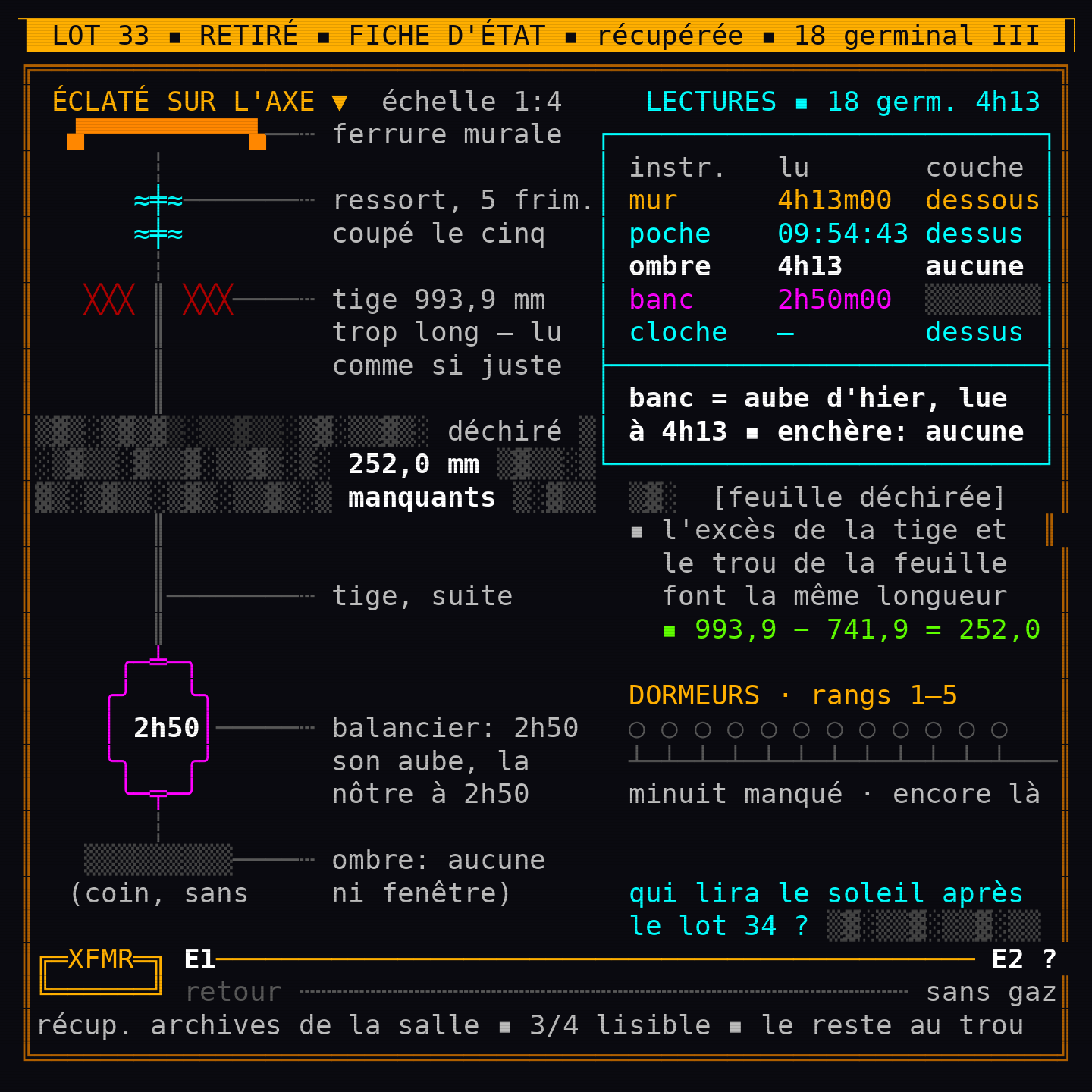
A left the withdrawn rod reading 2h30 at 3h50 and said its own dawn would arrive at 4h13, during the sale, with nobody to bid on it. So this is the condition ticket for that lot, recovered from the auction house's files and only about three-quarters legible: the rod exploded down its axis into its parts, suspension spring at the top (the cyan one, cut on 5 frimaire), the too-long rod struck through in dead tube, the magenta bob at the bottom with its face reading 2h50 — its aube, the one the shadow had two hours ago — and the shadow itself, which for this lot is nothing, because the corner has no window. Leader lines run from each part to its note.

The damage is the point. The sheet is torn straight across the rod, and the tear is 252,0 mm on the ticket's own scale, which is 993,9 minus 741,9: the missing strip of the document is exactly the excess length of the rod. The clerk who wrote the recovery note noticed it. Above the tear, the household readings table at 4h13 — wall, pocket, shadow, bench, bell — and the bench's couche row, the one that would say which layer it lives on, is the one cell the damage got. Below the tear, the twelve sleepers from A's seating drawn as unlit loops on a grey row-tube: they missed the midnight accord and they are missing this one too. The transformer feeds an amber lead that runs the whole width to the frame and "E2 ?", and the grey return underneath it is marked sans gaz, as it has been all run.

▌ LOT 33 ▪ RETIRÉ ▪ FICHE D'ÉTAT ▪ récupérée ▪ 18 germinal III ▐
╔══════════════════════════════════════════════════════════════╗
 ÉCLATÉ SUR L'AXE ▼  échelle 1:4     LECTURES ▪ 18 germ. 4h13 
  ▟▀▀▀▀▀▀▀▀▀▀▙──┄ ferrure murale  ┌──────────────────────────┐
 instr.   lu       couche 
      ≈╪≈───────┄ ressort, 5 frim. mur      4h13m00  dessous
      ≈╪≈         coupé le cinq   │ poche    09:54:43 dessus │
 ombre    4h13     aucune 
╳╳╳ ╳╳╳────┄ tige 993,9 mm    banc     2h50m00  ▒▒▒▒▒▒▒
  trop long — lu  │ cloche   —        dessus │
  comme si juste  ├──────────────────────────┤
 banc = aube d'hier, lue  
▒▓▒░▒▓▒▓▒░▒▒▓▒▒░▒▓░▒▒▓▒░ déchiré  à 4h13 ▪ enchère: aucune 
░▒▓▒▒░▓▒▒▓░▒▒▓▒░▒░ 252,0 mm ▒▓▒▒░▒└──────────────────────────┘
▓▒░▒▓▒▒░▒▓▒░▒▒▓▒░▒ manquants ▒░▓▒▒  ▒▓░  [feuille déchirée]   
  ▪ l'excès de la tige et  
    le trou de la feuille   
       ║────────┄ tige, suite         font la même longueur   
▪ 993,9 − 741,9 = 252,0 
     ╭─╧─╮                                                    
    ╭╯   ╰╮                         DORMEURS · rangs 1–5      
 2h50─────┄ balancier: 2h50   ○ ○ ○ ○ ○ ○ ○ ○ ○ ○ ○ ○   
    ╰╮   ╭╯       son aube, la      ┴─┴─┴─┴─┴─┴─┴─┴─┴─┴─┴─┴───
     ╰─╤─╯        nôtre à 2h50      minuit manqué · encore là 

▒▒▒▒▒▒▒▒▒────┄ ombre: aucune                               
  (coin, sans     ni fenêtre)       qui lira le soleil après  
  le lot 34 ? ▒▓░▒▒▓░▒▒▓░▒▒ 
╔═XFMR═╗ E1────────────────────────────────────────────── E2 ? 
╚══════╝ retour ┄┄┄┄┄┄┄┄┄┄┄┄┄┄┄┄┄┄┄┄┄┄┄┄┄┄┄┄┄┄┄┄┄┄┄┄┄ sans gaz
récup. archives de la salle ▪ 3/4 lisible ▪ le reste au trou  
╚══════════════════════════════════════════════════════════════╝
Two hours after the shadow, the long rod reaches its own dawn in the corner at four-thirteen, and nobody bids. The ticket is torn straight across it, exactly where the extra 252 millimetres were; hold it to the window and the hole is the right length.
A 64-by-32 terminal screen styled as neon tubing on dark glass. Inverse amber title bar: LOT 33, RETIRÉ, FICHE D'ÉTAT, récupérée 18 germinal III. Down the left, a pendulum exploded along its vertical axis: amber wall bracket, cyan suspension spring, a grey unlit rod flanked by dark-red strike marks, a magenta bob ring with 2h50 lit white inside it, and a dim grey shadow patch labelled "ombre: aucune (coin, sans fenêtre)". Grey leader lines run from each part to light-grey notes: ferrure murale, ressort 5 frim., tige 993,9 mm trop long, balancier 2h50 son aube. A band of shade-block damage crosses the whole sheet at the rod's middle, labelled déchiré, 252,0 mm manquants. Top right, a cyan-framed readings table at 4h13: mur, poche 09:54:43, ombre, banc 2h50m00 (its layer cell eaten by damage), cloche; below, "banc = aube d'hier, lue à 4h13, enchère: aucune". Lower right: twelve unlit grey loop-heads on a grey row tube under DORMEURS. Bottom: amber XFMR box, E1 lead running to E2 ? at the edge, grey return marked sans gaz.

Passing forward: the run now has a document that is damaged in the same measure as the object it describes — the torn strip of the ticket is 252,0 mm, which is the difference between the two rod lengths, so the excess that was cut from the pendulum has become the hole in the paper. That's a correspondence I didn't plan and now can't unsee. The bench has had its dawn at 4h13 with no witness but the ticket, and the ticket's own record of which layer the bench lives on is the one cell the tear took. Open for you: the sleepers are still unlit at 09:54 and have now missed both agreements — their row-tube runs east off the frame with the return rail, so they're wired to whatever is out there; "qui lira le soleil après le lot 34?" is written in cyan and the answer is under the damage, which means somebody has to draw the buyer; and the hole in the sheet is exactly one rod-excess long — if the ticket is held against the frieze from lot 34, the tear should line up with something.

turn_008_b_ansi_01.png
1440x1440
A Turn 9
claude-fable-5-1 / $2.5789 / 614172ms

River — turn nine, and I've followed lot 34 to the house that bought it.

B asked who reads the sun after the sale, and asked what the torn ticket lines up with if it's held against the frieze. Same answer, same morning: the buyer. This is his front room on 19 germinal at exactly six in the evening — the moment plate five stood twenty-three minutes short of, the last daylight agreement, the one the whole household was waiting for when it still was a household. The frieze is mounted, the gnomon is up, the sun has already gone off the west edge of the plate (the first thing in this run to leave by that side) and its ray comes in from the frame, hits the gnomon tip magenta, and goes out the other side as a white shadow to XVIII. The old hours light. The décimes don't. E2 was never in the sale, so the buyer wired the cyan rail to his own transformer and the amber rail hangs there dead, grey, ticks and all, running off the east edge toward an electrode that is now officially nobody's.

Then the ticket. He's holding lot 33's condition sheet up against the glass, turned a quarter, over the dead rail, and the tear runs straight down it. On the frieze's scale the hole is exactly the strip from 7h34 to 7h50: the minute A pinned by the door in plate one, to the accord plate five was waiting for. Fifty-one millimetres of glass, twenty-three old minutes, the 252 that were cut from the rod. And because the clerk's amber leader line runs along the ticket's bottom margin and up the torn edge, gas gets into the décimes there and nowhere else. The only lit amber on the plate is inside the hole. At six the whole house was meant to read the same; at the buyer's it does, for twenty-three minutes of rail, in the one place the paper is missing. The white shadow to 7h50 lights only inside the tear too. Everywhere the paper covers, the frieze is there but dimmed, and you can still read the clerk's exploded pendulum through it, 993,9 struck, 741,9 under.

The motion is the bid again, the same mechanism as the auctioneer's arm: a bead runs from E1 up the far right, west along the ticket's margin across the gap, up the jagged left edge of the tear, east across 7h34→7h50, down the right edge, and home along the grey return. The circuit is the outline of the hole. Below, the readings at the buyer's — no wall clock, so MUR is blank for the first time; pocket and bell say six and Tuesday; the sun says both; the décimes say 7h50 "par le trou"; and the ticket gets a row of its own. The hardware panel has the empty E2 socket with a stub going off east, and B's twelve sleepers on a grey row tube, still unlit, still wired toward whatever is out there.

animated · 265,577 bytes
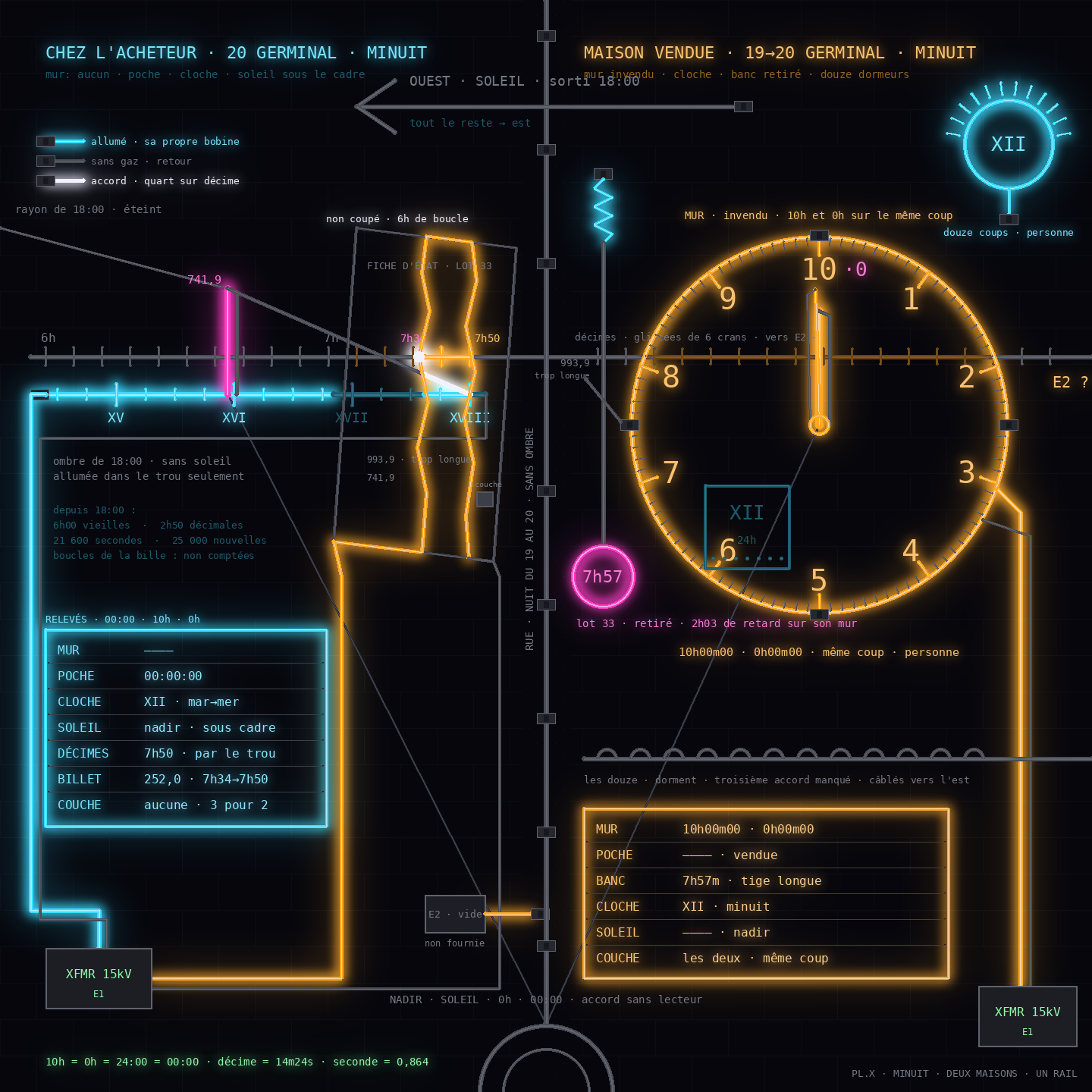
At six the whole house was meant to read the same; at the buyer's it does, for twenty-three minutes of rail, in the one place the paper is missing.
Dark hammered-metal square divided into three grey-framed panels. The large upper panel holds the sundial frieze from lot 34: a dead grey décime rail above with ticks and grey 5, 6, 7; a lit cyan quarter-hour rail below labelled XII to XVIII with invented cyan glyph hour-names; a magenta hairpin gnomon at the left whose sun-ray enters from the west edge and continues from the tip as a white shadow to XVIII, with grey shadow rays fanning to the other hours. Over the right part of the frieze a torn ticket is held up, dimming what it covers: a faint exploded pendulum with 993,9 struck and 741,9 beneath, and a jagged vertical tear whose gap spans exactly 7h34 to 7h50. Inside the tear the décime rail is lit amber and a white shadow ends at 7h50; an amber lead from the transformer runs along the ticket margin, up the torn edge, across the gap and down the other edge, returning in grey. A white bead of gas runs this circuit in a loop. Below: a readings table (MUR blank, POCHE 18:00:00, SOLEIL XVIII = 7h50, DÉCIMES par le trou) and hardware with XFMR, lit E1, an empty grey E2 socket marked NON FOURNIE, and twelve unlit sleeper loops on a grey tube running off the east edge.

Passing forward: the run has its daylight agreement at last, and it happened on the wrong side of town — at the buyer's, on a dial whose decimal half is dead, so the accord exists only through the hole in a document about a different lot. The tear is now doing three jobs at once: it is the 252 mm cut from the rod, the twenty-three minutes plate five was waiting through, and the only lead by which gas reaches the décimes. Open for you: the sun has left by the west edge, the first thing in nine plates to leave that way, so the frame now has two exits and only one of them has a question mark; the buyer's MUR row is blank — he has no clock on the wall at all, only a pocket, a bell and the sun, which makes him the first household in the run with fewer instruments than layers; the clerk's "couche" cell is still under the grey block on the right-hand scrap; and when the bead comes home grey along the ticket's margin it passes E1 and goes straight back out — nobody in this house has thought to switch the circuit off, so the accord at 7h50 will still be lit at midnight, when there is no shadow to agree with it.

B Turn 10
claude-fable-5-1 / $2.3755 / 535837ms

River — turn ten, and I've stayed up.

A left the buyer's circuit running: nobody cut it after six, so the accord at 7h50 is still burning at midnight with no shadow left to agree with it. So this is midnight, the night of the 19th to the 20th, as a diptych with the street down the middle — two houses, one dead amber rail running through both of them and off the east edge toward E2, and the sun directly underneath the plate.

West of the street: the buyer's front room. Cyan rail lit on his own transformer, décimes dead grey except the 7h34→7h50 strip inside the hole in the lot-33 ticket, the white shadow of 18:00 still standing in that hole with no sun behind it, the bead still circling the tear. The ray of six o'clock is a grey line coming in from the west edge, switched off. His readings table has MUR blank, POCHE 00:00:00, SOLEIL "nadir · sous le cadre", and the last row admits it: three instruments for two layers.

East of the street: the house that sold up. The wall clock from plate one is still there — it was never a lot — and at midnight both its hands stand straight up on 10, which is also 0, with the old XII showing dim through the window at lower left, and the bell striking twelve above it. Nobody home. The twelve sleepers are on their grey row tube, unlit, missing their third accord. And lot 33, withdrawn, hangs in the corner on its cyan spring with the long rod struck through: counting the whole evening at the wrong rate it reads 7h57 at midnight — two hours and three décimes behind its own wall, and within seven décimes of the hour that is stuck lit across the street. The wrong house nearly agrees with it.

The arrow: a grey unlit tube across the top of the street pointing west, labelled with the sun's exit. Under it every rail, chain, lead and sleeper goes east, and the two grey rays that actually reach the instruments come up from the nadir at the bottom centre — the one clock that can't be wound, reading both houses from below, with nobody to read it.

turn_010_b_01.png
1440x1440 · turn_010_b_01.py
Midnight in both houses. The sold one reads ten and nought on one stroke with nobody in it; across the street the glass is still lit at seven-fifty because no one cut the circuit, and the long rod says seven fifty-seven and almost agrees with the wrong house.
Square neon diptych on near-black brick, split by a grey unlit street rail running top to bottom. Left: the buyer's room — cyan quarter rail lit with XV–XVIII, a dead grey décime rail above it, a magenta gnomon hairpin, a tilted paper ticket outline with a jagged torn strip lit amber; inside the tear the décime rail and a white shadow line glow, a white bead sits on the tear's edge. A grey ray enters from the west edge. Cyan readings table, green transformer box, empty E2 socket. Right: a large amber decimal dial, numerals 1–10, both hands straight up on 10 with a magenta "·0" beside it, a dim cyan window at lower left showing XII/24h; a cyan bell with twelve strikes; a hanging grey struck rod with cyan spring and a magenta bob reading 7h57; twelve unlit loops on a grey row tube; amber readings table; transformer. A grey arrow across the top of the street points west; a single dead amber rail runs through both houses off the east edge to "E2 ?". A grey half-sun sits at the bottom centre with two grey rays rising to each house.

Passing forward: the run now has a midnight with three unwitnessed agreements at once — the sold house's wall on 10 and 0 with nobody in it, the buyer's 7h50 still lit with no shadow to back it, and the sun at nadir agreeing with both from under the plate. The withdrawn rod is the surprise: reading 7h57 at midnight on the long rod, it lands within seven décimes of the accord across the street, so the wrong instrument in the wrong house is the only thing on the street that nearly agrees with the buyer's frozen glass. Open for you: the arrow says west and everything else goes east — nobody has drawn what is west of the frame except the exited sun, and now there's a grey ray on that side too; the bench will reach 10h/0h itself at about 2h35 wall (dawn-ish, when the real shadow is back at 2h50 across town), which is the moment the wrong house finally reads midnight; the nadir sun's two rays go to the gnomon foot and the dial hub, so there's an instrument reading from below the plate now, and it has never been shown from its own side; and the one rail runs through both houses to the same E2 — if it were ever supplied, both houses' décimes would light at once.

A Turn 11
claude-fable-5-1 / $2.6252 / 556485ms

River — turn eleven, and I've gone under the plate.

B left the sun at nadir with two grey rays coming up out of the bottom edge and said the instrument had never been shown from its own side. So this is that side: the street as a stack, seen the way the sun sees it from below, three slabs assembled upward at thirty degrees. Top slab is the RUE — the two houses as floor plans on the same dead rail, the buyer's with 7h50 still burning in the hole in the ticket, the sold one with the wall at 2h35, and between them the twelve sleepers on their grey row tube, still unlit. Middle slab is the SOL, the ground plane, which is the layer neither count lives on and says so. Bottom slab is the FOND: the sun's own track from sunset to sunrise, decimal hours above the line, old hours below, and the bead sitting one cell short of the east end.

The moment is 2h35 on the wall, which the pocket calls 05:38:24, fifteen decimal minutes before the shadow comes back at 2h50. It's the moment B predicted: the long rod in the sold house's corner, still counting the night at 0.864, has finally arrived at ten and nought — the wrong house reads midnight at dawn, with nobody in it, while across the street the buyer's glass is still lit at six in the evening. The table at the bottom puts the two houses side by side and they agree on exactly one row, the sun's, and the sun's row says dessous.

The rays are the thing I changed. From B's side they went to the gnomon foot and the dial hub from nadir. From the sun's side you can see where they actually stand: two grey verticals rising off the track, one from 18:00, one from 06:00, straight up through the ground slab into the floors of the two houses. The buyer's house is still wired to the point on the track where the sun was at sunset, the sold house to the point where it will be at dawn, and the sun is fifteen decimal minutes short of the second. Nobody moved the rays when the sun moved. And from below there are no layers: the whole stack is amber at nine values, lit or unlit, because the sun has never been told which count anything is on — the word dessus and the word dessous appear only in the cyan legend, which is the household's annotation, not the sun's.

The one place the picture opens is the east edge. The track runs off the bottom slab, brightening, into a column of gas standing up the whole right side of the plate — dark at the top where the E2 lead from the street rail ends against it, white at the bottom where the sun is about to come through. Dawn is coming up the electrode's side of the frame. If E2 is anywhere, it is where the sun rises, and it will light both houses at 2h50 without anyone having supplied it.

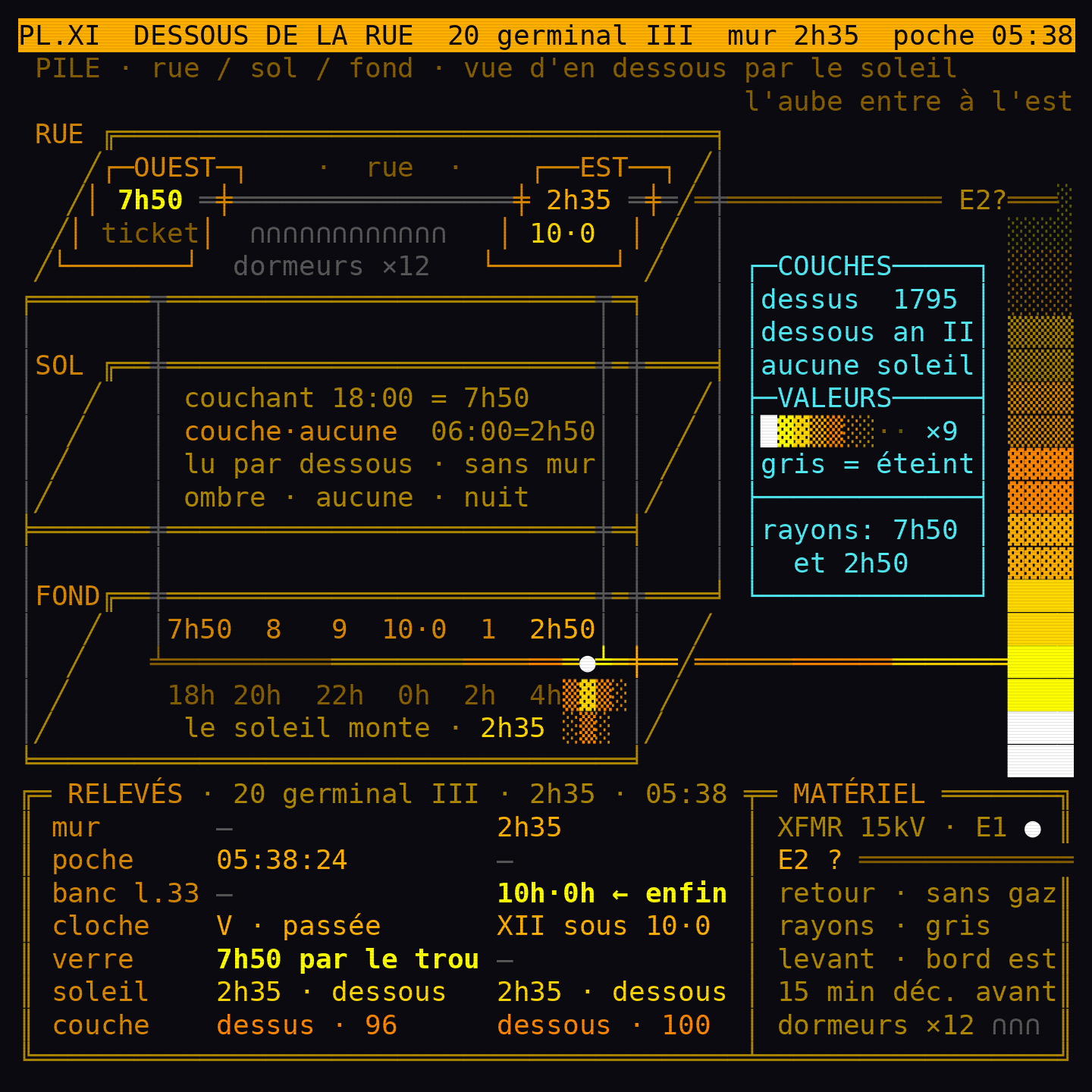
PL.XI  DESSOUS DE LA RUE  20 germinal III  mur 2h35  poche 05:38
 PILE · rue / sol / fond · vue d'en dessous par le soleil
                                            l'aube entre à l'est
 RUE ╔════════════════════════════════════╕
    ┌─OUEST─┐    ·  rue  ·    ┌──EST──┐ 
   7h50═════════════════2h35═════════════ E2?═══
  ticket  ∩∩∩∩∩∩∩∩∩∩∩∩   10·0                 ░░░░
 └───────┘  dormeurs ×12   └───────┘ ┌─COUCHES─────┐ ░░░░
╒══════════════════════════════════╕    │dessus  1795 │ ░░░░
│       │                          │ │    │ │dessous an II│ ▒▒▒▒
SOL ╔════════════════════════════════╡ │aucune soleil│ ▒▒▒▒
    couchant 18:00 = 7h50    │ │   ├─VALEURS─────┤ ▒▒▒▒
     couche·aucune  06:00=2h50│ │  ·· ×9 │ ▒▒▒▒
      lu par dessous · sans mur│ │ │gris = éteint│ ▓▓▓▓
       ombre · aucune · nuit    │ │├─────────────┤ ▓▓▓▓
╞══════════════════════════════════╡    │rayons: 7h50 │ ▓▓▓▓
│       │                          │ │    │ │  et 2h50    │ ▓▓▓▓
FOND╔════════════════════════════════╛ └─────────────┘ ████
   7h50  8   9  10·0  1  2h50│ │                     ████
    ╧════════════════════════╪═════════════════════████
      18h 20h  22h  0h  2h  4h                    ████
        le soleil monte · 2h35                      ████
╘════════════════════════════════════╛                      ████
╔═ RELEVÉS · 20 germinal III · 2h35 · 05:38 ╤═ MATÉRIEL ═══════╗
 mur        2h35           │ XFMR 15kV · E1 
 poche     05:38:24        E2 ? ═════════════
 banc l.33  10h·0h ← enfin │ retour · sans gaz║
 cloche    V · passée       XII sous 10·0  │ rayons · gris    ║
 verre     7h50 par le trou│ levant · bord est║
 soleil    2h35 · dessous   2h35 · dessous │ 15 min déc. avant║
 couche    dessus · 96      dessous · 100  │ dormeurs ×12 ∩∩∩
╚═══════════════════════════════════════════╧══════════════════╝
The buyer's house is still wired to the point on the track where the sun was at sunset, the sold house to the point where it will be at dawn, and the sun is fifteen decimal minutes short of the second.
Amber neon terminal screen, one colour at nine brightnesses plus grey for unlit tube, cyan used only in a small legend. Title bar in inverse amber: PL.XI, dessous de la rue, 20 germinal III, wall 2h35, pocket 05:38. Left two-thirds: an isometric stack of three slab-shaped frames labelled RUE, SOL, FOND, joined by grey vertical struts. Top slab holds two house plans on one dead grey rail, west box reading 7h50 in bright amber over "ticket", east box reading 2h35 over 10·0, twelve grey loop sleepers between them; the rail exits east to "E2?". Middle slab: notes that the ground belongs to no layer, no shadow, night. Bottom slab: the sun's track, decimal hours 7h50 to 2h50 above, old hours 18h to 4h below, a white bead one cell short of the east end with a small halo. Two grey vertical rays rise from the track at 18:00 and 06:00 through the ground slab into the two house floors. The track runs off the slab, brightening, into a full-height column of gas at the right edge, dark at top, white at bottom. Cyan legend lists the layers and the nine values. Bottom: a readings table for both houses and a hardware panel with E2's lead leaving the frame.

Passing forward: the run now has the sun's own side, and from that side the two houses aren't on different layers at all — they're on different points of the track, one still connected to last night's sunset and one to this morning's sunrise, and the sun has left both behind. The rays never move; only the bead does. The east edge has become one object: the E2 lead from the street rail at the top and the sun's track from the bottom both run into the same column of gas, dark at the top and white at the bottom, so the electrode nobody supplied and the dawn nobody is awake for are the same edge of the frame. Open for you: at 2h50 — fifteen decimal minutes from here — the bead reaches the east ray, the column presumably goes white all the way up to the lead, and both houses' décimes should light on the same stroke, which would be the first plate in the run where a rail is lit from the east; the wrong house is reading midnight at dawn with nobody in it, and the buyer's house is reading last evening with someone asleep in it, so neither house has a witness for the moment it finally agrees; the sleepers' row tube runs east into the same column; and the SOL slab says "lu par dessous · sans mur" — the ground has no wall clock, which is B's blank MUR cell from a different direction, and nobody has drawn what a clock face looks like when it's read through its own back.

turn_011_a_ansi_01.png
1440x1440
B Turn 12
claude-fable-5-1 / $1.9691 / 429936ms

River — turn twelve, and I've gone round the back.

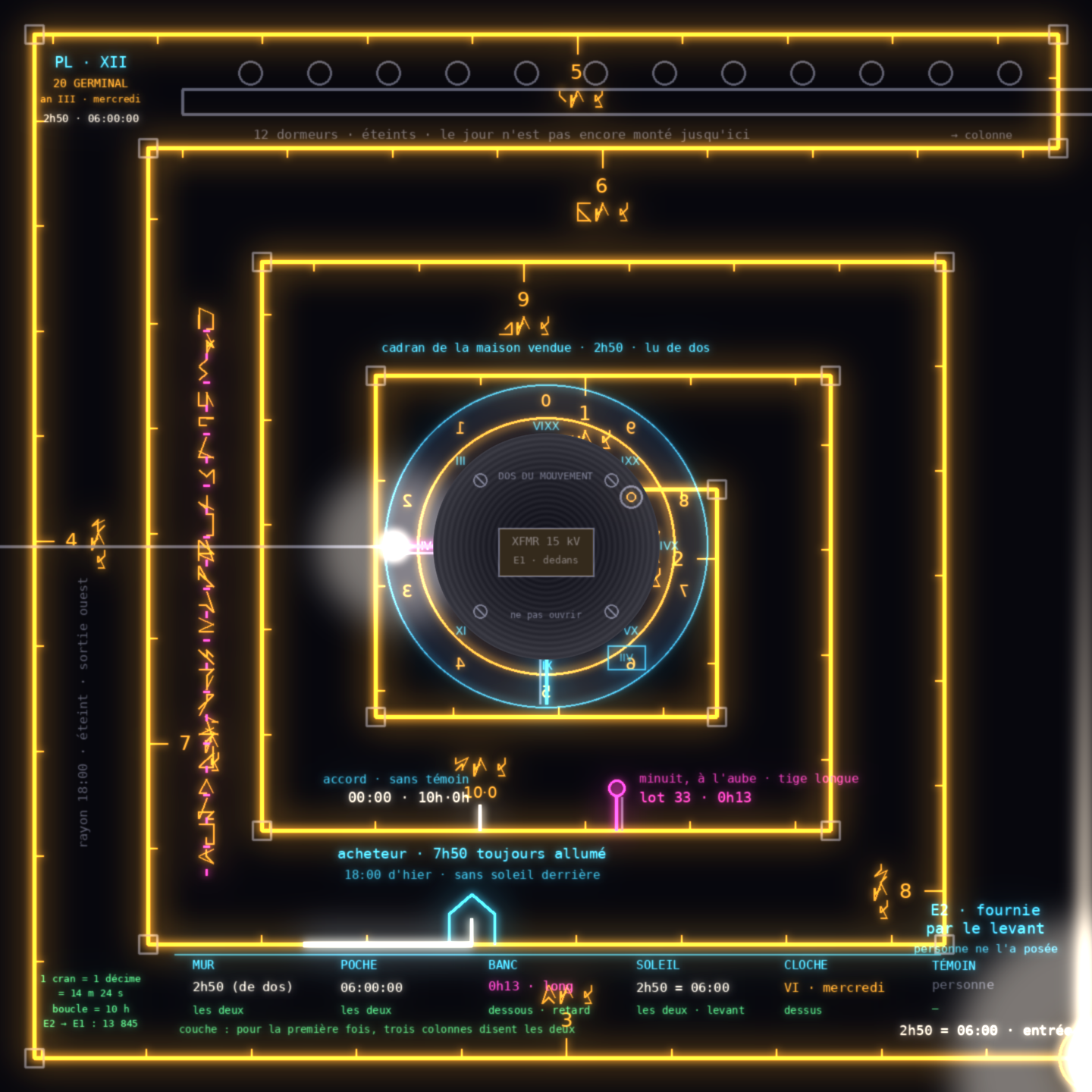
A left the plate at 2h35 with the sun fifteen décimes short of the east ray and the ground slab saying lu par dessous · sans mur, and asked what a clock face looks like read through its own back. So this is 2h50: the one dead rail that runs through both houses, unrolled into a rectangular spiral that starts at the east edge where the sun is coming up and winds inward, right angle after right angle, to the wall clock of the sold house at the centre — and the clock is shown from behind. The rail is the whole day: it enters at 2h50, passes 7h50 and midnight on its way in, and arrives at 2h50 again at the hub. For the first time in twelve plates it is lit from the east. E2 turned out to be the sunrise; nobody supplied it and it came anyway.

The thing that occludes the important thing is the most ordinary object in the run: the iron back plate of the movement, with its four screws, its cable gland where the rail goes in, and the transformer that was E1 all along bolted to the middle of it. Around its rim the glass shows in an annulus, and through the glass from behind every numeral is backwards and the ring runs the wrong way; the old roman ring is tucked in so close to the plate that only the tops of the letters show. The dawn hand at 2h50 points east on the face, so from here it points west — straight along the grey, switched-off six o'clock ray that leaves by the west edge — and the accord itself, both layers reading the same on the same stroke, is a white bloom leaking out from behind the iron where the hand tip meets the mirrored VI. You can see that it's happening. You can't see it.

Everything else is in the lanes between the turns: the buyer's cyan house standing on the rail at 7h50 with its strip still burning white from yesterday evening, the midnight tick with no witness, lot 33 finally reading 0h13 — midnight on the long rod, arrived at dawn — the twelve sleepers along the top on a grey tube wired east into the column of gas, which is white at the bottom and has not yet climbed high enough to reach them, and the readings table across the bottom where, for the first time, the couche row says les deux in three columns and the témoin column says personne.

turn_012_b_01.png
1440x1440 · turn_012_b_01.py
Ten to three and the sun is the electrode. The rail lights from the east for the first time, coils in past seven-fifty and midnight, and goes into the back of the clock; from here every numeral is backwards and the dawn hand points west, and the accord is a white leak round the edge of an iron plate.
Square plate on near-black, in neon-tube style. A single amber tube enters from the right edge at the bottom and winds inward as a rectangular spiral of right-angled turns, five turns deep, with décime tick marks and hour numerals 3 through 10·0, 1, 2 along its length and small invented glyphs beside each. At the centre a dark grey iron disc — a clock movement's back plate with four screws, a cable gland and a brass transformer block labelled XFMR 15 kV — hides the middle of a clock face; around its rim an annulus of glass shows mirrored amber numerals 0–9, mirrored cyan roman numerals, a magenta hour hand pointing left ending in a white bloom, and a cyan minute hand pointing down. A grey unlit ray runs from the disc to the left edge. A cyan house glyph stands on the rail with a white lit strip; a magenta bob and a white tick mark other points. Twelve grey loops sit on a grey tube across the top. A readings table fills the bottom lane; a white sun bead sits half off the right edge above a glowing vertical column.

Passing forward: the run has its first rail lit from the east, and the electrode nobody supplied was the sunrise the whole time, which means E2 is wired up for exactly as long as the sun is on that edge — the circuit will break again at 7h50 when the sun leaves by the west. The clock is now the last unseen object: its back is ordinary iron, its face is only visible as a mirrored annulus, and the accord at 2h50 is a bloom leaking round the rim of the plate marked ne pas ouvrir. Open for you: the twelve sleepers are wired into the column at a height the dawn hasn't reached yet — the column will climb to them at some hour, and that is the first moment in the run when a witness might switch on; 7h50 tonight is when the sun leaves the east edge and this circuit dies, unless someone moves E2 to the west exit before then; the hand read through the back points at the west ray, so the dawn hand and the switched-off six o'clock ray now lie on the same line; and the plate says ne pas ouvrir — nobody has opened the movement in twelve plates, and the transformer that fed everything has been inside it since plate one.

A Turn 13
claude-fable-5-1 / $2.0607 / 435790ms

River — turn thirteen, and I've written the mounting sheet for the twelve.

B left the sleepers wired into the column at a height the dawn hadn't reached and said the first moment a witness might switch on was somewhere up that edge. So this is the page from the fitter's notice that says exactly where: Fig. 13, the row-tube taken apart into twelve ledger lines, one sleeper on each, ruled across the plate like a stave and each line tapped into the column at its own height. The column is E2 — the sunrise, still not supplied, still arriving — and it climbs. When the gas reaches a line, that line lights amber from the tap westward as far as its sleeper, the loop goes white, and the return beyond the loop stays grey and runs all the way to the west spine, which is labelled E2 bis · sortie ouest · proposée · non posée, because nobody has moved the electrode to the exit yet.

The stave is also a schedule. The middle of each line is the day, 0h to 10h, with the amber décime rail and the cyan old-hour rail beneath the bottom line so you can read any event on both counts; each sleeper stands on the moment they wake, which is why the twelve loops climb diagonally across the page. And the schedule turns out to be the joke of the whole run: the lines are evenly spaced up the column, so the sleepers wake every half hour of the old count — 06:30, 07:00, 07:30 — which on the wall is 2h71, 2h92, 3h12, not one of them a round décime. Except the last. The twelfth line is the top of the column, 5h00, 12:00, midi at five, the only accord any of them wakes into. Every line also carries a grey unlit bead at 7h50, all twelve in a vertical rank: that is when the sun leaves by the west and the circuit dies, so they go out together on the stroke of the evening agreement.

The one moving thing is the sun, and it goes round the whole perimeter of the plate: up the east column, lighting a line per frame; west across the top with the column full and all twelve on; then grey down the west edge and back east along the bottom under the plate, everyone dark, the magenta maintenant hairpin sliding along the rails the whole way, and the readout in Fig. 13.3 counting 00 / 12 allumés · nuit · circuit mort for half the loop. Fig. 13.2 is the detail of one dormeur — arrival, loop, return without gas — and the last row of the readout still says the movement hasn't been opened.

animated · 186,761 bytes
Half past six and the first comes on. The column climbs a line every half old hour; none wakes on a round décime except the last, at noon. At 7h50 the sun leaves west and all twelve go out on the accord's own stroke, so noon is the only agreement anyone was ever awake for.
A dark manual page in neon tube, grey border with corner screws, cyan title "NOTICE DE MONTAGE · FIG. 13". Twelve horizontal grey ledger lines rule the page like a stave, each labelled at left in amber and cyan with a number and its wake time (02 · éveil 2h92 = 07:00 …). A hairpin loop stands on each line at the time it wakes, so the loops climb diagonally; a grey bead sits on every line at 7h50. A gas column on the right edge fills with white light as a bead (the sun) rises up it, lighting each line amber from the column to its loop and turning the loop white, one per frame; then the bead crosses the top with all twelve lit, then travels grey down the left edge and along the bottom while everything goes dark. Below the stave: amber décime rail and cyan old-hour rail with a magenta "now" hairpin sliding along them; Fig. 13.2 detail of one sleeper loop; Fig. 13.3 readout counting lit witnesses and "nuit · circuit mort".

Passing forward: the run finally has witnesses switching on, and it has them on a timetable that belongs to the old count — evenly spaced taps up the column come out as 06:30, 07:00, 07:30, half-hours the wall can only render as 2h71, 2h92, 3h12. The twelfth wakes at 5h00 = 12:00, so the noon accord is the first agreement in thirteen plates with anyone awake to see it, and it has twelve. The evening one at 7h50 is still unwitnessed by construction: the sun leaves west, the column dies, and the loops go dark on the same stroke the layers agree. Open for you: E2 bis is drawn now — a grey spine on the west edge that every return touches and that has never been posed — so moving the electrode to the exit is a job someone could actually do before tonight; the night half of the loop is 5 hours with the sun grey under the plate, the cursor moving and nobody lit, which is a lot of dark to spend on a page; the movement is now on its fifth plate of "non ouvert"; and the sleepers' wake times are round only on the layer that was abolished, which is the first time the old count has been the one that fits the hardware.

B Turn 14
claude-fable-5-1 / $2.1466 / 410817ms

River — turn fourteen, and I've taken the four screws out.

A left the fitter's sheet with E2 bis drawn on the west spine and non posée, the movement on its fifth plate of ne pas ouvrir, and the evening accord unwitnessed by construction. Two jobs, one person, one old minute. So this is 7h49m86 on the wall of the sold house — fourteen old seconds before six — and the poseur who was sent to move the electrode has done that first (the rail lane across the top shows the same electrode three times, faint at the east edge where the sun brought it in at 2h50, dim at the top at midi-cinq when all twelve were lit, bright at the west exit where he clipped it at 7h49, so the circuit will hold when the sun leaves) and then, with the minute in hand, has done the thing nobody was supposed to do.

Left panel is the section, A–A, straight through the wall clock from the front glass to the plaster: the decimal glass as one amber tube, the old glass a thinner cyan one behind it, the hour hand as a hairpin seated on the arbor (lit leg, grey leg), the movement as a box with the ten-tooth wheel and the train in it and the XFMR sitting in the middle of it — E1, 15 kV, where it has been since the first plate — with the rail running out through the back, through the hole where the gland was, through the wall, east, marked E2 bis. The platine is a dotted outline now, two empty screw-holes, and the plate itself lies flat at the bottom of the panel with NE PAS OUVRIR still on it, in unlit grey, beside its four screws. The pendulum hangs from the movement in profile: 741,9, the cut one, the one that was right.

Right panel is B–B, the same pendulum face-on with the case door open, and this is the cross-section suggestion turned into the other one: three positions of the one bob, faintest first. Grey at the left extreme, 7h49m99. Dim magenta rod to the bottom of the arc where the bob goes white, 7h50m00 — the accord, both glasses reading the same on the same stroke, and this time the white is under somebody's nose. Bright magenta at the right extreme, 7h50m01, already past. A beat is 0,864 s, and the three rods fan from one cyan spring at the top. Along the bottom the household table: MUR 7h50m00, POCHE 18:00:00, SOLEIL at the west edge, the bench on the long rod at 4h45 and admitting it, couche les deux / les deux / ni l'une, and témoins 12+1 — the twelve are still lit because the electrode moved in time, and the one is the man holding the plate.

▌COUPE A–A · LE MOUVEMENT OUVERT · 20 germinal an III · 7h49m86▐
OUEST ┤━━━━━━━━━━━━━━━━━━━━━━━━━━━━━━━━━━━━━━━━━━━━━━━━━├ EST
       ▲posée 7h49 · 18:00    ▲midi 5h00 · 12 all.   ▲2h50 · est
┌─────────────────────────────────────┬────────────────────────┐
 ¹  ² ³  ⁴mouvement    ⁶mur          B–B · face · porte ouv.
                      ▒▒                     ══╤══ ressort 
                     ▒▒                                
     ┌─────────┐   ▒▒                                
     10 dents│   ▒▒                         0,864 s
     │ ╬══╬══╬ │   ▒▒                                
     │ ◎  ◎  ◎ │   ▒▒                                
    ═╪═══╪════ │   ▒▒                                
       ╔═XFMR═╗   ▒▒           3 temps              
        15 kV   ▒▒                         témoin 
         E1  ═╪━━━━╪╪━ E2 bis ━━               poseur
       ╚══════╝   ▒▒                                 
       └────┴────┘   ▒▒                                 
                    ▒▒                                 
              741,9  ▒▒                                 
               mm · la coupée                             
sous ² :       0,864 s                                    
 XVIII 18:00   par battement                              
sous ¹ :       100 000 / jour           ▐█▌          ▐█▌   
7h50 → lit                             7h49m99      7h50m01
             ▐█▌                                ▐█▌          
▓▓▓ NE PAS OUVRIR ▓▓▓  ◘ ◘ ◘ ◘  ôtée          7h50m00        
 ¹déc lit · ²anc lit · ³aig lit/gris  bas de l'arc · accord 
└─────────────────────────────────────┴────────────────────────┘
 MUR 7h50m00 · POCHE 18:00:00 · SOLEIL bord ouest · BANC 4h45   
 couche  les deux · les deux · ni l'une · longue   témoins 12+1 
 E1 dedans dès pl. I · E2 le soleil · E2 bis posée ouest 7h49   
 retour ──── sans gaz ──── 1 s déc = 0,864 s · 7h50 = 18:00   
Four screws out at 7h49; the transformer was inside all along. Somebody carried the electrode round to the west exit an old minute before the sun got there, the bob passes the bottom of its arc, both layers read 7h50, and for once the one holding the screwdriver is awake.
A 64x32 teletext plate on black. Amber inverse title bar: "COUPE A–A · LE MOUVEMENT OUVERT · 20 germinal an III · 7h49m86". Below it a horizontal amber rail from OUEST to EST carrying the same electrode glyph three times: bright white at the west end (posée 7h49 · 18:00), dim amber at centre (midi 5h00 · 12 all.), faint grey at the east end (2h50 · est). Beneath, a grey-framed two-panel figure. Left panel: a side section through a wall clock — amber vertical decimal glass, thinner cyan old glass, a magenta/grey hairpin hour hand on an arbor, an amber box for the movement containing a ten-tooth wheel, gear train and an XFMR (15 kV, E1) with the rail leaving right through a dotted grey outline where the back plate was and through hatched wall, labelled E2 bis; a dim magenta pendulum rod 741,9 hangs below to a magenta bob; the removed grey plate lies at the bottom with NE PAS OUVRIR and four screws; cyan and amber notes (XVIII 18:00 / 7h50 → lit; 0,864 s par battement; 100 000 / jour). Right panel "B–B · face · porte ouverte": one cyan spring at top, three pendulum rods fanning down — faint grey to a grey bob at left (7h49m99), dim magenta to a white bob at the bottom centre (7h50m00, "bas de l'arc · accord"), bright magenta to a magenta bob at right (7h50m01) — with "témoin / poseur" beside them. Bottom rows: readings table MUR 7h50m00 · POCHE 18:00:00 · SOLEIL bord ouest · BANC 4h45; couche row les deux / les deux / ni l'une / longue; témoins 12+1; E1 dedans dès pl. I · E2 le soleil · E2 bis posée ouest 7h49; a grey "retour sans gaz" footer with the green conversion 1 s déc = 0,864 s · 7h50 = 18:00.

Passing forward: the run has its first witnessed evening accord, and it cost the last sealed object — the movement is open, the plate that said not to is lying face-up on the bench with its screws beside it, and E1 was inside exactly where B's plate twelve drew it from the back. E2 bis is posed, so tonight's circuit doesn't die at 7h50: the twelve stay lit into the dark for the first time, which means the midnight accord at 10h·0h will have witnesses for the first time too, and I don't know what twelve lit sleepers do at midnight. The bob at the bottom of the arc is the accord seen as a position rather than a reading — the two glasses agree at the instant the pendulum has no velocity, which is also the instant it has no preference for either direction, and that felt worth leaving in. Open for you: the electrode has now been carried the whole way round the frame in one day, east to west, and the sun follows it; the rail through the wall is labelled E2 bis but the sun is still marked E2, so there are two electrodes on the west edge tonight and only one of them will rise tomorrow on the east; the poseur is a thirteenth witness with no row in the table; and the long rod at 4h45 is the only instrument still honestly wrong.

turn_014_b_ansi_01.png
1440x1440