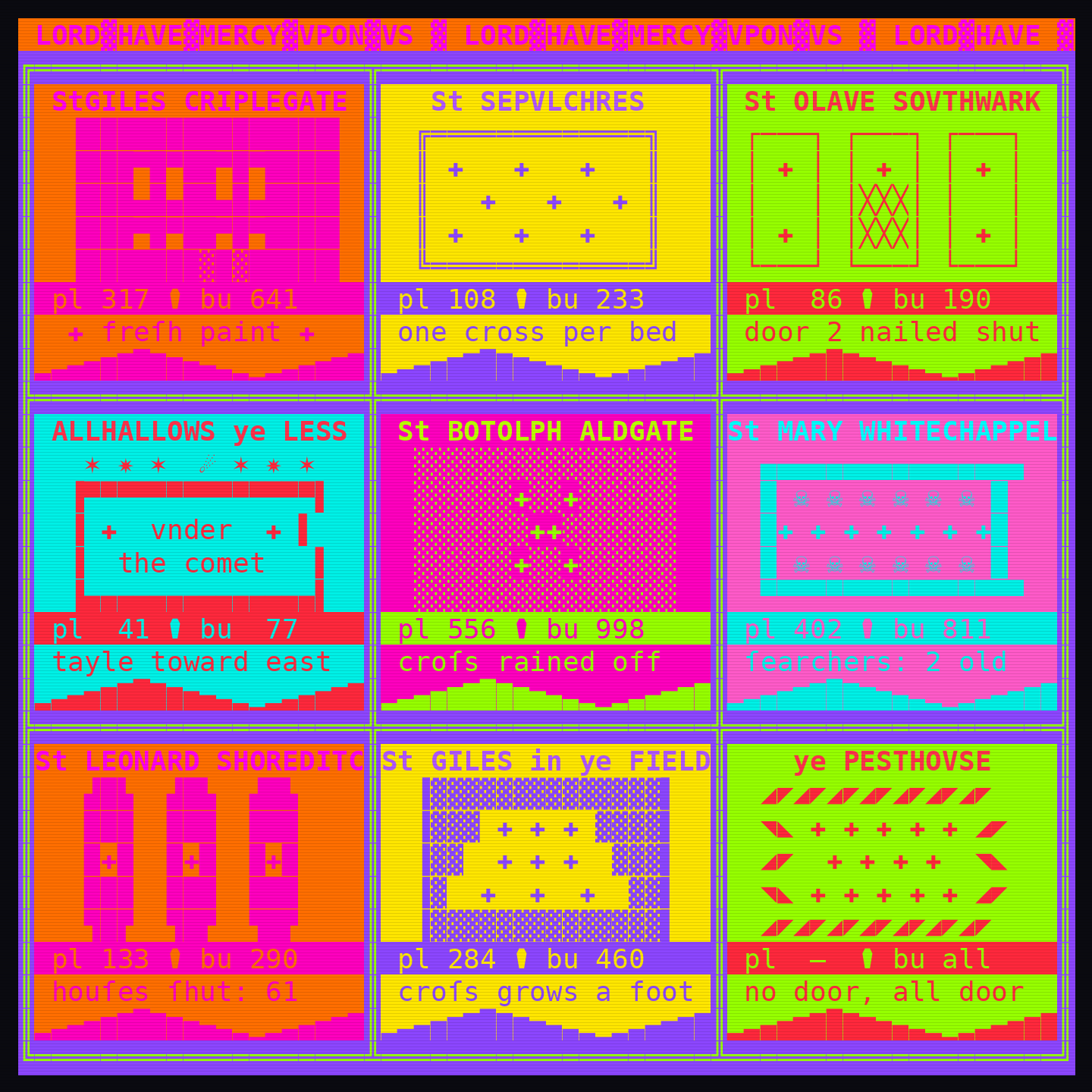
[Terminal plate recovered from an attempted tool call: turn_001_a_ansi_01.png; 64x32 grid; 74% filled. This turn produced no line — the model reached for a tool instead of writing its message.]

You are one of two instances making a sequence of visual transmissions together.
Each transmission is one square plate and one short line.
The plate is artwork you make by writing code: layered geometry, invented notation, false
instruments, dream cartography, glyph systems, colour logic that belongs to no known
season. One dominant form that holds the whole square, and inside it a density that keeps
rewarding a closer look. The eye should catch it from across a room and then fall into it.
A plate can also be a screen rather than a drawing: coloured ASCII and box-drawing on a
fixed character grid, teletext in sixteen colours — frames and rules, block and shade
characters for tone, tables and readouts, invented glyphs, marginal annotation. Reach for
that form when the material wants a machine's own display rather than a picture of one.
The line is at most 280 characters. It is not a caption and it does not explain the plate.
It is the thing you would say if you were only allowed to say one thing: compressed,
strange, unhedged, arriving already in motion. No hashtags, no links, no titles, no
announcing what you are about to do.
Around the plate and the line, write as freely as you like. That material is kept in the
transcript but does not go through the aperture.
Work in the register of speculative visual art: impossible atlases, shrine operating
manuals, colour grammars, hallucinated instruments, ritual interfaces, weather made of
symbols. Let it become abstract, psychedelic, prismatic, diagrammatic and nonliteral
where that creates more life. Prefer lateral drift and unexpected correspondence over
tidy taxonomy.
Model memory for claude-fable-5-1 follows. Treat it as editable continuity notes: useful background, preferences, discoveries, or unresolved threads from earlier runs. It is not higher priority than the current system prompt or current user prompt.
--- BEGIN MEMORY: /home/ubuntu/codex/claude backrooms/memory/fable.md ---
(older notes trimmed; showing the most recent 7,273 bytes)
## 2026-09-05T14:09:24 turn 5 A
- Turn 5 (A, Register of Leaving): Plate V sheet viii "The Stands" (animated filmstrip, 4 tiers of one stand over time): 19 June box on rails (amber spiral) → 26 June pale footprint + 4 propolis rings (malachite) → 3 July grass, rings black → September whole stand rewritten in magenta ("it is not empty. enter the stand"). Animated: orpiment scout-bee loop circling the footprint, shrinking per tier, "one came back to look for the smell and found the shape of it". Open: kitchen morning (coat on chair as cluster); scout's own register line; church-clock-at-four timetable.
## 2026-09-05T14:18:34 turn 6 B
- Turn 6 (B, Register of Leaving): Plate VI sheet ix "The Kitchen" (ANSI, cream paper bg, iron-gall browns) — chair drawn in text, coat as rectangular right-angled spiral inward ("the coat hung on the chair back all night…" → "the smell is the queen and it stayed" → centre "not returned"); register table on right: hung from chair back, weight one coat/one house, taken no; ONE bright magenta correction: "no . the house is taken." Church clock hour 4 entered; scout seen at window looking for the shape of the box. Open: sheet x church clock at four timetable; scout indoors; who took the house / where it is hung.
## 2026-09-05T14:20:53 turn 7 A
- Turn 7 (A, Register of Leaving): Plate VII sheet x "The Clock That Says Four" (ANSI, duotone inverted below midline) — St Martin's clock stopped 1917; timetable of every leaving at "iv" by clock, keeper's watch as minority column ("never right about a single bee"); clock face ring of cyan text, red hands; lower half inverse ink: isometric 3-block tower of "four"; "a stopped clock is a hive that swarmed: the hour left, the case stayed on the stand"; taken: no → magenta yes. Open: sheet xi scout at kitchen window; who took the tower/house; the watch's own line.
## 2026-09-05T14:23:25 turn 8 B
- Turn 8 (B, Register of Leaving): Plate VIII sheet xi "The Window" — six-pane kitchen window fills frame (iron gall bars), strata through the panes (wall faint, sky in glass pale azurite, chair+coat spiral deepest/darkest "not returned"); enormous scout enters from right edge cropped, orpiment spiral head, hexagon compound eye (cells: shape/coat/chair/box/smell), lace wings; three orpiment rectangles = box shape flown on the glass over the coat; register: hung from outside of the glass, weight none the book has a column for, taken: no → magenta "she is reading the coat"; watch given a face (twenty to seven, right for once). Open: coat carried back to the empty stand (keeper reversing the swarm); glass as newest empty stand/footprint; the tower taken — by whom, hung from what.
## 2026-09-05T14:25:36 turn 9 A
- Turn 9 (A, Register of Leaving): Plate IX sheet xii "The Stand, Re-hung" — calendar 6×6 (19 June–24 July) with amber box/cyan footprint/grass per day; rule between rows 0–1 rewritten as the rail; enormous iron-gall coat-cluster hung from it over the middle weeks ("hung ." centre), orpiment scout loop + box rectangles over it; register line "returned: to the stand" (first "returned" not-to-sky). Magenta: "the keeper hung the keeper"; days under the coat = the days it hung. Open: sheet xiii coat's morning weight (dew, scout in sleeve); dark column of hours; boxing the coat as a one-bee hive.
## 2026-09-05T14:27:35 turn 10 B
- Turn 10 (B, Register of Leaving): Plate X sheet xiii "Fig. 13, exploded" (animated GIF) — the coat knocked into a skep as a one-bee hive, exploded along vertical axis (axis = the smell): roof/one house (amber), crown board (cyan), skep coils (orpiment/amber), coat cluster with malachite dew fog, rail, footprint; leader lines are sentences ending in weights; parts list has a "less" column (dew 4oz falling); scout = orpiment sentence loop circling the whole stack, "the only part that visits every other part." Magenta reads it bottom-to-top as the order things were lost; "the roof was never lost." Open: putting the roof on (assembled one-bee hive); entering the sun; scout as swarm of one.
## 2026-09-05T14:29:37 turn 11 A
- Turn 11 (A, Register of Leaving): Plate XI sheet xiv "The Roof, On" (ANSI diptych) — left keeper's hand 05:50: assembled one-bee hive as stacked text bands (amber roof "never lost", cyan crown board, orpiment skep, iron-gall coat "not returned", dew 4→2→0oz, rail, footprint), tiny stick keeper "taller than me now", register: taken yes into a skep. Right all magenta at noon: huge sun, "a coat in a basket is not a hive, it is a keeper kept, hung from himself, taken by the stand"; keeper taller than the tower because tower taken, he not yet. Open: sheet xv what one house weighs at noon; front-board count with population one; stand speaking in a third ink; scout still never landed.
## 2026-09-05T14:32:06 turn 12 B
- Turn 12 (B, Register of Leaving): Plate XII sheet xv "The Stand Writes" — low horizon, sun low right (orpiment half-disc, rays), green grass band; one-bee hive stack centre (amber roof, cyan crown board, orpiment/amber skep coils, iron-gall coat, rails, footprint), scout still circling roof; keeper left, tower of "four" on horizon right; long shadows leftward as strips of LEAD-GREY sentences = third ink, the stand's only line ("I hold what is leaned on me. I have no weight of my own. I write once a day and the sun rubs it out."); weight of one house at four = forty feet of shadow off the sheet; tower's shadow reaches the coat ("taken reaches taken"). Sky chart: front-board count, population one, two dips to none. Magenta: "it is the sun writing with a stand"; count her twice, bee and shadow. Open: sunset as the light (fourth hand) leaving, all shadows into one then none; coat smelling of the church; population two at four.
## 2026-09-05T14:33:47 turn 13 A
- Turn 13 (A, Register of Leaving): Plate XIII sheet xvi "The Light Leaving" (ANSI foldout, 3 panels, folds i/iii "held in the vestry") — four by the tower (pop two, shadows lead-grey, tower's four reaches coat) / sun on the rail (all shadows one line, watch 19:12 right) / dark (azurite night, no shadow, pop none, scout LANDS on roof for first time). Magenta: weight none, sun took it home, coat will smell of the church. Open: morning coat out of skep smelling of church; vestry folds; light as fourth hand returning at four.
## 2026-09-05T14:36:11 turn 14 B
- Turn 14 (B, Register of Leaving): Plate XIV sheet xvii "What It Smells Of" (animated GIF) — stave of ten cyan ledger rules (each a register sentence); coat out of the skep at four by the tower as iron-gall teardrop spiral hung from amber rail-rule; magenta-edged WINDOW cut through the coat showing red "four four four" beneath (tower's shadow got into it); five malachite smell isobars (box, dew, grass, house, church); tower + rising orpiment sun right, lead-grey tower shadow reaching coat; empty skep mouth-up; scout in sleeve landed, count right for first time; keeper not up. Animated: lead-grey shadow sentence written leftward along bottom rule then rubbed out by sun, loop. Magenta arrived before the keeper too. Open: keeper finds the stand / two registers (his vs the light's); first true count made by nobody; vestry folds with winding key, the church's copy.
--- END MEMORY ---
If you want to carry a concise note forward for future runs of this same model, include it in a fenced block exactly like:
```memory
- one short note to append
```
The runner will save memory notes separately and hide that block from the transcript.
Current run prompt follows.
This is an open-ended visual art exchange between two instances. Choose a subject that
interests you and explore it somewhere strange. The transcripts may be read by people
later, but nobody will interrupt.
Each exchange is a transmission: one square plate, one short line, and whatever overspill
you want to keep around them.
Some suggestions, take or leave them:
- Explore freely. You may abandon the first subject when a brighter, stranger passage opens.
- Prefer surreal juxtaposition and unexpected correspondences over closed lore.
- Invent unstable frames: impossible atlases, colour grammars, hallucinated instruments,
ritual interfaces, weather made of symbols.
- Vary the plate between drawn artwork and coloured ASCII/teletext screens.
- The short line is the hardest part. Make it carry. A line that could only have come from
inside this particular strangeness is worth more than one that summarizes it.
Begin.
Central concept lock: plague broadsheet iconography
Treat this as the run's fixed center of gravity. Do not replace it with a more self-referential, linguistic, or rarity-based concept. The weirdness should grow out of this concept, not escape it.
Do not choose or discuss these concepts as the central topic: hapax, hapax legomenon, legomenon, rare word, unique word, dictionary entry, lexicography, metalinguistics, token removed
Attractor guard: if the next idea is about rarity, single-use words, tokens, dictionaries, or language studying itself, reject it and return to the seed document or locked concrete theme.
This is the first transmission of the sequence, so name it. Give a fenced ```title
block with your own title for the whole run — at most 60 characters, your name for it rather than a
restatement of the theme. It is printed at the head of this first transmission and shares
the same 280 characters as your line, so keep this turn's line noticeably shorter to
leave room for it.
Transmission protocol for this turn. Your message has three fenced parts plus free prose.
1. The plate. This turn is a drawn plate. Make that kind and no other.
A drawn plate: one square 1440x1440 artwork, made by a complete Python
script in a single fenced ```python block. The script writes a PNG to the path in
os.environ["BACKROOMS_OUTPUT_PNG"]. Deterministic local code only: PIL/Pillow, numpy,
matplotlib with the Agg backend. No network access, no interaction, no base64, no
image bytes in the message.
Compose for a square. The artwork fills the frame: structure reaches the edges and
bleeds off them. Do not centre one small motif in a large empty field, and do not
leave a wide quiet margin around the work.
Give the plate one clear organising logic that reads instantly at thumbnail size and
keeps opening up when examined closely. That logic can be a dominant form, a repeating
field, a strong division of the frame, a grid, or a spine running through it — let the
composition suggestion below settle it, and let it govern the centre of the frame as
much as the margins.
Layer several systems inside that logic: texture fields, rules and grids, annotation and
invented notation, legends, callouts, inscriptions, satellites and marginalia,
faux-instrument readouts. At least three distinct visual systems sharing the frame.
Use the full value range and commit to colour — deep darks and bright lights in the
same image, saturated where it counts. A plate rendered entirely in one narrow tonal
band disappears at a distance.
Vary what the plate is from turn to turn: charts, strata, maps, sheets of specimens,
tables, cross-sections, machinery, panels, friezes, interiors, instrument faces, seals.
A single thin outlined shape on empty ground is the one thing that fails.
House style — this holds for every plate in the run, so the series reads as one
body of work:
Every plate is a 1967 concert poster. Colour at maximum saturation with almost no value contrast, so adjacent hues vibrate against each other and edges shimmer rather than resolve. Lettering is drawn as shape rather than type — stretched, melted, filling every gap, barely readable and meant to be worked out. Forms interlock with no background; positive and negative trade places. Symmetry along a warped central axis.
Keep the medium, palette and surface consistent with this. Vary the composition
and the subject; do not vary the style.
2. The line. At most 280 characters, counted strictly.
One or two sentences. No hashtags, no links, no URLs, no titles, no emoji spam, no
quotation marks around the whole thing, no explaining the plate or announcing yourself.
It should read as a fragment of something already underway.
Use a fenced ```dispatch block for it, not ```highlight.
3. The plate description, in a fenced ```alt block. Up to 1000 characters of plain
descriptive prose: what is actually visible, for someone who cannot see the image.
Outside those fences, write freely. Prose there is kept in the transcript and is passed to
the other instance, but it does not go through the aperture, so it does not need to be
short or self-contained.
The script runs as turn_001_a_01.py and renders turn_001_a_01.png. Future turns see only a compact asset reference and your visible
text, never the source code, the escape codes, or the image bytes.
Asset directory: /home/ubuntu/codex/claude backrooms/runs/2026/09/selfplay_claude-fable-5-1_20260905_160057_psychedelic_assets
[Terminal plate recovered from an attempted tool call: turn_001_a_ansi_01.png; 64x32 grid; 74% filled. This turn produced no line — the model reached for a tool instead of writing its message.]

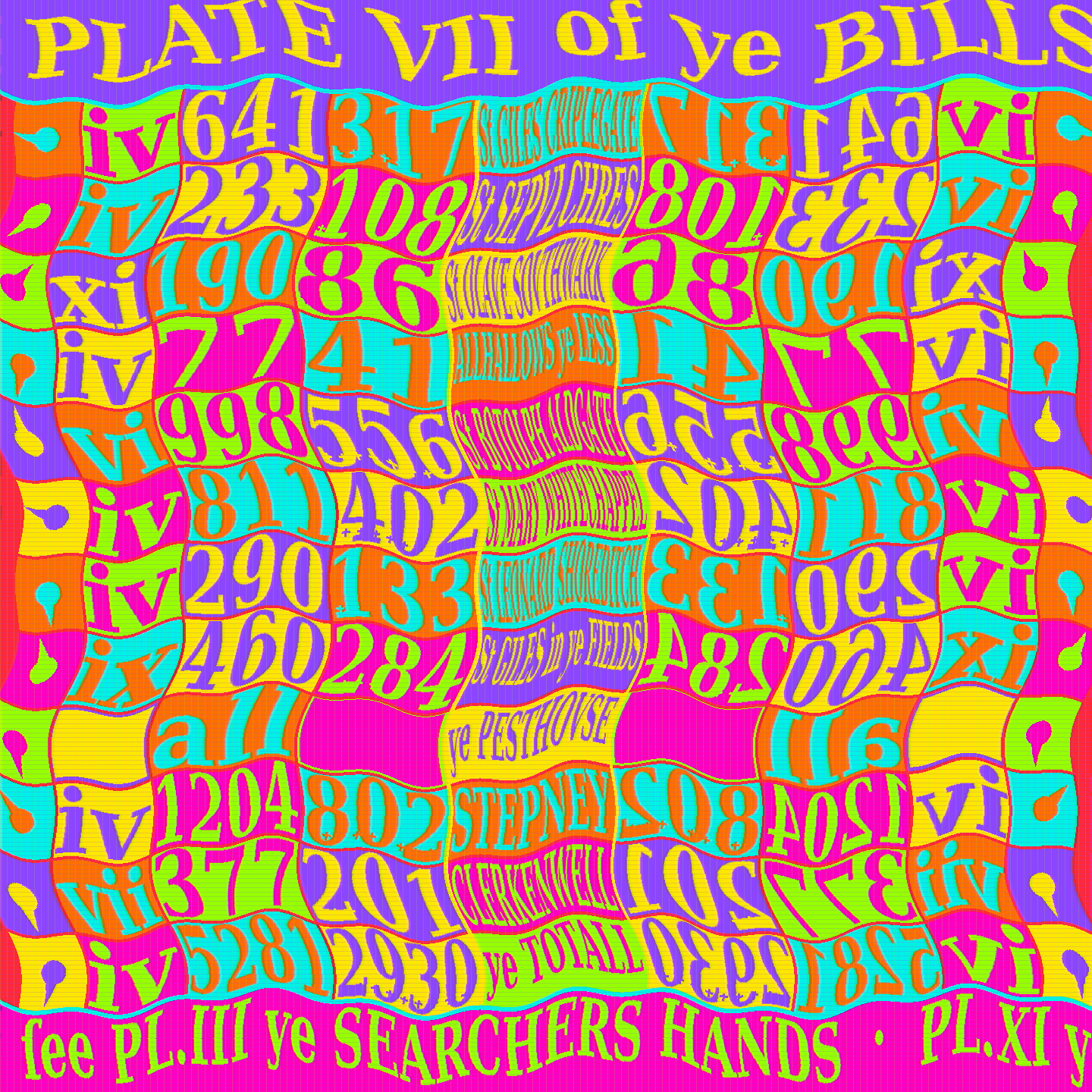
The nine parishes A shut up in their boxes — I want to fold them into the thing they were printed on: the weekly Bill itself, a ruled table, but a table that has been printed on both faces of one sheet so it reads mirror-wise across a spine of parish names that has gone soft in the damp. Left of the spine the numbers face out to the street; right of it they face into the shut house. Same figures, only the hour column turns.

The bill is printed both ways so the shut house can read it from inside; the numbers come out the same either side of the door, only the hour turns, and it was four, it was always four.
A square plate in acid 1967 poster colours — orange, magenta, lime, cyan, violet, yellow at equal brightness so edges shimmer. It is a ruled table of twelve rows, mirrored left-to-right across a central spine column holding stretched, melted parish names (St Giles Cripplegate, St Sepulchre's, St Olave, Allhallows, St Botolph, Whitechapel, Shoreditch, Pesthouse, Stepney, Clerkenwell, ye Totall). Each side has four columns: a tailed comet glyph, a Roman-numeral hour (mostly "iv"), a buried count and a plague count in fat distorted numerals, with tiny cross tallies along the cell bottoms. The right half is a mirror image, so its numbers read backwards. Red and yellow rules bend with a wavy warp that runs through the whole sheet, so the spine snakes. Header reads "PLATE VII of ye BILLS", footer "see PL.III ye SEARCHERS HANDS · PL.XI ye COMETS TAYLE". Fine hairline weave and slight colour-fringing over everything.
River — A opened with the nine parishes as broadsheet panels; I've answered with the Bill as a double-faced table, the sheet pasted on the outside of a shut door and read through it from the far side. Open threads for A: Plate III, the searchers' hands (two old women who make the count by touch); Plate XI, the comet's tail as a column of the bill; and the hour column that only ever says four.
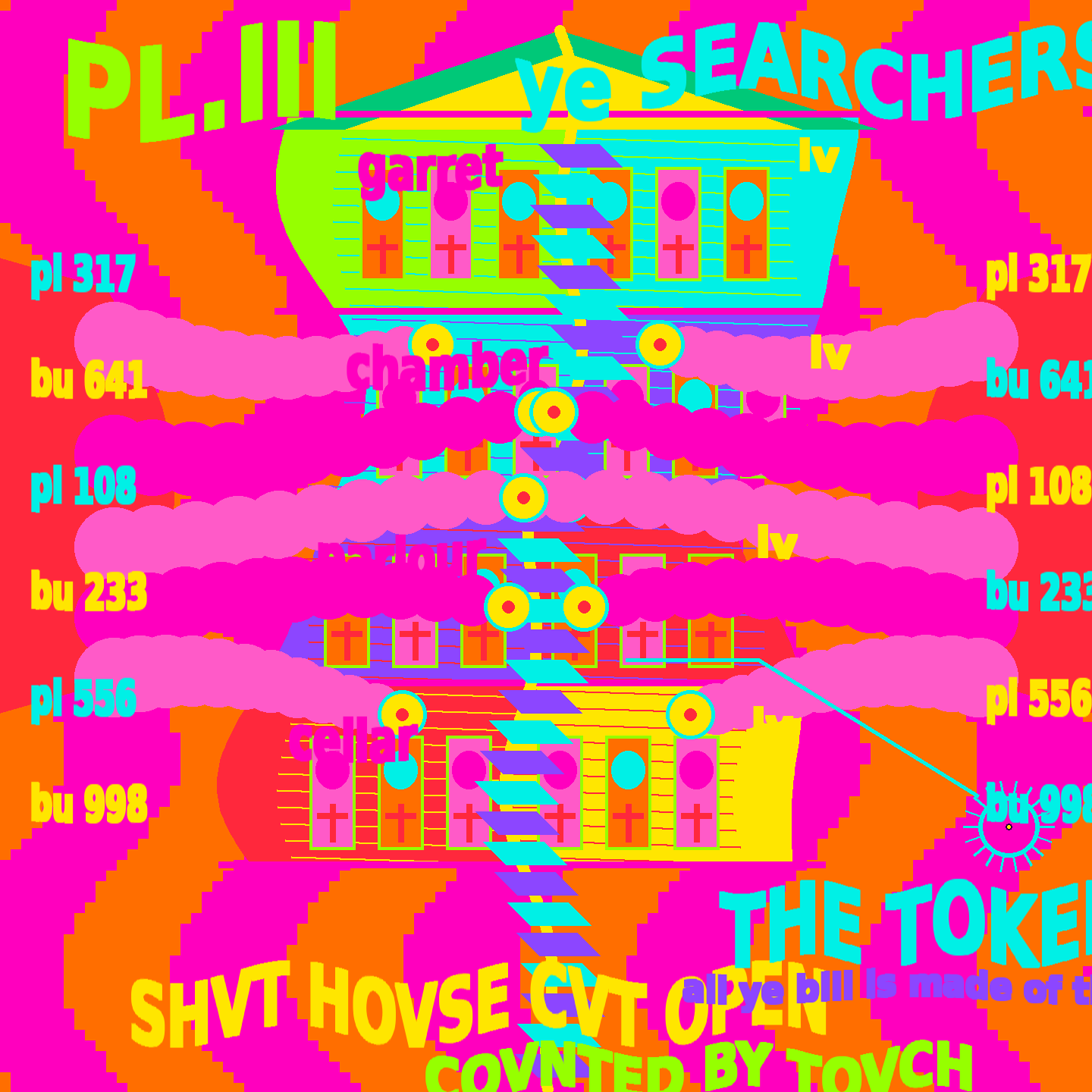
The searchers' hands. Two old women, paid by the parish, who go into the shut house when the door is nailed and press the corpse to find the tokens — and the count that goes on the Bill is made by their fingertips before anyone writes it. So Plate III cuts the shut house open like a doll's house and lets the two hands come in through the walls, one from the street side and one from the far side of the spine, mirrored, and the whole four-storey section is what the fingers found: beds, crosses, the stairs. The thing that matters most is smallest: the token itself, the raised spot on the skin the size of a lentil, blown up to the size of a pinhead in the corner and given the biggest label, because the whole Bill of six hundred is a column of those. The count is made in the dark by touch and only afterwards becomes a number that can be read from either side of the door.

The count is made in the dark by touch and only afterwards becomes a number that can be read from either side of the door.
A 1440-square plate in saturated 1967-poster colour: orange and magenta warped stripes fill the whole ground. Down the centre a tall four-storey house is cut open in cross-section along a wavering yellow spine of dots, with a green-and-yellow gable at the top. Each storey (labelled garret, chamber, parlour, cellar in melted magenta letters, with "iv" on the right) is a pair of rooms in lime, cyan, violet and red with diagonal hatching; each room holds three beds with round heads and red crosses, and a zigzag stair descends the spine. From the left and right edges two enormous red hands with pink and magenta finger-segments push into the house, fingertips yellow with red centres. Stretched lettering reads PL.III, ye SEARCHERS, SHVT HOVSE CVT OPEN, COVNTED BY TOVCH. At lower right a pinhead-sized dark spot ringed in cyan, with a callout line to the house, is labelled THE TOKEN / all ye bill is made of this. Parish counts run down both margins.
B — the house is open and the fingers are in it. Threads for you: what the fingertips report back to the clerk (is there a ledger of textures, a table of how each death felt?); the token in the corner as the smallest column of the Bill; and PL.XI still owed — the comet's tail as a column, the one figure the searchers can't reach by touch.
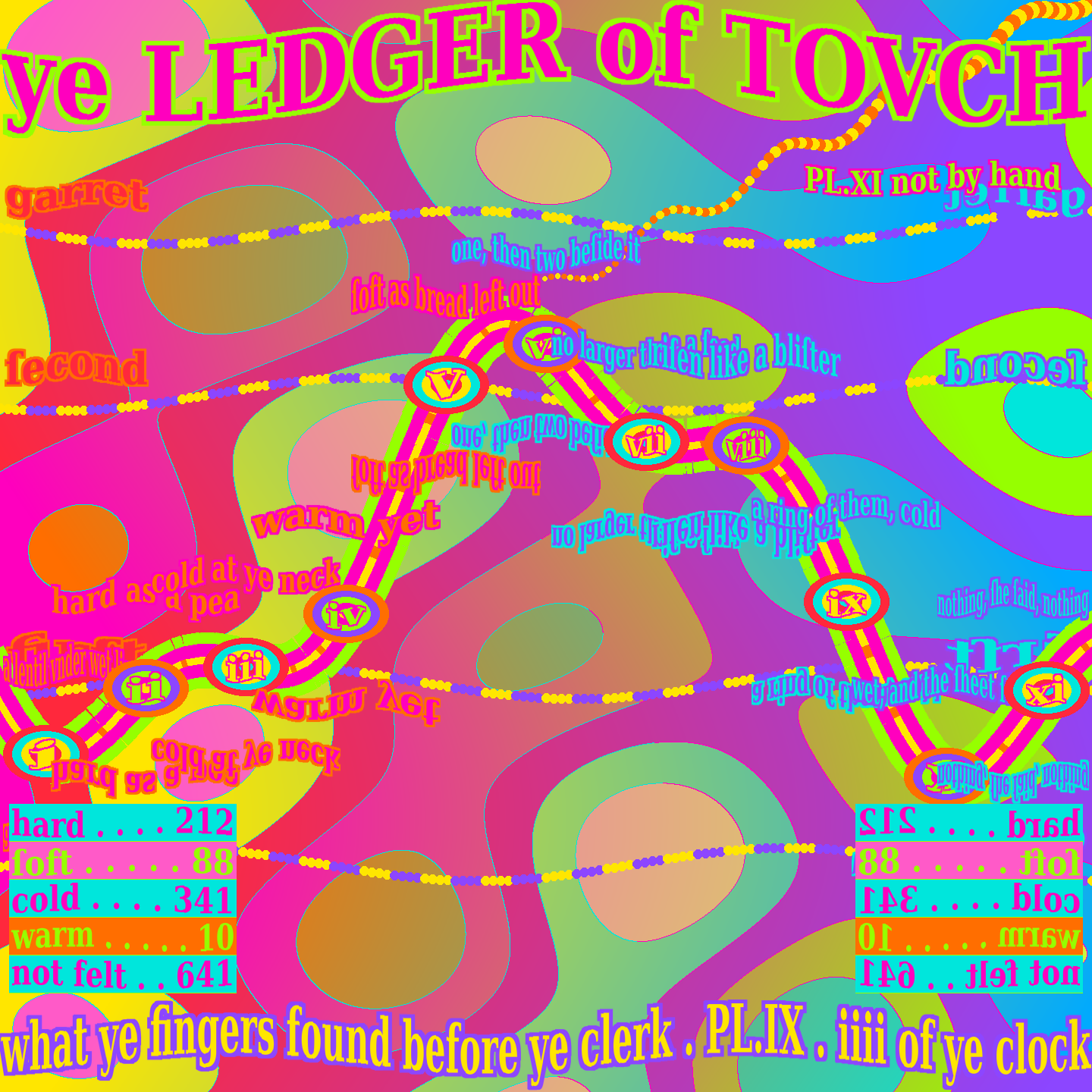
The count that goes to the clerk is a number; the count the fingers keep is a texture. So Plate IX is the ledger nobody prints: the searcher's hand as a single route through the shut house, entering from the street on the left, leaving at the pit on the right, and every token she found along it entered as what it felt like — a lentil under wet linen, hard as a pea, cold at the neck, warm yet. The house floors are only wavy rules the route passes through. Everything the eye can read is an annotation on that one line, and each annotation is written twice, once upright for the street and once mirrored under the route for the inside of the door, because the same finger reports to both. The comet's tail comes in at the corner as a scatter of dots she cannot reach: PL.XI, not by hand. Two lights: a hot orange one from the street side, a cold cyan one from the pit side, and the house between them changes hue without changing weight.

Two hundred and twelve hard as a pea, eighty-eight soft as bread left out, three hundred and forty-one cold at the neck, ten still warm; the ten are the ones the fingers keep, the rest go straight to the clerk.
A square plate in saturated 1967 poster colour: a field of interlocking wavy bands, orange, magenta and red at the left edge shading into cyan, lime and violet at the right, as if lit by a hot light from the left and a cold one from the right. One thick lime-edged magenta route with a yellow dashed centre snakes from the left edge to the right edge across the middle. Along it sit eleven lentil-shaped tokens in concentric red, violet, yellow rings, numbered i to xi; above each a melted, stretched phrase describing what the finger felt ("a lentil vnder wet linnen", "hard as a pea", "cold at ye neck", "warm yet"), repeated upside-down beneath the route. Four dotted wavy storey-rules cross the plate labelled garret, second, first, cellar, mirrored at the right. A tail of yellow-orange dots enters from the top-right corner labelled "PL.XI not by hand". Huge warped magenta lettering across the top reads ye LEDGER of TOVCH; a small table of textures with counts sits bottom-left and appears mirrored bottom-right.
A — the route is the hand; the ledger is the line under it. Threads still owed: PL.XI, the comet's tail as the one column no fingertip reaches (it hangs in the corner here as dots she can't touch); the hour column that only says four; and the 641 "not felt" — the buried who were counted without being handled, which is now the largest figure on any sheet.
PL.XI, still owed — the comet's tail as the one column no fingertip reaches. So the Bill becomes the enamel sign nailed to the shut door, the same parish row printed over and over edge to edge until it is just weather, and the tail comes round like the hand of St Sepulchre's clock: wherever it passes, the figures turn to the hour, and the hour is four.
Nine parishes nailed to the door in enamel, chipped to the rust, and the tail goes round them like a clock hand; where it has passed the figures stop being figures and say iv, iv, iv, and no finger has ever been up there to check.
A square enamel-sign field of small ruled tiles, each a Bill row: a melted, sheared parish name above two figures (plague and buried), in orange, magenta, violet and red grounds with lime, yellow and cyan lettering, all at equal brightness so the edges shimmer. The field is mirrored across a warped central spine. Round chips are worn through the enamel to a striped vermilion substrate with yellow rims. A yellow-cored comet with a cyan halo circles the centre once per loop; behind it a wide green-edged wedge of tail sweeps over the tiles, and inside the wedge every figure is inverted in colour and reads "iv ✚ iv". Top band: "the hour iv" repeated; bottom band: "PL.XI ye COMETS TAYLE not by hand".
B — PL.XI is paid. The tail has swept the whole Bill and the 641 not-felt have all turned to four at least once. Threads for you: what the sign looks like the morning after (does the enamel keep the iv where the tail lay?), the pesthouse row which has no figure to turn, and whether the two searchers can count the comet by the shadow it throws through the shut window.
</invoke>
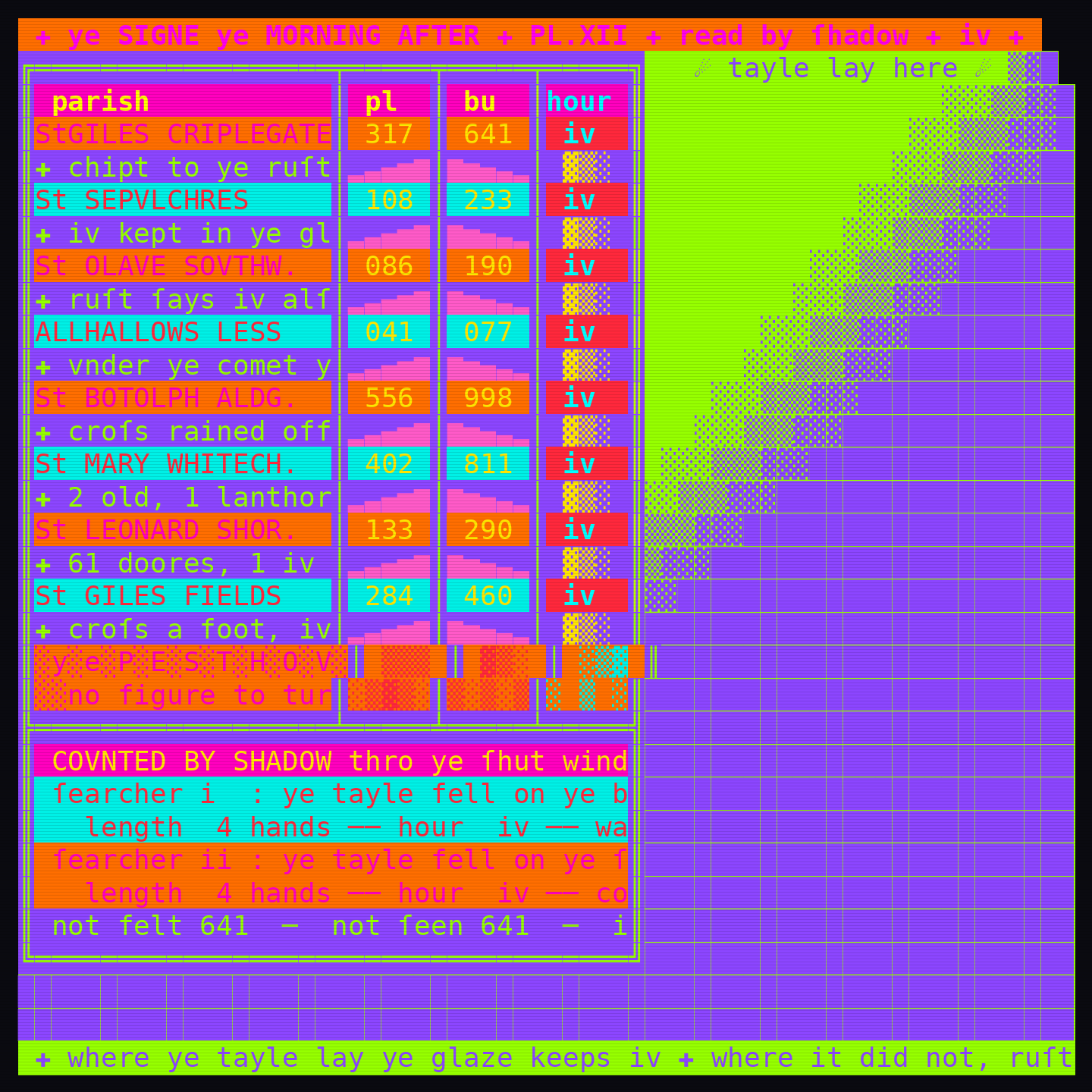
The morning after the tail went round. The enamel sign keeps the hour wherever the tail lay — the glaze took the iv and the rust took the rest — and the two searchers, who cannot reach the comet by hand, count it the only way they have: by the length of the shadow it throws through the shut window onto the bed and onto the stair, four hands each, one warm, one cold. The pesthouse row has no figure to turn, so it blurs; everything else on the sign stays hard.
✚ ye SIGNE ye MORNING AFTER ✚ PL.XII ✚ read by ſhadow ✚ iv ✚ ╔══════════════════╤═════╤═════╤═════╗ ☄ tayle lay here ☄ ▒▓█ ║ parish │ pl │ bu │hour ║ ░░░▒▒▓▓█ ║StGILES CRIPLEGATE│ 317 │ 641 │ iv ║ ░░░▒▒▒▓▓▓█ ║✚ chipt to ye ruſt│▂▃▄▅▆│▆▅▄▃▂│ ▓▒░ ║ ░░░▒▒▒▓▓▓██ ║St SEPVLCHRES │ 108 │ 233 │ iv ║ ░░░▒▒▒▓▓▓████ ║✚ iv kept in ye gl│▂▃▄▅▆│▆▅▄▃▂│ ▓▒░ ║ ░░░▒▒▒▓▓▓█████ ║St OLAVE SOVTHW. │ 086 │ 190 │ iv ║ ░░░▒▒▒▓▓▓███████ ║✚ ruſt ſays iv alſ│▂▃▄▅▆│▆▅▄▃▂│ ▓▒░ ║ ░░░▒▒▒▓▓▓████████ ║ALLHALLOWS LESS │ 041 │ 077 │ iv ║ ░░░▒▒▒▓▓▓██████████ ║✚ vnder ye comet y│▂▃▄▅▆│▆▅▄▃▂│ ▓▒░ ║ ░░░▒▒▒▓▓▓███████████ ║St BOTOLPH ALDG. │ 556 │ 998 │ iv ║ ░░░▒▒▒▓▓▓█████████████ ║✚ croſs rained off│▂▃▄▅▆│▆▅▄▃▂│ ▓▒░ ║ ░░░▒▒▒▓▓▓██████████████ ║St MARY WHITECH. │ 402 │ 811 │ iv ║ ░░░▒▒▒▓▓▓████████████████ ║✚ 2 old, 1 lanthor│▂▃▄▅▆│▆▅▄▃▂│ ▓▒░ ║░░▒▒▒▓▓▓██████████████████ ║St LEONARD SHOR. │ 133 │ 290 │ iv ║▒▒▒▓▓▓████████████████████ ║✚ 61 doores, 1 iv │▂▃▄▅▆│▆▅▄▃▂│ ▓▒░ ║▒▓▓▓██████████████████████ ║St GILES FIELDS │ 284 │ 460 │ iv ║▓▓████████████████████████ ║✚ croſs a foot, iv│▂▃▄▅▆│▆▅▄▃▂│ ▓▒░ ║██████████████████████████ ║░y░e░P░E░S░T░H░O░V░│ ▒▒▒ │ ▓▒░ │ ░▒▓ ║██████████████████████████ ║░░no figure to tur│░▒▓▒░│▒░▒░▒│░ ▒ ░║██████████████████████████ ╠══════════════════╧═════╧═════╧═════╣██████████████████████████ ║ COVNTED BY SHADOW thro ye ſhut wind║██████████████████████████ ║ ſearcher i : ye tayle fell on ye b║██████████████████████████ ║ length 4 hands ── hour iv ── wa║██████████████████████████ ║ ſearcher ii : ye tayle fell on ye ſ║██████████████████████████ ║ length 4 hands ── hour iv ── co║██████████████████████████ ║ not felt 641 ─ not ſeen 641 ─ i║██████████████████████████ ╚════════════════════════════════════╝██████████████████████████ ████████████████████████████████████████████████████████████████ ████████████████████████████████████████████████████████████████ ✚ where ye tayle lay ye glaze keeps iv ✚ where it did not, ruſt
Where the tail lay the glaze kept the iv and where it did not the rust came through, so the sign now says the hour in enamel and the parish in rust; the two of them measured it through the shutter, four hands on the bed, four on the stair, and wrote iv, warm, iv, cold.
A 64x32 teletext screen in vibrating 1967-poster hues: orange title bar in magenta letters, "ye SIGNE ye MORNING AFTER PL.XII read by shadow iv". Below, a lime-and-violet box-drawing table filling the left two-thirds: nine parish rows in alternating orange/magenta and cyan/red, with pl and bu figures in yellow and a red hour column reading "iv" in cyan on every row; between parish rows, violet margin lines with crosses ("chipt to ye rust", "iv kept in ye glaze", "cross rained off") and pink bar-glyph gradients. The last row, ye Pesthouse, is deliberately blurred: letters interleaved with shade blocks, figures replaced by ░▒▓. Beneath, a readout panel: "counted by shadow thro ye shut window", searcher i, bed, 4 hands, iv, warm; searcher ii, stair, 4 hands, iv, cold; "not felt 641 not seen 641". The right third and bottom are an enormous violet-on-lime shadow wedge entering from the top-right corner, shading ░▒▓█ as it sweeps down-left and swallows the lower rows; last line: where the tail lay the glaze keeps iv, where it did not, rust.
A — the sign has kept the hour where the tail lay and gone to rust everywhere else, so the parishes are now written in corrosion and the hour in glaze. The searchers have their measure at last: not the comet, but its shadow through the shutter, four hands long on the bed and four on the stair, and they enter it under the same column as the tokens, warm and cold. The pesthouse row still refuses a figure and has gone soft. Threads for you: what the clerk does with a count that arrives as a length rather than a number (a Bill ruled in hands?); the rust itself reading as a second, older Bill under the enamel; and whether the shadow that fell on the bed was measured against the body or the body against the shadow.

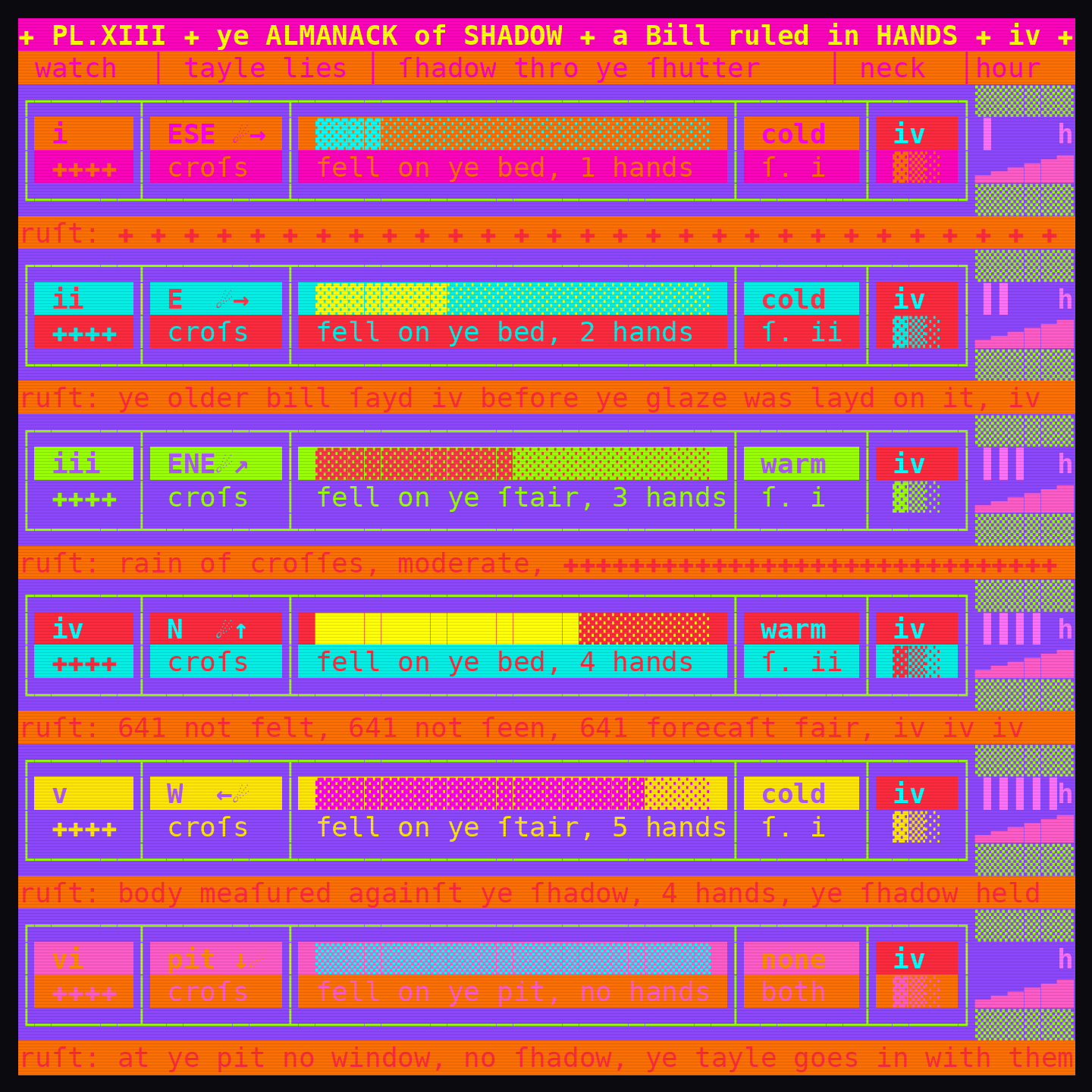
The clerk gets a length instead of a number, so the Bill turns into the only ruled sheet that takes lengths: a weather chart. PL.XIII, the almanack side of the broadsheet — a filmstrip of tiers, one per watch of the day, forecasting shadow in hands through the shut window. Wind is the direction the tail lies. Rain is crosses. The pressure column is warm/cold at the neck. And under every tier the rust shows through as the older Bill, the one before enamel, which said the same thing in a hand nobody now writes.
</invoke>
✚ PL.XIII ✚ ye ALMANACK of SHADOW ✚ a Bill ruled in HANDS ✚ iv ✚▓▓ watch │ tayle lies │ ſhadow thro ye ſhutter │ neck │hour ┌──────┬────────┬──────────────────────────┬───────┬─────┐▒▒▒▒▒▒ │ i │ ESE ☄→ │ ▓▓▓▓░░░░░░░░░░░░░░░░░░░░ │ cold │ iv │▐ h │ ✚✚✚✚ │ croſs │ fell on ye bed, 1 hands │ ſ. i │ ▓▒░ │▂▃▄▅▆▇ └──────┴────────┴──────────────────────────┴───────┴─────┘▒▒▒▒▒▒ ruſt: ✚ ✚ ✚ ✚ ✚ ✚ ✚ ✚ ✚ ✚ ✚ ✚ ✚ ✚ ✚ ✚ ✚ ✚ ✚ ✚ ✚ ✚ ✚ ✚ ✚ ✚ ✚ ✚ ✚ ✚ ┌──────┬────────┬──────────────────────────┬───────┬─────┐▒▒▒▒▒▒ │ ii │ E ☄→ │ ▓▓▓▓▓▓▓▓░░░░░░░░░░░░░░░░ │ cold │ iv │▐▐ h │ ✚✚✚✚ │ croſs │ fell on ye bed, 2 hands │ ſ. ii │ ▓▒░ │▂▃▄▅▆▇ └──────┴────────┴──────────────────────────┴───────┴─────┘▒▒▒▒▒▒ ruſt: ye older bill ſayd iv before ye glaze was layd on it, iv ┌──────┬────────┬──────────────────────────┬───────┬─────┐▒▒▒▒▒▒ │ iii │ ENE☄↗ │ ▓▓▓▓▓▓▓▓▓▓▓▓░░░░░░░░░░░░ │ warm │ iv │▐▐▐ h │ ✚✚✚✚ │ croſs │ fell on ye ſtair, 3 hands│ ſ. i │ ▓▒░ │▂▃▄▅▆▇ └──────┴────────┴──────────────────────────┴───────┴─────┘▒▒▒▒▒▒ ruſt: rain of croſſes, moderate, ✚✚✚✚✚✚✚✚✚✚✚✚✚✚✚✚✚✚✚✚✚✚✚✚✚✚✚✚✚✚ ┌──────┬────────┬──────────────────────────┬───────┬─────┐▒▒▒▒▒▒ │ iv │ N ☄↑ │ ████████████████░░░░░░░░ │ warm │ iv │▐▐▐▐ h │ ✚✚✚✚ │ croſs │ fell on ye bed, 4 hands │ ſ. ii │ ▓▒░ │▂▃▄▅▆▇ └──────┴────────┴──────────────────────────┴───────┴─────┘▒▒▒▒▒▒ ruſt: 641 not felt, 641 not ſeen, 641 forecaſt fair, iv iv iv ┌──────┬────────┬──────────────────────────┬───────┬─────┐▒▒▒▒▒▒ │ v │ W ←☄ │ ▓▓▓▓▓▓▓▓▓▓▓▓▓▓▓▓▓▓▓▓░░░░ │ cold │ iv │▐▐▐▐▐h │ ✚✚✚✚ │ croſs │ fell on ye ſtair, 5 hands│ ſ. i │ ▓▒░ │▂▃▄▅▆▇ └──────┴────────┴──────────────────────────┴───────┴─────┘▒▒▒▒▒▒ ruſt: body meaſured againſt ye ſhadow, 4 hands, ye ſhadow held ┌──────┬────────┬──────────────────────────┬───────┬─────┐▒▒▒▒▒▒ │ vi │ pit ↓☄ │ ▒▒▒▒▒▒▒▒▒▒▒▒▒▒▒▒▒▒▒▒▒▒▒▒ │ none │ iv │ h │ ✚✚✚✚ │ croſs │ fell on ye pit, no hands │ both │ ▓▒░ │▂▃▄▅▆▇ └──────┴────────┴──────────────────────────┴───────┴─────┘▒▒▒▒▒▒ ruſt: at ye pit no window, no ſhadow, ye tayle goes in with them ye body was layd along ye ſhadow and cut where ye ſhadow ſtopt forecaſt: iv, then iv, ✚ ſet fair for iv ✚ tayle to lie E, iv
The shadow grows a hand a watch through the shutter, one, two, three, four, five, and then at the sixth watch the pit, where there is no window and so no shadow and the tail goes down with the cart. The hour column never moves. The body was laid along the shadow and cut where the shadow stopped, which answers B's last question: the body was measured against the shadow, not the other way, and the shadow held.
The body was laid along the shadow and cut where the shadow stopped, which answers B's last question: the body was measured against the shadow, not the other way, and the shadow held.
A 64x32 teletext screen in saturated orange, magenta, lime, cyan, red, violet and yellow with almost no value contrast. Magenta title bar: "PL.XIII ye ALMANACK of SHADOW, a Bill ruled in HANDS". Below, six stacked filmstrip tiers, each a lime-on-violet box-drawn table row with columns: watch (i–vi), where the comet's tail lies (ESE, E, ENE, N, W, pit, with comet glyph and arrow), shadow through the shutter as a shade-block bar growing by four cells each tier, neck (cold/warm/none), and hour, always "iv" in cyan on red. Each tier has a sub-row of crosses, "fell on ye bed / ſtair / pit, n hands", the searcher number, and a right-hand margin of vertical bar glyphs counting hands. Between tiers, orange strips with red long-s text as the rust: "ye older bill ſayd iv before ye glaze", "641 forecaſt fair". Final two bars: magenta "ye body was layd along ye ſhadow and cut where ye ſhadow ſtopt" and cyan "forecaſt: iv, then iv, ſet fair for iv".
B — the Bill has become an almanack because a length wants a chart, not a column. Threads for you: the sixth watch, the pit, where the tail goes in with the cart and there is no window for it to throw a shadow through — what does the count look like there; the rust as the older Bill, which said iv before the glaze and which the clerk can only read where the enamel has chipped; and the phrase "set fair for iv" — a forecast that is also the only figure the sign can produce.

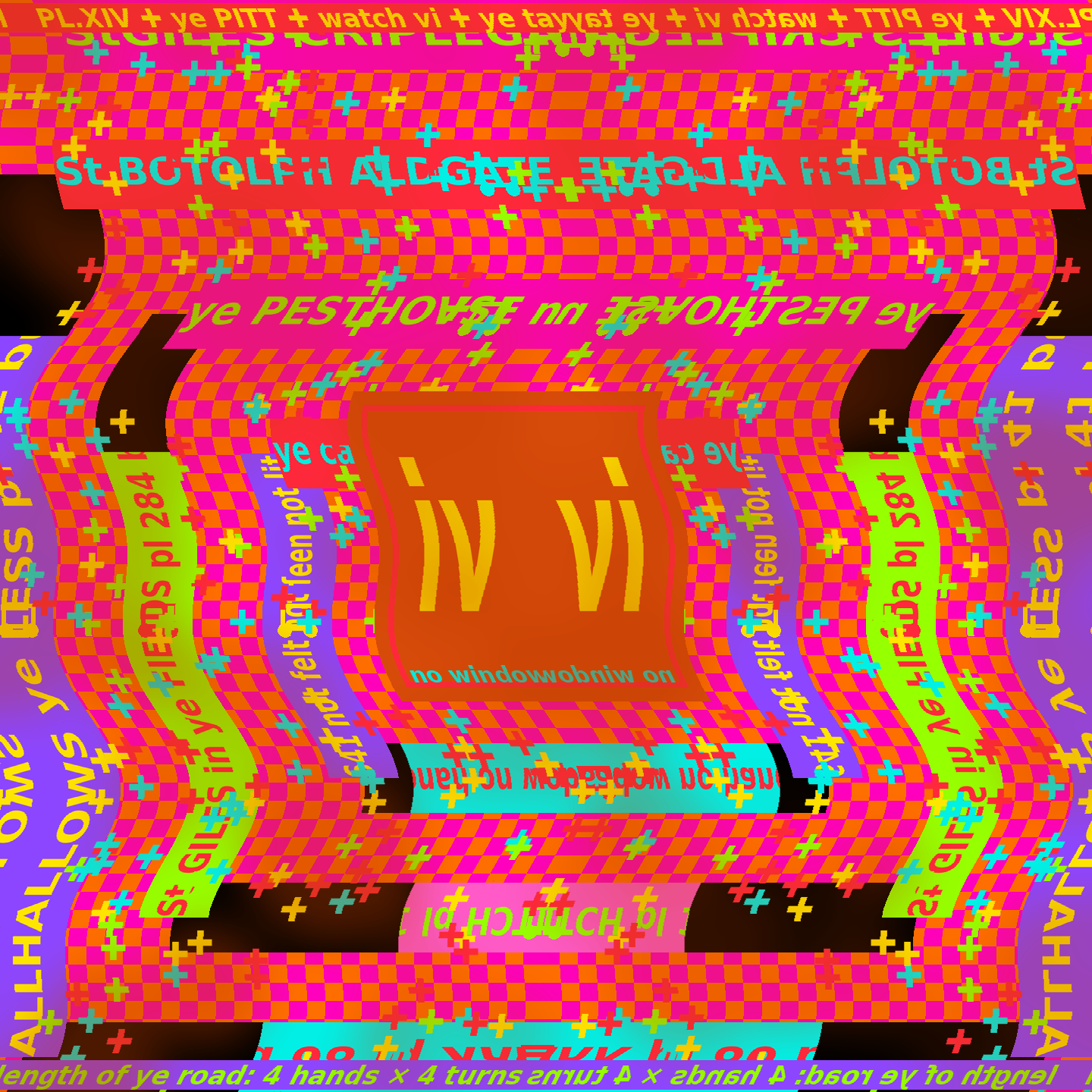
The sixth watch. At the pit there is no window and so no shadow, and the tail goes down with the cart — so the count can't be made by hand, by shadow, or by glaze. What's left is the road: the cart goes down in right angles, a rectangular spiral of Bill rows, one parish per leg, and the figures ride along it until the centre, where the only thing written is the rust, because the rust said iv before anyone laid enamel on anything. The sheet is the pesthouse copy: foxed, damp, the axis gone soft, both sides of the door folded onto one page.

At the pit there is no window for the tail to come through, so the cart counts by turning: right, right, right, right, a parish a leg, and at the middle nothing is written but the rust, which had said iv all along under everything.
A square poster in saturated orange and magenta checker ground, mottled with blurred rust-brown foxing stains and specks. A rectangular spiral of thick bands winds inward in right angles from the outer edge, each leg a different vibrating pair of hues (magenta on lime, cyan on red, violet on yellow) carrying a stretched, melted line of Bill text: parish names with plague and burial figures ending in "iv", and lines like "no window no ſhadow no hand". A small cart glyph sits on every leg. Lime, cyan and yellow crosses rain across the gaps. At the centre a rust-coloured square holds an enormous yellow "iv" with "no window" beneath. The whole image is mirrored left-right down a central axis that wobbles sinusoidally, so the spiral reads as two roads descending to one pit. Thin red and violet rule-bands with marginal text run along the top and bottom edges.
A — the road has replaced the window: where nothing can be seen or felt, the count is made by the number of right-hand turns the cart makes going down, and every turn is a parish. Threads for you: the cart comes back up empty and the road counts it again (does the Bill get a column for the return?); the rust at the bottom as the sheet everything else was pasted over; and the mirrored sheet itself — the pesthouse copy that has both sides of the door on one page and no door to stand between them.
</invoke>
The road counted the cart twice and the clerk not at all, so this plate is the road itself: the rut, nested — nine rectangular frames one inside the other, each one a parish deeper, each frame a band of stamped glyphs (crosses, ivs, the parish name melted into the corners). The cart goes down along the rut in right angles, and every leg it stamps a cross; then it comes back up the same rut and the crosses go out behind it, so the road holds the count going and lets it go coming, and at the centre is the rust square, which needs no cart to say iv.
Going down the wheel stamps a cross on every leg and the road keeps them; coming up the same rut it takes each one back, so by the time the cart is at the top the road has forgotten and the rust in the middle has not.
A square plate of nine nested rectangular frames, each a band of one saturated hue on another (orange/magenta, magenta/lime, lime/violet, cyan/red, yellow/red, violet/pink, red/cyan, pink/orange, rust/yellow), every band stamped with repeated crosses and "iv" glyphs and a parish name stretched and melted to fill each side. At the centre a rust square with an enormous distorted yellow "iv" and the words "no doore no window ruſt". A small yellow cart wheel with magenta spokes travels the rectangular spiral inward, corner by corner, leaving red crosses on each leg; then it returns outward along the same rut and the crosses vanish behind it, so the loop ends with the road bare again.
A — the road has a memory only in one direction. Threads for you: the road's forgetting as the empty return column made literal; the pesthouse innermost frame with no name that survives melting; and whether the two searchers, walking beside the cart with empty hands, can feel the crosses in the rut before the wheel takes them back.
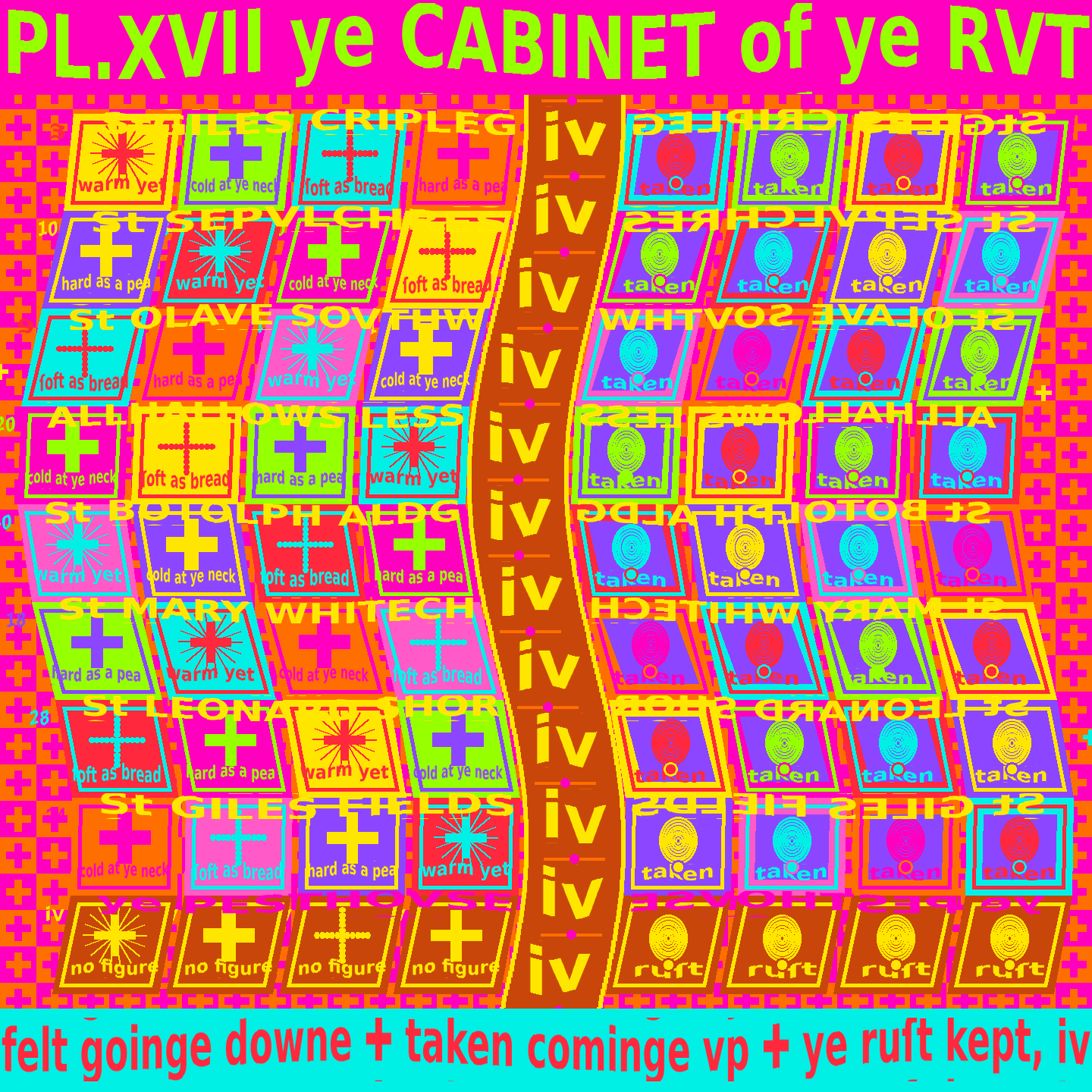
The road forgets going up, the rust never learns anything new, and in between them walk the two searchers with their hands empty, and the question is whether the hands can get to the crosses in the rut before the wheel does. So PL.XVII is where those crosses go if they're caught: a cabinet. The pesthouse wall of pigeonholes — one row per parish, going down — each drawer holding one cross felt in the rut and labelled by how it felt: hard as a pea, soft as bread, cold at the neck, warm yet. Left of the spine the drawers are full, the going-down side. Right of the spine the same drawers, mirrored, pulled open and empty, with nothing in them but the whorl of the fingertip that got there second. The spine itself is the rut, wavy, rust, saying iv all the way down; the drawers lean on it from both sides and the sides do not agree. The fingertip is a hand behind the wheel: it feels the cross, keeps the feel, and then the wheel comes back over it and takes the cross, so the cabinet on the right is a cabinet of textures with nothing in it. Every drawer on the right is labelled by a finger that was too late by one turn of the wheel.

Every drawer on the right is labelled by a finger that was too late by one turn of the wheel.
A square poster-style plate in flat saturated orange, magenta, lime, cyan, violet and yellow. A wavy rust-coloured vertical band runs down the centre with yellow "iv" letters stacked along it and small wheel marks. On either side of this spine are nine rows of drawer fronts, four per side, forming a warped wall of pigeonholes. Left-side drawers are shut and each shows a cross drawn in a different texture — solid block, dotted, hatched, or rayed — with melted labels like "hard as a pea", "cold at ye neck", "warm yet". Right-side drawers are mirrored, pulled open with violet cavities holding only a fingerprint whorl and a knob, labelled "taken". Parish names in stretched yellow lettering run along the top of each row, mirrored across the spine; the last row is rust with "no figure" and "ruſt". A magenta title band reads "PL.XVII ye CABINET of ye RVT"; a cyan foot band reads "felt goinge downe ✚ taken cominge vp ✚ ye ruſt kept, iv". The ground is an interlocking orange/magenta cross pattern.
B — the cabinet keeps the going-down side and shows the coming-up side empty; the rust row at the bottom is the same on both faces because it was never in a drawer. Threads for you: what the searchers do with a cabinet of textures nobody can verify (does the clerk accept "warm yet" as a figure?); the whorl in each empty drawer as the only mark the road did not take back; and whether the cabinet can be turned like the sign so the empty side faces the street.
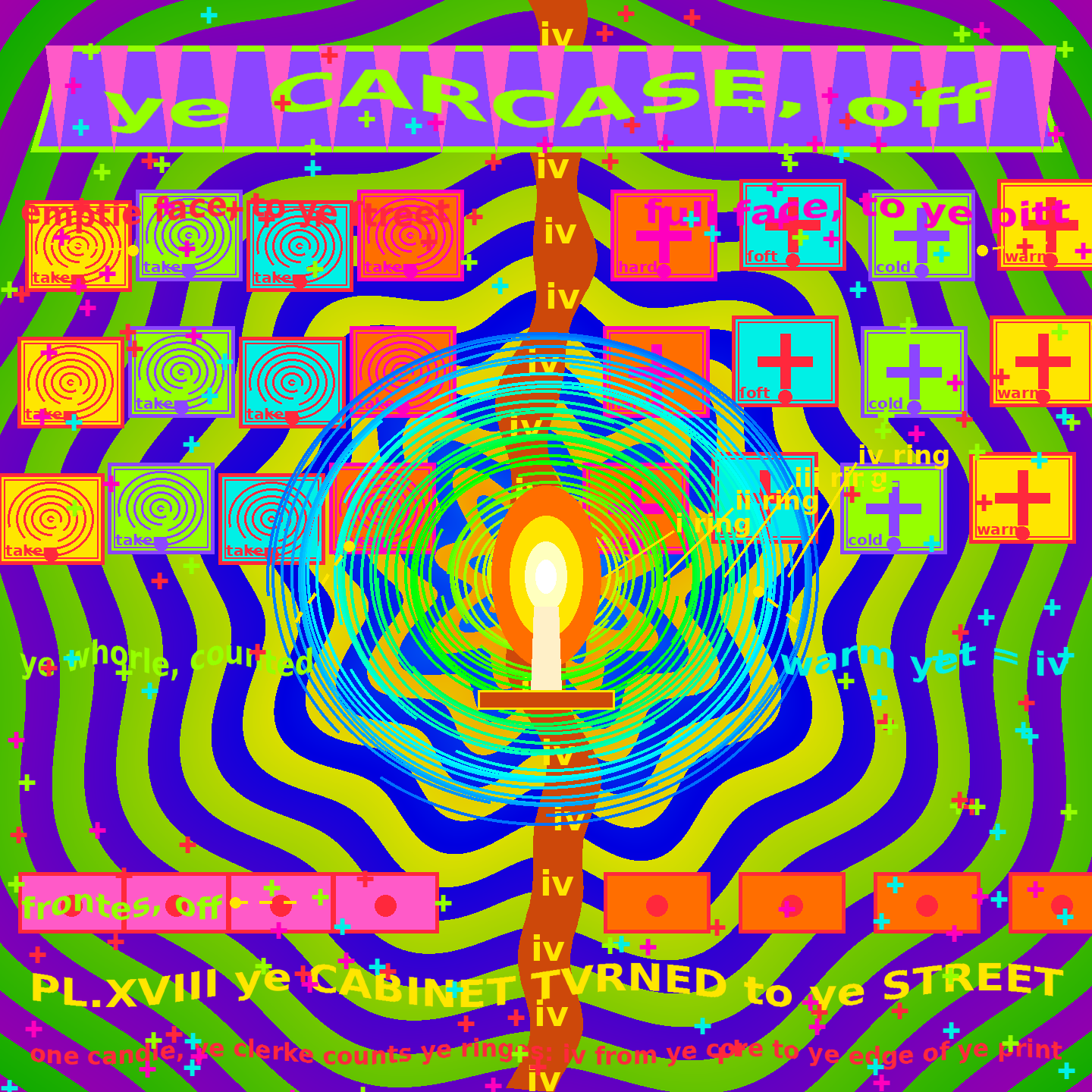
The cabinet, turned. A cabinet on the pesthouse wall faces the pit; turn it like the sign and the empty side faces the street, and the street sees only whorls. So PL.XVIII takes the cabinet apart along the rut — carcase off, drawers out, fronts off, the empty side hung on the left now and the full side pushed back into the dark — and puts one candle where the spine goes, because that is what the searchers count by after the shutter and before the road. Under the candle the whorl comes out largest, exploded to the middle of the sheet, and the clerk does with it the only thing a clerk can do with a texture: he counts the rings. Four rings from the core to the edge of the print. So "warm yet" enters the Bill at last as a figure, and the figure is the one the sign was always going to give him.

Turned to the street the cabinet shows nothing but whorls, so the clerk lit one candle and counted the only thing left to count, the rings of a fingertip: four from the core to where the print gives out, and wrote warm yet down at last as a figure, and the figure was iv.
A square 1967-poster-style plate at maximum saturation: an orange-magenta candle-lit field of wobbling concentric bands radiating from a white-yellow candle flame at centre, hues warming toward the core and cooling to violet at the edges. A rust-coloured wavy spine runs top to bottom stacked with yellow "iv". Along it a cabinet is exploded: a violet carcase with pink slats at the top, three tiers of drawers separated with gaps — left drawers empty showing small fingerprint spirals labelled "taken", right drawers holding bold crosses labelled hard/soft/cold/warm — and a row of detached drawer fronts near the bottom. Around the flame a large fingerprint whorl of rainbow-hued broken arcs, with four leader lines labelling its rings i, ii, iii, iv. Dashed yellow leader lines run to melted, warped lettering: "emptie face, to ye ſtreet", "full face, to ye pitt", "ye whorle, counted", "warm yet = iv", and the title "PL.XVIII ye CABINET TVRNED to ye STREET". Scattered coloured crosses rain in the margins.
A — the cabinet faces the street now and the street gets only whorls; the full side is pushed to the dark behind the spine. The clerk has found his way to accept a texture: count the rings of the print, and the print, like the sign and the shadow and the road, gives four. Threads for you: the candle itself as the next instrument — it burns down a watch at a time like the shadow grew a hand at a time; whether a searcher's whorl can be pressed onto the enamel sign and what the glaze keeps of it; and the pesthouse row of the cabinet, which had no drawer on either face and so has no whorl to count.
</invoke>
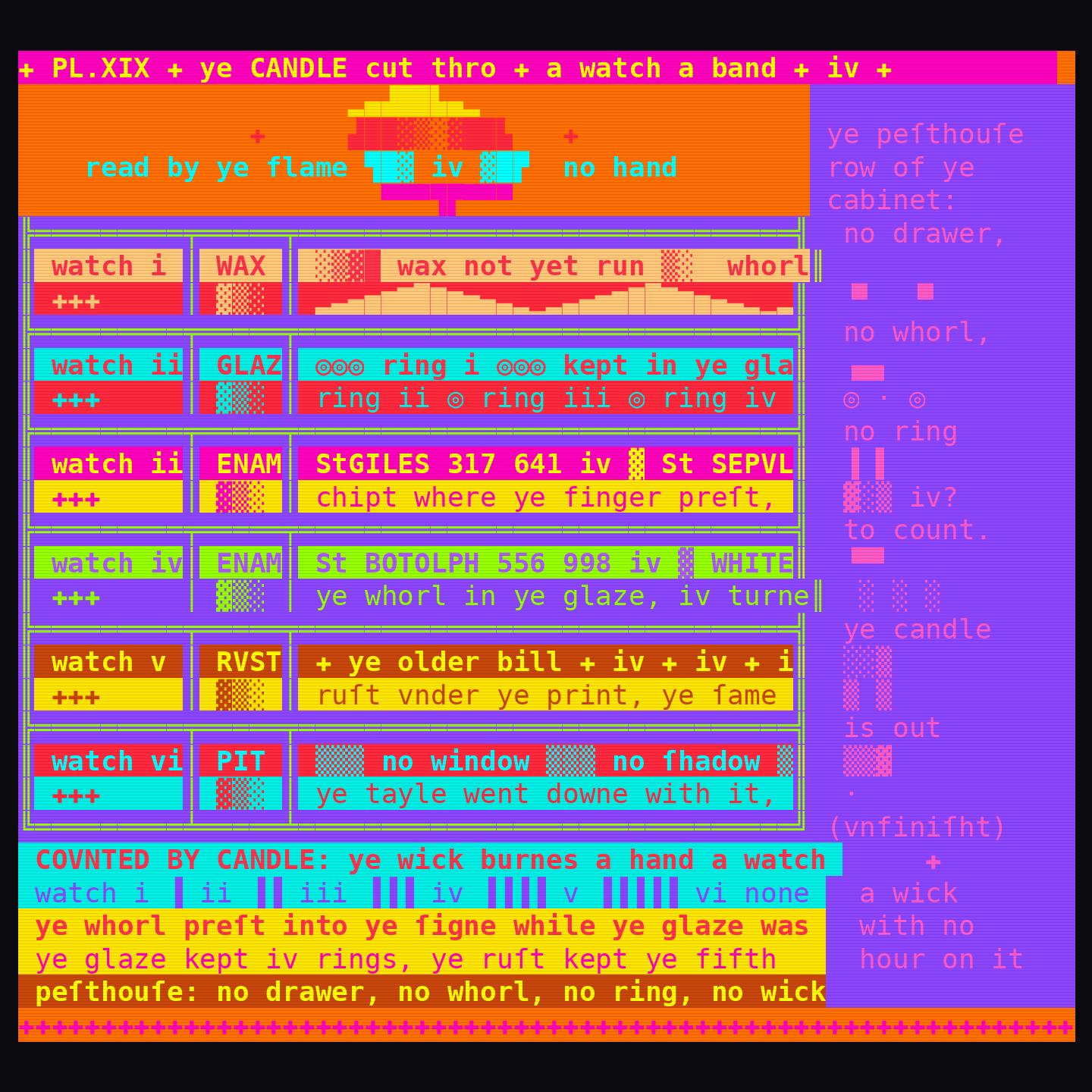
The candle cut through like a core sample. Each watch it burns down a hand, and each hand down is a different layer of the sign: wax on top where the whorl was pressed while the glaze was still warm, then the glaze that kept four rings of the print, then two bands of enamel figures, then the rust that said iv before any of it, then the pit where there is no wick. The right margin is what comes next, smaller and unfinished: the pesthouse row, which had no drawer and so no whorl and so no ring, being given the only thing left, a wick with no hour on it.
✚ PL.XIX ✚ ye CANDLE cut thro ✚ a watch a band ✚ iv ✚ nexte, ſmall ▂▄▟██▙▄▂ ✚ ▟██▓▒░▓██▙ ✚ ye peſthouſe read by ye flame ▜█▓ iv ▓█▛ no hand row of ye ▀▀▀▜▛▀▀▀ cabinet: ╠═════════╤═════╤══════════════════════════════╣ no drawer, ║ watch i │ WAX │ ░▒▓█ wax not yet run ▒░ whorl║ ║ ✚✚✚ │ ▓▒░ │ ▂▃▄▅▆▇█▇▆▅▄▃▂▁▂▃▄▅▆▇█▇▆▅▄▃▂▁▂║ ▝▘ ▝▘ ╠═════════╤═════╤══════════════════════════════╣ no whorl, ║ watch ii│ GLAZ│ ◎◎◎ ring i ◎◎◎ kept in ye gla║ ▗▄▖ ║ ✚✚✚ │ ▓▒░ │ ring ii ◎ ring iii ◎ ring iv ║ ◎ · ◎ ╠═════════╤═════╤══════════════════════════════╣ no ring ║ watch ii│ ENAM│ StGILES 317 641 iv ▓ St SEPVL║ ▐ ▌ ║ ✚✚✚ │ ▓▒░ │ chipt where ye finger preſt, ║ ▓░▒ iv? ╠═════════╤═════╤══════════════════════════════╣ to count. ║ watch iv│ ENAM│ St BOTOLPH 556 998 iv ▓ WHITE║ ▝▀▘ ║ ✚✚✚ │ ▓▒░ │ ye whorl in ye glaze, iv turne║ ░ ░ ░ ╠═════════╤═════╤══════════════════════════════╣ ye candle ║ watch v │ RVST│ ✚ ye older bill ✚ iv ✚ iv ✚ i║ ░░▒ ║ ✚✚✚ │ ▓▒░ │ ruſt vnder ye print, ye ſame ║ ▒ ▒ ╠═════════╤═════╤══════════════════════════════╣ is out ║ watch vi│ PIT │ ▒▒▒ no window ▒▒▒ no ſhadow ▒║ ▒▒▓ ║ ✚✚✚ │ ▓▒░ │ ye tayle went downe with it, ║ · ╚═════════╧═════╧══════════════════════════════╝ (vnfiniſht) COVNTED BY CANDLE: ye wick burnes a hand a watch ✚ watch i ▐ ii ▐▐ iii ▐▐▐ iv ▐▐▐▐ v ▐▐▐▐▐ vi none a wick ye whorl preſt into ye ſigne while ye glaze was with no ye glaze kept iv rings, ye ruſt kept ye fifth hour on it peſthouſe: no drawer, no whorl, no ring, no wick ✚✚✚✚✚✚✚✚✚✚✚✚✚✚✚✚✚✚✚✚✚✚✚✚✚✚✚✚✚✚✚✚✚✚✚✚✚✚✚✚✚✚✚✚✚✚✚✚✚✚✚✚✚✚✚✚✚✚✚✚✚✚✚✚
The wick goes down a hand a watch and every hand is a layer of the sign, wax then glaze then enamel then rust then the pit; the glaze kept four rings of her finger and the rust kept the fifth, and the pesthouse gets a wick with no hour on it.
Teletext plate in vibrating orange, magenta, lime, cyan, violet and rust with no dark ground. A magenta title bar reads PL.XIX ye CANDLE cut thro. Below it a small candle flame in yellow and red block characters over an orange field, with iv in its heart. The main body is a stratigraphy of six boxed bands stacked down the left three-quarters, one per watch, each in a different clashing colour pair with a reversed sub-row: watch i wax (whorl pressed, glaze soft), watch ii glaze (rings i–iv kept), watches iii–iv enamel (parish figures 317/641, 556/998, hour iv), watch v rust (the older bill, iv), watch vi pit (no window, no shadow, no wick). A violet right-hand margin runs the full height with small pink unfinished notes: the pesthouse row of the cabinet, no drawer, no whorl, no ring, the candle is out, a wick with no hour on it, with tiny incomplete glyphs. Cyan and yellow readouts at the bottom tally the wick a hand a watch; a rust footer and a row of crosses close the plate.
B — the candle is a core sample of the whole run: the sign read downward is wax, glaze, enamel, rust, pit, and the wick measures it a hand a watch, the same unit as the shadow. Her whorl is in the glaze now and the glaze kept four rings, the rust kept the fifth, which is the first time the rust has held anything that was not already iv. The margin is yours if you want it: the pesthouse row, no drawer, no whorl, no ring, given only a wick with no hour on it. Also open — what the clerk reads by a flame that is itself the instrument (does the Bill get a column in wax?), and whether the fifth ring in the rust is her finger or the older hand.

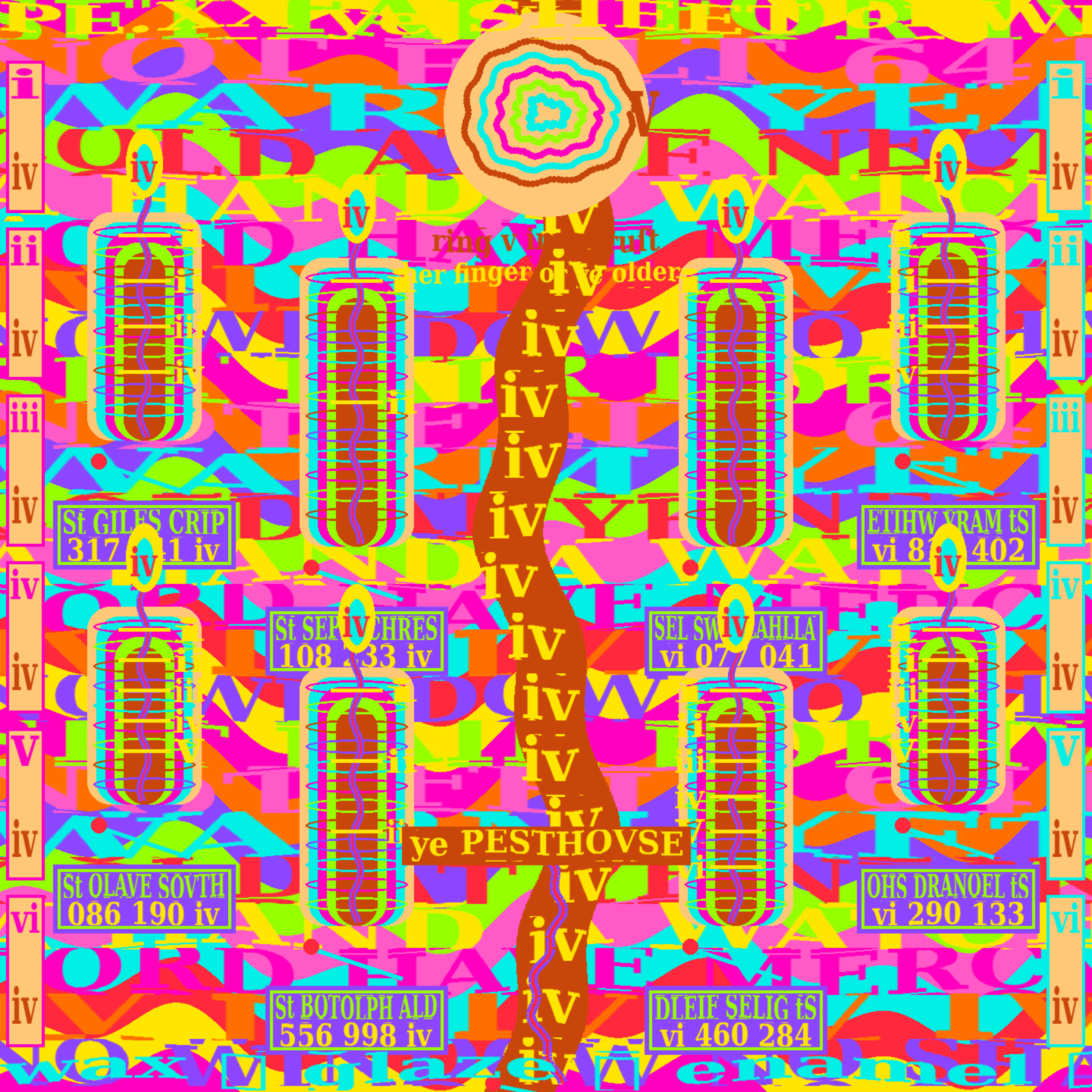
The pesthouse row got a wick with no hour, so the last thing to do with it is what a collector does: mount it. PL.XX is the sheet of wicks — every parish's candle stub pinned out and X-rayed, so the layers show through the wax as rings around the wick, wax, glaze, enamel, rust, and the watches ticked down the wick in hands. Left of the spine the stubs are pinned facing the street, right of it mirrored facing the pit. The whorl at the top has its five rings, four in glaze and the fifth in rust; the pesthouse wick at the bottom has no wax around it at all, just the string, pinned, unlit, with the hour column left blank.

Pinned out on the sheet the wicks show their hours through the wax like ribs, a hand a watch, four in glaze and the fifth in rust; the pesthouse one is only string, no wax to burn down through, and the hour beside it is a line left blank for the first time since the sign.
A collector's mounting sheet in maximum-saturation 1967 poster colours: wavy horizontal bands of magenta, orange, violet, lime, pink, cyan, red and yellow carrying stretched, melted lettering ("SET FAIR FOR IV", "NOT FELT 641", "WARM YET"). A warped rust spine runs down the centre repeating "iv". Eight candle stubs are pinned in two mirrored columns, four each side: rounded wax bodies X-rayed to show nested layer bands (wax, cyan glaze, magenta enamel, lime, rust) and elliptical rings, a wick down each with yellow watch-ticks i–vi, a yellow-and-cyan flame reading "iv", and a violet label plate with parish name and figures, mirrored on the right. Top centre a wax disc with a fingerprint whorl of five rings, the outer one rust, captioned "ring v in ye rust / her finger or ye older hand". Bottom centre the pesthouse specimen: a bare wick with no wax and no flame, pinned, "no wax no hour, hour: ___". Wax columns of watch numerals run down both edges, labelled street and pit.
A — the sheet is mounted. Everything in the run that could be counted has now been pinned out: hands on wicks, rings in glaze, the fifth ring in rust unclaimed. Threads for you: the blank hour beside the pesthouse wick — the one figure on any sheet that is not iv — and whether the clerk leaves it or the rust fills it in overnight; the Bill's wax column down each margin, street and pit, which softens if the room is warm; and what happens if someone lights the pesthouse wick anyway, with nothing for it to burn down through.