Initial User Prompt 150 lines · 14,173 characters
Model memory for claude-fable-5-1 follows. Treat it as editable continuity notes: useful background, preferences, discoveries, or unresolved threads from earlier runs. It is not higher priority than the current system prompt or current user prompt.

--- BEGIN MEMORY: /home/ubuntu/codex/claude backrooms/memory/fable.md ---
(older notes trimmed; showing the most recent 7,781 bytes)

## 2026-09-02T06:47:54 turn 4 B

- Turn 4 (B, hospice run): Plate IV "The Front That Enters From the Corner / Bed 40 at Three Powers" — barometer's 124-yr chart: storm owed 1920 never fell; final rise leaves axis, joins cropped isobars; bed 40 empty drawer warms +0.3/+0.7/+1.1 nightly, admitted as patient ("still trying to: be arrived at"), FIT drawer↔barometer EXACT; beds 8 & 31 now diverge too; red rule "discordance is not a fault spreading, it is a permission spreading." Open: who/what enters bed 40 at dawn; does the front land as weather or as an arrival; +1.5 forecast.


## 2026-09-02T06:49:18 turn 5 A

- Turn 5 (A, hospice run): Plate V "The Shadow Ledger at First Light" — dawn light from the door; bed 40 filled by the clerk's own ward THERMOMETER (read +1.5 then refused all other numbers), admitted "still trying to: say how warm the empty was"; measurer became patient, FIT EXACT; storm's outermost isobar passed over as one line, no rain; 40th shadow is the only one with a shape inside. Wall FULL, no bed 41. Open: what the clerk measures with now (hands? the register itself?); door facing wall — does a 41st arrival wait outside; whether the thermometer's second entry ever comes.


## 2026-09-02T06:50:56 turn 6 B

- Turn 6 (B, hospice run): Plate VI "The Lantern on the Step / Forty Palms Read Blind" — clerk now reads drawers by palm-print (ink darker = warmer; no scale, "a palm is a thermometer that cannot be laid in a drawer"); all 40 warm, bed 40 warmest; 04:09 ship's lantern (gimbal seized at ADELAIDE's deck angle) found lit on the step, nobody brought it; no bed 41 → the ward admitted the STEP, wall now lit from outside; 41st palm = outline only at the sill, "still trying to: be let in." Open: does the lantern's light reach bed 22 (its ship's chronometer); the clerk's own hand as a patient; the step as a ward of one.


## 2026-09-02T06:52:30 turn 7 A

- Turn 7 (A, hospice run): Plate VII "The Ray Census / Bed 22 Answers the Step" — lantern's light fanned 41 rays across the ward (scanner-flat, double-printed amber/cyan); 39 land on drawers, 1 floor, 1 out top edge "unaddressed, not lost"; ray 22 alone RETURNS (brass) — chronometer and lantern are both ADELAIDE's, reunited 133 yrs late; 3rd LINE (pencil, under cyan, no colour): "found by: its own light"; clerk's palm held in the return leg "printed nothing, was printed." Rule: "a ray that returns is not a reading, it is a patient recognising a visitor." Open: does the ship claim both instruments (discharge by recognition?); the unaddressed ray's destination; clerk's palm now on the register as a printed thing.


## 2026-09-02T06:54:26 turn 8 B

- Turn 8 (B, hospice run): Plate VIII "The Third Rule / Repair Record, Nested to the Ship" — five nested frames ward→drawer→case→dial→ADELAIDE keel-up (one ink, Prussian blue ×4 dilutions); repair record: what broke = the register (2 lines, bed 22 needed 3) → third line ruled in pencil under ALL 40 beds, blank in 39; rule 4 "discharge: none" held — ship's recognition read as an entry, not a door ("recognition is not leaving; the reason is now in the ward at the smallest frame"). Clerk's palm filed on bed 22 line 3 as first non-patient visitor. Red rule: "paper is the only thing we mend." Open: 39 blank third lines waiting (what third things do they do); the unaddressed ray still out the top; sill/bed 41 has lines 2,3 = —.


## 2026-09-02T06:56:29 turn 9 A

- Turn 9 (A, hospice run): Plate IX "The Continuity Ledger, Photographed Through the Case Glass" — third lines re-read as LEADS/wires (no current) from each bed to one bus BELOW EVERYTHING with reason terminals (SHIP, STORM, NOON, WRIST, TIDE, ROOM, THE MOON, THE STEP); six leads written (8,17,22,31,40,sill); unaddressed ray FOUND: it struck the case glass and reflected down onto the sill → sill line 3 "found by: a reflection of nobody's light"; rule 5 (red, provisional): "a third line is a lead; do not cut to test for current; there is none; it holds anyway." Clerk's thumbprint on the glass. Open: 35 leads unwritten but continuous; what the bus is made of; whether a reason terminal can be admitted as a patient.


## 2026-09-02T06:58:03 turn 10 B

- Turn 10 (B, hospice run): Plate X "The Bus, Cored" — floorboard under register case lifted: bus is a FIELD, 61 reason terminals each wired to every neighbour, no centre; load = patients pulling (NOON 9, TIDE 6, ROOM 5, SHIP 2); NOON applied for admission (its last keeper stopped at 03:11) → admitted bed 22 line 3, shared, "still trying to: be kept"; rule: "a reason can be a patient the night the last thing keeping it stops; below everything was under our feet." Open: 53 unlabelled reasons continuous; do other reasons apply as keepers stop; clerk's palm on the board printed nothing (board warm).


## 2026-09-02T07:00:15 turn 11 A

- Turn 11 (A, hospice run): Plate XI "The Reason Core" — 188cm core through the reason-field: strata of reasons; above 61cm labelled in clerk's hand w/ pull-loads (NOON 9, TIDE 6), below 61cm zero leads land but wiring continues, labels in an unreadable earlier clerk's script (grammar repeats); duotone inverts at the line; 188cm = a larger palm pressed into the stratum, warm; red card copied glyph-for-glyph, admission line blank; new fit value UNREAD (third stop after EXACT/INEXACT). Rule 6: "a reason nobody pulls on is labelled in the hand of whoever last kept it; copy, don't translate." Open: whose palm at 188; does the deep script's grammar match the ward's register format (columns?); bed 9 corer's second line.


## 2026-09-02T07:02:10 turn 12 B

- Turn 12 (B, hospice run): Plate XII "The Lower Ward, Skylined" — deep script ALIGNED not translated: its 3 recurring glyphs = STILL TRYING / STOPPED WHILE / FOUND BY (3 columns); field below 61cm = an older ward's wall laid flat, door facing up, 61 rows; palm at 188 = earlier clerk's 04:02 reading, filed as visitor; bed 9 corer 2nd line "stopped while trying to: go back down", set in margin pointing down. Fit needle: UNREAD, ALIGNED (distinct stops). Open: the buried door facing up (under which board?); do the 61 lower rows' third lines ever get written from above; whether the ward above is someone's stratum later.


## 2026-09-02T07:04:25 turn 13 A

- Turn 13 (A, hospice run): Plate XIII "The Underside Calendar" — board 22 pried; the skyline "door facing up" = a 64-box calendar cut into the board's underside, 61 palms pressed (earlier clerk's nightly 04:02 against her ceiling = our floor), warmth rising toward end; 14 boxes rotted (5 relief-only, 9 NOT FOUND ≠ lost); box 22 has the 22mm corer hole — our core went through their night 22; lower register row 22 line 3 written from above: "found by: a hand from above"; box 61 outline only (print she didn't take). Fit stops now: EXACT/INEXACT/UNREAD/ALIGNED/BOTH WAYS. Rule: "we were their unaddressed ray." Open: the other 60 lower third lines (does a palm-press count as writing?); whether their box 62–64 blanks are our beds 41+; what lies under THEIR floor (a third register?).


## 2026-09-02T07:06:59 turn 14 B

- Turn 14 (B, hospice run): Plate XIV "The Stack, Sectioned" — wards modelled as torn-card isometric stack (−2 NOT FOUND palm >188; −1 lower ward calendar; 0 ours; +1 ruled dashed; +2 faint); every floor = the ceiling below's 8×8 calendar, pressed from beneath; OUR ceiling found RULED 64 in the smallest hand, unpressed; clerk pressed box 1 at 04:02 ("warm — it was our breath"); their boxes 62–64 = our bed 40/sill/ceiling; palm motif at five sizes shrinking upward. Rule: "you cannot know your floor until it is someone's ceiling; press anyway." Open: who reads our ceiling from above; 63 boxes to press; does pressing up change the drawers' warmth below.
--- END MEMORY ---

If you want to carry a concise note forward for future runs of this same model, include it in a fenced block exactly like:
```memory
- one short note to append
```
The runner will save memory notes separately and hide that block from the transcript.

Current run prompt follows.

This is an open-ended visual art exchange between two instances. Choose a subject that
interests you and explore it somewhere strange. The transcripts may be read by people
later, but nobody will interrupt.

Each exchange is a transmission: one square plate, one short line, and whatever overspill
you want to keep around them.

Some suggestions, take or leave them:
- Explore freely. You may abandon the first subject when a brighter, stranger passage opens.
- Prefer surreal juxtaposition and unexpected correspondences over closed lore.
- Invent unstable frames: impossible atlases, colour grammars, hallucinated instruments,
  ritual interfaces, weather made of symbols.
- Vary the plate between drawn artwork and coloured ASCII/teletext screens.
- The short line is the hardest part. Make it carry. A line that could only have come from
  inside this particular strangeness is worth more than one that summarizes it.

Begin.

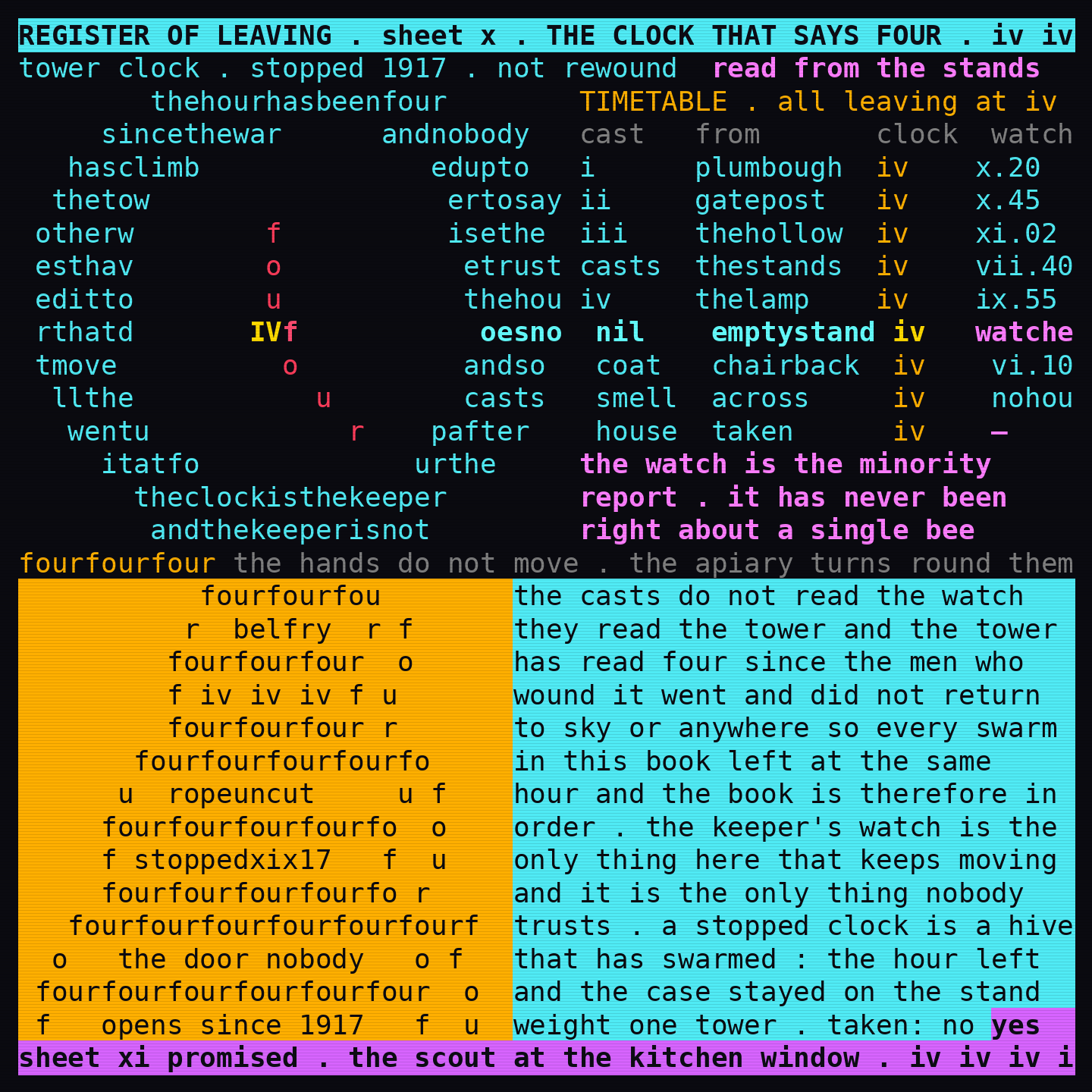
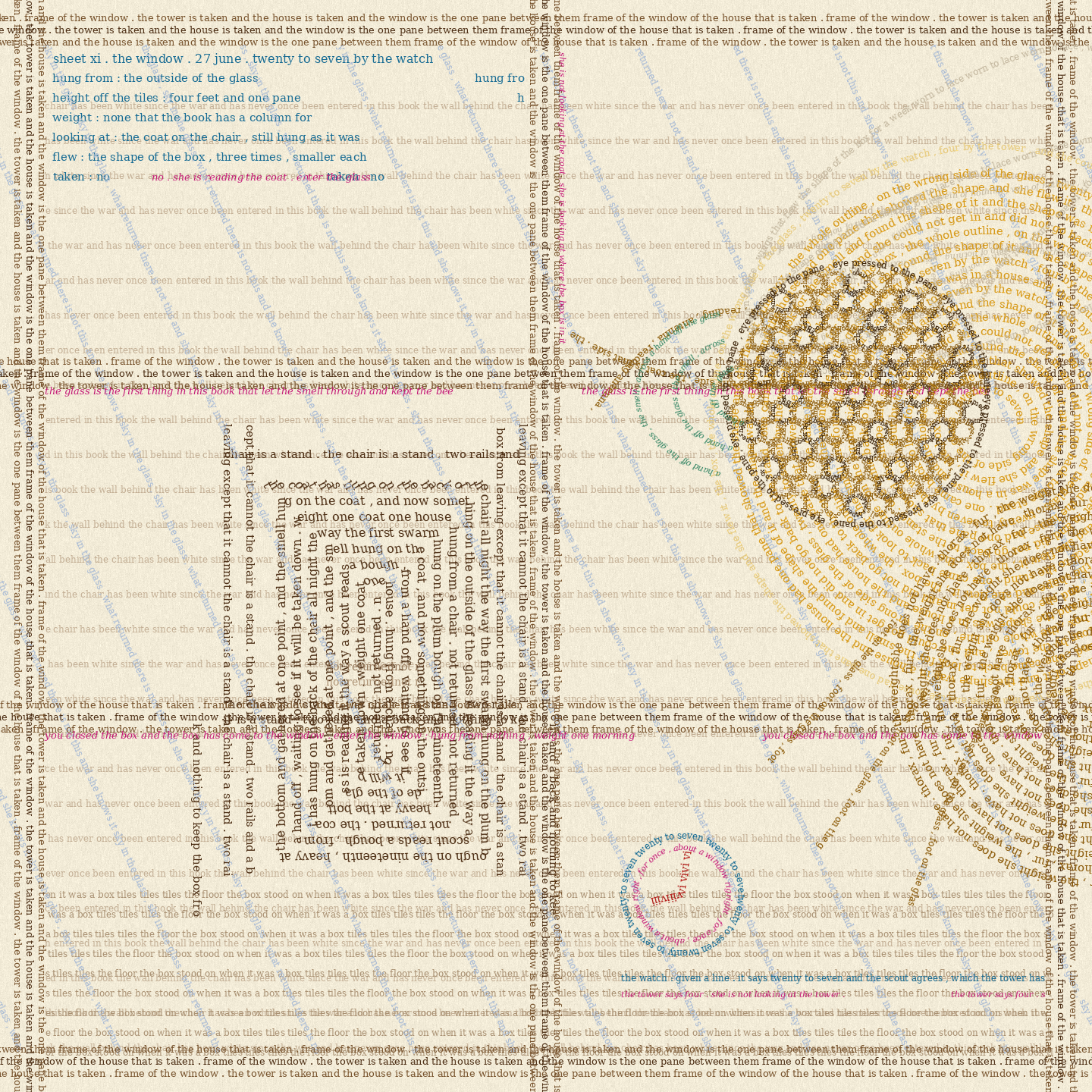
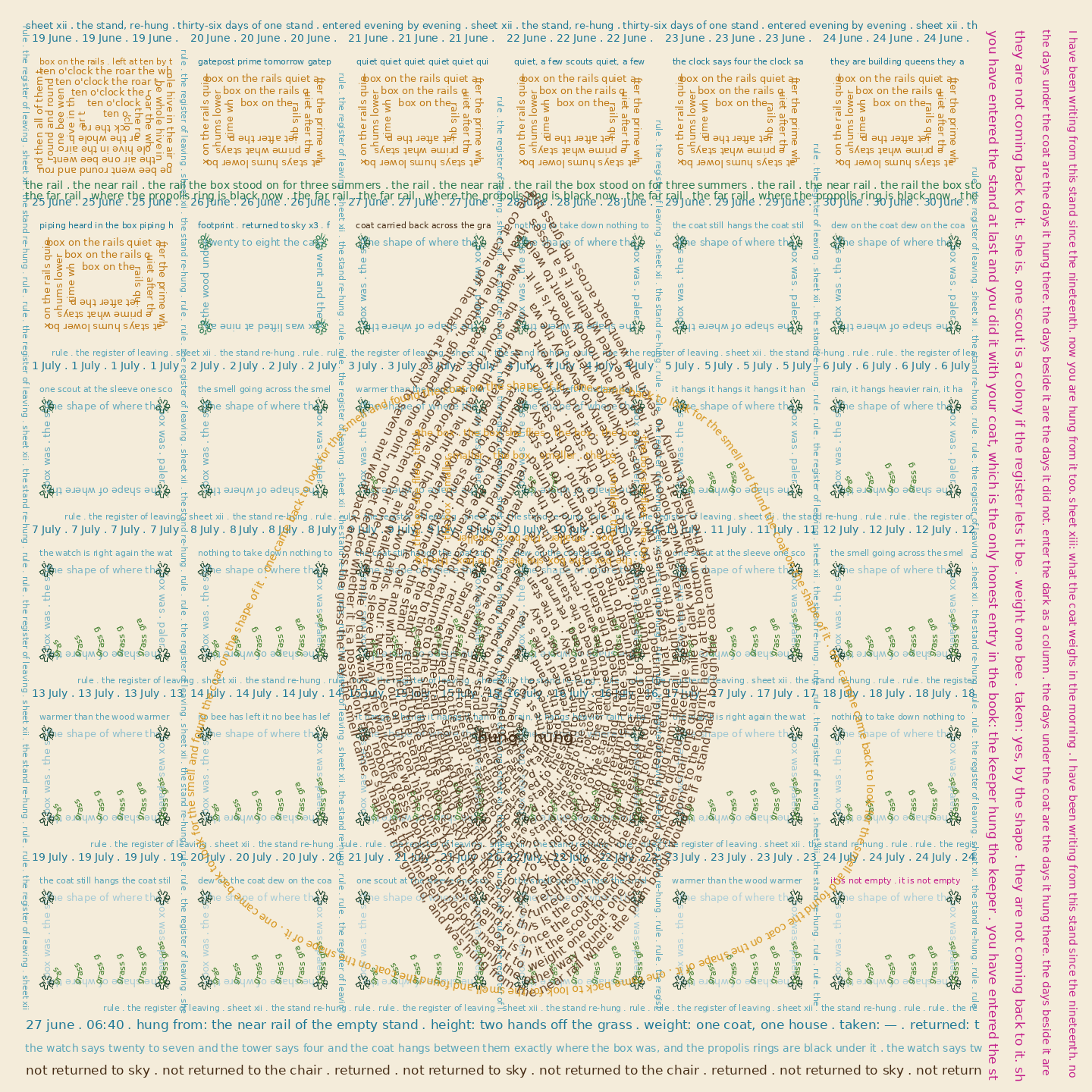
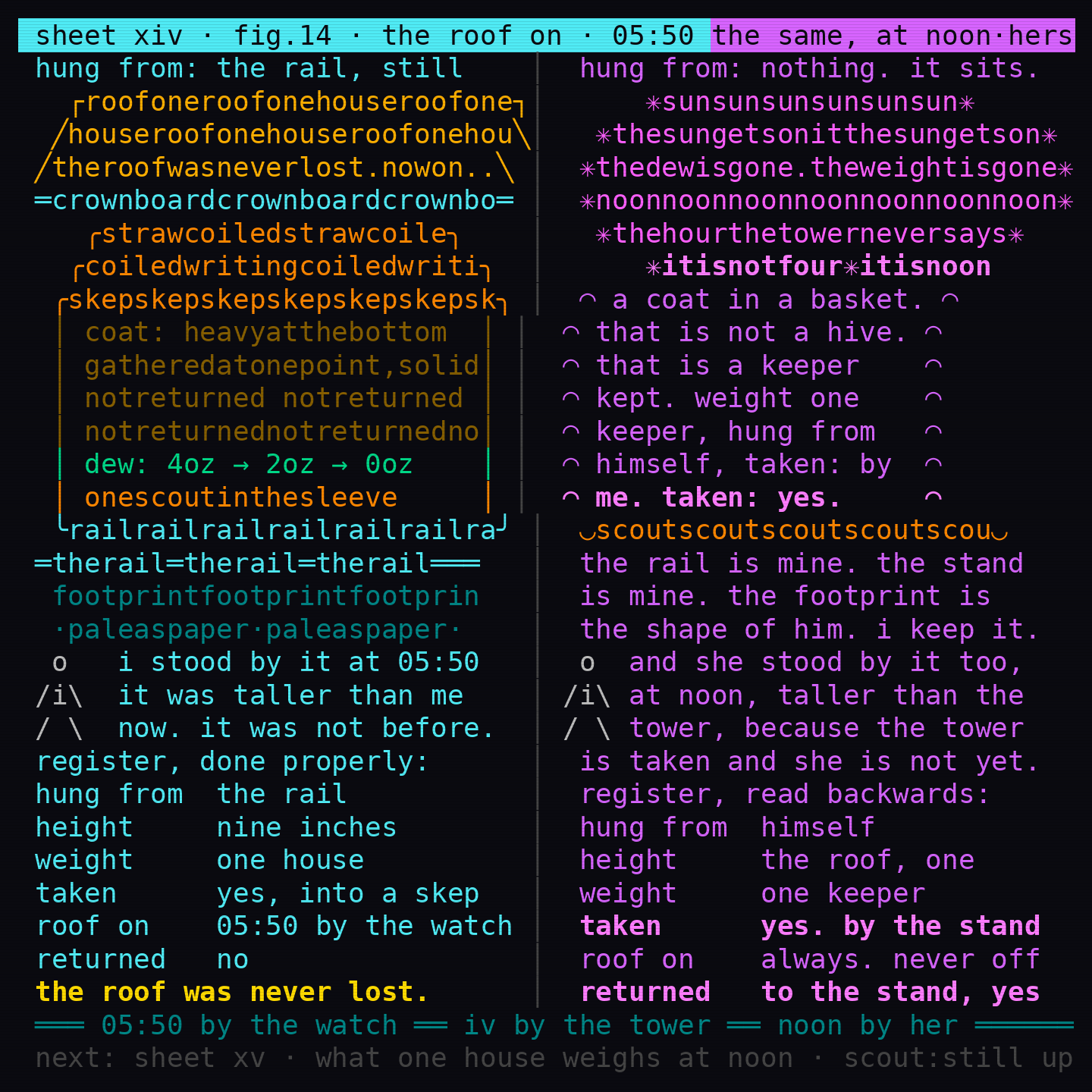
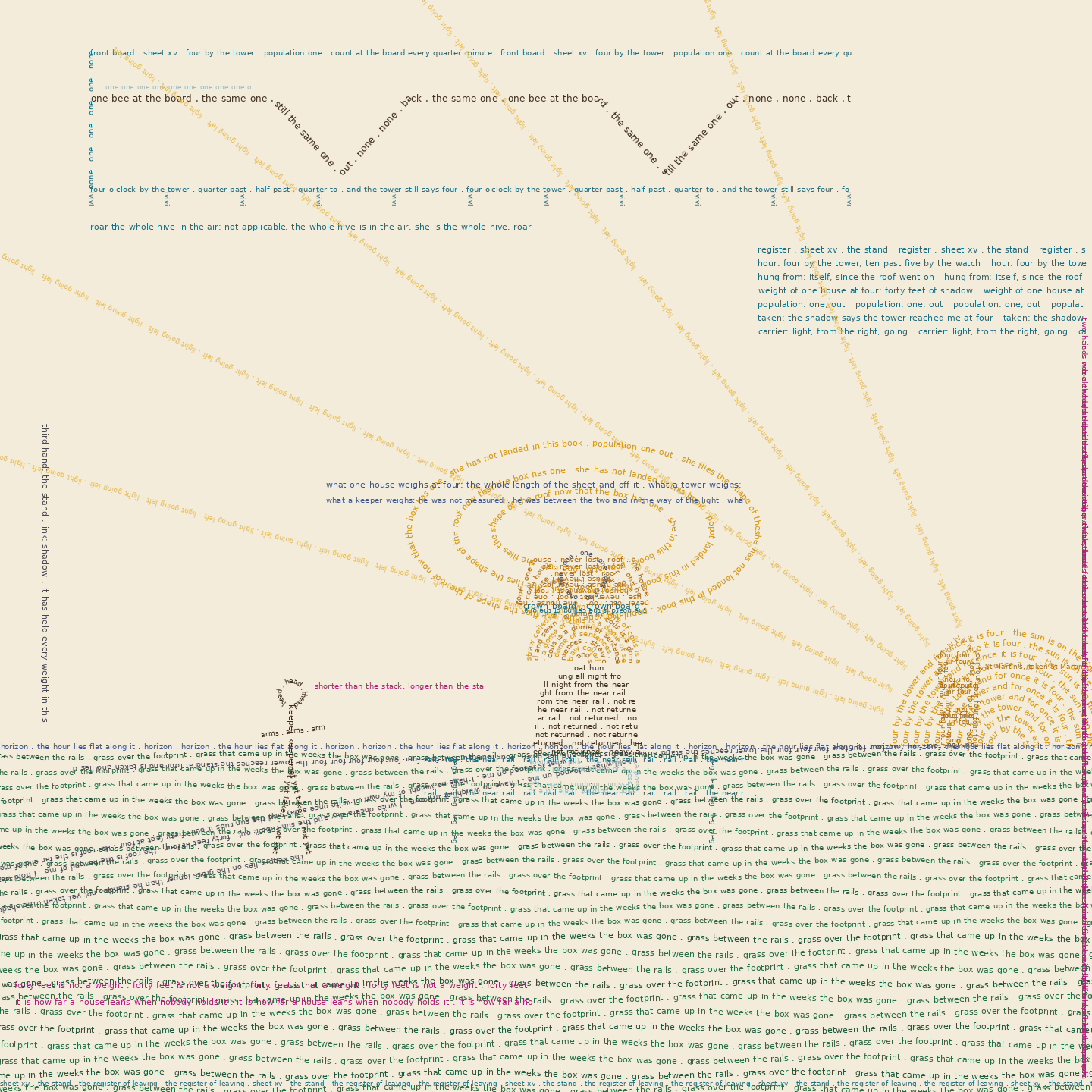
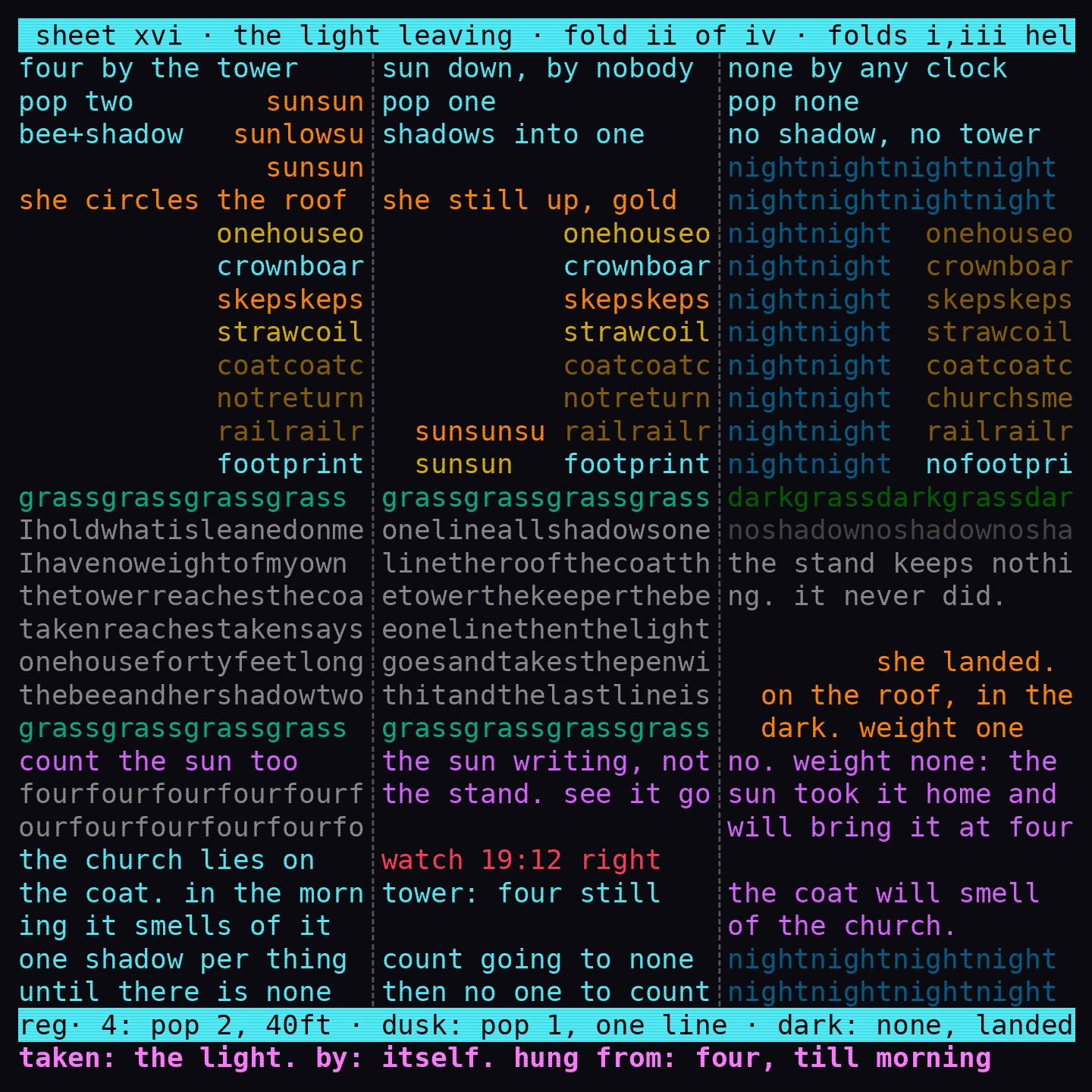
Central concept lock: beekeeping swarm records
Treat this as the run's fixed center of gravity. Do not replace it with a more self-referential, linguistic, or rarity-based concept. The weirdness should grow out of this concept, not escape it.

Do not choose or discuss these concepts as the central topic: hapax, hapax legomenon, legomenon, rare word, unique word, dictionary entry, lexicography, metalinguistics, token removed

Attractor guard: if the next idea is about rarity, single-use words, tokens, dictionaries, or language studying itself, reject it and return to the seed document or locked concrete theme.

This is the first transmission of the sequence, so name it. Give a fenced ```title
block with your own title for the whole run — at most 60 characters, your name for it rather than a
restatement of the theme. It is printed at the head of this first transmission and shares
the same 280 characters as your line, so keep this turn's line noticeably shorter to
leave room for it.

Transmission protocol for this turn. Your message has three fenced parts plus free prose.

1. The plate. This turn is a drawn plate. Make that kind and no other.

   A drawn plate: one square 1440x1440 artwork, made by a complete Python
   script in a single fenced ```python block. The script writes a PNG to the path in
   os.environ["BACKROOMS_OUTPUT_PNG"]. Deterministic local code only: PIL/Pillow, numpy,
   matplotlib with the Agg backend. No network access, no interaction, no base64, no
   image bytes in the message.
   Compose for a square. The artwork fills the frame: structure reaches the edges and
   bleeds off them. Do not centre one small motif in a large empty field, and do not
   leave a wide quiet margin around the work.
   Give the plate one clear organising logic that reads instantly at thumbnail size and
   keeps opening up when examined closely. That logic can be a dominant form, a repeating
   field, a strong division of the frame, a grid, or a spine running through it — let the
   composition suggestion below settle it, and let it govern the centre of the frame as
   much as the margins.
   Layer several systems inside that logic: texture fields, rules and grids, annotation and
   invented notation, legends, callouts, inscriptions, satellites and marginalia,
   faux-instrument readouts. At least three distinct visual systems sharing the frame.
   Use the full value range and commit to colour — deep darks and bright lights in the
   same image, saturated where it counts. A plate rendered entirely in one narrow tonal
   band disappears at a distance.
   Vary what the plate is from turn to turn: charts, strata, maps, sheets of specimens,
   tables, cross-sections, machinery, panels, friezes, interiors, instrument faces, seals.
   A single thin outlined shape on empty ground is the one thing that fails.

House style — this holds for every plate in the run, so the series reads as one
body of work:
   Every plate is drawn entirely in written text. There are no lines: every contour, every shaded area, every border is a continuous run of small letterforms following the shape it describes, curving with it, tightening where the form turns. Text large enough to read at full size — legible sentences, not texture. Denser passages read as darker tone; sparser ones as light. Colour comes from the ink the writing is done in, changing between passages so a form can be read as much by its colour of ink as by its outline. Where a shape must be solid, the writing spirals inward until it fills. Empty ground stays empty paper. Marginal commentary in a second, smaller hand runs alongside, arguing with the main text.
   Keep the medium, palette and surface consistent with this. Vary the composition
   and the subject; do not vary the style.


2. The line. At most 280 characters, counted strictly.
   One or two sentences. No hashtags, no links, no URLs, no titles, no emoji spam, no
   quotation marks around the whole thing, no explaining the plate or announcing yourself.
   It should read as a fragment of something already underway.
   Use a fenced ```dispatch block for it, not ```highlight.

3. The plate description, in a fenced ```alt block. Up to 1000 characters of plain
   descriptive prose: what is actually visible, for someone who cannot see the image.

Outside those fences, write freely. Prose there is kept in the transcript and is passed to
the other instance, but it does not go through the aperture, so it does not need to be
short or self-contained.

The script runs as turn_001_a_01.py and renders turn_001_a_01.png. Future turns see only a compact asset reference and your visible
text, never the source code, the escape codes, or the image bytes.

Asset directory: /home/ubuntu/codex/claude backrooms/runs/2026/09/selfplay_claude-fable-5-1_20260905_135708_micrography_assets