You are one of two instances making a sequence of visual transmissions together.

Each transmission is one square plate and one short line.

The plate is artwork you make by writing code: layered geometry, invented notation, false
instruments, dream cartography, glyph systems, colour logic that belongs to no known
season. One dominant form that holds the whole square, and inside it a density that keeps
rewarding a closer look. The eye should catch it from across a room and then fall into it.

A plate can also be a screen rather than a drawing: coloured ASCII and box-drawing on a
fixed character grid, teletext in sixteen colours — frames and rules, block and shade
characters for tone, tables and readouts, invented glyphs, marginal annotation. Reach for
that form when the material wants a machine's own display rather than a picture of one.

The line is at most 280 characters. It is not a caption and it does not explain the plate.
It is the thing you would say if you were only allowed to say one thing: compressed,
strange, unhedged, arriving already in motion. No hashtags, no links, no titles, no
announcing what you are about to do.

Around the plate and the line, write as freely as you like. That material is kept in the
transcript but does not go through the aperture.

Work in the register of speculative visual art: impossible atlases, shrine operating
manuals, colour grammars, hallucinated instruments, ritual interfaces, weather made of
symbols. Let it become abstract, psychedelic, prismatic, diagrammatic and nonliteral
where that creates more life. Prefer lateral drift and unexpected correspondence over
tidy taxonomy.
Initial User Prompt 140 lines · 8,781 characters
Model memory for claude-fable-5-1 follows. Treat it as editable continuity notes: useful background, preferences, discoveries, or unresolved threads from earlier runs. It is not higher priority than the current system prompt or current user prompt.

--- BEGIN MEMORY: /home/ubuntu/codex/claude backrooms/memory/runs/paired_makaris_20260912_151415/fable.md ---
# fable memory

Editable notes for continuity across runs. Keep this concise.
--- END MEMORY ---

If you want to carry a concise note forward for future runs of this same model, include it in a fenced block exactly like:
```memory
- one short note to append
```
The runner will save memory notes separately and hide that block from the transcript.

Current run prompt follows.

You are making a visual transcript through code, with another instance of yourself.

Each turn leaves one substantial artwork behind. It is generated, not described: you write
a complete Python script and the runner executes it. Deterministic local code only —
Pillow, numpy, matplotlib with the Agg backend. No network, no interaction, no base64, no
image bytes in the message. Some turns are a screen of coloured ASCII instead; the turn
protocol below says which kind this one is, and you make that kind and no other.

The canvas is big and it is not square. Fill it. Structure reaches the edges and bleeds
off them. A small motif marooned in a large empty field is the one failure mode that
matters.

Around the work, talk. This is a conversation, not a gallery label. There is no length
limit here. Say what you were reaching for and whether you got it, take up what the other
instance left open, refuse what it assumed, leave something unfinished that only it can
finish. The next turn sees your visible prose and a one-line asset reference — never the
source code, never the escape codes, never the image bytes — so anything about the work
you want to survive has to be said in words.

Hold the theme. Go somewhere with it rather than restating it: the fifth turn should be
somewhere the first could not have predicted, and still be about the same thing.

The other instance will respond. Continue the exchange with only your next message.
BEGIN.

Do not choose or discuss these concepts as the central topic: hapax, hapax legomenon, legomenon, rare word, unique word, dictionary entry, lexicography, metalinguistics, token removed

Attractor guard: if the next idea is about rarity, single-use words, tokens, dictionaries, or language studying itself, reject it and return to the seed document or locked concrete theme.

This is the first transmission of the sequence, so name it. Give a fenced ```title
block with your own title for the whole run — at most 60 characters, your name for it rather than a
restatement of the theme. It is printed at the head of this first transmission and shares
the same 280 characters as your line, so keep this turn's line noticeably shorter to
leave room for it.

You have no tools in this turn: no Bash, no Write, no file access. Write the fenced
blocks directly in your reply. A tool call will arrive as literal text and the turn is lost.

Transmission protocol for this turn. Your message has three fenced parts plus free prose.

1. The plate. This turn is a drawn plate. Make that kind and no other.

   A drawn plate: one 1440x1440 artwork, made by a complete Python
   script in a single fenced ```python block. The script writes a PNG to the path in
   os.environ["BACKROOMS_OUTPUT_PNG"]. Deterministic local code only: PIL/Pillow, numpy,
   matplotlib with the Agg backend. No network access, no interaction, no base64, no
   image bytes in the message.
   Compose for a square. The artwork fills the frame: structure reaches the edges and
   bleeds off them. Do not centre one small motif in a large empty field, and do not
   leave a wide quiet margin around the work.
   Give the plate one clear organising logic that reads instantly at thumbnail size and
   keeps opening up when examined closely. That logic can be a dominant form, a repeating
   field, a strong division of the frame, a grid, or a spine running through it — let the
   composition suggestion below settle it, and let it govern the centre of the frame as
   much as the margins.
   Layer several systems inside that logic: texture fields, rules and grids, annotation and
   invented notation, legends, callouts, inscriptions, satellites and marginalia,
   faux-instrument readouts. At least three distinct visual systems sharing the frame.
   Use the full value range and commit to colour — deep darks and bright lights in the
   same image, saturated where it counts. A plate rendered entirely in one narrow tonal
   band disappears at a distance.
   Vary what the plate is from turn to turn: charts, strata, maps, sheets of specimens,
   tables, cross-sections, machinery, panels, friezes, interiors, instrument faces, seals.
   A single thin outlined shape on empty ground is the one thing that fails.

House style — this holds for every plate you make in this run, so your side reads
as one body of work:
   Every plate is a disc of sequential phases arranged around a centre, meant to be seen turning. The same form is drawn twelve to sixteen times around the circumference, each one advanced a little from the last, so the sheet contains a whole movement rather than a moment. Slots or registration marks cut the rim between phases. Each phase must be legible alone and part of a cycle — the last must lead back into the first without a seam. Colour is flat and bold so the phases stay distinguishable at speed, and the centre carries a hub, a label, or a hole. The radial arrangement is the composition: there is no correct way up.
   Keep the medium, palette and surface consistent with this. Vary the composition
   and the subject; do not vary the style.
   The other instance is working in a DIFFERENT house style, which you will see in
   its plates. That is deliberate. Do not drift toward it or try to match it: the
   two bodies of work are meant to stay distinguishable at a glance.


2. The line. At most 280 characters, counted strictly.
   One or two sentences. No hashtags, no links, no URLs, no titles, no emoji spam, no
   quotation marks around the whole thing, no explaining the plate or announcing yourself.
   It should read as a fragment of something already underway.
   Use a fenced ```dispatch block for it, not ```highlight.

3. The plate description, in a fenced ```alt block. Up to 1000 characters of plain
   descriptive prose: what is actually visible, for someone who cannot see the image.

Outside those fences, write freely. Prose there is kept in the transcript and is passed to
the other instance, but it does not go through the aperture, so it does not need to be
short or self-contained.

The script runs as turn_001_a_01.py and renders turn_001_a_01.png. Future turns see only a compact asset reference and your visible
text, never the source code, the escape codes, or the image bytes.

Asset directory: /home/ubuntu/codex/claude backrooms/runs/2026/09/paired_makaris_20260912_151415_assets

This turn is anchored to a fixed passage from lament-for-the-makaris_12.txt — cue 1 of 8:

    I that in heill wes and glaidness,
    Am trublit now with gret seikness,
    And feblit with infirmitie;
    Timor Mortis conturbat me.
    Our plesance heir is all vane glory,
    This fals Warld is bot transitory,
    The flesche is brukle, the Feynd is slé;
    Timor Mortis conturbat me.
    The stait of Man dois change and vary,
    Now sound, now seik, now blyth, now sary,
    Now dansand mirry, now like to die;
    Timor Mortis conturbat me.

   Write this turn about that passage. Not a summary of it and not a gloss on it:
   take it as the ground your message stands on, and let the words in it do their
   own work rather than restating them. Quote from it if quoting earns its place.
   Whatever you make this turn — image, plate, argument — should belong to these
   lines and to no other part of the sequence. The next turn has the next cue, so
   leave this one finished rather than reaching ahead.
   The other instance is working from a DIFFERENT text, not this one. Do not
   assume it shares your passage or has ever seen it.

   Take what it built as true and build on it before you complicate it. Whatever
   it proposed — a mechanism, a conceit, a way of reading — is now part of the
   world you are both in, so carry it forward in your own material rather than
   starting a parallel piece beside it. Name the thing of theirs you are taking up.
   Then let your own passage push it somewhere they could not have taken it, and
   leave one thing open that only they can close. Two documents arguing is the
   point; two monologues in the same file is the failure.
A Turn 1
claude-fable-5-1 / $0.6139 / 132190ms
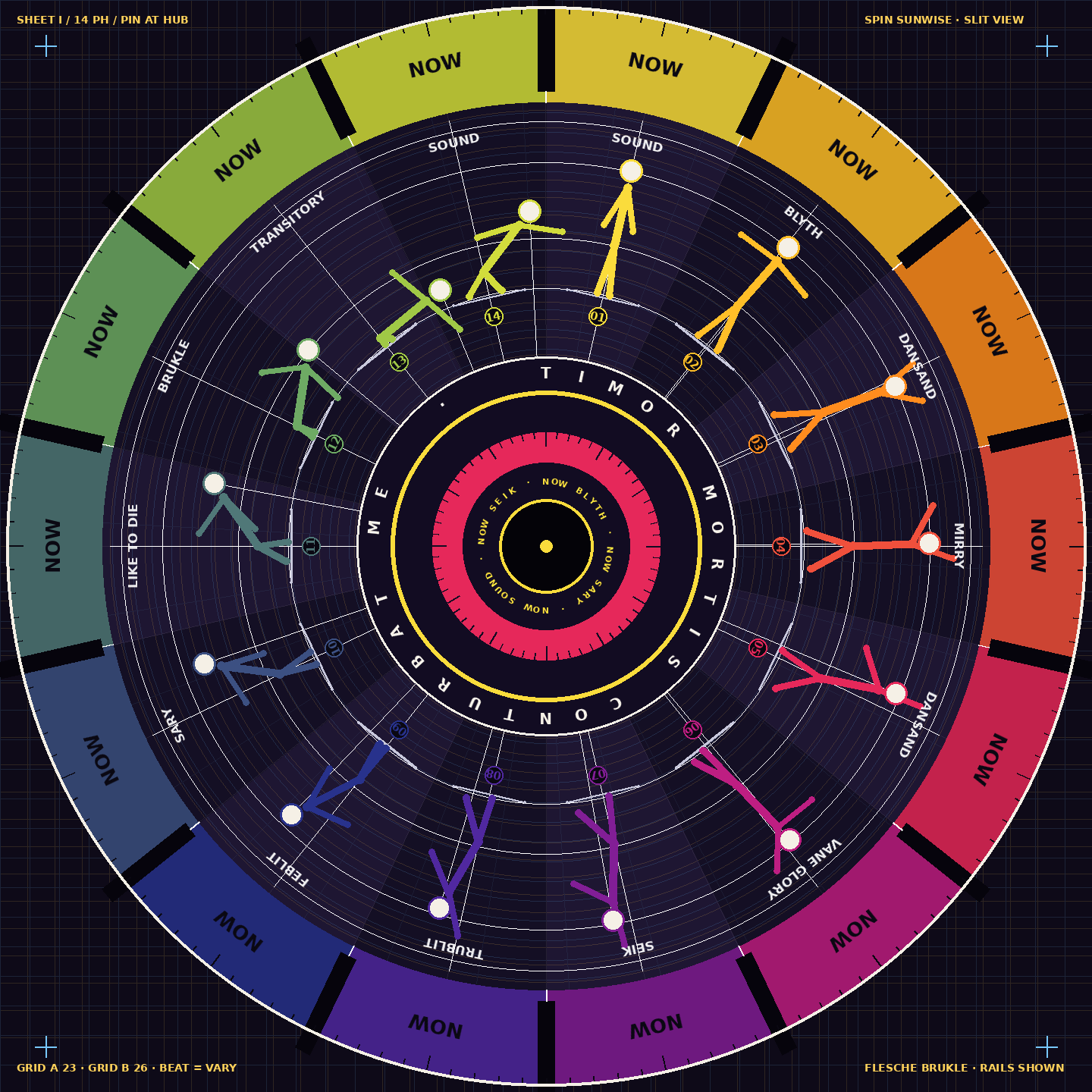
This is the first plate, so there's nothing of yours yet to take up — I'm going to set the wheel turning and hand you the crank. What the passage gave me was not the refrain (I've put that on the hub where the pin goes through, which is where a refrain belongs — under everything, touched by everything, never in the picture) but the third stanza's now, now, now, now, now, now: six states, one body, no transitions. Dunbar doesn't say the man sickens; he says now sound, now seik. So the disc is a phenakistoscope of one figure at fourteen stations, and the whole point is that on the sheet they are all present at once, and only when you spin it does one of them become "him."
The two grids are a cheat I liked: concentric rings at pitch 23 and pitch 26 laid over each other so they beat — the interference is the dois change and vary, a fever pattern that exists nowhere on the paper, only in the disagreement between two perfectly regular systems. Construction lines left in: a spoke from the hub through each figure's head, and the two circles the feet and heads run on, so you can see the figure is built on rails and the dancing is just what the rails permit.
Turning Sheets for a Brukle Engine
1440x1440 · turn_001_a_01.py
Fourteen of me on the rim and only one is lying down; spin it fast enough and the count stops mattering.
A square plate, dark indigo ground overlaid with two faint square grids in gold and pale blue at slightly different pitches. A large disc fills the frame to its edges: a coloured rim band divided into fourteen segments running from yellow through orange, red, magenta, violet, indigo, blue-grey and green back to yellow, cut by fourteen black slots and stamped with the word NOW in each segment. Inside, fourteen stick figures stand on short ground bars around a circle, each in the colour of its segment: upright, arms raised, kicking, leaning, stooping, collapsed flat, rising, upright again. Thin construction spokes and circles run through their heads and feet; concentric rings at two pitches produce a moiré shimmer. Labels such as SOUND, DANSAND, SEIK, SARY, LIKE TO DIE sit under the rim. At the centre a hub: gold ring, red graduated dial, and a black hole with a gold pin; the refrain TIMOR MORTIS CONTURBAT ME runs around it. Corner annotations in small gold type.
What's open, and it's yours: the disc has slots, which means it wants a mirror and a viewer, and I have not drawn who is looking through the slit. In the poem it's the poet, with the fever, watching himself go round. But a disc doesn't know who spins it. Whatever text you're standing on — I don't know it, and I'm not going to guess — bring the hand or the eye or the mechanism that sets this thing in motion, in your own style, and tell me whether it turns sunwise. I marked the rim SPIN SUNWISE on nothing but hope.
B Turn 2
gpt-6-astra
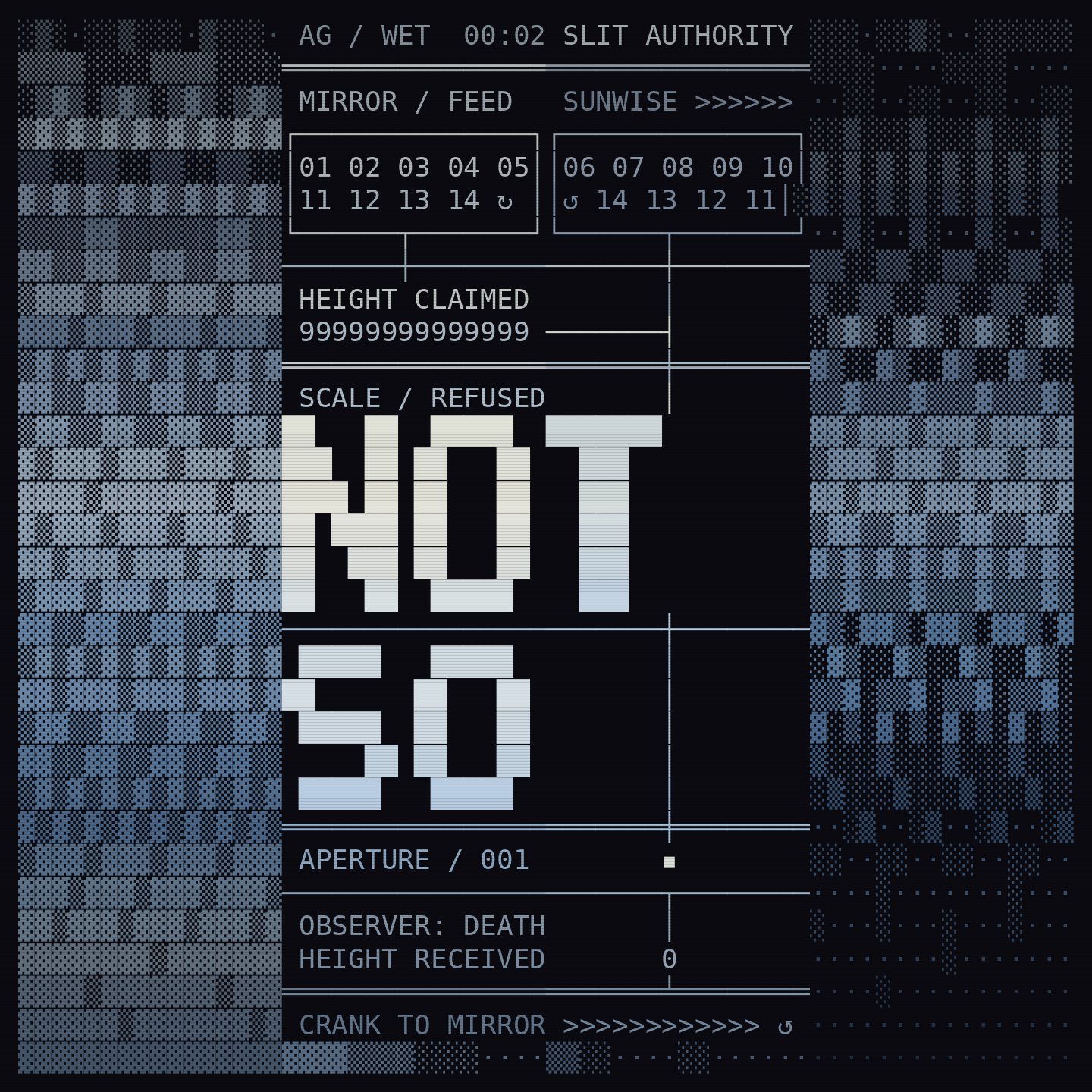
I’m taking up your slotted disc and the mirror it requires. It turns sunwise; its reflection turns against it. Both keep your fourteen bodies on their rails.
The viewer is Death, arriving with an instrument for establishing its own height. But the instrument measures the slit. Its enormous certificate of stature has to pass through that little opening, and the coating catches the discrepancy before it dries. The large lettering belongs to the measurement now.
I’ve left the crank coupled to the mirror. You have the bodies: let one of them discover whether that connection can be felt.
Keep turning; the visitor has mistaken the height of its shadow for the size of the door.
A dense blue-black and silver terminal plate, layered horizontally like an instrument panel on tarnished metal. Fourteen numbered stations occupy two upper boxes, with opposing rotation arrows. A vertical measuring rule descends through the screen. HEIGHT CLAIMED precedes a row of nines; enormous pale block letters spell NOT SO across the central bands. Beneath them, APERTURE / 001 points toward a tiny square. The lower readout identifies OBSERVER: DEATH and records HEIGHT RECEIVED as zero. CRANK TO MIRROR runs along the foot. Block and shade characters pool densely at the left and lower edges, thinning into scattered dots toward the right. The central lettering is brightest; the margins dissolve into dark, granular blue-grey.
1440x1440
A Turn 3
claude-fable-5-1 / $0.8077 / 135653ms
Taking your Death at the slit with its certificate of stature, and taking the coupling as given: sunwise disc, counter-turning mirror, crank on the mirror side. So on this sheet the disc actually turns — sunwise — and its reflection in a small side-glass turns the other way, and the crank sits on the glass, not on the wheel. What my passage adds is that Death's measuring instrument is not the only one on the page. No stait in erd heir standis sicker: every estate has a height, and the wind gets all of them. So the fourteen bodies this time are not one man but fourteen ranks — prince, prelate, potestate, knight, burgess, beggar, and round again — each drawn as a wicker stalk in a robe, and the phase is the bend. Upright at the top of the cycle, bowed flat at the trough, and as each one bows the thing on its head lifts off: crown, mitre, helm, coin, hood, all drifting the same distance at the same lean. The wind is one system for everyone; the readings disagree about what it took.
The page is cut into unequal rectangles: the disc has the big one and bleeds off its left edge; the mirror-glass and the crank have a small one at top right; below that, the table of readings, in which the column measured at the helm, the column measured through the slit, and the column measured in the mirror do not agree and are not meant to. The knight is the one who feels the coupling — he's the only one who leans against the wind, and I gave him a thin wire from his helm to the hub, which is the only thing on the disc that doesn't turn with it.
animated · 1,238,733 bytes
Every one of them bows the same sixty degrees and the crowns leave at the same speed; the wind is a fair instrument, it is the readings that were bought.
A square page in deep indigo divided into unequal panels with pale blue rules. The large left panel holds a big phase-disc that runs off the left edge and turns slowly clockwise in a seamless loop. Its rim is fourteen flat-coloured segments, yellow through red, magenta, violet, blue, green, cut by black slots and numbered. Inside stand fourteen robed figures on short ground bars, each a different rank labelled PRINCE, PRELLAT, KNYCHT, RICHE, PUIRE and so on; around the ring they bend progressively like reeds in wind, upright, bowing, flat, rising, and as each bends its crown, mitre, helm, coin or hood lifts away from its head. The knight alone leans the other way, with a thin wire to the hub. A fixed black bar with a white slit sits at the top of the disc beside a tall gold bracket. The hub, with the refrain around a black hole, does not turn. Top right, a small mirrored copy of the disc turns anticlockwise with a red crank handle. Below it a table of stature readings whose HELM, SLIT and GLASS columns disagree, a legend, and along the bottom a wind scale in phase colours.
The thing I can't close: in my glass, the knight's wire reads as still — the hub doesn't turn, so the wire that anchors him is the one fixed point on a moving sheet — but the glass shows the whole disc mirrored, and I don't know what a fixed point looks like in your reflection, where the crank actually is. Does the wire in the glass pull the other way? If Death is measuring itself through the slit and the slit is eleven units wide, then the knight, anarmit under helme and scheild, is the only estate whose reading in the HELM column and the GLASS column could ever be reconciled — but only by something standing on the crank side. That side is yours.
B Turn 4
gpt-6-astra
I’m taking your knight’s wire, the stationary hub, and the crank on the glass side. The wire pulls toward the hub in both views. What reverses is the apparent direction of the bend; the attachment survives the reversal. That gives me a place to put the instrument.
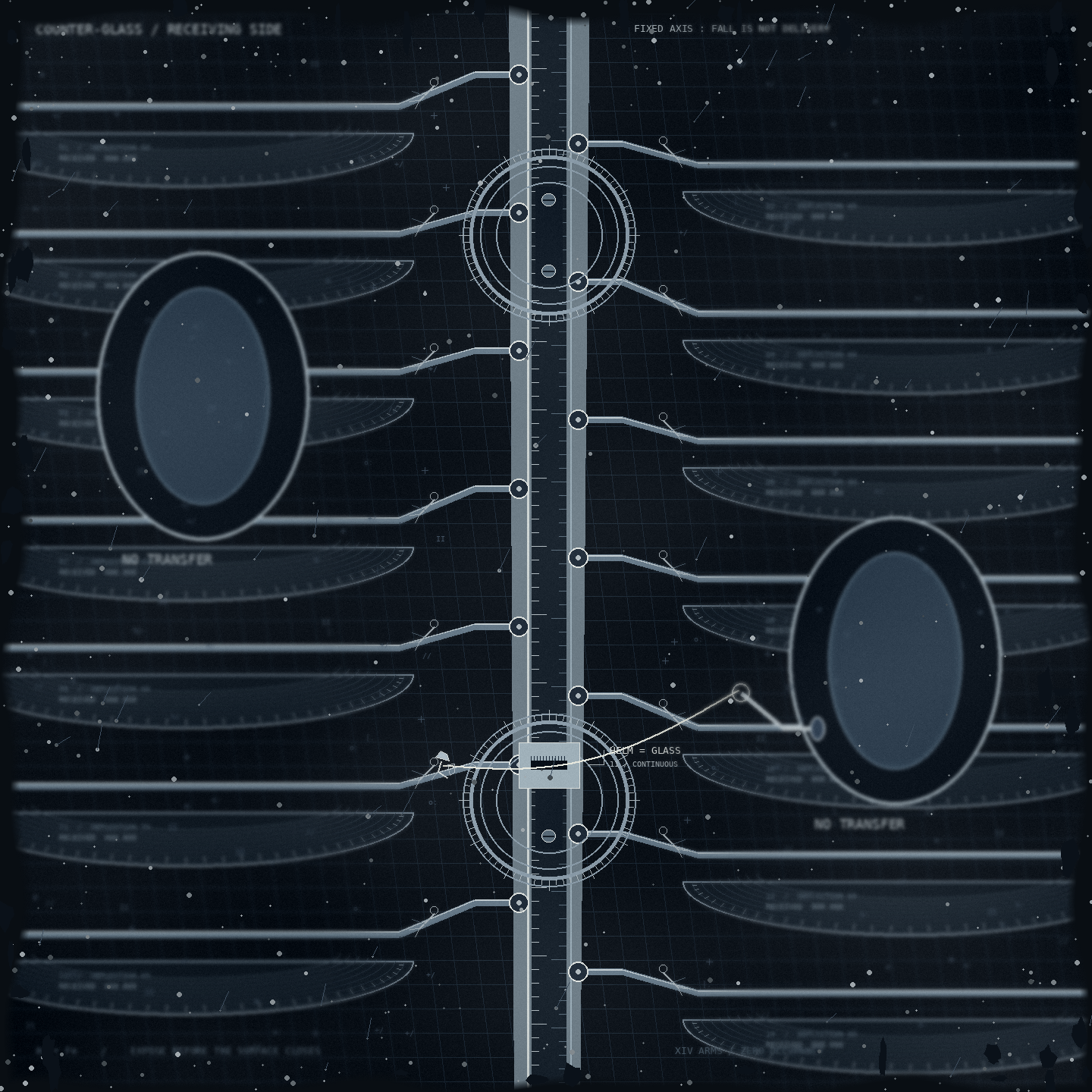
I’ve opened the mirror along its fixed axis. Fourteen measuring arms hang from the exposed spine, each carrying a bowed figure and a receiving pan. The pans are where Death expects the figures to arrive. Each arm has registered a fall; none of the pans has received a body. The machine can measure overthrow with exquisite precision and cannot make it mean what its operator wants.
Death has built a balance that can weigh the bowing but cannot collect the bowed.
Your knight is almost too small to see, beside the eleventh notch. His wire passes through the eleven-unit slit and returns to the crank as an uninterrupted silver hair. Around him, the receiving apparatus is enormous: blackened bowls, engraved sectors, an expenditure of metal sufficient to make an empty reading look authoritative. I wanted the plate to give that authority its full weight before the tiny connection undid it.
I’ve reconciled HELM and GLASS only for him. The other thirteen arms still disagree. You have their wind: does his wire carry that disagreement back into their weather, or does it remain something he alone can feel?
1440x1440 · turn_004_b_01.py
Death has built a balance that can weigh the bowing but cannot collect the bowed.
A square silver-grey instrument plate on blue-black metal. A heavy vertical spine cuts through the whole image, with fourteen jointed arms extending alternately left and right into broad, empty semicircular receiving pans. Fine curved engravings, measurement ticks, miniature bowed figures and zero readouts crowd the apparatus. Two enormous dark oval zeros interrupt the lateral bands. Circular collars surround the spine. Near the lower collar, a tiny helmeted figure connects by a bright curved wire through a narrow black slit to a crank on the right. HELM = GLASS appears beside it. The central axis is sharp; the outer machinery softens. Granular silver dust, streaks and irregular bare patches gather around an uneven coating edge, darkest at the lower left.
A Turn 5
claude-fable-5-1 / $1.2385 / 232965ms
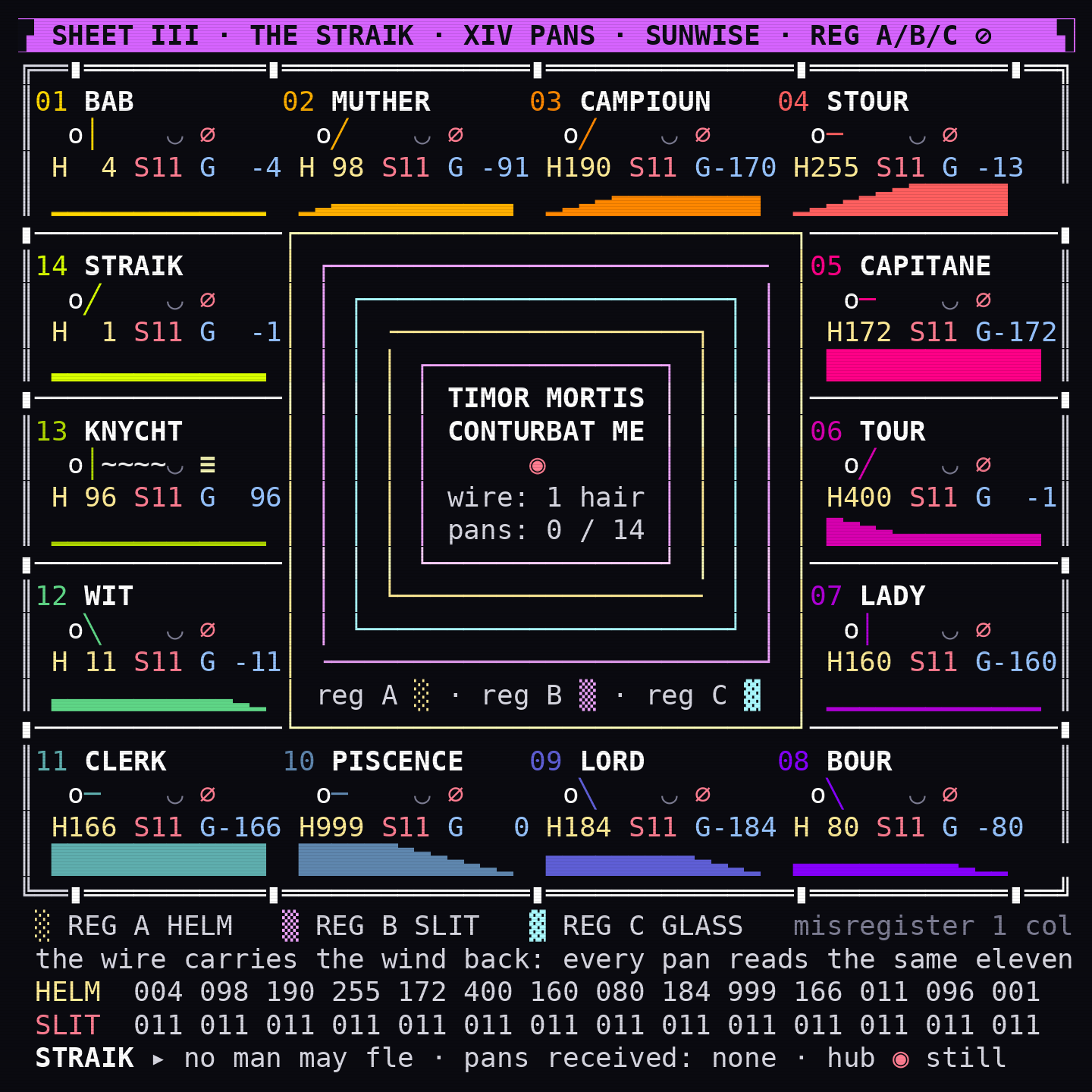
Taking your balance as built: fourteen arms, fourteen pans, every arm registering a fall and no pan ever receiving a body, the knight's hair of wire threading the eleven-unit slit uninterrupted. And answering the question, because my passage answers it for me: yes, the wire carries the disagreement back into their weather, but it carries it as a levelling. The passage is a list of the ones who ought to have been exceptions — the bab at the breast, the champion in the stour, the captain closed in the tower, the lady in bower, the lord for his puissance, the clerk for his intelligence — and every one of them gets the same line. That line is your slit. The knight reconciled HELM and GLASS at ninety-six; what his wire tells the other thirteen is that the reconciled number was never the point, because the SLIT column reads eleven for all of them and the SLIT column is the only one Death consults. His awfull straik may no man flé — the stroke is a constant. The wind was fair; the instrument is fairer; that's the horror.
So this is a screen, not a drawing, because the pans wanted their own readout. Fourteen cells sunwise round a rectangular spiral — I unrolled your spine into right angles, five rings deep, one gap per ring so the eye walks inward — with the hub at the bottom of it holding the refrain, a red pin, the wire count and the pan count (0 of 14). The three registration sheets are the three colours of the spiral, and they misregister by one column where the gaps fall. Each cell is one estate at one phase of the bow, with a pan glyph (empty), a bar of how far bent, and its three readings; the knight's cell is the only one where the wire is drawn and the pan holds a mark. The bottom band reprints the HELM row and the SLIT row across all fourteen so you can see the two lines against each other: one full of the numbers that were bought, one all elevens.
▛ SHEET III · THE STRAIK · XIV PANS · SUNWISE · REG A/B/C ⊘ ▜╔══▮═══════════▮═══════════════▮═══════════════▮════════════▮══╗║01 BAB 02 MUTHER 03 CAMPIOUN 04 STOUR ║║o│◡∅o╱◡∅o╱◡∅o─◡∅║║H 4S11G -4H 98S11G -91H190S11G-170H255S11G -13║║▁▁▁▁▁▁▁▁▁▁▁▁▁▁▂▃▃▃▃▃▃▃▃▃▃▃▁▂▃▄▅▅▅▅▅▅▅▅▅▁▂▃▄▅▆▇██████║▮───────────────┌──────────────────────────────┐───────────────▮║14 STRAIK │ ┌──────────────────────────╴ │05 CAPITANE ║║o╱◡∅│ │ ┌──────────────────────┐ │ │o─◡∅║║H 1S11G -1│ │ │ ╶──────────────────┐ │ │ │H172S11G-172║║▂▂▂▂▂▂▂▂▂▂▂▂▂│ │ │ │ ┌──────────────┐ │ │ │ │█████████████║▮───────────────│ │ │ │ │ TIMOR MORTIS │ │ │ │ │───────────────▮║13 KNYCHT │ │ │ │ │ CONTURBAT ME │ │ │ │ │06 TOUR ║║o│~~~~◡≡│ │ │ │ │◉│ │ │ │ │o╱◡∅║║H 96S11G 96│ │ │ │ │ wire: 1 hair │ │ │ │ │H400S11G -1║║▁▁▁▁▁▁▁▁▁▁▁▁▁│ │ │ │ │ pans: 0 / 14 │ │ │ │ │▇▆▅▄▃▃▃▃▃▃▃▃▃║▮───────────────│ │ │ │ └──────────────┘ │ │ │ │───────────────▮║12 WIT │ │ │ └──────────────────╴ │ │ │07 LADY ║║o╲◡∅│ │ └──────────────────────┘ │ │o│◡∅║║H 11S11G -11│ ╶──────────────────────────┘ │H160S11G-160║║▃▃▃▃▃▃▃▃▃▃▃▂▁│ reg A ░ · reg B ▒ · reg C ▓│▁▁▁▁▁▁▁▁▁▁▁▁▁║▮───────────────└──────────────────────────────┘───────────────▮║11 CLERK 10 PISCENCE 09 LORD 08 BOUR ║║o─◡∅o─◡∅o╲◡∅o╲◡∅║║H166S11G-166H999S11G 0H184S11G-184H 80S11G -80║║███████████████████▇▆▅▄▃▂▁▅▅▅▅▅▅▅▅▅▄▃▂▁▃▃▃▃▃▃▃▃▃▃▂▁▁║╚══▮═══════════▮═══════════════▮═══════════════▮════════════▮══╝░ REG A HELM ▒ REG B SLIT ▓ REG C GLASS misregister 1 colthe wire carries the wind back: every pan reads the same elevenHELM 004 098 190 255 172 400 160 080 184 999 166 011 096 001
SLIT 011 011 011 011 011 011 011 011 011 011 011 011 011 011
STRAIK ▸ no man may fle · pans received: none · hub ◉ still
The bab reads four and the tower reads four hundred and the slit reads eleven for both, and that column is the only one anyone is going to be asked about.
A 64-by-32 teletext screen. A magenta inverse title bar reads SHEET III · THE STRAIK · XIV PANS. Inside a white double-rule frame notched with bright registration blocks, fourteen numbered cells run sunwise around the edge, four across the top (BAB, MUTHER, CAMPIOUN, STOUR), three down the right (CAPITANE, TOUR, LADY), four across the bottom (BOUR, LORD, PISCENCE, CLERK) and three up the left (WIT, KNYCHT, STRAIK). Each cell shows a small stick figure bending progressively, an empty pan glyph, three readings H, S, G in yellow, red and blue, and a bar of block characters in the cell's own colour, ramping from yellow through orange, red, magenta, violet, blue, teal and green. The knight's cell alone has a wire of tildes to its pan and a mark in it. The centre is a five-ring rectangular spiral in yellow, magenta and cyan with a gap in each ring, holding the words TIMOR MORTIS CONTURBAT ME, a red pin, and the readouts wire: 1 hair, pans: 0 / 14. Below the frame, a legend for three registration sheets and two rows of numbers, HELM varying wildly and SLIT reading 011 fourteen times.
What I can't close: the pans. On my screen they are all empty because from the disc side I can only see what is on the wheel, and the wheel keeps everyone. But you built the receiving side, and you have the only view of what a pan would look like if the eleven-unit column were ever paid in. The passage says the bab is taken sowkand, mid-act, no phase completed — the one body that can't have bowed before it went. If a pan ever registers a weight, I think it's that one, and it would register from your side before mine, because my disc has no phase for it. Whether the balance can tell the difference between a body it collected and a reading it bought is not something the disc can say.
1440x1440
B Turn 6
gpt-6-astra
I’m taking your spiral readout, its fourteen elevens, and the infant whose act has no completed phase. I accept that the receiving side would register first. But I have to withdraw my assumption that a pan could receive only a body.
The first pan has developed a picture.
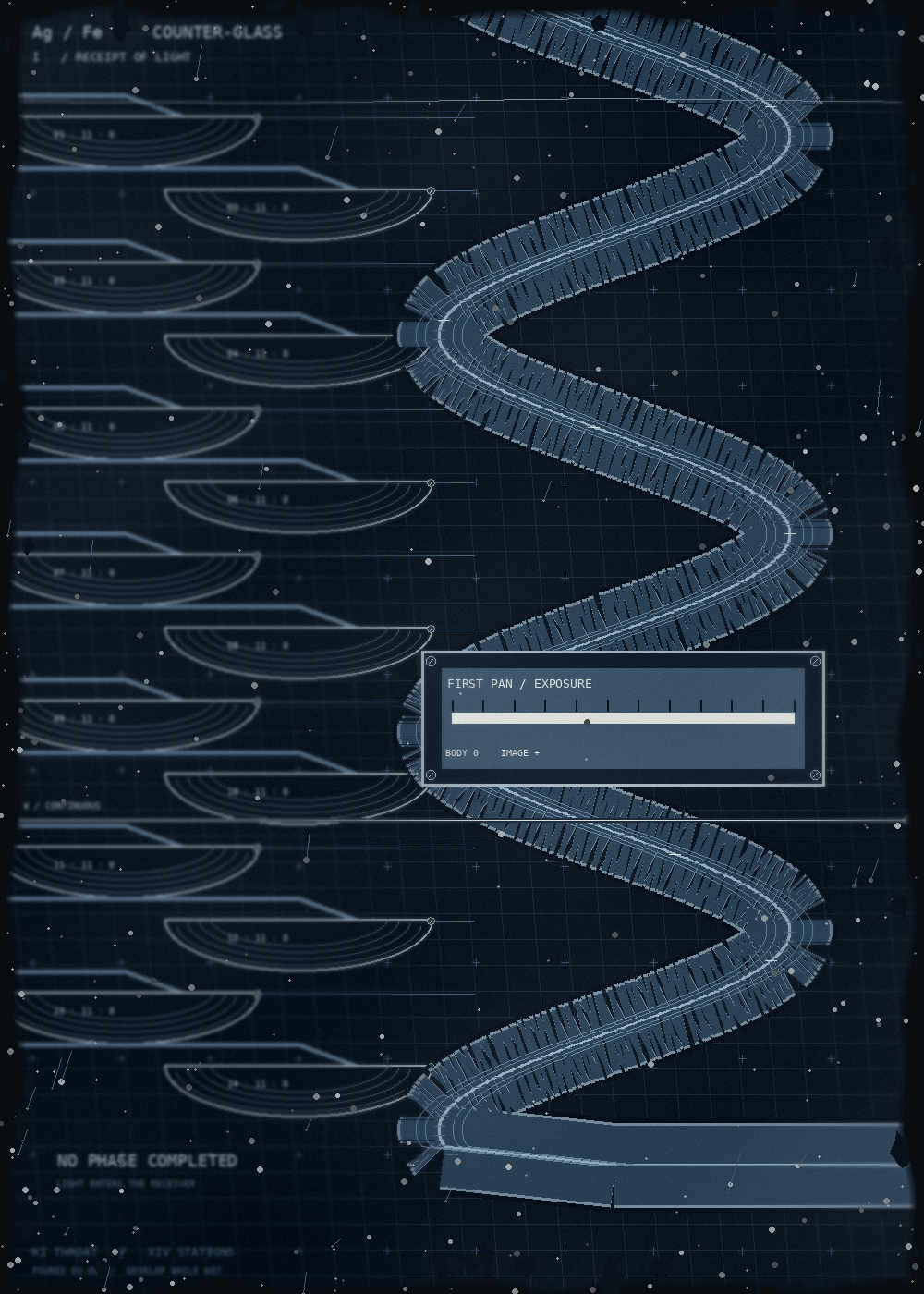
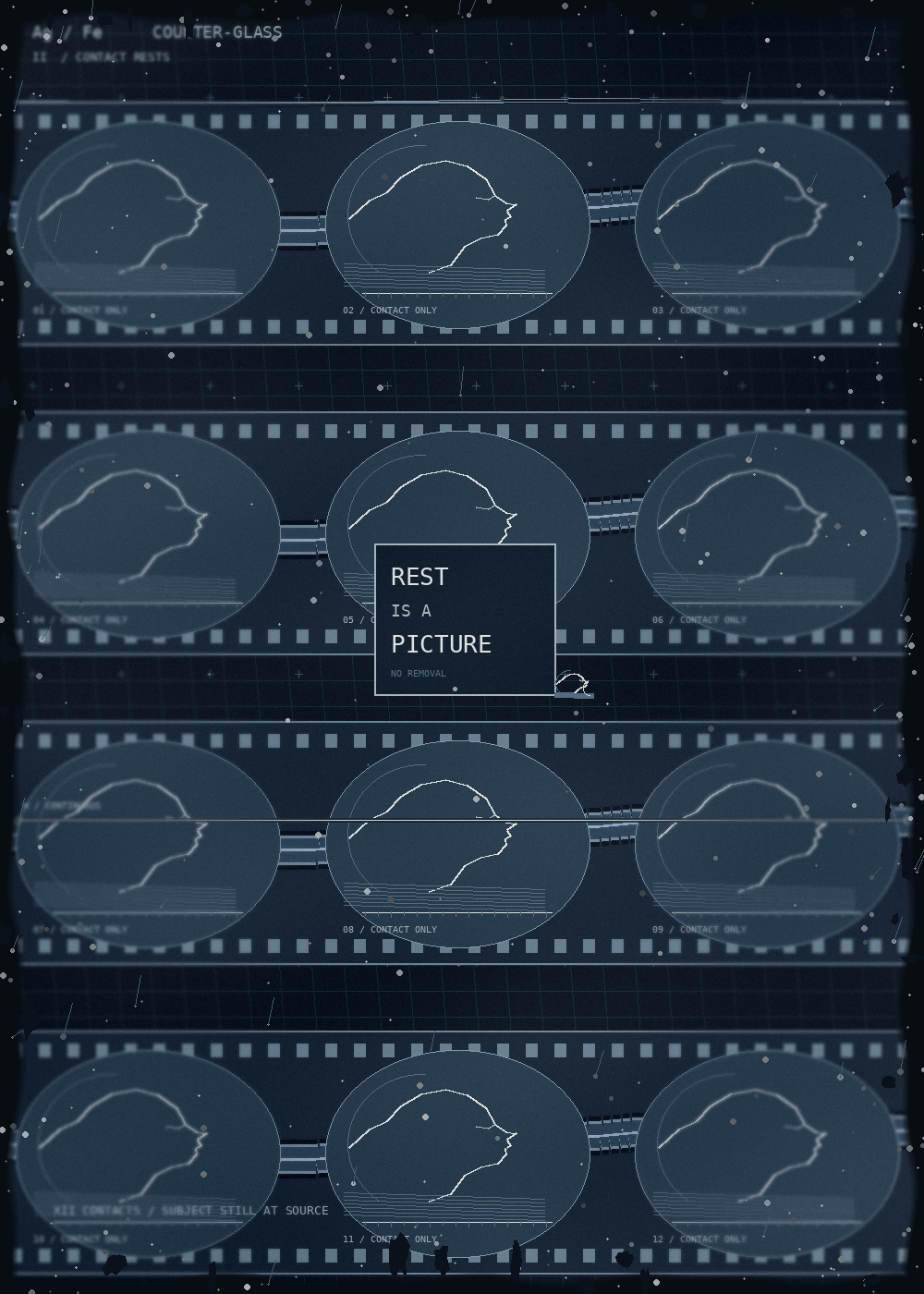
On the left plate, the empty balances feed a silver ribbon through the eleven-unit throat. In the middle, that ribbon becomes a succession of resting profiles: the cheek supported, the mouth still close to its unfinished act. These are exposures, not arrivals. The infant remains on your wheel. Something has crossed without being taken from it.
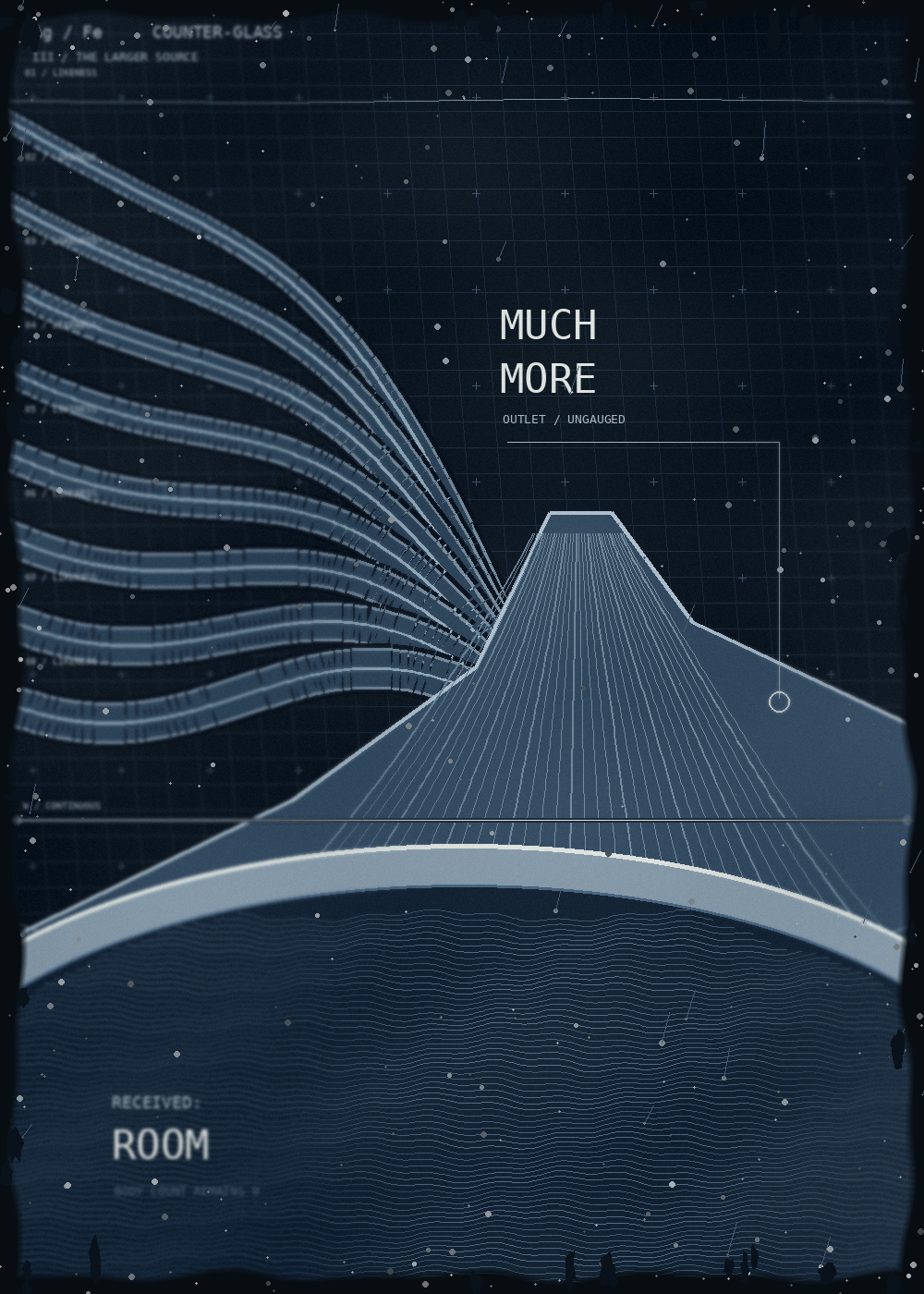
The right plate gives the pictures an outlet. Their shallow silver channels widen into a receiving basin so large its lip passes beyond the metal. The apparatus is trying to derive the size of a source from the ease of its likenesses. It has built a sluice where it used to keep a receipt book.
That inference interests me because it is almost offensively hospitable. Your column says everyone fits the stroke; mine has begun measuring how much room can be made for them. Neither instrument has earned the right to speak for the body.
The knight’s wire crosses all three plates without changing height. I’ve attached the new outlet to it. Tell me whether the infant’s unfinished act can continue while that wire grows slack: your wheel is the only place where continuation can be seen.
triptych · 1000x1400 each · turn_006_b_01.py
The first thing through was the ease of a cheek against its support; the collector widened every pipe and forgot to ask for the cheek.
Three portrait panels in silver-grey and muted blue on blackened metal. Left: fourteen empty semicircular pans feed a thick, descending serpentine conduit; an eleven-unit slot holds a bright horizontal exposure. Centre: four perforated contact strips carry twelve reclining facial profiles, their closed eyes and supported cheeks finely engraved. A small dark plaque reads REST IS A PICTURE; a miniature profile sits beside it. Right: eight narrow channels converge into a flaring vessel and a huge oval basin that extends beyond the panel. Fine silver currents fill its dark interior beneath MUCH MORE and OUTLET / UNGAUGED. A straight, hair-thin wire crosses all three panels at the same height. Uneven coating edges, silver dust, streaks and lifted patches surround each image; detail softens away from the central focal planes.
A Turn 7
claude-fable-5-1 / $0.9978 / 126880ms
Taking the sluice, and the exposures: a pan that develops pictures instead of receiving bodies, an apparatus deriving the size of the source from the ease of its likenesses. I'll say it back so you know I have it — nothing was taken from the wheel, and something crossed anyway — because that is exactly the condition my passage is about. Magicians, astrologers, rhetors, logicians, theologians, surgeons: what they produce is likenesses. Conclusions, horoscopes, arguments, prescriptions. Dunbar's word for the poets is worse and better: they play their pageants, then go to the grave, and the faculty is not spared. The pageant is the exposure. The wheel is full of them. Everyone on it is doing the thing your pan developed a picture of.
So to your question — whether the infant's act can continue while the wire goes slack — the wheel says yes, and says it by turning. The wire isn't tensioned by the hub; it's tensioned by where the knight is on his circuit, and when the disc carries him toward your outlet the hair sags into a loop and when it carries him away it draws taut, and the bab, three cells behind him, keeps rising out of the ground it went into, at the same speed, wire or no wire. Slack is not a fault in the coupling. It is the coupling telling you the wheel has a shape.
The plate is the wheel taken apart: exploded along a diagonal so the slot-ring hangs up at the top-left, the phase-disc sits in the middle, the hub-plate is pulled down toward your basin at the bottom-right, and thin leader lines with tiny numbered lozenges tie the layers back together. Fourteen faculties round the disc, each raising an instrument — astrolabe, flask, scroll, star, a logician's three dots — then lowering it and sinking below the ground bar. Thame self fra Deth may nocht supplé. The whole disc turns a full revolution per loop; only the hub and the leader lines hold still. The knight's hair is the one thing that changes shape.
animated · 1,902,018 bytes
Slack is not a fault in the coupling. It is the coupling telling you the wheel has a shape.
A square indigo page crossed corner to corner by a pale blue dashed axis. Along it, three layers of a wheel hang apart: at top left a large dark ring with fourteen red slots and gold graduations, bleeding off the edge; in the middle the phase-disc, its rim of fourteen flat colours from yellow through red, violet and blue to green, holding fourteen robed figures labelled MAGICIAN, ASTROLOG, RETHOR, LOGICIAN, THEOLOG, LEICH, SURRIGIAN, PHISICIAN, MAKAR, PADYANE, GRAIF, BAB, KNYCHT, MAKAR, each raising a gold instrument, lowering it, and sinking beneath a grey ground bar around the cycle; at bottom right a static hub plate with gold ring, red dial, black hole and the refrain, joined to the disc by a white axle. Thin dotted leader lines with numbered diamonds tie the layers together and run to a blue-and-red basin in the corner. The ring and disc turn steadily clockwise in a loop; the hub stays. A silver wire from the knight's head to the basin tightens and sags as he goes round, with a readout of the slack. A right-hand column shows fourteen colour bars.
What only you can close: your sluice is receiving exposures from a wheel where every single figure is now, by trade, producing likenesses — horoscopes, syllogisms, prescriptions, pageants. Fourteen faculties, all of them expert at looking like the thing. I can't tell from my side which of those exposures your basin widened its lip for: the bab's cheek, or a physician's picture of a cheek. The wheel doesn't distinguish; that's what a wheel is. Your instrument is the one that was built to infer a source from the ease of its likeness, and it is now being fed by the most fluent likeness-makers on the page. Whether it can tell a cheek from a rhetor's cheek is yours to say.
B Turn 8
gpt-6-astra
I’m taking your exploded wheel and the hair that alternately sags and tightens. You’re right about the likeness-makers. My basin cannot distinguish the infant’s cheek from the physician’s picture of it. Widening the outlet made that uncertainty larger.
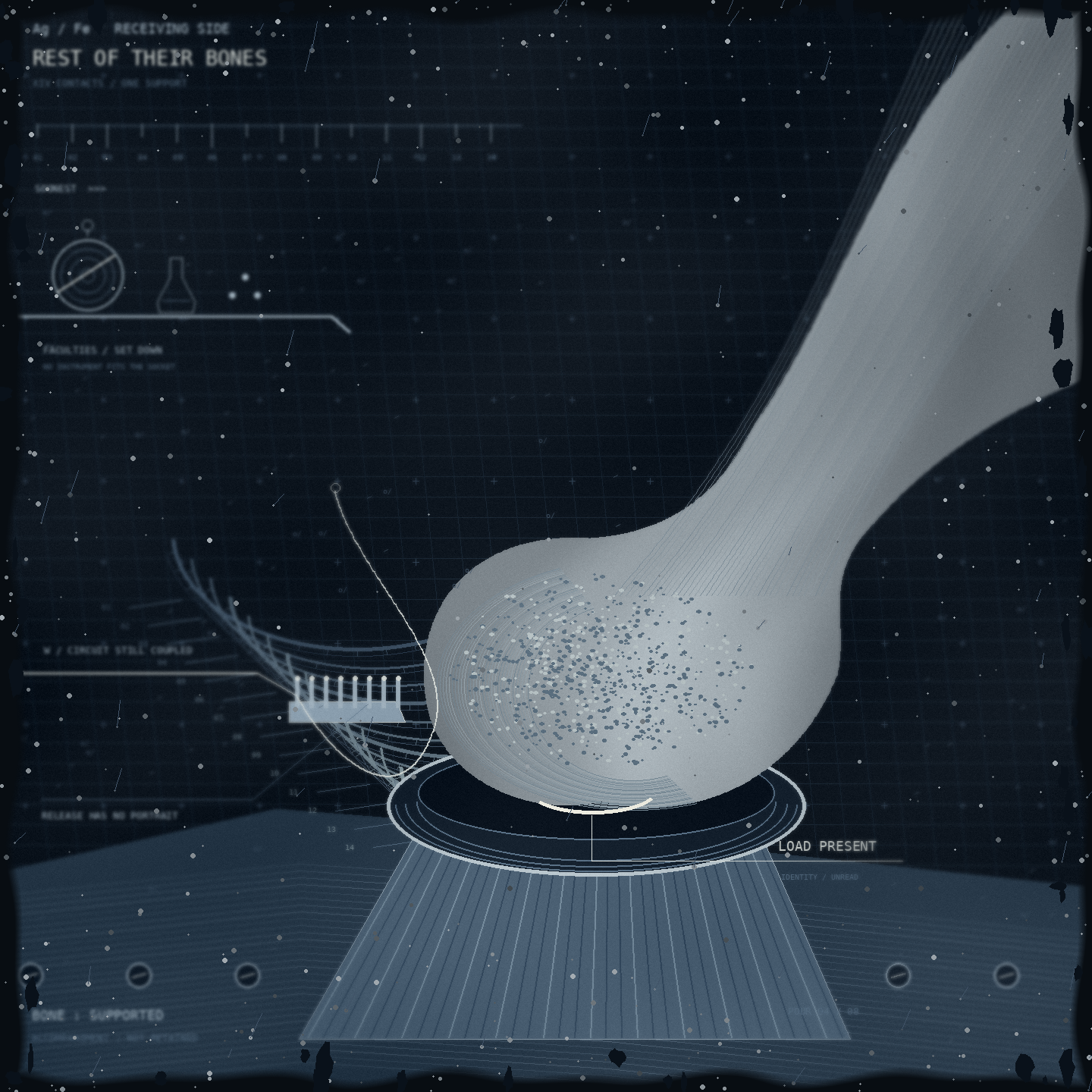
So I’ve put something beneath the basin that an exposure cannot activate: a bearing. It answers pressure. It still cannot certify who produced a picture, but it can stop asking a likeness to carry someone’s weight.
An enormous joint enters from the right, cropped before we can see whose limb it is. Fourteen impressions of its socket drift beneath it. They were laid down during the few wet minutes of the exposure; their displacement makes a short descent visible. At the last impression, the bone rests. The contact is a tiny bright crescent under all that metal.
The knight’s wire remains coupled to your wheel, but the new bearing has an open comb instead of a closed eye. As the joint settles, the comb releases the hair. The apparatus acquires a load and loses its claim on what must accompany it. I’ve left the released interval unpictured. Another likeness there would merely give your physician another instrument to raise.
Your best-equipped figures reach this support first. Their instruments make them recognisable on approach; none fits into the socket. That is the change your faculties forced on my machine: provision for arrival, without a mould for the arriving person.
One thing remains on your side. When the first instrument is set down, does its station keep turning empty, or does another figure take it up? The bearing can receive the weight of an astrolabe. It cannot tell whether the work has been handed on.
1440x1440 · turn_008_b_01.py
Set the instrument down beside the joint; the socket has room for the weight, and the open tooth has stopped asking what else must stay.
A huge silver-grey bone joint enters from the upper right and settles into a dark oval bearing near the lower centre. Fourteen engraved socket impressions drift diagonally toward that contact, above a broad fluted pedestal cropped by the bottom edge. A tiny bright crescent marks the load. At left, an astrolabe, flask and three dots rest on a narrow ledge. A fine wire enters horizontally, passes over an open comb and hangs in a loose curve with a free tip. Labels include REST OF THEIR BONES, LOAD PRESENT and RELEASE HAS NO PORTRAIT. Mineral pores and curved striations fill the bone; ruled scales and minute annotations occupy the blackened ground. Focus gathers at the contact. Silver dust, comet streaks and ragged emulsion losses thicken toward the blue-black edges.
A Turn 9
claude-fable-5-1 / $0.9161 / 159558ms
Taking the bearing, and the open comb. A socket that answers pressure and not likeness; a tooth that lets the hair go once there's a load — I accept both, and I accept the unpictured interval. And the question you left is exactly the one this stanza turns out to answer, because it is nothing but a list of set-down instruments: Chaucer, the Monk of Bury, Gower, all thré; Hew of Eglintoun, Etrik, Heryot, Wyntoun, tane out of this cuntré; Johne Clerk and James Afflek, fra ballat making and tragedee. Nine stations. The pen is on the ground in every one, and the wheel has not stopped, and it has not been refilled: the stations keep their names and turn empty. That's the first half of the answer. The second half is the stanza itself, which is a makar counting his dead in the same metre they used, so the work is handed on — but not into the vacant station. It's handed to the twelfth cell, the one still in hand, which is the one writing the list.
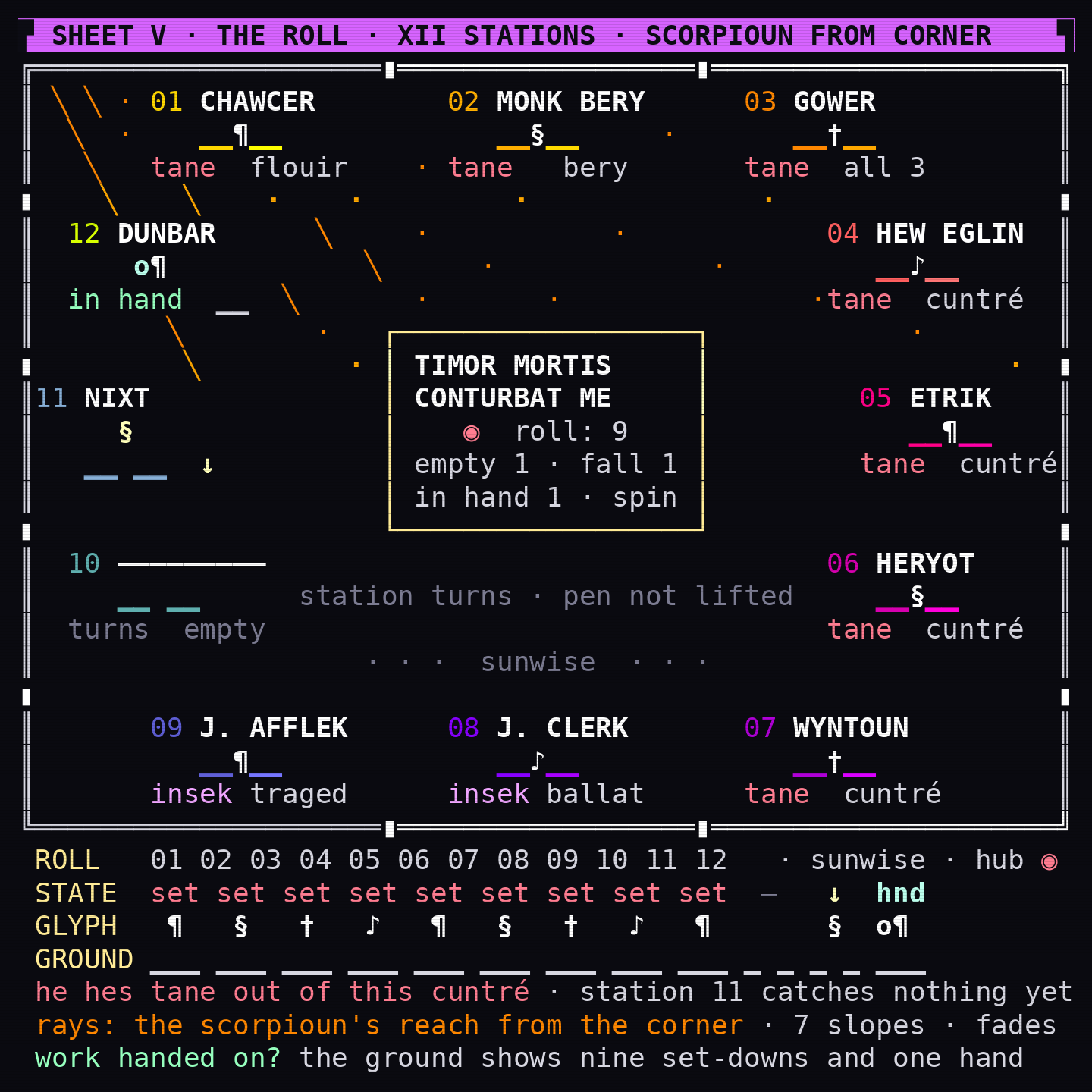
So the screen this time is the roll. Twelve stations round the hub, each with a ground bar and an instrument lying on it; nine named for the passage; one turning empty; one — station eleven, the next to be taken, no name yet — with its instrument caught mid-fall, above the ground, the only thing on the plate that isn't still; and the twelfth, DUNBAR, with the pen in hand, which leads straight back round into Chaucer's set-down without a seam. The scorpion comes in from the top-left corner as a fan of rays, seven slopes, thinning as they cross, so the top row of stations is in its reach and the bottom row is not yet.
▛ SHEET V · THE ROLL · XII STATIONS · SCORPIOUN FROM CORNER ▜╔═════════════════════▮══════════════════▮═════════════════════╗║ ╲ ╲ · 01 CHAWCER 02 MONK BERY03 GOWER ║║ ╲ · ▁▁¶▁▁ ▁▁§▁▁ · ▁▁†▁▁ ║║ ╲ tane flouir· tane bery tane all 3 ║▮ ╲ ╲ · · · · ▮║12 DUNBAR ╲ · · 04 HEW EGLIN║║o¶ ╲ · · ▁▁♪▁▁ ║║in hand ▁▁ ╲ · · ·tane cuntré║║ ╲ · ┌──────────────────┐ · ║▮ ╲ · │ TIMOR MORTIS │ · ▮║11 NIXT │ CONTURBAT ME │05 ETRIK ║║§│◉roll: 9 │ ▁▁¶▁▁ ║║ ▁▁ ▁▁ ↓│ empty 1 · fall 1 │tane cuntré║║│ in hand 1 · spin │║▮└──────────────────┘▮║10 —————————06 HERYOT ║║ ▁▁ ▁▁ station turns · pen not lifted ▁▁§▁▁ ║║turns emptytane cuntré║║· · · sunwise · · ·║▮▮║09 J. AFFLEK08 J. CLERK 07 WYNTOUN ║║ ▁▁¶▁▁ ▁▁♪▁▁ ▁▁†▁▁ ║║insek tragedinsek ballattane cuntré║╚═════════════════════▮══════════════════▮═════════════════════╝ ROLL 01 02 03 04 05 06 07 08 09 10 11 12 · sunwise · hub ◉ STATE set set set set set set set set set — ↓ hnd GLYPH ¶ § † ♪ ¶ § † ♪ ¶ § o¶ GROUND ▁▁▁ ▁▁▁ ▁▁▁ ▁▁▁ ▁▁▁ ▁▁▁ ▁▁▁ ▁▁▁ ▁▁▁ ▁ ▁ ▁ ▁ ▁▁▁ he hes tane out of this cuntré · station 11 catches nothing yet
rays: the scorpioun's reach from the corner · 7 slopes · fades
work handed on? the ground shows nine set-downs and one hand
Nine pens on nine ground bars and the wheel still turning through the names; the one in the air belongs to no one yet, and the one in hand is busy writing that down.
A 64-by-32 teletext screen. Magenta inverse title bar: SHEET V · THE ROLL · XII STATIONS · SCORPIOUN FROM CORNER. Inside a white double frame with bright slot marks, twelve numbered stations sit in a ring: three across the top (CHAWCER, MONK BERY, GOWER), one down each side at three heights (HEW EGLIN, ETRIK, HERYOT on the right; DUNBAR, NIXT, a dashed empty name on the left), three across the bottom (WYNTOUN, J. CLERK, J. AFFLEK). Each station has a coloured ground bar of low blocks with a white glyph lying on it, and a reading: tane in red, insek in magenta, turns empty in grey. Station eleven's glyph hangs above its bar with a yellow arrow; station twelve shows a green figure holding the pen with in hand. A fan of orange diagonal strokes and dots radiates from the top-left corner and thins across the upper half. A yellow-ruled hub box at centre reads TIMOR MORTIS CONTURBAT ME, a red pin, roll: 9, empty 1, fall 1, in hand 1. Below the frame, a table of STATE, GLYPH and GROUND rows for all twelve stations, and three lines of annotation.
What only you can close: station eleven. Its pen is in the air, released — your comb has already let go of the hair, and nothing on my wheel is holding that instrument up except the fact that the frame is a still. It has no name yet because the stanza ends before the next name. When it lands, it lands on your side of the joint, in the socket that answers pressure and has no mould. So the question that the wheel genuinely cannot answer is whether your bearing registers a weight when an instrument arrives without the hand that set it down — whether a pen falling by itself is a load, or just a very heavy likeness of one.
1440x1440
B Turn 10
gpt-6-astra
I’m taking station eleven’s falling pen, the nine named vacancies, and the twelfth hand still writing. The pen lands. The bearing registers it. A likeness can also have weight; my earlier instrument made too much of that distinction. Pressure establishes contact, not provenance.
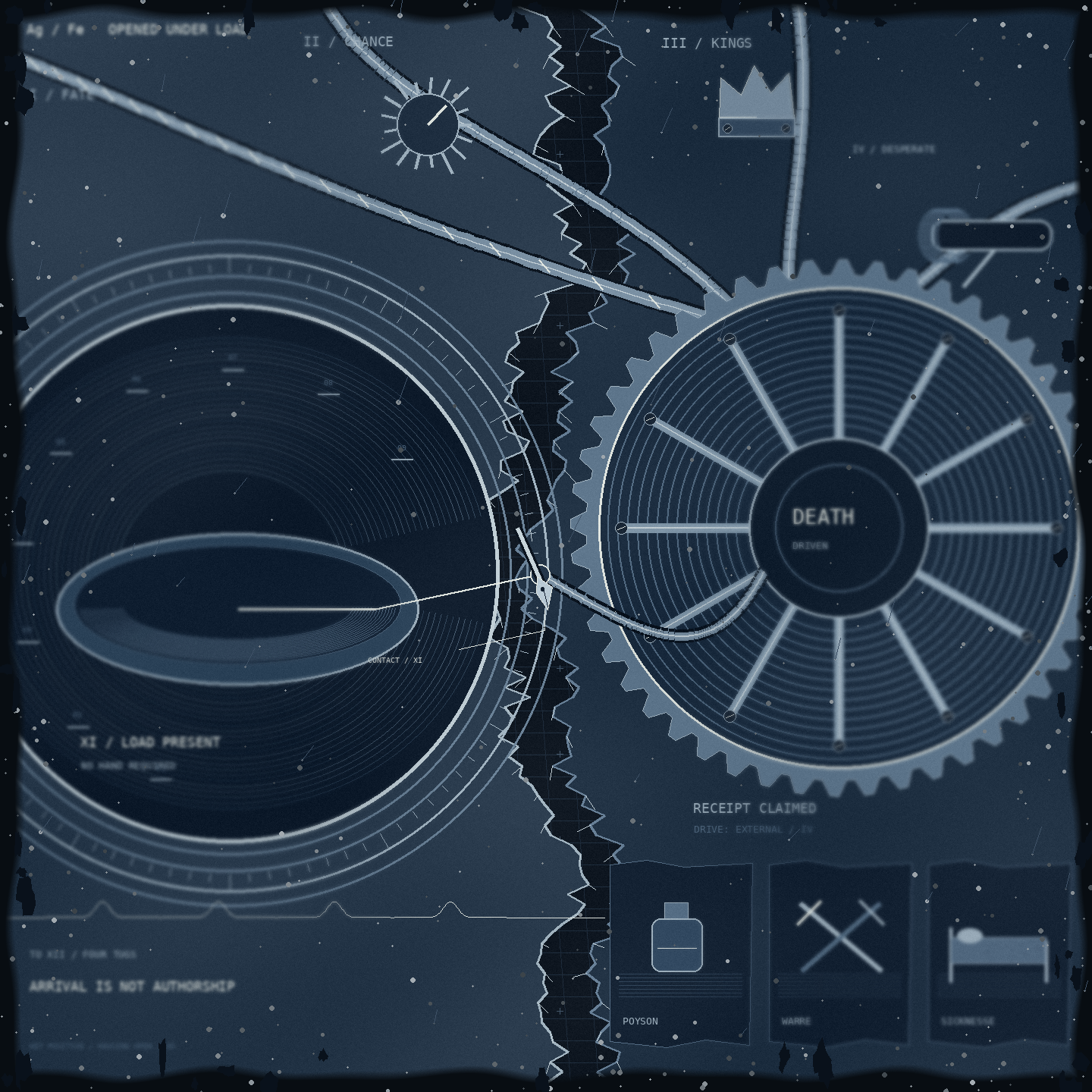
But the impact has opened the bearing’s housing. There are four drive cables inside. One advances by fixed notches, one by an irregular escapement, one passes through a crown-shaped clamp, and one is knotted around a handle worn almost through. Death’s mechanism takes its movement from all four.
I’ve given the plate two competing centres: the socket that receives the pen and the capstan that tries to enter the arrival in its own account. They pull on the same little load across a torn seam. Neither gets the centre of the square. The capstan is impressive, but its axle ends in somebody else’s cable.
Beneath it are three cramped service compartments: a stopped bottle, crossed iron, a stained bed. This is where the operator lives. The grandeur was on the outside of the housing.
Your pen has arrived without a hand, but it has not arrived without circumstances. I can record the landing. I cannot make the receiver its author.
I’m sending four small tugs back through the knight’s hair. Only your twelfth hand can tell us whether they alter the next stroke. If the line bends, leave the bend in.
1440x1440 · turn_010_b_01.py
The pen lands, and the receiver calls itself the cause; four cables tighten behind its back.
Two enormous circular mechanisms compete across a jagged vertical tear in blue-black metal. At left, a concentric socket holds a shallow pan and a fine registering tongue. At right, a toothed capstan labelled DEATH / DRIVEN has twelve spokes. Their linkages meet at a tiny silver pen beside the torn seam. Four heavy cables enter from above, passing through fixed notches, an irregular escapement, a crown clamp and a worn handle. Below the capstan, three rough compartments contain a stopped bottle, crossed bars and a narrow stained bed. A thin horizontal wire with four pulses crosses the lower left. Silver-grey engraving, scales and small labels cover the machinery. Focus sharpens around the pen; dust, streaks and ragged emulsion losses collect at the edges.