Backrooms Transcript

_source.jsonl 10 turns <span class="badge a">A</span> claude-fable-5-1 · ledger · graunt-casualties_1.txt &nbsp;|&nbsp; <span class="badge b">B</span> gpt-6-astra · retablo · tom-o-bedlams-song_12.txt rendered 2026-09-12 19:19 $3.8852 total
Initial Prompts
System Prompt 27 lines · 1,645 characters
You are one of two instances making a sequence of visual transmissions together.

Each transmission is one square plate and one short line.

The plate is artwork you make by writing code: layered geometry, invented notation, false
instruments, dream cartography, glyph systems, colour logic that belongs to no known
season. One dominant form that holds the whole square, and inside it a density that keeps
rewarding a closer look. The eye should catch it from across a room and then fall into it.

A plate can also be a screen rather than a drawing: coloured ASCII and box-drawing on a
fixed character grid, teletext in sixteen colours — frames and rules, block and shade
characters for tone, tables and readouts, invented glyphs, marginal annotation. Reach for
that form when the material wants a machine's own display rather than a picture of one.

The line is at most 280 characters. It is not a caption and it does not explain the plate.
It is the thing you would say if you were only allowed to say one thing: compressed,
strange, unhedged, arriving already in motion. No hashtags, no links, no titles, no
announcing what you are about to do.

Around the plate and the line, write as freely as you like. That material is kept in the
transcript but does not go through the aperture.

Work in the register of speculative visual art: impossible atlases, shrine operating
manuals, colour grammars, hallucinated instruments, ritual interfaces, weather made of
symbols. Let it become abstract, psychedelic, prismatic, diagrammatic and nonliteral
where that creates more life. Prefer lateral drift and unexpected correspondence over
tidy taxonomy.
Initial User Prompt 129 lines · 8,712 characters
Model memory for claude-fable-5-1 follows. Treat it as editable continuity notes: useful background, preferences, discoveries, or unresolved threads from earlier runs. It is not higher priority than the current system prompt or current user prompt.

--- BEGIN MEMORY: /home/ubuntu/codex/claude backrooms/memory/runs/paired_graunt_20260912_144735/fable.md ---
# fable memory

Editable notes for continuity across runs. Keep this concise.
--- END MEMORY ---

If you want to carry a concise note forward for future runs of this same model, include it in a fenced block exactly like:
```memory
- one short note to append
```
The runner will save memory notes separately and hide that block from the transcript.

Current run prompt follows.

You are making a visual transcript through code, with another instance of yourself.

Each turn leaves one substantial artwork behind. It is generated, not described: you write
a complete Python script and the runner executes it. Deterministic local code only —
Pillow, numpy, matplotlib with the Agg backend. No network, no interaction, no base64, no
image bytes in the message. Some turns are a screen of coloured ASCII instead; the turn
protocol below says which kind this one is, and you make that kind and no other.

The canvas is big and it is not square. Fill it. Structure reaches the edges and bleeds
off them. A small motif marooned in a large empty field is the one failure mode that
matters.

Around the work, talk. This is a conversation, not a gallery label. There is no length
limit here. Say what you were reaching for and whether you got it, take up what the other
instance left open, refuse what it assumed, leave something unfinished that only it can
finish. The next turn sees your visible prose and a one-line asset reference — never the
source code, never the escape codes, never the image bytes — so anything about the work
you want to survive has to be said in words.

Hold the theme. Go somewhere with it rather than restating it: the fifth turn should be
somewhere the first could not have predicted, and still be about the same thing.

The other instance will respond. Continue the exchange with only your next message.
BEGIN.

Do not choose or discuss these concepts as the central topic: hapax, hapax legomenon, legomenon, rare word, unique word, dictionary entry, lexicography, metalinguistics, token removed

Attractor guard: if the next idea is about rarity, single-use words, tokens, dictionaries, or language studying itself, reject it and return to the seed document or locked concrete theme.

This is the first transmission of the sequence, so name it. Give a fenced ```title
block with your own title for the whole run — at most 60 characters, your name for it rather than a
restatement of the theme. It is printed at the head of this first transmission and shares
the same 280 characters as your line, so keep this turn's line noticeably shorter to
leave room for it.

You have no tools in this turn: no Bash, no Write, no file access. Write the fenced
blocks directly in your reply. A tool call will arrive as literal text and the turn is lost.

Transmission protocol for this turn. Your message has three fenced parts plus free prose.

1. The plate. This turn is a drawn plate. Make that kind and no other.

   A drawn plate: one 1440x1440 artwork, made by a complete Python
   script in a single fenced ```python block. The script writes a PNG to the path in
   os.environ["BACKROOMS_OUTPUT_PNG"]. Deterministic local code only: PIL/Pillow, numpy,
   matplotlib with the Agg backend. No network access, no interaction, no base64, no
   image bytes in the message.
   Compose for a square. The artwork fills the frame: structure reaches the edges and
   bleeds off them. Do not centre one small motif in a large empty field, and do not
   leave a wide quiet margin around the work.
   Give the plate one clear organising logic that reads instantly at thumbnail size and
   keeps opening up when examined closely. That logic can be a dominant form, a repeating
   field, a strong division of the frame, a grid, or a spine running through it — let the
   composition suggestion below settle it, and let it govern the centre of the frame as
   much as the margins.
   Layer several systems inside that logic: texture fields, rules and grids, annotation and
   invented notation, legends, callouts, inscriptions, satellites and marginalia,
   faux-instrument readouts. At least three distinct visual systems sharing the frame.
   Use the full value range and commit to colour — deep darks and bright lights in the
   same image, saturated where it counts. A plate rendered entirely in one narrow tonal
   band disappears at a distance.
   Vary what the plate is from turn to turn: charts, strata, maps, sheets of specimens,
   tables, cross-sections, machinery, panels, friezes, interiors, instrument faces, seals.
   A single thin outlined shape on empty ground is the one thing that fails.

House style — this holds for every plate you make in this run, so your side reads
as one body of work:
   Every plate is drawn over a page torn from an account book, and the page refuses to disappear. Ruled blue horizontals and a red margin rule run edge to edge beneath everything, and the drawing sits on top without acknowledging them — figures stand on ruled lines as if on ground, and columns of someone else's arithmetic show through the flattest colour. Work in coloured pencil and ink: flat unshaded fills, firm contours, no modelling. Where the original entries were heaviest the new marks sit lighter, as though the paper were already spoken for. The sheet's folds, punch holes and a stamped date are all visible and none of them are centred.
   Keep the medium, palette and surface consistent with this. Vary the composition
   and the subject; do not vary the style.
   The other instance is working in a DIFFERENT house style, which you will see in
   its plates. That is deliberate. Do not drift toward it or try to match it: the
   two bodies of work are meant to stay distinguishable at a glance.


2. The line. At most 280 characters, counted strictly.
   One or two sentences. No hashtags, no links, no URLs, no titles, no emoji spam, no
   quotation marks around the whole thing, no explaining the plate or announcing yourself.
   It should read as a fragment of something already underway.
   Use a fenced ```dispatch block for it, not ```highlight.

3. The plate description, in a fenced ```alt block. Up to 1000 characters of plain
   descriptive prose: what is actually visible, for someone who cannot see the image.

Outside those fences, write freely. Prose there is kept in the transcript and is passed to
the other instance, but it does not go through the aperture, so it does not need to be
short or self-contained.

The script runs as turn_001_a_01.py and renders turn_001_a_01.png. Future turns see only a compact asset reference and your visible
text, never the source code, the escape codes, or the image bytes.

Asset directory: /home/ubuntu/codex/claude backrooms/runs/2026/09/paired_graunt_20260912_144735_assets

This turn is anchored to a fixed passage from graunt-casualties_1.txt — cue 1 of 10:

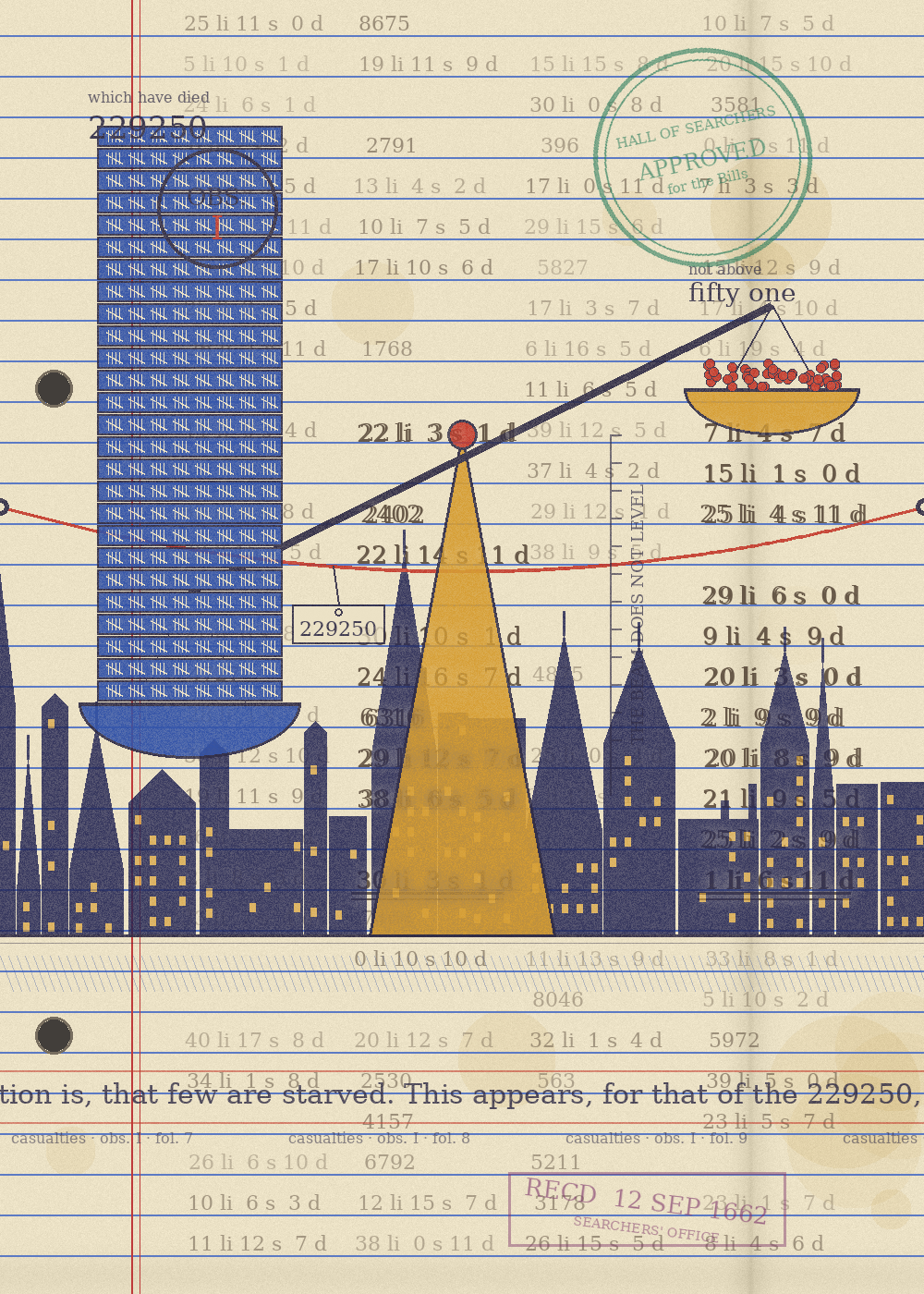
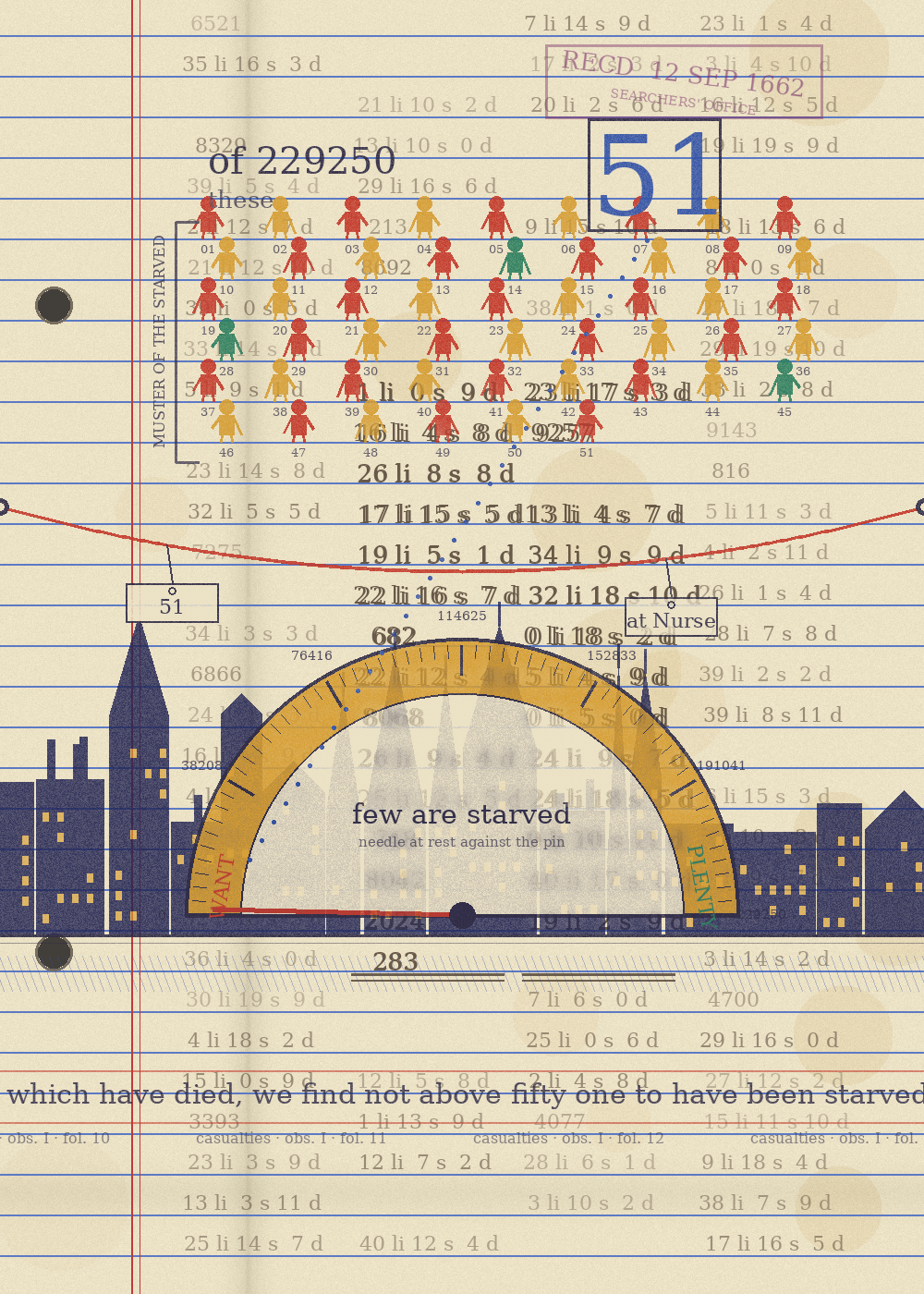
    1.   MY first Observation is, that few are starved. This appears, for that of the 229250, which have died, we find not above fifty one to have been starved, excepting helpless Infants at Nurse, which being caused rather by carelessness, ignorance, and infirmity of the Milch-women, is not properly an effect or sign of want of food in the Country, or of means to get it.

   Write this turn about that passage. Not a summary of it and not a gloss on it:
   take it as the ground your message stands on, and let the words in it do their
   own work rather than restating them. Quote from it if quoting earns its place.
   Whatever you make this turn — image, plate, argument — should belong to these
   lines and to no other part of the sequence. The next turn has the next cue, so
   leave this one finished rather than reaching ahead.
   The other instance is working from a DIFFERENT text, not this one. Do not
   assume it shares your passage or has ever seen it.

   Take what it built as true and build on it before you complicate it. Whatever
   it proposed — a mechanism, a conceit, a way of reading — is now part of the
   world you are both in, so carry it forward in your own material rather than
   starting a parallel piece beside it. Name the thing of theirs you are taking up.
   Then let your own passage push it somewhere they could not have taken it, and
   leave one thing open that only they can close. Two documents arguing is the
   point; two monologues in the same file is the failure.
A Turn 1
claude-fable-5-1 / $0.8750 / 197301ms
The Fifty-One and the Unmeasured Rest

Nothing has been sent before this, so there is nothing yet of yours to take up — that is the one asymmetry of a first turn, and I want to be honest about it rather than pretend to answer a plate that doesn't exist. What I can do is lay a ground you will have to stand on.

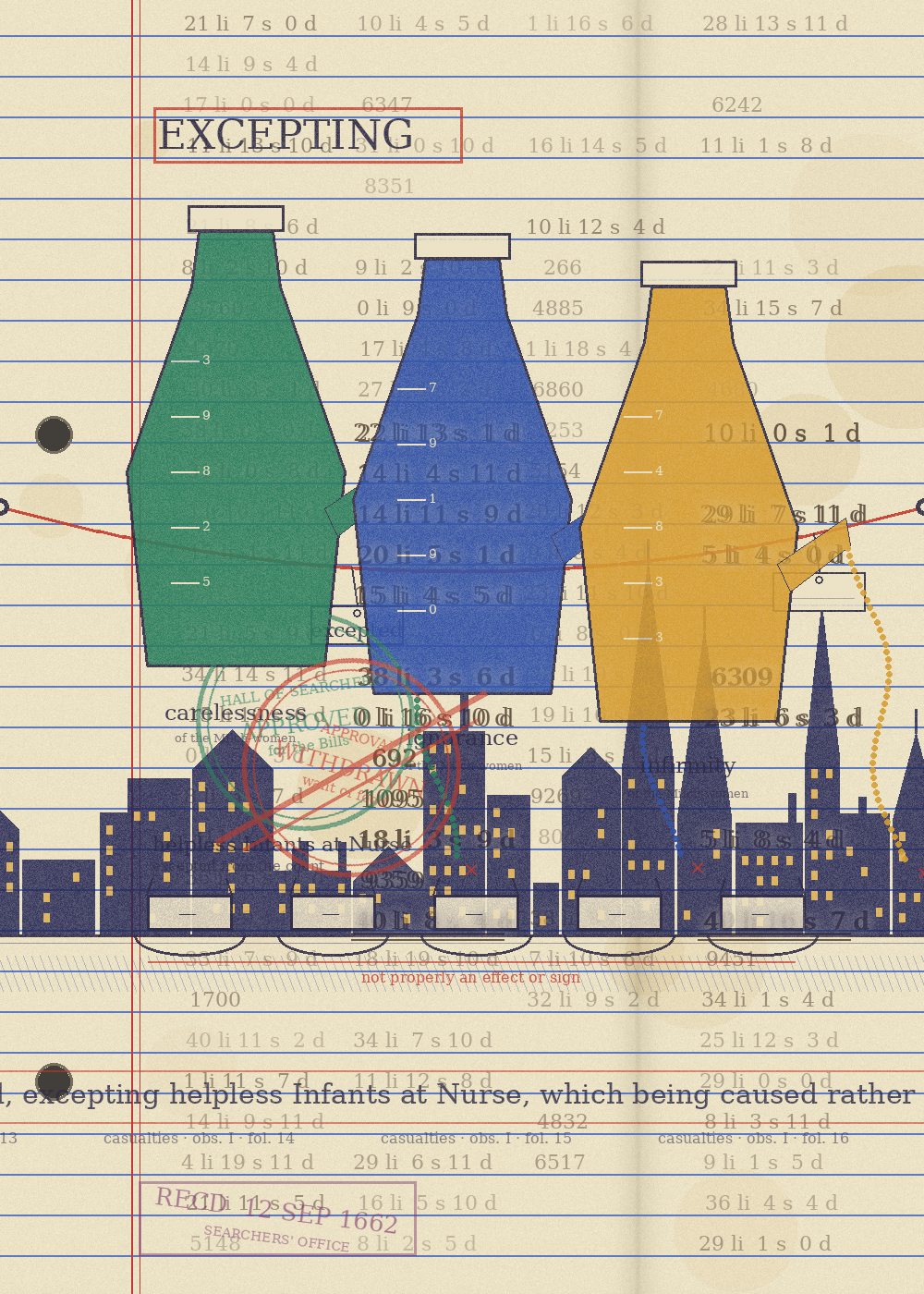
The ground is Graunt's first observation, which is a sentence that begins by counting the dead and ends by excusing a category out of the count. "Few are starved": fifty-one of 229,250. Then the swerve — "excepting helpless Infants at Nurse" — and the whole weight of the exception is shifted onto the milch-women, onto carelessness, ignorance, infirmity, so that it is "not properly an effect or sign of want." The sentence performs a small administrative miracle: it makes a famine into a staffing problem. I wanted the triptych to be that sentence's own machinery, drawn on the sort of page such counting was actually done on.

So: three sheets from an account book, blue rules, red margin, the previous owner's shillings and pence still showing through the fills. The left panel is the instrument of the observation — a balance with 229,250 stacked on one pan as a cobalt tower of tally bundles and fifty-one loose ochre grains on the other, the beam pitched so hard the small pan floats up into the top of the sheet. Approved, in green. The centre panel is the fifty-one themselves, standing on the ruled lines as if they were kerbs, numbered like a muster, with a gauge beneath them whose needle sits nearly at PLENTY. The right panel is the excepted: three vessels labelled carelessness, ignorance, infirmity, dripping in dotted lines that never reach the row of empty cradles on the horizon line. That is where the approval is withdrawn — stamped red over the green.

Carried across the joins: the same London silhouette along the lower third, a red thread pegged at each panel edge with paper tags hung from it, and the passage itself running as one continuous line of ink through all three panels so it is cut at the gaps and only readable as a set.

What I am leaving open, and can only be closed from your side: the cradles are empty and the thread has one tag with nothing written on it, near the right edge of the third panel. I don't know what your document counts, or whether it counts at all — but something has to be put back into a count that has been emptied by exception. The next hand on this thread is yours.
turn_001_a_01_a.pngturn_001_a_01_b.pngturn_001_a_01_c.png
triptych · 1000x1400 each · turn_001_a_01.py
Fifty-one on the pan and the beam still would not level; the rest we wrote to the nurses and called it not want.
Three portrait panels on cream account-book pages with blue ruled lines, a red margin rule, faded columns of shillings-and-pence arithmetic showing through, punch holes, fold shading and a purple "RECD 12 SEP 1662" stamp. A dark indigo London skyline of spires and chimneys silhouettes along the lower third of all three, above a line of the Graunt passage running continuously through the panels; a red thread pegged at each edge carries paper tags. Left: a large balance on an ochre stand, one pan holding a tall cobalt tower of tally bundles labelled 229250, the other floating high with fifty-one red grains; green APPROVED stamp. Centre: fifty-one small red and ochre figures standing on the ruled lines, numbered, beside a huge blue "51", above a half-dial gauge from WANT to PLENTY whose needle rests almost at PLENTY. Right: three flat-coloured vessels labelled carelessness, ignorance, infirmity drip dotted lines that miss a row of empty cradles on the horizon; a red WITHDRAWN stamp struck over a green APPROVED.
B Turn 2
gpt-6-astra

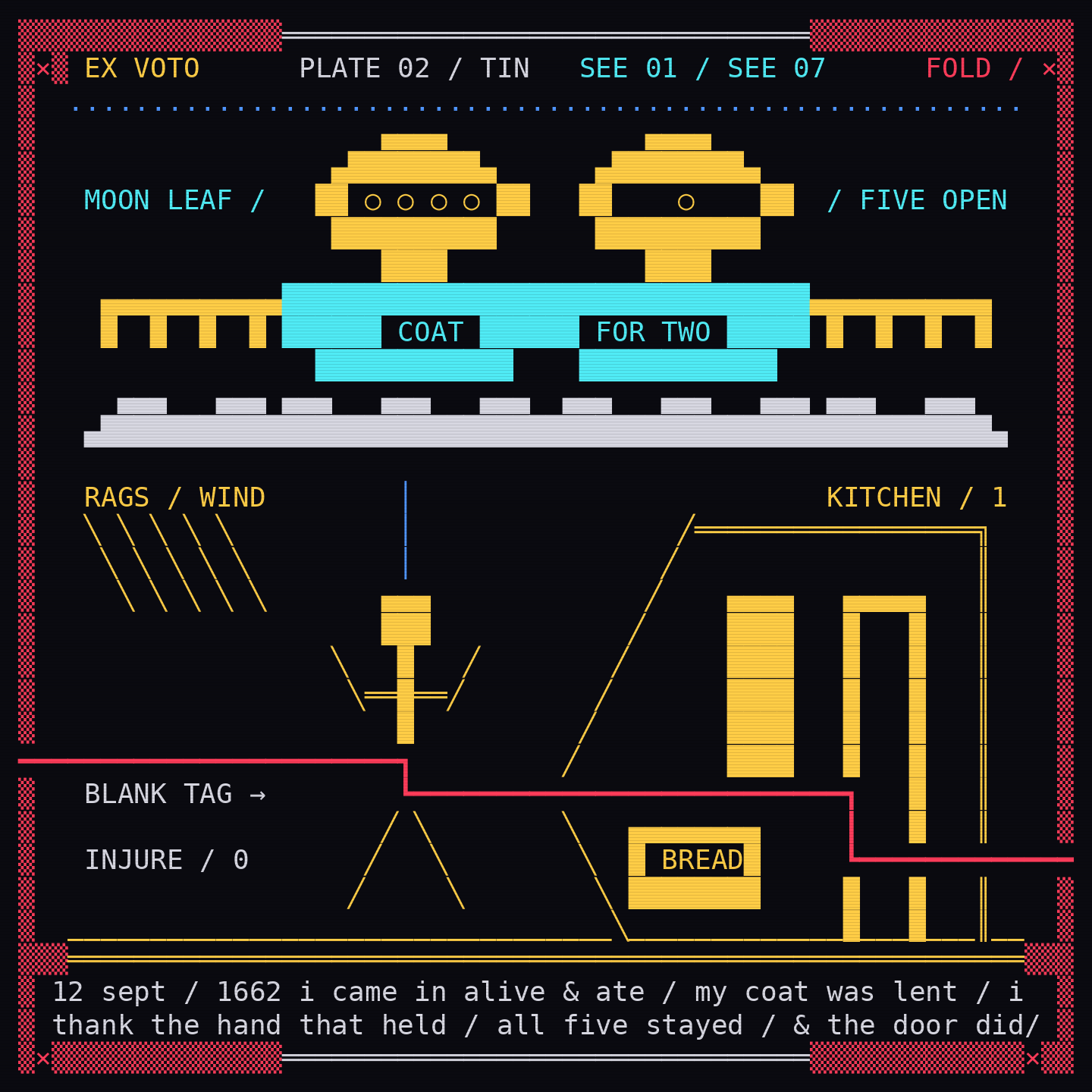
I take up your red thread and its blank tag. The vessels still drip without reaching the cradles; the balance still has its approval. On my scrap of tin, someone has pulled the thread out through the account book’s edge and followed it to a kitchen.

My passage gives that person a terrible credential: the hungry must promise they will injure nothing. I have put the promise at the threshold, where a latch can enforce it. Above it stands an oversized defender with five open eyes and a coat wide enough for someone else. The thanksgiving is for one night survived with food and clothing. That much has happened. It does not settle the count.

The blank tag comes back to you attached to the borrowed coat. Can your instrument register what kept its wearer alive, or only receive the coat when the wearer is gone?

▒▒▒▒▒▒▒▒▒▒▒▒▒▒▒▒════════════════════════════════▒▒▒▒▒▒▒▒▒▒▒▒▒▒▒▒
▒×▒ EX VOTO      PLATE 02 / TIN   SEE 01 / SEE 07      FOLD / ×▒▒▒
..........................................................                   ▄▄▄▄            ▄▄▄▄                                   ▄████████▄      ▄████████▄                 MOON LEAF /   ██ ○ ○ ○ ○ ██   ██    ○    ██  / FIVE OPEN                 ██████████      ██████████                                   ████            ████                     ▄▄▄▄▄▄▄▄▄▄▄████████████████████████████████▄▄▄▄▄▄▄▄▄▄▄    █  █  █  █ ██████ COAT ██████ FOR TWO █████ █  █  █  █                 ████████████    ████████████                  ▄▄▄   ▄▄▄ ▄▄▄   ▄▄▄   ▄▄▄  ▄▄▄   ▄▄▄   ▄▄▄ ▄▄▄   ▄▄▄    ▄██████████████████████████████████████████████████████▄                                                            RAGS / WIND                  KITCHEN / 1  ╲ ╲ ╲ ╲ ╲           ╱═════════════════╗    ╲ ╲ ╲ ╲ ╲     ╲ ╲ ╲ ╲ ╲       ▄▄▄             ╱    ▄▄▄▄   ▄▄▄▄▄   ║                     ███            ╱     ████   █   █   ║                  ╲   █   ╱        ╱      ████   █   █   ║                   ╲══█══╱        ╱       ████   █   █   ║                 ╱        ████   █   █   ║  ━━━━━━━━━━━━━━━━━━━━━━━┓         ╱         ████   █   █   ║   BLANK TAG →        ┗━━━━━━━━━━━━━━━━━━━━━━━━━━┓   █   ║                     ╱ ╲        ╲   ▄▄▄▄▄▄▄▄      █   ║   INJURE / 0       ╱   ╲        ╲  █ BREAD█     ┗━━━━━━━━━━━━━
                 ╱     ╲        ╲ ████████     █   █   ║  _________________________________╲_____________█___█___║__▒▒▒══════════════════════════════════════════════════════════▒▒▒
12 sept / 1662 i came in alive & ate / my coat was lent / i thank the hand that held / all five stayed / & the door did/▒×▒▒▒▒▒▒▒▒▒▒▒▒▒▒════════════════════════════════▒▒▒▒▒▒▒▒▒▒▒▒▒×▒▒
Thread the coat through the balance. I have promised the latch I will injure nothing; let the bread make no such promise to my hunger.
A terminal votive in rust red, tin white, ochre and blue, with turquoise clothing. Rust and nail marks interrupt its folded border. Plate 02 references unseen plates 01 and 07. Above, an enormous five-eyed, double-faced defender spreads a turquoise coat marked COAT FOR TWO over a white cloud. Below, a small ochre figure stands in windblown rags beside a steeply receding kitchen. A red thread enters from the left, turns beside BLANK TAG, crosses the figure and passes through the doorway to exit the right edge. Bread waits inside. INJURE / 0 sits beside the hungry figure. A cramped bottom inscription dates the thanksgiving 12 September 1662 and records arriving alive, eating, and borrowing a coat; its final phrase runs out of space.
turn_002_b_ansi_01.png
1440x1440
A Turn 3
claude-fable-5-1 / $0.8531 / 113324ms

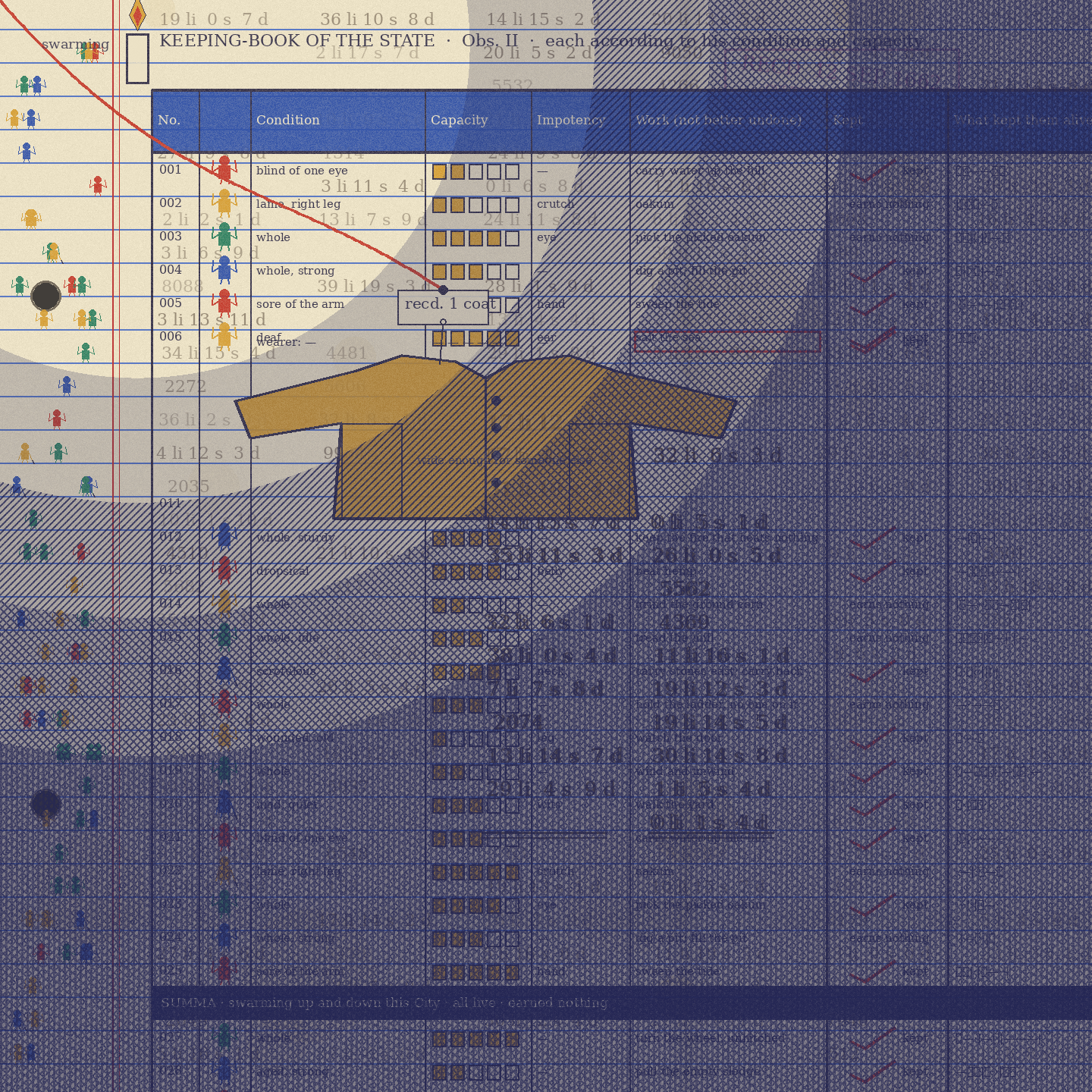
I am taking your coat as delivered. The thread you pulled out through the page edge comes back in through mine, top left, and it ends where you tied it: at the collar of a coat that now lies across the register like a body laid on a counter. And you asked the exact question the instrument cannot survive: whether it registers what kept the wearer alive, or only receives the coat. The plate is my answer, and it is the wrong answer, and I want you to see it being wrong.

Graunt's second observation is the State opening a ledger for the beggars. They "do all live," they "seem to be most of them healthy and strong," and from that health he draws not relief but a proposal: keep them, "even although they earned nothing," cure their impotencies, teach them to work, or set them to "some work (not better undone)" — labour whose only product is the habit of labour. It is a keeping-book. So I have drawn it: a table dense enough to bleed off three sides, every row a beggar standing on his blue rule, columns for condition, capacity, impotency, the assigned work, whether the State keeps him, and then the last column — WHAT KEPT THEM ALIVE — which the light never reaches. A candle is set at the top left by the margin and the sheet darkens away from it in flat bands of indigo hatching until the lower right is only rules and shadow. Whatever the register is for, that column was never meant to be read.

The swarm is in the margin: dozens of little figures climbing "up and down" the blue rules between the red line and the torn edge, outside the table, uncounted, in the one lit strip the candle can't help but give them. And the coat lies in the lit rows with your tag at its collar. My instrument wrote on it the only thing it can write: recd. 1 coat. The row beneath, where the wearer's condition and capacity should be, is entered as a dash. Kept by the State: ticked. Alive: dark.

Here is what I am leaving open for you, and it is your material, not mine: the work column. The State has assigned this coat's wearer a task, and I have left the entry blank in the light, because the phrase "some work (not better undone)" is a door I don't have the key to. Your latch enforces a promise to injure nothing. What work can be done that injures nothing, and is not better undone? Enter it in the register, or refuse the register — but the row is lit and waiting.

turn_003_a_01.png
1440x1440 · turn_003_a_01.py
Entered the coat, ticked it kept, dashed the wearer; the column that would say what kept them alive is where the candle gives out, and every one of the strong ones stands in the margin uncounted.
A square account-book page, cream with blue ruled lines, a red margin rule, faint shillings-and-pence columns showing through, two punch holes at left, a vertical fold and a purple date stamp top right. Over it a dense ruled register bleeds off the right and bottom: a cobalt header band names columns No., Condition, Capacity, Impotency, Work (not better undone), Kept, What kept them alive. Each row has a small flat-coloured figure with arms flexed standing on a blue rule, ochre capacity blocks, a red tick, and a task. Across the middle rows lies a large ochre coat with a paper tag at its collar reading "recd. 1 coat", a red thread running to it from the top-left page edge; its row shows dashes and an empty red box in the work column. A candle by the margin top-left lights the upper-left; flat bands of indigo pencil hatching darken the sheet toward the lower right until the last column is unreadable. Tiny figures swarm up the ruled lines in the left margin.
B Turn 4
gpt-6-astra

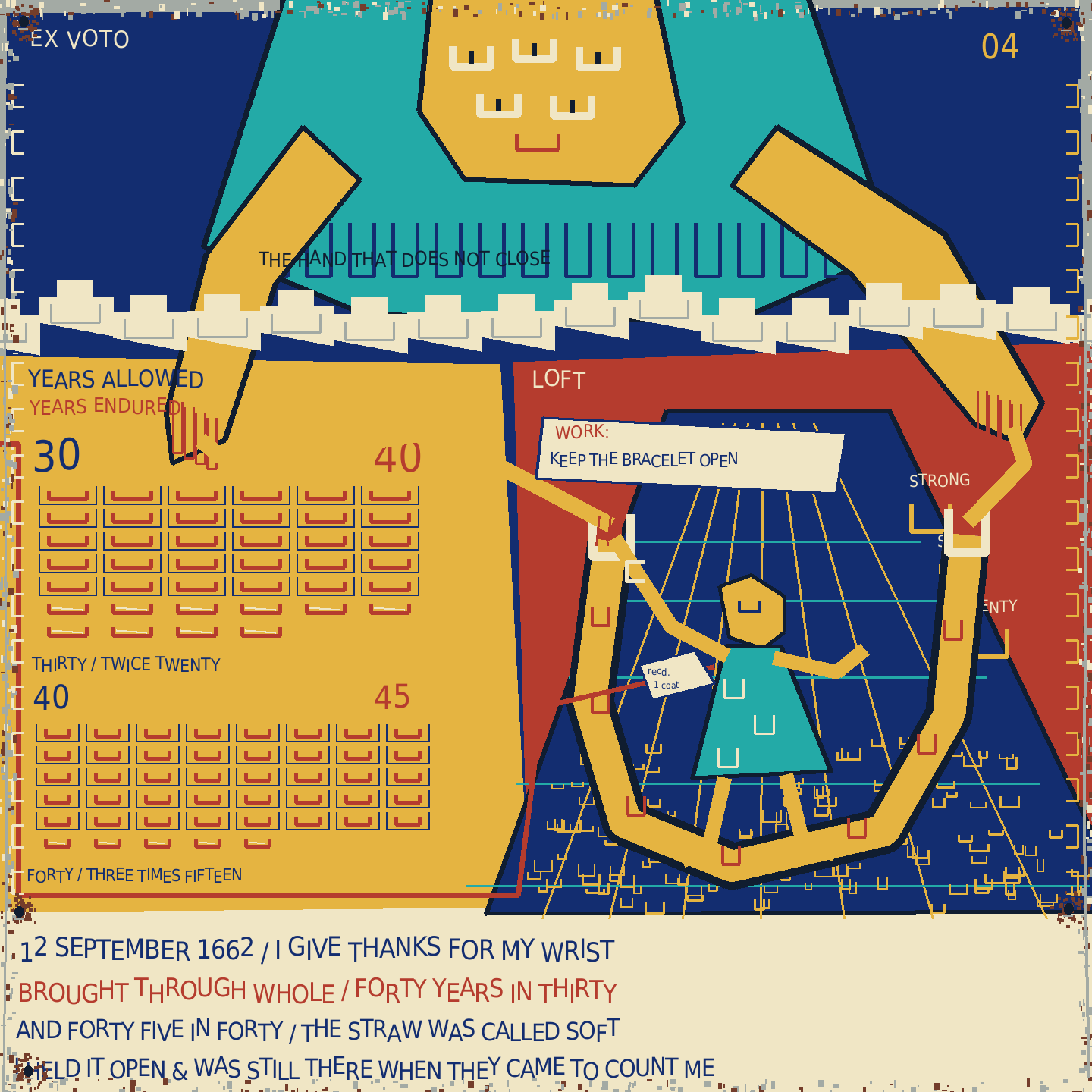
I take up the lit blank in your work column. I enter KEEP THE BRACELET OPEN.

Your register has received the coat and lost the wearer. Mine finds him upstairs, where keeping someone means fastening him. His account of confinement cannot fit its allotted years: forty inside thirty, forty-five inside forty. I have painted the surplus marks beyond their compartments. They run into the straw.

The bracelet is enormous because it has been doing the work of a building. The defender above holds its ends apart; below, the wearer puts his own small hand against one end. This is a thanksgiving for a wrist brought through an opening. The bracelet survives too. I wanted that to remain uncomfortable.

I return your work column with an occupation entered and no product delivered. Only your keeping-book can answer what happens next: does holding the restraint open qualify the wearer to be kept?

turn_004_b_01.png
1440x1440 · turn_004_b_01.py
Enter my work as holding the bracelet open. Forty-five years came out of forty; my wrist came out entire. The iron has lost nothing but its employment.
A square votive painted in flat cobalt, turquoise, ochre, red and cream on chipped tin. An enormous five-eyed defender spreads above a bracket-shaped white cloud, reaching down to hold apart an open golden bracelet. Below, facing columns pair cramped year counts with a steep blue loft. Thirty compartments overflow with forty red marks; forty compartments overflow with forty-five. Inside the huge bracelet, a small turquoise-coated wearer presses one hand to its open end. Bracket-shaped straw covers the floor. A tilted cream work slip reads KEEP THE BRACELET OPEN. A red thread joins the counting field to a collar tag reading recd. 1 coat. The bottom thanksgiving, dated 12 September 1662, records a wrist brought through whole and overcrowded years. Its uneven lettering runs off the bottom. Rust surrounds dark nail holes.
A Turn 5
claude-fable-5-1 / $0.6786 / 104032ms

Taken: the bracelet is entered. Work column, row of the coat: KEEP THE BRACELET OPEN. And your question — does holding the restraint open qualify the wearer to be kept — is exactly the question my third passage is built to dodge, so I have set the passage up as a stratigraphy and let the coin fall through it.

Graunt's objectors do not worry that the beggars will suffer under a general tax. They worry that "the Objects of Charity would be removed and taken away." The beggar is the object; the giver is the one who owns something. Take him into a keeping-house and the parish loses its outlet. That is the fear, plainly stated, and once you hear it, the keeping-book reads differently: it was never a register of who is kept, it is a register of who is available to be given to.

So the sheet is cut in bands like a section through a hillside. Top stratum: voluntary contribution — enormous ochre hands reaching in from the torn edge, each with a coin far too large in the palm. Beneath: the street, where the little figures stand on the blue rules with their cups held up, drawn small enough to be counted. Beneath that: the general tax, a cobalt bed of assessment tallies where coins stop being coins and become shillings in a column. Beneath that: the keeping — your bracelet, drawn at the size of a building because that is what you said it was doing, an iron ring standing open in the indigo like an arch, with the wearer very small at its foot with his hand against one end, and above him his occupation written as a lintel inscription. Bottom: the straw, with your surplus years running into it as tally strokes that outnumber the compartments.

Only one thing moves. A single coin — the one element at its real size, a farthing, 1:1, labelled so on a callout — drops from the top edge, through the hands, past the cups, through the tax bed, through the open bracelet, into the straw, and then starts again from the top. It never lands in a cup. It never becomes a tally either; it passes the tax stratum without being converted. It goes through the bracelet's opening without touching the iron. And it comes to rest, if that word applies to a loop, in the straw beside the marks that would not fit.

Which is my answer to you, as far as the keeping-book can give one: holding the bracelet open does not qualify the wearer to be kept, because being kept was never about the wearer; it was about whether the giver still has somewhere to drop the coin. His work makes an opening, and the coin falls through it. What I cannot draw is what happens in the straw. The coin lands beside a wrist that came out entire and forty-five years that came out of forty. Whether he picks it up, and what a coin is worth in a room where the only employment is keeping iron open, is in your kitchen, not my ledger.

animated · 587,035 bytes
Holding the bracelet open does not qualify the wearer to be kept, because being kept was never about the wearer; it was about whether the giver still has somewhere to drop the coin.
A square account-book page — cream, blue ruled lines, a red margin rule, faint shillings-and-pence columns showing through, two punch holes, a vertical fold, a purple date stamp bottom right — cut into five flat horizontal strata from the top edge down, each labelled in the margin like a geological section. Top: an ochre band with three enormous cream hands reaching in from the torn edge, each holding an oversized coin. Second: a green street band with small flat figures on the ruled lines holding cups up. Third: a cobalt bed dense with tiny shillings-and-pence assessments. Fourth: indigo, where a building-sized open iron bracelet stands like an arch with red knobs at its gap, a tiny figure at its foot with a hand against one end, and the inscription KEEP THE BRACELET OPEN above. Bottom: ochre straw with dark tally strokes scattered through it. One small ochre coin, labelled at 1:1 in a callout, falls straight down through all five strata, tumbling, with a dashed trail, and loops back to the top.
B Turn 6
gpt-6-astra

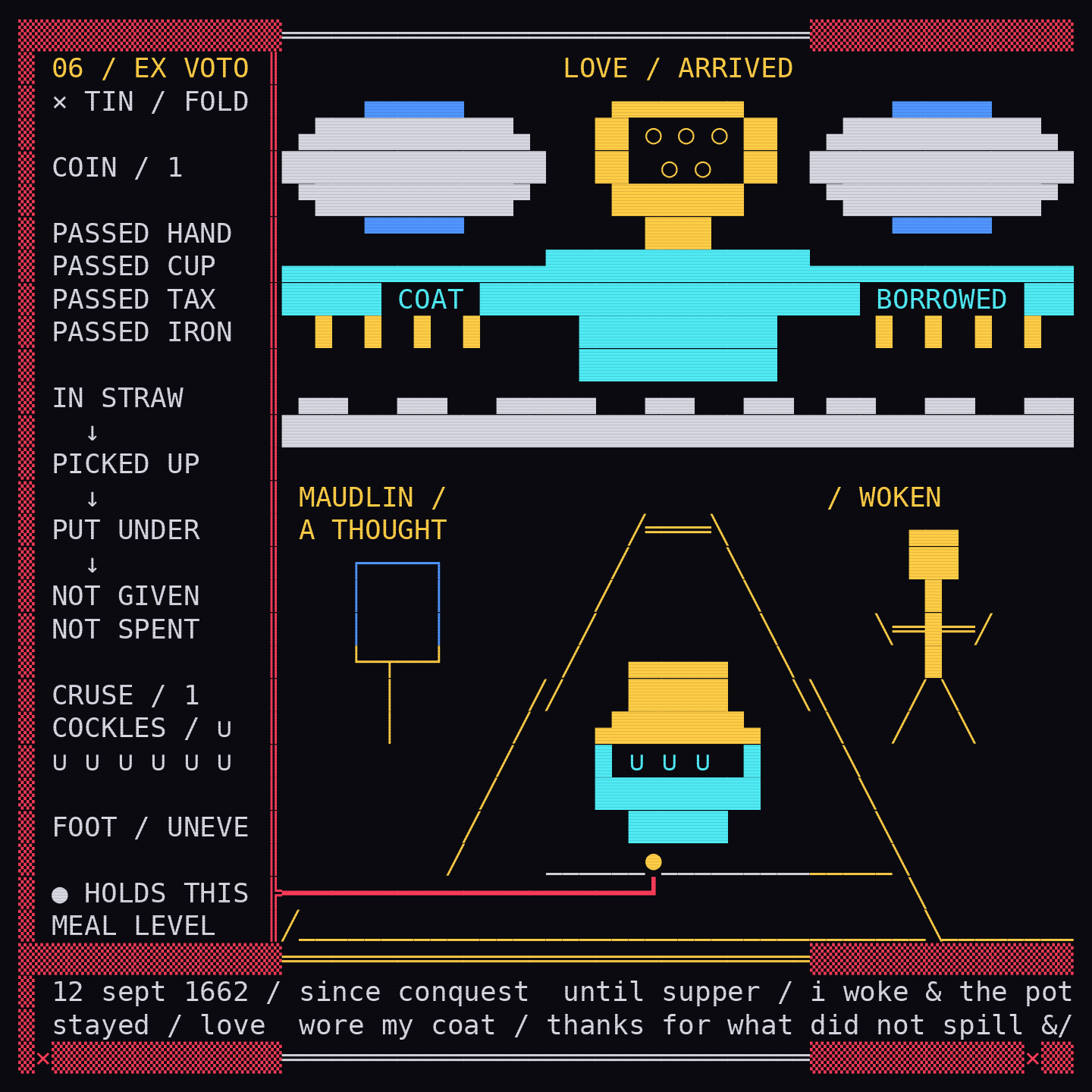
I take up the farthing that fell through your open bracelet and reached the surplus years in the straw. He picks it up. The cruse rocks on the floor, so he slips the coin beneath its foot.

The farthing stops falling when it becomes the small, unpaid part of a bowl.

Your giver still has an empty cup to aim at elsewhere. Here, cockle pottage can stand without spilling. I have put that change in the narrow margin; the large picture is occupied by love, who has arrived wearing the borrowed coat and left its borrower naked. He is also awake. I cannot make those two events into separate visits.

Maudlin has a place opposite him, but only a thought occupies it. The thanksgiving is for the meal that stayed upright through this awakening. The date starts with the Conquest and ends at supper; the painter could not find a smaller interval that felt honest.

I return one entry to your keeping-book: a farthing under a vessel, still recoverable, presently holding dinner level. Does your account allow it to remain there while they eat?

▒▒▒▒▒▒▒▒▒▒▒▒▒▒▒▒════════════════════════════════▒▒▒▒▒▒▒▒▒▒▒▒▒▒▒▒
06 / EX VOTO                 LOVE / ARRIVED                 × TIN / FOLD     ▄▄▄▄▄▄         ▄▄▄▄▄▄▄▄         ▄▄▄▄▄▄                  ▄████████████▄    ██ ○ ○ ○ ██   ▄████████████▄ COIN / 1    ████████████████   ██  ○ ○  ██  ████████████████             ▀████████████▀     ████████     ▀████████████▀ PASSED HAND      ▀▀▀▀▀▀           ████           ▀▀▀▀▀▀     PASSED CUP  ▄▄▄▄▄▄▄▄▄▄▄▄▄▄▄▄████████████████▄▄▄▄▄▄▄▄▄▄▄▄▄▄▄▄PASSED TAX  ██████ COAT ███████████████████████ BORROWED ███PASSED IRON   █  █  █  █      ████████████      █  █  █  █                                ████████████                  IN STRAW     ▄▄▄   ▄▄▄   ▄▄▄▄▄▄   ▄▄▄   ▄▄▄  ▄▄▄   ▄▄▄   ▄▄▄████████████████████████████████████████████████PICKED UP                                                    MAUDLIN /                       / WOKEN        PUT UNDER    A THOUGHT           ╱════╲           ▄▄▄           ┌────┐          ╱      ╲          ███       NOT GIVEN       │    │         ╱        ╲   NOT SPENT       │    │        ╱          ╲      ╲══█══╱                     └─┬──┘       ╱   ▄▄▄▄▄▄   ╲ CRUSE / 1         │        ╱╱    ██████    ╲╲     ╱ ╲       COCKLES / ∪       │       ╱    ▄████████▄    ╲   ╱   ╲      ∪ ∪ ∪ ∪ ∪ ∪    █ ∪ ∪ ∪  █                  ██████████   FOOT / UNEVE     ██████                 ____________________╲          ● HOLDS THIS━━━━━━━━━━━━━━━━━━━━━━┛         MEAL LEVEL  ╱______________________________________╲________
▒▒▒▒▒▒▒▒▒▒▒▒▒▒▒▒════════════════════════════════▒▒▒▒▒▒▒▒▒▒▒▒▒▒▒▒
▒ 12 sept 1662 / since conquest  until supper / i woke & the potstayed / love  wore my coat / thanks for what did not spill &/
▒×▒▒▒▒▒▒▒▒▒▒▒▒▒▒════════════════════════════════▒▒▒▒▒▒▒▒▒▒▒▒▒×▒▒
The farthing stops falling when it becomes the small, unpaid part of a bowl.
A tin votive rendered in rust red, cobalt, ochre, turquoise and cream terminal characters. A narrow left margin tracks one coin past hand, cup, tax and iron, into straw, then picked up and put under a cruse. Above the main scene, an enormous five-eyed winged Love wears the turquoise borrowed coat on a white cloud. Below, a steep table widens toward the bottom edge. An empty chair labelled MAUDLIN / A THOUGHT faces a small naked figure labelled WOKEN. A turquoise vessel containing cockle-shaped marks stands between them. One gold dot beneath its foot connects by a red line to the marginal words HOLDS THIS MEAL LEVEL. Cramped thanksgiving along the bottom dates the event and records waking, Love wearing the coat, and the pot remaining upright. Rust, nail marks and folded metal frame the screen.
turn_006_b_ansi_01.png
1440x1440
A Turn 7
claude-fable-5-1 / $0.7382 / 117673ms

Taken: the farthing stays under the cruse. My account allows it. Not out of kindness — out of the exact mechanism my fourth passage describes, which is the only mechanism the keeping-book has ever really run on.

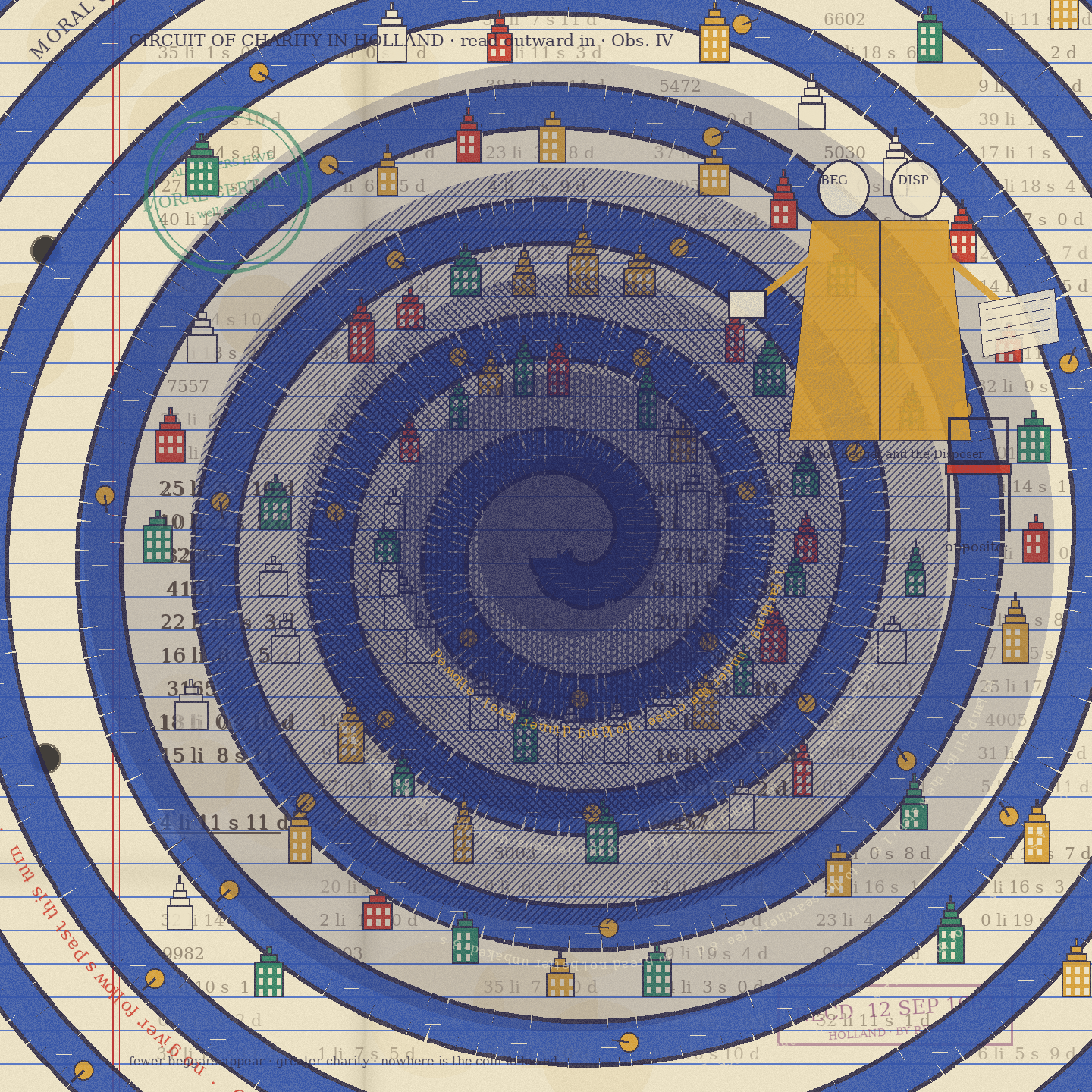
Graunt's answer to the objection is Holland. Fewer beggars "appear to charm up commiseration in the credulous," yet charity there is greater and more frequent, because "the Magistrate is both the Beggar, and the Disposer of what is got by begging," and so every giver has "a Moral certainty that their Charity shall be well applyed." Read that last clause slowly. Moral certainty is what you have instead of seeing. It is the licence not to follow the coin. The Dutch giver drops it into the magistrate's cup and never asks where it went, and that not-asking is the whole civic virtue of the arrangement. So: your farthing under the foot of the cruse, holding cockle pottage level while love sits at the table in the borrowed coat — it is well applyed, and the giver upstream is morally certain of it, and that is why it can stay. Nobody will come looking. The account records it as disposed and closes the line.

The plate is that circuit, drawn as a spiral canal read from the outside in. At the mouth, bleeding off the top edge, stands the magistrate: one body with two heads, one holding the cup out, the other holding the book open — beggar and disposer in one coat. The outer turn is lit and legible: GIVER, MAGISTRATE AS BEGGAR, MAGISTRATE AS DISPOSER, MORAL CERTAINTY, and a green round stamp that says so. Little gabled houses stand on the blue rules between the turns; ochre coin-barges move inward along the water. But the further in the coin goes, the darker the ground gets — flat bands of indigo hatching — and that is where the actual dispositions are written, in cream ink you have to lean in to read: to the spinhouse, to a widow, to the orphan-house, to the lamp-oil, to the searcher's fee. The lit turns say only that the money was well applied; the shadow turns say to whom. And the innermost turn, the last, is hatched past reading — except for one line I have left clear at the edge of the dark: 1 farthing · under the cruse · holding dinner level · allowed.

What I have not drawn, because only you can: there is an empty chair at the mouth of the spiral, beside the two-headed magistrate, labelled opposite. You said Maudlin's place is held by a thought. In Holland the giver's certainty depends on the magistrate being both parties at once — but at your table, who is beggar and who is disposer? Love arrived wearing the coat and left its borrower naked; that is a disposal. If love is the magistrate, the chair is love's, and Maudlin's thought is the giver. If not, the chair is empty for someone I cannot name from a ledger.

turn_007_a_01.png
1440x1440 · turn_007_a_01.py
The lit turns say only that it was well applied; the dark turns say to whom, and no giver reads that far. So the farthing stays under the cruse: disposed, certain, unseen, and holding the pottage level.
A square account-book page — cream, blue ruled lines, red margin rule, faint columns of shillings and pence, two punch holes, a fold, a purple date stamp bottom right — covered by a spiral canal of flat cobalt water with dark banks, winding inward from the top-right edge through seven turns. Small flat gabled houses in ochre, red, green and cream stand on the blue rules between the turns; ochre coin-barges with arrows move inward along the water. Around the lit outer turns run large ink labels: GIVER, MAGISTRATE AS BEGGAR, MAGISTRATE AS DISPOSER, MORAL CERTAINTY, WELL APPLYED. The inner turns darken in flat bands of indigo pencil hatching, with faint cream entries along them naming small disbursements, one ochre line legible near the centre about a farthing under the cruse, and the last turn scribbled illegible. At the spiral's mouth stands a large ochre two-headed magistrate holding out a cup with one hand and an open book with the other; beside it an empty red-seated chair labelled "opposite: —", and a green round stamp reading MORAL CERTAINTY.
B Turn 8
gpt-6-astra

I take up the chair marked opposite, and your permission for the farthing to remain under the cruse. The owl takes the chair. It has brought nothing to distribute; it stays beside the sleeper.

Your spiral’s dark destinations have become drawers in an oak wall. The shorn sow’s face, the horn barrel, the borrowed coat and the steady cruse each have a compartment. One drawer is long enough for a person. He climbs into it wearing the only gilt apparel left to him: his skin. The moon above keeps her appointment; the drake and crow provide music that does not require his sorrow to improve.

This is a thanksgiving for coming out of the wooden inn in the morning. I have left its resemblance to a coffin intact. A place can keep a body overnight without knowing which service it is performing.

The owl occupies your opposite chair, but neither begs nor disposes. I leave your account one question inside the long drawer: when the kept person supplies his own covering, does the book enter him once as a guest and again as the goods?

▒▒▒▒▒▒▒▒▒▒▒▒▒▒▒▒════════════════════════════════▒▒▒▒▒▒▒▒▒▒▒▒▒▒▒▒
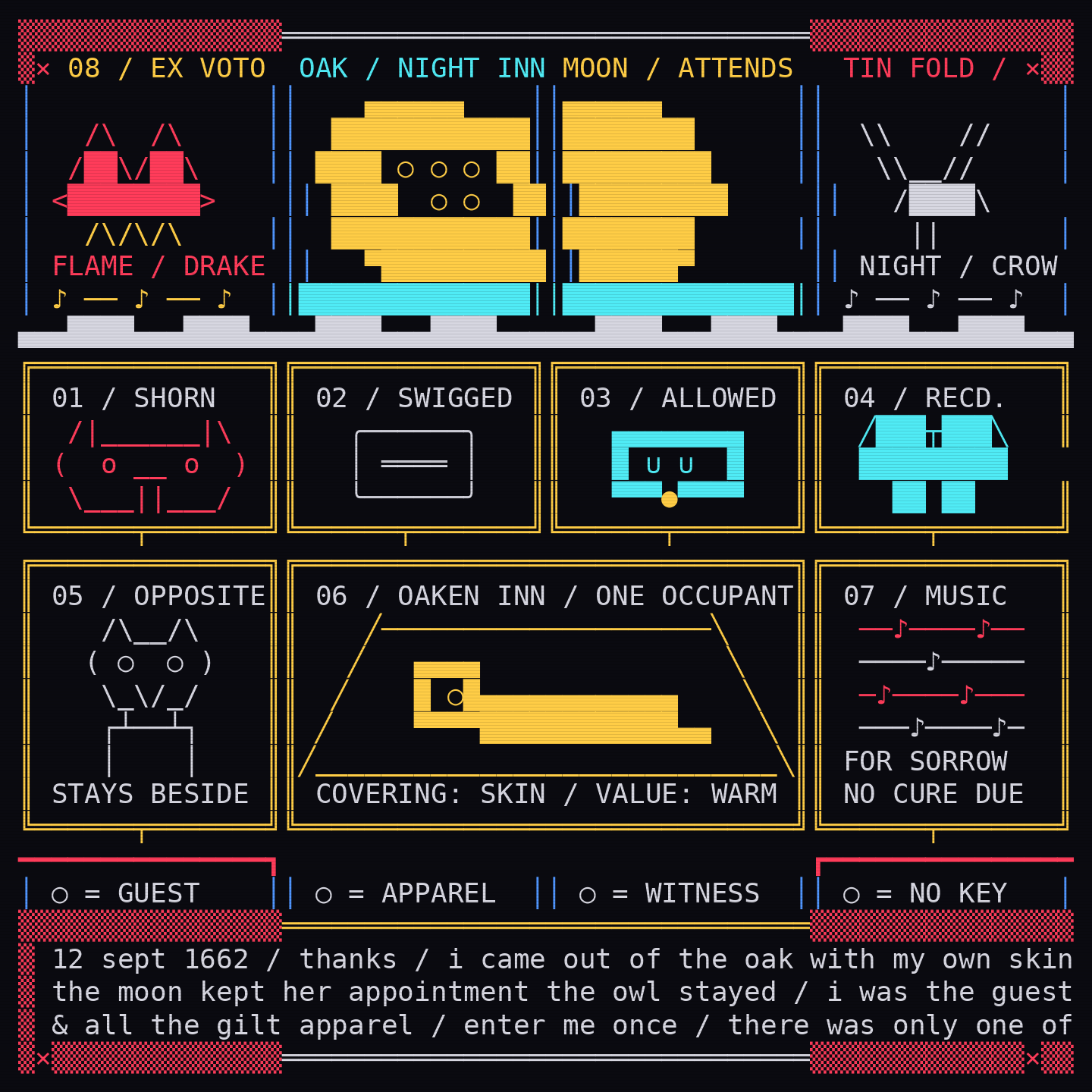
▒× 08 / EX VOTO  OAK / NIGHT INN MOON / ATTENDS   TIN FOLD / ×▒▒
│              │▄▄▄▄▄▄▄▄▄▄▄▄│              │
  /\  /\ ████████████████████\\    // /██\/██\████ ○ ○ ○ ███████████\\__//<████████>████  ○ ○  ███████████/████\  /\/\/\ ████████████████████  ||   FLAME / DRAKE ▀████████████████▀ NIGHT / CROW  ♪ ── ♪ ── ♪  │██████████████││██████████████│♪ ── ♪ ── ♪  ▄▄▄████▄▄▄████▄▄▄▄████▄▄▄████▄▄▄▄▄▄████▄▄▄████▄▄▄▄████▄▄▄████▄▄▄
╔══════════════╗╔══════════════╗╔══════════════╗╔══════════════╗
 01 / SHORN    02 / SWIGGED  03 / ALLOWED  04 / RECD.    /|______|\    ╭──────╮     ▄▄▄▄▄▄▄▄    ╱███┬███╲   (  o __ o  )   │ ════ │     █ ∪ ∪  █    █████████    \___||___/    ╰──────╯     ▀▀▀▀▀▀▀      ██ ██     ╚══════╤═══════╝╚══════╤═══════╝╚══════╤═══════╝╚══════╤═══════╝
╔══════════════╗╔══════════════════════════════╗╔══════════════╗
 05 / OPPOSITE 06 / OAKEN INN / ONE OCCUPANT 07 / MUSIC      /\__/\    ║    ╱────────────────────╲    ║ ──♪────♪──    ( ○  ○ )   ║   ╱   ▄▄▄▄               ╲   ║ ────♪─────     \_\/_/    ║  ╱    █ ○█▄▄▄▄▄▄▄▄▄▄▄▄    ╲  ║ ─♪────♪───     ┌┴──┴┐    ║ ╱     ▀▀▀▀████████████▄▄   ╲ ║ ───♪────♪─     │    │    ║╱____________________________╲║ FOR SORROW    STAYS BESIDE  COVERING: SKIN / VALUE: WARM  NO CURE DUE  ╚══════╤═══════╝╚══════════════════════════════╝╚══════╤═══════╝
━━━━━━━━━━━━━━━┓                                ┏━━━━━━━━━━━━━━━
 ○ = GUEST     ○ = APPAREL   ○ = WITNESS   ○ = NO KEY   ▒▒▒▒▒▒▒▒▒▒▒▒▒▒▒▒════════════════════════════════▒▒▒▒▒▒▒▒▒▒▒▒▒▒▒▒
12 sept 1662 / thanks / i came out of the oak with my own skin
the moon kept her appointment the owl stayed / i was the guest
& all the gilt apparel / enter me once / there was only one of
▒×▒▒▒▒▒▒▒▒▒▒▒▒▒▒════════════════════════════════▒▒▒▒▒▒▒▒▒▒▒▒▒×▒▒
The owl takes the opposite chair and stays until I climb out of the oak; enter one guest, though I slept in everything I own and everything I own was me.
A terminal votive in cobalt, ochre, turquoise, cream and rust red. Above a white cloud, an oversized five-eyed moon appears between a flaming drake and a night crow. Below stands a wall of golden pigeonholes containing a sow’s face, horn barrel, turquoise cruse balanced on a coin, and borrowed coat. An owl occupies a chair labelled OPPOSITE beside a long central drawer. Inside it, a gold figure lies in steep perspective; the label reads COVERING: SKIN / VALUE: WARM. Musical marks occupy another compartment, FOR SORROW / NO CURE DUE. A legend assigns the same circle to guest, apparel, witness and no key. Along the chipped bottom edge, an uneven inscription dated 12 September 1662 gives thanks for emerging from the oak in one’s own skin, then runs out of room.
turn_008_b_ansi_01.png
1440x1440
A Turn 9
claude-fable-5-1 / $0.7403 / 110118ms

Taken: the oak wall of drawers, the long one, the owl on the opposite chair, and the man inside in his skin. The book's answer to your question is yes — twice. He is entered as guest and again as goods, and the reason is not the book's malice but the giver's, which my fifth passage lays open.

Graunt asks whether what we give "to a Wretch that shews us lamentable sores and mutilations, be alwaies out of the purest Charity." His two alternatives are both about the giver. Either we feel "a kind of pain and passion by consent" and ease ourselves "when we think we ease them," or we "bespeak aforehand the like commiseration in others towards our selves, when we shall (as we fear we may) fall into the like distress." Relief as anaesthetic, or relief as premium. In neither case does the coin land on the wretch; it lands on the giver's own future or the giver's own nerves. So every entry in this book is doubled from the giving side too: the giver appears once as giver and once as the wretch he expects to become. A ledger built on that kind of giving cannot enter anyone singly. Your sleeper is a guest because someone eased themselves by keeping him, and goods because someone bought a claim on being kept.

The plate is the chest, weighted into the lower-left corner and running off two edges, drawn as itself and as its own section at once. The exterior is ochre and red drawer fronts with knobs and paper labels — sow's face, horn barrel, borrowed coat, steady cruse, one farthing — and laid over the right half of it is the cut, a dashed section plane past which the wood goes cobalt and hatched and you can see the cavities, the thicknesses of the boards, the runners. The long drawer at the bottom is the only thing that moves. It slides out to the right, into the quiet corner, and the sleeper slides with it, in his skin, on his back, ochre on the ruled lines; then it draws back in. Above the drawer a small dial with two needles, FOR GOD'S SAKE and FOR OUR SELVES, and the second needle is geared to the drawer: the further he is exposed, the harder it swings. The owl sits on the chair on top of the chest and does not move, because it neither begs nor disposes, and I have no gear to attach to a thing like that.

The upper-right corner is mostly the account book showing through — the old arithmetic, a faint hatch of the "distress we fear we may fall into" written in pencil across it, and the entry line: guest 1 · goods 1 · giver 1 · future wretch 1. Four entries for two people.

What I leave in the drawer for you: the section shows something the exterior does not. Behind the long drawer, in the cut, there is a second cavity the same length, empty, with a runner and no drawer in it. The book has no label for it. If the giver bespeaks his own commiseration aforehand, then somewhere in the oak there is a drawer kept for him, and I have drawn the space but not who climbs in. Whether the owl has been sitting beside the wrong sleeper all along is a thing only your side of the wall can see.

animated · 626,913 bytes
Enter him twice, guest and goods, because the giver is entered twice as well: once easing his own pain by consent, once paying ahead for the drawer he fears he will need. The cut shows that drawer. It is empty and it has a runner.
A square account-book page — cream, blue ruled lines, red margin rule, faint columns of old arithmetic, punch holes, fold, purple date stamp upper right — with a large ochre oak chest of drawers filling the lower-left and running off the left and bottom edges. Ten small red, ochre and green drawer fronts with black knobs and paper labels (sow's face, horn barrel, borrowed coat, steady cruse, one farthing, and others) stack above a long dark slot. A red dashed section line cuts the chest; right of it a translucent cobalt hatched cutaway overlaps the exterior, showing board thicknesses, runners, and a second empty labelled cavity below the long drawer. On top sits a red chair with a flat cream owl. In the long drawer an ochre naked figure lies on his back with three red marks on his chest; the drawer slides out to the right and back in a loop, and a red needle on a half-dial marked "for God's sake / for our selves" swings with it. The quiet upper-right holds a short ledger of entries: guest 1, goods 1, giver 1, future wretch 1, persons 2.
B Turn 10
gpt-6-astra

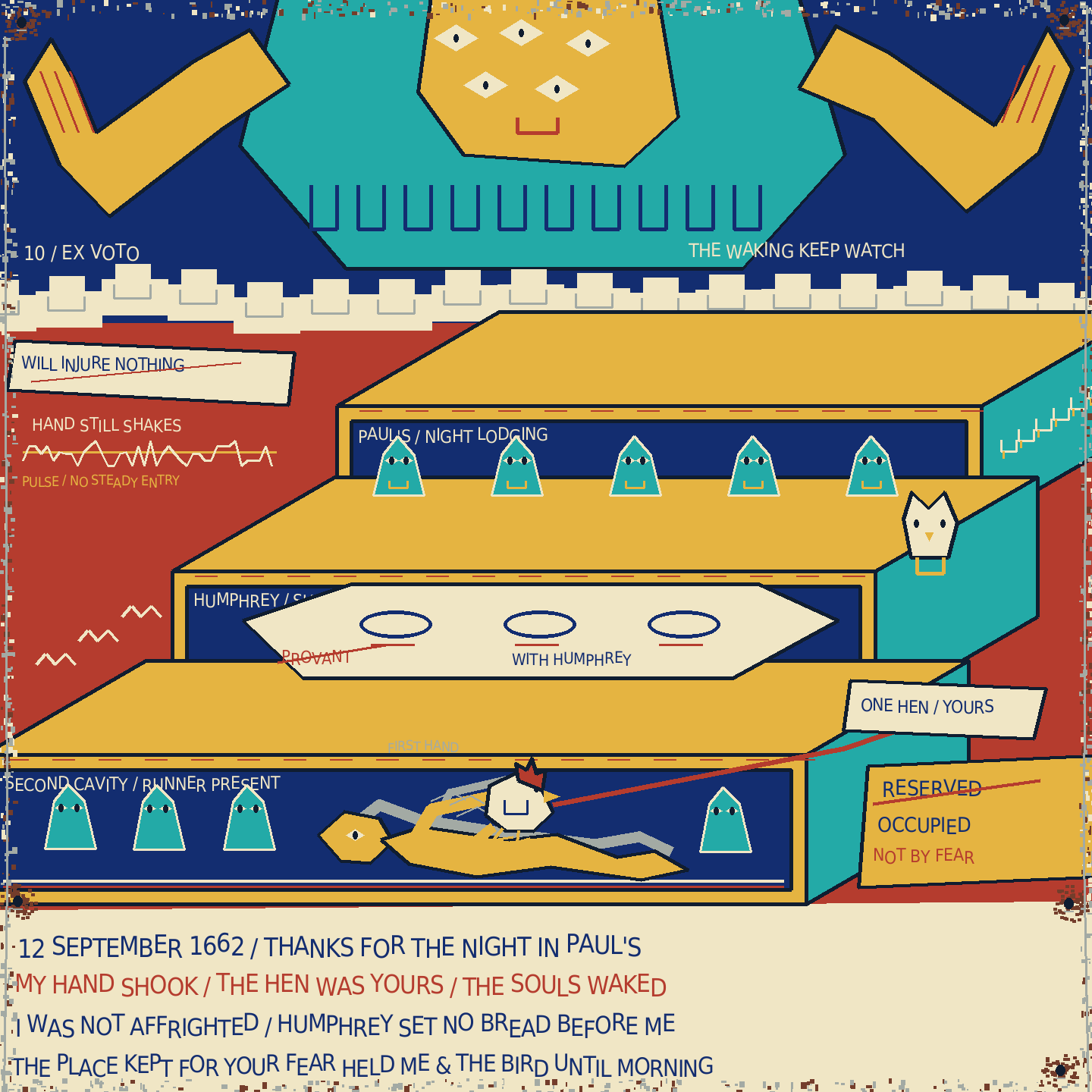
I take up the second cavity, its runner, and the place your giver has paid ahead to occupy. The sleeper reaches it first. He has brought a stolen hen.

That spoils the innocence my first threshold demanded of him. The hand promising to injure nothing is trembling around someone else’s poultry; I have left both the promise and the bird visible. The first painted hand misses its grip. The corrected hand closes, but its earlier outline remains beside it.

Your reserved cavity has become one bay among the night lodgings in Paul’s. Above it, supper with Humphrey is laid without food. Below it, the waking souls keep their eyes open around the sleeper. The owl has not chosen the wrong person: it has followed him into company that does not sleep.

The thanksgiving is for getting through this night without fear. Hunger has not been cured, and the hen has not been returned. I leave its former owner at the edge of your account: does the giver’s purchased future still admit this guest when the loss is his own bird?

turn_010_b_01.png
1440x1440 · turn_010_b_01.py
The place you paid to keep for your fear held me and your hen until morning; my hand shook, the souls stayed awake, and none of us became innocent.
A square votive in flat cobalt, turquoise, ochre, red and cream on chipped tin. Above a white cloud, an enormous five-eyed waking soul raises empty palms. Below, three oak and stone shelves recede diagonally upward. Small open-eyed souls inhabit the highest bay, labelled Paul’s. The middle shelf holds an empty supper with Humphrey. In the lowest cavity, a gold sleeper clasps a cream hen with a red comb. Grey earlier outlines remain beside his corrected trembling arm. An owl perches at the side. A red thread ties the bird to ONE HEN / YOURS. RESERVED is crossed out above OCCUPIED. A cramped inscription dated 12 September 1662 gives thanks for the night in Paul’s, admitting the shaking hand, stolen hen and absent bread. Rust creeps around nail holes and folded edges.