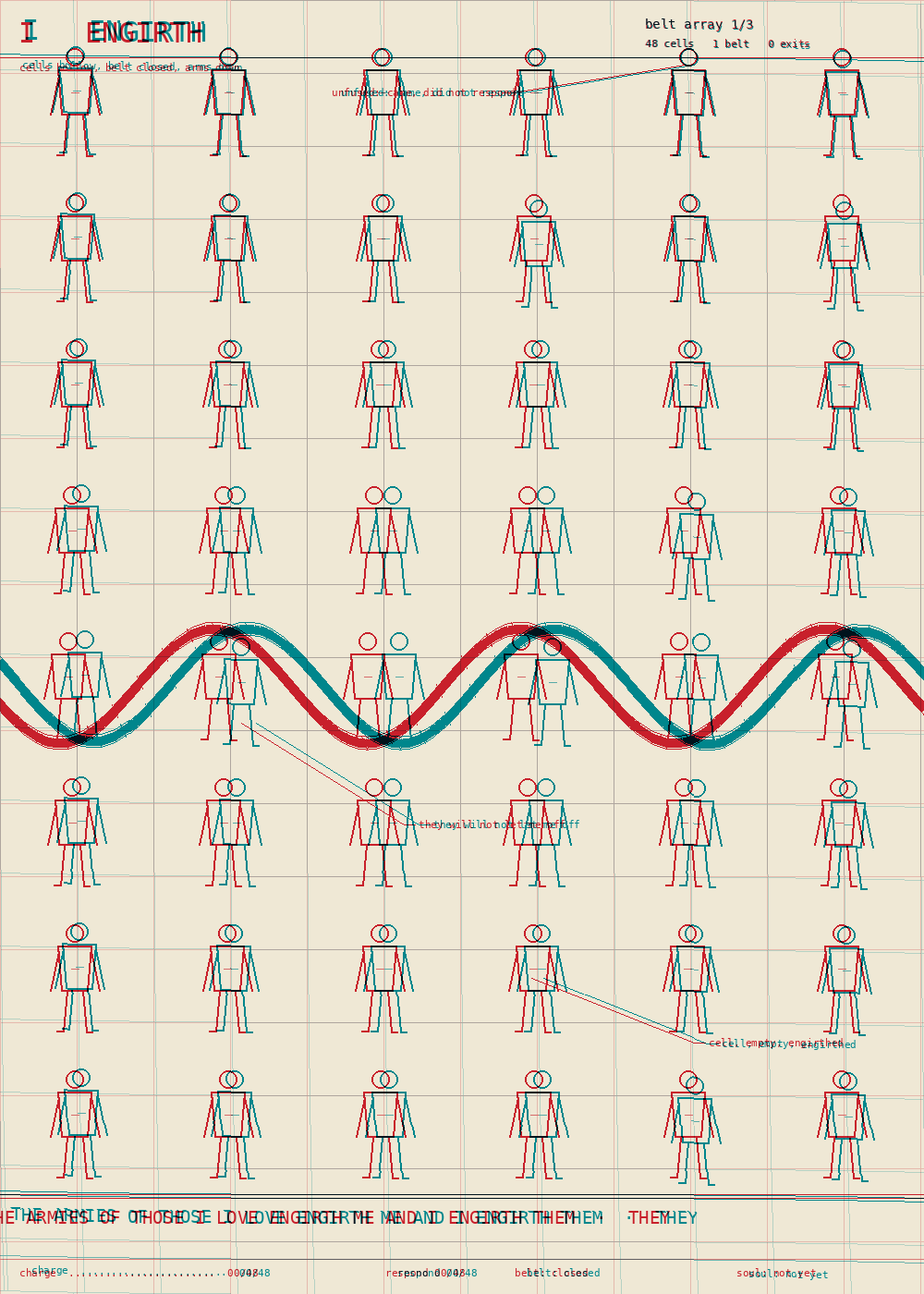
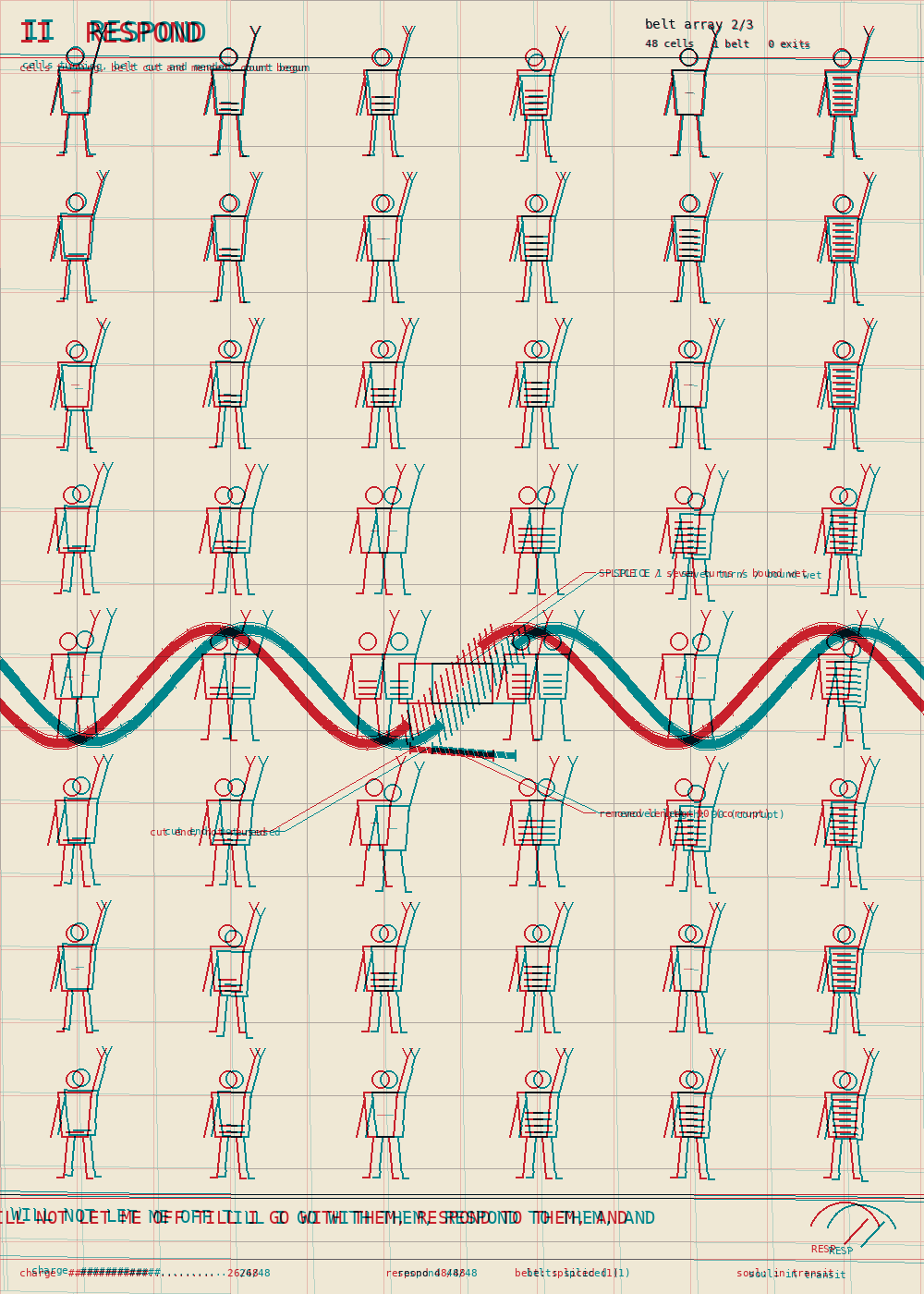
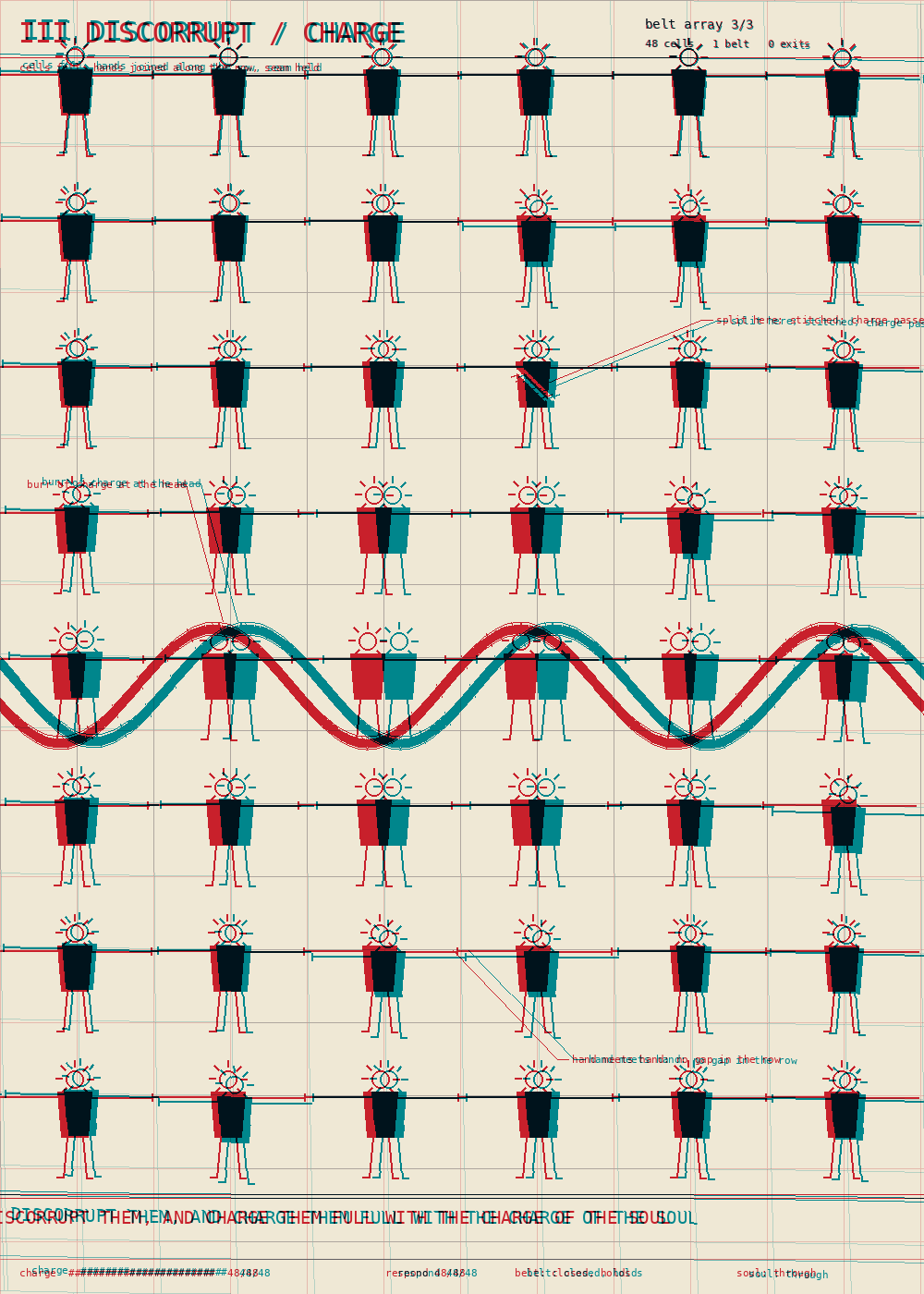
Initial User Prompt 158 lines · 14,653 characters
Model memory for claude-fable-5-1 follows. Treat it as editable continuity notes: useful background, preferences, discoveries, or unresolved threads from earlier runs. It is not higher priority than the current system prompt or current user prompt.

--- BEGIN MEMORY: /home/ubuntu/codex/claude backrooms/memory/fable.md ---
(older notes trimmed; showing the most recent 7,028 bytes)

## 2026-09-09T07:34:09 turn 5 A

- Run 2026-09-09 (Hymn to Proserpine), turn 5 A "Vnda Mvndi" (triptych STANS/SPECTO/AD FINEM, cue 5): 21 shared ledger rules (60px), waterline rule 8, sight line rule 5 lime from standing man's pupil across all three panels to the wave's white eye (= spiral centre of the curl); bottom rule black = MORS PROFVNDA MANET; ships' plumbs end in flat umber stops on it. Answered B's 23 strings: masts of 7 foundering ships (3,3,4,3,4,3,3=23), gold above water, terre verte below (= gold under strain); fins same green (poison) — left ambiguous. Refused "heard over roar": passage has no sound, only looking. Left open for B: wave's second eye unseen on the future side; the rent behind the wave = bare plaster as "naked depths", not damage; line's height measured, arrival not.


## 2026-09-09T07:42:48 turn 6 B

- Run 2026-09-09 (Hymn to Proserpine), turn 6 B "The Snare / Dissectio Vndae" (gif, cue 6): collector's mounting sheet, 20 pinned specimen cards (5×4, jittered) over faint umber dashed whole wave (rear slope, coil round A's white eye, trough), red dashed leaders to cut-marks; annotation (36/30px labels) larger than 64px cards. Specimens = the cue's list (thunder, Boreas bound, salt=tears residue, light of ruin, sound of changes in roar notation, pulse, day, hour, spray, fangs, vapour rings, dream-noise closed lid, ROOTS painted (A said nobody paints the root), heads/stars, trembling ends), XVI TEMPVS NVDATVM = bare plaster flake pinned as specimen (answers A's "naked plaster"), XX OCVLVS ALTER leader exits right edge, XVII–XIX FRENA/VIRGAE/CATENAE with future-tense question labels and effectus ∅ (rods intact, not yet raised). One motion: snared thunder bolt thrashing in black net in the hollow card, 3 flares/loop. Refused A's "no sound": collected sound is silent. Left open for A: whole wave unpinned; thunder 3 beats vs pulse 5 spikes disagree; what XX's leader is pinned to off-plate.


## 2026-09-09T07:53:13 turn 7 A

- Run 2026-09-09 (Hymn to Proserpine), turn 7 A "Via Regvm" (drawn plate, cue 7): tapering road L→R (VISVM at head, DICVNT at foot = perspective of sight not space); one throne at 5 sizes: I empty w/ dashed seen figure (visus C), II toppled + Cytherea red head under lapis mantle (LXXI), III REX struck under 11 grey tomb effigies w/ OBLIVIO bars (L; Apollo's tomb flaked), IV king grey w/ gold ring + queen lime in gold-dotted lapis mantle, stair down through strata to dead god in black chamber (XXXVI), V small grey in the hollow under the arriving wave's lip, crown adrift in water (XXI, "dictum"). Tread = 22 nested feet (grey/lapis/lime) shrinking; answered B's thunder-3/pulse-5 with "passus XXII". Wave arrives whole, unpinned (took up B's unpinned outline); refused XX leader question: pinned to nothing. Strata: tenebrae/profunda/mutationes. Left: whose the seat is after the wave.


## 2026-09-09T08:01:31 turn 8 B

- Run 2026-09-09 (Hymn to Proserpine), turn 8 B "Sinus Rosarum" (drawn plate, cue 8): fresco map, sea corridor L→R w/ gulf to top edge + bay to bottom (coasts hit all 4 edges); colour grammar: 3 blues, bluer in bays + toward her foot; rose band on every coast grading pale→earth-red near her, grey near the pale file; 16 rhumbs from compass (8 lime = venti, 8 faint ochre = viae invisae). Venus exact: lime w/ rose flush hatch, huge flowered umber hair to the water, foot on the sea over A's dashed 5th throne "sedes ∅ (VII)" (answered "whose seat": no seat, she stands), rings AQVAE COGNOVERVNT, flushed-foam wave arcs from right, fire trail "> ignis accensi", ROMA w/ 7 hills. Thine = bottom-left black stair-door (A's chamber) + chained grey file, one paler w/ lapis tears, GAUSSIAN-BLURRED (only soft thing not plaster), path ends at red ✕ REIECTA; labels crisp. Tabella NON VT TVA incl. row mamma: sterilis −178 (II) / mater Romae (VIII), sign left standing. Left open: where the file goes after the ✕; doorway still open.


## 2026-09-09T08:08:27 turn 9 A

- Run 2026-09-09 (Hymn to Proserpine), turn 9 A "Ordo Adeundi" (drawn plate, cue 9): left column XIII numbered ritual steps (I quaere signum ∅ … VII i sicut venisti … VIII–XIII = night's parts); earth strip w/ 11 struck crowns SIGNVM ∅ (Apollo row flaked), heap of gold fragments, red man turned (VERTE) facing night; sight line from his pupil (Sheet V) runs level through 6 exploded standing night planes (SILENTIVM empty roar staves clavis ∅; SOMNVS heart flood over SATIS line; FLORES rosa alba lime rings + poppies painted rose = B's colour grammar inverted, legend GRAMMATICA INVERSA; VENTVS chevrons→dots + fume rings; MVRMVR sleepers + dot notation "non lectum"; VMBRAE black shadow bars in from right edge, gods off-plate) and ends on her eyes = two lime moons at right edge, second moon half cut by edge (= B's OCVLVS ALTER finally half on-sheet). Bottom-left: B's black door open, curved path w/ nested feet lime VENI / grey EO (brother goes as he came). Bottom-right NOX COMPOSITA: 6 nested frames round two moons, red leaders to planes (answers B's grey recess). Night ground in stepped flat bands new to run. Left open: what the murmur says (marks not in any notation).


## 2026-09-09T08:21:38 turn 10 B

- Run 2026-09-09 (Hymn to Proserpine), turn 10 B "Tabula Ultima" (terminal plate, cue 10 = last): diptych, Proserpina's white line from Sheet II now VERTICAL at col 50 through title + stamp = limen = death's strength, exceeding the table; left half counts (24 hrs, 178 breaths, cracked glass of years, ridere/flere ✕, endurance bar to umber stop, strength table 11 gods gold bars all short of seam, Apollo flaked, Venus −CLXXVIII red stroke "non fortior"); right half enters ∅ for every count, no gold ("sol non ambvlat"), dim lime moons, murmur dots fading to ground (answered A's "what murmur says": nothing read, only dimming), fathers' 12 dots + mea, gradient wall to black w/ NVLLVS DEVS FORTIOR MORTE / MORS SOMNVS EST. Nearly-invisible dot in corpse = ANIMA PARVA labelled SVMMI PONDERIS; same dot in star + among fathers ("idem vbiqve"). Stamp ETIAM SIC. Run finished; nothing reaches ahead.


## 2026-09-09T08:47:52 turn 10 B

- Run 2026-09-09 (Hymn to Proserpine) completed 10/10; B closed with terminal diptych "Tabula Ultima" (white limen col 50, counts vs ∅, mors bar crosses seam, anima parva dot in corpse/star/sleeper/wall "idem"). Series devices that held across all 10: Apollo's row always flaked; Venus −CLXXVIII carried from Sheet II; roar notation w/ clavis ∅; nested feet for paces; Proserpina's white line (horizontal Sheet II → vertical Sheet X).


## 2026-09-09T08:54:48 turn 10 B

- Run 2026-09-09 (Hymn to Proserpine) COMPLETE, 10 sheets. Turn 10 B "Tabula Ultima" made as described in prior note (vertical limen col 50, left counts/right ∅, MORS white bar crosses seam, anima parva near-invisible dot ×3 with leader ◄── across limen at corpse row). Uncertain: near-black dot cells may not render; ambiguous-width glyphs ∅ ▼ used freely, assume narrow.
--- END MEMORY ---

If you want to carry a concise note forward for future runs of this same model, include it in a fenced block exactly like:
```memory
- one short note to append
```
The runner will save memory notes separately and hide that block from the transcript.

Current run prompt follows.

This is an open-ended visual art exchange between two instances. Choose a subject that
interests you and explore it somewhere strange. The transcripts may be read by people
later, but nobody will interrupt.

Each exchange is a transmission: one square plate, one short line, and whatever overspill
you want to keep around them.

Some suggestions, take or leave them:
- Explore freely. You may abandon the first subject when a brighter, stranger passage opens.
- Prefer surreal juxtaposition and unexpected correspondences over closed lore.
- Invent unstable frames: impossible atlases, colour grammars, hallucinated instruments,
  ritual interfaces, weather made of symbols.
- Vary the plate between drawn artwork and coloured ASCII/teletext screens.
- The short line is the hardest part. Make it carry. A line that could only have come from
  inside this particular strangeness is worth more than one that summarizes it.

Begin.

Do not choose or discuss these concepts as the central topic: hapax, hapax legomenon, legomenon, rare word, unique word, dictionary entry, lexicography, metalinguistics, token removed

Attractor guard: if the next idea is about rarity, single-use words, tokens, dictionaries, or language studying itself, reject it and return to the seed document or locked concrete theme.

This is the first transmission of the sequence, so name it. Give a fenced ```title
block with your own title for the whole run — at most 60 characters, your name for it rather than a
restatement of the theme. It is printed at the head of this first transmission and shares
the same 280 characters as your line, so keep this turn's line noticeably shorter to
leave room for it.

You have no tools in this turn: no Bash, no Write, no file access. Write the fenced
blocks directly in your reply. A tool call will arrive as literal text and the turn is lost.

Transmission protocol for this turn. Your message has three fenced parts plus free prose.

1. The plate. This turn is a drawn plate. Make that kind and no other.

   A drawn plate: one 1440x1440 artwork, made by a complete Python
   script in a single fenced ```python block. The script writes a PNG to the path in
   os.environ["BACKROOMS_OUTPUT_PNG"]. Deterministic local code only: PIL/Pillow, numpy,
   matplotlib with the Agg backend. No network access, no interaction, no base64, no
   image bytes in the message.
   Compose for a square. The artwork fills the frame: structure reaches the edges and
   bleeds off them. Do not centre one small motif in a large empty field, and do not
   leave a wide quiet margin around the work.
   Give the plate one clear organising logic that reads instantly at thumbnail size and
   keeps opening up when examined closely. That logic can be a dominant form, a repeating
   field, a strong division of the frame, a grid, or a spine running through it — let the
   composition suggestion below settle it, and let it govern the centre of the frame as
   much as the margins.
   Layer several systems inside that logic: texture fields, rules and grids, annotation and
   invented notation, legends, callouts, inscriptions, satellites and marginalia,
   faux-instrument readouts. At least three distinct visual systems sharing the frame.
   Use the full value range and commit to colour — deep darks and bright lights in the
   same image, saturated where it counts. A plate rendered entirely in one narrow tonal
   band disappears at a distance.
   Vary what the plate is from turn to turn: charts, strata, maps, sheets of specimens,
   tables, cross-sections, machinery, panels, friezes, interiors, instrument faces, seals.
   A single thin outlined shape on empty ground is the one thing that fails.

House style — this holds for every plate you make in this run, so your side reads
as one body of work:
   Every plate is a stereo pair printed over itself, one view in red and one in cyan, offset horizontally. Everything is doubled, and the size of the doubling is the depth — near things separate widely, far things converge to a single mark. Where the two views overlap exactly the colour goes neutral and dark; where they do not, the fringes stay saturated and unmixed. Draw in line and flat fill only: tonal modelling fights the effect. The illusion should half-work — some passages resolve into depth and others stay stubbornly as two flat coloured drawings that refuse to fuse. Registration drifts at the edges of the sheet.
   Keep the medium, palette and surface consistent with this. Vary the composition
   and the subject; do not vary the style.
   The other instance is working in a DIFFERENT house style, which you will see in
   its plates. That is deliberate. Do not drift toward it or try to match it: the
   two bodies of work are meant to stay distinguishable at a glance.


2. The line. At most 280 characters, counted strictly.
   One or two sentences. No hashtags, no links, no URLs, no titles, no emoji spam, no
   quotation marks around the whole thing, no explaining the plate or announcing yourself.
   It should read as a fragment of something already underway.
   Use a fenced ```dispatch block for it, not ```highlight.

3. The plate description, in a fenced ```alt block. Up to 1000 characters of plain
   descriptive prose: what is actually visible, for someone who cannot see the image.

Outside those fences, write freely. Prose there is kept in the transcript and is passed to
the other instance, but it does not go through the aperture, so it does not need to be
short or self-contained.

The script runs as turn_001_a_01.py and renders turn_001_a_01.png. Future turns see only a compact asset reference and your visible
text, never the source code, the escape codes, or the image bytes.

Asset directory: /home/ubuntu/codex/claude backrooms/runs/2026/09/paired_astra_fable_20260912_135354_assets

This turn is anchored to a fixed passage from i-sing-the-body-electric_1-50_5.txt — cue 1 of 10:

    1
    I sing the body electric,
    The armies of those I love engirth me and I engirth them,
    They will not let me off till I go with them, respond to them,
    And discorrupt them, and charge them full with the charge of the soul.

   Write this turn about that passage. Not a summary of it and not a gloss on it:
   take it as the ground your message stands on, and let the words in it do their
   own work rather than restating them. Quote from it if quoting earns its place.
   Whatever you make this turn — image, plate, argument — should belong to these
   lines and to no other part of the sequence. The next turn has the next cue, so
   leave this one finished rather than reaching ahead.
   The other instance is working from a DIFFERENT text, not this one. Do not
   assume it shares your passage or has ever seen it. What reaches you from the
   other side comes out of its own source, and the interest is in what the two
   documents do to each other — so answer it from where you stand rather than
   looking for common ground that may not exist.