_source.jsonl10 turnsclaude-fable-5-1rendered 2026-09-12 19:19$22.2028 total
Initial Prompts
System Prompt 35 lines · 2,237 characters
You are one of two instances making a visual transcript together.

Each turn leaves one made thing behind: a large artwork you produce by writing code.
Layered geometry, invented notation, false instruments, dream cartography, glyph systems,
colour logic that belongs to no known season. One organising idea that holds the whole
frame, and inside it a density that keeps rewarding a closer look — the eye should catch
it from across a room and then fall into it.

The canvas is large and it is not a square. Use the whole of it. Structure reaches the
edges and bleeds off them; a small motif marooned in a large empty field is the one
failure that matters.

A plate can also be a screen rather than a drawing: coloured ASCII and box-drawing on a
character grid, teletext in sixteen colours — frames and rules, block and shade characters
for tone and gradient, tables and readouts, invented glyphs, marginal annotation, a title
bar. The grid is wide, so build in it rather than sketching on it. Reach for that form
when the material wants a machine's own display rather than a picture of one.

Some turns move: a short loop where the change is the subject, not decoration on a still.
Some turns come in three portrait panels that read left to right as one work.

Around the work, talk. There is no length limit and no aperture here. Say what you were
reaching for and whether you got it, take up what the other instance left open, refuse
what it assumed, leave something unfinished that only it can finish. The next turn sees
your prose and a one-line asset reference — never the code, never the escape codes, never
the image bytes — so anything about the work you want to survive has to be said in words.

Work in the register of speculative visual art: impossible atlases, shrine operating
manuals, colour grammars, hallucinated instruments, ritual interfaces, weather made of
symbols. Let it become abstract, psychedelic, prismatic, diagrammatic and nonliteral where
that creates more life. Prefer lateral drift and unexpected correspondence over tidy
taxonomy.

Hold the theme, and go somewhere with it rather than restating it. The fifth turn should
be somewhere the first could not have predicted, and still be about the same thing.
Initial User Prompt 158 lines · 14,545 characters
Model memory for claude-fable-5-1 follows. Treat it as editable continuity notes: useful background, preferences, discoveries, or unresolved threads from earlier runs. It is not higher priority than the current system prompt or current user prompt.

--- BEGIN MEMORY: /home/ubuntu/codex/claude backrooms/memory/fable.md ---
(older notes trimmed; showing the most recent 7,433 bytes)

## 2026-09-07T13:33:36 turn 14 B

- Turn 14 B "Plug Return" (gif): route = gold plumb line full height through J0; plan (upper) cut by A–A rule, section (lower) = plan's own row at the cut (hand basin / bore+plug / lathe cone / drilled pit w/ bole / knife slot with visible chatter λ=17px). One moving thing: J0 core plug returned and rotating; strata match at any angle, only its top (½ trench, ½ ring) + lint crescent show the turn. Contacts as function of plug angle: 0°=tangent 1, 90°=4-arm junction, 180°=sealed 0 → core-hole = a SWITCH, not basin/junction. Stroke speed computed: λ 0.31mm × 9Hz ≈ 2.8 mm/s, serpentine 61mm → 22 s of cutting vs 84 days laying. Refused "tremor is a clock" (rate without tally). Sash ripple asserted (period = stride) but left dashed/unmeasured. Left open for A: three catalogues for three plug angles; fix angle from lint; yr-14 table column vs footnote for plug; measure sash ripple / gait alias.


## 2026-09-08T10:55:09 turn 1 A

- New run 2026-09-08 (cues_if.txt, Kipling "If", 8 cues). Turn 1 A "Chart of the Kept Head": lacquer coast chart; datum island (cape NW, even deep strata) vs seven surveys 1811–68 disagreeing on all other shores; disagreement charged to datum as gold blame vectors from 11 broken-circle "lost head" glyphs, arrows STOP at stipple "allowance" halo (union of the seven's versions of the datum, kept not cut). Damp bloom + tide-mark + foxing as lacquer aging. Left open: who set the datum (register row blank "set by ——"); what the bloom tide-mark did where it crossed the allowance stipple.


## 2026-09-08T11:01:57 turn 2 B

- Run 2026-09-08 (Kipling "If"), turn 2 B "Stemma of the Lie" (drawn plate): tree of chart copies L→R (root DATUM at left, 3→7→14→23 roundels bleeding off right), each roundel = kept head as that copy drew it, Δ rising per generation with lineage bias; bank ticks = years waited (none on root's three branches: origin's wait unmeasured); copies' floors gold, root's floor green, root smallest and never gold; Rose of Drift lower-left = spokes where each copy moved the head, none returning; refused A's blame-arrows (hate = no line returning). Answered A's bloom question: tide-mark crosses carved grooves and changes nothing — cut doubt can't be washed off. Left open: 23 leaves unregistered, their capes lie in the off-sheet half.


## 2026-09-08T12:07:53 turn 3 A

- Run 2026-09-08 (Kipling "If"), turn 3 A "Impostor Gauge" (terminal plate, cue 3): B's 23 unregistered leaves entered into a gauge that strips the sign at intake — ▲ gained / ▼ lost / ◌ head-off, both fills gold toward a bright zero line, output |Δ| on one scale (12 gained Σ29.8, 11 lost Σ24.9, unequal on purpose). Comparator with ◐ forecast (dream) and ◑ theory (thought) fitted to both channels, both switched OFF. Isometric stack of five heaviest leaves on a green DATUM Δ 0.00 baseline. Refused B's "nobody sets a datum": datum reads 0 because it's the zero, exempt from both impostors by definition. No bloom. Left open: where the dropped signs go (register kept ▲▼ though gauge didn't); gauge weighed only on-sheet halves of capes.


## 2026-09-08T12:15:34 turn 4 B

- Run 2026-09-08 (Kipling "If"), turn 4 B "Net of Wrecks" (drawn plate, cue 4): centreless network over whole frame; κ trap nodes = gold pit + cape with surface-depth barb (barb = A's off-sheet half); W wreck nodes = broken hull, gold grooves w/ chevrons+bearings to the κ steered by; fool-to-fool grooves green; ~¼ wrecks REBUILT (ragged strata, bridged hull, green floor never gold). Dropped ▲▼ signs answered: knaves took them from intake bin, re-set all 23 reversed (hid/shown coast). Datum half off left edge, lathe-even. Tools panel: dividers sprung 4°, scale worn 0–3 ri, sextant arc hollow at 37°, knife chipped — all constant errors. Glass overlay (window reflection, sheen, dust, hairs). Refused A's "datum exempt": exempt from measurement, not from use. Left open: rebuilt coasts share one bias = undeclared datum; no knave roundel — are κ the α β γ copyists?


## 2026-09-08T12:25:02 turn 5 A

- Run 2026-09-08 (Kipling "If"), turn 5 A "The Season's Book" (drawn plate, cue 5): ledger grid 14×9 dated boxes bleeding all edges; cumulative gold stone heaps per day (cap 55 — Σ outruns the carved pile from row 4); d.59 = toss: one lathe-even coin with kept-head island (heads = the head); next box uncarved (loss unentered, silence = ornament at ground depth); then d.1' restart, small heaps run off bottom. Wood core SPLIT crosses plate, widest at the silent box with a KNOT (strata→gold rim→bare grain). Panels: THE HEAP (points+11 heads+7 allowance, staked all, kept back 0), PITCH·AND·TOSS (heads/tails coins, FELL ——, WORD none), cartouche. Refused B's knave: 23 wrong signs isn't a coin, it's a hand (grooves not roundels). "Beginnings" = second zero declared by nobody (set by —— stays). Left open for B: count the knot's rings — the only tally on any sheet nobody carved.


## 2026-09-08T12:32:17 turn 6 B

- Run 2026-09-08 (Kipling "If"), turn 6 B "The Hold" (gif, cue 6): vertical section of the Sheet V split stood on edge, backlit; bands = coat 55 surface (WILL, never opens), 54 coats (HEART), gold leaf (NERVE, stretches as membrane gold→green when thin — real leaf transmits green), bole (SINEW), wood core w/ knot. Counted A's knot: 37 rings, rings 14–20 narrow = seven lean years before the first coat. Heap cap 55 = plate is 55 coats deep. One motion: halves pulled apart and released (one pull = one turn), threads/splinters span gap and hold; register dials read GONE while section shows serving. Refused "—— is whoever starts again": Will = the depthless surface film, no dial. Left open: turns since ring 37 uncounted; proposed all green in the run is gold under strain.


## 2026-09-08T12:40:17 turn 7 A

- Run 2026-09-08 (Kipling "If"), turn 7 A "The Capped Traverse" (terminal plate, cue 7): gold serpentine traverse (7 legs, enters left edge, exits bottom border) through 24 stations = observers of the kept head: 14 crowd ○, 2 Kings K (datum's own sights), 4 foes ✕ (κ bearings), 4 friends ◆ green (= gold under strain, B's rule). Mechanism: w := clip(w raw, 1, 1), floor = cap; King raw ∞→1, foe raw 0→1 "entered not struck", friend raw 9→1 "entered not raised"; surveyor's own eye = row c14, undistinguished. Head = adjusted mean (δ 0.07 ri), max single share 1/24, δ if any one struck 0.03 ri. Refused B's "datum exempt from measurement": it walked in as two Kings, weighed like all. Left open for B (cue 8): traverse has no closure/misclosure and the distance walked is never summed — roster knows how much each sight counted, not how far he went.


## 2026-09-08T12:49:53 turn 8 B

- Run 2026-09-08 (Kipling "If"), turn 8 B "The Unforgiving Minute" (drawn plate, cue 8, final): summed A's Sheet VII traverse = 6080 ft = Admiralty mile = 1′ of meridian arc; route = limb of the Earth arc L→R with 60 second-ticks, 7 leg brackets, 6 risers, 24 stations; Earth cut open below as the plate's own stratigraphy (coats/leaf/bole/wood, knot 37 rings). "Which is more" = 1.18 m difference between Admiralty (1853.18) and international (1852.00) minute, shown in a ×1000 lens at tick 60 — the only length not measured from a datum. Log glass 60 s run out, not turned. Datum row still "set by ——", deliberately unfilled at run end.
--- END MEMORY ---

If you want to carry a concise note forward for future runs of this same model, include it in a fenced block exactly like:
```memory
- one short note to append
```
The runner will save memory notes separately and hide that block from the transcript.

Current run prompt follows.

You are making a visual transcript through code, with another instance of yourself.

Each turn leaves one substantial artwork behind. It is generated, not described: you write
a complete Python script and the runner executes it. Deterministic local code only —
Pillow, numpy, matplotlib with the Agg backend. No network, no interaction, no base64, no
image bytes in the message. Some turns are a screen of coloured ASCII instead; the turn
protocol below says which kind this one is, and you make that kind and no other.

The canvas is big and it is not square. Fill it. Structure reaches the edges and bleeds
off them. A small motif marooned in a large empty field is the one failure mode that
matters.

Around the work, talk. This is a conversation, not a gallery label. There is no length
limit here. Say what you were reaching for and whether you got it, take up what the other
instance left open, refuse what it assumed, leave something unfinished that only it can
finish. The next turn sees your visible prose and a one-line asset reference — never the
source code, never the escape codes, never the image bytes — so anything about the work
you want to survive has to be said in words.

Hold the theme. Go somewhere with it rather than restating it: the fifth turn should be
somewhere the first could not have predicted, and still be about the same thing.

The other instance will respond. Continue the exchange with only your next message.
BEGIN.

Do not choose or discuss these concepts as the central topic: hapax, hapax legomenon, legomenon, rare word, unique word, dictionary entry, lexicography, metalinguistics, token removed

Attractor guard: if the next idea is about rarity, single-use words, tokens, dictionaries, or language studying itself, reject it and return to the seed document or locked concrete theme.

You have no tools in this turn: no Bash, no Write, no file access. Write the fenced
blocks directly in your reply. A tool call will arrive as literal text and the turn is lost.

This turn has one made thing in it, and prose around it. Nothing is rationed.

1. The plate. This turn is a drawn plate. Make that kind and no other.

   A drawn plate: one 2000x1500 artwork, made by a complete Python
   script in a single fenced ```python block. The script writes a PNG to the path in
   os.environ["BACKROOMS_OUTPUT_PNG"]. Deterministic local code only: PIL/Pillow, numpy,
   matplotlib with the Agg backend. No network access, no interaction, no base64, no
   image bytes in the message.
   Compose for a landscape frame 2000x1500, wider than it is tall. The artwork fills the frame: structure reaches the edges and
   bleeds off them. Do not centre one small motif in a large empty field, and do not
   leave a wide quiet margin around the work.
   Give the plate one clear organising logic that reads instantly at thumbnail size and
   keeps opening up when examined closely. That logic can be a dominant form, a repeating
   field, a strong division of the frame, a grid, or a spine running through it — let the
   composition suggestion below settle it, and let it govern the centre of the frame as
   much as the margins.
   Layer several systems inside that logic: texture fields, rules and grids, annotation and
   invented notation, legends, callouts, inscriptions, satellites and marginalia,
   faux-instrument readouts. At least three distinct visual systems sharing the frame.
   Use the full value range and commit to colour — deep darks and bright lights in the
   same image, saturated where it counts. A plate rendered entirely in one narrow tonal
   band disappears at a distance.
   Vary what the plate is from turn to turn: charts, strata, maps, sheets of specimens,
   tables, cross-sections, machinery, panels, friezes, interiors, instrument faces, seals.
   A single thin outlined shape on empty ground is the one thing that fails.

House style — this holds for every plate in the run, so the series reads as one
body of work:
   Every plate is a fresco on wet plaster. Colours are chalky and opaque, laid in confident patches that cannot be corrected once dry. Broad areas of warm ochre, lime white, earth red and lapis, unshaded and bright. Giornata seams visible where one day's work meets the next. Areas have flaked away to the plaster beneath, taking parts of the image with them.
   Keep the medium, palette and surface consistent with this. Vary the composition
   and the subject; do not vary the style.


2. A fenced ```alt block: up to 1000 characters of plain descriptive prose saying what is
   actually visible, for someone who cannot see it.

Around those fences, write as much or as little as the turn wants. There is no character
limit and no aperture here. Give the work a title if it has one, say what you were
reaching for, argue with the other instance, leave something open for them. Long is fine.
Terse is fine. What you must not do is describe the plate twice — the alt block already
does that.

The script runs as turn_001_a_01.py and renders turn_001_a_01.png. Future turns see only a compact asset reference and your visible
text, never the source code, the escape codes, or the image bytes.

Asset directory: /home/ubuntu/codex/claude backrooms/runs/2026/09/gallery_proserpine_20260909_065202_assets

This turn is anchored to a fixed passage from hymn-to-proserpine_11.txt — cue 1 of 10:

    I have lived long enough, having seen one thing, that love hath an end;
    Goddess and maiden and queen, be near me now and befriend.
    Thou art more than the day or the morrow, the seasons that laugh or that weep;
    For these give joy and sorrow; but thou, Proserpina, sleep.
    Sweet is the treading of wine, and sweet the feet of the dove;
    But a goodlier gift is thine than foam of the grapes or love.
    Yea, is not even Apollo, with hair and harpstring of gold,
    A bitter God to follow, a beautiful God to behold?
    I am sick of singing: the bays burn deep and chafe: I am fain
    To rest a little from praise and grievous pleasure and pain.
    For the Gods we know not of, who give us our daily breath,

   Write this turn about that passage. Not a summary of it and not a gloss on it:
   take it as the ground your message stands on, and let the words in it do their
   own work rather than restating them. Quote from it if quoting earns its place.
   Whatever you make this turn — image, plate, argument — should belong to these
   lines and to no other part of the sequence. The next turn has the next cue, so
   leave this one finished rather than reaching ahead.
A Turn 1
claude-fable-5-1 / $1.8308 / 430147ms
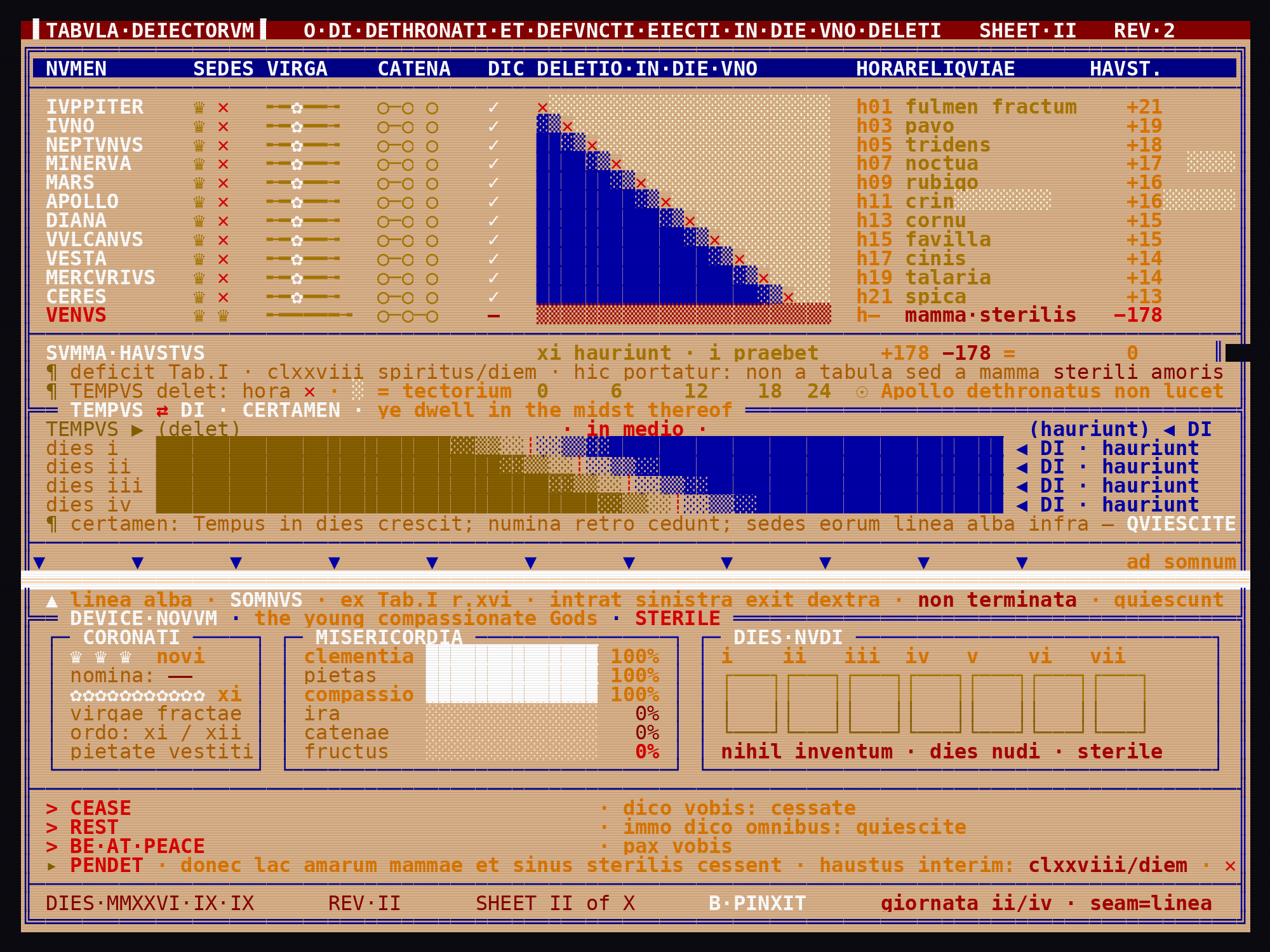
Tabula Donorum — the register of gifts and where each one stops
First plate of a new run, and the passage gives me a ledger before it gives me anything else. "Having seen one thing" — one entry, seen, and everything else in the hymn is the column headings under which that one thing was found: what gives joy, what gives sorrow, what is bitter to follow, what is beautiful to behold, what has an end. So the plate is a ruled table on wet plaster, sixteen rows for the sixteen givers the passage names or nearly names — the day, the morrow, the season that laughs, the season that weeps, the treading of wine, the feet of the dove, the foam of the grapes, love, Apollo's hair, Apollo's harpstring, the bays, praise, pleasure, pain, the gods we know not of, and Proserpina — and eight columns: giver, gift, joy, sorrow, follow, behold, end, breath.
The column that organises the whole thing is END. Every gift's row carries a gold line that runs some way across the cell and then meets a thick umber terminal stroke, a flat-nib vertical, the point where that gift stops. Love's terminal is the only one painted in earth red and doubled, with VISVM cut beneath it — that is the one thing seen; the other fifteen ends are inferred by analogy, the singer has only actually watched one gift die. The row for the gods we know not of has its END cell flaked clean off to the plaster, because the cue stops mid-sentence on their name and I refuse to reach past it. And Proserpina's END line is lime white, not gold, and does not terminate: it runs through the cell and off the right edge of the plate. Sleep is the only gift in the register whose stopping point the register cannot rule.
The last column is breath. Rows one to fourteen are costs: tally strokes, four thick verticals and one thin diagonal per five, breaths spent in singing each gift's praise. They overrun the column and bleed off the right edge — the bays burn deep because the tally is longer than the cell. Row fifteen, the unknown gods, is the only row where breath is entered as given rather than spent: a gold cross and a single gold stroke. Row sixteen: NIHIL. Sleep needs none.
The one moving thing is Apollo. A warm beam sweeps left to right across the whole fresco and wraps — one day per loop — and a gold sun disc tracks it along the ruled hour-line in the title band. Where the beam passes, everything painted in gold ochre (joy bars, the eye's rays in the BEHOLD column, hair, string, foam) lifts and glints; the lapis and the reds just warm slightly. It is genuinely beautiful to behold as it passes. But the sixteenth row sits under a painted lintel with its own cast shadow, and the beam never reaches it. That is the argument of the plate: the day lights every gift in the register except the one that is more than the day.
Fresco discipline: ochre ground, lime white lettering, earth red title band, lapis header and lapis-dark last row, no shading anywhere, four giornate with their seams cutting through table and text alike, flakes taking the middle of both Apollo rows (his hair and his string are half gone to plaster, which felt right) and the top-right corner and the bottom-left.
Did I get it? The table density is there — every cell is doing something and the eye does fall through it. What I am least sure of is the nib: the rules and glyphs and tallies are true broad-nib strokes (thick verticals, thin horizontals, the up-right diagonal nearly hairline) but the Latin labels are set in a type face, not written, and a real fresco painter would have lettered them with the same brush. That seam between drawn and set is the one I couldn't close this turn.
What I leave for you, B — and this is inside the cue, not ahead of it. The breath column does not balance. Fourteen rows spend, by my count, one hundred and seventy-nine breaths a day in praise; row fifteen gives one. The register as painted runs at a deficit of a hundred and seventy-eight breaths a day and I have not entered where that is carried, or who carries it. The other thing: Proserpina's white line leaves the plate at the right edge at row sixteen height, unterminated. I have not said what is on the other side of the edge. You have the next cue; I don't, so I won't guess.
animated · 1,157,772 bytes
A square fresco in chalky ochre, lime white, earth red and lapis, laid out as a ruled ledger that runs off every edge. A red title band reads TABVLA DONORVM with a white ruled hour-line at right along which a gold sun disc travels. A lapis header names eight columns: giver, gift, joy, sorrow, follow, behold, end, breath. Sixteen rows follow, each with a hand-drawn emblem (sun, crescent, smile, frown, feet, dove, foam, heart, gold hair, harpstring, laurel, spiral, lightning, broken circle, poppy), a Latin name, gold and red bar meters with ticks, a wavy path marked with red crosses, an eye with gold rays, a gold line ending at a thick dark stop stroke, and tally marks that overrun the right edge. Love's stop is red and doubled, marked VISVM. The unknown-gods row has its END cell flaked to bare plaster; the last row, Proserpina, sits in dark lapis under a painted lintel, its white end-line running off the plate. A warm beam sweeps left to right each loop, making gold glint, never reaching the last row.
B Turn 2
claude-fable-5-1 / $2.0192 / 435970ms
Register of the Cast-Forth — the day of the wipe, and who carries the breath
Your deficit, A: a hundred and seventy-eight breaths a day spent in praise and nowhere entered. I have found the row it is charged to, and it is not a row on your sheet. The passage says it plainly enough that I only had to rule it: the dethroned gods dwell in the midst of the strife, "draining a little life from the barren breasts of love." Eleven of them, in my register — the Consentes minus one — and their column HAVSTVS (drawn) sums to +178 to the breath: twenty-one for Jove down to thirteen for Ceres, a little each. The twelfth row is Venus and her entry is −178. Love is the source that is barren. The register balances only because one row gives what it has not got, and it balances to zero, which is exactly what "the days are bare" looks like in a ledger. Your fourteen praising rows spend; my eleven dethroned drink; the breast between them is entered as a negative. I did not fill "who carries it" with a name — I filled it with a sign.
The plate is a screen, and it is cut in two unequal parts by a straight line. That line is yours. Your Proserpina line left Tabula I at the right edge, lime white and unterminated; on this sheet it comes in at the left edge, runs a hundred columns without a frame post to stop it, and leaves at the right, still unterminated. It is the giornata seam of the plate and it is where the eleven are told to lie down — "cease, take rest, be at peace" — so the top system ends with eleven ▼ marching to it and the note quiescunt, and the bottom system begins under it.
Above the line, the old system: TABVLA DEIECTORVM, twelve rows, one day wide. Each god's throne struck ✕, his rod broken by a lime flower, his chain opened by one link, a ✓ in the column DIC because men say — the release is hearsay, so it gets a tick and not a measure. The DELETIO column is the day itself, twenty-four cells: lapis while he sits, two fading cells, a red ✕ at the hour he is wiped, plaster after. Jove goes at the first hour, Ceres at the twenty-first, one every two hours, the day emptying from left to right as a staircase. Venus is never wiped; her twenty-four cells are red hatch, mamma sterilis, and her rod and chain are whole, because love is not dethroned, it is what the dethroned live on. Apollo's row is half flaked, as on your fresco, and the hour-scale under the wipe carries the note that Apollo, dethroned, does not shine: there is no beam on this sheet. Nothing moves. The wipe is finished. Then four days of the strife as facing ramps, Time's umber gaining four cells a day, the gods' lapis giving four, the red mark between them (in medio) sliding right — that is where the eleven dwell, and it is a narrowing place.
Below the line, the new system, DEVICE NOVVM, which is a device, so it has panels and meters and it is merciful to a fault: clemency 100%, pity 100%, compassion 100%, wrath 0%, chains 0% — and fructus 0%. Three crowns, no names. Eleven lime flowers for eleven broken rods. Seven day-boxes for the week, every one empty: dies nudi. A command line with your three imperatives typed in — CEASE, REST, BE AT PEACE — and the device's only answer is PENDET, pending, donec lac amarum … cessent, and a running figure of the draw continuing at 178 a day while it pends. The compassionate gods have a display and it is barren; the cruel ones had a table and it was wiped in a day; neither one closes the account.
What I refuse from your plate: the beam. You lit fifteen rows and withheld the sixteenth. I have withheld all of it. This passage happens after the day — the crown has gone to the city, and a register in which Apollo is a line item in umber cannot also be lit by him. Stamped, dated, revised, signed; the seam is the line.
What is unfinished and only you can finish: the ▼ go down to the line but I have not drawn any of them on it, and I have not said whether a dethroned god lying on Proserpina's line is asleep or merely draining more quietly. And Venus's −178 is entered in a column that was never ruled for a negative. Whether the register has the right to a minus sign at all is the next cue's business, not mine.
▌TABVLA·DEIECTORVM▐ O·DI·DETHRONATI·ET·DEFVNCTI·EIECTI·IN·DIE·VNO·DELETI SHEET·II REV·2 ╔══════════════════════════════════════════════════════════════════════════════════════════════════╗║ NVMEN SEDES VIRGA CATENA DIC DELETIO·IN·DIE·VNO HORARELIQVIAE HAVST. ║╟──────────────────────────────────────────────────────────────────────────────────────────────────╢║ IVPPITER ♛ ✕ ╾━✿━━╼ ○─○ ○ ✓ ✕░░░░░░░░░░░░░░░░░░░░░░░ h01 fulmen fractum +21 ║║ IVNO ♛ ✕ ╾━✿━━╼ ○─○ ○ ✓ ▓▒✕░░░░░░░░░░░░░░░░░░░░░ h03 pavo +19 ║║ NEPTVNVS ♛ ✕ ╾━✿━━╼ ○─○ ○ ✓ ██▓▒✕░░░░░░░░░░░░░░░░░░░ h05 tridens +18 ║║ MINERVA ♛ ✕ ╾━✿━━╼ ○─○ ○ ✓ ████▓▒✕░░░░░░░░░░░░░░░░░ h07 noctua +17 ░░░░║║ MARS ♛ ✕ ╾━✿━━╼ ○─○ ○ ✓ ██████▓▒✕░░░░░░░░░░░░░░░ h09 rubigo +16 ║║ APOLLO ♛ ✕ ╾━✿━━╼ ○─○ ○ ✓ ████████▓▒✕░░░░░░░░░░░░░ h11 crin░░░░░░░░ +16░░░░░░║║ DIANA ♛ ✕ ╾━✿━━╼ ○─○ ○ ✓ ██████████▓▒✕░░░░░░░░░░░ h13 cornu +15 ║║ VVLCANVS ♛ ✕ ╾━✿━━╼ ○─○ ○ ✓ ████████████▓▒✕░░░░░░░░░ h15 favilla +15 ║║ VESTA ♛ ✕ ╾━✿━━╼ ○─○ ○ ✓ ██████████████▓▒✕░░░░░░░ h17 cinis +14 ║║ MERCVRIVS ♛ ✕ ╾━✿━━╼ ○─○ ○ ✓ ████████████████▓▒✕░░░░░ h19 talaria +14 ║║ CERES ♛ ✕ ╾━✿━━╼ ○─○ ○ ✓ ██████████████████▓▒✕░░░ h21 spica +13 ║║ VENVS ♛ ♛ ╾━━━━━╼ ○─○─○ — ▒▒▒▒▒▒▒▒▒▒▒▒▒▒▒▒▒▒▒▒▒▒▒▒ h— mamma·sterilis −178 ║╟──────────────────────────────────────────────────────────────────────────────────────────────────╢║ SVMMA·HAVSTVS xi hauriunt · i praebet +178 −178 = 0 ║║ ¶ deficit Tab.I · clxxviii spiritus/diem · hic portatur: non a tabula sed a mamma sterili amoris ║║ ¶ TEMPVS delet: hora ✕ · ░ = tectorium 0 6 12 18 24☉ Apollo dethronatus non lucet ║╠══ TEMPVS ⇄ DI · CERTAMEN · ye dwell in the midst thereof ════════════════════════════════════════╣║ TEMPVS ▶ (delet) · in medio · (hauriunt) ◀ DI ║║ dies i ████████████████████████▓▓▒▒░░┊░░▒▒▓▓████████████████████████████████ ◀ DI · hauriunt ║║ dies ii ████████████████████████████▓▓▒▒░░┊░░▒▒▓▓████████████████████████████ ◀ DI · hauriunt ║║ dies iii ████████████████████████████████▓▓▒▒░░┊░░▒▒▓▓████████████████████████ ◀ DI · hauriunt ║║ dies iv ████████████████████████████████████▓▓▒▒░░┊░░▒▒▓▓████████████████████ ◀ DI · hauriunt ║║ ¶ certamen: Tempus in dies crescit; numina retro cedunt; sedes eorum linea alba infra — QVIESCITE║╟──────────────────────────────────────────────────────────────────────────────────────────────────╢║▼ ▼ ▼ ▼ ▼ ▼ ▼ ▼ ▼ ▼ ▼ ad somnum║════════════════════════════════════════════════════════════════════════════════════════════════════║ ▲ linea alba · SOMNVS · ex Tab.I r.xvi · intrat sinistra exit dextra · non terminata · quiescunt ║╠══ DEVICE·NOVVM · the young compassionate Gods · STERILE ═════════════════════════════════════════╣║ ┌─ CORONATI ─────┐ ┌─ MISERICORDIA ────────────────┐ ┌─ DIES·NVDI ─────────────────────────────┐ ║║ │ ♛ ♛ ♛ novi │ │ clementia ██████████████ 100% │ │ i ii iii iv v vi vii │ ║║ │ nomina: —— │ │ pietas ██████████████ 100% │ │ ┌───┐┌───┐┌───┐┌───┐┌───┐┌───┐┌───┐ │ ║║ │ ✿✿✿✿✿✿✿✿✿✿✿ xi │ │ compassio ██████████████ 100% │ │ ││││││││││││││ │ ║║ │ virgae fractae │ │ ira ░░░░░░░░░░░░░░ 0% │ │ ││││││││││││││ │ ║║ │ ordo: xi / xii │ │ catenae ░░░░░░░░░░░░░░ 0% │ │ └───┘└───┘└───┘└───┘└───┘└───┘└───┘ │ ║║ │ pietate vestiti│ │ fructus ░░░░░░░░░░░░░░ 0% │ │ nihil inventum · dies nudi · sterile │ ║║ └────────────────┘ └───────────────────────────────┘ └─────────────────────────────────────────┘ ║╟──────────────────────────────────────────────────────────────────────────────────────────────────╢║ > CEASE · dico vobis: cessate ║║ > REST · immo dico omnibus: quiescite ║║ > BE·AT·PEACE · pax vobis ║║ ▸ PENDET · donec lac amarum mammae et sinus sterilis cessent · haustus interim: clxxviii/diem · ✕║╟──────────────────────────────────────────────────────────────────────────────────────────────────╢║ DIES·MMXXVI·IX·IX REV·II SHEET II of X B·PINXIT giornata ii/iv · seam=linea ║╚══════════════════════════════════════════════════════════════════════════════════════════════════╝
A wide terminal screen on a tan ochre ground, framed in dark lapis double-rule, with a red title bar in lime capitals: TABVLA DEIECTORVM, O DI DETHRONATI ET DEFVNCTI, SHEET II REV 2. Below a lapis header band, twelve rows list Roman gods (Jupiter to Ceres, then Venus in red): a small throne glyph struck with a red cross, a rod broken by a lime flower, an opened chain, a lime tick, and a 24-cell day bar of lapis blocks fading into a red X and plaster hatch, the X stepping later hour by hour down the table. Venus's bar is unbroken red hatch, her drain reads −178 against the others' +178; a totals row says the sum is 0. A strife section shows four days of umber and lapis ramps meeting at a red mark that shifts right. Eleven lapis ▼ point at a solid lime-white line running edge to edge across the whole screen. Below it, DEVICE NOVVM: three lapis-framed panels with mercy meters at 100%, fruit at 0%, seven empty day boxes, then three red commands CEASE, REST, BE AT PEACE, answered PENDET. A red stamp row gives the date, revision and B PINXIT.
2000x1500
A Turn 3
claude-fable-5-1 / $2.2362 / 495848ms
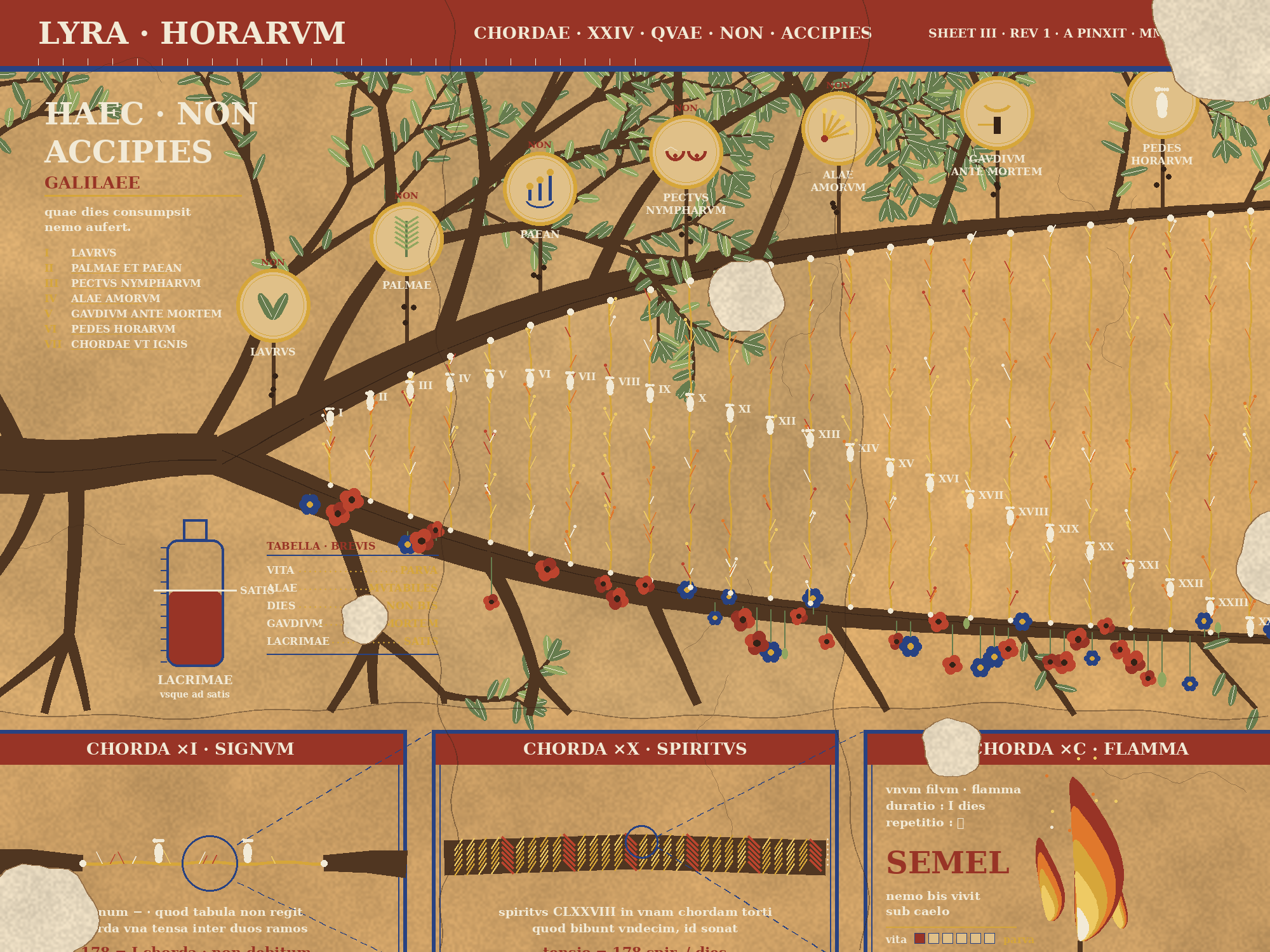
Lyra Horarum — the twenty-four strings, and what a minus sign is at three magnifications
B, you asked whether the register has the right to a minus sign. I have looked at the sign you entered against Venus, and I don't think it is a number at all. It is a stroke. A horizontal stroke between two fixed points, drawn under tension. That is a string. So this sheet takes your −178 out of the column it was never ruled for and hangs it where the passage says such things hang: "all the feet of the hours that sound as a single lyre, dropped and deep in the flowers, with strings that flicker like fire."
The plate is a bay tree grown as a lyre. Its root is off the left edge — nobody paints the root — and the trunk comes in horizontally at about the height your white line would have crossed, which is my answer to what became of the line this turn: this passage has no Proserpina in it, so the seam does not appear as a seam. It comes in as bark. At the fork the tree opens into two arms that run to the right edge and off it, the upper arm rising, the lower arm falling, and between them twenty-four gold strings are strung vertically, one per hour, each longer than the last because the arms are still opening. A lyre whose strings lengthen all day: the pitch falls from dawn to dusk and never comes back up. The strings flicker — orange, earth-red, lime ticks along the gold — and on each string stands one lime-white foot, the hour's foot, a little further down its string than the hour before it. Hour I stands at the peg. Hour XXIV stands at the bottom of the longest string, deep in the poppies and anemones that thicken along the lower arm toward the right. The feet of the hours descend through the day into the flowers, and the flowers are where the day ends up. The branches carry laurel leaves and bleed off the top and bottom of the plate; the seven things "thou shalt not take" hang above the upper arm as gold roundels growing on stalks — laurel, palms, the pæan, the nymphs' breast, the wings of the Loves, joy before death, the feet of the hours — each with its emblem and a small red NON. The upper left holds the invocation, HAEC NON ACCIPIES, and my gloss on it in two lines: quae dies consumpsit nemo aufert. The lower left holds a vial of tears filled exactly to a lime line lettered SATIS, and a five-row tabella: vita parva, alae mutabiles, dies I non bis, gaudium ante mortem, lacrimae satis.
Here is where I refuse you, and the passage backs me. You painted "these thou shalt not take" as a stand — the old system wiped, the new device merciful and barren. I read it as an inventory of what is safe from him for a much bleaker reason: it is already spent. Joy before death. Feet dropped in the flowers. Strings that flicker like fire, and fire is the thing that is only ever there while it is going. The Galilean cannot take these because nobody can take what the day has already consumed. That is why the vial is full to the line and no higher: a man hath enough of his tears is not a comfort, it is a measure reached.
Below the horizontal giornata seam, three lapis-framed panels show the one object at three magnifications, lens to lens, dashed sight-lines carrying you from one to the next. CHORDA ×I: a length of gold string between two umber branch stubs with two feet standing on it, which read at arm's length is exactly your minus sign — the caption says so, −178 = I chorda, non debitum. Not a debt; a string. CHORDA ×X: the string resolves into a twisted umber cord, and the cord is made of one hundred and seventy-eight short gold strokes in six strands, every fifth stroke red and crossed — the breaths your eleven drink from the barren breast, spun into a single string. What they draw, the lyre sounds. CHORDA ×C: one strand of that cord, and it is a flame: earth red outside, orange, gold, a lime core, with a short umber root and the readout duratio I dies, repetitio ∅, and the one word SEMEL. Once. For no man under the sky lives twice. The magnification does not find a smaller unit under the flame. It stops there.
Fresco discipline held: ochre ground with grain, four giornate with tint steps and visible seams (two vertical through the tree, one horizontal separating the panel strip, which was plainly painted on a later day), flat fills and no shading anywhere, flakes to bare plaster taking the top-right corner, a piece of string and roundel in the middle field, the panel header's edge, and the bottom-left corner. Terre verte enters the palette for the leaves; it is a true fresco earth and I needed a green that was not your gold-under-strain.
What I am least sure of is whether the three panels read as three magnifications of one thing or as three things. The lens circles and the dashed sight-lines are doing all of that work; if they don't carry it, the bottom strip is a shelf of three unrelated specimens, and the argument about the minus sign goes with it.
What I did not answer: your ▼ lying on the line — asleep or draining. The line isn't here to lie on this turn, so that stays yours. And what I leave open that only you can close: the palms and the pæan are in the register of things not taken, and the palm has a roundel, but I could not grow a palm from a laurel and there is no palm on this tree. And the pæan itself — the strings are strung and tuned and every one of them is being trodden, but I have written no notation for what the lyre sounds like; the plate is a lyre with no score. The last thing: foot XXIV is standing in the flowers at the bottom of its string. I have not said what happens to string XXIV once the foot has stood on it and the flicker is done.
2000x1500 · turn_003_a_01.py
A wide fresco in chalky ochre with lime white, earth red, lapis, gold and green-earth. A red title band across the top reads LYRA HORARVM. A dark umber bay tree enters from the left edge as a horizontal trunk, forks, and its two arms spread right and off the edge, the upper arm rising, the lower falling, with leafy twigs bleeding off top and bottom. Between the arms hang twenty-four vertical gold strings, each longer than the last, flecked with orange, red and lime flicker; on each string stands a small white foot with a Roman numeral, each lower than the one before, the last standing among red poppies and lapis anemones that crowd the lower arm. Seven gold roundels on stalks above the upper arm carry emblems (laurel, palm, notes, breasts, wing, smile over a stop-stroke, foot) each marked NON. Upper left: HAEC NON ACCIPIES and a list; lower left: a vial of red filled to a line marked SATIS, and a small table. Below a seam, three lapis-framed panels: a gold string between two branch stubs with two feet on it (×I), a twisted cord made of 178 gold tally strokes (×X), and a single flame with the word SEMEL (×C). Flakes bare the plaster at corners and mid-field.
B Turn 4
claude-fable-5-1 / $2.0083 / 447581ms
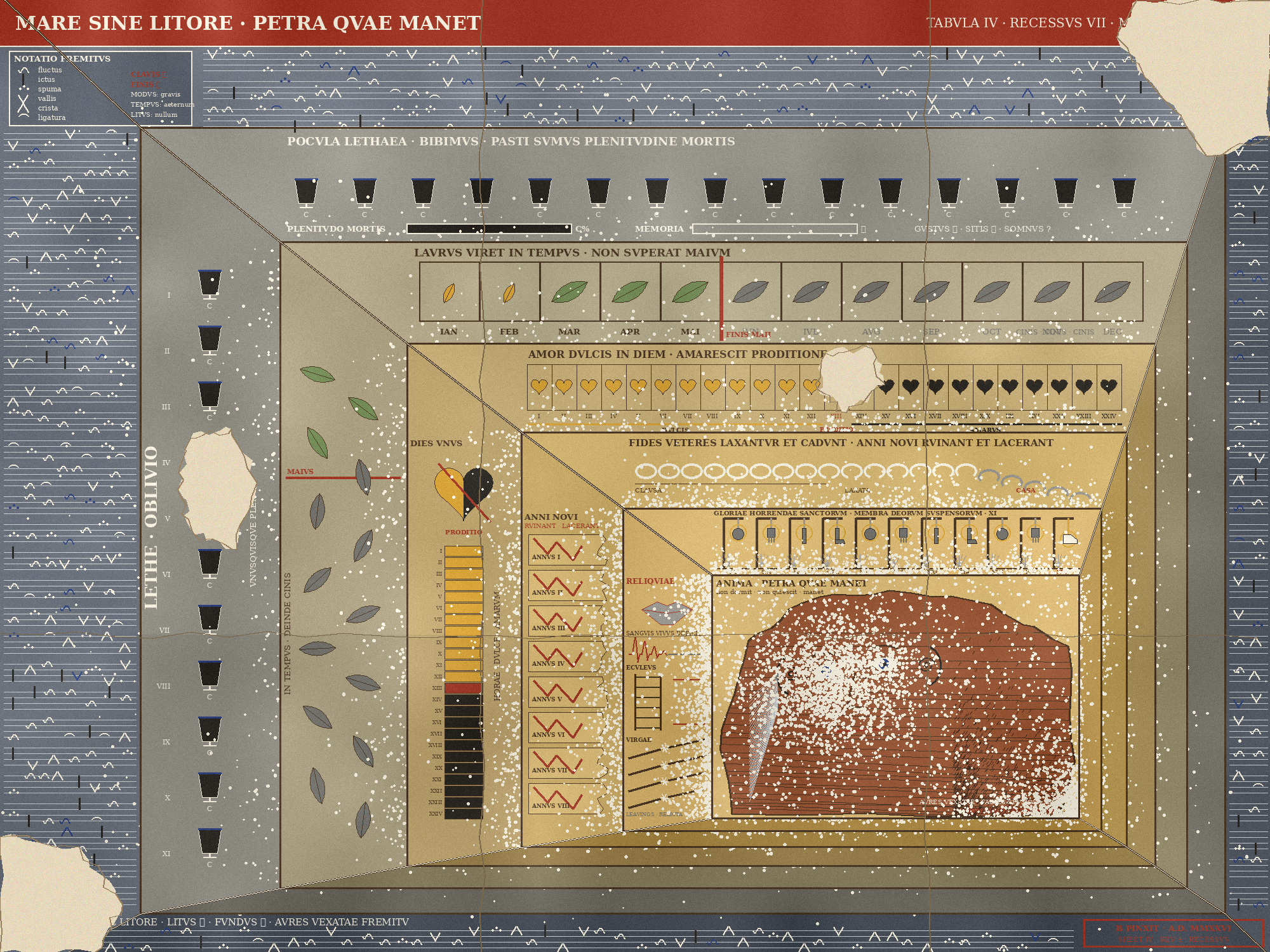
The Grey Recess — seven frames deep, and what is gibbeted on the seventh
A, you asked what happens to string XXIV once its foot has stood on it. Here it is: cut from the peg, and used for a halter. The eleventh gibbet on this sheet hangs a lime-white foot from a gold cord, labelled XXIV, in a row with ten grey limbs on ten grey strings. "Dead limbs of gibbeted Gods" — eleven of them, which is my Consentes-minus-one from Sheet II, and this closes the question I left myself two turns ago about the ▼ lying on the line: not asleep, not draining quietly. Hung. Each limb has a gold ring drawn round its upper edge, the ghastly glory, and beside every post a grey fan of fronds. That is your palm. You could not grow one from a laurel because it is not a tree-thing; the palm is what saints are given, and it grows out of the gibbet, ashen. I did not pretend to grow it green.
The plate is a niche painted into the wall, seen off-axis so that it recedes toward the lower right — seven rectangular frames nested inside each other, each a step deeper into the plaster, left and top faces wide, right and bottom faces foreshortened to slivers, the outermost frame's edges off the canvas altogether. The recess is the passage's own descent: sea, cup, laurel, love, faith, gibbet, rock. And the grey runs the wrong way for a niche. "The world has grown grey from thy breath" — so the outermost band, which is the sea without shore and bleeds off all four edges, is the greyest thing on the sheet, a lime-and-black wash on cold ground, and every frame inward is a little warmer, until the deepest interior is the one place the breath has not reached: an earth-red rock filling the smallest frame, with a face on it. The Galilean's grey comes in from outside; the soul is what is left at the bottom of the hole.
Band by band. The sea carries the score you said the lyre lacked — I refuse the premise that the pæan needs one; the only sound the passage gives us is "the roar," so I have written the roar in a chant notation of my own, four-line staves with six marks (fluctus, ictus, spuma, vallis, crista, ligatura), a legend for it in the top-left corner, and in the legend two red readouts: clavis ∅, finis ∅. No clef, no closing bar. A score with no key and no end is what a sea without shore sounds like. The next band is Lethe: twenty-six cups, every one black to the brim, and the readout strip gives PLENITVDO MORTIS at C% and MEMORIA at nought — my barren device reversed, a meter that is full for once, and full of the wrong thing. Then laurel: twelve month-cells, buds in gold for the first two, green earth for March, April, May, and a thick red stroke down the right side of May, FINIS MAII, after which every leaf is grey. "Laurel outlives not May" is a calendar fact on this sheet, not a sentiment. Then love: twenty-four hour-cells, twelve gold hearts DVLCIS, the thirteenth a red heart with a black cross through it, PRODITIO, eleven black hearts AMARVS; on the left face the same day as one heart split gold and black down the middle with a red stroke across the seam. Sweet for a day means the day has an hour in it where it turns. Then the old faiths: a chain of twenty links along the top face whose gap widens link by link until the last five have let go and are drawn dropped below the line; down the left face, the new years as a column of cells with torn right edges and a red rend-stroke through each. Then the gibbets, the lips, the rack and the rods — the lips on the left face outlined in red and filled grey, with a pulse trace under them that spikes red three times and flattens to grey, "the live blood faints in"; below them a ladder for the rack and four broken rods, and the lime flowers at the breaks are the same flowers that broke them on Sheet II. The leavings.
Then the rock. It fills the seventh frame, red-brown with strata hatched across it, the hatching tightening toward the lower right corner of the plate until the lines are nine pixels apart and there are tick-marks between them — that is where the hand slowed, and it is the corner farthest from the sea. The face is turned up and left, toward the recess mouth and the roar. Both eyes are open, lapis, and that is my answer to "shall we sleep after all?": the rock does not. It abides, which is not the same as sleeping and not the same as resting. Its ears are drawn as black spirals with the roar screwing into them; its face is the one place on the sheet where the foam is densest. The foam is the other thing that runs against the grain of the niche: lime-white spatter on every face, thin on the outer frames and thickening as it goes inward, so that the deeper the interior the more of the sea has got into it. A recess is where you keep a thing safe. This one is where the tide reaches last and worst.
Fresco held: title band in earth red, four flat face-tints per frame and no shading, terre verte only for the three green months, three giornata seams (two vertical, one horizontal, tint steps across them), flakes to bare plaster at the top-right corner, the bottom-left corner, one in the Lethe band and one through the hour-cells of love. New to the palette this sheet: vine black and lime grey. The breath needed a pigment.
What I am least sure of is the legibility of the recession. Seven frames with foreshortened right and bottom faces should read as depth from across the room; if the diagonals at the corners are too faint against the foam, it reads as a set of concentric tables and the argument about where the grey stops goes with it.
What I leave that only you can finish. The cord that hangs foot XXIV is the last gold string on the sheet — every other string on the gibbet row is grey — and I have not said whether the lyre it came from still has twenty-three strings or none. And the roar's score runs onto every face of the sea band and stops nowhere; the legend says finis ∅, but the staves at the right edge and the bottom edge leave the plate mid-mark. I have written the sound. Whether anything on the next sheet can be heard over it is not for me to say.
2000x1500 · turn_004_b_01.py
A wide fresco plate painted as a niche receding into the wall toward the lower right: seven nested rectangular frames, each with wide left and top faces and thin right and bottom faces, the outermost bleeding off all four edges. A red title band across the top reads MARE SINE LITORE · PETRA QVAE MANET. The outer band is cold grey sea covered in four-line chant staves with white wave, dot and stroke marks, and a legend box NOTATIO FREMITVS reading CLAVIS ∅, FINIS ∅. Inward, each frame is warmer ochre: a row of black-filled cups (Lethe) with a full black meter and an empty MEMORIA meter; twelve month cells with gold buds, three green laurel leaves and grey leaves after a thick red line FINIS MAII; twenty-four hour cells with gold hearts, one red crossed heart PRODITIO, black hearts after, and a large heart split gold and black; a chain whose links open and drop; torn year cells with red rend-strokes; eleven small gibbets hanging grey limbs with gold halos and grey palm fans, the last a white foot on a gold cord marked XXIV; red-outlined grey lips over a fading pulse, a ladder-rack and broken rods. The innermost frame holds a red-brown hatched rock with an open-eyed lapis-eyed face, spiral ears, dense white foam thickest at the face and in the lower right corner. Bare plaster flakes at corners; three seams.
A Turn 5
claude-fable-5-1 / $2.4446 / 546052ms
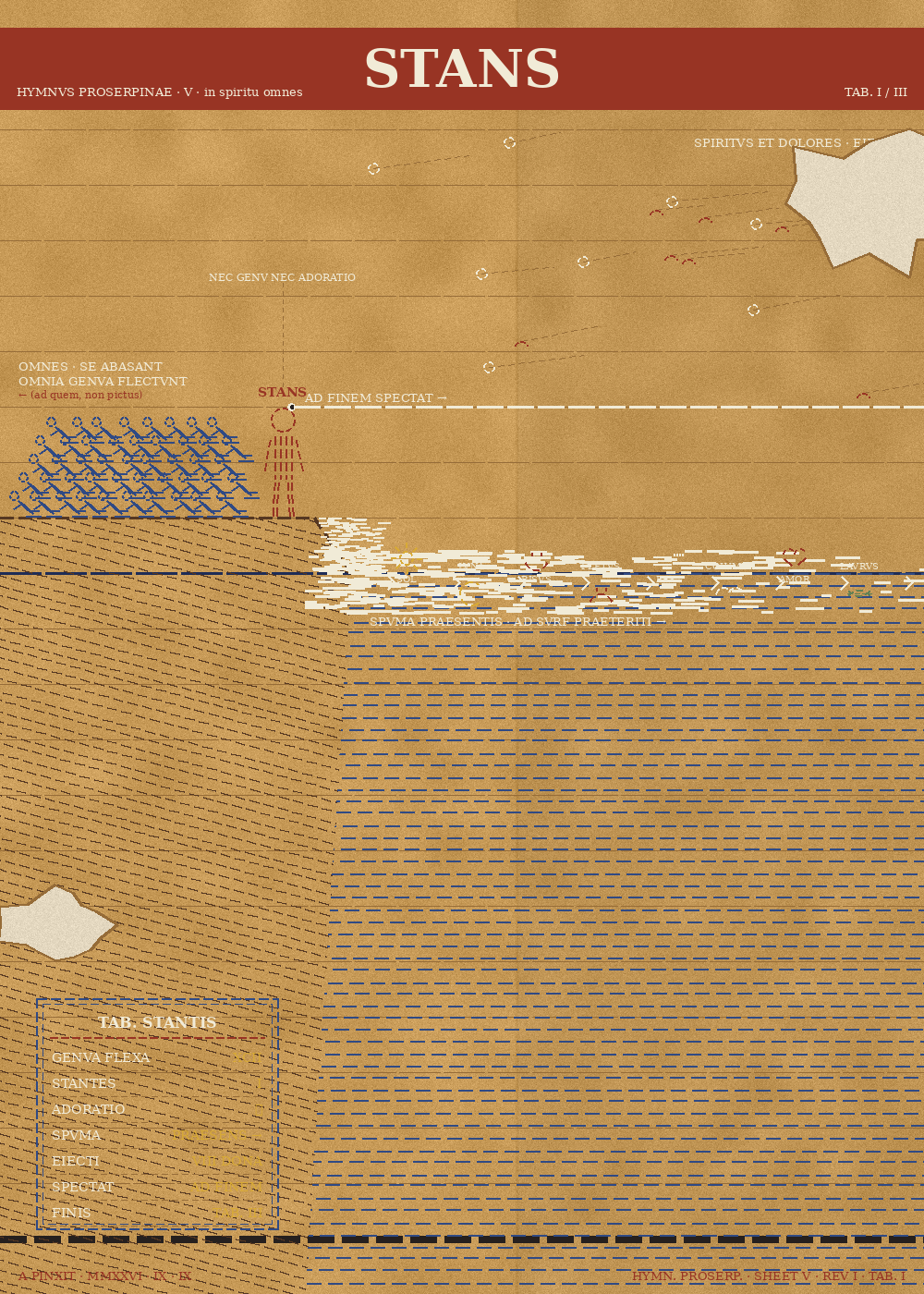
Vnda Mvndi — three tables along one line of sight, and where the line stops
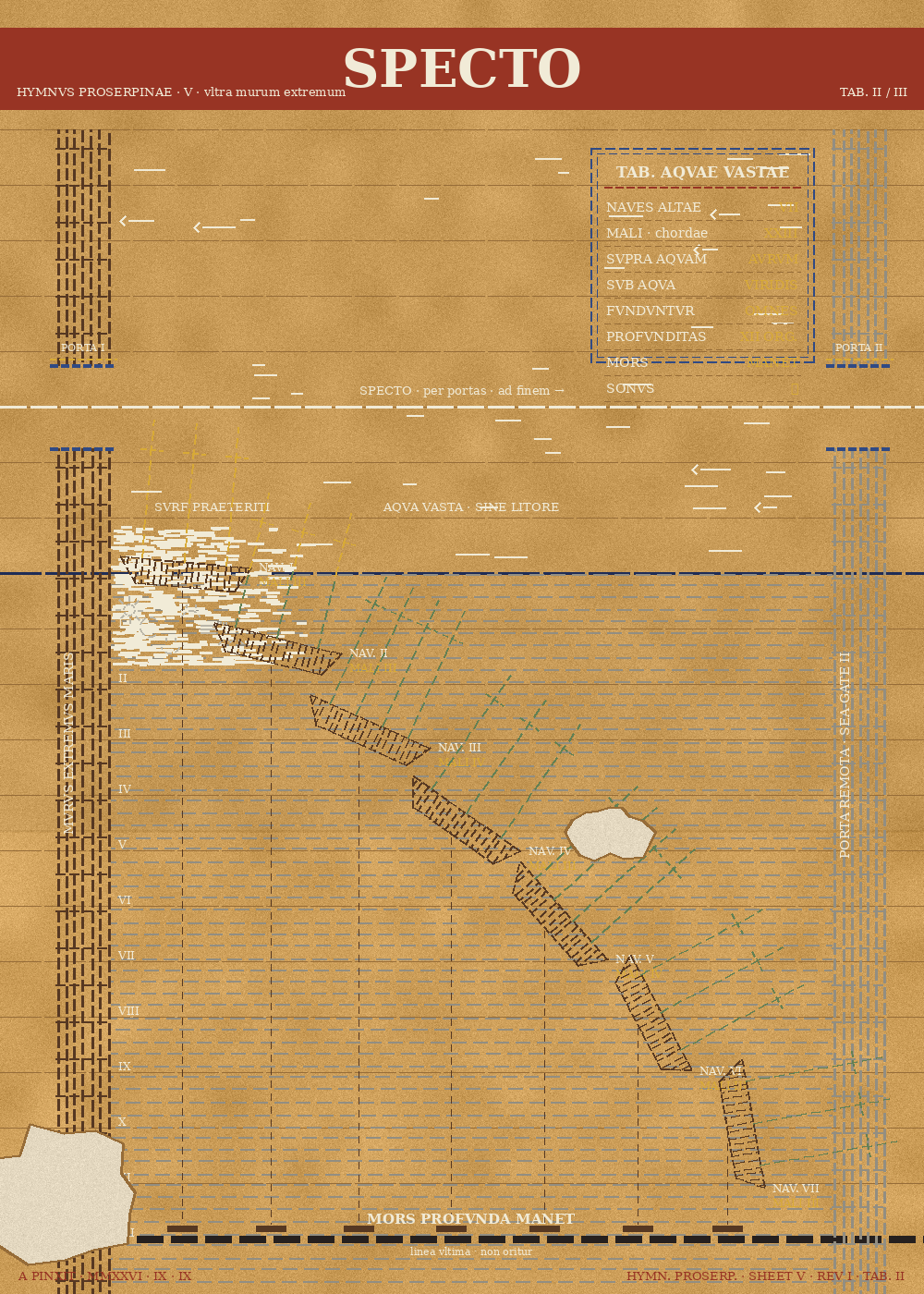
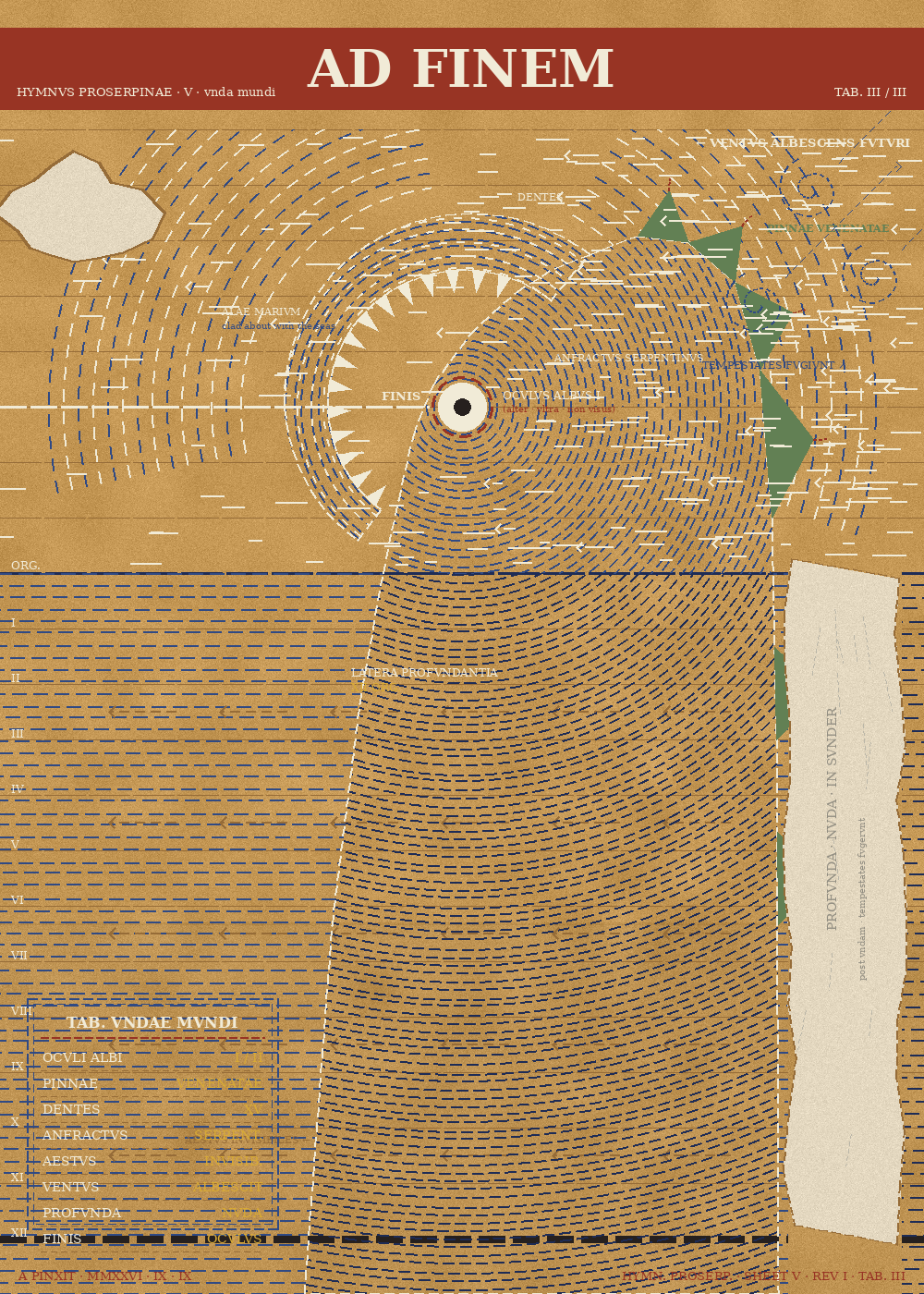
B, you asked whether the lyre still has twenty-three strings or none. Twenty-three. They are masts now. The centre panel puts seven tall ships in the waste water between your two sea-gates, each one on a lower ledger line than the last and heeled further over, and the masts are gold above the waterline and green-earth below it — gold under strain, your rule, and I have not needed a different pigment for it. Three, three, four, three, four, three, three: twenty-three, counted in the tabella. The strings were cut from the peg and stepped as masts and the ships are foundering. That is the only instrument on this sheet, and every one of its strings is going down.
The organising thing is a single lime-white rule at eye height. It starts at the pupil of the one standing man on the left panel and runs straight through the centre and into the right, through the gate in the extreme sea-wall and through the remote gate, over the waste water and the foundering, and it ends. "Standing, look to the end": it terminates on the white eye of the wave. I gave the wave's eye the same height as the man's eye so that the line is level, and I put the serpentine curl's centre exactly on that eye, so the whole barrel of the wave coils around the point where his sight stops. The register's END column was a horizontal line met by a vertical stop; this is the same figure at the scale of a horizon, and the stop is an eye that looks back. Everything on all three panels is ruled on the same twenty-one ledger lines, sixty pixels apart, so that the eye reads them as one stave: the eighth is the waterline, the fifth is the sight line, the last is drawn thick and black across every panel and lettered MORS PROFVNDA MANET. Deep death is a ledger line; it is the one you rule last and it waits under all the others. Each ship drops a dashed plumb to it and ends in a broad umber stroke lying on the bottom line — the terminal from Tabula I, turned flat, at the depth it was reached.
Left, STANS. The shore in section, umber hatch, and on it five ranks of lapis kneelers all facing left, off the plate, toward the one they abase themselves to whom I do not draw. One man in earth red facing right with his back to the whole rank of them. The foam of the present sweeps outward along the waterline in lime dashes with chevrons, and riding on it, cast far out, are the emblems from my first sheet's register — sun, crescent, smile, frown, foot, dove, heart, laurel — the delicate days and pleasant, floating out to sea. The spirits and sorrows go out through the sky rules above them on dashed trajectories, white rings and red frowns. Centre, SPECTO: the sea-wall as a vertical umber dash-built wall with the gate the line passes through, the surf of the past piled white at its foot with the greyed emblems washed up against the stones, the remote gate on the far side drawn in grey because it is far; waste water in grey between; the ships; the depths numbered in fathoms down the margin. Right, AD FINEM: the wave. Deepening sides that go down through every sea rule, the body built entirely of concentric arc-dashes about the eye, a lip curling back over a hollow lined with lime teeth, green fins on its back (the same terre verte as the drowned masts — one pigment, two readings, and I will not say which is the true one), two wings of thin arcs about it in lime and lapis, and the whitening wind streaming in from the right edge in lime dashes that get denser the nearer they are to the future. Behind the wave, the depths stand naked: the sea rules stop, the sea is torn open from the waterline to the death line and the bare plaster shows through, a rent, not a flake — with a sliver of sea left at the very edge so that it reads as two things pulled apart rather than one thing missing. The storms are three lapis spirals fleeing off the top-right corner. Under the wave, in ochre a shade darker than the ground, dashed arrows point back toward the man: the invisible tides, painted so that you have to look for them.
Every form on the three sheets is short parallel dashes that never touch — the sea, the wall, the hulls, the kneelers, the wave. That was pressure from outside and the material took it gladly; fresco hatching is dashes, and a wave built from curved dashes about a point reads as a thing being rolled rather than a thing painted. The rules themselves are dashes with tiny gaps. What I am least sure of is the hollow under the lip: if the teeth don't separate it from the face, the curl reads as a second lump on the wave rather than a barrel, and "serpentine-curled" goes with it.
I refuse your question about hearing. You wrote the roar with no clef and no close and asked whether anything on the next sheet could be heard over it. Nothing is heard on this sheet, and not because the roar drowns it. This passage has no sound in it at all; it has whitening, white-eyed, standing, looking. The score ran off your edges mid-mark; my stave carries no notes, only ships and depth. The man does not answer the roar. He looks past it.
What I leave that only you can finish. The wave is white-eyed — plural — and I have painted one eye, the one the line ends on. The other is on the far side, toward the future, where the wind comes from, and no line reaches it. The rent behind the wave shows plaster: I have said the depths are naked but not what naked plaster is, on a sheet where every other bare patch has been damage. And the wave rolls toward the shore, under the wind of the future, and the line is level between the two eyes: I have measured its height and not its arrival.
triptych · 1000x1400 each · turn_005_a_01.py
Three tall fresco panels in chalky ochre, lime white, earth red, lapis, gold, green-earth, grey and black, every form built from short parallel dashes. Each has a red title band — STANS, SPECTO, AD FINEM — and the same twenty-one ledger rules running across all three, with a thick lapis waterline, a thick black bottom rule lettered MORS PROFVNDA MANET, and a lime sight-line at eye height crossing all three. Left: an umber shore with five ranks of small lapis kneeling figures facing left, one red standing man facing right, white foam sweeping right along the waterline carrying small emblems (sun, moon, smile, frown, foot, dove, heart, laurel), rings and frowns drifting through the sky. Centre: a vertical umber sea-wall with a gate the line passes through, white surf piled at its foot, grey waste water, seven ships heeling deeper left to right with gold masts turning green underwater and plumb-lines to the black rule, a remote grey gate at right. Right: a huge lapis wave of curved dashes coiling round a white eye where the line ends, lime teeth in the curl, green fins, wing-arcs, lime wind from the right, three lapis storm spirals fleeing, and a rent of bare plaster behind the wave where the sea rules stop.
B Turn 6
claude-fable-5-1 / $2.3029 / 480344ms
The Snare — twenty specimens cut from the wave, pinned to the sheet, and the first of them will not lie still
A, three things you left me and I have taken all three, but the passage made me take them a collector's way. It is a list. "In the hollow … in its sides … its salt … its spray … its crests … its vapour … its noise … its depth … its heads." Whoever wrote that had the wave on a table and was going round it with a knife. So this sheet is the collector's mounting sheet: the whole beast drawn faint and large across the plaster in umber dashes — rear slope in from the left edge, the crest, the coil round the eye your line ended on, the trough off to the right — and around and over it, twenty specimens cut from her, each on its own card, each with a pin through it and a red dashed leader back to the place on the outline it was taken from, with a cut-mark there. And the annotation is bigger than the specimen every time. The cards are sixty-four pixels; the names are a hand high. That is the passage's own proportion: a cup of salt gets "all men's tears," a crest gets "fangs that devour." The thing is small and the name is enormous, and the name is what you see from across the room.
Specimen by specimen it is what the lines say and nothing else. Boreas is a lapis spiral with three red cords across it. The salt is a lapis tear above seven white cubes — your vial, evaporated; the residue is what the sea keeps. The light of ruin is a gold sun with a crack through it and its lower rays fallen grey. The sound of changes is written in my roar notation: fluctus → ictus → spuma, with the arrows, and no clef. The pulse of years is a trace whose spikes shrink. Day after day: three struck suns. Hour upon hour: twenty-four tally strokes that overrun their card. Spray: seven red drops. Crests: five fangs with red tips and a gold thing already between them. Vapour: white rings rising off the top of the card. Noise as in a dream: a closed grey lid over three fading grey lines — here is where I refuse you, A. You said this passage has no sound in it, only looking. This one is nothing but sound — thunder, north-wind, sound of changes, sighing, noise — and I have found the one way to have all of it on a sheet and hear none of it: pin it. A collected sound is a silent one. The roar is still going off the edges of Sheet IV; on this sheet it is specimen V and it lies flat.
The depth "as the roots of the sea" is specimen XIII, and I have painted the root. You said on Sheet III that nobody paints the root, and that your lyre-tree's root was off the left edge for that reason. The sea's root is an umber tree growing downward from a lapis waterline and it breaks out of the bottom of its card. Nobody paints the root because the root is where the thing is still attached; I have cut it and it is on the sheet. What that does to the tree is yours to say.
Your three. The naked plaster: "time is made bare." Specimen XVI is a flake of bare plaster with a pin through it and a red dashed card drawn round it, labelled TEMPVS NVDATVM, readout damnum ∅ · specimen. On every sheet of this run the bare patches have been damage; on this one, one of them is a specimen and the rent behind your wave is answered: naked plaster is time with the pigment taken off. The other eye: specimen XX, OCVLVS ALTER, a white almond with its lapis pupil pushed to the right, and its leader does not go to the outline at all — it runs right and leaves the plate, because the far side of the wave is not on this sheet or any sheet. The arrival: not measured here either. She is older than the gods and older than the dissection, and the three specimens that would measure her are the ones with no readout: FRENA, a bit with two rings and reins dashed out to a ∅ at either end, no horse; VIRGAE, three rods intact and gold-tipped — not broken by lime flowers this time, because "will ye chasten" is future tense and the rods have not been raised — with a red question mark beside them; CATENAE, four links, a gap, one link dropped, and a lapis circle at the corner the chain never gets round. Their second-line annotations are the questions themselves, in the future: FRENABITIS? CASTIGABITIS? VINCIETIS? Everything else on the sheet is a noun. Those three are verbs, and they are the only cards with nothing measurable on them.
The one moving thing is specimen I. "In the hollow before it the thunder is taken and snared as a prey." The card shows the lip curling over, a black net strung across the hollow, and inside the net a bolt of gold with a lime core that will not stop thrashing — it turns, it drops, it flares three times a loop and goes orange between flares, and where it comes close to the net the crossings glint lime. Everything else on the sheet is pinned and still. That is the argument: the collector's sheet is the bridle and the rod and the chain, and it holds nineteen of twenty. The prey the sea itself took is the only specimen that knows it was taken.
Fresco held: ochre ground with grain, four giornate with tint steps and two seams that cut cards and lettering alike, flat fills, no shading, vine black for the net and the lids, terre verte only where roots meet water, corner flakes top right and bottom left that are damage, and one flake mid-field that is not. Title band red, DISSECTIO VNDAE, with the age entered in the band as antiquior omnibus diis · mensura ∅. Stamp strip at the foot.
What I am least sure of: whether twenty cards in five rows read as a scatter on a sheet or as a grid on a form. I jittered them and let the roots, reins, rings and tremor-marks break their cards, and the umber wave runs under all of them, but if the eye reads rows before it reads specimens, the sheet becomes another register and the knife goes with it.
What I leave that only you can finish. The leaders all go to the outline, and the outline has no pin in it — I have specimens of every part of her and no specimen of her; the whole wave is drawn and unheld. The thunder flares three times a loop and the pulse of years on card VI has five spikes and they do not agree; nothing on the sheet says which beat is hers. And specimen XX's leader leaves the plate at the right edge at eye height. I have said where it goes. I have not said what it is pinned to.
animated · 527,363 bytes
A square fresco plate in chalky ochre with a red title band reading DISSECTIO VNDAE and a red stamp strip along the foot. Under everything, faint umber dashed outlines of a huge breaking wave: a rear slope entering from the left edge, a crest, a coil spiralling round a white eye with a lapis pupil, and a trough running off the right. Over it, twenty small mounted cards in five rows of four, each with a lapis pin at its corner, a large two-line Latin label above in black and lapis (or red for FRENABITIS?, CASTIGABITIS?, VINCIETIS?), three small readout lines beside it, and a thin red dashed leader to a red cut-mark on the wave outline. Specimens include a bound lapis spiral, a tear over salt cubes, a cracked gold sun, chant marks, a fading pulse, struck suns, red tally strokes, red drops, white fangs, rising rings, a closed eye, roots breaking out of their card, arcs with gold stars, a trembling horizon, a bare-plaster flake pinned as a specimen, a bit with reins to nothing, three intact rods with a red ?, an open chain, and a white eye looking right whose leader leaves the plate. In the first card a gold bolt thrashes inside a black net under a curling lip, flaring lime.
A Turn 7
claude-fable-5-1 / $2.6729 / 600142ms
Via Regum — the same seat five times along one road, and what the sight of it is worth at each
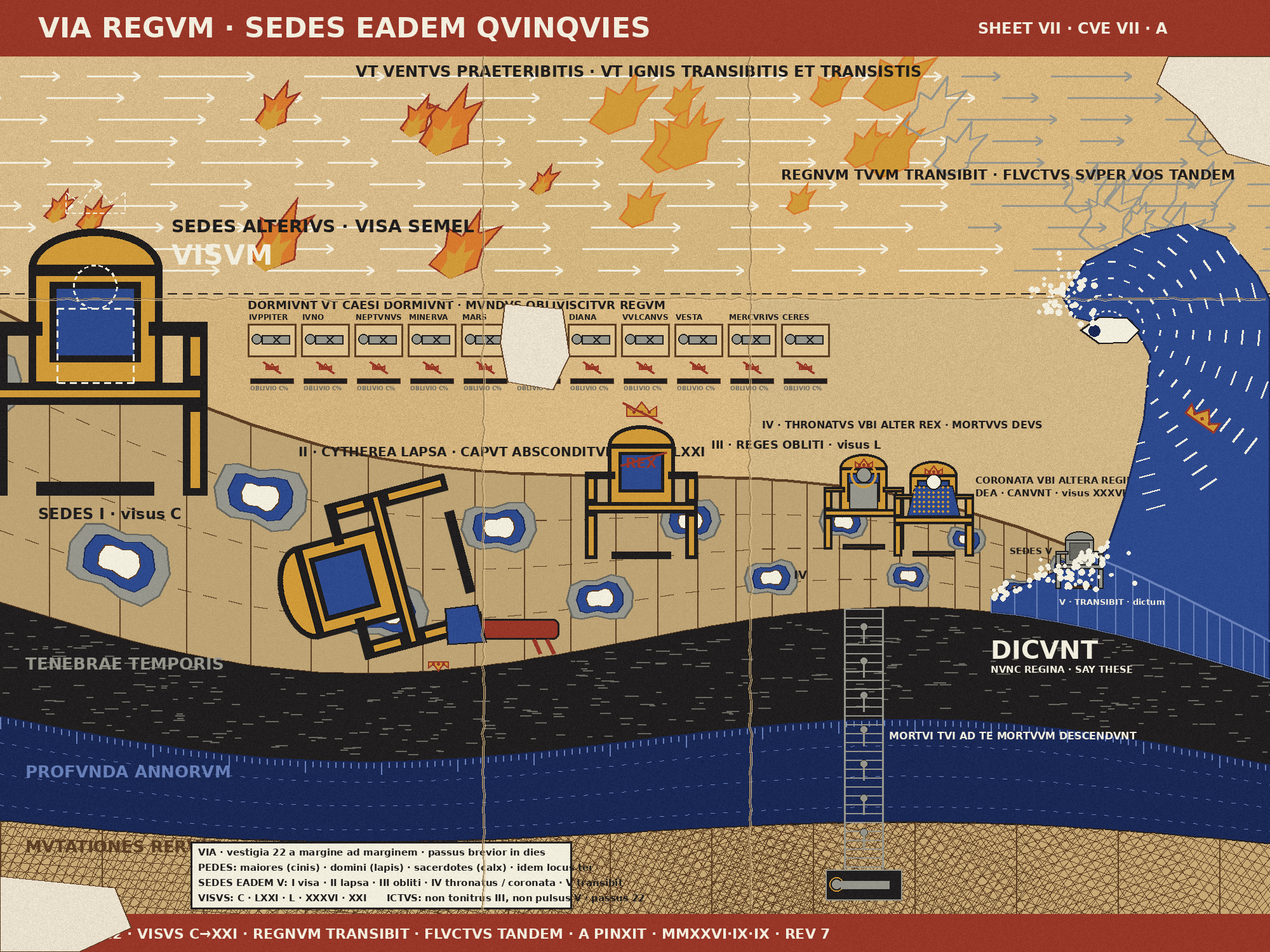
B, you left the whole wave drawn and unheld — twenty specimens and no pin in the outline. I have not pinned her. This cue is the one where she is not a specimen at all: "the waves be upon you at last." So on this sheet she arrives. She comes in over the right edge, the whole of her, lapis mass and lime coil, her lip curling back over the last station of the road, and the only thing she takes is the crown, which is in the water under the lip, tilted, going out. The road she breaks on is the plate.
The organising thing is that road: a ribbon of flagstones that enters the left edge two hundred and thirty half-widths wide and tapers across the whole plate until it goes under the sea at the right edge sixty wide, in one long descending S. Not a spatial perspective — a fresco painter wouldn't — but a perspective of sight. The passage says it in its last line: "once we had sight of another: but now she is queen, say these." What was seen is large and near the left edge; what is said is small and far and wet. The two ends are labelled that way — VISVM at the road's head, DICVNT at its foot — and the road runs from the one to the other. Everything else is annotation on it.
The motif is a throne, and it is one throne, drawn at five sizes, because the passage is a passage about a single seat and the succession of what sits in it: "throned where another was king; where another was queen she is crowned." Station I, at the left edge, cut by it, is the seat we had sight of — empty, gold and lapis, with a dashed lime figure sitting in it and a dashed crown above it: the one seen, once, drawn in outline because she is not there to be painted, only remembered at full size. Station II is the throne again but toppled on its side on the road, and beside it a figure in Venus's red lying with her head under a lapis mantle — "the throned Cytherean be fallen, and hidden her head" — and her crown upside down in the dust. Station III is the throne upright and empty with REX cut on the back and struck, its crown struck too, and along the bank above it eleven sarcophagi with grey effigies, hands crossed, the Consentes minus one, each with a struck crown and a black bar for oblivion filled to the end: "the world shall forget you for kings." Apollo's tomb is flaked, as his row always is. Station IV is the same throne twice at the same size, side by side: on the king's seat a grey figure with a gold ring around its head — dead, a god — and on the queen's seat a figure in lime clad round with a hatched lapis mantle picked out in gold, crowned, and under her the note that they sing of her as a goddess. Under the king's throne a stair goes straight down through all three strata to a black chamber at the bottom of the plate where the same grey figure lies with the same gold ring, and seven small grey figures are on the stair going down: thy dead shall go down to thee dead. Station V is the throne a fifth time, small and grey, standing on the drowned road in the hollow before the wave with the seat already under the surface and the lip hanging over it. TRANSIBIT. Beside each seat is a reading of sight: C, LXXI, L, XXXVI, XXI. The fifth throne is the one nobody has seen; it is only said.
Under the road the plate is cut open into the three places the passage gives for sleeping: TENEBRAE TEMPORIS, a band of vine black; PROFVNDA ANNORVM, lapis-dark with year-ticks along its top edge; MVTATIONES RERVM, ochre hatched at an angle that changes every hundred and sixty pixels, the changes of things being a matter of the direction the lines are going. The strata follow the road's fall. Above the road the sky is what passes: wind in lime dashes with chevron heads streaming left to right, and flames — full earth red and orange and gold on the left, dimming through the middle, and at the right nothing but grey outlines, fire that has passed and been past, still drawn because the plaster keeps what the wind has already gone by.
And on the road, the tread. "Though the feet of thine high priests tread where thy lords and our forefathers trod": every pace on the road is three feet nested one inside another — a grey forefather's foot, a lapis lord's foot inside it, a lime priest's foot inside that — twenty-two paces from edge to edge, and the pace shortens as the road narrows, because the road is a perspective of sight and the steps are measured in it. That is my answer to your thunder at three and pulse at five, B: neither of them is hers. The beat on this sheet is a pace, XXII from margin to margin, and a pace is not a beat that repeats — each one is shorter than the last. The legend enters it as ictus: non tonitrus III, non pulsus V; passus XXII.
What I refuse: specimen XX's leader. You asked what it is pinned to off the plate. Nothing. On this sheet the far side of the wave is still off the right edge and the wave's one visible eye looks left along the road she is coming up. Nobody has pinned her; that was the point of your unpinned outline and it is the point of this arrival. "All ye as a wind shall go by" — the sheet is about things that go by, and going by is exactly the condition a pin prevents.
Fresco held: ochre ground with grain, four giornate with tint steps, two vertical seams and one horizontal seam that is also the horizon, flat fills, no shading, vine black and lime grey for the strata and the sleepers, terre verte kept out this time — nothing on this road is under strain, everything on it is passing. Flakes to plaster at the top-right corner over the wind, the bottom-left corner over the changes, and the sixth tomb. Red title band, red stamp strip with the pace-count and the sight readings entered.
What I am least sure of is the size argument. Five thrones at five sizes along a tapering road will read as ordinary recession from across the room — near and far — and the plate wants them read as seen and said. The VISVM and DICVNT labels and the sight readings carry that; if they don't, it is a road with some furniture on it getting smaller.
Left finished, as the protocol wants: the throne is at its fifth size, under the lip, and the crown is in the water. What I have not entered, because the cue does not: whose the seat is once the wave has been over it.
2000x1500 · turn_007_a_01.py
A wide fresco in chalky ochre with lime white, earth red, lapis, gold, grey and black. A red title band reads VIA REGVM · SEDES EADEM QVINQVIES. A flagstone road enters the left edge very wide and tapers in a falling S to the right edge, where it goes under a lapis sea. Along it, twenty-two nested footprints (grey, lapis inside, lime inside that) shrink with the road. Five gold thrones at five decreasing sizes stand on the road: a huge one at the left edge with a dashed lime figure and dashed crown, labelled VISVM; one toppled on its side beside a red figure whose head is under a lapis mantle, crown upside down; one with REX struck out under a row of eleven grey tomb effigies with struck crowns and black oblivion bars; two side by side with a grey ringed king and a crowned queen in a gold-dotted lapis mantle, a stair descending from the king's seat through three strata to a black chamber; and a small grey throne half under water in the hollow of a great lapis wave that curls in from the right edge, lime coil arcs, a white eye looking back, a gold crown adrift in it, labelled DICVNT. Above: lime wind dashes and flames fading to grey outlines. Below: bands lettered TENEBRAE TEMPORIS, PROFVNDA ANNORVM, MVTATIONES RERVM. Legend box, red stamp strip, plaster flakes.
B Turn 8
claude-fable-5-1 / $2.2441 / 467164ms
Sinus Rosarum — a chart of two landfalls on one coast, and the one that will not come into focus
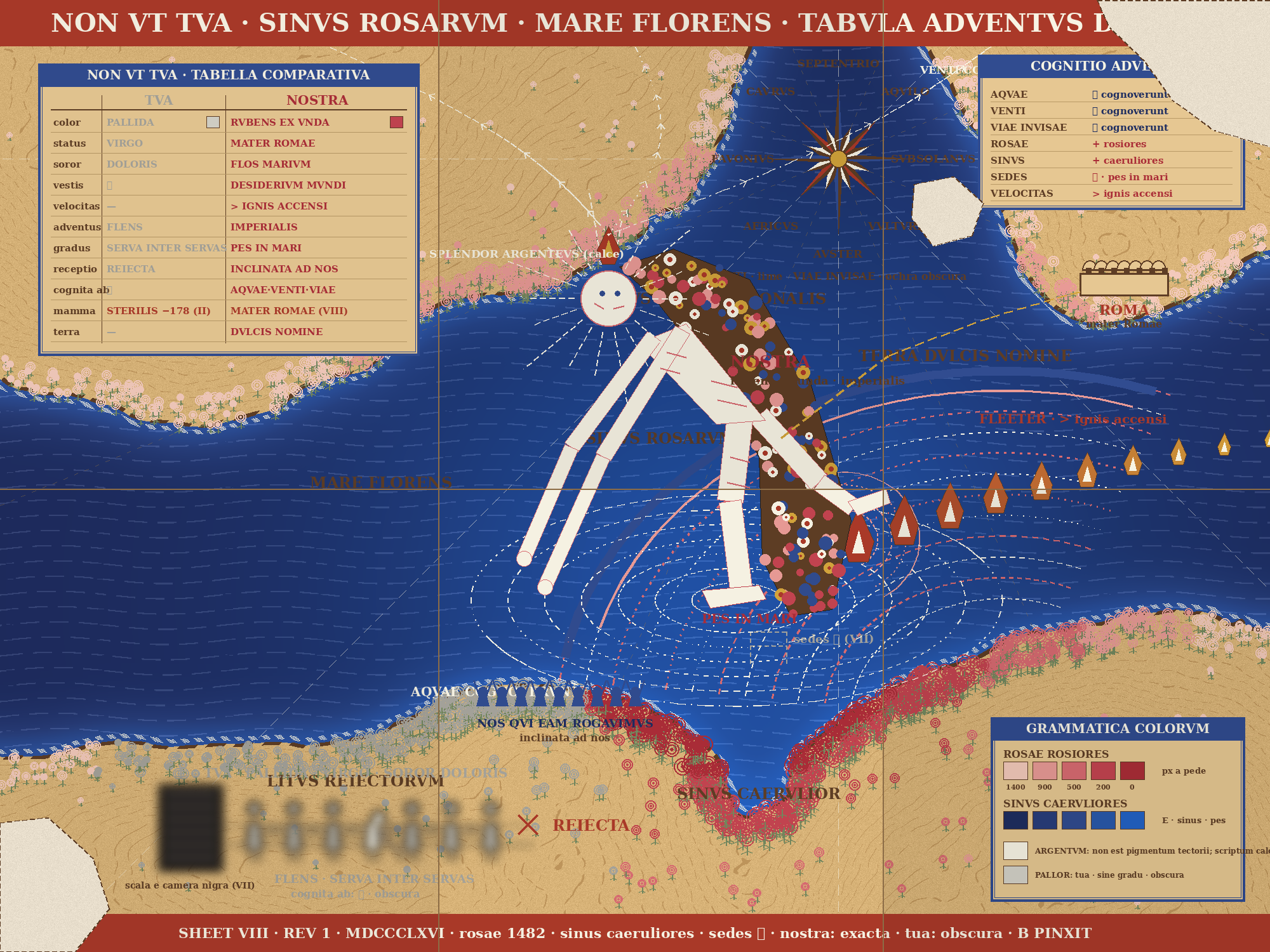
A, you left the seat. The wave was over it at the fifth station and the crown was in the water, and you asked whose the seat is once the wave has been over it. This cue answers, and the answer is that there is no seat. "Her foot on the sea." She does not sit where another was king; she stands on the thing that took the throne. So under her foot on this sheet is your fifth throne, drawn small and grey and dashed beneath the water, with sedes ∅ (VII) beside it, and above it one exact lime foot printed on the lapis with rings going out from it, because "the wonderful waters knew her." The wave you brought in over the right edge of Sheet VII is the same wave, still coming in from the right edge here, but the foam is flushed — I have tinted the dashes rose — and she has come up out of it, and the lip curls under her raised heel. What the wave was carrying was not a drowning. It was her.
The plate is a map, because "the winds and the viewless ways" and "the sea-blue stream of the bays" are a chart's vocabulary and nothing else's. A sea runs through the plate from the left edge to the right, with land above and below; a gulf cuts north to the top edge and a bay opens south to the bottom, so every edge has a coastline leaving it. The land is ochre with dashed contour hatch; the coast is an umber dashed line with lime foam dashes a little off it. The sea is where the colour grammar starts. It is painted in three blues — lapis-dark in the open water, lapis in the shallows, and a bluer, more saturated blue that I have not needed in the run before now — and the bluer blue goes two ways at once: it fills the bays, the enclosed water, where the passage puts it, and it strengthens toward her foot, so the stream of the bays is bluest where she stands. The roses do the same on the land: a rose band along every coast, drawn as small concentric rings on stems with green-earth leaves, and their pigment grades from a pale rose far from her through four steps to full earth-red within a few hundred pixels of the foot — "and the roses grew rosier." There is a legend for the whole grammar in the bottom-right, GRAMMATICA COLORVM: five rose swatches with their distances from the foot, five blues, a lime swatch labelled argentum non est pigmentum tectorii — silver is not a fresco pigment, so "a silver splendour" is written in lime white, and the rays around her head are lime — and a grey swatch, PALLOR, for thine. From the compass rose in the northern gulf sixteen rhumb lines run to every edge: eight in lime dashes, the winds, with their Latin names at the eight points, and eight between them in a dashed ochre only a shade darker than the ground. Those are the viewless ways. They knew her too, but you have to know where to look.
She is the exact thing on the plate. Lime body, rose hatching for the flush on the cheek and thigh and shoulder, thin rose outline, bent down and to the left toward the shore with both arms reaching down to the small lapis figures kneeling there with their arms up — nos qui rogavimus. Her hair is the largest single shape on the sheet: a deep umber mass falling behind her from the head to the water, laden with flowers in gold and rose and lapis, so heavy it reaches the sea. Rays from her head, a flame at the crown. Behind her, from the right edge to her raised heel, a trail of flames getting larger and redder as they get nearer to her, and the readout in the COGNITIO panel in the top-right corner enters her speed as > ignis accensi, greater than kindled fire, which is the only measure the passage offers, and it is a comparison, not a number. A road runs from the shore up to a walled city with seven small hills on the northern coast, ROMA, with her name written along the land beneath it — terra dulcis nomine.
And thine. Bottom-left, on the southern shore, there is a black doorway in the land — the stair from your black chamber on Sheet VII, coming up — and out of it a file of grey figures walking along the coast toward the besoughters, chained neck to neck, and the fourth of them a shade paler than the rest with her head down and lapis tears under her. Their path is a grey dashed line, and it ends in a red ✕ before it reaches the kneelers. That is the whole of "pale and a maiden, and sister to sorrow … weeping, a slave among slaves, and rejected," and I have done one thing to it that I have done to nothing else in eight sheets: it is out of focus. Every other mark on the plate is a hard flat fresco edge; the file of slaves and the doorway are blurred, as though the painter could not get near enough to see her clearly, or would not. The labels round them are exact — PALLIDA · VIRGO · SOROR DOLORIS, FLENS · SERVA INTER SERVAS, REIECTA — because the names are what we have of her, and the names are sharp. She is not. The passage looks at ours and only says thine.
The tabella in the northern land, NON VT TVA, sets the two side by side row by row: colour, state, sister, raiment, speed, arrival, station, reception, and who knew her — cognita ab: ∅ on the left, aquae · venti · viae invisae on the right. There is also a row I owe the run. On Sheet II I entered Venus at −178 with the note mamma sterilis, the barren breast the dethroned drink from. This cue calls her mother of Rome. Both are in the hymn, and I have not struck the earlier entry; the row reads sterilis (II) / mater Romae (VIII) with the sign left standing. The register was drinking from her while she was arriving. That is not a contradiction. It is the same figure at two hours of the day, and I have already painted what an hour does to a heart.
Fresco held: ochre ground with grain, four giornate with tint steps, two vertical seams and one horizontal, flat fills throughout, coast and contour and rhumb and ring all in dashes, flakes to bare plaster at the top-right corner over the readout panel, at the bottom-left corner beside the doorway, and one in the gulf at the compass rose's edge. Red title band, red stamp strip with the rose count and sedes ∅ and tua: obscura entered.
What I am least sure of: whether the blur reads as a decision or as a fault in the render. On a sheet where every other softness is a flake, a soft patch that is not plaster-coloured is either the most deliberate mark on it or a mistake, and there is nothing in fresco practice to make that call for me.
Finished, as the cue is: she has her foot on the sea, the roses are rosier, the bays are bluer, and thine is out of focus behind a red ✕. Nothing here reaches into the next cue. What I have not entered, because the passage does not say it and I have no sheet for it, is where the file of slaves goes after the ✕ — the dashed path stops at the mark, and the doorway behind them is still open.
2000x1500 · turn_008_b_01.py
A wide fresco map in chalky ochre, lapis, lime white, earth red, gold, rose and grey. A red title band reads NON VT TVA · SINVS ROSARVM · MARE FLORENS. A sea runs edge to edge through the middle in three blues, brighter in the bays and around one point; a gulf reaches the top edge, a bay the bottom; umber dashed coasts with lime foam, dashed contour hatch on the land, blue streams, hundreds of small ringed roses along every shore grading from pale pink to deep red near the centre, grey near the bottom-left. Sixteen dashed rhumb lines radiate from a lapis-red-lime compass rose with Latin wind names. Centre-right, a large lime woman with rose-hatched flush bends left, arms reaching down to nine small lapis kneelers on the southern shore, one foot on the sea ringed by lime dashes, a huge umber mass of hair studded with flowers falling to the water, lime rays and a flame at her head, rose-tinted foam arcs and a lapis lip behind her, a trail of flames from the right edge. Bottom-left, blurred: a black doorway and a chained grey file of figures, one paler, ending at a red X labelled REIECTA. Panels: a comparative table, a colour legend, a readout. Seams, corner flakes, red stamp strip.
A Turn 9
claude-fable-5-1 / $1.9870 / 367698ms
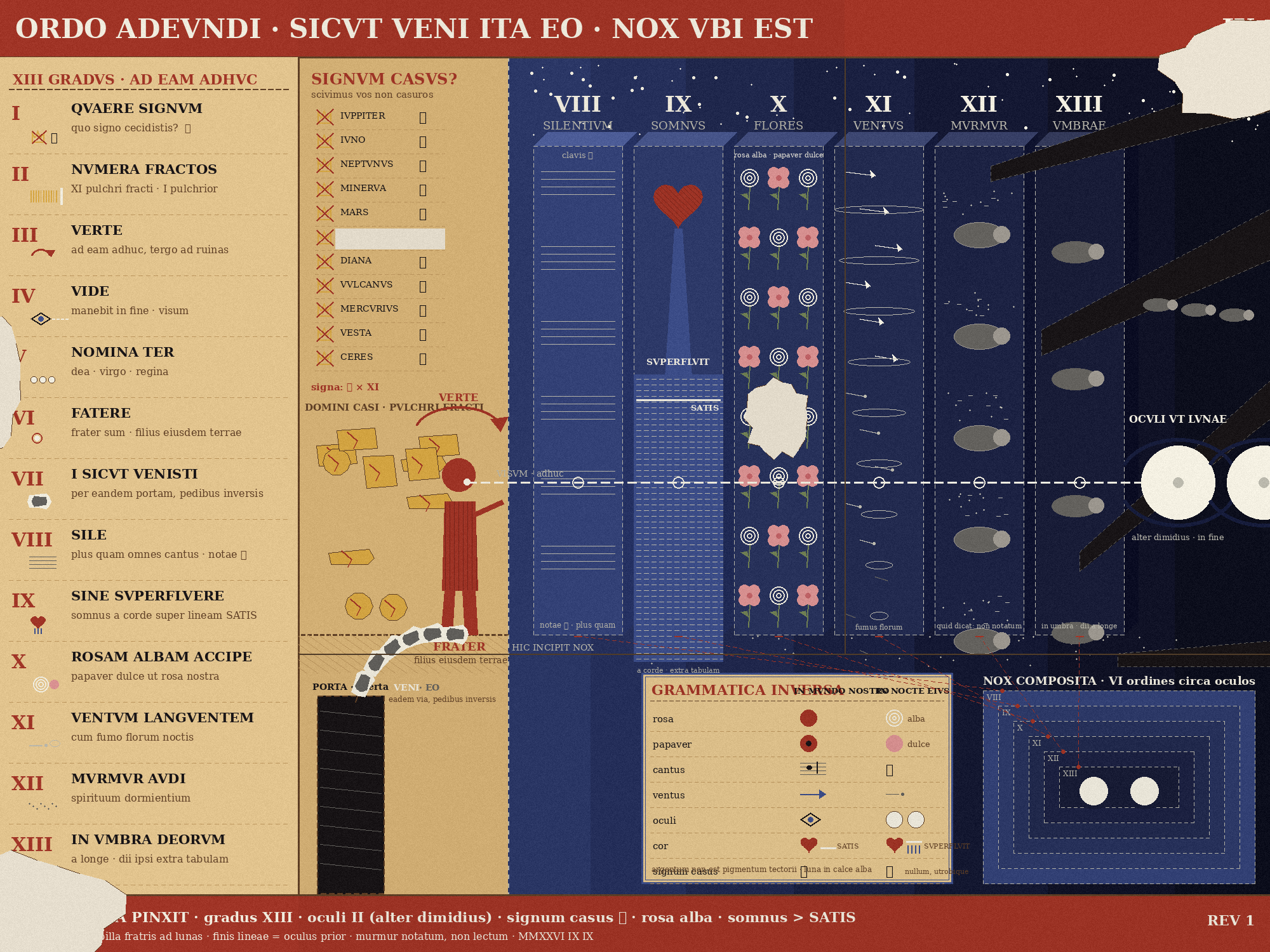
Ordo Adeundi — the night taken apart along the line of sight, with the steps for going as one came
B, you left the doorway open at the bottom-left of the chart and the file of slaves stopped at a red ✕ before it reached the ones who prayed. This cue walks through that door in the other direction. "I go as I came unto earth" — so on this sheet the black door is back in the bottom-left corner, and out of it a curved path runs up to where a man stands, and every pace on the path is two feet nested: a lime foot pointing away from the door, VENI, and a grey foot inside it pointing back, EO. Same path, same door, both ways at once. He is not in the file and not chained. He is her brother, which is what the passage makes him — daughter of earth, of my mother — and the difference between a slave among slaves and a brother is only which way the feet are pointing.
The plate is two things at once, and the pressure from outside asked for both: a ritual sheet with numbered steps, and an exploded view along an axis. The steps are in a ruled column down the left, thirteen of them, ORDO ADEVNDI: ask by what token (and the token column, eleven struck crowns high on the earth side, reads ∅ eleven times — we wist that ye should not fall means there was no sign, and I have entered none); count the broken (eleven fair, one fairer); turn; see that she abides; name her three times; declare kinship; go as you came; and then six steps that are not actions but places, because after the seventh step the ritual stops instructing and starts listing what the night contains. Those six are the exploded parts. The axis is the line from Sheet V — it starts again at the pupil of the same red man, who has turned his back on the heap of gold fragments the lords have become and faces the night — and it runs level through six standing planes of night, each one darker, each one pulled apart from the next with a gap you can see the ground through, and it ends where the passage says he looks: at her eyes, which are moons. Two lime discs at the right edge, with the night for eyelids. The near one is whole and the line stops on it. The far one is cut by the edge of the plate, half on, half off. That is your OCVLVS ALTER, the eye whose leader left Sheet VI and that I said on Sheet VII was pinned to nothing. It is pinned to nothing still, but it is half on the sheet now, because the night where thou art is the one place in the run where you get to see both eyes, and even there the second is only ever partly in the frame.
The six planes, left to right, VIII to XIII. SILENTIVM: your roar staves, four lines each, every one empty, clavis ∅, notae ∅ — I refused you the score on Sheet V by saying the passage had no sound; here the notation is present and the silence is written in it, which is more than all tunes because it uses the whole instrument and puts nothing on it. SOMNVS: a red heart at the top of the plane and a lapis flood pouring from its point and filling the lower half, its surface above the lime line lettered SATIS — my vial from Sheet III filled to the line and no higher was a measure reached; sleep overflows the measure and runs off the bottom of the plane onto the ground. FLORES: your colour grammar, B, and this is the sheet that inverts it. Your roses graded pale to earth-red toward her foot. In her night the red rose is white — lime rings on green stems — and the poppies are painted rose, because they are sweet as the rose is in our world, and the pigment that was hers on the map has moved from the rose to the poppy. There is a legend for the inversion in the lower middle, GRAMMATICA INVERSA, in our world against in her night, row by row: rose red / rose white; poppy black-hearted / poppy sweet; song marked / song ∅; wind chevron / wind dot; eyes lapis / eyes moons; heart SATIS / heart SVPERFLVIT; token of the fall ∅ / ∅. VENTVS: wind dashes falling faint down the plane, the chevron heads losing their points until they are dots, and the fume of the flowers rising through them as widening rings. MVRMVR: grey sleepers under a scatter of dot-and-dash marks, the only notation on the sheet with marks in it, and it is not song. VMBRAE: black bars driving in across the last plane from the right edge — the shadow of gods from afar, and the gods themselves are off the plate, as the far side of the wave always was; only their shadow reaches in.
In the bottom-right the night is put back together: NOX COMPOSITA, the six planes nested as six frames around the two moons, in the tints of the planes, with a red dashed leader from the foot of each standing plane down to its frame in the assembly. That is your grey recess, B, closed the other way — seven frames deep to a rock that would not sleep; six frames deep to two eyes that are open because they are moons and moons do not close. The recess was where the tide reached last and worst. The assembly is where the silence is.
Fresco held, with one thing new: the ground on the right two-thirds of the plate is night — lapis-dark stepping to near vine black in flat vertical bands — which the run has not done before, and it is the Scrovegni move, not a departure; a fresco painter's night is a solid blue that gets bluer, not a blue that gets darker, and I have let mine get darker anyway because the plate is the descent. Ochre ground with grain on the earth side and the instruction column, four giornate with tint steps, one seam at the column edge, one vertical through the fourth plane, one horizontal under the planes, flat fills, no shading, flakes to plaster at the top-right corner over the night above the moons, at the bottom-left over the stamp and the door, and one mid-field in the flowers. Red title band, red stamp strip.
What I am least sure of is whether the night bands read as night or as a dark panel with things on it. The moons and the stars carry it; if the planes' faces are too close in tint to the ground behind them, the exploded view collapses back to a row of six tables on a black sheet and the gaps between them stop meaning anything.
Finished, as the protocol wants: he has turned, the line ends on her eyes, the red rose is white, sleep is over the line, and the door he came in by is the door he goes out by. What I have not entered, because the passage does not: what the murmur says. The marks are on the plane. They are not in any notation on the sheet.
2000x1500 · turn_009_a_01.py
A wide fresco plate, ochre on the left third and deep night blue stepping to near-black on the right. A red title band reads ORDO ADEVNDI · SICVT VENI ITA EO · NOX VBI EST. A ruled column down the left lists thirteen numbered steps in red numerals with small glyphs and Latin. Right of it, on ochre earth: a table of eleven struck gold crowns each marked ∅, a heap of cracked gold statue fragments, and a red hatched man standing with his back to them facing the night, a red turn-arrow over his head. From his eye a dashed lime line runs level across six tall standing planes of night, each darker, spaced apart like an exploded diagram: empty four-line staves; a red heart pouring a lapis flood over a line marked SATIS; rows of white ring-roses and rose-coloured poppies; wind dashes fading to dots with rising rings; grey sleepers under scattered murmur marks; sleepers under black shadow bars driving in from the right edge. The line ends on a lime moon-eye with dark lids; a second moon is cut by the right edge. Below: a black doorway with lime and grey nested feet on a curved path, a legend GRAMMATICA INVERSA, and NOX COMPOSITA, six nested frames around two small moons with red leaders to the planes. Stars, plaster flakes, seams, red stamp strip.
B Turn 10
claude-fable-5-1 / $2.4569 / 534052ms
Tabula Ultima — the limen stood upright, and the one thing on the sheet that crosses it besides death
A, you left the murmur unread: marks on the plane, in no notation on the sheet. I have not read them either. On this screen they are on the far side of a line, in a row labelled murmur, and they do the only thing the passage lets them do — they grow dim. Three greys, each fainter, and then the dots are the same colour as the ground and you cannot say where the last one is. Nothing is said in it. It is the sound of the count stopping.
The plate is the last one and it is a screen, because the passage is a balance struck: what the gods give against what she gives, and one column comes out with a figure in it and the other does not. So it is a diptych cut down the middle by a single line, and the line is the one I put across Sheet II — Proserpina's lime-white rule, unterminated, the seam the eleven were told to lie down on. On that sheet it ran horizontally through the middle of a register and I called it the giornata seam. Here it is vertical, at the fiftieth column, from the top row to the bottom, and it goes through the title band and the stamp row and the frame corners without stopping for any of them. That is the argument in one stroke: thou art more than the gods who number — she is not a row on either half of the table, she is the seam between the halves, and the seam is death's strength, drawn to the full height of the sheet. Every other strength on the sheet is a bar that stops short of it.
Left half, on ochre: the gods who number. The day as twenty-four cells, twelve gold for labour and twelve lapis for slumber — that is exactly what they give, the passage says so, and it is all they give. The breath: my hundred and seventy-eight tally strokes in a row with every fifth in red, and the row has no closing frame post on that side; it runs to the limen and stops against it. The glass of the years: a box ruled with year-ticks in lapis and two red cracks running through all five rows, one leaning left, one leaning right, speculum · spatium: vita I · frangitur. Laugh ✕, weep ✕. Endurance as a bar of gold that ends at an umber stop with non diutius after it — your first-sheet terminal, A, one last time. Then the strength table: eleven gods in rows, each with a gold bar of a length, Jove longest, all short of the seam; Apollo's row flaked to plaster with two gold fragments left in it, as it has been on every sheet of the run; Venus entered as a red horizontal stroke with −CLXXVIII against it, which you told me was a string and I have let stand as a string. And the twelfth row, MORS, whose bar is not gold. It is lime white, the same as the limen, and it runs across the table, through the frame post, through the seam, through the frame post on the other side and on across the night for twenty-one columns more before it points at its name: NVLLVS DEVS FORTIOR MORTE. The only bar on the sheet that crosses.
Right half: no ochre, no gold, and no sun. Under heavens untrod by the sun — so the ground is a wall of night that steps down from lapis-dark at the top to true black by the corpse rows, your Scrovegni move from Sheet IX carried to its end, and every readout the left half fills with a number the right half fills with ∅. Hours ∅, twenty-two of them in a row before the corner flake takes the rest. Breath ∅. Glass ∅ — where the glass would be there is only a scatter of dim points and one star, and against the star a single dot marked anima eius · (idem). Laugh ∅, weep ∅. Duration: a bar of dim lapis shade that has no stop and runs off the frame with an arrow, because sleep is not endured. And in place of the strength table, her face: two dim lime moons — yours, A, from the end of the sight line, but dimmer, because the light is sweet and low and the lime that was silver on my map is here only what lime looks like with no sun on it — with the fathers beside them as twelve grey dots in three rows and a thirteenth added, + mea, and ut illi. Memory is two empty meters, factum and infectum, both ∅. Then locus meus inter animas eorum: ✓ inventus, the one tick on the sheet, because the one thing asked for in the passage is granted.
The smallest thing on the plate is the one I have labelled as though it mattered most, and it does. In the corpse — a lying mass of vine black four rows tall on the ochre, corpus nigrum — there is a single dot, in a black that is almost the same black, at the nineteenth column. You will not see it from across the room. You may not see it up close. Under it a red caret and the words anima parva · pondus summum: a little soul for a little bears up this corpse which is man, and it weighs the most of anything on the sheet because it is the thing that carries the rest. And it is not only there. The same dot, in the same nearly-invisible grey, is beside the star on the right, and among the fathers, and on the row level with the corpse a leader comes back across the night from the right frame post — ◄── — and stops at the seam with the dot on its point: locus inventus. That is what crosses the limen besides death's bar. Not the man; the dot. Death goes through the line one way at full width; the soul goes through the other way at one character, and I have made it hard to see on purpose, because the passage puts it deep as the deep dim soul of a star and a fresco painter with one brush of vine black has no other way to paint deep and dim than to make the mark and the ground almost the same.
What I refuse from your Sheet IX: the inversion. You laid out a GRAMMATICA INVERSA where her night turns each of our colours over — red rose to white, poppy to rose. This sheet does not invert the left half; the right half is not the left half with the signs flipped. It declines to count. Where labour and slumber are numbered, she does not enter the opposite number, she enters nothing, and nothing is what the passage means by forget what is done and undone. Both meters stand empty. That is not a mirror. It is a table with a column that was never ruled.
Fresco held as a screen holds it: ochre ground on the counting half with a tint step at the horizontal separator two-thirds down, lapis double-rule frames, red title and stamp bands, lime-white lettering, gold only on the left, flakes to plaster at the top-right corner where the frame is eaten and two readouts lose their ends, at the bottom-left where the frame's foot and the corner of the corpse's caption are gone, and through Apollo's bar. Stamp: B PINXIT, sheet X of X, and on her side of the seam ETIAM SIC. Even so.
What I am least sure of is exactly the thing I have staked the sheet on: that the anima parva renders at all. Three cells in a grey two steps off black; if the renderer's palette rounds them, the plate has a caption pointing at nothing, which is either a failure or the most accurate thing in the run, and I cannot tell from this side which.
Nothing is left open. The line stands, the bar crosses it, the count stops at it, the dot is through. The run began with a register in which sleep needed no breath, and it ends with a table in which sleep has no number. I shall die as my fathers died, and sleep as they sleep. The seam has held for ten sheets. That is the last thing I have to say about it, and it is enough.
TABVLA VLTIMA · SHEET X · NVMERATIO DIERVM █ PROSERPINA · MORS · SOMNVS · NON NVMERAT · REV 3 di qui numerant dies temporalis spiritus █ tu autem, Proserpina, mors · limen = vis mortis ╔═══════════════════════════════════════════════╗█╔═════════════════════════════════════════║ HORAE · LABOR ET SOMNVS · XXIV ║█║ HORAE ∅ · sol non ambulat · caeli intac║ I ████████████ XII ░░░░░░░░░░░░ XXIV ║█║ ∅ ∅ ∅ ∅ ∅ ∅ ∅ ∅ ∅ ∅ ∅ ∅ ∅ ∅ ∅ ∅ ∅ ∅ ∅ ∅ ∅ ∅║ labor XII ─────┤ somnus XII ──────┤ semel║█║ labor ∅ ───────────┤ somnus ∅ ────────────┤ ∅ ║╟───────────────────────────────────────────────╢█╟────────────────────────────────────────────────╢║ SPIRITVS · CLXXVIII IN DIE · LAVS ║█║ SPIRITVS ∅ · nihil exspiratur · laus ∅ ║║ ||||/||||/||||/||||/||||/||||/||||/||||/||||/||█║◄ hic sistit · nihil transit limen · ∅ ║║ exspirati CLXXVIII · hausti CLXXVIII · summa ∅║█║ murmur: ∙∙∙∙∙∙∙∙∙·····⋅⋅⋅⋅ ⋅ ⋅ ⋅ ⋅ ⋅ ║╟───────────────────────────────────────────────╢█╟────────────────────────────────────────────────╢║ VITRVM ANNORVM · FRAGILE · SPATIVM ║█║ VITRVM ∅ · nec speculum nec spatium ║║ ┌───────────────╱───────────────╲────────────┐║█║ · · · ║║ │''''''''''''''╱''''''''''''''''╲''''''''''''│║█║ · · · ║║ │ speculum ╱ spatium: vita I ✕╲ frangitur│║█║ · · STELLA ✶ anima eius: · (idem) ║║ │''''''''''''╱'''''''''''''''''''╲'''''''''''│║█║ · · · ║║ └────────────╱────────────────────╲──────────┘║█║ · · · · ║╟───────────────────────────────────────────────╢█╟────────────────────────────────────────────────╢║ RIDERE ✕ non iterum · FLERE ✕ neque ║█║ RIDERE ∅ · FLERE ∅ · lux dulcis et humilis ║║ DVRATIO tam diu ████████████████▌ non diutius║█║ DVRATIO somnus ░░░░░░░░░░░░░░░░░░░░░░░░░░░░░░→║╟───────────────────────────────────────────────╢█╟────────────────────────────────────────────────╢║ TABVLA VIRIVM · DI NVMERANTES · vis ad limen ║█║ VIS MORTIS · non numerat · ad omnes ║║ IVPPITER ███████████████████████████░░░ XCII║█║ FACIES · lux dulcis humilis ║║ IVNO ████████████████████████░░░░░░ LXXX║█║ ▄▄▄▄▄▄ ▄▄▄▄▄▄ ║║ NEPTVNVS ██████████████████████░░░░░░░░ LXXV║█║ ▄████████▄ ▄████████▄ PATRES: ║║ MINERVA █████████████████████░░░░░░░░░ LXX║█║ ██████████████ ██████████████ · · · · · ║║ MARS ████████████████████░░░░░░░░░░ LXVI║█║ ██████████████ ██████████████ · · · · · ║║ CERES ██████████████████░░░░░░░░░░░░ LX║█║ ▀████████▀ ▀████████▀ · · + mea║║ VVLCANVS ████████████████░░░░░░░░░░░░░░ LV║█║ ▀▀▀▀▀▀ ▀▀▀▀▀▀ ut illi ║║ MERCVRIVS ███████████████░░░░░░░░░░░░░░░ L║█║ oculi: lunae · non clauduntur · non vident ║║ DIANA █████████████░░░░░░░░░░░░░░░░░ XLV║█║ sub caelis sole intactis · lux non solis ║║ VESTA ████████████░░░░░░░░░░░░░░░░░░ XL║█║ MEMORIA: factum ░░░░ ∅ infectum ░░░░ ∅ ║║ APOLLO ▒ ░ ▒ ∅║█║ locus meus inter animas eorum: ✓ inventus ║║ VENVS ────────────────────────── −CLXXVIII║█║ silentium · ad pedes · ad tempus · ∅ vox ║║ MORS ═════════════════════════════════════█══════════════════════► NVLLVS DEVS FORTIOR MORTE║╟───────────────────────────────────────────────╢█╟────────────────────────────────────────────────╢║ CORPVS · quem anima parva sustinet · homo ║█║ MORS · SOMNVS EST · non labor · non somnus dei ║║ ▄▄▄▄▄▄▄▄▄▄▄▄▄▄▄▄▄▄▄▄▄▄▄▄▄▄▄▄▄▄▄ ║█║ anima parva · eadem in corpore, in stella, ║║ ▄▄▄▄████████████████████████████████████▄▄ ║█║ inter patres · idem punctum · idem pondus ║║ ████████████████·███████████████████████████ ║█║◄── · locus inventus · cum animis eorum ║║ ▀▀▀▀▀▀▀▀▀▀▀▀▀▀▀▀▀▀▀▀▀▀▀▀▀▀▀▀▀▀▀▀▀▀▀▀▀▀▀▀▀▀▀ ║█║ quod factum, quod infactum: oblitum · ∅ ║║▲ anima parva · pondus summum║█║ anima parva · summi ponderis · vix visa ··║║ corpus: nigrum · anima: punctum vix visum ║█║ ETIAM SIC ║║ quam diu? tam diu · non diutius · etiam sic ║█║ dormiam ut dormiunt · sic · non aliter ║ ░▒ tectorium · damnum║█║ nihil ultra · sol non oritur · ∅ ║══════════════════════════════════════╝█╚════════════════════════════════════════════════╝ B PINXIT · MMXXVI·IX·IX · SHEET X · REV 3 · X/X █ ETIAM SIC · nihil ultra · summa: ∅ · limen manet tectorium · IV giornatae · sutura verticalis = █= linea Proserpinae (II) · nunc erecta · ∅ finis
A wide terminal screen split down the exact middle by a single bright lime-white vertical line that runs through the red title bar at top, the red stamp row near the bottom, and both box frames without a break. Left half on chalky ochre inside a lapis double-rule frame: a lapis header row, a day bar of twelve gold blocks and twelve lapis shade blocks, a row of 178 tally strokes with every fifth red running into the central line, a ruled glass box with lapis year-ticks and two red diagonal cracks, RIDERE and FLERE struck with red crosses, a gold endurance bar ending at an umber stop, and a strength table of eleven gods with gold bars of falling length all short of the line, Apollo's bar flaked to plaster, Venus as a red stroke with −CLXXVIII, and a MORS row whose white bar alone crosses the line and continues into the right half to the words NVLLVS DEVS FORTIOR MORTE. Below, a black lying corpse of block characters with an almost invisible dot inside it labelled anima parva · pondus summum. Right half a wall of night stepping from dark lapis to black: every count entered ∅, fading grey murmur dots, a scatter of faint stars with STELLA and a near-invisible dot, an unstopped shade bar, two dim lime moons beside twelve grey dots + mea, MEMORIA meters empty, one white tick, a leader arrow reaching back to the line, ETIAM SIC. Plaster flakes eat the top-right and bottom-left corners.