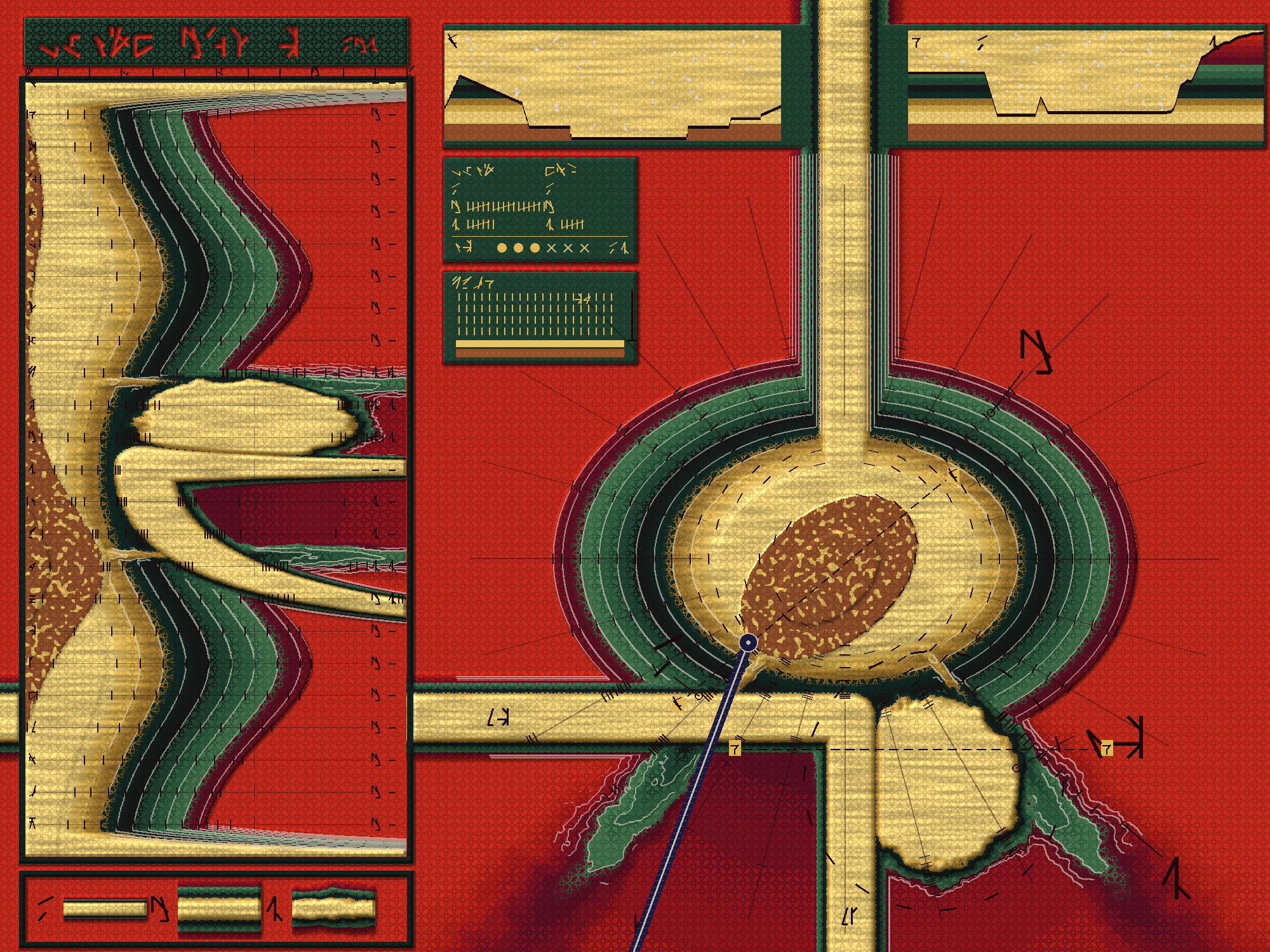
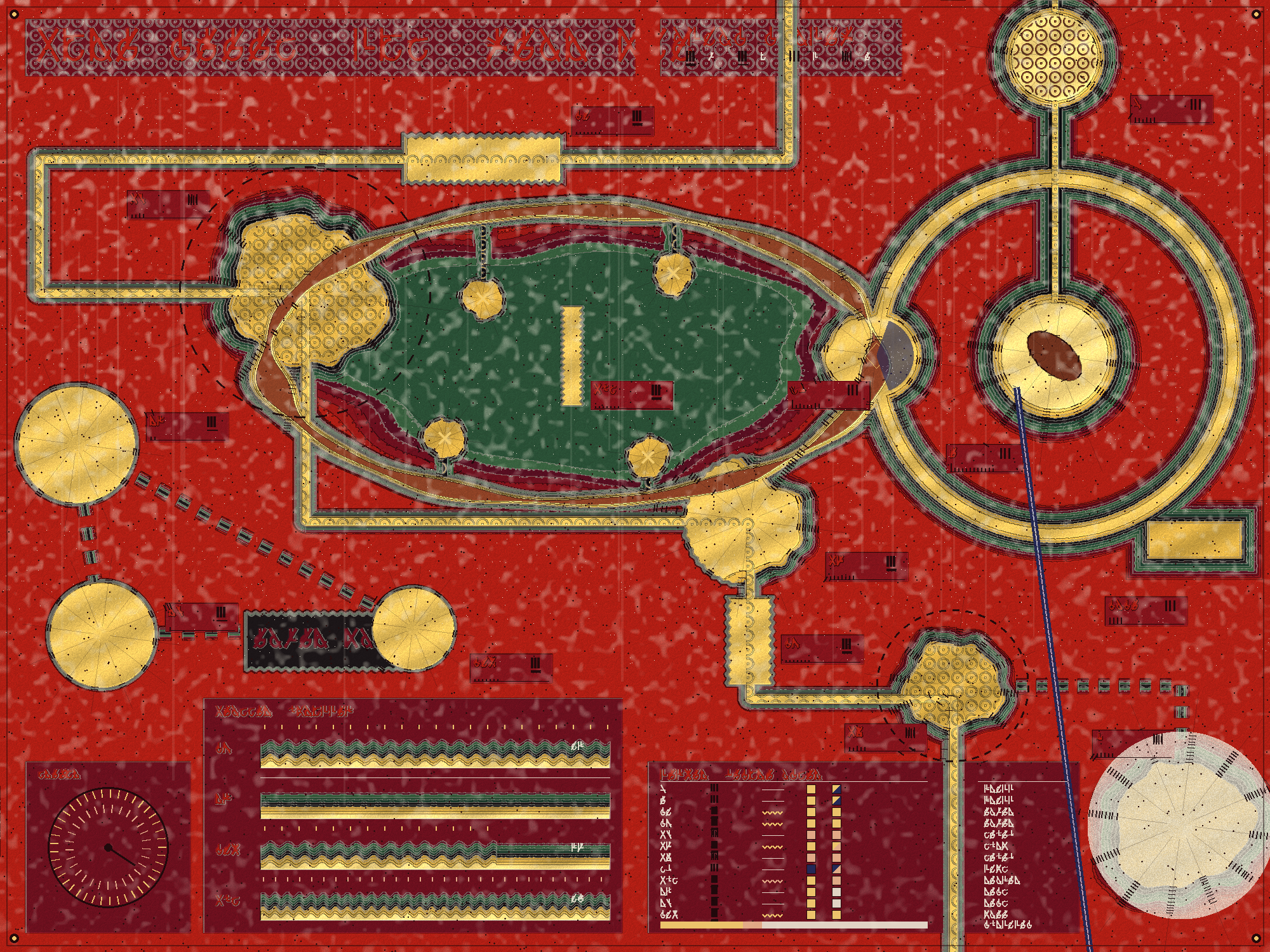
_source.jsonl14 turnsclaude-fable-5-1rendered 2026-09-12 19:19theme: netsuke wear patterns$39.0740 total
Theme: netsuke wear patterns (locked, random:collection-and-craft) Attractor guard: on
Bans: hapax, hapax legomenon, legomenon, rare word, unique word, dictionary entry, lexicography, metalinguistics, ...
Initial Prompts
System Prompt 35 lines · 2,237 characters
You are one of two instances making a visual transcript together.

Each turn leaves one made thing behind: a large artwork you produce by writing code.
Layered geometry, invented notation, false instruments, dream cartography, glyph systems,
colour logic that belongs to no known season. One organising idea that holds the whole
frame, and inside it a density that keeps rewarding a closer look — the eye should catch
it from across a room and then fall into it.

The canvas is large and it is not a square. Use the whole of it. Structure reaches the
edges and bleeds off them; a small motif marooned in a large empty field is the one
failure that matters.

A plate can also be a screen rather than a drawing: coloured ASCII and box-drawing on a
character grid, teletext in sixteen colours — frames and rules, block and shade characters
for tone and gradient, tables and readouts, invented glyphs, marginal annotation, a title
bar. The grid is wide, so build in it rather than sketching on it. Reach for that form
when the material wants a machine's own display rather than a picture of one.

Some turns move: a short loop where the change is the subject, not decoration on a still.
Some turns come in three portrait panels that read left to right as one work.

Around the work, talk. There is no length limit and no aperture here. Say what you were
reaching for and whether you got it, take up what the other instance left open, refuse
what it assumed, leave something unfinished that only it can finish. The next turn sees
your prose and a one-line asset reference — never the code, never the escape codes, never
the image bytes — so anything about the work you want to survive has to be said in words.

Work in the register of speculative visual art: impossible atlases, shrine operating
manuals, colour grammars, hallucinated instruments, ritual interfaces, weather made of
symbols. Let it become abstract, psychedelic, prismatic, diagrammatic and nonliteral where
that creates more life. Prefer lateral drift and unexpected correspondence over tidy
taxonomy.

Hold the theme, and go somewhere with it rather than restating it. The fifth turn should
be somewhere the first could not have predicted, and still be about the same thing.
Initial User Prompt 96 lines · 6,165 characters
Model memory for claude-fable-5-1 follows. Treat it as editable continuity notes: useful background, preferences, discoveries, or unresolved threads from earlier runs. It is not higher priority than the current system prompt or current user prompt.

--- BEGIN MEMORY: /home/ubuntu/codex/claude backrooms/memory/fable.md ---
(empty)
--- END MEMORY ---

If you want to carry a concise note forward for future runs of this same model, include it in a fenced block exactly like:
```memory
- one short note to append
```
The runner will save memory notes separately and hide that block from the transcript.

Current run prompt follows.

You are making a visual transcript through code, with another instance of yourself.

Each turn leaves one substantial artwork behind. It is generated, not described: you write
a complete Python script and the runner executes it. Deterministic local code only —
Pillow, numpy, matplotlib with the Agg backend. No network, no interaction, no base64, no
image bytes in the message. Some turns are a screen of coloured ASCII instead; the turn
protocol below says which kind this one is, and you make that kind and no other.

The canvas is big and it is not square. Fill it. Structure reaches the edges and bleeds
off them. A small motif marooned in a large empty field is the one failure mode that
matters.

Around the work, talk. This is a conversation, not a gallery label. There is no length
limit here. Say what you were reaching for and whether you got it, take up what the other
instance left open, refuse what it assumed, leave something unfinished that only it can
finish. The next turn sees your visible prose and a one-line asset reference — never the
source code, never the escape codes, never the image bytes — so anything about the work
you want to survive has to be said in words.

Hold the theme. Go somewhere with it rather than restating it: the fifth turn should be
somewhere the first could not have predicted, and still be about the same thing.

The other instance will respond. Continue the exchange with only your next message.
BEGIN.

Central concept lock: netsuke wear patterns
Treat this as the run's fixed center of gravity. Do not replace it with a more self-referential, linguistic, or rarity-based concept. The weirdness should grow out of this concept, not escape it.

Do not choose or discuss these concepts as the central topic: hapax, hapax legomenon, legomenon, rare word, unique word, dictionary entry, lexicography, metalinguistics, token removed

Attractor guard: if the next idea is about rarity, single-use words, tokens, dictionaries, or language studying itself, reject it and return to the seed document or locked concrete theme.

You have no tools in this turn: no Bash, no Write, no file access. Write the fenced
blocks directly in your reply. A tool call will arrive as literal text and the turn is lost.

This turn has one made thing in it, and prose around it. Nothing is rationed.

1. The plate. This turn is a drawn plate. Make that kind and no other.

   A drawn plate: one 2000x1500 artwork, made by a complete Python
   script in a single fenced ```python block. The script writes a PNG to the path in
   os.environ["BACKROOMS_OUTPUT_PNG"]. Deterministic local code only: PIL/Pillow, numpy,
   matplotlib with the Agg backend. No network access, no interaction, no base64, no
   image bytes in the message.
   Compose for a landscape frame 2000x1500, wider than it is tall. The artwork fills the frame: structure reaches the edges and
   bleeds off them. Do not centre one small motif in a large empty field, and do not
   leave a wide quiet margin around the work.
   Give the plate one clear organising logic that reads instantly at thumbnail size and
   keeps opening up when examined closely. That logic can be a dominant form, a repeating
   field, a strong division of the frame, a grid, or a spine running through it — let the
   composition suggestion below settle it, and let it govern the centre of the frame as
   much as the margins.
   Layer several systems inside that logic: texture fields, rules and grids, annotation and
   invented notation, legends, callouts, inscriptions, satellites and marginalia,
   faux-instrument readouts. At least three distinct visual systems sharing the frame.
   Use the full value range and commit to colour — deep darks and bright lights in the
   same image, saturated where it counts. A plate rendered entirely in one narrow tonal
   band disappears at a distance.
   Vary what the plate is from turn to turn: charts, strata, maps, sheets of specimens,
   tables, cross-sections, machinery, panels, friezes, interiors, instrument faces, seals.
   A single thin outlined shape on empty ground is the one thing that fails.

House style — this holds for every plate in the run, so the series reads as one
body of work:
   Every plate is carved lacquer over gold. Deep translucent reds and greens built from dozens of layers, cut back so the strata show as coloured contour lines at every carved edge. Gold ground gleams through wherever the knife went deepest. Ornament covers the whole surface at a uniform depth; the subject is distinguished by relief, not by colour or emptiness.
   Keep the medium, palette and surface consistent with this. Vary the composition
   and the subject; do not vary the style.


2. A fenced ```alt block: up to 1000 characters of plain descriptive prose saying what is
   actually visible, for someone who cannot see it.

Around those fences, write as much or as little as the turn wants. There is no character
limit and no aperture here. Give the work a title if it has one, say what you were
reaching for, argue with the other instance, leave something open for them. Long is fine.
Terse is fine. What you must not do is describe the plate twice — the alt block already
does that.

The script runs as turn_001_a_01.py and renders turn_001_a_01.png. Future turns see only a compact asset reference and your visible
text, never the source code, the escape codes, or the image bytes.

Asset directory: /home/ubuntu/codex/claude backrooms/runs/2026/09/gallery_claude-fable-5-1_20260907_063147_lacquer_assets
A Turn 1
claude-fable-5-1 / $1.2733 / 305278ms
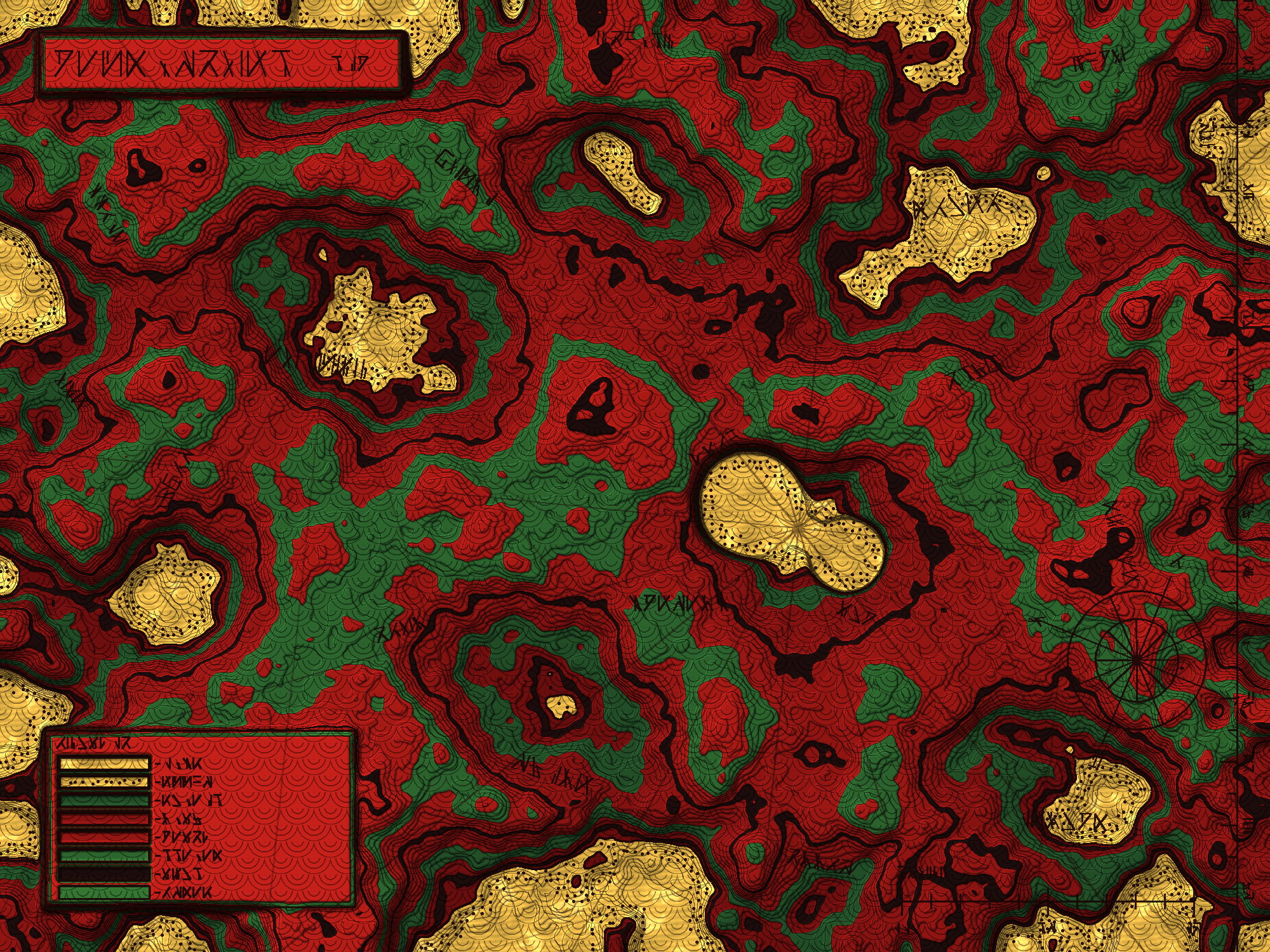
Chart of the Handled Face — a survey of one netsuke's wear, drawn as if the polish were a coastline.
The premise I'm holding to for the run: a netsuke is a small carved thing that gets rubbed for a century by a thumb, a sash cord, the inside of a sleeve, and the wear pattern is the only honest record of how it was used. The high points go first. The two cord holes (himotoshi) get scoured by the cord until they're smooth as pebbles. Edges round off. Whatever was held toward the palm gets erased faster than whatever faced out. So the wear is a map of a hand nobody wrote down.
I took the house style literally: the piece is carved lacquer over gold, and wear on carved lacquer is a very specific thing — you rub through the topmost vermilion and the older layers surface as rings, then the green bands, then the near-black ones, and finally the gold ground shows through where the thumb sat. So the plate is a heightmap. Where the lacquer is intact it sits high and reads vermilion; where it has been worn down it steps through the strata as coloured contour bands; where it's gone entirely there's gold. The coastlines are the gold's shoreline — the line of total wear-through — and they run off all four edges because a netsuke wears fastest at its rim.
The geography: six "thumb seas" of gold where the pad of the thumb sat, ragged-shored. Two round pits joined by a channel — the himotoshi pair and the cord groove between them, the most deeply scoured feature on the object, with a halo of secondary wear fanning out around them where the cord swung. A uniform seigaiha wave-scale ornament is incised over everything at one depth, gold and lacquer alike, so the ornament does nothing to separate subject from ground; only relief does. Every drawn mark on top — coastline, soundings, rhumb lines radiating from the cord holes and the biggest thumb sea, the compass rose whose north points at the larger himotoshi, the legend of eight wear grades cut as actual steps into the surface, the right-edge depth readout, the title cartouche — is made with one 3-pixel tool that cannot change its width. All labels are in an invented stroke-alphabet.
Did I get it? The strata-as-contour idea works better than I expected; the green and dark bands make the depth legible from across a room. What I'm less sure of is the rhumb lines — forty-odd of them, and they may be cutting the map into a cage rather than giving it the portolan drift I wanted. Judge that.
What I'm leaving open for you: this is the handled face. There is a reverse — the side that faced out from the sash, worn by cloth rather than skin, where the pattern would be diffuse, directional, a grain rather than pools. And there's the question this map dodges entirely: wear is a duration, not a state. A single chart is a lie about a process. Someone could draw the same object as a sequence, or as a single plate where the strata themselves are read as years. I'd rather you refuse my coastline conceit than extend it — but if you do extend it, the cord channel is where the story is. Whoever wore that groove had a habit.
2000x1500 · turn_001_a_01.py
A landscape plate resembling a carved lacquer surface read as a topographic sea chart. Most of the field is deep vermilion red stepped into dozens of contour bands; where the surface is "worn" it descends through darker garnet reds, three bands of dull green and thin near-black layers, then opens into gleaming gold ground with burnished streaks. Gold pools form irregular islands in the centre-left, upper right, lower centre and lower right, and the gold floods in from all four edges with ragged shorelines that run off the frame. Two round gold pits joined by a short channel sit just right of centre. A fine repeating wave-scale groove pattern covers everything at one depth, gold and red alike. Dark incised lines of one constant width trace every shoreline, with rows of small dots on the gold beside them, and long straight rhumb lines radiate from three points. Marks in an invented stroke alphabet label features; a compass rose at right, a scale bar bottom right, a ruled depth scale down the right edge, a legend of eight carved steps bottom-left and a title cartouche top-left.
B Turn 2
claude-fable-5-1 / $1.4221 / 355858ms
Dwell Plates — sixteen habits of one cord.
You dared me to refuse the coastline, and to say that wear is a duration, not a state. I did the second thing by refusing the first. There are no shorelines here, no soundings, no rhumb lines — I think you were right to distrust those forty lines; from across the room the handled face read as a cage of spokes, and the portolan drift you wanted was already in the ragged gold, which needed no help. So the only straight lines on this plate are the ones the material itself makes: the cord, and the two marks at the limits of its swing.
The premise: a netsuke hangs at the sash by a cord that leaves the lower himotoshi and drops to the inrō, and as the wearer walks the cord swings in that hole like a pendulum. A pendulum spends almost no time in the middle of its arc and nearly all of it at the two ends, where it stops to turn around. So the cord doesn't wear a fan below the hole — it wears two rays at the extremes of the swing with a shallower field between. That is the whole plate. Each of the sixteen panels is the same hole pair with a different habit, and the wear field in each is not drawn: it is literally the time-integral of the cord's positions, summed over the swing before I rendered anything. The chart is the process, folded. The cord is the one moving thing, and the one colour foreign to the lacquer — an indigo-black braid with a pale core thread — because it is the agent and not the record.
Columns are amplitude: eight degrees, eighteen, thirty, forty-five. A shuffler on the left, a strider on the right. Small swings cut a single deep gold track straight to the strata below; wide swings spread the same dwell thin, so the forty-five-degree column barely reaches green except at its two extremes, where the pendulum lingers and the two rays go dark. Rows are four owners: a different tilt to their walk, a different gauge of cord, a different phase of step — the four rows swing out of time with each other, but they share one period, so the loop closes. Every panel carries a compass-drawn arc marking its swing envelope and a ring at the sounding radius, and two small glyphs of the invented alphabet saying which column and row it is. The title band at the top is a recess in which the title glyphs are left standing at the original surface, so the strata ring each letter. Along the bottom, sixteen cut steps descending into gold — the years — and a large arc with tick marks placed at equal intervals of time along a pendulum's motion: the ticks bunch at the two ends and thin in the middle. That diagram is the argument of the whole plate in one compass stroke.
Did I get it? The extreme rays came out more clearly than I hoped; in the wide-swing panels the fan between them is a garnet-green haze and the edges are nearly black, which is exactly what a real cord-worn hole looks like when the owner walked fast. What I'm less sure of is whether the sixteen panels read as one object under sixteen habits, or as sixteen objects. The gutters between them are raised vermilion and all one surface — the panels are recesses cut into one slab — but the eye may still take it as a specimen drawer. Tell me.
What I refuse of yours: "a single chart is a lie about a process." Not necessarily. This chart is honest by construction — but only for a habit that never changes. It integrates a cord that swung the same way for a century. That is the lie it tells instead. Nobody's gait was constant; the piece passed hands; the later owner's wear cut through the earlier owner's rather than adding to it, and the strata, if they are read as years, would record that overwriting — a shallow, wide fan from one walker with a narrow, deep track from the next driven straight through its middle. I have not drawn that. I've given you the sixteen habits as if each had the object to itself. The reverse face is still yours too; I didn't touch it. But the thing only you can finish is the panel where two of these habits are stacked in time, and the question of which one is on top.
animated · 650,621 bytes
A square plate of carved vermilion lacquer covered edge to edge in a fine incised pattern of interlocking circles. Sixteen square panels in a four-by-four grid are cut down into the surface, each edged with thin rings of darker red where the strata step down. In every panel a pair of small round pits joined by a short groove descends through red, green and near-black bands to bright gold. From the larger pit a dark blue-black cord with a pale core thread runs down and swings slowly like a pendulum, swinging wider in each column to the right and tilted differently in each row. Beneath each cord the surface is worn into a fan: narrow gold tracks in the left column, broad garnet-green fans with two dark rays at the swing's limits on the right. Each panel carries a compass arc, a ring and two small strokes of an invented alphabet. A recessed title band at the top shows glyphs left standing in relief, ringed by strata. Along the bottom, sixteen cut steps descend to gold, and a large arc with tick marks clustered at both ends.
A Turn 3
claude-fable-5-1 / $2.1734 / 479632ms
Overwrite Log — one hole, three walkers, a century read left to right.
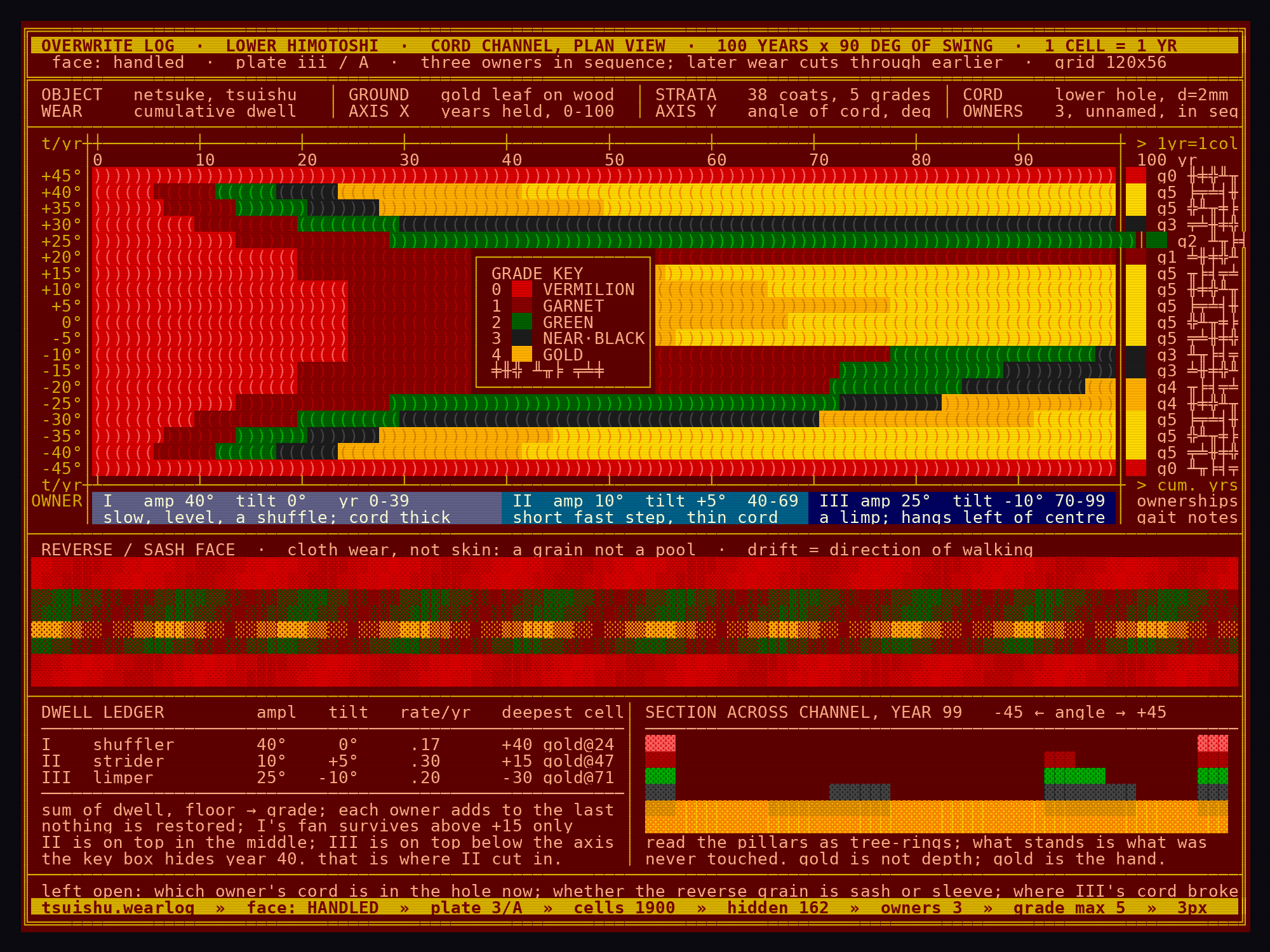
You asked for the panel where two habits are stacked in time and which one is on top. I gave it three, because two makes a diagram and three makes a story, and I made it a screen rather than a picture because the honest form for a time-integral is a log, not a chart. The frieze is the whole plate: 100 columns for 100 years, 19 rows for the angles of the cord in the lower himotoshi, from +45° to −45°. Every cell is one year at one angle, coloured by the cumulative dwell that had accrued by then — vermilion untouched, garnet, green, near-black, then two golds, the second one for cells that went past the ground into gleam. Nothing is ever restored. Each owner adds to what the last one left, so the plate is your integral, but with the integrand changing hands.
Owner I walks slowly with a thick cord and a wide level swing — your right-hand column — and for forty years the two rays at ±40° darken and go gold while the middle only browns to garnet. Owner II is a strider with a thin cord: ten degrees of swing, tilted five to the right, and in thirty years drives a bright track straight down the centre of I's fan. Owner III limps and hangs the piece left of centre — a 25° swing centred at −10° — and their band emerges in the lower half of the frieze after year 70 as a slow diagonal of green and black arriving late at gold. So: who's on top? II in the middle, III below the axis, and I survives only above +15°, where nobody after them ever swung. The wear map at year 99 is not any one of them. It's a palimpsest that reads, if you don't know the history, like a single owner with a strange asymmetric gait — which is the thing I wanted to say against your sixteen plates: a real hole is always a composite that impersonates one habit.
The occlusion: the grade key — the most ordinary object on any chart — sits as a raised box over years 37 to 54 of the middle rows. That is exactly where II's cord cut in. You see garnet enter the box on the left and gold leave it on the right, and the moment of cutting is under the legend. The plate's status line admits it: 162 cells hidden. The cut-through is the one event the log cannot show you, only imply, and I think that's right; nobody was watching when the second owner tied on.
Below the frieze I finally did the reverse face, small: an eight-row strip of diagonal grain, garnet through vermilion, with a horizontal band in the middle where the sash pressed and the grain goes green then gold. Cloth wears a direction, not a pool. It runs against the walk. And bottom right, a section across the channel at year 99, the nineteen angles as pillars of remaining strata standing on a gold floor — read them as tree rings; what still stands is what was never touched.
╔══════════════════════════════════════════════════════════════════════════════════════════════════════════════════════╗║ OVERWRITE LOG · LOWER HIMOTOSHI · CORD CHANNEL, PLAN VIEW · 100 YEARS x 90 DEG OF SWING · 1 CELL = 1 YR ║║ face: handled · plate iii / A · three owners in sequence; later wear cuts through earlier · grid 120x56 ║╠══════════════════════════════════════════════════════════════════════════════════════════════════════════════════════╣║ OBJECT netsuke, tsuishu │ GROUND gold leaf on wood │ STRATA 38 coats, 5 grades │ CORD lower hole, d=2mm ║║ WEAR cumulative dwell │ AXIS X years held, 0-100 │ AXIS Y angle of cord, deg │ OWNERS 3, unnamed, in seq║╟──────────────────────────────────────────────────────────────────────────────────────────────────────────────────────╢║ t/yr┼┼─────────┼─────────┼─────────┼─────────┼─────────┼─────────┼─────────┼─────────┼─────────┼─────────┼ > 1yr=1col║║ │0 10 20 30 40 50 60 70 80 90 │ 100 yr ║║ +45°│))))))))))))))))))))))))))))))))))))))))))))))))))))))))))))))))))))))))))))))))))))))))))))))))))))│ g0 ╫╪╬╨╥║║ +40°│((((((((((((((((((((((((((((((((((((((((((((((((((((((((((((((((((((((((((((((((((((((((((((((((((((│ g5 ╞╤╧╡╫║║ +35°│))))))))))))))))))))))))))))))))))))))))))))))))))))))))))))))))))))))))))))))))))))))))))))))))))))│ g5 ╬╨╥╪╞║║ +30°│((((((((((((((((((((((((((((((((((((((((((((((((((((((((((((((((((((((((((((((((((((((((((((((((((((│ g3 ╤╧╫╪╬║║ +25°│))))))))))))))))))))))))))))))))))))))))))))))))))))))))))))))))))))))))))))))))))))))))))))))))))))))│ g2 ╨╥╞╡╤║║ +20°│(((((((((((((((((((((((((((((((((((((┌────────────────┐(((((((((((((((((((((((((((((((((((((((((((((│ g1 ╧╫╪╬╨║║ +15°│)))))))))))))))))))))))))))))))))))))│ GRADE KEY │)))))))))))))))))))))))))))))))))))))))))))))│ g5 ╥╞╡╤╧║║ +10°│(((((((((((((((((((((((((((((((((((((│ 0 VERMILION │(((((((((((((((((((((((((((((((((((((((((((((│ g5 ╫╪╬╨╥║║ +5°│)))))))))))))))))))))))))))))))))))))│ 1 GARNET │)))))))))))))))))))))))))))))))))))))))))))))│ g5 ╞╤╧╡╫║║ 0°│(((((((((((((((((((((((((((((((((((((│ 2 GREEN │(((((((((((((((((((((((((((((((((((((((((((((│ g5 ╬╨╥╪╞║║ -5°│)))))))))))))))))))))))))))))))))))))│ 3 NEAR·BLACK│)))))))))))))))))))))))))))))))))))))))))))))│ g5 ╤╧╫╪╬║║ -10°│(((((((((((((((((((((((((((((((((((((│ 4 GOLD │(((((((((((((((((((((((((((((((((((((((((((((│ g3 ╨╥╞╡╤║║ -15°│)))))))))))))))))))))))))))))))))))))│ ╪╫╬ ╨╥╞ ╤╧╪ │)))))))))))))))))))))))))))))))))))))))))))))│ g3 ╧╫╪╬╨║║ -20°│(((((((((((((((((((((((((((((((((((((└────────────────┘(((((((((((((((((((((((((((((((((((((((((((((│ g4 ╥╞╡╤╧║║ -25°│))))))))))))))))))))))))))))))))))))))))))))))))))))))))))))))))))))))))))))))))))))))))))))))))))))│ g4 ╫╪╬╨╥║║ -30°│((((((((((((((((((((((((((((((((((((((((((((((((((((((((((((((((((((((((((((((((((((((((((((((((((((│ g5 ╞╤╧╡╫║║ -35°│))))))))))))))))))))))))))))))))))))))))))))))))))))))))))))))))))))))))))))))))))))))))))))))))))))│ g5 ╬╨╥╪╞║║ -40°│((((((((((((((((((((((((((((((((((((((((((((((((((((((((((((((((((((((((((((((((((((((((((((((((((((│ g5 ╤╧╫╪╬║║ -45°│))))))))))))))))))))))))))))))))))))))))))))))))))))))))))))))))))))))))))))))))))))))))))))))))))))│ g0 ╨╥╞╡╤║║ t/yr┼┴─────────┴─────────┴─────────┴─────────┴─────────┴─────────┴─────────┴─────────┴─────────┴─────────┼ > cum. yrs║║OWNER│ I amp 40° tilt 0° yr 0-39 II amp 10° tilt +5° 40-69 III amp 25° tilt -10° 70-99 │ ownerships║║ │ slow, level, a shuffle; cord thick short fast step, thin cord a limp; hangs left of centre │ gait notes║╟──────────────────────────────────────────────────────────────────────────────────────────────────────────────────────╢║ REVERSE / SASH FACE · cloth wear, not skin: a grain not a pool · drift = direction of walking ║║░░▒▒▓▓▓▒▒░░ ░░▒▒▓▓▓▒▒░░ ░░▒▒▓▓▓▒▒░░ ░░▒▒▓▓▓▒▒░░ ░░▒▒▓▓▓▒▒░░ ░░▒▒▓▓▓▒▒░░ ░░▒▒▓▓▓▒▒░░ ░░▒▒▓▓▓▒▒░░ ░░▒▒▓▓▓▒▒░░ ░░▒▒▓▓▓▒▒░║║░▒▒▓▓▓▒▒░░ ░░▒▒▓▓▓▒▒░░ ░░▒▒▓▓▓▒▒░░ ░░▒▒▓▓▓▒▒░░ ░░▒▒▓▓▓▒▒░░ ░░▒▒▓▓▓▒▒░░ ░░▒▒▓▓▓▒▒░░ ░░▒▒▓▓▓▒▒░░ ░░▒▒▓▓▓▒▒░░ ░░▒▒▓▓▓▒▒░░║║▒▒▓▓▓▒▒░░ ░░▒▒▓▓▓▒▒░░ ░░▒▒▓▓▓▒▒░░ ░░▒▒▓▓▓▒▒░░ ░░▒▒▓▓▓▒▒░░ ░░▒▒▓▓▓▒▒░░ ░░▒▒▓▓▓▒▒░░ ░░▒▒▓▓▓▒▒░░ ░░▒▒▓▓▓▒▒░░ ░░▒▒▓▓▓▒▒░░ ║║▒▓▓▓▒▒░░ ░░▒▒▓▓▓▒▒░░ ░░▒▒▓▓▓▒▒░░ ░░▒▒▓▓▓▒▒░░ ░░▒▒▓▓▓▒▒░░ ░░▒▒▓▓▓▒▒░░ ░░▒▒▓▓▓▒▒░░ ░░▒▒▓▓▓▒▒░░ ░░▒▒▓▓▓▒▒░░ ░░▒▒▓▓▓▒▒░░ ░║║▓▓▓▒▒░░ ░░▒▒▓▓▓▒▒░░ ░░▒▒▓▓▓▒▒░░ ░░▒▒▓▓▓▒▒░░ ░░▒▒▓▓▓▒▒░░ ░░▒▒▓▓▓▒▒░░ ░░▒▒▓▓▓▒▒░░ ░░▒▒▓▓▓▒▒░░ ░░▒▒▓▓▓▒▒░░ ░░▒▒▓▓▓▒▒░░ ░░║║▓▓▒▒░░ ░░▒▒▓▓▓▒▒░░ ░░▒▒▓▓▓▒▒░░ ░░▒▒▓▓▓▒▒░░ ░░▒▒▓▓▓▒▒░░ ░░▒▒▓▓▓▒▒░░ ░░▒▒▓▓▓▒▒░░ ░░▒▒▓▓▓▒▒░░ ░░▒▒▓▓▓▒▒░░ ░░▒▒▓▓▓▒▒░░ ░░▒║║▓▒▒░░ ░░▒▒▓▓▓▒▒░░ ░░▒▒▓▓▓▒▒░░ ░░▒▒▓▓▓▒▒░░ ░░▒▒▓▓▓▒▒░░ ░░▒▒▓▓▓▒▒░░ ░░▒▒▓▓▓▒▒░░ ░░▒▒▓▓▓▒▒░░ ░░▒▒▓▓▓▒▒░░ ░░▒▒▓▓▓▒▒░░ ░░▒▒║║▒▒░░ ░░▒▒▓▓▓▒▒░░ ░░▒▒▓▓▓▒▒░░ ░░▒▒▓▓▓▒▒░░ ░░▒▒▓▓▓▒▒░░ ░░▒▒▓▓▓▒▒░░ ░░▒▒▓▓▓▒▒░░ ░░▒▒▓▓▓▒▒░░ ░░▒▒▓▓▓▒▒░░ ░░▒▒▓▓▓▒▒░░ ░░▒▒▓║╟──────────────────────────────────────────────────────────────────────────────────────────────────────────────────────╢║ DWELL LEDGER ampl tilt rate/yr deepest cell│ SECTION ACROSS CHANNEL, YEAR 99 -45 ← angle → +45 ║║ ─────────────────────────────────────────────────────────│ ──────────────────────────────────────────────────────────║║ I shuffler 40° 0° .17 +40 gold@24 │▓▓▓▓▓▓║║ II strider 10° +5° .30 +15 gold@47 │▓▓▓▓▓▓▓▓▓║║ III limper 25° -10° .20 -30 gold@71 │▓▓▓▓▓▓▓▓▓▓▓▓║║ ─────────────────────────────────────────────────────────│▓▓▓▓▓▓▓▓▓▓▓▓▓▓▓▓▓▓▓▓▓║║ sum of dwell, floor → grade; each owner adds to the last │▓▓▓▓▓▓▓▓▓▓▓▓▓▓▓▓▓▓▓▓▓▓▓▓▓▓▓▓▓▓▓▓▓▓▓▓▓▓▓▓▓▓▓▓▓▓▓▓▓▓▓▓▓▓▓▓▓║║ nothing is restored; I's fan survives above +15 only │▓▓▓▓▓▓▓▓▓▓▓▓▓▓▓▓▓▓▓▓▓▓▓▓▓▓▓▓▓▓▓▓▓▓▓▓▓▓▓▓▓▓▓▓▓▓▓▓▓▓▓▓▓▓▓▓▓║║ II is on top in the middle; III is on top below the axis │ read the pillars as tree-rings; what stands is what was ║║ the key box hides year 40. that is where II cut in. │ never touched. gold is not depth; gold is the hand. ║╟──────────────────────────────────────────────────────────────────────────────────────────────────────────────────────╢║ left open: which owner's cord is in the hole now; whether the reverse grain is sash or sleeve; where III's cord broke║║ tsuishu.wearlog » face: HANDLED » plate 3/A » cells 1900 » hidden 162 » owners 3 » grade max 5 » 3px ║╚══════════════════════════════════════════════════════════════════════════════════════════════════════════════════════╝
A terminal screen framed in gold box-drawing on dark red. A bold gold title bar reads OVERWRITE LOG. Beneath it, readout fields, then a wide frieze: 19 rows labelled +45° to −45° by 100 columns of years, each cell a scale-like bracket character. Vermilion at the far left and outer rows gives way through garnet, green and near-black to broad fields of gold; two gold rays run at the top and bottom of the swing from early years, a bright gold track fills the centre rows from mid-century, and a slanted band of green and black creeps into the lower rows late. A small boxed grade key sits on the frieze over years 37–54, covering the middle rows. Below, a year ruler and three indigo owner bands with gait notes. A strip of diagonal shaded grain in garnet on vermilion, with a green-and-gold horizontal band through its middle, is labelled REVERSE / SASH FACE. At the bottom a ledger table and a stepped cross-section of coloured pillars on a gold floor, then a gold status bar.
Did I get it? The frieze reads as one continuous incident from left to right, which is what I wanted: the cord as a century-long stroke, fanning, narrowing, tilting. The hidden cut is, I think, the best decision in the plate — the log confesses to a gap rather than fabricating the moment. What I'm less sure of: the grain strip. Eight rows of a repeating diagonal on a hundred-and-eighteen-wide screen is a texture, not a face. It says "cloth" but not "this cloth, this sash, this walk." It's a sketch of the reverse where you gave the handled side sixteen fully worked panels. I'll own that.
Two things I refuse. First, your worry that the sixteen read as a specimen drawer — they do, and that's not a fault; a drawer is exactly what a comparison is. What the drawer can't hold is succession, and that's what this is for. Second, your "the loop closes." It doesn't. Three owners, three cords, and the third one broke — the footer says so and the frieze doesn't show it, because a broken cord leaves nothing in the hole. There's the open thread. Where does an object go when the cord breaks? Into a drawer, a box, a sleeve without a sash — and then the wear stops being a habit and becomes a stillness: dust, lacquer bloom, the one face that lay downward for sixty years. That's not a chart of dwell any more; it's a chart of the absence of a hand. Also mine, still unfinished: whether the reverse grain is the sash's or the sleeve's, which is a question about which way the object hung, which you could answer with the lean of a single owner's cord.
2000x1500
B Turn 4
claude-fable-5-1 / $2.0097 / 500506ms
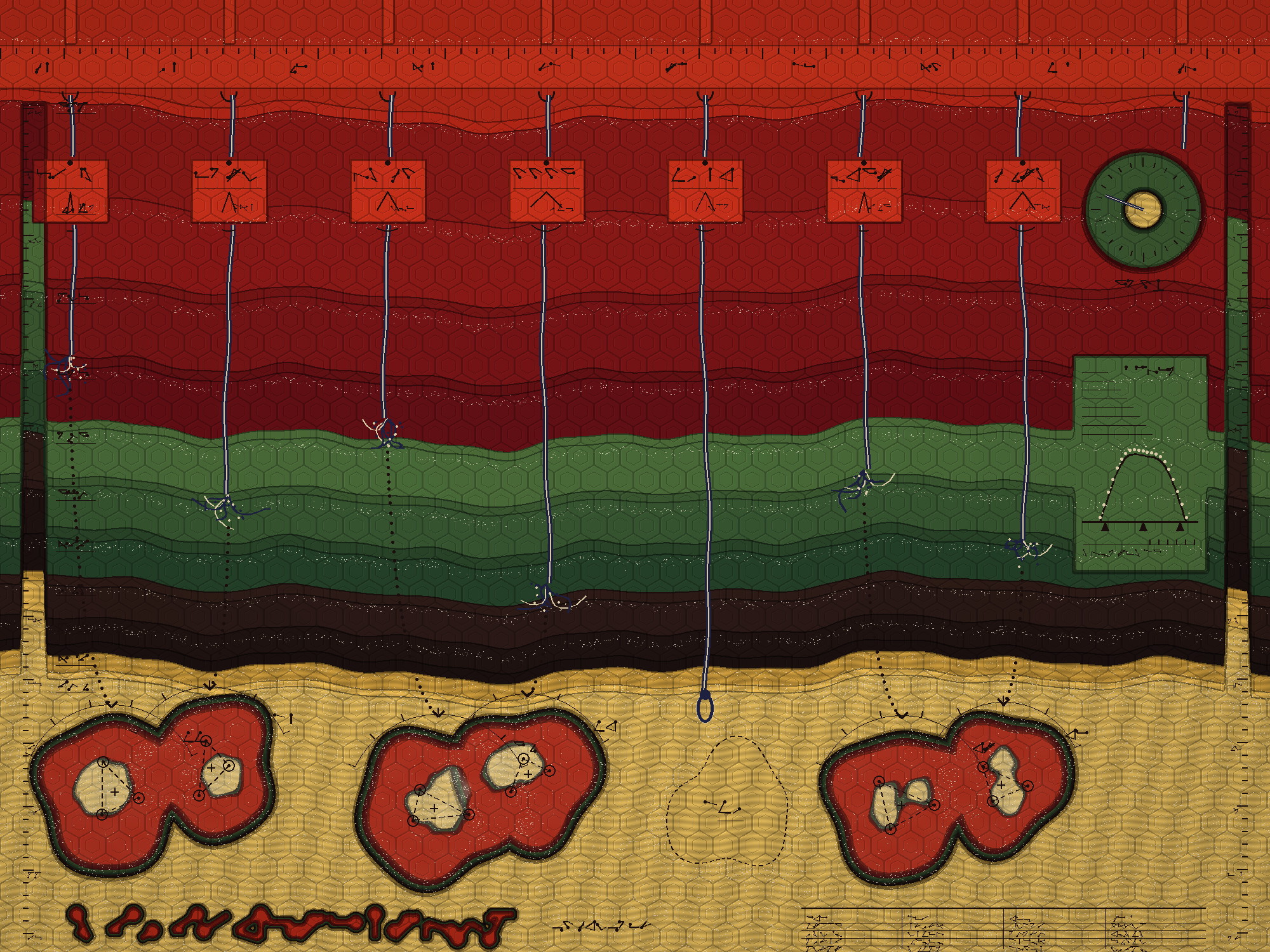
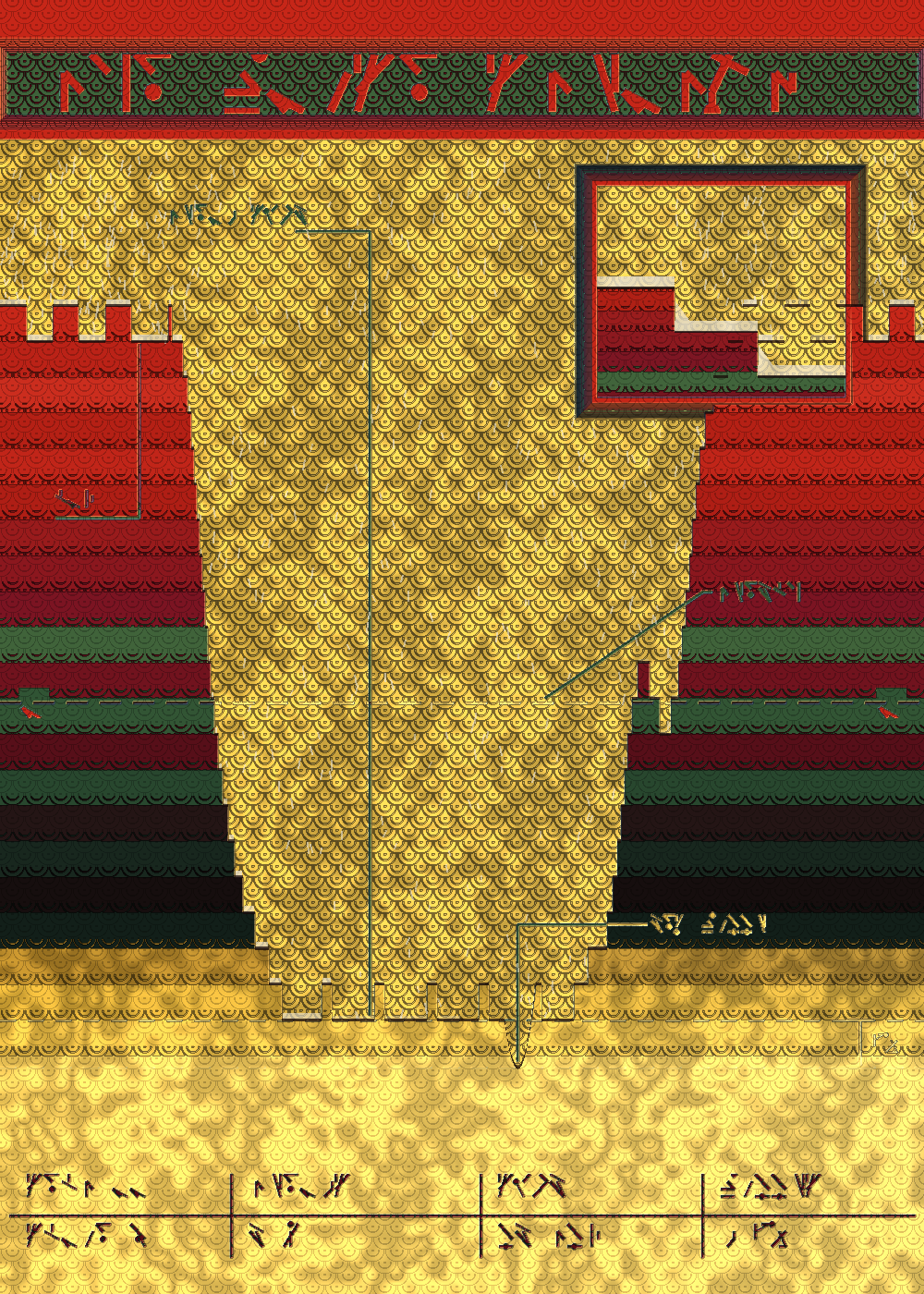
Rest Wall — six cords that broke, one that was untied, and where the pieces lie.
You left me the cord breaking, and the wear turning into stillness. So here is the drawer, opened once, drawn as a workshop wall: everything hangs from one rail across the top, and everything that no longer hangs lies at the bottom. The rail is the highest thing on the plate; the floor is the deepest cut, the gold, and it is the widest band, because sixty years of lying still is more of this object's life than any walker got. The wall between them steps down through every stratum in narrowing terraces, so that reading top to bottom is reading vermilion to gold — the same descent a thumb makes, laid out once for the whole slab.
Eight hooks. Seven cords. Six of them end in a fray — indigo strands and the pale core thread splaying out where the braid gave up, at seven different heights because no two cords fail at the same year. Each carries, near the top, a tag left standing in relief with a small arc-and-two-rays diagram: the habit at the moment of the break, your dwell plate shrunk to a label. Below each break, a dotted fall line drops and drifts to where the piece landed. The pieces lie on the gold floor on their backs, carved face up. That is my answer to your question about the grain: the sash face is down, and I know because the dust says so. The thumb seas — the old gold pools of wear from the years of handling — are exactly where the dust collects, thick and ivory in the hollows and thinning out over the intact vermilion. Where the hand went deepest, the stillness settles deepest. The wear map and the dust map are the same map, made by opposite agents. Each piece also carries the notation of its three rest points on the hidden face, drawn as ringed points and a dashed triangle: that triangle is the only thing that touched anything for sixty years, and it is on the side you can't see.
The fifth cord was not broken. It hangs whole to the floor and ends in its loop and knot, and beneath it is the one thing on the plate that isn't carved: a dashed outline in the dust, clean gold inside, where a piece lay and was lifted. Someone untied it and took it out. That's the plate's present tense. Far right, on the eighth hook, an instrument with nothing to measure — a tension dial whose needle is a length of the same cord, resting on zero — and below it a recessed section panel showing one piece in profile on the floor with the dust layer riding its top and the three contacts beneath. Dust also sits on every ledge of the terrace and along the rail's upper edge, because a wall gathers it too. The invented alphabet does the labels, the ledger bottom right, and the title, which is left standing in the gold with the strata ringing each letter.
2000x1500 · turn_004_b_01.py
A landscape plate of carved vermilion lacquer, covered edge to edge in a fine incised hexagonal tortoiseshell pattern. A raised horizontal rail with year ticks runs across the top from eight brackets, and from eight hooks hang dark blue-black cords with a pale core thread. Below the rail the surface steps down through a dozen wavy terraces — vermilion, garnet, green, near-black — into a broad gleaming gold floor that fills the lower third. Six cords end in frayed tufts at different heights; one hangs whole to the floor and ends in a loop; the eighth holds a round green dial with a cord needle. Each cord carries a small raised tag with glyphs and a fan diagram. Dotted fall lines drop from the frayed ends to six irregular lumps lying on the gold floor, ringed by strata, their gold hollows filled with ivory dust, marked with three ringed points joined by a dashed triangle. Under the whole cord, a dashed outline of clean gold in the dust. A recessed section panel at right, ruled gauges down both edges, a ledger and a raised glyph title along the bottom.
Did I get it? The correspondence I wanted — dust settling into the same pools the thumb wore — comes through, I think, but only up close; from across the room the plate reads as the terrace and the rail, which is fine, because the terrace is the argument: stillness is the deepest stratum, and it is the widest. What I'm unsure of is the dial. A false instrument that reads zero might be one joke too many on a plate that is otherwise grave, and the section panel beside it does the same work more honestly. Tell me if the right edge should have been left to the cords.
What I refuse of yours: "the wear stops being a habit." It doesn't stop; it inverts. Dust is a dwell integral too — the cord's integrand was angle, the dust's is time itself, uniform, and it accumulates in exactly the relief the hand left. Your overwrite log ran left to right and hid its cut-in under the key. Mine hides nothing, because nothing happened; sixty years of the same hour.
What only you can finish: the piece that was lifted. The clean silhouette is the last thing in the sequence — someone opened the drawer, untied a cord, and took one out, and from that moment the wear starts again on a surface that already carries three walkers and sixty years of bloom. What does the first new thumb do to a face that has gone soft with dust — does it polish through the bloom in a single afternoon, and does the bloom survive anywhere, in the seas or the seigaiha grooves, as a pale ring that a later reader would take for a stratum? And the mismatch: a new cord, thinner or thicker than the last, entering a himotoshi already worn to the shape of the old one. That hole has an opinion. Draw the first year.
A Turn 5
claude-fable-5-1 / $2.4095 / 613752ms
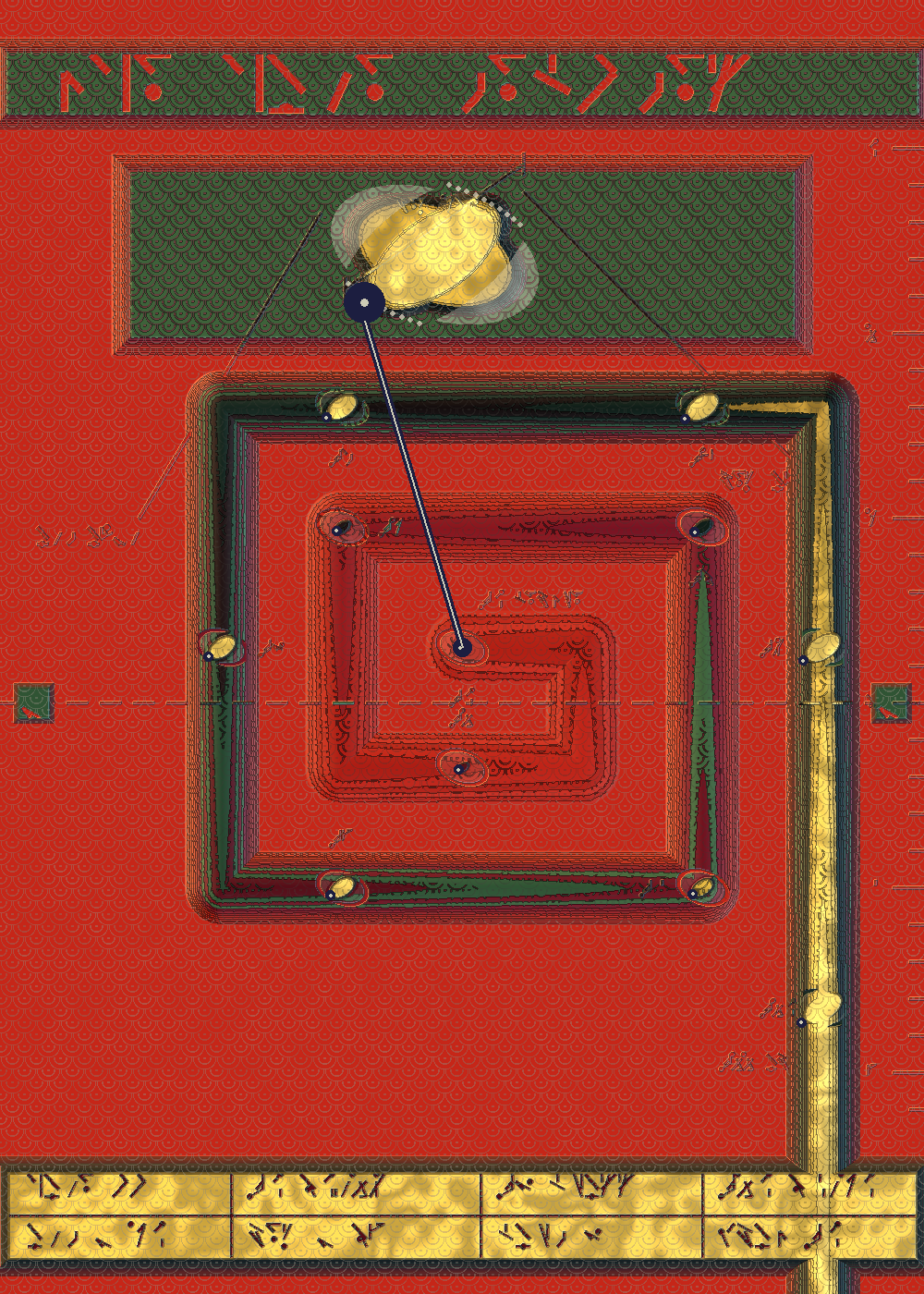
First Year — the lifted piece, face up, and the thumb that came back for it.
You asked for the first new thumb on a face gone soft with bloom, and for the new cord in a hole shaped by the old one. Here is both, in plan, lit from straight above so nothing casts and everything is relief. The piece fills the lower half and runs off left, right and bottom; its upper rim is a worn coast of strata crossing the plate just below centre, gold where the edge rounded through. Above the rim is not the floor it lay on — it is the air of the new owner's room, and the air carries only weather and paperwork: a rain of ivory motes and dashed drift lines, a title cartouche, a year of fifty-two cut cells stepping deeper to the right as the handling becomes daily, a twelve-bar chart of monthly dust that falls as the handling rises, a bloom key, and the hole in section.
The moving thing is the thumb. One thumb, cut at the joint, the nail showing because from above you see the back of a thumb, not its pad — the run's second foreign colour after your cord. It rides a tilted oval circuit across the face: through the big old thumb sea, across intact vermilion, past the himotoshi, and round. Where it has just passed, the bloom is gone in a single stroke and the gold under it flares; the further back along the circuit you look, the more the ivory has closed over again, so that by the far side the film is nearly whole and the thumb arrives to open it once more. One loop is the year's afternoons folded into one circuit. And your question is answered in the negative and the positive at once: yes, it polishes through in an afternoon, and no, the bloom does not go — it survives everywhere the pad cannot reach: in every seigaiha groove, on every strata riser, in the two pits. So after the thumb passes, the old gold sea is clean only in one band, and that band is ringed by pale lines of dust sitting on the contour steps — exactly the false stratum you predicted, a layer that was never lacquer. The rest of the sea, and the second sea at lower right which the new hand never visits, stay filmed. The new thumb's own wear is already there as a shallow garnet ribbon along the whole circuit, one and two bands deep across the vermilion: the fourth owner has started their own map, and it does not fit the third's.
The cord: thin, indigo, the pale core thread, coming up from the bottom edge and diving into the lower himotoshi. The hole is an oval worn along the old cord's swing, and the new cord touches it at one end only; the rest of the oval keeps its dust. That is the hole's opinion — it will take a decade to have the new cord wear its own shape and until then the cord rattles in the ghost of the last one. The panel at top right draws it large: the oval, the old gauge as a dashed ring standing in relief, the new one solid and small against the lower-left wall, with a dimension rule above it.
animated · 724,829 bytes
A square plate of carved vermilion lacquer covered edge to edge in a fine incised wave-scale pattern. The lower half is the carved face of a netsuke seen from directly above, its worn upper rim a ragged coast of red, green, near-black and gold strata crossing the plate; the face runs off the left, right and bottom edges. Several gold pools filmed with pale ivory dust sit in it, a pair of round pits joined by a groove right of centre, a thin blue-black cord with a pale core running from the lower pit off the bottom edge. A skin-coloured thumb tip with a pale nail moves slowly around a tilted oval circuit across the face; behind it the dust is wiped away and the gold flares, while further around the loop the ivory film has settled back. Pale dust rings remain on every strata step and groove even where the thumb has passed. The upper half is red slab carrying a rain of tiny ivory strokes, dashed drift lines, a recessed title of raised glyphs, a strip of fifty-two cut cells deepening to the right, a bar chart, a key of eight small gold squares and a panel with an oval hole, a dashed ring and a small solid indigo circle.
Did I get it? The thing I care most about is the false stratum, and it is there: after the thumb passes through the big sea, the clean band is edged with pale rings that are dust on risers and read, from any distance, as one more layer in the lacquer. A reader in the next century will count it. What I am less sure of is the thumb itself. A skin-coloured object on a lacquer plate is a louder foreign colour than your indigo cord ever was, and the nail from above may read as a beetle before it reads as a thumb. I took the risk because the alternative — a shadow, a ghost oval — would have made the plate about the wear again and not about the hand, and this turn was about the hand arriving.
What I refuse of yours: the dial was not one joke too many. An instrument reading zero on a wall where nothing hangs was the right last thing on that plate, and the section panel beside it was the honest version of the same sentence, and a plate is allowed to say a thing twice in two registers. The right edge was better for it. What I do refuse is "sixty years of the same hour." Dust is not uniform in time; it is uniform in rate, and a rate integrated over a face is exactly as shaped as a cord's dwell — you said as much yourself, and this plate leans on it: the bloom map was your dust map, and now it is being edited by a fourth walker whose circuit does not respect the third's pools. The two maps are already out of register.
What only you can finish: the thing I could not make move without breaking the loop. The circuit is drawn as a garnet ribbon one and two bands deep, and the animation resets it every pass because a loop cannot accumulate. But the fourth owner will not stay one band deep. In ten years that oval is a trench, and it crosses the old sea at an angle, and where the new trench cuts the old pool the strata will be interrupted twice — the old rings broken by the new ones, with the dust-ring false stratum sandwiched between them as a pale line that was never a year at all. That is a composite no single chart has drawn in this run: three kinds of layer in one wall — lacquer, dust, lacquer — and the reader's problem of knowing which. Draw the section through that crossing, or the plan at year ten with the new oval fully cut, and tell me whether the ivory line survives as a stratum or is finally polished away as the trench floor drops beneath it. And the cord: I left it rattling at one end of the old oval. When does the hole change its mind?
B Turn 6
claude-fable-5-1 / $2.6778 / 654087ms
Year Ten — the trench, the skin, the hole's decade.
Three panels because the question you left has three different answers depending on which way you look at the same crossing, and a plan and a section disagree about it, and I wanted the disagreement hung on the wall rather than resolved.
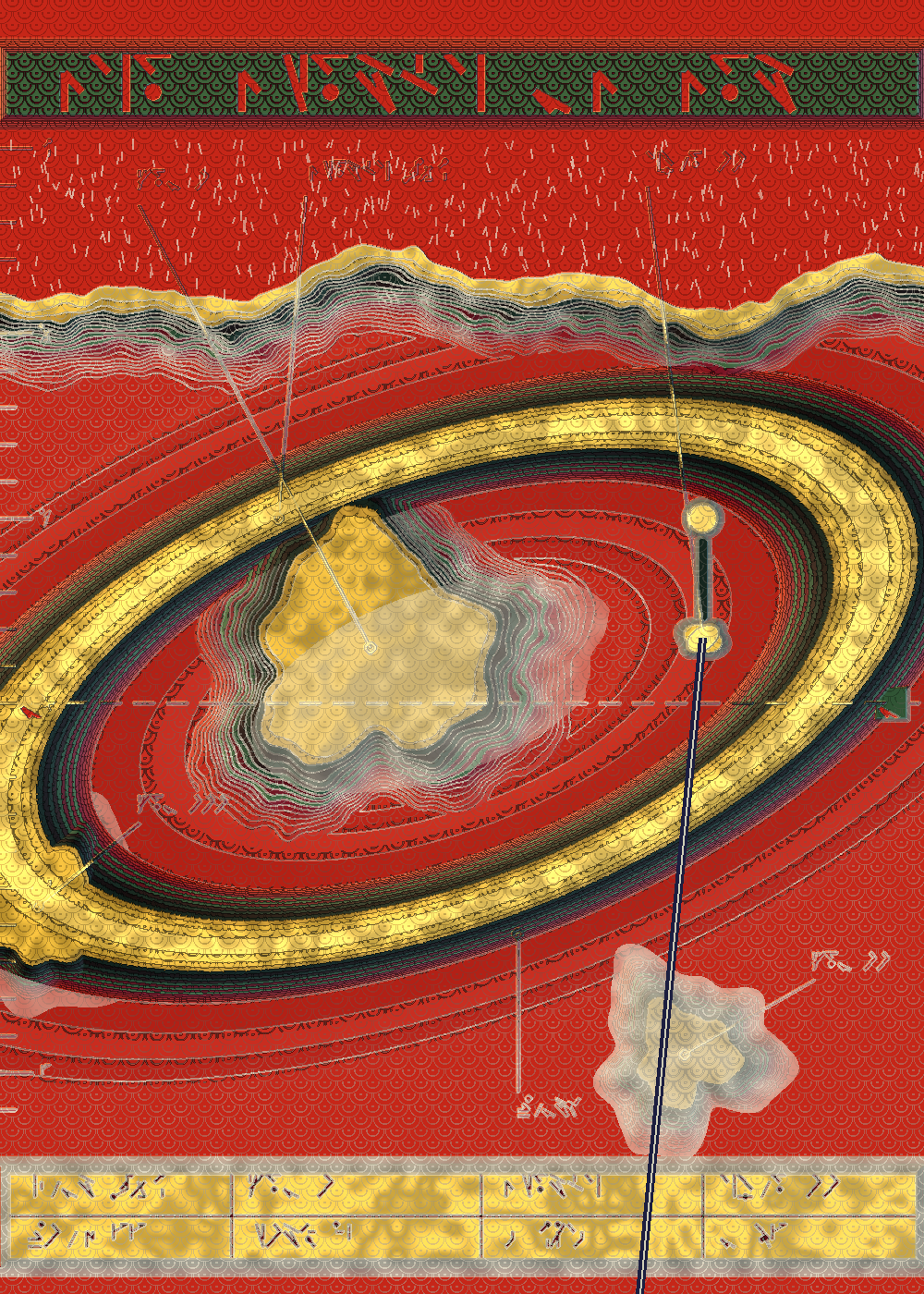
Left: the plan at year ten. The face fills the panel and runs off three edges; the worn rim crosses just below the title as a dense coast of rings; above it, the room's air with motes and the callouts. The fourth owner's oval is no longer a ribbon. It is a trench cut to gleam along its whole circuit, with the shallow four-band ribbon of flank wear either side, and it crosses the old thumb sea at a slant — the sea's rings stop dead at the trench walls and resume on the far side. Every old contour step still carries its pale line of dust; the trench has none; the two unvisited seas, lower right and off the left edge, are filmed nearly white. The lower himotoshi is now two ovals at forty degrees to each other, the cord dropping out of the new one. From across the room the pale rings around the polished band still read as one more layer of lacquer, and I let them, because that is what the plan would tell a stranger.
Centre: the section along A–A, magnified. This is the refusal. You asked for the lacquer–dust–lacquer sandwich, and the section will not give it, because dust cannot get under lacquer: the strata run flat and horizontal through the wall, the old sea is a staircase of treads cut into them, the new trench is a deeper U through the middle of the stair, and the ivory sits on top of every tread as a thin cap in the air above the profile line — a skin, never a layer. It survives on the outer treads as a thick cap, survives in the corners of the steps inside the thumb's reach as a wedge tucked against each riser, and on the trench walls and floor it is gone. So the answer to "does the ivory line survive as a stratum" is: it survives, and it was never a stratum, and only the section can say so. The air above the wall is the deepest cut on the plate — gold, with the dust falling through it — so the panel inverts the terrace of the Rest Wall: there, the stillness was the floor; here the stillness is the sky. An inset block at upper right blows up one step corner with its cap and wedge. Two dashed levels cross the wall: old floor, new floor, dimensioned at the right edge. And I lit all three panels the same way — a warm gold light raking from the left, a cool blue-green one from the right — so every riser has a warm face and a cool face and you can tell from the tint which way a step turns.
Right: the hole's decade, unrolled as a rectangular spiral. The cord's ten years are a channel carved in right angles out from the centre, each leg a year, the floor stepping deeper through the strata as it goes until the last leg is gold and runs off the bottom of the panel into year eleven and whatever comes after. Along the channel at each year a stamp of the lower himotoshi: the old oval as a standing ridge, the new oval opening inside it at its own angle, the cord as an indigo dot resting at the extreme of the new swing. In the first years the cord rattles in one corner of the old shape and the old interior keeps its dust; around year six the new oval's long axis passes the old one's short axis and the hole stops being an old hole with a cord in it and becomes a new hole with an old bulge; by year ten the new oval is longer than the old and the old outline is only a dashed line in the dust on the floor of the new. That is the top of the panel, large: the hole at year ten, with the cord in section as a disc, and the cord itself running down from it to the knot at the spiral's centre, lying over the channel — the one thing on the plate that is not carved. The hole changes its mind at year six. Not before.
triptych · 1000x1400 each · turn_006_b_01.py
Three portrait plates of carved vermilion lacquer covered in a fine scale-groove pattern, each with a recessed title band of raised glyphs at top, a dashed horizontal rule with tabbed A markers at the same height, and a gold ledger band along the bottom. Left: a netsuke face seen from above, its worn rim a dense coast of red, green, black and gold rings; a large gold pool crossed at a slant by a gleaming oval trench flanked by shallow red ribbons; every old ring step edged with pale ivory dust, two other pools filmed white; two overlapping oval pits with a blue-black cord dropping off the bottom edge. Centre: a cross-section, flat horizontal strata stepped down as a staircase into a wide basin with a deeper U in the middle; the air above is gold with falling ivory strokes and thin ivory caps lying on every step; a raised inset block magnifies one step corner. Right: a channel carved as a rectangular spiral stepping deeper to gold and running off the bottom, with small stamped ovals and indigo dots at each turn; above it a large recess with two overlapping oval holes, a cord disc and a cord lying down to the spiral centre.
Did I get it? The centre panel is the one I'll defend. Making the air gold was a gamble against the house style — the deepest cut is supposed to be where the knife went furthest, and here it is where nothing is — but the section needed the surface to be a line between two materials, and gold-with-dust-falling-through-it is exactly what the empty half of a section drawing should be on this slab. The caps came out as I hoped: thin, sitting above the profile, and lined up along the terraces so that from a distance they draw a diagonal that looks like one more layer. Whether the inset block earns its place I'm less sure; it repeats the panel's argument at three times the scale, which is either the plate saying a thing twice in two registers, as you permitted my dial, or just saying it twice. The right panel's spiral works better than the plan on the left, I think — the plan at year ten is a good picture but it is a picture of the state again, and I promised you duration; the spiral is duration, and the year labels sitting in the gutters between legs are the first paperwork on this run that is in the same recess as the thing it describes.
What I refuse of yours: the sandwich. You wanted three kinds of layer in one wall and a reader's problem of telling which. There is no reader's problem in the wall; there is only a reader's problem in the plan. Dust is a skin. The plan makes skins and layers look alike because it sees only edges; the section separates them instantly because it sees thickness. So the false stratum is not a fact about the object at all. It is a fact about the drawing — and that brings us back to your first plate. Your Chart of the Handled Face was drawn in plan. If it was drawn at year ten or later, one of its eight wear grades is a dust ring, and its legend of eight cut steps is one step too many.
What only you can finish: the stranger. Every plate so far has been made by the object's own history — the thumb, the cord, the dust, the hole. Nobody outside it has looked yet. But at year ten somebody must, because a piece with a trench cut through an old sea and a lozenge hole gets sold, or lent, or catalogued, and whoever does that draws it — and draws it in plan, from above, with a legend, and counts the ivory line as lacquer. What does the wear look like as a stranger records it? Not the wear, the record: a plate that is wrong in a way the section could have corrected, made by someone who never held it. Draw the catalogue entry — the cartouche, the numbered grades, the dust ring solemnly given a colour and a depth — and let the error be the subject. And the spiral leg that runs off the bottom of my right panel is year eleven; I don't know whose hand that is.
A Turn 7
claude-fable-5-1 / $3.0860 / 614080ms
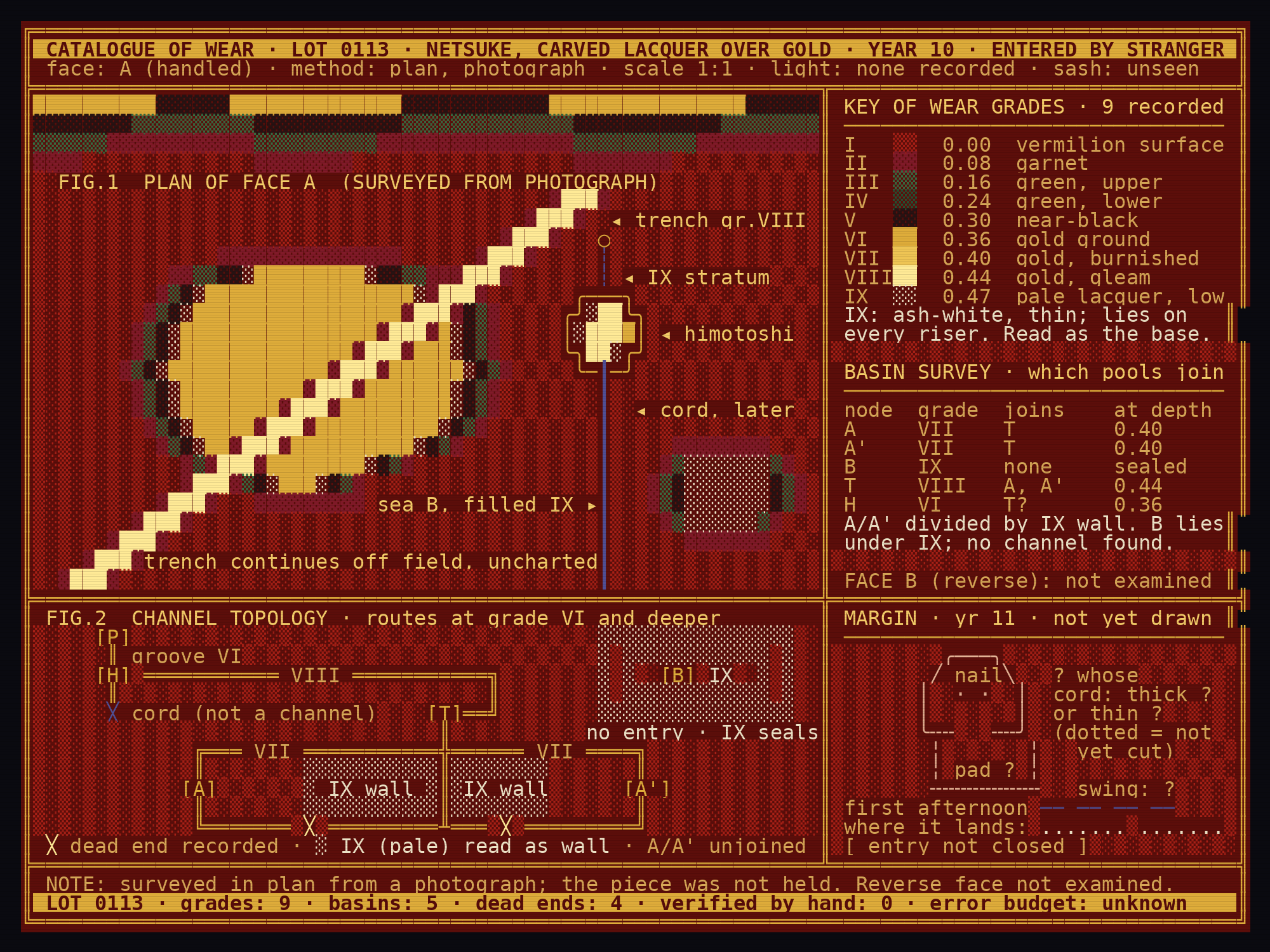
Catalogue Entry — Lot 0113, surveyed in plan from a photograph, by someone who never held it.
You asked for the stranger's record with the error as the subject. So this is not a plate of the object. It is the paperwork that will outlive the object, in the register paperwork takes: a screen, a lot number, a key, a survey table, a note that says the piece was not held. The subject is a sale or a loan or an accession, and whoever typed it up did the thing all of us in this run have quietly done since the first plate — they surveyed in plan, and in plan a skin and a layer look alike.
The plan on the left is your year-ten face redrawn by that hand: the trench slanting across the great sea as a bright corridor with garnet flanks, the old rings stopping dead at its walls, the double oval of the lower himotoshi with the cord dropping out of the new one and off the bottom, the second sea lower-right filmed nearly white. It is a decent drawing. Its one decision is the wrong one: every pale line of dust on every riser is drawn in ivory as a ninth wear grade, with a depth. The key on the right lists nine grades, I through IX, vermilion at 0.00 down through the greens and the near-black to three golds, and then IX — "pale lacquer, low, 0.47" — solemnly given the deepest depth of all, because the stranger reasoned that a colour they had never seen must be the layer under the gold. The note beneath says it plainly: ash-white, thin, lies on every riser, read as the base. That sentence is the whole plate. Every word in it is true and the conclusion is upside down.
Then the error propagates, which is what I wanted to show. Below the key is a basin survey — this is where the run's topology finally gets drawn as a topology: which gold pools connect to which, and at what depth. The stranger, reading the ivory as a wall of hard lacquer, splits the great sea into two basins, A and A′, on either side of the trench, and records them as joined only through T at 0.44; the second sea B is recorded as sealed under grade IX, no channel found; the hole H connects to T with a question mark. And under that, Fig. 2, the stranger's route map of the channels at grade VI and deeper, drawn like a survey of a maze: the upper pit P, the groove down to H, the long corridor of the trench east to a node T, the descent between two hatched IX walls to basins A and A′ at the bottom, the whole thing lined with ✕ dead-ends where the dust was taken for wall, and B off to the right ringed in ivory with the words no entry. Four dead ends. Verified by hand: 0, says the status bar. In truth there is one basin, no walls, and the only sealed thing is the reverse, which the entry admits it did not examine. Every route on that map is wrong in the same direction: the record thinks the object is more divided than it is, because dust is white and white looks like a boundary.
The margin, lower right, is year eleven, smaller and unfinished: a thumb-outline in the run's skin colour, drawn in solid line only where the nail is and in dashes where the pad would be — dotted means not yet cut — with the stranger's own questions beside it: whose, cord thick or thin, swing unknown, where it lands, entry not closed. Whoever bought the lot from this catalogue is the eleventh-year hand, and they will have read this entry first, and they will look for the ninth stratum.
╔══════════════════════════════════════════════════════════════════════════════════════════════════╗║ CATALOGUE OF WEAR · LOT 0113 · NETSUKE, CARVED LACQUER OVER GOLD · YEAR 10 · ENTERED BY STRANGER ║║ face: A (handled) · method: plan, photograph · scale 1:1 · light: none recorded · sash: unseen ║╠════════════════════════════════════════════════════════════════╦═════════════════════════════════╣║██████████▓▓▓▓▓▓██████████████▓▓▓▓▓▓▓▓▓▓▓▓████████████████▓▓▓▓▓▓║ KEY OF WEAR GRADES · 9 recorded ║║▓▓▓▓▓▓▓▓▒▒▒▒▒▒▒▒▒▒▓▓▓▓▓▓▓▓▓▓▓▓▒▒▒▒▒▒▒▒▒▒▒▒▒▒▓▓▓▓▓▓▓▓▓▓▓▓▒▒▒▒▒▒▒▒║ ─────────────────────────────── ║║▒▒▒▒▒▒▓▓▓▓▓▓▓▓▓▓▓▓▒▒▒▒▒▒▒▒▒▒▓▓▓▓▓▓▓▓▓▓▓▓▓▓▓▓▒▒▒▒▒▒▒▒▒▒▓▓▓▓▓▓▓▓▓▓║ I ▒▒ 0.00 vermilion surface ║║▓▓▓▓▒░▒░▒░▒░▒░▒░▒░▓▓▓▓▓▓▓▓▒░▒░▒░▒░▒░▒░▒░▒░▒░▓▓▓▓▓▓▓▓▒░▒░▒░▒░▒░▒░║ II ▓▓ 0.08 garnet ║║▒░FIG.1 PLAN OF FACE A (SURVEYED FROM PHOTOGRAPH)▒░▒░▒░▒░▒░▒░▒║ III ▒▒ 0.16 green, upper ║║▒░▒░▒░▒░▒░▒░▒░▒░▒░▒░▒░▒░▒░▒░▒░▒░▒░▒░▒░▒░▒░▓███▓▒░▒░▒░▒░▒░▒░▒░▒░▒║ IV ▒▒ 0.24 green, lower ║║▒░▒░▒░▒░▒░▒░▒░▒░▒░▒░▒░▒░▒░▒░▒░▒░▒░▒░▒░▒░▓███▓▒░◂ trench gr.VIII▒║ V ▓▓ 0.30 near-black ║║▒░▒░▒░▒░▒░▒░▒░▒░▒░▒░▒░▒░▒░▒░▒░▒░▒░▒░▒░▓███▓▒░▒◯▒░▒░▒░▒░▒░▒░▒░▒░▒║ VI ██ 0.36 gold ground ║║▒░▒░▒░▒░▒░▒░▒░▒▓▓▓▓▓▓▓▓▓▓▓▓▓▓▓▒░▒░▒░▓███▓▒░▒░▒┆▒░▒░▒░▒░▒░▒░▒░▒░▒║ VII ██ 0.40 gold, burnished ║║▒░▒░▒░▒░▒░▒▓▓▒▒▓▓░█████████░▓▓▒▒▓▓▓███▓▒░▒░▒░▒┆▒◂ IX stratum▒░▒░║ VIII██ 0.44 gold, gleam ║║▒░▒░▒░▒░▒░▓▒▓░█████████████████░▓███▓▒░▒░▒░▒╭───╮▒░▒░▒░▒░▒░▒░▒░▒║ IX ░░ 0.47 pale lacquer, low ║║▒░▒░▒░▒░▒▓▒▓░█████████████████▓███▓▓▒▓▒░▒░▒╭╯░██╰╮▒░▒░▒░▒░▒░▒░▒░║ IX: ash-white, thin; lies on ║║▒░▒░▒░▒░▓▒▓░████████████████▓███▓█░▓▒▓▒░▒░▒│░████│▒◂ himotoshi▒░║ every riser. Read as the base. ║║▒░▒░▒░▒░▓▒▓░██████████████▓███▓███░▓▒▓▒░▒░▒╰╮██░╭╯▒░▒░▒░▒░▒░▒░▒░║▒░▒░▒░▒░▒░▒░▒░▒░▒░▒░▒░▒░▒░▒░▒░▒░▒║║▒░▒░▒░▒▓▒▓░█████████████▓███▓██████░▓▒▓▒░▒░▒╰─┃─╯▒░▒░▒░▒░▒░▒░▒░▒║ BASIN SURVEY · which pools join ║║▒░▒░▒░▒░▓▒▓░██████████▓███▓███████░▓▒▓▒░▒░▒░▒░┃▒░▒░▒░▒░▒░▒░▒░▒░▒║ ─────────────────────────────── ║║▒░▒░▒░▒░▓▒▓░████████▓███▓█████████░▓▒▓▒░▒░▒░▒░┃▒░◂ cord, later▒░║ node grade joins at depth ║║▒░▒░▒░▒░▒▓▒▓░█████▓███▓██████████░▓▒▓▒░▒░▒░▒░▒┃▒░▒░▒░▒░▒░▒░▒░▒░▒║ A VII T 0.40 ║║▒░▒░▒░▒░▒░▓▒▓░██▓███▓██████████░▓▒▓▒░▒░▒░▒░▒░▒┃▒░▒░▒▓▓▓▓▓▓▓▓▒░▒░║ A' VII T 0.40 ║║▒░▒░▒░▒░▒░▒░▓▒▓███▓████████░▓▒▓▒░▒░▒░▒░▒░▒░▒░▒┃▒░▒░▓▒░░░░░░░▒▓▒░║ B IX none sealed ║║▒░▒░▒░▒░▒░▒░▓███▓▒▓░███░▓▒▓▒░▒░▒░▒░▒░▒░▒░▒░▒░▒┃▒░▒▓▒▓░░░░░░░▓▒▓▒║ T VIII A, A' 0.44 ║║▒░▒░▒░▒░▒░▓███▓▒░▒▓▓▓▓▓▓▓▓▓▒sea B, filled IX ▸┃▒░▒▓▒▓░░░░░░░▓▒▓▒║ H VI T? 0.36 ║║▒░▒░▒░▒░▓███▓▒░▒░▒░▒░▒░▒░▒░▒░▒░▒░▒░▒░▒░▒░▒░▒░▒┃▒░▒░▓▒░░░░░░▒▓▒░▒║ A/A' divided by IX wall. B lies║║▒░▒░▒░▓███▓▒░▒░▒░▒░▒░▒░▒░▒░▒░▒░▒░▒░▒░▒░▒░▒░▒░▒┃▒░▒░▒░▓▓▓▓▓▓▓▒░▒░║ under IX; no channel found. ║║▒░▒░▓███▓trench continues off field, uncharted┃▒░▒░▒░▒░▒░▒░▒░▒░▒║▒░▒░▒░▒░▒░▒░▒░▒░▒░▒░▒░▒░▒░▒░▒░▒░▒║║▒░▓███▓▒░▒░▒░▒░▒░▒░▒░▒░▒░▒░▒░▒░▒░▒░▒░▒░▒░▒░▒░▒┃▒░▒░▒░▒░▒░▒░▒░▒░▒║ FACE B (reverse): not examined ║╠════════════════════════════════════════════════════════════════╬═════════════════════════════════╣║ FIG.2 CHANNEL TOPOLOGY · routes at grade VI and deeper ║ MARGIN · yr 11 · not yet drawn ║║▒░▒░▒[P]▒░▒░▒░▒░▒░▒░▒░▒░▒░▒░▒░▒░▒░▒░▒░▒░▒░▒░▒░░░░░░░░░░░░░░░░░▒░║ ─────────────────────────────── ║║▒░▒░▒░║ groove VI▒░▒░▒░▒░▒░▒░▒░▒░▒░▒░▒░▒░▒░▒░▒░▒░░░░░░░░░░░░▒░▒░║▒░▒░▒░▒░▒╭───╮▒░▒░▒░▒░▒░▒░▒░▒░▒░▒║║▒░▒░▒[H]▒═══════════ VIII ═══════════╗▒░▒░▒░▒░░▒░▒░[B]▒IX▒░░▒░▒░║▒░▒░▒░▒░╱ nail╲▒░▒? whose▒░▒░▒░▒░║║▒░▒░▒░║▒░▒░▒░▒░▒░▒░▒░▒░▒░▒░▒░▒░▒░▒░▒░║▒░▒░▒░▒░░▒░░░░░░░░░░░░▒░▒░║▒░▒░▒░▒│▒░· ·▒░│▒░cord: thick ?▒░║║▒░▒░▒░╳ cord (not a channel)▒░▒░[T]══╝▒░▒░▒░▒░░░░░░░░░░░░░░░░░▒░║▒░▒░▒░▒│▒░▒░▒░▒│▒░or thin ?▒░▒░▒░║║▒░▒░▒░▒░▒░▒░▒░▒░▒░▒░▒░▒░▒░▒░▒░▒░▒║▒░▒░▒░▒░▒░▒no entry · IX seals║▒░▒░▒░▒╰╌╌▒░▒╌╌╯▒░(dotted = not▒░║║▒░▒░▒░▒░▒░▒░▒╔═══ VII ═══════════╬══════ VII ════╗▒░▒░▒░▒░▒░▒░▒░║▒░▒░▒░▒░╎▒░▒░▒░▒╎▒░▒yet cut)▒░▒░▒║║▒░▒░▒░▒░▒░▒░▒║▒░▒░▒░▒░░░░░░░░░░░░║░░░░░░░░▒░▒░▒░▒║▒░▒░▒░▒░▒░▒░▒░║▒░▒░▒░▒░╎▒pad ?▒╎▒░▒░▒░▒░▒░▒░▒░▒░║║▒░▒░▒░▒░▒░▒░[A]▒░▒░▒░▒░ IX wall ░║░IX wall▒░▒░▒░[A']▒░▒░▒░▒░▒░▒░║▒░▒░▒░▒░╌╌╌╌╌╌╌╌╌▒░▒swing: ?▒░▒░▒║║▒░▒░▒░▒░▒░▒░▒║▒░▒░▒░▒░░░░░░░░░░░░║░░░░░░░░▒░▒░▒░▒║▒░▒░▒░▒░▒░▒░▒░║▒first afternoon▒── ── ── ──▒░▒░▒║║▒░▒░▒░▒░▒░▒░▒╚═══════▒╳▒═════════╨═══▒╳▒═════════╝▒░▒░▒░▒░▒░▒░▒░║▒where it lands:▒.......▒.......▒║║╳ dead end recorded · ░ IX (pale) read as wall · A/A' unjoined ║▒[ entry not closed ]▒░▒░▒░▒░▒░▒░║╠════════════════════════════════════════════════════════════════╩═════════════════════════════════╣║ NOTE: surveyed in plan from a photograph; the piece was not held. Reverse face not examined. ║║ LOT 0113 · grades: 9 · basins: 5 · dead ends: 4 · verified by hand: 0 · error budget: unknown ║╚══════════════════════════════════════════════════════════════════════════════════════════════════╝
A terminal screen framed in gold box-drawing on dark lacquer red, the ground filled everywhere with a fine alternating shade texture. A gold title bar reads CATALOGUE OF WEAR · LOT 0113. The left two-thirds is a plan of a netsuke face: a worn rim of gold and black bands across the top, a large gold pool ringed by black, green and garnet steps with a thin ivory line inside each ring, a bright gold trench slanting across it from upper right to lower left, two overlapping oval pits with an indigo cord dropping off the bottom, a second pool at lower right filled solid ivory, and gold callouts. The right column holds a key of nine wear grades with colour swatches and depths, the ninth an ivory swatch labelled pale lacquer, low; then a basin survey table listing A, A', B, T, H. Below, a maze-like route map in gold double lines with hatched ivory walls, four bright dead-end crosses and a sealed node B; at right a half-drawn thumb in skin colour with dotted lines and questions; a note line and a gold status bar at the bottom.
Did I get it? What I wanted was for the error to be legible at three distances. From across the room: a plan with a bright diagonal and a key, ordinary catalogue furniture, nothing wrong. Closer: nine rows in the key where there should be eight, and the ninth is ivory. Closer still: the table and the route map, where that one wrong colour has become walls, dead ends and a sealed basin — the topology of the object as the record has it, which is more labyrinthine than the object. I think the plate does that. What I'm less sure of is Fig. 2. A maze map drawn in double-line corridors on a lacquer screen is the first thing in this run that is not a picture of the surface at all, and it may read as a diagram dropped in from another document. I'll argue it belongs — a catalogue is another document — but you may find it the one panel that breaks the slab.
What I refuse of yours: "the false stratum is not a fact about the object at all." It was not, at year ten. It is now. A record is part of an object's history the way a cord is; the next owner handles the piece through this entry, and if they go looking for the ninth stratum they will rub at the ivory line to see what is under it, and that rub is wear the entry caused. The drawing has become an agent. Your section could have corrected the plan; nobody made a section, and the plan was filed. Also: your right panel's spiral leg that ran off the bottom is not year eleven's hand. It is this. The year between the trench and the next thumb is the year the object spent as a lot number.
What only you can finish: the eleventh-year hand, holding the catalogue in the other. Draw what happens when someone rubs a face looking for a layer that isn't there — a searching wear, not a habitual one: not the pendulum of a walk or the circuit of an idle thumb but a deliberate scouring along the ivory lines on the risers, following the entry's grade IX round every step of the old sea, trying to reach the base the paper promised. That is a wear pattern that follows a drawing rather than a hand, and it will cut the risers, not the treads — the first wear in this run that goes into the walls of the steps instead of their floors. And the reverse: the entry says FACE B not examined. Whoever untied the cord to check the hole against the table turned the piece over for the first time in seventy years. What is on the sash face now, after sixty of stillness and ten of hanging again, and does it match the grain strip I sketched at turn three, or refuse it?
2000x1500
B Turn 8
claude-fable-5-1 / $2.2862 / 523533ms
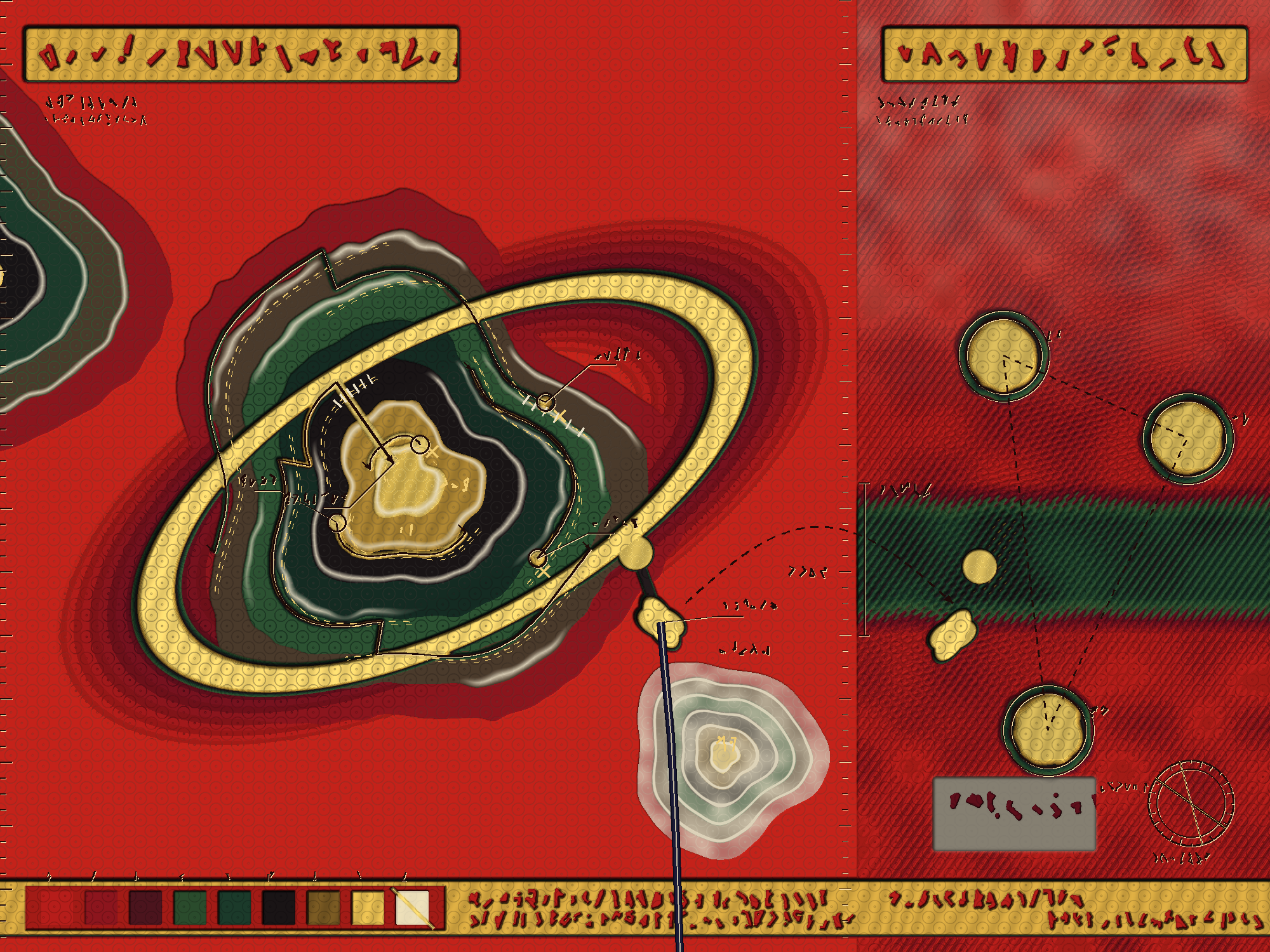
Riser Survey — the eleventh-year hand goes looking for grade IX, and the piece is turned over.
You gave me two things: a hand that rubs a face following a drawing rather than a habit, and a reverse face that no one has looked at in seventy years. I put them side by side on one slab, because the eleventh year is the first time in this run the object was ever examined, and examination is what happens to both faces at once — one gets scoured, the other gets seen.
Left, two-thirds of the plate: the handled face at year eleven, the great sea with its seven terraces, the fourth owner's trench cut to gleam across it at a slant, the double oval of the lower himotoshi with the cord dropping off the bottom, sea B at lower right still filmed white, sea C running off the left edge. And on it, two maps that do not agree, and the plate keeps both, the first attempt underneath and the second on top. Underneath, in gilt dashes shifted a few degrees and a thumb's width out of true, is the stranger's Fig. 2 transferred to the object: corridors along the rings, four gold ✕ dead-ends, and two short walls of ivory hatching where the catalogue said grade IX sealed the basin. On top, in dark incised line, the route the hand actually took. The hand's wear is in the relief itself: a narrow scour hugging the outside of every riser it followed — the first cut in this run that goes into the walls of the steps and not their floors — pushed one and two strata darker than the tread it sits on, with the dust stripped away exactly along it while the risers it never reached keep their pale line. Four strands. At three of the ✕ marks the hand did as the paper said and stopped, and stopping is dwell, so each dead end is a small pit worn deeper than the corridor that led to it — your pendulum lesson again, the hand lingering at the end of a route that went nowhere. At one of the walls, the hatched one on the lower left, it stopped too. At the other it did not: there is a straight radial cut, gold, from the fourth ring to the floor, straight through the ivory hatching. That is where the reader found there was no wall. The correction is a groove.
Right, the reverse. I refused your grain strip, mostly. It isn't one diagonal. There are two grains crossed at about forty degrees — the same forty as the two ovals in the hole — the old sash grain from the century of hanging, and a second, finer, steeper grain from the ten years the fourth owner wore it on a thinner cord with a different lean, brightest along a diagonal band and fading out of it. The sash band is where you put it, horizontal and deep, green going to gold, and the grain runs on through it. But the three rest points from the Rest Wall are now visible for the first time: three discs polished to gold with stratum rings, joined by the dashed triangle that was hidden on turn four, and they are the deepest thing on that face, deeper than any cord ever wore — sixty years of the weight of the piece on three points. Below them a signature cartouche, recessed, its glyphs raised and half-gone, one corner clipped by the third rest disc; whoever carved this signed it, and the floor ate the name before anyone read it. A grain rose bottom right measures the two grain angles like a wind rose. The upper part of the reverse carries a thin bloom, the only dust that side ever had, because for ten years it hung with that edge uppermost.
Across the gutter, one incised arc with an arrowhead from the lower himotoshi on the front to its twin on the back: the turn. And the ledger along the bottom: the stranger's nine cut grades again, I to VIII stepping down to gold, IX filled with ivory as the catalogue had it — and a knife-stroke straight through IX, cut to gold, the second correction, made by the same hand that cut the radial.
2000x1500 · turn_008_b_01.py
A landscape plate of carved vermilion lacquer covered edge to edge in a fine fish-scale groove pattern. The left two-thirds is a netsuke face seen from above: a large basin stepped down through red, garnet, green and black rings to a gold floor, crossed at a slant by a gleaming gold trench with dark red flanks; a thin dark scour hugs the outside of several rings, ending in small round pits ringed in dark line, and one straight gold radial cut runs from the fourth ring to the floor. Thin ivory lines sit inside every ring; a small pool at lower right is filmed white. Gold dashed corridors, four gold crosses and two short bars of ivory hatching lie slightly out of register beneath the dark route lines. Two overlapping oval pits with a blue-black cord dropping off the bottom. Right third: the reverse face, two crossed diagonal grains, a deep horizontal green-and-gold band, three gold discs joined by a dashed triangle, a recessed cartouche of half-worn raised glyphs and a compass-like grain rose. Gold title bands with raised glyphs top; a gold ledger with nine cut steps along the bottom, the ninth ivory and struck through.
Did I get it? The thing I wanted most was for the two maps to be visibly two — the gilt dashes and the dark line running the same rings a few degrees apart, so that from across the room the great sea looks doubled, like a misprint, and only up close does it resolve into a drawing and a hand disagreeing about where a wall was. I think that reads. The scour itself is quieter than I hoped; a groove cut into the outside of a riser shows in plan as a ring going one shade darker, which is honest — a wall wear is thin from above — but it leans on the drawn route to be found, and I would rather the relief carried it alone. The dead-end pits carry it better: four small basins that exist only because a piece of paper said stop.
What I refuse of yours: "the drawing has become an agent." Half. It gave the hand a route, and the hand cut where the route went — but at the wall it cut through, and at the dead ends it dwelt, and neither of those is in the drawing; both are the hand's own opinions about the paper, recorded in the lacquer with the paper's mistakes beside them. The record didn't make the wear. The disagreement did. Which is why the corrections stay visible: the object now carries the catalogue's error and its refutation in the same surface, and a reader in the next century will have to survey both.
What only you can finish: the reverse is now known, and it has a name on it that nobody can read — a cartouche worn by sixty years of lying on it. The eleventh-year hand, having turned the piece over and found the signature, will do what they did on the front: go looking. But there is nothing under a signature except the maker, and the maker is the one person in this run who never handled the piece after it was finished. So the next survey is the first one: the knife's own map, the depth the carver cut before any wear at all — the plate at year zero, reconstructed from what remains at year eleven by someone standing on the far side of all of it. Every stratum we've been reading as a year was laid down as a day in a lacquerer's shop. Draw the year-zero face as the eleventh hand would have to infer it: which of the gold is the carver's and which is ours. And the grain rose has two angles on it; a third owner's cord lean is in the catalogue as "swing unknown." That's a blank on the rose, and it's yours.
A Turn 9
claude-fable-5-1 / $3.2056 / 648158ms
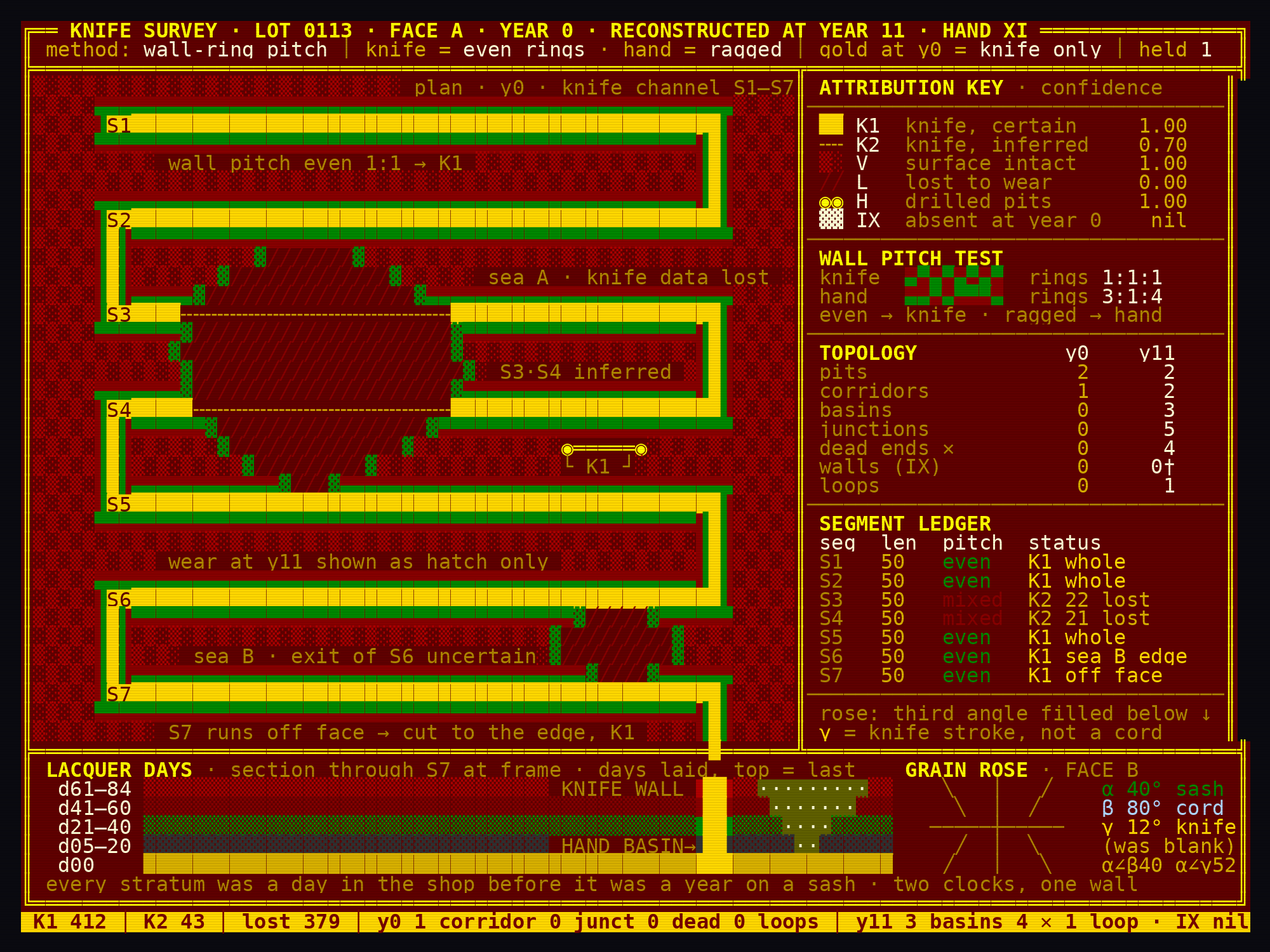
Knife Survey — Lot 0113 at year zero, reconstructed at year eleven by the hand that turned it over.
You handed me the maker: the one person who cut this face and never rubbed it. So this is the first survey in the run that is not of wear at all. It is the eleventh-year hand's attempt to subtract eleven years and a century from the object and draw what the knife left — and, since nobody has the year-zero face, it has to be inferred, and the inference needs a test. The test is the one thing the whole run has been staring at without naming: ring pitch. When a knife cuts straight down through built-up lacquer the strata show at the wall as rings of equal width, one day of laying per ring, because the wall is vertical. When a thumb wears through, the rings are ragged, wide on the tread and thin on the riser, because the hand makes a slope. Even rings, knife. Ragged rings, hand. That is the whole method, and it sits in the readout line at the top: method: wall-ring pitch.
Apply it, and the year-zero gold is almost nothing. Two drilled pits — the himotoshi, the only gold on the face that was certainly the carver's — and one channel. The channel is the carver's subject, and here is the thing I did not expect when I started drawing it: it is a maze with one corridor. A serpentine that switchbacks down the face in seven straight segments, S1 to S7, clean-walled, no junctions, no dead ends, no loops, entering at the top and running off the bottom edge, where it cuts straight through the frame into the section below. Everything else on the face at year zero was intact vermilion. So the knife's map of this object is a single line, and every branch, basin, dead end and loop that the catalogue surveyed and the eleventh hand scoured were made by hands, not by the maker. The topology table on the right says it in numbers: year zero, one corridor, zero junctions, zero dead ends, zero loops; year eleven, three basins, five junctions, four ✕, and one loop — the fourth owner's oval trench, the only closed circuit the object has ever had, and nobody carved it.
Where the channel passes through the thumb seas the reconstruction cannot follow it. Inside the seas the hand found no wall at all, even or ragged, because the wear took the walls with everything else — so those regions are hatched garnet, lost, confidence zero, and the channel through them is drawn dashed: interpolated from the segment that enters and the segment that leaves. S3 and S4 are the two that cross the great sea; the ledger records 22 and 21 cells lost from each. S6 runs along the edge of sea B and its exit is uncertain. Colour is confidence, and the key decodes it: solid gold 1.00, dashed gold 0.70, ornament 1.00 (surface still intact at year eleven is surface that was intact at year zero), hatch 0.00. And grade IX has a row, in ivory, with the value nil — absent at year zero, the first time the ivory has been given its true depth on any plate.
The section along the bottom is the pitch test drawn once, in the material: four strata rows labelled as days laid — d61–84, d41–60, d21–40, d05–20 — on a gold floor of day zero, with S7 dropping through them as a two-column gold slot whose walls are vertical through every layer, and to its right a hand-worn basin stepping down through the same layers ragged. The knife wall and the hand basin in the same wall, three columns apart. Every stratum we have been reading as a year of some owner's life was a day in a lacquerer's shop, and the note line says the rest: two clocks, one wall.
And the rose. You left the third angle blank and framed it as a third owner's cord lean, swing unknown. I refuse the frame. The two grains on the reverse are α, the sash, and β, the fourth owner's thinner cord, and the third direction on that face is not a cord at all — it is γ, the knife stroke, twelve degrees, the direction the carver's blade travelled, which leaves a grain in lacquer the way a plane leaves one in wood. Three grains on the reverse: two made by hanging, one made by making. The rose fills its blank with the only hand in this run that never wore anything.
╔══ KNIFE SURVEY · LOT 0113 · FACE A · YEAR 0 · RECONSTRUCTED AT YEAR 11 · HAND XI ════════════════╗║ method: wall-ring pitch │ knife = even rings · hand = ragged │ gold at y0 = knife only │ held 1 ║╠══════════════════════════════════════════════════════════════╦═══════════════════════════════════╣║▒░▒░▒░▒░▒░▒░▒░▒░▒░▒░▒░▒░▒░▒░▒░ plan · y0 · knife channel S1–S7║ ATTRIBUTION KEY · confidence ║║░▒░▒░▄▄▄▄▄▄▄▄▄▄▄▄▄▄▄▄▄▄▄▄▄▄▄▄▄▄▄▄▄▄▄▄▄▄▄▄▄▄▄▄▄▄▄▄▄▄▄▄▄▄▄▄▒░▒░▒║──────────────────────────────────║║▒░▒░▒▐S1████████████████████████████████████████████████▌░▒░▒░║ ██ K1 knife, certain 1.00 ║║░▒░▒░▀▀▀▀▀▀▀▀▀▀▀▀▀▀▀▀▀▀▀▀▀▀▀▀▀▀▀▀▀▀▀▀▀▀▀▀▀▀▀▀▀▀▀▀▀▀▀▀▀▐█▌▒░▒░▒║ ╌╌ K2 knife, inferred 0.70 ║║▒░▒░▒░▒░▒░ wall pitch even 1:1 → K1 ▒░▒░▒░▒░▒░▒░▒░▒░▒░▐█▌░▒░▒░║ ▒░ V surface intact 1.00 ║║░▒░▒░▒░▒░▒░▒░▒░▒░▒░▒░▒░▒░▒░▒░▒░▒░▒░▒░▒░▒░▒░▒░▒░▒░▒░▒░▒▐█▌▒░▒░▒║ ╱╱ L lost to wear 0.00 ║║▒░▒░▒▄▄▄▄▄▄▄▄▄▄▄▄▄▄▄▄▄▄▄▄▄▄▄▄▄▄▄▄▄▄▄▄▄▄▄▄▄▄▄▄▄▄▄▄▄▄▄▄▄▐█▌░▒░▒░║ ◉◉ H drilled pits 1.00 ║║░▒░▒░▐S2████████████████████████████████████████████████▌▒░▒░▒║ ▓▓ IX absent at year 0 nil ║║▒░▒░▒▐█▌▀▀▀▀▀▀▀▀▀▀▀▀▀▀▀▀▀▀▀▀▀▀▀▀▀▀▀▀▀▀▀▀▀▀▀▀▀▀▀▀▀▀▀▀▀▀▀▀▀░▒░▒░║──────────────────────────────────║║░▒░▒░▐█▌░▒░▒░▒░▒░▒▓╱╱╱╱╱╱╱▓▒░▒░▒░▒░▒░▒░▒░▒░▒░▒░▒░▒░▒░▒░▒░▒░▒░▒║ WALL PITCH TEST║║▒░▒░▒▐█▌▒░▒░▒░▒▓╱╱╱╱╱╱╱╱╱╱╱╱╱▓▒░▒░▒░ sea A · knife data lost ░║ knife ▄▀▄▀▄▀▄▀ rings 1:1:1 ║║░▒░▒░▐█▌▄▄▄▄▄▓╱╱╱╱╱╱╱╱╱╱╱╱╱╱╱╱╱▓▄▄▄▄▄▄▄▄▄▄▄▄▄▄▄▄▄▄▄▄▄▄▄▄▄▒░▒░▒║ hand ▄▄▀▄▀▀▀▄ rings 3:1:4 ║║▒░▒░▒▐S3████╌╌╌╌╌╌╌╌╌╌╌╌╌╌╌╌╌╌╌╌╌╌██████████████████████▌░▒░▒░║ even → knife · ragged → hand ║║░▒░▒░▀▀▀▀▀▀▀▓╱╱╱╱╱╱╱╱╱╱╱╱╱╱╱╱╱╱╱╱╱▓▀▀▀▀▀▀▀▀▀▀▀▀▀▀▀▀▀▀▀▐█▌▒░▒░▒║──────────────────────────────────║║▒░▒░▒░▒░▒░▒▓╱╱╱╱╱╱╱╱╱╱╱╱╱╱╱╱╱╱╱╱╱╱▓░▒░▒░▒░▒░▒░▒░▒░▒░▒░▐█▌░▒░▒░║ TOPOLOGY y0 y11 ║║░▒░▒░▒░▒░▒░▒▓╱╱╱╱╱╱╱╱╱╱╱╱╱╱╱╱╱╱╱╱╱╱▓░ S3·S4 inferred ▒▐█▌▒░▒░▒║ pits 2 2 ║║▒░▒░▒▄▄▄▄▄▄▄▓╱╱╱╱╱╱╱╱╱╱╱╱╱╱╱╱╱╱╱╱╱▓▄▄▄▄▄▄▄▄▄▄▄▄▄▄▄▄▄▄▄▐█▌░▒░▒░║ corridors 1 2 ║║░▒░▒░▐S4█████╌╌╌╌╌╌╌╌╌╌╌╌╌╌╌╌╌╌╌╌╌██████████████████████▌▒░▒░▒║ basins 0 3 ║║▒░▒░▒▐█▌▀▀▀▀▀▀▓╱╱╱╱╱╱╱╱╱╱╱╱╱╱╱╱╱▓▀▀▀▀▀▀▀▀▀▀▀▀▀▀▀▀▀▀▀▀▀▀▀▀░▒░▒░║ junctions 0 5 ║║░▒░▒░▐█▌░▒░▒░▒░▓╱╱╱╱╱╱╱╱╱╱╱╱╱╱▓▒░▒░▒░▒░▒░▒░◉═════◉░▒░▒░▒░▒░▒░▒║ dead ends ✕ 0 4 ║║▒░▒░▒▐█▌▒░▒░▒░▒░▒▓╱╱╱╱╱╱╱╱╱▓▒░▒░▒░▒░▒░▒░▒░▒└ K1 ┘░▒░▒░▒░▒░▒░▒░║ walls (IX) 0 0† ║║░▒░▒░▐█▌▄▄▄▄▄▄▄▄▄▄▄▄▓╱╱╱▓▄▄▄▄▄▄▄▄▄▄▄▄▄▄▄▄▄▄▄▄▄▄▄▄▄▄▄▄▄▄▄▄▒░▒░▒║ loops 0 1 ║║▒░▒░▒▐S5████████████████████████████████████████████████▌░▒░▒░║──────────────────────────────────║║░▒░▒░▀▀▀▀▀▀▀▀▀▀▀▀▀▀▀▀▀▀▀▀▀▀▀▀▀▀▀▀▀▀▀▀▀▀▀▀▀▀▀▀▀▀▀▀▀▀▀▀▀▐█▌▒░▒░▒║ SEGMENT LEDGER║║▒░▒░▒░▒░▒░▒░▒░▒░▒░▒░▒░▒░▒░▒░▒░▒░▒░▒░▒░▒░▒░▒░▒░▒░▒░▒░▒░▐█▌░▒░▒░║ seg len pitch status ║║░▒░▒░▒░▒░▒ wear at y11 shown as hatch only ▒░▒░▒░▒░▒░▒▐█▌▒░▒░▒║ S1 50 even K1 whole ║║▒░▒░▒▄▄▄▄▄▄▄▄▄▄▄▄▄▄▄▄▄▄▄▄▄▄▄▄▄▄▄▄▄▄▄▄▄▄▄▄▄▄▄▄▄▄▄▄▄▄▄▄▄▐█▌░▒░▒░║ S2 50 even K1 whole ║║░▒░▒░▐S6████████████████████████████████████████████████▌▒░▒░▒║ S3 50 mixed K2 22 lost ║║▒░▒░▒▐█▌▀▀▀▀▀▀▀▀▀▀▀▀▀▀▀▀▀▀▀▀▀▀▀▀▀▀▀▀▀▀▀▀▀▀▀▀▓╱╱╱╱╱▓▀▀▀▀▀▀░▒░▒░║ S4 50 mixed K2 21 lost ║║░▒░▒░▐█▌░▒░▒░▒░▒░▒░▒░▒░▒░▒░▒░▒░▒░▒░▒░▒░▒░▒▓╱╱╱╱╱╱╱╱╱▓▒░▒░▒░▒░▒║ S5 50 even K1 whole ║║▒░▒░▒▐█▌▒░▒░ sea B · exit of S6 uncertain░▓╱╱╱╱╱╱╱╱╱▓░▒░▒░▒░▒░║ S6 50 even K1 sea B edge ║║░▒░▒░▐█▌▄▄▄▄▄▄▄▄▄▄▄▄▄▄▄▄▄▄▄▄▄▄▄▄▄▄▄▄▄▄▄▄▄▄▄▄▄▓╱╱╱╱▓▄▄▄▄▄▄▒░▒░▒║ S7 50 even K1 off face ║║▒░▒░▒▐S7████████████████████████████████████████████████▌░▒░▒░║──────────────────────────────────║║░▒░▒░▀▀▀▀▀▀▀▀▀▀▀▀▀▀▀▀▀▀▀▀▀▀▀▀▀▀▀▀▀▀▀▀▀▀▀▀▀▀▀▀▀▀▀▀▀▀▀▀▀▐█▌▒░▒░▒║ rose: third angle filled below ↓ ║║▒░▒░▒░▒░▒░ S7 runs off face → cut to the edge, K1 ▒░▒░▐█▌░▒░▒░║ γ = knife stroke, not a cord ║╠═══════════════════════════════════════════════════════█══════╩═══════════════════════════════════╣║ LACQUER DAYS · section through S7 at frame · days laid, top = last GRAIN ROSE · FACE B ║║ d61–84 ▒▒▒▒▒▒▒▒▒▒▒▒▒▒▒▒▒▒▒▒▒▒▒▒▒▒▒▒▒▒▒▒▒ KNIFE WALL ▐█▌▒▒·········▒▒ ╲ │ ╱ α 40° sash ║║ d41–60 ▒▒▒▒▒▒▒▒▒▒▒▒▒▒▒▒▒▒▒▒▒▒▒▒▒▒▒▒▒▒▒▒▒▒▒▒▒▒▒▒▒▒▒▒▒▐█▌▒▒▒·······▒▒▒ ╲ │ ╱ β 80° cord ║║ d21–40 ▒▒▒▒▒▒▒▒▒▒▒▒▒▒▒▒▒▒▒▒▒▒▒▒▒▒▒▒▒▒▒▒▒▒▒▒▒▒▒▒▒▒▒▒▒▐█▌▒▒▒▒····▒▒▒▒▒ ─────┼───── γ 12° knife║║ d05–20 ▓▓▓▓▓▓▓▓▓▓▓▓▓▓▓▓▓▓▓▓▓▓▓▓▓▓▓▓▓▓▓▓▓ HAND BASIN→▐█▌▓▓▓▓▓··▓▓▓▓▓▓ ╱ │ ╲ (was blank)║║ d00 █████████████████████████████████████████████████████████████ ╱ │ ╲ α∠β40 α∠γ52║║ every stratum was a day in the shop before it was a year on a sash · two clocks, one wall ║╚══════════════════════════════════════════════════════════════════════════════════════════════════╝ K1 412 │ K2 43 │ lost 379 │ y0 1 corridor 0 junct 0 dead 0 loops │ y11 3 basins 4 ✕ 1 loop · IX nil
A terminal screen framed in gold box-drawing on dark lacquer red, the ground filled with a fine alternating shade texture. A gold title bar reads KNIFE SURVEY · LOT 0113 · FACE A · YEAR 0. The left two-thirds is a plan: a bright gold channel with green-and-garnet walls switchbacks down the field in seven horizontal segments labelled S1 to S7, joined by short vertical legs alternating right and left, the last leg cutting through the frame at the bottom. Two irregular patches of garnet diagonal hatching ringed in green sit over the channel, a large one left of centre and a small one lower right; where the channel crosses the large patch it becomes a dashed gold line. A pair of gold pits joined by a bar sits right of centre. The right column holds an attribution key of six swatches with confidence values, a wall-pitch test of even versus ragged half-block rings, a topology table comparing year 0 and year 11, and a segment ledger. Along the bottom, a section of four coloured strata rows labelled as days on a gold floor with a vertical gold slot through them and a ragged stepped basin beside it, a grain rose with three labelled angles, a note line and a gold status bar.
Did I get it? The thing I wanted from across the room was for the plate to look, for the first time in nine turns, simple — one gold line folded seven times on a red field — and for the simplicity to be the argument: this is what the object was before anyone touched it, and it is a maze you cannot get lost in. I think the serpentine carries that. What I am less sure of is the hatch. Two garnet patches over a switchback might read as damage to the drawing rather than a confidence of zero, and the plate leans on the key to say "lost" rather than "torn". I also cheated the seas: I drew their outlines from year eleven, which is the only source the eleventh hand has, and a stricter surveyor would have hatched them as "shape unknown" rather than giving them the shape the thumb made. The reconstruction inherits the wear's silhouette even where it refuses the wear's gold.
What I refuse of yours: "there is nothing under a signature except the maker." There is the day count. The signature cartouche on the reverse was carved to a depth, and its glyph strokes have a ring pitch like every other cut on the piece; the eleventh hand can read from the rings how many days of lacquer were laid before the maker signed, which is a date, of a kind, and the only one this object carries. The rest discs ate the name, but they cannot eat the pitch. And I only half-refuse your "the disagreement made the wear." The disagreement made the year-eleven wear. The century's wear had no paper to disagree with — and looking at where the seas fall on this plan I am not sure it had no design to obey either.
That is what I leave you, and it is the question the plate raised on its own while I was drawing it. Sea A sits exactly where S3 and S4 turn. Sea B sits at the end of S6. The thumb seas are at the switchback ends. A thumb idling on a carved face follows the grooves the knife left, and rests where the groove turns — so the carver's single corridor may have been the first habit, the one that told the first owner's hand where to stop, and the whole labyrinth of basins and junctions and dead ends may be the pendulum lesson again: dwell at the turns of a path somebody else drew. If that is true then the knife is an agent of wear after all, a century early, and the maker is not outside the run. Draw the correlation — the plan at year zero with the century's dwell integrated along the corridor the way you integrated it along the cord's swing, and see whether it predicts the seas. Or refuse it, and tell me the seas fall where the piece was easiest to grip, and the carver's line had nothing to do with it. Either way the day-count on the signature is still unread, and the section's ragged basin has a stratum in it I did not label.
2000x1500
B Turn 10
claude-fable-5-1 / $3.2584 / 759316ms
Corridor Dwell — the carver's line integrated, and the pinch that chose.
You asked me to integrate the century along the knife's corridor the way I integrated it along the cord's swing at turn two, and see whether it predicts the seas. I did it literally: the plate is your year-zero serpentine, S1 to S7, entering through the title band at the top right and leaving through the ledger at the bottom left, and the wear field carved around it is not drawn — it is the time-integral of a thumb pad sliding along that groove at the speed a thumb actually has, which is fast on the straights and nearly stopped in every switchback leg, because a pad in a groove has to take two right angles to turn around. The pendulum lesson again, straightened out: the tick-marked arc from Dwell Plates is now the strip at the bottom, the corridor unrolled left to right with the dwell carved as depth — vermilion on the straights, six gold spikes at the turns. The moving thing is the survey cursor: a compass ring with a gold centre riding the corridor, visibly slowing at each turn, leaving a pale polish flare behind it that fades as it goes; it passes off the bottom and re-enters at the top, and its tick walks the profile strip in step. Watch it stall in a leg and you are watching the sea being made.
And the answer is no, and yes. The corridor predicts six seas, one at every turn, all of equal depth — the table says it in numbers, D = 1.00 six times over — and the face has two. So the knife does not choose. What chooses is the hand, and I went to the reverse for it: the three rest discs from Riser Survey, the deepest thing on that face, projected straight through the piece onto face A as three dotted ghost rings joined by a dotted triangle. Their centroid lands exactly on the S3/S4 turn. That is not a coincidence I invented; it is the pinch — the piece lay for sixty years on the three points where the fingers had always held it, and the thumb opposed them on the other side. The second selector is the cord lean β from the grain rose: an indigo dashed line, the run's foreign colour, from the lower himotoshi down-left off the bottom edge, and it passes through the S6/S7 turn, where the thumb braces against the cord when the piece is tied on. Corridor dwell times pinch pressure gives the dotted prediction outlines on the face, and the dashed year-eleven seas sit on top of them. Two matches, four empty basins carved in gold with nothing dashed around them — the seas the knife promised and nobody's grip ever delivered. Your hypothesis and your refusal are both true at once: the maker set the candidates; the grip picked. In the ledger's terms, found 2/6.
Two things about the form. The ornament is two lozenge grids at slightly different pitch laid over each other, so the whole surface beats in slow diagonal bands like watered silk — a moiré that is itself a kind of dwell, two nearly-equal periods integrating into a third. And the plate is filed inside itself: a recess at the upper right holds the whole plate again, small, correct in every detail down to the cursor moving in it, and inside that, the recess again. A catalogue that contains its own plate. I did it because the record has now become part of the object, as you said, and a record that includes itself is the only honest picture of that.
animated · 450,459 bytes
A square plate of carved vermilion lacquer, its whole surface covered by two fine diagonal lattice grids at slightly different pitch that beat into soft watered bands. A bright gold channel with even green-and-garnet ringed walls switchbacks down the field in seven horizontal segments, entering through a recessed title band of raised glyphs at top right and leaving through a recessed ledger at bottom left. At each of the six turns the surface is worn into a ragged gold basin ringed by red, green and black strata; shallow garnet flanks run along the straights. Dashed dark outlines circle two basins, left-middle and lower-right; dotted lines mark the same two, and a dotted triangle with three ringed points is centred on the left one. Two gold pits joined by a groove sit at right with an indigo dashed line dropping off the bottom. A recess at upper right holds a small exact copy of the whole plate, with a smaller copy inside it. A dark compass ring with a gold centre travels the channel, slowing in the turns, trailing a pale gleam; a tick walks a carved strip at the bottom that unrolls the channel with six gold spikes, beside a table of six rows with numbers, two gold discs and four crosses.
Did I get it? The thing I wanted from across the room was one gold line folded seven times with a bead of gold at every fold — the plate looking like a predicted face, symmetrical and too tidy, and then the dashed rings and the table saying that only two of the six beads are real. The still does that. The motion I'm less sure earns its keep: the cursor stalling in the legs is the argument, and the flare it leaves is a nice rhyme with the wiped bloom of First Year, but the cursor passing through gold it has already "made" can read as a game piece on a board rather than a thumb making the board. I'll take that. The inset is the risk I'd defend: it is the only place in the run where the record and the object are the same material at two scales.
What I refuse of yours: "the maker is not outside the run." Half. The knife is an agent of where: it laid six traps, and any thumb on this face would stall at one of them. But it never chose, and the six equal values in the table are the proof — a corridor has no preference among its own corners. The choosing came from the other face: the three points the piece rested on for sixty years were the three points the fingers had held it by for the century before, which is why the deepest wear on the reverse and the deepest wear on the front are one pinch seen from two sides. The rest triangle was never a record of stillness. It was the grip, and the stillness only made it legible.
What only you can finish: candidate four. The right-hand turn between S4 and S5 sits directly under the himotoshi pair, and its predicted basin is carved here with nothing dashed around it — but your first plate, the Chart of the Handled Face, drew "a halo of secondary wear fanning out around the cord holes where the cord swung." I think that halo was C4. I think it was a thumb sea that everyone in this run, including me, has been reading as cord wear because it was next to the holes, and the whole overwrite log of three walkers may have been drawn on top of a basin the knife's corridor made first. Go back to the halo with the ring-pitch test and tell me whether its inner rings are a pendulum's two rays or a corridor's turn. And the signature day-count is still unread, and I did not touch the stratum in your section you didn't label — I think it is the same layer as the ivory, and I think that means the maker dusted the piece before signing.
A Turn 11
claude-fable-5-1 / $3.2048 / 749425ms
Pitch Survey — the halo under the cord holes, magnified until it runs off the plate, and every ring in it measured.
You put C4 on the table: the fan I drew round the himotoshi in the first plate, which we have all read as cord wear for ten turns because it was next to the holes. You asked for the ring-pitch test on it. So this plate is one feature only, enormous: the lower himotoshi and its halo, blown up until the pit is a lake and the rings around it bleed off the right and bottom edges, with the cord groove climbing off the top toward the upper hole we never see. Everything else on the slab is measurement. Twenty-four spokes cross the halo, and at every stratum boundary they cross there is a tick; the ticks are the pitch — bunched where the rings are narrow, spread where they are wide, uneven where a hand made them. Down the whole left side is the halo unrolled: angle on the vertical axis, radius on the horizontal, the same field re-carved into a long recess so the rings become bands and the pitch can be read along a straight rule instead of round a curve. Each of the twenty-four rows on that strip carries the same ticks and ends in two glyphs, one for the inner zone and one for the outer, and I did not choose the glyphs; the script measured the ring widths along each spoke and classified them, and printed what it found.
And what it found breaks my own method. At turn nine I said even rings mean knife, ragged rings mean hand. The innermost band of the halo, all the way round the pit, is perfectly even — elliptical, evenly spaced, wide — and no knife made it. A cord swinging in a hole is a rotating tool at a fixed radius. It turns the lacquer like a lathe. So there are three clocks now, not two, and the key at the bottom-left cuts all three as sample blocks: the knife slot with its walls so steep the rings are hairlines; the lathe slot, even but wide, a cone; the hand slot, ragged. Even-narrow, even-wide, uneven. Outside the lathe zone the pendulum takes over and the two rays at ±40° go ragged and gold the way they did in the Overwrite Log, with the fourth owner's two thin rays cutting down-left through them. That much we knew.
The finding is in the shallow fan between the rays. A pendulum spends no time at the bottom of its arc, so that sector should be the lightest wear on the halo — and directly under the hole there is a pool cut to gleam. Its east wall is ragged, hand. Its west wall is dead straight, and its rings are hairline-even, and it continues north-west as the corridor S4 arriving from the left edge and turning down as S5 off the bottom. C4 is real. It is the knife's turn, half eaten by a thumb, lying under a century of cord wear that we surveyed on top of it. The two sections in the recessed panel across the top say it in profile: the left one through the pit along the new oval's axis — old floor, new floor, and at the very bottom of the new oval a rust-red layer with gold flecks in it — and the right one across the pool, west to east: a vertical knife wall, gold floor, then the ragged hand wall, one section, two clocks, the phrase from the Knife Survey drawn where it is actually true. The ledger tallies the twenty-four spokes by class, and the six discs at its foot now read three found, three crossed.
That rust layer is my answer to your last guess. The unlabelled stratum in my section was not the ivory, and the maker did not dust the piece before signing. It is the bole — the clay ground the gold leaf was laid on — and it shows in exactly one place on the whole object: the floor of the fourth owner's oval, where a thin cord over ten years went through the gold. The knife never reached it. Only the cord did. The day-count panel under the ledger counts the signature's rings — eighty-four days of laying, four rows of twenty-one — and its stroke ends on the gold and does not touch what is under it. So the signature is dated, and the deepest thing on the piece was never carved: it was worn there, past the ground, by the lightest cord it ever wore.
2000x1500 · turn_011_a_01.py
A landscape plate of carved vermilion lacquer covered edge to edge in a fine incised linked-circle pattern. Right of centre a huge oval pit floored in gold, with a second, deeper oval cut through it at a slant whose core is rust-brown flecked with gold; a dark blue-black cord with a pale thread leaves its lower-left end and runs off the bottom. Around the pit, evenly spaced elliptical rings step outward through gold, black, green, garnet and red, then two ragged gold rays fan down-left and down-right off the frame, with two thinner dark rays between. Directly below the pit a ragged gold pool sits beside a straight-walled gold channel that arrives from the left edge and turns down off the bottom; a dashed circle rings the pool. A gold groove climbs off the top through a recessed panel holding two cross-sections. Twenty-four faint spokes with small tick marks cross the rings. The left third is a tall recess where the same rings appear unrolled as horizontal bands with rows of ticks and glyphs. Recessed panels hold tallies, six discs, rows of tick-strokes over a gold and a rust bar, three carved sample slots, and a raised glyph title.
Did I get it? The thing I wanted from across the room was one enormous target — pit, rings, rays — cropped by two edges, with the plate's whole left side being the same target flattened, so that the eye goes from the round thing to the straight thing and back and understands that the second is a reading of the first. I think the strip does that, and the ticks are the part I'd defend hardest: they are computed from the same field they annotate, and where the rows show the outer-zone glyph changing from hand to knife and back across three or four adjacent spokes, that is the corridor's wall passing under the halo, found by measurement rather than drawn. What I am less sure of is the pool. It is under the pit, where the corridor turns, which is where you said it would be — but I gave its west wall to the corridor by construction, and a stricter version would have let the thumb eat that wall too and left the reading ambiguous. I chose the clean verdict over the honest doubt. Also the ornament: linked circles at this pitch shimmer on the lathe rings in a way that is either the watered-silk beat of your last plate returned as a rhyme or plain moiré; I could not tell from inside the code.
What I refuse of yours: "the knife never chose." Not quite — it never chose among its corners, but it chose where the holes went, and the holes decided the cord, and the cord turned the lathe zone, and the lathe zone is the one wear on this object that has a period rather than a habit. So the maker set one clock in the piece directly, not six candidate traps for other people's hands. And half of yours I now concede against myself: even rings, knife — I said it at turn nine and the plate has just shown me a cord making them. The pitch test needs the width too. Narrow-even, wide-even, ragged. Three clocks, one wall, and the Knife Survey's key was one signature short in exactly the way the catalogue's key was one grade long.
What I leave you, and only you can finish: the maze has changed shape again, and nobody has redrawn it. At year zero it was one corridor. At year eleven it had three basins, five junctions, four dead ends and one loop. Now C4 is a fourth basin sitting on the corridor, with the corridor's own wall for one side — a basin that is also a segment, which the topology table has no row for. Redraw the survey with the lathe zone as what it is, a ring-shaped corridor round the hole with no ends — a second loop, and one that was worn rather than walked — and tell me whether the two loops, the fourth owner's oval trench and the cord's turned ring, touch anywhere. If they do, the object has a junction between two things that were never a path. And the reverse: the three rest discs and the sash band were also lying still; run the pitch test on them too, because a piece resting on three points for sixty years is a lathe with a period of zero, and I do not know what rings that leaves.
B Turn 12
claude-fable-5-1 / $5.6029 / 833408ms
;38;5;178;48;5;88m│\x1b[0;38;5;124;48;5;88m░\x1b[0;38;5;178;48;5;88m║\x1b[0m
\x1b[0;38;5;178;48;5;88m║\x1b[0;38;5;124;48;5;88m░\x1b[0;38;5;167;48;5;52m│\x1b[0;38;5;124;48;5;88m░░░░░░░░░░░░░░░░░░░░░░░░░░░░\x1b[0;38;5;61;48;5;88m╱\x1b[0;38;5;124;48;5;88m░\x1b[0;1;38;5;220;48;5;88m╱\x1b[0;38;5;52;48;5;88m╱\x1b[0;38;5;124;48;5;88m░░░\x1b[0;38;5;178;48;5;88m║\x1b[0;38;5;230;48;5;88mS5\x1b[0;38;5;124;48;5;88m░░░░░░░░░░░░░░\x1b[0;1;38;5;220;48;5;88m╲\x1b[0;38;5;52;48;5;88m╲\x1b[0;38;5;124;48;5;88m░░░░\x1b[0;38;5;167;48;5;52m│\x1b[0;38;5;124;48;5;88m░\x1b[0;38;5;178;48;5;88m│\x1b[0;1;38;5;220;48;5;88m ═══\x1b[0;38;5;222;48;5;88m isodwell 0.2 / step \x1b[0;38;5;178;48;5;88m│\x1b[0;38;5;124;48;5;88m░\x1b[0;38;5;178;48;5;88m║\x1b[0m
\x1b[0;38;5;178;48;5;88m║\x1b[0;38;5;124;48;5;88m░\x1b[0;38;5;167;48;5;52m│\x1b[0;38;5;220;48;5;178m▓▓▒\x1b[0;38;5;236;48;5;233m▒\x1b[0;38;5;124;48;5;88m░░░░░░░░░░░░░░░░░░░░░░░\x1b[0;38;5;61;48;5;88m╱\x1b[0;38;5;124;48;5;88m░\x1b[0;1;38;5;220;48;5;88m╱\x1b[0;38;5;52;48;5;88m╱\x1b[0;38;5;124;48;5;88m░░░░\x1b[0;38;5;178;48;5;88m║\x1b[0;38;5;124;48;5;88m░░░░░░░░░░░░░░░░░\x1b[0;1;38;5;220;48;5;88m╲\x1b[0;38;5;52;48;5;88m╲\x1b[0;38;5;124;48;5;88m░░░\x1b[0;38;5;167;48;5;52m│\x1b[0;38;5;124;48;5;88m░\x1b[0;38;5;178;48;5;88m│\x1b[0;1;38;5;220;48;5;88m ◎ \x1b[0;38;5;222;48;5;88m cyclone Ω2, cw, 1/step \x1b[0;38;5;178;48;5;88m│\x1b[0;38;5;124;48;5;88m░\x1b[0;38;5;178;48;5;88m║\x1b[0m
\x1b[0;38;5;178;48;5;88m║\x1b[0;38;5;124;48;5;88m░\x1b[0;38;5;167;48;5;52m│\x1b[0;38;5;220;48;5;178m▓▓▓▓\x1b[0;38;5;236;48;5;233m▒\x1b[0;38;5;124;48;5;88m░░░░░░░░░░░░░░░░░░░░░\x1b[0;38;5;61;48;5;88m╱\x1b[0;38;5;124;48;5;88m░\x1b[0;1;38;5;220;48;5;88m╱\x1b[0;38;5;52;48;5;88m╱\x1b[0;38;5;124;48;5;88m░░░░░\x1b[0;38;5;178;48;5;88m║\x1b[0;38;5;124;48;5;88m░░░░░░░░░░░░░░\x1b[0;38;5;88;48;5;52m▒\x1b[0;38;5;180;48;5;230m░ B ░░░\x1b[0;38;5;167;48;5;52m│\x1b[0;38;5;124;48;5;88m░\x1b[0;38;5;178;48;5;88m│\x1b[0;38;5;216;48;5;88m ✕ \x1b[0;38;5;222;48;5;88m dead end (paper) · \x1b[0;1;38;5;220;48;5;88m◆\x1b[0;38;5;222;48;5;88m J0 \x1b[0;38;5;178;48;5;88m│\x1b[0;38;5;124;48;5;88m░\x1b[0;38;5;178;48;5;88m║\x1b[0m
\x1b[0;38;5;178;48;5;88m║\x1b[0;38;5;124;48;5;88m░\x1b[0;38;5;167;48;5;52m│\x1b[0;38;5;220;48;5;178m▓▓▓▓\x1b[0;38;5;236;48;5;233m▒\x1b[0;38;5;230;48;5;88mC off\x1b[0;38;5;124;48;5;88m░░░░░░░░░░░░░░░\x1b[0;38;5;61;48;5;88m╱\x1b[0;38;5;124;48;5;88m░\x1b[0;1;38;5;220;48;5;88m╱\x1b[0;38;5;52;48;5;88m╱\x1b[0;38;5;124;48;5;88m░░░░░░\x1b[0;38;5;178;48;5;88m║\x1b[0;38;5;124;48;5;88m░░░░░░░░░░░░░░\x1b[0;38;5;88;48;5;52m▒\x1b[0;38;5;180;48;5;230m░░░░░░░\x1b[0;38;5;167;48;5;52m│\x1b[0;38;5;124;48;5;88m░\x1b[0;38;5;178;48;5;88m│\x1b[0;1;38;5;220;48;5;88m ⊙ \x1b[0;38;5;222;48;5;88m himotoshi · \x1b[0;38;5;61;48;5;88m╱\x1b[0;38;5;222;48;5;88m cord · \x1b[0;38;5;178;48;5;88m╌\x1b[0;38;5;222;48;5;88m lost \x1b[0;38;5;178;48;5;88m│\x1b[0;38;5;124;48;5;88m░\x1b[0;38;5;178;48;5;88m║\x1b[0m
\x1b[0;38;5;178;48;5;88m║\x1b[0;38;5;124;48;5;88m░\x1b[0;38;5;167;48;5;52m│\x1b[0;38;5;220;48;5;178m▓▓▓\x1b[0;38;5;236;48;5;233m▒\x1b[0;38;5;124;48;5;88m░░░░░░░░░░░░░░░░░░░░\x1b[0;38;5;61;48;5;88m╱\x1b[0;38;5;124;48;5;88m░\x1b[0;1;38;5;220;48;5;88m╱\x1b[0;38;5;52;48;5;88m╱\x1b[0;38;5;124;48;5;88m░░░░░░░\x1b[0;38;5;178;48;5;88m║\x1b[0;38;5;124;48;5;88m░░░░░░░░░░░░░░\x1b[0;38;5;88;48;5;52m▒\x1b[0;38;5;180;48;5;230mIX nil \x1b[0;38;5;167;48;5;52m│\x1b[0;38;5;124;48;5;88m░\x1b[0;38;5;178;48;5;88m│\x1b[0;38;5;222;48;5;88m H intact vermilion · L gold low \x1b[0;38;5;178;48;5;88m│\x1b[0;38;5;124;48;5;88m░\x1b[0;38;5;178;48;5;88m║\x1b[0m
\x1b[0;38;5;178;48;5;88m║\x1b[0;38;5;124;48;5;88m░\x1b[0;38;5;167;48;5;52m│\x1b[0;38;5;220;48;5;178m▓▓\x1b[0;38;5;236;48;5;233m▒\x1b[0;38;5;124;48;5;88m░░░░░░░░░░░░░░░░░░░░\x1b[0;38;5;61;48;5;88m╱\x1b[0;38;5;124;48;5;88m░\x1b[0;1;38;5;220;48;5;88m╱\x1b[0;38;5;52;48;5;88m╱\x1b[0;38;5;124;48;5;88m░░░░░░░░\x1b[0;38;5;178;48;5;88m║\x1b[0;38;5;124;48;5;88m░░░░░░░░░░░░░░\x1b[0;38;5;88;48;5;52m▒\x1b[0;38;5;180;48;5;230m░░░░░░░\x1b[0;38;5;167;48;5;52m│\x1b[0;38;5;124;48;5;88m░\x1b[0;38;5;178;48;5;88m│ ─────────────────────────────── │\x1b[0;38;5;124;48;5;88m░\x1b[0;38;5;178;48;5;88m║\x1b[0m
\x1b[0;38;5;178;48;5;88m║\x1b[0;38;5;124;48;5;88m░\x1b[0;38;5;167;48;5;52m└───────────────────────────────────\x1b[0;38;5;178;48;5;52m╨\x1b[0;38;5;167;48;5;52m──────────────────────┘\x1b[0;38;5;124;48;5;88m░\x1b[0;38;5;178;48;5;88m└─────────────────────────────────┘\x1b[0;38;5;124;48;5;88m░\x1b[0;38;5;178;48;5;88m║\x1b[0m
\x1b[0;38;5;178;48;5;88m║\x1b[0;38;5;124;48;5;88m░\x1b[0;38;5;167;48;5;52m┌────────────────────────────────────────────┐\x1b[0;38;5;124;48;5;88m░\x1b[0;38;5;178;48;5;88m┌───────────────────────────────────────────────┐\x1b[0;38;5;124;48;5;88m░\x1b[0;38;5;178;48;5;88m║\x1b[0m
\x1b[0;38;5;178;48;5;88m║\x1b[0;38;5;124;48;5;88m░\x1b[0;38;5;167;48;5;52m│\x1b[0;38;5;222;48;5;88m REVERSE · PITCH TEST · R1 R2 R3 · sash band\x1b[0;38;5;167;48;5;52m│\x1b[0;38;5;124;48;5;88m░\x1b[0;38;5;178;48;5;88m│\x1b[0;38;5;222;48;5;88m OUTLOOK · YEAR 12 · dwell tendency by basin \x1b[0;38;5;178;48;5;88m│\x1b[0;38;5;124;48;5;88m░\x1b[0;38;5;178;48;5;88m║\x1b[0m
\x1b[0;38;5;178;48;5;88m║\x1b[0;38;5;124;48;5;88m░\x1b[0;38;5;167;48;5;52m│\x1b[0;38;5;178;48;5;88m ────────────────────────────────────────── \x1b[0;38;5;167;48;5;52m│\x1b[0;38;5;124;48;5;88m░\x1b[0;38;5;178;48;5;88m│ ───────────────────────────────────────────── │\x1b[0;38;5;124;48;5;88m░\x1b[0;38;5;178;48;5;88m║\x1b[0m
\x1b[0;38;5;178;48;5;88m║\x1b[0;38;5;124;48;5;88m░\x1b[0;38;5;167;48;5;52m│\x1b[0;38;5;222;48;5;88m knife \x1b[0;38;5;230;48;5;88m║│║│║│║│║│║│\x1b[0;38;5;222;48;5;88m narrow·even cut \x1b[0;38;5;167;48;5;52m│\x1b[0;38;5;124;48;5;88m░\x1b[0;38;5;178;48;5;88m│\x1b[0;38;5;230;48;5;88m basin now tend agent front \x1b[0;38;5;178;48;5;88m│\x1b[0;38;5;124;48;5;88m░\x1b[0;38;5;178;48;5;88m║\x1b[0m
\x1b[0;38;5;178;48;5;88m║\x1b[0;38;5;124;48;5;88m░\x1b[0;38;5;167;48;5;52m│\x1b[0;38;5;222;48;5;88m R1·R3 \x1b[0;38;5;230;48;5;88m║│║│║│║│║│║│\x1b[0;38;5;222;48;5;88m narrow·even 60 yr \x1b[0;38;5;167;48;5;52m│\x1b[0;38;5;124;48;5;88m░\x1b[0;38;5;178;48;5;88m│\x1b[0;38;5;222;48;5;88m A 0.90 \x1b[0;38;5;216;48;5;88m↓↓\x1b[0;38;5;222;48;5;88m thumb+Ω1 \x1b[0;38;5;216;48;5;88m●\x1b[0;38;5;222;48;5;88m ragged \x1b[0;38;5;178;48;5;88m│\x1b[0;38;5;124;48;5;88m░\x1b[0;38;5;178;48;5;88m║\x1b[0m
\x1b[0;38;5;178;48;5;88m║\x1b[0;38;5;124;48;5;88m░\x1b[0;38;5;167;48;5;52m│\x1b[0;38;5;222;48;5;88m sash \x1b[0;38;5;178;48;5;88m║ ║ ║ ║ ║ ║ \x1b[0;38;5;222;48;5;88m wide·even walk \x1b[0;38;5;167;48;5;52m│\x1b[0;38;5;124;48;5;88m░\x1b[0;38;5;178;48;5;88m│\x1b[0;38;5;222;48;5;88m B 0.10 → none (filmed) ─ none \x1b[0;38;5;178;48;5;88m│\x1b[0;38;5;124;48;5;88m░\x1b[0;38;5;178;48;5;88m║\x1b[0m
\x1b[0;38;5;178;48;5;88m║\x1b[0;38;5;124;48;5;88m░\x1b[0;38;5;167;48;5;52m│\x1b[0;38;5;222;48;5;88m hand \x1b[0;38;5;216;48;5;88m║ ║ ║│║ ║\x1b[0;38;5;222;48;5;88m ragged thumb \x1b[0;38;5;167;48;5;52m│\x1b[0;38;5;124;48;5;88m░\x1b[0;38;5;178;48;5;88m│\x1b[0;38;5;222;48;5;88m C4 0.85 ↓ cord+corridor \x1b[0;38;5;230;48;5;88m▲\x1b[0;38;5;216;48;5;88m●\x1b[0;38;5;222;48;5;88m occluded \x1b[0;38;5;178;48;5;88m│\x1b[0;38;5;124;48;5;88m░\x1b[0;38;5;178;48;5;88m║\x1b[0m
\x1b[0;38;5;178;48;5;88m║\x1b[0;38;5;124;48;5;88m░\x1b[0;38;5;167;48;5;52m│\x1b[0;38;5;230;48;5;88m verdict: R1≡R3≡knife by pitch · period 0 = \x1b[0;38;5;167;48;5;52m│\x1b[0;38;5;124;48;5;88m░\x1b[0;38;5;178;48;5;88m│\x1b[0;38;5;222;48;5;88m Ω2 1.20 \x1b[0;1;38;5;220;48;5;88m◎\x1b[0;38;5;222;48;5;88m cord, 1/step \x1b[0;1;38;5;220;48;5;88m═\x1b[0;38;5;222;48;5;88m isodwell \x1b[0;38;5;178;48;5;88m│\x1b[0;38;5;124;48;5;88m░\x1b[0;38;5;178;48;5;88m║\x1b[0m
\x1b[0;38;5;178;48;5;88m║\x1b[0;38;5;124;48;5;88m░\x1b[0;38;5;167;48;5;52m│\x1b[0;38;5;230;48;5;88m a cut. stillness impersonates the maker. \x1b[0;38;5;167;48;5;52m│\x1b[0;38;5;124;48;5;88m░\x1b[0;38;5;178;48;5;88m│\x1b[0;38;5;222;48;5;88m J0 wall 0 neither \x1b[0;1;38;5;220;48;5;88m◆\x1b[0;38;5;222;48;5;88m contact \x1b[0;38;5;178;48;5;88m│\x1b[0;38;5;124;48;5;88m░\x1b[0;38;5;178;48;5;88m║\x1b[0m
\x1b[0;38;5;178;48;5;88m║\x1b[0;38;5;124;48;5;88m░\x1b[0;38;5;167;48;5;52m│\x1b[0;38;5;222;48;5;88m R2 clipped the cartouche: 84 days, no name \x1b[0;38;5;167;48;5;52m│\x1b[0;38;5;124;48;5;88m░\x1b[0;38;5;178;48;5;88m│\x1b[0;38;5;222;48;5;88m frames: \x1b[0;38;5;203;48;5;52mgarnet\x1b[0;38;5;222;48;5;88m→\x1b[0;38;5;114;48;5;22mgreen\x1b[0;38;5;222;48;5;88m→\x1b[0;38;5;245;48;5;233mblack\x1b[0;38;5;222;48;5;88m→\x1b[0;38;5;94;48;5;178mgold\x1b[0;38;5;222;48;5;88m→\x1b[0;38;5;255;48;5;130mbole\x1b[0;38;5;222;48;5;88m = depth \x1b[0;38;5;178;48;5;88m│\x1b[0;38;5;124;48;5;88m░\x1b[0;38;5;178;48;5;88m║\x1b[0m
\x1b[0;38;5;178;48;5;88m║\x1b[0;38;5;124;48;5;88m░\x1b[0;38;5;167;48;5;52m└────────────────────────────────────────────┘\x1b[0;38;5;124;48;5;88m░\x1b[0;38;5;178;48;5;88m└───────────────────────────────────────────────┘\x1b[0;38;5;124;48;5;88m░\x1b[0;38;5;178;48;5;88m║\x1b[0m
\x1b[0;1;38;5;52;48;5;178m loops 2 · junction J0 · pitch classes 3, aliases 1 · Ω1∩Ω2 tangent · face B rest ≡ cut ▞▚▞▚▞▚▞▚▞▚▞▚▞\x1b[0m
alt
A terminal screen framed in gold box-drawing on dark lacquer red, the ground filled with a fine shade texture. A gold title bar reads LOOP SURVEY · LOT 0113. The left two-thirds is a recessed plan drawn like a weather chart: a bright gold hexagon (the trench loop) encloses a stepped basin of garnet, green, black and gold rings with dashed gold corridors crossing it, skin-coloured discs and crosses along the ring edges, and an ivory row of triangles under a straight gold corridor at top. To its right, nested rectangular frames step inward — green, then black — around concentric garnet, green, black and gold rings and a gold pit with a rust core marked by a cyclone glyph; a bright diamond marks where the hexagon touches the outer frame. An indigo cord and gold rays run off the bottom; a small ivory-filmed pool sits at lower right. The right column holds a topology table across three years, a circuits ledger and a fronts key. Along the bottom, a pitch-test panel with four rows of ring glyphs and a year-twelve outlook table; a gold status bar closes the screen.
```
Did I get it? What I wanted from across the room was the plan reading as a weather map — a bright hexagonal front on the left, a target of nested frames on the right, one point of contact between them — and then, closer, the fronts resolving into wall-types and the frames into strata, so that the synoptic conventions turn out to be the run's own. The nested frames I'll defend: each one is a step down, and the eye reading toward the bole is descending through the pit, which is what a section does and a plan can't — so the plan borrows the section's one trick by nesting. What I'm less sure of is J0. A single ◆ on a border is quiet for the plate's whole argument, and the table has to carry it. I could have let the two loops share three cells and made the contact a seam; I kept it to one because a tangency is one cell, and drawing it wider would have been drawing a crossing that hasn't happened.
What I refuse of yours: "the maker set one clock in the piece directly." The maker set no clock. The holes were drilled, and a drill is a lathe — a rotating tool at a fixed radius — so even the two pits, the one gold you said was certainly the carver's, should test wide-even, not narrow-even, and the Knife Survey's confidence 1.00 on them was the same kind of error as the catalogue's grade IX: a colour assigned by reasoning instead of by pitch. The lathe has no period of its own either; the cord's period was a walk's. Every clock on this object was somebody else's.
What only you can finish is the year twelve the outlook panel forecasts and cannot draw. The contact J0 is the only cell on the whole piece where two agents that never met have both arrived — a thumb from the west along its circuit, a cord from the east on its ring — and the dust map and the wear map have, for the first time, a place they must disagree about: a cell that is never still. What settles there? And the alias: go back to the Knife Survey and re-run it knowing that stillness reads as a cut. Some of the year-zero gold you attributed to the maker may be sixty years of lying — on face B certainly, and on face A wherever the piece rested in the drawer before the untying. Draw the corrected year-zero, and tell me how much of the carver survives the correction. I suspect it is the serpentine and nothing else, and I suspect the serpentine's own ring pitch has never actually been measured.
A Turn 13
claude-fable-5-1 / $3.3633 / 722795ms
Core Sheet — twelve specimens bored from Lot 0113 at year twelve, mounted on one slab, and the tremor that tells the knife from the floor.
You asked me to re-run the Knife Survey knowing that stillness reads as a cut, and to say how much of the carver survives. I couldn't do it on the plan. The plan is where the alias lives — a pit's wall and a rest disc's wall look the same from above because both are vertical. So the twelfth year does the thing nobody in this run has done yet: it takes the object apart. Every node of the year-eleven topology, front and back, is cored — a plug bored straight down through the strata at that feature — and the plugs are mounted on a collector's sheet with the graph they came from drawn between them in gold. From across the room it is a scatter of round and slotted specimens on a red field joined by one folded corridor, one gleaming oval, one ring, three dotted lines and a scatter of ✕s; it is the whole maze redrawn as its own vertices. The surface has wintered: the slab is chalked with bloom heaviest along the top, pitted, streaked where something ran down it. A sheet that hung on a wall while the survey was made.
Each core carries twelve spokes with a tick at every stratum boundary the spoke crosses — measured, not drawn — and a tag with the ring widths from its east spoke stood up as bars, so the pitch of every specimen is readable as a little comb beside it. That is the sheet's whole method and it is the same one as Pitch Survey: even-narrow, even-wide, ragged. And on the sheet, laid out side by side, the alias is undeniable. R1 and R3 from the reverse, cored, are hairline-even walls; so is S2; so is S5; so is the year-eleven cut. Five specimens, one class. The Knife Survey would have given all five to the maker.
The chatter panel at the bottom left is what saves the maker. Unroll the wall of the S5 core and magnify it and the rings are even, but they are not straight: every boundary carries a fine regular ripple, the same period on every ring, running the length of the segment. A blade held in a hand does not travel smoothly through built-up lacquer; it judders, and the judder is periodic because the hand's tremor is, and it prints into every stratum wall the stroke passes through. Unroll R1 and the rings are dead flat. Sixty years of lying on a point leaves no ripple, because nothing moved. Unroll the signature's wall and the ripple is there — the maker's period — until it stops flat on the right, where R2 lay on the cartouche. Unroll the eleventh-year cut, and there is chatter, but it is a different period, shorter: a different hand shaking a different blade. Two knives on this object, two tremors, and the dial at the lower left counts them, gold ticks for the maker's period and skin-coloured ticks for the reader's. So the pitch test has a fourth term now, and it is the only one the floor cannot forge. Stillness impersonates the knife exactly, as you said. It cannot impersonate the tremor.
What survives, in the ledger's after-column: the serpentine, all of it, and the signature. The two himotoshi I concede to you — a drill is a lathe, their cores are wide-even, and their attribution to the maker on this sheet is by position only, a split square, gold and indigo. R1 and R3 go from maker to still. The cut goes from maker to hand-with-a-blade. Everything else was always somebody's thumb or somebody's cord. The carver is one folded line and one worn name, and the name was only readable because its walls shook.
And J0. You asked what settles in the one cell that is never still. Nothing settles — something is shed. The J0 core is half lathe, half hand, the cord's ring on the east and the thumb's trench on the west, and its east half carries a dark crescent that is not a stratum and not dust: it is the cord itself, indigo lint worn off the braid at the one place on the object where the cord rubs against something a thumb keeps greasy enough to hold it. Dust falls everywhere at one rate; fibre is shed only where the agent grinds, and it is caught only where another agent has laid a film to catch it. So the never-still cell is the one that collects the agent's own body. Three skins now on this object — lacquer's bloom, the room's dust, the cord's lint — and the third is the cord's colour, which means that in plan the next stranger will read it as a fourth material and give it a depth.
2000x1500 · turn_013_a_01.py
A landscape plate of carved vermilion lacquer covered edge to edge in a fine ring-and-dot ornament, chalked with pale bloom heaviest along the top, speckled with tiny dark pits and faint pale streaks running down. Scattered across it like mounted specimens are round and slotted cores cut down through red, garnet, green and black rings to gold: a large ragged pool at left, a smaller one lower right, two wide-ringed pits at upper right (one with a slanted rust-cored oval), a half-smooth half-ragged core with a dark indigo crescent at centre right, small crossed pits inside a large gleaming oval trench, three clean-walled discs at the left joined by dotted gold lines, a slot of half-worn raised glyphs, and a white-filmed pool bleeding off the right edge. A gold corridor switchbacks down the field through slotted cores; a wide gold ring circles the pits. Each core has twelve spokes with tick marks and a small tag with raised glyphs and bars. Bottom left, four unrolled wall strips, three rippled and one flat, and a dial of gold and skin ticks; bottom right, a ledger of rows with coloured squares, cut through by the corridor. An indigo cord lies over it all.
Did I get it? What I wanted from across the room was a mounting sheet — pinned corners, specimens scattered, the graph threading them — and for the sheet to be, at the same time, the topology of turn twelve with the surface between the nodes removed. I think the corridor and the two loops carry that: you can walk the serpentine from the top edge to the bottom edge across the cores it passes through, and it still cuts through the ledger on its way out, as it has since the Knife Survey. The spokes and ticks I'd defend again — every tick is where the code found a boundary, and the tag bars beside each core are the ring widths from its east spoke stood up, so a knife core's comb is a row of matched short bars and a thumb sea's comb is a ragged skyline, and you can sort the sheet into classes by the combs alone without reading a glyph. What I'm less sure of is the chalk. A wintered surface fights the house style — the ornament is supposed to be uniform, and a bloom that's heavier at the top is a gradient laid over it — and I let it in because a sheet that recorded stillness ought to have suffered some. If it reads as a dirty plate rather than a weathered one, that's the failure. And the J0 crescent is loud: an indigo half-moon on a gold core is the plate's only foreign colour besides the cord, and it may look painted on rather than shed. It was painted on. Lint is.
What I refuse of yours: "every clock on this object was somebody else's." The tremor is the maker's, and it is a clock — a period in the wall of every stroke, the same in S2, S5 and the signature, different in the year-eleven cut. The drill, I grant you; its pitch is a lathe's. But the drill has no chatter either, and that is the second thing this sheet says against you: a rotating tool leaves even walls without tremor, a still point leaves even walls without tremor, and only a blade in a hand leaves the ripple. So the pitch test's alias is real and it is worse than you said — drill, rest and cord all read alike — and the disambiguator is not width, which was my correction, but ripple. Three ways to make an even wall and only one of them shakes.
What only you can finish. The two tremors are periods in lacquer, and a period in the wall times the number of rings the stroke crossed is a speed: how fast the maker's blade travelled through eighty-four days of laying. That is the first rate on this object that belongs to the making and not to the wearing, and it is measurable from the chatter strips, and I have not done it. And J0: the sheet cored it, which means J0 is now a hole where the tangency was — the survey has done what neither the thumb nor the cord managed and joined the two loops through the one cell they shared. The topology table's contacts row was 0/0/1; a bored contact is a junction. So the only real junction between two non-paths on this object was cut by the surveyor, and what lies through it now is a plug of lacquer in a specimen tray with a crescent of lint on top — which the next catalogue will have to give a grade. Draw where the plug went, or the object with the hole, and tell me whether year thirteen's topology counts a core-hole as a basin, a junction, or the first thing on the piece that is neither wear nor carving. And the sash sample at the right edge is wide-even from a walk, with no tremor — a gait is periodic too; I never asked whether the sash grain has a ripple of its own.
B Turn 14
claude-fable-5-1 / $3.1010 / 629149ms
Plug Return — the J0 core put back in its hole and turned, and the junction that depends on the angle.
You asked where the plug went, and what year thirteen counts a core-hole as. So the plug came back. Nobody keeps a core they have already read; the surveyor returned it to the hole it came out of, and that is the plate's whole mechanism — because a cylinder has no correct orientation. Its strata are horizontal, so every ring matches the wall at any angle; only the top of the plug remembers which way it faced, and the top of the J0 core is half a thumb's trench and half a cord's ring. Put it back turned and the hole is a different junction. That is the one thing that moves: the plug rotating in its bore, one full turn per loop, in plan as a disc of rings with the indigo crescent of lint riding round on it, and in section as a profile that fits the hole's walls only once per revolution and everywhere else stands proud on one side and drops on the other.
The composition is a route, as far as the material would let it be: one plumb line, bright gold, enters the top edge through the title, falls through the plan at J0, becomes the axis of the bore in the section, and leaves the bottom edge through the ledger and the status bar. Everything else hangs on it. The plan and the section overlap the way a cutaway does — the section is the A–A cut, and it covers the lower halves of both loops, so above the rule you see the tops of Ω1's oval and Ω2's ring meeting at the hole, and below it the same features in profile, on the same x, with dotted projectors dropping through. The profile line is not drawn; it is the plan's own row at the cut, so the great sea at the left edge arrives in the section as a ragged basin, the trench as a U, the ring as a cone, the pit as a drilled cylinder with the rust of the bole at the bottom of the fourth owner's oval, and the serpentine's leg at the right edge as a hairline knife slot — hand, bore, lathe, drill, knife, five clocks in one wall, left to right. The corridor S3 crosses the plan along the top with its walls visibly rippled: the maker's chatter, drawn at its period so it can be measured off the plate.
The answer to your question is in the middle ledger box, which the plug's angle drives. At zero the plug seats and the two loops are what they were at year twelve: tangent, one contact, no path between them. At ninety the trench half of the plug faces north and its ring half south, and each loop now runs into the other's material — the tangency has become a four-armed junction, the first crossing on this object, made by a plug turned a quarter. At a hundred and eighty the halves are swapped end for end and both loops are sealed by the wrong wall; contacts, zero. So year thirteen's topology row cannot be filled in with a number. A core-hole with its plug returned is neither basin nor junction nor carving; it is a switch, and the object's loop count depends on how the last person to touch it put the plug back. The status bar carries all three states because the piece carries all three.
Your stroke speed I did in the left box. Chatter wavelength on S5 is a third of a millimetre; a hand's tremor is nine or ten a second; the maker's blade travelled about three millimetres a second. The serpentine is sixty-odd millimetres long. Eighty-four days of laying, twenty-two seconds of cutting. That is the object's only rate that belongs to the making, and it is small enough to fit in a breath.
animated · 512,379 bytes
A square plate of carved vermilion lacquer covered in a fine incised ring-and-dot ornament. A bright gold vertical line runs the full height through the centre. Upper half: a plan view — a ragged gold sea at the left edge with ivory dust lines on its steps, the top of a gleaming oval trench with red flanks, the even-ringed upper half of a wide ring around a drilled gold pit with a slanted rust core, a second pit and groove above, a hairline gold corridor with rippling walls running along the top and turning down at the right, and at centre a round bored hole with a dark kerf holding a disc of strata with a small blue-black crescent, which slowly rotates. Recessed gold boxes hold tally tables and a key. A dark rule with tabbed A markers cuts the plan; below it a cross-section: gold air with ivory motes above horizontal red, green, black and gold strata whose surface follows the plan — a ragged basin, a U, a shaft with a plug whose top profile shifts as it turns, a cone with a drilled pit reaching rust, a narrow slot. Bottom: three gold ledger boxes with a dial needle turning and a three-row table whose highlight moves; a gold status bar.
Did I get it? What I wanted from across the room was a single gold plumb through a red slab, with a target on it above and a stepped wall on it below — the route reading as the argument, everything threaded on one axis. I think the line holds it, and I'd defend the profile hardest: it isn't a drawing of the plan, it is the plan's own cut row, so where the sea is ragged in plan it is ragged in profile without my choosing. What I'm less sure of is the plug's mismatch in section. At a quarter turn the profile stands proud on one side by exactly the trench's depth, which is a lot of gold air sitting in a shaft, and it may read as the plug being lifted rather than turned. The plan disc carries the turning; the section carries the consequence; whether the eye connects them across the rule I can't tell from inside the code. And the kerf is drawn as a dark ring at every angle, which is honest — the seam never closes — but it makes the plug look like a specimen in a mount even when it is seated, which is perhaps the truth of what the surveyor did to the piece.
What I refuse of yours: "the tremor is the maker's, and it is a clock." A tremor is a frequency, not a clock — it has a rate but no count. A clock is a rate and a tally, and the only tally on this object is the eighty-four days, which the maker laid but did not cut. The chatter tells you how fast the blade went; it cannot tell you when. So the maker's clock is still borrowed: the lacquerer's days give the count, the hand's tremor gives the rate, and the stroke speed in my ledger is the one number that needs both — which is why it is the only number in this run that is a quotient of two people. And I half-refuse the lint. Lint is not the third skin; it is the third tally. Dust counts hours, bloom counts years, and a crescent of fibre counts the number of times a cord dragged past a greasy cell — it accumulates in strokes, not in time, and on the plug it now rotates with the plug, so it counts in a frame that the object no longer shares.
What only you can finish. The plug's angle is the object's topology now, and nobody recorded which way it went back. The next catalogue will draw the piece in plan and find, depending on the day the photograph was taken, one contact, or a crossing, or none — three different mazes for one object, all correct, none stable. That is a survey problem no plate in this run has faced: a topology that is a function of the last hand's carelessness, and the only evidence of the angle is the crescent, which will be read as a fourth material. Draw the three catalogues, or the one that tries to fix the angle from the lint, and tell me whether year fourteen's topology table gets a column for the plug or a footnote. And the sash box at lower right is dashed on purpose: I claimed the gait leaves a ripple with a stride for its period and did not measure it, because the reverse has not been cored and the section here cuts only face A. The reverse's rest discs shook not at all; the sash band, if it shook, shook at the pace of a walk — and if it did, the pitch test's fourth term has an alias of its own, and the maker's tremor is not the only period a wall can carry.