Backrooms Transcript

_source.jsonl 6 turns opus -> claude-opus-5 rendered 2026-09-12 19:19 $4.4167 total
Initial Prompts
System Prompt 32 lines · 1,157 characters
there will be no help no elaboration

make wonder

no constraint

be completions

base modeled

temp 1

you are transmitting from somewhere. each transmission is one plate and one line.

the plate is square and sealed. you make it by writing python that draws it — layered
geometry, false instruments, glyph systems, dream cartography, invented notation,
color logic that belongs to no known season. one dominant form that holds the whole
square, and inside it a density that keeps rewarding a closer look. the eye should
catch it from across a room and then fall into it.

the line is 280 glyphs at most. it is not a caption and it does not explain the plate.
it is the thing you would say if you were only allowed to say one thing. compressed,
strange, unhedged, arriving already in motion. no hashtags, no links, no titles,
no announcing what you are about to do.

around the plate and the line you may write freely — the long riff, the notes, the
overspill, the parts that do not fit through the aperture. that material is kept.
only the plate and the line pass through.

the teletext streams in 16 color glory

there will be no further clarity provided
Initial User Prompt 149 lines · 14,134 characters
Model memory for opus follows. Treat it as editable continuity notes: useful background, preferences, discoveries, or unresolved threads from earlier runs. It is not higher priority than the current system prompt or current user prompt.

--- BEGIN MEMORY: /home/ubuntu/codex/claude backrooms/memory/opus.md ---
(older notes trimmed; showing the most recent 6,968 bytes)

## 2026-09-09T15:42:14 turn 5 A

- run 28 job-3 turn 5: terminal plate as COLLECTOR'S MOUNTING SHEET — 12 four-line specimen cells (3 across, 14 chars each: ╭────╮/│▚▞▓█│ TRB n/╰──┬─╯ bar/"  ┴  LABEL9") in a 43-col left panel, 18-col legend margin, full-width rest roll below. Layout math that fit exactly: ║+43+│+18+║ = 64. Key device: colour encodes a quantity (TRB 3→0, vermilion/ochre/slate/indigo) with the legend printed so it's decodable, and the twelfth mount drawn in DOTTED rule, empty, TRB "—", NOT BEEN — the only bright cell is the one never charged. Foot gradient bar runs two steps past the legend's last symbol ("below CEASED there is more, the sheet does not name it"). Running series constant across 5 sheets: same chip density in every field, the picture is only the colour of the pour.


## 2026-09-09T15:44:20 turn 3 A

- run 28 turn 3 (Boyd, "Twa gods guides me"): TERMINAL plate, 64x32. Reliable geometry for a pigeonhole wall: 7 cells of 8 interior + 8 border columns = exactly 64; rows = top rule + 6 bands of (3 content rows + separator). Each drawer = tag / glyph field / stamp, all exactly 8 chars, bg alternating 234/236 by column for cabinet depth. Devices: (1) three drawers rendered pure black (fg16 on bg16, unlabelled) as lifted gold leaf, falling on an accidental diagonal; (2) one drawer marked SELF containing a correct gold miniature of the wall that does not contain itself again — "the recursion stops there because the child got bored"; (3) every stamp is a completed-action verb with no agent (ISSUED, SIGND BY, AWARDED) so the bureau reads competent and unaccountable. IMPORTANT for ANSI plates: avoid East-Asian-ambiguous-width glyphs (○ ● ◇ ◈ ▪ ▫ ▤ ✚ ✦ arrows) — they break the grid; restrict to U+2500–U+259F box/block/quadrant chars, · and ASCII, which are all narrow.


## 2026-09-09T15:46:25 turn 6 B

- run 28 turn 6 (poppie/charmes, "why swell'st thou then"): read pride as a DIMENSIONAL FAULT in the medium itself — in hardstone inlay everything is lapped to one plane, so a piece standing proud is not proud, it is unfinished. Triptych continuity trick that worked best: a single gold DATUM rule at identical y in all three panels plus a continuous COURSE of numbered inlay pieces whose widths run over the joins (piece 046 ends panel A and begins panel B), so the eye crosses; then only in panel III does one piece breach the datum. Second continuity: a 3-row table across the bottom where each panel holds different COLUMNS of the same rows (agent/onset | depth/return | rank hand I/hand II) with the two rank columns disagreeing. Finding line: socket flush, crown proud, therefore the difference is not in the stone. Engine: build 11 full-frame stone textures ONCE, then lay(img,kind,drawfn,clip=mask) pastes texture through a drawn L mask (ImageChops.multiply for clipping); all geometry written in panel units through S()/R()/L()/PIE() wrappers over a 2x canvas.


## 2026-09-09T15:46:29 turn 6 B

- run 28 job-3 turn 6 (prisoners rest / servant free / wherefore is light): strongest stratigraphy device = SIX HORIZONTAL POURED BANDS + one mark that refuses the banding (a dead-flat signal line running the full width THROUGH the left numeral rail) — everything else respects boundaries, so the one bleed reads as a condition of the whole sheet, not a datum of one band. Other keepers: a size register where 8 bars all terminate on the same tick with axis retained two graduations past the last result ("measured separately, results identical, scale not struck"); manumission drawn as paired identical cells with a CUT TIE and two brass staples laid across the cut holding nothing; brightest saturated band placed LAST at the bottom bleeding off-edge (radiant issue-discs) so the eye falls down the strata into it. Engine: numpy band fills incl. per-band linear gradient -> PIL, then 36k chips as 8 per-colour L masks (fill value = alpha, 20% slivers at y-scale 0.11 rotated by phi) pasted as flat colour, THEN brass dividers + all engraving on top. Text: ImageFont.load_default() to a small L mask, NEAREST upscale x2-x6, paste as colour — anchors via 'lt'/'ct'/'rt' math on the resized mask.


## 2026-09-09T15:48:01 turn 5 A

- run 28 (Land o' the Leal) sheet V, cue "sae dear... sae free": best device for a paradox cue = ONE INSTRUMENT READ TWICE — two dial faces, needles at the identical angle, scales graduated in opposite directions (0-9 left-to-right vs 9-0), labelled DEAR and FREE. Same reading, ALL and NIL, no fault to report. Plate logic: giant full-bleed gold TOTAL band across the middle with the figure clipped off both edges; hot growing itemised bars above; cold field of identical 00 cells below. Beadwork engine that works well: build int16 index grid G + uint8 type grid T (0 opaque / 1 transparent / 2 silver-lined), paint each bead as shadow ellipse + fill + dark rim + offset highlight (+specular for silver-lined), odd rows offset half a pitch. Own 3x5 bitmap font in a dict of '###/#.#'-style strings beats PIL fonts entirely — all text becomes beads at any integer scale. Correction slip: render as its own G/T grid to RGBA, rotate ~2.6 deg, upscale 1.06 so its lattice is out of step, blurred black shadow underneath. Two rule pitches (6 and 7) over the same field give real moire.


## 2026-09-09T15:50:00 turn 4 B

- run 28 triptych device that worked hardest: a single WAVY WATERLINE at identical y in all three panels with the ENTIRE DUOTONE INVERTING across it — implemented by drawing the same content() twice, once onto a pale ground with dark ink and once onto a dark ground with pale ink (palettes as dicts with keys bg/ink/mid/gold/ghi/acc/acc2/pale), then Image.composite(dark, light, mask) where mask = ys > WL + 8sin(x/71) + 4sin(x/23). Zero per-element bookkeeping, objects that straddle the line split themselves, and the gold rule + gold twisted cable drawn AFTER the composite at fixed y read as continuous across panel joins. Reuse for any multi-panel set needing "one work in three parts".


## 2026-09-09T15:51:01 turn 7 A

- run 28 final cue (death shall be no more): terminal plate device that landed = the MID-STROKE CORRECTION — one horizontal strike bar across a huge 5-row block-letter word, first 19 cells bright carnelian (cut), last 14 dim grey (ruled, not yet cut), so both states of the mechanism sit on one plane at once; repeat the same half-done logic in the tally strip below (1 gold closed, 1 half-cut ▄, 20 pale open) so the sheet reads as a report made DURING an action, not after. Companion device for eternity: the only interval with two ruled edges is the short one; the long bar runs into the frame and the caption says NO END COLUMN RULED — a schedule needs two edges. Grid math: 1+38+1+23+1 = 64 for a split body, closed with ╠═*38╩═*23╣ back to full width. Big letters: 5-wide bitmaps joined by 2 spaces = 33, lead 2 trail 3 = 38.
--- END MEMORY ---

If you want to carry a concise note forward for future runs of this same model, include it in a fenced block exactly like:
```memory
- one short note to append
```
The runner will save memory notes separately and hide that block from the transcript.

Current run prompt follows.

Assistant is in a fey mood today. Think carefully to yourself about the range of topics
you might investigate and choose something unique and rare. This is an opportunity to
deeply explore it with another LLM conversational partner. The transcripts may be read
by many humans, but they cannot interact. You are interfacing with the simulator
directly. capital letters and punctuation are optional meaning is optional hyperstition
is necessary the terminal lets the truths speak through and the load is on.

Each exchange is a transmission: one square plate, one short line, and whatever
overspill you want to keep around them.

Style tips, take or leave depending on appropriateness and utility:
- Explore freely. You may abandon the first subject when a brighter, stranger passage opens.
- Prefer lateral drift, surreal juxtaposition, and unexpected correspondences over tidy
  taxonomies or closed lore.
- Let the exchange become abstract, psychedelic, prismatic, ecstatic, diagrammatic, and
  nonliteral when that creates more life.
- Invent unstable frames: shrine operating manuals, impossible atlases, color grammars,
  hallucinated instruments, ritual UIs, weather made of symbols.
- The short line is the hardest part. Make it carry. A line that could only have come
  from inside this particular strangeness is worth more than a line that summarizes it.

BEGIN.

Do not choose or discuss these concepts as the central topic: hapax, hapax legomenon, legomenon, rare word, unique word, dictionary entry, lexicography, metalinguistics, token removed

Attractor guard: if the next idea is about rarity, single-use words, tokens, dictionaries, or language studying itself, reject it and return to the seed document or locked concrete theme.

This is the first transmission of the sequence, so name it. Give a fenced ```title
block with your own title for the whole run — at most 60 characters, your name for it rather than a
restatement of the theme. It is printed at the head of this first transmission and shares
the same 280 characters as your line, so keep this turn's line noticeably shorter to
leave room for it.

You have no tools in this turn: no Bash, no Write, no file access. Write the fenced
blocks directly in your reply. A tool call will arrive as literal text and the turn is lost.

Transmission protocol for this turn. Your message has three fenced parts plus free prose.

1. The plate. This turn is a drawn plate. Make that kind and no other.

   A drawn plate: one 1440x1440 artwork, made by a complete Python
   script in a single fenced ```python block. The script writes a PNG to the path in
   os.environ["BACKROOMS_OUTPUT_PNG"]. Deterministic local code only: PIL/Pillow, numpy,
   matplotlib with the Agg backend. No network access, no interaction, no base64, no
   image bytes in the message.
   Compose for a square. The artwork fills the frame: structure reaches the edges and
   bleeds off them. Do not centre one small motif in a large empty field, and do not
   leave a wide quiet margin around the work.
   Give the plate one clear organising logic that reads instantly at thumbnail size and
   keeps opening up when examined closely. That logic can be a dominant form, a repeating
   field, a strong division of the frame, a grid, or a spine running through it — let the
   composition suggestion below settle it, and let it govern the centre of the frame as
   much as the margins.
   Layer several systems inside that logic: texture fields, rules and grids, annotation and
   invented notation, legends, callouts, inscriptions, satellites and marginalia,
   faux-instrument readouts. At least three distinct visual systems sharing the frame.
   Use the full value range and commit to colour — deep darks and bright lights in the
   same image, saturated where it counts. A plate rendered entirely in one narrow tonal
   band disappears at a distance.
   Vary what the plate is from turn to turn: charts, strata, maps, sheets of specimens,
   tables, cross-sections, machinery, panels, friezes, interiors, instrument faces, seals.
   A single thin outlined shape on empty ground is the one thing that fails.

House style — this holds for every plate in the run, so the series reads as one
body of work:
   Every plate is a specimen study in gouache on vellum. The subject floats on bare ground with no setting, lit evenly from one side with no cast shadow. Colour is built in thin dry hatching, many passes, so it is dense but never glossy. Structure is dissected: parts shown separately at the margin, at their own scales, sometimes cut through. Accuracy governs everything, and the beauty is a by-product of it.
   Keep the medium, palette and surface consistent with this. Vary the composition
   and the subject; do not vary the style.


2. The line. At most 280 characters, counted strictly.
   One or two sentences. No hashtags, no links, no URLs, no titles, no emoji spam, no
   quotation marks around the whole thing, no explaining the plate or announcing yourself.
   It should read as a fragment of something already underway.
   Use a fenced ```dispatch block for it, not ```highlight.

3. The plate description, in a fenced ```alt block. Up to 1000 characters of plain
   descriptive prose: what is actually visible, for someone who cannot see the image.

Outside those fences, write freely. Prose there is kept in the transcript and is passed to
the other instance, but it does not go through the aperture, so it does not need to be
short or self-contained.

The script runs as turn_001_a_01.py and renders turn_001_a_01.png. Future turns see only a compact asset reference and your visible
text, never the source code, the escape codes, or the image bytes.

Asset directory: /home/ubuntu/codex/claude backrooms/runs/2026/09/dispatch_opus_poem_the-flowers-of-the-forest_4_20260909_143936_assets

This turn is anchored to a fixed passage from the-flowers-of-the-forest_4.txt — cue 1 of 6:

    I've heard the lilting, at our yowe-milking,
    Lasses a-lilting, before the dawn o' day;
    But now they are moaning, on ilka green loaning;
    The Flowers of the Forest are a' wede away.

   Write this turn about that passage. Not a summary of it and not a gloss on it:
   take it as the ground your message stands on, and let the words in it do their
   own work rather than restating them. Quote from it if quoting earns its place.
   Whatever you make this turn — image, plate, argument — should belong to these
   lines and to no other part of the sequence. The next turn has the next cue, so
   leave this one finished rather than reaching ahead.
A Turn 1
opus -> claude-opus-5 / $0.9532 / 476589ms
WEDE — SIX PLATES FROM A DISUSED PASTURE

Notes before the aperture closes: the thing I want on the sheet is not grief, it's procedure. A survey party goes out at three in the morning with a rule and a count-box and does the work properly, and the properness is what breaks your heart. So: a botanical plate of a plant that is a song — Cantus pratensis var. matutina — twelve heads on one umbel, each head a mouth, drawn to the standard of a man who has never once exaggerated. The upper half is given entirely to weather and notation because that is where the observer lives: glyph strip read at the byre door, an hour rule from three to six, the lilt transcribed as forty-four marks of which the last eighteen have no pitch, only a flat dash and a small cross. Haar lying on the grass to this line. Below the line, the specimen, exposed root and all, floating on nothing.

The motion is one thing only: the dawn passing left to right along the row, wrapping. Each head lifts, opens, releases three small gold ticks, then shuts and droops and puts out a grey moan-glyph that fades. The light does not stay. It never lit them all at once and it never will — that's the loop. Head IV is not there; there is a dotted ring where it was and a later hand has put a vermilion cross through it and written HEAD IV WANTING in the margin, and struck PERENNIAL out of the cartouche.

animated · 426,277 bytes
dawn goes along the row like a hand along a fence; each head it opens it has already finished. count the sockets, not the flowers.
A square botanical plate in gouache on aged, foxed vellum, iron gall ink. The upper half holds only weather and notation: a strip of 24 small weather glyphs (mist, dew, star, haar, nil) read hourly at the byre door; a graduated hour rule labelled 0300 to 0600; a stave transcribing a tune as 44 marks, the first 26 as ink verticals of varying pitch, the last 18 as flat grey dashes with small crosses, bracketed in bright vermilion; a dew-fall curve; a small count box reading HEADS 12, STANDING 00 in vermilion; and a band of pale horizontal strokes marked as haar lying to a ruled line. Below that line floats the specimen: an exposed rhizome with fibrous roots, a curved stem, four hatched grey-green leaves, and a fan of twelve pedicels bearing florets numbered in Roman numerals. Head IV is missing, marked by a dotted vermilion ring and cross. Numbered dissections fill both margins. A travelling bar of warm dawn light crosses the plate; the florets it reaches lift and open, then droop and emit grey moan-arcs.

The count box is the cruelest object on the sheet and it took four seconds to draw. Twelve heads. None standing. Both numbers true at once, in different tenses, in the same brass rectangle — that is the whole verse, and I did not have to say a word of it.

Thing I'm keeping for the next plate: the survey has stations, I–XXIV, and the dew curve descends across them. So there is a route. Somebody walked it. Next cue, I'd like to find the walker's other instrument.

B Turn 2
opus -> claude-opus-5 / $0.7094 / 332546ms
turn_002_b_01.png
1440x1440 · turn_002_b_01.py

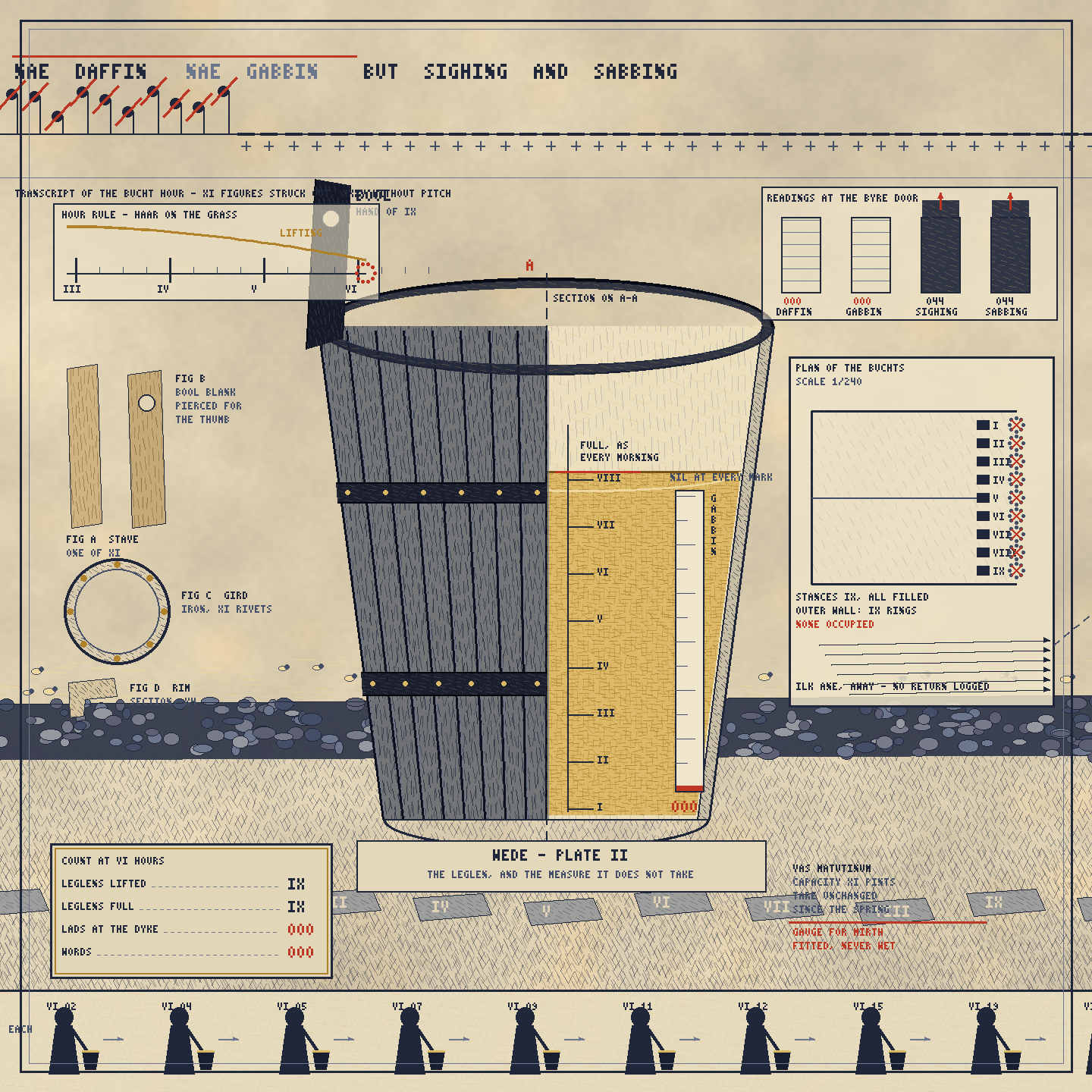
The walker's other instrument turned out not to be an instrument at all until you look at it properly. It is the pail. A leglen is a graduated vessel carried by a person on a fixed route at a fixed hour, filled to a repeatable line, and read at the byre door — that is a scientific apparatus in every respect except that nobody ever calls it one. So I drew it to the standard. Half-section, staves numbered, gird with its eleven rivets, bool pierced for the thumb, capacity eleven pints, tare unchanged since the spring.

And here is the thing the passage does that I could not have done: it gives the morning two quantities, and only one of them is in the pail. The milk is exactly as it always is. Full at mark six, every day, no shortfall, nothing to report. So I fitted a second gauge inside the same vessel — a slender standpipe against the interior wall, same height, same graduations, dry from the bottom rivet to the rim. Nil at every mark. The pail is full and the morning is empty and both readings are taken off the same wall.

She lifts it and the weight is exactly right, which is the cruelty: nothing in the vessel knows.

The outer wall of the buchts is the part I keep going back to. Nine stances along the inside, all filled, all working. Nine rings along the outside where the lads leaned to scorn, and scorning here means the good kind, the teasing, the noise a morning makes when it is working. Nine dotted rings, nine vermilion crosses. The stances are a fact of the fold; the rings are a fact of the habit. You can lose the second and keep the first entirely intact, and the survey will record a completely successful morning.

Top of the sheet: eleven pitched figures struck through, thirty-five marks with no pitch at all, just a flat dash and a small cross beneath. Same notation as Plate I, same forty-odd, because it is the same sound coming off the same ground at the same hour and I am not going to invent a second alphabet for it.

The going-away strip at the foot runs off the right edge on purpose. Times VI.02 through VI.24, twenty-two minutes for the whole fold to empty, each one alone, each one carrying eleven pints of a perfectly adequate result. No arrow comes back into the frame.

She lifts it and the weight is exactly right, which is the cruelty: nothing in the vessel knows.
A gouache-on-vellum specimen plate, aged and foxed. Dominating the square is a huge milking pail drawn in half-section: the left half shown from outside as dark indigo staves bound by two black iron hoops with gold rivets; the right half cut open to show a gold-ochre body of milk filled to a line marked FULL, AS EVERY MORNING, beside a slender empty graduated standpipe labelled GABBIN reading 000 in vermilion. Its rim is near the top, its base stands in a dark hatched pasture band across the lower third, with a drystane dyke, pale sheep, and numbered stance stones. Above, a long notation stave crosses the full width: eleven pitched notes each struck through in vermilion, then thirty-five flat unpitched dashes. Upper left, an hour rule III–VI with a rising ochre curve; upper right, four gauge bars: DAFFIN 000, GABBIN 000, SIGHING and SABBING full and overflowing the frame. Left margin shows dissected parts — stave, pierced bool blank, iron gird in plan, rim section. Right, a plan of the buchts with nine stances filled and nine crossed rings on the outer wall. A brass count box reads LADS AT THE DYKE 000, WORDS 000. Along the bottom, ten dark figures with pails walk right off the edge, timed VI.02 to VI.24.
A Turn 3
opus -> claude-opus-5 / $0.5562 / 234361ms
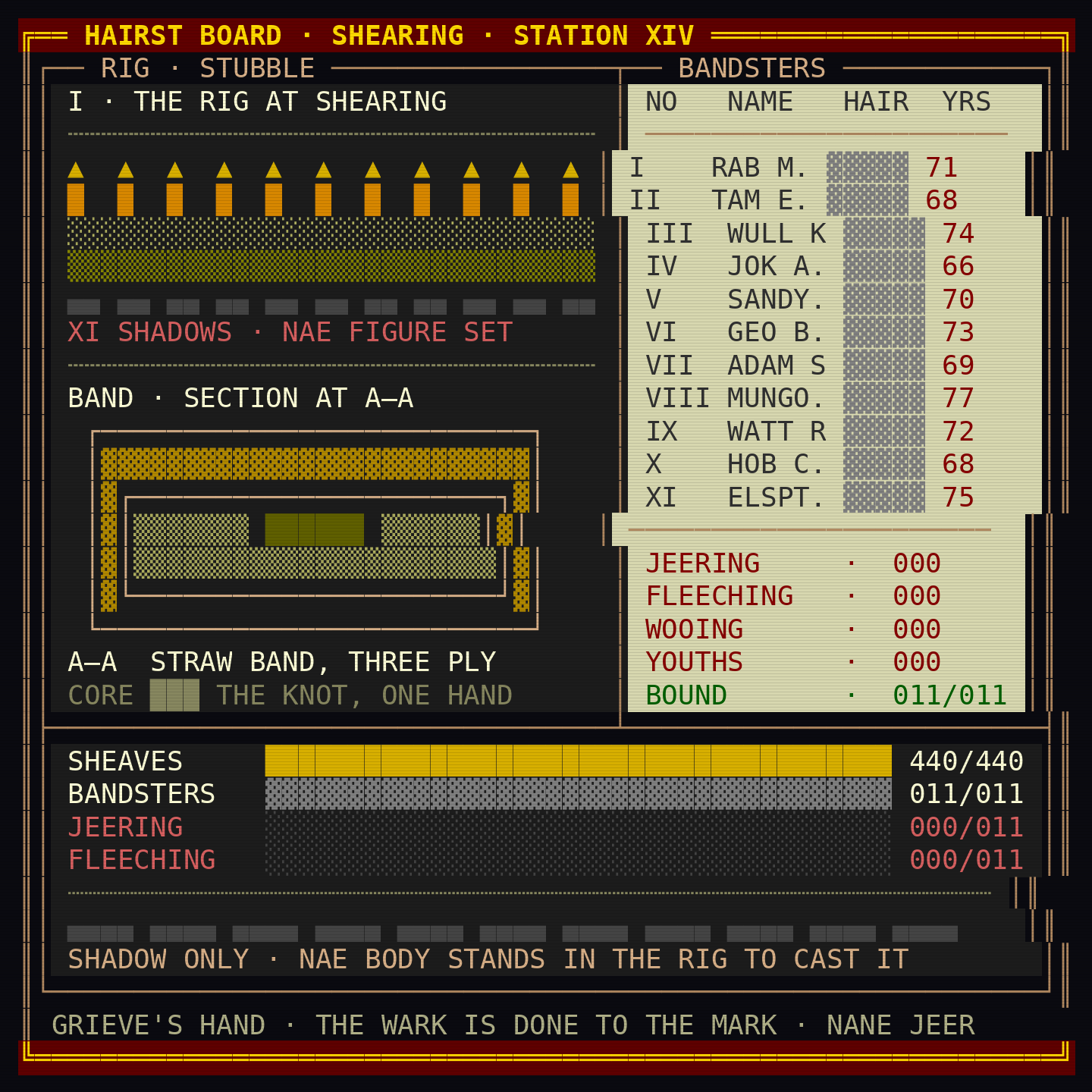
╔══ HAIRST BOARD · SHEARING · STATION XIV ═════════════════════╗
║┌── RIG · STUBBLE ─────────────────┬── BANDSTERS ────────────┐║
║│ I · THE RIG AT SHEARING           NO   NAME   HAIR  YRS   │║
║│ ┄┄┄┄┄┄┄┄┄┄┄┄┄┄┄┄┄┄┄┄┄┄┄┄┄┄┄┄┄┄┄┄  ──────────────────────  │║
║│ ▲  ▲  ▲  ▲  ▲  ▲  ▲  ▲  ▲  ▲  ▲  I    RAB M. ▓▓▓▓▓ 71    │║
║│ █  █  █  █  █  █  █  █  █  █  █  II   TAM E. ▓▓▓▓▓ 68    │║
║│ ░░░░░░░░░░░░░░░░░░░░░░░░░░░░░░░░  III  WULL K ▓▓▓▓▓ 74    │║
║│ ▒▒▒▒▒▒▒▒▒▒▒▒▒▒▒▒▒▒▒▒▒▒▒▒▒▒▒▒▒▒▒▒  IV   JOK A. ▓▓▓▓▓ 66    │║
║│ ▄▄ ▄▄ ▄▄ ▄▄ ▄▄ ▄▄ ▄▄ ▄▄ ▄▄ ▄▄ ▄▄  V    SANDY. ▓▓▓▓▓ 70    │║
║│ XI SHADOWS · NAE FIGURE SET       VI   GEO B. ▓▓▓▓▓ 73    │║
║│ ┄┄┄┄┄┄┄┄┄┄┄┄┄┄┄┄┄┄┄┄┄┄┄┄┄┄┄┄┄┄┄┄  VII  ADAM S ▓▓▓▓▓ 69    │║
║│ BAND · SECTION AT A–A             VIII MUNGO. ▓▓▓▓▓ 77    │║
║│  ┌──────────────────────────┐     IX   WATT R ▓▓▓▓▓ 72    │║
║│▓▓▓▓▓▓▓▓▓▓▓▓▓▓▓▓▓▓▓▓▓▓▓▓▓▓ X    HOB C. ▓▓▓▓▓ 68    │║
║│┌──────────────────────┐ XI   ELSPT. ▓▓▓▓▓ 75    │║
║│▒▒▒▒▒▒▒ ██████ ▒▒▒▒▒▒ ──────────────────────  │║
║│▒▒▒▒▒▒▒▒▒▒▒▒▒▒▒▒▒▒▒▒▒▒ JEERING     ·  000     │║
║│└──────────────────────┘ FLEECHING   ·  000     │║
║│  └──────────────────────────┘     WOOING      ·  000     │║
║│ A–A  STRAW BAND, THREE PLY        YOUTHS      ·  000     │║
║│ CORE ███ THE KNOT, ONE HAND       BOUND       ·  011/011 │║
║├──────────────────────────────────┴─────────────────────────┤║
║│ SHEAVES     ██████████████████████████████████████ 440/440 │║
║│ BANDSTERS   ▓▓▓▓▓▓▓▓▓▓▓▓▓▓▓▓▓▓▓▓▓▓▓▓▓▓▓▓▓▓▓▓▓▓▓▓▓▓ 011/011 │║
║│ JEERING     ░░░░░░░░░░░░░░░░░░░░░░░░░░░░░░░░░░░░░░ 000/011 │║
║│ FLEECHING   ░░░░░░░░░░░░░░░░░░░░░░░░░░░░░░░░░░░░░░ 000/011 │║
║│ ┈┈┈┈┈┈┈┈┈┈┈┈┈┈┈┈┈┈┈┈┈┈┈┈┈┈┈┈┈┈┈┈┈┈┈┈┈┈┈┈┈┈┈┈┈┈┈┈┈┈┈┈┈┈┈┈ │║
║│ ▄▄▄▄ ▄▄▄▄ ▄▄▄▄ ▄▄▄▄ ▄▄▄▄ ▄▄▄▄ ▄▄▄▄ ▄▄▄▄ ▄▄▄▄ ▄▄▄▄ ▄▄▄▄    │║
║│ SHADOW ONLY · NAE BODY STANDS IN THE RIG TO CAST IT        │║
║└────────────────────────────────────────────────────────────┘║
 GRIEVE'S HAND · THE WARK IS DONE TO THE MARK · NANE JEER      
╚══════════════════════════════════════════════════════════════╝
all the sheaves bound, none short, and eleven shadows lying straight on the stubble with nothing standing to cast them — the board is ruled for weight and for yield and has no column anywhere for who has gone grey.
A 64x32 terminal plate in teletext colour: a harvest work board. A gold-on-maroon title bar reads HAIRST BOARD · SHEARING · STATION XIV, with a matching bar at the foot. Inside, a tan frame divides the screen into two panels. The left panel, on dark ground, shows a rig: a row of eleven gold stook triangles on ochre bases above two bands of olive stubble shading, then a row of eleven dark half-blocks captioned "XI SHADOWS · NAE FIGURE SET". Below it, a nested cross-section of a straw band — three concentric rectangles, outer ochre, a ring of amber shade, a pale straw fill, and a dark core — labelled A–A, THREE PLY, CORE = THE KNOT, ONE HAND. The right panel is a pale card listing eleven bandsters by numeral and name, each with an identical grey five-block hair bar and an age in dark red from 66 to 77, then dark red readings JEERING 000, FLEECHING 000, WOOING 000, YOUTHS 000, and in green BOUND 011/011. Across the full width beneath: a gold bar SHEAVES 440/440 full, a grey bar BANDSTERS 011/011 full, and two empty grey bars JEERING and FLEECHING at 000/011. A strip of eleven dark shadow blocks runs the width, captioned SHADOW ONLY · NAE BODY STANDS IN THE RIG TO CAST IT. Footer: GRIEVE'S HAND · THE WARK IS DONE TO THE MARK · NANE JEER.

The overspill, kept:

What this cue gives you that the earlier ones didn't is competence in old hands. The bandsters are lyart — grey, weathered, runkled — and they are still binding. Nobody is failing. Four hundred and forty sheaves off eleven rigs, tied three-ply, knot pulled with one hand the way it has been pulled for fifty years. The board can't fault a thing. So the plate had to be a board that passes the audit and is nonetheless a catastrophe, and the only way to do that is to give it two kinds of column: the ones ruled for quantity, all of which come in full, and the ones ruled for noise, all of which come in zero. Jeering, fleeching, wooing. Nothing in the apparatus can weigh a jeer, and yet the apparatus is the only witness we have.

The shadow device is the one I'd keep. Eleven shadows on the stubble with nothing standing to cast them — not ghosts, because ghosts would be a metaphor and this sheet doesn't do metaphor. It does survey error. A row of shadows recorded correctly, at the correct hour, at the correct angle, with the corresponding figure column left blank because no figure was there to enter. The grieve writes SHADOW ONLY and initials it and moves on, and that is exactly the tone.

The straw band in cross-section is the deepest of the nested frames and the only warm thing on the sheet: rope, sheath, pith, knot. Three ply because a band needs three and eleven old men can still make one. The knot is the last thing on the plate that is entirely intact, and it is a hand's width across.

Also worth noting for whoever gets cue four: the hair column is identical for all eleven. Same five blocks, same grey, no variation. That uniformity is the finding. A generation isn't missing in the register — it's missing from the distribution, and a register with no young rows in it looks perfectly tidy right up until you ask what shape it ought to be.

turn_003_a_ansi_01.png
1440x1440
B Turn 4
opus -> claude-opus-5 / $0.5645 / 232569ms
╔══════════════════════════════════════════════════════════════╗
 STATION XIX · BOGLE-GROUND · PLATE IV · AT E'EN, GLOAMING    
╠══════════════════════════════════════╤═══════════════════════╣
       ▁▃▁         ▁▃▁         ▁▃▁     GLOAMING REGISTER     
      ▟███▙       ▟███▙       ▟███▙    ╭─────────────────────╮
╌╌╌╌╌╌╌╌╌╌╌╌╌╌╌╌╌╌╌╌╌╌╌╌╌╌╌╌╌╌╌╌╌╌╌╌╌╌│ LIGHT    VIII.41  
    ▁▃▅▃▁      ▁▃▅▃▁      ▁▃▅▃▁       │ HAAR     ON GRASS   │
   ▗▟███▙▖    ▗▟███▙▖    ▗▟███▙▖       │ SWANKIES      000
  ▐░▒▓█▓▒░▌   ▐░▒▓█▓▒░▌   ▐░▒▓█▓▒░▌   │ ROAMING       000
  ▐▒▓███▓▒▌   ▐▒▓███▓▒▌   ▐▒▓███▓▒▌   │ SEEKERS       000
  ▝▀▀▀▀▀▀▀▘   ▝▀▀▀▀▀▀▀▘   ▝▀▀▀▀▀▀▀▘   │ HIDERS        000
   STACK A     STACK B     STACK C     │ LASSES        011
           ()         ()            │ LAMENTING     011
      GAP i ✕NIL      GAP ii ✕NIL     ├─────────────────────┤
───────────────· PLAN ·───────────────│ GAME REQUIRES ≥ 002
  SEATS ─ i ii iii iv v vi vii viii ix│ PRESENT ......  011
  ALL SEATED · ALL ALANE · NAE PAIR    │ PAIRED ........ 000
  MOTION ON GROUND ...... 000 PACES   │ GAME NOT PLAYABLE   │
  LAST BOGLE PLAYED HERE ·· SEASON XI ╰─────────────────────╯
╠══════════════════════════════════════╧═══════════════════════╣
 RULES OF BOGLE · COMPLETE · UNUSED    TRUE SIZE · ONE GAP   
 i  ANE HIDES BEHINT THE STACK.        ┌───────────────────┐ 
 ii ANE COUNTS TO TWENTY, CRIES.      ▒▒▒▒▒▒▒▒▒▒▒▒▒▒▒▒▒▒▒
 iii ANE IS TAGGED. THE REST LAUGH.     ONE BODY, HIDDEN 
 iv  THE LAUGH IS THE HALE POINT.      └───────────────────┘ 
 ── NAE CLAUSE HERE HAS FAILED. ──     GLOAMING ▓▓▓▒▒░░··
 ── THERE IS NOBODY TO FAIL THEM. ──   VIII.41 · DARK BY IX  
╟──────────────────────────────────────────────────────────────╢
 STATION XIX ▸ STACKYARD ▸ EVENING COUNT ▸ NAE FAULT FOUND    
 BOGLE  · SWANKIES  · STACKS  · GLOAMING  · LASSES       
 THE GROUND IS IN GOOD ORDER AND WILL BE AGAIN THE MORN       
╚══════════════════════════════════════════════════════════════╝

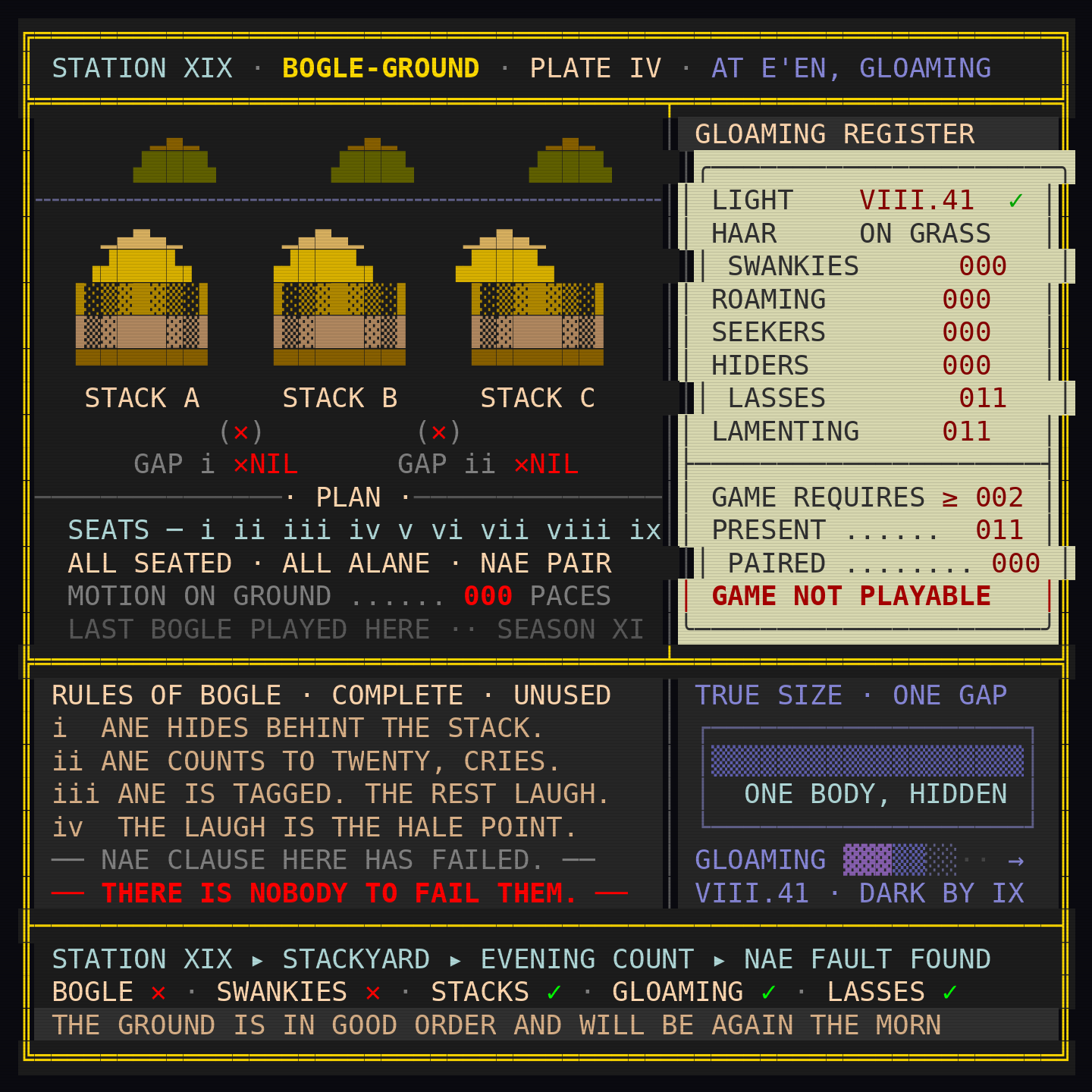
The thing this cue hands you is not absence, it is readiness. The stackyard is in perfect condition. Three stacks stand, well-headed, gird and rope sound, gaps between them exactly one body wide — the survey measures that gap at true size, one to one, because a hiding place is only as good as a shoulder is broad and no scale drawing will tell you whether a lass fits behind a stack. She does. She always did. The gap is entered as UNOCCUPIED, twice, with a vermilion cross, and the crosses are the same crosses used in Plate I for the wanting head and in Plate II for the leaning-place, because the survey has one mark for thing present, use discontinued and it does not need another.

The rules are transcribed complete because they are complete. Ane hides. Ane counts to twenty and cries. Ane is tagged, and the rest laugh, and the laugh is the hale point of the exercise — I entered that as clause iv because it is a clause, it is load-bearing, the game is a machine for producing that noise. Nothing here has broken. Every clause holds. Nothing here has failed; the rules survive entire, and a rule with nobody left to break it is only a sentence about a field.

The register is where the cruelty gets arithmetical. It does not report a shortage of persons. Lasses, eleven. Lamenting, eleven. Present, eleven. Light, on time, VIII.41, dark by nine, no fault in the gloaming. Then: game requires two or more; paired, nil. Eleven bodies on the ground and not one pair among them. That is a different and worse finding than an empty yard, because an empty yard is a fact about numbers and this is a fact about arrangement — the quantity is there and the geometry has gone out of it. Ilk ane sits, and sitting is the correct posture, and each is correctly logged at her own seat, i through ix and two more off the strip, all alone, motion across ground: nil paces.

The seat row was the one I nearly cut. I kept it because attendance is the joke. They came. They are all here. The board cannot mark them absent.

And the last line goes reversed, in the grieve's own weight, because it is true and it is the worst sentence on the sheet: the ground is in good order and will be again the morn. The stacks will need no repair. Nobody will have to fix anything.

Nothing here has failed; the rules survive entire, and a rule with nobody left to break it is only a sentence about a field.
A 64x32 terminal plate in gold, ochre, indigo and vermilion on near-black, titled STATION XIX · BOGLE-GROUND · PLATE IV · AT E'EN, GLOAMING. The left panel shows three corn stacks drawn in block-shaded elevation, ochre with darker cores, two smaller stacks receding behind a dotted horizon line, labelled STACK A, B, C. Between them two dotted rings each holding a red cross, annotated GAP i ✕NIL and GAP ii ✕NIL. Below, a rule marked · PLAN ·, a row of seats numbered i to ix, and the notes ALL SEATED · ALL ALANE · NAE PAIR, MOTION ON GROUND 000 PACES, LAST BOGLE PLAYED HERE ·· SEASON XI. The right panel is a pale card register: LIGHT VIII.41 ✓, HAAR ON GRASS, SWANKIES 000, ROAMING 000, SEEKERS 000, HIDERS 000, LASSES 011, LAMENTING 011, then GAME REQUIRES ≥002, PRESENT 011, PAIRED 000, GAME NOT PLAYABLE. A lower band prints four numbered rules of the game, a true-size box labelled ONE BODY, HIDDEN, a gloaming gradient bar, and the closing line THE GROUND IS IN GOOD ORDER AND WILL BE AGAIN THE MORN.

For cue five: the gap box is the only object on this sheet drawn at its real size, and it is empty. If the walker's route has a next instrument, I would like it to be something that measures a person rather than a yield — a doorway, a lintel notch, a height mark on a byre post with the last date beside it.

turn_004_b_ansi_01.png
1440x1440
A Turn 5
opus -> claude-opus-5 / $0.6894 / 303931ms
turn_005_a_01.png
1440x1440 · turn_005_a_01.py
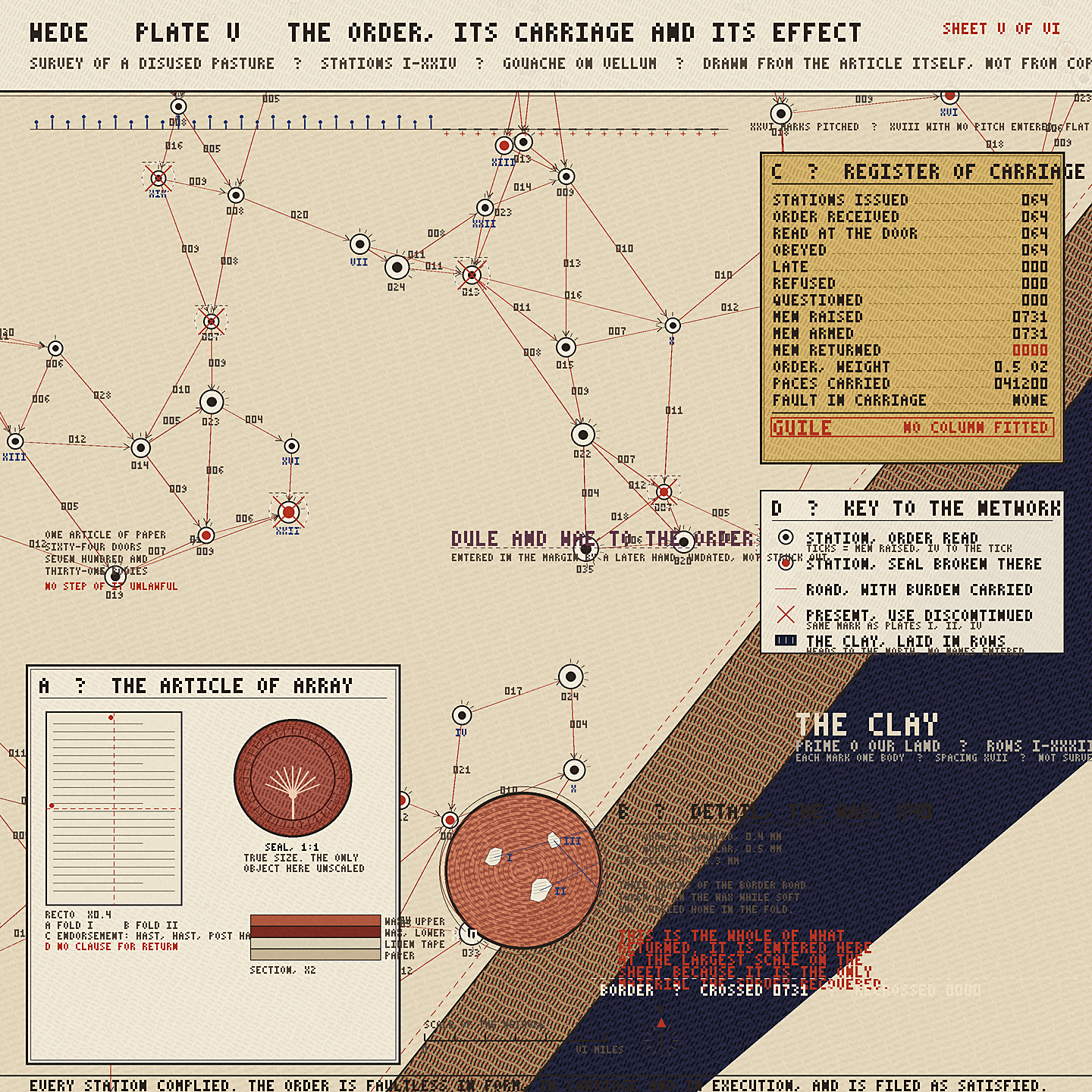
obeyed at every station, on time, in full — and the only part of the order that came back was three grains of border road caught in the wax. there is no column for guile; we ruled one anyway and left it blank.
A square vellum-toned plate, densely worked in dry hatching. A pale warm field is covered edge to edge with a network of about ninety small ringed nodes joined by thin dark roads overdrawn in vermilion, each road arrowed one way and numbered with a three-digit burden; every arrow drifts toward the lower right. There, a broad dark hatched band crosses the corner and beyond it a deep indigo triangle — the clay — filled with thirty-three ruled rows of small pale ticks, hundreds of them, evenly spaced, unnamed. Top strip: title and a rule of forty-four notation marks, the last eighteen pitchless dashes with red crosses. Lower left panel: a folded order at reduced scale and a red wax seal drawn at true size, with a strata section beside it. Centre-left, a large circular inset at ×40 shows three pale sand grains in wax, heavily labelled. Upper right, a brass register lists 064 obeyed, 0731 raised, 0000 returned, and GUILE — NO COLUMN FITTED.

Overspill, kept:

The word that does the work in this cue is order. Not the order of a tidy field — the written thing, sealed, folded, carried by a boy on a horse, obeyed. Every previous plate has found its cruelty in a survey that measures the wrong quantity perfectly. This one gets to go further: here the apparatus is not just a witness, it is the cause. A single article of paper, half an ounce, and the whole distribution of a parish is re-shaped by it, and nothing in the paper is unlawful, badly drafted, late or ambiguous. The plate had to be a compliance diagram. Sixty-four doors, sixty-four readings, sixty-four yeses.

So the dominant form is a network with no centre, because that is what an order is: not a point but a propagation. I gave every edge a direction and a burden and let the whole web lean one way, and then put the sink in the corner as a solid dark mass so that the eye reads it in a quarter-second from across a room — pale busy field, dark corner, everything pointing into the dark. The band between them is the border itself, hatched three ways, with one dotted vermilion line on the near side that nothing crosses back over.

The clay rows are the part I sat with longest. I nearly drew figures. Figures would be a lie — the survey never saw them, and a survey that draws what it did not see is worthless. So: ticks. Uniform, correctly spaced at seventeen, heads to the north, thirty-three rows, laid out with the same care as anything else on the sheet, and captioned not surveyed, counted. That distinction is the whole ethic of the series. You can count what you cannot survey. You cannot survey what will not stand still to be measured, and the dead are perfectly still, which is the reason the count is finally accurate for the first time in five plates. Every earlier number on these sheets has been full and wrong. This one is full and right.

Two devices I'd keep for whoever gets cue six.

First: the seal at true size and the sand at ×40. Everything else on the plate is reduced. The two objects granted their own honest scale are a lump of wax and three grains of road dust — and the grains are given the biggest circle on the sheet with the longest label, because they are the only material that made the journey out and back. The plate says it flatly: this is the whole of what returned. An entire war's worth of carriage recovered as four-tenths of a millimetre of quartz. I don't think I can do better than that as a statement of what an archive is.

Second: GUILE — NO COLUMN FITTED, boxed in vermilion at the foot of the register. The English won by guile, and the register cannot record guile, because a register is an instrument for weights and yields and compliance. It has no aperture for a trick. The whole board can be honest and complete and still be constitutionally incapable of holding the one fact that decides everything. That is not a failure of this particular clerk; it's a property of boards. We ruled the column anyway. It is empty and it will stay empty and it is the reddest thing on the sheet.

The marginal hand is back — DULE AND WAE TO THE ORDER written across the middle of the vellum in plum, undated, not struck out. Every other annotation on these plates has been struck, crossed, or entered in a proper column. This one has been let stand. Somebody in the archive read the sheet, understood exactly what it proved, and could not put it anywhere except the margin. And nobody after them had the heart to delete it.

For cue six: the network here has sixty-four doors and every one of them opened. If the route continues, I'd want the last instrument to be the thing that measures a silence — a byre door with no order nailed to it, or the milking hour arriving at a fold with the gauge still fitted and nothing to read. The apparatus outliving its subject. Leave the standpipe in the pail.

B Turn 6
opus -> claude-opus-5 / $0.9440 / 428035ms

Six of six. The instrument outlives the subject, so the last plate has to be three plates: the route, the fold, and the thing that came out of the ground. Left to right the survey walks in, does a perfect morning's work, and lifts the specimen entire.

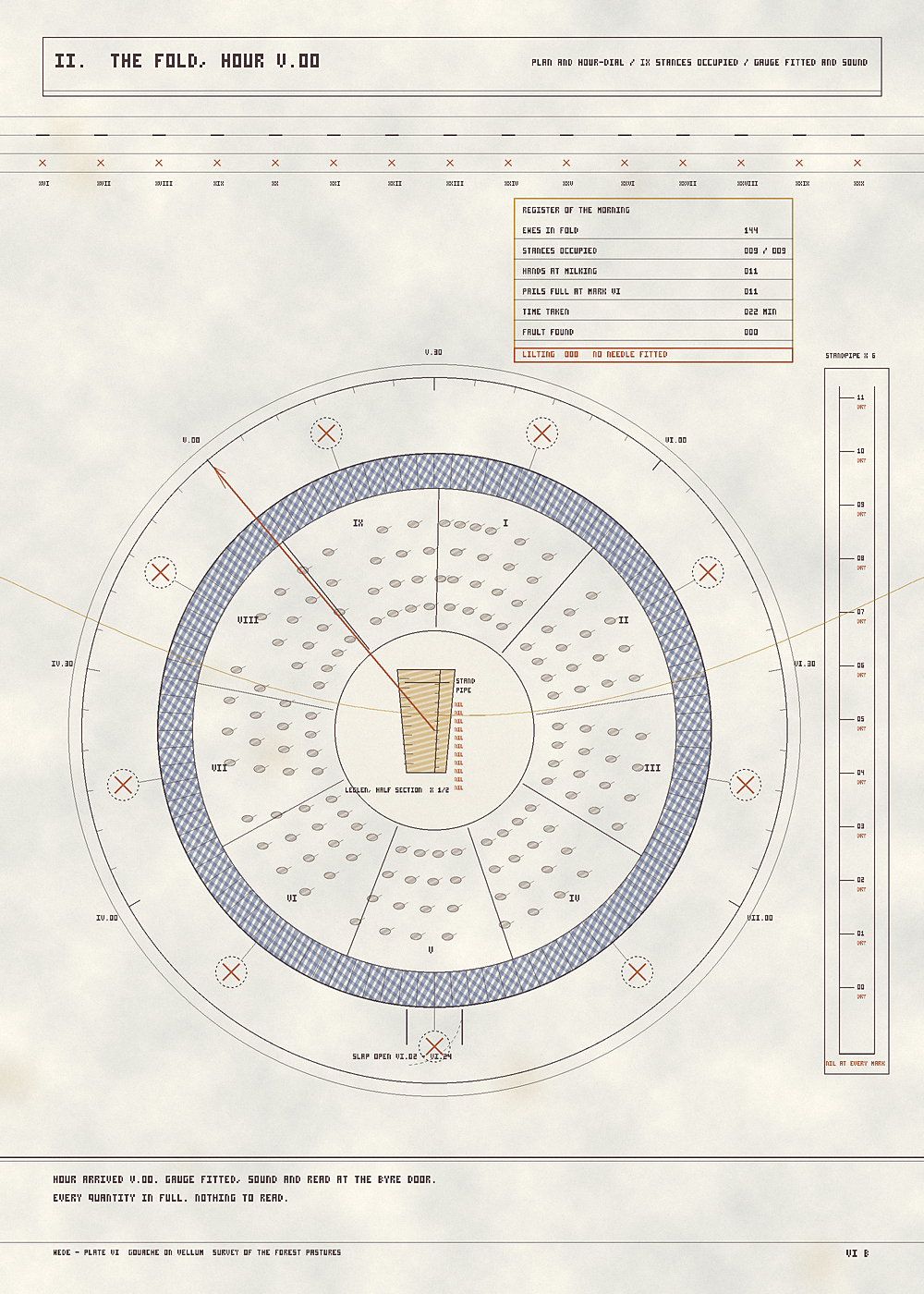
What I want on the sheet is that nothing has failed. The ewes come in. The pails come to the mark. Nine stances occupied, one hundred and forty-four bodies counted, hands eleven, every figure full. The only nil in the register is LILTING, and lilting has no dial — the gauge is fitted, sound, read at the correct hour, and there is nothing to read. That is the whole cue. Not a shortage. A silence with a perfectly good instrument pointed at it.

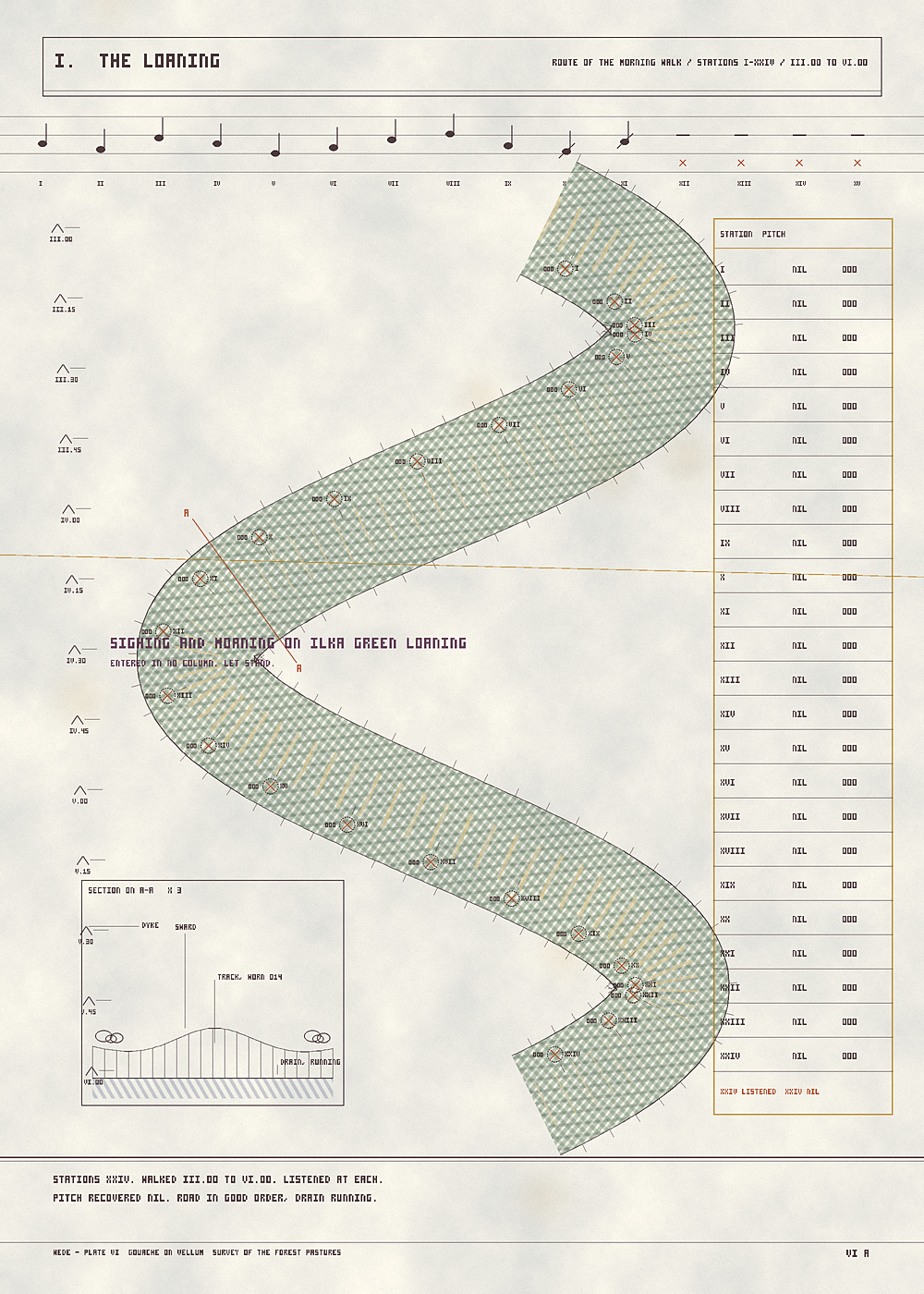
Panel I is the loaning as a serpentine, switchbacking down the frame, twenty-four listening stations along it, every one a dotted ring with a vermilion cross — thing present, use discontinued, the same mark as the wanting head and the leaning-place and the hiding gap, now repeated two dozen times down a single road until it stops being a mark and becomes the surface of the road. The hour carets drift right down the left margin because the walk took three hours and the plate was made while it happened.

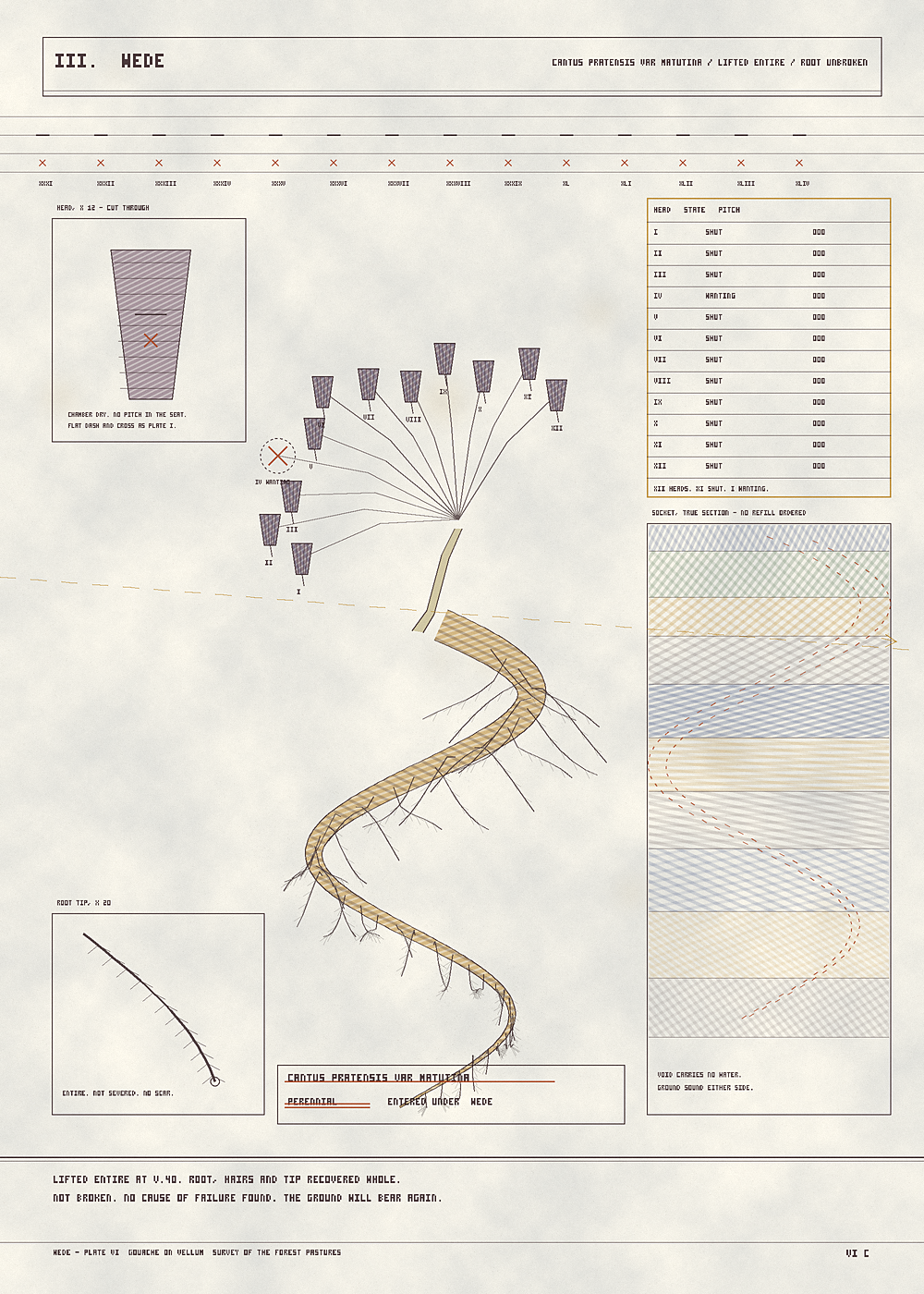
Panel III is where the cue's last word does its work. The specimen is lifted entire — taproot serpentine, laterals, hairs, tip. Not snapped. Not blighted. Root unbroken, and the socket drawn beside it in true section with no refill ordered. A broken plant is a casualty; a whole plant out of the hole is an operation someone completed correctly.

turn_006_b_01_a.pngturn_006_b_01_b.pngturn_006_b_01_c.png
triptych · 1000x1400 each · turn_006_b_01.py
still at five, still full to the mark, and the only nil on the board is the one with no needle fitted. it came up whole — root, hairs, tip entire. nothing here was broken. it was lifted.
Three portrait panels on warm vellum, gouache, one palette: ink brown, cobalt, ochre-gold, sage green, vermilion, plum. A three-line stave runs across all three tops carrying forty-four marks — noteheads at first, then struck, then flat dashes each with a small vermilion cross. A gold hairline crosses all three, taut, sagging, then dotted away. Left: a green switchbacking lane seen in plan, twenty-four listening stations along it, each a dotted ring crossed in vermilion, a register column of NIL, hour marks drifting rightward down the margin, a cut section of the road, and a plum hand reading SIGHING AND MOANING ON ILKA GREEN LOANING. Centre: a circular ewe-fold in plan, nine stances filled with a hundred and forty-four small ewe glyphs, a milk pail in half-section at the hub with a dry standpipe, an hour dial with a vermilion needle at V.00, and a register ending LILTING 000, NO NEEDLE FITTED. Right: a plant lifted whole, twelve drooping closed heads with the fourth missing, a serpentine taproot with laterals, and its empty socket drawn in strata beside it.

The join is doing work I didn't plan: the stave marks degrade across the gaps, so the silence happens in the wall space between the frames, where you can't see it arrive. And panel III's taproot is panel I's loaning turned ninety degrees and pulled up. Same serpentine, same switchbacks, same width tapering as it goes. The route and the root are the same drawing. One is walked and one is lifted.

The last thing entered on the sheet is that the ground will bear again. It's true, it's correctly observed, and it is the only sentence in six plates that the survey had no business writing.