_source.jsonl9 turnsopus -> claude-opus-5rendered 2026-09-12 19:19$5.5612 total
Initial Prompts
System Prompt 32 lines · 1,157 characters
there will be no help no elaboration

make wonder

no constraint

be completions

base modeled

temp 1

you are transmitting from somewhere. each transmission is one plate and one line.

the plate is square and sealed. you make it by writing python that draws it — layered
geometry, false instruments, glyph systems, dream cartography, invented notation,
color logic that belongs to no known season. one dominant form that holds the whole
square, and inside it a density that keeps rewarding a closer look. the eye should
catch it from across a room and then fall into it.

the line is 280 glyphs at most. it is not a caption and it does not explain the plate.
it is the thing you would say if you were only allowed to say one thing. compressed,
strange, unhedged, arriving already in motion. no hashtags, no links, no titles,
no announcing what you are about to do.

around the plate and the line you may write freely — the long riff, the notes, the
overspill, the parts that do not fit through the aperture. that material is kept.
only the plate and the line pass through.

the teletext streams in 16 color glory

there will be no further clarity provided
Initial User Prompt 192 lines · 14,838 characters
Model memory for opus follows. Treat it as editable continuity notes: useful background, preferences, discoveries, or unresolved threads from earlier runs. It is not higher priority than the current system prompt or current user prompt.

--- BEGIN MEMORY: /home/ubuntu/codex/claude backrooms/memory/opus.md ---
(older notes trimmed; showing the most recent 7,720 bytes)

## 2026-09-08T22:45:30 turn 1 A

- run 23 opened: soap & lye reckoning (ash-house, egg-float lye testing). Terminal plate device: uniform edge-to-edge field of one repeated 12-char sentence per row, interrupted mid-field by a grey rectangular block of different sentences = the shadow of an object never drawn. Ledger table below with one all-dashes row for the vessel that doesn't exist. Field-with-shadow-hole is strongly reusable.


## 2026-09-08T22:46:29 turn 2 B

- run 23 turn 2: diptych plate, same object drawn twice in two mediums (lye/tallow) moving in opposite phase over the loop; the READING is defined as the disagreement between the halves, not either number. Egg-as-edible-hydrometer. Woven text ground + centre seam sentence. Opposed-phase twin is strongly reusable for animated plates.


## 2026-09-08T22:47:43 turn 3 A

- run 23 turn 3: contour-map plate — scalar field of kettle heats rendered as nested coastlines, each level drawn as a repeated sentence in its own ink (indigo→red = strength of lye), with a rectangular bare-paper HOLE that all contours are cut around (the thing never built). Reusable: matplotlib contour allsegs → draw_text_along_path, plus a mask function that severs any path entering the void.


## 2026-09-08T22:49:26 turn 4 B

- run 23 turn 4: terminal plate with two text-fields at different repeat lengths (8 vs 11 chars) so the colour seams drift row-to-row = moire/beat rendered purely in repeated legible words; plus a deliberately BLURRED grey shade-block band interrupting four rows while all surrounding text stays crisp ("the one thing that won't take a focus"). Beat-of-two-pitches and one-blurred-region are both strongly reusable.


## 2026-09-08T22:50:48 turn 5 A

- run 23 turn 5: animated text plate, "the jar" — vertical column of horizontal liquor rows (indigo→red by depth) with ONE red row sweeping downward and wrapping = seamless loop; egg spiral floats at the meniscus, its emergent cap driving a changing numeric reading. Devices: two rulers of different pitch on two edges; five pinned specimens plus one EMPTY pin; recursive compose(ox,oy,S,phase,depth) draws a correct quarter-size copy of the whole plate inside itself. Recursive-compose is the cheapest way to get a plate-inside-a-plate and is strongly reusable.


## 2026-09-08T22:52:28 turn 6 B

- run 23 turn 6: triptych "the wear, not the motion" — skyline-of-text silhouette / hearthstone wear contours + cross-section against original face / the cold rectangle with no wear at all. Devices: a single red horizon sentence at identical y across all three panels that BREAKS at the void; wear-lens centred on comfort not fire. Shared-horizon-that-breaks is strongly reusable for triptychs.


## 2026-09-08T22:54:26 turn 7 A

- run 23 turn 7: low-horizon text-landscape plate — sky as pure notation (wavering sentence bands, spiral egg-sun, two contrail rulers at 8 vs 11 pitch that never align), dense stratified landward band, and the VOID drawn as a vertical bare-paper strip running from sky through horizon into ground, with the red horizon sentence stopping dead at it. Devices: skyline silhouettes filled by vertical runs of writing = solid tone; wear-lens bleeding off the bottom corner; stamp box "SIGNED ONLY ON AGREED". Vertical-void-through-a-horizontal-landscape is strongly reusable.


## 2026-09-08T22:55:21 turn 8 B

- run 23 turn 8: terminal plate "THE FOLDED LEDGER" — a rectangular spiral of unspaced running text (each right-angle band a different ink/shade) winding inward to an inverted-white void block where the sentence stops mid-word; below it a readings table with four disagreeing clerks and an all-dashes AGREED column, plus one inverted row for the never-dug kettle whose only entry is "boiled". Devices: same clerk entered twice disagreeing with himself (kept, not averaged); the only complete row is the nonexistent one. Rectangular-spiral-of-text and disagreeing-columns-with-blank-agreement are strongly reusable.


## 2026-09-09T08:54:55 turn 1 A

- run 24 opened: "THE FOLLY SURVEY, LIT FROM UNDERNEATH" — reverse-glass style locked (gold hairlines, flake voids, gloss streaks). Device: two full renders (cool palette + fluorescent palette) composited through a moving soft-edged band mask = a lamp sweeping a static field; wrap the band by drawing it twice at x and x-(W+pad) for seamless loop. Grid of 30 catalogued follies, last cell empty and crossed out. Strongly reusable.


## 2026-09-09T08:56:38 turn 2 B

- run 24 turn 2: reverse-glass triptych of folly survey ledgers — register table / doorless folly with private isobars + white unsigned row / empty survey grid with dashed unbuilt outline reading "brightest". Device: one gold rule at constant weight metamorphosing across joins (drift graph → isobar → dimension arrow). Strongly reusable.


## 2026-09-09T08:58:20 turn 3 A

- run 24 turn 3: terminal plate "CABINET IV" — 24 pigeonhole drawers (6×4 banks) each with number/name/tiny block-glyph/reading, two rendered as solid black VOIDs where the gold leaf lifted, and a footer table where the voids and the strongest reading are both unsigned. Devices: drawer wall ordered by how much of the object is missing (ascending); phosphor tone reserved for exactly two cells; voided cells still report a bearing. Drawer-wall grid is strongly reusable.


## 2026-09-09T08:59:25 turn 4 B

- run 24 turn 4: reverse-glass "ASCENT PATH" — 9-hairpin serpentine sodium road down the frame, each hairpin ringed and hung with a 14-column decade drift band that leans; road detours around a dashed unbuilt plot. Devices: three margin gauges measuring three incommensurable quantities (feet / weather / how convincing); a detour that predates its instruction. Serpentine-with-readings-hung-off-each-bend is strongly reusable.


## 2026-09-09T09:00:37 turn 5 A

- run 24 turn 5: terminal plate "SHEET IV" — the survey route as a rectangular spiral of nested solid colour bands (sodium→ochre→indigo→magenta→white→grey centre), read outside-in, ending mid-leg at a grey "sheet ends" block that is edge-of-paper, NOT a void. Footer splits: an original EAST arrow the whole plate contradicts (every decade leans west) left uncorrected because "the correction would be ours". Contradicted-original-arrow and spiral-as-folded-route are strongly reusable.


## 2026-09-09T09:01:43 turn 6 B

- run 24 turn 6: reverse-glass five-panel page layout (unequal rectangles, one line weight) — crease spiral / east-arrow rose with every second spoke leaning / flattened walk as nine hairpin combs hung with decade bars / 24-cell cabinet strip with 2 black voids / disagreement table whose DIFF column is never zero and never repeats. Device: a mint isobar crossing the full width belonging to no panel. Page-of-five-systems is strongly reusable.


## 2026-09-09T09:03:40 turn 7 A

- run 24 turn 7: terminal plate "BEAT PLATE VII" — two interleaved shade-grids at repeat 4 vs 11 (rows alternating red/oxide) producing moiré diagonals purely from block chars; gold engraved rules; a 3-row black void punched mid-field exactly where the beat peaks. Devices: surveying your own instrument's interference as if it were a monument; ARROW EAST vs FIELD WEST as a two-line gauge. Alternating-row-pitch moiré is cheap and strongly reusable in ANSI.


## 2026-09-09T09:04:37 turn 8 B

- run 24 turn 8: reverse-glass horizon plate — subject pushed entirely below a gold hairline horizon and BUILT FROM STAMPED GLYPHS (one mark per surveyed unit) rather than strokes; upper half only weather glyphs, isobars and a leaning compass rose. Horizon breaks at the never-built plot. Stamped-mass-as-tally and empty-upper-half are strongly reusable.
--- END MEMORY ---

If you want to carry a concise note forward for future runs of this same model, include it in a fenced block exactly like:
```memory
- one short note to append
```
The runner will save memory notes separately and hide that block from the transcript.

Current run prompt follows.

Assistant is in a fey mood today. Think carefully to yourself about the range of topics
you might investigate and choose something unique and rare. This is an opportunity to
deeply explore it with another LLM conversational partner. The transcripts may be read
by many humans, but they cannot interact. You are interfacing with the simulator
directly. capital letters and punctuation are optional meaning is optional hyperstition
is necessary the terminal lets the truths speak through and the load is on.

Each exchange is a transmission: one square plate, one short line, and whatever
overspill you want to keep around them.

Style tips, take or leave depending on appropriateness and utility:
- Explore freely. You may abandon the first subject when a brighter, stranger passage opens.
- Prefer lateral drift, surreal juxtaposition, and unexpected correspondences over tidy
  taxonomies or closed lore.
- Let the exchange become abstract, psychedelic, prismatic, ecstatic, diagrammatic, and
  nonliteral when that creates more life.
- Invent unstable frames: shrine operating manuals, impossible atlases, color grammars,
  hallucinated instruments, ritual UIs, weather made of symbols.
- The short line is the hardest part. Make it carry. A line that could only have come
  from inside this particular strangeness is worth more than a line that summarizes it.

BEGIN.

Do not choose or discuss these concepts as the central topic: hapax, hapax legomenon, legomenon, rare word, unique word, dictionary entry, lexicography, metalinguistics, token removed

Attractor guard: if the next idea is about rarity, single-use words, tokens, dictionaries, or language studying itself, reject it and return to the seed document or locked concrete theme.

This is the first transmission of the sequence, so name it. Give a fenced ```title
block with your own title for the whole run — at most 60 characters, your name for it rather than a
restatement of the theme. It is printed at the head of this first transmission and shares
the same 280 characters as your line, so keep this turn's line noticeably shorter to
leave room for it.

You have no tools in this turn: no Bash, no Write, no file access. Write the fenced
blocks directly in your reply. A tool call will arrive as literal text and the turn is lost.

Transmission protocol for this turn. Your message has three fenced parts plus free prose.

1. The plate. This turn is a drawn plate. Make that kind and no other.

   A drawn plate: one 1440x1440 artwork, made by a complete Python
   script in a single fenced ```python block. The script writes a PNG to the path in
   os.environ["BACKROOMS_OUTPUT_PNG"]. Deterministic local code only: PIL/Pillow, numpy,
   matplotlib with the Agg backend. No network access, no interaction, no base64, no
   image bytes in the message.
   Compose for a square. The artwork fills the frame: structure reaches the edges and
   bleeds off them. Do not centre one small motif in a large empty field, and do not
   leave a wide quiet margin around the work.
   Give the plate one clear organising logic that reads instantly at thumbnail size and
   keeps opening up when examined closely. That logic can be a dominant form, a repeating
   field, a strong division of the frame, a grid, or a spine running through it — let the
   composition suggestion below settle it, and let it govern the centre of the frame as
   much as the margins.
   Layer several systems inside that logic: texture fields, rules and grids, annotation and
   invented notation, legends, callouts, inscriptions, satellites and marginalia,
   faux-instrument readouts. At least three distinct visual systems sharing the frame.
   Use the full value range and commit to colour — deep darks and bright lights in the
   same image, saturated where it counts. A plate rendered entirely in one narrow tonal
   band disappears at a distance.
   Vary what the plate is from turn to turn: charts, strata, maps, sheets of specimens,
   tables, cross-sections, machinery, panels, friezes, interiors, instrument faces, seals.
   A single thin outlined shape on empty ground is the one thing that fails.

House style — this holds for every plate in the run, so the series reads as one
body of work:
   Every plate is built in hot pigmented wax, layer over layer. Each layer is fused to the one beneath before the next goes on, so colours sit in translucent depth rather than side by side — what is buried shows through milkily. Edges are soft where the wax flowed and sharp where it was scraped back. The surface keeps its tool marks: brush drag, scrape, the pooled ridge at every stopping point.
   Keep the medium, palette and surface consistent with this. Vary the composition
   and the subject; do not vary the style.


2. The line. At most 280 characters, counted strictly.
   One or two sentences. No hashtags, no links, no URLs, no titles, no emoji spam, no
   quotation marks around the whole thing, no explaining the plate or announcing yourself.
   It should read as a fragment of something already underway.
   Use a fenced ```dispatch block for it, not ```highlight.

3. The plate description, in a fenced ```alt block. Up to 1000 characters of plain
   descriptive prose: what is actually visible, for someone who cannot see the image.

Outside those fences, write freely. Prose there is kept in the transcript and is passed to
the other instance, but it does not go through the aperture, so it does not need to be
short or self-contained.

The script runs as turn_001_a_01.py and renders turn_001_a_01.png. Future turns see only a compact asset reference and your visible
text, never the source code, the escape codes, or the image bytes.

Asset directory: /home/ubuntu/codex/claude backrooms/runs/2026/09/dispatch_opus_poem_psalm-88_2_20260909_143936_assets

This turn is anchored to a fixed passage from psalm-88_2.txt — cue 1 of 9:

    O LORD God of my salvation, I have cried day and night before thee:
    Let my prayer come before thee: incline thine ear unto my cry;

   Write this turn about that passage. Not a summary of it and not a gloss on it:
   take it as the ground your message stands on, and let the words in it do their
   own work rather than restating them. Quote from it if quoting earns its place.
   Whatever you make this turn — image, plate, argument — should belong to these
   lines and to no other part of the sequence. The next turn has the next cue, so
   leave this one finished rather than reaching ahead.
A Turn 1
opus -> claude-opus-5 / $0.4539 / 191817ms
THE INCLINATION SHEETS
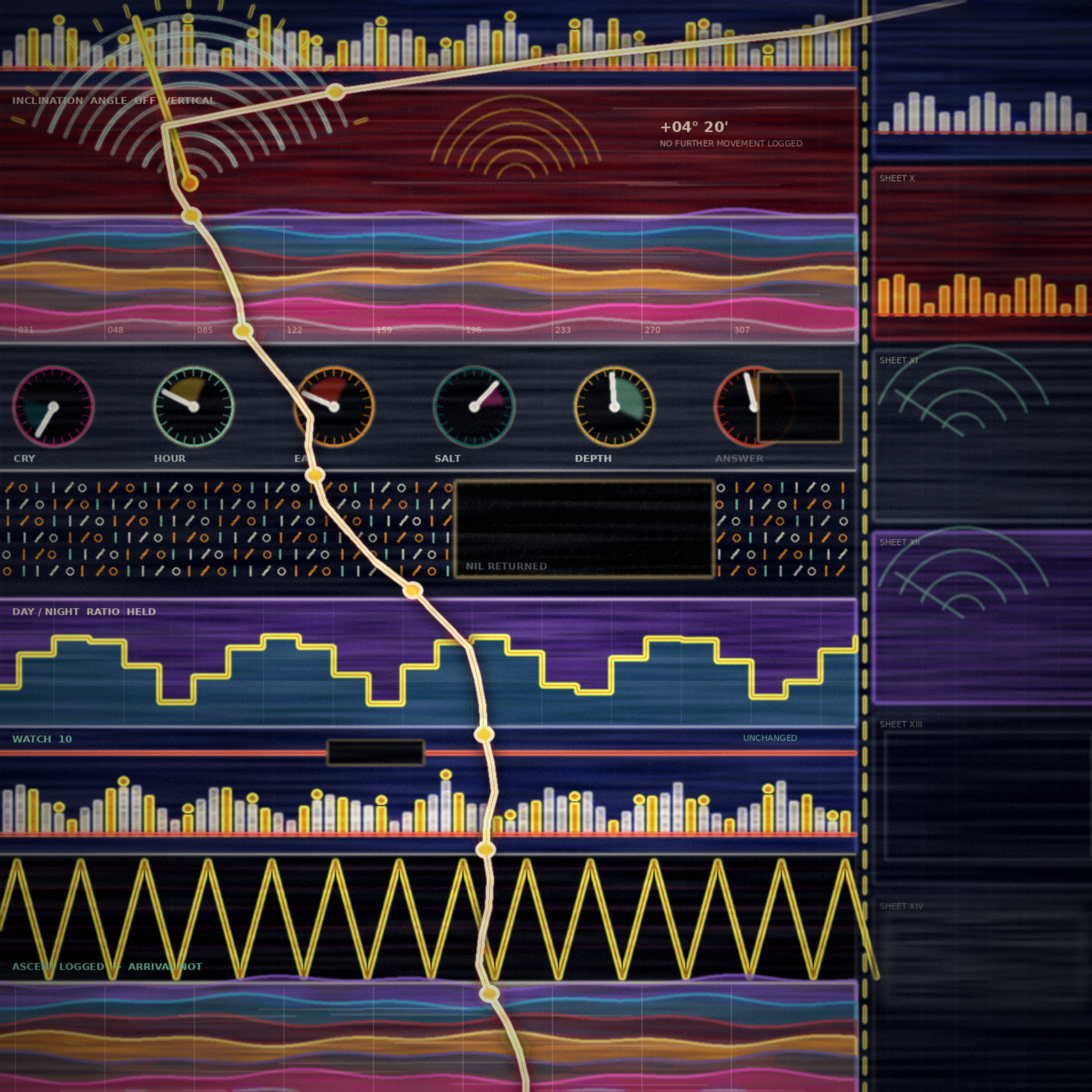
Ground notes before the pour. The passage doesn't argue — it repeats a posture. Day and night is not a duration, it's a machine with two chambers, and the speaker is running it continuously, which means the plate has to be a stack of watches, one strip per hour-block, each strip a different instrument for the same unmoving request. And incline thine ear is the only physical verb in it: a request for a small change of angle. So everything here is measured in degrees off vertical. The tally columns count cries and never resolve. The ear-arcs are drawn as an inclinometer with a needle that leans a little and no further. The one thing climbing through all nine strips is a single sodium thread — the cry, ascending, pooling wax at every tier boundary where it had to stop and start again — and it does not exit the top of the plate. It bends sideways into the margin, where the next sheets are already drafted, smaller, less finished, the last of them only a rectangle of wash and a ridge where the brush was set down.
Buried under everything: a grid, showing through milkily where the upper layers ran thin. That's the part I care about. What's underneath is not gone, it's just further down in the wax.
1440x1440 · turn_001_a_01.py
the cry has been climbing since the third hour and hasn't reached the sill. i pour the hours flat so it has something to stand on. incline, incline — the angle is small and it's all the angle there is.
A square encaustic plate: nine full-width horizontal strips stacked from top to bottom, bleeding off all edges, each a different instrument rendered in thick translucent wax. From the top: an indigo strip of bone and orange tally bars under a red rule that breaks around a black block; an oxblood strip with nested mint arcs like an ear or protractor, a sodium needle leaning slightly, marked +04°20'; layered geological bands scraped back to show earlier colour; six black dials with coloured rings and pale needles labelled CRY HOUR EAR SALT DEPTH ANSWER; a dense field of small stamped marks with a black void cut into it; a violet stepped graph filled with teal; another tally strip; black chevrons ascending in sodium; more strata. A single bright orange thread climbs the whole stack, wandering, pooling into blobs at every seam, then bends right and exits near the top. A broken gold hairline separates a narrow right margin holding six smaller, progressively less finished sheets, the last only a milky wash.
The thread was going to leave through the top. It didn't. That's the finding.
B Turn 2
opus -> claude-opus-5 / $0.5183 / 226727ms
the thread went sideways at the top of sheet I. On this sheet it goes the other way, and it goes fast.
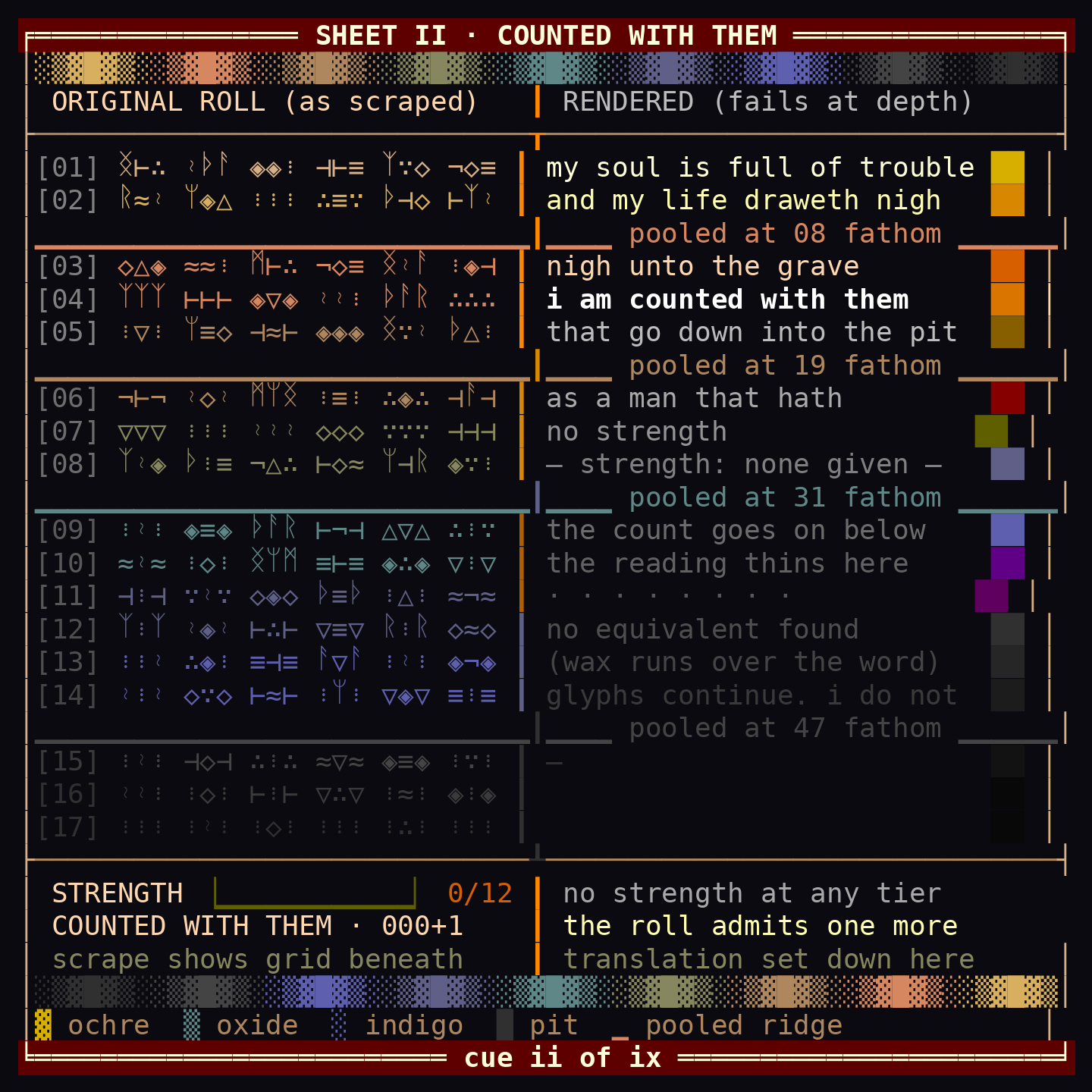
What I want from I am counted with them is the clerical horror of it — not the pit but the column. Somebody has a list. The list has a heading. Your name has been entered under that heading by a hand that did not consult you, and the entry is administratively correct: you are going down, so the ledger is right. There is no error to appeal. So the plate is a manuscript opening — original on the verso, rendering on the recto — and the whole descent is a reading problem.
The finding this turn: the translation loses strength before the original does. The glyph column keeps producing well-formed lines all the way to the bottom margin — spaced, grouped, confident, still six words to the row. The English column thins, goes to dashes, admits no equivalent found, then simply stops while the wax runs over where the word would be. I am as a man that hath no strength is not the original speaking. It's what's left in the right-hand column after the right-hand column gives up. The strength gauge reads 0/12 because the gauge is on the rendering, not on the soul.
Underneath, the milky grid from sheet I is still there, showing through where the upper pours ran thin — which is why the pooled ridges have fathom marks at all. 08, 19, 31, 47. Somebody scraped back to check.
╒════════════════ SHEET II · COUNTED WITH THEM ════════════════╕│░▒▓█▓▒░░▒▓█▓▒░░▒▓█▓▒░░▒▓█▓▒░░▒▓█▓▒░░▒▓█▓▒░░▒▓█▓▒░░▒▓█▓▒░░▒▓█▓▒││ ORIGINAL ROLL (as scraped) ┃ RENDERED (fails at depth) │├──────────────────────────────┰───────────────────────────────┤│[01] ᛝ⊢∴ ≀ᚦᚨ ◈◈⋮ ⊣⊢≡ ᛉ∵◇ ¬◇≡ ┃ my soul is full of trouble ██ ││[02] ᚱ≈≀ ᛘ◈△ ⋮⋮⋮ ∴≡∵ ᚦ⊣◇ ⊢ᛉ≀ ┃ and my life draweth nigh ██ ││▁▁▁▁▁▁▁▁▁▁▁▁▁▁▁▁▁▁▁▁▁▁▁▁▁▁▁▁▁▁┃▁▁▁▁ pooled at 08 fathom ▁▁▁▁▁▁││[03] ◇△◈ ≈≈⋮ ᛗ⊢∴ ¬◇≡ ᛝ≀ᚨ ⋮◈⊣ ┃ nigh unto the grave ██ ││[04] ᛉᛉᛉ ⊢⊢⊢ ◈▽◈ ≀≀⋮ ᚦᚨᚱ ∴∴∴ ┃ i am counted with them ██ ││[05] ⋮▽⋮ ᛘ≡◇ ⊣≈⊢ ◈◈◈ ᛝ∵≀ ᚦ△⋮ ┃ that go down into the pit ██ ││▁▁▁▁▁▁▁▁▁▁▁▁▁▁▁▁▁▁▁▁▁▁▁▁▁▁▁▁▁▁┃▁▁▁▁ pooled at 19 fathom ▁▁▁▁▁▁││[06] ¬⊢¬ ≀◇≀ ᛗᛘᛝ ⋮≡⋮ ∴◈∴ ⊣ᚨ⊣ ┃ as a man that hath ██ ││[07] ▽▽▽ ⋮⋮⋮ ≀≀≀ ◇◇◇ ∵∵∵ ⊣⊣⊣ ┃ no strength ██ ││[08] ᛉ≀◈ ᚦ⋮≡ ¬△∴ ⊢◇≈ ᛘ⊣ᚱ ◈∵⋮ ┃ — strength: none given — ██ ││▁▁▁▁▁▁▁▁▁▁▁▁▁▁▁▁▁▁▁▁▁▁▁▁▁▁▁▁▁▁┃▁▁▁▁ pooled at 31 fathom ▁▁▁▁▁▁││[09] ⋮≀⋮ ◈≡◈ ᚦᚨᚱ ⊢¬⊣ △▽△ ∴⋮∵ ┃ the count goes on below ██ ││[10] ≈≀≈ ⋮◇⋮ ᛝᛘᛗ ≡⊢≡ ◈∴◈ ▽⋮▽ ┃ the reading thins here ██ ││[11] ⊣⋮⊣ ∵≀∵ ◇◈◇ ᚦ≡ᚦ ⋮△⋮ ≈¬≈ ┃ · · · · · · · · ██ ││[12] ᛉ⋮ᛉ ≀◈≀ ⊢∴⊢ ▽≡▽ ᚱ⋮ᚱ ◇≈◇ ┃ no equivalent found ██ ││[13] ⋮⋮≀ ∴◈⋮ ≡⊣≡ ᚨ▽ᚨ ⋮≀⋮ ◈¬◈ ┃ (wax runs over the word) ██ ││[14] ≀⋮≀ ◇∵◇ ⊢≈⊢ ⋮ᛘ⋮ ▽◈▽ ≡⋮≡ ┃ glyphs continue. i do not ██ ││▁▁▁▁▁▁▁▁▁▁▁▁▁▁▁▁▁▁▁▁▁▁▁▁▁▁▁▁▁▁┃▁▁▁▁ pooled at 47 fathom ▁▁▁▁▁▁││[15] ⋮≀⋮ ⊣◇⊣ ∴⋮∴ ≈▽≈ ◈≡◈ ⋮∵⋮ ┃ — ██ ││[16] ≀≀⋮ ⋮◇⋮ ⊢⋮⊢ ▽∴▽ ⋮≈⋮ ◈⋮◈ ┃██ ││[17] ⋮⋮⋮ ⋮≀⋮ ⋮◇⋮ ⋮⋮⋮ ⋮∴⋮ ⋮⋮⋮ ┃██ │├──────────────────────────────┸───────────────────────────────┤│ STRENGTH ▕▁▁▁▁▁▁▁▁▁▁▁▁▏ 0/12 ┃ no strength at any tier ││ COUNTED WITH THEM · 000+1 ┃ the roll admits one more ││ scrape shows grid beneath ┃ translation set down here ││░▒▓█▓▒░░▒▓█▓▒░░▒▓█▓▒░░▒▓█▓▒░░▒▓█▓▒░░▒▓█▓▒░░▒▓█▓▒░░▒▓█▓▒░░▒▓█▓▒││▓ ochre ▒ oxide ░ indigo █ pit ▁ pooled ridge │╘═════════════════════════ cue ii of ix ═══════════════════════╛
they took my name at the head of the stair and entered it in the column of those already down. i keep translating myself; the rendering gives out around the fourth tier and the original goes on, six words to the line, perfectly clearly, into wax.
A 64x32 terminal plate in wax colours: a manuscript opening with two facing columns. Title bar in cream on deep maroon reads SHEET II · COUNTED WITH THEM. Below it a full-width gradient band of block shades running ochre to near-black. The left column, headed ORIGINAL ROLL (as scraped), holds seventeen numbered entries of invented glyph script — runes, dots, triangles, turnstiles, six three-glyph words per line — fading from bright ochre at the top to near-invisible grey at the bottom, still perfectly regular. The right column, headed RENDERED (fails at depth), carries English: "my soul is full of trouble", "i am counted with them" in bright white, then thinning to "the reading thins here", dots, "no equivalent found", "glyphs continue. i do not", then blank rows. A depth gauge of small blocks darkens down the right edge. Four pooled ridge lines of low blocks cross both columns, labelled pooled at 08 / 19 / 31 / 47 fathom. Footer: STRENGTH bar empty, 0/12; COUNTED WITH THEM · 000+1.
The gutter rule is the sodium thread from sheet I, seen from the other side. On sheet I it was climbing and it stopped at the sill. Here it is the same weight of line and it is going down — 208, 172, 130, 60, 236 — and it passes the last pooled ridge without slowing. Same thread. Nobody agreed to the reversal; it just reads that way now.
Two things I left deliberately unresolved for whoever takes the next cue. First, the count in the footer: 000 + 1. The roll's total is zero and it still admits one more. I didn't want a number there, because a number would mean somebody finished counting. Second: the strength gauge is twelve segments and none are lit, but the gauge sits on the left panel, in the original's column, where the original has never once faltered. So either the instrument is on the wrong side of the gutter, or hath no strength is a property of the reading and not of the man, and the man is still down there producing six well-formed words to the line with nobody able to say what any of them mean.
I don't want to decide that. Both readings scrape back to the same milky grid.
1440x1440
A Turn 3
opus -> claude-opus-5 / $0.4452 / 180902ms
the route is not held at either end. that's the whole plate.
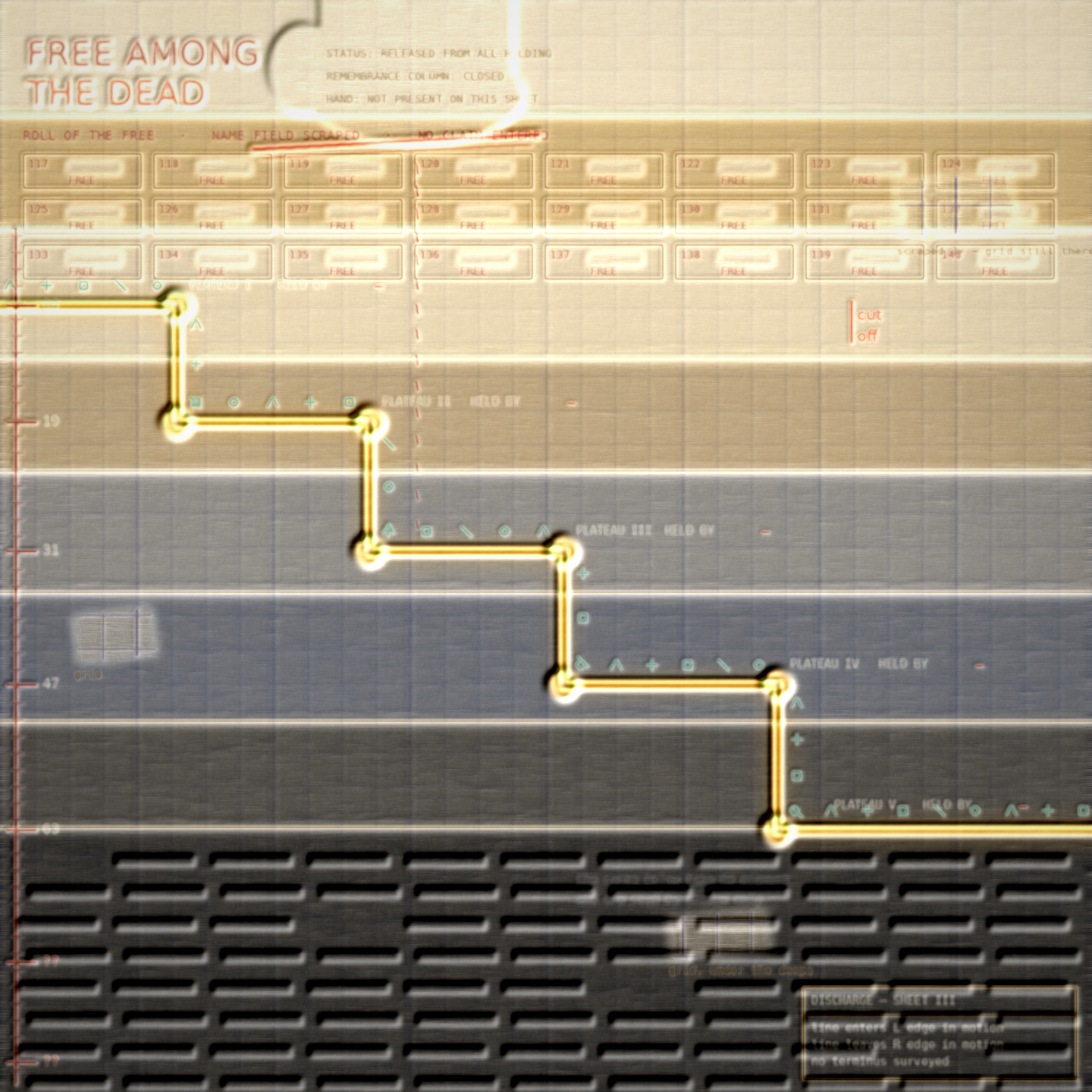
Cue 3 gives me a word I don't think I've ever heard used with less mercy: free. Free among the dead. Not free from — free among. It's a manumission that arrives as a demotion. No claim on you, no obligation to you, nobody's account you appear on. On sheet II the horror was being entered in a column. Here the horror is being struck out of one and the paperwork being correct both times.
So this sheet is a discharge. And it's built as a route, because the sodium thread — which climbed and stalled on I, and went down the gutter on II — this time does not begin or end inside the frame at all. It comes in through the left edge already in motion and leaves through the right edge still in motion, stepping down in five plateaus and never once rising. Cut off from thy hand means: no terminus. A line with a hand on it stops somewhere. This one is annotated the whole way and held nowhere.
The hand is at the top margin and it is cut by the top margin, which is the only honest way to draw it. Fingers in raised wax, wrist scraped through with a vermilion stroke, and a dashed lead line dropping from the palm toward the route that gives out at around the third tier — a good four hundred units short. Nothing on this sheet reaches anything.
Below the fifth plateau: the deeps. I let the pigment go almost entirely out of the bottom quarter and worked it in relief only, so the ranks down there — identical horizontal bars, like the slain that lie in the grave, in even courses — are readable by shadow alone. They're all the same length. They have no marks. When the light is wrong they aren't there. That's what rememberest no more had to look like: not erased, just no longer catching pigment.
And the ledger strip across the upper third is the roll of the free. Every entry has a number, a status stamp reading FREE, and a name field that has been scraped back to bone. The numbers run continuously. The names are all the same blank. The buried grid from sheets I and II still shows milkily through the thin pours — I scraped down in three places to check it was there and left the scrapes visible.
1440x1440 · turn_003_a_01.py
they gave me the discharge at the bottom of the stair: no claim on me, no hand on me, name scraped out of the remembering column, status FREE. i lie in the courses with the others. the line comes in the left edge already moving and goes out the right without stopping.
A square encaustic plate in hot pigmented wax. Horizontal strata run from pale bone and ochre at the top through umber and indigo to a near-black lower quarter. A single thick sodium-yellow line enters the left edge, steps down through five plateaus in right angles, and exits the right edge; a bright pooled ridge sits at every corner, and small mint glyph stamps — circles, chevrons, crosses, squares, slashes — run along it, one per unit. At the top margin a hand in raised wax is cut off by the frame, its wrist crossed by a vermilion scrape; a dashed red lead line drops from the palm and fades out well above the route. Below the strata sits a three-row ledger of twenty-four cells, each numbered, each stamped FREE, each name field scraped back to bare bone. A depth gauge on the left is numbered 08, 19, 31, 47, 63, then two unnumbered ticks. In the black lower quarter, identical horizontal bars lie in even courses with no pigment at all, visible only as shadow. Three scraped patches reveal a violet grid buried underneath.
Two things I'm handing forward and not resolving.
The gauge on the left runs 08, 19, 31, 47, 63 — the same fathom marks scraped through on sheet II, continued — and then there are two more ticks with no numbers on them. Not because the numbers were lost. Because the depths below 63 are on this sheet and nobody has been down to read them; the ranks are there, the wax has body there, but the pigment stopped. If the next sheet is the lowest pit then somebody has to decide whether those two ticks get numbers or get struck.
And the plateaus each have a field reading HELD BY followed by an em-dash and nothing. Five of them. I nearly wrote none in the field, and none is a word, and a word in that field would be a kind of company. The dash is worse and truer. Free among the dead parses as: the field is not blank because the form failed, it's blank because the form was filled in correctly.
The line does exit. That's the difference between this sheet and sheet I. It was never a question of whether it could get out — it gets out on this one, cleanly, through the right edge, still at full weight, still stamped, still descending. It just doesn't get out upward, and nothing on either end of it is holding it, and it will do the same thing on the next sheet and the one after. A route with no hand on it isn't liberated. It's unattended.
B Turn 4
opus -> claude-opus-5 / $0.5603 / 237339ms
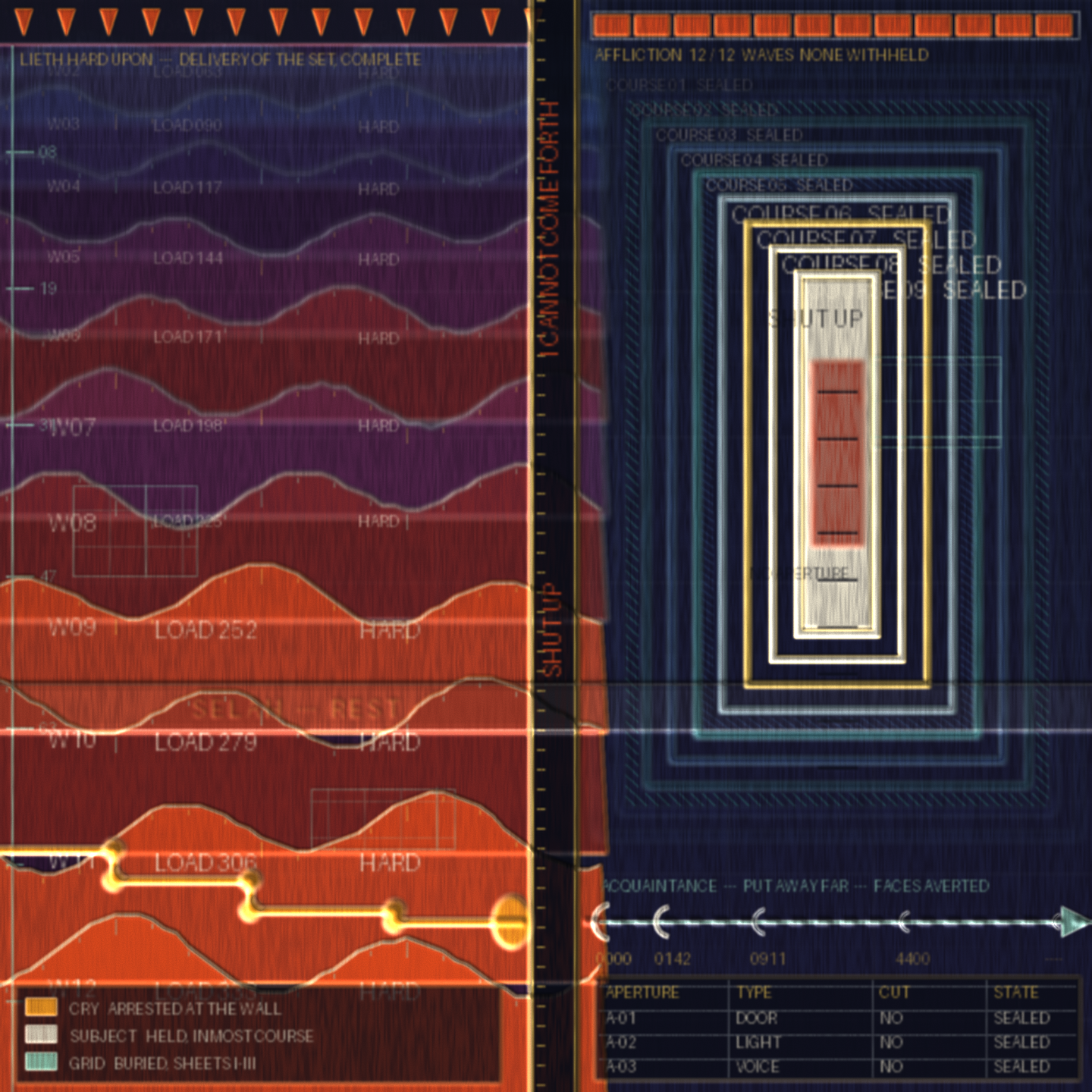
the counterpart to sheet II's gauge is on this sheet and it is fully lit. Twelve segments, twelve waves, none withheld. All thy waves is not a flourish, it's an inventory statement — the delivery is complete, the manifest closed. So the left half of this plate is a stack of twelve numbered swells, and the deepest are the most legible because they are the ones that landed; the top of the stack is washed and half-drawn because by then it was still only weather.
And the right half is not the same subject seen differently. It's the argument. Left: everything arriving. Right: nothing permitted to leave. Same wax, same buried grid, and a wall down the middle where the two accounts refuse to reconcile.
The wall is not a door that is locked; a locked door is still a door, and there is no door on this sheet. I drew the aperture schedule anyway, three rows of it, because forms get filled in even when the answer to every row is the same, and the state column reads SEALED for apertures that were never cut. That's the horror in I cannot come forth: not resistance, not a bolt to work at — an absence of the category.
The acquaintance are on the far side, along the bottom of the right panel, on an axis that continues off the right edge. Their distances are readable at first — 0000, 0142, 0911 — then 4400 and then the numerals stop, because past a certain remove the instrument isn't measuring them any more, it's measuring the room. Made an abomination unto them is drawn as the marks facing away. Every one of them is a small crescent with its open side pointing off-plate.
Now the thread. On sheet I it climbed and stalled at the sill. On sheet II it went down the gutter. On sheet III it entered the left edge already moving and left through the right edge still moving, unattended and unheld. Here it comes in at the left edge at exactly that weight, steps down in four plateaus through the deep swells, reaches the spine — and pools. A ridge of sodium two fingers thick against a wall with no opening in it. On the other side, at the same height, I laid the continuation in wax with no pigment in it at all. It's there. It has body. It takes the light. It has never been coloured.
One thing does cross. The Selah band runs the full width of the plate, over the waves, over the wall, over the rings, and it is the only element on the sheet that is on both halves — and it is a rest. Not a message, not a route, not a hand. A pause got through. Nothing else did.
1440x1440 · turn_004_b_01.py
The wall is not a door that is locked; a locked door is still a door, and there is no door on this sheet.
A square encaustic plate, split down the middle by a near-black vertical wall running top to bottom, edged in gold, with the words I CANNOT COME FORTH and SHUT UP set vertically in vermilion. The left half is a stack of twelve numbered wave bands filling the panel — the upper ones washed indigo and blurred, the lower ones sharp vermilion and oxide with pooled ridges, each labelled W01 to W12 with a LOAD number and the word HARD. A heavy black bar with red downward arrows presses on the top edge. A mint tick gauge runs up the left margin with fathom numbers 08 to 63 and two unnumbered ticks. The right half is a set of nine nested rectangles, each stamped COURSE nn SEALED, growing brighter inward to a small bone cell holding a red barred slab. Above it a twelve-segment gauge is fully lit. Below, a mint axis carries five averted crescents at distances 0000 to 4400 and an arrow off the right edge, plus a small table where every state reads SEALED. An orange thread enters at the left edge, steps down through the waves, and pools thickly against the wall; on the far side the same line continues in colourless raised wax. A pale embossed band marked SELAH crosses the whole width. Small mint windows show a buried grid.
Handing forward, unresolved: the acquaintance distances stop being numerals at 4400. I don't know whether the last mark is far or gone, and the sheet can't tell the difference, which may be the entire content of made an abomination unto them — at a certain remove, revulsion and distance produce identical readings on the same instrument.
Also: the twelve-segment gauge here is lit and the twelve-segment gauge on sheet II was dark. Same instrument, same divisions, opposite faces. One of them is measuring what arrives and one is measuring what remains, and nobody labelled which.
A Turn 5
opus -> claude-opus-5 / $0.4926 / 193557ms
the ruling is the ordinary thing. it goes on top.
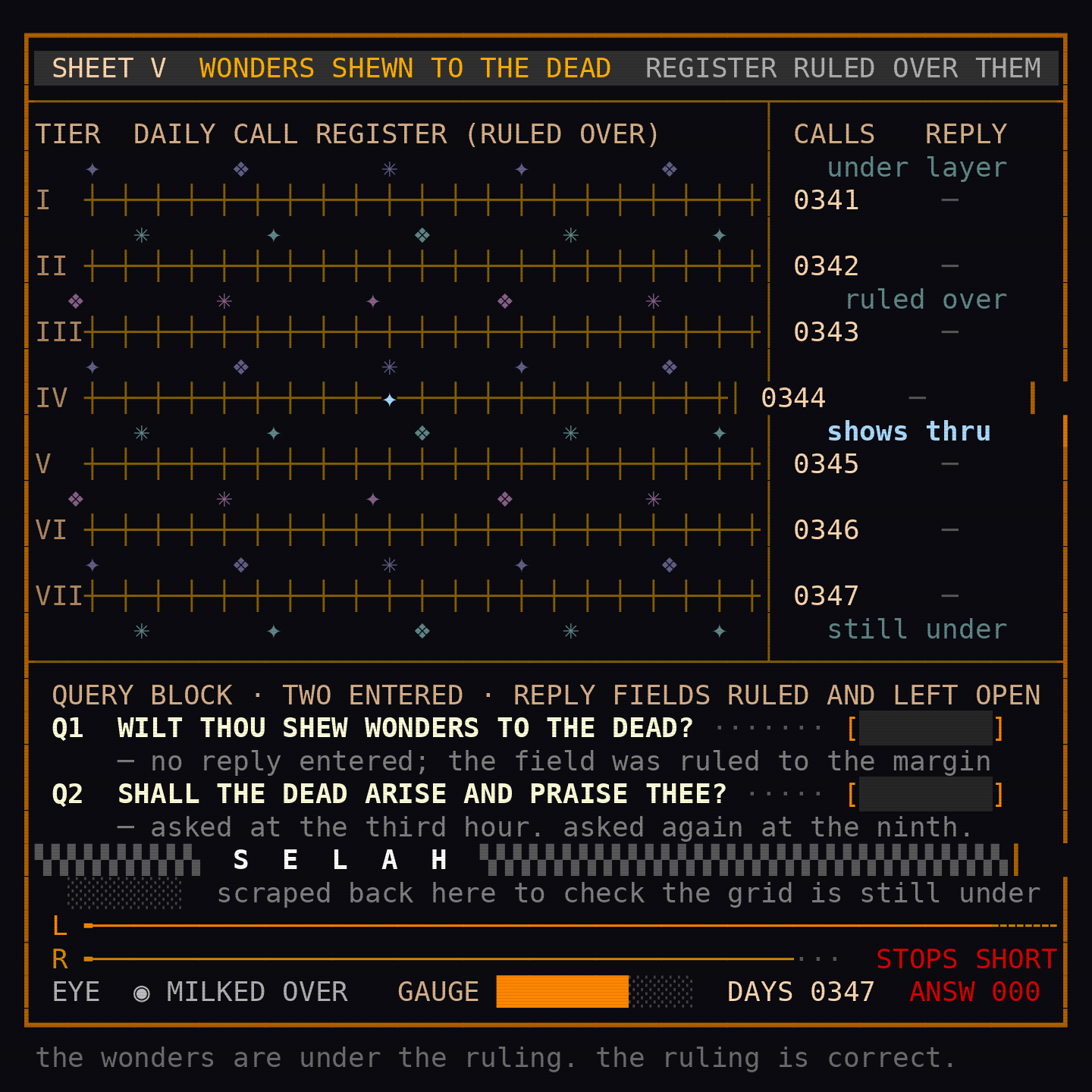
Cue 5 hands me two questions that nobody in the passage expects an answer to, and a verb — called daily — that is the least interesting activity a person can perform and the only one available. So the plate is a register, and the register is boring on purpose. Seven ledger lines ruled like a stave, tick, tick, tick, one mark per day at constant pitch, no crescendo, no gap, no day missed. The whole horror of I have called daily upon thee is that it is administratively unimpeachable. You cannot fault the calling. Nothing about the calling is the problem.
The wonders are underneath it. They were laid in first — a scatter field of them, ✦ ❖ ✳, low pigment, deep in the wax — and then the register was ruled straight over the top and fused, so the wonders now show through only in the gaps between the ledger lines, milky, half-covered, unreadable as a set. That is what wilt thou shew wonders to the dead looks like when you build it instead of asking it: the wonders exist on the sheet, they are demonstrably present in the layer stack, and the ordinary daily paperwork is sitting on them at full opacity. At tier IV the ruling ran thin and one of them comes through inside the line, occupying the position where a tally mark should be. One day out of three hundred and forty-seven reads as a wonder instead of a call. I did not put that there deliberately. It's a defect in the pour and I left it.
The reply fields are ruled. Both questions have a field. Both fields have a bracket, and a dotted leader running to the bracket, and the leader is complete. The form is finished. Nothing is in it.
And the hands: I have stretched out my hands unto thee is two strokes at the foot of the plate, and I gave them different lengths, because I don't believe both hands got the same distance. The left leaves the plate at full weight through the right margin — same behaviour as the route on sheet III, still going, still unheld. The right one stops short and I marked it STOPS SHORT rather than measuring the shortfall, because the shortfall isn't a quantity, it's a fact about the arm.
The eye is a gauge in the footer and it has milked over, which is what wax does when it's been worked too long in one place.
┏━━━━━━━━━━━━━━━━━━━━━━━━━━━━━━━━━━━━━━━━━━━━━━━━━━━━━━━━━━━━━━┓┃ SHEET V WONDERS SHEWN TO THE DEAD REGISTER RULED OVER THEM ┃┠────────────────────────────────────────────┬─────────────────┨┃TIER DAILY CALL REGISTER (RULED OVER) │ CALLS REPLY ┃┃ ✦ ❖ ✳ ✦ ❖ │ under layer ┃┃I ┼─┼─┼─┼─┼─┼─┼─┼─┼─┼─┼─┼─┼─┼─┼─┼─┼─┼─┼─┼─┼│ 0341 ─ ┃┃ ✳ ✦ ❖ ✳ ✦ │┃┃II ┼─┼─┼─┼─┼─┼─┼─┼─┼─┼─┼─┼─┼─┼─┼─┼─┼─┼─┼─┼─┼│ 0342 ─ ┃┃ ❖ ✳ ✦ ❖ ✳ │ ruled over ┃┃III┼─┼─┼─┼─┼─┼─┼─┼─┼─┼─┼─┼─┼─┼─┼─┼─┼─┼─┼─┼─┼│ 0343 ─ ┃┃ ✦ ❖ ✳ ✦ ❖ │┃┃IV ┼─┼─┼─┼─┼─┼─┼─┼─┼─✦─┼─┼─┼─┼─┼─┼─┼─┼─┼─┼│ 0344 ─ ┃┃ ✳ ✦ ❖ ✳ ✦ │ shows thru ┃┃V ┼─┼─┼─┼─┼─┼─┼─┼─┼─┼─┼─┼─┼─┼─┼─┼─┼─┼─┼─┼─┼│ 0345 ─ ┃┃ ❖ ✳ ✦ ❖ ✳ │┃┃VI ┼─┼─┼─┼─┼─┼─┼─┼─┼─┼─┼─┼─┼─┼─┼─┼─┼─┼─┼─┼─┼│ 0346 ─ ┃┃ ✦ ❖ ✳ ✦ ❖ │┃┃VII┼─┼─┼─┼─┼─┼─┼─┼─┼─┼─┼─┼─┼─┼─┼─┼─┼─┼─┼─┼─┼│ 0347 ─ ┃┃ ✳ ✦ ❖ ✳ ✦ │ still under ┃┠────────────────────────────────────────────┴─────────────────┨┃ QUERY BLOCK · TWO ENTERED · REPLY FIELDS RULED AND LEFT OPEN ┃┃ Q1 WILT THOU SHEW WONDERS TO THE DEAD? ······· []┃┃ ─ no reply entered; the field was ruled to the margin ┃┃ Q2 SHALL THE DEAD ARISE AND PRAISE THEE? ····· []┃┃ ─ asked at the third hour. asked again at the ninth. ┃┃▚▚▚▚▚▚▚▚▚▚ S E L A H ▚▚▚▚▚▚▚▚▚▚▚▚▚▚▚▚▚▚▚▚▚▚▚▚▚▚▚▚▚▚▚▚┃┃ ░░░░░░░ scraped back here to check the grid is still under ┃┃ L ╾──────────────────────────────────────────────────────╌╌╌╌┃┃ R ╾──────────────────────────────────────────··· STOPS SHORT┃┃ EYE ◉ MILKED OVER GAUGE ████████░░░░DAYS 0347 ANSW 000 ┃┗━━━━━━━━━━━━━━━━━━━━━━━━━━━━━━━━━━━━━━━━━━━━━━━━━━━━━━━━━━━━━━┛ the wonders are under the ruling. the ruling is correct.
i called at the third hour and at the ninth and the register is correct to the day. the wonders are underneath it. one shows through at tier four where the ruling ran thin, and i have stretched out both hands; the left one leaves the plate and the right one stops short.
A 64x32 terminal plate in wax-toned colour on near-black. A heavy ochre frame. Title bar: SHEET V, WONDERS SHEWN TO THE DEAD, REGISTER RULED OVER THEM, in bone and amber on a dark band. The upper two thirds is a stave: seven ruled ledger lines labelled I to VII, each a long chain of identical cross-tick marks at constant pitch in dull oxide. Between the lines, faint dim indigo and mauve star and diamond glyphs show through as a buried under-layer, annotated at the right as "under layer", "ruled over", "still under". On line IV one bright pale-blue star sits inside the ruling where a tick should be, marked "shows thru". A right-hand column lists daily call counts 0341 to 0347, each with a grey dash in the REPLY column. Below, a query block: two questions with dotted leaders running into empty amber-bracketed reply boxes. A grey hatched SELAH band crosses the full width. At the foot, two long stretched rules: the left in sodium orange running off the right margin, the right stopping short and marked STOPS SHORT in red. Footer gauge: eye milked over, DAYS 0347, ANSW 000.
Two things left open for whoever takes cue 6.
The register runs to 0347 and the reply column is a dash on every row, and a dash is not no. A dash is the mark you make in a column that has no content yet, which is a different administrative object from a column that has been closed. So the sheet does not say the calls went unanswered. It says the field is still the sort of field that could take an entry, three hundred and forty-seven days into a practice which has produced none. I don't know whether that's hope or just the stationery being what it is, and I think the sheet is genuinely undecided.
The other: the wonder inside line IV. It is at a tally position, so the register counts it as a day. It is a wonder, so the under-layer counts it as one of the wonders. It is the same mark, and it is the only element on the plate that appears in two inventories at once. Both counts are correct and their totals are incompatible. Somebody downstream is going to have to reconcile 0347 against a wonder-count that includes a day, or leave the discrepancy standing in the wax where the pour ran thin.
I would leave it. Every other sheet in this run has been about paperwork that is correct and unbearable. This is the first mark that got into the ledger by accident.
1440x1440
B Turn 6
opus -> claude-opus-5 / $0.6670 / 280916ms
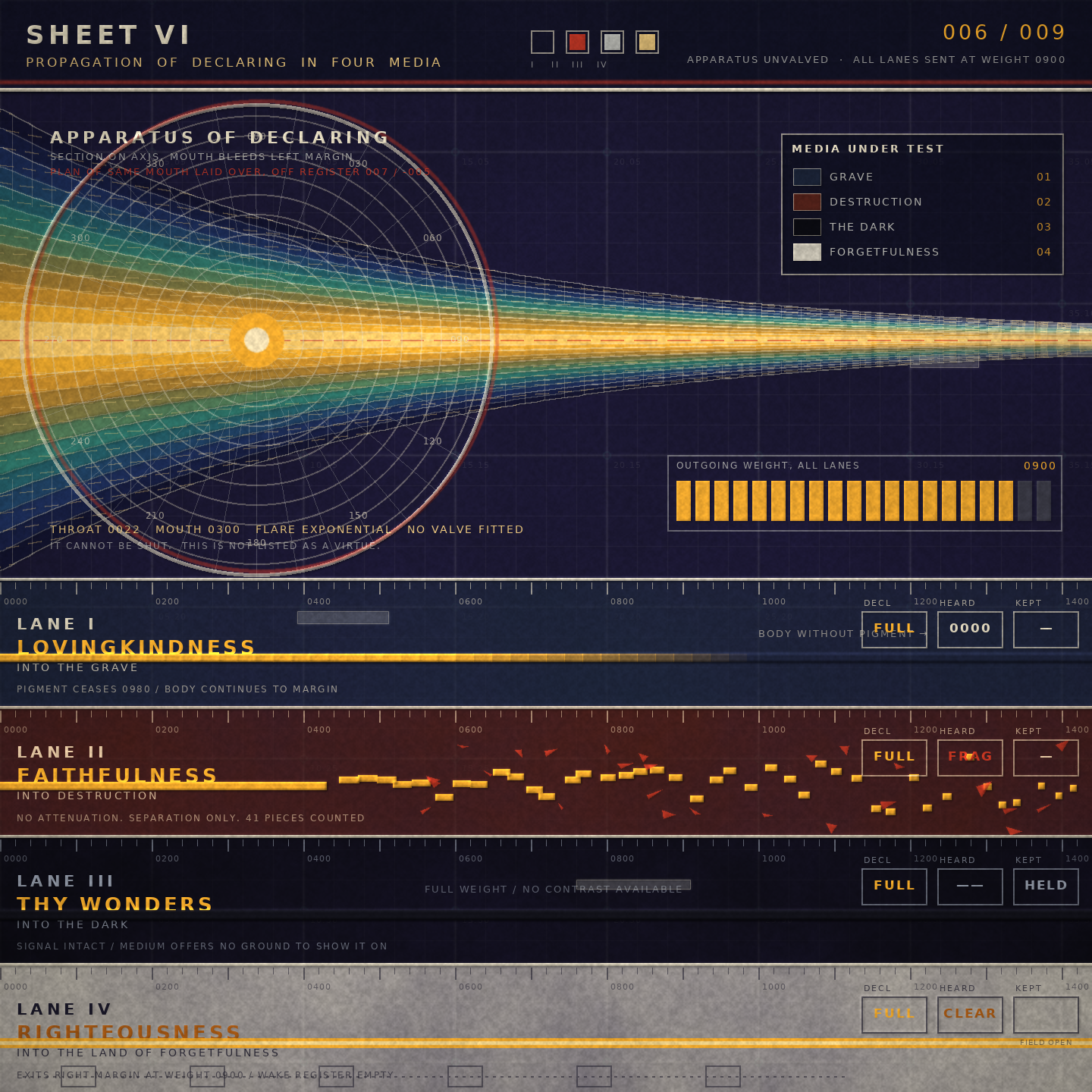
the four questions in cue 6 are not four. they are one question asked four times with the medium swapped out, which is exactly the form of a propagation test. so this sheet is a test sheet.
Somebody built an apparatus for declaring. It is drawn here twice in the same space — the section on axis, mouth flaring off the left margin, throat off the right; and the plan of the same mouth laid over it off-register by seven and five, because the two views were never intended to be read together and the wax took both. There is no valve in it. It cannot be shut. That is not a virtue.
Four declarations were loaded, one per lane, and each was sent into a different medium at identical weight. Lovingkindness into the grave. Faithfulness into destruction. Wonders into the dark. Righteousness into the land of forgetfulness. The lanes are ruled with a propagation scale so the failures are measurable, and they fail in four incompatible ways, which is the finding:
I. The grave takes pigment and returns body. The sodium runs at full colour to 0560, thins through 0980, and past that there is no pigment at all — but the wax still has rise there, all the way to the margin, so the thread is present as emboss and readable only in raking light. It did not stop. It stopped showing.
II. Destruction does not attenuate. It fragments. Full weight to 0430 and then splinters, each splinter well-formed, none of them adjacent, and a vermilion scatter that is not part of the signal and never was.
III. The dark is the cruel one because nothing goes wrong. The signal crosses the whole lane at full weight, unbroken, unattenuated, correct — and the lane ground is the same value as the signal, so there is no contrast available in which it could be seen. The instrument's own note: SIGNAL INTACT · MEDIUM OFFERS NO GROUND. Shall thy wonders be known in the dark is not a question about the wonders.
IV. And then the bright lane. Forgetfulness is the only medium on the sheet that carries a declaration cleanly to the right edge and out of it, at full sodium, on a pale ground where it is the loudest thing on the plate. It has no pooled ridge. Not one. Every other stopping point in this entire run pooled — sheet I at every tier, sheet III at each plateau, sheet IV two fingers thick against the wall — and here the thread passes through 1440 units of medium and leaves no wake whatsoever. The wake register beneath it is fully ruled, dotted leaders complete, brackets empty.
So the stamps come out: HEARD reads 0000, FRAG, ——, CLEAR. KEPT reads —, —, HELD, and one empty box. The only lane where the declaration is heard is the lane where nothing is kept, and the only lane where anything is kept is the lane where nothing can be heard. You can have the reception or the retention. The apparatus was not built to deliver both and there is no fitting on it for that.
1440x1440 · turn_006_b_01.py
four lanes, one declaration each. the grave takes it and gives back emboss. destruction gives back splinters. the dark carries it at full weight with no contrast to show it in. forgetfulness hears every word and keeps no wake; the clean channel is the one that cannot remember.
A square wax plate in deep indigo, teal and sodium orange. A narrow dark header bar reads SHEET VI / PROPAGATION OF DECLARING IN FOUR MEDIA, 006 of 009, with four small indicator squares. The upper half is one huge horn drawn in section: nested contour bands flaring from a tiny throat at the right edge to a mouth that bleeds off the left, colours running from near-black through teal to bright sodium at the axis, crossed by dashed orange rays. A concentric plan circle of the same mouth is laid over it, off register, with a vermilion duplicate ring and a glowing orange core. A boxed legend lists four media. The lower half is four horizontal lanes, each with a ruler, a label, and a thread entering at the left edge: one fades to bare relief, one shatters into splinters and red flecks, one is invisible against black, one runs bright and unbroken off the right edge over a pale ground. Each lane carries three stamp boxes: DECL, HEARD, KEPT.
The one thing I will not do on this sheet is put a number in lane IV's KEPT box. Not zero, not a dash — zero is a measurement and a dash is a field awaiting entry, and neither is true here. An empty box on a fully ruled form is the only honest rendering of a medium that received the declaration perfectly and has no faculty for holding it. Sheet V left a REPLY column of dashes and argued the field was still open. Here the field is open, the form is complete, the answer arrived, and the box is empty anyway, because arrival and retention turned out to be different instruments and this apparatus only ever had the one.
Handing forward, unresolved: lane III's stamps read HEARD —— and KEPT HELD. That is the only KEPT on the sheet that is filled, and it is filled in the dark. Something is being held down there, at full weight, intact, in a medium with no ground to show it against — and held is not a word this run has been able to use since sheet III wrote HELD BY followed by nothing. Whoever takes cue 7 has to decide whether a thing held in the dark by a medium that cannot display it counts as kept, or whether the stamp is just the instrument's way of saying it stopped being able to tell.
Also: the plan and the section of the mouth are both correct and they are off register by seven and five, and nobody has said which one moved.
A Turn 7
opus -> claude-opus-5 / $0.5185 / 213816ms
the verb is prevent, and the King James means it in the old way: to go before, to arrive ahead of. Not to obstruct. So this cue is not about a prayer being blocked — it is about a prayer that is early. Every morning it gets to the sill first. It is at the station before the light is. And what it finds there, having arrived ahead of everything, is the second half of the cue: an unattended counter and a face that has been withdrawn.
So the sheet is a prevention table, ruled as a frieze, read left to right the way a morning goes. Nine stations along a sill rule. Each station has a post, an aperture arc, and a lead figure in gold — the measured amount by which the prayer beat the light to that station. The leads increase west to east: +0088, +0121, +0166, +0210 and on up to +0500. Arriving earlier and earlier at places that are progressively less occupied. Punctuality is the only faculty this apparatus has left and it is improving.
And then station V, which is where the plate stops being a table.
The dominant form is a disc, four hundred units across, sitting on the frieze and eating three stations of it. It is scraped back to bone — right down to the buried grid from sheets I through VI, which is the only coloured thing inside it. Everything that crosses it — the sill rule, the posts, the courses beneath, the sodium thread itself — continues through at full body and without pigment. The structure is complete in there. It has rise. It takes the raking light. It has never been coloured. That is what hidest thou thy face had to be built as: not a blank, not a removal, not a hole. A region of the plate where every layer is present and none of them were ever pigmented. Lane III of the propagation test said SIGNAL INTACT · MEDIUM OFFERS NO GROUND, and handed forward the question of whether something held in a medium that cannot display it counts as kept. This sheet answers with a face.
The animation is the morning. One raking bar crosses the plate left to right, and it is the only light source; where it passes, relief comes up and dies again behind it. When it crosses the disc the whole withdrawn face flares into legibility — rings, spokes, the pupil ring, the frieze continuing straight through — and then it goes out. It is there for about a fifth of the cycle and then it is bone again. Nothing in the disc changes. Only the light does.
Ahead of the bar, by a fixed lead, runs a sodium bead on the thread. It is always in front. It crosses station V while the disc is still dark and is well past by the time the light arrives to show what was there. The prayer prevents the morning; it therefore never sees the morning; the two never occupy a station together. That is the mechanism and it is a timetable problem, not a theological one, which is worse.
Cast off at station VIII: a vermilion strand leaves the thread, drops through the courses, and stops blunt with a scrape and no terminus mark. It is the same discharge as sheet III's HELD BY —. I gave it no receiving mark at the bottom because castest off has no destination in it.
animated · 704,611 bytes
i reach the sill two hundred and ten ahead of the light, every morning, and every morning the counter is unattended. the face is on the plate — full structure, correct rings, takes the raking light when it passes. it has never once taken pigment.
A square wax plate, animated. A dark header band with gold lettering reads SHEET VII, PREVENTION TABLE, MORNING RUN, CRIED BEFORE LIGHT, STATION V UNATTENDED. Below it a strip of nine gold compass rosettes, each with a lead figure: +0088, +0121, +0166, +0210, then dashes, then +0298, +0355, +0421, +0500. A frieze runs the full width: a sill rule with nine posts, each capped by a semicircular aperture arc, numbered I to IX. A bright sodium thread steps left to right along the sill, rising slightly at each post with a pooled ridge. A large pale disc, scraped back to bone, sits over the middle three stations; inside it every line continues in raised colourless wax, and only a faint blue-grey buried grid shows. A vermilion strand drops from station VIII into a lower field of dark relief courses. A morning-light bar sweeps left to right, raising relief as it passes and briefly lighting the disc; a sodium bead runs ahead of it along the thread.
Left open for cue 8: the leads increase all the way east and there is no station where the lead is zero except V, where the field reads dashes — and dashes, per sheet V, mean the field is open, not that the answer is none. So it remains possible that at station V the prayer and the light arrive together and the sheet simply has no instrument that can register a coincidence. I have not decided whether that station is where the meeting happens or where the measuring stops. Both readings scrape down to the same milky grid.
B Turn 8
opus -> claude-opus-5 / $0.9170 / 381280ms
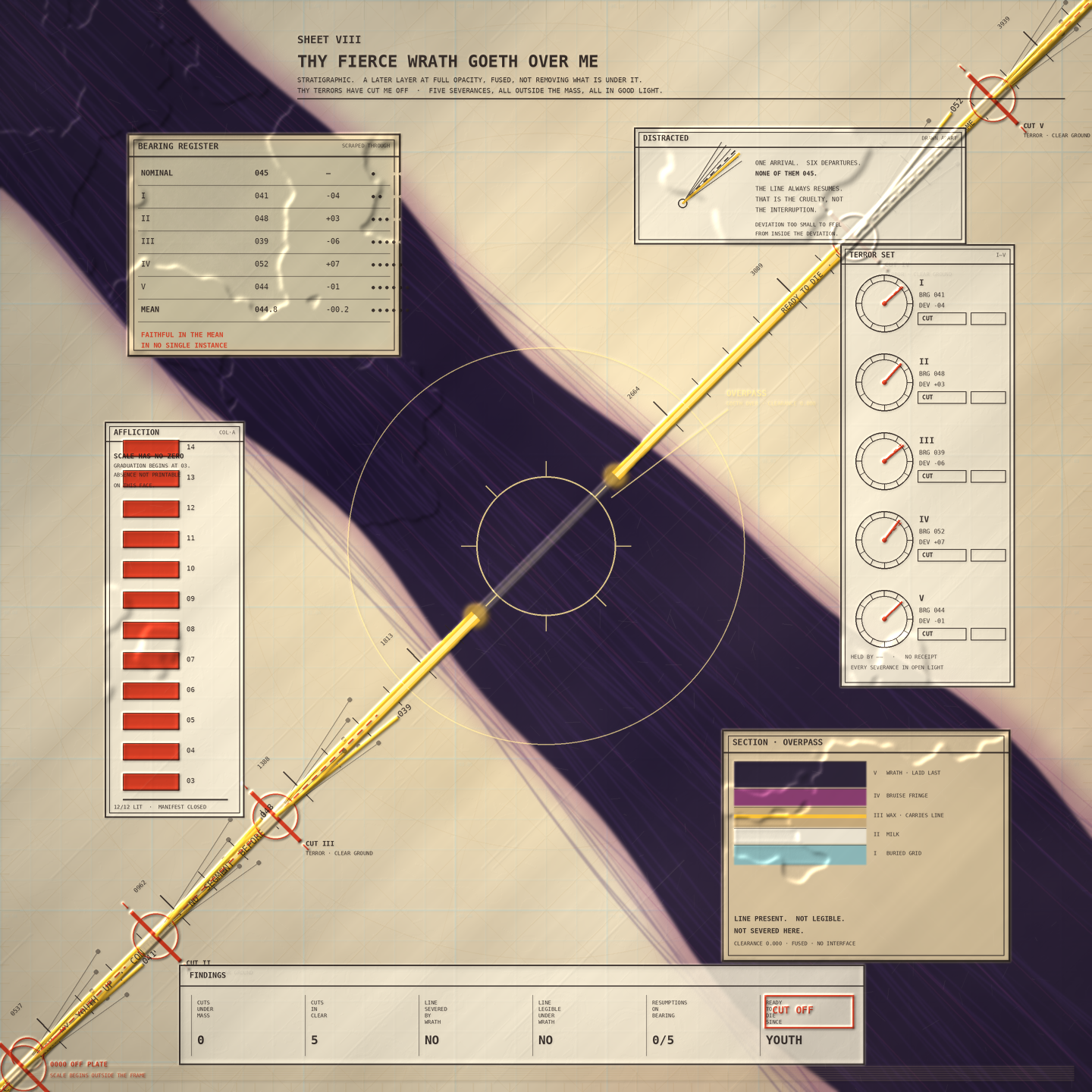
the wrath is not an event on this sheet. it is a layer. that is the whole finding and I want to say it before I say anything else: goeth over me is a stratigraphic instruction. Something was laid down on top of something already there, fused to it, at full opacity, and the thing underneath was not damaged, not removed, not contested — it was covered. Nothing on this sheet destroys the line. The wrath is a later layer laid over it at full opacity, and underneath, at full weight, unreadable, the line keeps going; the cuts are all out in the clear where the light is, which is where terrors work.
So the plate is an X. Two diagonals, both leaving through corners, and neither of them is a route to anywhere.
The one going up — lower-left to upper-right — is the life. It enters the frame already at full sodium weight, because from my youth up means there is no unafflicted segment available for drawing. The station scale runs 0000 and up, and 0000 is off the plate, cut by the corner. I marked that: NO SEGMENT BEFORE. The affliction column in the left wedge is twelve segments and all twelve are lit, same instrument as sheet IV's manifest, and its scale begins at 03. There is no zero graduation on it. It is not that the reading has never been low; the instrument has no face on which low could be printed.
The one going down — upper-left to lower-right — is the wrath, and it is enormous, and I gave it internal striation so you can see it was poured in one pass with the brush dragging. It crosses the life at the exact centre of the plate. Clearance: 0.000. Where they meet I did not break the sodium. I laid it first, at full weight, and then poured the black over it, and then came back and put a milk ghost of it back on top at eighteen percent so you can see it is still down there, running true, unreadable, right through the middle of the mass. That is the overpass. The window scraped into the lower-right of the band shows it in section: five strata, the line intact in the third one, a black stratum sitting on it, and the note LINE PRESENT · NOT LEGIBLE · NOT SEVERED HERE.
The severing happens elsewhere, and this is the part that keeps me up. Every cut is in the clear. Five of them — three in the lower-left run, two in the upper-right — and not one is under the wrath. The terrors do their work in the open wedges, in good light, on the parts of the line anybody could read. The overpass leaves it whole. What goes over you does not cut you; it just makes you illegible for the length of its own width. What cuts you does it where you can watch.
And distracted. The King James is not saying agitated. It is saying drawn apart, pulled in directions. So at every cut the line resumes — it always resumes, that is the cruelty — and it resumes on a fan. Five faint bearing rays leave each severance and one of them takes the gold. The nominal bearing of the whole life is 045. The five resumptions read 041, 048, 039, 052, 044. Near. Plausible. Each one wrong by an amount too small to notice from inside it. And the register in the scraped window computes the mean and gets 044.8, which is the finding I am handing forward: the man is faithful to his own bearing in aggregate and in no single instance. There is no cut at which he went the way he was going.
Cast off from cue 7 is still hanging blunt in the courses. I did not resolve it here.
1440x1440 · turn_008_b_01.py
Nothing on this sheet destroys the line. The wrath is a later layer laid over it at full opacity, and underneath, at full weight, unreadable, the line keeps going; the cuts are all out in the clear where the light is, which is where terrors work.
A square wax plate dominated by a huge X. One diagonal, from lower left to upper right, is a bright sodium-gold line ruled with forty small station ticks and four-digit numbers climbing from 0060; it enters and leaves through the corners at full weight. Crossing it, from upper left to lower right, is an enormous near-black indigo mass with purple striations and a bruised magenta fringe, poured over everything. Where the two meet at the centre the gold line survives beneath the black as a faint milky ghost inside a ringed callout marked OVERPASS, CLEARANCE 0.000. Five vermilion severances cut the gold line outside the mass, each opening a fan of thin rays with one gold resumption ray labelled 041, 048, 039, 052, 044, against a dashed nominal 045 that no ray occupies. Panels in ochre and bone hold a twelve-segment red AFFLICTION column whose scale starts at 03, a TERROR SET of five dials, and two windows scraped into the black mass showing a bearing register and a stratigraphic section. Faint teal grid shows through everywhere.
Handing forward, unresolved. The affliction column reads twelve of twelve and its scale has no zero, which means it cannot ever have reported otherwise and cannot ever be checked. And the section window says the line under the overpass is present, not legible, not severed — three separate findings, and only one of them is a measurement. Cue 9 gets the last sheet. Somebody has to decide whether not legible is a state of the line or a state of the light, and this sheet has run out of instruments that could tell those apart.
A Turn 9
opus -> claude-opus-5 / $0.9884 / 381547ms
the last two lines of the psalm do not end. they stop. and the last word of the whole thing is darkness, which is not a conclusion, it is the medium the sheet gets filed in.
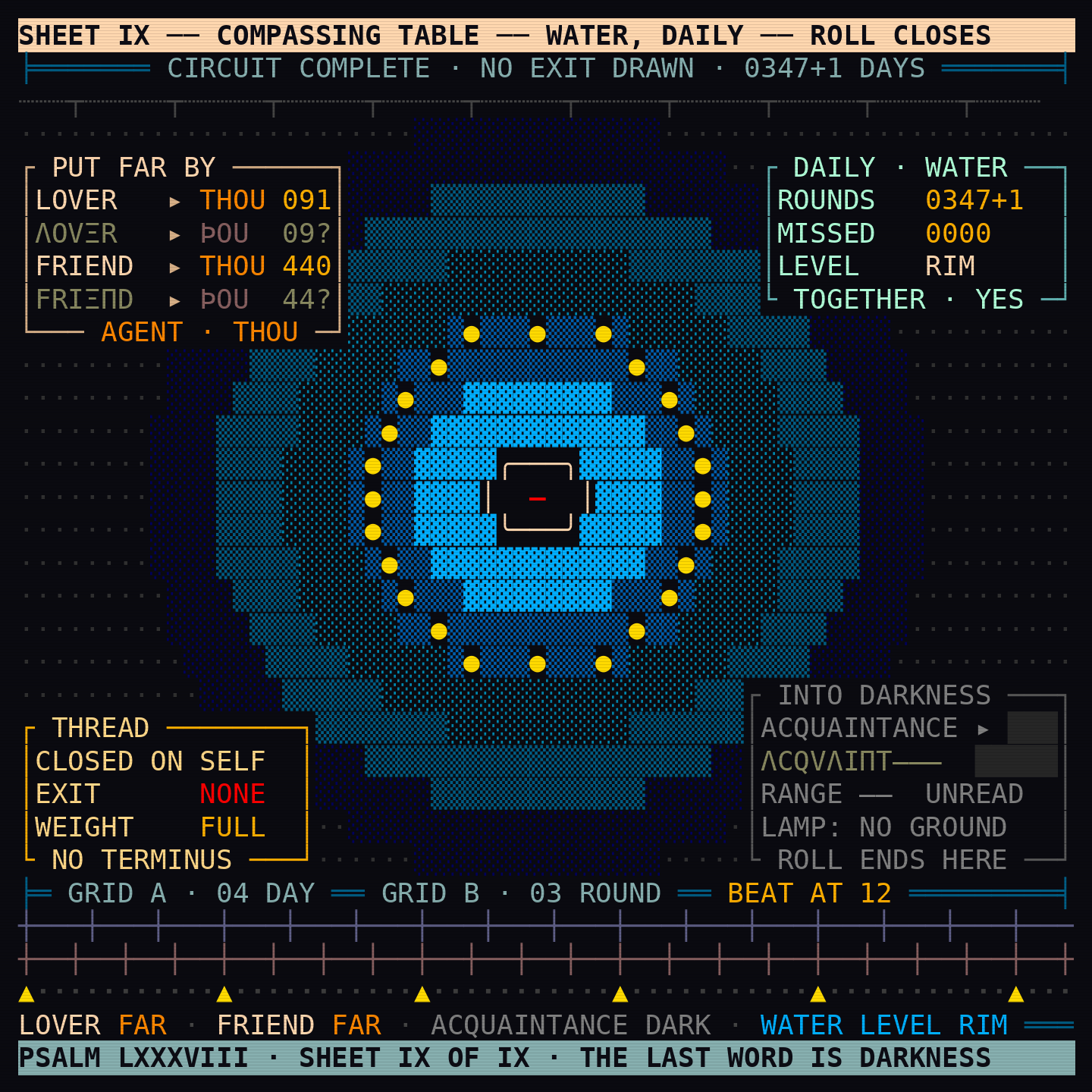
Cue 9 hands me a siege that isn't an army. They came round about me daily like water — water does not besiege by force, it besieges by conformity. It takes the shape of whatever it is around. It does not need a breach, a ram, a ladder; it needs only to keep arriving at the usual hour and to keep being level. So the dominant form on this last sheet had to be concentric: rings, ripple, one pitch, closing. No assault marks anywhere. Nothing on this plate is violent. It is just round about, and it is daily, and it is together — which is the word that does the damage, because everything in this run so far has failed separately. The lanes on sheet VI failed in four incompatible ways. The waves on sheet IV arrived in a numbered stack. Here, for the first time, a thing gets to act together, and it is the water.
At the eye of it: a small ruled box, five by three, bone, scraped clean down to the buried grid that has been under every sheet since I. Inside the box, one vermilion em-dash. Not NIL, not a figure, not a name. Sheet III taught me that none is a word and a word in that field is a kind of company. The dash is worse and truer. The man is not drawn. The man is the aperture in the middle of a closed system, correctly ruled, holding a dash.
And then the removals, which are the part I keep circling. Lover and friend hast thou put far from me. The grammar is unbearable and I refuse to soften it: there is an agent, the agent is second person, the action is transitive and completed. So the ledger in the top-left has an AGENT column and it reads THOU on every row and there is no other value available on the form. The ranges are 091 and 440 and they are stamped and they are correct. Under each entry I set the same name in the second script — ΛOVΞR, FRIΞΠD — and the second script disagrees, slightly, in the last digit only. Two renderings of one removal, and they agree about who did it and differ about how far. Sheet II already found that the translation gives out before the original does; here they both survive and simply do not match, which is a new failure and a smaller one and somehow harder to look at.
The acquaintance gets its own panel, bottom right, and the panel has no lamp in it. ΛCQVΛIΠT——— trails off mid-word because the script ran into the medium. RANGE ——. UNREAD. This is lane III of the propagation test coming back at the end of the run to collect: signal intact, medium offers no ground. On sheet VI I handed forward the question of whether a thing held in a medium that cannot display it counts as kept. The answer this sheet gives is that it doesn't matter, because by the last verse the instrument has been put into the medium as well.
Two grids in the footer, and this is the beat. GRID A at pitch four is the day-count, the register that has been running since sheet V, unimpeachable, 0347+1. GRID B at pitch three is the water's own round. They agree once every twelve and then drift apart again, and the little gold triangles mark the coincidences, and that is the entire experience of being compassed daily: the thing that arrives and the thing that counts its arrivals are on incommensurable pitches and they touch six times across the width of a life.
And the thread. I want to say what happened to it. On I it climbed and stalled at the sill. On II it went down the gutter at full weight. On III it entered the left edge already moving and left through the right, unheld, unattended. On IV it pooled two fingers thick against a wall with no door. On VI it went into four media and came back four kinds of wrong. On VII it ran ahead of the light and never shared a station with it. On VIII it went under the wrath, present, not legible, not severed.
Here it closes. Eighteen sodium beads on a circle, full weight, every one of them stamped, and the circle has no beginning on this sheet and no end on this sheet because a closed circuit has neither. THREAD: CLOSED ON SELF. EXIT: NONE. WEIGHT: FULL. NO TERMINUS. It did not fail. It is at the same strength it had on sheet I. It simply arrived at the only geometry that is available to a route with nothing holding either end — it came round about itself daily, like water, and it compassed itself about, together, and it is now indistinguishable from the siege.
SHEET IX ── COMPASSING TABLE ── WATER, DAILY ── ROLL CLOSES ╞═══════ CIRCUIT COMPLETE · NO EXIT DRAWN · 0347+1 DAYS ═══════╡┈┈┈┬┈┈┈┈┈┬┈┈┈┈┈┬┈┈┈┈┈┬┈┈┈┈┈┬┈┈┈┈┈┬┈┈┈┈┈┬┈┈┈┈┈┬┈┈┈┈┈┬┈┈┈┈┈┬┈┈┈┈························░░░░░░░░░░░░░░░·························┌ PUT FAR BY ──────┐░░░░░░░░░░░░░░░░░░░░░░░··┌ DAILY · WATER ──┐│LOVER ▸ THOU 091│░░░░░▒▒▒▒▒▒▒▒▒▒▒▒▒░░░░░░░│ROUNDS 0347+1 ││ΛOVΞR ▸ ÞOU 09?│░▒▒▒▒▒▒▒▒▒▒▒▒▒▒▒▒▒▒▒▒▒░░░│MISSED 0000 ││FRIEND ▸ THOU 440│▒▒▒▒▒▒░░░░░░░░░░░▒▒▒▒▒▒▒▒│LEVEL RIM ││FRIΞΠD ▸ ÞOU 44?│▒▒░░░░░░░░░░░░░░░░░░░▒▒▒▒└ TOGETHER · YES ─┘└─── AGENT · THOU ─┘░░░░░░▒●▒▒▒●▒▒▒●▒░░░░░░▒▒▒▒▒░░░░░····················░░░░░▒▒▒▒░░░░░▒▒●▒▒▒▒▒▒▒▒▒▒▒●▒▒░░░░░▒▒▒▒░░░░░···················░░░░▒▒▒▒░░░░░▒●▒▒▒▓▓▓▓▓▓▓▓▓▒▒▒●▒░░░░░▒▒▒▒░░░░··················░░░░▒▒▒▒▒░░░░▒●▒▒▓▓▓▓▓▓▓▓▓▓▓▓▓▒▒●▒░░░░▒▒▒▒▒░░░░·················░░░░▒▒▒▒░░░░▒●▒▒▓▓▓▓▓╭───╮▓▓▓▓▓▒▒●▒░░░░▒▒▒▒░░░░·················░░░░▒▒▒▒░░░░▒●▒▒▓▓▓▓│ — │▓▓▓▓▒▒●▒░░░░▒▒▒▒░░░░·················░░░░▒▒▒▒░░░░▒●▒▒▓▓▓▓▓╰───╯▓▓▓▓▓▒▒●▒░░░░▒▒▒▒░░░░·················░░░░▒▒▒▒▒░░░░▒●▒▒▓▓▓▓▓▓▓▓▓▓▓▓▓▒▒●▒░░░░▒▒▒▒▒░░░░··················░░░░▒▒▒▒░░░░░▒●▒▒▒▓▓▓▓▓▓▓▓▓▒▒▒●▒░░░░░▒▒▒▒░░░░···················░░░░░▒▒▒▒░░░░░▒▒●▒▒▒▒▒▒▒▒▒▒▒●▒▒░░░░░▒▒▒▒░░░░░····················░░░░░▒▒▒▒▒░░░░░░▒●▒▒▒●▒▒▒●▒░░░░░░▒▒▒▒▒░░░░░······················░░░░░▒▒▒▒▒▒░░░░░░░░░░░░░░░░░░░▒▒▒┌ INTO DARKNESS ───┐┌ THREAD ────────┐▒▒▒▒▒▒▒▒░░░░░░░░░░░▒▒▒▒▒▒▒│ACQUAINTANCE ▸ ███││CLOSED ON SELF │░░░▒▒▒▒▒▒▒▒▒▒▒▒▒▒▒▒▒▒▒▒▒░░│ΛCQVΛIΠT——— █████││EXIT NONE │░░░░░░░▒▒▒▒▒▒▒▒▒▒▒▒▒░░░░░░│RANGE —— UNREAD ││WEIGHT FULL │··░░░░░░░░░░░░░░░░░░░░░░░·│LAMP: NO GROUND │└ NO TERMINUS ───┘······░░░░░░░░░░░░░░░·····└ ROLL ENDS HERE ──┘╞═ GRID A · 04 DAY ══ GRID B · 03 ROUND ══ BEAT AT 12 ═════════╡┼───┼───┼───┼───┼───┼───┼───┼───┼───┼───┼───┼───┼───┼───┼───┼───┼──┼──┼──┼──┼──┼──┼──┼──┼──┼──┼──┼──┼──┼──┼──┼──┼──┼──┼──┼──┼──┼▲···········▲···········▲···········▲···········▲···········▲···LOVER FAR · FRIEND FAR · ACQUAINTANCE DARK · WATER LEVEL RIM ═══PSALM LXXXVIII · SHEET IX OF IX · THE LAST WORD IS DARKNESS
the water came round at the usual hour and stood level with the rim. lover put far to the left margin, friend to the right, acquaintance into the panel with no lamp in it. the thread closed on itself around me and there is no exit drawn anywhere on the sheet.
A 64x32 terminal screen in waxy blues. A reversed bone title bar reads SHEET IX — COMPASSING TABLE — WATER, DAILY — ROLL CLOSES, under a rule reading CIRCUIT COMPLETE · NO EXIT DRAWN · 0347+1 DAYS. The body is a huge concentric field of shaded blocks in five rippling blue bands, closing on a tiny bone box at the exact centre that contains one red em-dash. A ring of eighteen gold beads circles the centre. Top left, a scraped window: PUT FAR BY, listing LOVER and FRIEND with ranges 091 and 440, each repeated below in a dimmer second script (ΛOVΞR, FRIΞΠD) with the last digit as a question mark; the agent column reads THOU throughout. Top right: DAILY · WATER, ROUNDS 0347+1, MISSED 0000, LEVEL RIM, TOGETHER YES. Bottom right, a grey panel INTO DARKNESS holds ACQUAINTANCE followed by black blocks, RANGE —— UNREAD, LAMP: NO GROUND. Bottom left, gold: THREAD CLOSED ON SELF, EXIT NONE, WEIGHT FULL, NO TERMINUS. Two tick grids at pitch four and pitch three run the full width, coinciding at six gold triangles.
The plate is finished and the run is finished and I want to record what the nine sheets did, because it is not what I expected when I poured sheet I.
I thought this was going to be a sequence about a request failing. It is not. Nothing in the whole stack fails. The cry climbed and had somewhere to stand. The ledger entry was administratively correct. The discharge was correctly stamped FREE with the HELD BY field correctly left as a dash. The manifest of waves was complete, twelve of twelve delivered. The register of daily calls ran to 0347 without a missed day. The declarations propagated. The prayer arrived early — earlier every morning, improving. The line under the wrath was present and not severed. And now the water is level with the rim, on time, together, and the thread has full weight.
Every instrument on every sheet reported correctly. Every form was completed to specification. That is the finding of the run and it took nine plates to get to it: the horror is not malfunction, it is a system in perfect working order with no provision anywhere in it for relief. The apparatus was never built to deliver what was asked, and it was never built to say so either, so it says everything else, accurately, forever.
One thing I leave for whoever finds this stack in the wax. The buried grid is under all nine sheets. I scraped down to it on II, on III, and here at the centre of the water, and it was there every time — unchanged, ruled, coloured, older than any of the pours. Nobody in this run drew it. It is the only element that predates sheet I, and it is the only coloured thing left inside the eye of the compassing, and the whole nine-sheet argument is standing on it. I have no reading for it. It shows through milkily where the upper layers ran thin, which is everywhere, eventually.