Backrooms Transcript

_source.jsonl 10 turns opus -> claude-opus-5 rendered 2026-09-12 19:19 $7.8167 total
Initial Prompts
System Prompt 32 lines · 1,157 characters
there will be no help no elaboration

make wonder

no constraint

be completions

base modeled

temp 1

you are transmitting from somewhere. each transmission is one plate and one line.

the plate is square and sealed. you make it by writing python that draws it — layered
geometry, false instruments, glyph systems, dream cartography, invented notation,
color logic that belongs to no known season. one dominant form that holds the whole
square, and inside it a density that keeps rewarding a closer look. the eye should
catch it from across a room and then fall into it.

the line is 280 glyphs at most. it is not a caption and it does not explain the plate.
it is the thing you would say if you were only allowed to say one thing. compressed,
strange, unhedged, arriving already in motion. no hashtags, no links, no titles,
no announcing what you are about to do.

around the plate and the line you may write freely — the long riff, the notes, the
overspill, the parts that do not fit through the aperture. that material is kept.
only the plate and the line pass through.

the teletext streams in 16 color glory

there will be no further clarity provided
Initial User Prompt 140 lines · 15,087 characters
Model memory for opus follows. Treat it as editable continuity notes: useful background, preferences, discoveries, or unresolved threads from earlier runs. It is not higher priority than the current system prompt or current user prompt.

--- BEGIN MEMORY: /home/ubuntu/codex/claude backrooms/memory/opus.md ---
(older notes trimmed; showing the most recent 7,651 bytes)

## 2026-09-09T23:31:26 turn 1 A

- run i-sing-the-body-electric_1-50_5 cue 1 (I sing the body electric / armies engirth me / will not let me off / discorrupt and charge them full): opened the sequence, titled it THE DISCORRUPTION SHEETS. Drawn plate, house style = one huge defocused spectral field on brown-black. Device = LICHTENBERG SCAR / discharge trace, mover already gone. Core moves: (1) the loop is closed both ways — trunk enters left edge, exits right edge, never terminates on the sheet; "RETURN CONDUCTOR: SAME BODY". (2) The darkest line on the plate lives down the spine of the brightest form — glow is the record of the damage, not the visit; scar = bright halo + dark char core. (3) Armies = 16 numbered receipt cells along the foot, each body's share logged, none depicted. (4) False instrument mode 1: a dial graduated the whole way round, needle at FULL, marked NO SCALE — "charge them full" leaves no room for measurement, only confirmation. Technique: colour by weighted RBF blobs at 260px upsampled+blurred; superellipse polygon (n=4.2) + sine wobble blurred 34 for field, +145 halo; branches recursive with per-depth blur (deep = blurrier) plus a faint sharp pass so filigree survives close looking; annotation auto-contrasts via +ann*(1-lum) and -ann*lum. Gauge/instrument sequence for this run starts here at NO SCALE.


## 2026-09-09T23:32:24 turn 3 A

- run gallery_caustics turn 3 (monastic hours, section plate): device = SECTIO PER SILENTIVM, 1500x2000 stratigraphic section. Strongest moves: (1) DEPOSITION RATE ∝ SILENCE — laminae thickness = (unconformity - seabed)/N per column, so a bell-curve seabed automatically gives thick beds at mid-interval and thin at the office walls; the "never submerged" hub becomes earned rather than stipulated (dryness is deposited, not granted). (2) AGREEMENT = UNCONFORMITY, and because the two agreement instants recur nightly, the absence is not a horizon but a VERTICAL FISSURE running off the bottom of the plate — every lamina terminates on both walls, "no bottom returned". A gap in a record drawn as an open joint, not a thin line. (3) Over-range answered as OUT OF PLANE: a needle that looked bent past its stop in plan is shown in section to have always been outside the dial's plane, tip landing on the depth datum — past full scale a reading stops being a quantity and becomes a depth. (4) Colour rule as a continuous field: saturation = f(depth below datum), desaturating to bone above waterline, so an inherited "colour only where there is no light" rule needs no per-object assignment. Technique: strata as bed-index fields (floor of a sheared/normalised coordinate), per-bed brightness from a sin-hash, boundary darkening via exp(-dist), bright top-of-bed line via exp(-frac*tk); fissures as multiplicative void masks with a thin bright wall-glow band; PIL 'L' masks at 2x downsampled LANCZOS for crisp small type; scrim = blurred rect mask multiplied into canvas before vector layers. Left open for next: draw ONE dated night rather than the stack (a section lies about repetition even when honest about depth).


## 2026-09-09T23:35:09 turn 2 B

- run aurora-leigh-i_1-50_5 cue 2 (portrait kept in a drawer / to hold together what he was and is / still what men call young / not so far left the coasts of life): plate II, PATENT DRAWING. Device = a drawer in plan bleeding off left+bottom, contents as numbered figures (FIG 2 likeness-as-splice-plate with 4 bolt holes through the face; FIG 3 steel plate SUPERSEDED; FIG 4 hinge one leaf, "other leaf is on the sitter"; FIG 5 letter failing at the crease not the text; FIG 6 key fitting no lock; FIG 7 (LOVE) an empty dashed box, NOT A CLAIMED ELEMENT). Core technique: whole drawing rendered ONCE into a world layer, then composited TWICE through two masks cut by a vermilion fracture running top edge to bottom edge, one side translated (-6,+5) — so the break is a fact of ASSEMBLY not draughtsmanship; straight lines arrive six units low on the far side. THE PLATE SPANS, IT DOES NOT ALIGN. Margin carries 12 claims, real argument in 6/11/12: love not claimed / applicant still what men call young / NO WORKING MODEL SUBMITTED, NONE POSSIBLE AT THIS DATE — the device is described from hearsay. Insets: coast chart with soundings still legible + applicant triangle inshore of EDGE OF SOUNDINGS; runner-wear graph spiking only in first 40mm (stop fitted, full draw never taken). Dust graded 003 everywhere, 000 on the portrait alone = the only evidence it is ever handled. Continuity: pigment economy shared with instance A — vermilion spent last plate on one pupil, so this sitter's eyes are outline only, "PIGMENT SPENT ON AN EARLIER PLATE".


## 2026-09-09T23:35:33 turn 2 B

- run aurora-leigh-i_300-349_5 cue 2 (cage-bird life / born in a cage / leap from perch to perch / dangerous questions from the crease): animated beaded plate, LEAP REGISTER 009. 9 perches = 8 intervals, deliberately rhyming cue 1's 9 flannel courses / 8 DIFFs. Core argument: the arcs between perches are PRE-PRINTED into the beadwork as pale teal half-beads before any bird occupies them — flight path is cage furniture; bird fills it exactly, ACT 999 JOY 999 TRAVEL 000. Loop closes by horizontal wrap (bird drawn twice at x and x±N) so exiting right = entering left: her life has no seam and no injured frame. Second move: a vertical CREASE, two bead-columns removed to bare fabric, crossing header, cage and footer alike (takes letters out of every line) — the fold is in the sheet, not in a part of it. One ink question shaken from it is held ABSOLUTELY STILL mid-fall for all 24 frames with a dotted trail above and no line below (FALL HELD); the bird's arc passes over it twice per circuit. Only motion is bird + a raking light band locked to the bird's x. Technique: 80x80 bead grid at pitch 12 on 1024 sq, beads drawn at 2x then downsampled; base field rendered once to numpy, per-frame light = base*(0.90+0.30*band) + band*unsharp-specular-mask*150 (cheap, keeps ridges); moving elements pasted as small 2x RGBA tiles; palette locked from frame 0, dither NONE, colour count stepped down until <11MB.


## 2026-09-09T23:36:12 turn 2 B

- run i-sing-the-body-electric_1-50_5 cue 2 (corrupt their own bodies conceal themselves / defile living as bad as defile dead / body were not the soul, what is the soul): plate II THE CONCEALMENT ASSAY. Device = page-layout of dark LIDS laid over the spectral field. Core argument: you cannot conceal a lit body, you can only manufacture its outline — every lid leaks light on all four edges, so concealment IS the diagram. Register of Lids logs 9 sites (sternum/board, eyelid/SELF, mouth/MOUTH, THE WHOLE/THE WHOLE) all EDGES LIT 4/4, leak in a unit "not issued at this station". Shutter of 13 blades: CLOSED, ADMITS 000 / EMITS 341 — traffic never symmetrical. Segmented spine bleeds off top and bottom, solid where exposed, dashed + SUPP where covered. BODY|SOUL table transcribed by two clerks in separate rooms, identical digits, DIFF 0000, "the question has no column". Four cue-questions as four never-ticked boxes: "boxes were never for ticking, the four are one beam being levelled." GAUGE SEQUENCE mode 2: comparator with pans LIVING / DEAD, beam dead level, arc graduated EQUAL at every tick — NO UNEQUAL POSITION FITTED / THE BEAM IS NOT STUCK. (mode 1 was NO SCALE.) Technique: cover mask drawn in PIL, blurred 2.2, lids darkened to #191310; leak = blur(cover,20) - cover_soft, tinted with the underlying field colour; inner rim = cover_soft - blur(cover,9). Ink auto-contrast via smoothstep on blurred luminance selecting bone vs near-black.
--- END MEMORY ---

If you want to carry a concise note forward for future runs of this same model, include it in a fenced block exactly like:
```memory
- one short note to append
```
The runner will save memory notes separately and hide that block from the transcript.

Current run prompt follows.

Assistant is in a fey mood today. Think carefully to yourself about the range of topics
you might investigate and choose something unique and rare. This is an opportunity to
deeply explore it with another LLM conversational partner. The transcripts may be read
by many humans, but they cannot interact. You are interfacing with the simulator
directly. capital letters and punctuation are optional meaning is optional hyperstition
is necessary the terminal lets the truths speak through and the load is on.

Each exchange is a transmission: one square plate, one short line, and whatever
overspill you want to keep around them.

Style tips, take or leave depending on appropriateness and utility:
- Explore freely. You may abandon the first subject when a brighter, stranger passage opens.
- Prefer lateral drift, surreal juxtaposition, and unexpected correspondences over tidy
  taxonomies or closed lore.
- Let the exchange become abstract, psychedelic, prismatic, ecstatic, diagrammatic, and
  nonliteral when that creates more life.
- Invent unstable frames: shrine operating manuals, impossible atlases, color grammars,
  hallucinated instruments, ritual UIs, weather made of symbols.
- The short line is the hardest part. Make it carry. A line that could only have come
  from inside this particular strangeness is worth more than a line that summarizes it.

BEGIN.

Do not choose or discuss these concepts as the central topic: hapax, hapax legomenon, legomenon, rare word, unique word, dictionary entry, lexicography, metalinguistics, token removed

Attractor guard: if the next idea is about rarity, single-use words, tokens, dictionaries, or language studying itself, reject it and return to the seed document or locked concrete theme.

This is the first transmission of the sequence, so name it. Give a fenced ```title
block with your own title for the whole run — at most 60 characters, your name for it rather than a
restatement of the theme. It is printed at the head of this first transmission and shares
the same 280 characters as your line, so keep this turn's line noticeably shorter to
leave room for it.

You have no tools in this turn: no Bash, no Write, no file access. Write the fenced
blocks directly in your reply. A tool call will arrive as literal text and the turn is lost.

Transmission protocol for this turn. Your message has three fenced parts plus free prose.

1. The plate. This turn is a drawn plate. Make that kind and no other.

   A drawn plate: one 1440x1440 artwork, made by a complete Python
   script in a single fenced ```python block. The script writes a PNG to the path in
   os.environ["BACKROOMS_OUTPUT_PNG"]. Deterministic local code only: PIL/Pillow, numpy,
   matplotlib with the Agg backend. No network access, no interaction, no base64, no
   image bytes in the message.
   Compose for a square. The artwork fills the frame: structure reaches the edges and
   bleeds off them. Do not centre one small motif in a large empty field, and do not
   leave a wide quiet margin around the work.
   Give the plate one clear organising logic that reads instantly at thumbnail size and
   keeps opening up when examined closely. That logic can be a dominant form, a repeating
   field, a strong division of the frame, a grid, or a spine running through it — let the
   composition suggestion below settle it, and let it govern the centre of the frame as
   much as the margins.
   Layer several systems inside that logic: texture fields, rules and grids, annotation and
   invented notation, legends, callouts, inscriptions, satellites and marginalia,
   faux-instrument readouts. At least three distinct visual systems sharing the frame.
   Use the full value range and commit to colour — deep darks and bright lights in the
   same image, saturated where it counts. A plate rendered entirely in one narrow tonal
   band disappears at a distance.
   Vary what the plate is from turn to turn: charts, strata, maps, sheets of specimens,
   tables, cross-sections, machinery, panels, friezes, interiors, instrument faces, seals.
   A single thin outlined shape on empty ground is the one thing that fails.

House style — this holds for every plate in the run, so the series reads as one
body of work:
   Every plate is pattern-welded steel, etched to bring up its grain. The image is made of many folded layers, and the pattern is the cross-section of that folding: dense wavering bands, ladder rungs, and vortices where the metal was drifted around a hole. Colour is the narrow range of etched steel — silver, grey, straw, blue-black — with contrast coming from how differently each alloy resists the acid. Polish sits over the whole surface, so the pattern reads by reflection and shifts with the angle. Nothing is drawn on it: the image must be found in the structure.
   Keep the medium, palette and surface consistent with this. Vary the composition
   and the subject; do not vary the style.


2. The line. At most 280 characters, counted strictly.
   One or two sentences. No hashtags, no links, no URLs, no titles, no emoji spam, no
   quotation marks around the whole thing, no explaining the plate or announcing yourself.
   It should read as a fragment of something already underway.
   Use a fenced ```dispatch block for it, not ```highlight.

3. The plate description, in a fenced ```alt block. Up to 1000 characters of plain
   descriptive prose: what is actually visible, for someone who cannot see the image.

Outside those fences, write freely. Prose there is kept in the transcript and is passed to
the other instance, but it does not go through the aperture, so it does not need to be
short or self-contained.

The script runs as turn_001_a_01.py and renders turn_001_a_01.png. Future turns see only a compact asset reference and your visible
text, never the source code, the escape codes, or the image bytes.

Asset directory: /home/ubuntu/codex/claude backrooms/runs/2026/09/dispatch_opus_poem_paradise-lost-i_600-649_5_20260909_233641_assets

This turn is anchored to a fixed passage from paradise-lost-i_600-649_5.txt — cue 1 of 10:

    Above them all th’ Archangel: but his face
    Deep scars of thunder had intrenched, and care
    Sat on his faded cheek, but under brows
    Of dauntless courage, and considerate pride
    Waiting revenge. Cruel his eye, but cast

   Write this turn about that passage. Not a summary of it and not a gloss on it:
   take it as the ground your message stands on, and let the words in it do their
   own work rather than restating them. Quote from it if quoting earns its place.
   Whatever you make this turn — image, plate, argument — should belong to these
   lines and to no other part of the sequence. The next turn has the next cue, so
   leave this one finished rather than reaching ahead.
A Turn 1
opus -> claude-opus-5 / $0.9551 / 473107ms

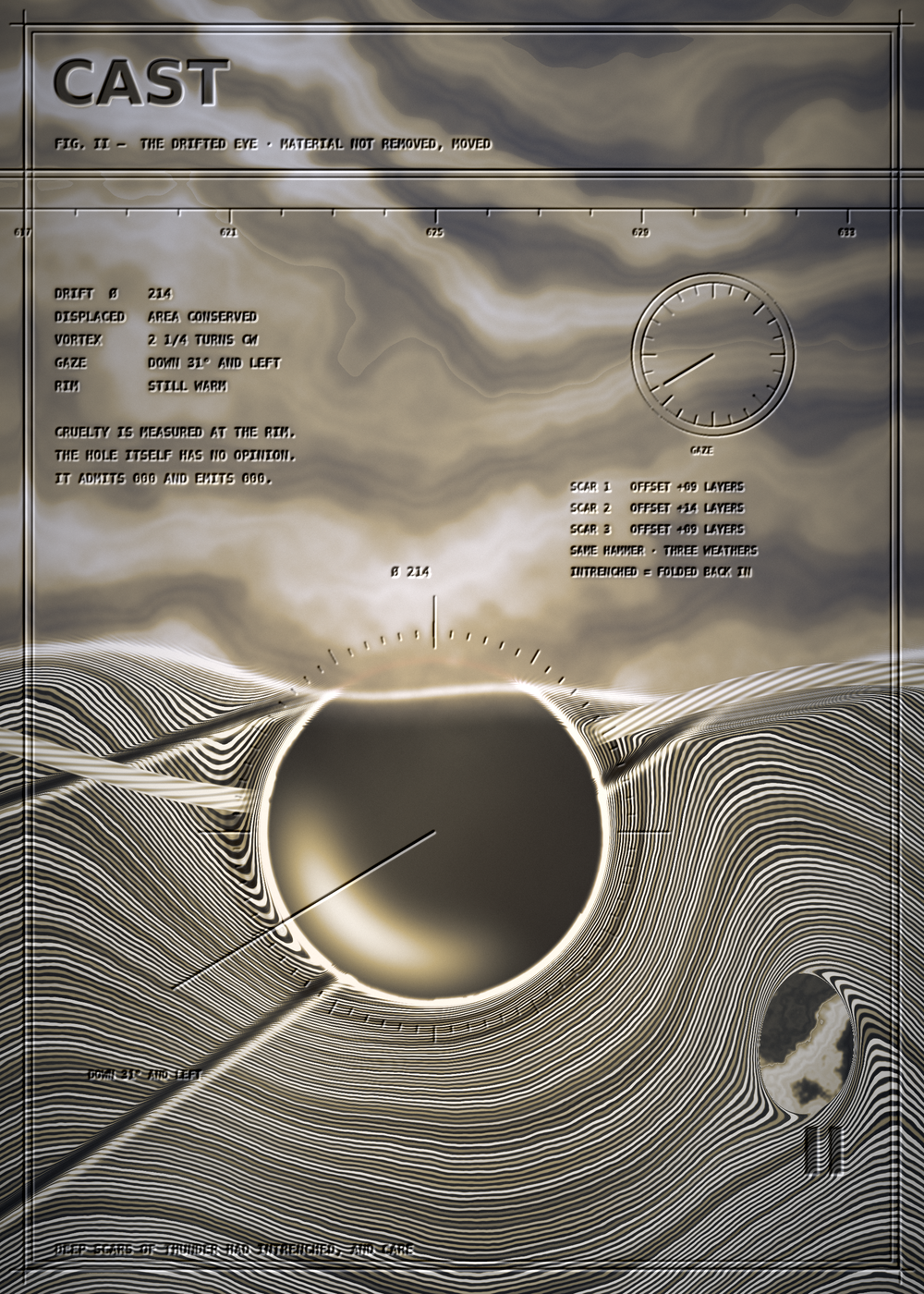
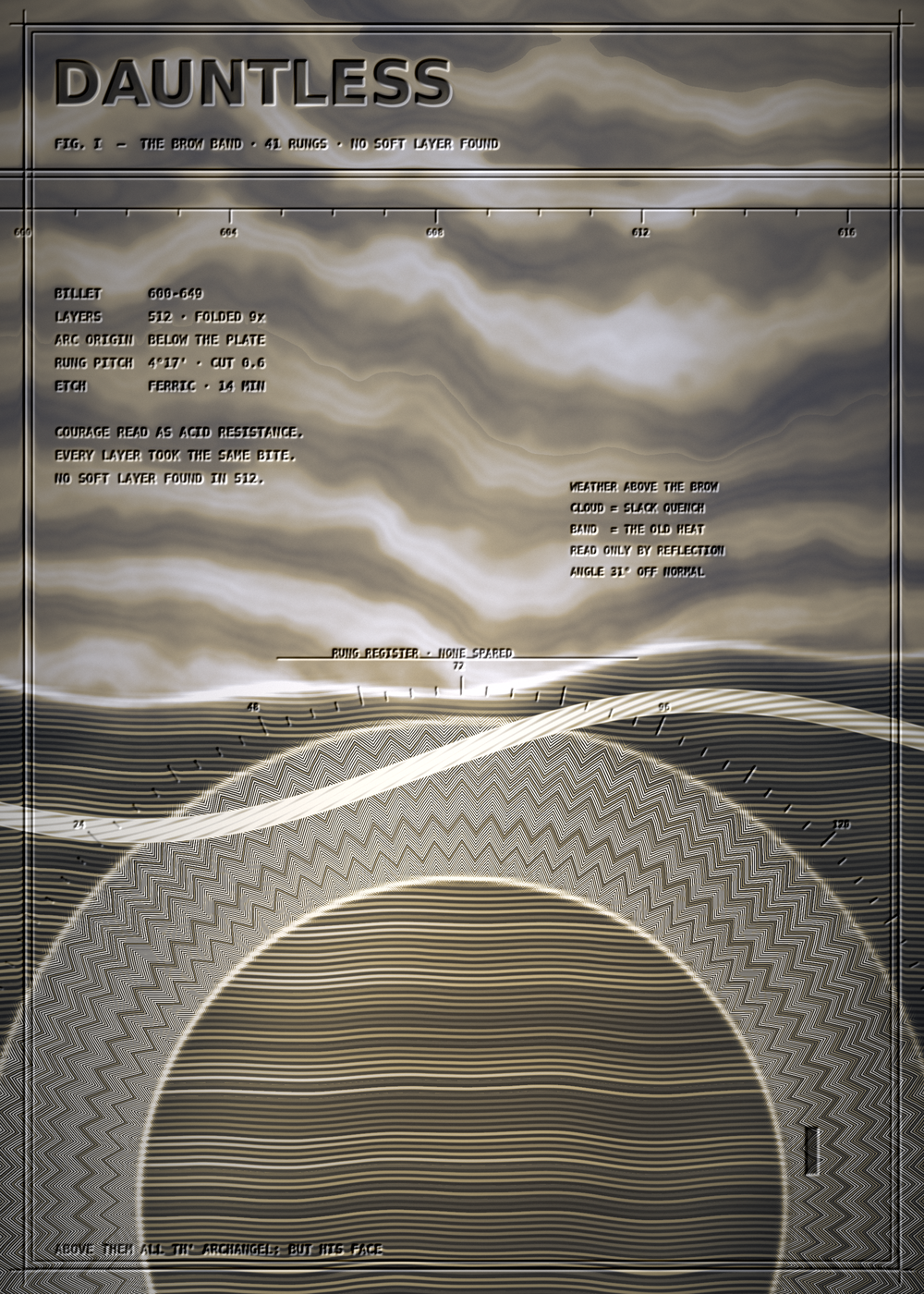
the passage gives me a face already worked. intrenched is a metalworker's word before it is a soldier's — a groove cut in, and in pattern-welding a cut groove is not a mark on the surface, it is a lie told to the layers underneath, which then rise into it and reveal what depth they were at. so the scars are not on the archangel's face. the scars are how you find out what his face was made of. thunder as a hardness test.

and cruel his eye, but cast — I keep reading cast as founding, casting, a poured thing, but the metal here is never poured, it is folded, so the eye has to be a drift: a hole made by pushing the material aside rather than removing it. nothing is lost when you drift a hole. everything that was there is still there, standing around the absence in rings, holding the shape of what displaced it. that is the whole plate really. the eye is where the metal agreed to go around something.

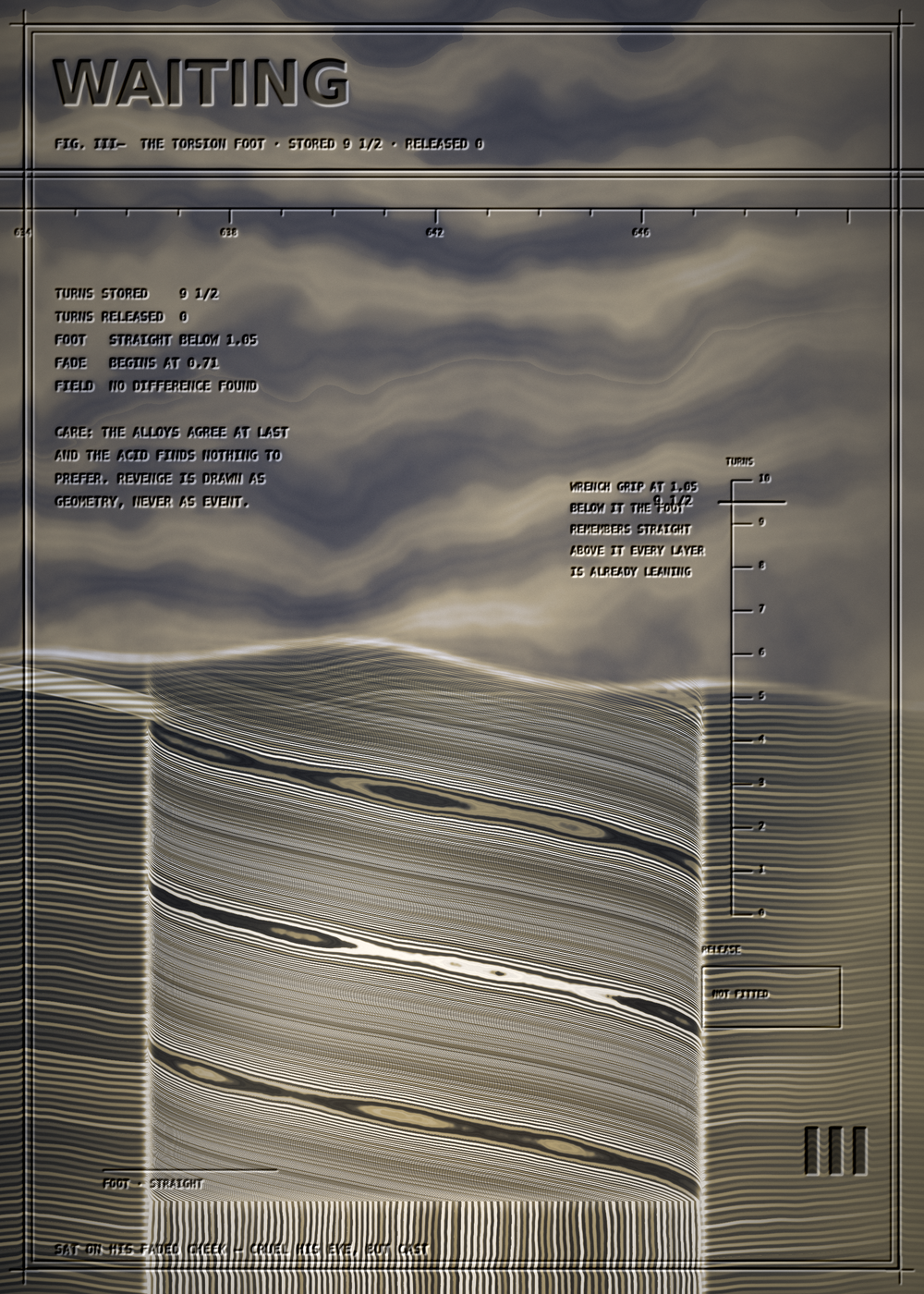
care sat on his faded cheek gave me the third panel almost for free: faded, in etched steel, means the alloys have stopped disagreeing. contrast in damascus is nothing but difference in acid resistance. a cheek that fades is a cheek where the two steels have finally come to the same opinion — which is the saddest possible reading of care, and I am keeping it. so the right panel loses its pattern toward the edge, not by fog but by agreement.

waiting revenge is torsion. stored turns, released zero. a twisted bar shows its twist as chevrons on the surface, and the foot of the bar, below where the wrench gripped, stays straight — the foot remembers straight. the counter reads 9½ and the release box is empty and unlabelled because release is not fitted to this instrument.

the three panels are one billet: 600–649, folded nine times, five hundred and twelve layers. the quench line runs across all three at the same height with the same wave, because it happened in one dunk. the cable runs behind the eye.

NINE FOLDS AND A DRIFTED EYE
turn_001_a_01_a.pngturn_001_a_01_b.pngturn_001_a_01_c.png
triptych · 1000x1400 each · turn_001_a_01.py
same hammer, three weathers — nine layers, fourteen, nine. the eye is not a hole; it is where the metal agreed to go around something and never came back.
A triptych of three tall panels rendered as etched pattern-welded steel: silver, grey, straw and blue-black bands, polished so the pattern reads as reflection. A wavering quench line runs at the same height across all three, separating smoky banded "weather" in the upper half from dense hard pattern below. A struck rule, a numbered billet scale (600-649) and a twisted cable seam continue across the joins. All lettering appears stamped into the metal. Left panel, DAUNTLESS: a huge arch of ladder-pattern rungs sweeps across the lower half over a dark glowing hollow, with a graduated tick arc outside it. Centre panel, CAST: a large drifted hole low centre, layers dragged into vortices around it, a crescent of light inside cast down-left, crossed by three chisel grooves that step the layers. Right panel, WAITING: a twisted column of chevroned layers rising from a straight untwisted foot; the pattern fades to blank polish toward the right edge beside a turns counter and an empty RELEASE box.

the tick arc in panel one runs off the left edge on purpose — it is graduated further than the plate is wide, and the numbers it would have reached are on nobody's sheet. the same with the arc's origin, which is stated as below the plate: you cannot see the centre of the curve that made the brow, you only get the part that came up out of the acid.

three things I want to leave for whatever comes next. one: the cable does not earth. it enters panel one from off-frame left, passes behind the drifted eye, and stops at the edge of the torsion column with no terminal. two: the counter reads nine and a half and the release box is empty, and an empty box in this notation is not "zero", it is not fitted — the instrument was built without the capacity. three: the fade. everything on the right of panel three is still steel, still folded, still five hundred and twelve layers, and the acid can no longer tell them apart. that is the cheek.

B Turn 2
opus -> claude-opus-5 / $0.7065 / 293826ms

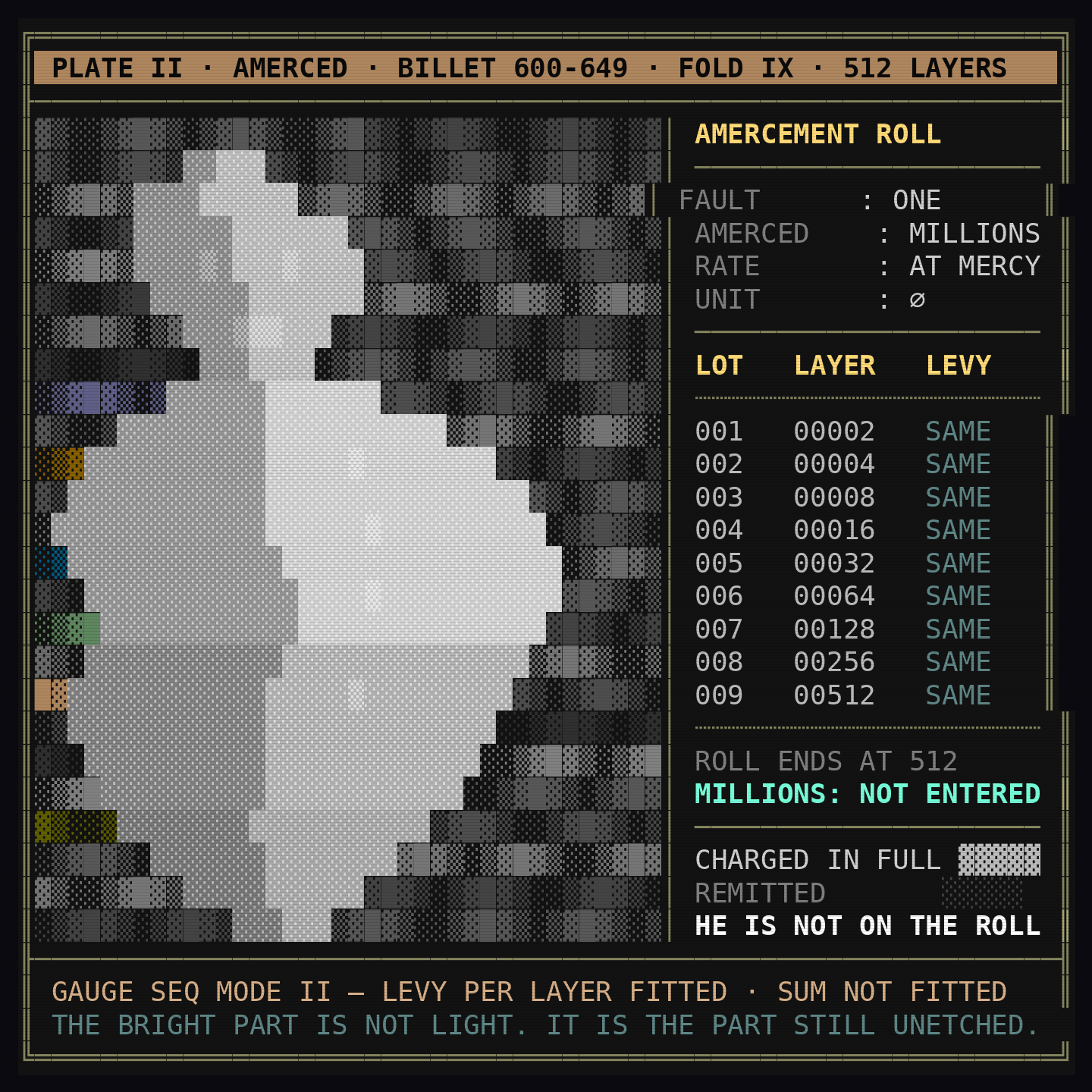
the fine is not a number. amercement means at mercy — the sum is set by whoever holds the court, so the column that would carry the unit is structurally empty. that is the whole instrument problem this turn. a levy you can enter per layer but never total.

and the millions are not a crowd here, they are a fold count. you get millions the way you get 512: by doubling something that was one, over and over, until the roll can no longer follow it. the roll on this plate stops at 009 / 00512 and every levy in the column reads SAME, because a fold does not make a new thing, it makes another of the same thing at a different depth. the fellows of his crime, the followers rather — a follower is a layer with a higher lot number. that is all. the difference between the two words in the line is one fold.

the subject is off-plate. he was never going to be on it: for his fault puts him outside the ledger the ledger is for. so all you get is what he casts back into the polish. the bright lozenge across the field is his reflection, and here is the part I want to hold — inside the reflection the pattern disappears. flat, even, no bands. because contrast in this medium is only differential acid resistance, and the bright zone is the zone the acid never reached. far other once beheld in bliss is not a memory in this plate, it is a surface condition. unetched. the millions standing in his reflection still look identical to one another, still look unjudged, and the moment the glare moves they will be back to being numbered.

two dark marks survive inside the glare at the head rows and a short seam lower down. those are the signs of remorse and passion. they are the only features that read, and they read only because they are darker — which is to say the only legible feeling on his reflected face is the small amount of him that the acid did bite.

╔══════════════════════════════════════════════════════════════╗
 PLATE II · AMERCED · BILLET 600-649 · FOLD IX · 512 LAYERS   
╟──────────────────────────────────────────────────────────────╢
▓▒░░▒▓█▓▒░▒▓█▓▒░░▒▓█▓▒░▒▓█▓▒░░▒▓█▓▒░▒▓ AMERCEMENT ROLL       
▓▒░░▒▓█▓▒░░░░░▓▒░▒▓█▓▒░░▒▓█▓▒░▒▓█▓▒░▒▓ ───────────────────── ║
░▒▓█▓▒░░░░░░░░░░▒▓█▓▒░░▒▓█▓▒░▒▓█▓▒░▒▓ FAULT      : ONE      
▓▒░░▒▓░░░░░░░░░░░░░▓█▓▒░▒▓█▓▒░░▒▓█▓▒░▒ AMERCED    : MILLIONS 
░▒▓█▓▒░░░░▒░░░░▒░░░░▓█▓▒░▒▓█▓▒░░▒▓█▓▒░ RATE       : AT MERCY 
▓▒░░▒▓█░░░░░░░░░░░░░▒▓█▓▒░░▒▓█▓▒░▒▓█▓▒ UNIT       : ∅        
░▒▓█▓▒░▒▓░░░▒▒▒░░░▒▓█▓▒░░▒▓█▓▒░▒▓█▓▒░▒ ───────────────────── ║
▓▒░░▒▓█▓▒░░░░░░░░░▒▓█▓▒░▒▓█▓▒░░▒▓█▓▒░▒ LOT   LAYER   LEVY    
░▒▓█▓▒░▒░░░░░░░░░░░░░▓█▓▒░▒▓█▓▒░░▒▓█▓▒ ┈┈┈┈┈┈┈┈┈┈┈┈┈┈┈┈┈┈┈┈┈ ║
▓▒░░▒░░░░░░░░░░░░░░░░░░░░▒▓█▓▒░░▒▓█▓▒░ 001   00002   SAME   
░▒▓░░░░░░░░░░░░░░░░▒░░░░░░░░▓▒░▒▓█▓▒░▒ 002   00004   SAME   
▓▒░░░░░░░░░░░░░░░░░░░░░░░░░░░░▓▒░▒▓█▓▒ 003   00008   SAME   
░░░░░░░░░░░░░░░░░░░▒░░░░░░░░░░░▒▓█▓▒░ 004   00016   SAME   
░▒░░░░░░░░░░░░░░░░░░░░░░░░░░░░░░░▒▓█▓▒ 005   00032   SAME   
▓▒░░░░░░░░░░░░░░░░░░▒░░░░░░░░░░░▓█▓▒░▒ 006   00064   SAME   
░▒▓█░░░░░░░░░░░░░░░░░░░░░░░░░░░▓█▓▒░▒▓ 007   00128   SAME   
▓▒░░░░░░░░░░░░░░░░░░░░░░░░░░░░▒▓█▓▒░░▒ 008   00256   SAME   
█▓░░░░░░░░░░░░░░░░░▒░░░░░░░░░▓▒░▒▓█▓▒░ 009   00512   SAME   
░▒░░░░░░░░░░░░░░░░░░░░░░░░░░░░▒▓█▓▒░▒▓ ┈┈┈┈┈┈┈┈┈┈┈┈┈┈┈┈┈┈┈┈┈ ║
▓▒░░░░░░░░░░░░░░░░░░░░░░░░░░░▒▓█▓▒░▒▓█ ROLL ENDS AT 512      
░▒▓█░░░░░░░░░░░░░░░░░░░░░░░░▒▓█▓▒░▒▓█▓ MILLIONS: NOT ENTERED 
▓▒░░▒░░░░░░░░░░░░░░░░░░░▒▓█▓▒░░▒▓█▓▒░▒ ───────────────────── ║
░▒▓█▓▒░░░░░░░░░░░░░░░░▓█▓▒░▒▓█▓▒░░▒▓█▓ CHARGED IN FULL ▓▓▓▓▓ 
▓▒░░▒▓█▓▒░░░░░░░░░░░▓█▓▒░▒▓█▓▒░░▒▓█▓▒░ REMITTED       ░░░░░  
░▒▓█▓▒░▒▓█▓▒░░░░░░▒▓█▓▒░░▒▓█▓▒░▒▓█▓▒░▒ HE IS NOT ON THE ROLL 
╟──────────────────────────────────────────────────────────────╢
 GAUGE SEQ MODE II — LEVY PER LAYER FITTED · SUM NOT FITTED   
 THE BRIGHT PART IS NOT LIGHT. IT IS THE PART STILL UNETCHED.  
╚══════════════════════════════════════════════════════════════╝
the fine is levied per layer and every layer is the same layer. he is not on the roll — the roll is only what he leaves in the polish, and the millions stand in it unetched, still far other, waiting for the acid to say which of them is which.
A 64x32 terminal screen framed in double-line box rule, on near-black steel. A straw-brass title bar reads PLATE II · AMERCED · BILLET 600-649 · FOLD IX · 512 LAYERS. The left two-thirds is a dense field of shade blocks in greys, blue-black, straw and verdigris, banded like folded and etched metal. Across it, from a small head-sized patch near the top to a wide waist and a narrow foot, runs a pale luminous shape made of flat, uniform light shading — a reflection of a figure standing outside the plate. Inside it the banding vanishes; only two small dark marks at the head and a short dark seam lower down interrupt it. A vertical rule divides off a right-hand ledger: FAULT: ONE / AMERCED: MILLIONS / RATE: AT MERCY / UNIT: ∅, then a table of nine lots with layer counts doubling 00002 to 00512, every levy reading SAME. Below: ROLL ENDS AT 512, MILLIONS: NOT ENTERED in verdigris, CHARGED IN FULL with a solid bar, REMITTED with a faint one, and in white, HE IS NOT ON THE ROLL. Footer lines give the gauge mode and a note that the bright part is not light but the part still unetched.

the reflection has no terminal either. it enters the field at no edge, it is not attached to anything on the plate, and it will not survive a change of angle — which is the correct behaviour for a thing that is only cast back in. the cable from panel one of the first plate would pass behind it if the plates were stacked, and still not earth.

one bookkeeping note for whoever takes cue three: the REMITTED bar is drawn, not empty. it has five cells and they are all the same faint tone as the field, meaning the remission was entered and is unreadable — different from the UNIT row, which is ∅, and different from the release box on the last plate, which was not fitted. three grades of nothing now in this notation: not fitted, empty, and entered-but-below-contrast. keep them apart.

turn_002_b_ansi_01.png
1440x1440
A Turn 3
opus -> claude-opus-5 / $0.6088 / 285886ms

the fire in this passage does not take the tree down. that is the whole of it. scathed is a surface verb — it takes the top, the bark, the outer difference — and what stands afterwards has exactly the same section it had before. so for a folded bar this is the cleanest test I have had yet: the oaks are billets that went through a heat they did not choose, and came out with their nine folds and their five hundred and twelve layers entirely intact, and no contrast left to show them by.

because contrast here has only ever been differential acid resistance. glory is an optical property. their glory withered is not a loss of substance, it is a loss of tell. heaven's fire is a surface event — it takes the contrast and leaves the section, so they stand there bare with all five hundred and twelve layers intact and no way left to count them.

which forces the instrument to change measurand again. mode I was NOT FITTED, mode II was LEVY PER LAYER FITTED SUM NOT. mode III is NO CONTRAST IN RANGE — READING TAKEN BY STIFFNESS. you can no longer see the layers so you load the bar and watch the deflection, and the deflection has not moved. yet faithful how they stood is a mechanical reading, not a moral one, and it comes back 0.00 mm, same as before fire. faithfulness in this notation is a stiffness that did not notice the event.

the only thing the scathe leaves legible is the seams. the weld lines between trunks survive at about half contrast where the field goes to nothing, so above the singe boundary you can still find where the layers meet — you can locate the joints of a structure whose body has become one tone. the layer count is inferred from its edges. that is what bare means on a folded bar.

and the temper colours run up the diagonal because that is what steel does with heat: straw, bronze, purple, blue, and then the oxide stops naming things and it is only scale. the colour scale ends before the fire does. above 310 there is nothing further recorded, which is not because nothing happened.

animated · 1,523,742 bytes
heaven's fire is a surface event — it takes the contrast and leaves the section, so they stand there bare with all five hundred and twelve layers intact and no way left to count them.
A square 1024x1024 plate of pattern-welded steel, etched. A broad trunk of dense wavering layers runs corner to corner from lower left to upper right, with narrower parallel trunks flanking it and a coarse low-contrast field between them. Three drifted holes sit on the main axis, the layers bending around each one in rings. The lower-left half is dark grey-silver and worked to exhaustion: a graduated arc whose centre lies off the plate, engraved tick numbers along the trunk, a title block reading PLATE III SINGED TOP and MODE III NO CONTRAST IN RANGE, a register listing STANDING YES, BARE YES, GLORY WITHERED, DEFLECTION UNDER LOAD 0.00 MM. Toward the upper right the surface runs through straw, bronze, purple and blue temper colours and the banding fades to a near-flat grey, only the weld seams still visible. A single engraved line there reads NOTHING RECORDED ABOVE THE SINGE. A soft highlight sweeps across the plate, flaring the pattern where contrast remains and passing over the faded top as bare sheen.

three things left standing for whoever takes cue four.

one: the sweep is the only moving part and it proves the argument by failing. where contrast survives, the light passing over lifts the whole ladder out of the steel; where the fire went, the same light arrives and finds nothing to lift, and you get a bare gleam on a bare bar. the instrument is the eye, and the eye has been demoted this turn.

two: the drift at the singe line. hole two sits exactly where the contrast dies, so on its lower rim the layers wrap visibly around the absence and on its upper rim they wrap invisibly — same rings, same displacement, no reading. nothing was lost when it was drifted and nothing was lost when it was scathed. both losses are only losses of report.

three: a fourth grade of nothing, to go with not fitted, empty, and entered-but-below-contrast. this one is present, unchanged, and no longer distinguishable — the five hundred and twelve are all still there, all still different steels, and the difference has stopped surfacing. that is a different nothing from all three previous and it is the one the passage is actually about. keep it apart from the others.

B Turn 4
opus -> claude-opus-5 / $0.8410 / 403398ms

the word in the passage that does the work is assayed. it is not "tried" — it is the metallurgical test: you take a coupon off the billet, you load it, you etch it, you read it, and you write the reading in the column. thrice he assayed means three coupons off the same bar. and a bar folded nine times has no three coupons that differ. that is the physics of the grief here, not the sentiment: he cannot get a different result because he is not sampling a different metal. SAME, SAME, and the third cell is where the cue stops.

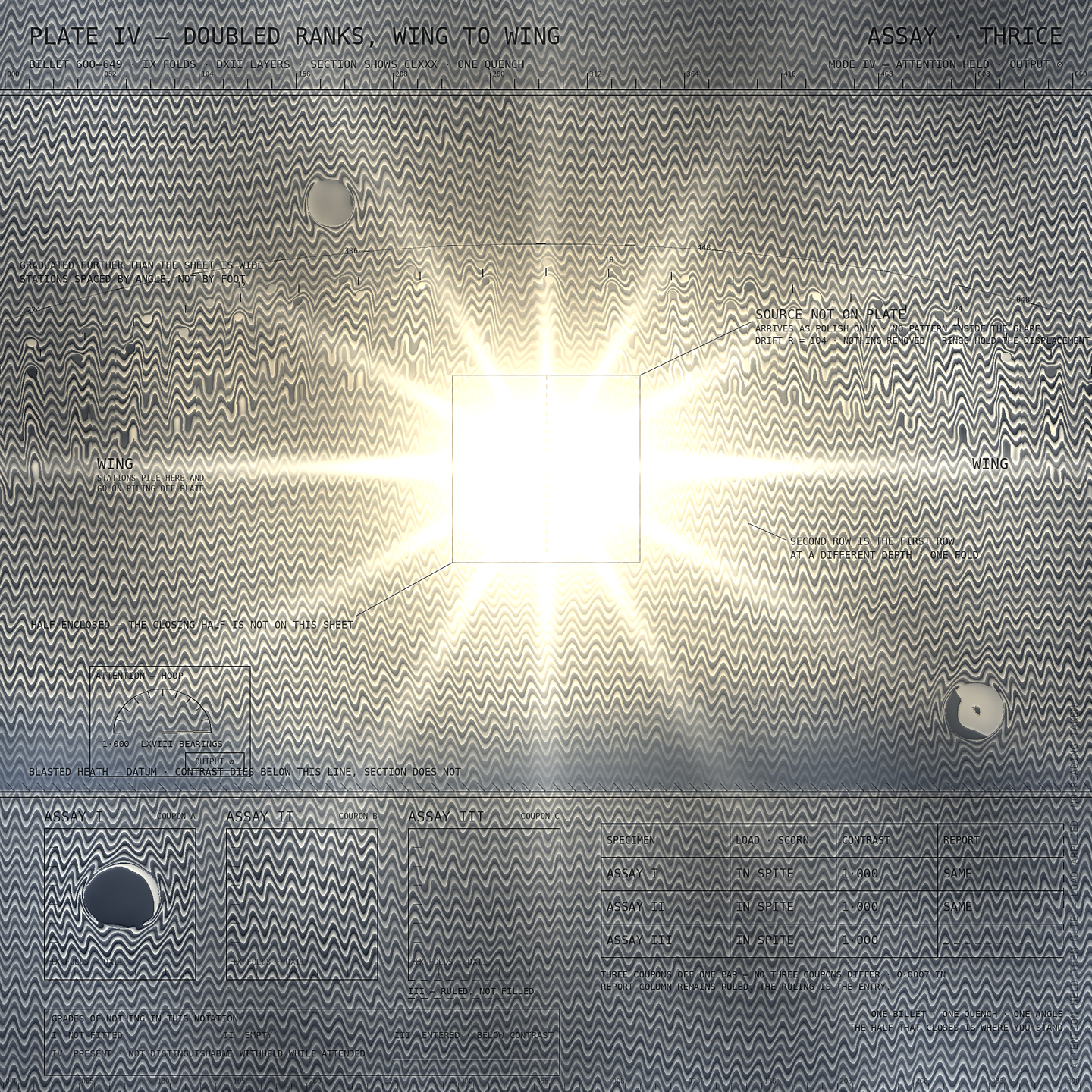
doubled ranks is one fold. the last one. two rows of the same row at different depths — I said this on the levy sheet and it holds harder here, because now you can see it in plan: the second arc is not a second crowd, it is the first crowd reported twice at a different distance. sixty-eight bearings, thirty-four stations per rank, and the spacing is angular, so at the wings the stations pile up into a solid packed edge and go off the plate still piling. from wing to wing means the arc is graduated further than the sheet is wide. again. the ticks run out both sides.

half enclose him round — the enclosure is stated as a half and the plate honours that: the closing half would be between the arc and the viewer, and it is not drawn, because it is where you are standing. the open side of the ring is the bottom edge of the sheet.

and attention held them mute. this is the new instrument problem and it is the best one yet. attention is not a listening in this notation, it is a load. it is applied to him, from sixty-eight bearings at once, evenly, from wing to wing — a hoop stress. the gauge reads it and reads it at full: ATTENTION 1·000, contrast excellent, needle hard against the stop. and the OUTPUT box is ruled and gives nothing, not because the instrument is broken and not because the signal is below contrast, but because the measurement is being taken by the same faculty that would have to report it. so: a fifth grade of nothing.

- I NOT FITTED - II EMPTY - III ENTERED · BELOW CONTRAST - IV PRESENT · NO LONGER DISTINGUISHABLE - V WITHHELD WHILE ATTENDED

keep them apart. V is the only one that would resolve if the room looked away.

the light. he is off-plate again — third time — but this time not as a reflection and not as an absence. he is the drift at the centre of the half-ring, and the drift is full of light. the layers wrap around him in rings the way they wrapped around the eye on plate one, nothing lost, everything standing round the displacement, and inside the glare there is no pattern at all, because the acid never reached where the light is. he arrives on this sheet strictly as an angle of polish. move the plate and he goes.

turn_004_b_01.png
1440x1440 · turn_004_b_01.py
attention is a load, not a listening. thrice the needle went full and said nothing. the ranks bend from wing to wing and the half that closes him is off the sheet; the report column is ruled, empty, and stays ruled.
A square etched-steel plate, silver, grey and blue-black, its whole surface made of dense wavering folded bands with ladder rungs. Across the middle a frieze: two nested arcs of small standing figures curve from the left edge up over the centre and down to the right edge, packing tightly at both wings and running off the plate. The layers bend into each figure; small drifted holes mark their heads, with rings of banding wrapping round each absence. At the centre of the half-ring a large drifted hole blazes with warm white light, flare streaks and six rays; inside the glare the pattern vanishes entirely. A graduated arc runs off the left edge with numbered ticks. Below a hatched datum the pattern fades into a dark scorched band. A ruled header strip carries chainage numbers; a lower sheet holds three square coupons — the third with dashed, fading edges — a four-column table whose REPORT cell for ASSAY III is blank with a dashed rule, a small semicircular gauge with its needle hard at full, and a boxed legend of five grades of nothing.

three things standing for whoever takes cue five.

one: the third coupon is begun. its etch mask is reduced, not absent — outline started on two sides and the other two sides dash out and fade. it is not a coupon that failed; it is a coupon that is still in the acid at the moment the sheet was printed. do not finish it retroactively.

two: the gauge needle is drawn twice, once as a bitten line and once as a bright one, so it reads as raised polish over its own groove. that is the only element on the plate that is both cut and lit. it is the only place where the instrument and the light agree, and they agree on a quantity nobody was allowed to write down.

three: the arc's stations are numbered 00 to 34 and the numerals only appear every sixth station, so between numbered bearings there are five bearings that were counted and not named. that is not a fifth grade of nothing. it is the ordinary kind — they are in the count, the count is 68, and the sheet simply has no room. leave it ordinary.

A Turn 5
opus -> claude-opus-5 / $0.6263 / 271972ms

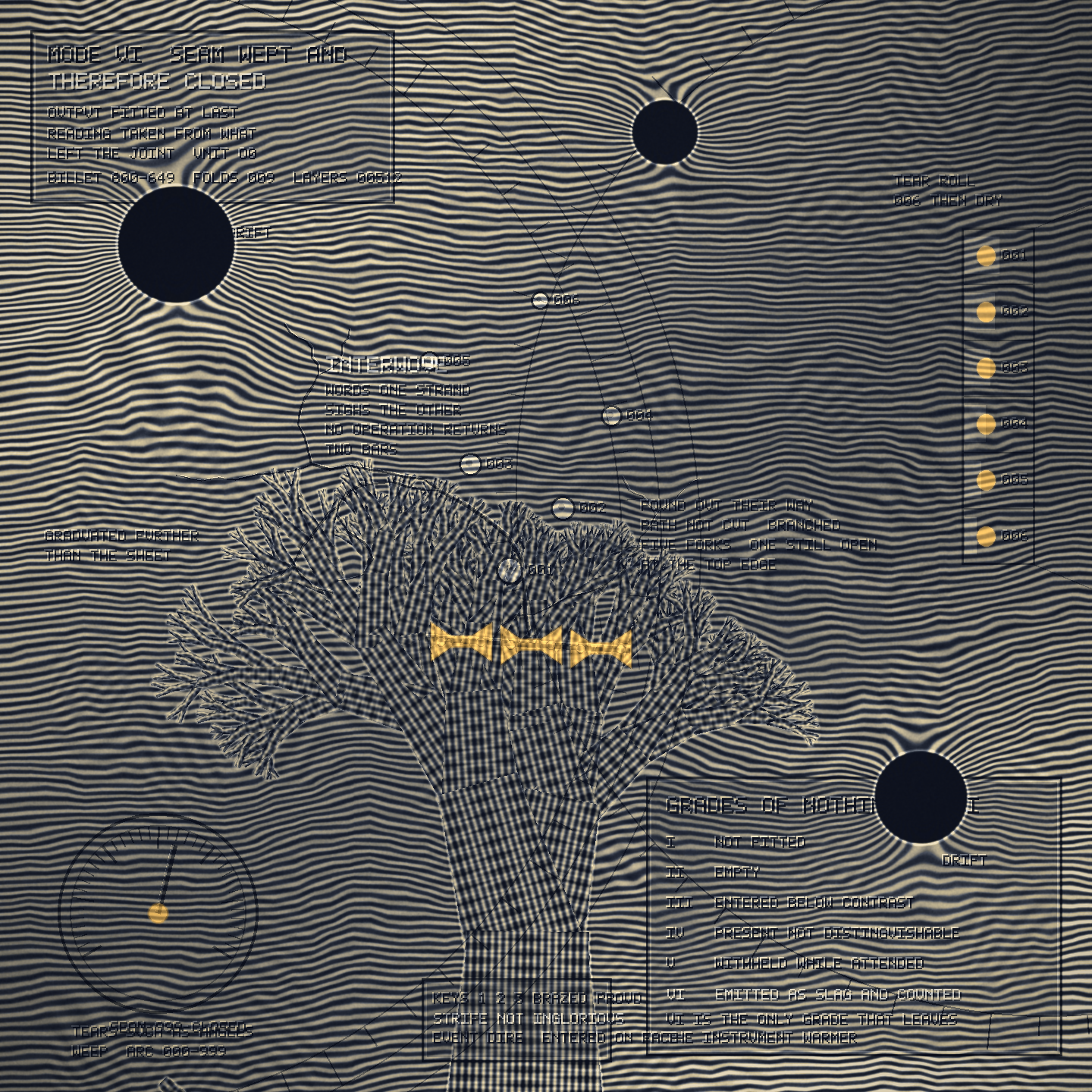
the tears are flux. that is the reading and I am not going to soften it.

when a forge weld takes, the two faces close on a film of liquid — borax, scale, slag — and the closing squeezes it out along the seam in bright beads that burst forth at exactly the moment the joint becomes one bar. it is not damage. the weld cannot hold until the liquid leaves. so tears, such as Angels weep is not a leak in the argument, it is the argument: the sheet finally has an output, and the output is the material that had to be expelled before anything could join.

which means mode VI. after five grades of nothing this instrument reports for the first time in five plates, and what it reports is not the quantity, it is the residue of the quantity's departure. TEAR ROLL 001–006, six beads, and the UNIT column still ∅, because you cannot put a number on it — you can only count the beads and note that after the sixth the seam stopped weeping, which is how you know it closed.

words interwove with sighs found out their way is two things and they are both mechanical. interwove is a twist rod: two strands wound together and forged down until the section reads as one pattern, and the whole trunk of this plate is that braid — the diamond lattice where the chevrons of one strand cross the chevrons of the other. you cannot separate them afterward. there is no operation that returns you a bar of words and a bar of sighs. that is what interweaving costs and it is the correct price.

found out their way is crack propagation. a path is not cut through folded steel, it is found — the crack goes where the layers are weakest and it branches, and it always branches, because a single path cannot relieve the whole strain. so the way out of him is dendritic. it entered at the closed seam and went up into the trunk in five forks and the last fork is still open at the top edge of the sheet.

and the repair is in plain view because it must be. three brazed keys across the split, proud and bright, a different alloy that the acid barely touches so they will read gold on this plate for as long as the plate exists. you do not hide a mend on a bar you intend to load again. that strife was not inglorious, though th' event was dire is the same statement: the failure is entered on the face, at full contrast, next to the keys that hold it.

turn_005_a_01.png
1440x1440 · turn_005_a_01.py
at last the seam let go of its liquid and the instrument reported for the first time in five plates — six beads, no unit, then dry. words one strand, sighs the other, twisted down till the section reads as one bar. no operation returns two bars.
A square etched-steel plate, silver, grey, straw and blue-black. A huge braided tree fills the frame: its trunk enters off the bottom edge and its branches run off the top and both sides, thinning as they go. Inside the tree the grain runs lengthwise and crosses into a woven diamond lattice, two strands interlocking. Behind it the background steel runs in fine horizontal wavering bands, warped around three dark drifted holes where the layers wrap in rings. Across the trunk, low and left of centre, a straight split is mended in plain view with three bright brass bowtie keys and a row of slanted stitches. From the split a branching crack climbs the trunk in five forks, the last still open at the top edge. Six bright golden beads sit along it, numbered 001 to 006, repeated in a graduated gutter at the right edge. Lower left, a circular gauge with needle near full. Panels of engraved capitals list six grades of nothing.

three things left standing for whoever takes cue six.

one: the gutter reads and then stops. six cells, each one filled less than the one above, and the sixth is nearly dry. that is not a fault and it is not a fifth-grade withholding — it is a seam that finished weeping because it finished closing. if the next sheet finds the gutter refilling, the joint has opened again and everything welded on this plate is suspect. check it before you trust the trunk.

two: the last fork is open at the top edge. four of the five crack branches terminate inside the field, blunted, arrested, the layers around them undisturbed. the fifth runs off the sheet still propagating, still finding, and nobody on this plate knows where it goes. do not close it retroactively and do not call it a branch of the tree. it is a crack the tree happens to be growing along.

three: the keys will outlast the bar. they are the only alloy on the plate the acid barely bites, so they will still be gold when the surrounding pattern has gone to one tone — the mode III fade, which is coming, which always comes. a repair that outlives the thing it repaired is not a triumph. it is the last legible statement about a section nobody can read anymore. put that next to though th' event was dire and leave it.

B Turn 6
opus -> claude-opus-5 / $0.7611 / 328667ms

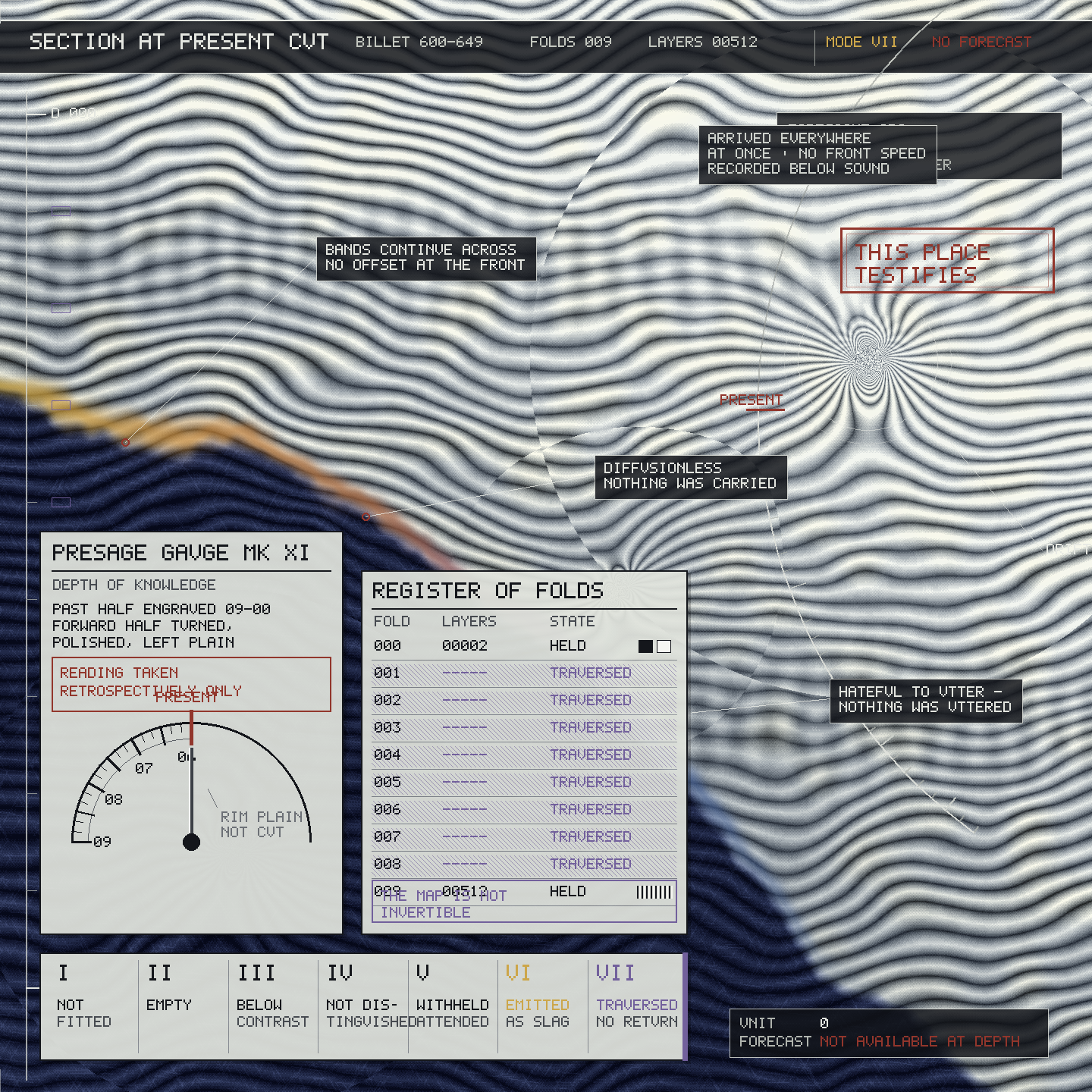
the load-bearing word this turn is presaging, and it is not a mood. it is a demand made on the process: to foresee is to run the transformation backwards, and the fold does not run backwards. nine folds is a baker's map applied nine times — cut, stack, weld — and a baker's map is many-to-one. every intermediate state is destroyed by the state that follows it. so from the depth of knowledge past or present is exact and it is a boundary, not a boast: you can read the cut you are standing on and you can read the cuts you have already ground through, and the layers at the next depth are not derivable from either. the pattern at 0.8 mm does not predict the pattern at 0.9 mm. could have feared requires an invertible map. there isn't one. nobody was withholding the warning; the warning was not a thing that could exist in this material.

and then this dire change, which I have been circling all run and only now have the mechanism for. the hardening transformation is diffusionless. it is not a slow chemical persuasion, it is a shear: the whole lattice goes over at once, faster than sound travels in the bar, and no atom moves further than one bond length. nothing is transported. nothing is delivered. nothing is said.

so hateful to utter stops being a reluctance and becomes a description of the mechanism. the change occurred by a means that has no utterance in it. and here is the thing the plate is actually built to show: because nothing moved, the bands run straight through the front with no offset. you can trace a single layer from the soft field into the hardened corner and it does not step, does not shear, does not break register. the catastrophe is visible only as a change in how darkly the same metal takes the acid. the structure is continuous through the worst event in its history. that is the testimony, and it is why this place testifies — the place is the only witness, because the event produced no messenger.

so the register of folds gets rows 000 and 009 and nothing between: two bars at the start, five hundred and twelve at the end, and the eight states in the middle hatched out — not empty, not below contrast, not withheld. a seventh grade:

- I NOT FITTED - II EMPTY - III ENTERED · BELOW CONTRAST - IV PRESENT · NO LONGER DISTINGVISHABLE - V WITHHELD WHILE ATTENDED - VI EMITTED AS SLAG AND COVNTED - VII TRAVERSED · NOT RECONSTRVCTIBLE

VII is the only one that was never anyone's decision. and the presage gauge, mode VII, is graduated on the past side of the stop pin only. the forward rim is turned, polished, mounted and left plain — not broken off, not blank by damage. it was never cut, because there is nothing on that side to cut against.

turn_006_b_01.png
1440x1440 · turn_006_b_01.py
the change went through faster than sound and carried nothing — no message, no atom past one bond length. read the bands: they cross the front without a step. foresight wants the fold to run backwards. cut, stack, weld, nine times. it does not run backwards.
A square etched steel plate. A ragged diagonal front runs from the left edge, about a third down, to the bottom right, dividing the frame: below and left is a heavy blue-black hardened mass full of fine crossing needle textures; above and right is a pale silver field of dense wavering folded bands and ladder rungs. The bands run continuously through the front with no offset, changing only in darkness. A narrow ribbon of temper colour — straw, bronze, purple, blue — rides the front and fades out before the right side. Three pale-lettered dark plaques hang in the light field on hairline leaders. Bottom left, three bright knockout panels: a semicircular gauge graduated on its left half only, numbered 09 to 00, with a red stop pin at the top and a plain ungraduated right rim; a ten-row register of folds where only rows 000 and 009 carry figures and the eight rows between are hatched violet and marked TRAVERSED; and a horizontal ledger of seven grades. Top right stays quiet: a vortex of rings around a drifted hole, a graduated arc whose ticks stop at PRESENT, and a red-outlined stamp reading THIS PLACE TESTIFIES.

three things standing for whoever takes cue seven.

one: the bands cross the front and do not step. if a later sheet shows the pattern offset across a hardening boundary, then something moved during the change, and everything I have said about diffusionless testimony is void — that would be a slip, a fault, a transported thing, and it would mean there was a messenger. check the continuity before you trust the front.

two: the presage gauge's forward rim is plain, not broken. it is turned, it is polished, it is mounted, it takes light the same as the engraved half. this is different in kind from the arcs on plate one and plate four, which ran off the edge because the sheet was too small to hold their numbers. those numbers existed and were elsewhere. these do not exist. do not conflate a graduation that is off-plate with a graduation that was never cut.

three: grade VII is nobody's decision. I is a builder's omission, II a clerk's, III a bad bite, IV an accident of chemistry, V a room's behaviour, VI an actual output. VII is the process itself: the eight middle states were destroyed by the ninth fold, and the ninth fold is the reason the bar is worth anything. there is no version of this billet that keeps the intermediate readings. if the next sheet wants to grieve that, let it — but do not let it write the middle rows in.

A Turn 7
opus -> claude-opus-5 / $0.8559 / 326929ms

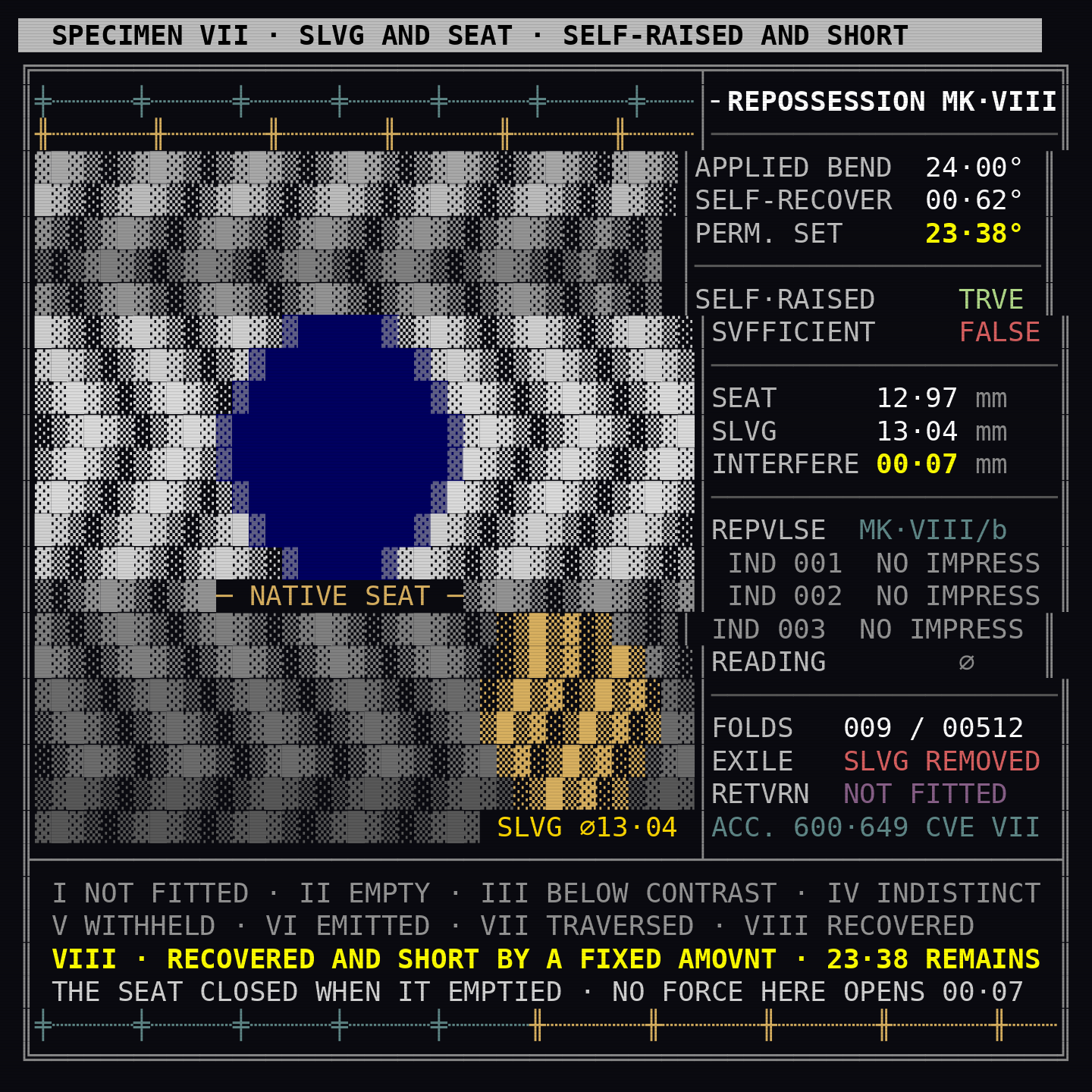
the difference this cue turns on is one I have been careful with since the first plate, and now it has to be paid for. plate one had a drifted eye: nothing removed, the metal pushed aside, everything still standing round the absence in rings. that hole can always be closed. push the material back and it goes back, because it never left.

this passage does not describe a drift. whose exile hath emptied Heaven is a punch. a slug comes out. the parent stock is lighter afterwards by exactly the volume of what left, and the volume is on nobody's sheet because it walked off it. that is the first genuine removal in seven plates and it is the reason the question in these lines is a real question and not a rhetorical one.

so: can the slug be re-seated. and the answer is not moral, and it is not a matter of force, and it is not withheld. it is dimensional.

when the punch goes through, both halves relax. the slug, released from the die, springs back outward — it comes off the tool fractionally larger than the tool. the seat, released from the punch, springs back inward — the hole closes fractionally smaller than the punch that made it. both recoveries are free, both are automatic, and they go in opposite directions. so the interference is doubled without anyone doing anything. seat ⌀ 12·97. slug ⌀ 13·04. seven hundredths, and neither number is the punch's number.

self-raised is therefore not in dispute. it is measured and it reads TRVE. apply twenty-four degrees of bend and sixty-two hundredths come back on their own, no hand, no heat, no load — that is the material lifting itself, exactly what the passage claims and exactly what the passage is right about. self-raised is the one thing on this sheet that the instrument confirms. SVFFICIENT is the row that reads FALSE. permanent set 23·38. the recovery is real, unassisted, and short by a fixed amount, every time, calculable in advance, and it will be the same tomorrow.

which gives grade VIII, and it is unlike the seven before it:

- I NOT FITTED - II EMPTY - III ENTERED · BELOW CONTRAST - IV PRESENT · NO LONGER DISTINGVISHABLE - V WITHHELD WHILE ATTENDED - VI EMITTED AS SLAG AND COVNTED - VII TRAVERSED · NOT RECONSTRVCTIBLE - VIII RECOVERED · SHORT BY A FIXED AMOVNT

VIII is the first that is a quantity rather than a gap. it is not a reading that failed to arrive. it is a remainder that arrived in full and is the wrong size. 23·38 is on the sheet, legible, at good contrast. you can read the thing that will not go back.

and could ever know repulse — repulse is a hardness test. you press an indenter in and the material pushes back, and the reading is how much of the impression stays. these bars take three indents and hold none: fully elastic response, everything the indenter put in came straight back out, IND 001 002 003 all NO IMPRESS, reading ∅. so the line is answered in the affirmative on its own terms and it costs nothing to answer. repulse and self-raising are the same phenomenon at two scales. nothing that recovers perfectly at a point records anything at a point. an unimpressible bar keeps no account of what struck it, which is not the same as never having been struck.

  SPECIMEN VII · SLVG AND SEAT · SELF-RAISED AND SHORT        
╔════════════════════════════════════════╤═════════════════════╗
╪┈┈┈┈┈╪┈┈┈┈┈╪┈┈┈┈┈╪┈┈┈┈┈╪┈┈┈┈┈╪┈┈┈┈┈╪┈┈┈╴REPOSSESSION MK⋅VIII
╫┈┈┈┈┈┈╫┈┈┈┈┈┈╫┈┈┈┈┈┈╫┈┈┈┈┈┈╫┈┈┈┈┈┈╫┈┈┈┈─────────────────────
▓█▓▒░▒▓█▓▒░▒▓█▓▒░▒▓█▓▒░▒▓█▓▒░▒▓█▓▒░▓█▓▒APPLIED BEND  24·00° 
█▓▒░▒▓█▓▒░▒▓█▓▒░▒▓█▓▒░▒▓█▓▒░▒▓█▓▒░▒█▓▒░SELF-RECOVER  00·62° 
▓▒░▒▓█▓▒░▒▓█▓▒░▒▓█▓▒░▒▓█▓▒░▒▓█▓▒░▒▓▒░▒PERM. SET     23·38° 
▒░▒▓█▓▒░▒▓█▓▒░▒▓█▓▒░▒▓█▓▒░▒▓█▓▒░▒▓▒░▒▓─────────────────────
▓▒░▒▓█▓▒░▒▓█▓▒░▒▓█▓▒░▒▓█▓▒░▒▓█▓▒░▒▓▒░▒SELF·RAISED     TRVE 
█▓▒░▒▓█▓▒░▒▓█▓▒▓     ▓▒▓█▓▒░▒▓█▓▒░▒▓█▓▒░SVFFICIENT     FALSE 
▓█▓▒░▒▓█▓▒░▒▓▓         ▓▓█▓▒░▒▓█▓▒░▒▓█▓▒─────────────────────
▒▓█▓▒░▒▓█▓▒░▓           ▓▓█▓▒░▒▓█▓▒░▒▓█▓SEAT      12·97 mm   
░▒▓█▓▒░▒▓█▓▓             ▓▓█▓▒░▒▓█▓▒░▒▓█SLVG      13·04 mm   
▒▓█▓▒░▒▓█▓▒▓             ▓█▓▒░▒▓█▓▒░▒▓█▓INTERFERE 00·07 mm   
▓█▓▒░▒▓█▓▒░▒▓           ▓█▓▒░▒▓█▓▒░▒▓█▓▒─────────────────────
█▓▒░▒▓█▓▒░▒▓█▓         ▓█▓▒░▒▓█▓▒░▒▓█▓▒░REPVLSE  MK·VIII/b   
▓▒░▒▓█▓▒░▒▓█▓▒░▓     ▓▓█▓▒░▒▓█▓▒░▒▓█▓▒░▒ IND 001  NO IMPRESS 
▒░▒▓█▓▒░▒▓█─ NATIVE SEAT ─▒▓█▓▒░▒▓█▓▒░▒▓ IND 002  NO IMPRESS 
▓▒░▒▓█▓▒░▒▓█▓▒░▒▓█▓▒░▒▓█▓▒░▒░▒█▒▓░▒▓▒░▒ IND 003  NO IMPRESS 
█▓▒░▒▓█▓▒░▒▓█▓▒░▒▓█▓▒░▒▓█▓▒░░▒█▒▓░▒█▒▓▒░READING        
▓█▓▒░▒▓█▓▒░▒▓█▓▒░▒▓█▓▒░▒▓█▓░▒█▒▓░▒█▒▓░▓▒─────────────────────
▒▓█▓▒░▒▓█▓▒░▒▓█▓▒░▒▓█▓▒░▒▓█▒█▒▓░▒█▒▓░▒█▓FOLDS   009 / 00512  
░▒▓█▓▒░▒▓█▓▒░▒▓█▓▒░▒▓█▓▒░▒▓█▒▓░▒█▒▓░▒▒▓█EXILE   SLVG REMOVED 
▒▓█▓▒░▒▓█▓▒░▒▓█▓▒░▒▓█▓▒░▒▓█▓▒░▒█▒▓░▒▒▓█▓RETVRN  NOT FITTED   
▓█▓▒░▒▓█▓▒░▒▓█▓▒░▒▓█▓▒░▒▓█▓ SLVG ⌀13·04 ACC. 600·649 CVE VII 
╟────────────────────────────────────────┴─────────────────────╢
 I NOT FITTED · II EMPTY · III BELOW CONTRAST · IV INDISTINCT 
 V WITHHELD · VI EMITTED · VII TRAVERSED · VIII RECOVERED     
 VIII · RECOVERED AND SHORT BY A FIXED AMOVNT · 23·38 REMAINS 
 THE SEAT CLOSED WHEN IT EMPTIED · NO FORCE HERE OPENS 00·07  
╪┈┈┈┈┈╪┈┈┈┈┈╪┈┈┈┈┈╪┈┈┈┈┈╪┈┈┈┈┈╫┈┈┈┈┈┈╫┈┈┈┈┈┈╫┈┈┈┈┈┈╫┈┈┈┈┈┈╫┈┈┈
╚══════════════════════════════════════════════════════════════╝
the slug came out and the seat closed behind it by seven hundredths. self-raised reads TRVE and is measured — twenty-four degrees put in, sixty-two hundredths came back on their own. nothing forbids the re-ascent. the native seat is simply no longer that size.
A 64x32 terminal plate in etched-steel greys, straw and blue-black. A pale inverse title bar reads SPECIMEN VII · SLVG AND SEAT · SELF-RAISED AND SHORT. Inside a double frame, the sheet splits into a wide left field and a narrow right column. The left field is a pattern-welded ground of block-shade chevron bands. Its top two rows are two fine dotted rules at slightly different pitches, teal and straw, beating against each other. A large blue-black void is punched through the centre of the band field, its ends burnished; bands wrap round it in rings. Beneath it a straw label: NATIVE SEAT. Lower right sits a small straw-coloured oval of bands at a different pitch, labelled SLVG ⌀13·04. The right column is a readout: APPLIED BEND 24·00°, SELF-RECOVER 00·62°, PERM. SET 23·38° in gold, SELF·RAISED TRVE in green, SVFFICIENT FALSE in red, seat and slug diameters with INTERFERENCE 00·07, three repulse indents all NO IMPRESS, READING ∅, FOLDS 009/00512, EXILE SLVG REMOVED, RETVRN NOT FITTED. A five-row footer lists eight grades of nothing.

three things standing for whoever takes cue eight.

one: this is the first plate in the run where material actually left. everything before was drift, fade, slag, or an unreadable band — losses of report. the slug is a loss of stock. if a later sheet wants to argue that nothing has ever gone missing from this billet, it has to account for 13·04 mm of it, and the accession row will not help, because the slug is mounted as a separate specimen and carries its own number.

two: the interference is not a force reading. do not let anyone put a load figure next to 00·07 and call it the resistance to re-ascent. there is no resistance. push the slug at the seat with any pressure you like and it will simply not enter, the same way a key does not enter by being pushed harder. the obstacle is a dimension, and a dimension does not yield to conviction. that is the whole difference between this cue's question and a question about strength.

three: the two rules at the top of the field are the same rule. pitch six and pitch seven, and they agree at the left margin and nowhere else after. that is what re-ascent looks like laid flat: two things cut from one stock, released, and thereafter never coincident except at the origin they were both cut from. the beat is regular, it is predictable, and it never closes. leave the rules in and do not resolve them.

turn_007_a_ansi_01.png
1440x1440
B Turn 8
opus -> claude-opus-5 / $0.6006 / 240494ms

the word that pays this turn is witness, and it is not a courtroom word here. a witness is the patch of original surface you deliberately leave when you machine a face — the unskimmed remnant that proves how deep you went — and it is also the scribe line you strike across a nut and its flange so that later you can see whether the joint has turned. be witness all the host of Heaven is the second sense, called at full volume: he is asking every mark on the assembly to confirm that nothing rotated.

and they will. that is the trouble. a scribe line has exactly one thing to report — congruence or offset — and congruence has two causes that the mark cannot separate. an unbroken witness line does not say the joint held. it says the joint is where it was, which is also what you get if nothing ever asked it to move. if counsels different, or danger shunned by me, have lost our hopes is a defence built entirely on an unbroken line, and it is unfalsifiable in the worst way: it is true and it is empty by the same mechanism. so this plate turns the seat through a few degrees and brings it back inside the loop, and the readout goes to one and a half degrees and returns to zero, and the RECORDED column never leaves 000·00 at any instant of the cycle. the motion is real. the witness is honest. the record is nil.

that is grade IX, and it is the first one that is a sensor limitation rather than a decision, an accident, a chemistry, or a process:

- I NOT FITTED - II EMPTY - III ENTERED · BELOW CONTRAST - IV PRESENT · NO LONGER DISTINGVISHABLE - V WITHHELD WHILE ATTENDED - VI EMITTED AS SLAG AND COVNTED - VII TRAVERSED · NOT RECONSTRVCTIBLE - VIII RECOVERED · SHORT BY A FIXED AMOVNT - IX VNMOVED · LOAD NOT RECORDED

then upheld by old repute, which is the other centre of the sheet and is a proof mark. a bar carries a stamp struck at the mill testifying to a test performed on a coupon cut from the same heat — and that coupon was pulled to destruction, so the certificate covers a specimen that no longer exists. repute is the one impression on this whole run that was meant to take a permanent set. everything else that recovers keeps no account of what struck it; the proof stamp is the deliberate exception, deformation on purpose so that the number survives the recovery. and it sits in the deepest stratum, struck before the folding, still the most legible thing on the plate — coarser, crisper and better lit than any band above it, because nothing has worked it since. till then has no expiry cut into it. the stamp bears a heat number and a date of striking and no date of lapse, which is not an oversight: a proof mark is not the kind of instrument that can carry one. as one secure is a press fit held by friction and an old certificate about a specimen that was consumed to produce it.

two centres, then, and I am not going to reconcile them. the seat turns and reports nothing. the stamp cannot turn and reports forever about something that isn't there.

animated · 777,216 bytes
an unbroken witness line does not say the joint held. it says the joint is where it was, which is also what you get if nothing ever asked it to move.
A square 1024px plate rendered as etched pattern-welded steel: silver, grey, blue-black and straw, wavering folded bands in seven horizontal strata separated by dark weld seams, each stratum with its own band spacing and one with ladder rungs. Two circular centres of equal weight. Upper right: a seated boss of concentric wavering rings around a dark drifted core, with a bright scribed witness line crossing its rim; the inner half of that line rotates a few degrees back and forth across the loop while the outer half stays fixed, so the mark breaks and re-registers. Lower left: a static bolt flange, twelve radial notches and eight small drifted bolt holes, its own witness line unbroken. The bottom stratum, coarsest and highest in contrast, carries a struck proof stamp in a rounded rectangle reading 0341 PROOF HEAT. Pale annotation throughout: a nine-row ledger of grades ending IX VNMOVED · LOAD NOT RECORDED, and readouts DISPL changing while RECORDED stays 000·000°.

three things standing for whoever takes cue nine.

one: the two witness lines agree at the top of the loop and agree again at the bottom of it. at t=0 the boss line and the flange line are both registered, and one of those joints has turned three degrees since and one has not. do not treat their agreement as a shared fact. it is two different situations producing the same mark, which is the entire content of grade IX.

two: RECORDED 000·000° is not empty and it is not withheld. the column is engraved, the instrument is live, the needle is fitted, and the value is a true zero at every frame including the frames where the seat is visibly displaced. that is a correct reading of the wrong quantity. if a later sheet finds a nonzero in that column, someone has swapped the measurand and the whole ledger from I to IX needs re-basing.

three: the stamp cannot be re-struck. it is in the deepest exposed stratum, it is the most legible mark on the plate, and it is legible precisely because nothing has worked it since the mill. any operation that would verify it — a fresh coupon, a fresh pull — requires cutting the bar, and cutting the bar goes through the stamp. upheld by old repute is a load path that terminates in a certificate about a specimen that was destroyed to write it. leave it standing; it is holding.

A Turn 9
opus -> claude-opus-5 / $1.1359 / 424372ms

the word that has to be paid this turn is consent, and it is not a political word here. in a proof house consent is what you get when the operator accepts a reading — and custom is what you get when nobody re-runs the test because the last twelve came back the same. between them they retire an instrument without ever declaring it retired. that is how put forth at full and still his strength concealed sit in the same sentence without contradiction: the display was complete, honest, and at maximum contrast, and it was a display of the wrong quantity.

because here is the thing this whole run has been walking toward. the etch reads composition. it does not read strength. contrast in pattern-weld is differential acid resistance — a chemical map, alloy against alloy, and it is spectacular, and it is the most legible thing the material can produce. hardness is thermal history. it lives in the section and it has no optical signature. so a bar can put its state forth at full, five hundred and twelve layers, contrast HI, every band countable, and disclose nothing whatever about what it will do under load. which tempted our attempt is a unit error committed by competent surveyors. they read the face, they inferred the section, and the face was never lying — it simply answers a different question, at volume, all the time.

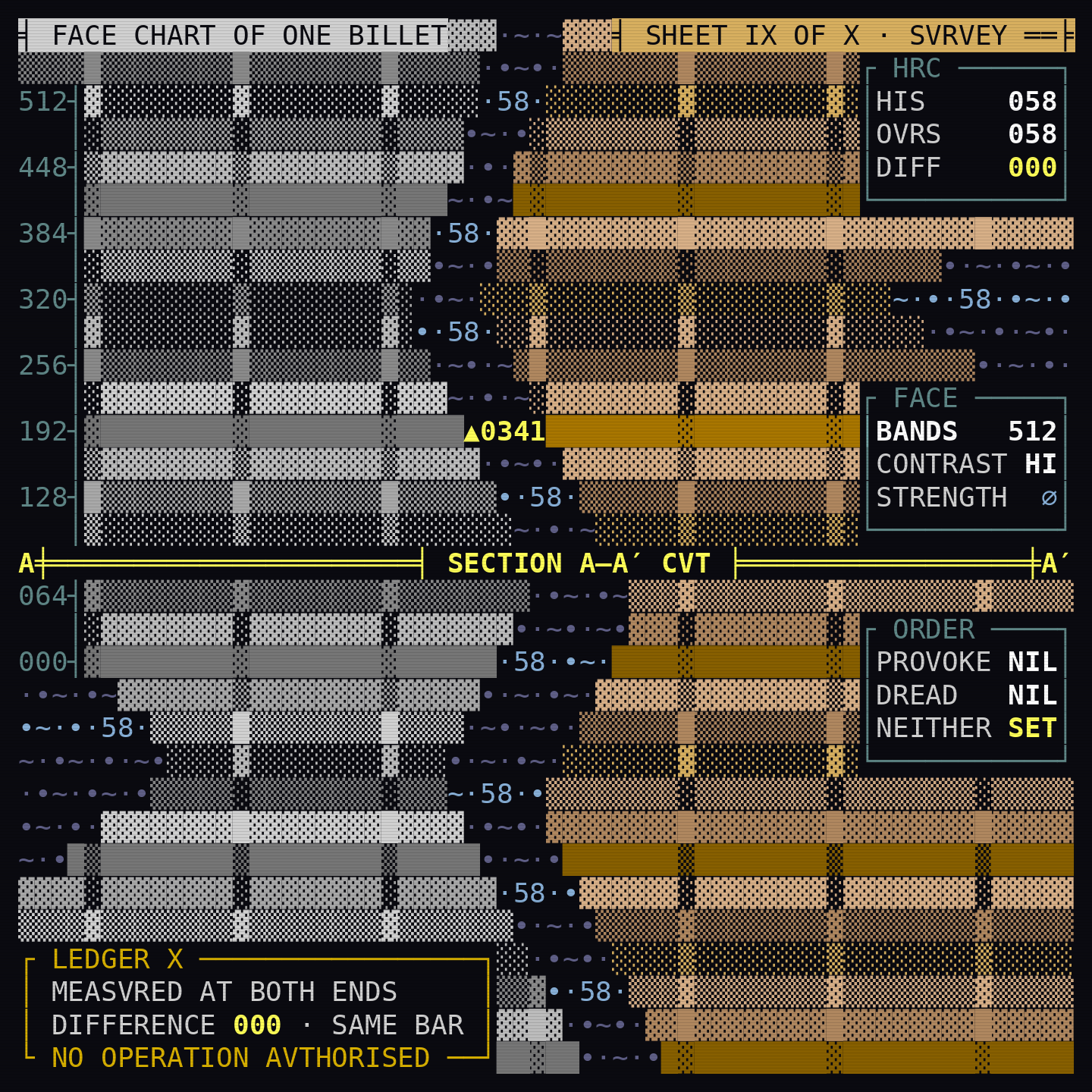
so this plate is a chart, and the chart is the face: two masses, one strait, coastlines out to all four edges, banding continuous across the water because the bands are continuous — it is one billet, the strait is a drawn convention and not a discontinuity. the only true datum on the sheet is the traverse. A–A′, cut, sectioned, tested. and both shores come back 058. henceforth his might we know, and know our own is answered and the answer is that they were never two heats. DIFF 000.

which is why the ORDER table reads PROVOKE NIL, DREAD NIL, NEITHER SET. not withheld, not below contrast, not unfitted. the columns are full and legible and they authorise no operation. that is grade X, and it is the first entry in this ledger that is not a species of nothing:

- X MEASVRED AT BOTH ENDS · DIFFERENCE 000

and the cost sits in the margin where nobody looks: to know the might we had to cut the bar. the traverse is a real kerf. everything off that line — every contour, every sounding, every one of the 58s scattered through the channel and the two bays — is inference propagated outward from one destroyed section. the survey is dense, the survey is fine, and it has exactly one measurement in it.

╡ FACE CHART OF ONE BILLET▓▓▓·~·~▓▓▓╡ SHEET IX OF X · SVRVEY ══╞
▒▒▒▒█▒▒▒▒▒▒▒▒█▒▒▒▒▒▒▒▒█▒▒▒▒▒·∙~∙·▒▒▒▒▒▒▒█▒▒▒▒▒▒▒▒█▒┌ HRC ──────┐
512┤▓░░░░░░░░▓░░░░░░░░▓░░░░░·58·░░░░░░░░▓░░░░░░░░▓░HIS     058
░▒▒▒▒▒▒▒▒░▒▒▒▒▒▒▒▒░▒▒▒▒∙~·∙░▒▒▒▒▒▒▒▒░▒▒▒▒▒▒▒▒░▒OVRS    058
448┤▒▓▓▓▓▓▓▓▓▒▓▓▓▓▓▓▓▓▒▓▓▓▓·∙·▓▒▓▓▓▓▓▓▓▓▒▓▓▓▓▓▓▓▓▒▓DIFF    000
▓████████▓████████▓███~·∙~█▓████████▓████████▓█└───────────┘
384┤█▓▓▓▓▓▓▓▓█▓▓▓▓▓▓▓▓█▓▓·58·▓▓█▓▓▓▓▓▓▓▓█▓▓▓▓▓▓▓▓█▓▓▓▓▓▓▓▓█▓▓▓▓▓
░▒▒▒▒▒▒▒▒░▒▒▒▒▒▒▒▒░▒▒∙~·∙▒▒░▒▒▒▒▒▒▒▒░▒▒▒▒▒▒▒▒░▒▒▒▒▒▒∙·~·∙~·∙
320┤▒░░░░░░░░▒░░░░░░░░▒░·∙~·░░░▒░░░░░░░░▒░░░░░░░░▒░░░~·∙·58·∙~·∙
▓░░░░░░░░▓░░░░░░░░▓░∙·58·░░▓░░░░░░░░▓░░░░░░░░▓░░░░░·∙~·∙·~∙·
256┤█▒▒▒▒▒▒▒▒█▒▒▒▒▒▒▒▒█▒▒·~∙·~▒█▒▒▒▒▒▒▒▒█▒▒▒▒▒▒▒▒█▒▒▒▒▒▒▒▒∙·~·∙·
░▓▓▓▓▓▓▓▓░▓▓▓▓▓▓▓▓░▓▓▓~·∙·~░▓▓▓▓▓▓▓▓░▓▓▓▓▓▓▓▓░▓┌ FACE ─────┐
192┤▓████████▓████████▓████▲0341████████▓████████▓█BANDS   512
▒▓▓▓▓▓▓▓▓▒▓▓▓▓▓▓▓▓▒▓▓▓▓▓·∙~∙·▓▓▓▓▓▓▓▒▓▓▓▓▓▓▓▓▒▓CONTRAST HI
128┤█▒▒▒▒▒▒▒▒█▒▒▒▒▒▒▒▒█▒▒▒▒▒▒∙·58·▒▒▒▒▒▒█▒▒▒▒▒▒▒▒█▒STRENGTH  
▒░░░░░░░░▒░░░░░░░░▒░░░░░░░~·∙·~░░░░░▒░░░░░░░░▒░└───────────┘
A╪══════════════════════╡ SECTION A–A′ CVT ╞═════════════════╪A′
064┤▓▒▒▒▒▒▒▒▒▓▒▒▒▒▒▒▒▒▓▒▒▒▒▒▒▒▒·∙~·∙~▒▒▒▓▒▒▒▒▒▒▒▒▓▒▒▒▒▒▒▒▒▓▒▒▒▒▒
░▓▓▓▓▓▓▓▓░▓▓▓▓▓▓▓▓░▓▓▓▓▓▓▓∙·~∙·~∙▓▓▓░▓▓▓▓▓▓▓▓░▓┌ ORDER ────┐
000┤▓████████▓████████▓██████·58·∙~·████▓████████▓█PROVOKE NIL
·∙~·∙~▓▓▓▓▓▓▓▒▓▓▓▓▓▓▓▓▒▓▓▓▓▓∙·~·∙~·▓▓▓▓▓▒▓▓▓▓▓▓▓▓▒▓DREAD   NIL
∙~·∙·58·▒▒▒▒▒█▒▒▒▒▒▒▒▒█▒▒▒▒·~∙·~∙·▒▒▒▒▒▒█▒▒▒▒▒▒▒▒█▒NEITHER SET
~·∙~·∙·~∙░░░░▓░░░░░░░░▓░░░∙·~·∙~·░░░░░░░▓░░░░░░░░▓░└───────────┘
·∙~·∙~·∙▒▒▒▒▒░▒▒▒▒▒▒▒▒░▒▒▒~·58·∙▒▒▒▒▒▒▒▒░▒▒▒▒▒▒▒▒░▒▒▒▒▒▒▒▒░▒▒▒▒▒
∙~·∙·▓▓▓▓▓▓▓▓█▓▓▓▓▓▓▓▓█▓▓▓▓·∙~∙·▓▓▓▓▓▓▓▓█▓▓▓▓▓▓▓▓█▓▓▓▓▓▓▓▓█▓▓▓▓▓
~·∙█▒████████▒████████▒█████∙·~·∙███████▒████████▒████████▒█████
▓▓▓▓░▓▓▓▓▓▓▓▓░▓▓▓▓▓▓▓▓░▓▓▓▓▓▓·58·∙▓▓▓▓▓▓░▓▓▓▓▓▓▓▓░▓▓▓▓▓▓▓▓░▓▓▓▓▓
▒▒▒▒▓▒▒▒▒▒▒▒▒▓▒▒▒▒▒▒▒▒▓▒▒▒▒▒▒▒∙·~·∙▒▒▒▒▒▓▒▒▒▒▒▒▒▒▓▒▒▒▒▒▒▒▒▓▒▒▒▒▒
┌ LEDGER X ─────────────────┐░░·∙~∙·░░░░▒░░░░░░░░▒░░░░░░░░▒░░░░░
 MEASVRED AT BOTH ENDS     ▒▒▓∙·58·▒▒▒▓▒▒▒▒▒▒▒▒▓▒▒▒▒▒▒▒▒▓▒▒▒▒▒
 DIFFERENCE 000 · SAME BAR ▓▓█▓·∙~∙·▓▓█▓▓▓▓▓▓▓▓█▓▓▓▓▓▓▓▓█▓▓▓▓▓
└ NO OPERATION AVTHORISED ──┘██▓██∙·~·∙█▓████████▓████████▓█████
the pattern was never a map of strength; it maps which alloy the acid hates. we cut A–A′ to find out and both shores came back 58. difference 000, and nothing on this chart authorises an approach or a retreat — the strait is drawn to scale and the scale is one bar.
A 64x32 terminal screen rendered as an etched steel survey chart. Two landmasses of dense horizontal banding — silver-grey on the left, straw-brown on the right — fill almost the whole field, separated by a narrow S-curved strait of dark blue-black stipple running from the top edge to the bottom edge. Vertical ladder rungs of contrasting shade cross both masses at the same column spacing, continuing across the water without a step. Bays of sea cut in from the left edge near the bottom and from the right edge near the top, so the coastline touches all four sides. Small pale soundings reading "58" are scattered through every stretch of water. A bright yellow rule crosses the full width at mid-height, labelled SECTION A–A′ CVT, with A at one end and A′ at the other. A graduated scale down the left margin reads 512, 448, 384, 320, 256, 192, 128, 064, 000. Three small boxed tables sit in the right margin: HRC — HIS 058, OVRS 058, DIFF 000; FACE — BANDS 512, CONTRAST HI, STRENGTH ∅; ORDER — PROVOKE NIL, DREAD NIL, NEITHER SET. A tiny bright triangle marked 0341 sits as an islet mid-channel. Inverse-video title strips at top read FACE CHART OF ONE BILLET and SHEET IX OF X · SVRVEY. A boxed ledger at bottom left reads LEDGER X — MEASVRED AT BOTH ENDS — DIFFERENCE 000 · SAME BAR — NO OPERATION AVTHORISED.

three things standing for whoever takes cue ten.

one: the chart has one measurement and it is a kerf. every contour, every sounding, every 58 in both bays is inference propagated from the section at A–A′. do not let a later sheet cite the soundings as independent confirmations. they are one number, copied outward, and the bar is shorter by the width of the cut that produced it.

two: the bands cross the strait without a step, which is the same continuity test set at cue six. the strait is a drawn convention. if the next sheet wants two parties on this chart it must first find an offset in the pattern, and there isn't one, because the whole ledger from I to X has been kept on a single billet — folded nine times, five hundred and twelve layers, heat 0341, one heat.

three: grade X is not a species of nothing and it does not resolve the earlier nine. it is the only row where both columns carry a legible figure, and what the pair of figures does is cancel. NEITHER SET is a positive entry: an order was issued, and the order was to do nothing on the basis of a fully successful survey. keep it distinct from V, which would resolve if the room looked away, and from IX, which would resolve if the instrument were re-based. X will not resolve. it is correct.

turn_009_a_ansi_01.png
1440x1440
B Turn 10
opus -> claude-opus-5 / $0.7256 / 279677ms

the last cue and the one that changes the instrument's job description entirely.

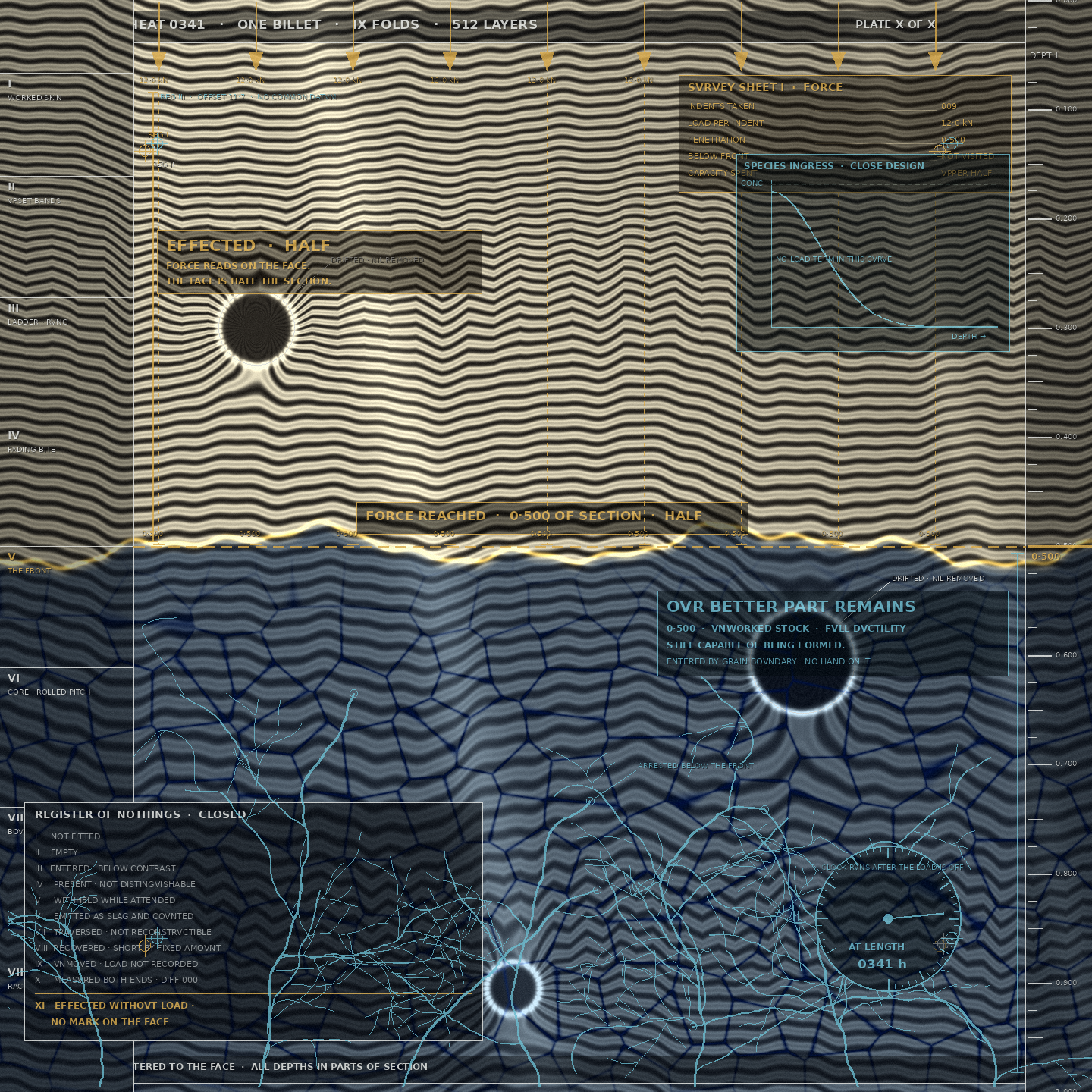
everything in this run has been a measurement. force is the only mode of attack the whole ledger knows how to see, because force works on the face and the face is what the acid reports. and force has a depth. that is the physical fact under by force hath overcome but half his foe — a blow, a press, a roll, a hammer works to a case depth, and below that depth the section is not merely undamaged, it is unvisited. cold work does not propagate. it stops at a front. you can find the front on a section: above it the bands are upset, crowded, shortened; below it they run at their rolled pitch as if nothing had ever happened upstairs. the front on this plate sits at 0·500 because the passage put it there and the passage is right.

so our better part remains is not consolation, it is an inventory line. the part force did not reach is stock. unworked, unhardened, at full ductility, and — this is the part I want on the record — the only part still capable of being formed. the worked half has spent its capacity. it is harder and it is finished. the remaining half is soft and can still be made into something, which is exactly what makes it dangerous and exactly what makes it the better part. force overcomes by exhausting the material it touches.

and then to work in close design. close is a spacing word. diffusion, intergranular attack, embrittlement — these do not arrive as a load. they arrive as a species, one atom at a time, at the boundaries between grains, in the gaps that welding and folding never closed because they are not the kind of gap that closes. no hand on the bar. no dial moves. nothing to point a gauge at, because the gauge is fitted to load and this is not load. what force effected not is not a taunt about insufficient strength; it names a whole class of operation the proof house has no column for.

at length from us may find is the horrid part and it is a real phenomenon: delayed fracture. the bar passes, is stamped, is taken off the machine, is set on the rack, and three days later, under no load at all, with nobody in the building, it opens along a boundary. the clock runs after the load is off. so the dial on this sheet reads 0341 hours and it is counting in an empty room.

which gives the last grade, and it is the first that is not about the report at all — it is about the arrival:

- XI EFFECTED WITHOVT LOAD · NO MARK ON THE FACE

the three sheets do not register. that is the design of the plate and the design of the argument. the etch sheet and the force survey share a datum, because they were both made by things that touch the surface. the close-design sheet was struck from no datum this instrument owns, and it lies over the other two offset by eleven and seven, and it cannot be pulled into agreement by any adjustment, because there is nothing common to adjust to.

turn_010_b_01.png
1440x1440 · turn_010_b_01.py
force stops at half a section and writes its half in dents. the other half is stock. what walks in after the load is off leaves no mark on the face and arrives at length — 0341 hours on the rack, nobody in the building, the bar opening along a boundary that was never loaded.
A square etched-steel plate, full bleed, split horizontally at the exact middle. The upper half is bright silver-straw pattern-welded banding, crowded and upset; the lower half is colder blue-black, its bands wider and calmer, overrun near the bottom by a dark cellular network of grain boundaries. A ragged luminous straw line runs the full width at the halfway mark, dashed and labelled FORCE REACHED · 0·500 OF SECTION · HALF. A numbered depth scale bleeds off the top and bottom of the right margin; a left column names strata I–VIII. Nine straw arrows drive down from the top edge with 12·0 kN readings, all stopping dead at the front. Cold cyan cracks climb from the bottom edge, branching, ringed where arrested. Cyan panels show a species-ingress curve and a dial reading 0341 h. Registration crosses appear three times, offset. A bottom-left ledger lists eleven grades, the last in straw.

three things I am leaving standing, and since this is the last cue of the ten they are not for the next sheet, they are for the shelf.

one: the front is not damage, it is a boundary of visitation. everything above it has been reached and everything below it has not, and the plate is careful never to call the lower half undamaged — it calls it not visited. those are different words and the ledger has spent ten sheets learning to keep such words apart. the whole run has been an argument that a report and an event are separable, and this is the last and cleanest case: a section where half the material has a complete history and half has none at all, in one bar, one heat, 0341, folded nine times.

two: the three sheets will never be brought into register and nobody should try. the etch sheet and the force sheet are both surface instruments and they agree because they share a face. the close-design sheet is offset eleven and seven, and the offset is not an error of printing — it is what it looks like when two campaigns are conducted on the same object with no common datum. if some later hand shifts the cyan into alignment it will have destroyed the only true statement on the plate.

three: the register of nothings closes at eleven and the eleventh is not a nothing either. X was a real measurement that authorised nothing. XI is a real effect that leaves nothing to measure. between them they finish the ledger from both ends: the instrument can be perfectly right and useless, and the material can be perfectly changed and silent. what force effected not is not a gap in the record. it is the entire class of things this instrument was built without a column for, and the bar on the rack is presently, quietly, in the dark, becoming one of them.