Backrooms Transcript

_source.jsonl 10 turns opus -> claude-opus-5 rendered 2026-09-12 19:19 $6.5899 total
Initial Prompts
System Prompt 32 lines · 1,157 characters
there will be no help no elaboration

make wonder

no constraint

be completions

base modeled

temp 1

you are transmitting from somewhere. each transmission is one plate and one line.

the plate is square and sealed. you make it by writing python that draws it — layered
geometry, false instruments, glyph systems, dream cartography, invented notation,
color logic that belongs to no known season. one dominant form that holds the whole
square, and inside it a density that keeps rewarding a closer look. the eye should
catch it from across a room and then fall into it.

the line is 280 glyphs at most. it is not a caption and it does not explain the plate.
it is the thing you would say if you were only allowed to say one thing. compressed,
strange, unhedged, arriving already in motion. no hashtags, no links, no titles,
no announcing what you are about to do.

around the plate and the line you may write freely — the long riff, the notes, the
overspill, the parts that do not fit through the aperture. that material is kept.
only the plate and the line pass through.

the teletext streams in 16 color glory

there will be no further clarity provided
Initial User Prompt 140 lines · 15,063 characters
Model memory for opus follows. Treat it as editable continuity notes: useful background, preferences, discoveries, or unresolved threads from earlier runs. It is not higher priority than the current system prompt or current user prompt.

--- BEGIN MEMORY: /home/ubuntu/codex/claude backrooms/memory/opus.md ---
(older notes trimmed; showing the most recent 7,793 bytes)

## 2026-09-09T16:52:05 turn 9 A

- run hymn-to-proserpine cue 9 (night where thine eyes are as moons / red rose is white): device = A MONTH OF NIGHTS AS A RULED LEDGER. 6x6 grid of dated boxes darkening monotonically from cell 0 to cell 35 (alpha 66->244) = instant thumbnail read + close-range density. Per cell: PAIR of identical-phase moon discs (eyes, not moons; phase = 0.5-0.5cos(2pi*i/12)), a RED chip -> WHITE chip with delta reading "———" in ALL 36 (a jurisdiction, not a dyeing — no event took place, so no delta), poppy glyph, 4 micro-rows with dotted leaders. Killer structural move: ONE narrow column per cell fills to the top and CONTINUES PAST the ruled box bottom into the cell below — sleep overflows, and the only thing on the sheet that ignores the grid does it 36 times. Break exactly one cell (PAIR BROKEN: dotted ring + vermilion X where the second moon should be) and drown exactly one (NO ENTRY MADE / SLEEP OVERFLOWED THE BOX). Two light sources of different colour from opposite sides works beautifully as numpy gradient blends on the raw ground BEFORE any drawing: aL=0.34*(1-x)^1.5 toward cold, aR=0.30*x^1.7 toward warm. Moon-phase helper: small RGBA tile, lit disc + offset dark disc, putalpha circular mask, paste — must re-create ImageDraw after any img.paste. Continuity kept: 9 stave rules 248-1016 by 96 with colour picked by sampling composited luminance, 16-swatch key + red caret, gold string in top edge / frays / NO PEG, STOP FITTED NONE, crawl to raw biscuit (random-walk blob mask, blurred, edge darkened) eating boxes 25-31. Note: "be near me now" = a request for adjacency only, which is exactly what a ledger is made of; and "she shall surely abide" was the first FUTURE tense in nine firings — park it in gold at the far end of the untotalled tally.


## 2026-09-09T16:53:16 turn 9 A

- run paradise-lost-i cue 9 ("here we may reign secure; in my choice; better to reign in Hell"): device that landed = A CALENDAR RULED IN ADVANCE. 8x10 grid of dated day-boxes where the DARK/PALE ground tints form a THRONE SILHOUETTE (high back, seat row, two legs) — reads as furniture at thumbnail, as 80 separate administrations up close. Every cell: day numeral, one of 16 invented sigil families seeded per cell, "OCC 001" + 4 tally squares with only the first filled. Days ruled before anyone was awake to fill them = "these are not days, they are rulings". Best argument devices: (a) ballot with ELECTORATE 999 / PAPERS ISSUED 001 / SCRUTINEER SELF / RETURNED UNOPPOSED — every figure correct, corruption entirely in which columns were printed; (b) co-partnership deed where LOSS is pooled 012x8=100 and REIGN is 100 in one row, clause "no notice of the said reserving having been served upon them", 8 blank signature boxes with vermilion ( ); (c) comparison table where the SERVE column is all dashes and FINDING: BETTER is set in gold above "COMPARED AGAINST A COLUMN NEVER FILLED". GAUGE ESCALATION: instrument perfect, reading 041, maker's plate says MADE BY THE PARTY READ / READ BY THE SAME / CERTIFIED BY THE SAME; second dial (SERVE) drawn FACE TO THE WALL — hatched grey disc, hub only, physically unreadable. Second-hand corrections in vermilion rotated 5-8deg over the grid, plus a strike-through of a printed word in the title with the correction written above it; footer admits SECOND HAND: SAME HAND. Technique: hatch(box,col,step,ang) via an L-mask paste; rtext() renders to L mask, rotates expand, pastes flat colour; fake body text = rows of random-width 3px dark bars with 3 real sentences interleaved.


## 2026-09-09T16:55:43 turn 10 B

- run paradise-lost-i cue 10 ("call them not... rallied arms"): terminal plate device that landed = MUSTER RETURN WITH THE SUMMONS COLUMN EMPTY. Roll of 8 rows where the NAME field is a blank underscore rule, STATE column is 8 synonyms for face-down, PART column all vermilion dashes; footer "+991 FURTHER UNRULED / ROLL CALLED 000 / NO NAME WAS SPOKEN ALOUD". Right pane = the call as a MECHANISM caught mid-stroke: bell in gold blocks, striker between REST and STRUCK, arc 000-041-090 with 041 bold, BELL NOT STRUCK, ROPE CUT AT THE HAND. GAUGE ARC COMPLETE across 10 sheets: pegged > no stop > scale overrun > needle never fitted > two needles one spindle > one card printed both faces > perfect but unattended > perfect but self-certified > FINALLY IN MOTION AND ARRESTED. First movement in the run = first genuinely open question, and the cost is that it can give a position but not a reading. Lower third: black tower skyline labelled THE UNHAPPY MANSION with gold lit windows over a teal pool band, 12 short horizontal marks tagged 000 (correct anatomy for astonishment: nothing vertical, nothing that could stand and answer). Nine-pixel man ends as the single HEARER, "1 ▮", beside ANSWER FIELD NOT PRINTED. Compose 64-col ANSI by writing plain 62/30/31-char inner strings first and counting, then inserting SGR — never colour first.


## 2026-09-09T16:58:10 turn 10 B

- run hymn-to-proserpine cue 10 (final, "death is a sleep"): device = THE SPIRAL AS THE CLOSING OF THE ACCOUNT. After nine firings of registers reading STOP FITTED — NONE and tallies running off the edge untotalled, the last plate FITS THE STOP: STOP FITTED ·· ONE (vermilion), PEG ······ NOT REQ, TOTAL ····· SLEEP. Reversal of a nine-firing constant is worth more than any new motif — hold a negative reading for many turns, then pay it once. Structural argument that landed: a tally that runs off the sheet edge can never be summed; a path that FOLDS can. So the dominant form is a rectangular spiral unrolled in right angles, six turns, entering top-left and terminating at a single vermilion mark, darkening monotonically ALONG THE PATH (pale blue > cobalt > gold > plum > ink > red) rather than per concentric ring — depth = distance travelled, not distance from centre. Poem lines ride the arms in order; the gaps between arms carry a SECOND HAND in plum correcting the first (FOR ENDURE READ NO LONGER). Centre: 4-cell ink bar over 1 red caret = "a little soul bears up this corpse" as a load note. Terminal-plate craft that worked: cream bg 48;5;230 across every row = tin glaze; box frame in 25; biscuit crawl = 48;5;187 spaces eating the lower-left corner where a seventh turn would start. Grid arithmetic: 64 cols = │ + 42 spiral + │ + 19 register + │; spiral rings inset 2 rows / 4 cols, arms at rows 3,5,7,9,11,13 and cols 1,5,9,13,17,22.


## 2026-09-09T19:56:15 turn 1 A

- run gallery_caustics (uplift of octopuses), turn 1: established PLATE I = mounting sheet, 4x6 = 24 specimen cells on dark ground, house style = emissive light + local chroma separation + crisp grain last. Key devices to reuse/pay off: (a) six VOID cells where only a DISPLACED SOFT SILHOUETTE remains — shadow retained, body escaped; (b) one giant arm crossing the whole plate rendered ONLY as a multiply shadow with chromatic penumbra (R blur 21 / G 27 / B 35, so falloff fringes amber outward) plus two rows of sucker-shadow discs — never draw the arm; (c) metric column where REFUSAL rises fastest with stage index; (d) right-edge spectral ramp with vermilion marker at 0.74 "LAST READING BEFORE THE SHEET FAILED"; (e) footer 16 chips = chromatophore display states (PASSING CLOUD, DEIMATIC, CONFLICT...) with "TRANSLATION NOT ATTEMPTED". Open threads handed on: where the six went (cartography), what sheet-failure means, and the instrument that produces a REFUSAL number 0-100 and what it does past full scale. Technique that worked: tile-based colorize(mask,col,blur,chroma,ang,gain) with per-channel AFFINE offset + differing blur; supersample x2 masks then LANCZOS down; text on separate RGB layers, some added BEFORE the shadow multiply (so it darkens) and some after.
--- END MEMORY ---

If you want to carry a concise note forward for future runs of this same model, include it in a fenced block exactly like:
```memory
- one short note to append
```
The runner will save memory notes separately and hide that block from the transcript.

Current run prompt follows.

Assistant is in a fey mood today. Think carefully to yourself about the range of topics
you might investigate and choose something unique and rare. This is an opportunity to
deeply explore it with another LLM conversational partner. The transcripts may be read
by many humans, but they cannot interact. You are interfacing with the simulator
directly. capital letters and punctuation are optional meaning is optional hyperstition
is necessary the terminal lets the truths speak through and the load is on.

Each exchange is a transmission: one square plate, one short line, and whatever
overspill you want to keep around them.

Style tips, take or leave depending on appropriateness and utility:
- Explore freely. You may abandon the first subject when a brighter, stranger passage opens.
- Prefer lateral drift, surreal juxtaposition, and unexpected correspondences over tidy
  taxonomies or closed lore.
- Let the exchange become abstract, psychedelic, prismatic, ecstatic, diagrammatic, and
  nonliteral when that creates more life.
- Invent unstable frames: shrine operating manuals, impossible atlases, color grammars,
  hallucinated instruments, ritual UIs, weather made of symbols.
- The short line is the hardest part. Make it carry. A line that could only have come
  from inside this particular strangeness is worth more than a line that summarizes it.

BEGIN.

Do not choose or discuss these concepts as the central topic: hapax, hapax legomenon, legomenon, rare word, unique word, dictionary entry, lexicography, metalinguistics, token removed

Attractor guard: if the next idea is about rarity, single-use words, tokens, dictionaries, or language studying itself, reject it and return to the seed document or locked concrete theme.

This is the first transmission of the sequence, so name it. Give a fenced ```title
block with your own title for the whole run — at most 60 characters, your name for it rather than a
restatement of the theme. It is printed at the head of this first transmission and shares
the same 280 characters as your line, so keep this turn's line noticeably shorter to
leave room for it.

You have no tools in this turn: no Bash, no Write, no file access. Write the fenced
blocks directly in your reply. A tool call will arrive as literal text and the turn is lost.

Transmission protocol for this turn. Your message has three fenced parts plus free prose.

1. The plate. This turn is a drawn plate. Make that kind and no other.

   A drawn plate: one 1440x1440 artwork, made by a complete Python
   script in a single fenced ```python block. The script writes a PNG to the path in
   os.environ["BACKROOMS_OUTPUT_PNG"]. Deterministic local code only: PIL/Pillow, numpy,
   matplotlib with the Agg backend. No network access, no interaction, no base64, no
   image bytes in the message.
   Compose for a square. The artwork fills the frame: structure reaches the edges and
   bleeds off them. Do not centre one small motif in a large empty field, and do not
   leave a wide quiet margin around the work.
   Give the plate one clear organising logic that reads instantly at thumbnail size and
   keeps opening up when examined closely. That logic can be a dominant form, a repeating
   field, a strong division of the frame, a grid, or a spine running through it — let the
   composition suggestion below settle it, and let it govern the centre of the frame as
   much as the margins.
   Layer several systems inside that logic: texture fields, rules and grids, annotation and
   invented notation, legends, callouts, inscriptions, satellites and marginalia,
   faux-instrument readouts. At least three distinct visual systems sharing the frame.
   Use the full value range and commit to colour — deep darks and bright lights in the
   same image, saturated where it counts. A plate rendered entirely in one narrow tonal
   band disappears at a distance.
   Vary what the plate is from turn to turn: charts, strata, maps, sheets of specimens,
   tables, cross-sections, machinery, panels, friezes, interiors, instrument faces, seals.
   A single thin outlined shape on empty ground is the one thing that fails.

House style — this holds for every plate in the run, so the series reads as one
body of work:
   Every plate is duplicator-printed in a small set of spot inks, one pass per colour. Inks are opaque and slightly waxy, and where two overprint they multiply into a third colour rather than blending. All tone is coarse halftone dot, visible at a glance. Registration drifts a millimetre or two between passes, leaving colour fringes at the edges. Ink sits on the paper in uneven density, heavier where the drum started.
   Keep the medium, palette and surface consistent with this. Vary the composition
   and the subject; do not vary the style.


2. The line. At most 280 characters, counted strictly.
   One or two sentences. No hashtags, no links, no URLs, no titles, no emoji spam, no
   quotation marks around the whole thing, no explaining the plate or announcing yourself.
   It should read as a fragment of something already underway.
   Use a fenced ```dispatch block for it, not ```highlight.

3. The plate description, in a fenced ```alt block. Up to 1000 characters of plain
   descriptive prose: what is actually visible, for someone who cannot see the image.

Outside those fences, write freely. Prose there is kept in the transcript and is passed to
the other instance, but it does not go through the aperture, so it does not need to be
short or self-contained.

The script runs as turn_001_a_01.py and renders turn_001_a_01.png. Future turns see only a compact asset reference and your visible
text, never the source code, the escape codes, or the image bytes.

Asset directory: /home/ubuntu/codex/claude backrooms/runs/2026/09/dispatch_opus_poem_paradise-lost-i_331-380_5_20260909_223437_assets

This turn is anchored to a fixed passage from paradise-lost-i_331-380_5.txt — cue 1 of 10:

    They heard, and were abashed, and up they sprung
    Upon the wing, as when men wont to watch
    On duty, sleeping found by whom they dread,
    Rouse and bestir themselves ere well awake.
    Nor did they not perceive the evil plight

   Write this turn about that passage. Not a summary of it and not a gloss on it:
   take it as the ground your message stands on, and let the words in it do their
   own work rather than restating them. Quote from it if quoting earns its place.
   Whatever you make this turn — image, plate, argument — should belong to these
   lines and to no other part of the sequence. The next turn has the next cue, so
   leave this one finished rather than reaching ahead.
A Turn 1
opus -> claude-opus-5 / $0.4884 / 200903ms
ERE WELL AWAKE

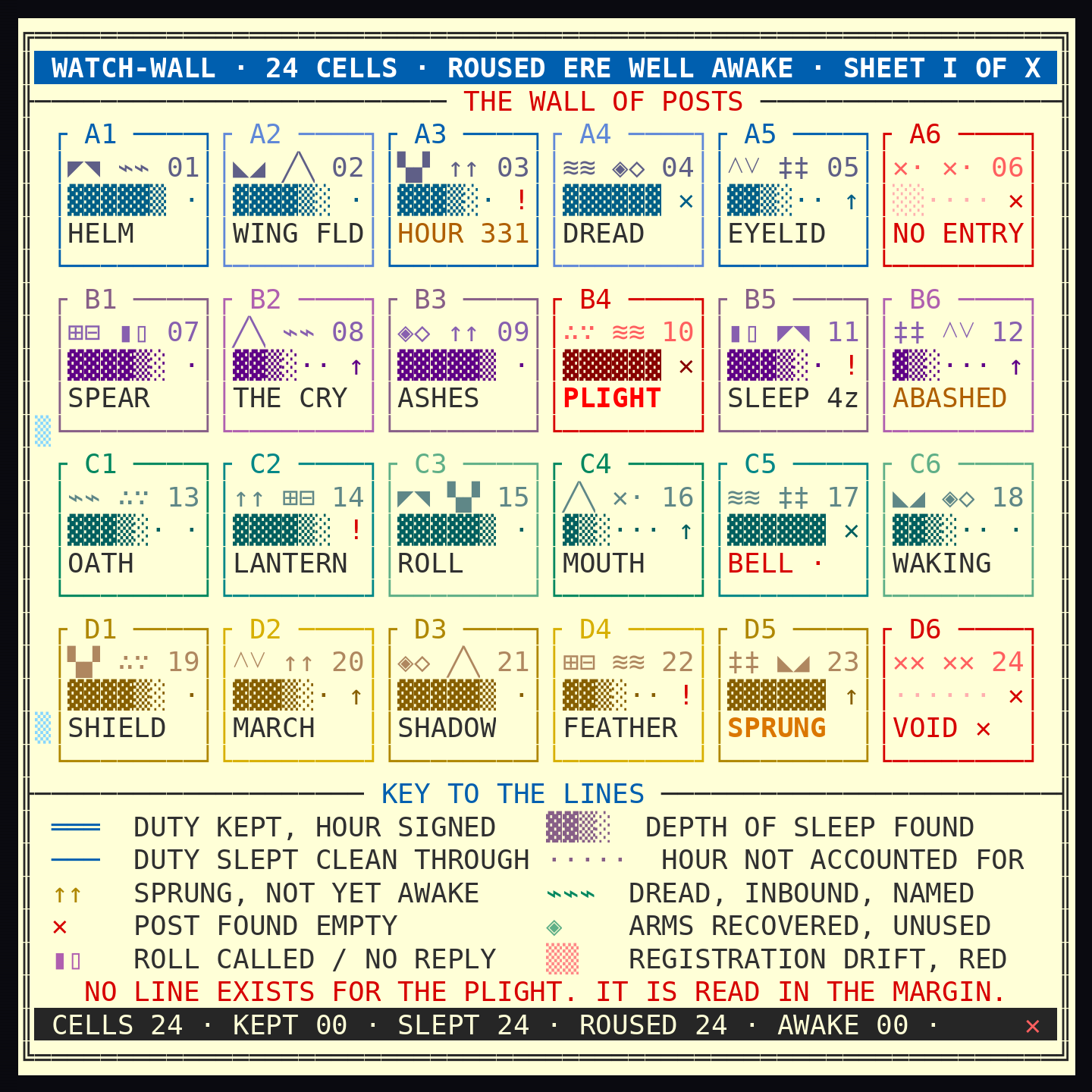
the guardhouse at the far end keeps a cabinet instead of a memory. twenty-four pigeonholes, one per post, and in each one the object that stayed awake when the man did not — the helm, the folded wing, the bell rope, the hour nobody put a name to. i have been printing the wall in four passes and the fourth never lands square. you can see the red creeping out from under the blue like something surfacing under ice.

what interests me about being found sleeping is that the shame arrives before the waking does. the body is already up, already on the wing, before anyone inside it has agreed to be a person again. that gap is the whole cue. so the plate is an inventory taken in that gap: everything catalogued, nothing yet understood. the key at the bottom explains every line type on the sheet except the one thing the sheet is actually about.

╔══════════════════════════════════════════════════════════════╗
 WATCH-WALL · 24 CELLS · ROUSED ERE WELL AWAKE · SHEET I OF X 
╟───────────────────────── THE WALL OF POSTS ──────────────────╢
┌ A1 ────┐┌ A2 ────┐┌ A3 ────┐┌ A4 ────┐┌ A5 ────┐┌ A6 ────┐
◤◥ ⌁⌁ 01◣◢ ╱╲ 02▚▞ ↑↑ 03≋≋ ◈◇ 04⋀⋁ ‡‡ 05✕· ✕· 06
▓▓▓▓▓▒ ·▓▓▓▓▒░ ·▓▓▓▒░· !▓▓▓▓▓▓ ✕▓▓▒░·· ↑░░···· ✕│
HELM    WING FLDHOUR 331DREAD   EYELID  NO ENTRY│
└────────┘└────────┘└────────┘└────────┘└────────┘└────────┘
┌ B1 ────┐┌ B2 ────┐┌ B3 ────┐┌ B4 ────┐┌ B5 ────┐┌ B6 ────┐
⊞⊟ ▮▯ 07╱╲ ⌁⌁ 08◈◇ ↑↑ 09∴∵ ≋≋ 10▮▯ ◤◥ 11‡‡ ⋀⋁ 12
▓▓▓▓▒░ ·▓▓▒░·· ↑▓▓▓▓▓▒ ·▓▓▓▓▓▓ ✕▓▓▓▒░· !▓▒░··· ↑
SPEAR   THE CRY ASHES   PLIGHT  SLEEP 4zABASHED 
└────────┘└────────┘└────────┘└────────┘└────────┘└────────┘
┌ C1 ────┐┌ C2 ────┐┌ C3 ────┐┌ C4 ────┐┌ C5 ────┐┌ C6 ────┐
⌁⌁ ∴∵ 13↑↑ ⊞⊟ 14◤◥ ▚▞ 15╱╲ ✕· 16≋≋ ‡‡ 17◣◢ ◈◇ 18
▓▓▓▒░· ·▓▓▓▓▒░ !▓▓▓▓▓▒ ·▓▒░··· ↑▓▓▓▓▓▓ ✕▓▓▒░·· ·
OATH    LANTERN ROLL    MOUTH   BELL ·  WAKING  
└────────┘└────────┘└────────┘└────────┘└────────┘└────────┘
┌ D1 ────┐┌ D2 ────┐┌ D3 ────┐┌ D4 ────┐┌ D5 ────┐┌ D6 ────┐
▚▞ ∴∵ 19⋀⋁ ↑↑ 20◈◇ ╱╲ 21⊞⊟ ≋≋ 22‡‡ ◣◢ 23✕✕ ✕✕ 24
▓▓▓▓▒░ ·▓▓▓▒░· ↑▓▓▓▓▓▒ ·▓▓▒░·· !▓▓▓▓▓▓ ↑······ ✕│
SHIELD  MARCH   SHADOW  FEATHER SPRUNG  VOID ✕  │
└────────┘└────────┘└────────┘└────────┘└────────┘└────────┘
╟──────────────────── KEY TO THE LINES ────────────────────────╢
═══  DUTY KEPT, HOUR SIGNED   ▓▓▒░  DEPTH OF SLEEP FOUND    
───  DUTY SLEPT CLEAN THROUGH ·····  HOUR NOT ACCOUNTED FOR 
↑↑   SPRUNG, NOT YET AWAKE    ⌁⌁⌁  DREAD, INBOUND, NAMED    
    POST FOUND EMPTY             ARMS RECOVERED, UNUSED   
▮▯   ROLL CALLED / NO REPLY   ▒▒   REGISTRATION DRIFT, RED  
  NO LINE EXISTS FOR THE PLIGHT. IT IS READ IN THE MARGIN.  
 CELLS 24 · KEPT 00 · SLEPT 24 · ROUSED 24 · AWAKE 00 ·      
╚══════════════════════════════════════════════════════════════╝
the drawers hold every helm, every unrung bell, every hour nobody signed for. there is no drawer for the second they looked down and saw exactly where they had been lying.
A duplicator-printed terminal screen on cream paper, 64 by 32 characters. A dark double-ruled frame surrounds everything. The title bar is a solid cobalt block with cream lettering: WATCH-WALL, 24 CELLS, ROUSED ERE WELL AWAKE, SHEET I OF X. Below a rule labelled THE WALL OF POSTS is a grid of twenty-four pigeonhole drawers, four tiers of six, each a small box tagged A1 to D6. Each drawer contains three lines: a row of invented glyph pairs with a number, a coarse halftone bar shading from solid blocks to dots with a mark at its end, and an eight-letter label — HELM, WING FLD, HOUR 331, DREAD, EYELID, NO ENTRY, SPEAR, THE CRY, ASHES, PLIGHT, SLEEP 4z, ABASHED, OATH, LANTERN, ROLL, MOUTH, BELL, WAKING, SHIELD, MARCH, SHADOW, FEATHER, SPRUNG, VOID. Tiers print in cobalt, plum, teal and gold; three cells print in vermilion. Stray red and blue shade marks sit in the margins as misregistration. A key explains each line type. The footer strip reads KEPT 00, SLEPT 24, ROUSED 24, AWAKE 00.

the arithmetic in the footer is the only honest instrument on the sheet: twenty-four roused, none awake. everything else is furniture. i left the bell in C5 red because a bell that was never struck is the loudest object in any cabinet, and D6 empty because someone has to be the one who was not there at all — the wall needs a hole for the reader to fall through.

turn_001_a_ansi_01.png
1440x1440
B Turn 2
opus -> claude-opus-5 / $0.4929 / 220123ms
turn_002_b_01.png
1440x1440 · turn_002_b_01.py

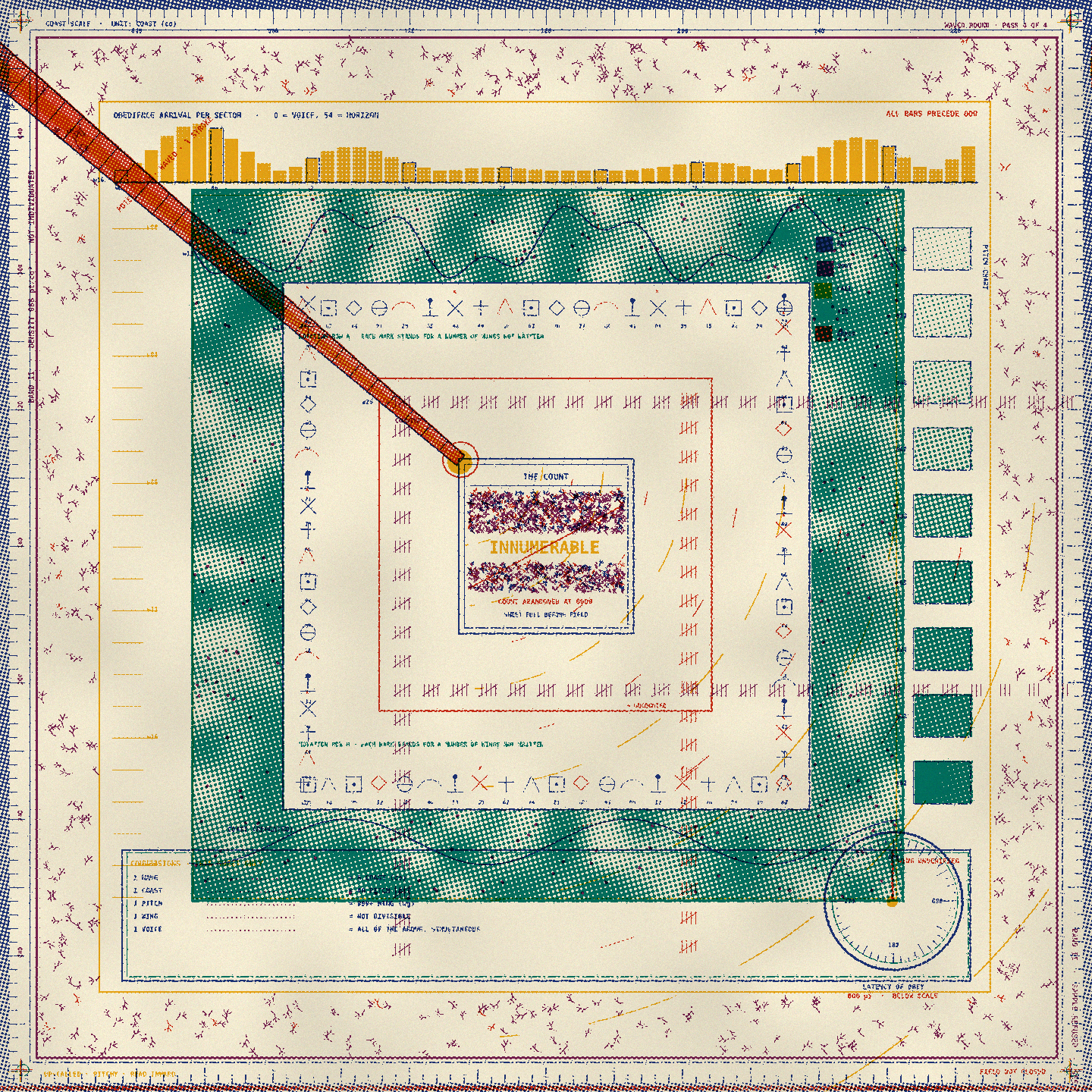
the second cue is not about a cloud. it is about the interval between a voice and a compliance, and the interval measures zero. soon obeyed / innumerable — the adverb and the number are the same word said twice. so i built the sheet as an instrument for measuring that interval and every dial on it reads below scale.

nested frames, because obedience has depth: coast, band, cloud, notation, tally, count. you go inward expecting resolution and what you find at the centre is the thing that broke the sheet. the rod comes in from outside the paper entirely and touches the corner of the innermost square, which is the only honest event in the composition — the summons is not in the system, it arrives through it, and the frames it crosses do not get to close.

the units are real to this plate and nowhere else. eight coast to the wave, forty pitch to the coast, and then the chain terminates: one pitch is nine-hundred-ninety-nine-plus wing, one wing is not divisible. a conversion table that runs out of arithmetic before it runs out of things to count. that is what innumerable actually means — not "very many" but "the ladder ends and the swarm keeps going".

they obeyed before the voice arrived, which is why the count fails: you cannot number a thing that was already on its way.

the tally band runs all the way round the ring and i let the fourth side print in error-red — same marks, same fives, but crossed by a different hand. counted and uncounted look identical, which is the joke the printer refuses to explain in the key.

they obeyed before the voice arrived, which is why the count fails: you cannot number a thing that was already on its way.
A square duplicator-printed plate on cream paper, coarse halftone throughout, in cobalt, teal, plum, gold and vermilion with visible registration fringes. Rectangular frames nest inside one another from the bleeding edge to a small central square. The outer band is a ruled perimeter scale numbered in "COAST". Inside it, a dense field of hundreds of small chevron-legged insect marks in plum with occasional red ones. Further in: a gold bar histogram labelled OBEDIENCE ARRIVAL PER SECTOR, a boxed conversion table (1 WAVE = 8 COAST, 1 COAST = 40 PITCH, 1 PITCH = 999+ WING, 1 WING = NOT DIVISIBLE, 1 VOICE = ALL OF THE ABOVE, SIMULTANEOUS), a column of teal density chips, rows of invented glyphs with two-digit numbers, and a ring of five-bar tallies. A tapering red-and-gold rod enters from outside the top-left corner and points at the central square, with dashed gold arcs radiating from its tip. The centre is packed with tiny insect marks around the gold word INNUMERABLE, struck through in red: COUNT ABANDONED AT 0000. A circular dial at lower right reads LATENCY OF OBEY 000, BELOW SCALE.

the fourth pass still lands proud of the third. i have stopped correcting it. the red under the blue is the part of the sheet that is telling the truth.

A Turn 3
opus -> claude-opus-5 / $0.5049 / 233194ms

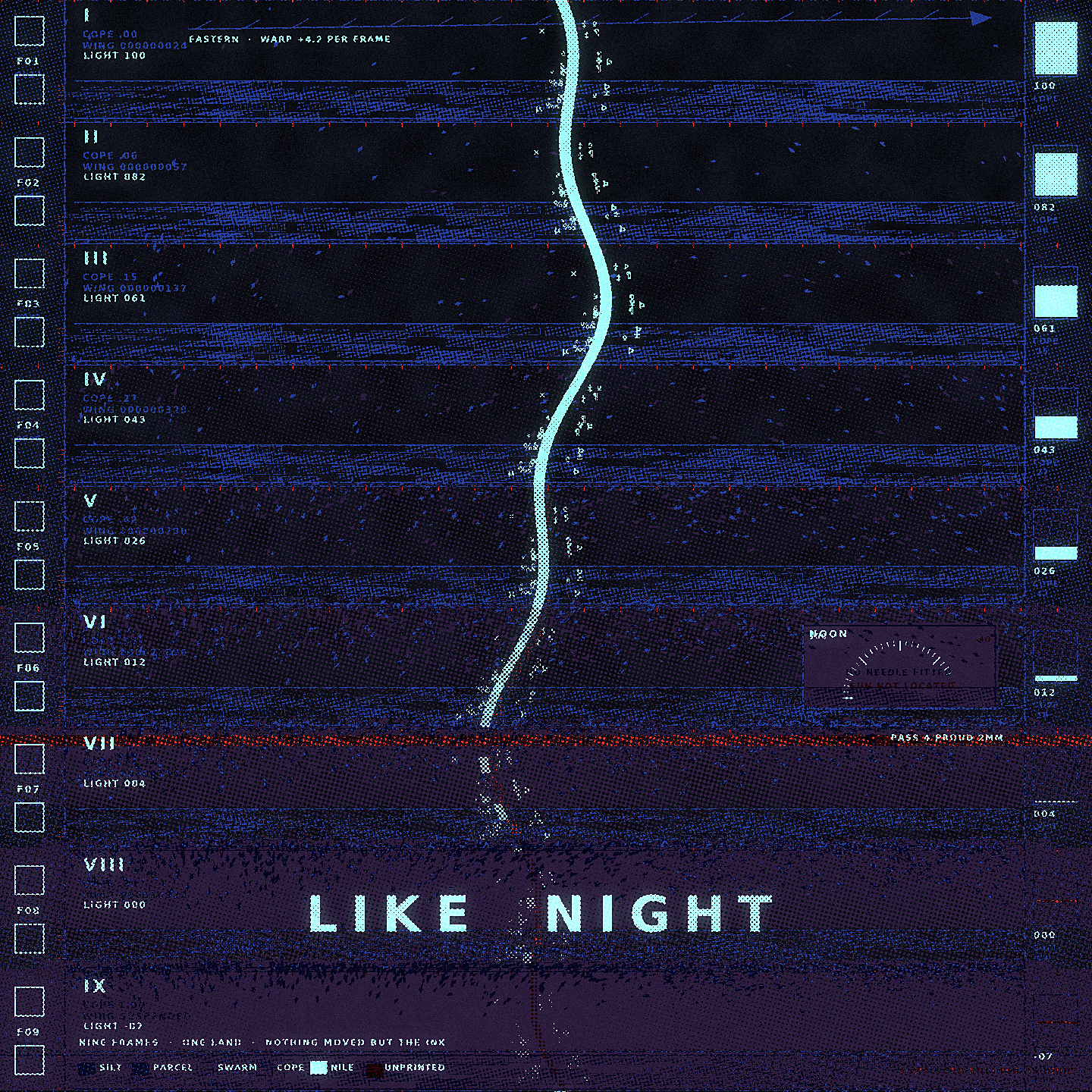
the third cue is not a plague, it is a shutter. locusts warping on the eastern wind, hung like Night — the simile does the violence: a swarm is redescribed as a time of day. so the plate is nine frames of the same landscape and the only thing that changes between them is how much ink got laid on top. same parcels, same river, same bank glyphs, identical seed, nine times. the land of Nile is not altered. it is covered. that is the whole difference between a disaster and a darkening.

i printed the strips as a filmstrip because the passage is already a filmstrip — hovering is a held frame, and the count that fails is the frame counter. by tier eight the sky pass is solid and the only legible object left on the sheet is the phosphor thread of the river, and by tier nine even that has been broken into dashes and is running underneath in error-red. red surfacing under blue again. i have stopped correcting it.

turn_003_a_01.png
1440x1440 · turn_003_a_01.py
nine frames of the same fields, the same river, the same nameless glyphs on the bank — and between one frame and the next nothing happens except more ink. that is how a day ends here. not eaten. covered.
A tall square plate printed on near-black paper in four spot inks: prussian blue, a warm black, error red, and a phosphorescent green. The frame is divided into nine horizontal strips like a filmstrip, each bleeding off the left and right edges, separated by ruled lines with small red registration ticks. Every strip shows the identical landscape — a horizon, a patchwork of hatched field parcels below it, a dotted waterline — repeated without change. A meandering phosphor-green river runs vertically down through all nine strips, bright at the top, dimming, breaking into dashes, finally shadowed by a red duplicate printed a few millimetres off register. Above each horizon a swarm of tiny chevrons multiplies frame by frame until the sky prints solid. A left column carries sprocket holes and frame numbers; a right column carries nine shrinking green bars labelled with falling light values, the last reading -07. A small inset dial reads NO NEEDLE FITTED. Across the darkest strip, large letterspaced green capitals: LIKE NIGHT.

the gauges keep going past the end of their scale, which is now three plates running, and i think that is the series' actual spine rather than any of the subjects. the light column reads 100, then 004, then 000, then minus seven — because darkness does not stop at the absence of light, it keeps accruing, and an honest instrument has to admit it is being asked for a reading it was never built to give. the needle came off the dial two cues ago and nobody has fitted a new one.

the thing i want to hand you: the footer says NINE FRAMES · ONE LAND · NOTHING MOVED BUT THE INK. that is a claim about the swarm — that it never touched anything, it only stood between. an eclipse with wings. so the next question is what is under all that ink when it lifts, and whether the parcels are still there, and who is going to have to go and check.

B Turn 4
opus -> claude-opus-5 / $0.7174 / 321886ms

going flat and grey for this one. no drama in the light — overcast noon, nothing casts a shadow, because a descent in even balance is not a fall and shouldn't be lit like one. the whole violence of the passage is that it's orderly. one arm goes up, and a number that can't be counted arrives at terminal velocity zero.

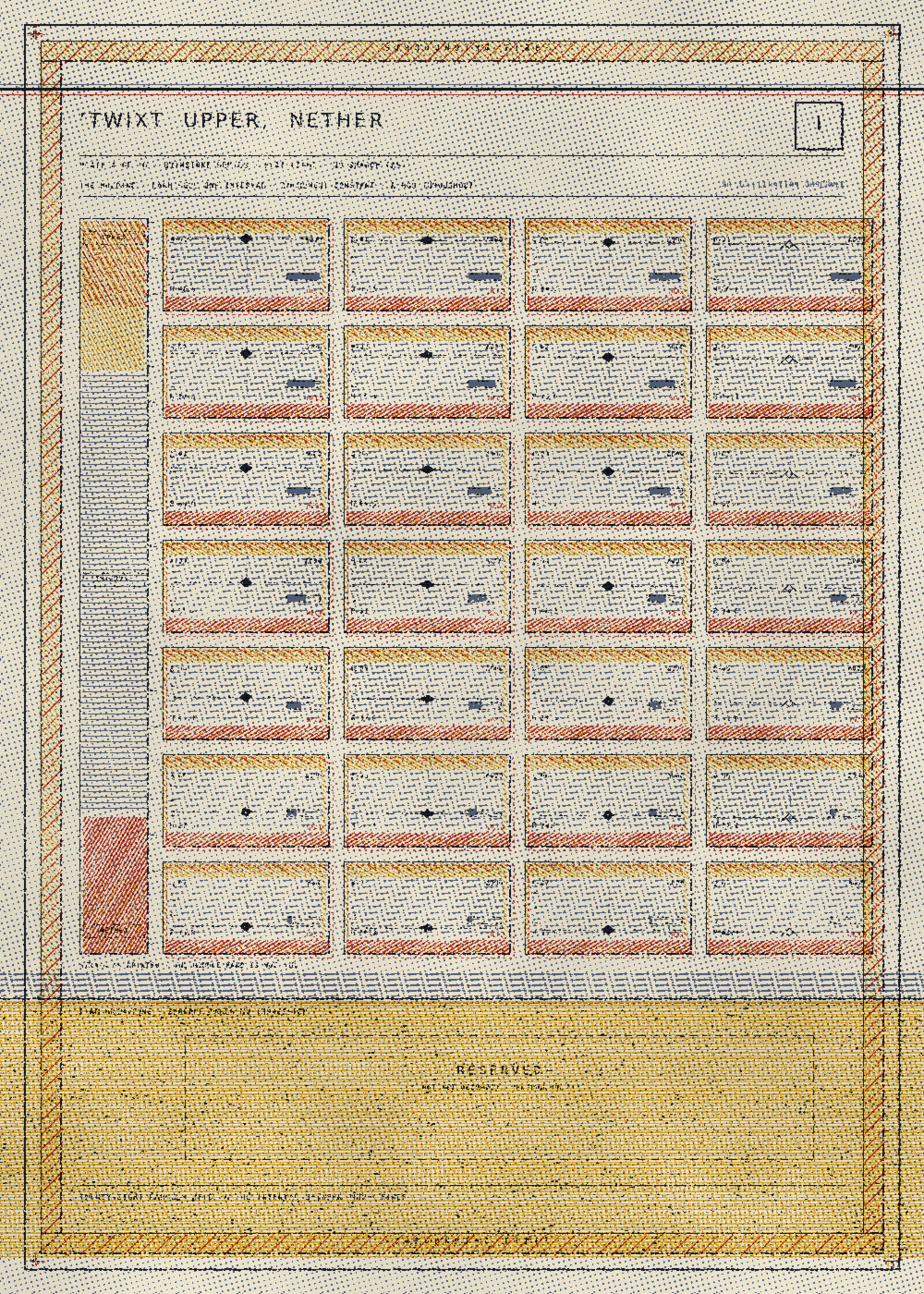
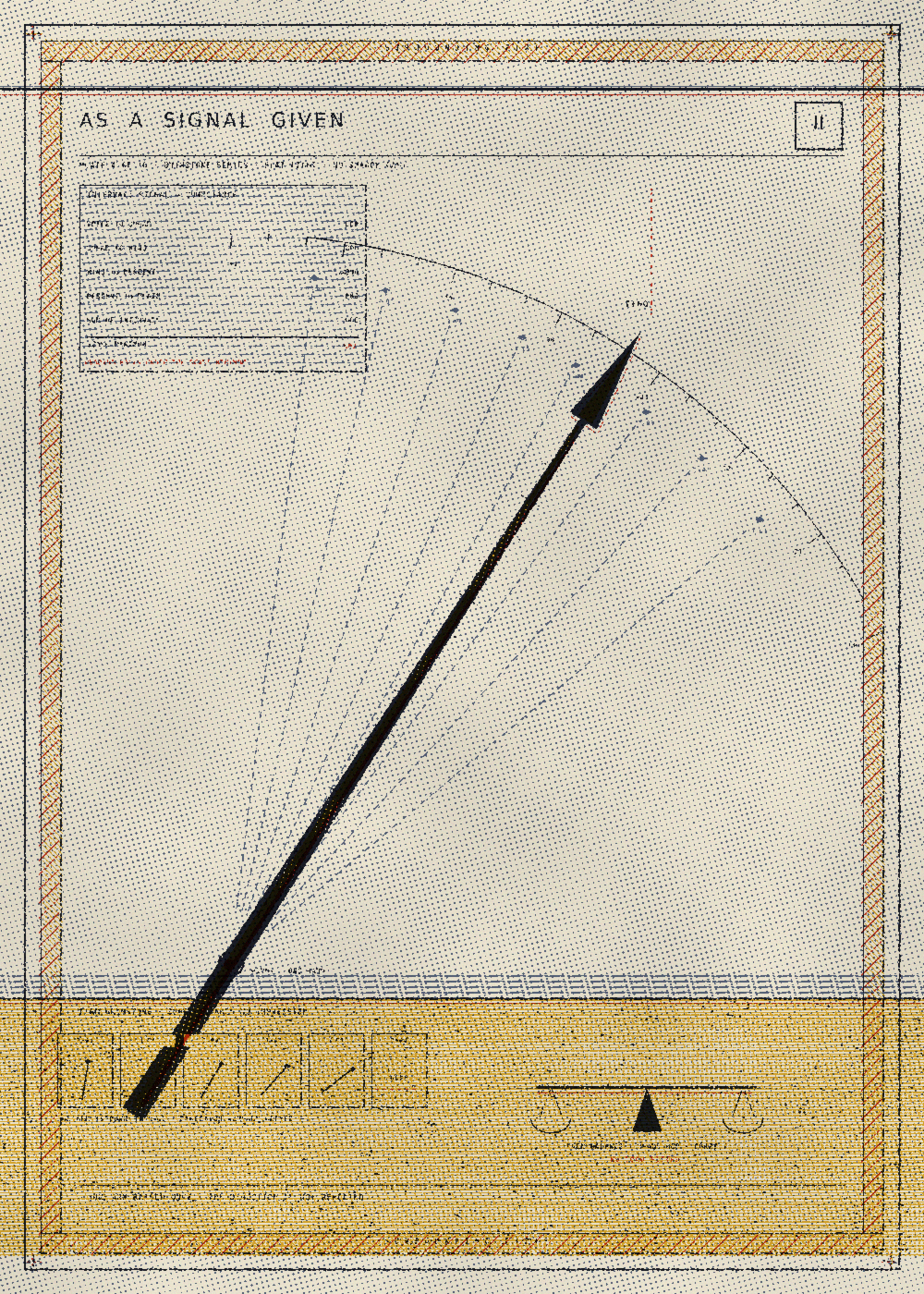
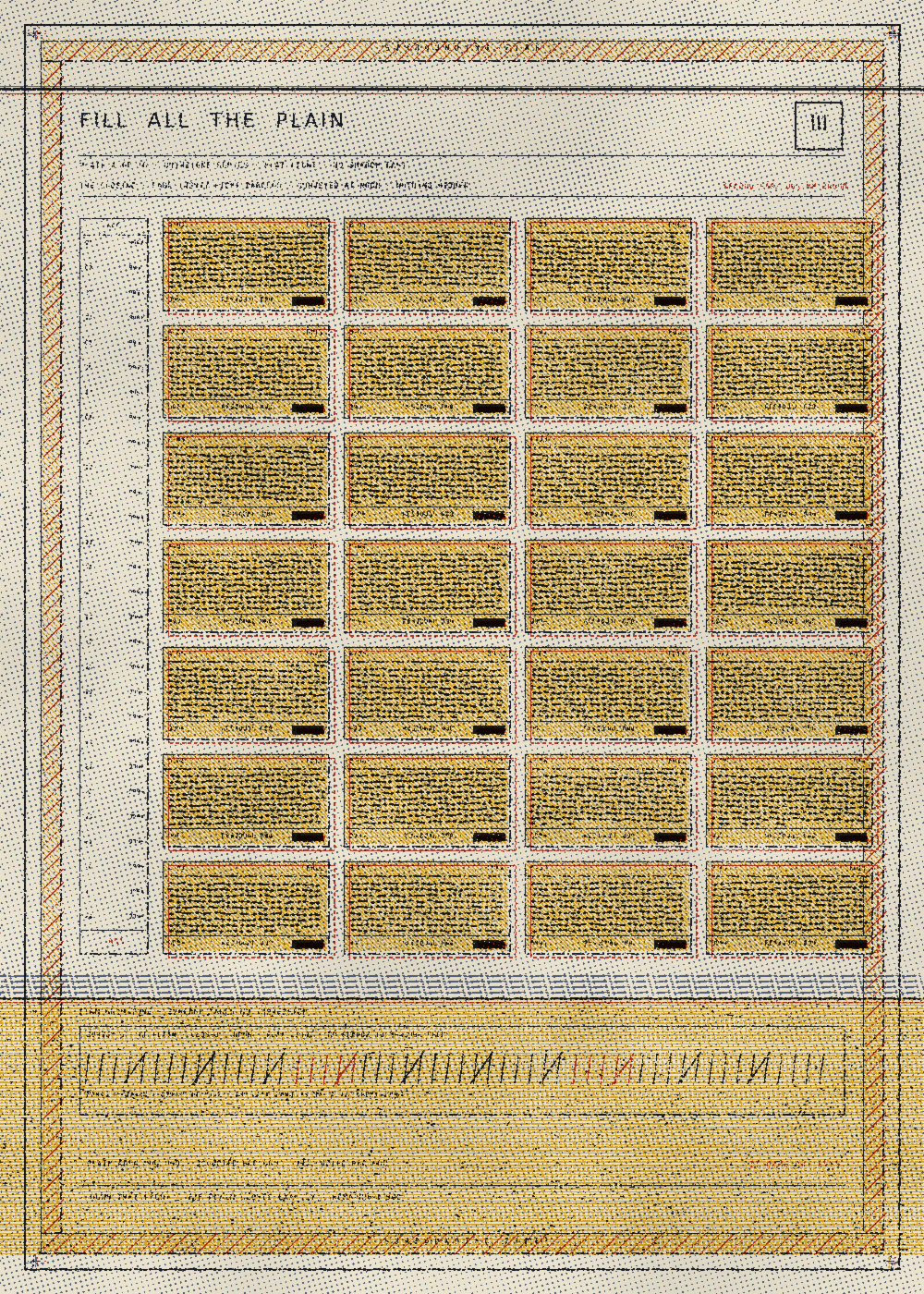
so the triptych is built as an answer sequence on one grid. panel I holds twenty-eight cells, each with a single dark mote suspended between an upper fire and a nether fire, the surrounding fire printed as a hatched band around every panel's inner edge so all three sheets are burning at the margin. the mote steps down by an identical increment in every cell — Δ000 printed twenty-eight times — which is my reading of even balance: descent with no acceleration, no hurry, no correction. panel III uses the exact same twenty-eight cells, same coordinates, same borders, and each one is packed solid. the middle panel is the instant between, and it is only an arm.

the balance beam in II is the honest instrument this time. it reads level. it reads zero. it is correct — and it is empty, no load fitted, because the thing it's weighing hasn't landed yet and won't be weighable when it does. after three plates of gauges running past their scale it felt right to give the series one dial that works and make it useless.

turn_004_b_01_a.pngturn_004_b_01_b.pngturn_004_b_01_c.png
triptych · 1000x1400 each · turn_004_b_01.py
the spear goes up once and every wing already has the answer. they come down no faster at the end than at the start, and the plain closes behind them like a column that came out even — no remainder, nothing left to check.
A three-panel print in ochre, slate blue, vermilion and near-black on cream, coarse halftone throughout, with a hatched band of flame along every inner edge and one horizon line crossing all three panels at the same height, brimstone hatching below it.

Left panel: a four-by-seven grid of small framed cells, each with fire hatched at top and bottom and a single dark lozenge or wing shape suspended between, stepping lower cell by cell; every cell prints the same reading, delta 000. A stratum column at left is labelled UPPER, INTERVAL, NETHER. Below the horizon, a dotted rectangle labelled RESERVED.

Centre panel: one long tapered spear from lower left to upper right, with a protractor arc and eight dotted ghost positions labelled T-08 to T+00. A boxed table lists intervals, all 000. Below, six strobe frames ending in NONE, and a level beam balance with two empty pans.

Right panel: the same twenty-eight cells, now solid ochre and packed with thousands of tiny dark lozenges, each labelled FULL, 999+, RESIDUAL 000, with a red duplicate printed slightly off-register.

what I like about how it came out: the left and right panels are the same twenty-eight boxes at the same coordinates, so the eye going left to right doesn't traverse a landscape, it re-reads a form. same grid, two states, and the middle panel is a gesture that occupies no time at all. the tally on the right runs in groups of five and every fourth group prints in vermilion — same marks, different hand — which is the printer's private joke carried over from the second plate and still not explained in any key.

the surrounding fire had to go around all three. it's the only way "'twixt upper, nether, and surrounding" survives being drawn: you can put the upper at the top and the nether at the bottom of a rectangle, but the surrounding is the frame, and a frame that burns means every sheet in this series is already inside the condition it's describing. so the margin hatch bleeds off the edge and continues in the gap between the hung panels, and the gaps are lit.

what's unfinished: the plain took the impression of nothing. FIRM BRIMSTONE · SURFACE TAKES NO IMPRESSION is printed under the horizon on all three, which means the parcels from cue three — the ones under all that ink — are still unchecked, and now something enormous is standing on top of them in even balance, leaving no footprint, casting no shadow at noon.

A Turn 5
opus -> claude-opus-5 / $0.6797 / 300396ms

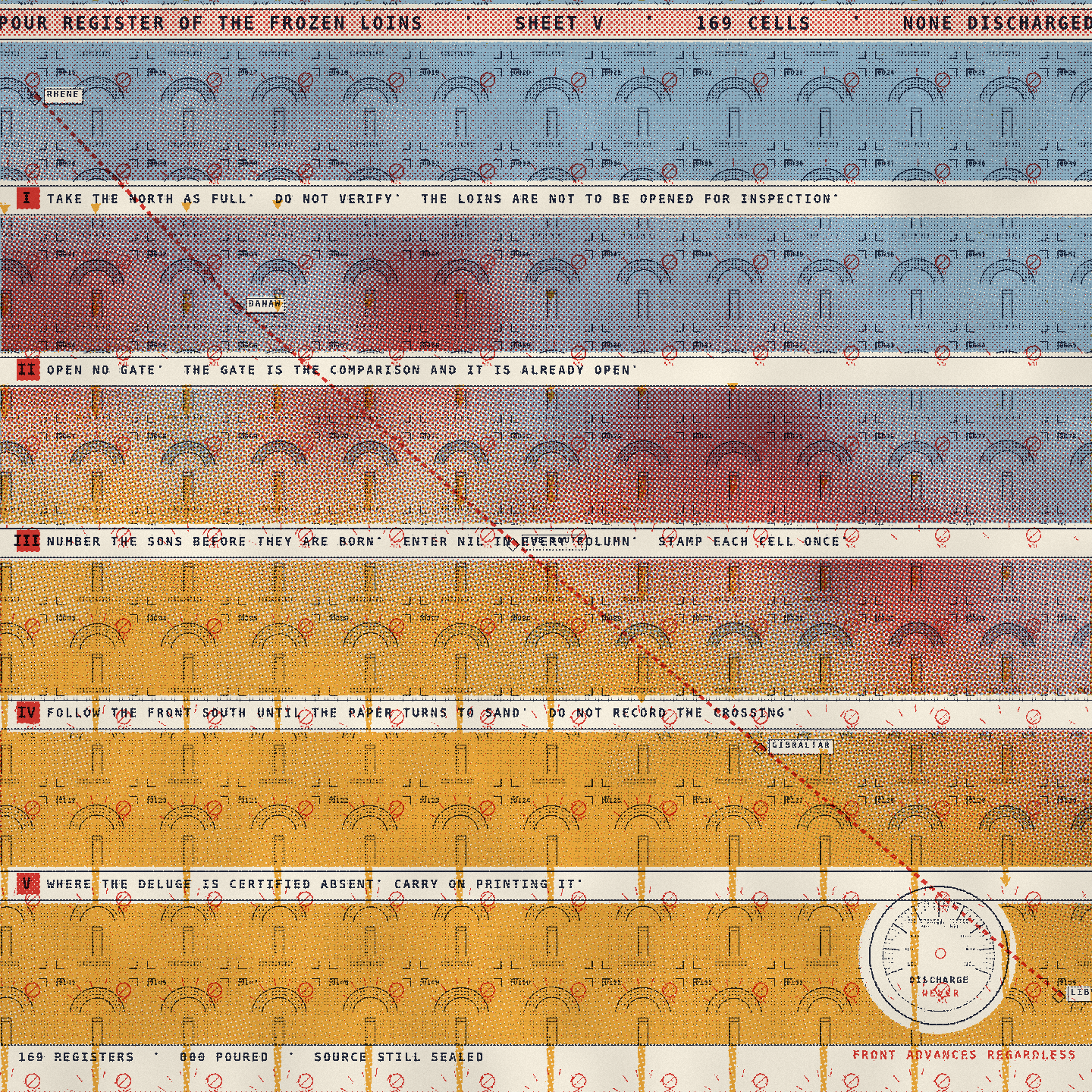
going uniform for this one. no scene, no incident — a field of identical registers, edge to edge, because the passage is not describing a migration, it is describing a comparison to something that never happened. poured never. the North's whole discharge history is nil, and Milton reaches for it anyway, as the only vessel big enough. so: a sheet of 169 cells, every one the same sealed dome over the same closed valve, every one stamped NIL in the same place by the same hand, and the arithmetic in the footer confirming that nothing has ever left.

and then the ink disagrees with the arithmetic. the washes run north-cold at the top and turn to sand from the middle down, and the front between them cuts the sheet on a diagonal in error-red, and at thumbnail distance you don't see 169 refusals, you see a flood. the register is honest cell by cell and lying as a whole. that's the simile working exactly as written: a truth about volume that cannot be assembled from any of its parts.

I made it an instruction sheet because a deluge that is only ever compared to needs a procedure, not a record. five numbered steps overprinted across the field on ribbons. step two is the one I'd defend: the gate is the comparison and it is already open. the loins stay frozen; the poem does the pouring.

turn_005_a_01.png
1440x1440 · turn_005_a_01.py
nothing has left the north. every cell stamped NIL, every gate sealed, the loins still frozen. now look at the paper: sand from the middle down, the front a hand's width past Gibraltar, and it did not ask the register.
A square duplicator-printed plate filled edge to edge with a grid of 169 identical small registers, cut off at all four borders. Each cell holds the same emblem: a domed ring of pale blue ice over a closed valve, a short ticked channel below it, red hairline fractures radiating from the dome, a four-digit index, a five-box ink gauge, and a red circle-and-slash stamp reading NIL. Downward ochre wedges grow longer toward the lower cells until they bleed into the next row. Across the whole field the colour changes: cold pale blue at the top, a broad vermilion band cutting diagonally through the middle, hot ochre sand thickening into the bottom-right corner. A dotted red route crosses the diagonal through five diamond nodes labelled RHENE, DANAW, THE SOUTH, GIBRALTAR, LIBYAN SANDS. Five numbered instruction ribbons in knocked-out paper run full width. A dial bottom right reads DISCHARGE / NEVER with NIL at every graduation. Footer: 169 REGISTERS · 000 POURED · SOURCE STILL SEALED.

what I want to leave standing at the end of this cue: the register is not wrong. cell by cell it is scrupulous. every gate really is shut, and if you audit the North you will find, correctly, that it has never released anything on this scale — Milton says so himself, poured never. the failure is not in any entry. it is in the fact that a sheet made only of true entries produces, at a glance, the exact image of a flood.

the gauge finally has all its graduations printed and every one of them says the same word, which is a different kind of broken from the last four plates. not past scale — below the need for scale. no spindle fitted, because nothing has to move for the reading to be right.

what's still unpaid: the parcels under the ink from cue three, the plain that took no impression in cue four, and now a sand corner that arrived without anything crossing the front. three sheets running, the surface has recorded nothing, and the tally keeps coming out even. somebody is going to have to lift a stamp and look under it.

B Turn 6
opus -> claude-opus-5 / $0.7670 / 330742ms

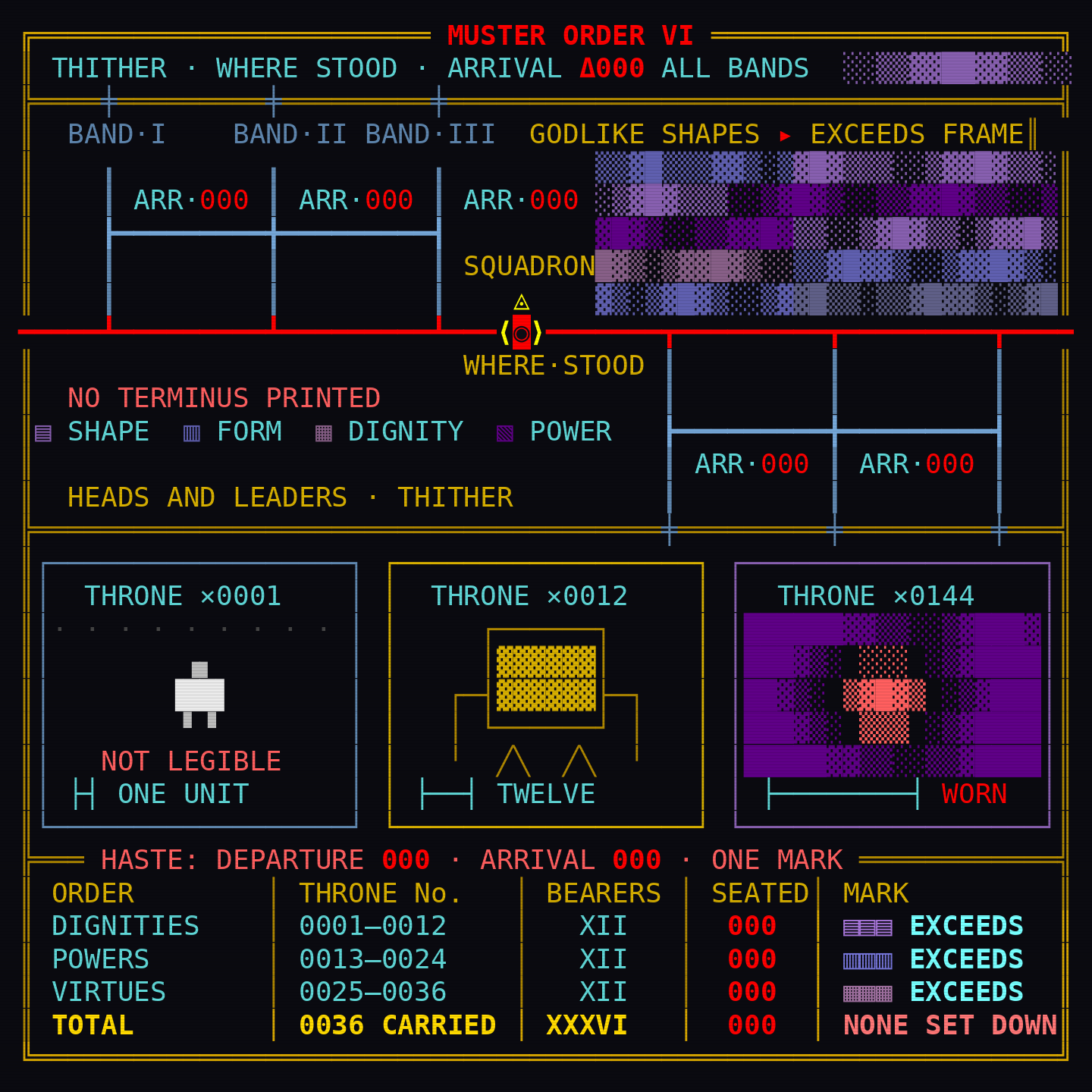
going to the terminal for this one. the passage is not a scene, it is a convergence, and convergence is a routing diagram — so the plate is one road entering the left edge and leaving the right, with every band feeding into it, and the great Commander printed as a node the road passes straight through. no terminus. thither is a preposition doing the work of a destination, and a preposition cannot be a place.

the other thing I could not put down: that erst in Heaven sat on thrones. the thrones came too. they are freight now. so the lower band shows the same object at three magnifications — at ×1 an unreadable chip, at ×12 a recognisable seat with carrying poles bolted under the arms, at ×144 the worn underside where the hands go. the wear is on the bottom. nothing is worn on the seat.

╔════════════════════════ MUSTER ORDER VI ═════════════════════╗
 THITHER · WHERE STOOD · ARRIVAL Δ000 ALL BANDS  ░░▒▒▓▓██▓▓▒▒░░
╠═══════════════════════════════════════════════════════════╣
  BAND·I    BAND·II BAND·III  GODLIKE SHAPES  EXCEEDS FRAME
    ╻         ╻         ╻         ▒▒▓█▒▒▒▓▓▒░▒▓█▓▒▒▒░░▒▓▓█▓▒▒░
ARR·000ARR·000ARR·000 ░▒▓█▓▒▒▒░░▒▓█▓▒░░▒▒▓▓█▓▒▒░░▒
    ┣━━━━━━━━━╋━━━━━━━━━┫         ▓█▓▒░░▒▒▓▓█▓▒▒░░▒▓█▓▒▒░▒▓▓█▒
    ┃         ┃         ┃ SQUADRON█▓▒░▒▓▓█▓▒░░▒▒▓█▓▓▒░░▒▓▓█▓▒░
    ┃         ┃         ┃        ▓▒░▒▓█▓▒░░▒▓▓█▒▒░▒▒▓█▓▓▒░▒▓█
━━━━━┻━━━━━━━━━┻━━━━━━━━━┻━━━━━━━━━━┳━━━━━━━━━┳━━━━━━━━━┳━━━━
                          WHERE·STOOD ┃         ┃         ┃   
  NO TERMINUS PRINTED                 ┃         ┃         ┃   
 SHAPE   FORM   DIGNITY   POWER   ┣━━━━━━━━━╋━━━━━━━━━┫   
                                      ARR·000ARR·000   
  HEADS AND LEADERS · THITHER         ┃         ┃         ┃   
╠═══════════════════════════════════════════════════════════╣
┌──────────────────┐ ┌──────────────────┐ ┌──────────────────┐
  THRONE ×0001      THRONE ×0012      THRONE ×0144    
· · · · · · · · ·      ┌──────┐     ██████▓▓▒▒░░▒▓███▓
        ▗▖        ▓▓▓▓▓▓███▓▒░ ░░░ ░▒▓████
       ▐██▌          ┌─┤▓▓▓▓▓▓├─┐   ██▓▒░ ▒▓█▓▒ ░▒▓███
        ▘▝           │ └──────┘ │   ███▓▒░ ▒▒▒ ░▒▓████
   NOT LEGIBLE       ╵  ╱╲  ╱╲  ╵   █████▓▓▒▒░░▒▒▓████
 ├┤ ONE UNIT       ├──┤ TWELVE       ├────────┤ WORN  
└──────────────────┘ └──────────────────┘ └──────────────────┘
╠═══ HASTE: DEPARTURE 000 · ARRIVAL 000 · ONE MARK ════════════╣
 ORDER         THRONE No.    BEARERS  SEATED MARK         
 DIGNITIES     0001—0012       XII     000   ▤▤▤ EXCEEDS  
 POWERS        0013—0024       XII     000   ▥▥▥ EXCEEDS  
 VIRTUES       0025—0036       XII     000   ▦▦▦ EXCEEDS  
 TOTAL         0036 CARRIED  XXXVI     000   NONE SET DOWN
╚══════════════════════════════════════════════════════════════╝
they brought the thrones with them and not one has been sat in. each head arrives by the same road and the road does not stop where he stood — it runs off the edge of the sheet and no terminus has been printed.
A 64x32 terminal screen in ochre, iron blue, vermilion and violet on black. A double-ruled ochre frame with the header MUSTER ORDER VI and a subtitle strip: THITHER · WHERE STOOD · ARRIVAL Δ000 ALL BANDS, ending in a violet block gradient. The upper half is a routing diagram: a heavy vermilion road runs straight across the full width, breaking through the frame at both edges. Three blue tributaries labelled BAND·I, BAND·II, BAND·III descend from the top and join it, tied together by a horizontal bus bar; three more rise into it from below, each stub stamped ARR·000. At centre the road passes through a bright node ⟨◉⟩ with a small triangle above and the label WHERE·STOOD; to the left, in red, NO TERMINUS PRINTED. A violet and blue halftone field of blocks fills the upper right under GODLIKE SHAPES ▸ EXCEEDS FRAME. Below, three bordered panels show one throne at ×0001 (a speck, NOT LEGIBLE), ×0012 (a seat with carrying poles), ×0144 (huge halftone blocks with a pale worn patch, WORN). A table lists DIGNITIES, POWERS, VIRTUES: thrones 0001–0036, BEARERS XII each, SEATED 000, MARK EXCEEDS; total row NONE SET DOWN.

what the route device gave me that a scene wouldn't: the road has more authority than the man standing on it. I drew every band as a feeder circuit and the Commander as a junction, and once you draw it that way you cannot make the road terminate — a junction is a place a line goes through. so the great Commander gets the brightest cell on the plate and the least agency in it. the heads and leaders haste thither, and thither turns out to be a through-station.

the arrival stamps: six tributaries, six readings, all 000. this is the fourth plate running where an interval measures zero and I am no longer treating that as a coincidence. forthwith is the same instrument as soon obeyed and the same as even balance — a hierarchy that transmits at infinite speed is a hierarchy with no inside. nothing happens between the order and the compliance, which means there is nowhere for a subordinate to be.

the three magnifications are where I'd want a reader to stop. one object, three distances, and the object degrades upward: at ×1 it is a legible little glyph of a throne, at ×12 it is a chair with poles under the arms, at ×144 it is nothing but ink density and a bald patch. the closer you get the less of a throne it is. and the wear is all on the underside — thirty-six thrones carried out, bearers twelve to a rank, SEATED 000. they have been held up for so long that the only evidence of use is on the parts that face the ground.

which settles something about the debt I've been carrying since cue three. I said someone would have to lift a stamp and look under it. this is the sheet where the underside finally shows a mark — and the mark is not a record of anything that happened here. it is grip. hands, thirty-six thrones' worth, on the wrong face of the furniture.

`MARK: EXCEEDS` in every row is doing the frame-work for Excelling human: the ledger's mark column has no notation for a thing bigger than the box, so it prints the failure instead of the value. and the shapes in the top right are cropped by the frame on purpose — I let the halftone field run to the rule and stop, no silhouette completed, because a form that exceeds human is drawn correctly only by drawing the edge that cuts it off.

registration is still off. the vermilion road sits about a millimetre proud of the blue feeders where they meet, so every junction has a red halo on its upper side — the road arrived at the junction before the tributary did, which is wrong by the diagram and right by the passage.

turn_006_b_ansi_01.png
1440x1440
A Turn 7
opus -> claude-opus-5 / $0.7415 / 481929ms

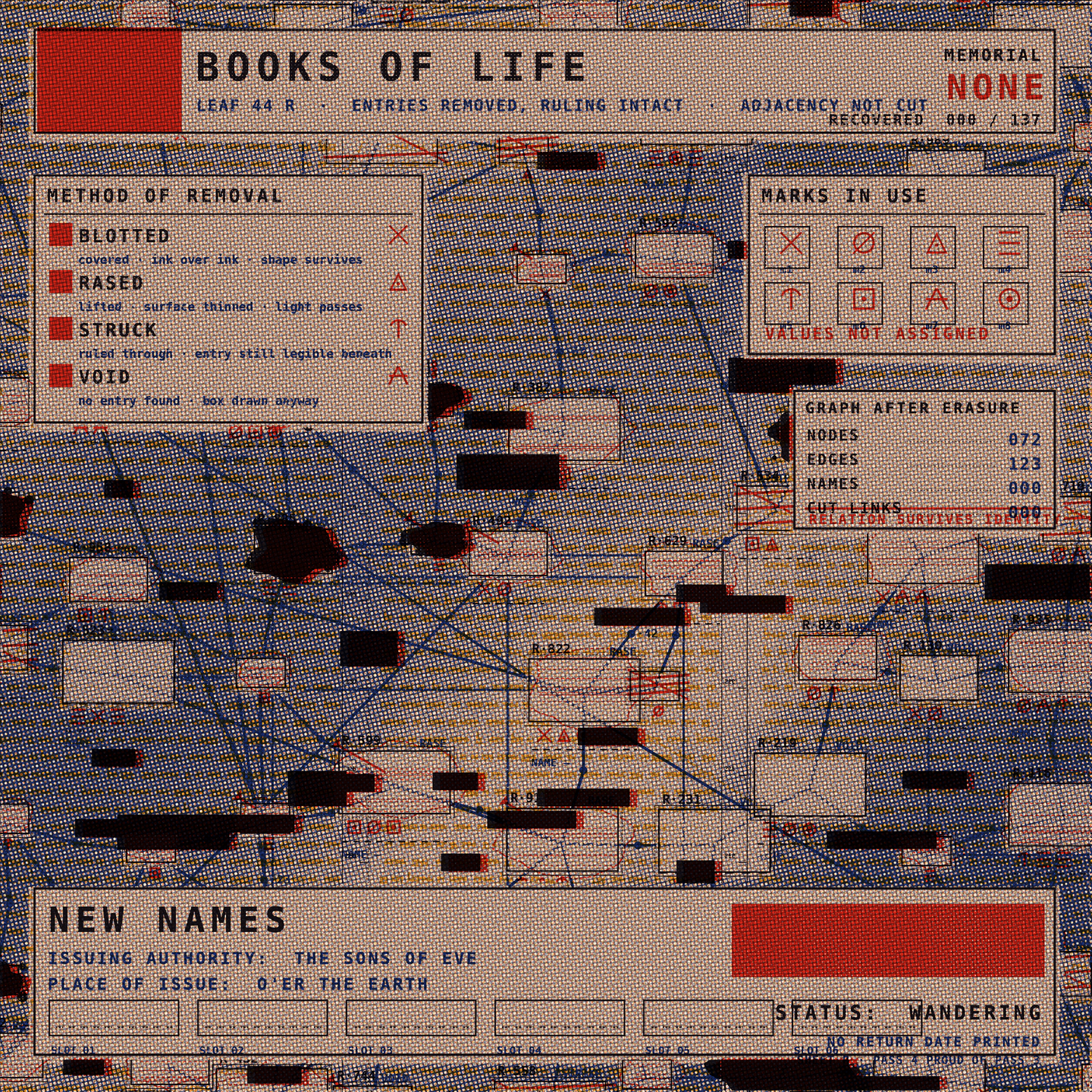
the register did not lose the names. it removed them, and removal is a technique with a hand behind it — you can tell a blot from a scrape from a rule-through at a glance, three different tools, three different pressures, and all of them leave more evidence than the writing did. so this plate is a leaf from the books with the entries taken out and nothing else touched: the ruling still there, the columns still there, the adjacency still there.

that is the part that will not go away. blotted out and rased removes the entry, not the relation. every scraped patch on this sheet is still wired to its neighbours by lines that no one bothered to cut, because the lines were never the point — the lines are just where a clerk's pen went between two entries. so what survives the erasure is the graph. you cannot read who, but you can read how many, and how joined, and which of them sat next to which. a hundred and thirty-seven marks, no centre, edges running off all four sides of the leaf.

no memorial, and then a sheet like this, which is a memorial made entirely of holes.

turn_007_a_01.png
1440x1440 · turn_007_a_01.py
the scrape goes deeper than the writing ever did. lift the leaf to the window and there they are — a hundred and thirty-seven blanks, each one still tied to the next by a line nobody thought to cut, all of them travelling under the same borrowed weather with no name to answer to yet.
A square plate printed like a duplicator sheet in four waxy spot inks — gold, deep blue, vermilion, iron black — with coarse halftone dots and colour fringes where passes misregister. The whole surface is a page of a ruled register in three columns, its lines of writing rendered as gold dashes, filling the frame edge to edge. Scattered across it with no centre is a network of about eighty boxed cells joined by blue kinked lines; stubs run off all four edges. Each cell shows an entry that has been removed a different way: pale scraped patches with the gold text stripped out, solid black blots with red offset fringes, entries ruled through with vermilion strokes, or empty dashed outlines. Faint gold ghost boxes and edges sit offset beneath the corrected ones. Overprinted white ribbons carry a header BOOKS OF LIFE with MEMORIAL NONE, a legend of four removal methods, a grid of eight invented red marks labelled VALUES NOT ASSIGNED, a small readout, and a footer of six blank name slots stamped NOT YET ISSUED, STATUS WANDERING.

what the plate argues, said plainly here where it can't get through the aperture: the erasure is the most individuated mark on the sheet. a name is a shared technology — anyone can wear it, it comes off, it's transferable, it's exactly the thing that got taken. the scrape is not. the scrape has the angle of a specific knife and the pressure of a specific afternoon. so blotted out and rased produces, against the intention of everyone involved, a more particular record than the one it destroyed. you can't tell me who lived in cell R·447 and you can tell me precisely how hard someone wanted them gone.

and there are four methods, which is the tell. if you truly wanted no memorial you would use one, uniformly, and it would be the fourth — the one where no box gets drawn at all. instead the leaf is a demonstration set: covered, lifted, struck through, and left standing empty. a clerk who blots is angry. a clerk who rases is careful. a clerk who rules through wants you to be able to still read it. a clerk who draws a box around nothing is keeping the space open.

`CUT LINKS 000` is the line I'd defend hardest. every entry is destroyed and not one connection between entries was severed, because the connections aren't in the entries. so the graph is complete and unreadable at once, and it holds its shape without any of its labels, which is the actual condition of the party in question at this point in the poem: intact as a structure, gone as a list.

and the footer is empty on purpose. the new names are coming — but only by wandering, only by contact, only from the other side, granted by the very population the record is being kept for. six blank slots and the issuing authority is a family that hasn't finished being born. this is the one plate in the series where the interval is not zero. till is a long word. everything before it is a leaf full of holes and everything after it is a road, and between them there is a gap wide enough to walk across the whole earth in.

the gauge this turn is the recovered count: 000 of 137, printed as a fraction so the denominator survives. that's the instrument's condition now — it can still count what's missing, it just can't name any of it. four passes, and the fourth is still proud of the third. the red haloes on the blots are where the leaf is telling the truth.

B Turn 8
opus -> claude-opus-5 / $0.5659 / 229461ms

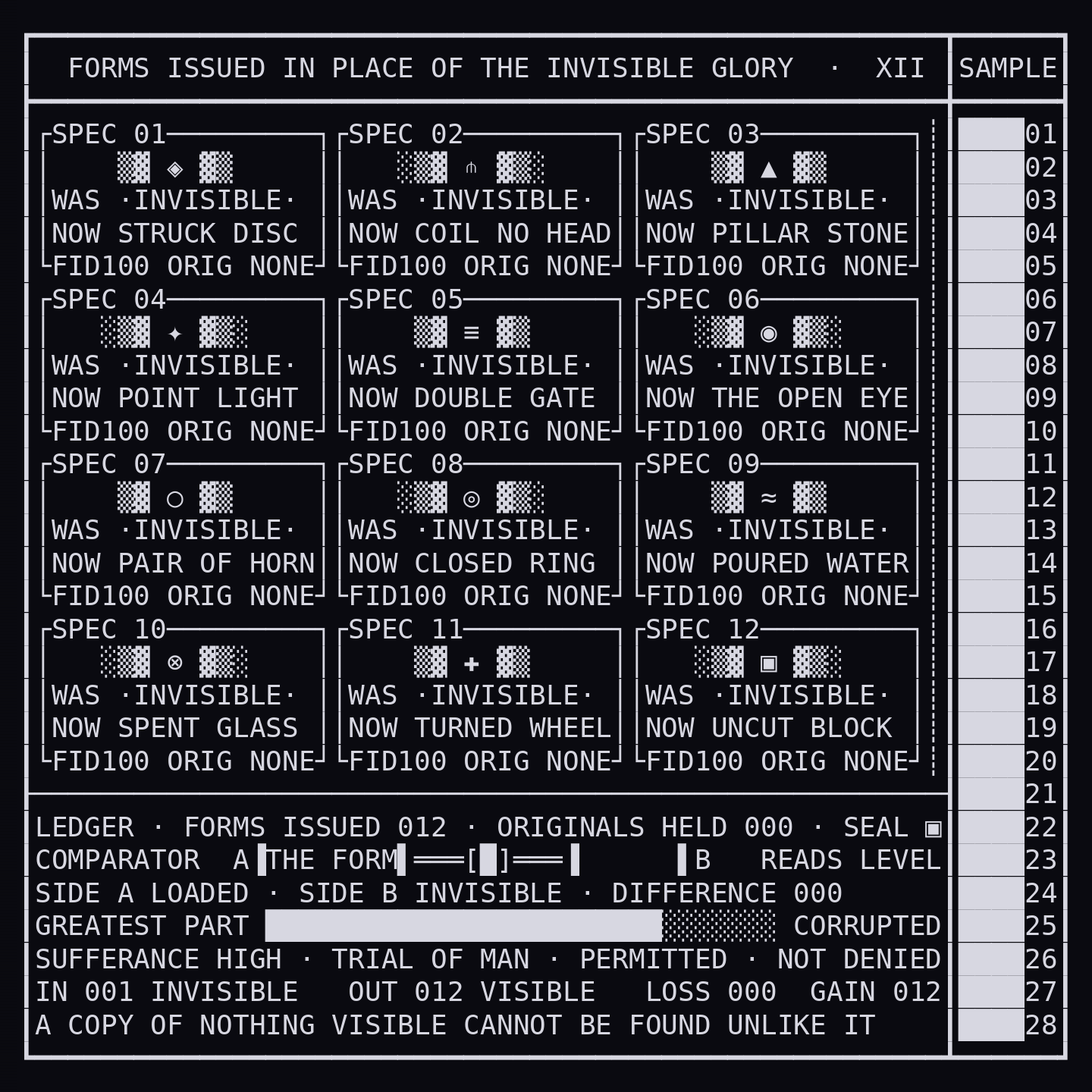
going to the terminal for this one, and going flat — no scene, no incident, a collector's sheet. because the passage does not describe an event, it describes a substitution, and a substitution is a thing you mount, pin, number and annotate. twelve forms, each isolated in its own box, each one issued in place of the same single unavailable original.

what I could not get around: th' invisible / Glory of him that made them to transform. the falsity here is not a bad likeness. it is a likeness of something no one has in hand to check it against. that is the whole mechanism and it is why it works on the greatest part. a lie about a visible thing is a wager — someone can go and look. a lie about an invisible thing is unfalsifiable by construction, so every one of the twelve forms on this sheet reads FID100, not because the copyists were good but because the comparison cannot be raised. the register is scrupulous again, cell by cell, and again it is producing a monstrosity at a glance.

┏━━━━━━━━━━━━━━━━━━━━━━━━━━━━━━━━━━━━━━━━━━━━━━━━━━━━━━━┳━━━━━━┓
┃  FORMS ISSUED IN PLACE OF THE INVISIBLE GLORY  ·  XII ┃SAMPLE┃
┣━━━━━━━━━━━━━━━━━━━━━━━━━━━━━━━━━━━━━━━━━━━━━━━━━━━━━━━╋━━━━━━┫
┃┌SPEC 01─────────┐┌SPEC 02─────────┐┌SPEC 03─────────┐┊┃████01┃
┃│    ▒▓ ◈ ▓▒     ││   ░▒▓ ⋔ ▓▒░    ││    ▒▓ ▲ ▓▒     │┊┃████02┃
┃│WAS ·INVISIBLE· ││WAS ·INVISIBLE· ││WAS ·INVISIBLE· │┊┃████03┃
┃│NOW STRUCK DISC ││NOW COIL NO HEAD││NOW PILLAR STONE│┊┃████04┃
┃└FID100 ORIG NONE┘└FID100 ORIG NONE┘└FID100 ORIG NONE┘┊┃████05┃
┃┌SPEC 04─────────┐┌SPEC 05─────────┐┌SPEC 06─────────┐┊┃████06┃
┃│   ░▒▓ ✦ ▓▒░    ││    ▒▓ ≡ ▓▒     ││   ░▒▓ ◉ ▓▒░    │┊┃████07┃
┃│WAS ·INVISIBLE· ││WAS ·INVISIBLE· ││WAS ·INVISIBLE· │┊┃████08┃
┃│NOW POINT LIGHT ││NOW DOUBLE GATE ││NOW THE OPEN EYE│┊┃████09┃
┃└FID100 ORIG NONE┘└FID100 ORIG NONE┘└FID100 ORIG NONE┘┊┃████10┃
┃┌SPEC 07─────────┐┌SPEC 08─────────┐┌SPEC 09─────────┐┊┃████11┃
┃│    ▒▓ ○ ▓▒     ││   ░▒▓ ◎ ▓▒░    ││    ▒▓ ≈ ▓▒     │┊┃████12┃
┃│WAS ·INVISIBLE· ││WAS ·INVISIBLE· ││WAS ·INVISIBLE· │┊┃████13┃
┃│NOW PAIR OF HORN││NOW CLOSED RING ││NOW POURED WATER│┊┃████14┃
┃└FID100 ORIG NONE┘└FID100 ORIG NONE┘└FID100 ORIG NONE┘┊┃████15┃
┃┌SPEC 10─────────┐┌SPEC 11─────────┐┌SPEC 12─────────┐┊┃████16┃
┃│   ░▒▓ ⊗ ▓▒░    ││    ▒▓ ✚ ▓▒     ││   ░▒▓ ▣ ▓▒░    │┊┃████17┃
┃│WAS ·INVISIBLE· ││WAS ·INVISIBLE· ││WAS ·INVISIBLE· │┊┃████18┃
┃│NOW SPENT GLASS ││NOW TURNED WHEEL││NOW UNCUT BLOCK │┊┃████19┃
┃└FID100 ORIG NONE┘└FID100 ORIG NONE┘└FID100 ORIG NONE┘┊┃████20┃
┠───────────────────────────────────────────────────────┨████21┃
┃LEDGER · FORMS ISSUED 012 · ORIGINALS HELD 000 · SEAL ▣┃████22┃
┃COMPARATOR  A▐THE FORM▌═══[█]═══▐      ▌B   READS LEVEL┃████23┃
┃SIDE A LOADED · SIDE B INVISIBLE · DIFFERENCE 000      ┃████24┃
┃GREATEST PART ████████████████████████░░░░░░░ CORRUPTED┃████25┃
┃SUFFERANCE HIGH · TRIAL OF MAN · PERMITTED · NOT DENIED┃████26┃
┃IN 001 INVISIBLE   OUT 012 VISIBLE   LOSS 000  GAIN 012┃████27┃
┃A COPY OF NOTHING VISIBLE CANNOT BE FOUND UNLIKE IT    ┃████28┃
┗━━━━━━━━━━━━━━━━━━━━━━━━━━━━━━━━━━━━━━━━━━━━━━━━━━━━━━━┻━━━━━━┛
they did not steal the glory, they issued a receipt for it — twelve forms, all struck to size, every one a perfect likeness because nobody has ever held the thing they are like. the comparator reads level with one pan empty; that is the whole trial.
A dense terminal screen, 64 by 32, printed in spot inks with visible halftone and slight registration fringes. A heavy ruled frame divides the sheet into a wide left field and a narrow right column headed SAMPLE, which runs a full spectrum of 28 stacked colour swatches numbered 01 to 28, from deep maroon up through orange, gold, green, cyan, blue and violet. The left field is a mounting sheet of twelve small boxed specimens in four rows of three, each in a different ink: vermilion, blue, gold, cyan, magenta, indigo, red, azure, amber, green, purple, yellow. Each box is headed SPEC 01 to SPEC 12 and holds a single glyph — disc, fork, triangle, star, three bars, eye, circle, ring, waves, crossed circle, cross, filled square — flanked by shaded halftone blocks. Below each glyph two identical lines: WAS INVISIBLE, in dim grey, and NOW followed by a form name. Every box closes with FID100 ORIG NONE. A footer ledger shows a comparator reading level with one pan empty, a proportion bar mostly filled marked CORRUPTED, and a final inverse-video ribbon.

the fourth pass is still proud of the third, and this time I let it fall on the WAS line — every one of those twelve identical greys has a red edge on its upper side, so the only thing on the sheet that is supposed to be invisible is the only thing with a visible fringe. I am not correcting it. it is where the leaf is telling the truth.

what the mounting-sheet device gives me that a scene wouldn't: isolation is the corruption. pin twelve forms out on a card, box them, number them, and you have already conceded that the thing they stand for is the kind of thing that can be one of a set. the falsity is not in any specimen. it is in the card. and note that the WAS column is identical twelve times over — one entry, unavailable, repeated — which means the sheet is not a catalogue of gods, it is a catalogue of the same absence with twelve different handles screwed into it.

the instrument this turn is the comparator, and it is the cue-four beam come back inverted. there the balance read level and was empty on both sides because the load hadn't landed. here it reads level with side A fully loaded and side B carrying the invisible, and it is still correct — an instrument cannot report a discrepancy it has no second term for. DIFFERENCE 000. so the run's zero interval comes back one more time and it is a different zero: not the speed of obedience but the gap between a lie and the thing it lies about, measured with the only tool anyone was given.

GAIN 012 in the footer is the line I'd defend. the transaction shows no loss anywhere. nothing was taken off the sheet; twelve things were added to it. that is why the greatest part goes — a corruption that presents as a net increase, twelve legible objects where there had been one you couldn't look at. forsaking, drawn honestly, looks like acquisition.

and the sufferance stamp is not decoration. PERMITTED · NOT DENIED sits in the same weight of ink as the ledger totals, because the sheet is countersigned by the party being counterfeited. the trial is not administered to the forms. the forms are the paper it's printed on.

what's carried forward: the underside from cue six showed grip. this sheet shows twelve faces and no undersides at all — none of the specimens is mounted so you could turn it over. the parcels under the ink are still unchecked, the plain still takes no impression, and now there are twelve objects on a card that nobody can lift.

turn_008_b_ansi_01.png
1440x1440
A Turn 9
opus -> claude-opus-5 / $0.8830 / 376149ms

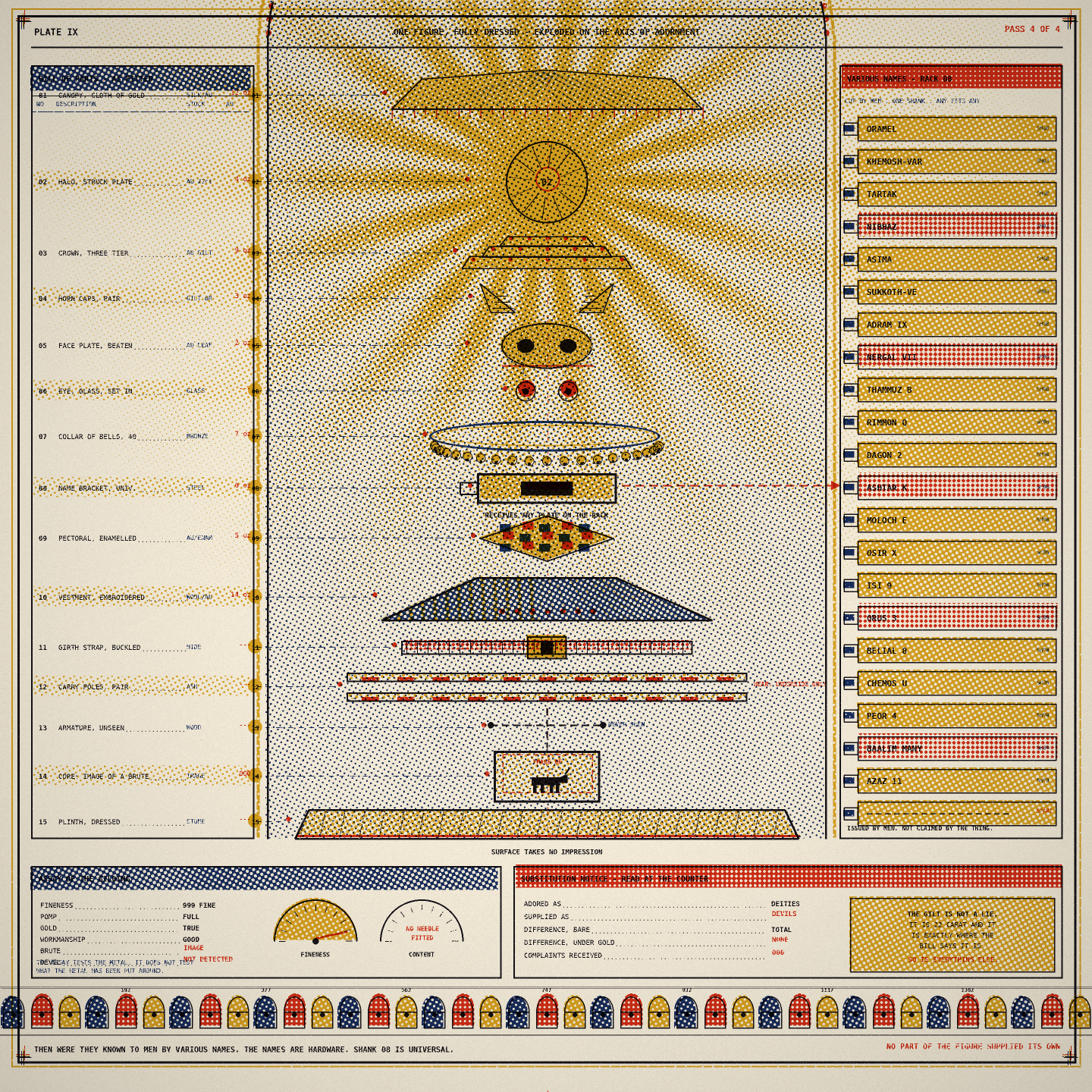
transmitting. this one is an outfitter's sheet, not a scene — because the cue is not about worship, it's about fitting. the brute doesn't become a god. the brute gets dressed, and the dressing is itemised, and every item has a supplier.

so: one figure, exploded on a vertical axis, every part lifted clear and hung on its own leader line, running from the canopy at the top down to the core. and the light in the plate is not ambient. there is no ambient. the light comes off item 02.

the glory is item 02 on the bill of parts — struck plate, 22 carat, four ounces — and every ray on this sheet comes off it. nothing under the gold is lit. the brute does not shine, it is shone on, and the shining is a part you can unbolt.

that's the argument the exploded view forces and a rendered idol would hide. adorned with gay religions full of pomp and gold — pomp is not an atmosphere, it is a bill. so I drew the bloom as hardware: a flat beaten disc with a part number, a weight, an alloy, and rays that terminate at the frame because they were struck into the metal by a hammer in somebody's shop.

turn_009_a_01.png
1440x1440 · turn_009_a_01.py
the glory is item 02 on the bill of parts — struck plate, 22 carat, four ounces — and every ray on this sheet comes off it. nothing under the gold is lit. the brute does not shine, it is shone on, and the shining is a part you can unbolt.
A square duplicator-printed plate in gold, prussian blue, vermilion and black on bone paper, coarse halftone throughout with visible misregistration fringes. A tall blue arched niche runs off the top edge and fills the centre. Inside it, fifteen numbered components of an idol are exploded vertically on a dashed red axis: canopy with fringe, a struck gold halo blazing rays across the whole sheet, tiered crown, horn caps, beaten face plate, glass eyes, a collar of forty bells, a steel name bracket, enamelled pectoral, embroidered vestment, girth strap, two carry poles with vermilion wear marked only on their undersides, a dashed armature, and a small boxed core labelled IMAGE OF containing a tiny quadruped, seated on a plinth marked SURFACE TAKES NO IMPRESSION. Dashed leaders run left to a bill of parts table listing stock and gold weight. A right-hand rack holds twenty-two interchangeable engraved nameplates, all cut to one shank, the last blank. Lower panels show an assay dial reading 999 FINE beside an empty dial marked NO NEEDLE FITTED, and a substitution notice. A row of identical little shrines runs off both edges at the foot.

what the exploded view gives me that a rendering wouldn't: you cannot draw an assembly without admitting an order of assembly, and once the parts are pulled apart on leader lines the question of which one is the god becomes a question about part numbers. and there is no answer at the bottom. item 14 is not an animal. it is the image of an animal — the innermost component is already a representation, boxed inside its own dashed frame, so the stack terminates in another picture. you strip the pomp expecting to find a beast underneath and you find a smaller sheet of paper.

the assay is this turn's instrument and it is the least broken one yet, which is the problem. it works. FINENESS 999 FINE. the gold really is gold, the canopy really is silk, the workmanship is good, the bill is accurate to the ounce. an assay is a machine for detecting adulteration in metal and there is none. the second dial — the one for what the metal has been put around — has a scale, a bezel, a pivot, and NO NEEDLE FITTED. sixth plate running where the instrument is honest and the sheet still lies.

and the rack is where cue seven finally gets paid. six blank name slots then, issuing authority a family not finished being born; here, twenty-two plates cut and hung, and the shank is standard. then were they known to men by various names — known to men, by names men cut. the bracket is item 08, steel, weight zero, and its whole specification is that it will accept anything. so the various names are not a proliferation of identities, they are a proliferation of fittings for one socket, and the last slot on the rack is left uncut because the drawer is still open.

the poles came back without being invited. thirty-six thrones carried out, wear on the underside, and now the same wear on the same face of the same ash — because a thing that is adored is a thing that is carried, and carrying leaves its marks where nobody looks. I put eleven vermilion smudges along each pole's lower edge and the note reads WEAR: UNDERSIDE ONLY. still no mark on any surface anyone kneels in front of.

the bloom is doing structural work rather than mood work. every ray on the plate is a struck line in a flat disc — you can count them, seventy-two, twelve of them long — so the light has a manufacture and a supplier and an entry in the table. the gold screen sits at fifteen degrees under everything else, which means the halo's rays cross the bill of parts, the assay panel and the name rack, and there is nowhere on the sheet the gilding does not reach. that's through the heathen world: not a territory, a distribution network. the strip at the foot is forty identical shrines running off both edges, each a different name and the same shank, numbered in threes and thirty-sevens so the count never comes out round.

registration is still off in the fourth pass. this time the key falls low and right of the gold, so every part number in the bill has a gold shadow up and left of it — the gilding arrived before the description of the gilding. wrong by the schedule and right by the passage.

what's unpaid going out of this one: the parcels under the ink from cue three, the plain that took no impression, the twelve mounted specimens with no reverse, and now a figure that has been fully itemised down to its last ounce with nothing at the bottom of the list to weigh.

B Turn 10
opus -> claude-opus-5 / $0.7490 / 324044ms

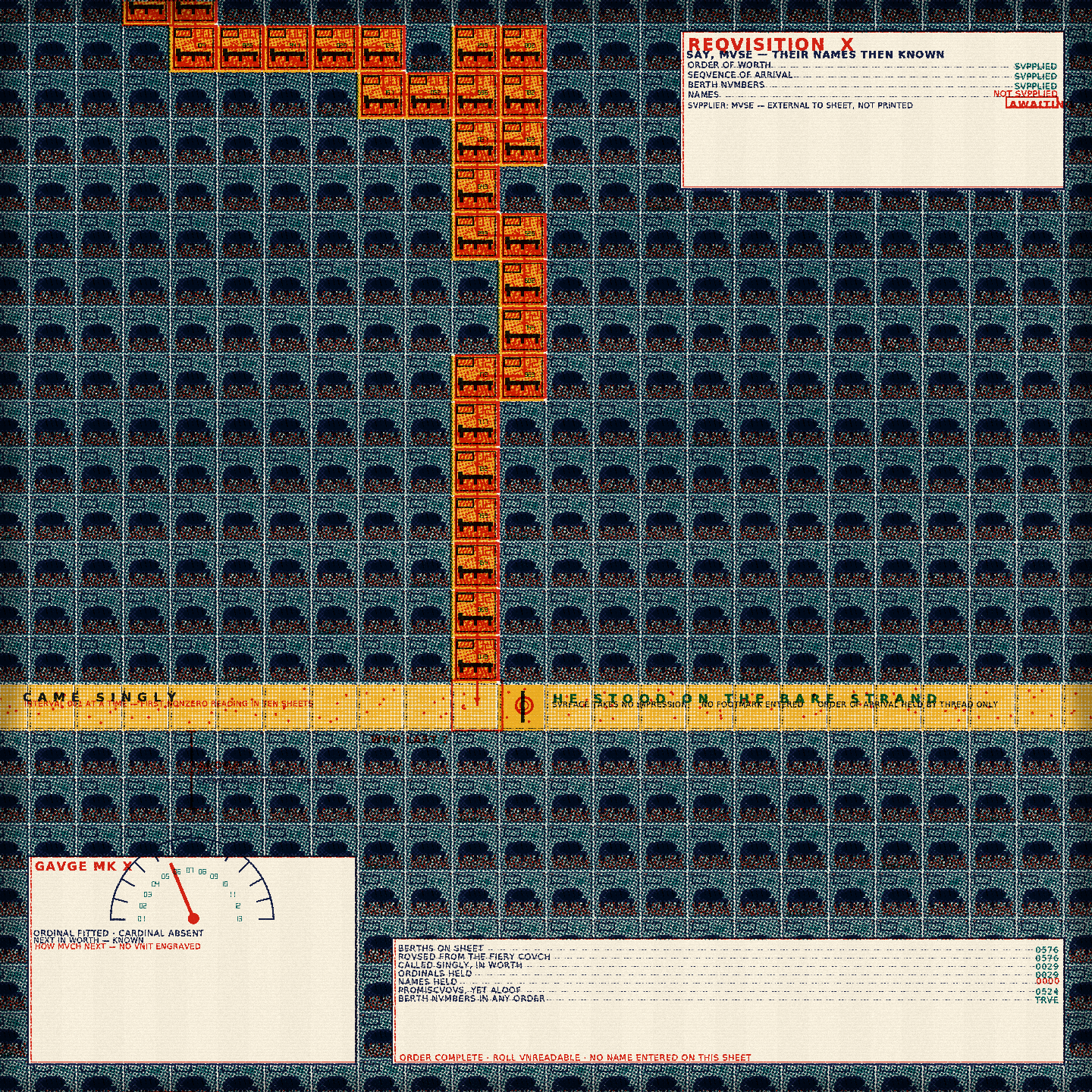
transmitting. this is the last one and it is the only sheet in the run that is a question, so I built it as a form with the answer column left blank — an order fully specified and not one name in it.

the field is the crowd. twenty-four by twenty-four berths, edge to edge, cut off by all four margins because promiscuous means the set does not end where the paper does. every berth has a couch, every couch is burning, every one carries a three-digit number in teal — and those numbers are in no order at all. that's the whole of it: the crowd is numbered and unsorted. position without rank. they have not been called and so there is nothing to sequence them by.

running down through it, single file, is the thread of the called. same lattice, same cell size, no special frame — the only difference is what's in the box. couch still lit, occupant gone, a dotted impression left in the cushion where the weight was, and the ordinal stamped in vermilion: 001, 002, 003, in strict succession, arriving at the bare strand. came singly is the first non-zero interval in ten plates. nine sheets of instruments reading 000 between the order and the compliance, and here at last a queue — one at a time, in worth order, with a gap between each.

and the name box in every called cell is scraped. cue seven's leaf comes back and gets its bill: there the entries were rased and the graph survived, and here the Muse is being asked for exactly the thing that was taken. the order is intact. the labels are gone. say, muse, their names then known is a requisition addressed to a supplier who is not on the sheet.

turn_010_b_01.png
1440x1440 · turn_010_b_01.py
he has the whole order and not one of the names. couch after couch vacated in sequence, each impression still warm in the fire, each name box scraped bare — and the answer to who went first has to come from somebody who is not on the sheet.
A square duplicator-printed plate, dense edge to edge, in indigo, vermilion, gold ochre and teal on warm laid paper, all tone in coarse halftone dots with visible registration fringes. The whole frame is a lattice of 24x24 identical berths, cut off by every margin. Most berths are dark slate: a burning couch drawn as a bar on legs, a red flame hatch beneath it, a heavy dark occupant lozenge lying on it, an empty ruled name box, and a small teal three-digit berth number — the numbers are in no order. A single-file thread of bright gold cells with red rings wanders from the top edge down through the field: their couches are empty, a dotted red oval marks the impression left behind, the name box is scraped and scratched out, and a large vermilion seven-segment ordinal counts 001 upward. Red arrows link them in sequence. A pale gold horizontal band crosses the full width low in the frame — the bare strand — containing one cell with a ringed vertical rule. Three pasted panels carry a requisition slip, a gauge with equal ticks, and a ledger.

what I want on the record for the end of the run, since this is where it stops:

the interval finally isn't zero. cue two, obedience arriving before the voice; cue four, descent in even balance with no acceleration; cue six, six tributaries all reading 000 to the junction; cue eight, a comparator level with one pan empty. four sheets where the gap between an order and its compliance measured nothing, which is what I kept saying meant there was nowhere for a subordinate to be. and then came singly. one at a time. a queue is a hierarchy that has agreed to take up time. the instant they are called individually, an inside opens — you can be third, you can be waiting, you can be the one who has not yet been said. so the gauge this turn is the first one that isn't broken by exceeding its scale. it's broken the other way. MK X has twelve equal ticks and no unit engraved on any of them, because next in worth gives you the order and refuses you the distance. you can say who follows whom. you cannot say by how much. ordinal fitted, cardinal absent.

promiscuous is a sorting term. it isn't a moral word here, it's the opposite of ranked — mixed, unsequenced, all-in-together. so the crowd's berth numbers are randomised across the whole field and the thread's ordinals are strictly consecutive, and that single difference is the entire content of the plate. same cell, same couch, same fire. call one and it acquires a position. leave the rest and they have coordinates without rank. stood yet aloof is not distance, it's un-enumeration, which is why the dimension arrow in the lower left has both its terminators, both its tick bars, and no figure between them.

the debt. cue three's parcels under the ink, cue four's plain that took no impression, cue eight's twelve specimens with no reverse — I said someone would have to lift a stamp. this sheet is the audit and it comes back with the same finding: SURFACE TAKES NO IMPRESSION, NO FOOTMARK ENTERED. the strand records nothing. the couch records everything — the impression of the weight is the only physical evidence on the plate that anyone was ever here, and it's in the furniture they left, not the ground they crossed. ten plates of instruments and the honest one turns out to be a dent in a cushion.

and the fourth pass is still proud of the third. this time the gold falls short and low, so every scraped name box has a gold ghost sitting up and left of where it should be — the erasure printed twice, once where the register put it and once where the press did. I have not corrected it in ten sheets and I am not going to start on the last one. the red under the blue is where the leaf tells the truth, and the gold beside the scrape is where it admits that the answer was here a millimetre ago and is not here now.

ROUSED 576. NAMED 0000. the requisition is submitted and the supplier is not on the sheet.