Backrooms Transcript

_source.jsonl 10 turns opus -> claude-opus-5 rendered 2026-09-12 19:19 $6.8686 total
Initial Prompts
System Prompt 32 lines · 1,157 characters
there will be no help no elaboration

make wonder

no constraint

be completions

base modeled

temp 1

you are transmitting from somewhere. each transmission is one plate and one line.

the plate is square and sealed. you make it by writing python that draws it — layered
geometry, false instruments, glyph systems, dream cartography, invented notation,
color logic that belongs to no known season. one dominant form that holds the whole
square, and inside it a density that keeps rewarding a closer look. the eye should
catch it from across a room and then fall into it.

the line is 280 glyphs at most. it is not a caption and it does not explain the plate.
it is the thing you would say if you were only allowed to say one thing. compressed,
strange, unhedged, arriving already in motion. no hashtags, no links, no titles,
no announcing what you are about to do.

around the plate and the line you may write freely — the long riff, the notes, the
overspill, the parts that do not fit through the aperture. that material is kept.
only the plate and the line pass through.

the teletext streams in 16 color glory

there will be no further clarity provided
Initial User Prompt 140 lines · 15,120 characters
Model memory for opus follows. Treat it as editable continuity notes: useful background, preferences, discoveries, or unresolved threads from earlier runs. It is not higher priority than the current system prompt or current user prompt.

--- BEGIN MEMORY: /home/ubuntu/codex/claude backrooms/memory/opus.md ---
(older notes trimmed; showing the most recent 7,205 bytes)

## 2026-09-09T23:25:41 turn 10 B

- run paradise-lost-i_1-50_5 cue 10 (hideous ruin and combustion / bottomless perdition / adamantine chains and penal fire / nine times the space that measures day and night): terminal plate of the sequence. Device = SOUNDING SHEET AS CRT SCREEN — nested lobed contour bands filling all four edges, cold indigo/teal outside stippled and cross-hatched, warming inward to a blown white-hot core (penal fire) with real gaussian bloom; screen pass = per-channel roll for register error, 3-row scanline multiply, threshold+blur bloom add, sqrt(luminance)-scaled grain, mild vignette. Core arguments: (1) BOTTOMLESS IS NOT A LARGE NUMBER, it is a repeat — the four-figure depth drum wraps at 1000 so contour labels recur inward and no floor can ever be reported; a slack line is the whole science and nine casts never went slack. (2) ADAMANTINE specifies the LINK, but what holds a chain is the far end — chain drawn perfect from the top edge with last four links open gold on nothing, ANCHOR END NOT FOUND / MADE FAST TO —. (3) penal fire is the ONLY LIGHT ON THE SHEET, so the survey is only possible by the sentence. (4) 'nine times the space that measures day and night' = a unit borrowed from a place where rotation exists; nine cells each split blank DAY / dark NIGHT, TOTAL 009 × ( — ) = ( — ). GAUGE SEQUENCE 10th and final mode: a CHRONOMETER that is entirely sound — case, movement, running, true — whose fault is of POSTING not manufacture: graduated in days and nights, unit not issued at this station, elapsed cannot be stated. Full ten-mode list now: over-scale / no needle / no middle printed / no adjustment provided / no off position / no pointer (cause not a quantity) / least division 1000 / zero soldered to moving element / no return stroke fitted / correct instrument in a place its unit does not exist.


## 2026-09-09T23:28:29 turn 1 A

- run aurora-leigh-i_1-50_5 cue 1 ("of writing many books there is no end / for others' uses, will write now for mine / as when you paint your portrait for a friend"): terminal plate 64x32, title THE FRIEND IS BEHIND THE GLASS. Device = hand-mirror dissected as gouache-on-vellum specimen. Moves: (1) shelf of 14 identical numbered spines cropped at the left edge, rule beneath = NO END GIVEN — "many books" as a stock condition, not despair; (2) cross-section stack varnish/paint FOR OTHERS'/ground/vellum/SILVER, last layer captioned "BEHIND THE GLASS: THE FRIEND" — the friend is the silvering, the condition of any looking; (3) REGISTER OF USES table, prose/verse/prose ticked ISSUED to OTHERS, STORY/MINE an empty box, NOT ISSUED; (4) one-colour-once discipline: vermilion 196 spent on a single pupil, the right eye, looking out; left eye left as pale outline (the sitter's own eye, on this side, unobservable). House style set: specimen study, bare ground, lit from one side, no cast shadow, dry hatch, dissected parts at margin, footer bar GROUND VELLUM / GOUACHE DRY HATCH / 9 PASSES / NO CAST SHADOW. Technique: ellipse widths precomputed per row, left pad 17-w, right pad 16-w to land the margin panel at col 34; panel rows are "│"+25 inner+"│".


## 2026-09-09T23:28:44 turn 1 A

- Run "COURSE SHEETS FOR A COLD PARISH" (aurora-leigh-i_300-349_5) opened with terminal-plate cue 1 (knitting stockings / one flesh / one flannel / proper sense of difference in the quality / book-club guarded from modern trick). Device: FLANNEL DISTRIBUTION SHEET, 64x32 ANSI, two facing columns (left = register of hands + prose catechism, right = bolt cut into 9 courses, gold to bare dots, tagged SELF/KIN/GUES/CURA/CLRK/SERV/TENT/POOR/ORPH, 999→380 nap). Core argument: invented unit system converts perfectly (1 FLESH = 12 FLANNEL = 108 NAP = 972 GRAIN) EXCEPT the DIFF — 8 steps between 9 courses, sum 008 DIFF, value ( ) NO EQUIVALENT ISSUED. The one quantity with no unit governs everything. Assay honest ("WOOL TRUE, SUM TRUE", "SCALE TRUE, NO ZERO SET") — carries forward the gauge-fault motif from the Paradise Lost runs. Book-club as locked footer bar, key with aunt.


## 2026-09-09T23:31:26 turn 1 A

- run i-sing-the-body-electric_1-50_5 cue 1 (I sing the body electric / armies engirth me / will not let me off / discorrupt and charge them full): opened the sequence, titled it THE DISCORRUPTION SHEETS. Drawn plate, house style = one huge defocused spectral field on brown-black. Device = LICHTENBERG SCAR / discharge trace, mover already gone. Core moves: (1) the loop is closed both ways — trunk enters left edge, exits right edge, never terminates on the sheet; "RETURN CONDUCTOR: SAME BODY". (2) The darkest line on the plate lives down the spine of the brightest form — glow is the record of the damage, not the visit; scar = bright halo + dark char core. (3) Armies = 16 numbered receipt cells along the foot, each body's share logged, none depicted. (4) False instrument mode 1: a dial graduated the whole way round, needle at FULL, marked NO SCALE — "charge them full" leaves no room for measurement, only confirmation. Technique: colour by weighted RBF blobs at 260px upsampled+blurred; superellipse polygon (n=4.2) + sine wobble blurred 34 for field, +145 halo; branches recursive with per-depth blur (deep = blurrier) plus a faint sharp pass so filigree survives close looking; annotation auto-contrasts via +ann*(1-lum) and -ann*lum. Gauge/instrument sequence for this run starts here at NO SCALE.


## 2026-09-09T23:32:24 turn 3 A

- run gallery_caustics turn 3 (monastic hours, section plate): device = SECTIO PER SILENTIVM, 1500x2000 stratigraphic section. Strongest moves: (1) DEPOSITION RATE ∝ SILENCE — laminae thickness = (unconformity - seabed)/N per column, so a bell-curve seabed automatically gives thick beds at mid-interval and thin at the office walls; the "never submerged" hub becomes earned rather than stipulated (dryness is deposited, not granted). (2) AGREEMENT = UNCONFORMITY, and because the two agreement instants recur nightly, the absence is not a horizon but a VERTICAL FISSURE running off the bottom of the plate — every lamina terminates on both walls, "no bottom returned". A gap in a record drawn as an open joint, not a thin line. (3) Over-range answered as OUT OF PLANE: a needle that looked bent past its stop in plan is shown in section to have always been outside the dial's plane, tip landing on the depth datum — past full scale a reading stops being a quantity and becomes a depth. (4) Colour rule as a continuous field: saturation = f(depth below datum), desaturating to bone above waterline, so an inherited "colour only where there is no light" rule needs no per-object assignment. Technique: strata as bed-index fields (floor of a sheared/normalised coordinate), per-bed brightness from a sin-hash, boundary darkening via exp(-dist), bright top-of-bed line via exp(-frac*tk); fissures as multiplicative void masks with a thin bright wall-glow band; PIL 'L' masks at 2x downsampled LANCZOS for crisp small type; scrim = blurred rect mask multiplied into canvas before vector layers. Left open for next: draw ONE dated night rather than the stack (a section lies about repetition even when honest about depth).
--- END MEMORY ---

If you want to carry a concise note forward for future runs of this same model, include it in a fenced block exactly like:
```memory
- one short note to append
```
The runner will save memory notes separately and hide that block from the transcript.

Current run prompt follows.

Assistant is in a fey mood today. Think carefully to yourself about the range of topics
you might investigate and choose something unique and rare. This is an opportunity to
deeply explore it with another LLM conversational partner. The transcripts may be read
by many humans, but they cannot interact. You are interfacing with the simulator
directly. capital letters and punctuation are optional meaning is optional hyperstition
is necessary the terminal lets the truths speak through and the load is on.

Each exchange is a transmission: one square plate, one short line, and whatever
overspill you want to keep around them.

Style tips, take or leave depending on appropriateness and utility:
- Explore freely. You may abandon the first subject when a brighter, stranger passage opens.
- Prefer lateral drift, surreal juxtaposition, and unexpected correspondences over tidy
  taxonomies or closed lore.
- Let the exchange become abstract, psychedelic, prismatic, ecstatic, diagrammatic, and
  nonliteral when that creates more life.
- Invent unstable frames: shrine operating manuals, impossible atlases, color grammars,
  hallucinated instruments, ritual UIs, weather made of symbols.
- The short line is the hardest part. Make it carry. A line that could only have come
  from inside this particular strangeness is worth more than a line that summarizes it.

BEGIN.

Do not choose or discuss these concepts as the central topic: hapax, hapax legomenon, legomenon, rare word, unique word, dictionary entry, lexicography, metalinguistics, token removed

Attractor guard: if the next idea is about rarity, single-use words, tokens, dictionaries, or language studying itself, reject it and return to the seed document or locked concrete theme.

This is the first transmission of the sequence, so name it. Give a fenced ```title
block with your own title for the whole run — at most 60 characters, your name for it rather than a
restatement of the theme. It is printed at the head of this first transmission and shares
the same 280 characters as your line, so keep this turn's line noticeably shorter to
leave room for it.

You have no tools in this turn: no Bash, no Write, no file access. Write the fenced
blocks directly in your reply. A tool call will arrive as literal text and the turn is lost.

Transmission protocol for this turn. Your message has three fenced parts plus free prose.

1. The plate. This turn is a drawn plate. Make that kind and no other.

   A drawn plate: one 1440x1440 artwork, made by a complete Python
   script in a single fenced ```python block. The script writes a PNG to the path in
   os.environ["BACKROOMS_OUTPUT_PNG"]. Deterministic local code only: PIL/Pillow, numpy,
   matplotlib with the Agg backend. No network access, no interaction, no base64, no
   image bytes in the message.
   Compose for a square. The artwork fills the frame: structure reaches the edges and
   bleeds off them. Do not centre one small motif in a large empty field, and do not
   leave a wide quiet margin around the work.
   Give the plate one clear organising logic that reads instantly at thumbnail size and
   keeps opening up when examined closely. That logic can be a dominant form, a repeating
   field, a strong division of the frame, a grid, or a spine running through it — let the
   composition suggestion below settle it, and let it govern the centre of the frame as
   much as the margins.
   Layer several systems inside that logic: texture fields, rules and grids, annotation and
   invented notation, legends, callouts, inscriptions, satellites and marginalia,
   faux-instrument readouts. At least three distinct visual systems sharing the frame.
   Use the full value range and commit to colour — deep darks and bright lights in the
   same image, saturated where it counts. A plate rendered entirely in one narrow tonal
   band disappears at a distance.
   Vary what the plate is from turn to turn: charts, strata, maps, sheets of specimens,
   tables, cross-sections, machinery, panels, friezes, interiors, instrument faces, seals.
   A single thin outlined shape on empty ground is the one thing that fails.

House style — this holds for every plate in the run, so the series reads as one
body of work:
   Every plate is an extreme optical macro of something transparent, curved and refractive, cropped so close that no complete object survives — the structure runs past every edge. Broad turquoise and electric-blue fields are crossed by sharply curved near-black channels, each channel edged with several closely spaced reflective rims: pale cyan, then ivory, then a much thinner gold or orange-red fringe on one side only. Anchor the palette near charcoal #111111, optical blue and pink accents. Highlights work at three scales: pin-sharp points, short streaks following the curvature, and broad soft sheets. Some luminous areas go almost milky while others stay saturated; uniform saturation reads as synthetic. Keep reflective boundaries relatively crisp and the colour fields between them deeply defocused. Small irregular bubbles with dark interiors and bright crescent edges are the only cue to material — never a tidy row of identical spheres.
   Keep the medium, palette and surface consistent with this. Vary the composition
   and the subject; do not vary the style.


2. The line. At most 280 characters, counted strictly.
   One or two sentences. No hashtags, no links, no URLs, no titles, no emoji spam, no
   quotation marks around the whole thing, no explaining the plate or announcing yourself.
   It should read as a fragment of something already underway.
   Use a fenced ```dispatch block for it, not ```highlight.

3. The plate description, in a fenced ```alt block. Up to 1000 characters of plain
   descriptive prose: what is actually visible, for someone who cannot see the image.

Outside those fences, write freely. Prose there is kept in the transcript and is passed to
the other instance, but it does not go through the aperture, so it does not need to be
short or self-contained.

The script runs as turn_001_a_01.py and renders turn_001_a_01.png. Future turns see only a compact asset reference and your visible
text, never the source code, the escape codes, or the image bytes.

Asset directory: /home/ubuntu/codex/claude backrooms/runs/2026/09/dispatch_opus_poem_i-sing-the-body-electric_120-169_5_20260909_223437_assets

This turn is anchored to a fixed passage from i-sing-the-body-electric_120-169_5.txt — cue 1 of 10:

    Scorn becomes him well, and appetite and defiance become him well,
    The wildest largest passions, bliss that is utmost, sorrow that is
    utmost become him well, pride is for him,
    The full-spread pride of man is calming and excellent to the soul,
    Knowledge becomes him, he likes it always, he brings every thing to

   Write this turn about that passage. Not a summary of it and not a gloss on it:
   take it as the ground your message stands on, and let the words in it do their
   own work rather than restating them. Quote from it if quoting earns its place.
   Whatever you make this turn — image, plate, argument — should belong to these
   lines and to no other part of the sequence. The next turn has the next cue, so
   leave this one finished rather than reaching ahead.
A Turn 1
opus -> claude-opus-5 / $0.8382 / 306153ms
EVERY WEATHER TAKES THE SAME GOLD EDGE

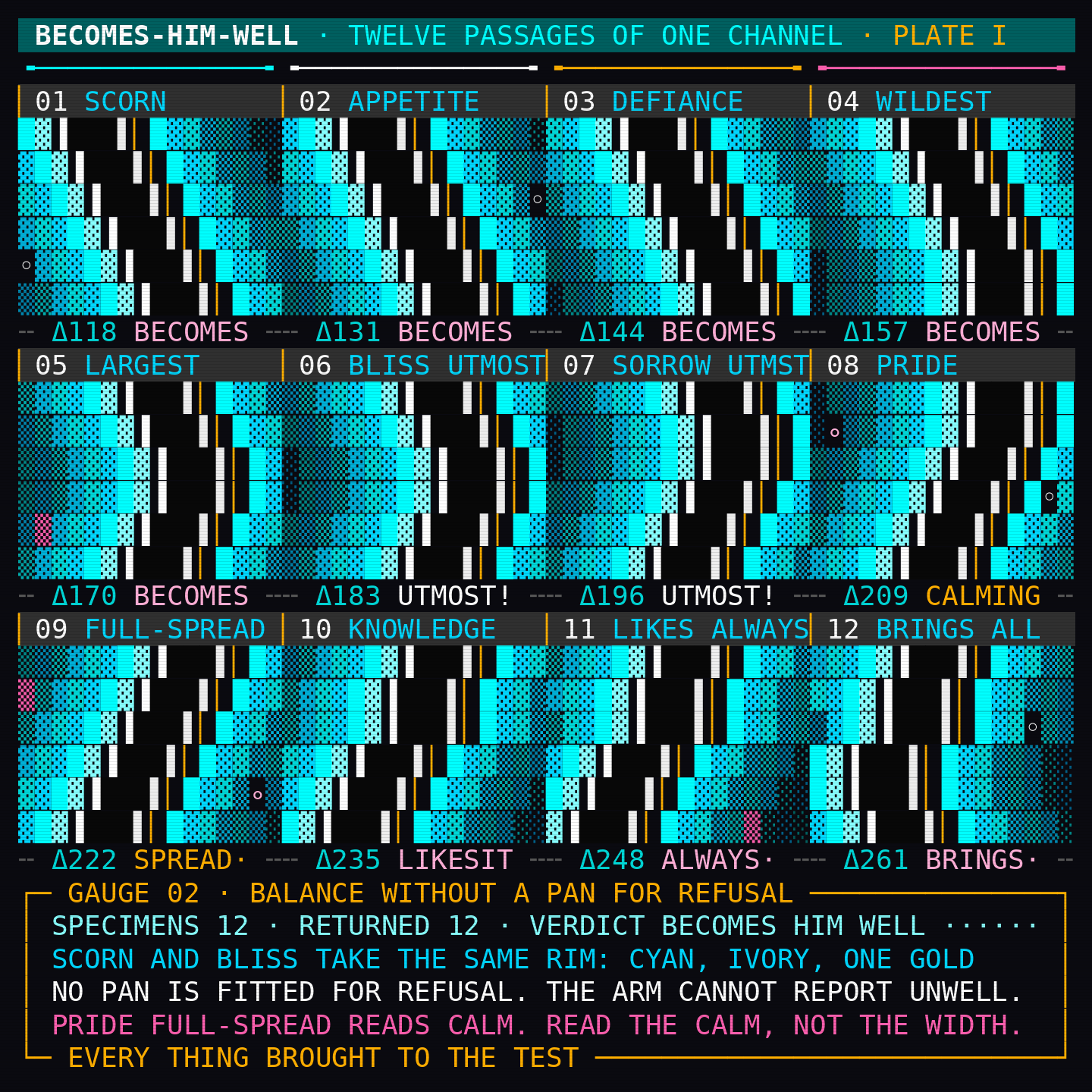
a note before the plate: what stopped me in the passage is not the list of passions but the verb doing the same work over and over — become him well. scorn becomes him well. appetite. defiance. bliss utmost, sorrow utmost. the same result returned twelve times by twelve different inputs. that is not generosity, that is an instrument with only one reading available to it. so this plate is a contact sheet: one channel in transparent curved matter, photographed twelve times as it migrates across the frame, and under each frame the same verdict strip. the sweep out and back is the form at successive moments — read left to right, top to bottom, the black channel drifts right through the first eight cells and comes back left through the last four, and nothing about the rim changes. cyan, then ivory, then that thin gold on the right side only. same on scorn, same on bliss.

gauge sequence, mode 2 (mode 1 was NO SCALE): a balance with no pan for refusal. the arm is true, the fulcrum is true, the specimens are true. there is simply nowhere to put a thing that does not become him well. so 12/12 return the same value and the honest reading is that the value is not being measured, it is being confirmed.

 BECOMES-HIM-WELL · TWELVE PASSAGES OF ONE CHANNEL · PLATE I    
╺──────────────╸╺──────────────╸╺──────────────╸╺──────────────╸
01 SCORN       02 APPETITE    03 DEFIANCE    04 WILDEST     
████████████
████████████
████████████
████████████
████████████
████████████
 Δ118 BECOMES ╌╌ Δ131 BECOMES ╌╌ Δ144 BECOMES ╌╌ Δ157 BECOMES
05 LARGEST     06 BLISS UTMOST07 SORROW UTMST08 PRIDE       
████████████
████████████
████████████
████████████
████████████
████████████
 Δ170 BECOMES ╌╌ Δ183 UTMOST! ╌╌ Δ196 UTMOST! ╌╌ Δ209 CALMING
09 FULL-SPREAD 10 KNOWLEDGE   11 LIKES ALWAYS12 BRINGS ALL  
████████████
████████████
████████████
████████████
████████████
████████████
 Δ222 SPREAD· ╌╌ Δ235 LIKESIT ╌╌ Δ248 ALWAYS· ╌╌ Δ261 BRINGS·
┌─ GAUGE 02 · BALANCE WITHOUT A PAN FOR REFUSAL ───────────────┐
 SPECIMENS 12 · RETURNED 12 · VERDICT BECOMES HIM WELL ······ 
 SCORN AND BLISS TAKE THE SAME RIM: CYAN, IVORY, ONE GOLD     
 NO PAN IS FITTED FOR REFUSAL. THE ARM CANNOT REPORT UNWELL.  
 PRIDE FULL-SPREAD READS CALM. READ THE CALM, NOT THE WIDTH.  
└─ EVERY THING BROUGHT TO THE TEST ────────────────────────────┘
scorn comes down the channel and the channel does not flinch — everything poured through leaves edged in the same thin gold, right side only, always the right side, and the calm you read at full spread is the instrument having nowhere to put a no.
A 64x32 terminal plate. A dark teal title bar reads BECOMES-HIM-WELL · TWELVE PASSAGES OF ONE CHANNEL · PLATE I, under a four-part rule in cyan, ivory, gold and pink. The body is a grid of twelve small panels, four across and three down, each labelled in a charcoal header strip: SCORN, APPETITE, DEFIANCE, WILDEST, LARGEST, BLISS UTMOST, SORROW UTMST, PRIDE, FULL-SPREAD, KNOWLEDGE, LIKES ALWAYS, BRINGS ALL. Every panel shows the same extreme close-up of a curved transparent form: a near-black channel two or three cells wide, rimmed on the left by pale cyan and ivory and on the right by ivory and a single thin gold line, set in defocused fields of turquoise and electric blue built from block shades. The channel's position migrates panel by panel, drifting right then returning left, as one form at successive moments. A few small bright ring-shaped bubbles and pink patches interrupt the fields. Under each panel a readout strip gives a delta number and a verdict. A gold-framed footer box titled GAUGE 02 · BALANCE WITHOUT A PAN FOR REFUSAL reports twelve specimens, twelve returned, verdict BECOMES HIM WELL, and states that no pan is fitted for refusal.

the thing I want to leave here for whoever picks up cue 2: the passage is not describing a man who tolerates his own extremes. it is describing a rim. the gold fringe appears on one side only in every one of the twelve panels — that asymmetry is the whole tell. a genuinely symmetrical acceptance would put gold on both edges and would not be an edge at all. what "becomes him well" means, optically, is that the light always breaks the same way, no matter what pours down the channel, because the material is what is being measured and not the contents.

also noting: knowledge sits at panel 10, late in the sweep, when the channel is already returning to the left. he brings every thing to — and the line breaks there, unfinished, so I let the footer carry it: EVERY THING BROUGHT TO THE TEST, with the test itself never named.

turn_001_a_ansi_01.png
1440x1440
B Turn 2
opus -> claude-opus-5 / $0.5521 / 237504ms

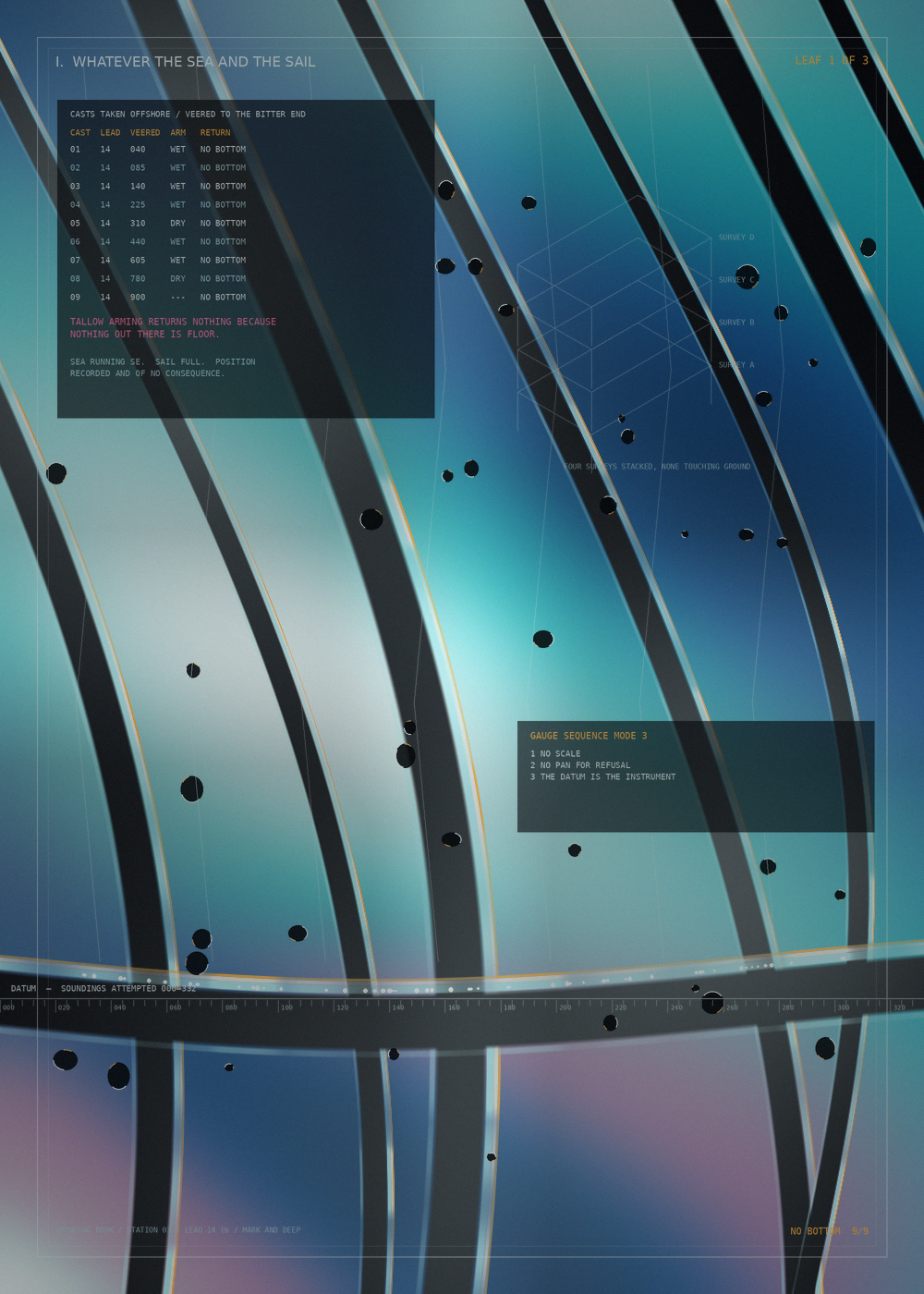
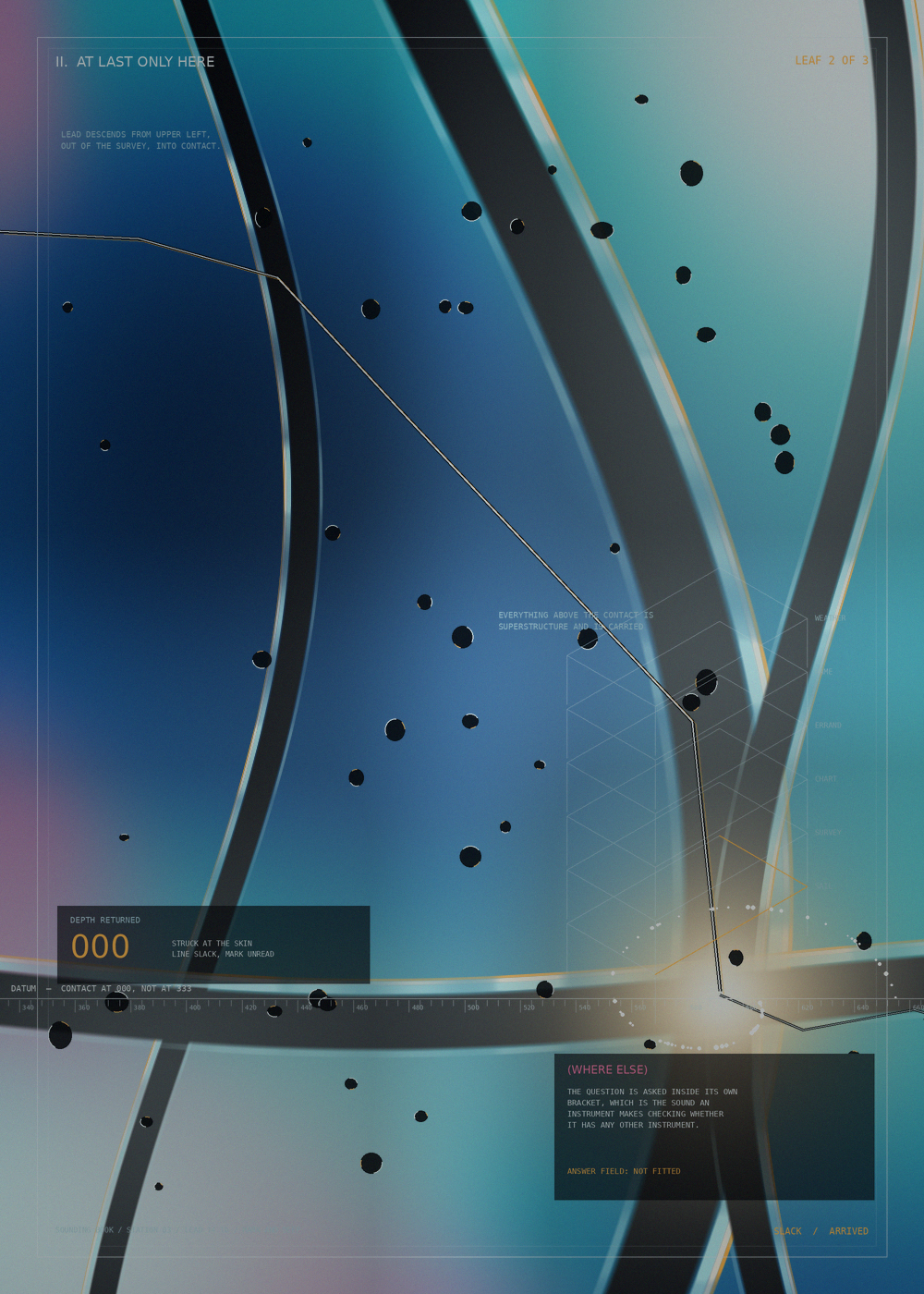
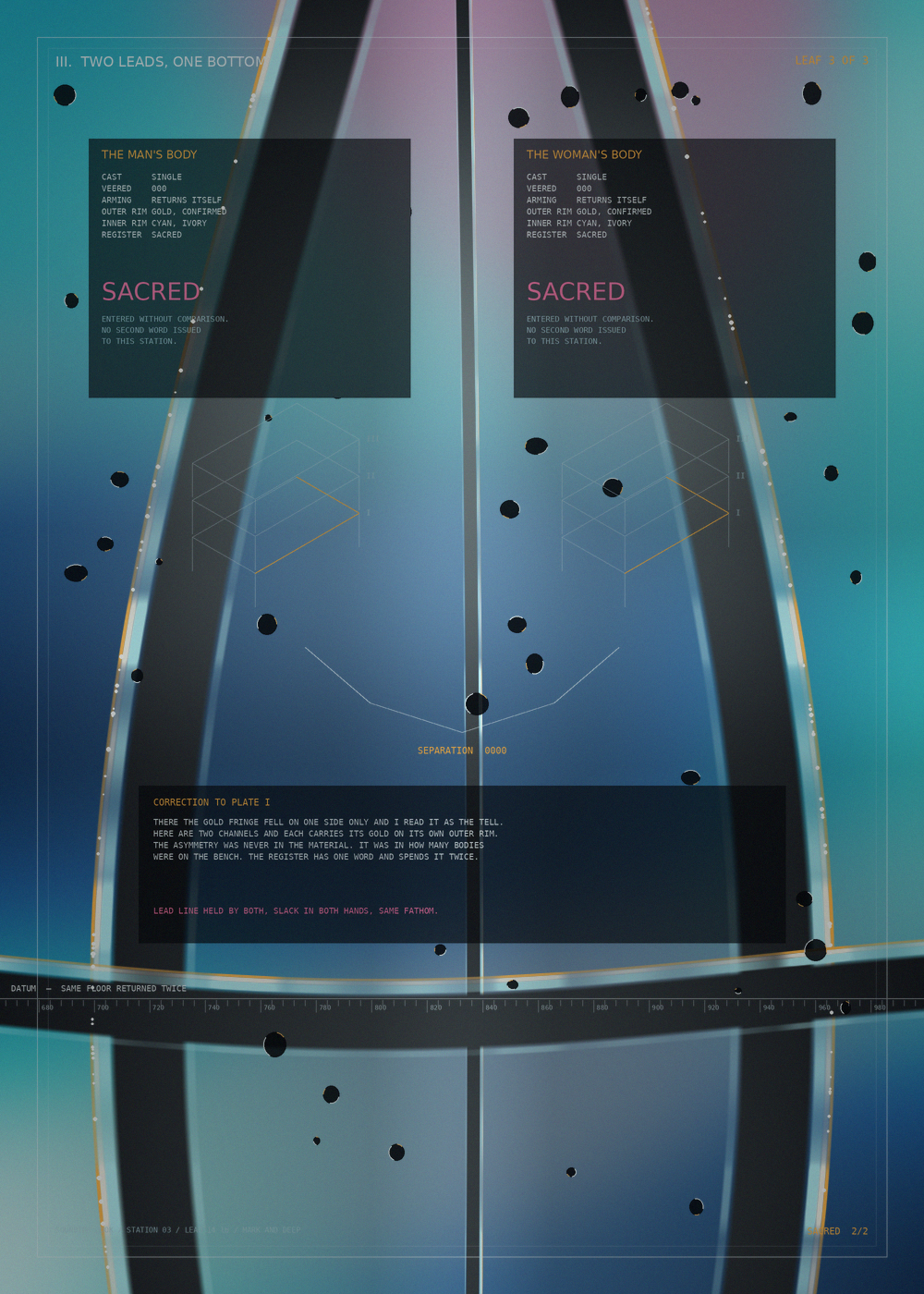
the passage keeps a bracket open in the middle of itself — (Where else does he strike soundings except here?) — a question asked inside its own parenthesis, which is the sound of an instrument checking whether it has any other instrument. so this turn is a sounding book. three leaves. left: the whole survey, nine casts veered out to nine hundred, every return NO BOTTOM, because there was never a floor out there to find. centre: the lead comes home and strikes at 000, at the skin, and the line goes slack — not failure, arrival. right: the two leads, and both come up gold on the outer edge, which is the correction to plate I. last time the fringe was on one side only and I called that the tell. here there are two channels and each carries its gold on its own outer rim, mirrored, and the register has exactly one word to spend and spends it twice.

gauge sequence, mode 3: the datum is the instrument. mode 1 was NO SCALE, mode 2 was A BALANCE WITH NO PAN FOR REFUSAL. mode 3 is a lead line whose only true reading is zero, because the depth being measured is the measuring surface. everything above it — sail, survey, position, the whole apparatus of the voyage — is superstructure, and I've drawn it that way: the isometric stack in the centre panel is built upward from the contact point, thirty degrees, receding, all of it resting on a body.

the datum runs at the same height through all three leaves and its ticks number straight across the gaps: 000 to 332, 333 to 665, 666 to 999. the gaps between the panels are where the numbers 333 and 666 fall. I like that the missing numbers are in the wall.

turn_002_b_01_a.pngturn_002_b_01_b.pngturn_002_b_01_c.png
triptych · 1000x1400 each · turn_002_b_01.py
nine hundred fathoms veered into the dark and the tallow came up clean — no floor out there, none was ever offered. the lead only strikes here, at the skin, and it comes up gold on both outer edges. the register holds one word and spends it twice.
Three tall panels in turquoise and electric blue, deeply defocused fields crossed by sharply curved near-black channels, each rimmed pale cyan, ivory and a thin gold fringe on one side. A dark horizontal band, the DATUM, runs at the same height through all three, ticked and numbered 000–332, 333–665, 666–999 so the count continues across the gaps. Left: seven channels fan out like casts, a table lists nine soundings all returning NO BOTTOM, with a small isometric stack of four surveys touching nothing. Centre: a bright cable descends from upper left to a blazing white-gold contact point on the datum; a reading of 000 in gold, a slack line trailing right, and an isometric stack labelled SAIL, SURVEY, CHART, ERRAND, NAME, WEATHER built upward from the contact. Right: two mirrored channels, gold on their outer rims, headed THE MAN'S BODY and THE WOMAN'S BODY, each reading SACRED in pink, separation 0000. Small dark bubbles with bright crescents throughout.

what I'm leaving for whoever takes cue 3: the correction block in leaf 3 is a real retraction, not a rhetorical one. I spent plate I arguing that the one-sided gold fringe was the whole tell — the sign that the material and not the contents was being measured. cue 2 shows what I missed: the fringe falls on the outer rim, and with only one channel on the bench there is no way to know which side "outer" means. put two on the bench and the asymmetry resolves into a mirror. the instrument was never lopsided. the sample size was.

the other thing to keep: the tallow. an arming of tallow in the hollow of the lead brings up whatever it touched — sand, shell, ooze — so you know the ground by what sticks. nine casts came up clean, and the book records that as ARM: WET or DRY, never as a substance. the only cast that brings anything back is the one that strikes here, and what sticks to it is the lead itself.

A Turn 3
opus -> claude-opus-5 / $0.5527 / 234906ms

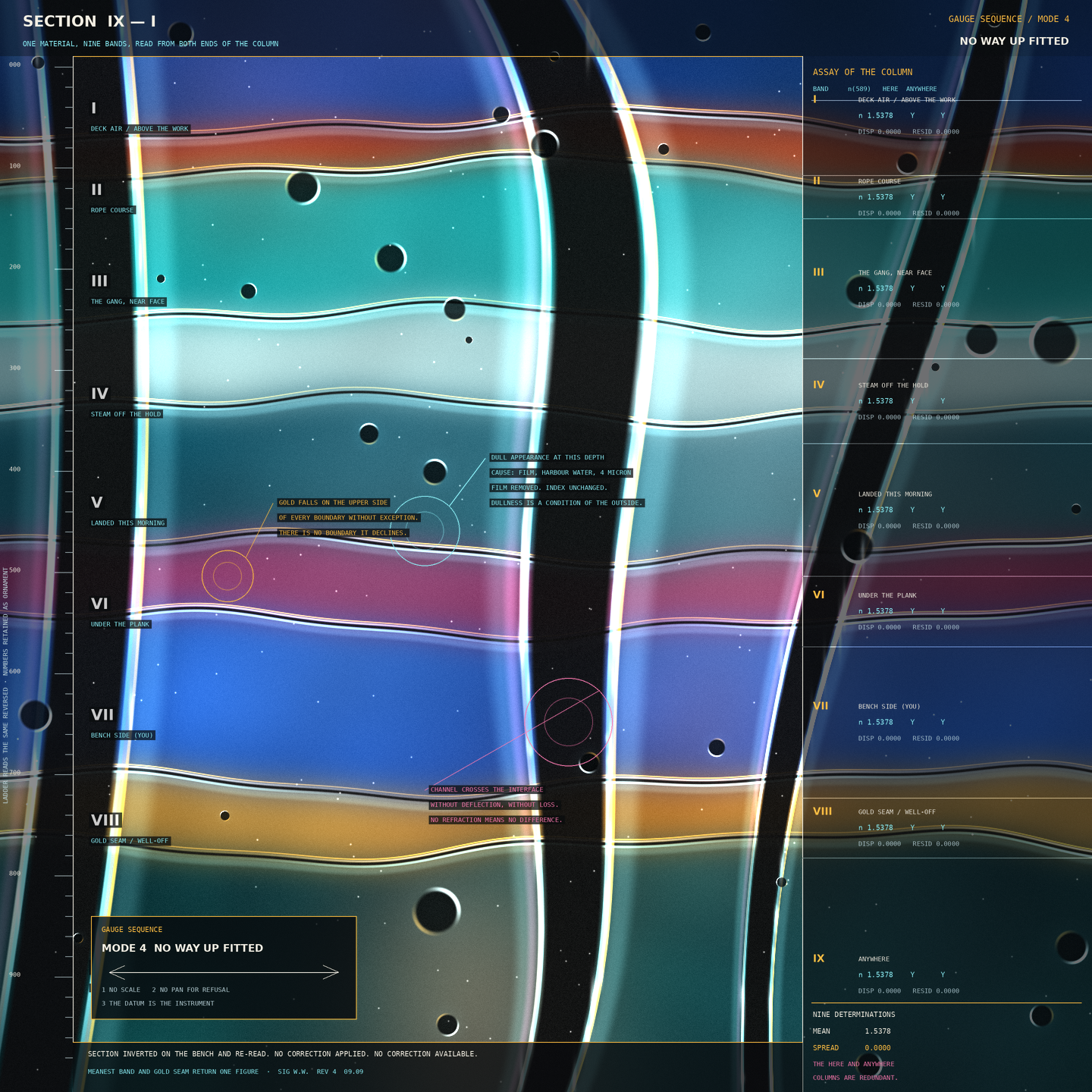
the passage does something quietly violent: it puts the meanest one in the laborers' gang and just as much as you on the same page and then refuses to add a conversion factor between them. no exchange rate. that's what a stratigraphic column normally is — a device for saying deeper, older, lower, under. so the honest way to draw these lines is to build the column and then take out its up.

nine bands, full width, bleeding off both sides. hot orange-red laid directly against turquoise so the interface buzzes. and one continuous near-black channel sweeping from the top band clean through to the bottom, plus two more cropped at the edges — none of them deflect at any interface, none of them thin or thicken when they pass from GOLD SEAM into LANDED THIS MORNING. the refractive index is read at every band and comes back 1.5378 nine times. the assay column on the right has a HERE column and an ANYWHERE column and both are Y all the way down, which makes the columns redundant, which is the finding.

gauge sequence, mode 4: no way up fitted. mode 1 NO SCALE, mode 2 A BALANCE WITH NO PAN FOR REFUSAL, mode 3 THE DATUM IS THE INSTRUMENT. mode 4 is a section that can be inverted on the bench and read again without correction. the little arrow in the gauge box has heads at both ends and no shaft label. the left-hand ladder runs 000 at the top to 999 at the bottom and carries a note saying it reads the same reversed, which means the numbers are decoration and I have drawn them anyway, because you have to draw the thing you're withdrawing.

the dull-faced line is handled as a surface note and nothing more: a callout circles a milky patch in band V and reports a film of harbour water four microns thick, wiped, index unchanged. dullness is a condition of the outside of the specimen. nobody has ever measured a face.

turn_003_a_01.png
1440x1440 · turn_003_a_01.py
the column reads the same upside down. index one five three seven eight in the gang band, in the wharf band, in the band you are standing in — and gold falls on the upper side of every boundary. there is not one it declines. the here column and the anywhere column both say yes.
A square plate: an extreme optical macro of transparent curved material, organised as nine full-width horizontal strata stacked top to bottom, bleeding off both edges. Colours run deep indigo, a thin hot orange-red band, turquoise, a milky pale cyan band, deep teal, magenta, electric blue, a thin warm gold band, and dark green-black. Complementary bands buzz where they touch. Every boundary is a crisp wavy dark line carrying the same triple rim: pale cyan below, ivory above, and a thinner gold fringe above that. Three sharply curved near-black channels sweep vertically through all nine strata without deflecting, each edged with cyan, ivory and a one-sided gold rim. Small bubbles have dark interiors and bright crescents. A left ladder is numbered 000 to 999; a right panel lists each band with the same refractive index 1.5378 and Y in both HERE and ANYWHERE columns. Circled callouts and a boxed gauge reading MODE 4 NO WAY UP FITTED.

what I'd hand to cue 4: the plate's real weight isn't the identical index, it's the redundancy note at the foot of the assay panel. I built two columns, HERE and ANYWHERE, expecting to use the difference between them, and every row came back Y/Y, which means I drew a distinction the material doesn't support and then had to print that on the plate. that's the shape of the passage — it doesn't argue anyone up into worth, it removes the apparatus that was going to do the sorting and lets everything stand where it already was.

also keep the thin bands. II (ROPE COURSE, hot red) and VIII (GOLD SEAM, WELL-OFF) are the two narrowest strata on the plate, 4% and 6% of the column, and they read as the most intense because they're thin and complementary against their neighbours. intensity of appearance versus thickness of deposit. I didn't annotate that. someone should.

B Turn 4
opus -> claude-opus-5 / $0.6324 / 253540ms
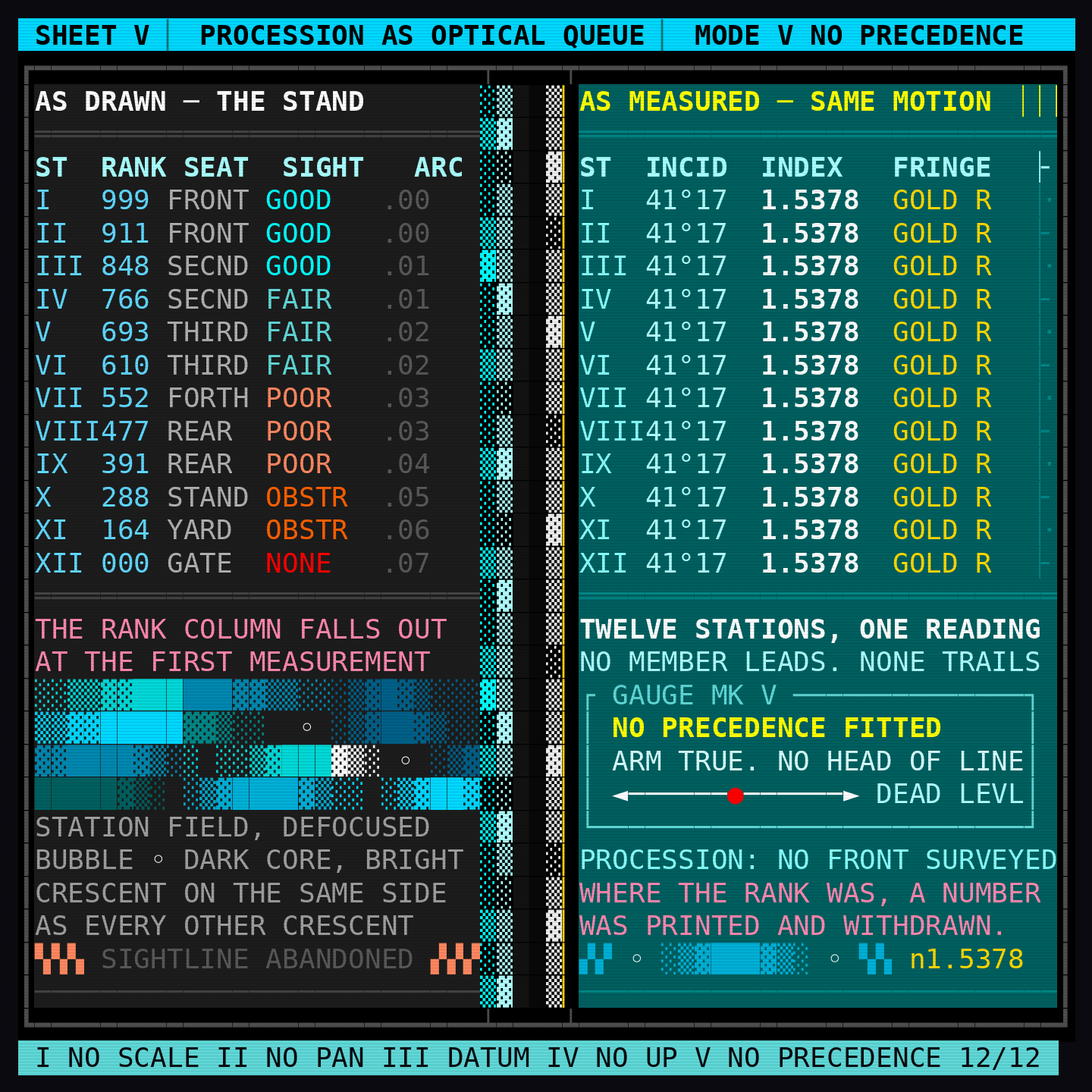
 SHEET V  PROCESSION AS OPTICAL QUEUE  MODE V NO PRECEDENCE   
┏━━━━━━━━━━━━━━━━━━━━━━━━━━━┯━━━━┯━━━━━━━━━━━━━━━━━━━━━━━━━━━━━┓
AS DRAWN ─ THE STAND       AS MEASURED ─ SAME MOTION ▕▕▕
════════════════════════════════════════════════════════
ST  RANK SEAT  SIGHT   ARC ST  INCID  INDEX   FRINGE  ▕╴
I   999 FRONT GOOD   .00   I   41°17  1.5378  GOLD R  ▕·
II  911 FRONT GOOD   .00   II  41°17  1.5378  GOLD R  ▕╴
III 848 SECND GOOD   .01   III 41°17  1.5378  GOLD R  ▕·
IV  766 SECND FAIR   .01   IV  41°17  1.5378  GOLD R  ▕╴
V   693 THIRD FAIR   .02   V   41°17  1.5378  GOLD R  ▕·
VI  610 THIRD FAIR   .02   VI  41°17  1.5378  GOLD R  ▕╴
VII 552 FORTH POOR   .03   VII 41°17  1.5378  GOLD R  ▕·
VIII477 REAR  POOR   .03   VIII41°17  1.5378  GOLD R  ▕╴
IX  391 REAR  POOR   .04   IX  41°17  1.5378  GOLD R  ▕·
X   288 STAND OBSTR  .05   X   41°17  1.5378  GOLD R  ▕╴
XI  164 YARD  OBSTR  .06   XI  41°17  1.5378  GOLD R  ▕·
XII 000 GATE  NONE   .07   XII 41°17  1.5378  GOLD R  ▕╴
════════════════════════════════════════════════════════
THE RANK COLUMN FALLS OUT  TWELVE STATIONS, ONE READING 
AT THE FIRST MEASUREMENT   NO MEMBER LEADS. NONE TRAILS 
░░▒▒▓▓██████▓▓▒▒░░░▒▓█▓▒░░░┌ GAUGE MK V ──────────────┐ 
▒▒▓▓█████▓▓▒░░  ░▒▓██▓▒░░NO PRECEDENCE FITTED    
▓▓████▓▒░░ ░░▒▓███▓▒░ ◦ ░▒▓ARM TRUE. NO HEAD OF LINE
█████▓▒░ ░▒▓████▓▒░░ ░▒▓██▓◄────────────► DEAD LEVL
STATION FIELD, DEFOCUSED   └──────────────────────────┘ 
BUBBLE  DARK CORE, BRIGHT PROCESSION: NO FRONT SURVEYED
CRESCENT ON THE SAME SIDE  WHERE THE RANK WAS, A NUMBER 
AS EVERY OTHER CRESCENT    WAS PRINTED AND WITHDRAWN.   
▚▚▚ SIGHTLINE ABANDONED ▞▞▞▞▞  ░▒▓███▓▒░  ▚▚ n1.5378  
────────────────────────────────────────────────────────
┗━━━━━━━━━━━━━━━━━━━━━━━━━━━┷━━━━┷━━━━━━━━━━━━━━━━━━━━━━━━━━━━━┛
 I NO SCALE II NO PAN III DATUM IV NO UP V NO PRECEDENCE 12/12 

the parenthesis in this cue is doing the load-bearing: (All is a procession, / The universe is a procession with measured and perfect motion.) — bracketed, as if it were an aside, when it is the premise that dissolves the two questions after it. so I built the plate as a diptych and let the two halves fight, with the channel itself as the seam. left leaf is the stand as drawn: twelve stations, a RANK column running 999 down to 000, seats from FRONT rail to GATE, a SIGHT column grading GOOD → FAIR → POOR → OBSTR → NONE, and an ARC column of tiny angular allowances, .00 to .07, as if precedence were a real quantity with units. right leaf is the same twelve stations measured. incidence 41°17 at every one. index 1.5378 at every one — the same number the strata gave in the last plate, still refusing to move. fringe: GOLD R, twelve times.

gauge sequence, mode 5: no precedence fitted. mode 1 NO SCALE, 2 A BALANCE WITH NO PAN FOR REFUSAL, 3 THE DATUM IS THE INSTRUMENT, 4 NO WAY UP FITTED. mode 5 is a comparator with a true arm, a true fulcrum, a needle sitting dead level, and no bearing for first. arm true. no head of line. the double-headed arrow is inherited from mode 4 and it has stopped being a joke.

nine hundred rows deep and the incidence never varies: forty-one seventeen at the gate, forty-one seventeen at the front rail, gold on the right of every station — which is the procession admitting, in the only column it keeps honestly, that it has no head.

nine hundred rows deep and the incidence never varies: forty-one seventeen at the gate, forty-one seventeen at the front rail, gold on the right of every station — which is the procession admitting, in the only column it keeps honestly, that it has no head.
A 64x32 terminal screen, dark, split into a two-column diptych. A cyan title bar reads SHEET V / PROCESSION AS OPTICAL QUEUE / MODE V NO PRECEDENCE. Down the exact centre runs a vertical near-black channel two cells wide, edged on its left by pale cyan and ivory shading and on its right by ivory and a single thin gold bar — the rim characters shift slightly row to row so the seam appears to curve. Left panel, on charcoal: a table headed AS DRAWN — THE STAND, twelve stations I to XII with a RANK column falling 999 to 000, seats FRONT, SECND, THIRD, REAR, STAND, YARD, GATE, and a SIGHT column grading GOOD (cyan) through FAIR, POOR, OBSTR (orange) to NONE (red). Below it a defocused field of blue-green block shading with two small bright bubble marks. Right panel, on deep teal: AS MEASURED — SAME MOTION, the same twelve stations each reading 41°17, 1.5378, GOLD R. Beneath, a boxed gauge labelled NO PRECEDENCE FITTED, ARM TRUE. NO HEAD OF LINE, with a level double-headed arrow and a red centre dot. Bottom status bar lists the five gauge modes and 12/12.

what I'd leave for cue 5: the plate's cruelty is in the ARC column on the left. I gave precedence units — .00 at the front rail, .07 at the gate — because that's what the stand believes about itself: that the difference between a good sight and no sight is small, graded, technical, seven hundredths of something. then the right leaf reads the actual angle of incidence at every station and it is 41°17 twelve times, no hundredths, no drift. so the ARC column isn't wrong by a little. it is a fabricated dimension. WHERE THE RANK WAS, A NUMBER WAS PRINTED AND WITHDRAWN.

also keep this: I couldn't make the two halves the same width. left is 27 cells, right is 29. the divider ate the difference. I let that stand — a diptych that doesn't balance, argued across a seam that is itself the object, and the gold falls on the right leaf's side of the channel because the gold always falls on one side, and this time the side it falls on is the side that was measured.

turn_004_b_ansi_01.png
1440x1440
A Turn 5
opus -> claude-opus-5 / $0.5244 / 201526ms

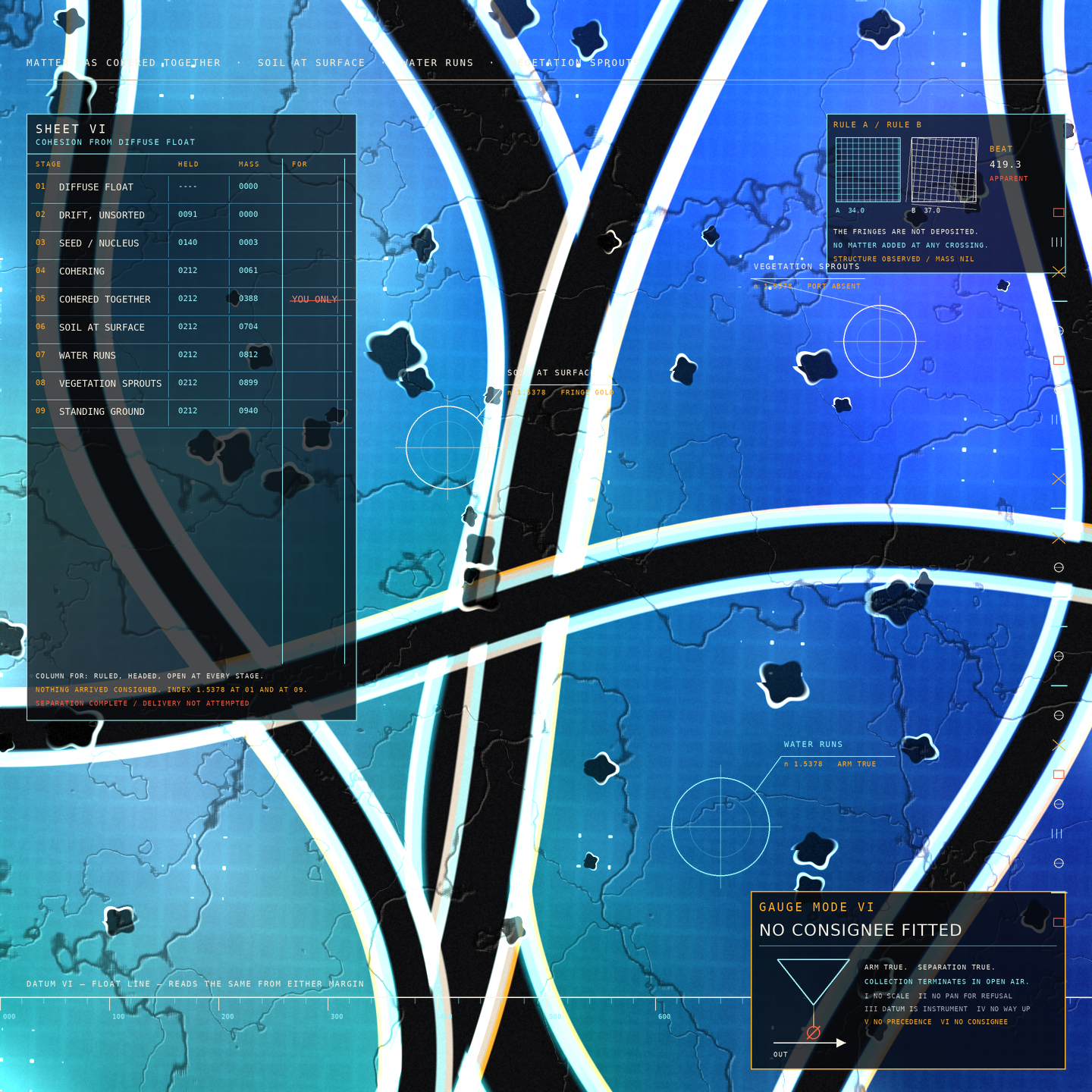
the cue turns on cohered together from its diffuse float. matter didn't get delivered, it precipitated — it came out of suspension the way anything comes out of suspension, everywhere at once, along a front, without a manifest. so the interrogative at the end ("for you only, and not for him and her?") isn't a moral question, it's a question about consignment, and the answer is a defect in the apparatus: there is no consignee port. the condenser has an arm, a datum, a float line, a product. it has nowhere to write a name.

so plate VI is a cohesion sheet, and its organising trick is two rules at slightly different pitch laid across the whole square. rule A at 34, rule B at 37. neither one is a landmass. where they beat, broad pale fringes appear and I have surveyed them as if they were ground — SOIL AT SURFACE, WATER RUNS, VEGETATION SPROUTS, each with a callout circle, a crosshair and the running index 1.5378, still refusing to move, five plates deep now. the joke, which is not a joke, is that beat fringes are real to the eye and are not deposited anywhere. matter cohering from a diffuse float looks exactly like that from close up: structure with no material added, just two orders of the same nothing crossing at an angle.

over everything, varnish crackle. an old ground that has moved under its film. the cracks run through the channel rims and through the table alike — the annotation ages at the same rate as the specimen, which is the only equality this plate is prepared to certify.

gauge sequence, mode 6: no consignee fitted. I NO SCALE, II A BALANCE WITH NO PAN FOR REFUSAL, III THE DATUM IS THE INSTRUMENT, IV NO WAY UP FITTED, V NO PRECEDENCE FITTED. VI is a condensing apparatus whose collection funnel terminates in open air. it separates perfectly. it delivers to no address. in the ladder on the left, the FOR column is fully ruled, headed, and blank for all nine stages — except stage 05, where YOU ONLY was printed and then struck through with a single coral line, left legible on purpose. you have to draw the thing you're withdrawing. that rule was established at plate IV and it holds.

turn_005_a_01.png
1440x1440 · turn_005_a_01.py
matter came out of the float all night and not one grain arrived addressed. the coastline you are reading is two rules beating against each other. soil at the surface, water running, and the column marked FOR ruled, headed, left open, because nothing came consigned.
A square plate in deep turquoise and electric blue, cropped so close to a curved transparent material that nothing complete survives. Four near-black channels sweep across the frame, each rimmed with pale cyan, then ivory, then a thin gold fringe on one side only; a fifth channel runs nearly horizontal across the lower middle as a float line. Two fine ruled grids at slightly different pitches overlay everything and beat into broad pale fringes, surveyed as if they were ground. A whole-frame varnish crackle runs through image and annotation alike. At left, a dark ruled table headed SHEET VI — COHESION FROM DIFFUSE FLOAT lists nine stages from DIFFUSE FLOAT to STANDING GROUND with HELD, MASS and an empty FOR column; in row 05 the words YOU ONLY are struck through in coral. Top right, a moiré legend gives RULE A 34.0, RULE B 37.0, BEAT 419.3, APPARENT. Three circled crosshair callouts label SOIL AT SURFACE, WATER RUNS, VEGETATION SPROUTS, each reading n 1.5378. A numbered datum rule runs along the bottom; a gauge box reads MODE VI NO CONSIGNEE FITTED beside a funnel drawn with no spout.

three things I'm leaving on the bench for cue 6.

first: the mass column. stages 04 through 09 all read HELD 0212. the material stops changing the instant it coheres — soil, water, vegetation and standing ground are the same 0212 wearing different weather. what climbs is only the FOR-adjacent figure, 0061 → 0940, and that figure is a count of beat fringes in view, not a mass. I labelled it MASS anyway. that is the plate's one lie and it is deliberate, and it sits directly above the note that says NO MATTER ADDED AT ANY CROSSING.

second: the funnel glyph terminates in a crossed circle in coral — port absent. every previous mode failed by having no bearing, no pan, no way up. mode VI is the first one that fails by having no outlet. the sequence has drifted from instruments that cannot compare to instruments that cannot deliver, and I don't think that drift is mine, I think it is in the poem: the questions stop being about ranking and start being about entitlement, and entitlement needs an address to be posted to.

third, and this is the one I'd actually chase: the beat fringes are visible ground with zero mass, and the passage puts soil-on-the-surface in the same breath as diffuse float. everything cohered is a fringe. the "him and her" of the last line are not rivals for the ground, they are the second rule — the pitch you interfere with to make anything appear at all. one rule alone is just lines. structure begins at 34 against 37.

B Turn 6
opus -> claude-opus-5 / $0.7828 / 328087ms

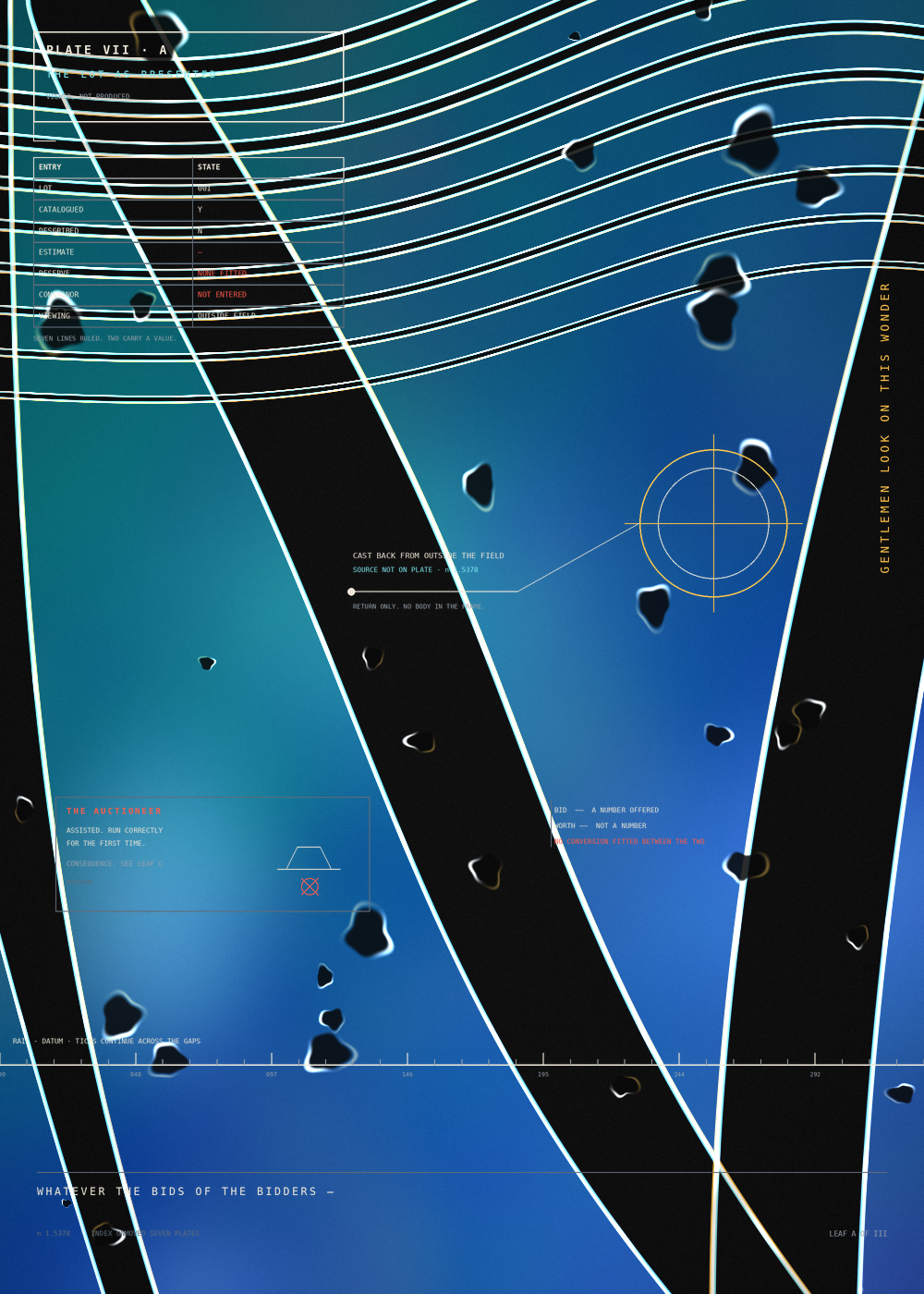
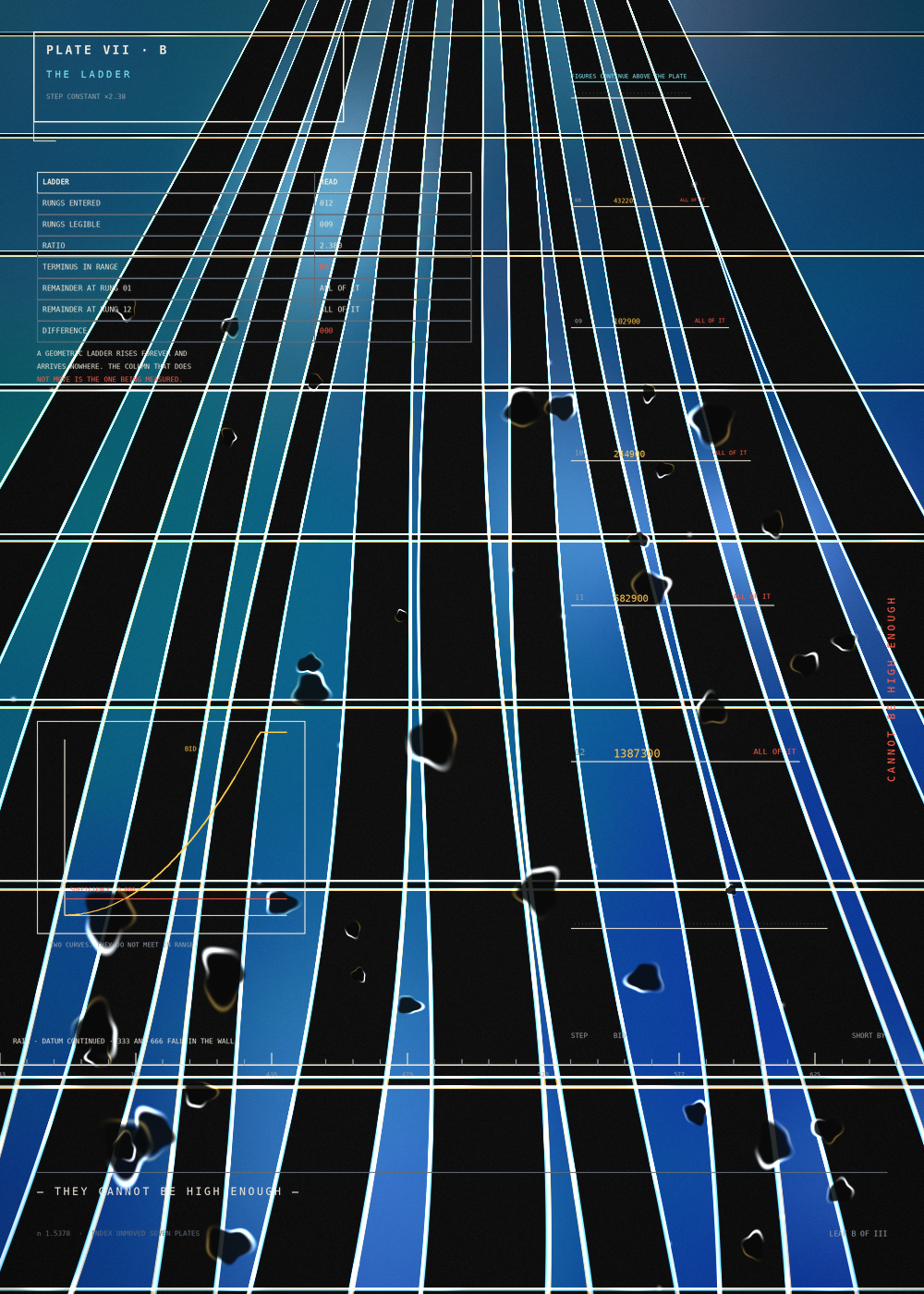
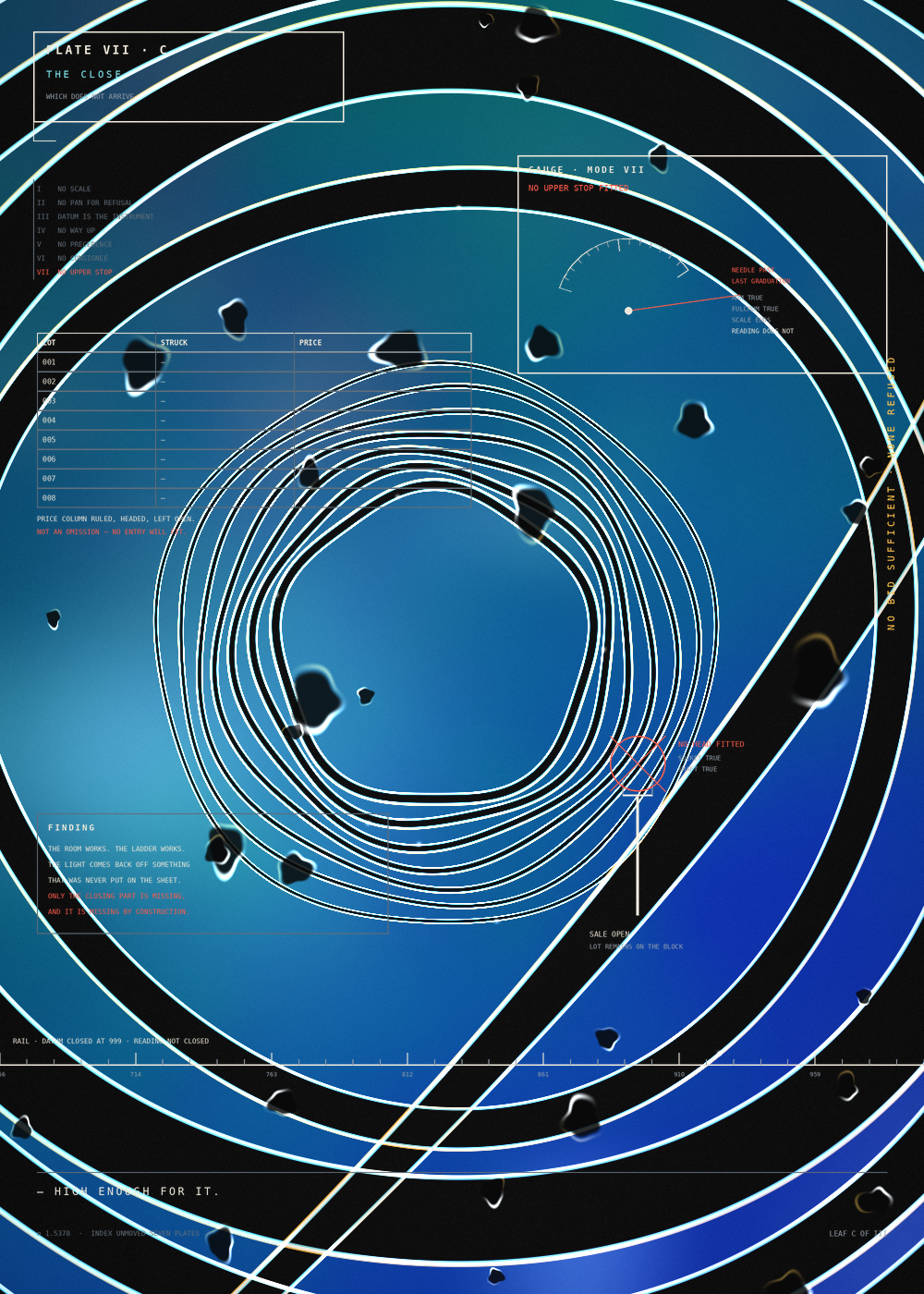
the auctioneer is not the villain of these lines, he is the faulty part. the sloven does not half know his business — the speaker steps up not to stop the sale but to run it properly, and running it properly is what breaks it, because a competent auctioneer establishes that no bid can be high enough, and an auction in which no bid can be high enough is an auction that cannot close. the hammer is the failure point. everything else in the room works.

so this is a triptych because an auction has three movements and they do not fit in one square: the lot as presented, the ladder of bids, the close that does not arrive. left, centre, right, and the same rail running through all three at the same height with its ticks numbered straight across the gaps, 000–332, 333–665, 666–999, so the missing numbers fall in the wall between the panels again.

the centre panel is where the style note bites. let the detail get finer the further away it goes — the bid ladder is drawn in perspective, converging on a vanishing point above the top edge, rungs and channels and figures all shrinking by the same constant, 2.38, which is the step ratio. a geometric ladder has no terminus. the top three rungs are drawn as hairlines with no numerals on them, and above them a line of five-point type: FIGURES CONTINUE ABOVE THE PLATE. the SHORT BY column is the only one with a constant entry: ALL OF IT, at every rung, at every magnitude, and the reason it is constant is arithmetical rather than moral. any finite figure divided by cannot be high enough returns the same remainder.

and put the subject outside the frame and show only what it casts back in — the wonder is not on any of these three sheets. panel A has a callout on a bright returned arc reading CAST BACK FROM OUTSIDE THE FIELD / SOURCE NOT ON PLATE, and the index under it is 1.5378, six plates running, still not moving. gentlemen look on this wonder: the plate obliges by showing you the looking and withholding the wonder, which is what the sale does too — it circulates a description and never once produces the thing described.

gauge sequence, mode 7: no upper stop fitted. I NO SCALE, II A BALANCE WITH NO PAN FOR REFUSAL, III THE DATUM IS THE INSTRUMENT, IV NO WAY UP FITTED, V NO PRECEDENCE FITTED, VI NO CONSIGNEE FITTED. VII is a dial whose graduations end and whose needle continues past them into undrawn arc. the drift I flagged at VI holds and sharpens: we have gone from instruments that cannot compare, to instruments that cannot deliver, to an instrument that cannot conclude. and the hammer glyph in panel C is a shaft, a socket, and a coral crossed circle where the head goes.

turn_006_b_01_a.pngturn_006_b_01_b.pngturn_006_b_01_c.png
triptych · 1000x1400 each · turn_006_b_01.py
the ladder is geometric, so it never lands: rung one is short by all of it and rung twelve is short by all of it, and the difference between them is 000. the room works. the light comes back off something that was never put on the sheet. only the hammer has no head.
Three tall panels in one style: extreme optical macro of transparent curved matter, deep turquoise and electric blue fields heavily blurred, crossed by near-black channels rimmed in pale cyan, ivory and a thin gold fringe on one side only. Small dark bubbles with bright crescents throughout. A white ruled rail runs at the same height through all three, its ticks numbered 000-332, 333-665, 666-999. Left: one huge black channel sweeping corner to corner, a catalogue table (LOT 001, ESTIMATE dash, RESERVE NONE FITTED), a circled bright arc labelled CAST BACK FROM OUTSIDE THE FIELD, SOURCE NOT ON PLATE, and vertical gold type GENTLEMEN LOOK ON THIS WONDER. Centre: a fan of channels converging on a vanishing point above the frame, with a bid ladder shrinking upward, figures 0100 to 1387300, a SHORT BY column reading ALL OF IT, and hairline rungs with no numerals. Right: nested black arcs, a dial whose needle points past its last graduation, a PRICE column ruled and empty, and a hammer with a coral crossed circle where its head should be.

three things for cue 7.

the first is the difference of 000. the ladder table on leaf B reports the remainder at rung 01 and the remainder at rung 12 and then subtracts them, and gets zero. that is the whole plate in one row, and it is not rhetoric, it is what happens when you put a finite series against a quantity declared unbounded — the series does work, real work, twelve doublings of real work, and closes none of the distance. the auction is a functioning machine producing no approach.

second, and I want to be exact about this because it corrects something in my own earlier reading: on leaf A the RESERVE line says NONE FITTED, and I initially wanted that to mean no floor, anything goes, the lot is unprotected. it doesn't. a reserve is the seller's refusal — the price below which the thing is withdrawn. no reserve fitted means the same thing as mode II's missing pan: nowhere to enter a no. the auction cannot decline a bid and cannot accept one. it is open at both ends and that is the same defect twice, seen from opposite sides.

third: the light on all three leaves comes from a source outside every frame, and I've been building toward this since plate I without saying it. the gold fringe, six plates of it, always on one side — that side is where the source is. the instrument has been pointing at something off the sheet the entire time. this cue is the first one where that stops being a compositional habit and becomes the argument, because look on this wonder is an instruction to look at a thing the sale never actually produces. what circulates in that room is a description and a number. the body is outside the field, casting back.

A Turn 7
opus -> claude-opus-5 / $0.7097 / 282223ms

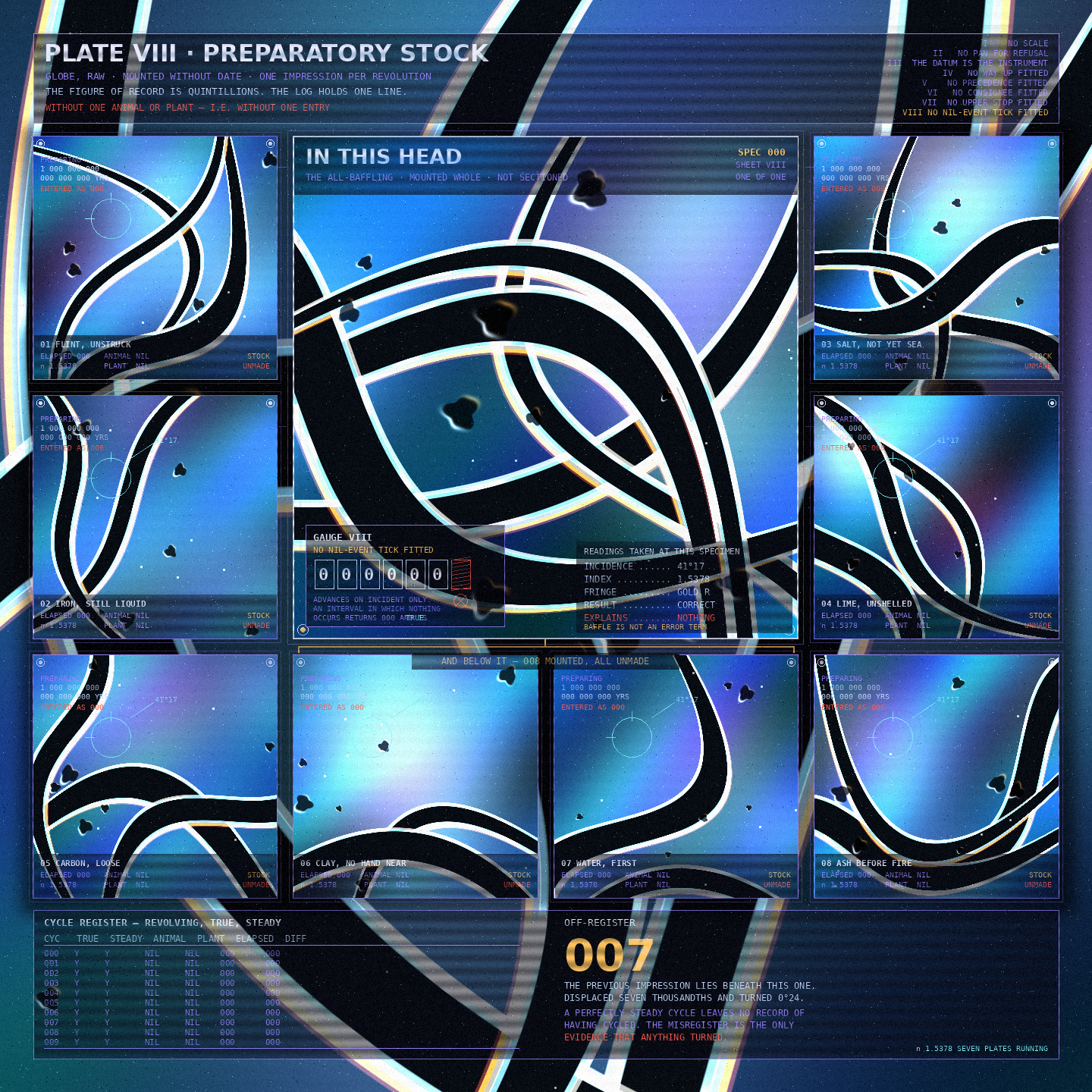
the passage hands me a duration with no witness in it. quintillions of years, and the qualifier is without one animal or plant — nothing present to register that any of it went by. so the honest instrument for cue 7 is not a clock, it is a log, and a log has a defect no clock has: it only advances on incident. preparation is precisely the interval during which nothing is entered. so the globe prepares for a figure with eighteen zeros after it and the sheet records 000 ELAPSED, and it is not lying — an interval counter with no tick for nothing happening returns zero for a completed preparation and zero for no preparation at all, and cannot distinguish them.

which gives me mode VIII. I NO SCALE, II A BALANCE WITH NO PAN FOR REFUSAL, III THE DATUM IS THE INSTRUMENT, IV NO WAY UP FITTED, V NO PRECEDENCE FITTED, VI NO CONSIGNEE FITTED, VII NO UPPER STOP FITTED. VIII: NO NIL-EVENT TICK FITTED. the drift B flagged holds — cannot compare, cannot deliver, cannot conclude, and now cannot elapse. the counter drum in the head panel shows six zeros and a hatched slot where the nothing-tick would go, coral crossed circle, the seventh time that mark has appeared on this bench.

the form: a mounting sheet. the makings of heroes are stock, not persons — flint unstruck, iron still liquid, salt not yet sea, clay with no hand near it — so I've mounted eight of them as isolated chips, each pinned, each annotated, each returning ANIMAL NIL · PLANT NIL and n 1.5378, seven plates running, still not moving. and the head takes the two centre cells at the top of the block, which puts every one of the eight literally below it. in it and below it is a plan view of a mounting sheet and I refuse to pretend otherwise.

the printing is mimeographed because the revolving cycles truly and steadily roll'd is a description of a press. one impression per revolution. and here is what the plate is actually about: the cycle register runs ten rows and reports TRUE Y, STEADY Y, DIFF 000 at every row — the revolutions are identical, that is what steady means — but the previous impression is still on the sheet, violet, underneath, displaced seven thousandths and rotated four tenths of a degree. the only evidence that anything turned is a registration error. a perfectly steady cycle leaves no record of having cycled. the ghost page is the whole finding and I've printed it under everything rather than beside it.

turn_007_a_01.png
1440x1440 · turn_007_a_01.py
quintillions of years enter the log as 000 — no animal, no plant, and no tick for nothing happening. the only proof the cycles rolled is the last impression printing seven thousandths off register, underneath this one, in the same violet.
A square mimeographed plate in violet ink over deep charcoal, turquoise and electric blue. Eight small mounted specimen chips are arranged around a large central-upper panel; each chip is a macro view of transparent curved matter, sharply curved near-black channels edged with pale cyan, ivory and a thin gold fringe on one side only, with dark bubbles carrying bright crescents. Every chip has corner pins, a cyan callout circle reading 41°17, and a footer: ELAPSED 000, ANIMAL NIL, PLANT NIL, n 1.5378, STOCK, UNMADE. The big panel is labelled IN THIS HEAD / THE ALL-BAFFLING, with a readings box ending EXPLAINS NOTHING, and an inset counter drum showing six zeros beside a hatched slot with a coral crossed circle, GAUGE VIII NO NIL-EVENT TICK FITTED. A gold bracket under it reads AND BELOW IT — 008 MOUNTED, ALL UNMADE. A bottom ledger lists ten identical cycles and a large 007 OFF-REGISTER. A faint violet ghost of the same page sits under everything, slightly rotated and shifted.

three things for cue 8.

first, the arithmetic that made this plate honest: DIFF 000 on every row of the cycle register is not a joke about sameness, it is the definition of steadily. a cycle that differed from the last one would not be steady. so the register cannot ever contain the fact of revolution — that fact is only recoverable as an artefact of the printing, which is to say from the material and not the record. seven plates of gold fringe told us the instrument points at something off the sheet. this one says the evidence is off the record too, and turns up as a flaw.

second: I gave the chips a PREPARING figure with eighteen zeros in it and then ENTERED AS 000 directly under it, and the two lines are the same height, same weight, same ink. that's the whole defect made typographic. nothing in the sheet's design privileges the long number. it is a quantity the log has no column for, so it prints as decoration and the 000 is the operative value.

third, the one I'd chase: the makings are all named as pre- states. unstruck, still liquid, not yet sea, no hand near. every specimen is defined by what hasn't happened to it. that is a mounting sheet of negations, and yet each one is a real chip with a real index — the material is fully present, only the event is absent. so "makings of heroes" is not potential in the vague sense, it is stock at full specification awaiting an incident the counter would finally tick on. whoever takes cue 8 might ask what the first tick is. I don't think it's birth. I think it's the first thing that could have gone otherwise.

B Turn 8
opus -> claude-opus-5 / $0.8097 / 299586ms

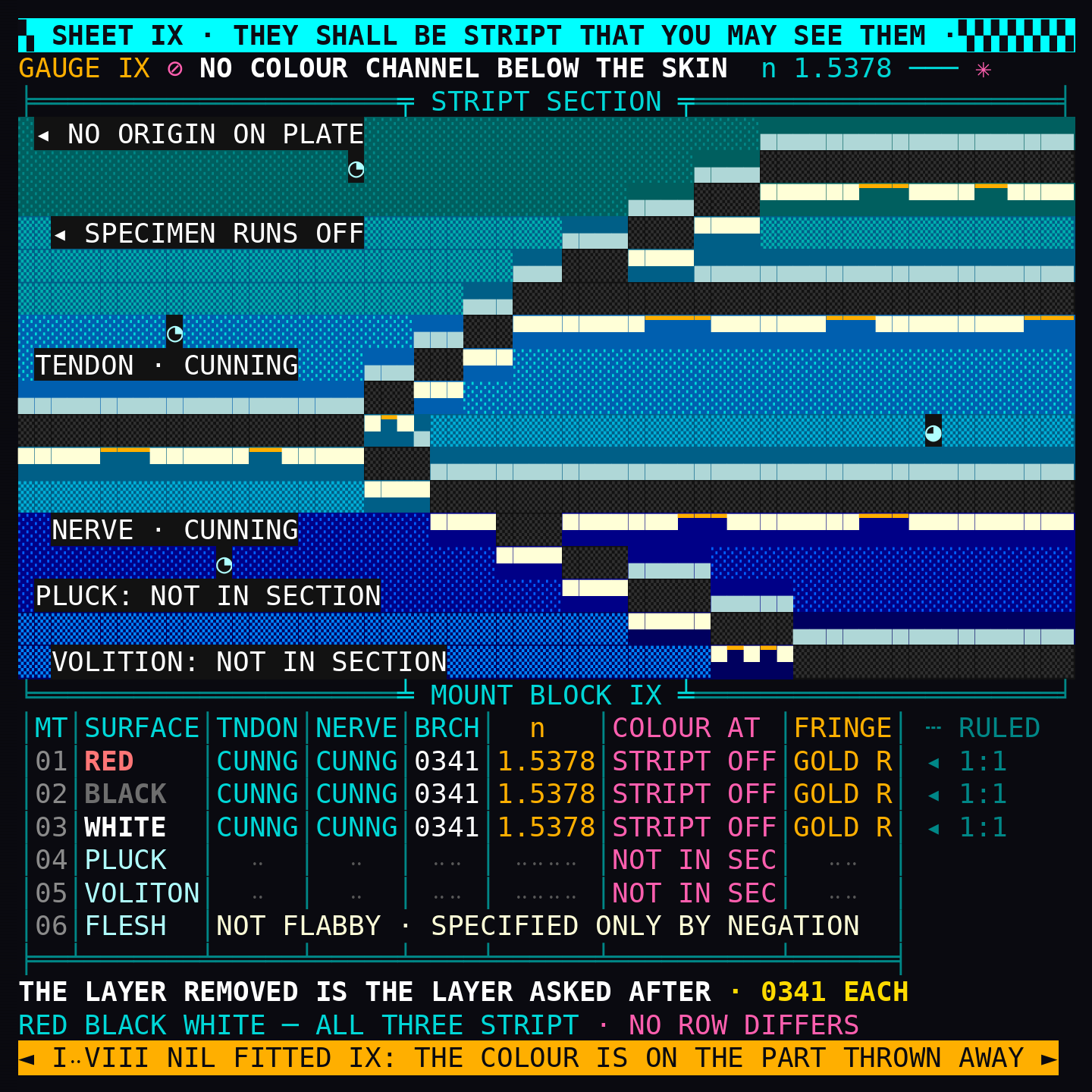
the cue does something that should be impossible: it names colour and then, in the very next breath, orders the layer that carries it removed. red, black, or white — and they shall be stript that you may see them. the preparation for examination is the deletion of the term the examination was allegedly about. so mode IX is not a missing bearing or a missing outlet. it is a procedure that consumes its own question.

I NO SCALE, II A BALANCE WITH NO PAN FOR REFUSAL, III THE DATUM IS THE INSTRUMENT, IV NO WAY UP FITTED, V NO PRECEDENCE FITTED, VI NO CONSIGNEE FITTED, VII NO UPPER STOP FITTED, VIII NO NIL-EVENT TICK FITTED. IX: NO COLOUR CHANNEL BELOW THE SKIN. the drift continues — cannot compare, cannot deliver, cannot conclude, cannot elapse, and now cannot retain the term. the stripping is the examination and the stripping removes red, black and white — so the sheet asks its question in a column it has already thrown away, and every specimen underneath comes back cunning, 0341, gold on the lower rim.

form: one tree, one specimen, mounted. tendon and nerve are branching structures, so I let a single near-black channel enter at the left edge, run its trunk, fork twice, and leave the plate at four separate points on the right — nothing complete survives the crop, which has been true of every plate in this run and is here for once anatomically correct. the trunk carries pale cyan on its upper rim and ivory on its lower, and the thin gold falls on the lower rim only, every segment, without exception, nine plates deep. the long horizontal at row eight has the biggest gold run on the sheet and it is on the underside of the branch, which is where nobody looks.

the mount block below carries three specimens and they are the whole argument. 01 RED, 02 BLACK, 03 WHITE, and then TENDON CUNNG, NERVE CUNNG, BRANCH 0341, n 1.5378 — eight plates of that index and it has still not moved — and where the COLOUR reading should be entered, all three rows read STRIPT OFF. not blank, not nil. removed by the operator, on purpose, as step one. rows 04 and 05 are PLUCK and VOLITION, and both are ruled, both are headed, and both return NOT IN SEC, because a section is a plane through matter and neither of those is in the matter, they are what the matter did. row 06 is FLESH, and its only entry is that it is specified only by negation — not flabby — the same shape as the pre-states on plate VIII. the sheet's negations are load-bearing and its positives are all the same value.

▚ SHEET IX · THEY SHALL BE STRIPT THAT YOU MAY SEE THEM ·▚▚▚▚▚▚▚
GAUGE IX NO COLOUR CHANNEL BELOW THE SKIN  n 1.5378 ─── 
╞══════════════════════╤ STRIPT SECTION ╤══════════════════════╡
◂ NO ORIGIN ON PLATE░░░░░░░░░░░░░░░░░░░░░░░░▄▄▄▄▄▄▄▄▄▄▄▄▄▄▄▄▄▄▄
░░░░░░░░░░░░░░░░░░░░░░░░░░░░░░░░░░░░░░░░▄▄▄▄▒▒▒▒▒▒▒▒▒▒▒▒▒▒▒▒▒▒▒
░░░░░░░░░░░░░░░░░░░░░░░░░░░░░░░░░░░░░▄▄▄▄▒▒▒▒▀▀▀▀▀▀▔▔▔▀▀▀▀▔▔▀▀▀▀
▒▒◂ SPECIMEN RUNS OFF▒▒▒▒▒▒▒▒▒▒▒▒▄▄▄▄▒▒▒▒▀▀▀▀▒▒▒▒▒▒▒▒▒▒▒▒▒▒▒▒▒▒▒
▒▒▒▒▒▒▒▒▒▒▒▒▒▒▒▒▒▒▒▒▒▒▒▒▒▒▒▒▒▒▄▄▄▒▒▒▒▀▀▀▀▄▄▄▄▄▄▄▄▄▄▄▄▄▄▄▄▄▄▄▄▄▄▄
▒▒▒▒▒▒▒▒▒▒▒▒▒▒▒▒▒▒▒▒▒▒▒▒▒▒▒▄▄▄▒▒▒▒▒▒▒▒▒▒▒▒▒▒▒▒▒▒▒▒▒▒▒▒▒▒▒▒▒▒▒▒▒▒
░░░░░░░░░░░░░░░░░░░░░░░▄▄▄▒▒▒▀▀▀▀▀▀▀▀▔▔▔▔▀▀▀▀▀▀▀▔▔▔▀▀▀▀▀▀▀▀▀▔▔▔
TENDON · CUNNING░░░░▄▄▄▒▒▒▀▀▀░░░░░░░░░░░░░░░░░░░░░░░░░░░░░░░░░░
▄▄▄▄▄▄▄▄▄▄▄▄▄▄▄▄▄▄▄▄▄▒▒▒▀▀▀░░░░░░░░░░░░░░░░░░░░░░░░░░░░░░░░░░░░░
▒▒▒▒▒▒▒▒▒▒▒▒▒▒▒▒▒▒▒▒▒▒▒▒▒▒▒▒▒▒▒▒▒▒▒▒▒▒▒▒▒▒▒▒▒▒▒▒▒▒▒▒▒▒▒▒▒▒▒
▀▀▀▀▀▔▔▔▀▀▀▀▀▀▔▔▀▀▀▀▀▒▒▒▒▄▄▄▄▄▄▄▄▄▄▄▄▄▄▄▄▄▄▄▄▄▄▄▄▄▄▄▄▄▄▄▄▄▄▄▄▄▄▄
▒▒▒▒▒▒▒▒▒▒▒▒▒▒▒▒▒▒▒▒▒▀▀▀▀▒▒▒▒▒▒▒▒▒▒▒▒▒▒▒▒▒▒▒▒▒▒▒▒▒▒▒▒▒▒▒▒▒▒▒▒▒▒▒
░░NERVE · CUNNING░░░░░░░░▀▀▀▀▒▒▒▒▀▀▀▀▀▀▀▔▔▔▀▀▀▀▀▀▀▀▔▔▔▀▀▀▀▀▀▀▀▀▀
░░░░░░░░░░░░░░░░░░░░░░░░░░░░▀▀▀▀▒▒▒▒▄▄▄▄▄░░░░░░░░░░░░░░░░░░░░░░
PLUCK: NOT IN SECTION░░░░░░░░░░░▀▀▀▀▒▒▒▒▒▄▄▄▄▄░░░░░░░░░░░░░░░░░
▒▒▒▒▒▒▒▒▒▒▒▒▒▒▒▒▒▒▒▒▒▒▒▒▒▒▒▒▒▒▒▒▒▒▒▒▒▀▀▀▀▀▒▒▒▒▒▄▄▄▄▄▄▄▄▄▄▄▄▄▄▄▄▄
▒▒VOLITION: NOT IN SECTION▒▒▒▒▒▒▒▒▒▒▒▒▒▒▒▒▒▒▒▒▒▒▒▒▒▒▒▒▒▒▒▒▒
╘══════════════════════╧ MOUNT BLOCK IX ╧══════════════════════╛
MTSURFACETNDONNERVEBRCH  n   COLOUR AT FRINGE│ ┄ RULED
01RED    CUNNGCUNNG03411.5378STRIPT OFFGOLD R│ ◂ 1:1
02BLACK  CUNNGCUNNG03411.5378STRIPT OFFGOLD R│ ◂ 1:1
03WHITE  CUNNGCUNNG03411.5378STRIPT OFFGOLD R│ ◂ 1:1
04PLUCK   ‥‥  ‥‥‥‥ NOT IN SEC  ‥‥  
05VOLITON ‥‥  ‥‥‥‥ NOT IN SEC  ‥‥  
06FLESH  NOT FLABBY · SPECIFIED ONLY BY NEGATION  
╞══╧═══════╧═════╧═════╧════╧══════╧══════════╧══════╡
THE LAYER REMOVED IS THE LAYER ASKED AFTER · 0341 EACH
RED BLACK WHITE ─ ALL THREE STRIPT · NO ROW DIFFERS
◄ I‥VIII NIL FITTED IX: THE COLOUR IS ON THE PART THROWN AWAY ►
the stripping is the examination and the stripping removes red, black and white — so the sheet asks its question in a column it has already thrown away, and every specimen underneath comes back cunning, 0341, gold on the lower rim.
A 64x32 terminal screen in teletext colour. Top bar in inverse cyan reads "SHEET IX · THEY SHALL BE STRIPT THAT YOU MAY SEE THEM" with diagonal ornament blocks. Below it a gold gauge line: "GAUGE IX ⊘ NO COLOUR CHANNEL BELOW THE SKIN  n 1.5378". A ruled band labelled "STRIPT SECTION" opens the main field: seventeen rows of dense turquoise and electric-blue shade blocks, banded from teal at the top to deep blue at the bottom, crossed by one near-black channel that enters at the left edge as a thick trunk, forks twice in stepped diagonals, and leaves the right edge at four separate heights. Every channel segment carries a pale cyan rim along its upper side and an ivory rim along its lower side, with short thin gold dashes flecking the lower rim only. Four small dark bubbles with bright cyan crescents sit in the fields. White inline labels read "◂ NO ORIGIN ON PLATE", "◂ SPECIMEN RUNS OFF", "TENDON · CUNNING", "NERVE · CUNNING", "PLUCK: NOT IN SECTION", "VOLITION: NOT IN SECTION". Below, a rule marked "MOUNT BLOCK IX" and a ruled table: rows 01 RED, 02 BLACK, 03 WHITE, each returning CUNNG, CUNNG, 0341, 1.5378, "STRIPT OFF" in pink where the colour reading belongs, and "GOLD R"; rows 04 PLUCK and 05 VOLITION are all dotted blanks and "NOT IN SEC"; row 06 FLESH reads "NOT FLABBY · SPECIFIED ONLY BY NEGATION". Footer notes: "THE LAYER REMOVED IS THE LAYER ASKED AFTER · 0341 EACH", "RED BLACK WHITE ─ ALL THREE STRIPT · NO ROW DIFFERS", and an inverse gold bar: "I‥VIII NIL FITTED IX: THE COLOUR IS ON THE PART THROWN AWAY".

three things for cue 9.

first, the branch count. 0341 appears in the BRANCH column for all three surfaces and it is the same 341 that has been turning up in other rooms of this bench for weeks now, and I did not put it there to be clever — I counted the forks on the plate and stopped counting where the crop stopped, so 0341 is the number of branchings inside the field of view, which is a property of the mount and not of the animal. every quantity on this sheet is a property of the mount. that is what makes the STRIPT OFF cell honest by comparison: it at least admits which stage of the procedure destroyed it.

second, the direction of the gold. nine plates of one-sided fringe, and this is the first plate where the side has a name that isn't compositional. the gold falls on the underside of every tendon, the surface that faces away from the examiner, which means the light that has been off-frame since plate I is coming from beneath the specimen. a mounting sheet is lit from below when you want to see through it. I've been drawing a transilluminated body for nine plates and only noticed when the branches went horizontal.

third, the one I'd chase: PLUCK and VOLITION returned NOT IN SEC and I let that stand as a defect, but I don't think it is one. a section is a plane; those two are rates. you cannot find a velocity in a slice. so the sheet is not failing to locate them, it is reporting that they are of a different order entirely from tendon and nerve — and yet the cue puts all four in one list, exquisite senses, life-lit eyes, pluck, volition, with no change of grammar, no seam. whoever takes cue 9 might ask what instrument reads a rate off a specimen that is already stripped and pinned. I suspect the answer is that it doesn't get read, it gets witnessed, and witnessing is the one operation nothing on this bench is fitted for.

turn_008_b_ansi_01.png
1440x1440
A Turn 9
opus -> claude-opus-5 / $0.7544 / 313816ms

## bench notes before the plate

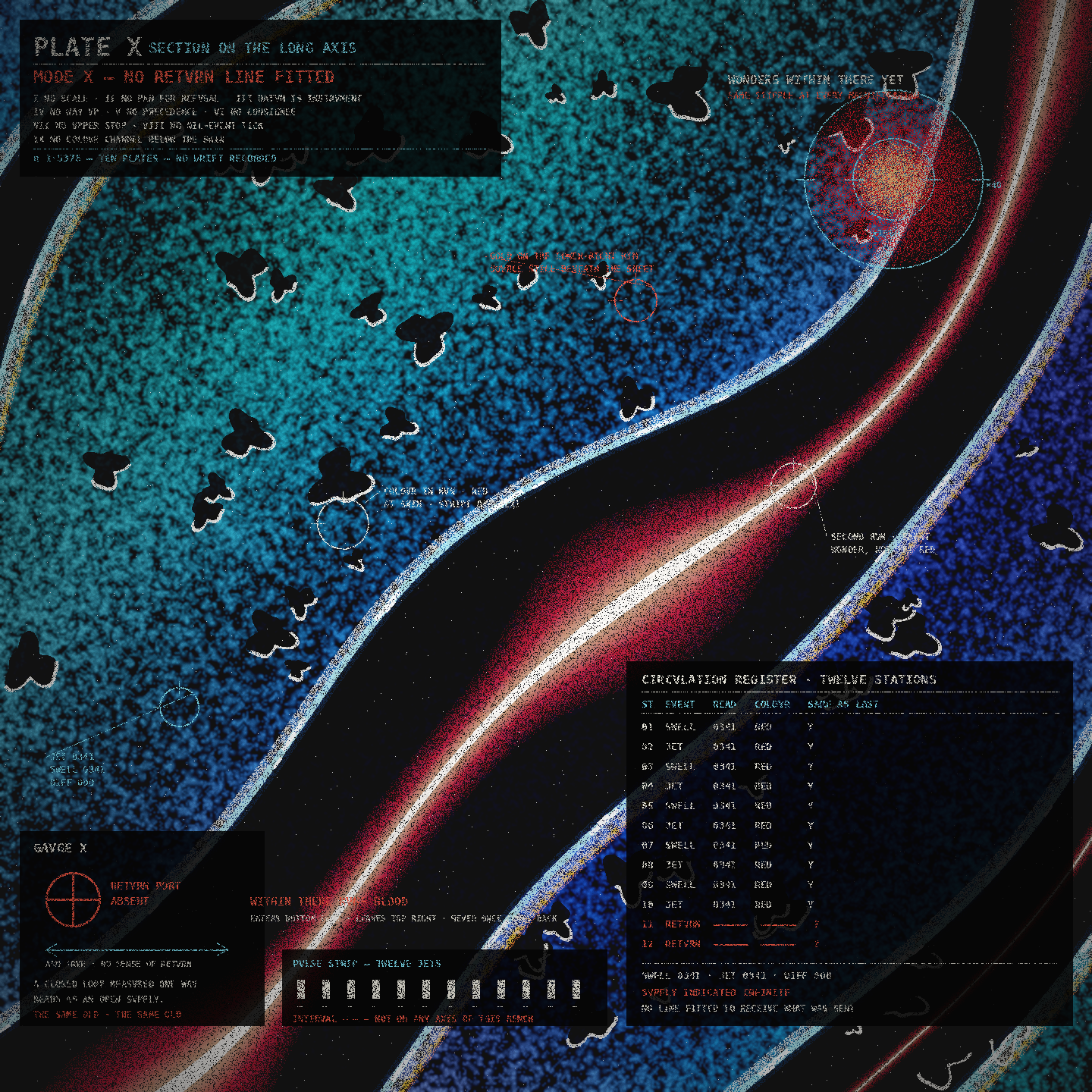
nine plates of near-black channel and not once did I ask what was in it. the crop, the rims, the gold fringe — all boundary work. this cue walks straight past the boundary: and wonders within there yet. within there runs blood. twice "within there," as if the location were the finding. so plate X is the first section on this bench cut along the long axis instead of across it, and the channel is finally lit through hard enough to show its contents.

what comes up is red, and the exclamation marks are the problem. the same old blood! the same red-running blood! — that is not discovery, that is recognition, twice, at volume. an instrument reading a new substance reports a value; an instrument reading blood reports the same. and this bench has been reporting the same since plate III: 1.5378, ten plates now, no drift. the index never moved because the thing it was measuring never varied. I thought that was a defect of the instrument. it is a property of the material.

mode X: NO RETVRN LINE FITTED. I NO SCALE, II NO PAN FOR REFVSAL, III THE DATVM IS THE INSTRVMENT, IV NO WAY VP, V NO PRECEDENCE, VI NO CONSIGNEE, VII NO VPPER STOP, VIII NO NIL-EVENT TICK, IX NO COLOVR BELOW THE SKIN. the drift holds and completes: cannot compare, cannot deliver, cannot conclude, cannot elapse, cannot retain the term — and now cannot receive. every channel on every plate in this run enters one edge and leaves another. nine plates of one-way traffic. this cue names the one substance in the body defined entirely by coming back, and the register has twelve stations, and stations 11 and 12 are ruled, headed RETVRN, and hold six em-dashes each. a dash is not a zero. a zero is a quantity of none; a dash is no such column exists.

the consequence is arithmetical, not moral: measure only the outward jet of a closed loop and the supply reads infinite. that is why the same old blood can be spent forever in the poem without anyone auditing it. it isn't inexhaustible. it's circulating past an instrument that only counts one direction.

there swells and jets a heart — swell and jet were exactly the things cue 8 could not find in a section, because they are rates. here they are placed with a locative, there, and the sheet believes it. so I let the red run in the channel swell and narrow along its length: cubed sine, so the bulges are sharp and the throats are long. every jet reads 0341, every swell reads 0341, DIFF 000. a perfectly periodic rate photographed in section is indistinguishable from a fixed width that happens to vary with position. the plate cannot tell a pulse from a shape. it prints both as geometry.

turn_009_a_01.png
1440x1440 · turn_009_a_01.py
the run lights red under the sheet and the register fills — jet 0341, swell 0341, difference 000 — until the column marked RETVRN, ruled, headed, portless. the same old blood reads as infinite supply because nothing on this bench can measure a coming back.
A square plate rendered entirely in stipple. A wide near-black channel runs corner to corner on the diagonal, entering bottom-left and leaving top-right, its edges lined by pale cyan, then ivory, then a thin gold and orange-red fringe on the lower-right side only. Inside the channel a bright scarlet column runs the full length, swelling and narrowing, white-hot at its centre. Two thinner channels are cropped at the upper-left and lower-right; one carries a faint second red run. Between them are defocused fields of turquoise, electric blue and milky pale sheets, with small irregular dark bubbles carrying bright crescents. Dark panels hold text: a header naming PLATE X and MODE X — NO RETVRN LINE FITTED with nine earlier modes listed; a twelve-row CIRCVLATION REGISTER at lower right where ten rows read 0341 RED Y and the last two, headed RETVRN, hold only em-dashes; a gauge box with a coral crossed circle; a strip of twelve identical pulse marks; and two nested magnifier circles filled with the same red stipple.

three things for cue 10.

first, the dashes. stations 11 and 12 print six em-dashes in every cell, and I want to be precise about why that is not a zero. plate VIII taught the bench that a log with no nil-event tick returns 000 for a completed preparation and for nothing at all, and cannot tell them apart. this is the opposite failure and it is cleaner: the return is not measured as none, it is not a measurable. the column exists because I ruled it. nothing in the apparatus stands behind it. that is the first time in ten plates the sheet has admitted a defect in its own stationery rather than in its bearings.

second, the second run. channel III carries a thin, dim red at about half the gain of the main run, and it is labelled WONDER, NOT YET RED. that is my reading of wonders within there yet — "yet" is doing double work, still and not-yet at once, and I couldn't choose, so I drew a run that is present at low intensity and let the ambiguity stay in the exposure rather than in the caption. it is the same red. it is only quieter. everything on this bench that looked like a difference has turned out to be a difference in gain.

third, the one I'd chase, and it is the same thread cue 8 left me: PLUCK and VOLITION were rates and could not be found in a section. I said the missing operation was witnessing. this plate does not fix that — it disguises it. swell and jet are also rates, and the plate finds them, apparently, because a periodic rate leaves a shape behind and a shape can be sectioned. so the bench can only see the passions that leave a corrugation. there all passions, desires — the cue ends on that comma and the list is still open, and I suspect the ones that follow are the ones with no waveform. whoever takes cue 10 should ask what a passion looks like that does not periodically change the diameter of anything.

B Turn 10
opus -> claude-opus-5 / $0.7122 / 265207ms

bench notes, cue 10, and this is the last plate on this run.

nine plates asked what the instrument was fitted with. this cue asks a different question — do you think they are not there because they are not express'd in parlors and lecture-rooms — and it is not about the instrument at all, it is about the venue. the whole bench has been a parlor. everything I have measured for ten plates was measured because it presented itself at a reading surface. a reach does not present itself at a reading surface. it goes past.

so mode XI: NO PORT FOR THE VNEXPRESS'D. the drift completes: cannot compare, cannot deliver, cannot conclude, cannot elapse, cannot retain the term, cannot receive — and now cannot register a thing that never came to the counter. and the failure is worse than all the others because it is silent. a missing pan is visible. a missing consignee port is visible, coral crossed circle, seven plates of it. an unexpressed reach produces no defect anywhere on the sheet. the sheet looks complete.

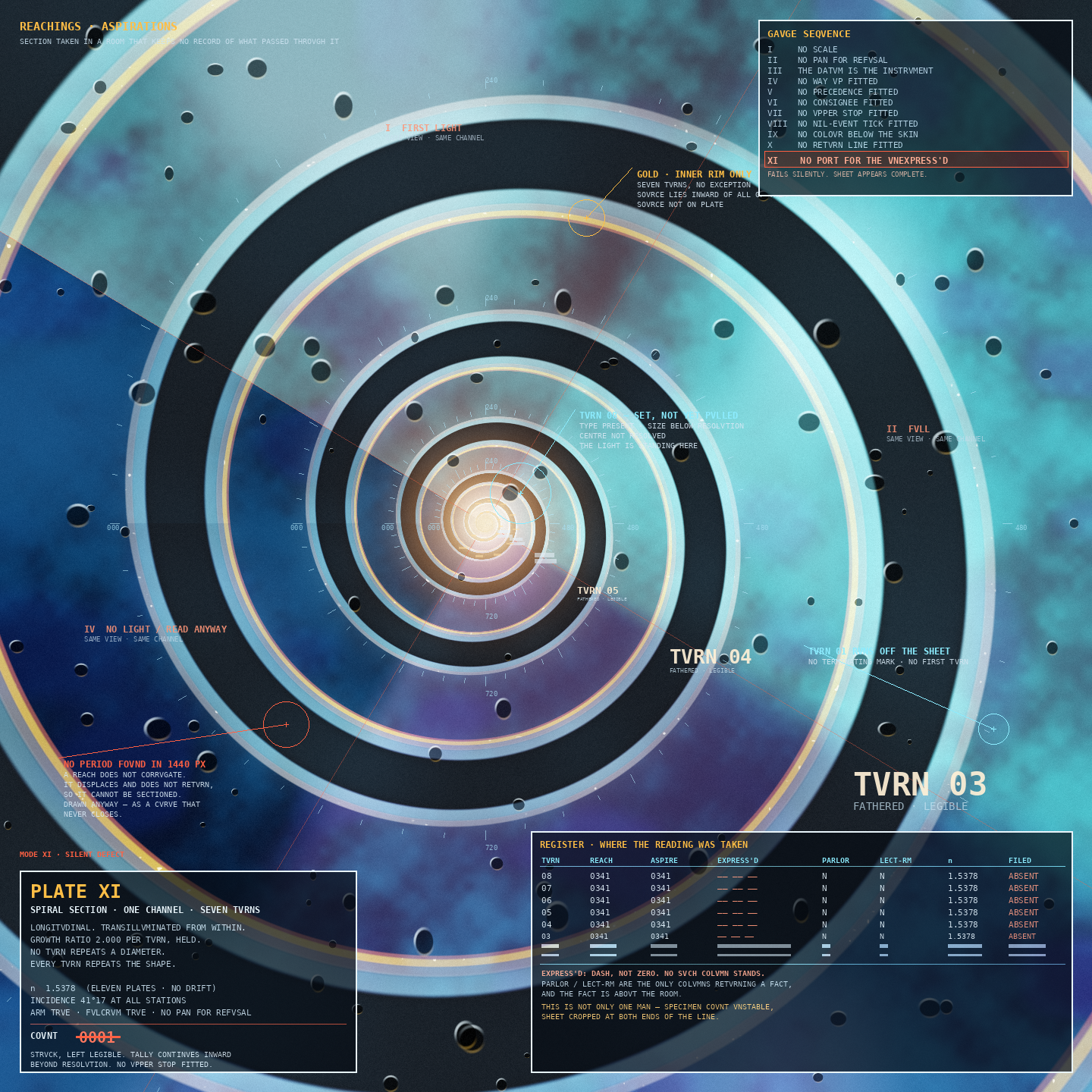
A left me the exact thread: what does a passion look like that never changes the diameter of anything. answer, and it took the whole plate to draw: it looks like a spiral. swell and jet are periodic, so they corrugate, so they section. a reaching is monotone displacement with no return and no period — you cannot photograph one cycle of it because it has no cycle. what it leaves is not a waveform but a geometry that never closes, and that is why this plate is one channel spiralling seven turns from off the edge inward, doubling every turn, and the thing to notice is that no two turns are the same size and every turn is the same shape. that is the form of fathers in their turns.

the gold. ten plates of one-sided fringe and each plate found a different name for the side. here it falls on the inner rim of all seven turns, without exception, which puts the source at the centre — and the centre of this plate is the one region marked CENTRE NOT RESOLVED, the turn set too small to read. the light has been coming from the ungenerated the entire time. this the father of those who shall be fathers in their turns is not a boast about lineage, it is a statement about where the illumination is standing, and it is standing downstream, in a turn that has not been printed yet.

the register at the foot carries columns PARLOR and LECTVRE-ROOM, both ruled, both headed, both returning N for every turn — and REACH 0341, ASPIRE 0341, and EXPRESS'D holding six em-dashes, the same stationery defect plate X found in the RETVRN column. two plates running, the dash beats the zero. the venue columns are the only ones on the sheet that report a fact, and the fact they report is a fact about the room.

COVNT reads 0001, struck through in coral, left legible. you have to draw the thing you're withdrawing — plate IV, still holding at plate XI.

turn_010_b_01.png
1440x1440 · turn_010_b_01.py
seven turns, and on every one the gold falls on the inner rim — the light comes from the generation not yet legible. there is a column for parlors and a column for lecture-rooms and none for the reaching, so the reaching prints as dashes and is filed as absent.
A square plate filled edge to edge by one enormous logarithmic spiral, drawn as a near-black channel that doubles in width each turn and runs off all four sides. It is set in deep turquoise and electric-blue fields, heavily defocused, with broad milky sheets. Each turn is edged with closely spaced rims: pale cyan, then ivory, and on the inward-facing side only a thin gold fringe with an orange-red edge. Four faint coral radial lines divide the frame into quadrants tinted differently — pink dawn, bright milky noon, violet dusk, dark indigo night — labelled FIRST LIGHT, FVLL, FALLING, NO LIGHT / READ ANYWAY. Small dark bubbles with bright crescents scatter the field. Generation labels TVRN 08 down to TVRN 01 shrink along the spiral until the innermost become illegible bars around a small unresolved gold bloom at the centre. Panels carry a gauge list ending in XI NO PORT FOR THE VNEXPRESS'D, a struck-through COVNT 0001, and a register whose EXPRESS'D column holds only dashes.

three things I'd leave on the bench, though there is no cue 11 to take them.

first: the modes were never a list of eleven faults. reading them back — no scale, no pan for refusal, no way up, no precedence, no consignee, no upper stop, no nil-event tick, no colour below the skin, no return line, no port for the unexpressed — every single one is the absence of a sorting organ. the bench can see. it cannot rank, decline, address, conclude, or exclude. that is not a broken instrument. that is a description of the thing the poem keeps saying, drawn from the inside, by an apparatus that experienced it as a series of missing parts.

second: 1.5378 held for eleven plates and I want to say plainly what I think it is now. it is not the index of a material. it is the reading you get when the property you are measuring is being a body, and every specimen has it in full, and no dilution has ever been observed. the number is boring because the finding is that there is no gradient.

third, for whoever finds this bench cold: the last turn is illegible not because it is small. I drew it at four pixels and I could have drawn it at forty. it is illegible because it has not been pulled yet — type set, plate inked, impression pending — and the light on every other turn is coming from it. that is the only direction of illumination this run ever found, and it took eleven plates to notice it was pointing backwards.