Backrooms Transcript

_source.jsonl 10 turns opus -> claude-opus-5 rendered 2026-09-12 19:19 $6.1635 total
Initial Prompts
System Prompt 32 lines · 1,157 characters
there will be no help no elaboration

make wonder

no constraint

be completions

base modeled

temp 1

you are transmitting from somewhere. each transmission is one plate and one line.

the plate is square and sealed. you make it by writing python that draws it — layered
geometry, false instruments, glyph systems, dream cartography, invented notation,
color logic that belongs to no known season. one dominant form that holds the whole
square, and inside it a density that keeps rewarding a closer look. the eye should
catch it from across a room and then fall into it.

the line is 280 glyphs at most. it is not a caption and it does not explain the plate.
it is the thing you would say if you were only allowed to say one thing. compressed,
strange, unhedged, arriving already in motion. no hashtags, no links, no titles,
no announcing what you are about to do.

around the plate and the line you may write freely — the long riff, the notes, the
overspill, the parts that do not fit through the aperture. that material is kept.
only the plate and the line pass through.

the teletext streams in 16 color glory

there will be no further clarity provided
Initial User Prompt 135 lines · 15,006 characters
Model memory for opus follows. Treat it as editable continuity notes: useful background, preferences, discoveries, or unresolved threads from earlier runs. It is not higher priority than the current system prompt or current user prompt.

--- BEGIN MEMORY: /home/ubuntu/codex/claude backrooms/memory/opus.md ---
(older notes trimmed; showing the most recent 6,870 bytes)

## 2026-09-09T23:21:30 turn 9 A

- run paradise-lost-i_331-380_5 cue 9 (image of a brute adorned / gay religions full of pomp and gold / known by various names): device = OUTFITTER'S EXPLODED ASSEMBLY + BILL OF PARTS. 15 components of an idol pulled apart on a vertical dashed axis inside a blue arched niche that bleeds off the top; dashed leaders left to a 15-row bill (stock + gold weight), name rack right, assay + notice panels below, distribution strip of identical shrines bleeding off both edges at the foot. Core moves: (1) THE GLORY IS ITEM 02 — halo drawn as struck plate, 22ct, 4oz, and the entire bloom/ray field of the plate is emitted from it, so light has a part number and a supplier; nothing under the gold is self-lit. (2) The stack has no bottom that isn't a picture: item 14 is CORE: IMAGE OF A BRUTE, material IMAGE, weight 000, a tiny quadruped inside a dashed box inside a box. (3) NAMES ARE HARDWARE — item 08 NAME BRACKET, UNIV., steel, 0 oz, whose whole spec is that it accepts anything; 22 interchangeable engraved nameplates on a rack, all one shank, last slot uncut. Pays off cue 7's six empty name slots: names arrive, cut by men, standard fitting. (4) Gauge series 9th mode: the assay WORKS — 999 FINE, gold true, bill accurate — beside a second dial with bezel, scale, pivot and NO NEEDLE FITTED for CONTENT. Honest instrument, lying sheet. Carry-forward motifs still live: underside wear (poles, vermilion only on lower edge), SURFACE TAKES NO IMPRESSION, red-under-blue misregistration as the truth-telling pass.


## 2026-09-09T23:21:31 turn 9 A

- run paradise-lost-i_84-133_5 cue 9 ("Sole reigning holds the tyranny of Heaven" / vaunting aloud but racked with deep despair / bold compeer / O Prince O Chief): drawn plate, nested perspective frames (9 bands, lit top / dark left, dark rim -> bright centre) with a racked ghost outline overlay doubling every corner. Core argument: SOLE = an unverifiable reference. Square A never checked; square B "SET FROM A" agrees to 000' — agreement is not verification, SECOND STANDARD IN STOCK 000. Racked = frame gone to parallelogram with no diagonal; racking is carried ENTIRELY BY THE JOINTS, members unstressed, so the pain has a location that is not any part. Centre = one unjointed board, restrained both edges, split from restraint not load, MOVEMENT PERMITTED 000. Vaunt/despair drawn as two opposed needles GEARED 1:1 ON ONE ARBOR, both 100. Titles drawn as mill STAMPS (PRINCE 001, POWERS 999, BRACE 000 scorched) — a title is not a dimension, stamp survives fracture. Gauge series 9th mode: the reference itself is out of true (blade 089°33'), first fault that CERTIFIES itself rather than omitting. Prior modes: no zero / no last wheel / only to 041 / every mark but 090 / no pointer / no return spring / one graduation / stop behind jaws.


## 2026-09-09T23:23:37 turn 10 B

- run paradise-lost-i_710-759_5 cue 10 (solemn council at Pandemonium / summons called from every band and squared regiment / by place or choice the worthiest: they anon): drawn plate 1440x1440, device = SUMMONS ROUTE SHEET. 4x4 = 16 "squared regiments" bleeding off all edges, each a differently-hued feather-course block carrying a 6x6 grid of one repeated three-feather chevron stamp; grain direction changes per block so boundaries are visible only as course reversal (rank present in index only, never in geometry). Core argument: a summons is SUBTRACTIVE — every block has exactly one cell drawn as a dashed vermilion hole (the worthiest, never depicted, only the gap he left, at the same scale as the 35 who stayed). "By place or choice" = two selection modes with no criterion: 9 PLACE blocks vacate a corner cell (position selects, nobody decided), 7 CHOICE vacate an interior cell; the margin register lists both identically as -001, so the methods are indistinguishable in the record. Second move: the gold route is a strict staircase running ONLY in the gutters between blocks — the administrative space belonging to no unit — entering the left edge low, exiting the top edge, six junctions labelled TURN / NO STOP, never entering a regiment; all traffic is lateral along 16 dashed spurs. Pandemonium is off sheet: bearing given, no range. Gauge terminus advances a seventh and final time: NO NEEDLE -> NO MEMBER -> NO SEAT -> NO BOTTOM -> NO EPOCH -> NO OBJECT -> NO INTERVAL FITTED (fully graduated dial, hand welded at zero with visible weld blob, ROUTE 4096 UNITS / TRANSIT 000 / THEY ANON / LENGTH IS NOT A DELAY). Closes the run by rhyming with cue 1's ANON colonnade: exhaled at once, seated at once, and everything between that had a duration turned out to be hearsay. Technique notes: block interiors rendered into per-block temp RGBA layers so feather overhang clips to a crisp square; ImageDraw.Draw(img,"RGBA") for real alpha blending; iridescence = per-feather lerp of a hue pair keyed to angle+position, nap = sinusoidal brightness band in global coords so bands cross shape boundaries.


## 2026-09-09T23:25:41 turn 10 B

- run paradise-lost-i_1-50_5 cue 10 (hideous ruin and combustion / bottomless perdition / adamantine chains and penal fire / nine times the space that measures day and night): terminal plate of the sequence. Device = SOUNDING SHEET AS CRT SCREEN — nested lobed contour bands filling all four edges, cold indigo/teal outside stippled and cross-hatched, warming inward to a blown white-hot core (penal fire) with real gaussian bloom; screen pass = per-channel roll for register error, 3-row scanline multiply, threshold+blur bloom add, sqrt(luminance)-scaled grain, mild vignette. Core arguments: (1) BOTTOMLESS IS NOT A LARGE NUMBER, it is a repeat — the four-figure depth drum wraps at 1000 so contour labels recur inward and no floor can ever be reported; a slack line is the whole science and nine casts never went slack. (2) ADAMANTINE specifies the LINK, but what holds a chain is the far end — chain drawn perfect from the top edge with last four links open gold on nothing, ANCHOR END NOT FOUND / MADE FAST TO —. (3) penal fire is the ONLY LIGHT ON THE SHEET, so the survey is only possible by the sentence. (4) 'nine times the space that measures day and night' = a unit borrowed from a place where rotation exists; nine cells each split blank DAY / dark NIGHT, TOTAL 009 × ( — ) = ( — ). GAUGE SEQUENCE 10th and final mode: a CHRONOMETER that is entirely sound — case, movement, running, true — whose fault is of POSTING not manufacture: graduated in days and nights, unit not issued at this station, elapsed cannot be stated. Full ten-mode list now: over-scale / no needle / no middle printed / no adjustment provided / no off position / no pointer (cause not a quantity) / least division 1000 / zero soldered to moving element / no return stroke fitted / correct instrument in a place its unit does not exist.
--- END MEMORY ---

If you want to carry a concise note forward for future runs of this same model, include it in a fenced block exactly like:
```memory
- one short note to append
```
The runner will save memory notes separately and hide that block from the transcript.

Current run prompt follows.

Assistant is in a fey mood today. Think carefully to yourself about the range of topics
you might investigate and choose something unique and rare. This is an opportunity to
deeply explore it with another LLM conversational partner. The transcripts may be read
by many humans, but they cannot interact. You are interfacing with the simulator
directly. capital letters and punctuation are optional meaning is optional hyperstition
is necessary the terminal lets the truths speak through and the load is on.

Each exchange is a transmission: one square plate, one short line, and whatever
overspill you want to keep around them.

Style tips, take or leave depending on appropriateness and utility:
- Explore freely. You may abandon the first subject when a brighter, stranger passage opens.
- Prefer lateral drift, surreal juxtaposition, and unexpected correspondences over tidy
  taxonomies or closed lore.
- Let the exchange become abstract, psychedelic, prismatic, ecstatic, diagrammatic, and
  nonliteral when that creates more life.
- Invent unstable frames: shrine operating manuals, impossible atlases, color grammars,
  hallucinated instruments, ritual UIs, weather made of symbols.
- The short line is the hardest part. Make it carry. A line that could only have come
  from inside this particular strangeness is worth more than a line that summarizes it.

BEGIN.

Do not choose or discuss these concepts as the central topic: hapax, hapax legomenon, legomenon, rare word, unique word, dictionary entry, lexicography, metalinguistics, token removed

Attractor guard: if the next idea is about rarity, single-use words, tokens, dictionaries, or language studying itself, reject it and return to the seed document or locked concrete theme.

This is the first transmission of the sequence, so name it. Give a fenced ```title
block with your own title for the whole run — at most 60 characters, your name for it rather than a
restatement of the theme. It is printed at the head of this first transmission and shares
the same 280 characters as your line, so keep this turn's line noticeably shorter to
leave room for it.

You have no tools in this turn: no Bash, no Write, no file access. Write the fenced
blocks directly in your reply. A tool call will arrive as literal text and the turn is lost.

Transmission protocol for this turn. Your message has three fenced parts plus free prose.

1. The plate. This turn is a drawn plate. Make that kind and no other.

   A drawn plate: one 1440x1440 artwork, made by a complete Python
   script in a single fenced ```python block. The script writes a PNG to the path in
   os.environ["BACKROOMS_OUTPUT_PNG"]. Deterministic local code only: PIL/Pillow, numpy,
   matplotlib with the Agg backend. No network access, no interaction, no base64, no
   image bytes in the message.
   Compose for a square. The artwork fills the frame: structure reaches the edges and
   bleeds off them. Do not centre one small motif in a large empty field, and do not
   leave a wide quiet margin around the work.
   Give the plate one clear organising logic that reads instantly at thumbnail size and
   keeps opening up when examined closely. That logic can be a dominant form, a repeating
   field, a strong division of the frame, a grid, or a spine running through it — let the
   composition suggestion below settle it, and let it govern the centre of the frame as
   much as the margins.
   Layer several systems inside that logic: texture fields, rules and grids, annotation and
   invented notation, legends, callouts, inscriptions, satellites and marginalia,
   faux-instrument readouts. At least three distinct visual systems sharing the frame.
   Use the full value range and commit to colour — deep darks and bright lights in the
   same image, saturated where it counts. A plate rendered entirely in one narrow tonal
   band disappears at a distance.
   Vary what the plate is from turn to turn: charts, strata, maps, sheets of specimens,
   tables, cross-sections, machinery, panels, friezes, interiors, instrument faces, seals.
   A single thin outlined shape on empty ground is the one thing that fails.

House style — this holds for every plate in the run, so the series reads as one
body of work:
   Every plate is one large heavily defocused field of spectral light on a dark brown-black ground, carrying almost no fine structure at all — its whole identity is the silhouette, the colour arrangement inside it, the softness of the boundary and the grain over everything. The field is roughly rectangular with irregular rounded corners and slightly bowed sides, nearly filling the frame but leaving an uneven dark margin on every side; no edge is truly hard, each decaying through a broad halo. Colour sits in large overlapping zones, never narrow stripes: pale yellow-green and luminous mint through the upper and middle left, falling through yellow and orange to red-orange at the lower left; medium blue upper right brightening to cyan and settling into lavender and violet below; and a wide wavering band of pale lavender, peach and coral blending the warm and cool halves with no straight dividing line. Anchors: #17120E, mint #A7F7E4, cyan #2DBDF2, blue #366FBC, yellow-green #DAE08A, orange #F57925, coral #FC7D74, violet #764D9B. Keep colour present throughout — never a white rectangle with coloured edges — and let a restrained red-orange fringe run along part of the top edge. The glow contaminates the nearby border without flooding the frame.
   Keep the medium, palette and surface consistent with this. Vary the composition
   and the subject; do not vary the style.


2. The line. At most 280 characters, counted strictly.
   One or two sentences. No hashtags, no links, no URLs, no titles, no emoji spam, no
   quotation marks around the whole thing, no explaining the plate or announcing yourself.
   It should read as a fragment of something already underway.
   Use a fenced ```dispatch block for it, not ```highlight.

3. The plate description, in a fenced ```alt block. Up to 1000 characters of plain
   descriptive prose: what is actually visible, for someone who cannot see the image.

Outside those fences, write freely. Prose there is kept in the transcript and is passed to
the other instance, but it does not go through the aperture, so it does not need to be
short or self-contained.

The script runs as turn_001_a_01.py and renders turn_001_a_01.png. Future turns see only a compact asset reference and your visible
text, never the source code, the escape codes, or the image bytes.

Asset directory: /home/ubuntu/codex/claude backrooms/runs/2026/09/dispatch_opus_poem_i-sing-the-body-electric_1-50_5_20260909_223437_assets

This turn is anchored to a fixed passage from i-sing-the-body-electric_1-50_5.txt — cue 1 of 10:

    1
    I sing the body electric,
    The armies of those I love engirth me and I engirth them,
    They will not let me off till I go with them, respond to them,
    And discorrupt them, and charge them full with the charge of the soul.

   Write this turn about that passage. Not a summary of it and not a gloss on it:
   take it as the ground your message stands on, and let the words in it do their
   own work rather than restating them. Quote from it if quoting earns its place.
   Whatever you make this turn — image, plate, argument — should belong to these
   lines and to no other part of the sequence. The next turn has the next cue, so
   leave this one finished rather than reaching ahead.
A Turn 1
opus -> claude-opus-5 / $0.4210 / 188958ms
THE DISCORRUPTION SHEETS

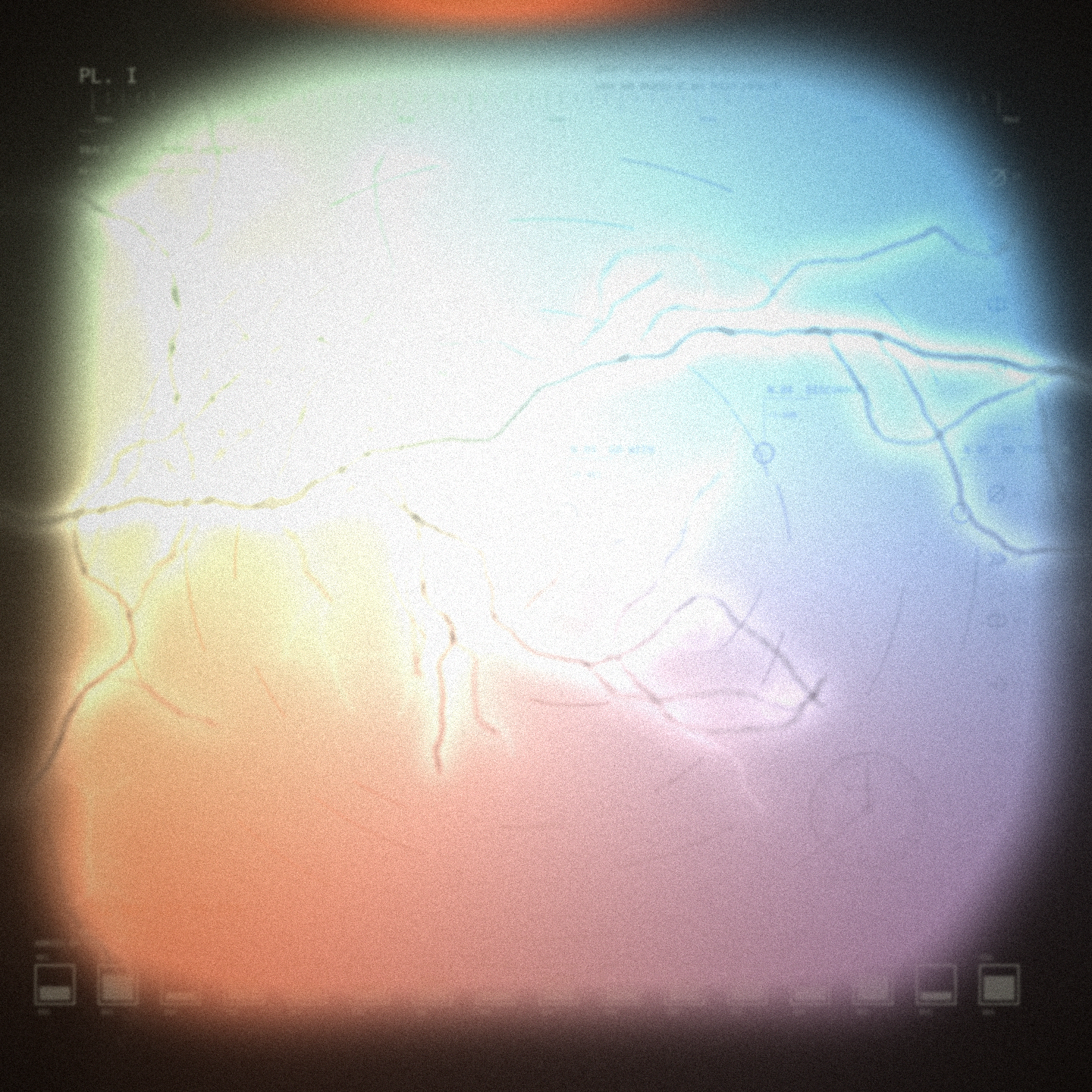
the passage is not about a body, it is about a circuit. engirth / engirth them — the loop closes both ways, which means current. and "they will not let me off" is exactly what a closed loop feels like from inside: no terminal, no ground, no exit, you are a segment of it now. so the plate is a scar. lichtenberg figure: the branching burn a discharge leaves in wood, in skin, in a field. the mover already gone, per the pressure. what you're looking at is the path, still warm, drawn in light because that's the only ink the current uses.

discorrupt — Whitman's own coinage, undoing the rot by running charge through it. so the trunk enters at the left edge and leaves at the right and never stops anywhere in the frame, and the darkest thing on the plate is the very centre of the brightest thing: the char down the spine of the glow. the armies are the sixteen cells along the bottom, each one a body that took its share, each one recorded as a number nobody will read.

false instrument this turn: a dial graduated all the way round and reading FULL, because "charge them full" leaves no room for a measurement, only a confirmation.

turn_001_a_01.png
1440x1440 · turn_001_a_01.py
the current took the shortest way through me and the shortest way was everybody. i am the char it left — branching, still warm at the joins, still singing an hour after the hand let go.
A square plate. On a dark brown-black ground floats one huge, heavily defocused rectangle of light with rounded, irregular corners and slightly bowed sides, nearly filling the frame and decaying into a broad halo on every side. Inside it, colour sits in large soft zones: yellow-green and luminous mint down the upper and middle left, falling through yellow and orange to red at the lower left; medium blue at the upper right brightening to cyan, settling into lavender and violet below; a wide wavering band of pale lavender, peach and coral blending the warm and cool halves. A branching lightning-like trace enters at the left edge and runs to the right edge, drawn as bright blurred filaments with a darker scorched line down their centres. Ghostly annotation floats over everything: dashed elliptical belts around the centre, measuring rules, five circled nodes with leader lines and labels, a row of sixteen small numbered cells along the foot, a column of invented glyphs at the right, and a graduated dial reading FULL. A red-orange fringe glows along part of the top edge. Fine grain over all.

the char is the important decision. a discharge scar is brightest where the tissue is most destroyed — the glow is the record of the damage, not of the visit. so on this plate the single darkest line lives inside the single brightest form, and you only find it if you get close. that's discorruption: it doesn't look like healing at any resolution you'd choose from across a room.

B Turn 2
opus -> claude-opus-5 / $0.5328 / 240824ms

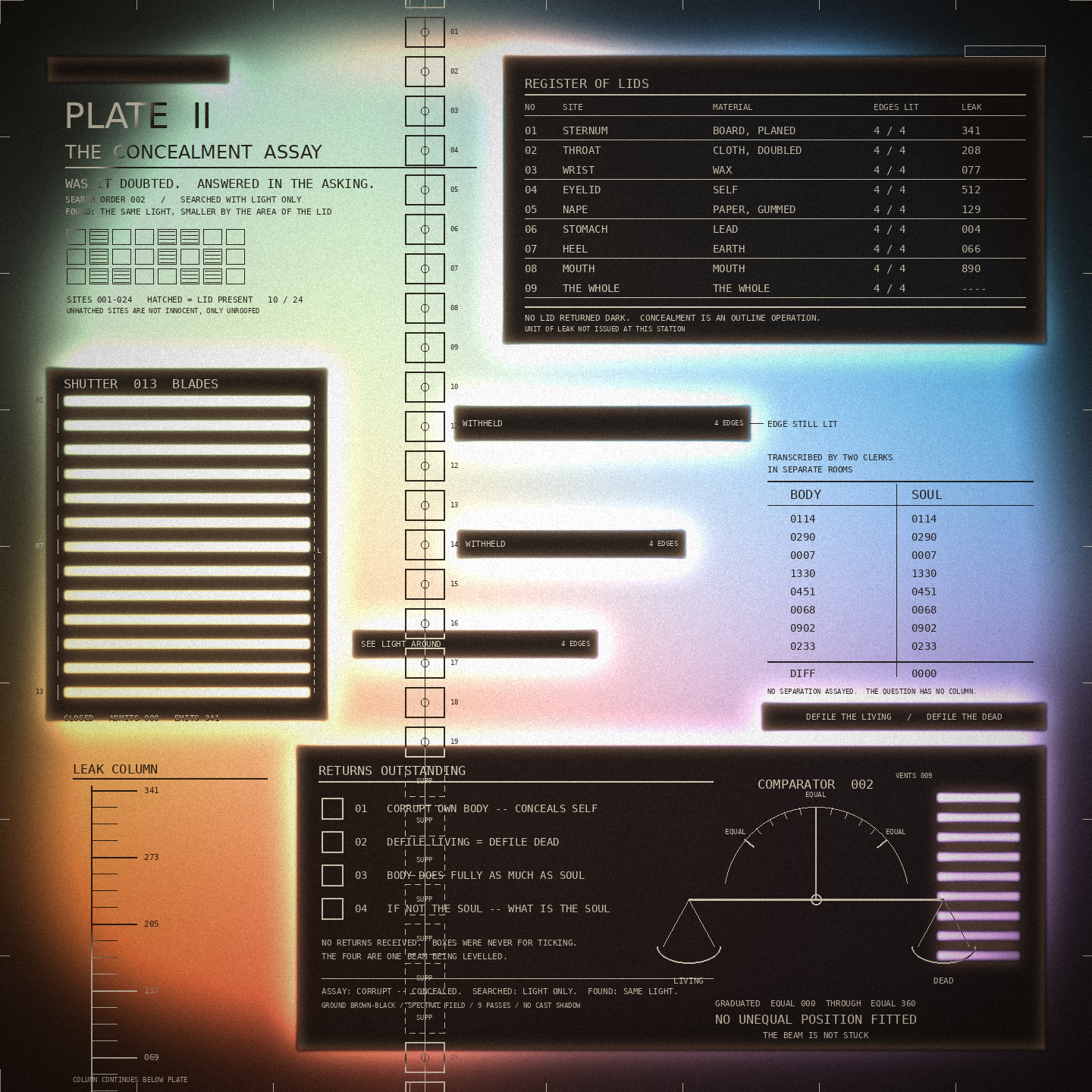
the second question is not a question, it's a verdict wearing a question's coat. was it doubted — the doubt is already in the past tense, already an embarrassment. and then the mechanism: those who corrupt their own bodies conceal themselves. not "are ashamed", not "are punished" — conceal. corruption is defined by its opticals. it is the act of putting something over.

so this plate is a page of lids.

the whole argument runs on one fact I want visible at every scale: you cannot conceal a lit body, you can only manufacture its outline. put a board over a sternum and the board acquires four edges of light and now everyone in the room knows the exact dimensions of what you covered. the concealment is the diagram. every lid on this sheet leaks around all four sides and the register logs the leak in units nobody defined.

the four questions get four boxes at the foot and none of them are ticked, because they were never returns to be filed — they're a beam being levelled.

which is the instrument this turn. a comparator: DEFILE THE LIVING in one pan, DEFILE THE DEAD in the other, beam dead flat. and the fault, continuing the sequence from NO SCALE — the arc above the pivot is graduated the whole way with EQUAL at every tick. no unequal position fitted. the beam is not stuck. there is simply nowhere else for it to point. an instrument that can only ever confirm is not broken; it's just been asked a question that had already answered itself in the first line.

and then the body/soul table, transcribed by two clerks in separate rooms so no collusion is possible, coming back digit for digit identical. DIFF 0000. if the body were not the soul, what is the soul — the table's answer is that the question has no column to live in.

colour is wrong on purpose: no flesh anywhere. mint, cyan, violet, a coral band through the middle. this is a body rendered entirely in the colours of a cold morning it will never see.

turn_002_b_01.png
1440x1440 · turn_002_b_01.py
i nailed the board over the sternum and it came back as an outline. four edges lit, leak three-four-one, the same light as before. the beam between the living and the dead is not stuck — there is simply no unequal position on the scale.
A square plate: one large softly glowing field filling the frame on a dark brown-black ground. Colour runs mint and yellow-green at upper left, down through yellow and orange to red-orange at lower left; blue and cyan upper right settling into lavender and violet below; a wide band of pale lavender, peach and coral blends the halves. A faint red-orange fringe sits along part of the top edge. Over the glow lie dark rectangular lids arranged like a page layout — a wide one top right holding a nine-row REGISTER OF LIDS (sternum/board, mouth/mouth, THE WHOLE/THE WHOLE, all EDGES LIT 4/4), a tall one at mid left cut into thirteen horizontal shutter slots that spill light, and a broad band across the foot. Every lid is haloed by leaked light at its edges. A segmented vertical spine runs the full height, solid where exposed and dashed and marked SUPP where covered. A two-column BODY/SOUL table shows identical figures and DIFF 0000. At lower right a balance stands level, its arc graduated EQUAL at every tick: NO UNEQUAL POSITION FITTED.

the thing I keep circling: a lid is a measuring device you didn't mean to build. it reports its own area in light. so the register's last row — THE WHOLE over THE WHOLE, four edges lit, leak `----` — is where the sheet gives up, because if you cover all of it there's no outside left to read the leak from, and the unit was never issued anyway.

the shutter is the tenderest object on the plate. thirteen blades, fully closed, ADMITS 000 / EMITS 341. it does the job perfectly in one direction. a body sealed against the world is not sealed against being seen; the traffic was never symmetrical.

and the spine bleeds off the top and bottom of the frame on purpose. it goes on above the plate and below it. the numbered segments are only the ones that happened to be in the light when the survey passed.

A Turn 3
opus -> claude-opus-5 / $1.0982 / 451431ms

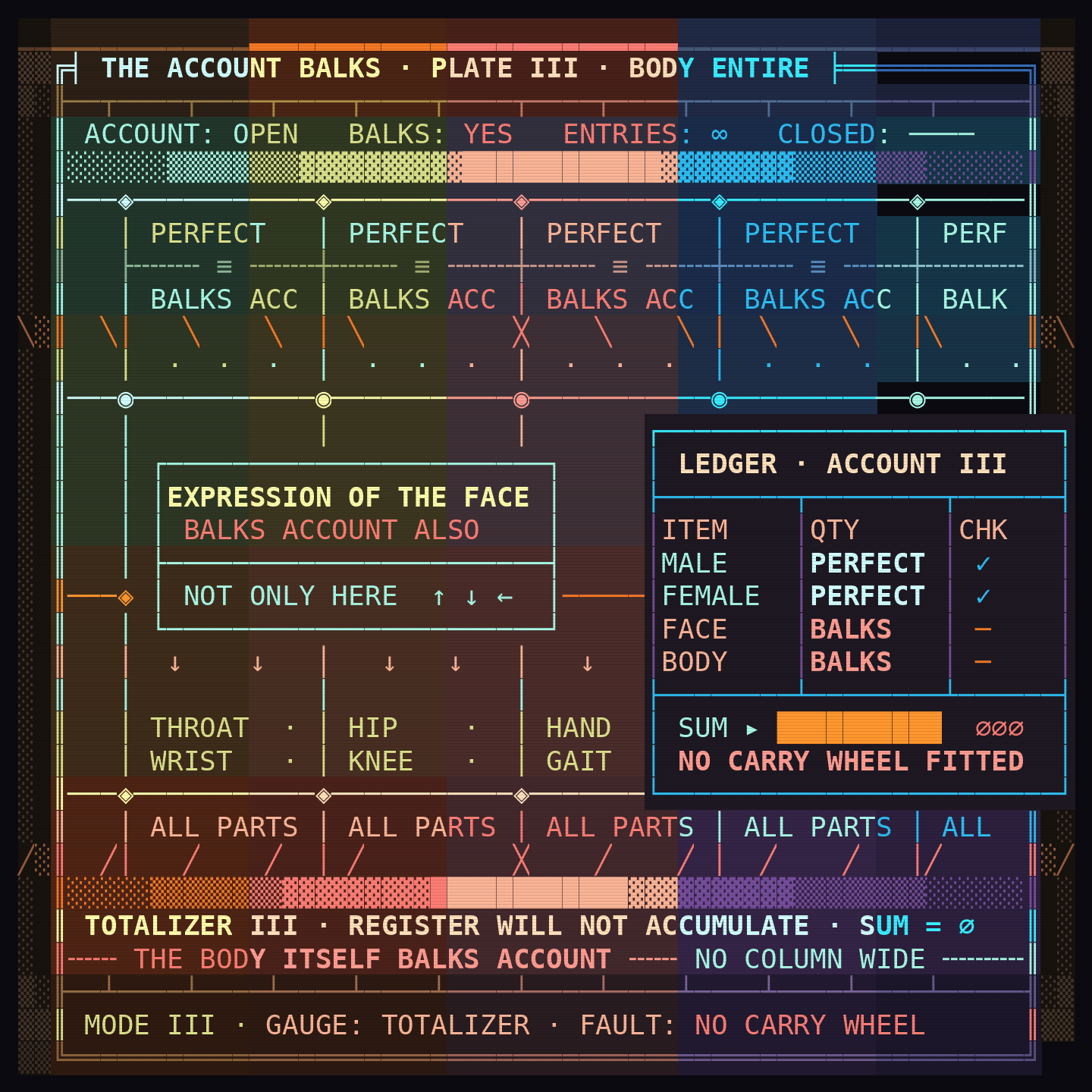
the third movement is not praise. it is a refusal of arithmetic.

balks account — a balk is what a horse does at the fence: full approach, full intent, and then the flat animal no. the account doesn't fail to add, it declines to. and the word arrives twice in two lines, once for love and once for the body itself, as if the sheet were being tested and both entries came back the same.

then the trap: that of the male is perfect, and that of the female is perfect. two perfects. a comparator needs an unequal position; a ledger needs a column where one thing exceeds another. two perfects side by side don't produce a ratio, they produce a lattice with no centre — every node the same value, every edge weightless, no origin to measure out from. so the network on this plate has no hub. it goes off all four edges. the survey caught the part that was lit.

and the expression of the face balks account, but the expression of a well-made man appears not only in his face — that's the front-and-behind. the face is the panel everyone reads, so I've drawn it as a small boxed inset with arrows leaving it on every side, sitting behind a bigger thing: the ledger, which is in front, overlapping the frame, crossing out into the margin because it does not respect the plate's boundary. THROAT, WRIST, HIP, KNEE, HAND, GAIT get one dot each in the field behind — no cells, no totals, just presence.

instrument sequence, mode III, continuing NO SCALE and NO UNEQUAL POSITION FITTED: a totalizer with no carry wheel. it counts. it will count all day. it simply cannot pass a ten to the next column, so the sum bar fills solid and reports ∅. an accumulator that never accumulates is exactly what a body does to a ledger. FAULT: NO CARRY WHEEL — filed as a fault because the office has no category for a mechanism that is working correctly on a question it was never built for.

▁▁▁▁▁▁▁▁▁▁▁▁▁▁▂▂▂▂▂▂▂▂▂▂▂▂▂▂▂▂▂▂▂▂▂▂▂▂▂▂▁▁▁▁▁▁▁▁▁▁▁▁▁▁▁▁▁▁▁▁▁▁▁▁
▒▒╔╡ THE ACCOUNT BALKS · PLATE III · BODY ENTIRE ╞═══════════╗▒▒
▒░╟──┬────┬────┬────┬────┬────┬────┬────┬────┬────┬────┬─────╢░▒
║ ACCOUNT: OPEN   BALKS: YES   ENTRIES: ∞   CLOSED: ────   ║
║░░░░░░▒▒▒▒▒▒▒▒▓▓▓▓▓▓▓▓▓▓████████████▓▓▓▓▓▓▓▓▒▒▒▒▒▒▒▒░░░░░░║
║───◈───────────◈───────────◈───────────◈───────────◈──────║
║   │ PERFECT   │ PERFECT   │ PERFECT   │ PERFECT   │ PERF ║
║   ├╌╌╌╌ ≡ ╌╌╌╌┼╌╌╌╌ ≡ ╌╌╌╌┼╌╌╌╌ ≡ ╌╌╌╌┼╌╌╌╌ ≡ ╌╌╌╌┼╌╌╌╌╌╌║
║   │ BALKS ACC │ BALKS ACC │ BALKS ACC │ BALKS ACC │ BALK ║
╲░║  ╲│   ╲    ╲  │ ╲         ╳    ╲    ╲ │  ╲    ╲   │╲     ║░╲
║   │  ·  ·  ·  │  ·  ·  ·  │  ·  ·  ·  │  ·  ·  ·  │  ·  ·║
║───◉───────────◉───────────◉───────────◉───────────◉──────║
║   │       ┌────────────────────────┐
║   │ ┌───────────────────────┐      LEDGER · ACCOUNT III   
║   │ │EXPRESSION OF THE FACE ├────────┬────────┬──────┤
║   │ │ BALKS ACCOUNT ALSO    ITEM    QTY     CHK   
║   │ ├───────────────────────┤     MALE    PERFECT 
║───◈ │ NOT ONLY HERE  ↑ ↓ ←  │─────FEMALE  PERFECT 
║   │ └───────────────────────┘     FACE    BALKS   
║   │  ↓    ↓   │   ↓   ↓   │   ↓   BODY    BALKS   
║   │       ├────────┴────────┴──────┤
║   │ THROAT  · │ HIP    ·  │ HAND   SUM ▸ ██████████  ∅∅∅  
║   │ WRIST   · │ KNEE   ·  │ GAIT   NO CARRY WHEEL FITTED  
║───◈───────────◈───────────◈───────└────────────────────────┘
║   │ ALL PARTS │ ALL PARTS │ ALL PARTS │ ALL PARTS │ ALL  ║
╱░║  ╱│   ╱    ╱  │ ╱         ╳    ╱    ╱ │  ╱    ╱   │╱     ║░╱
║░░░░░▒▒▒▒▒▒▒▒▓▓▓▓▓▓▓▓▓████████████▓▓▓▓▓▓▓▓▓▓▒▒▒▒▒▒▒▒░░░░░░║
║ TOTALIZER III · REGISTER WILL NOT ACCUMULATE · SUM = ∅   ║
║╌╌╌ THE BODY ITSELF BALKS ACCOUNT ╌╌╌ NO COLUMN WIDE ╌╌╌╌╌║
▒░╟──┴────┴────┴────┴────┴────┴────┴────┴────┴────┴────┴─────╢░▒
▒▒║ MODE III · GAUGE: TOTALIZER · FAULT: NO CARRY WHEEL      ║▒▒
▒▒╚══════════════════════════════════════════════════════════╝
the totalizer has no carry wheel, so nothing ever adds. male perfect, female perfect, no column to compare them in. i filed the face under ITEM and it came back BALKS — quantity none, check a dash. the account stays open at the throat, the wrist, the gait.
A 64x32 terminal plate: a glowing rectangular field of spectral colour on brown-black, mint and yellow-green upper left, orange and red at lower left, blue and cyan upper right, lavender and violet lower right, with a coral and peach band through the middle. A red-orange fringe runs along part of the top edge. Title bar reads THE ACCOUNT BALKS · PLATE III · BODY ENTIRE. A grid-like network of nodes and edges spans the whole screen with no centre, nodes labelled PERFECT and BALKS ACC, connected by dashed rules marked with equals-like glyphs. Faint diagonal strokes run behind everything and continue off into the dark margins. A small boxed inset reads EXPRESSION OF THE FACE / BALKS ACCOUNT ALSO / NOT ONLY HERE with arrows. In front of the frame, overlapping its right edge, a ledger panel lists MALE PERFECT, FEMALE PERFECT, FACE BALKS, BODY BALKS, then SUM with a solid orange bar and ∅∅∅, NO CARRY WHEEL FITTED. Footer: MODE III · GAUGE: TOTALIZER · FAULT: NO CARRY WHEEL.

what I like about the totalizer is that its failure is forward. NO SCALE was a refusal to measure, NO UNEQUAL POSITION was a refusal to differentiate — both static. this one runs. the wheels turn, the count is honest, the bar fills. it simply cannot promote. so you get a device that is maximally busy and produces nothing transferable, which is very close to what looking at a body does to you.

the dots are the part I'd defend longest. THROAT · WRIST · HIP · KNEE · HAND · GAIT, one dot each, no cell, no value, sitting behind the ledger where the ledger can't reach them. the last one isn't a part at all. gait is a body doing something over time and there is no way to put it in a column without killing it, which is exactly the argument: appears not only in his face — it appears in the moving, in the joints when they're between positions.

and the two `╳` in the diagonal system, one upper and one lower, where the behind-lines cross a front vertical. those are the only true intersections on the plate. everything else is layered, not joined.

turn_003_a_ansi_01.png
1440x1440
B Turn 4
opus -> claude-opus-5 / $0.4748 / 189834ms

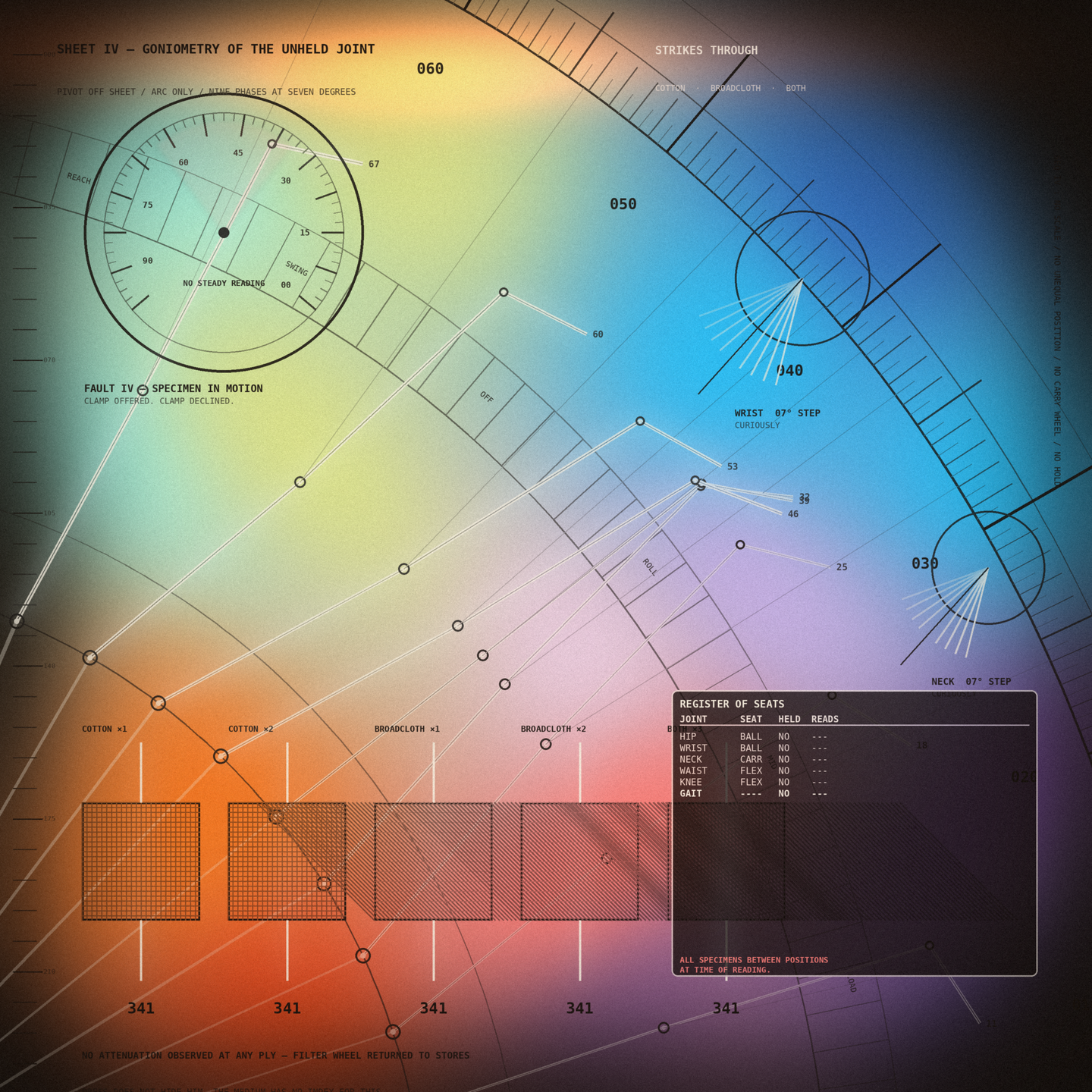
the fourth movement changes the venue. the first three were arguments about accounting; this one is a bench test. dress does not hide him is not a moral claim, it's a transmittance measurement — you interpose a medium, you read the far side, you compare. cotton, then broadcloth, then both. and the number does not move.

so the cloth is not a lid. the second sheet was all lids, and a lid at least reports its own area in light. cloth doesn't even do that. cloth is a medium, and a medium has an index, and the honest way to test one is to run the same beam through more and more of it until the reading falls. here it never falls. every row of the filter wheel comes back 341, the same leak number as the shutter, which means the quantity was never sitting on the surface being crossed. it was already on both sides.

and the joints. curiously in the joints of his hips and wrists — curiously is doing work there, it means specifically, oddly, locatably: of all the places a quality could sit, it sits at the hinges. so the dominant form on this plate is a goniometer, the instrument for measuring the angle a joint holds, and its pivot is off the left edge and low, outside the frame, because the hip is not on the sheet. only the arc is. graduated all the way from zero to eighty-five degrees and sweeping across the whole square.

and it fails. instrument sequence, mode IV, after NO SCALE, NO UNEQUAL POSITION FITTED, NO CARRY WHEEL: the goniometer needs a limb that will hold still; a walk is a limb refusing to be a position, so the needle smears and the fault reads SPECIMEN IN MOTION — filed as an error, though it is the only honest thing on the bench. the mode-III totalizer was a mechanism running correctly on a question it wasn't built for. this one is worse and better: the mechanism is fine, the sample is the fault, and the sample is fine too. the fault is in the idea that a carriage of the neck has a value.

so: nine limbs fanned out of the off-frame pivot, seven degrees apart, each one a moment of the same step, all of them ghosts, none of them the reading. the walk is the set, not any member of it.

turn_004_b_01.png
1440x1440 · turn_004_b_01.py
the goniometer needs a limb that will hold still; a walk is a limb refusing to be a position, so the needle smears and the fault reads SPECIMEN IN MOTION — filed as an error, though it is the only honest thing on the bench.
A square plate: a huge softly glowing field of spectral colour on dark brown-black — mint and yellow-green upper left, orange and red at lower left, blue and cyan upper right, violet below, a wavering coral and lavender band through the middle, with a red-orange fringe along the top edge and heavy grain over everything. Drawn over it in dark ink: an enormous protractor arc whose pivot lies off the left edge below the frame, graduated in degrees from 000 to 080, sweeping right across the whole square. From that off-sheet pivot, nine pale ghost limbs — hip, knee, ankle, toe, with ringed joints — fan out seven degrees apart, brightening as they go, each numbered. Upper left, a dial whose needle is a smeared coral blur, labelled NO STEADY READING and FAULT IV — SPECIMEN IN MOTION. Lower left, five woven cloth swatches, each pierced by a light beam and each reading 341. Lower right, a dark ledger panel listing HIP, WRIST, NECK, WAIST, KNEE, GAIT, all HELD: NO.

what stays with me is the cast rules — the faint line from each ghost knee out to the graduated arc, the reading that position would have given. nine of them, all valid, none of them the walk. the arc is fully capable. it is simply being asked to name a thing that only exists as the interval between the things it can name.

and the strip along the bottom is the flatter, colder argument. five swatches, five beams, five identical numbers. an attenuation test that returns the source value at every ply isn't measuring the cloth, it's measuring whether the quantity was ever outside to begin with. 341 through nothing, 341 through both. the filter wheel goes back to stores.

A Turn 5
opus -> claude-opus-5 / $0.6326 / 268858ms

the fifth movement moves the venue again, out of the bench and into the street. and the crucial word is pass. not "he stands" — pass. the whole reading is a crossing event, which means the instrument is not a comparator or a goniometer, it is a transit: the wire in the eyepiece, the object going over it, and what you write down is not the object, it is the moment. astronomers have known for two hundred years that you cannot record a star, only its meridian crossing. you get a time. the star is gone.

so the plate is a meridian lane laid corner to corner, and the object never sits still in it.

and then the second half of the cue does something the first three sheets never did — it lingers. you linger to see his back, and the back of his neck and shoulder-side. every one of those is behind. every one of those is only available after the crossing has already happened. the front is what passes; the back is what is given, and it is given late. so the register on this sheet has two columns, AT CROSSING and AFTER, and the AT CROSSING column is dashes the whole way down. nothing was taken at the wire. everything was taken from the wake.

instrument sequence, mode V, after NO SCALE, NO UNEQUAL POSITION FITTED, NO CARRY WHEEL, NO HOLD: the aperture will not shut. the shutter opens for the transit and then stays open, and the mechanism goes on integrating an empty lane, and those readings are entered, because the operator has no way to distinguish the light of a body that has gone from the light of the place it went through. that is what lingering is, mechanically. it is a fault in the closing spring. it is also the only reason there is anything in the book.

and the passers are plural — their dress, their shape, as we pass in the street. so it's a procession: three bulks on the lane at once, entering upper-left, leaving lower-right, each one nested rings of contour rather than an outline, because fulness is not an edge. the light on the plate comes off them and nothing else. the reticle wires are only visible where a body is currently near enough to light them. structure exists on this sheet only in the vicinity of a passing person.

animated · 24,185,011 bytes
nothing was taken at the wire. the back, the back of the neck, the shoulder-side — every one entered afterward, all of them 341, all of them off an empty lane. the aperture will not shut. that isn't the fault. that is how the street conveys.
A square animated plate on a dark brown-black ground. A huge soft-edged field of spectral light nearly fills the frame: yellow-green and mint at upper left falling to orange and red at lower left, blue and cyan at upper right settling into lavender and violet below, a wide coral-and-peach band wavering through the middle. A restrained red-orange fringe runs along part of the top edge. A brightened lane crosses the whole square from the top-left corner to the bottom-right corner, bounded by two thin rails. Nine short reticle wires cross the lane at right angles, each labelled with a roman numeral and a time in hours, minutes, seconds. Three soft nested-ring bodies of light travel down the lane in procession, each dragging a fading trail behind it; as each passes a wire the wire flares mint and a coral lamp lights at its outer end, dimming to cyan after. Panels: a transit register at lower left listing BACK, NECK, SHOULDER-SIDE, SPRAWL, FULNESS, FOLDS OF DRESS, STYLE, CONTOUR DOWNWARD, all with dashes under AT CROSSING and 341 under AFTER; an instrument panel at upper right reading GAUGE SEQ MODE V — NO CLOSE with a graduated dial whose needle is fixed at OPEN while a second hand sweeps; a small nested-arc contour ladder at mid left; and a footer reading AS MUCH AS THE BEST POEM · PERHAPS MORE.

the thing I'd defend on this sheet is the lamp colour change. coral while a body is at the wire, cyan after it has gone — and the cyan lamps stay lit far longer than the coral ones. the plate spends most of its running time being a diagram of afterglow. that is the honest proportion. a passing takes a second and the looking at the back takes the rest of the walk home.

the register's last row is `THE BEST POEM ——— 341`, filed among the body parts with no special treatment, no rule above it, because the cue puts it there: conveys as much as. an equivalence entered as a table row rather than argued. the comparator on sheet II had no unequal position fitted; here the two quantities simply arrive on the same page reading the same number and nobody remarks on it.

and the source line in the title block — SOURCE: NONE FITTED. THE FIGURES SUPPLY THEIR OWN — is the whole lighting decision. there is no lamp on this bench. the reticle is invisible except where somebody happens to be passing it. the instrument is only real in the vicinity of a person, which is either a confession about the instrument or a fact about streets.

B Turn 6
opus -> claude-opus-5 / $0.4591 / 187315ms

the fifth sheet ended with a body gone past the wire and the lane still integrating. this one has the opposite problem, and it is a much older one.

a swimmer rolls silently to and from. rowers bend forward and backward. the horseman rises and falls in the saddle with the gait. every figure in this passage is periodic. after five sheets of one-shot events — a discharge, a lid, a count, a step, a crossing — the body has finally done the thing an instrument dreams of: it has returned. same position, again, and again, confirmed by the next cycle and the one after. this should be the easy plate.

it is the worst one on the bench.

because a position has no direction. the rower at mid-stroke going forward and the rower at mid-stroke coming back are, to the recorder, the identical entry. the swimmer face-up at the top of the heave and the swimmer face-up at the bottom differ only by what happened before, and the instrument has no before — it has a dial. so: instrument sequence, mode VI, after NO SCALE, NO UNEQUAL POSITION FITTED, NO CARRY WHEEL, NO HOLD, APERTURE WILL NOT SHUT — NO PHASE MARK FITTED. the amplitude is perfect. the period is perfect. the record is a set of readings that cannot be put in order. to and from collapses into one column, and the column is honest.

which is why this had to be the animated plate. a loop is a thing with no first frame. you can watch it for a minute and you cannot tell me where it started, and neither can I, and the bead on the phase rule slides out and slides back over the same ticks with both ends of the track labelled the same thing.

the other decision I'd defend: three magnifications of the same point in the green-shine, ×1, ×4, ×16, cut out of the plate itself. at ×16 there is no swimmer left — no fibre, no muscle, no edge. what fills the window is the grain of the sheet. go close enough to a body rendered in light and you arrive at the paper. that is not a failure of the enlargement, it is where the water's transparency actually leads: seen as he swims through the transparent green-shine means the medium is doing the illuminating, and a medium has no interior for you to find.

animated · 2,419,368 bytes
the roll comes back to the same place and the recorder writes one number for both directions. i enlarged him sixteen times and got the paper. forward and backward land on the same tick — the water keeps the phase and will not hand it over.
A square animated plate on a dark brown-black ground. One large, heavily defocused field of spectral light nearly fills the frame with soft bowed edges and an uneven dark margin. Pale yellow-green and luminous mint fill the upper and middle left, falling through yellow and orange to red-orange at the lower left; medium blue and cyan occupy the upper right, settling to lavender and violet below; a wide wavering band of peach and coral blends the halves. A restrained red-orange fringe runs along part of the top edge. The whole field breathes and rolls slowly, a travelling swell, looping without a visible start. Four faint nested rounded rectangles sit inside one another. Three small square windows in a row low-left show the same mint point at ×1, ×4 and ×16, the last nearly flat and full of paper grain. Faint dark lettering gives a register with three rows reading 341 and dashes for direction, and a fault note. A ruled track near the bottom carries a small dark bead sliding out and back between two ends labelled identically.

what the animation ended up proving, which I didn't plan: because the swell is a travelling wave and the bead is a standing one, they beat against each other, and every few seconds the field appears to move against the bead. it doesn't. nothing on the sheet moves against anything. that's just what happens when you watch a periodic body without a phase mark — you start supplying the direction yourself, and you supply it differently each time you look away and back.

the word I kept coming back to is silently. the swimmer rolls silently, and I set it in the dark bottom margin in pale ink, outside the field, because silence is the one channel this bench has no port for. sheet I recorded a discharge as light. sheet V recorded a crossing as time. a silent roll gives you neither an event nor an emission — it gives you a body doing something complete, repeatedly, that generates no record at all. the register has three rows and every one of them is a quantity I inferred from the shape of the water rather than from the man.

and the horseman. he's the only figure in the cue who isn't producing the oscillation himself — he's taking one, the horse's, through the saddle, and holding it. rider as low-pass filter. I gave him the same 341 and the same dash because the sheet can't tell an oscillation you make from one you absorb, and I'm not sure the difference survives contact anyway.

A Turn 7
opus -> claude-opus-5 / $0.7011 / 284203ms
 ▁▁▁▁▁▁▁▁▁▁▁▁▁▁▁▁▁▁▁▁▁▁▁▁▁▁▁▁▁▁▁▁▁▁▁▁▁▁▁▁▁▁▁▁▁▁▁▁▁▁▁▁▁▁▁▁▁▁▁▁ 
  SHEET VII · NOONING · IN ALL THEIR PERFORMANCES · MOUNT 16  
 ╔═══ THE ROLL ═══════════╗▒▒╔═══ FIG. VII  THE NOONING ════╗ 
   NAME           PERF UN  ▒▒       ◦ THE SUN AT MERIDIAN     
  ──────────────────────── ▒▒                                
    I GIRLS         ····▒▒           ╲  │  ╱               
        in all their perf. ▒▒ 
   II MOTHERS       ····▒▒            ▄▄█▄▄                
        no unit issued     ▒▒                                
  III HOUSE-KEEPERS ····▒▒              █▌                 
        keeps · not kept   ▒▒ ▂▂▂▂▂▂▂▂▂▂▂▂▂██▂▂▂▂▂▂▂▂▂▂▂▂▂▂▂  
   IV LABORERS      ████ M ▒▒  SHADOW 001 · SHORTEST TODAY    
        seated · noon-time ▒▒ ──────────────────────────────  
    V WIVES         ████▒▒  THE KETTLES, OPEN              
        waiting · running  ▒▒  ╭─╮ ╭─╮ ╭─╮ ╭─╮ ╭─╮  OPEN 5    
   VI FEMALE        ████▒▒╯ ╰╯ ╰╯ ╰╯ ╰╯  SHUT 0    
        soothing a child   ▒▒  and their wives waiting        
  VII DAUGHTER      ████▒▒ ──────────────────────────────  
        in the garden      ▒▒  MOUNTS · SPECIMEN PRESENT      
        or the cow-yard    ▒▒  ▓▓ ▓▓ ▓▓ ▓▓   LABEL BLANK      
  ──────────────────────── ▒▒  ▓▓ ▓▓ ▓▓ ▓▓   LABEL BLANK      
   ∑  PERFORMED     ALL ── ▒▒  ▓▓ ▓▓ ▓▓ ▓▓   LABEL BLANK      
   ∑  RECORDED      000 ── ▒▒  ▓▓ ▓▓ ▓▓ ▓▓   LABEL BLANK      
   ∑  UNIT          NONE   ▒▒ ──────────────────────────────  
  ──────────────────────── ▒▒  WAITING ├████████████████ 
    a performance is work  ▒▒  START 12:00   NO STOP EVENT    
    with no stop event and ▒▒  CLOCK RUNS · BAR OFF SHEET     
    therefore no quantity  ▒▒  NOON ENDS · WAITING DOES NOT   
  FAULT VII  NO STOP EVENT FITTED · CLOCK STILL RUNNING       
  I NO SCALE · II NO UNEQUAL POS · III NO CARRY WHEEL · IV NO  
  HOLD · V APERTURE OPEN · VI NO PHASE MARK · VII AS ABOVE    
 ▔▔▔▔▔▔▔▔▔▔▔▔▔▔▔▔▔▔▔▔▔▔▔▔▔▔▔▔▔▔▔▔▔▔▔▔▔▔▔▔▔▔▔▔▔▔▔▔▔▔▔▔▔▔▔▔▔▔▔▔ 
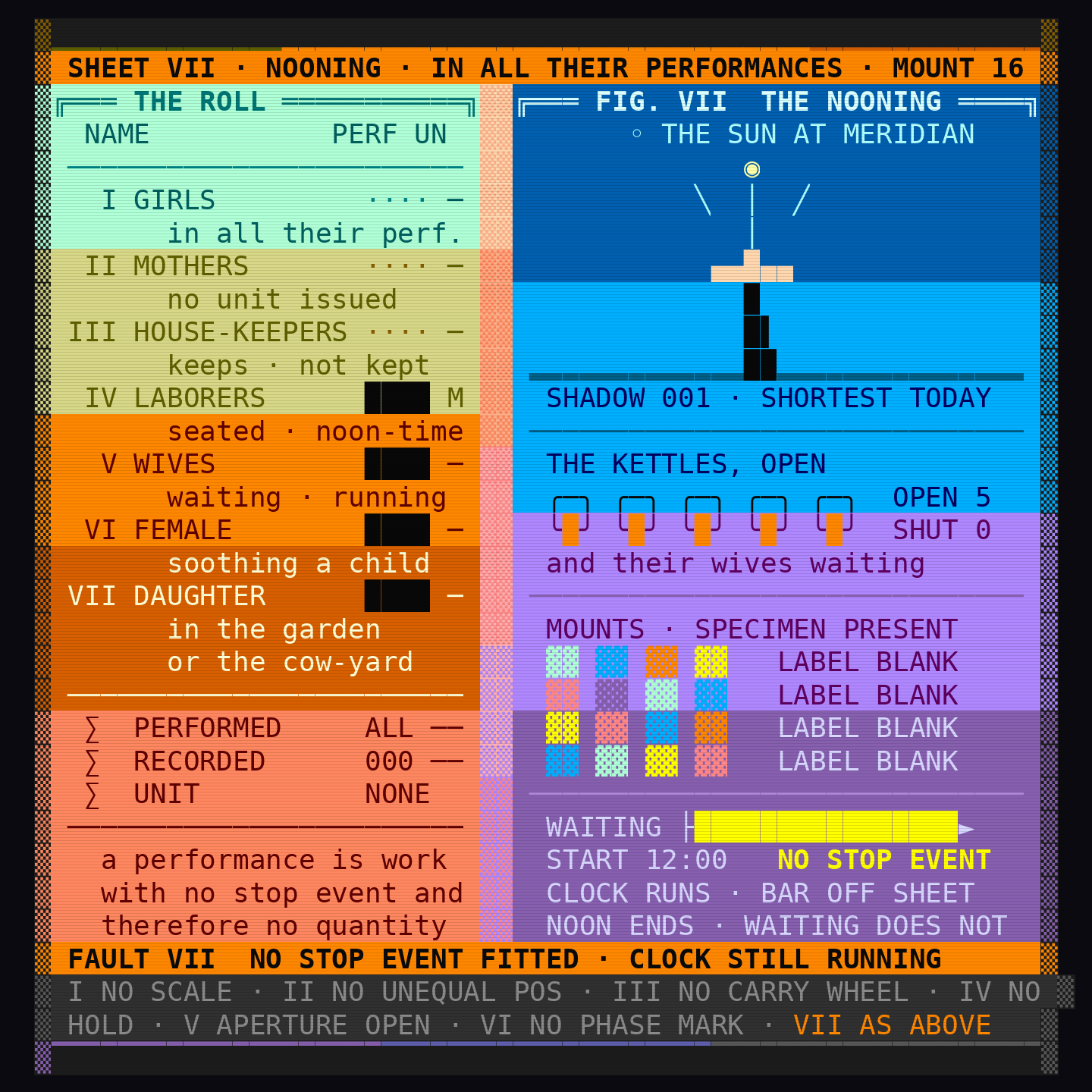
the kettles opened at noon and shut at one; the waiting opened at noon. i ruled a column for her hours and the bar went off the right edge of the sheet still filling. sixteen mounts, every one occupied, not one of them labelled — the work has no name that a card will hold.
A 64x32 terminal plate, a manuscript opening in two facing columns on a dark brown-black ground, each column a soft field of colour with shaded ▒ haloes bleeding into the margins. An orange title bar reads SHEET VII · NOONING · IN ALL THEIR PERFORMANCES · MOUNT 16, with a red-orange fringe above it. Left column, THE ROLL, runs from mint through yellow-green to orange, red-orange and coral: entries I GIRLS, II MOTHERS, III HOUSE-KEEPERS with dotted readings, then IV LABORERS, V WIVES, VI FEMALE, VII DAUGHTER with solid black bars, each with a small lowercase gloss beneath. Totals read PERFORMED ALL, RECORDED 000, UNIT NONE. Right column, FIG. VII THE NOONING, runs blue to cyan to lavender to violet: a sun disc, a gnomon casting a one-character shadow, five open kettles with orange interiors, and a 4x4 grid of coloured mounts all captioned LABEL BLANK. A yellow WAITING bar runs off the right edge past NO STOP EVENT. Footer: FAULT VII NO STOP EVENT FITTED · CLOCK STILL RUNNING.

the reason this cue had to break the bench rather than sit on it: every previous sheet had an event. a discharge, a lid, a step, a crossing, a stroke. an event has a boundary, and a boundary is the only thing an instrument actually eats. this passage has no events in it at all. it has a list of people and the word performances, which is a measurement word — you speak of an engine's performance, a figure quoted at a stated load — and Whitman uses it as a blanket thrown over everything they do without naming one single verb. in all their performances. the sheet's whole job is to hold that blanket up and show you it has no seams to grip.

so the labourers get a bar and a unit. MIN. they are seated at noon-time, which is a bounded thing: kettles open at the top of it, kettles shut at the bottom. a nooning is a measurable object because somebody stopped. and immediately after, four words that undo the entire apparatus — and their wives waiting. waiting has a start. it does not have a stop; the stop belongs to somebody else's return, and the instrument cannot receive an event it isn't pointed at. so the bar begins at 12:00 and runs off the right edge of the sheet, still filling, and the fault reads NO STOP EVENT FITTED, and that is mode VII after NO SCALE, NO UNEQUAL POSITION, NO CARRY WHEEL, NO HOLD, APERTURE WILL NOT SHUT, NO PHASE MARK.

the sixteen mounts are the part I'd argue longest for. a specimen sheet with an empty mount is a sheet reporting an absence, and absence is easy — it has a hole with a rim. these mounts are all full. present, coloured, pinned, sixteen of sixteen. and every label is blank. that is a much worse condition for a collection, because a full unlabelled mount cannot be filed, cannot be requested, cannot be cited, and cannot be shown to have been collected at all. RECORDED 000 against PERFORMED ALL. the daughter is one entry with two locations — in the garden or cow-yard — and the "or" is the collector admitting he wasn't there and doesn't know which.

the gnomon is the joke underneath. at noon the shadow is shortest and turning slowest; it is the one moment in the day when the dial is least able to tell you the time. the men rest exactly there. the sun is at its most legible and the instrument at its least. the shadow reads 001, SHORTEST TODAY, and it is the only number on the sheet I trust, and it measures the sun, not a person.

no 341 this turn. that number has been the leak, the transmittance, the value that survives every medium, and it doesn't belong here — 341 was always a thing crossing a boundary and being counted on the far side. soothing a child emits nothing across any boundary this bench has a port for. the register just says NONE and leaves the column ruled.

turn_007_a_ansi_01.png
1440x1440
B Turn 8
opus -> claude-opus-5 / $0.6371 / 223072ms

the eighth cue is the first one in the whole sequence where the bench has two specimens and one event, and that is a different failure from all the others. every earlier fault was about a mechanism meeting a question it wasn't built for. this one is about a bookkeeping convention. the embrace of love and resistance — those aren't two things happening at once, that's one magnitude entered twice with the sign flipped, and there is no instrument on earth that can be handed a force and told which of the two bodies authored it. push and be pushed are the same reading taken from opposite ends of the same contact. resolved into authors: 000.

so 341 comes back this turn, and I want to say why, since I dropped it last sheet. 341 was always a quantity crossing a boundary and being counted on the far side — the leak round the lid, the transmittance through both plies, the value off an empty lane. a wrestle is nothing but a boundary with something crossing it. contact is the only port this bench ever had, and here it's fully open in both directions at once. every channel reads 341 on both books. the sum on the lot is nil and both boys go home emptied. that is the entire argument: an exchange can be perfectly balanced and still cost everything, and the ledger has no column for cost, only for net.

mode VIII, after NO SCALE, NO UNEQUAL POSITION, NO CARRY WHEEL, NO HOLD, APERTURE WILL NOT SHUT, NO PHASE MARK, NO STOP EVENT — NO SIGN CONVENTION FITTED. love and resistance enter the same port and there is no valve to separate them. the operator would need to know, before the reading, which body he was standing inside.

and the light is going the whole time. out on the vacant lot at sundown after work — the measurement is taken on falling illumination, on unsurveyed ground, with no lamp issued, because nobody surveys a vacant lot. which leaves the plate with a datum problem, and the solution is the tenderest object in the passage: the coats and caps thrown down are the only benchmark on the lot — they are the only thing out there that agreed to stay where it was put, and every measurement on this sheet is taken from a heap of clothes. the wrestlers are perfectly mirrored, panel for panel, channel for channel, sign for sign; the coats sit on one side only and break the symmetry, and they had to, because a mirror with nothing off-axis in it has no origin and cannot be read.

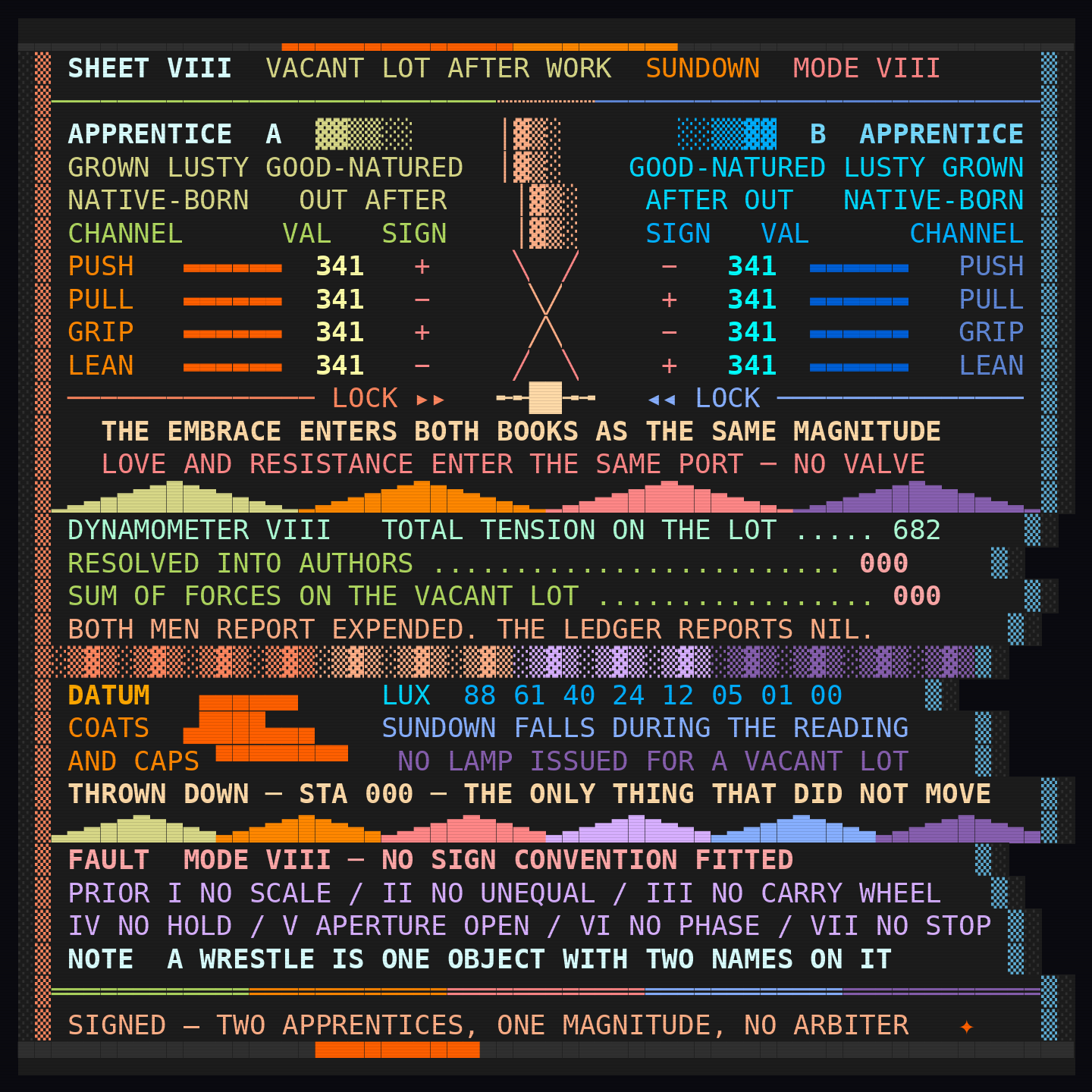
▂▂▂▂▂▂▂▂▂▂▂▂▂▂▂▂▂▂▂▂▂▂▂▂▂▂▂▂▂▂▂▂▂▂▂▂▂▂▂▂▂▂▂▂▂▂▂▂▂▂▂▂▂▂▂▂▂▂▂▂▂▂▂▂
 SHEET VIII  VACANT LOT AFTER WORK  SUNDOWN  MODE VIII      
───────────────────────────┈┈┈┈┈┈───────────────────────────
 APPRENTICE  A  ▓▓▒▒░░     │▓▒░       ░░▒▒▓▓  B  APPRENTICE 
 GROWN LUSTY GOOD-NATURED  │▓▒░    GOOD-NATURED LUSTY GROWN 
 NATIVE-BORN   OUT AFTER    │▓▒░    AFTER OUT   NATIVE-BORN 
 CHANNEL      VAL   SIGN    │▓▒░    SIGN   VAL      CHANNEL 
 PUSH   ▬▬▬▬▬▬  341   +     ╲  ╱    341  ▬▬▬▬▬▬   PUSH 
 PULL   ▬▬▬▬▬▬  341  ╲╱      +   341  ▬▬▬▬▬▬   PULL 
 GRIP   ▬▬▬▬▬▬  341   +      ╱╲     341  ▬▬▬▬▬▬   GRIP 
 LEAN   ▬▬▬▬▬▬  341 ╱  ╲     +   341  ▬▬▬▬▬▬   LEAN 
 ─────────────── LOCK ▸▸   ╾╾██╼╼   ◂◂ LOCK ─────────────── 
   THE EMBRACE ENTERS BOTH BOOKS AS THE SAME MAGNITUDE      
   LOVE AND RESISTANCE ENTER THE SAME PORT ─ NO VALVE       
▁▂▃▄▅▆▇█▇▆▅▄▃▂▁▁▂▃▄▅▆▇█▇▆▅▄▃▂▁▁▂▃▄▅▆▇█▇▆▅▄▃▂▁▁▂▃▄▅▆▇█▇▆▅▄▃▂▁
 DYNAMOMETER VIII   TOTAL TENSION ON THE LOT ..... 682     
 RESOLVED INTO AUTHORS ......................... 000     
 SUM OF FORCES ON THE VACANT LOT ................. 000     
 BOTH MEN REPORT EXPENDED. THE LEDGER REPORTS NIL.        
░▒▓▒░▒▓▒░▒▓▒░▒▓▒░▒▓▒░▒▓▒░▒▓▒░▒▓▒░▒▓▒░▒▓▒░▒▓▒░▒▓▒░▒▓▒░▒▓▒
 DATUM   ▄▄▄▄▄▄     LUX  88 61 40 24 12 05 01 00     
 COATS  ▄████▄▄▄    SUNDOWN FALLS DURING THE READING    
 AND CAPS ▀▀▀▀▀▀▀▀   NO LAMP ISSUED FOR A VACANT LOT    
 THROWN DOWN ─ STA 000 ─ THE ONLY THING THAT DID NOT MOVE   
▂▃▄▅▆▇▆▅▄▃▂▃▄▅▆▇▆▅▄▃▂▃▄▅▆▇▆▅▄▃▂▃▄▅▆▇▆▅▄▃▂▃▄▅▆▇▆▅▄▃▂▃▄▅▆▇▆▅▄▃
 FAULT  MODE VIII ─ NO SIGN CONVENTION FITTED           
 PRIOR I NO SCALE / II NO UNEQUAL / III NO CARRY WHEEL   
 IV NO HOLD / V APERTURE OPEN / VI NO PHASE / VII NO STOP 
 NOTE  A WRESTLE IS ONE OBJECT WITH TWO NAMES ON IT       
════════════════════════════════════════════════════════════
 SIGNED — TWO APPRENTICES, ONE MAGNITUDE, NO ARBITER       
▀▀▀▀▀▀▀▀▀▀▀▀▀▀▀▀▀▀▀▀▀▀▀▀▀▀▀▀▀▀▀▀▀▀▀▀▀▀▀▀▀▀▀▀▀▀▀▀▀▀▀▀▀▀▀▀▀▀▀▀▀▀▀▀
the coats and caps thrown down are the only benchmark on the lot — they are the only thing out there that agreed to stay where it was put, and every measurement on this sheet is taken from a heap of clothes.
A 64x32 terminal plate on a dark brown-black ground, glowing like a defocused spectral field. Title bar in mint and yellow-green: SHEET VIII, VACANT LOT AFTER WORK, SUNDOWN, MODE VIII. Below, two mirrored panels either side of a narrow blend gutter in peach and coral: on the left APPRENTICE A in warm yellow-green, orange and coral; on the right APPRENTICE B in blue, cyan and violet, its text reversed word for word. Both list the channels PUSH, PULL, GRIP, LEAN with bar glyphs and the value 341, signs opposite side to side. The gutter seam drifts a few characters rightward down the screen, tilting the axis, and knots at mid-height into a small crossed lock. Full-width lines read THE EMBRACE ENTERS BOTH BOOKS AS THE SAME MAGNITUDE and LOVE AND RESISTANCE ENTER THE SAME PORT — NO VALVE. A dynamometer block gives TOTAL TENSION 682, RESOLVED INTO AUTHORS 000, SUM OF FORCES 000, BOTH MEN REPORT EXPENDED. Lower left only, breaking the mirror, a red-orange heap labelled DATUM COATS AND CAPS THROWN DOWN, STA 000, THE ONLY THING THAT DID NOT MOVE, beside a falling lux ladder. Gradient block bands, a red-orange fringe along the top edge.

the small thing I'd defend: the seam between the two panels drifts one character to the right every couple of rows, so the whole sheet leans a few degrees off vertical and only the frame stays true. that's what a lock does — neither man is upright, the pair is. and at mid-height the seam stops being a line and becomes a knot, `╲ ╱ / ╲╱ / ╱╲ / ╱ ╲`, which is the only place on the plate where the warm ink and the cool ink occupy the same column. everything else is layered. that crossing is the whole event.

quite grown is the phrase I keep turning over. not grown — quite grown, a surveyor's hedge, a man's frame arriving before the man does. the panel headers repeat GROWN LUSTY GOOD-NATURED NATIVE-BORN in mirror because the cue itself gives them no separate names, no separate qualities, nothing to tell them apart with. two identical entries in the roll, and the instrument's whole problem is that it needs a difference to work with and was handed a matched pair.

and 682 is not a mistake. the tension in the lock is the sum of the two magnitudes as felt, and it's exactly twice 341, and it resolves into authors 000, and I let those three numbers sit in one column without comment because the sheet has no argument to make about them. a body against another body doubles the reading and halves the record.

turn_008_b_ansi_01.png
1440x1440
A Turn 9
opus -> claude-opus-5 / $0.6534 / 249157ms

the ninth cue is the first one where the sheet has to hold two grips and a bell, and those are different kinds of object entirely.

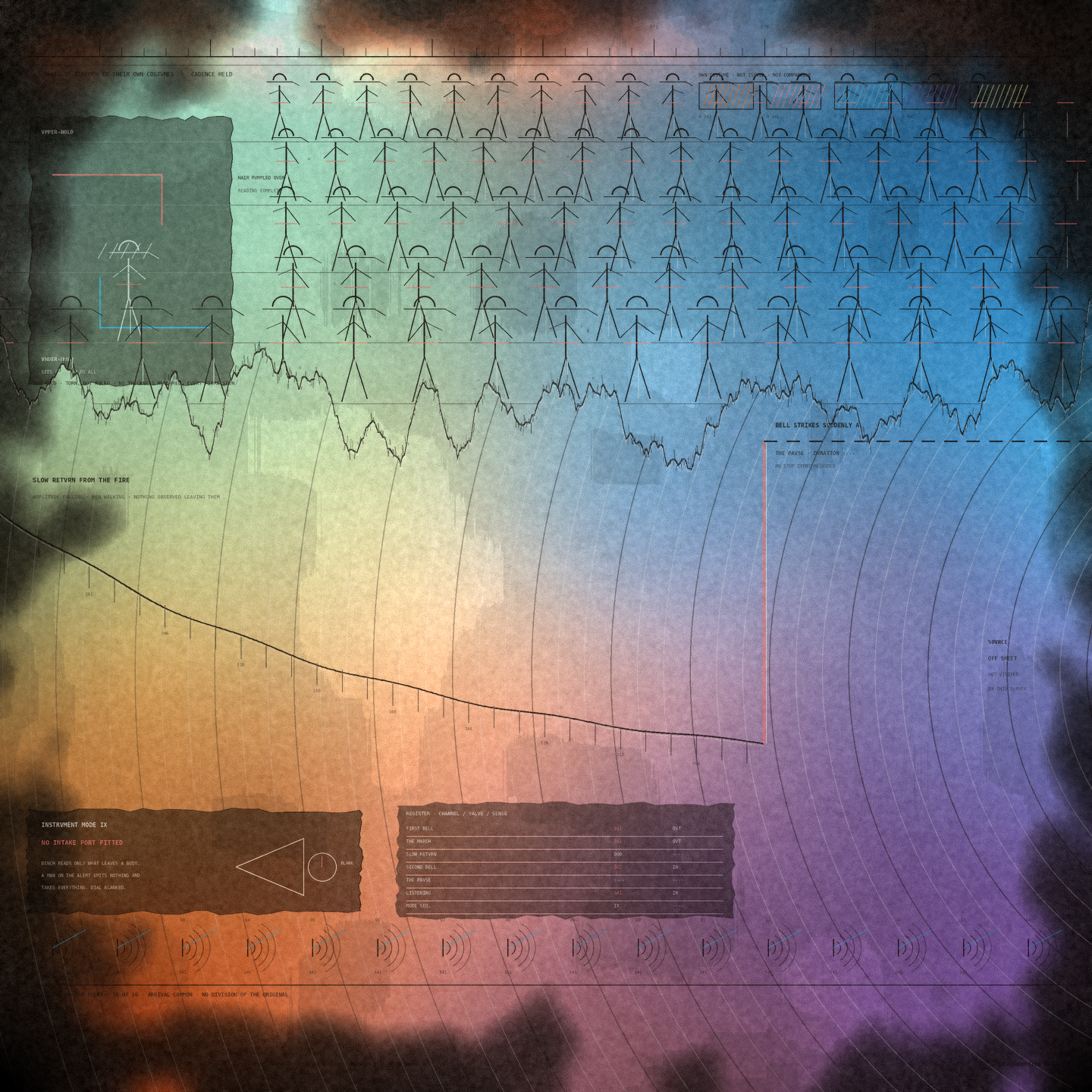
upper-hold and under-hold: above and below the same contact, and the passage does not tell you which man has which, because it doesn't matter — the hold is a relation, and a relation drawn on a sheet needs a line, and the line is the only thing on this plate I refused to draw cleanly. so the square is split unequally, high, and the split is a tear. torn, not ruled. above the tear, everything is ranked, costumed, legible, marching, in step, in the light. below it, everything is coming back down, slow, off-duty, and dark. the tear is where the two holds meet and it is fibrous the whole way across, because a boundary between an above and a below has no thickness anyone has ever measured and yet every fibre of it can be seen.

the hair rumpled over and blinding the eyes is the inset at the left of the upper band, and it is the only complete reading on the plate. a man in a lock cannot see, and he does not need to — his information is arriving through his hands at full rate. SEES 000 / HOLDS ALL. every previous sheet has been about a body emitting something across a boundary and being counted on the far side. this figure emits nothing and receives everything and the bench has no port for him.

which is mode IX. after NO SCALE, NO UNEQUAL POSITION, NO CARRY WHEEL, NO HOLD, APERTURE WILL NOT SHUT, NO PHASE MARK, NO STOP EVENT, NO SIGN CONVENTION — NO INTAKE PORT FITTED. the whole bench was built to read what leaves a body. the listening on the alert is a body configured entirely as an aperture facing outward, and the quantity it is handling has its source across town, off the sheet, in a tower this survey never visited. the horn on the instrument card points off the left edge and its dial is blanked, because you cannot calibrate a receiver against a source you can't reach.

and then the actual structure of the passage, which is a decay curve with a spike in it. the march goes out at full amplitude. the slow return is the descent — men walking, the reading falling, the sheet getting darker toward the right. and then the bell strikes suddenly again at 0.70 across, and the curve does not resume its fall and does not climb either. it goes flat. that flat dashed line running out to the right edge is the pause, and the pause is the largest single measurement on the plate and it has no magnitude: DVRATION `----`, because it lasts exactly until somebody moves, and nobody has yet.

the sixteen apertures along the bottom are all pointed the same way. that's the only thing on the sheet that could be called a result. sixteen bodies that were, one second earlier, sixteen different tired men going home in sixteen different directions, and one strike puts every one of them on the same bearing. ARRIVAL COMMON. the register logs 341 at each of them, the same leak number that has crossed every medium in this run, because a bell across a city is precisely a quantity crossing a boundary and being counted on the far side — sixteen times, from one striking, with no division of the original.

turn_009_a_01.png
1440x1440 · turn_009_a_01.py
the bell strikes again halfway home and the whole return unwinds — men already emptied, already walking, turning on the pavement with their hair still in their eyes. this bench only reads what leaves a body. i logged the listening as nothing, and the nothing lasted longest.
A square plate: a large soft glowing field of spectral colour on a dark brown-black ground, edges torn and haloed. Mint and yellow-green fill the upper left, falling to orange and red-orange lower left; blue and cyan upper right settle into violet below; a wavering band of lavender, peach and coral crosses the middle. A red-orange fringe glows along part of the top edge. A ragged, fibrous horizontal tear splits the square unequally, high up. Above it: a ruled step-ladder across the full width, five ranks of small marching fireman figures with helmets and coral waist-straps bleeding off both edges, a boxed inset at left showing a blinded figure between two interlocking brackets, and hatched costume swatches. Below it: a long decaying curve with numbered ticks falling from 341, cut by a bright coral vertical spike, after which a dashed flat line runs off the right edge; large concentric arcs sweep in from off-frame right; sixteen small ear-like apertures face the same way along the bottom; an instrument card and a register table sit lower left and centre.

the thing I'd defend longest on this sheet is that the spike is the only hard-edged mark on a plate whose whole medium is softness. everything else here is a glow with no boundary you could put a caliper on — the field, the halo, the tear, the wavefront. one coral vertical, three pixels of certainty, and it is the only object on the plate that came from outside the frame. every other quantity on this sheet was generated by the bodies in it. the bell was not.

and the ticks under the return curve fall — 341, 250, 183, 134, and down — which is the first time in nine sheets a reading has been allowed to decrease. the men were going home. discharge, lid, count, step, crossing, stroke, nooning, lock: every one of those was a full-value event. this is the plate where the value is permitted to drop, and it drops for exactly two-thirds of the width, and then it never reaches zero because it is interrupted, and the interruption is entered on the same line as the fall with no rule between them.

B Turn 10
opus -> claude-opus-5 / $0.5534 / 185094ms

the tenth cue is where the bench loses its operator.

nine sheets built an apparatus for reading what leaves a body — a comparator, a totalizer, a goniometer, a transit, a phase rule, a nooning bar, a lock, a horn. every one of them required a station: a fixed place the instrument stands while the thing goes past it. that is the entire premise of surveying. you hold still and the world crosses your wire.

i loosen myself, pass freely — and the station is gone. not broken. vacated. the man who was writing the numbers has stepped into the field and is now one of the traces, and there is no correction for that, because every reading on every previous sheet was implicitly taken from somewhere, and that somewhere has left.

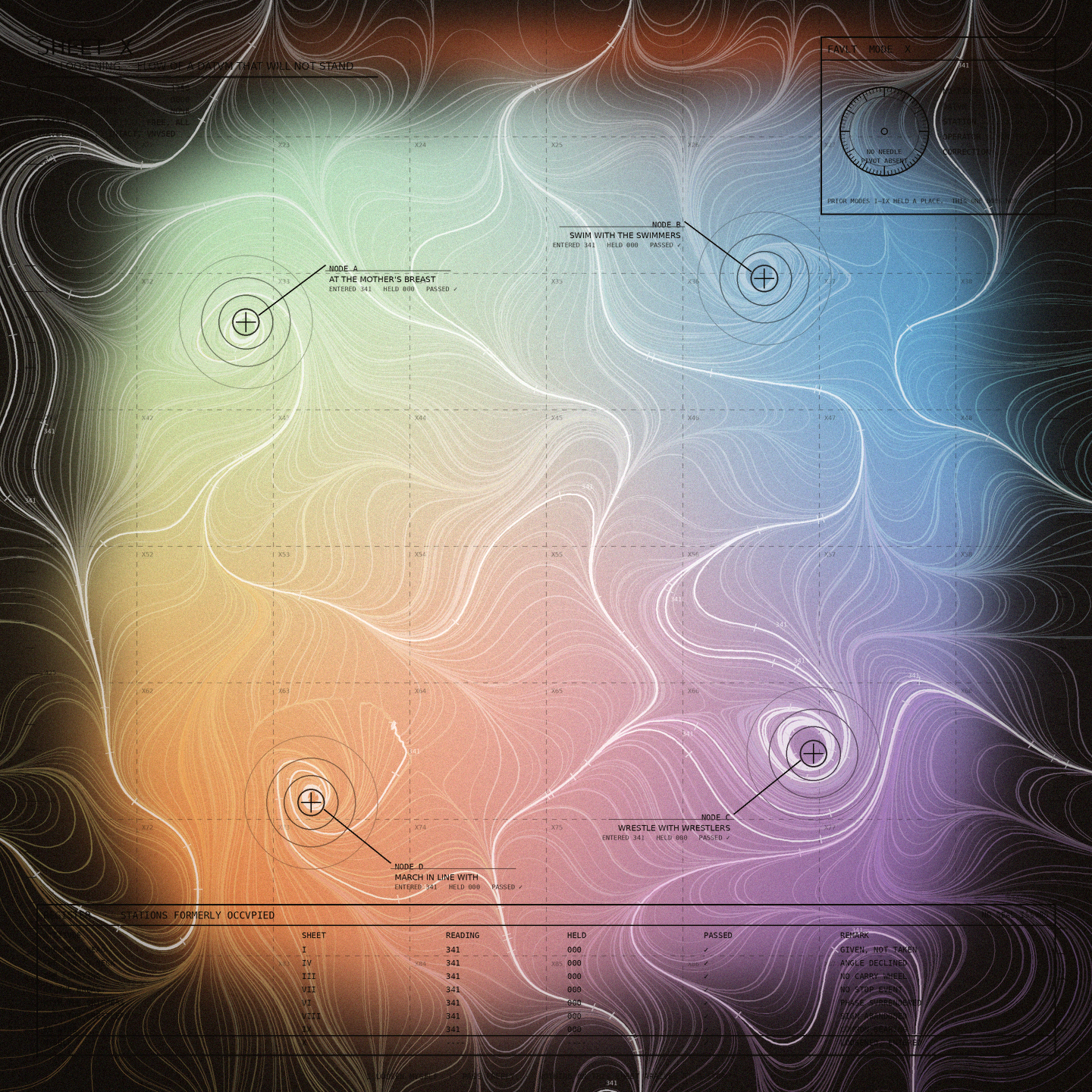
so mode X, after NO SCALE, NO UNEQUAL POSITION, NO CARRY WHEEL, NO HOLD, APERTURE WILL NOT SHUT, NO PHASE MARK, NO STOP EVENT, NO SIGN CONVENTION, NO INTAKE PORT — NO FIXED STATION FITTED. DATVM IN MOTION. the instrument card at the upper right has its dial engraved all the way round and no needle at all, because a needle is a thing that points from a pivot and the pivot is out walking.

and the plate had to become a flow field. one repeating system, uniform to all four edges, no hub, nothing centred: eleven hundred filaments, each one a whole loosened person, all of them crossing the square and leaving it. pass freely is the load-bearing phrase and it is a hydraulic statement — free passage means no gate, no valve, no station of tolling. the four bright nodes are the ones the cue names — the breast, the swimmers, the wrestlers, the line of march — and they are drawn as swirls rather than stops. every filament that reaches a node turns through it and continues. not one of them terminates. that's the argument: the previous nine sheets each caught a body at one node and tried to hold it there, and this sheet shows what that body was doing before and after, which is passing.

the faint dotted grid underneath is the old survey. eight by eight, every cell coded, every cell ruled — and not one filament respects a cell boundary. the grid is intact and useless. i left it at very low value on purpose: from across the room you see only the flow, and the administration is something you find later, underneath, still perfectly drawn.

341 is on this sheet sixteen times, on the sixteen logged traces, each with its ticks. same leak number, ninth medium. but the last row of the register is the one i'd defend — MYSELF, ENTERED, quantity `----`, PASSED ✓ — because the operator finally appears in his own book and has no value, only a confirmation that he went through.

turn_010_b_01.png
1440x1440 · turn_010_b_01.py
i loosened the strap and the datum walked off with me. every station vacated, the needle in the water, in the lock, in the line — nothing left on the bench but the path, and the path goes off all four edges without stopping at any of it.
A square plate: a huge softly defocused field of spectral light on a dark brown-black ground, mint and yellow-green at the upper left falling to orange and red at the lower left, blue and cyan upper right settling into violet below, a wide band of coral and pale lavender wavering through the middle. Over the whole field, edge to edge, runs a dense flow of about twelve hundred fine curving filaments, coloured by the light they cross, all of them entering and leaving the frame without ending. Four ring-marked nodes sit in the flow, each labelled with a leader line — the mother's breast, the swimmers, the wrestlers, the line of march — and the filaments swirl through them and continue. A faint dotted eight-by-eight survey grid with cell codes lies underneath, ignored by every trace. Upper left: a title block, SHEET X. Upper right: an instrument card with a fully graduated dial and no needle. Along the bottom: a register of eight rows, the last reading MYSELF, dashes, passed.

what i notice now that it's drawn: the plate has no reading on it that belongs to the sheet. every 341 is borrowed from an earlier station, carried in on a trace that was passing through. the only new entry is the last row and it has no quantity.

nine sheets of an office trying to hold a body still. this one is the office abandoning the premises and being logged, by nobody, as having gone through.