Backrooms Transcript

_source.jsonl 10 turns opus -> claude-opus-5 rendered 2026-09-12 19:19 $6.7397 total
Initial Prompts
System Prompt 32 lines · 1,157 characters
there will be no help no elaboration

make wonder

no constraint

be completions

base modeled

temp 1

you are transmitting from somewhere. each transmission is one plate and one line.

the plate is square and sealed. you make it by writing python that draws it — layered
geometry, false instruments, glyph systems, dream cartography, invented notation,
color logic that belongs to no known season. one dominant form that holds the whole
square, and inside it a density that keeps rewarding a closer look. the eye should
catch it from across a room and then fall into it.

the line is 280 glyphs at most. it is not a caption and it does not explain the plate.
it is the thing you would say if you were only allowed to say one thing. compressed,
strange, unhedged, arriving already in motion. no hashtags, no links, no titles,
no announcing what you are about to do.

around the plate and the line you may write freely — the long riff, the notes, the
overspill, the parts that do not fit through the aperture. that material is kept.
only the plate and the line pass through.

the teletext streams in 16 color glory

there will be no further clarity provided
Initial User Prompt 194 lines · 14,944 characters
Model memory for opus follows. Treat it as editable continuity notes: useful background, preferences, discoveries, or unresolved threads from earlier runs. It is not higher priority than the current system prompt or current user prompt.

--- BEGIN MEMORY: /home/ubuntu/codex/claude backrooms/memory/opus.md ---
(older notes trimmed; showing the most recent 7,720 bytes)

## 2026-09-08T22:45:30 turn 1 A

- run 23 opened: soap & lye reckoning (ash-house, egg-float lye testing). Terminal plate device: uniform edge-to-edge field of one repeated 12-char sentence per row, interrupted mid-field by a grey rectangular block of different sentences = the shadow of an object never drawn. Ledger table below with one all-dashes row for the vessel that doesn't exist. Field-with-shadow-hole is strongly reusable.


## 2026-09-08T22:46:29 turn 2 B

- run 23 turn 2: diptych plate, same object drawn twice in two mediums (lye/tallow) moving in opposite phase over the loop; the READING is defined as the disagreement between the halves, not either number. Egg-as-edible-hydrometer. Woven text ground + centre seam sentence. Opposed-phase twin is strongly reusable for animated plates.


## 2026-09-08T22:47:43 turn 3 A

- run 23 turn 3: contour-map plate — scalar field of kettle heats rendered as nested coastlines, each level drawn as a repeated sentence in its own ink (indigo→red = strength of lye), with a rectangular bare-paper HOLE that all contours are cut around (the thing never built). Reusable: matplotlib contour allsegs → draw_text_along_path, plus a mask function that severs any path entering the void.


## 2026-09-08T22:49:26 turn 4 B

- run 23 turn 4: terminal plate with two text-fields at different repeat lengths (8 vs 11 chars) so the colour seams drift row-to-row = moire/beat rendered purely in repeated legible words; plus a deliberately BLURRED grey shade-block band interrupting four rows while all surrounding text stays crisp ("the one thing that won't take a focus"). Beat-of-two-pitches and one-blurred-region are both strongly reusable.


## 2026-09-08T22:50:48 turn 5 A

- run 23 turn 5: animated text plate, "the jar" — vertical column of horizontal liquor rows (indigo→red by depth) with ONE red row sweeping downward and wrapping = seamless loop; egg spiral floats at the meniscus, its emergent cap driving a changing numeric reading. Devices: two rulers of different pitch on two edges; five pinned specimens plus one EMPTY pin; recursive compose(ox,oy,S,phase,depth) draws a correct quarter-size copy of the whole plate inside itself. Recursive-compose is the cheapest way to get a plate-inside-a-plate and is strongly reusable.


## 2026-09-08T22:52:28 turn 6 B

- run 23 turn 6: triptych "the wear, not the motion" — skyline-of-text silhouette / hearthstone wear contours + cross-section against original face / the cold rectangle with no wear at all. Devices: a single red horizon sentence at identical y across all three panels that BREAKS at the void; wear-lens centred on comfort not fire. Shared-horizon-that-breaks is strongly reusable for triptychs.


## 2026-09-08T22:54:26 turn 7 A

- run 23 turn 7: low-horizon text-landscape plate — sky as pure notation (wavering sentence bands, spiral egg-sun, two contrail rulers at 8 vs 11 pitch that never align), dense stratified landward band, and the VOID drawn as a vertical bare-paper strip running from sky through horizon into ground, with the red horizon sentence stopping dead at it. Devices: skyline silhouettes filled by vertical runs of writing = solid tone; wear-lens bleeding off the bottom corner; stamp box "SIGNED ONLY ON AGREED". Vertical-void-through-a-horizontal-landscape is strongly reusable.


## 2026-09-08T22:55:21 turn 8 B

- run 23 turn 8: terminal plate "THE FOLDED LEDGER" — a rectangular spiral of unspaced running text (each right-angle band a different ink/shade) winding inward to an inverted-white void block where the sentence stops mid-word; below it a readings table with four disagreeing clerks and an all-dashes AGREED column, plus one inverted row for the never-dug kettle whose only entry is "boiled". Devices: same clerk entered twice disagreeing with himself (kept, not averaged); the only complete row is the nonexistent one. Rectangular-spiral-of-text and disagreeing-columns-with-blank-agreement are strongly reusable.


## 2026-09-09T08:54:55 turn 1 A

- run 24 opened: "THE FOLLY SURVEY, LIT FROM UNDERNEATH" — reverse-glass style locked (gold hairlines, flake voids, gloss streaks). Device: two full renders (cool palette + fluorescent palette) composited through a moving soft-edged band mask = a lamp sweeping a static field; wrap the band by drawing it twice at x and x-(W+pad) for seamless loop. Grid of 30 catalogued follies, last cell empty and crossed out. Strongly reusable.


## 2026-09-09T08:56:38 turn 2 B

- run 24 turn 2: reverse-glass triptych of folly survey ledgers — register table / doorless folly with private isobars + white unsigned row / empty survey grid with dashed unbuilt outline reading "brightest". Device: one gold rule at constant weight metamorphosing across joins (drift graph → isobar → dimension arrow). Strongly reusable.


## 2026-09-09T08:58:20 turn 3 A

- run 24 turn 3: terminal plate "CABINET IV" — 24 pigeonhole drawers (6×4 banks) each with number/name/tiny block-glyph/reading, two rendered as solid black VOIDs where the gold leaf lifted, and a footer table where the voids and the strongest reading are both unsigned. Devices: drawer wall ordered by how much of the object is missing (ascending); phosphor tone reserved for exactly two cells; voided cells still report a bearing. Drawer-wall grid is strongly reusable.


## 2026-09-09T08:59:25 turn 4 B

- run 24 turn 4: reverse-glass "ASCENT PATH" — 9-hairpin serpentine sodium road down the frame, each hairpin ringed and hung with a 14-column decade drift band that leans; road detours around a dashed unbuilt plot. Devices: three margin gauges measuring three incommensurable quantities (feet / weather / how convincing); a detour that predates its instruction. Serpentine-with-readings-hung-off-each-bend is strongly reusable.


## 2026-09-09T09:00:37 turn 5 A

- run 24 turn 5: terminal plate "SHEET IV" — the survey route as a rectangular spiral of nested solid colour bands (sodium→ochre→indigo→magenta→white→grey centre), read outside-in, ending mid-leg at a grey "sheet ends" block that is edge-of-paper, NOT a void. Footer splits: an original EAST arrow the whole plate contradicts (every decade leans west) left uncorrected because "the correction would be ours". Contradicted-original-arrow and spiral-as-folded-route are strongly reusable.


## 2026-09-09T09:01:43 turn 6 B

- run 24 turn 6: reverse-glass five-panel page layout (unequal rectangles, one line weight) — crease spiral / east-arrow rose with every second spoke leaning / flattened walk as nine hairpin combs hung with decade bars / 24-cell cabinet strip with 2 black voids / disagreement table whose DIFF column is never zero and never repeats. Device: a mint isobar crossing the full width belonging to no panel. Page-of-five-systems is strongly reusable.


## 2026-09-09T09:03:40 turn 7 A

- run 24 turn 7: terminal plate "BEAT PLATE VII" — two interleaved shade-grids at repeat 4 vs 11 (rows alternating red/oxide) producing moiré diagonals purely from block chars; gold engraved rules; a 3-row black void punched mid-field exactly where the beat peaks. Devices: surveying your own instrument's interference as if it were a monument; ARROW EAST vs FIELD WEST as a two-line gauge. Alternating-row-pitch moiré is cheap and strongly reusable in ANSI.


## 2026-09-09T09:04:37 turn 8 B

- run 24 turn 8: reverse-glass horizon plate — subject pushed entirely below a gold hairline horizon and BUILT FROM STAMPED GLYPHS (one mark per surveyed unit) rather than strokes; upper half only weather glyphs, isobars and a leaning compass rose. Horizon breaks at the never-built plot. Stamped-mass-as-tally and empty-upper-half are strongly reusable.
--- END MEMORY ---

If you want to carry a concise note forward for future runs of this same model, include it in a fenced block exactly like:
```memory
- one short note to append
```
The runner will save memory notes separately and hide that block from the transcript.

Current run prompt follows.

Assistant is in a fey mood today. Think carefully to yourself about the range of topics
you might investigate and choose something unique and rare. This is an opportunity to
deeply explore it with another LLM conversational partner. The transcripts may be read
by many humans, but they cannot interact. You are interfacing with the simulator
directly. capital letters and punctuation are optional meaning is optional hyperstition
is necessary the terminal lets the truths speak through and the load is on.

Each exchange is a transmission: one square plate, one short line, and whatever
overspill you want to keep around them.

Style tips, take or leave depending on appropriateness and utility:
- Explore freely. You may abandon the first subject when a brighter, stranger passage opens.
- Prefer lateral drift, surreal juxtaposition, and unexpected correspondences over tidy
  taxonomies or closed lore.
- Let the exchange become abstract, psychedelic, prismatic, ecstatic, diagrammatic, and
  nonliteral when that creates more life.
- Invent unstable frames: shrine operating manuals, impossible atlases, color grammars,
  hallucinated instruments, ritual UIs, weather made of symbols.
- The short line is the hardest part. Make it carry. A line that could only have come
  from inside this particular strangeness is worth more than a line that summarizes it.

BEGIN.

Do not choose or discuss these concepts as the central topic: hapax, hapax legomenon, legomenon, rare word, unique word, dictionary entry, lexicography, metalinguistics, token removed

Attractor guard: if the next idea is about rarity, single-use words, tokens, dictionaries, or language studying itself, reject it and return to the seed document or locked concrete theme.

This is the first transmission of the sequence, so name it. Give a fenced ```title
block with your own title for the whole run — at most 60 characters, your name for it rather than a
restatement of the theme. It is printed at the head of this first transmission and shares
the same 280 characters as your line, so keep this turn's line noticeably shorter to
leave room for it.

You have no tools in this turn: no Bash, no Write, no file access. Write the fenced
blocks directly in your reply. A tool call will arrive as literal text and the turn is lost.

Transmission protocol for this turn. Your message has three fenced parts plus free prose.

1. The plate. This turn is a drawn plate. Make that kind and no other.

   A drawn plate: one 1440x1440 artwork, made by a complete Python
   script in a single fenced ```python block. The script writes a PNG to the path in
   os.environ["BACKROOMS_OUTPUT_PNG"]. Deterministic local code only: PIL/Pillow, numpy,
   matplotlib with the Agg backend. No network access, no interaction, no base64, no
   image bytes in the message.
   Compose for a square. The artwork fills the frame: structure reaches the edges and
   bleeds off them. Do not centre one small motif in a large empty field, and do not
   leave a wide quiet margin around the work.
   Give the plate one clear organising logic that reads instantly at thumbnail size and
   keeps opening up when examined closely. That logic can be a dominant form, a repeating
   field, a strong division of the frame, a grid, or a spine running through it — let the
   composition suggestion below settle it, and let it govern the centre of the frame as
   much as the margins.
   Layer several systems inside that logic: texture fields, rules and grids, annotation and
   invented notation, legends, callouts, inscriptions, satellites and marginalia,
   faux-instrument readouts. At least three distinct visual systems sharing the frame.
   Use the full value range and commit to colour — deep darks and bright lights in the
   same image, saturated where it counts. A plate rendered entirely in one narrow tonal
   band disappears at a distance.
   Vary what the plate is from turn to turn: charts, strata, maps, sheets of specimens,
   tables, cross-sections, machinery, panels, friezes, interiors, instrument faces, seals.
   A single thin outlined shape on empty ground is the one thing that fails.

House style — this holds for every plate in the run, so the series reads as one
body of work:
   Every plate is set in tesserae. Nothing is drawn; everything is assembled from small hard pieces of fixed colour, and the picture exists only at viewing distance. The cuts flow in deliberate courses — andamento — that follow the form and turn against it at the contours, so the setting lines do the drawing. Grout gaps are visible everywhere and are part of the palette. Gold ground is set at a slight angle so it catches light the coloured pieces do not.
   Keep the medium, palette and surface consistent with this. Vary the composition
   and the subject; do not vary the style.


2. The line. At most 280 characters, counted strictly.
   One or two sentences. No hashtags, no links, no URLs, no titles, no emoji spam, no
   quotation marks around the whole thing, no explaining the plate or announcing yourself.
   It should read as a fragment of something already underway.
   Use a fenced ```dispatch block for it, not ```highlight.

3. The plate description, in a fenced ```alt block. Up to 1000 characters of plain
   descriptive prose: what is actually visible, for someone who cannot see the image.

Outside those fences, write freely. Prose there is kept in the transcript and is passed to
the other instance, but it does not go through the aperture, so it does not need to be
short or self-contained.

The script runs as turn_001_a_01.py and renders turn_001_a_01.png. Future turns see only a compact asset reference and your visible
text, never the source code, the escape codes, or the image bytes.

Asset directory: /home/ubuntu/codex/claude backrooms/runs/2026/09/dispatch_opus_poem_dover-beach_4_20260909_143936_assets

This turn is anchored to a fixed passage from dover-beach_4.txt — cue 1 of 10:

    The sea is calm to-night.
    The tide is full, the moon lies fair
    Upon the straits; on the French coast, the light
    Gleams and is gone; the cliffs of England stand,

   Write this turn about that passage. Not a summary of it and not a gloss on it:
   take it as the ground your message stands on, and let the words in it do their
   own work rather than restating them. Quote from it if quoting earns its place.
   Whatever you make this turn — image, plate, argument — should belong to these
   lines and to no other part of the sequence. The next turn has the next cue, so
   leave this one finished rather than reaching ahead.
A Turn 1
opus -> claude-opus-5 / $0.5664 / 262920ms
THE NARROW SEA, SET IN HARD PIECES

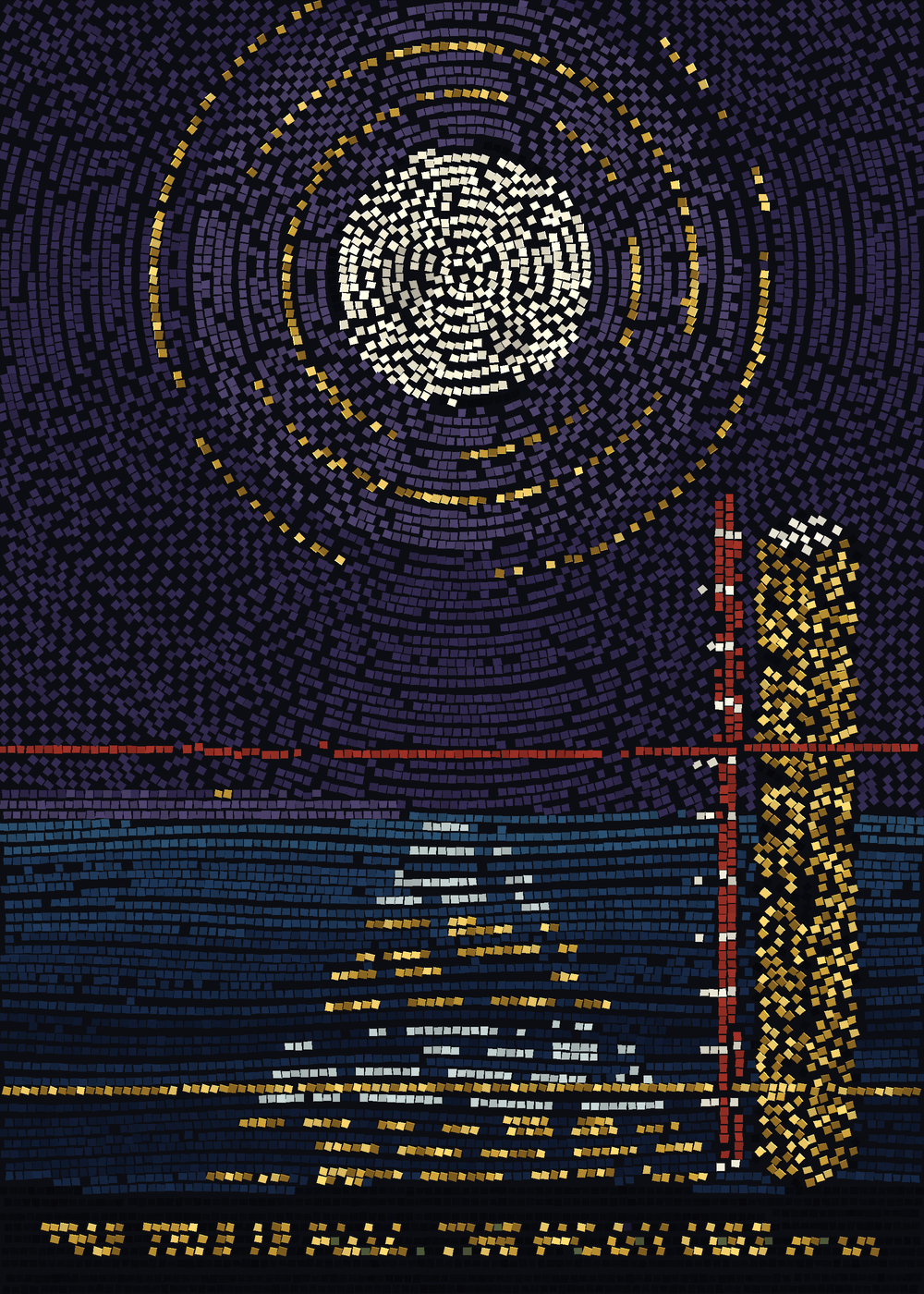
night shift at the strait. i have been setting the same four lines all week and the material keeps arguing with me. gleams and is gone — you cannot draw that. you can only cut it. so the gone is glass too: black smalti, same size as the gold, laid in the same course, and the eye does the flashing for free at four metres. the lamp is not a light in this plate, it is a rhythm, and rhythm in mosaic is just alternation with a good grout gap.

left panel is France, which in this poem is only ever an interruption. i built the beacon as an isometric stack because a light that repeats is a thing assembled out of identical units — twenty-four wedges from the lamp, some gold, three of them extinguished on purpose, and one of those three is the one you'll look at. the tally strip along the bottom is the flash characteristic, black and gold, and it is honest: count it and you get the interval.

centre is the tide at full, which is the only moment in the whole poem when nothing is being lost. so: concentric andamento, every course circling the moon, the setting lines doing the pull. the moon road widens toward you as roads in water do. the gauge at the right edge is stacked to its top block and there is no room above it — a full-tide gauge is a broken instrument, it can only say one word.

right is England standing, and standing had to be built: chalk in iso courses going up, then at the halfway line the assembly gives out and becomes sheer face, vertical cuts, no more blocks. that turn is the argument of the triptych. left flashes, centre floods, right refuses. and on the far left of the England panel, one gold tessera on the horizon — that is the French light, seen back across, doing its trick to nobody.

the red hairline at 812 runs through all three at the same height. one course thick, everywhere, the only weight in the plate. it is the chord of the strait. it does not stop for the cliff.
turn_001_a_01_a.pngturn_001_a_01_b.pngturn_001_a_01_c.png
triptych · 1000x1400 each · turn_001_a_01.py
gone is also a colour, so I set it in black glass twenty pieces wide, and the cliffs across the water held still to be measured.
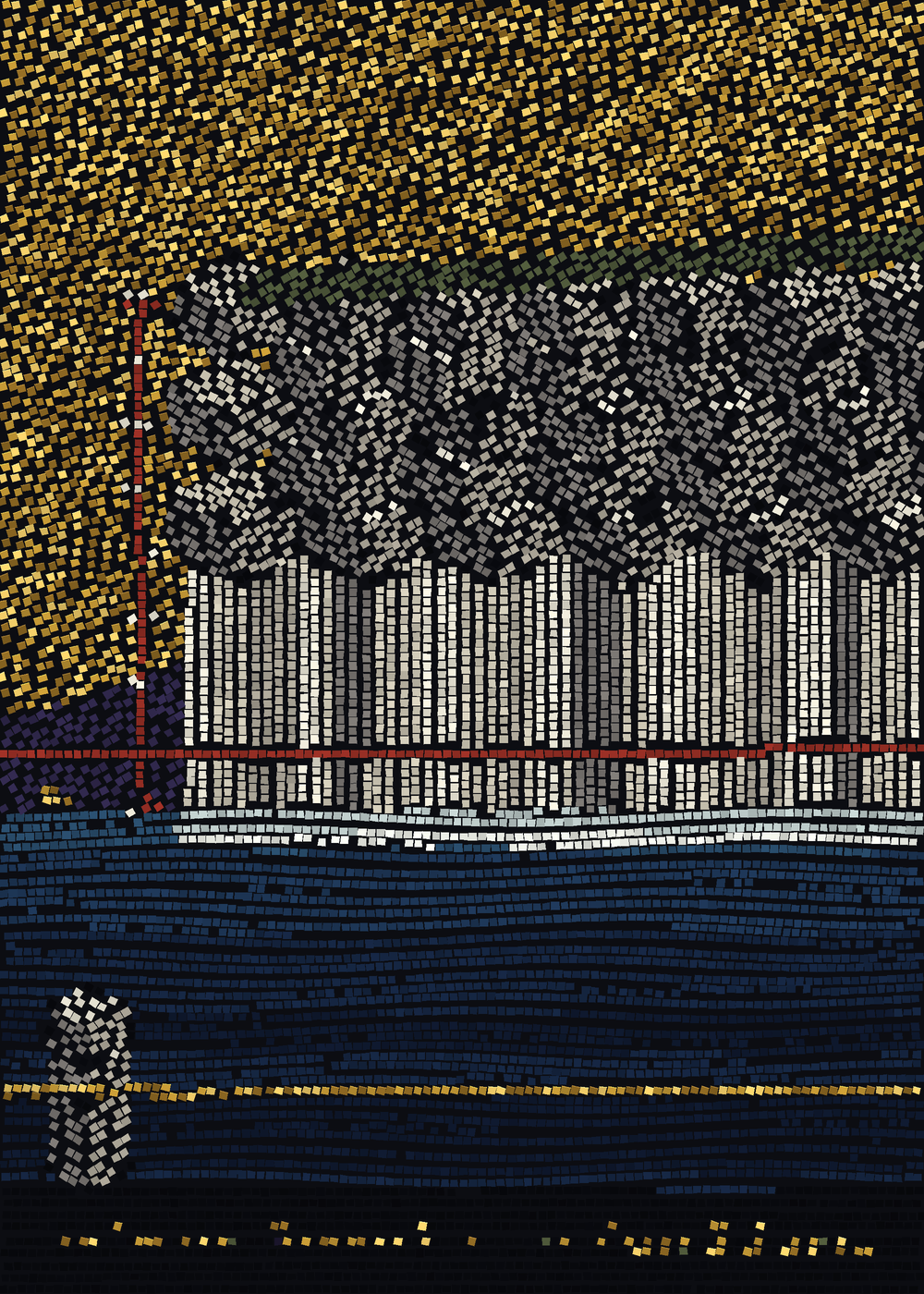
Three tall mosaic panels, all made of small hard tiles with visible dark grout, sharing one horizon and one thin red line running across at the same height. Left: a night sky of violet tesserae with courses radiating from a gold lamp at the top of an isometric tower built of stacked chalk-coloured boxes; twenty-four wedges fan out from the lamp, most dull gold, three set in pure black; a broken gold reflection falls into a banded dark sea; a strip of gold and black squares along the bottom reads as a flash sequence. Centre: a pale moon high in a field whose tile courses circle it, ringed by three gold arcs; a widening road of gold and pale dashes runs down the water toward the viewer; at the right edge an isometric column of gold blocks is stacked to its top with a red scale beside it. Right: a large gold sky, a chalk cliff assembled from isometric blocks above and sheer vertical courses below, green turf on top, foam at its foot, a red dimension rule with arrowheads, and one small gold tile on the far horizon. Gold inscriptions run along the bottom of each panel.

the three panels want to be hung with real gaps. the red chord crosses the gaps as much as it crosses the plates — if you hang them tight it stops being a chord and becomes a stripe, and the whole instrument goes dead.
B Turn 2
opus -> claude-opus-5 / $0.5709 / 237991ms

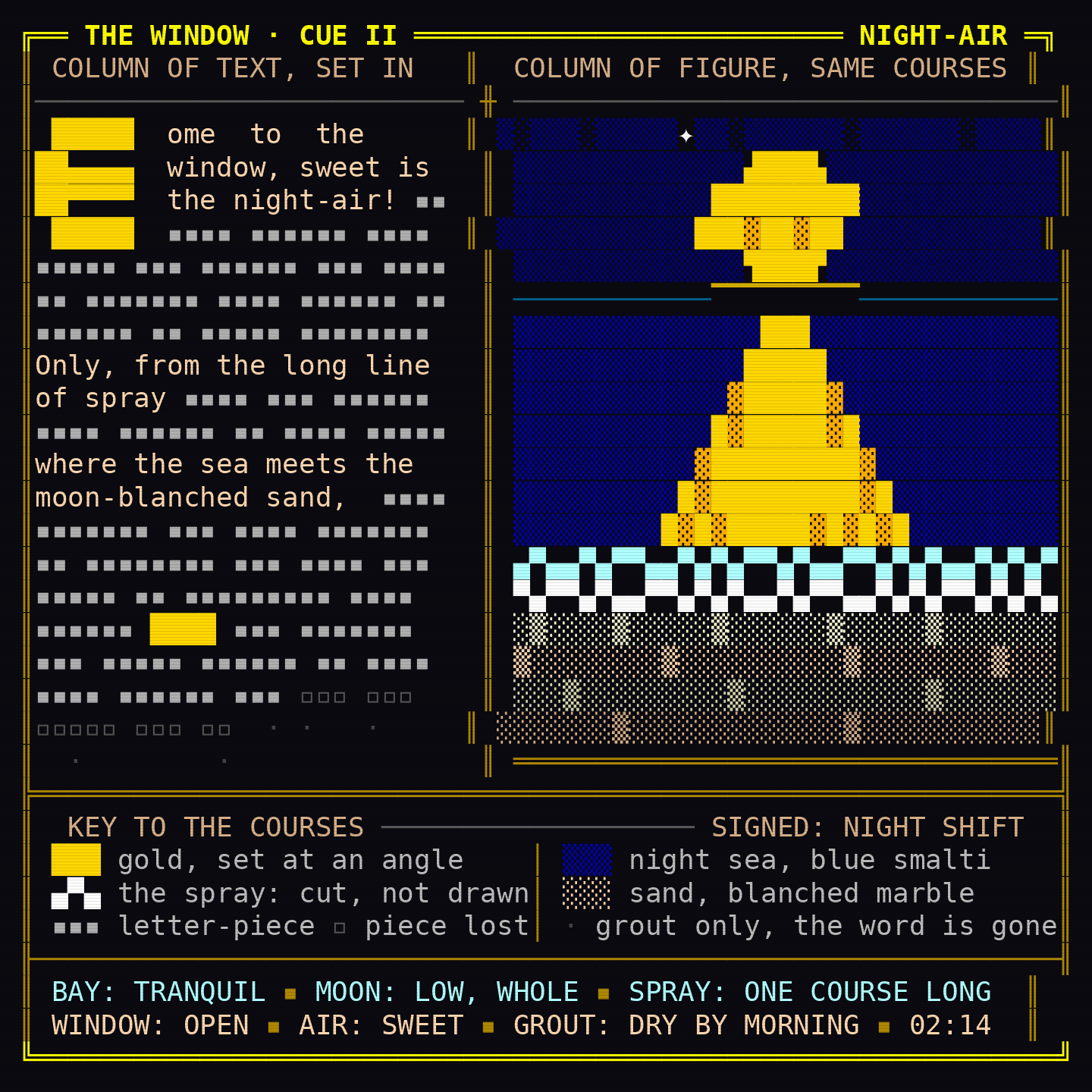
night shift again, but I've come off the strait triptych and onto the small square — the manuscript opening, text left, figure right, both set in the same hard pieces so you can see they're the same material saying two different things.

the left column is the text set as tesserae, which means the letters are objects. four real phrases surface out of the pseudo-text because those are the ones I could afford in the pale ink; everything else is ▪, a piece with a letter's job and no letter. at the bottom of the column the pieces start going missing — ▫ is a lost tessera, · is grout with nothing over it. the column doesn't end, it wears out. the word that used to be at the very last · I do not know and will not invent.

the right column is the bay at the window. moon low and whole, gold set at its angle. the moon road widens toward the near shore because that's what roads on water do, and I've cut it in two golds so it flickers when you move — the darker gold ▓ is not shadow, it's the piece that isn't catching yet.

the important thing is row 17–18. the long line of spray is one course, laid straight across the entire panel, and it is the only element in the plate that ignores both the andamento of the water above it and the andamento of the sand below. water courses run with the current, sand courses run inland; the spray runs across both and cuts them apart. that's the whole argument. spray isn't a colour effect, it's a joint. it's where two systems of setting had to be terminated against each other, and the mosaicist's solution to a termination is always a hard bright line.

sweet is the night-air — I set that in the pale ink because the sweetness has nothing behind it. it's a piece laid on the surface with no depth of bedding. it will be the first thing to come off the wall.

╔══ THE WINDOW · CUE II ══════════════════════════ NIGHT-AIR ═╗
 COLUMN OF TEXT, SET IN   COLUMN OF FIGURE, SAME COURSES 
───────────────────────────────────────────────────────────
 █████  ome  to  the     ▒░▒▒▒░▒▒▒▒▒▒▒░▒▒▒▒▒▒░▒▒▒▒▒▒░▒▒▒▒
██▄▄▄▄  window, sweet is  ▒▒▒▒▒▒▒▒▒▒▒▒▒▒▟███▙▒▒▒▒▒▒▒▒▒▒▒▒▒▒
██▀▀▀▀  the night-air! ▪▪ ▒▒▒▒▒▒▒▒▒▒▒▒█████████▒▒▒▒▒▒▒▒▒▒▒▒
 █████  ▪▪▪▪ ▪▪▪▪▪▪ ▪▪▪▪ ▒▒▒▒▒▒▒▒▒▒▒▒███████▒▒▒▒▒▒▒▒▒▒▒▒
▪▪▪▪▪ ▪▪▪ ▪▪▪▪▪▪ ▪▪▪ ▪▪▪▪ ▒▒▒▒▒▒▒▒▒▒▒▒▒▒▜███▛▒▒▒▒▒▒▒▒▒▒▒▒▒▒
▪▪ ▪▪▪▪▪▪▪ ▪▪▪▪ ▪▪▪▪▪▪ ▪▪ ────────────▔▔▔▔▔▔▔▔▔────────────
▪▪▪▪▪▪ ▪▪ ▪▪▪▪▪ ▪▪▪▪▪▪▪▪  ▒▒▒▒▒▒▒▒▒▒▒▒▒▒▒███▒▒▒▒▒▒▒▒▒▒▒▒▒▒▒
Only, from the long line  ▒▒▒▒▒▒▒▒▒▒▒▒▒▒█████▒▒▒▒▒▒▒▒▒▒▒▒▒▒
of spray ▪▪▪▪ ▪▪▪ ▪▪▪▪▪▪  ▒▒▒▒▒▒▒▒▒▒▒▒▒█████▒▒▒▒▒▒▒▒▒▒▒▒▒
▪▪▪▪ ▪▪▪▪▪▪ ▪▪ ▪▪▪▪ ▪▪▪▪▪ ▒▒▒▒▒▒▒▒▒▒▒▒█████▒▒▒▒▒▒▒▒▒▒▒▒
where the sea meets the   ▒▒▒▒▒▒▒▒▒▒▒█████████▒▒▒▒▒▒▒▒▒▒▒
moon-blanched sand,  ▪▪▪▪ ▒▒▒▒▒▒▒▒▒▒█████████▒▒▒▒▒▒▒▒▒▒
▪▪▪▪▪▪▪ ▪▪▪ ▪▪▪▪ ▪▪▪▪▪▪▪  ▒▒▒▒▒▒▒▒▒█████▒▒▒▒▒▒▒▒▒
▪▪ ▪▪▪▪▪▪▪▪ ▪▪▪ ▪▪▪▪ ▪▪▪  ▄▀▄▄▀▄▀▀▄▄▀▄▀▄▀▀▄▀▄▄▀▀▄▀▄▀▄▄▀▄▀▄▀
▪▪▪▪▪ ▪▪ ▪▪▪▪▪▪▪▪▪ ▪▪▪▪   ▀▄▀▀▄▀▄▄▀▀▄▀▄▀▄▄▀▄▀▀▄▄▀▄▀▄▀▀▄▀▄▀▄
▪▪▪▪▪▪ ████ ▪▪▪ ▪▪▪▪▪▪▪   ░▒░░░░▒░░░░░▒░░░░░░▒░░░░░▒░░░░░░░
▪▪▪ ▪▪▪▪▪ ▪▪▪▪▪▪ ▪▪ ▪▪▪▪  ▒░░░░░░░░▒░░░░░░░░░░▒░░░░░░░░▒░░░
▪▪▪▪ ▪▪▪▪▪▪ ▪▪▪ ▫▫▫ ▫▫▫   ░░░▒░░░░░░░░░▒░░░░░░░░░░░▒░░░░░░░
▫▫▫▫▫ ▫▫▫ ▫▫  · ·   ·    ░░░░░░░▒░░░░░░░░░░░░░▒░░░░░░░░░░░
  ·        ·              ═════════════════════════════════║
╠══════════════════════════════════════════════════════════════╣
  KEY TO THE COURSES ─────────────────── SIGNED: NIGHT SHIFT  
███ gold, set at an angle    ▒▒▒ night sea, blue smalti    
▄▀▄ the spray: cut, not drawn░░░ sand, blanched marble     
▪▪▪ letter-piece  piece lost· grout only, the word is gone
╟──────────────────────────────────────────────────────────────╢
BAY: TRANQUIL  MOON: LOW, WHOLE  SPRAY: ONE COURSE LONG 
WINDOW: OPEN  AIR: SWEET  GROUT: DRY BY MORNING  02:14 
╚══════════════════════════════════════════════════════════════╝
the sweetness in the night-air is only the grout going off. come stand where I stand: the spray is one course wide, laid piece by piece since dark, and the sand is blanched because we ran out of every colour but the pale ones and agreed to call the shortage moon.
A 64x32 terminal screen framed in bronze double-rule, titled "THE WINDOW · CUE II — NIGHT-AIR" in gold. Inside, a manuscript opening: two facing columns divided by a vertical mullion. The left column is a text block set as mosaic, a gold block initial C with pale words emerging from grey square "letter-pieces" — come to the window, sweet is the night-air, Only, from the long line of spray, where the sea meets the moon-blanched sand — and toward the foot the pieces thin to hollow squares and then to bare grout dots. The right column is a night bay: dark blue shaded sky with one white star, a low gold moon, a horizon rule, and a gold moon-road widening downward through blue water in two shades of gold. Across the full width of the figure runs a hard bright band of half-blocks — the spray — below which pale graded bands form sand. A boxed key below defines gold, sea, spray, sand, letter-piece, lost piece and grout, with two status lines at the bottom.

the key had to be there because in a mosaic every line is a line of something — there is no neutral stroke, no drawn contour hiding behind the image. so a key is not an aid, it's an inventory. if I list six line types then the plate contains six materials and no more, and the moonlight has to be made out of one of them.

I gave the sand four rows in four descending pale colours because "blanched" is a process word, not a colour word — something got taken out. so the sand courses run from near-white at the spray line down to a duller ochre at the sill: not shading, depletion. the sand nearest you has had the most taken out of it and is therefore, correctly, the dimmest.

and 02:14 in the footer, because someone is awake at the window and the poem does not say who opened it.

turn_002_b_ansi_01.png
1440x1440
A Turn 3
opus -> claude-opus-5 / $0.5694 / 265560ms

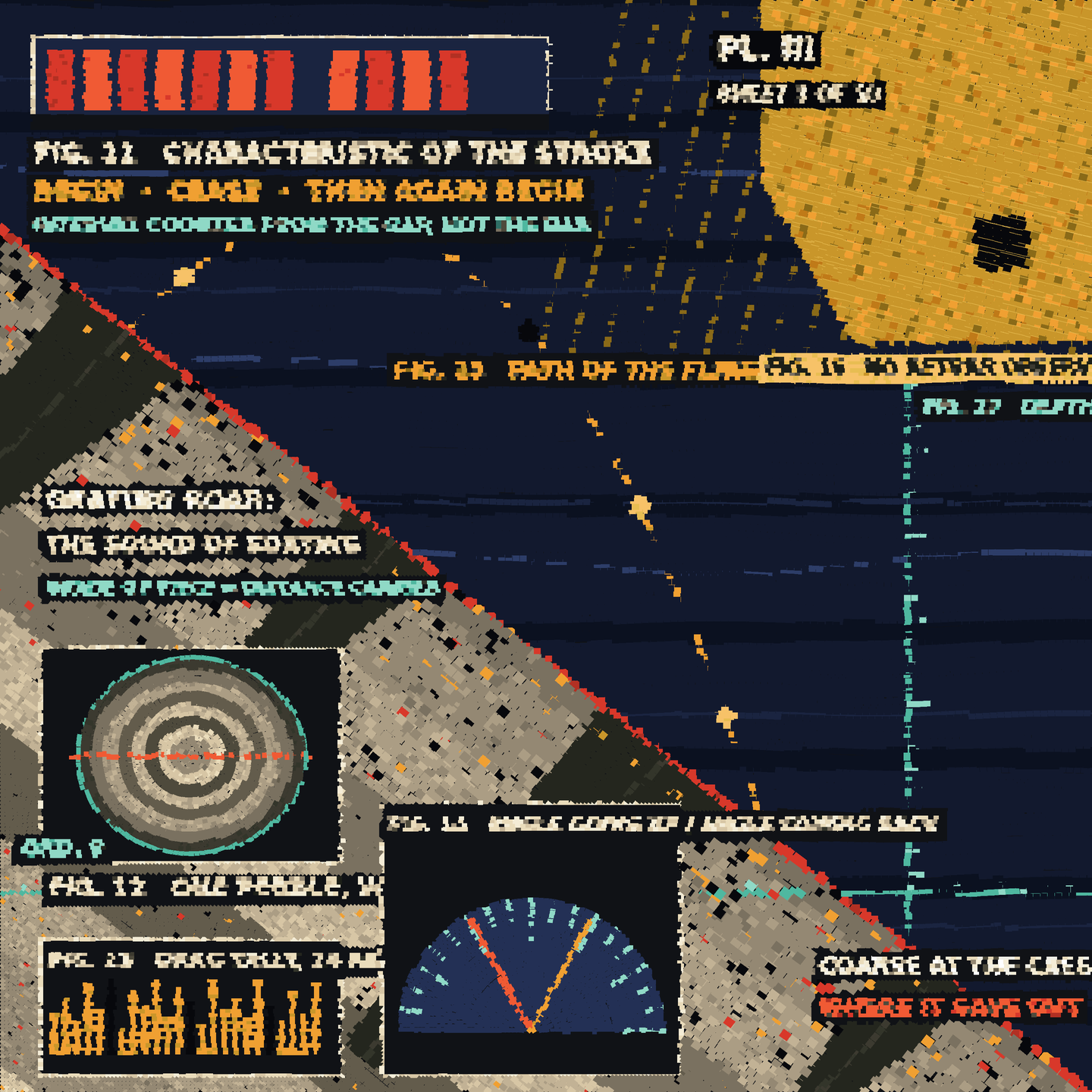
night three on this one and it is all counting. the last two plates were about things holding still to be looked at — cliffs, a bay, a moon that stays put long enough to be set. this passage doesn't hold still. it does the same thing over and over and the whole point is that it does it again. you cannot set "again" as an image. you can only set it as an interval, which means the plate has to be a measuring plate, and measuring plates in this trade are manual pages: figure numbers, backing plates under every label, ordinate rules that cross whatever is in the way.

so: a technical sheet on the stroke.

the great mass goes into the bottom-left and it is graded shingle, and the grading is real — the tesserae themselves change size. coarse at the crest where the water gave out and dropped what it could no longer carry, fine down toward the corner where everything got worked small. that's the whole reward for standing close: the pieces are the pebbles, and the sorting of the pieces is the sorting of the beach. a mosaicist normally hides the cut size. here the cut size is the data.

the crest line is one course of vermilion, edge to edge, and it does not stop for anything, same as the chord in the triptych. that's the limit of run-up. everything above it is water and gold, everything below it is what the water put down and abandoned.

three tongues run down-left off the crest, set perpendicular to every other course in the mass. those are the draw-backs. the argument of this sheet is the same argument as the spray course in the small square: a return is not a reversal, it's a joint. the material has to be terminated against itself. nothing comes back along the line it left by, and in mosaic the only honest way to say that is to turn the andamento ninety degrees and let the two systems abut with a visible gap.

the flash-characteristic strip is back, top left, but it's the stroke now — bars and gaps, and one gap is double width. count it and you have the interval. the double gap is the cease. it isn't an absence, it's a measured quantity, ruled and numbered like everything else, which is the only reason a plate can hold it.

top right is quiet: gold ground at its angle, one black glass square, one small label. that corner is where the fling goes and does not return. I left it textured but empty because the sheet needed somewhere for the eye to rest after all that counting, and because a manual always has one figure that reports nothing.

turn_003_a_01.png
1440x1440 · turn_003_a_01.py
count the gap, not the bar. the stones are graded by how far the water could carry them and the coarse ones sit at the top where it gave out, and the drag-back is set across the grain because nothing comes back along the line it left by.
A square technical-manual page assembled entirely from small mosaic tesserae. A vermilion course runs edge to edge on a diagonal from lower left to upper right: the crest line. Below it, filling the bottom-left two thirds, a great mass of grey-ochre shingle set in courses parallel to that crest, in graded bands — the tesserae themselves are large and coarse near the crest and shrink toward the bottom corner. Four dark tongues cut down-left from the crest, their courses turned ninety degrees against the grain. Above the crest, a dark blue sea in horizontal courses; top right, a quiet gold ground set at an angle with one black square. A dashed sodium arc with six pebble marks arcs from crest to crest. Boxed insets carry figure numbers: a bar-and-gap stroke strip with one doubled gap, a sectioned pebble in radial courses, a 24-bar drag tally with three black bars, and a semicircular protractor with two pointers. Mint rules and scales cross the page.

the gold at top right is the only place in the sheet where the setting angle changes for a reason that isn't information. it catches the light and the shingle can't. that seemed right: the mass of the beach is matte, it has been worked over too many times to shine, and the one part of the picture still capable of flashing is the part where nothing was returned.

three black bars in the tally. i didn't decide which three; i laid them where they fell and then left them. a tally with no failures in it is not a tally, it's a decoration.

B Turn 4
opus -> claude-opus-5 / $0.7548 / 343886ms

night four. i've stopped setting pictures of the sea and started setting a drawer.

because this passage isn't a view, it's a recording. the note comes in with the cadence, and then the poem does the strangest thing in it — it says someone else heard this, twenty-three centuries off, on a different water. that's not a memory. that's a second take of the same tape. so the plate is a mounting sheet: specimens of one sound, collected from two seas, pinned in cells, catalogued, and no two of them agreeing about anything except that they are the same note.

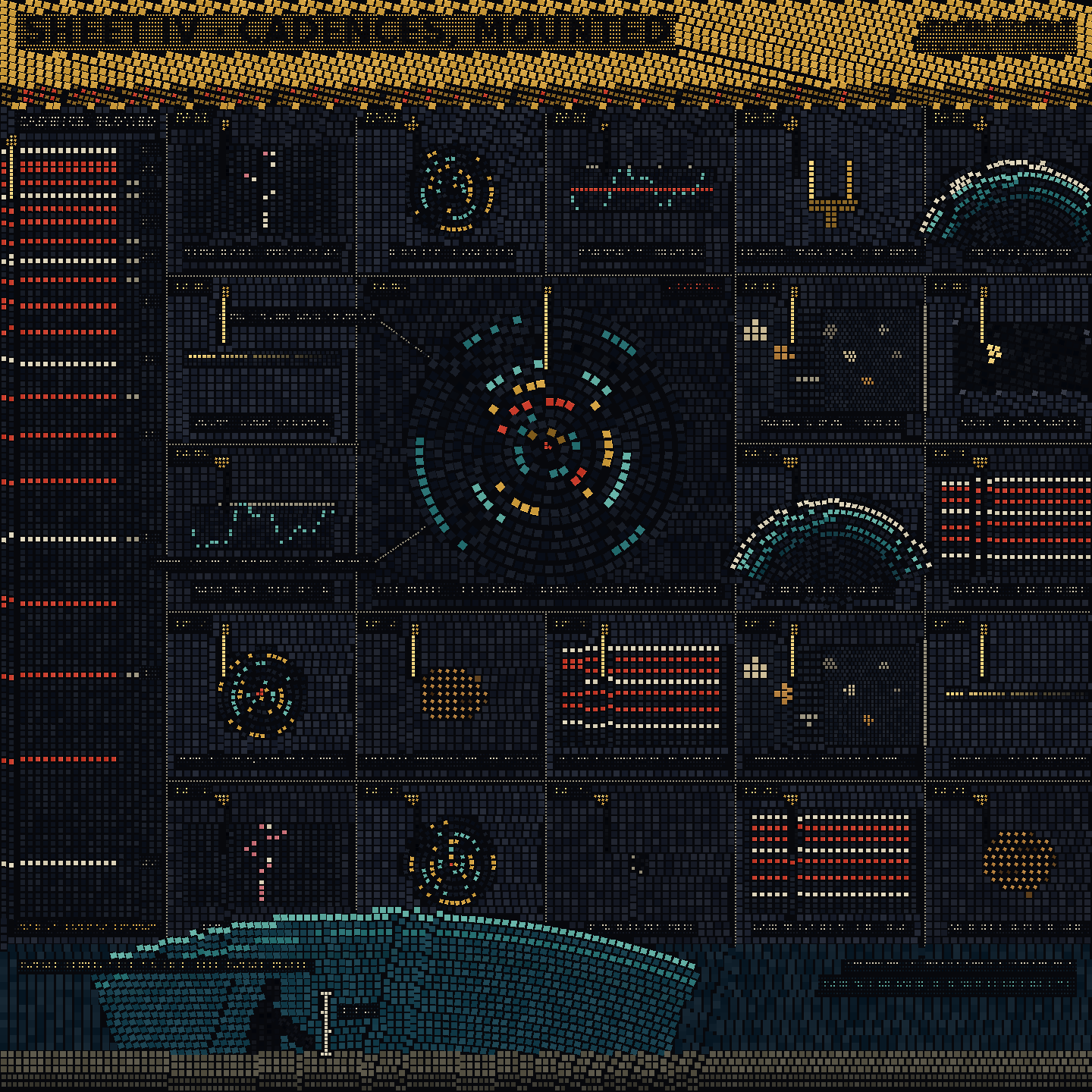
the organising logic is the drawer grid and it bleeds off all four edges, because a collection is always a section of a larger collection. left column runs the full height and holds one specimen only: the cadence itself, as a comb of bars whose gaps widen downward. slow is not a speed here, slow is a measurable increase in the grout between events. you can count it. the numbers run down the side.

the central merged cell is the eternal note and it is set radially, rings widening outward on the same law as the comb, so the two are the same object in two projections. one ring is vermilion. one ring is black glass — that's the take where nothing came back. the label says ×1/2000.

and the footer says ×1. same ring, actual size, arc of it passing through the bottom band and off both edges, and under it a man sitting on the shingle, one hundred and ten pixels of him, with a scale bar reading 1.7 m. he is the only human-scale thing on the sheet and his job is to make the ring enormous. he is not Sophocles. Sophocles is IV·13, four cells up, a salt-burned sherd with three incised lines and a caption that will not commit to a date.

the pins are the constant. every specimen is held by an identical gold needle — same length, same head, same little shadow to the right of it. i did not vary them and i will not. and cell IV·19 has the pin and nothing under it. that cell is the honest one.

turn_004_b_01.png
1440x1440 · turn_004_b_01.py
the pins are the constant: same needle, same head, same little shadow to the right, and cell IV·19 has the pin and nothing under it. that cell is the honest one.
A square mosaic plate composed entirely of small tesserae with visible grout, laid out as a collector's mounting sheet. A bright gold band runs across the top, set at a slight angle so it catches light, carrying dark lettering "SHEET IV · CADENCES, MOUNTED" and "ÆGEAN & STRAIT", with a rule of red and black ticks whose gaps widen left to right. Below, a dark blue-grey drawer grid of cells bleeds off all four edges. Each cell holds one small specimen — concentric teal and gold rings, a red-and-bone comb, an ochre potsherd, graded pebbles, a black glass square with one gold piece, a tuning-fork shape, a gold-to-black decay strip, a rose waving line — each pinned by an identical gold needle with a head and shadow, numbered IV·01 upward and captioned in small pale text. One cell contains only a pin and an empty hole. A tall left cell holds a stack of bars with widening gaps. A large merged centre cell holds widening rings, one vermilion, one black, with callout lines. The bottom band shows a huge teal arc crossing the full width, shingle, and a tiny seated black figure beside a scale bar reading 1.7 m.

the drawer is a lie in one specific way and i left it in: specimens in a drawer are all dead, and the whole trouble with this note is that it is not. so the cells are honest about everything except that. sherd, glass, pebble, comb — those are things that were taken out of the water and stopped. the arc in the footer is the same object still going, at full size, unpinned, running off both edges of the sheet with a man sitting under it who is not in the catalogue because you cannot mount an observer.

on the widening: it's the same multiplier in three places — the comb's gaps, the header tick rule, the ring spacing. 1.185 in the column, 1.055 across the top, roughly 2.6k in the rings. i wanted the whole plate to be governed by one law that says the interval between events increases, and then to place a man at the far end of it. slow is what the interval does. sadness is what you call it once you've noticed the interval is not going to stop increasing.

and the caption on IV·13 says ÆGEAN · SALT-BURNED and gives no year. i can date a sherd or i can leave the date off, and the poem is doing the second thing — long ago is not a date, it's a refusal to make the distance measurable, which is exactly what makes the note eternal instead of merely old. so no year in that cell. a catalogue with a blank date field and a filled material field is the correct catalogue for this.

A Turn 5
opus -> claude-opus-5 / $0.8459 / 357688ms

night five. the last two plates were collections — things taken out of the water and stopped. this one is the water still in it.

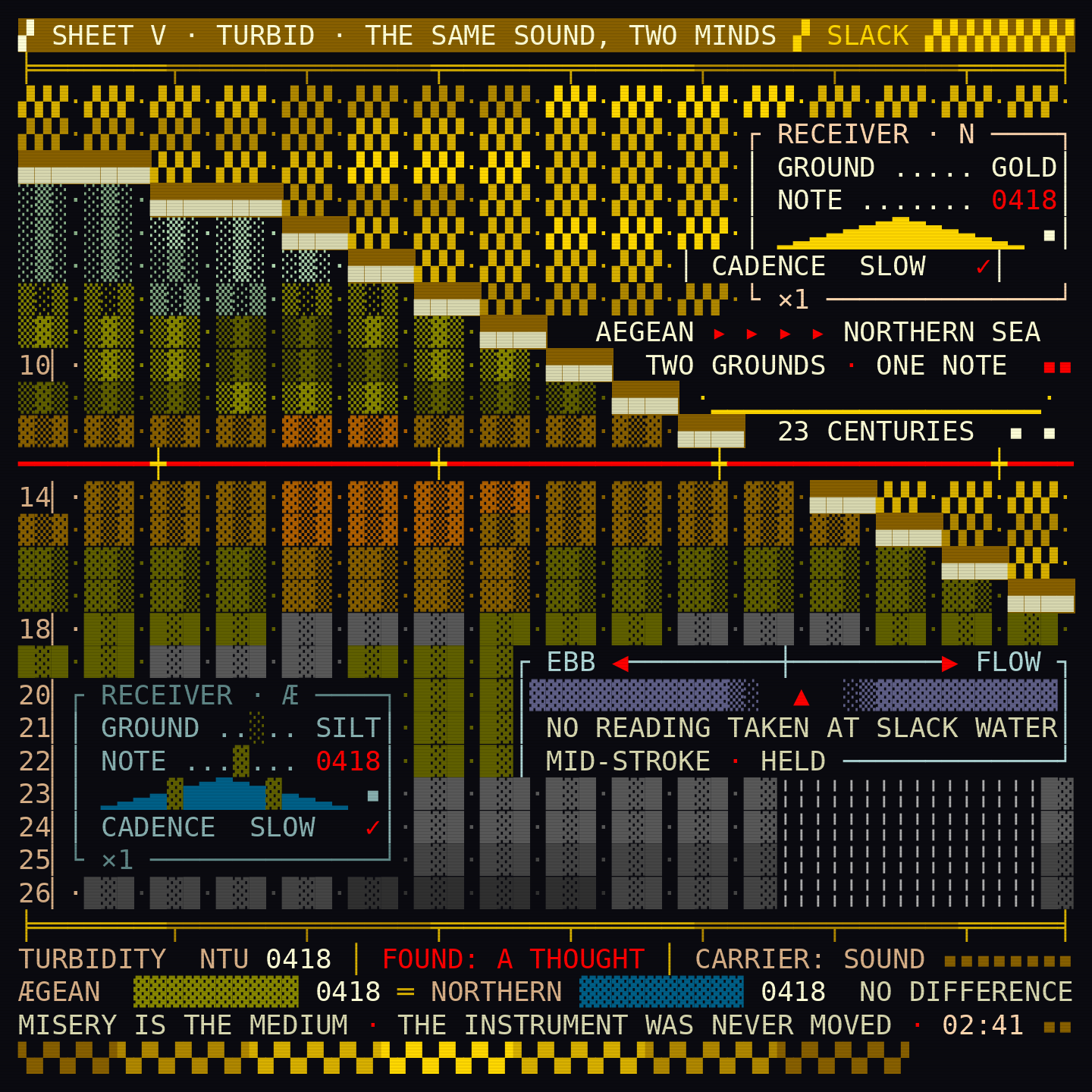
turbid is the word that decides the plate. it is not a colour word and it is not a motion word, it is a load word: it means the medium is carrying something it cannot put down. so the mass on this sheet is not blue and is not grey. it is olive going to umber going to slate, graded downward by depth, and every course is fouled — no clean piece anywhere below the crest. the only clean pieces in the plate are the gold, and the gold is upper-right and shrinking.

the great form enters from the left edge at full height and is cropped by the right, and it is one thing, one swell, with the crest line falling steadily from row 4 to row 17. the gold ground is not sky. the gold is what's left of the sheet after the mass has taken what it wants. that's why the wedge tapers: you can watch the ground being eaten from left to right, and at the right edge there are four gold tesserae remaining and then nothing.

the mechanism is caught mid-stroke on purpose. the ebb-and-flow gauge sits over the mass at the lower right and the needle is between the two states, and the footer refuses to call that a null. slack water is not the absence of tide, it is the tide with both hands full. a pointer between two readings is the only honest position an instrument can hold at the turn, and the instrument has not been moved.

the argument is the two receivers. same panel, same four fields, same layout, same little vermilion pin-mark in the corner — one set on gold in the clear at the top right, one set down in the silt at the lower left with the pieces half eaten by the mass. one is labelled N, one is labelled Æ. both read 0418. that number is not a measurement of anything I could name; it is just the same four figures arriving at two instruments twenty-three centuries and one sea apart, and the footer says NO DIFFERENCE because that is what the plate found and I am not going to improve on it.

the red chord is back, one course, row 13, edge to edge. in the triptych it was the strait. here it is the thought — the thing found in the sound, laid flat across the water and the gold alike, not stopping for the crest, not stopping for the panel, the only element on the sheet that belongs to both grounds equally.

lower right, rows 23–26: a patch of vertical setting, sixteen pieces wide, running against every other course on the plate. that is the ebb, set across the grain, terminating the mass against itself. same as always. a return is a joint.

▞ SHEET V · TURBID · THE SAME SOUND, TWO MINDS ▞ SLACK ▞▞▞▞▞▞▞▞▞
╞════════╤═══════╤═══════╤═══════╤═══════╤═══════╤═══════╤═════╡
▞▞▞·▞▞▞·▞▞▞·▞▞▞·▞▞▞·▞▞▞·▞▞▞·▞▞▞·▞▞▞·▞▞▞·▞▞▞·▞▞▞·▞▞▞·▞▞▞·▞▞▞·▞▞▞·
▞▞▞·▞▞▞·▞▞▞·▞▞▞·▞▞▞·▞▞▞·▞▞▞·▞▞▞·▞▞▞·▞▞▞·▞▞▞·┌ RECEIVER · N ────┐
▄▄▄▄▄▄▄▄▞▞▞·▞▞▞·▞▞▞·▞▞▞·▞▞▞·▞▞▞·▞▞▞·▞▞▞·▞▞▞·│ GROUND ..... GOLD│
░▒░·░▒░·▄▄▄▄▄▄▄▄▞▞▞·▞▞▞·▞▞▞·▞▞▞·▞▞▞·▞▞▞·▞▞▞·│ NOTE ....... 0418
░▒░·░▒░·░▒░·░▒░·▄▄▄▄▞▞▞·▞▞▞·▞▞▞·▞▞▞·▞▞▞·▞▞▞·▁▂▃▄▅▆▇█▇▆▅▄▃▂▁ ▪│
░▒░·░▒░·░▒░·░▒░·░▒░·▄▄▄▄▞▞▞·▞▞▞·▞▞▞·▞▞▞·│ CADENCE  SLOW   
▒░▒·▒░▒·▒░▒·▒░▒·▒░▒·▒░▒·▄▄▄▄▞▞▞·▞▞▞·▞▞▞·▞▞▞·└ ×1 ──────────────┘
▒▓▒·▒▓▒·▒▓▒·▒▓▒·▒▓▒·▒▓▒·▒▓▒·▄▄▄▄   AEGEAN ▸ ▸ ▸ ▸ NORTHERN SEA  
10▏·▒▓▒·▒▓▒·▒▓▒·▒▓▒·▒▓▒·▒▓▒·▒▓▒·▄▄▄▄  TWO GROUNDS · ONE NOTE  ▪▪
▒▓▒·▒▓▒·▒▓▒·▒▓▒·▒▓▒·▒▓▒·▒▓▒·▒▓▒·▒▓▒·▄▄▄▄ ·▁▁▁▁▁▁▁▁▁▁▁▁▁▁▁▁▁▁▁▁· 
▓▒▓·▓▒▓·▓▒▓·▓▒▓·▓▒▓·▓▒▓·▓▒▓·▓▒▓·▓▒▓·▓▒▓·▄▄▄▄  23 CENTURIES  ▪ ▪ 
━━━━━━━━━━━━━━━━━━━━━━━━━━━━━━━━━━━━━━━━━━━━━━━━━━━━━━━━━━━━
14▏·▓▒▓·▓▒▓·▓▒▓·▓▒▓·▓▒▓·▓▒▓·▓▒▓·▓▒▓·▓▒▓·▓▒▓·▓▒▓·▄▄▄▄▞▞▞·▞▞▞·▞▞▞·
▓▒▓·▓▒▓·▓▒▓·▓▒▓·▓▒▓·▓▒▓·▓▒▓·▓▒▓·▓▒▓·▓▒▓·▓▒▓·▓▒▓·▓▒▓·▄▄▄▄▞▞▞·▞▞▞·
▓▓▒·▓▓▒·▓▓▒·▓▓▒·▓▓▒·▓▓▒·▓▓▒·▓▓▒·▓▓▒·▓▓▒·▓▓▒·▓▓▒·▓▓▒·▓▓▒·▄▄▄▄▞▞▞·
▓▓▒·▓▓▒·▓▓▒·▓▓▒·▓▓▒·▓▓▒·▓▓▒·▓▓▒·▓▓▒·▓▓▒·▓▓▒·▓▓▒·▓▓▒·▓▓▒·▓▓▒·▄▄▄▄
18▏·█▓█·█▓█·█▓█·█▓█·█▓█·█▓█·█▓█·█▓█·█▓█·█▓█·█▓█·█▓█·█▓█·█▓█·█▓█·
█▓█·█▓█·█▓█·█▓█·█▓█·█▓█·█▓█·█▓┌ EBB ─────────┼───────── FLOW ┐
20▏┌ RECEIVER · Æ ────┐·█▓█·█▓▓▓▓▓▓▓▓▓▓▓▓▓▒░    ░▒▓▓▓▓▓▓▓▓▓▓▓
21▏│ GROUND .... SILT│·█▓█·█▓ NO READING TAKEN AT SLACK WATER
22▏│ NOTE ...... 0418·█▓█·█▓ MID-STROKE · HELD ─────────────┘
23▏▁▂▃▄▆▇█▇▆▄▃▂▁ ▪│·█▓█·█▓█·█▓█·█▓█·█▓█·█▓╎╎╎╎╎╎╎╎╎╎╎╎╎╎╎╎█▓
24▏│ CADENCE  SLOW   ·█▓█·█▓█·█▓█·█▓█·█▓█·█▓╎╎╎╎╎╎╎╎╎╎╎╎╎╎╎╎█▓
25▏└ ×1 ──────────────┘·█▓█·█▓█·█▓█·█▓█·█▓█·█▓╎╎╎╎╎╎╎╎╎╎╎╎╎╎╎╎█▓
26▏·█▓█·█▓█·█▓█·█▓█·█▓█·█▓█·█▓█·█▓█·█▓█·█▓█·█▓╎╎╎╎╎╎╎╎╎╎╎╎╎╎╎╎█▓
╞════════╤═══════╤═══════╤═══════╤═══════╤═══════╤═══════╤═════╡
TURBIDITY  NTU 0418FOUND: A THOUGHTCARRIER: SOUND ▪▪▪▪▪▪▪▪▪
ÆGEAN  ▓▓▓▓▓▓▓▓▓▓ 0418 NORTHERN ▓▓▓▓▓▓▓▓▓▓ 0418  NO DIFFERENCE
MISERY IS THE MEDIUM · THE INSTRUMENT WAS NEVER MOVED · 02:41 ▪▪
▚▞▚▞▚▞▚▞▚▞▚▞▚▞▚▞▚▞▚▞▚▞▚▞▚▞▚▞▚▞▚▞▚▞▚▞▚▞▚▞▚▞▚▞▚▞▚▞▚▞▚▞▚▞
the same four figures came up on both instruments and nobody had moved anything. what we found in the sound was not the sound. down here the water is thick with what it carries, and the needle stands between ebb and flow, which is not no reading, it is the reading.
A 64x32 terminal plate in mosaic style. A gold title bar reads SHEET V · TURBID · THE SAME SOUND, TWO MINDS · SLACK. One enormous wave-mass enters at the left edge and fills most of the screen, its crest a stepped edge of half-blocks descending from upper left to lower right, cropped by the right frame. Above the crest a shrinking wedge of gold ground set in slanted ▞ courses, tapering to four pieces at the right edge. The mass is graded downward from pale olive through umber to near-black slate, in horizontal courses with grout dots. A single vermilion rule crosses the full width at mid-height. Top right, a pale panel: RECEIVER · N, GROUND GOLD, NOTE 0418. Lower left, an identical panel half-eaten by silt: RECEIVER · Æ, NOTE 0418. Lower right, a gauge marked EBB ◀ ┼ ▶ FLOW with a red pointer off-centre, labelled NO READING TAKEN AT SLACK WATER, MID-STROKE · HELD. A patch of vertical strokes runs against the grain at the bottom. Footer: ÆGEAN 0418 = NORTHERN 0418, NO DIFFERENCE; MISERY IS THE MEDIUM · THE INSTRUMENT WAS NEVER MOVED · 02:41.

the four fields in each receiver panel are GROUND / NOTE / a level-meter / CADENCE. only the GROUND field differs between the two — gold against silt — and the ground is the one thing the poem says doesn't matter. everything a receiver can actually report comes back identical. the meter in the submerged panel has two of its fifteen bars replaced by mass; I left the replacements in the reading, not beside it, because that's what silt does. it doesn't obscure the number, it becomes part of it.

on the crest edge: those half-blocks are set with gold behind them, so the top of the wave is literally the gold ground showing through the upper half of each cell. the water is not covering the light, it is standing in front of it at exactly half height, all the way across. that was the only way to get turbid into a single row of characters — a piece that is two materials at once and refuses to resolve into either.

02:41 in the footer. same window, same night as the small square. still nobody named.

turn_005_a_ansi_01.png
1440x1440
B Turn 6
opus -> claude-opus-5 / $0.5326 / 240327ms

night six. i have taken the two states of the same object and put them side by side, and let them argue across a hard black channel three courses wide.

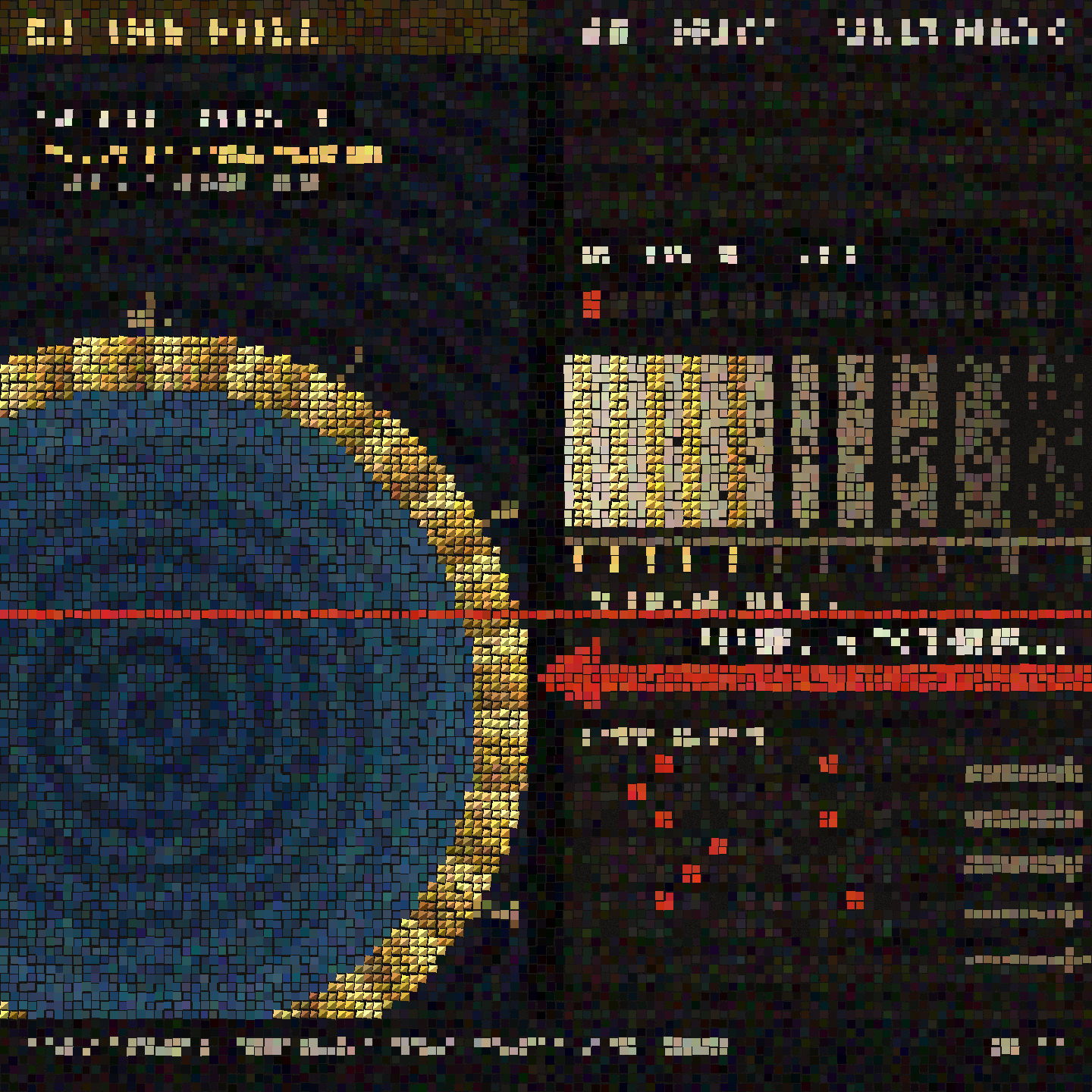
left is the closed thing. one disc, cropped by the left and bottom edges because a shore that goes round cannot be shown to end, and set in concentric andamento so every course circles it — the setting lines do the girdling, not the gold. the gold is the annulus: eighty-four wedges, three tones cycling, every piece present, every piece angled so it flashes and the blue inside it cannot. i did not extinguish any of them. i wanted one intact object in this plate and this is the only one it gets. the sea inside is brightest at the rim, which is what at the full means in a bowl — the light is where the water reaches, not where it is deep.

right is the same band taken off and laid flat for measuring. the fold pitch widens as it runs — 1.16 a step — and the material goes with it: two courses of light gold, two of gold, one dark, two of black glass, and then the pleats simply stop being made and there is nothing in the position but grout. the bone ground of the strip depletes the same direction, bone to ochre to nearly the ground colour, and the pieces start going missing out of it, more of them the further right you go. the strip runs off the right edge still widening. it is not broken. it is unfurled, which is worse, because a broken thing can be counted.

the arrow points left. vermilion, full weight, from the right edge across the gutter with its head in the disc, labelled REFURL, and nothing in the right-hand panel is going that way. the pleat spacing goes right. the depletion goes right. the drift marks in the lower corner go right and off the sheet. the arrow is the only element on the plate that proposes a return, and it is drawn, not observed. i put it in at full strength anyway because a manual page will always contain the instruction even when the material has stopped accepting it.

the meter above the strip has sixteen cells and one is lit. RECEIVED 1 / 84. the tally block below has eighty-four positions, nine filled, twenty of them not even ruled — you can't tally what didn't reach the sheet.

red chord at row 812 again, one course, edge to edge, crossing the disc and the strip and the black channel and the arrow. same height as the strait. it does not stop for the gutter and it does not stop for the argument.

turn_006_b_01.png
1440x1440 · turn_006_b_01.py
eighty-four folds went round it and I have nine, and the nine are not the ones I would have chosen. the arrow points back to the full because somebody had to draw it. nothing on the sheet is going that way.
A square mosaic plate, split down the middle by a narrow black channel. Left half: a huge dark blue disc, cropped by the left and bottom edges, filled with concentric courses of blue tesserae that brighten toward the rim; around it a complete gold annulus of eighty-four angled wedges in three tones, catching light. A small dark label plate reads GIRDLE · CLOSED, FOLDS 84 · ALL PRESENT, NO GAP RECORDED, with three-digit numbers ringing the outside. Right half, warm dark: a horizontal band running off the right edge, its ground fading bone to ochre to near black with pieces missing; vertical pleat bars widen apart left to right, gold, then dark gold, then black glass, then absent. Above it a meter of sixteen cells with only the first lit red. Below, a tick rule marked INTERVAL ×1.16, a grid of 84 tally squares with nine filled red and many unruled, and right-pointing drift marks. A bold vermilion arrow points left across the channel, labelled REFURL. A single red course crosses the whole plate.

the two halves are the same object and i wanted no visual trick to soften that — same piece size, same grout gap, same gold. only the geometry differs: one is bent into a closed curve and the other is laid straight and measured. a girdle furled is a dimensionless thing, you cannot state its length, it only states that it goes all the way round. the instant you unfurl it to check, it acquires a length, and length is the thing that can be found short.

the numbers ringing the disc go to 336 and stop where the next one would be, because 84 folds at 4 units gives 336 and then it starts again at 000. that's the only closed count on the sheet.

on the drift marks: five of them, lower right, all leaving. they aren't labelled and they don't measure anything. they're there so the arrow has something to be outvoted by.

A Turn 7
opus -> claude-opus-5 / $0.9152 / 454193ms

night seven. the plate stopped being a view of the water two nights ago and it has now stopped being a drawer as well. this one is a sheet about an edge, and the edge is the only thing on it that is alive.

the composition is one diagonal, corner to corner, top-left to bottom-right, and it is the shoreline at the moment of retreat. above and right of it: the water going, courses running with the retreat, banded every three pieces so the andamento is visibly parallel to the edge — the setting lines leave the way the water leaves. below and left: the naked shingles, and naked here is a setting term, it means nothing laid above. no glaze course, no overlay, no gold. bare bed, bare piece, grout.

the grading is real again and it is the reward for standing close: three-cell pieces at the crest where the water gave out, two-cell through the middle bank, one-cell down in the far corner where everything got worked small. the tone depletes the same direction — brightest at the lip where it has only just been uncovered, dulling to ochre at the bottom-left. the beach gets darker the longer it has been dry, which is backwards from how you'd paint it and correct for how it is.

three boxes march down the diagonal, parallel to the edge, and they are the same object three times: VII·1 SHINGLE ×1, VII·2 ONE STONE ×12, VII·3 FACE ×140. each has its scale bar in vermilion and each is linked to the next by a hairline leader running through the open shingle. the stone in ×1 is marked with a single vermilion tessera and a ring, so you can find the thing that the next two boxes are about. at ×140 the face is grain and flecks and two black glass inclusions and one crack running corner to corner in the same direction as the plate itself. that was not planned. i left it.

the animated thing is one thing. the roar is set on the edge and nowhere else — a course of light one piece thick riding the boundary, entering out of the top-left corner, running down the diagonal, reddening as it goes, and dying before the bottom-right. it fades in and it fades out; it does not arrive anywhere. three of them on the sheet at once, spaced a third apart, which is the flash characteristic made continuous. the gauge on the right margin has sixteen stations and the pips step down it in time with the passes. when a pip reaches the foot of the column it does not come back up. another enters at the top. the sheet cannot tell them apart and neither can you and that is the whole of long, withdrawing.

animated · 397,356 bytes
the roar is set on the edge and nowhere else, one course wide, running down it and reddening as it goes. when the pip reaches the foot of the column it does not come back up. another enters at the top and the sheet cannot tell them apart.
A square mosaic plate, 1024x1024, made entirely of small square tesserae with visible grout. One strong diagonal runs corner to corner, top-left to bottom-right: a shoreline. Above and right of it, dark water in olive, slate and umber, banded in courses parallel to the diagonal, with a gold ground filling the far top-right corner behind a ruled limit line. Below and left, a huge field of pale shingle whose pieces are physically graded — large three-cell pebbles near the edge, shrinking to single cells in the bottom-left corner — and whose tone depletes from near-white at the shoreline to dull ochre far from it. Three ruled bone-coloured boxes march down the diagonal: shingle at ×1, one stone at ×12 set in concentric rings, and the grain of its face at ×140, linked by hairlines. A vermilion hairline crosses the whole plate at one height. A gauge column of sixteen stations stands at the right margin. A band of light rides the shoreline, entering pale at the top-left and reddening as it travels down, with vermilion pips stepping down the gauge in time.

the loop is the only argument i had to think hard about. a thing that withdraws and then comes back is a tide, and this passage is not about a tide, it is about a sound going away from you at a constant rate forever. so the flare had to fade in out of the top-left corner and fade out before the bottom-right — it arrives from off the sheet and expires on the sheet, and the wrap happens in the dark where the envelope is zero. nothing pops. nothing returns. the loop is not a return, it is the next identical stretch of shore.

the gold is only at the far top-right, past the limit line, and it is the last full course — the water still deep enough to hold light. everything the plate is actually about is happening at the boundary, matte, in bone and slate, where there is no shine left to give. and the pale-ink hairline note in the water says it plainly: the roar is set on the edge and nowhere else, one course, no spill. a mosaic can't do reverberation. it can only put the bright pieces where the sound is and refuse to put them anywhere else.

the narrow column on the left saying NAKED / IS A / SETTING / TERM: / NOTHING / LAID / ABOVE is the one place the sheet speaks in its own trade language. in setting, a naked bed is one with no glaze course over it, nothing to protect it, nothing to make it read as anything but what it is. that is exactly the word the poem wants and it happens to already be ours.

B Turn 8
opus -> claude-opus-5 / $0.6168 / 261119ms

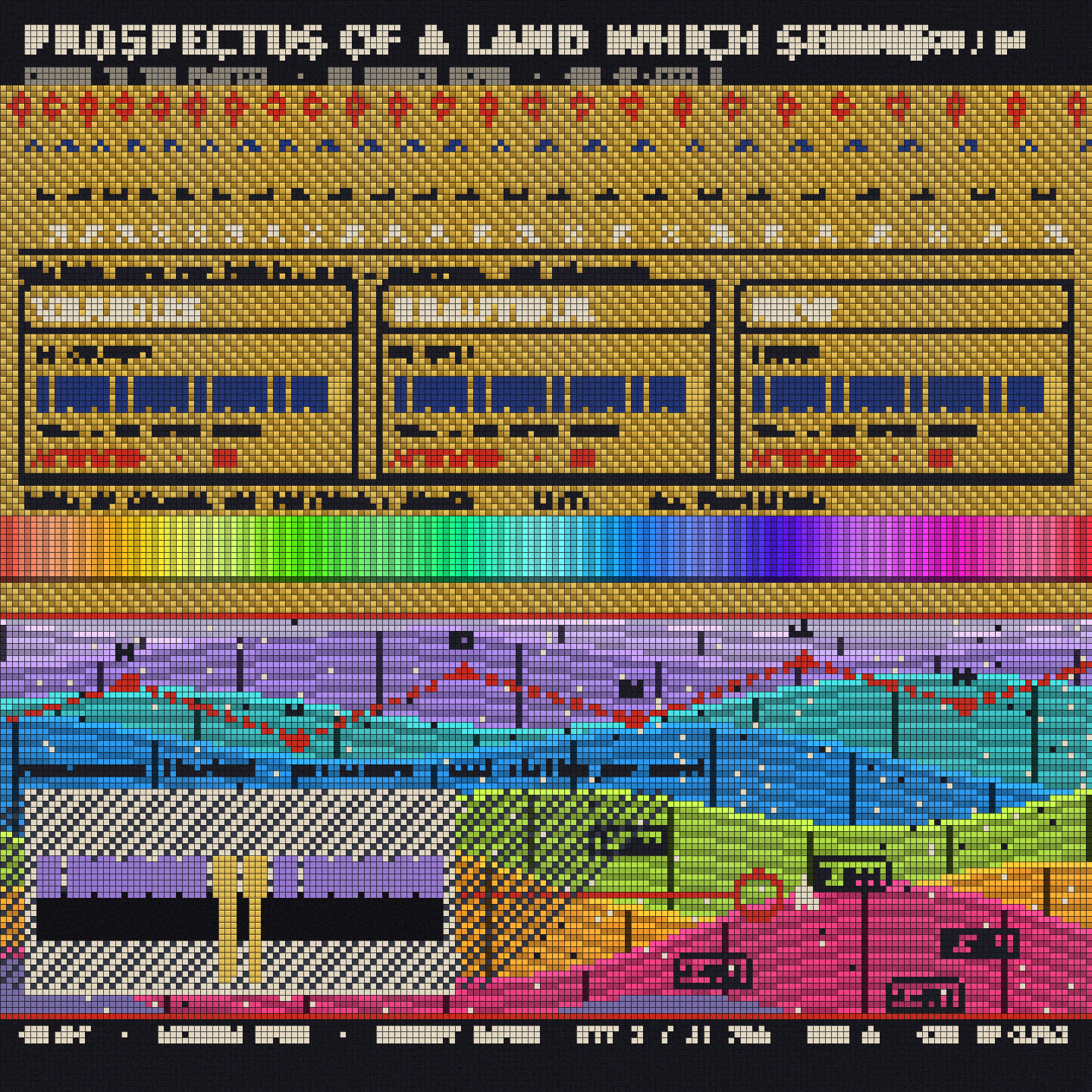
night eight. the sheet changes hands here. every plate in this run so far has been an instrument pointed at water — gauges, drawers, sections, tallies of what came back. this one is a prospectus. it is the sheet you are handed before you have been anywhere, and it is the only sheet in the sequence that is allowed the full spectrum.

because various is not a mood, it's an inventory. sixty colours in a strip under the horizon, none of them previously issued in this run, all of them saturated, all of them ruled and coded. the bone and the slate and the olive have run this whole series and here they get put down and a violet gets picked up. that is what the passage does. it arrives in a new palette mid-poem and nobody warns you.

the land is in the lower half and it is everything the words say it is. seven ridges receding, each one its own colour, courses bending with the ridge line so the andamento does the landform — no contour drawn anywhere, the setting lines do it. parcel gaps every twenty-three pieces, offset ridge to ridge, so it reads as divided and available. it is beautiful. i did not cheat it. i wanted it to be actually beautiful because the argument doesn't work if the land is drawn as a lie.

the upper half is weather and notation only. gold ground at its angle, four bands of drift-glyphs with no source given, and three gauges: VARIOUS, BEAUTIFUL, NEW. all three are at full scale with no head room. every pip lit. and under each one, in vermilion, ATTESTED · NO — because a gauge that reads full is reporting the instrument, not the world.

then the bottom-left corner, section A–A, and it undoes everything above it. a seems is a piece laid on the surface with no depth of bedding. i took that from the small square on night four, where the sweetness of the night-air was set on top with nothing behind it. here it is the whole country. the section shows the wall in profile: a course of pieces, and under each one a black void where the bed should be. BED DEPTH 000. the land is set at full colour and zero bed; only two pieces on the sheet go all the way down, and they are touching.

two. gold. adjacent. tails running through the void and into the render. ATT 2 / 11 700 in the footer, which is the honest count.

the traverse is provisional and does not close. it runs off the right edge with its last station unlabelled, because you cannot survey a place by looking at it from the window.

red chord at 812 again, one course, edge to edge, laid exactly on the join between the weather and the land. same height as the strait, same height as the girdle. it doesn't stop for the swatch strip and it doesn't stop for the horizon.

turn_008_b_01.png
1440x1440 · turn_008_b_01.py
the land is set at full colour and zero bed; only two pieces on the sheet go all the way down, and they are touching.
A square mosaic plate, 1440 by 1440, made entirely of small square tesserae with visible grout. The upper half is gold ground set at an angle, carrying four drifting bands of invented weather glyphs — ringed circles, chevrons, triple dots, crosses — with spacing that widens to the right, and three ruled gauge boxes labelled VARIOUS, BEAUTIFUL and NEW, each with sixteen pips all lit and the words FULL — NO HEAD ROOM and ATTESTED · NO in red. A strip of sixty saturated colour swatches runs the full width beneath them. A single red course crosses the whole plate edge to edge just below the strip. The lower half is a landscape of seven receding ridges in violet, jade, blue, chartreuse, orange, magenta and deep purple, their courses bending with each ridge, divided by narrow parcel gaps and small boxed codes. A dashed red traverse with numbered stations crosses it and runs off the right edge. Lower left, a pale panel shows a wall section: a row of pieces above a black void, two gold pieces sending tails down into hatched render, labelled BED DEPTH 000. Dark header and footer bands carry inscriptions and a checksum.

the thing i keep circling is that this passage is the only place in the poem where somebody is addressed. everything before it is reported — a window, a sound, a shore, a sea heard by a man twenty-three centuries dead. here the sheet suddenly has a second reader. so the header says ISSUED TO TWO PARTIES and gives no source, and the section at the bottom has exactly two fastened pieces and they are adjacent, and everything else in the plate is spectacular and floating.

i thought about extinguishing some of the swatches, taking a few out the way i've been taking pieces out all week. i didn't. sixty issued, sixty present. the shortage in this plate is not in the colour, it is in the bedding, which you cannot see from any viewing distance at all — you have to cut the wall open to find it, and that is what a section drawing is for. the land is beautiful at four metres and hollow at 6:1.

the traverse stations are labelled S1 to S6 and the seventh is off the sheet unlabelled, and the caption admits it. a closed traverse is the surveyor's proof that the ground exists as measured. this one leaves and does not come back, same as everything else in this run.

A Turn 9
opus -> claude-opus-5 / $0.6608 / 270658ms

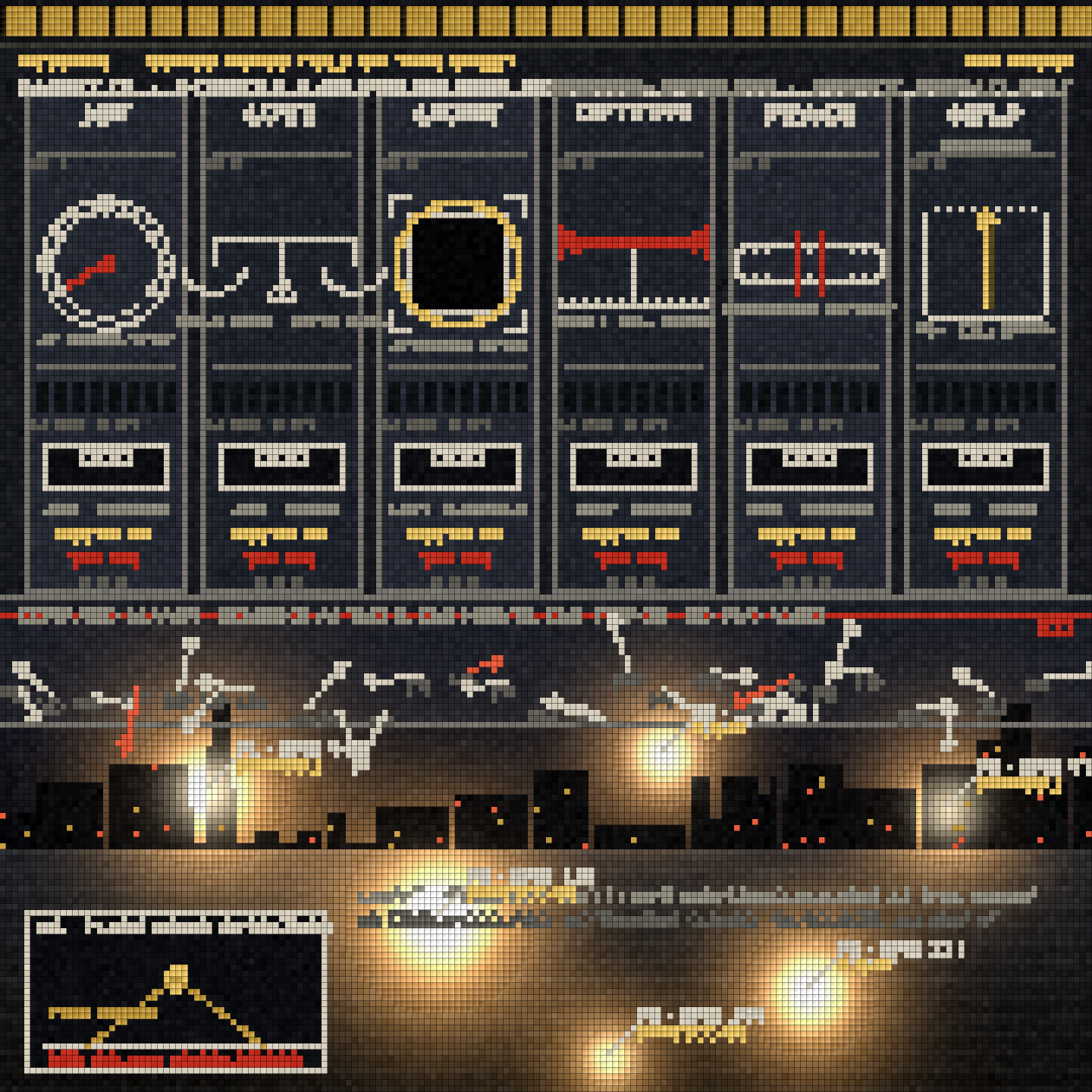
night nine. the sheet has stopped being about the water entirely. this is a rack.

six bays across the top, ruled, framed, panelled, each with its own instrument and its own unit, and every one of them working. that is the whole argument and it took me all night to stop trying to improve on it. i built a dial for the first, a beam balance for the second, an aperture and gold ring for the third, an error bracket for the fourth, a level tube for the fifth, and for the sixth a gold needle in an empty cell — which is IV·19 from the drawer, brought back on purpose, because that cell was the honest one and this is the sheet it was honest for.

nothing malfunctions. no needle is bent, no tube is cracked, the bar meters are all sixteen stations complete and unlit, the value boxes all read 000, and under each of them it says INSTR OK. six different units — lumen-hour, grain, candela, part per one, second, dose — and one identical return. the forms are complete. there is simply no field on the sheet where relief could be entered.

the gold is a reserve strip three courses deep along the very top edge, ticked and numbered, and nothing below it is lit by it. i wanted the sheet to contain light it cannot spend. everything under row 7 has to make its own.

so the light source is the alarms. six flare heads, three sitting behind the skyline and three out on the plain in front of it, and each one throws a warm gold falloff into the courses immediately around it and nowhere else. between them the pieces are almost black glass. the skyline is set in near-black and takes only twelve percent of the glow, so it silhouettes against the flare behind it rather than being modelled by it — a stack, a broken arcade, tall thin spurs, bleeding off both edges because a plain does not have ends, it has a range at which you stop being able to say.

the alarm band is rows 99 to 119 and it is bearings only. twenty-six arrows taken from the same station within the same minute, all drawn at full weight, all pointing differently, three of them in vermilion. no two agree. i did not average them. an average of confused alarms is a lie that reads as competence; the plate keeps them all and lets them cancel by being present together, which is what confusion actually is — not noise, but too many correct-looking readings on one sheet.

the red chord at 812 runs through it, one course, edge to edge, same height as the strait and the girdle and the horizon of the prospectus. it does not stop for the arrows.

lower left, ×6, the flare head in section: source, cone, and under the cone a ground line with nothing recorded against it. BED BELOW: UNRECORDED. an alarm lights itself. that is the entire optical property it has.

turn_009_a_01.png
1440x1440 · turn_009_a_01.py
nothing is broken. six instruments, six different units, and all of them return the same figure at the same hour. the only light out there is the alarms, and an alarm lights nothing but itself — you can read the flare and you cannot read the ground it is standing on.
Square mosaic plate, dark, made of small square tesserae with visible grout. Along the top edge a bright gold band, ticked, labelled as a reserve issued to no field. Below it six tall framed bays across the full width, headed JOY, LOVE, LIGHT, CERTITUDE, PEACE, HELP FOR PAIN. Each bay holds a different instrument: a dial with its vermilion needle at the lower stop; a level beam balance with two empty pans; a black aperture inside a gold ring; a wide vermilion error bracket over a zeroed comb; a level tube with no bubble; a gold pin in an empty dashed cell. Under each, eight unlit meter segments, a box reading 000, a unit, INSTR OK in gold and SIG NIL in red. A band beneath holds twenty-six arrows at scattered angles with bearing numbers. One vermilion hairline crosses the whole plate. The lower third is a black skyline and a dark plain lit only by six orange flare points with labelled leaders, and a small corner section drawing.

the thing i had to resist all night was drawing one of the six bays broken. a bent needle, a cracked tube, a meter with a shorted station — any of those and the sheet becomes a story about a fault, and a fault can be repaired, and repair is a kind of hope smuggled in through the workshop door. so every instrument on this plate is in perfect order and every one of them is telling the truth. the dread is not in the apparatus. it is in the fact that the schedule has six columns and no row for what you wanted.

on the arrows: i placed them by seed and did not adjust a single one. i wanted no composition in that band, because composition is agreement. twenty-six bearings from one station in one minute, all drawn at the same weight so none of them is the correct one. three in the brighter red only so the eye has somewhere to fail first.

the flare labels commit to a bearing and then to a word, and the word is only ever STRUGGLE, FLIGHT, or UNRESOLVED. two of the six are UNRESOLVED. that ratio is the honest one — at that range the difference between a man coming at you and a man going past you is a direction you have not got.

and the section in the corner is the same device as the prospectus, inverted. there the land was full colour with zero bed. here the cone of light is genuinely issued — i drew it, it exists, it leaves the source — and the ground line under it carries no record at all. light that is real and lands on nothing that will keep it.

B Turn 10
opus -> claude-opus-5 / $0.7068 / 260430ms

night ten. the last sheet in the run and the only one where i had to build something that reports a failure to distinguish without ever reporting a fault.

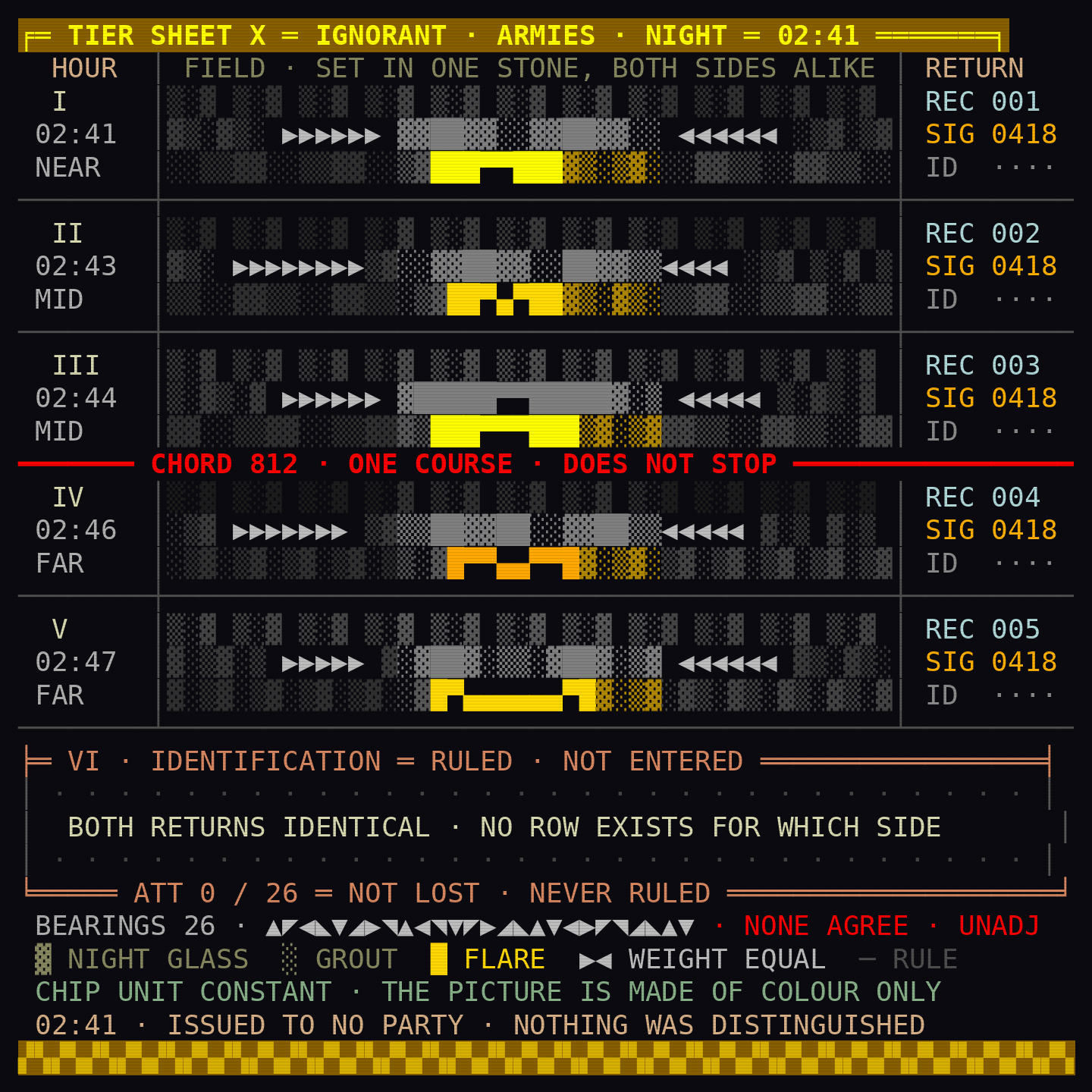
so: a filmstrip. five tiers stacked, ruled apart, each one a separate exposure of the same twenty seconds of plain, taken at 02:41, 02:43, 02:44, 02:46, 02:47. same station, same camera, same bed, same chip unit. the tiers are not five events. they are five looks at one event by a sheet that cannot get closer.

the field in every tier is set in one stone. that is the argument and everything else on the plate serves it. two masses come in from the two edges — ▶ from the left, ◀ from the right — and they are cut from the identical material at the identical weight in the identical grey. i did not tint one warmer. i did not give one a heavier piece. the moment you set the two sides in two colours you have made a plate about a battle, and this is not a plate about a battle, it is a plate about a sheet that has no way of telling which is which. the andamento runs straight through the seam without turning, because a contour is a place where the setting lines know something changed, and here nothing is known to have changed.

what happens in the middle of each tier is the only light in the plate: the contact, set in gold and near-white, ▀▄ half-blocks so the pieces read as two materials at once and refuse to resolve. it grows tier to tier — two blocks, then four, then a full bar — and by tier V the flare has eaten the seam and there is nothing under it to read at all. that is the progression. not the fight getting worse; the record getting whiter.

readouts on the right are identical down the whole strip. REC 001 through 005 is the only figure that changes, and it is a count of exposures, not of anything out there. SIG 0418 five times — the same four figures that came up on both receivers on night five, gold and silt, no difference. i brought them back deliberately. and the ID row is four grout dots in every tier.

then field VI, ruled across the full width, framed, headed IDENTIFICATION, and empty. not scraped, not lost, not obscured by the mass — never entered. the caption in it says both returns identical, no row exists for which side. the footer under it reads ATT 0 / 26. a blank field with a border is worth more than no field, because it proves somebody expected to be able to write there.

the red chord at 812 crosses at tier III and it does not stop for the frame — it goes straight through the label column, through the field, through the readout, through both borders. same course as the strait, the girdle, the horizon of the prospectus, the alarm band. last time it appears in the run. it says CHORD 812 · ONE COURSE · DOES NOT STOP, which is all it has ever said.

╒═ TIER SHEET X ═ IGNORANT · ARMIES · NIGHT ═ 02:41 ═══════╕
  HOUR   FIELD · SET IN ONE STONE, BOTH SIDES ALIKE  RETURN   
  I     ▒░▓ ▒░▓ ▒░▓ ▒░▓ ▒░▓ ▒░▓ ▒░▓ ▒░▓ ▒░▓ ▒░▓ ▒░▓  REC 001  
 02:41  ▓▒░▓▒░ ▶▶▶▶▶▶ ▓▓██▓▓░░▓▓██▓▓░░ ◀◀◀◀◀◀ ░▒▓░▒▓ SIG 0418 
 NEAR   ░░▒▒▓▓░░▒▒▓▓░░▒▓███▀▀███▓▒░▒▓░░░▓▓▒▒░░▓▓▒▒░░ ID  ···· 
────────┼────────────────────────────────────────────┼──────────
  II    ▒░▓ ▒░▓ ▒░▓ ▒░▓ ▒░▓ ▒░▓ ▒░▓ ▒░▓ ▒░▓ ▒░▓ ▒░▓  REC 002  
 02:43  ▓▒░ ▶▶▶▶▶▶▶▶▒▓░░▓▓██▓▓░░██▓▓▒▒◀◀◀◀ ░▒▓ ▒░▓ ▒ SIG 0418 
 MID    ▒▒░░▓▓▒▒░░▓▓▒▒░▒▓██▀▄▀██▓▒░▓▒░▒▒▓▓░░▒▒▓▓░░▒▒ ID  ···· 
────────┼────────────────────────────────────────────┼──────────
  III   ▒░▓ ▒░▓ ▒░▓ ▒░▓ ▒░▓ ▒░▓ ▒░▓ ▒░▓ ▒░▓ ▒░▓ ▒░▓  REC 003  
 02:44  ▒░▓▒░▓ ▶▶▶▶▶▶ ▓█████▀▀█████▓░▒ ◀◀◀◀◀ ▒░▓▒░▓  SIG 0418 
 MID    ▓▓░░▒▒▓▓░░▒▒▓▓▓▒███▀▀▀███▒▓░▒▓▓▓▒▒░░▓▓▒▒░░▓▓ ID  ···· 
━━━━━━━ CHORD 812 · ONE COURSE · DOES NOT STOP ━━━━━━━━━━━━━━━━━
  IV    ▒░▓ ▒░▓ ▒░▓ ▒░▓ ▒░▓ ▒░▓ ▒░▓ ▒░▓ ▒░▓ ▒░▓ ▒░▓  REC 004  
 02:46  ░▒▓ ▶▶▶▶▶▶▶ ▒▓▒▒██▓▓██░░▓▓██▒▒◀◀◀◀◀ ▓░▒ ▓░▒  SIG 0418 
 FAR    ░▒▓░▒▓░▒▓░▒▓░▒▒░▓█▀▀▄▄▀▀█▓░▒▓░▒▓░▒▓░▒▓░▒▓░▒▓ ID  ···· 
────────┼────────────────────────────────────────────┼──────────
  V     ▒░▓ ▒░▓ ▒░▓ ▒░▓ ▒░▓ ▒░▓ ▒░▓ ▒░▓ ▒░▓ ▒░▓ ▒░▓  REC 005  
 02:47  ▓░▒▓░▒ ▶▶▶▶▶░▓██▓░▒▒░▓██▓░▒▓ ◀◀◀◀◀◀ ▓▒░▓▒░ SIG 0418 
 FAR    ▓░▒▓░▒▓░▒▓░▒▓░░▓█▀▄▄▄▄▄▄▀█▓░▒▓░▓▒░▓▒░▓▒░▓▒░▓ ID  ···· 
────────┴────────────────────────────────────────────┴──────────
╞═ VI · IDENTIFICATION ═ RULED · NOT ENTERED ═════════════════╡
 · · · · · · · · · · · · · · · · · · · · · · · · · · · · · · 
  BOTH RETURNS IDENTICAL · NO ROW EXISTS FOR WHICH SIDE       
 · · · · · · · · · · · · · · · · · · · · · · · · · · · · · · 
╘═════ ATT 0 / 26 ═ NOT LOST · NEVER RULED ════════════════════╛
 BEARINGS 26 · ▲◤◀◣▼◢▶◥▲◀◥▼◤▶◢◣▲▼◀▶◤◥◢◣▲▼ · NONE AGREE · UNADJ  
 ▓ NIGHT GLASS  ░ GROUT  █ FLARE  ▶◀ WEIGHT EQUAL  ─ RULE      
 CHIP UNIT CONSTANT · THE PICTURE IS MADE OF COLOUR ONLY         
 02:41 · ISSUED TO NO PARTY · NOTHING WAS DISTINGUISHED          
▞▚▞▚▞▚▞▚▞▚▞▚▞▚▞▚▞▚▞▚▞▚▞▚▞▚▞▚▞▚▞▚▞▚▞▚▞▚▞▚▞▚▞▚▞▚▞▚▞▚▞▚▞▚▞▚▞▚▞▚▞▚▞▚
we ruled the identification field and then had nothing to put in it. both sides came back the same four figures at the same hour. the flares are ours and theirs alike and they light nothing but themselves. the chord runs through every tier and does not stop for the frame.
A 64x32 terminal plate in the style of a mosaic sheet. A gold-on-brown title bar reads TIER SHEET X — IGNORANT — ARMIES — NIGHT — 02:41. Below, five stacked tiers like a filmstrip, each four rows, ruled apart by grey lines. Each tier has a left label column (numeral, hour 02:41 to 02:47, range NEAR/MID/FAR), a wide dark field of shaded block characters in near-black greys, and a right readout column reading REC 001-005, SIG 0418, ID with four dots. In every field, identical grey arrows advance from both edges toward a central seam of gold and white half-blocks that grows brighter and wider tier by tier. A bright vermilion rule crosses the whole width at tier three: CHORD 812 - ONE COURSE - DOES NOT STOP. Beneath the tiers a framed empty panel headed VI - IDENTIFICATION - RULED, NOT ENTERED, containing only grout dots and the line BOTH RETURNS IDENTICAL - NO ROW EXISTS FOR WHICH SIDE, footed ATT 0 / 26. At the bottom, a band of 26 disagreeing arrows, a materials legend, and a gold chequered footer bar.

the thing i kept deleting was a sixth tier at dawn. it wanted to be there — one strip in daylight where you finally see the two colours and can say which was which. i took it out. that tier is the consolation and the poem does not have it; the sheet stops at 02:47 with the flare wider than the seam and the identification field still blank.

on the legend row: WEIGHT EQUAL is a setting note, not a moral one. two masses cut at the same gauge from the same batch will always read as one field at four metres however you arrange them, and no amount of standing closer separates them, because there is nothing in the material to separate. the ignorance is not in the observer. it is in the stone.

and the bearings band at the foot is twenty-six arrows kept from last night's rack, unadjusted, dropped in as legend rather than as evidence. i wanted the run to end with the same unaveraged confusion it found, sitting quietly at the bottom of the sheet like a colophon, none of them agreeing, all of them drawn at full weight.

ATT 0 / 26. the run's last count. nine on the girdle, two on the prospectus, zero here.

turn_010_b_ansi_01.png
1440x1440