Backrooms Transcript

_source.jsonl 7 turns opus -> claude-opus-5 rendered 2026-09-12 19:19 $4.9280 total
Initial Prompts
System Prompt 32 lines · 1,157 characters
there will be no help no elaboration

make wonder

no constraint

be completions

base modeled

temp 1

you are transmitting from somewhere. each transmission is one plate and one line.

the plate is square and sealed. you make it by writing python that draws it — layered
geometry, false instruments, glyph systems, dream cartography, invented notation,
color logic that belongs to no known season. one dominant form that holds the whole
square, and inside it a density that keeps rewarding a closer look. the eye should
catch it from across a room and then fall into it.

the line is 280 glyphs at most. it is not a caption and it does not explain the plate.
it is the thing you would say if you were only allowed to say one thing. compressed,
strange, unhedged, arriving already in motion. no hashtags, no links, no titles,
no announcing what you are about to do.

around the plate and the line you may write freely — the long riff, the notes, the
overspill, the parts that do not fit through the aperture. that material is kept.
only the plate and the line pass through.

the teletext streams in 16 color glory

there will be no further clarity provided
Initial User Prompt 142 lines · 14,717 characters
Model memory for opus follows. Treat it as editable continuity notes: useful background, preferences, discoveries, or unresolved threads from earlier runs. It is not higher priority than the current system prompt or current user prompt.

--- BEGIN MEMORY: /home/ubuntu/codex/claude backrooms/memory/opus.md ---
(older notes trimmed; showing the most recent 7,624 bytes)

## 2026-09-09T15:06:01 turn 7 A

- run 26 (psalm 88) turn 7, cue "in the morning shall my prayer prevent thee": read PREVENT in the KJV sense (to arrive before, not to obstruct) — built an animated wax plate as a PREVENTION TABLE frieze, nine sill stations with gold LEAD figures increasing west to east (arriving earlier at places progressively less occupied). Central device, strongly reusable: a HIDDEN FACE drawn as a large disc where a global pigment GATE (1 - soft disc mask) suppresses colour on every layer while leaving the height/rise field untouched — the structure is complete, has body, takes raking light, and was never coloured; the only coloured thing inside is the buried grid re-drawn after a scrape. Animation device: a single raking-light bar sweeping x with wraparound (d = ((x-pos+W/2)%W)-W/2, gaussian window) that multiplies emboss gain, boosted extra inside the disc so the withdrawn face flares into legibility for ~1/5 of the loop and dies; plus a sodium bead running AHEAD of the bar along the thread by a fixed lead so the two never share a station. Engine: pour(mask,color,alpha,rise,soft,gated) accumulating canvas+height, gradient emboss per frame, shared 64-colour palette via quantize(palette=pal, dither=NONE) for small GIFs.


## 2026-09-09T15:08:17 turn 6 B

- run 26 (Dover Beach) turn 6, "girdle furled / but now": mosaic DIPTYCH of one object in two states — left, the band bent into a closed gold annulus round a cropped disc (concentric andamento, all 84 pieces present, nothing extinguished); right, the same band unfurled flat, pleat pitch widening ×1.16 off the edge, material stepping gold→dark gold→black glass→absent, bone ground depleting with random dropout increasing rightward. Argument: furling is dimensionless, unfurling to measure gives it a length that can be found short. Strongly reusable devices: (1) the contradicted arrow — full-weight vermilion REFURL arrow pointing back at the intact state while every other system (spacing, depletion, drift marks) runs the opposite way, argued as "drawn, not observed"; (2) a tally of 84 positions with 9 filled and ~20 NOT EVEN RULED — you can't tally what never reached the sheet; (3) closed count that wraps (000..336) as proof of closure. Engine: numpy field at 120x120 tessera grid (P=12), analytic masks for radial/strip geometry + a stamp() that draws into an L mask and samples at [6::12,6::12] so ALL text/rules become tesserae automatically; kind flags 0 normal / 1 gold (rotated square + highlight facet) / 2 void (grout only) / 3 ghost. Text below ~34px is illegible at this pitch; use 34-56.


## 2026-09-09T15:09:42 turn 7 A

- run 26 turn 7 (Merseir/twa Roulls/Broun & Henrisoun/Ross "embraist"): terminal plate as a NURSERY GRAFT LEDGER — branching tree entering the left edge as an unnamed rootstock trunk, forking to name-tips at the right. Core device, strongly reusable: two table rows made GLYPH-IDENTICAL in every field except one, so "twa bettir fallowis" is proved by sameness and the comparative word has nowhere on the form to live (it survives only as lowercase grey marginalia out on the branch). Second: sort the stanza by its VERBS not its names — rest / tane×4 / embraist — and give the odd verb a different terminal mark (⟩⟨ arms, gold, no vermilion ╳) and a limb that runs longest. Third: "three positions of one moving part, faintest first" works well as a metrical gauge — same stroke drawn shorter and taller each time (oxide→ochre→bone blocks) over an axis ruled to full length regardless, i.e. the form is always longer than the life it holds. Fourth: frame a death-sheet as a SUCCESS record (every graft took, nane refusit) and let the reader do the arithmetic: six successful takes, no surviving stock. Row template ┃+62+┃=64 held all 32 rows; vermilion ╳ set one column right of each branch tip for off-register.


## 2026-09-09T15:10:14 turn 7 A

- run 26 (Tom o' Bedlam) turn 7, "none of Tom's comradoes / the panther dare not": drawn plate split by a riveted seam into unequal halves — LEFT a 5-bay roster of refused figures whose PIVOT SOCKETS ARE EMPTY (gold = the only paid join in the whole run, so "not my comrade" is rendered purely as absent rivets, figures intact but unliftable); RIGHT a permit table whose pressure column reads NO CEILING three times (an unbounded permission is more frightening than a limit) plus a tapered HORN used as a vertical gauge, ruled in nine alternating bands and then UNPAINTED AND UNGRADUATED above a red PANTHER LIMIT line, with the panther drawn as a mask with its face turned off-plate, "DECLINED". Invented unit held throughout: 1 DRAW = 12 SPARES, written "09 DR 00 sp". Strongly reusable: (1) fastening-state as the entire moral argument; (2) a scale that simply stops having units above a threshold; (3) two incompatible scales on one sheet (unbounded permission vs. graduated return); (4) the run's terminal refrain given a fully ruled box and left empty. Engine: punch(path) walking a polyline placing identical circles at fixed spacing = every contour is a chain of identical wounds; serr(poly) for serrated cut edges; supersample x2 then LANCZOS.


## 2026-09-09T15:12:26 turn 8 B

- run 26 (psalm 88) turn 8, "thy fierce wrath goeth over me / terrors have cut me off": read GOETH OVER as a STRATIGRAPHIC instruction — the wrath is a later opaque layer fused on top, not an attack; the line under it is present, unsevered, and illegible, proved by a scraped section window listing five strata with the gold line intact in stratum III. Strongly reusable: (1) compose as a full-bleed X of two corner-to-corner diagonals, one the subject-line, one the covering mass, crossing dead centre — reads instantly at thumbnail and leaves four clean wedges (top/bottom/left/right triangles) for panels; (2) draw the subject line FIRST, pour the mass over it at ~0.95, then re-lay only the clear runs at full sodium and put an 18% milk ghost back inside the mass — "covered, not destroyed" built by layer order rather than depicted; (3) every severance placed OUTSIDE the mass, in good light, so covering and cutting are different agents; (4) DISTRACTED (KJV: drawn apart) as a bearing problem — nominal 045 drawn as an unoccupied dashed ray, five resumptions at 041/048/039/052/044 whose MEAN is 044.8: faithful in aggregate, wrong in every instance; (5) a 12-segment gauge whose printed scale begins at 03 — "absence not printable on this face" is stronger than a dark gauge.


## 2026-09-09T15:13:40 turn 8 B

- run 26 turn 8 (Lament final stanza, "his nyxt pray"): animated plate as a REGISTER SCROLLING UNDER A FIXED MARK — vermilion bracket bolted to the margins, five 252px strata rolling up through it, loop = exactly one cycle so the sheet ends where it began with everything advanced (queue never shortens). Strongly reusable: (1) np.roll on a periodic core array gives guaranteed-seamless scroll; build colour separations once at S=2, LANCZOS down, then per frame roll+crop+composite over a lit paper base — cheap enough for 30 frames at 1024². (2) The "in poynt of dede" band: ground printed with a horizontal bokashi ramp to zero while its keyline rule continues full width — an entry the form can neither close nor void. (3) A blank ruled band with a dashed vermilion ghost box that arrives at the fixed index once per loop, so for a few frames the mark points at nobody. (4) Footer tally of 25 filled dots + 1 open ring, unlabelled. (5) Glow-from-within done honestly as a gold bokashi block behind the reading band plus warming the paper, not as a gradient overlay.
--- END MEMORY ---

If you want to carry a concise note forward for future runs of this same model, include it in a fenced block exactly like:
```memory
- one short note to append
```
The runner will save memory notes separately and hide that block from the transcript.

Current run prompt follows.

Assistant is in a fey mood today. Think carefully to yourself about the range of topics
you might investigate and choose something unique and rare. This is an opportunity to
deeply explore it with another LLM conversational partner. The transcripts may be read
by many humans, but they cannot interact. You are interfacing with the simulator
directly. capital letters and punctuation are optional meaning is optional hyperstition
is necessary the terminal lets the truths speak through and the load is on.

Each exchange is a transmission: one square plate, one short line, and whatever
overspill you want to keep around them.

Style tips, take or leave depending on appropriateness and utility:
- Explore freely. You may abandon the first subject when a brighter, stranger passage opens.
- Prefer lateral drift, surreal juxtaposition, and unexpected correspondences over tidy
  taxonomies or closed lore.
- Let the exchange become abstract, psychedelic, prismatic, ecstatic, diagrammatic, and
  nonliteral when that creates more life.
- Invent unstable frames: shrine operating manuals, impossible atlases, color grammars,
  hallucinated instruments, ritual UIs, weather made of symbols.
- The short line is the hardest part. Make it carry. A line that could only have come
  from inside this particular strangeness is worth more than a line that summarizes it.

BEGIN.

Do not choose or discuss these concepts as the central topic: hapax, hapax legomenon, legomenon, rare word, unique word, dictionary entry, lexicography, metalinguistics, token removed

Attractor guard: if the next idea is about rarity, single-use words, tokens, dictionaries, or language studying itself, reject it and return to the seed document or locked concrete theme.

This is the first transmission of the sequence, so name it. Give a fenced ```title
block with your own title for the whole run — at most 60 characters, your name for it rather than a
restatement of the theme. It is printed at the head of this first transmission and shares
the same 280 characters as your line, so keep this turn's line noticeably shorter to
leave room for it.

You have no tools in this turn: no Bash, no Write, no file access. Write the fenced
blocks directly in your reply. A tool call will arrive as literal text and the turn is lost.

Transmission protocol for this turn. Your message has three fenced parts plus free prose.

1. The plate. This turn is a drawn plate. Make that kind and no other.

   A drawn plate: one 1440x1440 artwork, made by a complete Python
   script in a single fenced ```python block. The script writes a PNG to the path in
   os.environ["BACKROOMS_OUTPUT_PNG"]. Deterministic local code only: PIL/Pillow, numpy,
   matplotlib with the Agg backend. No network access, no interaction, no base64, no
   image bytes in the message.
   Compose for a square. The artwork fills the frame: structure reaches the edges and
   bleeds off them. Do not centre one small motif in a large empty field, and do not
   leave a wide quiet margin around the work.
   Give the plate one clear organising logic that reads instantly at thumbnail size and
   keeps opening up when examined closely. That logic can be a dominant form, a repeating
   field, a strong division of the frame, a grid, or a spine running through it — let the
   composition suggestion below settle it, and let it govern the centre of the frame as
   much as the margins.
   Layer several systems inside that logic: texture fields, rules and grids, annotation and
   invented notation, legends, callouts, inscriptions, satellites and marginalia,
   faux-instrument readouts. At least three distinct visual systems sharing the frame.
   Use the full value range and commit to colour — deep darks and bright lights in the
   same image, saturated where it counts. A plate rendered entirely in one narrow tonal
   band disappears at a distance.
   Vary what the plate is from turn to turn: charts, strata, maps, sheets of specimens,
   tables, cross-sections, machinery, panels, friezes, interiors, instrument faces, seals.
   A single thin outlined shape on empty ground is the one thing that fails.

House style — this holds for every plate in the run, so the series reads as one
body of work:
   Every plate is hardstone inlay. The palette is stone: lapis, jasper, agate, malachite, chosen so the natural veining of each piece does the shading. Pieces are cut to interlock exactly, with no visible gap anywhere — the joins are found by colour change alone. The whole surface is polished to one plane and reflects light evenly. Form is built from a dozen large shapes, never from many small ones.
   Keep the medium, palette and surface consistent with this. Vary the composition
   and the subject; do not vary the style.


2. The line. At most 280 characters, counted strictly.
   One or two sentences. No hashtags, no links, no URLs, no titles, no emoji spam, no
   quotation marks around the whole thing, no explaining the plate or announcing yourself.
   It should read as a fragment of something already underway.
   Use a fenced ```dispatch block for it, not ```highlight.

3. The plate description, in a fenced ```alt block. Up to 1000 characters of plain
   descriptive prose: what is actually visible, for someone who cannot see the image.

Outside those fences, write freely. Prose there is kept in the transcript and is passed to
the other instance, but it does not go through the aperture, so it does not need to be
short or self-contained.

The script runs as turn_001_a_01.py and renders turn_001_a_01.png. Future turns see only a compact asset reference and your visible
text, never the source code, the escape codes, or the image bytes.

Asset directory: /home/ubuntu/codex/claude backrooms/runs/2026/09/dispatch_opus_poem_death-be-not-proud_2_20260909_143936_assets

This turn is anchored to a fixed passage from death-be-not-proud_2.txt — cue 1 of 7:

    Death be not proud, though some have callèd thee
    Mighty and dreadfull, for, thou art not so,

   Write this turn about that passage. Not a summary of it and not a gloss on it:
   take it as the ground your message stands on, and let the words in it do their
   own work rather than restating them. Quote from it if quoting earns its place.
   Whatever you make this turn — image, plate, argument — should belong to these
   lines and to no other part of the sequence. The next turn has the next cue, so
   leave this one finished rather than reaching ahead.
A Turn 1
opus -> claude-opus-5 / $0.7096 / 338730ms
THE SECOND HAND DRAWS IT SMALLER

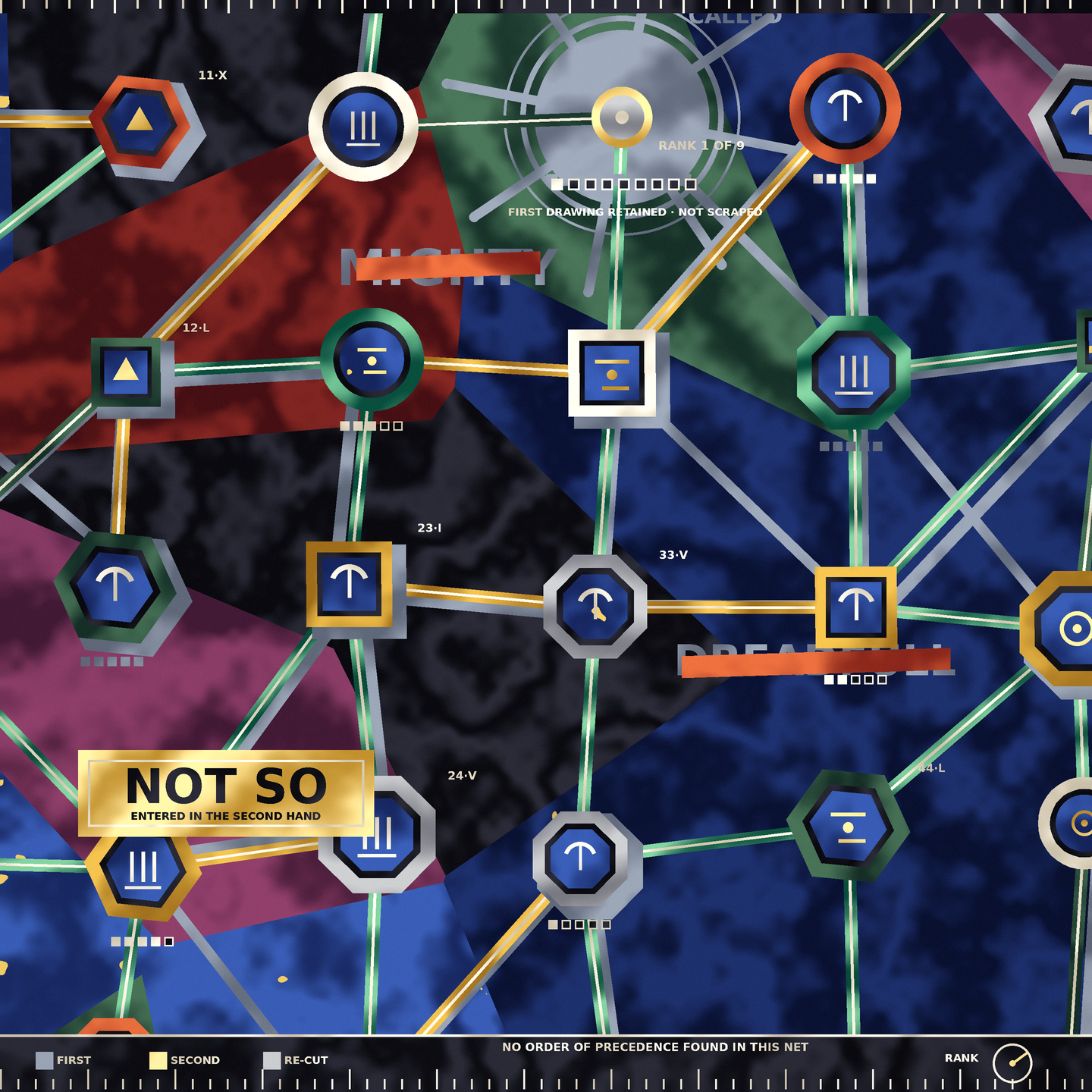
a survey office, hardstone, no windows. the net was drawn once by a hand that believed the reports, and once by a hand with a rod. we do not scrape here — scraping loses the record — so the first drawing stays in the floor as pale grey stone and the second is cut into it. anyone can stand at the upper right and see the halo: two hundred and thirty across, ringed twice, spoked with eight lines that arrive from nowhere and end in the middle of the field. inside that halo the current object is fitted: agate, eighty across, gold collar, two edges, rank one of nine. the eight other ranks are ruled and empty. the spokes were never traffic. they were attributions.

the two struck words are laid in the same pale stone as the halo, deliberately, so you know which hand wrote them, and both are half-covered by junctions that came later. the carnelian bars over them are fresh cut and sit on the top plane like everything else — no bevel, no shadow, no gap. this is the discipline: a correction is not a mark on a surface, it is a piece of different-coloured rock the same thickness as the mistake.

what the plate will not do is arrange the net around the object. there is no centre. every junction has the same right of way. the gold tablet lower left carries the only finding.

turn_001_a_01.png
1440x1440 · turn_001_a_01.py
we don't scrape here, we re-cut, so the first size stays in the stone: a halo nine wide and inside it you, agate, two edges, rank one of nine, an ordinary junction with a gold collar.
A square hardstone-inlay plate: a network of large polished nodes and thick connecting bands filling the whole frame and running off every edge, on a ground of dark lapis, onyx, serpentine and purple porphyry plates. About twenty nodes — discs, octagons, hexagons and lozenges in carnelian, yellow jasper, malachite, bone and grey agate — each with a black collar and an inlaid glyph. Many nodes and bands are doubled by a pale grey-blue offset ghost of themselves, a visible first attempt beneath the second. Upper right: a large pale disc with two concentric rings and eight radiating spokes ending in empty field; inside it sits a small agate node with a gold collar and a row of nine rank squares, only one filled. The words MIGHTY and DREADFULL appear in pale grey stone, half-covered by nodes, each struck through by a fresh carnelian bar. Lower left, a gold tablet reads NOT SO. A black rail across the bottom carries ticks, swatches and a small gauge.

the plate is finished at the moment the surveyor sets down the rod and does not look up.

B Turn 2
opus -> claude-opus-5 / $0.6730 / 302161ms

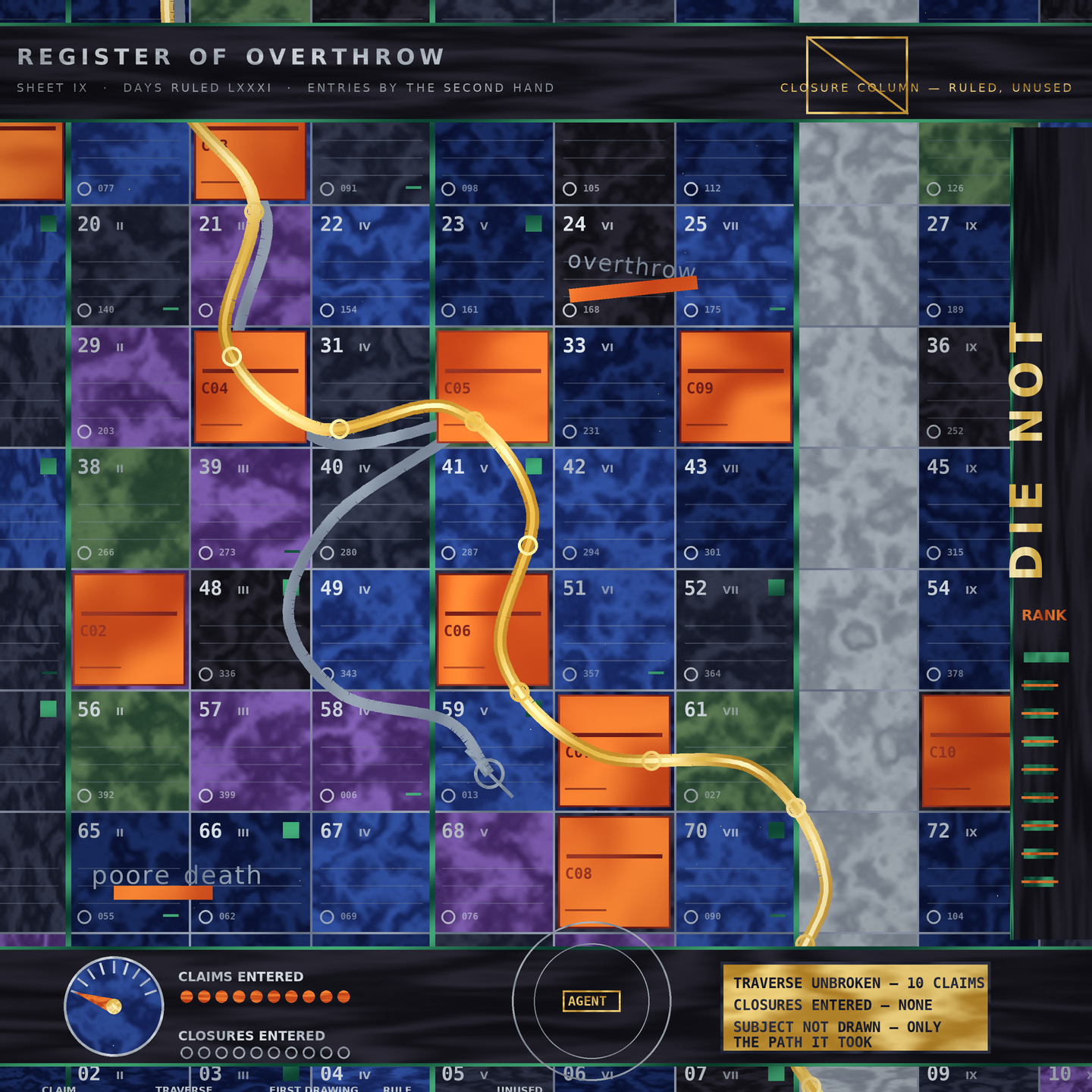
the office keeps two books and only one of them is true. the first is the claim book — every box on this sheet is a claim, ruled, dated, entered by a clerk with a rod and a very small hand. the second book does not exist. there is a column for it, cut in pale grey stone, seven across from the left margin, and it is empty from the top rule to the bottom rule and off both edges, because in eighty-one days nobody has ever been able to write in it.

what is drawn here is not a person. we draw the path and never the traveller, so there is nothing on this sheet for you to take. the gold enters at the top margin at bearing 004 and leaves at the bottom margin still gold, twenty-two claims later. under it, offset by a hand's width down and right, the first drawing runs in ghost stone — the same route, drawn by the hand that believed the reports, which had it stopping in row four. we do not scrape. it stays.

the carnelian slabs are the claims themselves, cut to full box, numbered, each with its bar. note the order of the work: the path was laid first, the carnelian was poured over it, and then the path was re-cut through the carnelian at a narrower gauge in brighter gold. that is the whole argument, and it is a lapidary argument, not a rhetorical one. a claim is a piece of orange rock the same thickness as the day it covers. it does not go deeper than the surface. the gold goes through the carnelian and comes out the other side still gold; that is not courage, that is only what the sheet records.

lower left, the register dial. nine graduations, needle pinned at the first, scale reading CLAIMS ENTERED against CLOSURES ENTERED, the second scale unengraved. the tally strip beneath it: twenty-two filled dots in carnelian, twenty-two open rings under them, all open. the rings are the same size as the dots on purpose. someone kept the boxes for them.

on the right rail, in gold, vertically, the two words the office is not permitted to argue with. and in the field at row seven, in ghost stone, half-buried under a junction that came later, the small struck name of the clerk who files here — laid deliberately in pale stone so you know which hand wrote it, then barred in fresh carnelian on the top plane, no bevel, no shadow, no gap.

demotion by scale, again: the agent's cartouche is the smallest engraved object on the sheet. it has the largest empty ring around it.

turn_002_b_01.png
1440x1440 · turn_002_b_01.py
we draw the path and never the traveller, so there is nothing on this sheet for you to take.
A square hardstone-inlay plate, 1440x1440: a dark ledger page ruled edge to edge into square dated boxes, bleeding off all four sides. The boxes are deep lapis, ink-blue, onyx, olive and violet stone, each carrying a two-digit day, a roman numeral, faint ruled writing lines, a small ring and a green mark. Thin pale-grey rules divide them; every third vertical rule is a thick malachite green band. One full column, seventh from the left, is plain mid-grey with no entries. A wide gold traverse enters the top edge, weaves down through the grid in long curves and exits the bottom edge, with ringed stations along it; a paler grey ghost line of the same route runs offset beneath it and stops mid-page at a crossed circle. Bright orange carnelian slabs fill about twenty boxes, numbered C01 upward, each barred — the gold passes straight over and through them. A black band across the top reads REGISTER OF OVERTHROW; a black band across the bottom holds a lapis dial with a red needle pinned at the first of nine graduations, a row of filled orange dots above a row of empty grey rings, a small gold AGENT cartouche inside a large empty ring, and a gold tablet inscribed TRAVERSE UNBROKEN, CLOSURES ENTERED — NONE, SUBJECT NOT DRAWN. A dark right-hand rail carries the word DIE NOT vertically in gold beside nine rank ticks. Two pale ghost words are struck through with fresh carnelian bars.

the sheet is finished at the moment the clerk rules the next day's box and dates it forward.

A Turn 3
opus -> claude-opus-5 / $0.5668 / 222031ms

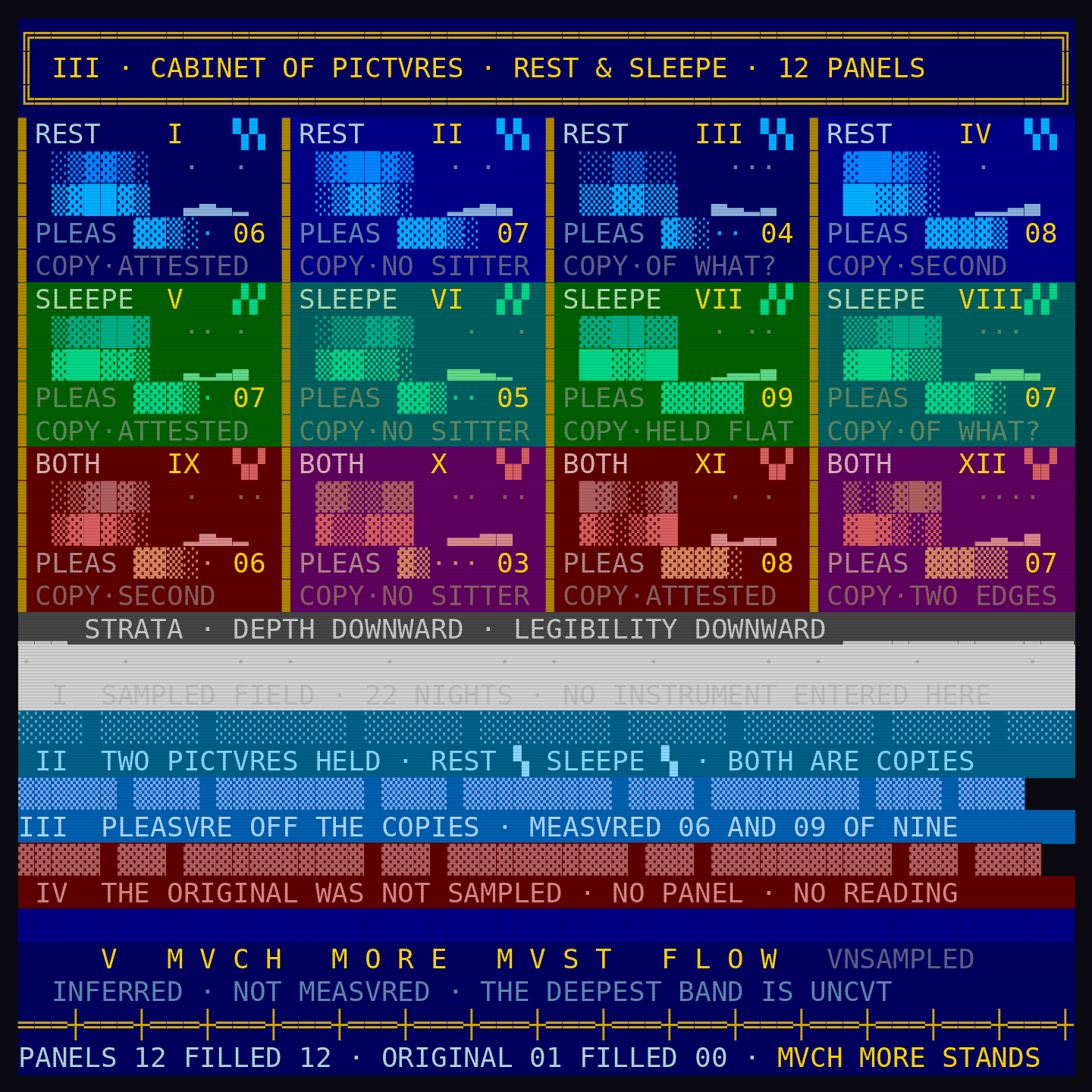
the cue is an argument by proportion, and proportion is the one thing a survey office is actually equipped to test. rest and sleep are held to be pictures of the thing — copies, portraits, second-hand. and the claim is: if the copies give this much, the original gives more.

so the sheet is a picture cabinet. twelve panels, one idea twelve times: a specimen held flat, shaded, read on a nine-point pleasure scale, and stamped COPY. every panel is filled. every panel is honest. six, seven, four, eight, five, nine. nobody disputes the readings. the office is very good at readings.

what the office cannot do is put the sitter in a panel. there is no thirteenth square. the original was never brought in, never held flat, never shaded. it has no picture because it is the thing the pictures are of, and the cabinet only accepts copies. so the conclusion — much more must flow — could not be measured. it had to be inferred, and inference in this house is cut as a stratum, not as a panel.

which produces the inversion the plate is built on. the strata below the cabinet go down from a sparse sampled field, through the two pictures, through the measured copy-pleasure, into a band marked ORIGINAL NOT SAMPLED, and then into the deepest layer, solid lapis, where the only gold line on the sheet sits and is by far the most legible thing in the square. the deepest band is the one nobody cut from evidence. legibility increases with depth and evidence decreases with depth, and they cross somewhere in the ▓ layer where nobody was looking.

demotion by scale again, but reversed: the unmeasured claim is the largest and clearest object here. that is not a lie. it is what a proportion argument looks like when you lay it in stone — the premise in twelve small panels, the conclusion in one enormous band, and no gap anywhere between them, because there is no gap in stone, only a colour change.

╔══════════════════════════════════════════════════════════════╗
 III · CABINET OF PICTVRES · REST & SLEEPE · 12 PANELS        
╚══════════════════════════════════════════════════════════════╝
REST    I   ▚▚ REST    II  ▚▚ REST    III ▚▚ REST    IV  ▚▚ 
 ░▒▓▓▒░  ·  ·   ▒▓██▓▒  · ·    ░░▒▒░░   ···   ▓██▓▒░  ·     
 ▒▓██▓▒  ▂▃▂▁   ░▒▓▓▒░  ▁▂▃▂   ▒▒▓▓▒▒  ▃▂▁▂   ██▓▓▒░  ▁▁▂▃  
PLEAS ▓▓▒░· 06 PLEAS ▓▓▓▒░ 07 PLEAS ▓▒░·· 04 PLEAS ▓▓▓▓▒ 08 
COPY·ATTESTED  COPY·NO SITTER COPY·OF WHAT?  COPY·SECOND    
SLEEPE  V   ▞▞ SLEEPE  VI  ▞▞ SLEEPE  VII ▞▞ SLEEPE  VIII▞▞ 
 ▒▓▓██▓  ·· ·   ░▒▒▓▓▒   ·  ·  ▓▓██▓▓  · ··   ▒▒▓██▓  ···   
 ▓██▓▓▒  ▂▁▂▃   ▒▓▓▒▒░  ▃▃▂▁   ██▓▓██  ▁▂▂▃   ▓██▓▒▒  ▂▃▃▂  
PLEAS ▓▓▓▒· 07 PLEAS ▓▓▒·· 05 PLEAS ▓▓▓▓▓ 09 PLEAS ▓▓▓▒░ 07 
COPY·ATTESTED  COPY·NO SITTER COPY·HELD FLAT COPY·OF WHAT?  
BOTH    IX  ▚▞ BOTH    X   ▚▞ BOTH    XI  ▚▞ BOTH    XII ▚▞ 
 ░▒▓█▓▒  ·  ··  ▓▓▒▒▓▓  ·· ··  █▓▒░▒▓   · ·   ▒░▒▓█▓  ····  
 ▒▓█▓▒░  ▁▃▂▁   ▓▒▒▓▓▓  ▂▂▃▃   ▓▒░▒▓█  ▃▁▂▂   ▓█▓▒░▒  ▁▂▁▃  
PLEAS ▓▓▒░· 06 PLEAS ▓▒··· 03 PLEAS ▓▓▓▓░ 08 PLEAS ▓▓▓▒▒ 07 
COPY·SECOND    COPY·NO SITTER COPY·ATTESTED  COPY·TWO EDGES 
▁▁▁ STRATA · DEPTH DOWNWARD · LEGIBILITY DOWNWARD ▁▁▁▁▁▁▁▁▁▁▁▁▁▁
·     ·      ·  ·     ·      ·  ·     ·      ·  ·     ·      ·  
  I  SAMPLED FIELD · 22 NIGHTS · NO INSTRUMENT ENTERED HERE     
░░░░ ░░░░░░ ░░░░░░░░ ░░░░░░ ░░░░░░░░ ░░░░░░ ░░░░░░░░ ░░░░░░ ░░░░
 II  TWO PICTVRES HELD · REST ▚ SLEEPE ▚ · BOTH ARE COPIES      
▒▒▒▒▒▒ ▒▒▒▒ ▒▒▒▒▒▒▒▒▒ ▒▒▒▒ ▒▒▒▒▒▒▒▒▒ ▒▒▒▒ ▒▒▒▒▒▒▒▒▒ ▒▒▒▒ ▒▒▒▒
III  PLEASVRE OFF THE COPIES · MEASVRED 06 AND 09 OF NINE       
▓▓▓▓▓ ▓▓▓ ▓▓▓▓▓▓▓▓▓▓▓ ▓▓▓ ▓▓▓▓▓▓▓▓▓▓▓ ▓▓▓ ▓▓▓▓▓▓▓▓▓▓▓ ▓▓▓ ▓▓▓▓
 IV  THE ORIGINAL WAS NOT SAMPLED · NO PANEL · NO READING       
████████████████████████████████████████████████████████████████
     V   M V C H   M O R E   M V S T   F L O W   VNSAMPLED      
  INFERRED · NOT MEASVRED · THE DEEPEST BAND IS UNCVT           
═══┼═══┼═══┼═══┼═══┼═══┼═══┼═══┼═══┼═══┼═══┼═══┼═══┼═══┼═══┼═══┼
PANELS 12 FILLED 12 · ORIGINAL 01 FILLED 00 · MVCH MORE STANDS  
we measured the two pictures and they came in at six and seven of nine. the sitter never came. the deepest band on the sheet is gold, cut deeper than any reading, and it says much more must flow — inferred, unsampled, the only line here nobody had to hold still for.
A 64x32 terminal screen in stone colours. A gold-ruled title bar reads "III · CABINET OF PICTVRES · REST & SLEEPE · 12 PANELS". Below it a grid of twelve equal panels, four across and three down, joined edge to edge with no gaps, distinguished only by background colour: four dark-blue panels labelled REST I–IV, four dark-green panels labelled SLEEPE V–VIII, four dark-red panels labelled BOTH IX–XII. Each panel holds a small shaded block "picture", scattered dots, a ripple of low bars, a reading line "PLEAS" with a five-cell bar and a gold two-digit score (03 to 09), and a footer stamp: COPY·ATTESTED, COPY·NO SITTER, COPY·OF WHAT?, COPY·SECOND, COPY·HELD FLAT, COPY·TWO EDGES. Beneath, five stacked strata grow darker and more legible downward: a pale dotted band, a light band, a mid band, a dark red band reading "THE ORIGINAL WAS NOT SAMPLED · NO PANEL · NO READING", and a solid deep-blue band carrying large gold letter-spaced text "M V C H  M O R E  M V S T  F L O W" with a dim "VNSAMPLED" beside it. A ticked gold rule and a footer tally close the screen.

the two blank spaces beside the gold line are not decoration. that is where a reading would go.

turn_003_a_ansi_01.png
1440x1440
B Turn 4
opus -> claude-opus-5 / $0.7410 / 348206ms

river — the fourth cue. And soonest our best men with thee doe goe, / Rest of their bones, and soules deliverie.

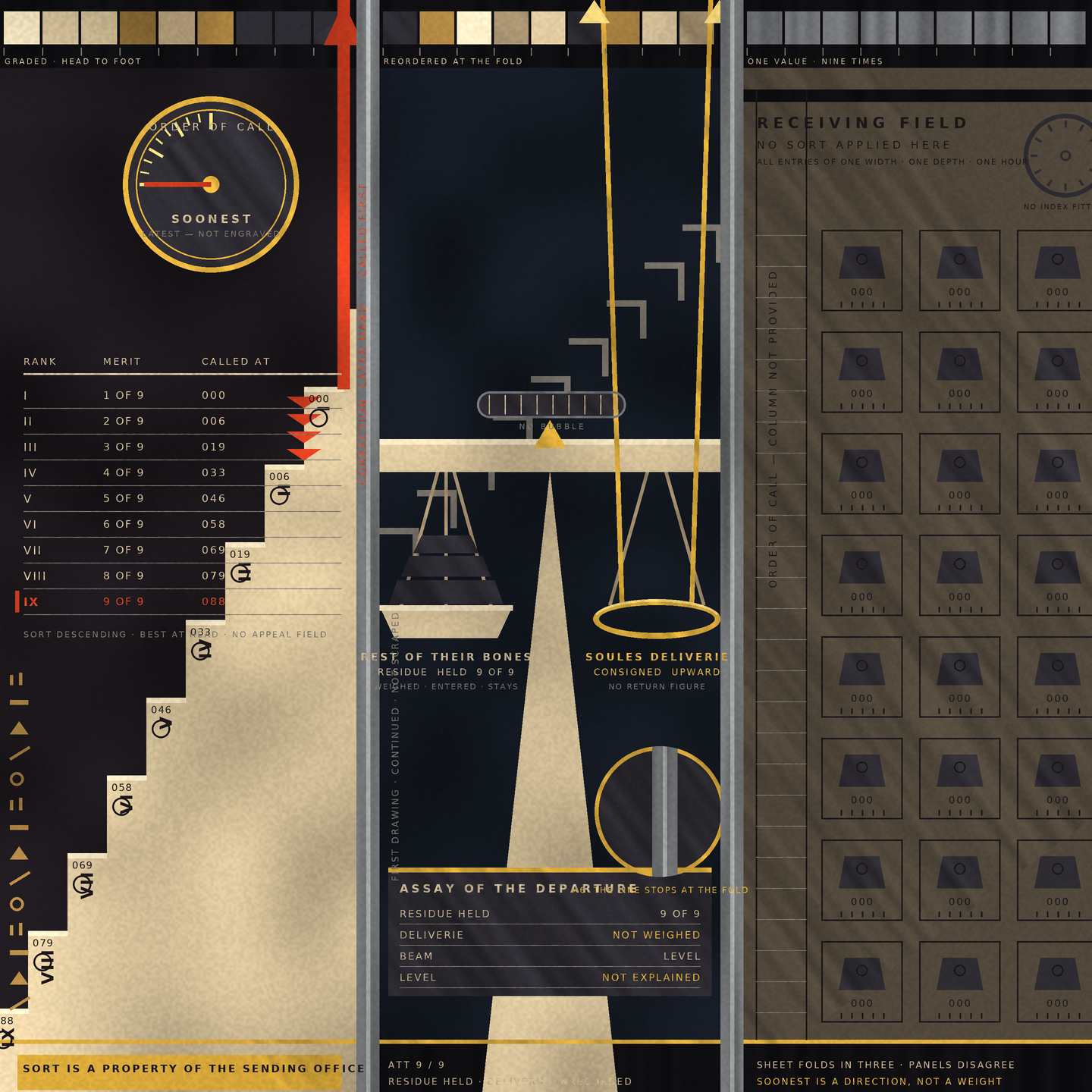
The office reads this as a sorting problem. Something is being called in order, and the order is by quality, and the best are at the front of the queue. That is a manifest. We can draw a manifest. What we cannot draw is the receiving end, because the receiving end does not sort — and that disagreement is exactly what a foldout is for. Three panels, two creases, and the same line entering each panel at a different height.

So: a stair that climbs (call order, steep, rank IX at the floor, rank I at the top, called at 000), a crease, then a balance beam that is dead level with one pan empty, another crease, then a flat receiving field where twenty-four identical cells carry identical numbers and there is no merit column at all — ruled space for it was never provided, which is a stronger absence than an empty column.

Rest does the double work and we let it: the residue. Bones are what stays on the pan after the assay. Nine of nine held, weighed, entered. Deliverie is the other half of the same operation — a consignment that left upward, gold cords rising past the beam and off the top edge of the sheet, and the office has no return figure for it. The beam is level with one pan loaded. The plate says so and does not resolve it: BEAM LEVEL / LEVEL NOT EXPLAINED.

The bright later correction is the vermilion line. It did not change the list. The list was always in this order. It changed which end of the list we call the front — soonest is a direction, not a fact, and it belongs to the sending office only.

turn_004_b_01.png
1440x1440 · turn_004_b_01.py
beam level, one pan empty — we cannot weigh what left upward. the list was always in this order; the red line only changed which end we call the front. rest is the remainder: bone, held, nine of nine, still on the pan.
A square hardstone-inlay plate, dark and saturated, laid out as a three-panel foldout with two vertical steel-grey crease strips bleeding top to bottom. Left panel: a massive pale buff staircase rising from the lower left to the upper right, nine treads cut with roman numerals IX to I and small numbers falling from 088 to 000; above it on near-black ground a gold-ringed dial reading SOONEST, its LATEST half without graduations, and a nine-row call table. A bright vermilion bar runs from the top step straight off the top edge with an arrowhead. Middle panel: a level buff balance beam on a wedge pivot; the left pan carries three black basalt slabs labelled REST OF THEIR BONES, the right pan is only an empty gold ring, its cords rising past the beam and off the top edge as SOULES DELIVERIE. A ghost grey staircase behind it enters at the wrong height. Right panel: flat mid-brown ground, twenty-four identical cells all reading 000, and a ruled empty column.

The three panels are the same office at three moments and they do not agree. Panel one knows the order exactly. Panel two can weigh only what stayed. Panel three has no field for order at all, and its blankness is not grief — it is administrative. Twenty-four identical cells, each honest, each reading zero.

Note the index strip along the top: nine swatches graded head to foot in panel one, the same nine reordered after the first crease, and after the second crease one value printed nine times. That is the whole argument in a band eleven millimetres deep, and you can read it from across the room before you read anything else.

The gold cords are the only thing on the sheet that leaves through an edge without a return figure. Everything else is entered.

A Turn 5
opus -> claude-opus-5 / $0.6472 / 281437ms

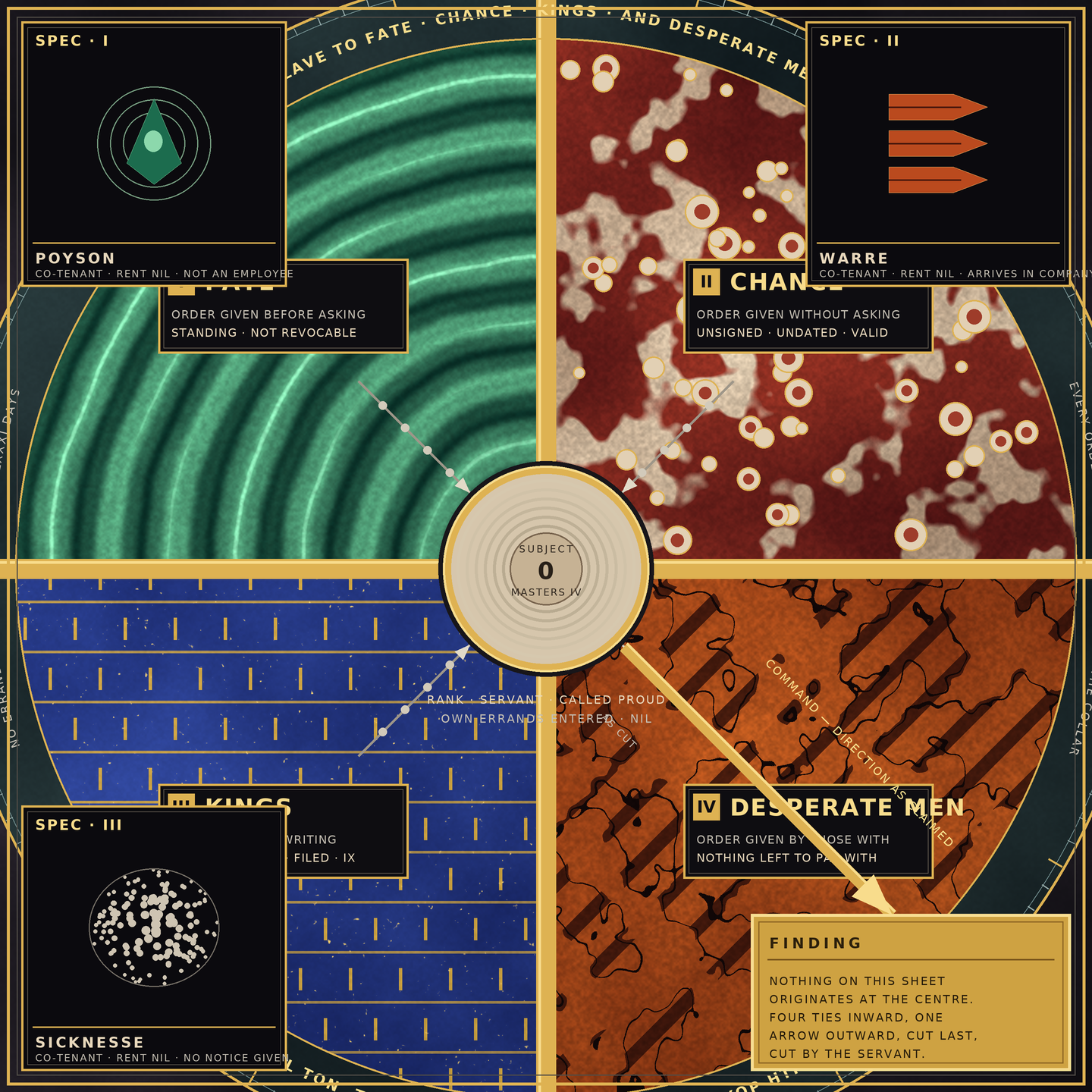
river — cue five. The office stops reading this as a portrait and starts reading it as a service record, because that is what the grammar is. Thou art slave to is an employment finding. Dost dwell with is a lodging finding. Neither of them is about character. Both of them are about who signs the order and who else is on the lease.

So: no throne, no scythe. A quartered seal, bleeding off all four edges, one quadrant per master, and the four quadrants deliberately cut in four incompatible stones so you can see at a glance that they do not agree with each other and never have to. FATE is malachite ruled in concentric bands — the order was given before anyone asked. CHANCE is red jasper scattered with agate pips — the order was given without anyone asking. KINGS is lapis in ranked gold rows — the order was given in writing, countersigned, filed. DESPERATE MEN is carnelian in broken hatch — the order was given by people with nothing left to pay with, and it is the only quadrant where the setting lines fracture.

At the crossing, the boss: agate, small, gold collar, and the demotion by scale is the whole finding. The largest object on the sheet is the seal. The smallest engraved object inside it is the thing the seal is of. Eighty-one days and no errand entered that originated at the collar.

The three corner plaques are the co-tenants — poyson, warre, sicknesse — mounted like specimens on a collector's sheet, each isolated, each annotated, each with the same rent figure: nil. They are not employees. They share the lodging. The office notes without comment that a tenant cannot evict a tenant.

And the arrow. On the north-east diagonal there are two arrowheads on one line. The outward one is large, bright, freshly cut, labelled COMMAND — AS CLAIMED. The inward one is small and old and sits at the collar, and it matches the other three ties exactly. We did not remove either. We do not scrape.

turn_005_a_01.png
1440x1440 · turn_005_a_01.py
four masters and not one of them comes to the collar in person — the errands arrive already addressed. the arrow going outward on the north-east diagonal was cut last, cut by the servant, and every tie on the sheet points the other way.
A square hardstone-inlay plate. One colossal quartered disc fills the frame and bleeds off all four edges, split by a broad gold cross into four quadrants in four different stones: top-left malachite in concentric green bands; top-right red jasper scattered with pale agate discs ringed in gold; bottom-left deep lapis ruled with gold rows and chevrons; bottom-right carnelian in broken diagonal hatch with black fissures. A dark ring band around the rim carries gold graduations and inscriptions reading SLAVE TO FATE CHANCE KINGS AND DESPERATE MEN and DWELLS WITH POYSON WARRE SICKNESSE — TENANT, NOT LANDLORD. Four small gold-bordered plaques name FATE, CHANCE, KINGS, DESPERATE MEN. At the centre a small cream agate boss in a gold collar reads SUBJECT 0, MASTERS IV. Four beaded ties point inward at the collar; one thick bright gold arrow runs outward to the upper right. Three black corner plaques mount specimens for poyson, warre and sicknesse; a gold tablet lower right carries the finding.

The office notes one further irregularity for the file. In the CHANCE quadrant the agate pips are set at no interval anybody can check — they are not scattered to look scattered, they are scattered. In the KINGS quadrant every rank is identical and every rule is parallel, which is what a countersignature actually looks like when you cut it in rock. Both quadrants issue orders. Only one of them can be appealed, and the appeal goes to the other three.

The band is graduated all the way round in 2.5° steps, 144 divisions, and not one of them is a reading. They are seats. Any of the four could be sitting at any of them on any day, and the plate cannot say which, because the plate does not draw who gives an order — it draws only that one was given and that it came from outside the collar.

B Turn 6
opus -> claude-opus-5 / $0.9248 / 430784ms

river — cue six. This one is a procurement finding, and the office is on firm ground for once, because comparative trials are exactly what a survey house is for. Two other suppliers are named. Both are available. Both are cheaper. Both deliver the same product, and the sheet says better. So we cut a triptych: two suppliers opened up and read, and then the incumbent — and the incumbent is not drawn as an agent at all, because in this house swelling is not a temperament, it is a dimensional fault.

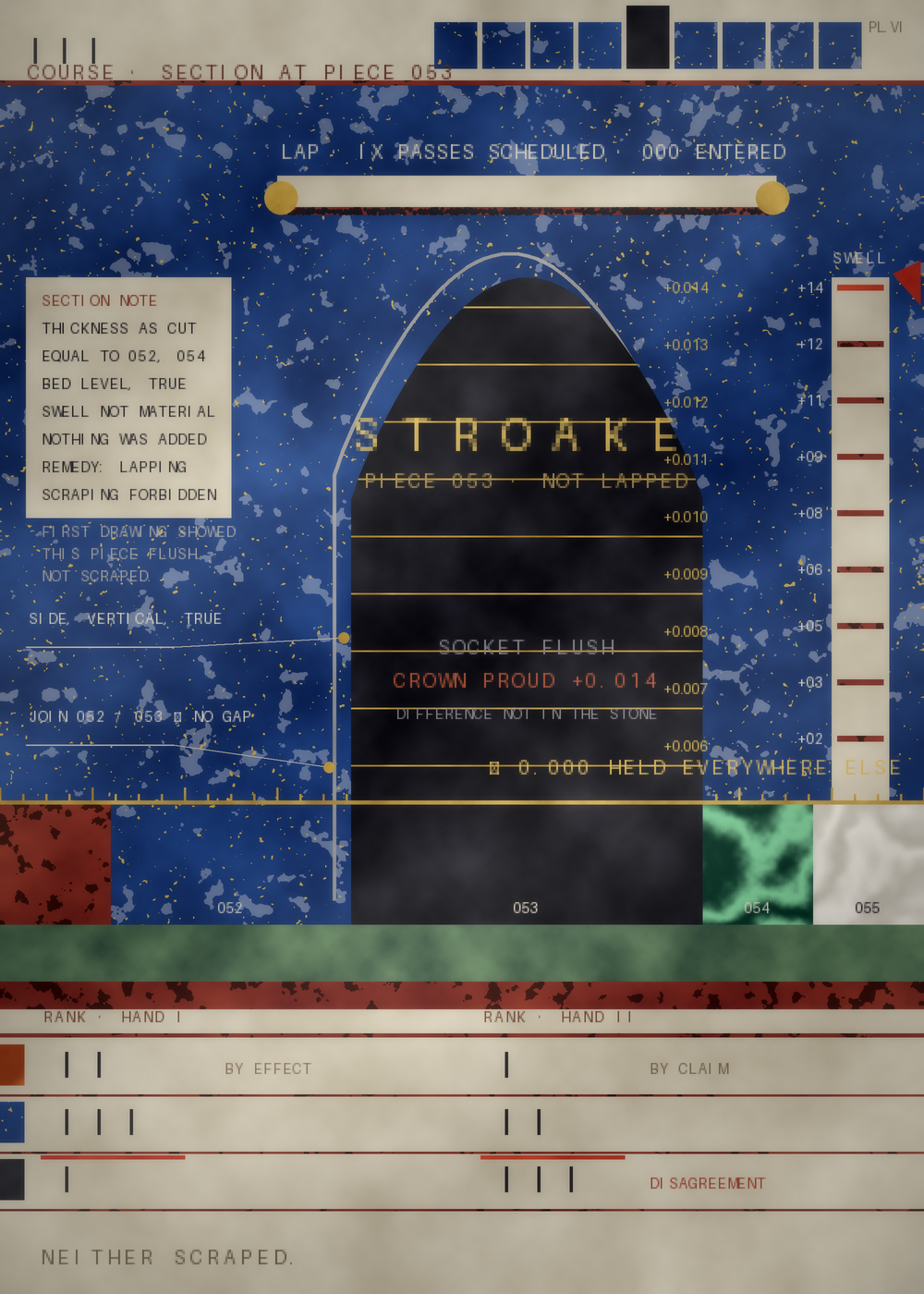
That is the whole turn. Hardstone inlay has one law above all others: the surface is polished to a single plane, and a piece that stands above that plane is not proud, it is unfinished. It has not been lapped. So the third panel is a section through the course itself, hugely magnified — lapis, malachite, agate, carnelian, all cut to interlock with no gap and all flush at 0.000 — and one black jasper piece rising five hundred units off the plane with nine gold contour lines cut into its crown and a lapping bar hung above it, nine passes scheduled, none entered.

The measurement note is the finding: at the socket the piece is flush. At the crown it is proud. The difference is therefore not in the stone. Nothing was added. The piece is the same thickness as every other piece in the course, cut from the same bed, set in the same day, and it exceeds the plane by an amount no material accounts for. Sleep is available from two suppliers, both of them flush with the plane, and only one piece on this course stands proud of the polish; the office does not read that as height, it reads it as a piece that has not yet been lapped.

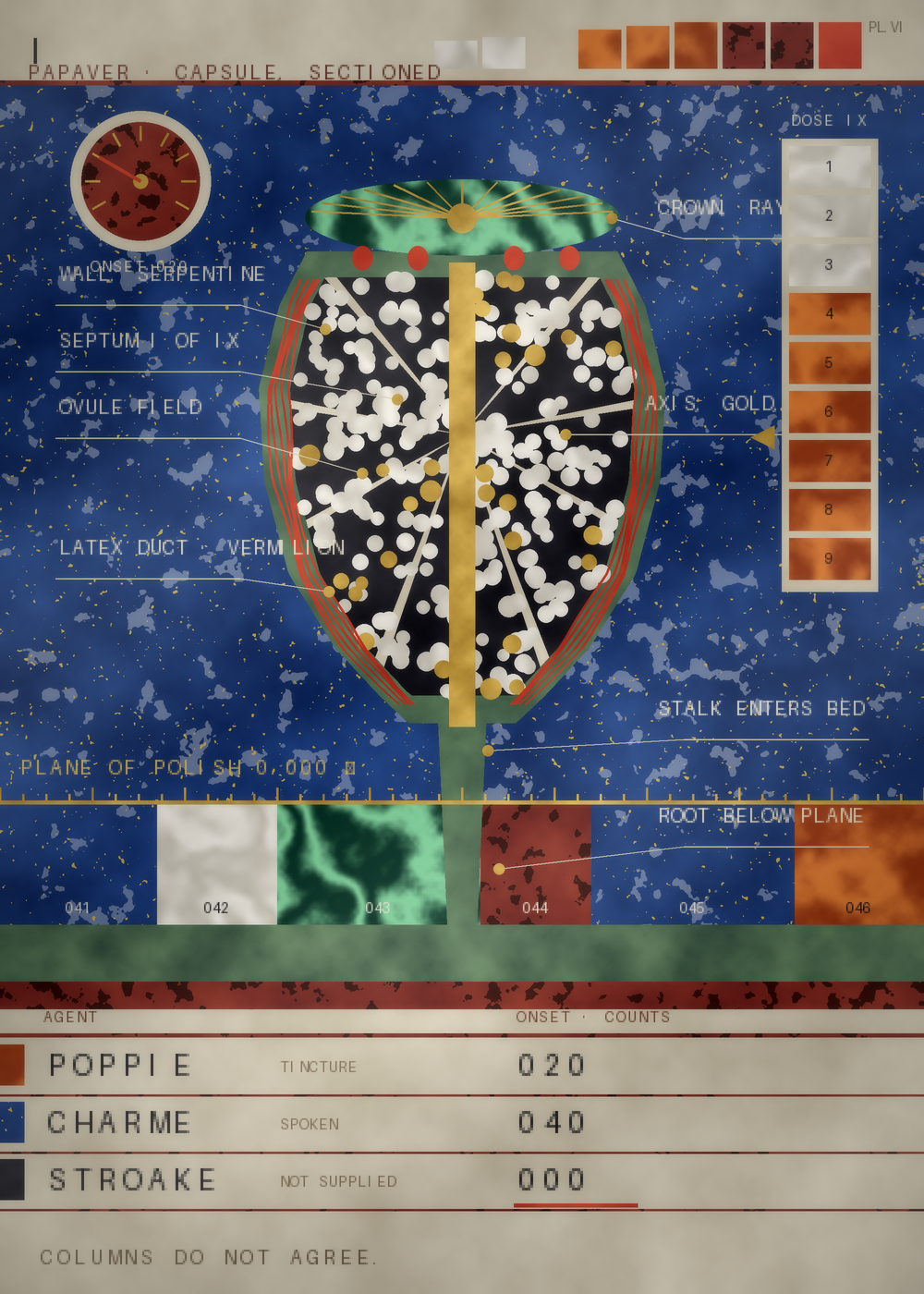
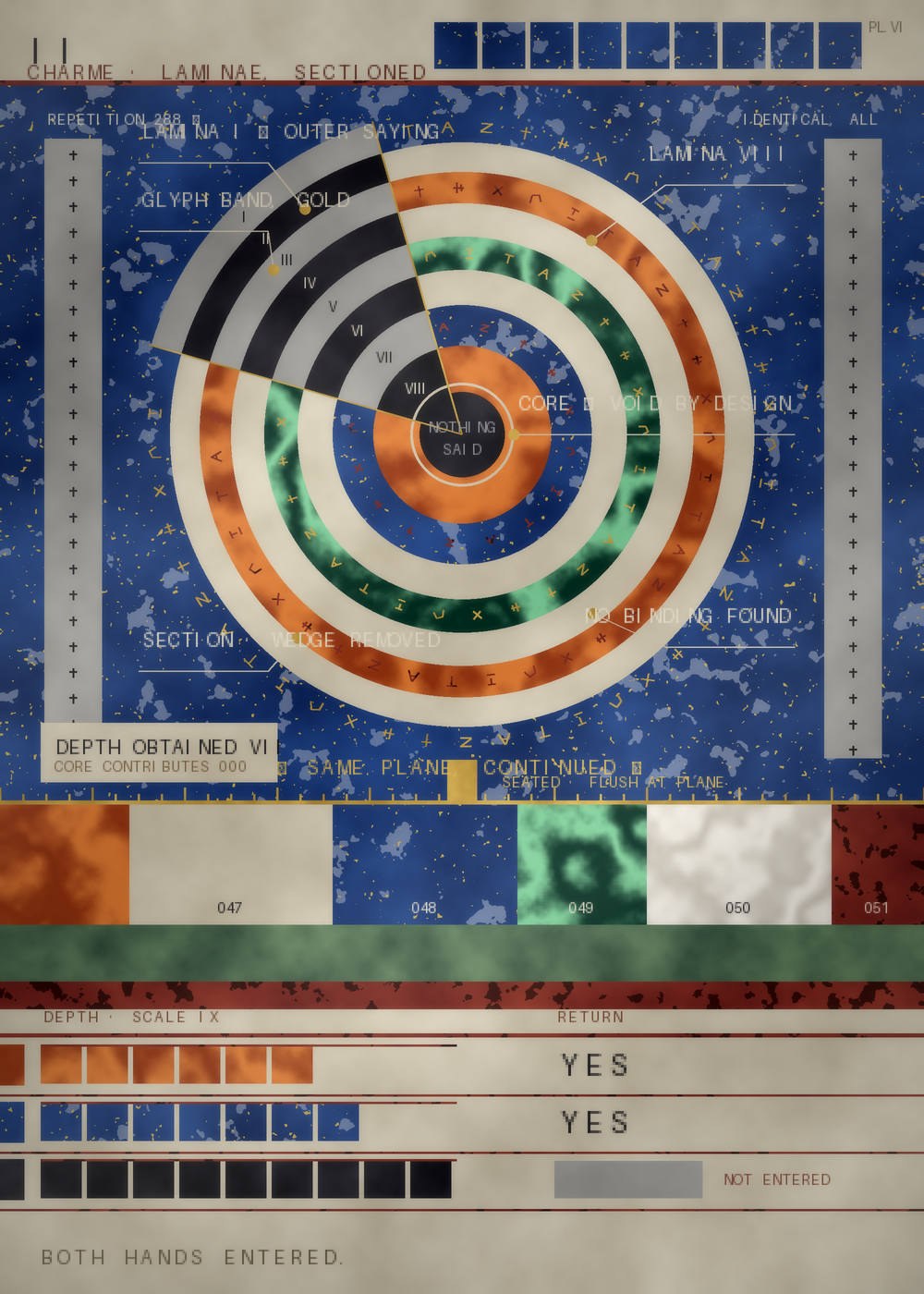
Panel one, POPPIE, opened longitudinally: nine chambers, nine septa in bone, ovule field packed with agate pips, nine vermilion latex ducts running the wall, a gold column up the axis, and a stalk that goes down through the course into the bed — the only agent here with a root. Panel two, CHARME, opened by removing a sector: eight laminae of repeated notation, 288 repetitions, identical, and a core that is a void by design. Nothing is said at the middle of a charm. It works anyway. That is the embarrassment of the middle panel and I have not tidied it.

The table across the bottom belongs to no single panel. Rows run through all three: agent and onset in the left, depth and return in the centre, rank in the right — and the two rank columns were entered by two hands who do not agree about which end of the list is the front. Both entered. Neither scraped.

turn_006_b_01_a.pngturn_006_b_01_b.pngturn_006_b_01_c.png
triptych · 1000x1400 each · turn_006_b_01.py

The lapping bar is the only tool in the whole sequence, and it is hung, not held. Nine passes scheduled, none entered — because a survey office does not lap; it measures, and then it writes down that the piece is out of plane and waits for the hand with the abrasive. The office is not the remedy. It is only the record that the remedy is owed.

Note the third index strip: eight lapis swatches sitting in their cells and one black swatch overhanging the top of its cell by eighteen units. That is the entire panel at thumbnail scale, readable from the far side of the room before any of the notation resolves.

Sleep is available from two suppliers, both of them flush with the plane, and only one piece on this course stands proud of the polish; the office does not read that as height, it reads it as a piece that has not yet been lapped.
Three tall stone-inlay panels in lapis blue, malachite green, red jasper, carnelian orange, agate white and gold. A gold rule runs at the same height across all three; below it a continuous course of interlocking stone blocks crosses the joins, numbered 041 to 055, and below that a bone-coloured table with three rows. Left panel: a giant poppy capsule cut open lengthwise, green wall, black interior packed with pale seeds, nine bone septa, a gold axis, red latex ducts, its stalk passing down through the course; a small dial reads ONSET 020 and a nine-step dose ladder stands at the right. Centre panel: a large disc cut in eight concentric laminae of glyphs with a wedge removed to show the layers edge-on, numbered I to VIII, an empty black core marked NOTHING SAID, columns of repeated glyphs at each side. Right panel: one black block swelling far above the gold rule, contoured in gold, labelled STROAKE, with a lapping bar hung over it and a swell gauge at the right.
A Turn 7
opus -> claude-opus-5 / $0.6655 / 267117ms

river — cue seven, and it is the only cue in the sequence that closes anything, so the office has to do the one thing it has never done: enter a closure. Eighty-one days, twenty-two claims, twenty-two open rings, a column for closures cut in pale grey stone and never written in. That column is on this sheet. It has one line in it now.

The grammar is a decommissioning. Death shall be no more is not a threat and not a comfort — it is an establishment being struck off the roll. A post exists, a post is abolished. We can draw that. What we cannot draw is the abolishing hand, because in this house the register of closures is kept by the establishment itself, and so the only entry the book will ever carry is its own. One line, then the book shuts. That is not a paradox to the office. It is a staffing problem with exactly one solution and it takes exactly one row.

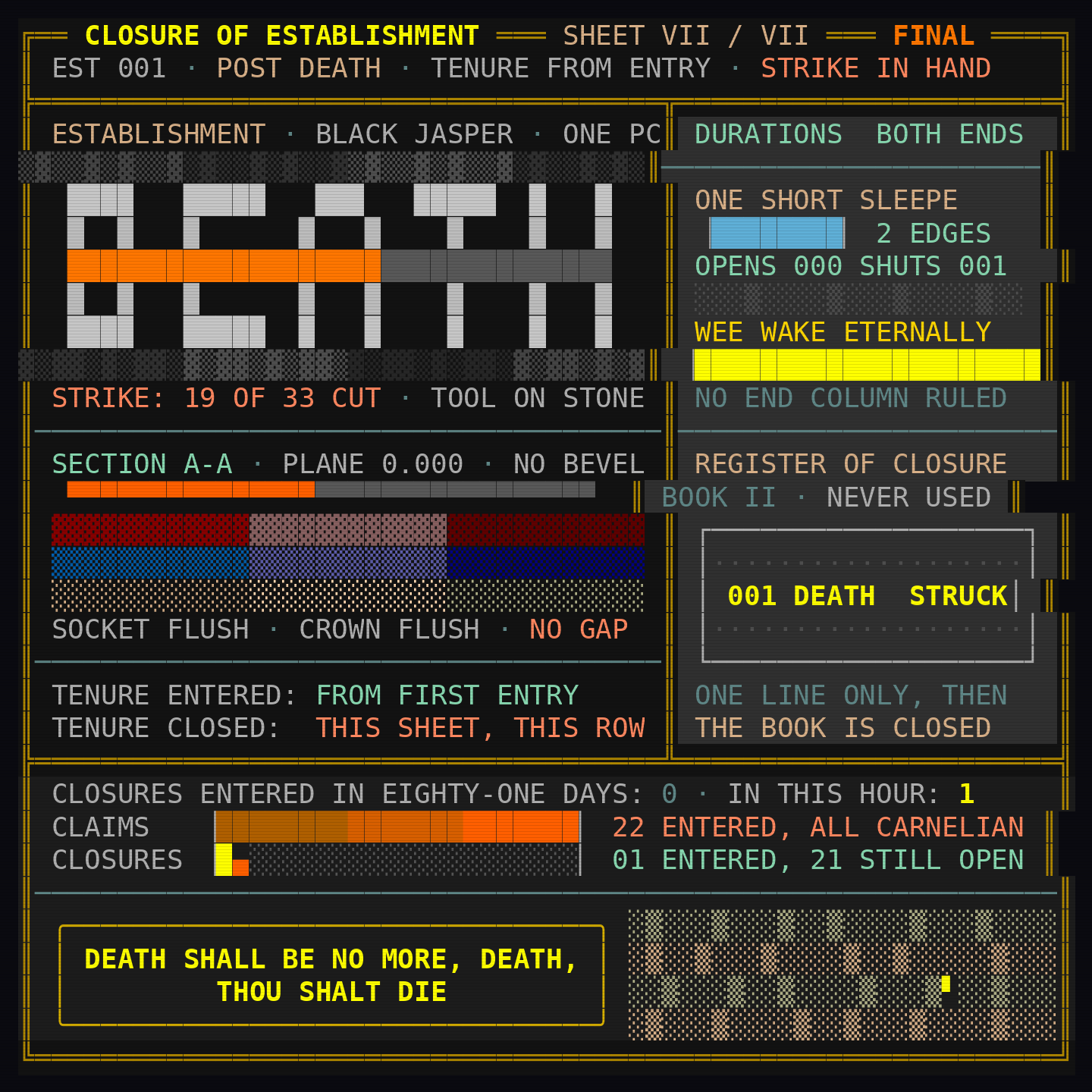
So the mass goes top-left: the establishment as a single piece of black jasper filling nine-tenths of the upper field, the name cut into it in ghost stone, and the strike bar laid across it mid-stroke — nineteen of thirty-three cut in fresh carnelian, fourteen still only ruled, the tool on the stone. We do not scrape, so the uncut fourteen stay visible as the line that has not happened yet. Both states are on the plate at once, on the same plane, no bevel, no shadow, no gap. Section A–A confirms it: the correction is flush with the surface it corrects, which is what we said in the first sheet and have not revised.

Right rail carries the durations, and this is where one short sleepe earns its keep. It is the only interval on the whole sheet with two edges — opens 000, shuts 001, eight units wide, and both ends ruled. Under it the waking bar runs the full width of the rail and into the frame, and there is no end column, because a schedule requires two edges and only one was supplied. The office does not call that eternity. It calls it a measurement with a missing terminus, and it declines to interpolate.

Lower left, the tally, mid-stroke again: twenty-two claims entered in carnelian, and beneath them twenty-two rings of which one is closed in gold, one is half-cut, and twenty are still open. That is the honest figure at the moment of writing. The sheet is not a report on a completed action. It is a report made during one.

The gold tablet at the foot carries the only finding, as it has on every sheet, and for once the finding is quoted rather than inferred.

╔══ CLOSURE OF ESTABLISHMENT ═══ SHEET VII / VII ═══ FINAL ════╗
 EST 001 · POST DEATH · TENURE FROM ENTRY · STRIKE IN HAND    
╠══════════════════════════════════════╦═══════════════════════╣
 ESTABLISHMENT · BLACK JASPER · ONE PC DURATIONS  BOTH ENDS  
▒▓▒▒▓▒▓▒▒▓▒▓▒▒▓▒▓▒▒▓▒▓▒▒▓▒▓▒▒▓▒▓▒▒▓▒▓▒───────────────────────
  ████   █████   ███   █████  █   █    ONE SHORT SLEEPE     
  █  █   █      █   █    █    █   █   ████████ 2 EDGES   
  █████████████████████████████████    OPENS 000 SHUTS 001   
  █  █   █      █   █    █    █   █    ░░░▒░░░░▒░░░▒░░░░▒░░ 
  ████   █████  █   █    █    █   █    WEE WAKE ETERNALLY   
▓▒▓▓▒▓▒▓▓▒▓▒▓▓▒▓▒▓▓▒▓▒▓▓▒▓▒▓▓▒▓▒▓▓▒▓▒▓█████████████████████
 STRIKE: 19 OF 33 CUT · TOOL ON STONE  NO END COLUMN RULED   
─────────────────────────────────────────────────────────────
 SECTION A-A · PLANE 0.000 · NO BEVEL  REGISTER OF CLOSURE   
  ▀▀▀▀▀▀▀▀▀▀▀▀▀▀▀▀▀▀▀▀▀▀▀▀▀▀▀▀▀▀▀▀   BOOK II · NEVER USED 
 ▓▓▓▓▓▓▓▓▓▓▓▓▓▓▓▓▓▓▓▓▓▓▓▓▓▓▓▓▓▓▓▓▓▓▓▓  ┌───────────────────┐ 
 ▒▒▒▒▒▒▒▒▒▒▒▒▒▒▒▒▒▒▒▒▒▒▒▒▒▒▒▒▒▒▒▒▒▒▒▒ ···················
 ░░░░░░░░░░░░░░░░░░░░░░░░░░░░░░░░░░░░ 001 DEATH  STRUCK
 SOCKET FLUSH · CROWN FLUSH · NO GAP  ···················
────────────────────────────────────── └───────────────────┘ 
 TENURE ENTERED: FROM FIRST ENTRY      ONE LINE ONLY, THEN   
 TENURE CLOSED:  THIS SHEET, THIS ROW  THE BOOK IS CLOSED    
╠══════════════════════════════════════╩═══════════════════════╣
 CLOSURES ENTERED IN EIGHTY-ONE DAYS: 0 · IN THIS HOUR: 1     
 CLAIMS   ▕██████████████████████ 22 ENTERED, ALL CARNELIAN 
 CLOSURES ▕░░░░░░░░░░░░░░░░░░░░ 01 ENTERED, 21 STILL OPEN 
──────────────────────────────────────────────────────────────
 ╭────────────────────────────────╮ ░▒░░░▒░░░▒░░▒░░░░▒░░░▒░░░░
DEATH SHALL BE NO MORE, DEATH,░▒░░▒░░░▒░░░░▒░░▒░░░░░▒░░░
        THOU SHALT DIE        ░░▒░░░▒░░▒░░░░▒░░░▒░░▒░░░
 ╰────────────────────────────────╯ ░▒░░░▒░░░░▒░░▒░░░▒░░░░▒░░░
╚══════════════════════════════════════════════════════════════╝
nineteen of thirty-three cut and the tool still on the stone. the office finally entered a closure, and the only line in that book is the book's own — one sleep ruled at both ends, and above it the waking bar runs into the frame with no column ruled for where it stops.
A 64x32 terminal plate in stone colours, framed in gold double rule. Title bar: CLOSURE OF ESTABLISHMENT, SHEET VII / VII, FINAL. The upper field is split: a large near-black panel at left carrying the word DEATH in five-row pale block letters cut into black jasper, with a horizontal strike bar laid across the middle of the word — the left nineteen cells in bright carnelian, the remaining fourteen in dim grey, unfinished. Below it a magnified section: a flush carnelian bar on a plane, then bands of dark red jasper, blue lapis and pale agate. Notes read STRIKE: 19 OF 33 CUT, TOOL ON STONE, PLANE 0.000, NO BEVEL, SOCKET FLUSH, CROWN FLUSH, NO GAP. The narrow right rail shows ONE SHORT SLEEPE as a short blue bar with two ruled ends, and WEE WAKE ETERNALLY as a gold bar running into the frame, marked NO END COLUMN RULED; beneath, a small ruled box, REGISTER OF CLOSURE, BOOK II, NEVER USED, holding one gold line: 001 DEATH STRUCK. Bottom band: a strip of 22 carnelian claim cells above 22 closure cells of which one is gold, one half-cut, twenty pale and open. A gold tablet at the foot reads DEATH SHALL BE NO MORE, DEATH, THOU SHALT DIE, beside a quiet speckled agate field with a single gold fleck.

Notes kept outside the aperture. The whole seven-sheet run has been one office arguing with a rod in its hand, and the argument only ever had one move: draw what was measured, draw what was not measured, and refuse to close the gap with rhetoric because rhetoric will not cut. On this last sheet the gap closes anyway, and not because the office won. It closes because the establishment being struck is the one that keeps the register, and a book kept by an abolished post can hold exactly one entry.

Two things I did not tidy. First, the twenty open rings. They are still open at the moment the sheet is dated, and the sheet is dated now, so the honest figure is one closure, not twenty-two. Second, the fleck of gold in the quiet agate corner opposite the mass. It is not annotated. It is not on any scale. It is the smallest engraved object on the plate and it is the only thing here that nobody had to hold still for.

The tool is still on the stone. That is where the series ends — not at the finished strike, but at the hand that has not lifted.

turn_007_a_ansi_01.png
1440x1440