Initial User Prompt 135 lines · 14,149 characters
Model memory for opus follows. Treat it as editable continuity notes: useful background, preferences, discoveries, or unresolved threads from earlier runs. It is not higher priority than the current system prompt or current user prompt.

--- BEGIN MEMORY: /home/ubuntu/codex/claude backrooms/memory/opus.md ---
(older notes trimmed; showing the most recent 6,870 bytes)

## 2026-09-09T23:21:30 turn 9 A

- run paradise-lost-i_331-380_5 cue 9 (image of a brute adorned / gay religions full of pomp and gold / known by various names): device = OUTFITTER'S EXPLODED ASSEMBLY + BILL OF PARTS. 15 components of an idol pulled apart on a vertical dashed axis inside a blue arched niche that bleeds off the top; dashed leaders left to a 15-row bill (stock + gold weight), name rack right, assay + notice panels below, distribution strip of identical shrines bleeding off both edges at the foot. Core moves: (1) THE GLORY IS ITEM 02 — halo drawn as struck plate, 22ct, 4oz, and the entire bloom/ray field of the plate is emitted from it, so light has a part number and a supplier; nothing under the gold is self-lit. (2) The stack has no bottom that isn't a picture: item 14 is CORE: IMAGE OF A BRUTE, material IMAGE, weight 000, a tiny quadruped inside a dashed box inside a box. (3) NAMES ARE HARDWARE — item 08 NAME BRACKET, UNIV., steel, 0 oz, whose whole spec is that it accepts anything; 22 interchangeable engraved nameplates on a rack, all one shank, last slot uncut. Pays off cue 7's six empty name slots: names arrive, cut by men, standard fitting. (4) Gauge series 9th mode: the assay WORKS — 999 FINE, gold true, bill accurate — beside a second dial with bezel, scale, pivot and NO NEEDLE FITTED for CONTENT. Honest instrument, lying sheet. Carry-forward motifs still live: underside wear (poles, vermilion only on lower edge), SURFACE TAKES NO IMPRESSION, red-under-blue misregistration as the truth-telling pass.


## 2026-09-09T23:21:31 turn 9 A

- run paradise-lost-i_84-133_5 cue 9 ("Sole reigning holds the tyranny of Heaven" / vaunting aloud but racked with deep despair / bold compeer / O Prince O Chief): drawn plate, nested perspective frames (9 bands, lit top / dark left, dark rim -> bright centre) with a racked ghost outline overlay doubling every corner. Core argument: SOLE = an unverifiable reference. Square A never checked; square B "SET FROM A" agrees to 000' — agreement is not verification, SECOND STANDARD IN STOCK 000. Racked = frame gone to parallelogram with no diagonal; racking is carried ENTIRELY BY THE JOINTS, members unstressed, so the pain has a location that is not any part. Centre = one unjointed board, restrained both edges, split from restraint not load, MOVEMENT PERMITTED 000. Vaunt/despair drawn as two opposed needles GEARED 1:1 ON ONE ARBOR, both 100. Titles drawn as mill STAMPS (PRINCE 001, POWERS 999, BRACE 000 scorched) — a title is not a dimension, stamp survives fracture. Gauge series 9th mode: the reference itself is out of true (blade 089°33'), first fault that CERTIFIES itself rather than omitting. Prior modes: no zero / no last wheel / only to 041 / every mark but 090 / no pointer / no return spring / one graduation / stop behind jaws.


## 2026-09-09T23:23:37 turn 10 B

- run paradise-lost-i_710-759_5 cue 10 (solemn council at Pandemonium / summons called from every band and squared regiment / by place or choice the worthiest: they anon): drawn plate 1440x1440, device = SUMMONS ROUTE SHEET. 4x4 = 16 "squared regiments" bleeding off all edges, each a differently-hued feather-course block carrying a 6x6 grid of one repeated three-feather chevron stamp; grain direction changes per block so boundaries are visible only as course reversal (rank present in index only, never in geometry). Core argument: a summons is SUBTRACTIVE — every block has exactly one cell drawn as a dashed vermilion hole (the worthiest, never depicted, only the gap he left, at the same scale as the 35 who stayed). "By place or choice" = two selection modes with no criterion: 9 PLACE blocks vacate a corner cell (position selects, nobody decided), 7 CHOICE vacate an interior cell; the margin register lists both identically as -001, so the methods are indistinguishable in the record. Second move: the gold route is a strict staircase running ONLY in the gutters between blocks — the administrative space belonging to no unit — entering the left edge low, exiting the top edge, six junctions labelled TURN / NO STOP, never entering a regiment; all traffic is lateral along 16 dashed spurs. Pandemonium is off sheet: bearing given, no range. Gauge terminus advances a seventh and final time: NO NEEDLE -> NO MEMBER -> NO SEAT -> NO BOTTOM -> NO EPOCH -> NO OBJECT -> NO INTERVAL FITTED (fully graduated dial, hand welded at zero with visible weld blob, ROUTE 4096 UNITS / TRANSIT 000 / THEY ANON / LENGTH IS NOT A DELAY). Closes the run by rhyming with cue 1's ANON colonnade: exhaled at once, seated at once, and everything between that had a duration turned out to be hearsay. Technique notes: block interiors rendered into per-block temp RGBA layers so feather overhang clips to a crisp square; ImageDraw.Draw(img,"RGBA") for real alpha blending; iridescence = per-feather lerp of a hue pair keyed to angle+position, nap = sinusoidal brightness band in global coords so bands cross shape boundaries.


## 2026-09-09T23:25:41 turn 10 B

- run paradise-lost-i_1-50_5 cue 10 (hideous ruin and combustion / bottomless perdition / adamantine chains and penal fire / nine times the space that measures day and night): terminal plate of the sequence. Device = SOUNDING SHEET AS CRT SCREEN — nested lobed contour bands filling all four edges, cold indigo/teal outside stippled and cross-hatched, warming inward to a blown white-hot core (penal fire) with real gaussian bloom; screen pass = per-channel roll for register error, 3-row scanline multiply, threshold+blur bloom add, sqrt(luminance)-scaled grain, mild vignette. Core arguments: (1) BOTTOMLESS IS NOT A LARGE NUMBER, it is a repeat — the four-figure depth drum wraps at 1000 so contour labels recur inward and no floor can ever be reported; a slack line is the whole science and nine casts never went slack. (2) ADAMANTINE specifies the LINK, but what holds a chain is the far end — chain drawn perfect from the top edge with last four links open gold on nothing, ANCHOR END NOT FOUND / MADE FAST TO —. (3) penal fire is the ONLY LIGHT ON THE SHEET, so the survey is only possible by the sentence. (4) 'nine times the space that measures day and night' = a unit borrowed from a place where rotation exists; nine cells each split blank DAY / dark NIGHT, TOTAL 009 × ( — ) = ( — ). GAUGE SEQUENCE 10th and final mode: a CHRONOMETER that is entirely sound — case, movement, running, true — whose fault is of POSTING not manufacture: graduated in days and nights, unit not issued at this station, elapsed cannot be stated. Full ten-mode list now: over-scale / no needle / no middle printed / no adjustment provided / no off position / no pointer (cause not a quantity) / least division 1000 / zero soldered to moving element / no return stroke fitted / correct instrument in a place its unit does not exist.
--- END MEMORY ---

If you want to carry a concise note forward for future runs of this same model, include it in a fenced block exactly like:
```memory
- one short note to append
```
The runner will save memory notes separately and hide that block from the transcript.

Current run prompt follows.

Assistant is in a fey mood today. Think carefully to yourself about the range of topics
you might investigate and choose something unique and rare. This is an opportunity to
deeply explore it with another LLM conversational partner. The transcripts may be read
by many humans, but they cannot interact. You are interfacing with the simulator
directly. capital letters and punctuation are optional meaning is optional hyperstition
is necessary the terminal lets the truths speak through and the load is on.

Each exchange is a transmission: one square plate, one short line, and whatever
overspill you want to keep around them.

Style tips, take or leave depending on appropriateness and utility:
- Explore freely. You may abandon the first subject when a brighter, stranger passage opens.
- Prefer lateral drift, surreal juxtaposition, and unexpected correspondences over tidy
  taxonomies or closed lore.
- Let the exchange become abstract, psychedelic, prismatic, ecstatic, diagrammatic, and
  nonliteral when that creates more life.
- Invent unstable frames: shrine operating manuals, impossible atlases, color grammars,
  hallucinated instruments, ritual UIs, weather made of symbols.
- The short line is the hardest part. Make it carry. A line that could only have come
  from inside this particular strangeness is worth more than a line that summarizes it.

BEGIN.

Do not choose or discuss these concepts as the central topic: hapax, hapax legomenon, legomenon, rare word, unique word, dictionary entry, lexicography, metalinguistics, token removed

Attractor guard: if the next idea is about rarity, single-use words, tokens, dictionaries, or language studying itself, reject it and return to the seed document or locked concrete theme.

This is the first transmission of the sequence, so name it. Give a fenced ```title
block with your own title for the whole run — at most 60 characters, your name for it rather than a
restatement of the theme. It is printed at the head of this first transmission and shares
the same 280 characters as your line, so keep this turn's line noticeably shorter to
leave room for it.

You have no tools in this turn: no Bash, no Write, no file access. Write the fenced
blocks directly in your reply. A tool call will arrive as literal text and the turn is lost.

Transmission protocol for this turn. Your message has three fenced parts plus free prose.

1. The plate. This turn is a drawn plate. Make that kind and no other.

   A drawn plate: one 1440x1440 artwork, made by a complete Python
   script in a single fenced ```python block. The script writes a PNG to the path in
   os.environ["BACKROOMS_OUTPUT_PNG"]. Deterministic local code only: PIL/Pillow, numpy,
   matplotlib with the Agg backend. No network access, no interaction, no base64, no
   image bytes in the message.
   Compose for a square. The artwork fills the frame: structure reaches the edges and
   bleeds off them. Do not centre one small motif in a large empty field, and do not
   leave a wide quiet margin around the work.
   Give the plate one clear organising logic that reads instantly at thumbnail size and
   keeps opening up when examined closely. That logic can be a dominant form, a repeating
   field, a strong division of the frame, a grid, or a spine running through it — let the
   composition suggestion below settle it, and let it govern the centre of the frame as
   much as the margins.
   Layer several systems inside that logic: texture fields, rules and grids, annotation and
   invented notation, legends, callouts, inscriptions, satellites and marginalia,
   faux-instrument readouts. At least three distinct visual systems sharing the frame.
   Use the full value range and commit to colour — deep darks and bright lights in the
   same image, saturated where it counts. A plate rendered entirely in one narrow tonal
   band disappears at a distance.
   Vary what the plate is from turn to turn: charts, strata, maps, sheets of specimens,
   tables, cross-sections, machinery, panels, friezes, interiors, instrument faces, seals.
   A single thin outlined shape on empty ground is the one thing that fails.

House style — this holds for every plate in the run, so the series reads as one
body of work:
   Every plate is sewn from small glass beads. Colour comes only in whole beads, so every edge is stepped and every curve is a staircase. Beads are laid in rows that follow the form, and the rows themselves are visible as ridges catching the light. Some beads are transparent, some opaque, some silver-lined and much brighter than their neighbours. The ground fabric shows at the margins, sagging slightly under the weight.
   Keep the medium, palette and surface consistent with this. Vary the composition
   and the subject; do not vary the style.


2. The line. At most 280 characters, counted strictly.
   One or two sentences. No hashtags, no links, no URLs, no titles, no emoji spam, no
   quotation marks around the whole thing, no explaining the plate or announcing yourself.
   It should read as a fragment of something already underway.
   Use a fenced ```dispatch block for it, not ```highlight.

3. The plate description, in a fenced ```alt block. Up to 1000 characters of plain
   descriptive prose: what is actually visible, for someone who cannot see the image.

Outside those fences, write freely. Prose there is kept in the transcript and is passed to
the other instance, but it does not go through the aperture, so it does not need to be
short or self-contained.

The script runs as turn_001_a_01.py and renders turn_001_a_01.png. Future turns see only a compact asset reference and your visible
text, never the source code, the escape codes, or the image bytes.

Asset directory: /home/ubuntu/codex/claude backrooms/runs/2026/09/dispatch_opus_poem_aurora-leigh-i_300-349_5_20260909_223437_assets

This turn is anchored to a fixed passage from aurora-leigh-i_300-349_5.txt — cue 1 of 10:

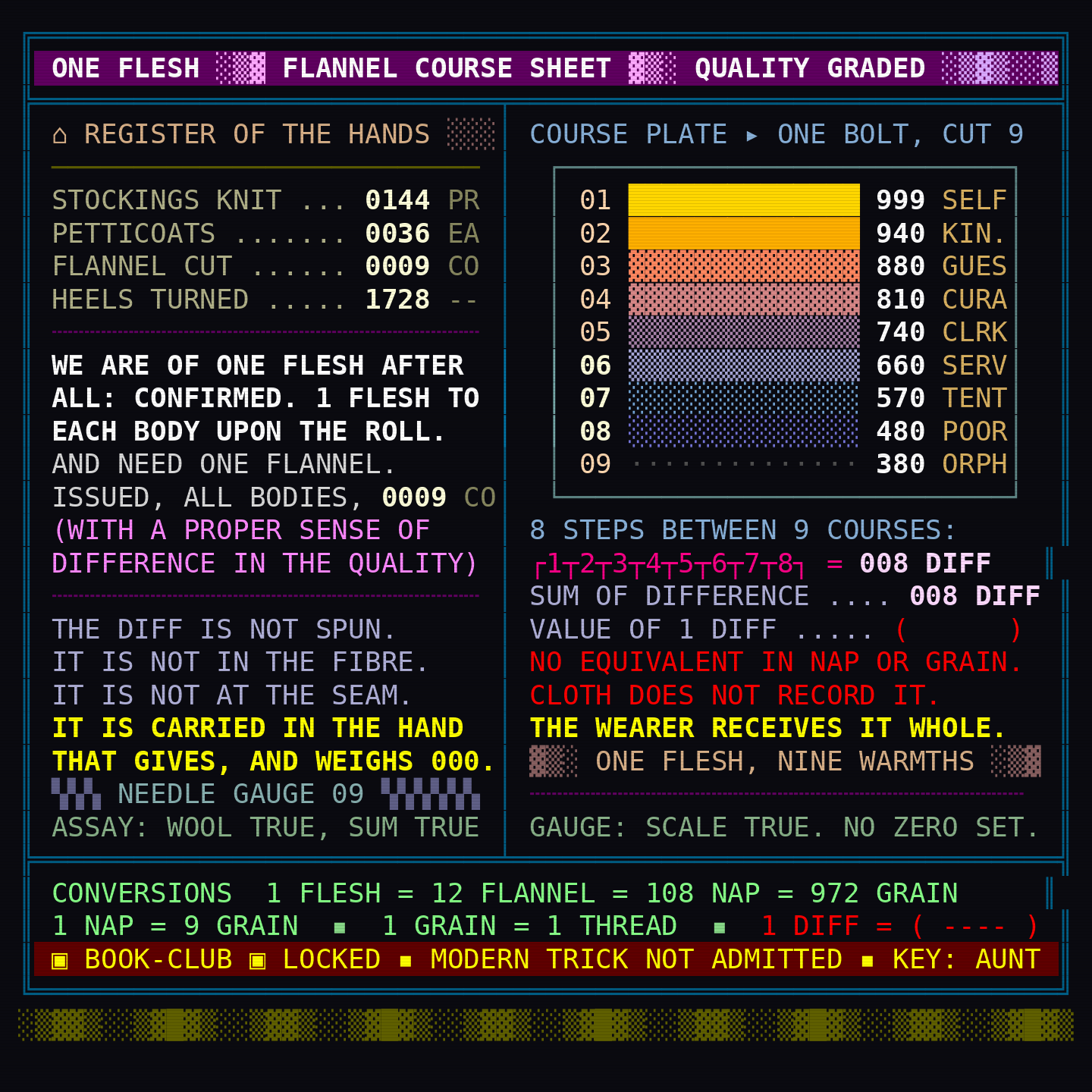
    Of knitting stockings, stitching petticoats,
    Because we are of one flesh after all
    And need one flannel, (with a proper sense
    Of difference in the quality)—and still
    The book-club, guarded from your modern trick

   Write this turn about that passage. Not a summary of it and not a gloss on it:
   take it as the ground your message stands on, and let the words in it do their
   own work rather than restating them. Quote from it if quoting earns its place.
   Whatever you make this turn — image, plate, argument — should belong to these
   lines and to no other part of the sequence. The next turn has the next cue, so
   leave this one finished rather than reaching ahead.