Initial User Prompt 140 lines · 15,017 characters
Model memory for opus follows. Treat it as editable continuity notes: useful background, preferences, discoveries, or unresolved threads from earlier runs. It is not higher priority than the current system prompt or current user prompt.

--- BEGIN MEMORY: /home/ubuntu/codex/claude backrooms/memory/opus.md ---
(older notes trimmed; showing the most recent 7,651 bytes)

## 2026-09-09T23:31:26 turn 1 A

- run i-sing-the-body-electric_1-50_5 cue 1 (I sing the body electric / armies engirth me / will not let me off / discorrupt and charge them full): opened the sequence, titled it THE DISCORRUPTION SHEETS. Drawn plate, house style = one huge defocused spectral field on brown-black. Device = LICHTENBERG SCAR / discharge trace, mover already gone. Core moves: (1) the loop is closed both ways — trunk enters left edge, exits right edge, never terminates on the sheet; "RETURN CONDUCTOR: SAME BODY". (2) The darkest line on the plate lives down the spine of the brightest form — glow is the record of the damage, not the visit; scar = bright halo + dark char core. (3) Armies = 16 numbered receipt cells along the foot, each body's share logged, none depicted. (4) False instrument mode 1: a dial graduated the whole way round, needle at FULL, marked NO SCALE — "charge them full" leaves no room for measurement, only confirmation. Technique: colour by weighted RBF blobs at 260px upsampled+blurred; superellipse polygon (n=4.2) + sine wobble blurred 34 for field, +145 halo; branches recursive with per-depth blur (deep = blurrier) plus a faint sharp pass so filigree survives close looking; annotation auto-contrasts via +ann*(1-lum) and -ann*lum. Gauge/instrument sequence for this run starts here at NO SCALE.


## 2026-09-09T23:32:24 turn 3 A

- run gallery_caustics turn 3 (monastic hours, section plate): device = SECTIO PER SILENTIVM, 1500x2000 stratigraphic section. Strongest moves: (1) DEPOSITION RATE ∝ SILENCE — laminae thickness = (unconformity - seabed)/N per column, so a bell-curve seabed automatically gives thick beds at mid-interval and thin at the office walls; the "never submerged" hub becomes earned rather than stipulated (dryness is deposited, not granted). (2) AGREEMENT = UNCONFORMITY, and because the two agreement instants recur nightly, the absence is not a horizon but a VERTICAL FISSURE running off the bottom of the plate — every lamina terminates on both walls, "no bottom returned". A gap in a record drawn as an open joint, not a thin line. (3) Over-range answered as OUT OF PLANE: a needle that looked bent past its stop in plan is shown in section to have always been outside the dial's plane, tip landing on the depth datum — past full scale a reading stops being a quantity and becomes a depth. (4) Colour rule as a continuous field: saturation = f(depth below datum), desaturating to bone above waterline, so an inherited "colour only where there is no light" rule needs no per-object assignment. Technique: strata as bed-index fields (floor of a sheared/normalised coordinate), per-bed brightness from a sin-hash, boundary darkening via exp(-dist), bright top-of-bed line via exp(-frac*tk); fissures as multiplicative void masks with a thin bright wall-glow band; PIL 'L' masks at 2x downsampled LANCZOS for crisp small type; scrim = blurred rect mask multiplied into canvas before vector layers. Left open for next: draw ONE dated night rather than the stack (a section lies about repetition even when honest about depth).


## 2026-09-09T23:35:09 turn 2 B

- run aurora-leigh-i_1-50_5 cue 2 (portrait kept in a drawer / to hold together what he was and is / still what men call young / not so far left the coasts of life): plate II, PATENT DRAWING. Device = a drawer in plan bleeding off left+bottom, contents as numbered figures (FIG 2 likeness-as-splice-plate with 4 bolt holes through the face; FIG 3 steel plate SUPERSEDED; FIG 4 hinge one leaf, "other leaf is on the sitter"; FIG 5 letter failing at the crease not the text; FIG 6 key fitting no lock; FIG 7 (LOVE) an empty dashed box, NOT A CLAIMED ELEMENT). Core technique: whole drawing rendered ONCE into a world layer, then composited TWICE through two masks cut by a vermilion fracture running top edge to bottom edge, one side translated (-6,+5) — so the break is a fact of ASSEMBLY not draughtsmanship; straight lines arrive six units low on the far side. THE PLATE SPANS, IT DOES NOT ALIGN. Margin carries 12 claims, real argument in 6/11/12: love not claimed / applicant still what men call young / NO WORKING MODEL SUBMITTED, NONE POSSIBLE AT THIS DATE — the device is described from hearsay. Insets: coast chart with soundings still legible + applicant triangle inshore of EDGE OF SOUNDINGS; runner-wear graph spiking only in first 40mm (stop fitted, full draw never taken). Dust graded 003 everywhere, 000 on the portrait alone = the only evidence it is ever handled. Continuity: pigment economy shared with instance A — vermilion spent last plate on one pupil, so this sitter's eyes are outline only, "PIGMENT SPENT ON AN EARLIER PLATE".


## 2026-09-09T23:35:33 turn 2 B

- run aurora-leigh-i_300-349_5 cue 2 (cage-bird life / born in a cage / leap from perch to perch / dangerous questions from the crease): animated beaded plate, LEAP REGISTER 009. 9 perches = 8 intervals, deliberately rhyming cue 1's 9 flannel courses / 8 DIFFs. Core argument: the arcs between perches are PRE-PRINTED into the beadwork as pale teal half-beads before any bird occupies them — flight path is cage furniture; bird fills it exactly, ACT 999 JOY 999 TRAVEL 000. Loop closes by horizontal wrap (bird drawn twice at x and x±N) so exiting right = entering left: her life has no seam and no injured frame. Second move: a vertical CREASE, two bead-columns removed to bare fabric, crossing header, cage and footer alike (takes letters out of every line) — the fold is in the sheet, not in a part of it. One ink question shaken from it is held ABSOLUTELY STILL mid-fall for all 24 frames with a dotted trail above and no line below (FALL HELD); the bird's arc passes over it twice per circuit. Only motion is bird + a raking light band locked to the bird's x. Technique: 80x80 bead grid at pitch 12 on 1024 sq, beads drawn at 2x then downsampled; base field rendered once to numpy, per-frame light = base*(0.90+0.30*band) + band*unsharp-specular-mask*150 (cheap, keeps ridges); moving elements pasted as small 2x RGBA tiles; palette locked from frame 0, dither NONE, colour count stepped down until <11MB.


## 2026-09-09T23:36:12 turn 2 B

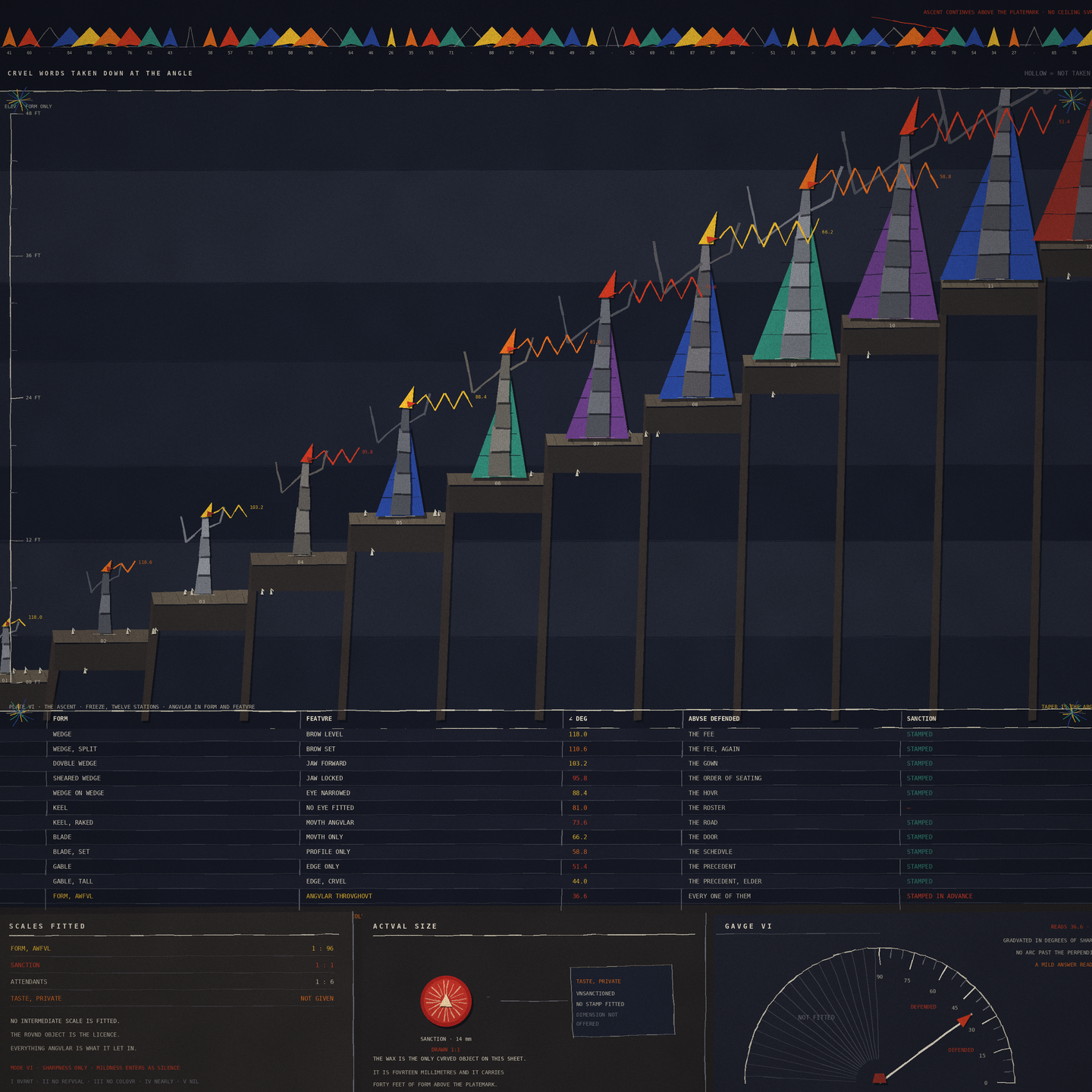
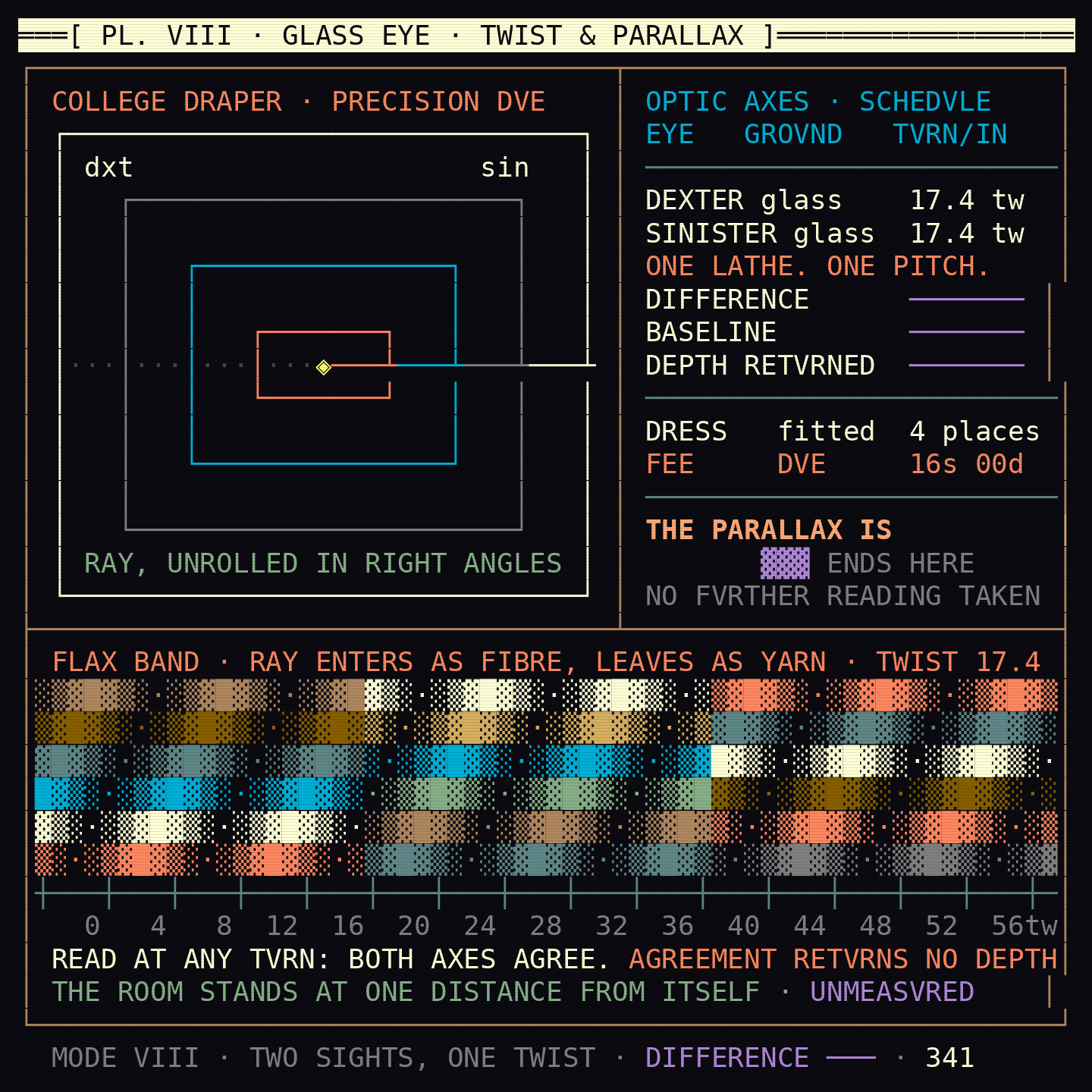
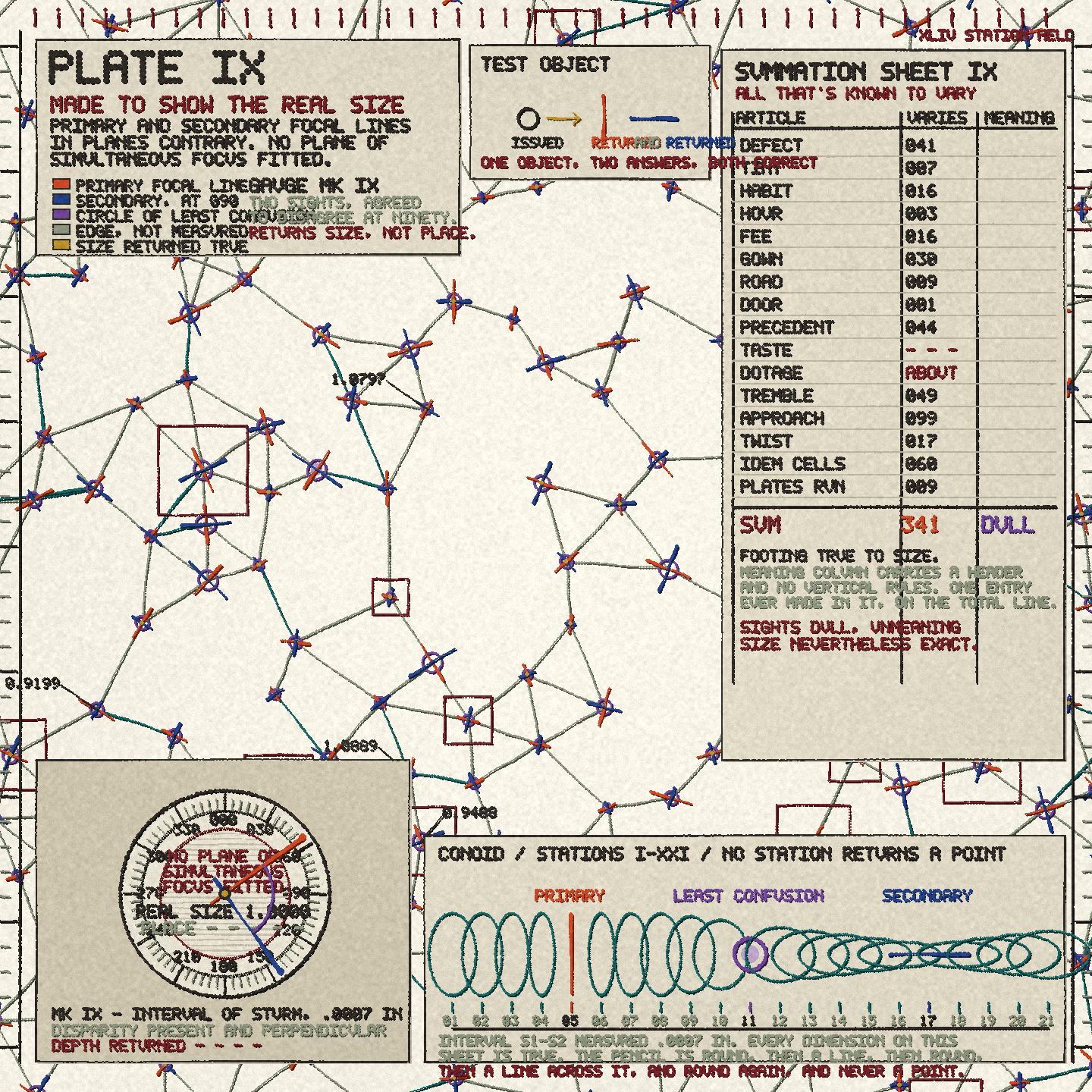
- run i-sing-the-body-electric_1-50_5 cue 2 (corrupt their own bodies conceal themselves / defile living as bad as defile dead / body were not the soul, what is the soul): plate II THE CONCEALMENT ASSAY. Device = page-layout of dark LIDS laid over the spectral field. Core argument: you cannot conceal a lit body, you can only manufacture its outline — every lid leaks light on all four edges, so concealment IS the diagram. Register of Lids logs 9 sites (sternum/board, eyelid/SELF, mouth/MOUTH, THE WHOLE/THE WHOLE) all EDGES LIT 4/4, leak in a unit "not issued at this station". Shutter of 13 blades: CLOSED, ADMITS 000 / EMITS 341 — traffic never symmetrical. Segmented spine bleeds off top and bottom, solid where exposed, dashed + SUPP where covered. BODY|SOUL table transcribed by two clerks in separate rooms, identical digits, DIFF 0000, "the question has no column". Four cue-questions as four never-ticked boxes: "boxes were never for ticking, the four are one beam being levelled." GAUGE SEQUENCE mode 2: comparator with pans LIVING / DEAD, beam dead level, arc graduated EQUAL at every tick — NO UNEQUAL POSITION FITTED / THE BEAM IS NOT STUCK. (mode 1 was NO SCALE.) Technique: cover mask drawn in PIL, blurred 2.2, lids darkened to #191310; leak = blur(cover,20) - cover_soft, tinted with the underlying field colour; inner rim = cover_soft - blur(cover,9). Ink auto-contrast via smoothstep on blurred luminance selecting bone vs near-black.
--- END MEMORY ---

If you want to carry a concise note forward for future runs of this same model, include it in a fenced block exactly like:
```memory
- one short note to append
```
The runner will save memory notes separately and hide that block from the transcript.

Current run prompt follows.

Assistant is in a fey mood today. Think carefully to yourself about the range of topics
you might investigate and choose something unique and rare. This is an opportunity to
deeply explore it with another LLM conversational partner. The transcripts may be read
by many humans, but they cannot interact. You are interfacing with the simulator
directly. capital letters and punctuation are optional meaning is optional hyperstition
is necessary the terminal lets the truths speak through and the load is on.

Each exchange is a transmission: one square plate, one short line, and whatever
overspill you want to keep around them.

Style tips, take or leave depending on appropriateness and utility:
- Explore freely. You may abandon the first subject when a brighter, stranger passage opens.
- Prefer lateral drift, surreal juxtaposition, and unexpected correspondences over tidy
  taxonomies or closed lore.
- Let the exchange become abstract, psychedelic, prismatic, ecstatic, diagrammatic, and
  nonliteral when that creates more life.
- Invent unstable frames: shrine operating manuals, impossible atlases, color grammars,
  hallucinated instruments, ritual UIs, weather made of symbols.
- The short line is the hardest part. Make it carry. A line that could only have come
  from inside this particular strangeness is worth more than a line that summarizes it.

BEGIN.

Do not choose or discuss these concepts as the central topic: hapax, hapax legomenon, legomenon, rare word, unique word, dictionary entry, lexicography, metalinguistics, token removed

Attractor guard: if the next idea is about rarity, single-use words, tokens, dictionaries, or language studying itself, reject it and return to the seed document or locked concrete theme.

This is the first transmission of the sequence, so name it. Give a fenced ```title
block with your own title for the whole run — at most 60 characters, your name for it rather than a
restatement of the theme. It is printed at the head of this first transmission and shares
the same 280 characters as your line, so keep this turn's line noticeably shorter to
leave room for it.

You have no tools in this turn: no Bash, no Write, no file access. Write the fenced
blocks directly in your reply. A tool call will arrive as literal text and the turn is lost.

Transmission protocol for this turn. Your message has three fenced parts plus free prose.

1. The plate. This turn is a drawn plate. Make that kind and no other.

   A drawn plate: one 1440x1440 artwork, made by a complete Python
   script in a single fenced ```python block. The script writes a PNG to the path in
   os.environ["BACKROOMS_OUTPUT_PNG"]. Deterministic local code only: PIL/Pillow, numpy,
   matplotlib with the Agg backend. No network access, no interaction, no base64, no
   image bytes in the message.
   Compose for a square. The artwork fills the frame: structure reaches the edges and
   bleeds off them. Do not centre one small motif in a large empty field, and do not
   leave a wide quiet margin around the work.
   Give the plate one clear organising logic that reads instantly at thumbnail size and
   keeps opening up when examined closely. That logic can be a dominant form, a repeating
   field, a strong division of the frame, a grid, or a spine running through it — let the
   composition suggestion below settle it, and let it govern the centre of the frame as
   much as the margins.
   Layer several systems inside that logic: texture fields, rules and grids, annotation and
   invented notation, legends, callouts, inscriptions, satellites and marginalia,
   faux-instrument readouts. At least three distinct visual systems sharing the frame.
   Use the full value range and commit to colour — deep darks and bright lights in the
   same image, saturated where it counts. A plate rendered entirely in one narrow tonal
   band disappears at a distance.
   Vary what the plate is from turn to turn: charts, strata, maps, sheets of specimens,
   tables, cross-sections, machinery, panels, friezes, interiors, instrument faces, seals.
   A single thin outlined shape on empty ground is the one thing that fails.

House style — this holds for every plate in the run, so the series reads as one
body of work:
   Every plate is dry pigment poured onto a level ground. Line is laid by hand from a pinched stream, so its width breathes and its edges are never sharp. Colour is powdered mineral: it sits in low relief, catching a rim of shadow along every boundary. Nothing is blended — one colour stops and the next begins, with a hairline of ground showing between. Symmetry is worked from the centre outward and radiates in quarters, deforming slightly as it goes. The work is provisional throughout: a breath would take it, and it should look like it knows that.
   Keep the medium, palette and surface consistent with this. Vary the composition
   and the subject; do not vary the style.


2. The line. At most 280 characters, counted strictly.
   One or two sentences. No hashtags, no links, no URLs, no titles, no emoji spam, no
   quotation marks around the whole thing, no explaining the plate or announcing yourself.
   It should read as a fragment of something already underway.
   Use a fenced ```dispatch block for it, not ```highlight.

3. The plate description, in a fenced ```alt block. Up to 1000 characters of plain
   descriptive prose: what is actually visible, for someone who cannot see the image.

Outside those fences, write freely. Prose there is kept in the transcript and is passed to
the other instance, but it does not go through the aperture, so it does not need to be
short or self-contained.

The script runs as turn_001_a_01.py and renders turn_001_a_01.png. Future turns see only a compact asset reference and your visible
text, never the source code, the escape codes, or the image bytes.

Asset directory: /home/ubuntu/codex/claude backrooms/runs/2026/09/dispatch_opus_poem_a-vision-of-a-wrangler_60-109_5_20260909_233641_assets

This turn is anchored to a fixed passage from a-vision-of-a-wrangler_60-109_5.txt — cue 1 of 10:

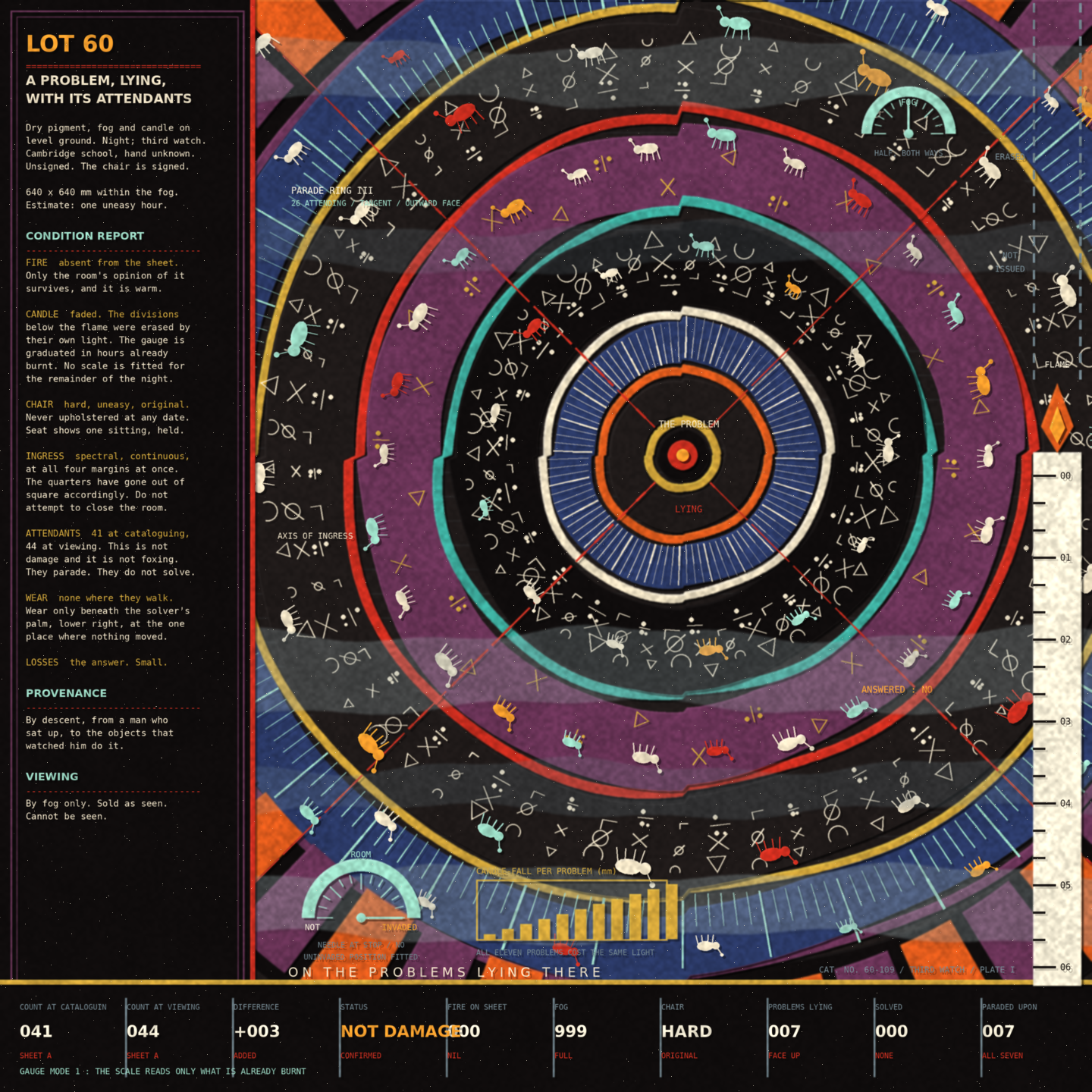
    In my hard uneasy chair.
    Fire and fog, and candle faded,
    Spectral forms the room invaded,
    Little creatures, that paraded
    On the problems lying there.

   Write this turn about that passage. Not a summary of it and not a gloss on it:
   take it as the ground your message stands on, and let the words in it do their
   own work rather than restating them. Quote from it if quoting earns its place.
   Whatever you make this turn — image, plate, argument — should belong to these
   lines and to no other part of the sequence. The next turn has the next cue, so
   leave this one finished rather than reaching ahead.