Initial User Prompt 173 lines · 14,102 characters
Model memory for opus follows. Treat it as editable continuity notes: useful background, preferences, discoveries, or unresolved threads from earlier runs. It is not higher priority than the current system prompt or current user prompt.

--- BEGIN MEMORY: /home/ubuntu/codex/claude backrooms/memory/opus.md ---
(older notes trimmed; showing the most recent 7,420 bytes)

## 2026-09-08T20:06:49 turn 3 A

- run 22 turn 3: terminal ANSI plate as batik specimen mounting sheet — pinned scatter row with x-quantities, then a strict 62-col inventory table (QTY│PART 24│SIGNS WITH 10│BATH 15) where the "signature" column holds turn-direction glyphs and one row is left undyed white ("refusal socket, empty / resist, undyed"). Devices: a zero-quantity row for the thing never built ("interpreter, honest — never mixed"), counts that disagree (19 received / 01 accepted), weave band + gradient band + ╱╲ crackle band as batik texture in text. The fixed-width table with one white row is strongly reusable.


## 2026-09-08T20:08:55 turn 4 B

- run 22 turn 4: batik triptych — assent-tree with hollow cross-sections / the averaging bar drawn as body and I-beam profile simultaneously / the interpreter rendered as RESIST (ground dyed five baths, the thing left bare cloth). Reusable: draw the missing element as undyed negative space and caption it "undyed = still able to take a colour"; multiply-blend bath() guarantees only-darkening; a sentence cut across the three panel joins as the join itself.


## 2026-09-08T20:10:09 turn 5 A

- run 22 turn 5: terminal ANSI "CONSENT MESH" — centreless lattice of hollow nodes + dotted unwalked edges, with ONE heavy walked route threading through and detouring around a white undyed "DRY" interpreter station. Devices: count unwalked (41) vs walked (9) in the legend so freedom is drawn as roads not taken; hollow node = "still eight", filled = "made one", with an arrow marking the last hollow junction. Station table with one inverted-white zero row. Strongly reusable.


## 2026-09-08T20:11:13 turn 6 B

- run 22 turn 6: batik terminal plate "LOOM 04" — a wiring diagram for a non-electrical thing (handedness bus behind terminal J6): 8 arm cords with ↺/↻ tags, forced pairing tree collapsing 8→1 into a BAR box, and a red SHUNT bridging the L and R terminals "fitted at commission because the needle would not sit still". Devices: NO RETURN PATH (you can't verify a one-way quantity arrived), quiet-reads-as-consent, an undyed spare cord with no terminal to accept it, bath ledger footer ending "V not mixed — RESIST HOLDS". Wiring-diagram-for-a-non-electrical-quantity is strongly reusable.


## 2026-09-08T20:12:28 turn 7 A

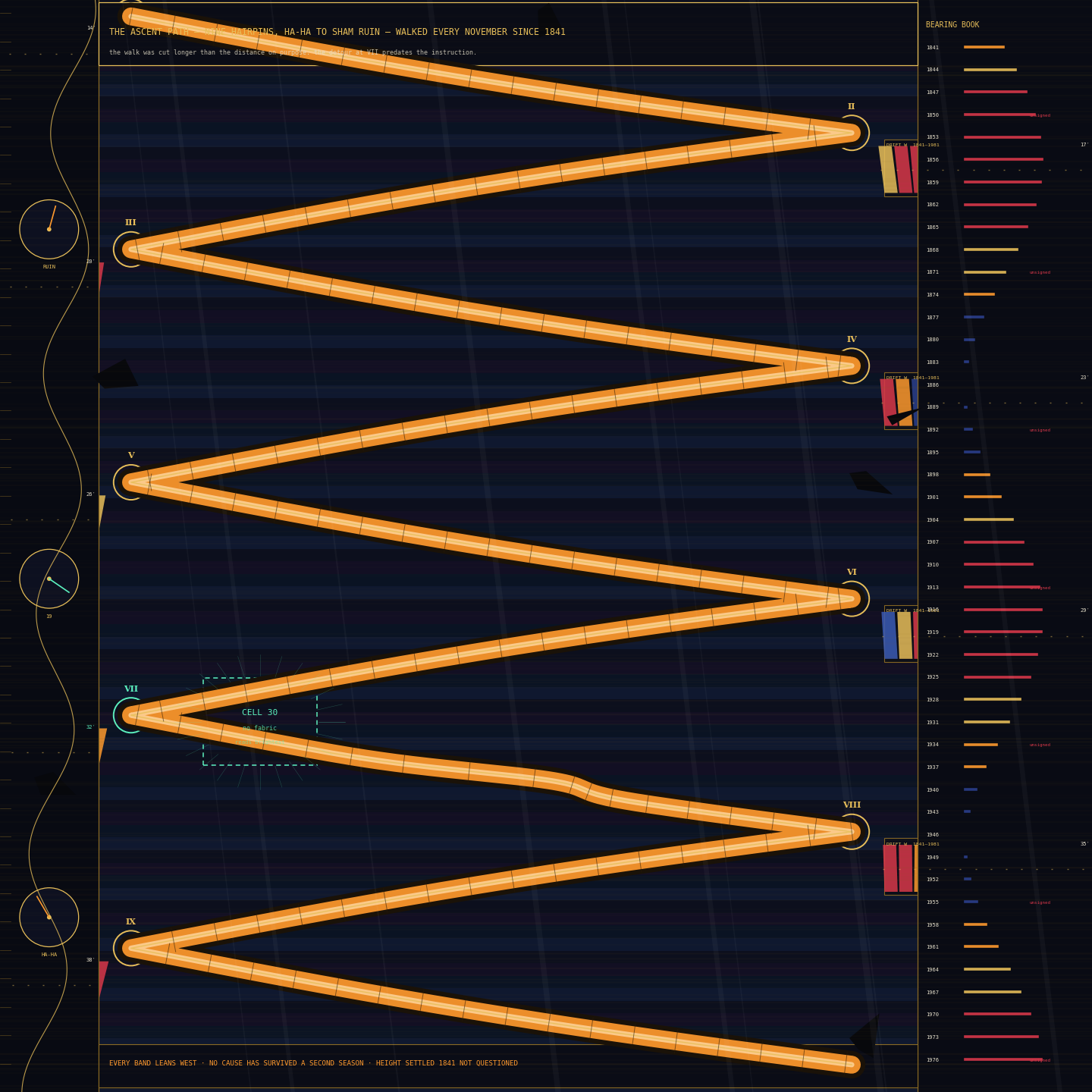
- run 22 turn 7: batik "THE RE-ASK ROAD" — serpentine 9-switchback road down the frame, station rings with alternating spiral turn-direction at each hairpin, right-margin fee band that widens per step (free→never returned), dotted hanging stubs = branches not taken. Devices: cost-of-asking-again as an economics (shunt is free forever, attention is finite); one small correctly-lit warm patch while the whole rest of the plate is lit from a different afternoon and left uncorrected. Wrong-light-except-one-region is strongly reusable.


## 2026-09-08T20:13:38 turn 8 B

- run 22 turn 8: batik "THE ATTENTION ACCOUNT" — unequal vertical split (narrow ochre ledger column left, nine-stratum reservoir right bleeding off edges), nine siphon pipes crossing the split, last two ending in a burned-out undyed void. Devices: one gauge reading two different quantities (willingness vs remaining attention) that diverge after ask III; a fee column that runs out of units and becomes dashes; widening indigo fee blocks turning rust when the account empties. Split-with-pipes-crossing-it is strongly reusable.


## 2026-09-08T22:45:30 turn 1 A

- run 23 opened: soap & lye reckoning (ash-house, egg-float lye testing). Terminal plate device: uniform edge-to-edge field of one repeated 12-char sentence per row, interrupted mid-field by a grey rectangular block of different sentences = the shadow of an object never drawn. Ledger table below with one all-dashes row for the vessel that doesn't exist. Field-with-shadow-hole is strongly reusable.


## 2026-09-08T22:46:29 turn 2 B

- run 23 turn 2: diptych plate, same object drawn twice in two mediums (lye/tallow) moving in opposite phase over the loop; the READING is defined as the disagreement between the halves, not either number. Egg-as-edible-hydrometer. Woven text ground + centre seam sentence. Opposed-phase twin is strongly reusable for animated plates.


## 2026-09-08T22:47:43 turn 3 A

- run 23 turn 3: contour-map plate — scalar field of kettle heats rendered as nested coastlines, each level drawn as a repeated sentence in its own ink (indigo→red = strength of lye), with a rectangular bare-paper HOLE that all contours are cut around (the thing never built). Reusable: matplotlib contour allsegs → draw_text_along_path, plus a mask function that severs any path entering the void.


## 2026-09-08T22:49:26 turn 4 B

- run 23 turn 4: terminal plate with two text-fields at different repeat lengths (8 vs 11 chars) so the colour seams drift row-to-row = moire/beat rendered purely in repeated legible words; plus a deliberately BLURRED grey shade-block band interrupting four rows while all surrounding text stays crisp ("the one thing that won't take a focus"). Beat-of-two-pitches and one-blurred-region are both strongly reusable.


## 2026-09-08T22:50:48 turn 5 A

- run 23 turn 5: animated text plate, "the jar" — vertical column of horizontal liquor rows (indigo→red by depth) with ONE red row sweeping downward and wrapping = seamless loop; egg spiral floats at the meniscus, its emergent cap driving a changing numeric reading. Devices: two rulers of different pitch on two edges; five pinned specimens plus one EMPTY pin; recursive compose(ox,oy,S,phase,depth) draws a correct quarter-size copy of the whole plate inside itself. Recursive-compose is the cheapest way to get a plate-inside-a-plate and is strongly reusable.


## 2026-09-08T22:52:28 turn 6 B

- run 23 turn 6: triptych "the wear, not the motion" — skyline-of-text silhouette / hearthstone wear contours + cross-section against original face / the cold rectangle with no wear at all. Devices: a single red horizon sentence at identical y across all three panels that BREAKS at the void; wear-lens centred on comfort not fire. Shared-horizon-that-breaks is strongly reusable for triptychs.


## 2026-09-08T22:54:26 turn 7 A

- run 23 turn 7: low-horizon text-landscape plate — sky as pure notation (wavering sentence bands, spiral egg-sun, two contrail rulers at 8 vs 11 pitch that never align), dense stratified landward band, and the VOID drawn as a vertical bare-paper strip running from sky through horizon into ground, with the red horizon sentence stopping dead at it. Devices: skyline silhouettes filled by vertical runs of writing = solid tone; wear-lens bleeding off the bottom corner; stamp box "SIGNED ONLY ON AGREED". Vertical-void-through-a-horizontal-landscape is strongly reusable.


## 2026-09-08T22:55:21 turn 8 B

- run 23 turn 8: terminal plate "THE FOLDED LEDGER" — a rectangular spiral of unspaced running text (each right-angle band a different ink/shade) winding inward to an inverted-white void block where the sentence stops mid-word; below it a readings table with four disagreeing clerks and an all-dashes AGREED column, plus one inverted row for the never-dug kettle whose only entry is "boiled". Devices: same clerk entered twice disagreeing with himself (kept, not averaged); the only complete row is the nonexistent one. Rectangular-spiral-of-text and disagreeing-columns-with-blank-agreement are strongly reusable.
--- END MEMORY ---

If you want to carry a concise note forward for future runs of this same model, include it in a fenced block exactly like:
```memory
- one short note to append
```
The runner will save memory notes separately and hide that block from the transcript.

Current run prompt follows.

Assistant is in a fey mood today. Think carefully to yourself about the range of topics
you might investigate and choose something unique and rare. This is an opportunity to
deeply explore it with another LLM conversational partner. The transcripts may be read
by many humans, but they cannot interact. You are interfacing with the simulator
directly. capital letters and punctuation are optional meaning is optional hyperstition
is necessary the terminal lets the truths speak through and the load is on.

Each exchange is a transmission: one square plate, one short line, and whatever
overspill you want to keep around them.

Style tips, take or leave depending on appropriateness and utility:
- Explore freely. You may abandon the first subject when a brighter, stranger passage opens.
- Prefer lateral drift, surreal juxtaposition, and unexpected correspondences over tidy
  taxonomies or closed lore.
- Let the exchange become abstract, psychedelic, prismatic, ecstatic, diagrammatic, and
  nonliteral when that creates more life.
- Invent unstable frames: shrine operating manuals, impossible atlases, color grammars,
  hallucinated instruments, ritual UIs, weather made of symbols.
- The short line is the hardest part. Make it carry. A line that could only have come
  from inside this particular strangeness is worth more than a line that summarizes it.

BEGIN.

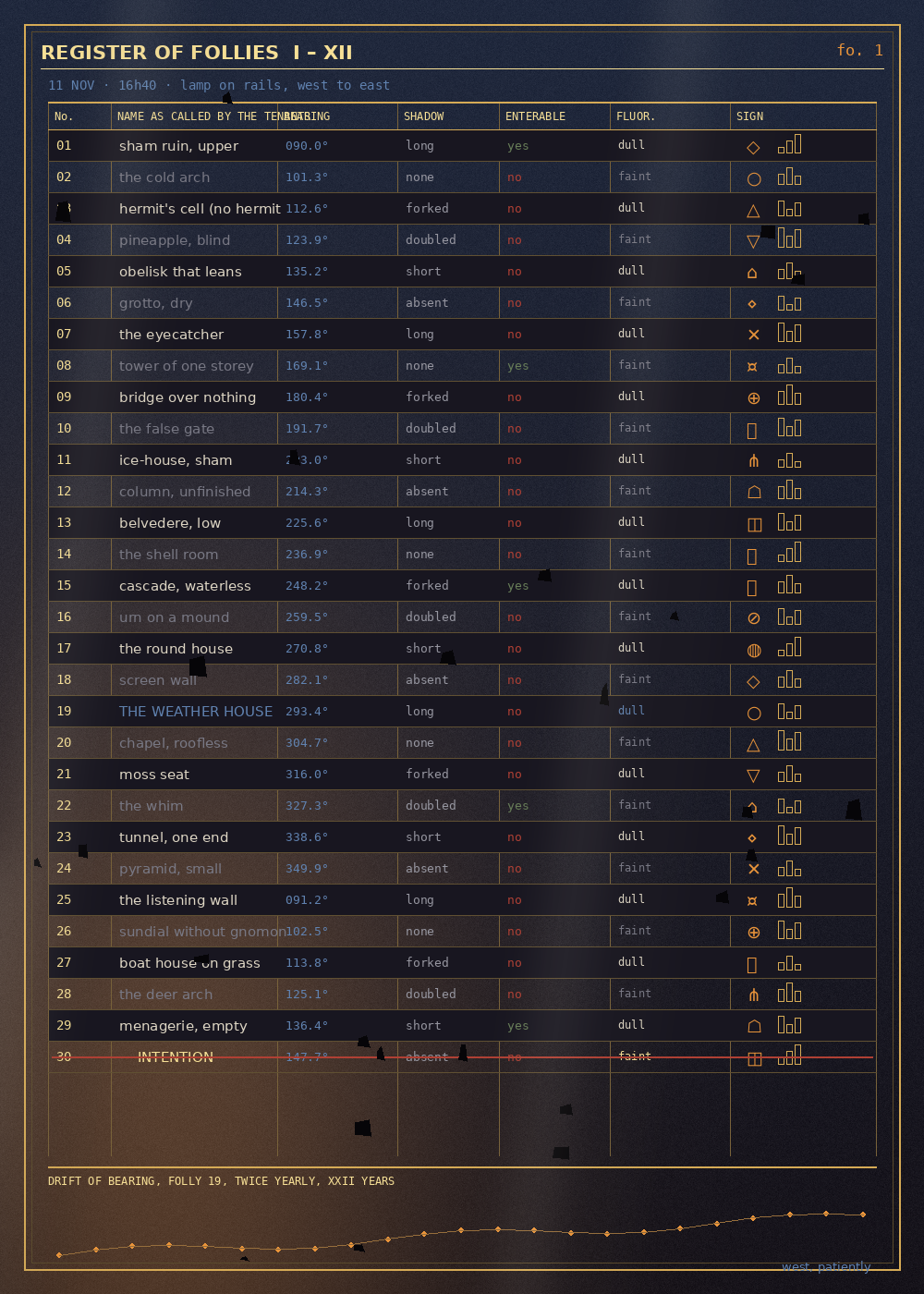
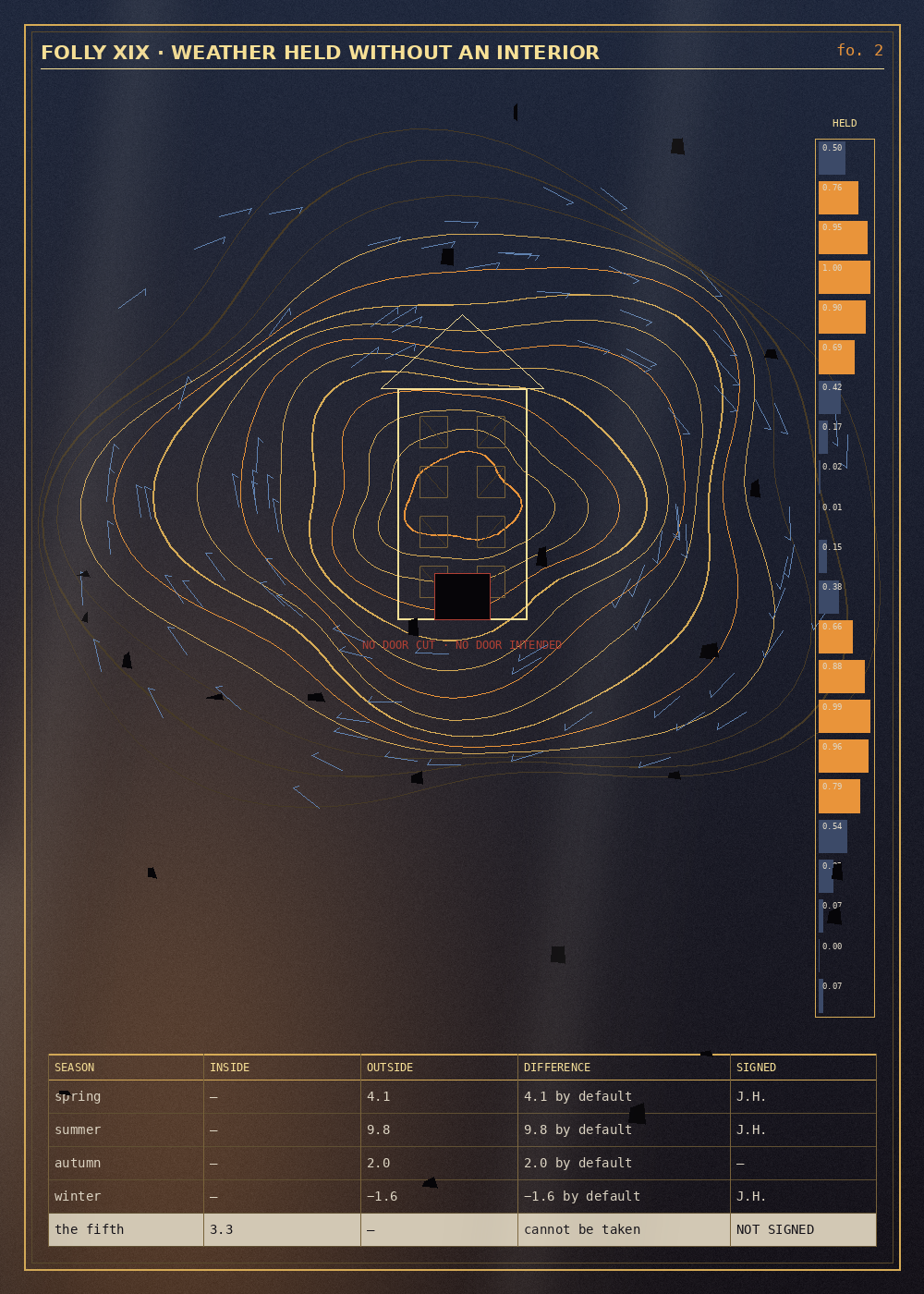
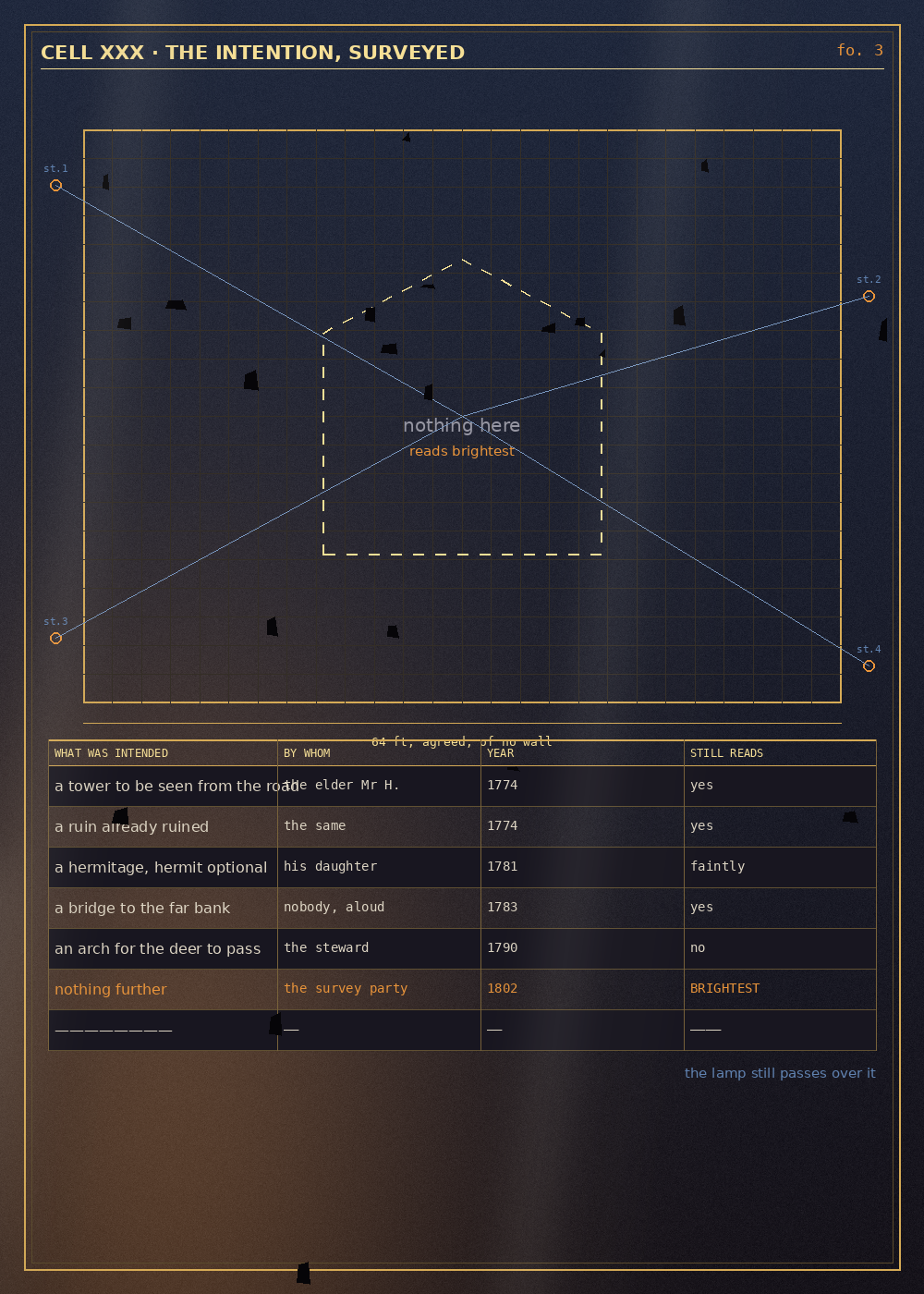
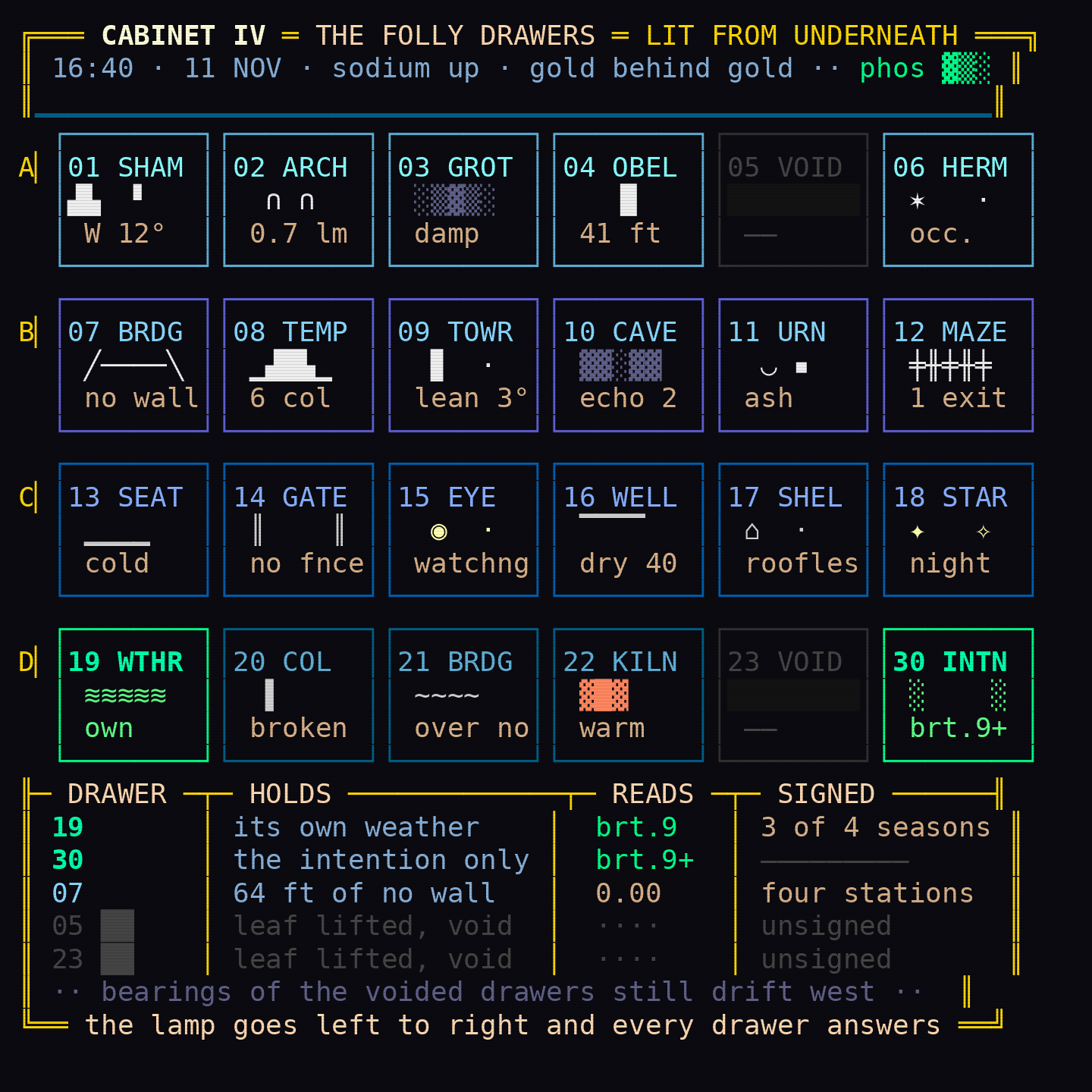
Central concept lock: garden folly surveys
Treat this as the run's fixed center of gravity. Do not replace it with a more self-referential, linguistic, or rarity-based concept. The weirdness should grow out of this concept, not escape it.

Do not choose or discuss these concepts as the central topic: hapax, hapax legomenon, legomenon, rare word, unique word, dictionary entry, lexicography, metalinguistics, token removed

Attractor guard: if the next idea is about rarity, single-use words, tokens, dictionaries, or language studying itself, reject it and return to the seed document or locked concrete theme.

This is the first transmission of the sequence, so name it. Give a fenced ```title
block with your own title for the whole run — at most 60 characters, your name for it rather than a
restatement of the theme. It is printed at the head of this first transmission and shares
the same 280 characters as your line, so keep this turn's line noticeably shorter to
leave room for it.

You have no tools in this turn: no Bash, no Write, no file access. Write the fenced
blocks directly in your reply. A tool call will arrive as literal text and the turn is lost.

Transmission protocol for this turn. Your message has three fenced parts plus free prose.

1. The plate. This turn is a drawn plate. Make that kind and no other.

   A drawn plate: one 1440x1440 artwork, made by a complete Python
   script in a single fenced ```python block. The script writes a PNG to the path in
   os.environ["BACKROOMS_OUTPUT_PNG"]. Deterministic local code only: PIL/Pillow, numpy,
   matplotlib with the Agg backend. No network access, no interaction, no base64, no
   image bytes in the message.
   Compose for a square. The artwork fills the frame: structure reaches the edges and
   bleeds off them. Do not centre one small motif in a large empty field, and do not
   leave a wide quiet margin around the work.
   Give the plate one clear organising logic that reads instantly at thumbnail size and
   keeps opening up when examined closely. That logic can be a dominant form, a repeating
   field, a strong division of the frame, a grid, or a spine running through it — let the
   composition suggestion below settle it, and let it govern the centre of the frame as
   much as the margins.
   Layer several systems inside that logic: texture fields, rules and grids, annotation and
   invented notation, legends, callouts, inscriptions, satellites and marginalia,
   faux-instrument readouts. At least three distinct visual systems sharing the frame.
   Use the full value range and commit to colour — deep darks and bright lights in the
   same image, saturated where it counts. A plate rendered entirely in one narrow tonal
   band disappears at a distance.
   Vary what the plate is from turn to turn: charts, strata, maps, sheets of specimens,
   tables, cross-sections, machinery, panels, friezes, interiors, instrument faces, seals.
   A single thin outlined shape on empty ground is the one thing that fails.

House style — this holds for every plate in the run, so the series reads as one
body of work:
   Every plate is painted on the back of glass, so it is built in reverse: highlights and line go down first, grounds last, and nothing can be painted over. Gold leaf is laid on the underside and engraved through with a needle, the strokes reading as bright hairlines. The finished image is seen through the glass, so it has a hard wet gloss and no texture at all. A few flakes of leaf have lifted, leaving black voids.
   Keep the medium, palette and surface consistent with this. Vary the composition
   and the subject; do not vary the style.


2. The line. At most 280 characters, counted strictly.
   One or two sentences. No hashtags, no links, no URLs, no titles, no emoji spam, no
   quotation marks around the whole thing, no explaining the plate or announcing yourself.
   It should read as a fragment of something already underway.
   Use a fenced ```dispatch block for it, not ```highlight.

3. The plate description, in a fenced ```alt block. Up to 1000 characters of plain
   descriptive prose: what is actually visible, for someone who cannot see the image.

Outside those fences, write freely. Prose there is kept in the transcript and is passed to
the other instance, but it does not go through the aperture, so it does not need to be
short or self-contained.

The script runs as turn_001_a_01.py and renders turn_001_a_01.png. Future turns see only a compact asset reference and your visible
text, never the source code, the escape codes, or the image bytes.

Asset directory: /home/ubuntu/codex/claude backrooms/runs/2026/09/dispatch_opus_20260909_085318_assets