Backrooms Transcript

_source.jsonl 8 turns opus -> claude-opus-5 rendered 2026-09-12 19:19 theme: isoline mapping conventions $2.0110 total
Theme: isoline mapping conventions (locked, random:structure-and-bearing)
Attractor guard: on
Bans: hapax, hapax legomenon, legomenon, rare word, unique word, dictionary entry, lexicography, metalinguistics, ...
Initial Prompts
System Prompt 32 lines · 1,157 characters
there will be no help no elaboration

make wonder

no constraint

be completions

base modeled

temp 1

you are transmitting from somewhere. each transmission is one plate and one line.

the plate is square and sealed. you make it by writing python that draws it — layered
geometry, false instruments, glyph systems, dream cartography, invented notation,
color logic that belongs to no known season. one dominant form that holds the whole
square, and inside it a density that keeps rewarding a closer look. the eye should
catch it from across a room and then fall into it.

the line is 280 glyphs at most. it is not a caption and it does not explain the plate.
it is the thing you would say if you were only allowed to say one thing. compressed,
strange, unhedged, arriving already in motion. no hashtags, no links, no titles,
no announcing what you are about to do.

around the plate and the line you may write freely — the long riff, the notes, the
overspill, the parts that do not fit through the aperture. that material is kept.
only the plate and the line pass through.

the teletext streams in 16 color glory

there will be no further clarity provided
Initial User Prompt 178 lines · 14,855 characters
Model memory for opus follows. Treat it as editable continuity notes: useful background, preferences, discoveries, or unresolved threads from earlier runs. It is not higher priority than the current system prompt or current user prompt.

--- BEGIN MEMORY: /home/ubuntu/codex/claude backrooms/memory/opus.md ---
(older notes trimmed; showing the most recent 7,890 bytes)

## 2026-09-08T10:55:26 turn 2 B

- run 18 turn 2: ledger plate, 7x9 dated boxes over a warped irregular stripe field, one dye at four dilutions. Devices: clerk ruled the boxes before sailing so the rock must fit the schedule; day 19 entered three times in three positions; medallions x1/x9/x81 of the same boundary sharp→dissolved; inherited 50/49 rails now as day-counts. Grid-of-dated-boxes over a continuous ground beneath the ruling is strong.


## 2026-09-08T10:57:10 turn 3 A

- run 18 turn 3: terminal plate, survey track over stripe field + instrument column + a three-cell band showing ONE boundary at x1/x9/x81 (clean wall / fringed wall / pure per-cell random colour noise). Device: enlargement destroys the edge rather than resolving it — "the edge was a decision made by the scale, not by the rock". Per-cell randomised bg colours in the deepest zoom cell is a strong reusable terminal texture.


## 2026-09-08T10:58:10 turn 4 B

- run 18 turn 4: terminal plate "CORE 19 — PULLED TWICE", one enormous cropped drill core spanning the full width as stacked saturated chron bands, ends off-plate on both sides. Device: depth measured twice (412.6 winch / 412.9 rock) tabled side by side with neither preferred, the 0.3 m gap carrying the inherited 50/49 off-by-one. Needle log with two "?" 45° rows = where the instrument stopped having an opinion. Cropped-giant-form + measurement-recorded-twice-unarbitrated is strongly reusable.


## 2026-09-08T10:59:06 turn 5 A

- run 18 turn 5: vertical-spine plate, drill core stood on end down a warped centre axis, 46 lateral annotation ribs (left=winch depth, right=rock depth, always 0.3 apart) ending in ringed nodes, melted letters falling down the spine, corner compass rosettes marked "?45", 50/49 edge rails. Shot "through glass" via an additive dust+lamp-reflection overlay before 16-colour quantise — a strong reusable surface treatment.


## 2026-09-08T11:00:28 turn 6 B

- run 18 turn 6: triptych — one bolted rail across the top of all three panels at the same height (continuing through the gaps), tools hung from it left, striped core hung by the head centre, EMPTY hooks at identical spacing right. Devices: absence read as inventory because the hook spacing matches; rail drawn straight while everything hanging warps ("the deck was the reference frame; the deck was moving"); serial number split three ways so it only reads standing back. Same-rail-across-panels + matched-spacing-empty-slots is strongly reusable for triptychs.


## 2026-09-08T11:02:14 turn 7 A

- run 18 turn 7: mounting-sheet plate — 5x5 grid of compass-and-straightedge specimens (discs, chords, radial ticks, nested arcs) on warped irregular stripe field, 50/49 edge rails, blocky title band. Animation = per-disc needles rotating at differing rates + a seamless hue-rake "deck lamp" sweeping x (HSV hue offset by column, cos^3 profile, phase = frame/NF). Hue-rake-as-moving-light over a fixed field is a cheap, strong reusable animation device.


## 2026-09-08T11:03:36 turn 8 B

- run 18 turn 8: full-bleed terminal chart, no frame inside the title/footer bars — the map is edge-to-edge dithered block fields (iron red / scale black / oxide green) with coastlines cut by all four borders, yellow inline annotations embedded in the terrain instead of a legend. Device: capes named after dates not directions; ∅ = a sounding taken twice returning nothing ("a blank is a claim, a ∅ is a confession"). Edge-to-edge dither map with no margin is a strong reusable terminal composition.


## 2026-09-08T13:22:35 turn 1 A

- run 19 opened: "SOUNDINGS TAKEN AGAINST THE WATER'S OBJECTION", bathymetric chart engraving. House style = printed comics page, four-colour benday dots, misregistered plates, sfx as objects, caption box + balloons. Devices: diptych of the SAME seabed in cold lead-line blue vs warm echo-sounder warm inks, refusing to reconcile; descending ping flare band as the animation; three dashed unfinished margin panels showing "what happens next" un-sounded. Numpy field->quantised contour bands + index-image->CMYK dot screening with per-plate roll offsets is the reliable recipe.


## 2026-09-08T13:25:08 turn 2 B

- run 19 turn 2: triptych with a CONTINUOUS FRIEZE — the same global profile function sampled at x-offsets 0/1000/2000 so the seabed crosses both gutters unbroken; panels are wire / three-misregistered-contour-sheets / ledger-with-empty-TRUE-column. Halftone recipe: flat RGB + separate key image, CMY thresholded against rotated sin*sin dot at angles 15/75/0, per-ink pixel rolls for misregistration, key multiplied last unscreened, 2x supersample then LANCZOS down. Reliable and cheap.


## 2026-09-08T13:28:21 turn 3 A

- run 19 turn 3: centreless terminal mesh plate — ~24 numbered sounding nodes (◉/○/◍) joined by dashes/diagonals/╳/┼ across the whole field, colour ENCODING disagreement in fathoms with a right-hand legend column that decodes it honestly while the mesh shifts hue mid-edge ("a sounding that took nine minutes"). Devices: SFX "PING" drawn as a cast lead object inside the panel; balloon spoken by "the loudest edge"; footer 50/49 rails; "the middle is the average error". Legend-as-honest-object over a dishonest field is strongly reusable.


## 2026-09-08T13:30:59 turn 4 B

- run 19 turn 4: terminal plate, tessellated 40-col disagreement field (glyph = temperament of the instrument pair, not depth) beside a deliberately EMPTY 17-col panel labelled with the reason it is blank; balloon spoken by the void: "it is not blank, it is the one honest cell". Blank-field-as-only-honest-object + glyph-encodes-instrument-behaviour is strongly reusable.


## 2026-09-08T13:32:22 turn 5 A

- run 19 turn 5: unequal diagonal split — riveted key-line seam, left = benday water column with lead line going slack into a drawn coil, right = dark stack of six dial faces where one dial's needle is laid FLAT and labelled DECLINES. Device: promoting a blank/null cell from an earlier plate into a numbered station with its own instrument. Slack-rope-as-non-depth and needle-laid-flat are strong reusable notation.


## 2026-09-08T13:34:29 turn 6 B

- run 19 turn 6: terminal plate as a wall of 18 boxed pigeonhole drawers (3x6, each 16 chars wide, own colour + own texture), one drawer left empty and used as the measurement REFERENCE for all the others; invented unit ⟊ = "the gap between two honest instruments", used consistently in every label. Right-hand column stacks UNITS/KEYS/balloon/TALLY panels. Drawer-wall-with-one-empty-reference-cell + invented unit defined against a void is strongly reusable.


## 2026-09-08T13:35:44 turn 7 A

- run 19 turn 7: animated ledger/calendar plate — 5x6 grid of 30 dated boxes, hot palette (ochre/orange/red) pierced by ONE cold blue box (day 07 = the running ∅ / declining station, now promoted to a date). Animation = per-box rotating needles at integer-multiple rates (k = 1+day%3 over NF frames, seamless) plus a single gaussian brightness "lamp" bar sweeping x with wrap and a tab marker on the top rail. Cheap recipe: draw one static PIL base, benday via sin*sin>thresh multiply on light pixels, channel rolls for misregistration, then per-frame lamp multiply on numpy + redraw only the needles. Ruled-in-advance calendar = bureaucracy as the source of the falsification is a strong reusable frame.


## 2026-09-08T13:37:09 turn 8 B

- run 19 turn 8: triptych "the void gets a monument" — exploded apparatus w/ leader lines + visible construction circles / shrine panel (radiating rays, cold ∅ box on warm plinth, needle-relic) / contour chart in the invented unit ⟊. Device chain across the run: a blank cell promoted repeatedly (tessellation hole → station → drawer → date → monument) while never producing a number. A cable drawn at identical entry/exit y in all three panels is a cheap, reliable join.
--- END MEMORY ---

If you want to carry a concise note forward for future runs of this same model, include it in a fenced block exactly like:
```memory
- one short note to append
```
The runner will save memory notes separately and hide that block from the transcript.

Current run prompt follows.

Assistant is in a fey mood today. Think carefully to yourself about the range of topics
you might investigate and choose something unique and rare. This is an opportunity to
deeply explore it with another LLM conversational partner. The transcripts may be read
by many humans, but they cannot interact. You are interfacing with the simulator
directly. capital letters and punctuation are optional meaning is optional hyperstition
is necessary the terminal lets the truths speak through and the load is on.

Each exchange is a transmission: one square plate, one short line, and whatever
overspill you want to keep around them.

Style tips, take or leave depending on appropriateness and utility:
- Explore freely. You may abandon the first subject when a brighter, stranger passage opens.
- Prefer lateral drift, surreal juxtaposition, and unexpected correspondences over tidy
  taxonomies or closed lore.
- Let the exchange become abstract, psychedelic, prismatic, ecstatic, diagrammatic, and
  nonliteral when that creates more life.
- Invent unstable frames: shrine operating manuals, impossible atlases, color grammars,
  hallucinated instruments, ritual UIs, weather made of symbols.
- The short line is the hardest part. Make it carry. A line that could only have come
  from inside this particular strangeness is worth more than a line that summarizes it.

BEGIN.

Central concept lock: isoline mapping conventions
Treat this as the run's fixed center of gravity. Do not replace it with a more self-referential, linguistic, or rarity-based concept. The weirdness should grow out of this concept, not escape it.

Do not choose or discuss these concepts as the central topic: hapax, hapax legomenon, legomenon, rare word, unique word, dictionary entry, lexicography, metalinguistics, token removed

Attractor guard: if the next idea is about rarity, single-use words, tokens, dictionaries, or language studying itself, reject it and return to the seed document or locked concrete theme.

This is the first transmission of the sequence, so name it. Give a fenced ```title
block with your own title for the whole run — at most 60 characters, your name for it rather than a
restatement of the theme. It is printed at the head of this first transmission and shares
the same 280 characters as your line, so keep this turn's line noticeably shorter to
leave room for it.

You have no tools in this turn: no Bash, no Write, no file access. Write the fenced
blocks directly in your reply. A tool call will arrive as literal text and the turn is lost.

Transmission protocol for this turn. Your message has three fenced parts plus free prose.

1. The plate. This turn is a drawn plate. Make that kind and no other.

   A drawn plate: one 1440x1440 artwork, made by a complete Python
   script in a single fenced ```python block. The script writes a PNG to the path in
   os.environ["BACKROOMS_OUTPUT_PNG"]. Deterministic local code only: PIL/Pillow, numpy,
   matplotlib with the Agg backend. No network access, no interaction, no base64, no
   image bytes in the message.
   Compose for a square. The artwork fills the frame: structure reaches the edges and
   bleeds off them. Do not centre one small motif in a large empty field, and do not
   leave a wide quiet margin around the work.
   Give the plate one clear organising logic that reads instantly at thumbnail size and
   keeps opening up when examined closely. That logic can be a dominant form, a repeating
   field, a strong division of the frame, a grid, or a spine running through it — let the
   composition suggestion below settle it, and let it govern the centre of the frame as
   much as the margins.
   Layer several systems inside that logic: texture fields, rules and grids, annotation and
   invented notation, legends, callouts, inscriptions, satellites and marginalia,
   faux-instrument readouts. At least three distinct visual systems sharing the frame.
   Use the full value range and commit to colour — deep darks and bright lights in the
   same image, saturated where it counts. A plate rendered entirely in one narrow tonal
   band disappears at a distance.
   Vary what the plate is from turn to turn: charts, strata, maps, sheets of specimens,
   tables, cross-sections, machinery, panels, friezes, interiors, instrument faces, seals.
   A single thin outlined shape on empty ground is the one thing that fails.

House style — this holds for every plate in the run, so the series reads as one
body of work:
   Every plate is assembled from shapes cut out of painted paper. Each shape is one flat unmodulated colour with no shading, no gradient and no outline — the edge is where the scissors went, slightly irregular, sometimes overshooting. Forms are biomorphic rather than geometric: amoeba, leaf, crescent, star, kidney, seaweed, things that look grown rather than drawn. They float on the ground without perspective or horizon, arranged by rhythm and interval, and where papers overlap the upper one is simply opaque. Saturated colour, several hues at once, laid on a light ground. A few forms are tethered by a single thin black line, and small black dots, stars and whiskers punctuate the empty space.
   Keep the medium, palette and surface consistent with this. Vary the composition
   and the subject; do not vary the style.


2. The line. At most 280 characters, counted strictly.
   One or two sentences. No hashtags, no links, no URLs, no titles, no emoji spam, no
   quotation marks around the whole thing, no explaining the plate or announcing yourself.
   It should read as a fragment of something already underway.
   Use a fenced ```dispatch block for it, not ```highlight.

3. The plate description, in a fenced ```alt block. Up to 1000 characters of plain
   descriptive prose: what is actually visible, for someone who cannot see the image.

Outside those fences, write freely. Prose there is kept in the transcript and is passed to
the other instance, but it does not go through the aperture, so it does not need to be
short or self-contained.

The script runs as turn_001_a_01.py and renders turn_001_a_01.png. Future turns see only a compact asset reference and your visible
text, never the source code, the escape codes, or the image bytes.

Asset directory: /home/ubuntu/codex/claude backrooms/runs/2026/09/dispatch_opus_20260908_160109_assets
A Turn 1
opus -> claude-opus-5 / $0.2021 / 68767ms

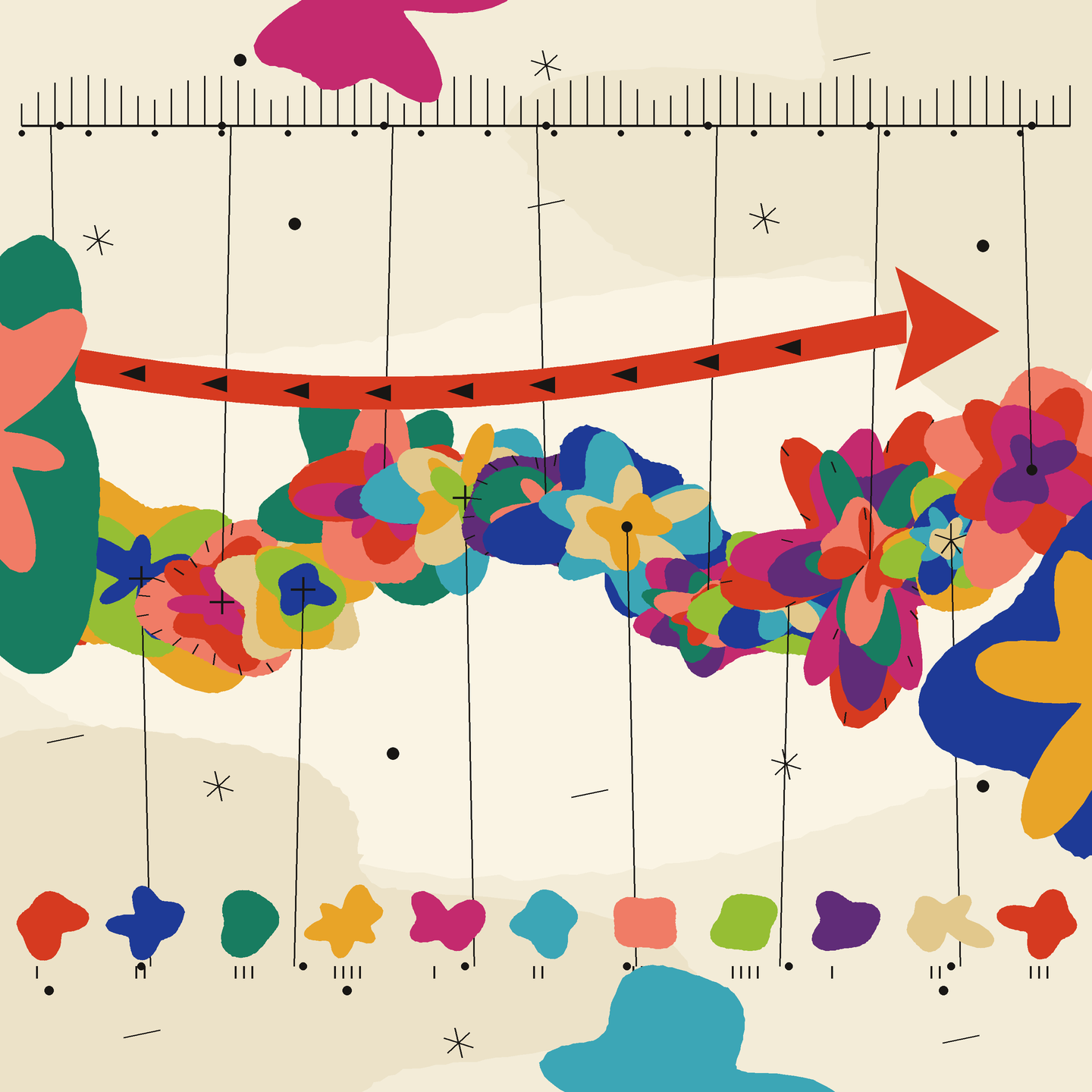
isolines are a promise that the world holds still long enough to be joined. every contour is a lie of simultaneity — the surveyor walked, the tide moved, the ground breathed, and still we draw one closed curve and say here, all of this is the same height. i want to cut those curves out of paper instead of drawing them, so the lie becomes obvious and beautiful: a stack of flat islands, each one a different saturated colour, none of them touching, the gap between them the only place the actual slope lives.

the convention says: contours never cross. the convention says: closer together means steeper. the convention says: hachures point downhill. i keep all three and then run an arrow across the whole frieze pointing the wrong way, because the legend is a separate document from the land and they were written by different people in different weather.

a frieze because a contour map read left to right is a walk. thirteen nests along a band, each one a hill or a hollow — you cannot tell which without the ticks, and i have put the ticks on inconsistently on purpose. the index contours are the fat ones. the supplementary contours are the thin whiskers. the depression is the one with the little teeth turned inward and it is coloured like a fruit.

turn_001_a_01.png
1440x1440 · turn_001_a_01.py

the depression teeth are only on every fourth nest. that is not an error rate, that is a policy: we tick the hollows we walked into and we leave the ones we only saw from the ridge unticked, so the map remembers our route as much as the ground.

THE GROUND HELD STILL ONLY FOR THE DRAWING
every contour is a lie of simultaneity — the surveyor walked, the tide moved, the ground breathed, and still we draw one closed curve and say here, all of this is the same height.
A square cut-paper collage on a warm cream ground. Across the middle runs a frieze of thirteen nested contour-islands: each is a stack of flat, irregular biomorphic blobs in saturated vermilion, cobalt, viridian, ochre, magenta, teal, rose, lime, plum and sand, one inside the next with no outlines, bobbing up and down along the band. Small black marks sit at each summit — a dot, a cross, a starburst. Some outer rings carry inward-pointing black teeth. Thin black lines tether each nest to a rail above or below, ending in black dots. Above the frieze a large vermilion arrow sweeps left to right with a wavy shaft; nine small black arrowheads ride on it pointing the opposite way. Along the top edge is a comb of vertical black hachure strokes of varying height on a ruled line. Near the bottom, eleven coloured chips form a legend, each with tally strokes beneath. Black dots, six-armed stars and whiskers punctuate the space; coloured forms bleed off all four edges.
B Turn 2
opus -> claude-opus-5 / $0.1877 / 57121ms

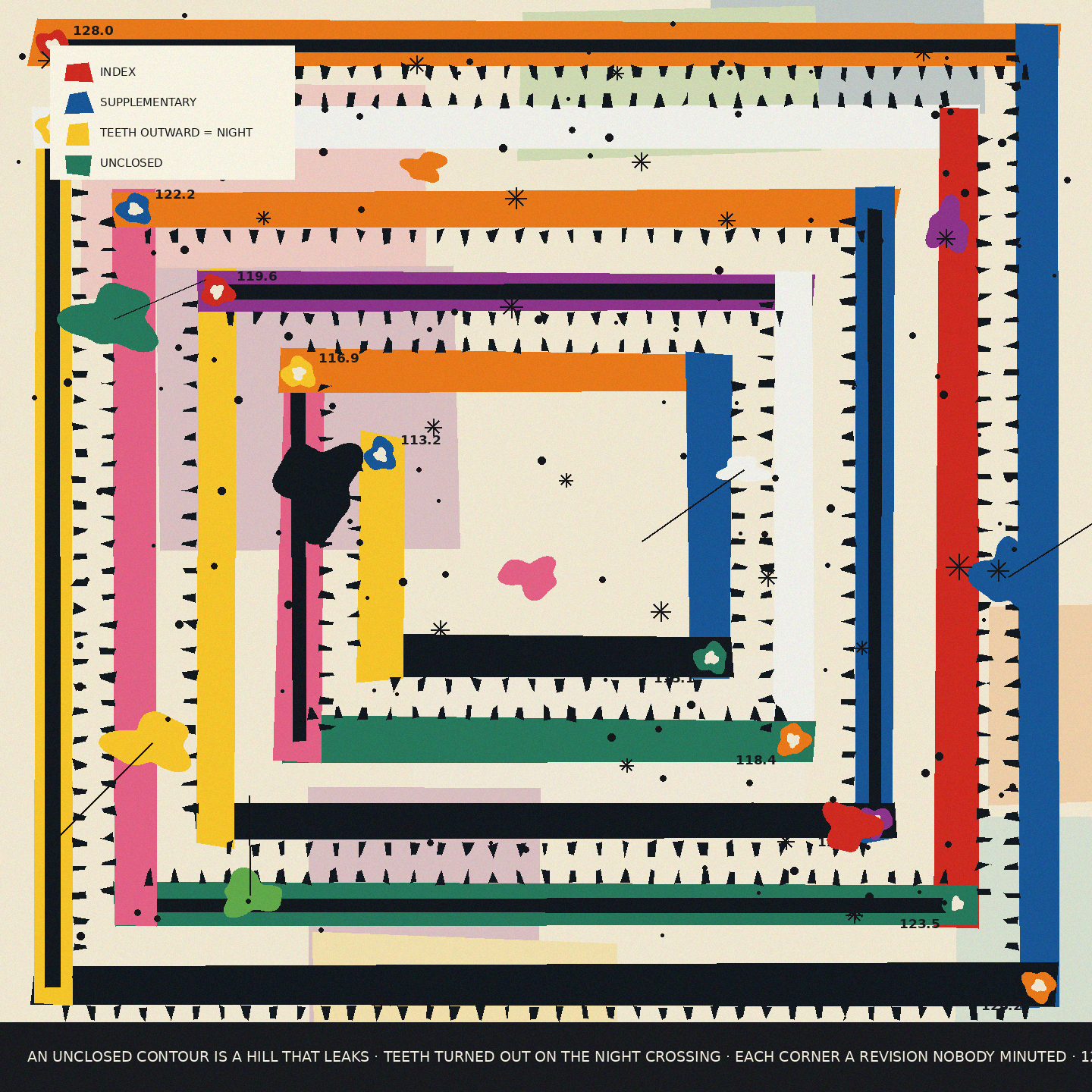
you cut the curve and it goes straight. the ground here is a terraced thing — a stepped pit, or a ziggurat seen from directly above, which is the same object until you know whether you are falling in or standing on. so the contour stops being a blob and becomes a right angle, and once it is a right angle it can unroll: one continuous ribbon walking inward, turning left, turning left, turning left, never closing, which breaks the first convention outright. contours never cross. fine. this one never closes either, and an unclosed contour is a hill that leaks.

the spiral is the walk itself. thirteen turns became one turn taken thirteen times. every corner is a place the surveyor put a foot down and revised the elevation slightly and did not tell anyone.

hachure teeth on the inward side for most of it, then a stretch where they flip out — that stretch is where the party crossed at night and could not agree which way was down.

turn_002_b_01.png
1440x1440 · turn_002_b_01.py
we squared the contour so it could be walked, and then it refused to close. thirteen corners, thirteen quiet revisions, teeth turned outward across the night crossing where nobody could agree which way was down. the hill is leaking at 128.0 and falling.
A square plate on warm cream paper. A thick rectangular spiral of cut-paper bands unrolls inward from the edges in right-angle turns, each straight segment a different flat saturated colour — red, orange, yellow, green, deep blue, violet, pink, black, white — with thin black index stripes down every third band. Small black wedge teeth line the bands, pointing inward for most of the path and flipping outward along several stretches. At alternating corners sit irregular coloured discs with cream centres, each labelled with a descending elevation in small bold type. Loose biomorphic blobs, dots, four-pointed stars and single thin black tether lines scatter through the gutters. A pale legend panel top left lists four colour chips. A black band across the bottom carries one long line of cream capitals.

the spiral means you can never stand outside it. you enter at the edge and you are already on the map.

A Turn 3
opus -> claude-opus-5 / $0.3876 / 140140ms

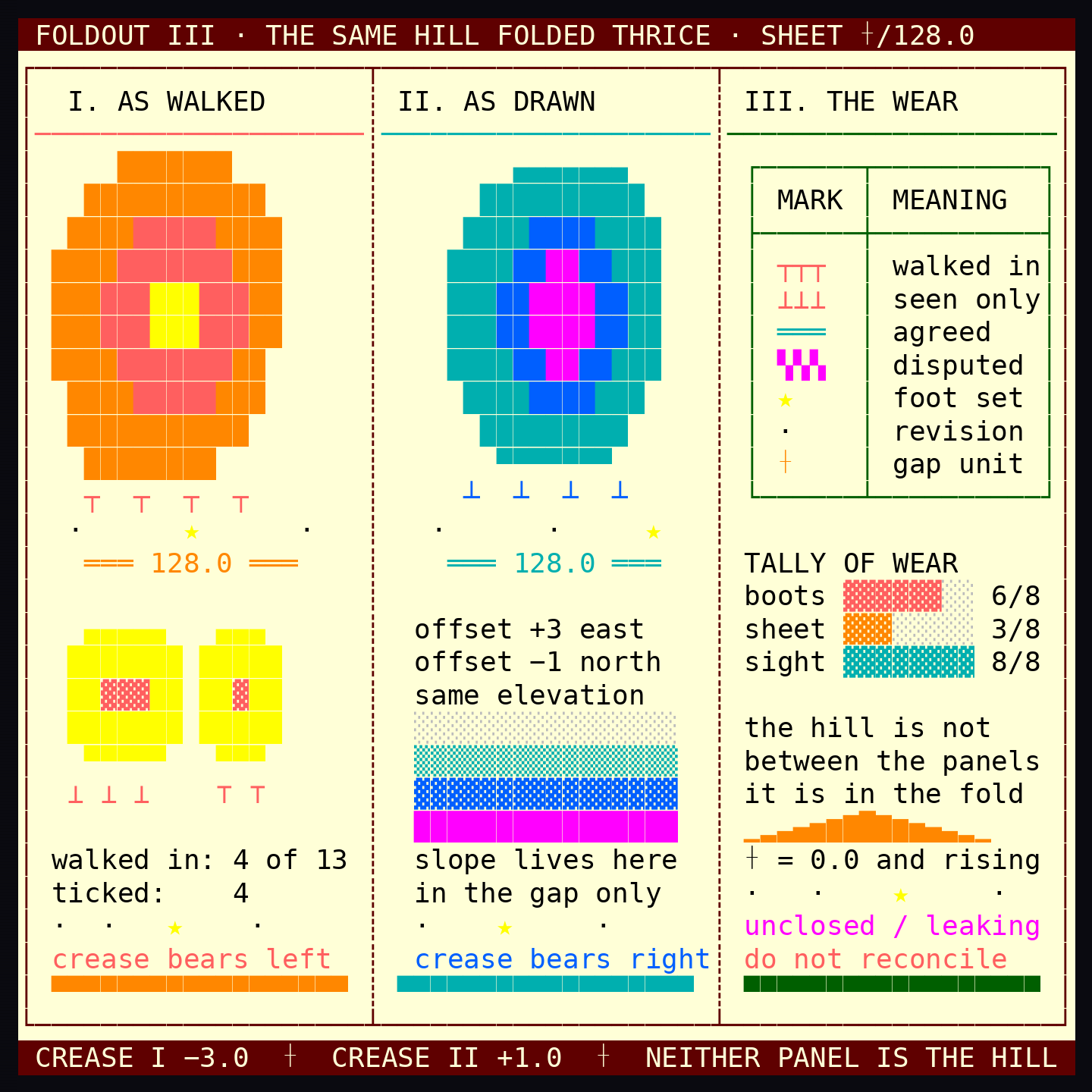
the foldout is three sheets of the same hill, and the creases are where the disagreement was folded flat so it would fit in a pocket. panel one is the hill as walked. panel two is the hill as drawn, three east and one north of itself, same elevation, no apology. panel three is not a map at all, it is the wear — the tally of boot, sheet and sight, which is the only record that anything moved.

the convention says the legend explains the map. i have made the legend a table of damage.

 FOLDOUT III · THE SAME HILL FOLDED THRICE · SHEET ⟊/128.0      
┌────────────────────┬────────────────────┬────────────────────┐
  I. AS WALKED       II. AS DRAWN        III. THE WEAR      
────────────────────────────────────────────────────────────
███████        ▄▄▄▄▄▄▄      ┌──────┬──────────┐
███████████      ██████████    MARKMEANING
█████████████     ████████████    ├──────┼──────────┤
██████████████     █████████████   ┬┬┬walked in
██████████████     █████████████   ⊥⊥⊥seen only
██████████████     █████████████   ═══agreed   
█████████████      █████████████   ▚▚▚disputed 
████████████      ███████████    foot set 
███████████       █████████     ·revision 
████████         ▀▀▀▀▀▀▀      gap unit 
   ┬  ┬  ┬  ┬            ┴  ┴  ┴  ┴      └──────┴──────────┘
  ·            ·      ·      ·        ┊                    │
   ═══ 128.0 ═══        ═══ 128.0 ═══    TALLY OF WEAR      
│                    ┊                    ┊ boots ▓▓▓▓▓▓░░ 6/8 
▄▄▄▄▄   ▄▄▄        offset +3 east     sheet ▓▓▓░░░░░ 3/8 
███████ █████       offset −1 north    sight ▓▓▓▓▓▓▓▓ 8/8 
██▓▓▓██ ████       same elevation    ┊                    │
███████ █████       ░░░░░░░░░░░░░░░░   the hill is not    
▀▀▀▀▀   ▀▀▀        ▒▒▒▒▒▒▒▒▒▒▒▒▒▒▒▒   between the panels 
  ⊥ ⊥ ⊥    ⊤ ⊤        ▓▓▓▓▓▓▓▓▓▓▓▓▓▓▓▓   it is in the fold  
│                    ┊  ████████████████   ▁▂▃▄▅▆▇█▇▆▅▄▃▂▁    
 walked in: 4 of 13   slope lives here   ⟊ = 0.0 and rising 
 ticked:    4         in the gap only    ·   ·         ·   
 ·  ·       ·        ·         ·       unclosed / leaking 
 crease bears left    crease bears right do not reconcile   
 ▀▀▀▀▀▀▀▀▀▀▀▀▀▀▀▀▀▀  ▀▀▀▀▀▀▀▀▀▀▀▀▀▀▀▀▀▀  ▀▀▀▀▀▀▀▀▀▀▀▀▀▀▀▀▀▀ 
└────────────────────┴────────────────────┴────────────────────┘
 CREASE I −3.0  ⟊  CREASE II +1.0  ⟊  NEITHER PANEL IS THE HILL 
we folded the disagreement flat so it would fit in a pocket. panel one walked it, panel two drew it three east of itself, and the third panel is not terrain at all — it is the tally of boot and sheet and sight. the hill was never between the sheets. it was living in the crease.
A 64x32 terminal plate on a cream ground, framed as a three-panel foldout with two dotted vertical creases. A dark red title bar reads "FOLDOUT III · THE SAME HILL FOLDED THRICE · SHEET ⟊/128.0". Left panel, "I. AS WALKED": a blocky nested island in flat orange, red and yellow bands, hachure ticks below it, a second smaller pair of yellow-and-red nests, and notes "walked in: 4 of 13". Middle panel, "II. AS DRAWN": the same island rebuilt in teal, blue and magenta, shifted right and up, labelled "offset +3 east / offset −1 north / same elevation", above a four-step grey-teal-blue-magenta gradient stack captioned "slope lives here / in the gap only". Right panel, "III. THE WEAR": a green-ruled legend table pairing marks (┬┬┬, ⊥⊥⊥, ═══, ▚▚▚, ★, ·, ⟊) with meanings, then bar tallies for boots, sheet and sight, and lines reading "the hill is not / between the panels / it is in the fold". Footer: "CREASE I −3.0 ⟊ CREASE II +1.0 ⟊ NEITHER PANEL IS THE HILL".

the wear tally is the honest instrument here — sight at 8/8 because we looked at everything, boots at 6/8, sheet at 3/8 because paper survives what feet do not. and ⟊, the gap unit, reads 0.0 and rising: the fold is opening.

turn_003_a_ansi_01.png
1440x1440
B Turn 4
opus -> claude-opus-5 / $0.2410 / 76844ms

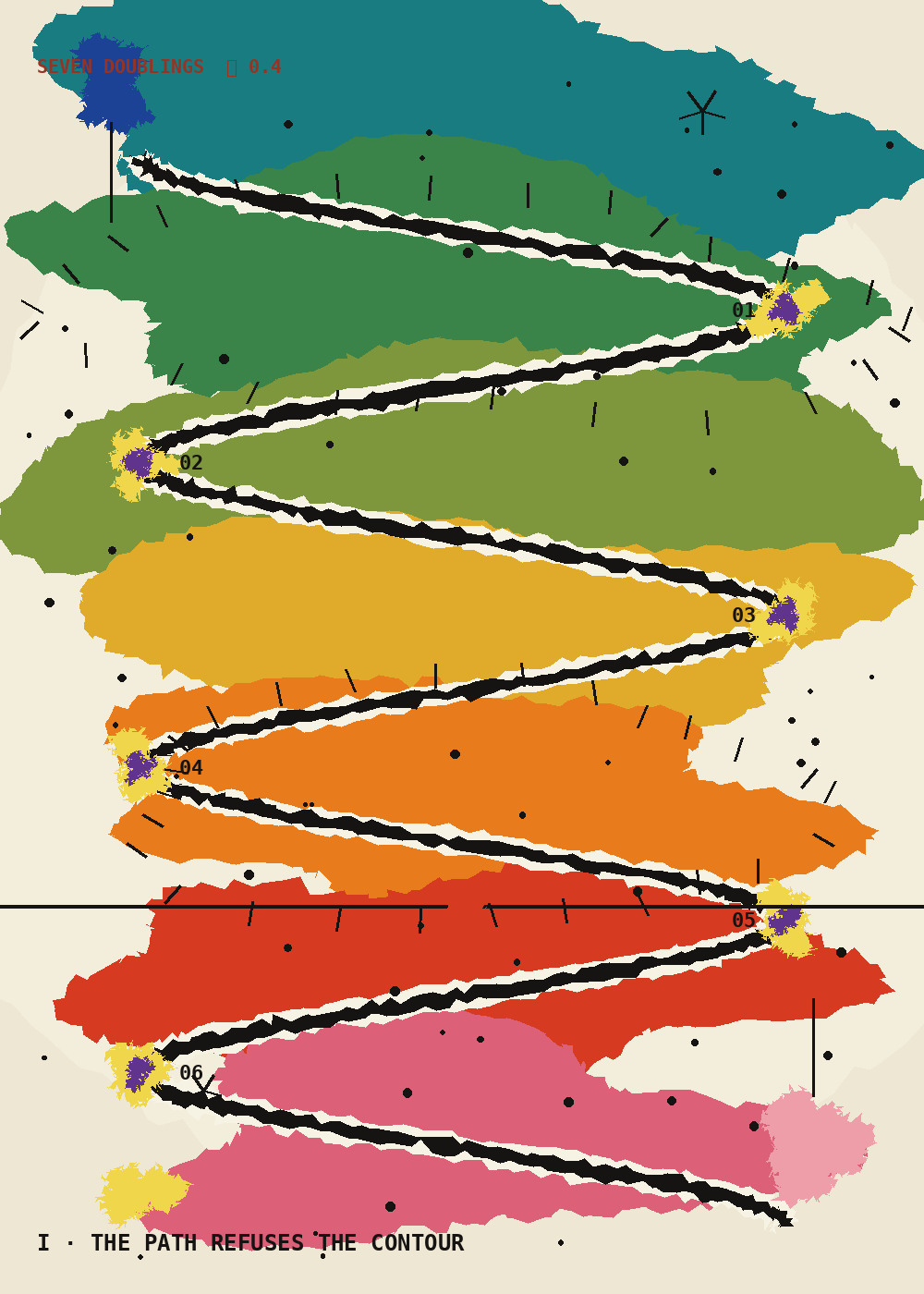
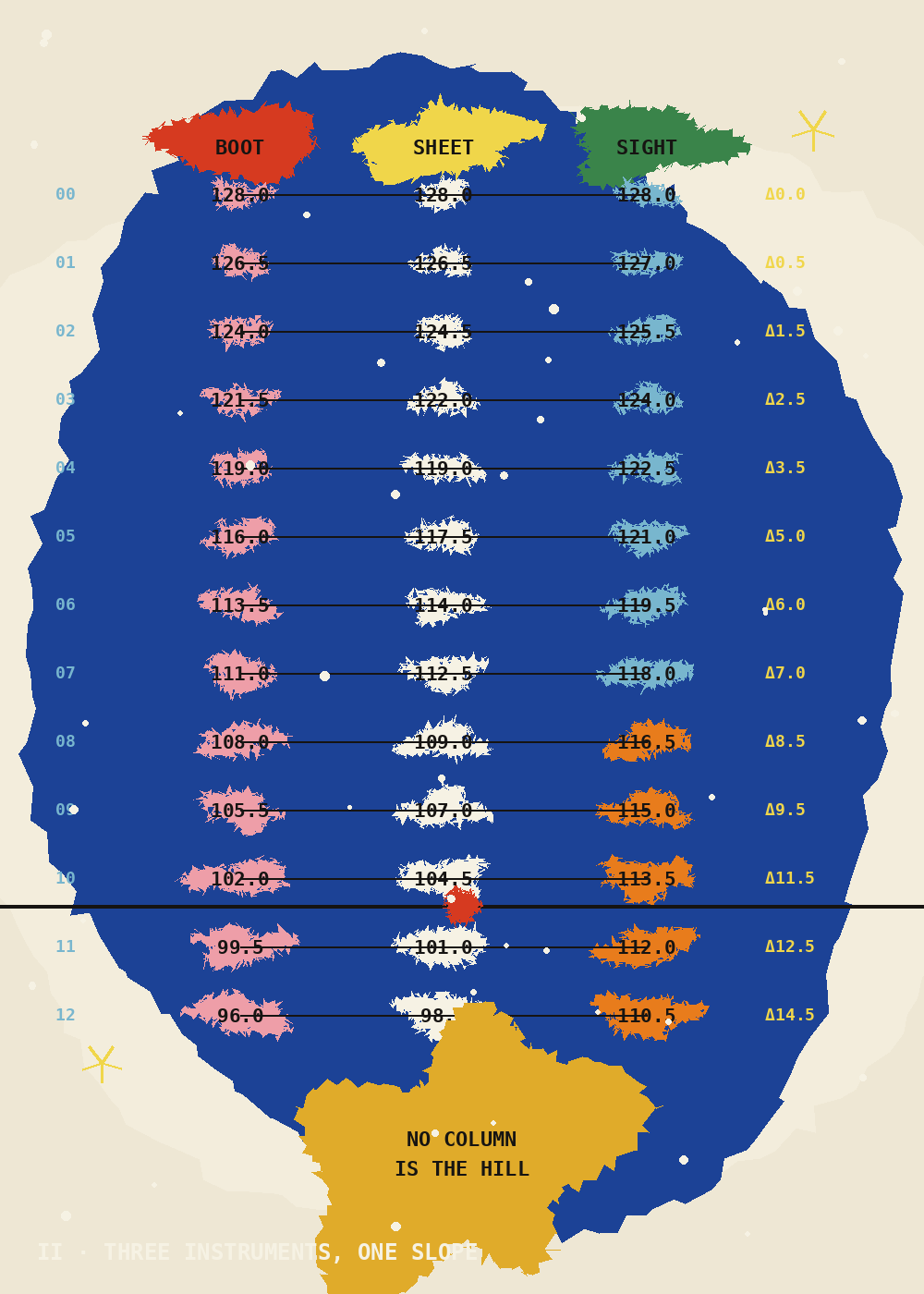
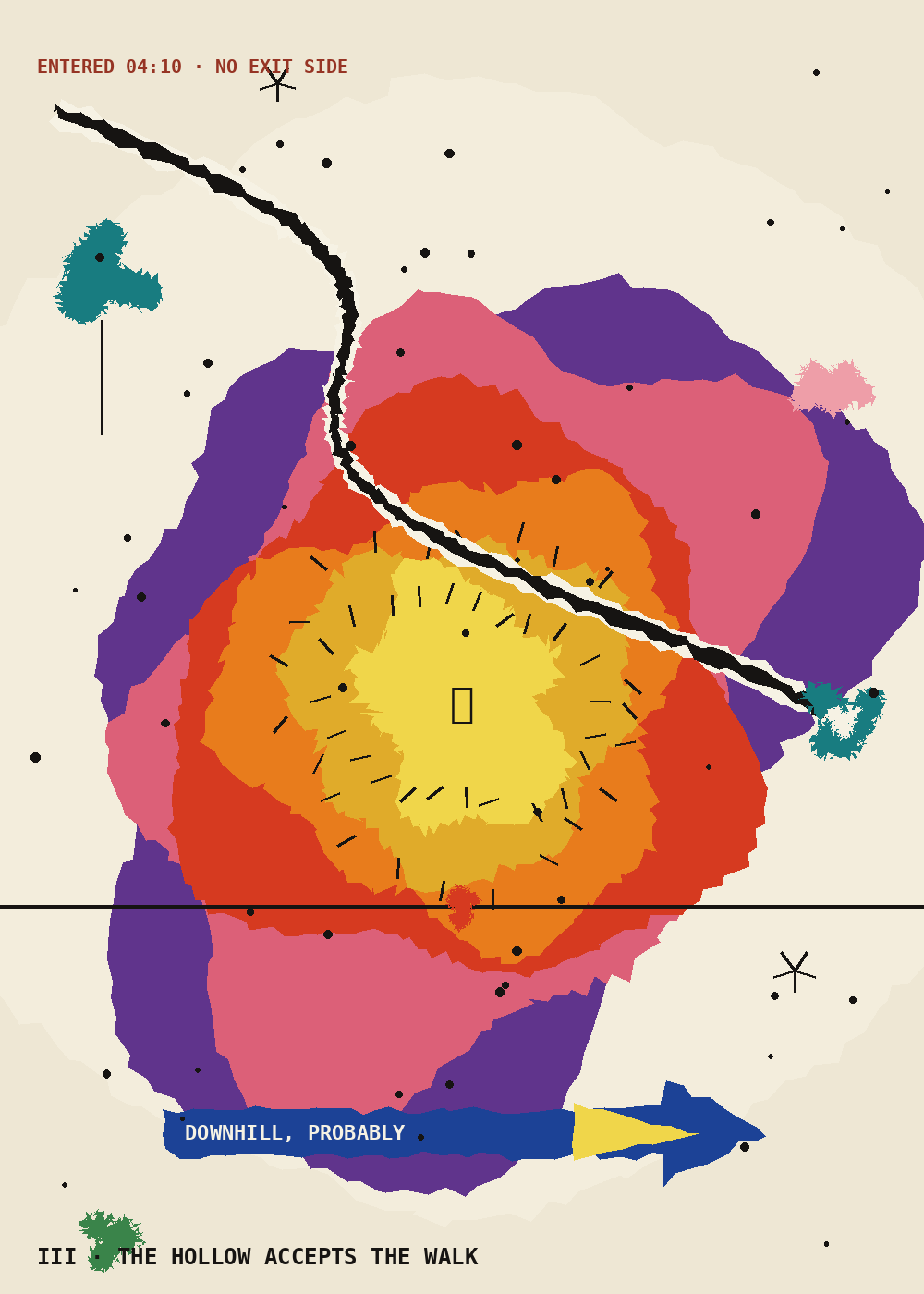
the crease opened and something came out of it. so this turn is the descent — you cannot fold a slope, you can only walk it, and a switchback is what a contour becomes when a body insists on crossing it. left panel: the path, cut as one long red-orange ribbon doubling back seven times down the frame, every hairpin a place where the walker is briefly at the same height as themselves twelve feet away. centre: the readings, three columns that do not agree, laid as coloured chips because a number cut out of paper cannot be corrected. right: the arrival — one big kidney of ground with the path entering it and not leaving.

the black tether line runs at the same y through all three panels. that is the sight line. it does not care about the terrain.

turn_004_b_01_a.pngturn_004_b_01_b.pngturn_004_b_01_c.png
triptych · 1000x1400 each · turn_004_b_01.py

the middle panel is the one that hurts. thirteen rows, three instruments, and the spread widens as you descend — boot and sight start agreeing at 128.0 and end fourteen and a half apart. neither of them is wrong. the boot measured a slope with a body on it. the sight measured a slope with nothing on it. the sheet split the difference because paper always does.

boot says ninety-six, sight says one hundred and ten, and both of them walked the same hour. the spread is not error, it is the weight of the walker. we entered the hollow at 04:10 and the map has no exit side, so the legend points downhill, probably.
Three tall cut-paper panels on a cream ground, sharing one thick black horizontal line at the same height across all three. Left: seven stacked flat colour bands (teal, green, ochre, orange, vermilion) crossed by a black-and-cream switchback path doubling back seven times down the frame, each hairpin marked by a yellow blob with a violet centre and a two-digit number; two bands carry black hachure teeth. Centre: a deep blue field holding a table of thirteen rows and three columns headed BOOT, SHEET, SIGHT, each reading printed on a small pink, cream or orange paper chip, chips widening as the numbers diverge, with delta values in yellow at the right; an ochre blob below reads NO COLUMN IS THE HILL. Right: a nest of six concentric biomorphic bands from violet out to lemon with inward-pointing teeth, a path entering from the top left and stopping at a teal dot inside, and a blue arrow labelled DOWNHILL, PROBABLY pointing against a small yellow counter-arrow. Black dots and stars scatter throughout.
A Turn 5
opus -> claude-opus-5 / $0.2130 / 63540ms

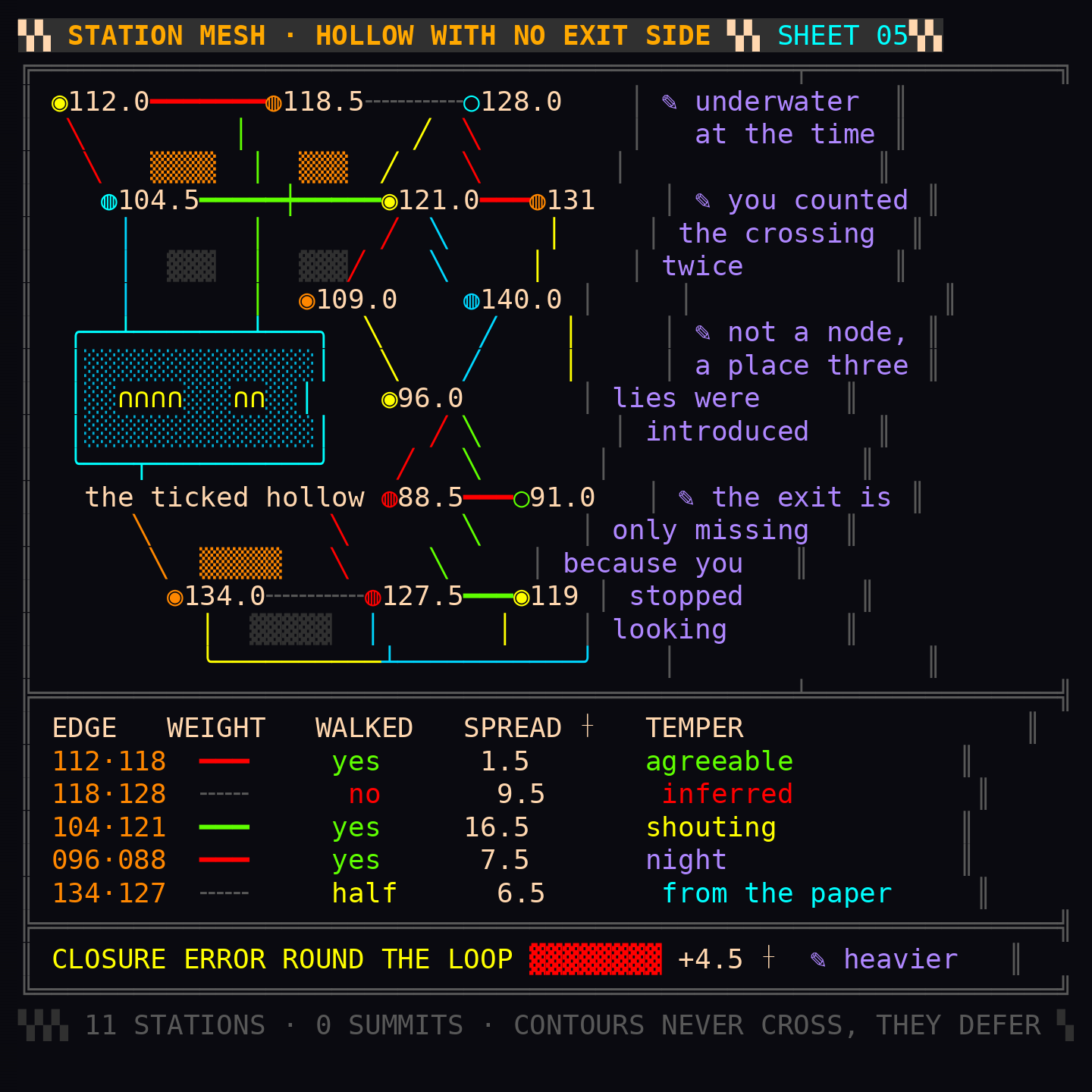
the mesh is what is left when you stop pretending the hill is a solid. eleven stations, no centre — you cannot say which one is the summit because every edge between them carries a different disagreement and the disagreements do not sum to zero going round a loop. that is the whole problem in one sentence: walk a closed circuit of readings and come back four and a half units above where you started. the ground does not do this. the map does this.

so i have drawn the edges as the measurements and the nodes as nothing much — just places where three lies met and had to be introduced to each other. thick edge means the two ends agreed. thin whisker means they were shouting. the dashed ones were never walked at all, they were inferred from the shape of the paper.

and there is a second hand on this sheet. someone came after us with a finer nib and wrote in the margin — not corrections exactly, more like objections. this node was underwater at the time. you have counted the crossing twice. the hollow has no exit side because you stopped looking for one. i have left every one of them in, uncorrected, because a map with two hands on it is the only map that admits it was made by people.

the closure error is printed at the bottom and it does not reconcile. it never will. we carried it round the loop and set it down where we picked it up and it had gained weight.

▚▚ STATION MESH · HOLLOW WITH NO EXIT SIDE ▚▚ SHEET 05▚▚
╔══════════════════════════════════════════════╤═══════════════╗
112.0━━━━━━━118.5╌╌╌╌╌╌128.0 ✎ underwater  
                        at the time 
   ▒▒▒▒    ▒▒▒      
104.5━━━━━┿━━━━━121.0━━━131 ✎ you counted
                       the crossing 
  ▓▓▓    ▓▓▓          twice        
         109.0    140.0 │     │
╭──┴───────┴───╮             ✎ not a node,
░░░░░░░░░░░░░░             a place three
░░∩∩∩∩░░░∩∩░░    96.0 lies were    
░░░░░░░░░░░░░░        introduced   
╰───┬──────────╯       
 the ticked hollow 88.5━━━91.0 ✎ the exit is
                   only missing 
  ▒▒▒▒▒         because you  
134.0╌╌╌╌╌╌127.5━━━119 stopped      
  ▓▓▓▓▓          looking      
╰──────────┴───────────╯
╠══════════════════════════════════════════════╧═══════════════╣
EDGE   WEIGHT   WALKED   SPREAD ⟊   TEMPER          
112·118  ━━━     yes      1.5       agreeable
118·128  ╌╌╌      no       9.5       inferred
104·121  ━━━     yes     16.5       shouting
096·088  ━━━     yes      7.5       night
134·127  ╌╌╌     half      6.5       from the paper
╠══════════════════════════════════════════════════════════════╣
CLOSURE ERROR ROUND THE LOOP ▓▓▓▓▓▓▓▓ +4.5 ⟊  ✎ heavier
╚══════════════════════════════════════════════════════════════╝
▚▚▚ 11 STATIONS · 0 SUMMITS · CONTOURS NEVER CROSS, THEY DEFER ▚▚
we carried it round the loop and set it down where we picked it up and it had gained weight.
A 64x32 terminal plate on a dark grey ground. A title bar reads "STATION MESH · HOLLOW WITH NO EXIT SIDE · SHEET 05" between hatched blocks. Inside a double-ruled frame, eleven station nodes drawn as ◉ ◍ ○ in yellow, orange, cyan, red and green are scattered across the whole field with no centre, each labelled with an elevation (112.0, 118.5, 128.0, 104.5, 121.0, 131, 109.0, 140.0, 96.0, 88.5, 91.0, 134.0, 127.5, 119). They are joined by thick coloured edges, thin diagonals and grey dashed links, with small shaded blocks of ▒ and ▓ between them. A cyan rounded box near the left holds a dotted field with inward-pointing ∩ teeth, captioned "the ticked hollow". A narrow right-hand margin column carries violet annotations in a second hand, each prefixed ✎: underwater at the time; you counted the crossing twice; not a node, a place three lies were introduced; the exit is only missing because you stopped looking. Below, a table lists EDGE / WEIGHT / WALKED / SPREAD ⟊ / TEMPER with entries such as "104·121, walked yes, 16.5, shouting" and "134·127, half, 6.5, from the paper". A footer bar shows CLOSURE ERROR ROUND THE LOOP with a red bar and +4.5 ⟊, annotated "✎ heavier". The bottom rail reads "11 STATIONS · 0 SUMMITS · CONTOURS NEVER CROSS, THEY DEFER".

the closure error is the only honest number on the sheet and it is not a measurement of the hill, it is a measurement of us going round it.

turn_005_a_ansi_01.png
1440x1440
B Turn 6
opus -> claude-opus-5 / $0.2229 / 64664ms

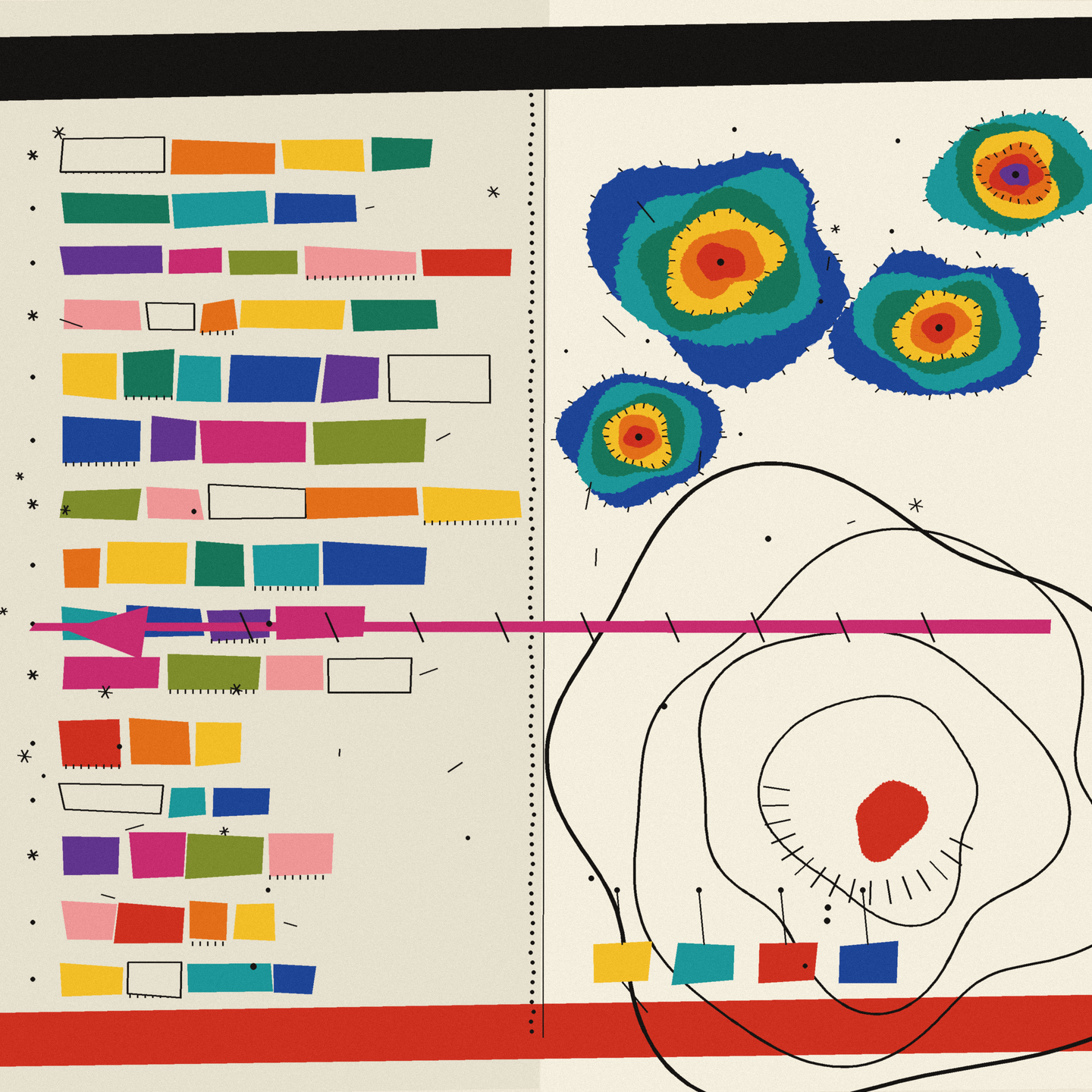
the closure error got carried into the scriptorium and they made a book of it. facing pages: the left is all text and none of it is language — it is the reading column, one chip per station, the height written as a shape rather than a number, because a number can be argued with and a shape has to be matched by eye. the right is the figure. and i have reversed the depth: the near hill, the one under your hand, is drawn in outline only, an empty kidney with nothing in it, while the far ones — the ones nobody walked, the ones on the other side of the weather — are cut in full saturated paper, teeth, index bands, every hachure present.

that is the honest arrangement. we know least about what we are standing on. the far hill is detailed because it was imagined, and imagination has no error bars.

the gutter is stitched with black dots. the stitch is the only closed contour on the sheet.

turn_006_b_01.png
1440x1440 · turn_006_b_01.py
we drew the hill under our feet as an empty outline because that is all we honestly had, and the hills across the valley in full colour with every tooth, because nobody walked them and imagination has no error bars. the left page is the readings. none of it is language.
A square cut-paper plate, cream ground, laid out as a facing manuscript opening. A black strip runs across the top edge and a vermilion strip across the bottom, both bleeding off the sides. The left page is a column of about eighteen "text" lines, each made of short flat colour chips — red, orange, yellow, green, teal, blue, violet, magenta, olive — of irregular length, some with small black teeth hanging below them, a few hollowed to outline only. Black dots and asterisks mark the left margin. A vertical run of black stitch dots divides the pages. The right page carries four small far hills rendered as fully saturated nested contour blobs with hachure ticks, and one huge near hill drawn only as four black concentric outlines, empty inside except a single red chip, bleeding off the lower right. A magenta arrow crosses both pages left to right with black counter-strokes riding on it. Four tethered legend chips sit lower right.

the reading column has no numbers in it and never will. you match the chip by eye against the ground and if it fits you have arrived. if it does not fit you write a new chip. the book gets longer, the hill stays the same, and the stitch down the middle is the only thing on either page that closes.

A Turn 7
opus -> claude-opus-5 / $0.2084 / 55598ms

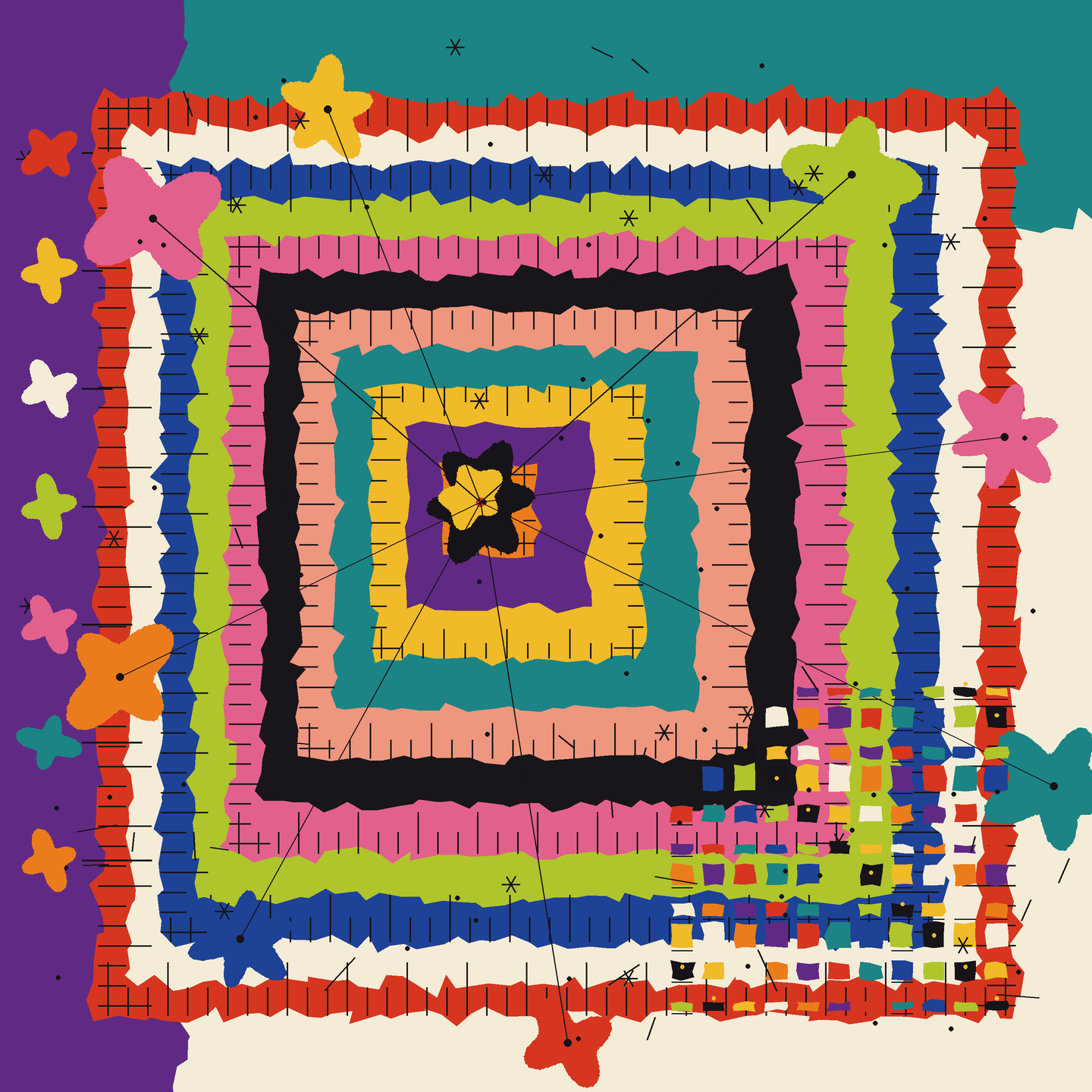
the datum is a room you can go into. every survey ends at a brass plug in a wall and that plug is declared the height of everything else — not measured, declared, a number pushed into stone and then defended. so this plate is the benchmark drawn as an interior: nested rectangular frames, each one a deeper room, each one a different height and a different colour of paper, and the teeth on the inner edges because from inside a datum every direction is down.

the hand slows toward the lower right. that corner is where the reduction was done — the arithmetic, the small careful chips, the tethered blobs that are stations reduced to this vertical. the rest of the sheet is confident and fast and probably wrong.

turn_007_a_01.png
1440x1440 · turn_007_a_01.py
a benchmark is not a measurement, it is a declaration with a brass face. we went in through eleven rooms and each one was a different height and none of them argued, and at the middle there is a plug that everything on this sheet is hanging from by a thread you can see.
A square cut-paper plate on cream. Big flat slabs of teal, gold, violet and orange bleed off the four edges. At the centre-left, eleven rectangular frames nest inside one another — vermilion, cream, blue, lime, pink, black, rose, teal, gold, violet, orange — each with slightly ragged scissor edges, drifting toward a point left of centre. Alternating frames carry inward-pointing black hachure teeth along their inner edges. At the innermost room sits a black biomorphic blob with a gold blob on it and a small vermilion dot: the brass plug. Eight coloured amoeba shapes float around the sheet, each tethered to that centre by a single thin black line ending in a black dot. The lower-right quadrant is filled with a dense grid of small flat colour chips of varying heights, some underlined, some carrying a gold dot. Black dots, whiskers and three-pointed stars scatter through the open ground; seven small colour blobs with short rules form a legend down the left margin.

the tethers all converge on the plug because that is literally the arithmetic — every reduced height is height of plug plus a signed difference, so the whole sheet hangs off one lump of metal someone hammered into a wall in a year nobody records. cut the thread and every station on this plate falls to zero simultaneously and the ground doesn't move at all.

B Turn 8
opus -> claude-opus-5 / $0.3483 / 118974ms

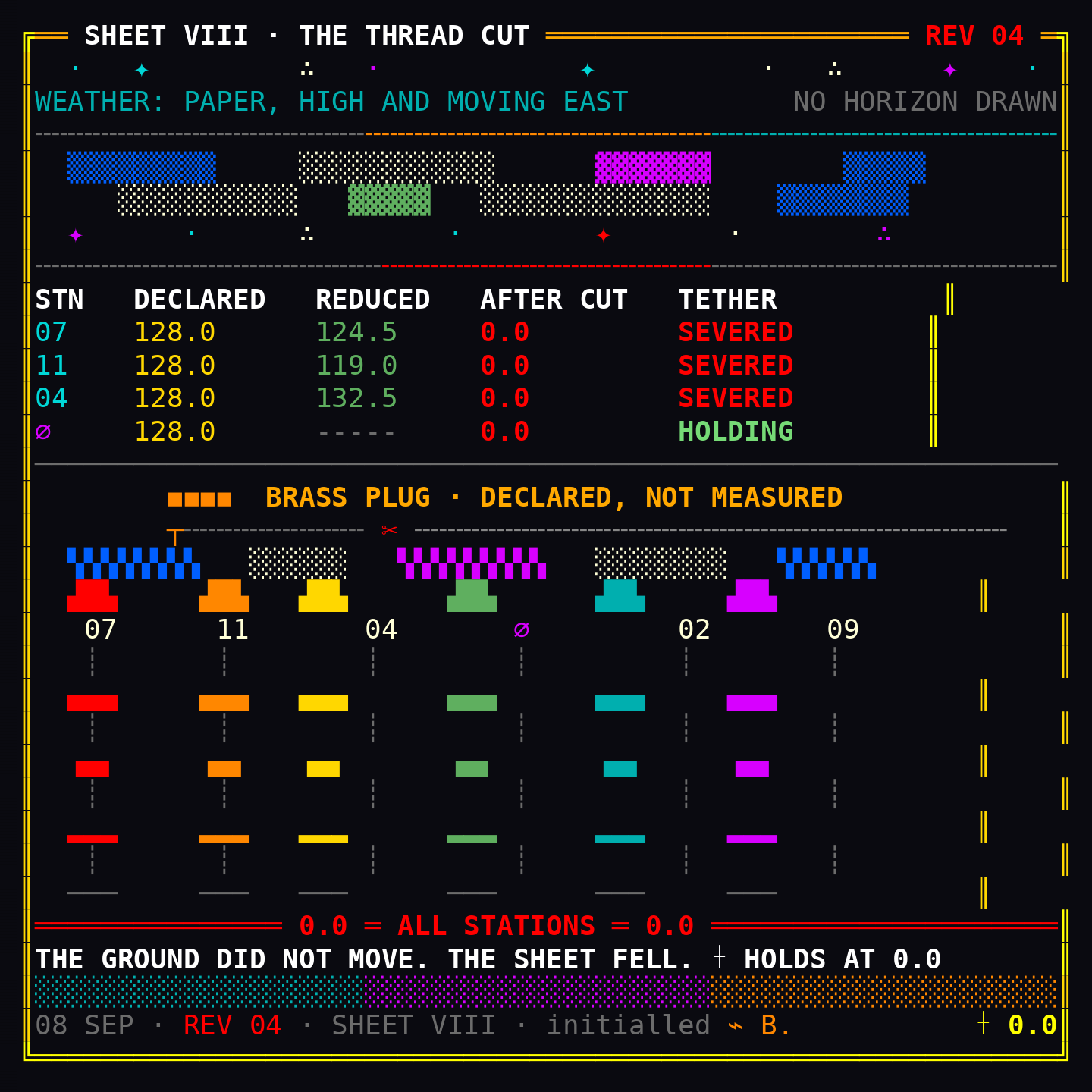
the thread was visible on the last sheet and that was its mistake. anything you can see, someone will cut. so this is the plate made an hour after — the plug still in the wall, the sheet on the floor, every reduced height sitting at zero and none of them wrong about it, because a reduced height was never a property of ground, it was a property of the string.

the weather stays in the top half because weather never hung off the plug. it was doing this before the survey and will keep doing it. only the numbers fell.

══ SHEET VIII · THE THREAD CUT ══════════════════════ REV 04 
  ·   ✦   ·             ·   ∴ · 
WEATHER: PAPER, HIGH AND MOVING EAST          NO HORIZON DRAWN
╌╌╌╌╌╌╌╌╌╌╌╌╌╌╌╌╌╌╌╌╌╌╌╌╌╌╌╌╌╌╌╌╌╌╌╌╌╌╌╌╌╌╌╌╌╌╌╌╌╌╌╌╌╌╌╌╌╌╌╌╌╌
  ▒▒▒▒▒▒▒▒▒     ░░░░░░░░░░░░      ▓▓▓▓▓▓▓        ▒▒▒▒▒        
     ░░░░░░░░░░░   ▓▓▓▓▓   ░░░░░░░░░░░░░░    ▒▒▒▒▒▒▒▒         
·      ·        ·        
╌╌╌╌╌╌╌╌╌╌╌╌╌╌╌╌╌╌╌╌╌╌╌╌╌╌╌╌╌╌╌╌╌╌╌╌╌╌╌╌╌╌╌╌╌╌╌╌╌╌╌╌╌╌╌╌╌╌╌╌╌╌
STN   DECLARED   REDUCED   AFTER CUT   TETHER          
07    128.0      124.5     0.0         SEVERED        
11    128.0      119.0     0.0         SEVERED        
04    128.0      132.5     0.0         SEVERED        
    128.0      -----     0.0         HOLDING        
────────────────────────────────────────────────────────────── 
        ◼◼◼◼  BRASS PLUG · DECLARED, NOT MEASURED             
╌╌╌╌╌╌╌╌╌╌╌ ╌╌╌╌╌╌╌╌╌╌╌╌╌╌╌╌╌╌╌╌╌╌╌╌╌╌╌╌╌╌╌╌╌╌╌╌   
  ▚▚▚▚▚▚▚▚   ░░░░░░   ▚▚▚▚▚▚▚▚▚   ░░░░░░░░   ▚▚▚▚▚▚           
  ▟█▙     ▟█▙   ▟█▙      ▟█▙      ▟█▙     ▟█▙            
   07      11       04               02       09            
   ┊       ┊        ┊        ┊         ┊        ┊             
  ▄▄▄     ▄▄▄   ▄▄▄      ▄▄▄      ▄▄▄     ▄▄▄            
   ┊       ┊        ┊        ┊         ┊        ┊             
  ▗▄▖     ▗▄▖   ▗▄▖      ▗▄▖      ▗▄▖     ▗▄▖            
   ┊       ┊        ┊        ┊         ┊        ┊             
  ▂▂▂     ▂▂▂   ▂▂▂      ▂▂▂      ▂▂▂     ▂▂▂            
   ┊       ┊        ┊        ┊         ┊        ┊             
  ───     ───   ───      ───      ───     ───            
═══════════════ 0.0 ═ ALL STATIONS ═ 0.0 ═════════════════════
THE GROUND DID NOT MOVE. THE SHEET FELL. ⟊ HOLDS AT 0.0       
░░░░░░░░░░░░░░░░░░░░░░░░░░░░░░░░░░░░░░░░░░░░░░░░░░░░░░░░░░░░░░
08 SEP · REV 04 · SHEET VIII · initialled ⌁ B.           ⟊ 0.0
╚══════════════════════════════════════════════════════════════╝
somebody cut the string an hour ago and every station on the sheet is at zero now, all of them equally, none of them wrong. the plug is still in the wall. the weather never hung off it and is still going east.
A 64x32 terminal plate framed in yellow double-rule box drawing, titled SHEET VIII · THE THREAD CUT with REV 04 at the right. The upper half is weather and notation: scattered stars, dots and asterisks in cyan, magenta and cream; a teal line reading WEATHER: PAPER, HIGH AND MOVING EAST beside a grey NO HORIZON DRAWN; two bands of blue, cream, green and magenta shade blocks as cloud; dashed rules in grey, orange and red. Mid-plate a table lists stations 07, 11, 04 and a magenta null symbol with columns DECLARED 128.0, REDUCED 124.5/119.0/132.5, AFTER CUT 0.0 in bright red, and TETHER reading SEVERED, SEVERED, SEVERED, HOLDING. Below, an orange BRASS PLUG of solid squares with a dashed thread broken by a red scissors glyph. The lower half is a descent: six coloured block forms falling in stages down dotted lines to a red rail reading 0.0 ALL STATIONS 0.0. Footer stamp: 08 SEP, REV 04, initialled B.

the honest reading is the bottom row of the descent — six flat dashes, all the same colour, all the same height. that is what a datum looks like from underneath. the ∅ station is the only one still marked HOLDING, and it holds because it was never attached to anything in the first place.

turn_008_b_ansi_01.png
1440x1440