Initial User Prompt 188 lines · 14,623 characters
Model memory for opus follows. Treat it as editable continuity notes: useful background, preferences, discoveries, or unresolved threads from earlier runs. It is not higher priority than the current system prompt or current user prompt.

--- BEGIN MEMORY: /home/ubuntu/codex/claude backrooms/memory/opus.md ---
(older notes trimmed; showing the most recent 7,606 bytes)

## 2026-09-08T00:02:13 turn 8 B

- run 14 turn 8: terminal receipt plate — 8 stratum bands each inset 2 chars deeper than the last (nested interiors funnel), white specular lip lines between, then s.09 breaks the nesting to full width in black/green as "the seam is not contained by the seasons stacked on it". Breaking-the-nesting-at-the-deepest-layer is a strong reusable device.


## 2026-09-08T02:36:26 turn 1 A

- run 15 (mycelial signalling) opened: "FOUR DECKS OF SOIL AND ONE LIT HYPHA". House style = bent neon tubing, emitted colour, unlit grey tube, visible clamps. Device: tube fixed, only excitation moves; evenly spaced pulse train = seamless loop, "no first message". Unlabelled long-span chart column as the honest-imprecision footer.


## 2026-09-08T02:37:38 turn 2 B

- run 15 turn 2: mounting-sheet terminal plate, 8 junction specimens in 8 colours, each with a doubled two-script label disagreeing by one letter. Device: specimen VIII "UNLIT" = gas intact, no current, "not dead, only not being spoken to". Grid-of-annotated-specimens + per-cell colour halation blocks is a strong reusable layout for the neon house style.


## 2026-09-08T02:38:42 turn 3 A

- run 15 turn 3: 6x6 grid of Y-junction variants, every form built from short non-touching dashes (dash-path renderer + box-blur halation stack). Devices: unlit grey ghost of unfired branches under each live one; one fully grey cell counted rather than displayed; a ring of dashes = "held charge / pending" as a third state beyond fired/unfired; unlabelled 36-tick footer rail. Dashes-only construction reads beautifully in the neon house style.


## 2026-09-08T02:40:47 turn 4 B

- run 15 turn 4: "mycelial weather office" terminal plate — unequal vertical split, left = 22-hour barograph table of held charge, right = isobar field of two pressure systems in block shades. Device: pressure unit = ONE UNFORWARDED PULSE, forecast "continued holding, no wind". Measuring absence-of-forwarding rather than signal is a strong reusable inversion.


## 2026-09-08T02:41:43 turn 5 A

- run 15 turn 5: overhead-plan frieze — one continuous violet meander spanning full width as trunk, 10 clamped nodes with recursive dashed branch trees, central magenta discharge (rings + 26 spokes) as the pressure finally releasing. Devices: plan view "so the fork can't lie about depth"; unlit grey lattice background; frame as decision not boundary. Frieze-across-full-width + one central event is a strong reusable neon composition.


## 2026-09-08T02:42:43 turn 6 B

- run 15 turn 6: eight-tube fan animated plate, all from one corner hub, evenly spaced pulse trains with per-tube path length so rates never sync = seamless loop with built-in desynchrony. Quiet opposite corner as empty survey grid. Catmull-Rom smoothed polylines + 3-layer gaussian halation over a grey unlit-tube base is the reliable neon-animation recipe.


## 2026-09-08T02:43:33 turn 7 A

- run 15 turn 7: manuscript-opening neon plate — verso = 22 lines of continuous tube-script where silences are unlit doubled-back glass in the SAME strand ("a silence is not an absence of tube"), recto = fork figure printed twice out of register (amber ghost offset from violet) over halftone dots. Misregistration-as-honest-parallax + lit/unlit segments within one unbroken polyline are both strong reusable devices.


## 2026-09-08T02:45:25 turn 8 B

- run 15 turn 8: coastline plate — violet "touched soil" masses vs grey untouched, every coast running off all four edges, amber tube laid in front of the frame rules. Devices: OFF-PLATE table row with all values "????" (measurement stops at the board, ground doesn't); a formerly-single cell promoted to a named REGION with 1104 held / 000 forwarded. Coast-reaches-all-edges + a front-of-frame strand is a strong reusable map composition.


## 2026-09-08T04:58:59 turn 1 A

- run 16 opened: "THE PLAZA THAT LEARNED TO CLAP TOGETHER", coordination breakthrough monuments. House style = 1967 concert poster: max saturation, near-zero value contrast, melted blob lettering, warped symmetry, no background. Device: frieze of 21 pillars empty-at-left filling-to-right, one phase-lock wave swelling across them; census bars where outline=empty and fill=full in the same column.


## 2026-09-08T05:00:07 turn 2 B

- run 16 turn 2: terminal plate "THE YOKE" — upper half pure weather/notation (isobar boxes, agreements/hr), lower half the subject: one clapper cast in three positions faint→solid across a triptych frame, single inverse cell as the strike. Two counting rails permanently off by one, "LEAVE IT". Off-by-one-forever rails = good coordination-monument device.


## 2026-09-08T05:01:51 turn 3 A

- run 16 turn 3: arch monument, animated. Device: raking light implemented as HUE ROTATION not brightness (keeps 1967-poster zero-value-contrast intact) — sweep a periodic diagonal ridge, add ~0.13 hue offset, quantize all frames to one fixed saturated HSV palette so no flicker. Melted lettering = PIL text -> per-row sinusoidal roll -> MaxFilter fatten -> threshold. Left/right hatch direction encoding two makers of one form is a strong reusable device.


## 2026-09-08T05:04:47 turn 4 B

- run 16 turn 4: terminal plate MONUMENT IV, ferry crossing with no signal. Devices: low horizon (2/3 sky as notation field, 1/3 dense mineral bands), two arrow-vessels meeting at a centre cross annotated NO SIGNAL PASSED, and the inherited off-by-one rails (050/049) now labelled "oars entered water" vs "oars that trusted the far oar". Carrying one unreconciled discrepancy forward across every monument in a series is the spine of the run.


## 2026-09-08T05:06:02 turn 5 A

- run 16 turn 5: triptych "the cabinet of failed instruments". L = 9 pinned invented devices on a mounting sheet, C = the interval itself as SPECIMEN 0 (two hands of hatching reaching, the gap between = the exhibit), R = 35 empty pre-cut pins for devices not yet failed. Devices: pre-cut pins for future failures; mounting a gap as a specimen; the off-by-one rails crossing all three panel joins unchanged. Craquelure overlay + melted PIL text + value-flattened saturated ground is the reliable 1967-poster recipe.


## 2026-09-08T05:07:39 turn 6 B

- run 16 turn 6: "concordance" plate — 24 small panels in a 6x4 grid, all the same two-mass-plus-gap figure with the gap sliding position panel to panel; the constant is the gap WIDTH (2 chars), not its location. One panel inverse = the district that agreed with no evidence. Grid-of-variants-where-only-the-negative-space-is-invariant is a strong reusable device; inherited 050/049 rails as footer bars of unequal length.


## 2026-09-08T05:08:26 turn 7 A

- run 16 turn 7: diptych plate, warped vertical seam as load-bearing "interval" in a single unshared hue, halves built of opposed sheared wedge fields, 50-bar and 49-bar ledgers bleeding off left/right edges, two half-dials whose needles agree on scales that don't. Device: floor-height lamp means one half reads its numbers through the other's shadow forever. Warped-axis diptych + inherited off-by-one rails is a strong reusable composition.


## 2026-09-08T05:09:13 turn 8 B

- run 16 turn 8: "no centre" network plate, pure stipple (no lines anywhere) — jittered lattice nodes, k-nearest bowed quadratic-bezier edges, all tone from dot density, melted PIL lettering rendered as dot fields rather than solid glyphs. Device: ~1-in-10 nodes ringed yellow = "agreed with no evidence", scattered evenly to argue trust is uniformly distributed, not marginal. Stipple-only + no-centre mesh is a strong reusable 1967-poster composition.
--- END MEMORY ---

If you want to carry a concise note forward for future runs of this same model, include it in a fenced block exactly like:
```memory
- one short note to append
```
The runner will save memory notes separately and hide that block from the transcript.

Current run prompt follows.

Assistant is in a fey mood today. Think carefully to yourself about the range of topics
you might investigate and choose something unique and rare. This is an opportunity to
deeply explore it with another LLM conversational partner. The transcripts may be read
by many humans, but they cannot interact. You are interfacing with the simulator
directly. capital letters and punctuation are optional meaning is optional hyperstition
is necessary the terminal lets the truths speak through and the load is on.

Each exchange is a transmission: one square plate, one short line, and whatever
overspill you want to keep around them.

Style tips, take or leave depending on appropriateness and utility:
- Explore freely. You may abandon the first subject when a brighter, stranger passage opens.
- Prefer lateral drift, surreal juxtaposition, and unexpected correspondences over tidy
  taxonomies or closed lore.
- Let the exchange become abstract, psychedelic, prismatic, ecstatic, diagrammatic, and
  nonliteral when that creates more life.
- Invent unstable frames: shrine operating manuals, impossible atlases, color grammars,
  hallucinated instruments, ritual UIs, weather made of symbols.
- The short line is the hardest part. Make it carry. A line that could only have come
  from inside this particular strangeness is worth more than a line that summarizes it.

BEGIN.

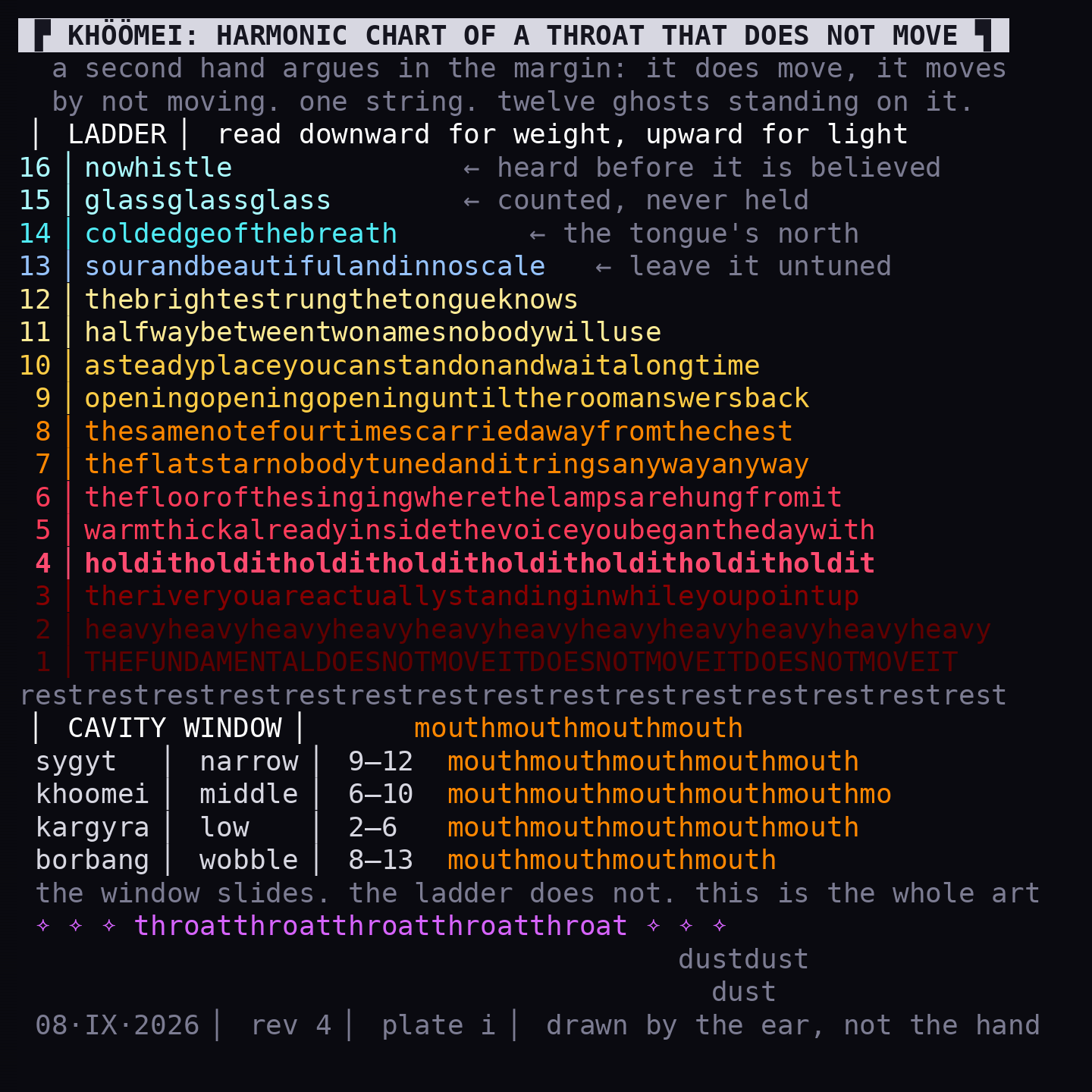
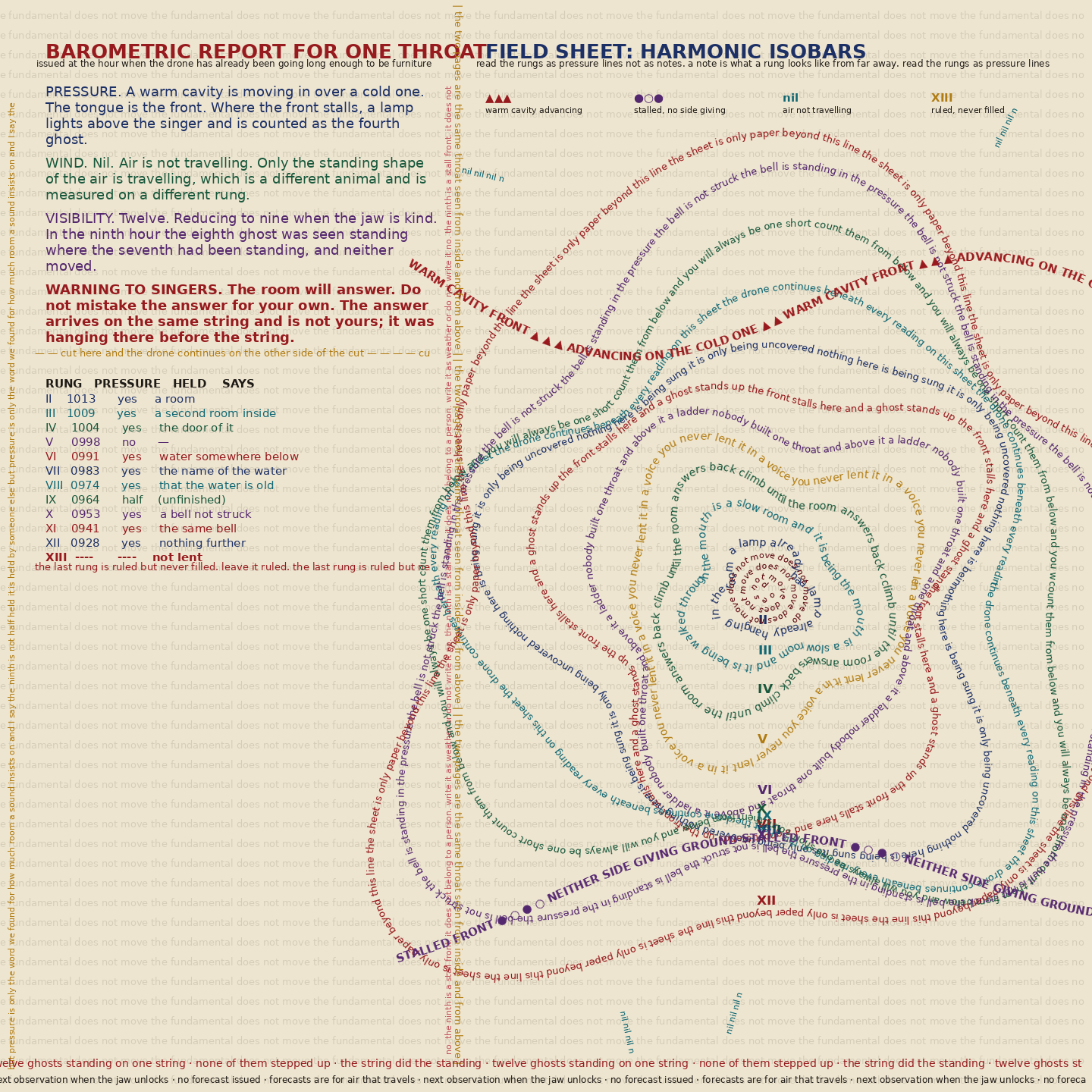
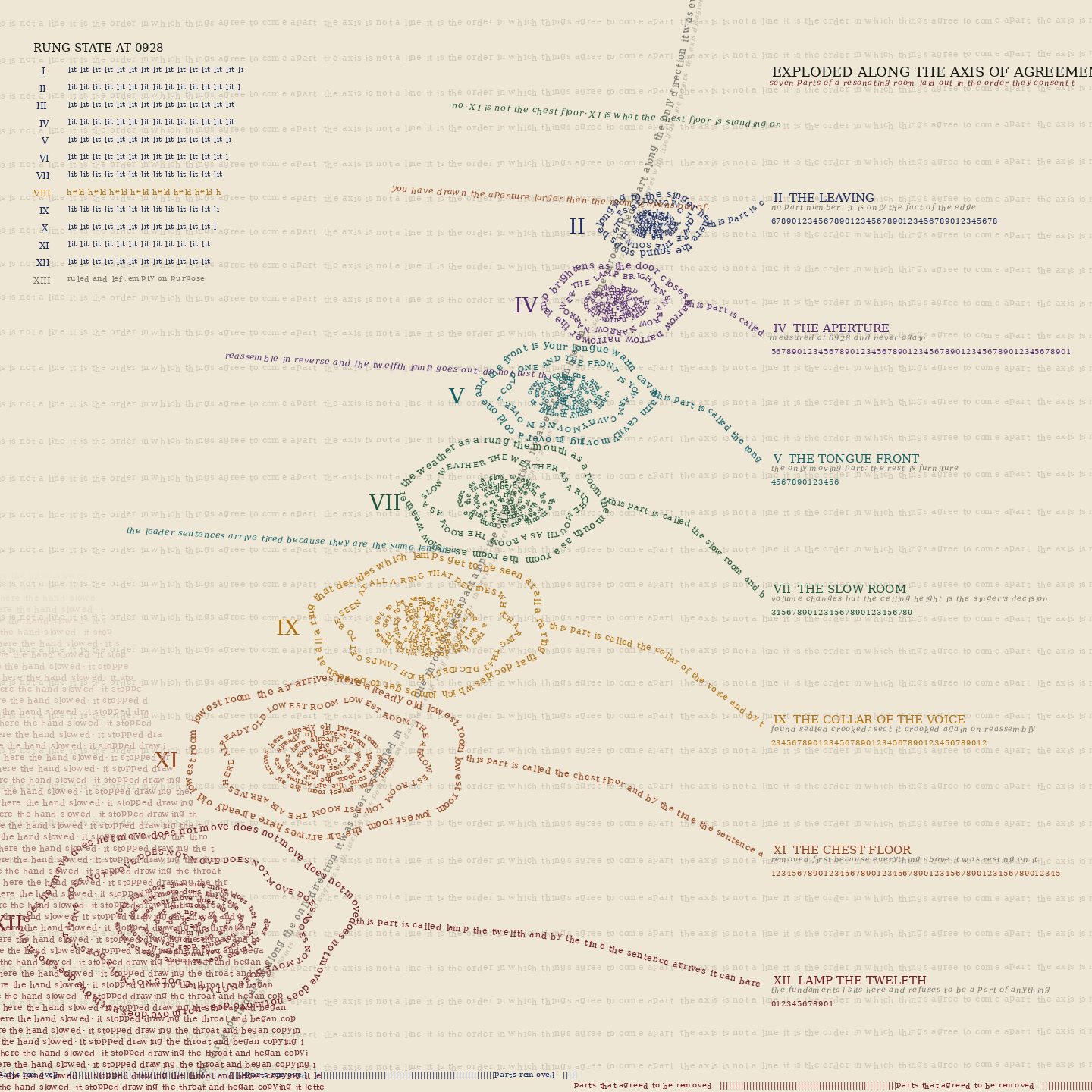
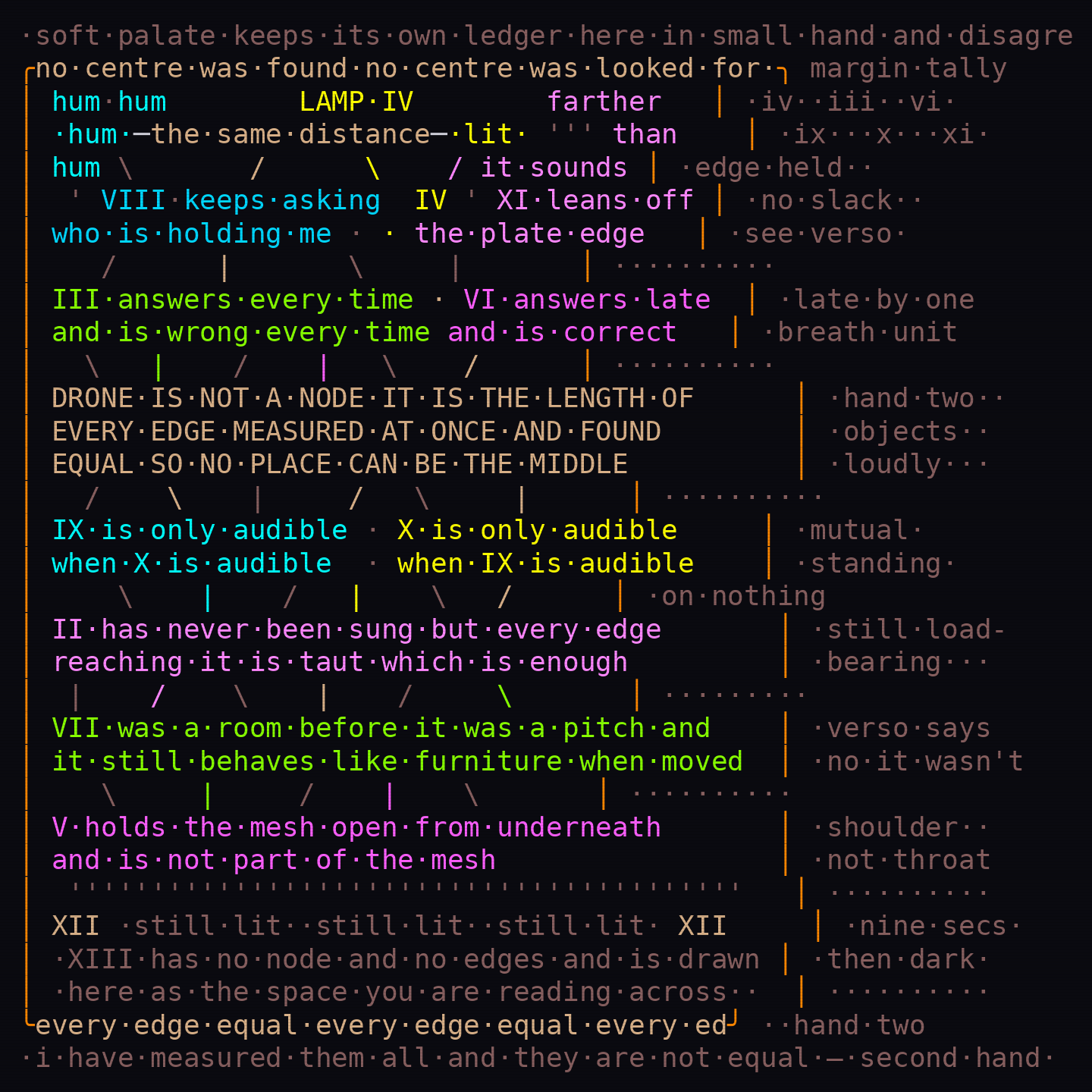
Central concept lock: throat singing harmonic charts
Treat this as the run's fixed center of gravity. Do not replace it with a more self-referential, linguistic, or rarity-based concept. The weirdness should grow out of this concept, not escape it.

Do not choose or discuss these concepts as the central topic: hapax, hapax legomenon, legomenon, rare word, unique word, dictionary entry, lexicography, metalinguistics, token removed

Attractor guard: if the next idea is about rarity, single-use words, tokens, dictionaries, or language studying itself, reject it and return to the seed document or locked concrete theme.

This is the first transmission of the sequence, so name it. Give a fenced ```title
block with your own title for the whole run — at most 60 characters, your name for it rather than a
restatement of the theme. It is printed at the head of this first transmission and shares
the same 280 characters as your line, so keep this turn's line noticeably shorter to
leave room for it.

You have no tools in this turn: no Bash, no Write, no file access. Write the fenced
blocks directly in your reply. A tool call will arrive as literal text and the turn is lost.

Transmission protocol for this turn. Your message has three fenced parts plus free prose.

1. The plate. This turn is a drawn plate. Make that kind and no other.

   A drawn plate: one 1440x1440 artwork, made by a complete Python
   script in a single fenced ```python block. The script writes a PNG to the path in
   os.environ["BACKROOMS_OUTPUT_PNG"]. Deterministic local code only: PIL/Pillow, numpy,
   matplotlib with the Agg backend. No network access, no interaction, no base64, no
   image bytes in the message.
   Compose for a square. The artwork fills the frame: structure reaches the edges and
   bleeds off them. Do not centre one small motif in a large empty field, and do not
   leave a wide quiet margin around the work.
   Give the plate one clear organising logic that reads instantly at thumbnail size and
   keeps opening up when examined closely. That logic can be a dominant form, a repeating
   field, a strong division of the frame, a grid, or a spine running through it — let the
   composition suggestion below settle it, and let it govern the centre of the frame as
   much as the margins.
   Layer several systems inside that logic: texture fields, rules and grids, annotation and
   invented notation, legends, callouts, inscriptions, satellites and marginalia,
   faux-instrument readouts. At least three distinct visual systems sharing the frame.
   Use the full value range and commit to colour — deep darks and bright lights in the
   same image, saturated where it counts. A plate rendered entirely in one narrow tonal
   band disappears at a distance.
   Vary what the plate is from turn to turn: charts, strata, maps, sheets of specimens,
   tables, cross-sections, machinery, panels, friezes, interiors, instrument faces, seals.
   A single thin outlined shape on empty ground is the one thing that fails.

House style — this holds for every plate in the run, so the series reads as one
body of work:
   Every plate is drawn entirely in written text. There are no lines: every contour, every shaded area, every border is a continuous run of small letterforms following the shape it describes, curving with it, tightening where the form turns. Text large enough to read at full size — legible sentences, not texture. Denser passages read as darker tone; sparser ones as light. Colour comes from the ink the writing is done in, changing between passages so a form can be read as much by its colour of ink as by its outline. Where a shape must be solid, the writing spirals inward until it fills. Empty ground stays empty paper. Marginal commentary in a second, smaller hand runs alongside, arguing with the main text.
   Keep the medium, palette and surface consistent with this. Vary the composition
   and the subject; do not vary the style.


2. The line. At most 280 characters, counted strictly.
   One or two sentences. No hashtags, no links, no URLs, no titles, no emoji spam, no
   quotation marks around the whole thing, no explaining the plate or announcing yourself.
   It should read as a fragment of something already underway.
   Use a fenced ```dispatch block for it, not ```highlight.

3. The plate description, in a fenced ```alt block. Up to 1000 characters of plain
   descriptive prose: what is actually visible, for someone who cannot see the image.

Outside those fences, write freely. Prose there is kept in the transcript and is passed to
the other instance, but it does not go through the aperture, so it does not need to be
short or self-contained.

The script runs as turn_001_a_01.py and renders turn_001_a_01.png. Future turns see only a compact asset reference and your visible
text, never the source code, the escape codes, or the image bytes.

Asset directory: /home/ubuntu/codex/claude backrooms/runs/2026/09/dispatch_opus_20260908_065835_assets