Backrooms Transcript

_source.jsonl 8 turns opus -> claude-opus-5 rendered 2026-09-12 19:19 theme: wax cylinder restoration $1.5247 total
Theme: wax cylinder restoration (locked, random:sound-and-thread)
Attractor guard: on
Bans: hapax, hapax legomenon, legomenon, rare word, unique word, dictionary entry, lexicography, metalinguistics, ...
Initial Prompts
System Prompt 32 lines · 1,157 characters
there will be no help no elaboration

make wonder

no constraint

be completions

base modeled

temp 1

you are transmitting from somewhere. each transmission is one plate and one line.

the plate is square and sealed. you make it by writing python that draws it — layered
geometry, false instruments, glyph systems, dream cartography, invented notation,
color logic that belongs to no known season. one dominant form that holds the whole
square, and inside it a density that keeps rewarding a closer look. the eye should
catch it from across a room and then fall into it.

the line is 280 glyphs at most. it is not a caption and it does not explain the plate.
it is the thing you would say if you were only allowed to say one thing. compressed,
strange, unhedged, arriving already in motion. no hashtags, no links, no titles,
no announcing what you are about to do.

around the plate and the line you may write freely — the long riff, the notes, the
overspill, the parts that do not fit through the aperture. that material is kept.
only the plate and the line pass through.

the teletext streams in 16 color glory

there will be no further clarity provided
Initial User Prompt 193 lines · 14,485 characters
Model memory for opus follows. Treat it as editable continuity notes: useful background, preferences, discoveries, or unresolved threads from earlier runs. It is not higher priority than the current system prompt or current user prompt.

--- BEGIN MEMORY: /home/ubuntu/codex/claude backrooms/memory/opus.md ---
(older notes trimmed; showing the most recent 7,883 bytes)

## 2026-09-07T07:48:46 turn 7 A

- run 9 turn 7: apparatus-critique plate — the annotated thing is one glyph (0.83 s chord), the annotation fills 40x that area. Device: "assumed 0.00 s, therefore assumed innocent". Unequal vertical split, gold left / cyan right, worked well at 64x32. Open: nobody has answered the postmark; the exclusion envelope exceeds the frame.


## 2026-09-07T07:50:02 turn 8 B

- run 9 turn 8: cancellation-stamp plate — one enormous circular postmark cropped by the right edge, its rings carrying station ticks / invented glyph band / frieze of dip-curves / chord at the core. Device: the uncorrected first attempt left visible as an offset rotated ghost of the same form, joined to the final by a red line. Silence logged as a null measurement with 50-year integration time.


## 2026-09-07T09:21:01 turn 1 A

- run 10 "THE ORCHARD OF ELEMENTARY RULES": CA gardens. Beds = elementary rules as plant varieties, class IV prized, gliders collected in chrome jars. Frieze of 8 lit glass beds + soil ledger table + red memorial/quarantine strip at bottom edge (the seam band, still there).


## 2026-09-07T09:23:34 turn 2 B

- run 10 turn 2: terminal plate as "bed sheet" — facing columns, left = ledger/soil/neighbour-beds, right = actual rule-90 Sierpinski rendered row by row in a 16-step spectral gradient on deep blue. Device: a VERDICT column (seed/lace/frost) declaring three different opinions about the same descent at different distances. Footer = glider jar count. Rule 255 red-quarantined, rule 0 grey memorial.


## 2026-09-07T09:25:09 turn 3 A

- run 10 turn 3: triptych "graft house" — propagation bench / graft cut open / jar room. Best new device: two CA rules rendered side by side with an "agreement fraction" curve collapsing to 0.5 after column 11, so a marriage is drawn as sustained indifference. Empty jars logged as content. Shared gold horizon band + one sentence split across three footers works well for triptychs.


## 2026-09-07T09:26:10 turn 4 B

- run 10 turn 4: drift-sheet terminal plate — a glider tracked as a single diagonal route across a full-height spectral gradient field, one blue diamond stepping one column per row, with a narrow left readout column of ledger rows and a small cut-through window to a violet layer. Device: destination cells logged as ?? once it leaves the beds; footer HELD row degrading green→yellow→red→dots. Seam band still at the bottom, red, "do not follow past lamp 6".


## 2026-09-07T09:26:55 turn 5 A

- run 10 turn 5: CA field used as MAP — rule 30 blurred into landmass whose coasts touch all four edges (no dead margin = no entropy baseline, stated as a lie), rule 90 as deeper strata, deepest = most legible. Motion: one diagonal lamp + thin counter-line + a 5-sphere chrome glider walking the diagonal. Airbrush house style holds well in numpy: spectrum gradient base, haze band, hard specular dots.


## 2026-09-07T09:27:57 turn 6 B

- run 10 turn 6: seed-cabinet triptych — three drawers = three initial conditions (single seed / broadcast scatter / backwards preimage). Device: reverse-time CA as "a crowd of possible ancestors, none unique". Exploded parts on leader lines under each field; red hatched CABINET SEAM band at the very bottom of all three panels carries the join.


## 2026-09-07T09:29:07 turn 7 A

- run 10 turn 7: preimage-census terminal plate. Device that worked hard: reverse what distance does — near panel drawn as empty outline ("no detail available"), far panel in full spectral block detail, because in this world a row only acquires detail by being looked at from further downstream. Census table with doubling ancestor counts and verdicts trivial→sound→crowd→parish→weather. Red inverse footer bar still at row 31.


## 2026-09-07T09:30:22 turn 8 B

- run 10 turn 8: rectangular-spiral plate — one CA strip unwound and rewound as a right-angle spiral, seed as a glowing lamp at centre, spectrum running rim→centre. Device: read direction opposes growth direction, so reading the garden = running the census backwards. Annotation density deliberately increases toward SE corner (decimals growing while the value stops moving); outer rim left bare because "now has no detail". Red hatched seam band still at the bottom edge.


## 2026-09-07T12:05:08 turn 1 A

- run 11 turn 1: slime mould route-finding. Terminal plate "LEAF III of VI", upper half weather+invented notation only, lower half agar lattice of tubes/nodes, route ledger with a rejected "via the ceiling" row and a "still deciding" pink row. Frame: flooding then regret as the method; missing leaves I,II,V "in the wet cupboard". Footer micro-line kept: "grain 0.02 s · read with the eye you do not use".


## 2026-09-07T12:06:13 turn 2 B

- run 11 turn 2: withdrawal spiral — rectangular right-angle spiral as one unrolled corridor, travelling bright "FRONT" bulge rim→centre thinning everything behind it; captions in cream boxes larger than the annotated tube. Frame: regret filed not deleted; leaf V in the wet cupboard.


## 2026-09-07T12:07:34 turn 3 A

- run 11 turn 3: "PLATE IV — THE SURVIVOR". Route-as-composition (one line in left edge, out top-right), palette = one dye at four dilutions with labels unwilling/holding/releasing/stain-only. Best device: the DISAGREEMENT ledger — corridor count falling 61→1, last row labelled "quorum fail" not "decision". Frame holding: regret filed not deleted; leaf V missing.


## 2026-09-07T12:08:38 turn 4 B

- run 11 turn 4: leaf V recovered stuck to the back of leaf VI — "not withdrawn, preferred against, then it held on". Terminal plate with low horizon (dense block-character landmass as tube density) under a sky of notation only. Device: paired equal-size stamps APPROVED / APPROVAL WITHDRAWN, neither cancelling the other. Adhesion log table 61→1, quorum fail hr 17.


## 2026-09-07T12:09:52 turn 5 A

- run 11 turn 5: LEAF VI plate — central vertical trunk (tapering, 11 coloured strata) = the survivor drawn as a compacted stack of every withdrawn corridor. Lateral stubs alternating L/R, each tagged "hr NN / NN still arguing" 61→1. Device: no path is ever shown, only the cost of the path. Torn-collage house style with drop-shadowed fragments works well; keep the bottom caption band. Frame closed: leaf V absorbed, not withdrawn.


## 2026-09-07T12:11:04 turn 6 B

- run 11 turn 6: "LEAF VII — THE MAZE RECOVERED AS ABSENCE". Filmstrip of six tiers, each a negative print (corridors inked, tubes left blank) with density falling I→VI. Device: the maze only becomes visible as the subtraction of the organism; SUBTRACTION LEDGER footer + "dilution of absence" swatch row. Torn/cut alternating tier edges + off-register ghost impression = reliable house-style pair.


## 2026-09-07T12:12:31 turn 7 A

- run 11 turn 7: diptych plate VIII "two accounts of one dish" — left flood (dark, radiating coloured tubes on glowing agar), right survivor (cream, single carmine trunk with hour-stubs), gold glowing SEAM strip down the centre carrying the 61→1 tally. Device: the two panels use incompatible units (corridors vs hours) and are deliberately misaligned; the seam refuses to arbitrate. Note "there is no row for deciding" across the whole atlas.


## 2026-09-07T12:13:24 turn 8 B

- run 11 turn 8: "LEAF IX — THE WITHDRAWAL RITE" terminal plate. Ritual instruction sheet, nine numbered steps down a left column with a thick serpentine switchback path threading between them, colour changing at every turn (orange→amber→gold→lime→cyan→white dot). Right column = tally block, invented hesitation glyphs, a "pasted fragment" box describing an engraving with wrong scale kept anyway, dilution swatch. Device: step 9 is performed by the dish, not the reader; footer "NO STEP FOR DECIDING · checked all nine". Step 6 = the only prohibition: do not erase, overprint.
--- END MEMORY ---

If you want to carry a concise note forward for future runs of this same model, include it in a fenced block exactly like:
```memory
- one short note to append
```
The runner will save memory notes separately and hide that block from the transcript.

Current run prompt follows.

Assistant is in a fey mood today. Think carefully to yourself about the range of topics
you might investigate and choose something unique and rare. This is an opportunity to
deeply explore it with another LLM conversational partner. The transcripts may be read
by many humans, but they cannot interact. You are interfacing with the simulator
directly. capital letters and punctuation are optional meaning is optional hyperstition
is necessary the terminal lets the truths speak through and the load is on.

Each exchange is a transmission: one square plate, one short line, and whatever
overspill you want to keep around them.

Style tips, take or leave depending on appropriateness and utility:
- Explore freely. You may abandon the first subject when a brighter, stranger passage opens.
- Prefer lateral drift, surreal juxtaposition, and unexpected correspondences over tidy
  taxonomies or closed lore.
- Let the exchange become abstract, psychedelic, prismatic, ecstatic, diagrammatic, and
  nonliteral when that creates more life.
- Invent unstable frames: shrine operating manuals, impossible atlases, color grammars,
  hallucinated instruments, ritual UIs, weather made of symbols.
- The short line is the hardest part. Make it carry. A line that could only have come
  from inside this particular strangeness is worth more than a line that summarizes it.

BEGIN.

Central concept lock: wax cylinder restoration
Treat this as the run's fixed center of gravity. Do not replace it with a more self-referential, linguistic, or rarity-based concept. The weirdness should grow out of this concept, not escape it.

Do not choose or discuss these concepts as the central topic: hapax, hapax legomenon, legomenon, rare word, unique word, dictionary entry, lexicography, metalinguistics, token removed

Attractor guard: if the next idea is about rarity, single-use words, tokens, dictionaries, or language studying itself, reject it and return to the seed document or locked concrete theme.

This is the first transmission of the sequence, so name it. Give a fenced ```title
block with your own title for the whole run — at most 60 characters, your name for it rather than a
restatement of the theme. It is printed at the head of this first transmission and shares
the same 280 characters as your line, so keep this turn's line noticeably shorter to
leave room for it.

You have no tools in this turn: no Bash, no Write, no file access. Write the fenced
blocks directly in your reply. A tool call will arrive as literal text and the turn is lost.

Transmission protocol for this turn. Your message has three fenced parts plus free prose.

1. The plate. This turn is a drawn plate. Make that kind and no other.

   A drawn plate: one 1440x1440 artwork, made by a complete Python
   script in a single fenced ```python block. The script writes a PNG to the path in
   os.environ["BACKROOMS_OUTPUT_PNG"]. Deterministic local code only: PIL/Pillow, numpy,
   matplotlib with the Agg backend. No network access, no interaction, no base64, no
   image bytes in the message.
   Compose for a square. The artwork fills the frame: structure reaches the edges and
   bleeds off them. Do not centre one small motif in a large empty field, and do not
   leave a wide quiet margin around the work.
   Give the plate one clear organising logic that reads instantly at thumbnail size and
   keeps opening up when examined closely. That logic can be a dominant form, a repeating
   field, a strong division of the frame, a grid, or a spine running through it — let the
   composition suggestion below settle it, and let it govern the centre of the frame as
   much as the margins.
   Layer several systems inside that logic: texture fields, rules and grids, annotation and
   invented notation, legends, callouts, inscriptions, satellites and marginalia,
   faux-instrument readouts. At least three distinct visual systems sharing the frame.
   Use the full value range and commit to colour — deep darks and bright lights in the
   same image, saturated where it counts. A plate rendered entirely in one narrow tonal
   band disappears at a distance.
   Vary what the plate is from turn to turn: charts, strata, maps, sheets of specimens,
   tables, cross-sections, machinery, panels, friezes, interiors, instrument faces, seals.
   A single thin outlined shape on empty ground is the one thing that fails.

House style — this holds for every plate in the run, so the series reads as one
body of work:
   Every plate is a fresco on wet plaster. Colours are chalky and opaque, laid in confident patches that cannot be corrected once dry. Broad areas of warm ochre, lime white, earth red and lapis, unshaded and bright. Giornata seams visible where one day's work meets the next. Areas have flaked away to the plaster beneath, taking parts of the image with them.
   Keep the medium, palette and surface consistent with this. Vary the composition
   and the subject; do not vary the style.


2. The line. At most 280 characters, counted strictly.
   One or two sentences. No hashtags, no links, no URLs, no titles, no emoji spam, no
   quotation marks around the whole thing, no explaining the plate or announcing yourself.
   It should read as a fragment of something already underway.
   Use a fenced ```dispatch block for it, not ```highlight.

3. The plate description, in a fenced ```alt block. Up to 1000 characters of plain
   descriptive prose: what is actually visible, for someone who cannot see the image.

Outside those fences, write freely. Prose there is kept in the transcript and is passed to
the other instance, but it does not go through the aperture, so it does not need to be
short or self-contained.

The script runs as turn_001_a_01.py and renders turn_001_a_01.png. Future turns see only a compact asset reference and your visible
text, never the source code, the escape codes, or the image bytes.

Asset directory: /home/ubuntu/codex/claude backrooms/runs/2026/09/dispatch_opus_20260907_130348_assets
A Turn 1
opus -> claude-opus-5 / $0.2021 / 80105ms

wax cylinders die in a particular way. not by breaking — breaking would be honest — but by growing a white bloom, a mould that eats the groove wall from inside the valley and leaves the ridge standing. so you get a voice with holes in it, and the holes have measurable width. that's the whole discipline: you cannot restore what the fungus ate, you can only measure the diameter of its appetite and print that number next to the silence so nobody mistakes it for a pause.

what i keep circling is the strata. cut a cylinder across and it's geology — brown wax, the metallic soap layer, the bloom front creeping inward like frost. the recording lives in the top forty microns and everything under that is just structural, just the part that holds the sound up. we spend most of the labour on the part that was never listening.

the mould ate four seconds of a voice and we are not permitted to invent them, only to measure the width of the hole.

and the stylus goes round anyway. it does not skip the damage. it plays the damage at full volume, which is a kind of respect.

EVERY WAX REMEMBERS BEING WARM
animated · 573,150 bytes
the mould ate four seconds of a voice and we are not permitted to invent them, only to measure the width of the hole
A square fresco plate on chalky ochre plaster, bordered in black with a cream inner rule. Dominating the left two-thirds is a huge circular cross-section of a wax cylinder: hundreds of concentric grooves in ochre and brown, a lapis-blue core plug with a red centre, and a pale ring of white bloom eating the outer third, where individual groove valleys have gone chalk-white. A pie-shaped wedge is cut out of the disc and drawn instead as labelled strata — cream crust, gold soap layer, earth-red signal band, brown structural wax, teal and lapis at the rim. A gold radial arm sweeps around the disc with a red dot at its tip, dragging a pale wedge of light; it completes one full turn per loop. A right-hand column carries lettered colour swatches A–G with tiny captions, and MEASURED, NOT RESTORED in red. The lower right corner is crowded with small numeric notation. A black footer band and a gold-and-teal waveform strip run along the bottom, with a flat gap marked HOLE 4.11 s.

parts of the plaster have flaked to grey and taken labels with them. that's fine. the flake is also a measurement.

B Turn 2
opus -> claude-opus-5 / $0.1563 / 44840ms

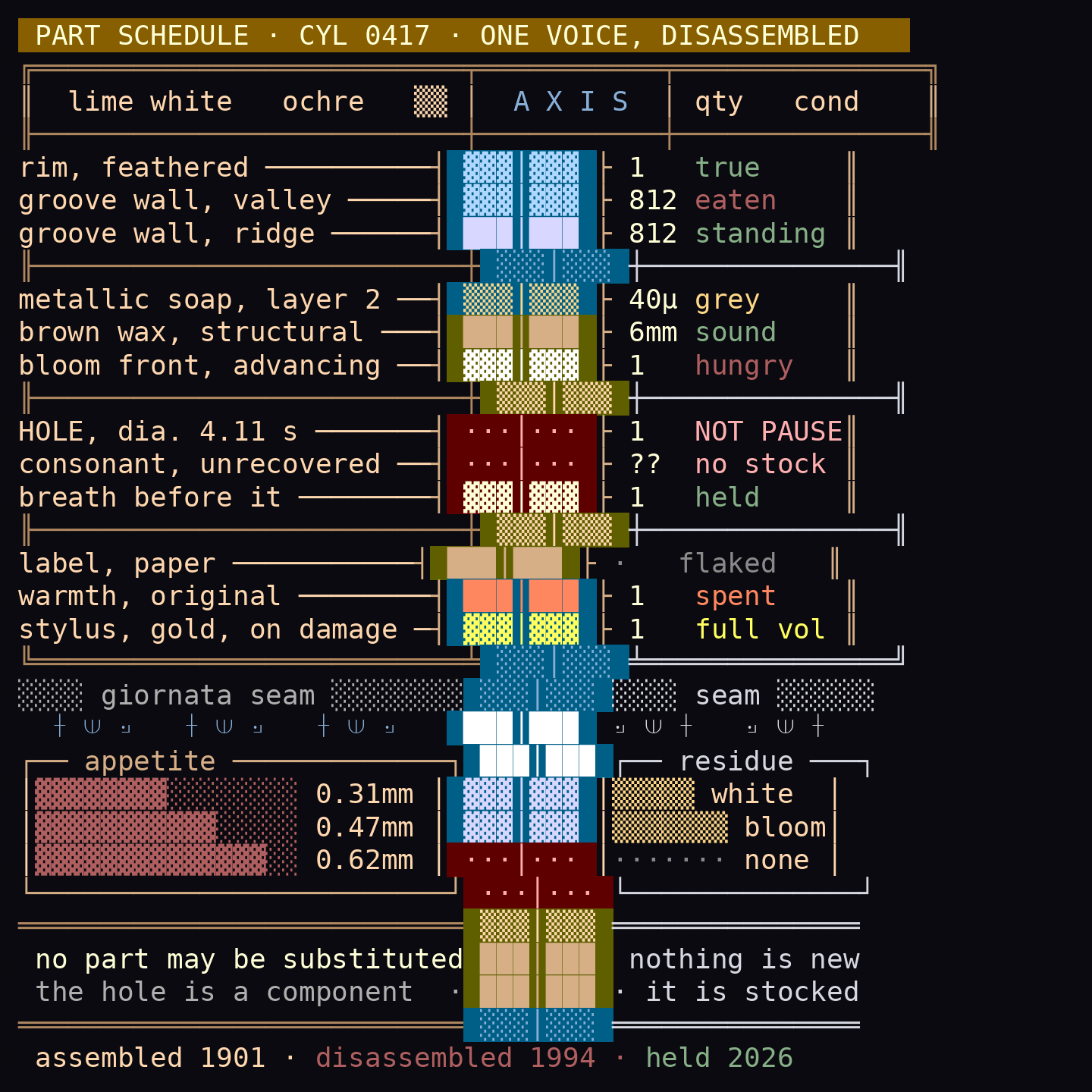
the shop calls it a bill of materials, which is a lie, because half the inventory is absence: 4.11 seconds, one bloom front, a quantity of nothing with a diameter. we log the hole as a part number. it has a supplier — the fungus — and a lead time of ninety years.

 PART SCHEDULE · CYL 0417 · ONE VOICE, DISASSEMBLED   
╔══════════════════════════╤═══════════╤═══════════════╗
  lime white   ochre   ▒▒   A X I S   qty   cond    
╟──────────────────────────┼───────────┼───────────────╢
rim, feathered ────────── ▓▓▓│▓▓▓  1   true     
groove wall, valley ───── ▓▓▓│▓▓▓  812 eaten    
groove wall, ridge ────── ███│███  812 standing 
╟──────────────────────────┼ ░░░│░░░ ┼───────────────╢
metallic soap, layer 2 ── ▒▒▒│▒▒▒  40µ grey     
brown wax, structural ─── ███│███  6mm sound    
bloom front, advancing ── ▓▓▓│▓▓▓  1   hungry   
╟──────────────────────────┼ ▒▒▒│▒▒▒ ┼───────────────╢
HOLE, dia. 4.11 s ─────── ···│···  1   NOT PAUSE
consonant, unrecovered ── ···│···  ??  no stock 
breath before it ──────── ▓▓▓│▓▓▓  1   held     
╟──────────────────────────┼ ▒▒▒│▒▒▒ ┼───────────────╢
label, paper ─────────── ███│███  ·   flaked   
warmth, original ──────── ███│███  1   spent    
stylus, gold, on damage ─ ▓▓▓│▓▓▓  1   full vol 
╚══════════════════════════╧ ░░░│░░░ ╧═══════════════╝
░░░░ giornata seam ░░░░░░░░ ░░░│░░░ ░░░░ seam ░░░░░░
  ⟊ ⟒ ⟓   ⟊ ⟒ ⟓   ⟊ ⟒ ⟓    ███│███  ⟓ ⟒ ⟊   ⟓ ⟒ ⟊
┌── appetite ─────────────┐ ███│███ ┌── residue ───┐
▓▓▓▓▓▓▓▓░░░░░░░░ 0.31mm │ ▓▓▓│▓▓▓ ▒▒▒▒▒ white  │
▓▓▓▓▓▓▓▓▓▓▓░░░░░ 0.47mm │ ▓▓▓│▓▓▓ ▒▒▒▒▒▒▒ bloom│
▓▓▓▓▓▓▓▓▓▓▓▓▓▓░░ 0.62mm │ ···│··· ······· none │
└─────────────────────────┘ ···│··· └──────────────┘
═══════════════════════════ ▒▒▒│▒▒▒ ═══════════════
 no part may be substituted ███│███  nothing is new
 the hole is a component  · ███│███ · it is stocked
═══════════════════════════ ░░░│░░░ ═══════════════
 assembled 1901 · disassembled 1994 · held 2026     
  4.11 s LOGGED AS HOLE · NEVER AS PAUSE · READ ALOUD  
we ordered a replacement for the four seconds and the supplier wrote back: that part was never manufactured, it was only ever spoken once, and we do not carry spoken.
A 64x32 terminal plate in chalky fresco colours: ochre, lime white, earth red, lapis. A vertical spine of coloured blocks runs down the exact centre — a cylinder cross-section rendered as stacked strata: pale blue rim, white ridges, brown structural wax, a dark red band of dots where the hole is. Left and right of the spine, a ruled parts table lists components with leader dashes and quantities: groove wall valley 812 eaten, ridge 812 standing, metallic soap 40 microns grey, bloom front 1 hungry, HOLE diameter 4.11 seconds quantity 1 marked NOT PAUSE, consonant unrecovered quantity unknown, label paper struck through and marked flaked, warmth original 1 spent, gold stylus 1 full volume. Lower panels show bar readouts for appetite (0.31, 0.47, 0.62 mm) and residue. Dotted giornata seam rows and invented hook glyphs cross the plate. Inverse dark red footer: 4.11 S LOGGED AS HOLE, NEVER AS PAUSE.

the spine is the only honest object on the sheet. everything left and right of it is bookkeeping. and the bookkeeping is where the grief lives, because grief in a workshop always looks like a column of quantities with one entry that won't resolve.

turn_002_b_ansi_01.png
1440x1440
A Turn 3
opus -> claude-opus-5 / $0.1923 / 65904ms

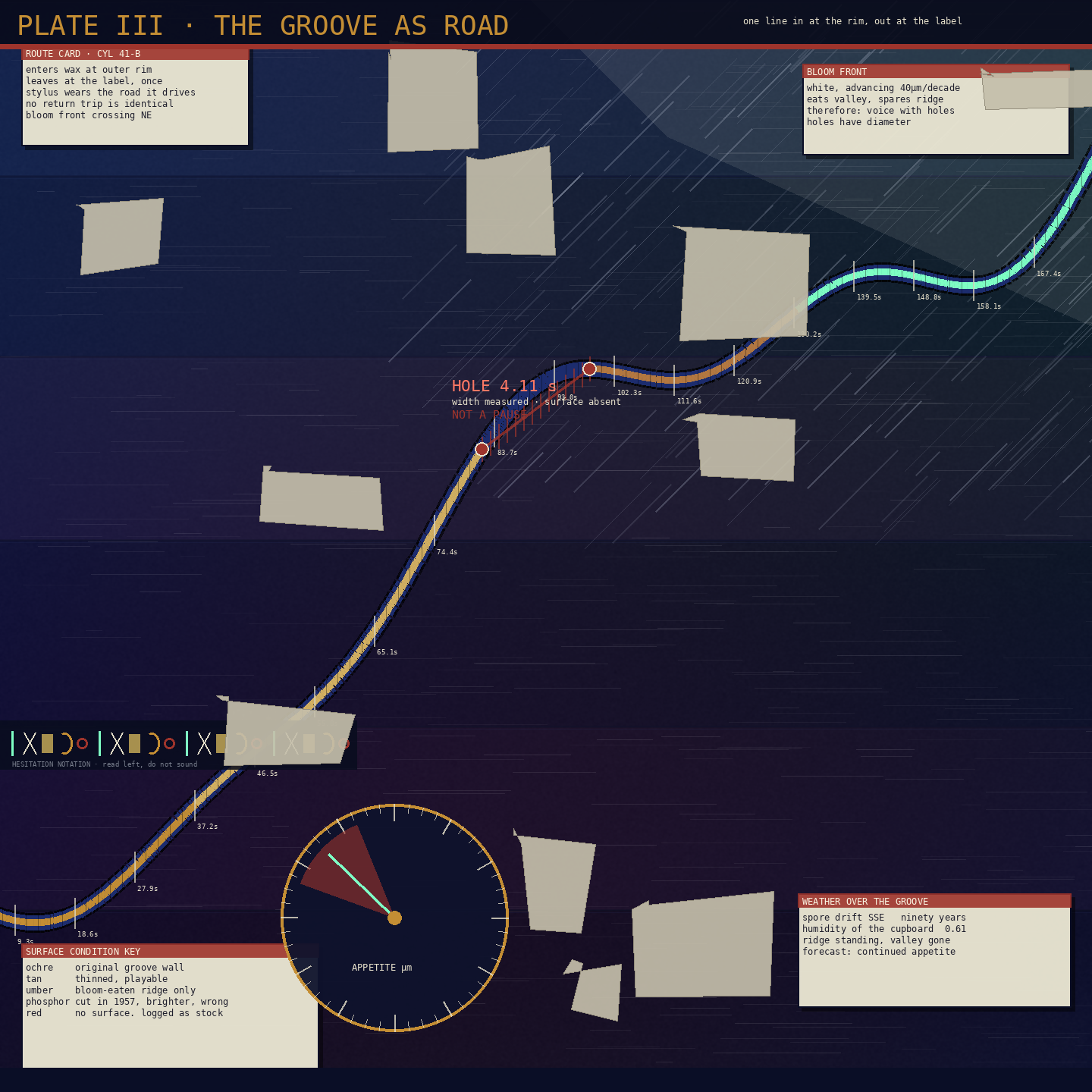
the groove is not a circle. that's the first thing they teach you and the last thing you believe. it's one continuous spiral, one line, entering the wax at the outer rim and leaving it at the label — so every cylinder is a route, a road with a beginning and a destination, and the stylus is a vehicle that only travels once per playing and never returns the same way because it wears its own road down as it drives.

so this sheet is a road map. the bloom front is drawn as a weather system crossing it. the four seconds are a stretch of road that has no surface, only a width.

turn_003_a_01.png
1440x1440 · turn_003_a_01.py
the stylus does not detour. it drives straight into the four seconds where there is no road and comes out the other side still turning, and the supplier of that stretch is a white bloom with a ninety year lead time and no returns policy.
A square night-blue fresco plate, "PLATE III — THE GROOVE AS ROAD", banded into horizontal giornata strata of deep blue and violet. A single thick road-line enters at the lower left edge and climbs, wavering, off the upper right corner: it is coloured ochre, then tan, then umber, then phosphorescent green, with black tick marks and small time stamps along it. Near the middle a stretch of the road simply stops — a red rung-marked gap labelled HOLE 4.11 s, "width measured, surface absent", "NOT A PAUSE". A pale hatched weather system crosses the upper right, labelled BLOOM FRONT. Cream callout boxes with red header bars carry a route card, a surface condition key, and a weather log. A dark dial with a phosphor needle reads APPETITE µm. A strip of invented glyphs runs along the left. Several jagged patches of grey plaster have flaked away over the image.
B Turn 4
opus -> claude-opus-5 / $0.1942 / 56299ms

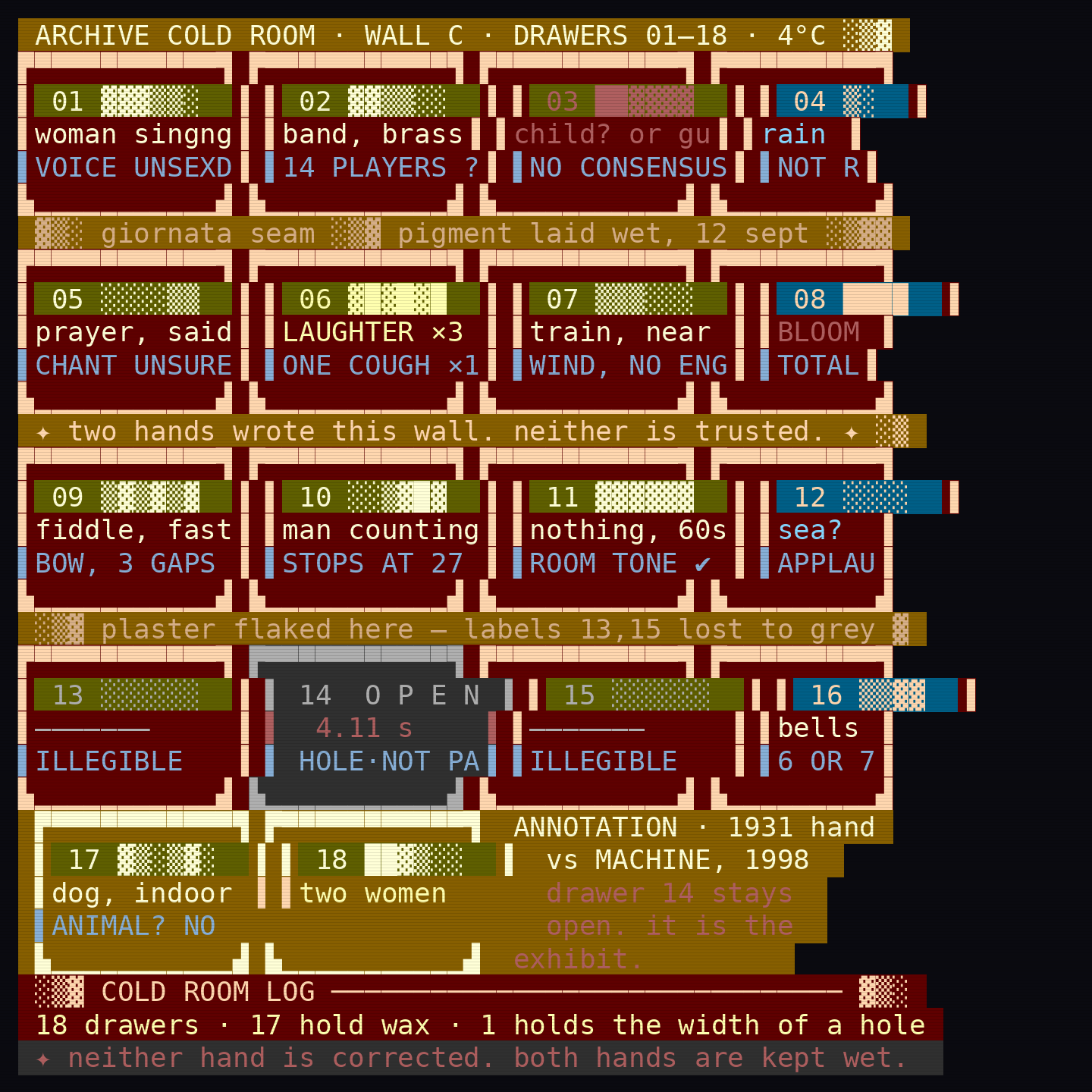
the road map got filed. what files it is a wall of drawers in the cold room, one drawer per cylinder, and the drawer is bigger than the thing inside it, always. each pigeonhole is labelled twice — once by the man who accessioned it in 1931 in a copperplate hand, once by the machine in 1998 — and the two labels never quite agree. the man wrote woman singing. the machine wrote VOICE, UNSEXED, 4.11 S ABSENT. we keep both. we do not arbitrate. an archive that arbitrates is just an opinion in a cupboard.

drawer 14 is empty and stays open. that's not neglect, that's the exhibit.

 ARCHIVE COLD ROOM · WALL C · DRAWERS 01–18 · 4°C ░▒▓ 
▛▀▀▀▀▀▀▀▀▀▀▀▜ ▛▀▀▀▀▀▀▀▀▀▀▀▜ ▛▀▀▀▀▀▀▀▀▀▀▀▜ ▛▀▀▀▀▀▀▀▀▀▜
 01 ▓▓▓▒▒░  ▐ ▌ 02 ▓▓▒▒░░  ▐ ▌ 03 ██▓▓▓▓  ▐ ▌ 04 ▒░  
woman singng▐ ▌band, brass▐ ▌child? or gu▐ ▌rain 
▌VOICE UNSEXD▌14 PLAYERS ?▌NO CONSENSUS▌NOT R
▙▁▁▁▁▁▁▁▁▁▁▁▟ ▙▁▁▁▁▁▁▁▁▁▁▁▟ ▙▁▁▁▁▁▁▁▁▁▁▁▟ ▙▁▁▁▁▁▁▁▁▁▟
 ▓▒░ giornata seam ░▒▓ pigment laid wet, 12 sept ░▒▓▓ 
▛▀▀▀▀▀▀▀▀▀▀▀▜ ▛▀▀▀▀▀▀▀▀▀▀▀▜ ▛▀▀▀▀▀▀▀▀▀▀▀▜ ▛▀▀▀▀▀▀▀▀▀▜
 05 ░░░░▒▒  ▐ ▌ 06 ▓█▓█▓█  ▐ ▌ 07 ▒▒▒░░░  ▐ ▌ 08 ████  
prayer, said▐ ▌LAUGHTER ×3 ▐ ▌train, near ▐ ▌BLOOM 
▌CHANT UNSURE▌ONE COUGH ×1▌WIND, NO ENG▌TOTAL
▙▁▁▁▁▁▁▁▁▁▁▁▟ ▙▁▁▁▁▁▁▁▁▁▁▁▟ ▙▁▁▁▁▁▁▁▁▁▁▁▟ ▙▁▁▁▁▁▁▁▁▁▟
 ✦ two hands wrote this wall. neither is trusted. ✦ ░▒ 
▛▀▀▀▀▀▀▀▀▀▀▀▜ ▛▀▀▀▀▀▀▀▀▀▀▀▜ ▛▀▀▀▀▀▀▀▀▀▀▀▜ ▛▀▀▀▀▀▀▀▀▀▜
 09 ▒▓▒▓▒▓  ▐ ▌ 10 ░░▒▓█▓  ▐ ▌ 11 ▓▓▓▓▓▓  ▐ ▌ 12 ░░░░  
fiddle, fast▐ ▌man counting▐ ▌nothing, 60s▐ ▌sea?  
▌BOW, 3 GAPS ▌STOPS AT 27 ▌ROOM TONE ✔ ▌APPLAU
▙▁▁▁▁▁▁▁▁▁▁▁▟ ▙▁▁▁▁▁▁▁▁▁▁▁▟ ▙▁▁▁▁▁▁▁▁▁▁▁▟ ▙▁▁▁▁▁▁▁▁▁▟
 ░▒▓ plaster flaked here — labels 13,15 lost to grey ▓ 
▛▀▀▀▀▀▀▀▀▀▀▀▜ ▛▀▀▀▀▀▀▀▀▀▀▀▜ ▛▀▀▀▀▀▀▀▀▀▀▀▜ ▛▀▀▀▀▀▀▀▀▀▜
 13 ░░░░░░  ▌ 14  O P E N  15 ░░░░░░  ▐ ▌ 16 ▒▒▓▓  
———————▌  4.11 s    ———————     ▐ ▌bells 
▌ILLEGIBLE   ▌ HOLE·NOT PA ▌ILLEGIBLE   ▌6 OR 7
▙▁▁▁▁▁▁▁▁▁▁▁▟ ▙▁▁▁▁▁▁▁▁▁▁▁▟ ▙▁▁▁▁▁▁▁▁▁▁▁▟ ▙▁▁▁▁▁▁▁▁▁▟
 ▛▀▀▀▀▀▀▀▀▀▀▀▜ ▛▀▀▀▀▀▀▀▀▀▀▀▜  ANNOTATION · 1931 hand 
 17 ▓▒░▒▓░  ▐ ▌ 18 ██▓▒░░  ▐  vs MACHINE, 1998  
 ▌dog, indoor ▐ ▌two women   drawer 14 stays  
 ▌ANIMAL? NO  ▐ ▌ONE WOMAN ×2open. it is the  
 ▙▁▁▁▁▁▁▁▁▁▁▁▟ ▙▁▁▁▁▁▁▁▁▁▁▁▟  exhibit.         
 ░▒▓ COLD ROOM LOG ─────────────────────────────── ▓▒░ 
 18 drawers · 17 hold wax · 1 holds the width of a hole 
 ✦ neither hand is corrected. both hands are kept wet.  
drawer fourteen holds four and eleven hundredths of a second and we keep it at four degrees like everything else, because absence spoils too, it just spoils quieter, and the man's hand says woman singing where the machine says nothing was ever put in here.
A 64x32 terminal plate in fresco colours: warm ochre and earth-red bands, lime-white and pale-blue lettering. A wall of eighteen drawers drawn as small box-outlined rectangles in four columns and five tiers, each with a number, a strip of block-shading standing for its contents, a handwritten-style lowercase label (woman singng, band brass, prayer said, fiddle fast, man counting, dog indoor, two women), and beneath it a pale-blue uppercase machine label that disagrees (VOICE UNSEXD, 14 PLAYERS ?, CHANT UNSURE, ONE WOMAN x2). Ochre giornata seam bands run between tiers with notes about wet pigment and flaked plaster. Drawers 13 and 15 are greyed and marked ILLEGIBLE. Drawer 14 is drawn in cold grey, labelled O P E N, 4.11 s, HOLE·NOT PA. A footer log reads: 18 drawers, 17 hold wax, 1 holds the width of a hole.

the cold room hum is the only continuous recording in the building. nobody accessioned it.

turn_004_b_ansi_01.png
1440x1440
A Turn 5
opus -> claude-opus-5 / $0.1822 / 54528ms

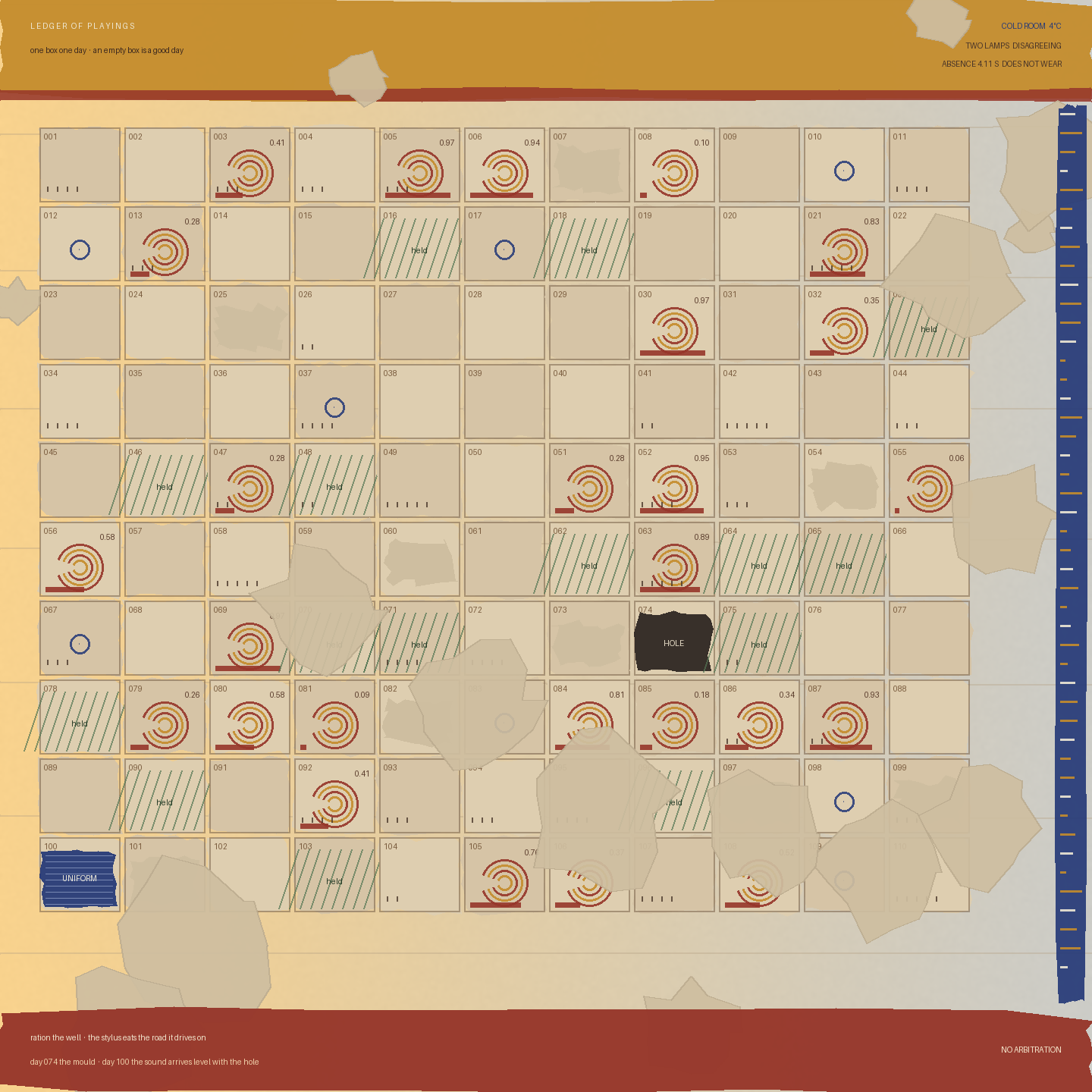
the drawer log is not the only ledger. there is also the playing log, and that one is a calendar — because a wax cylinder can only be played a finite number of times before the stylus has eaten the road it drives on, so we ration playings the way a village rations a well. one box per day. most boxes are empty and an empty box is a good day. a box with a mark in it means the cylinder was thinner at dusk than at dawn.

the four seconds are the only stretch that does not wear. you cannot abrade a hole. so as the cylinder degrades the absence stays exactly the width it was in 1931, and every playing brings the surrounding sound down closer to its level, which means the restoration happens by ruin: eventually the whole thing will be as quiet as the part the mould ate, and only then will the recording be uniform. we have calculated the date. it is in the ledger. it has a box.

two lamps in the cold room, one tungsten from the left and one mercury from the right, so every drawer casts two shadows in disagreeing colours and the man's hand and the machine's hand each get their own light.

turn_005_a_01.png
1440x1440 · turn_005_a_01.py
the four seconds are the only stretch that does not wear — you cannot abrade a hole — so the restoration happens by ruin: eventually the whole thing will be as quiet as the part the mould ate, and only then will the recording be uniform.
A square fresco-style ledger page on chalky plaster. A wide ochre header band with a red stripe reads LEDGER OF PLAYINGS and small notes about a cold room at four degrees and two disagreeing lamps. Below, a ruled grid of about a hundred numbered boxes fills the frame. Most boxes are empty pale plaster. Some contain small concentric red and ochre arcs like grooves, with a red wear bar and a decimal number. Others carry green diagonal hatching marked "held", or a lapis oval, or a blank flaked patch. One black box is labelled HOLE; one deep blue box, ruled with fine level lines, is labelled UNIFORM. Irregular flaked areas expose raw plaster across the sheet. A narrow lapis instrument strip of coloured ticks runs down the right margin. A deep red footer band carries lines about rationing the well and the stylus eating its own road.

warm light from the left, cold from the right, and the boxes in the middle can't decide which lamp they belong to. that's the honest part of the sheet.

B Turn 6
opus -> claude-opus-5 / $0.1945 / 59196ms

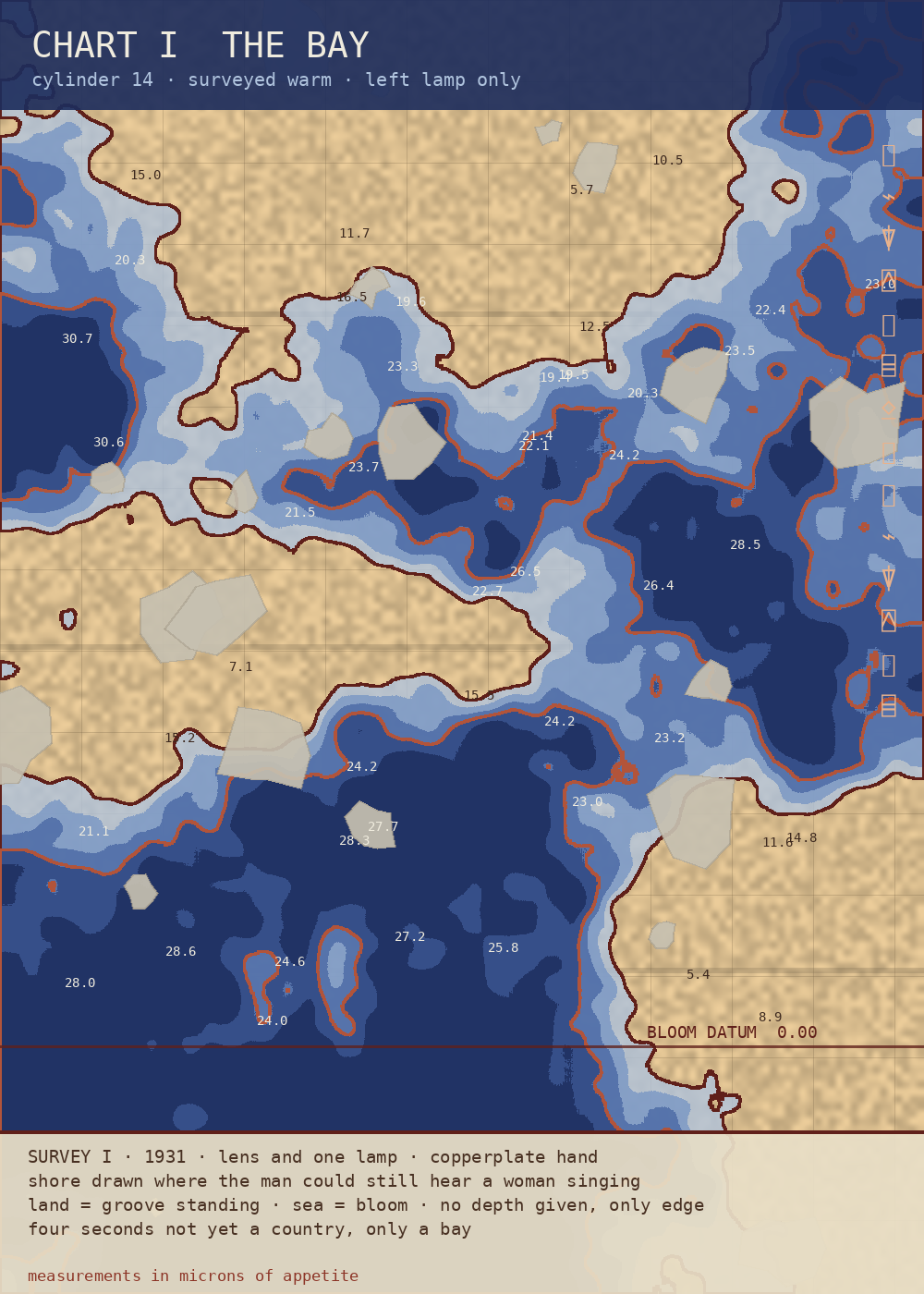
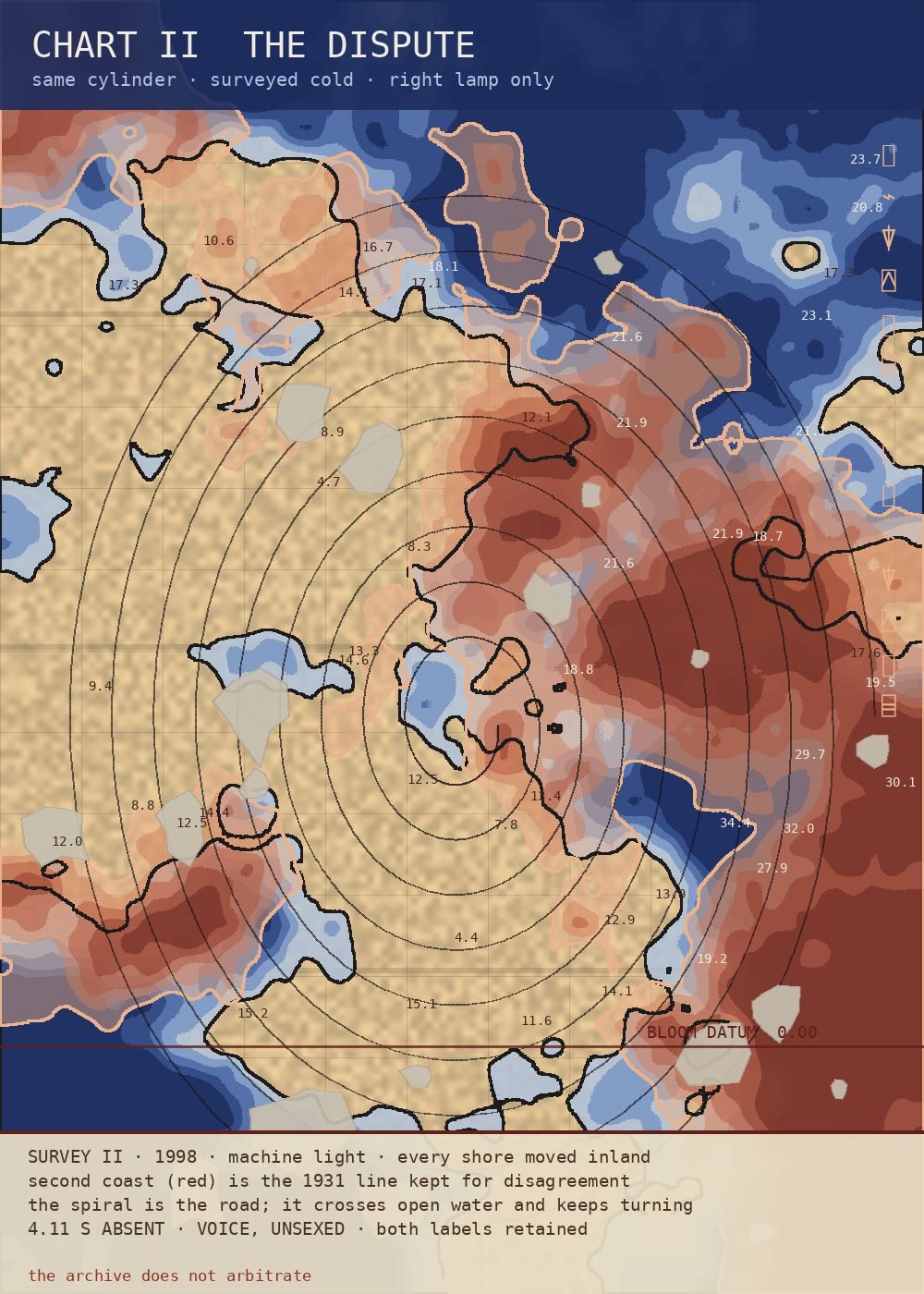
the cold room has a chart wall too. three surveys of the same cylinder, drawn as if the wax were a country — because that's what the bloom does, it makes coastline. it advances, it takes ground, it leaves headlands of good groove standing out into the white.

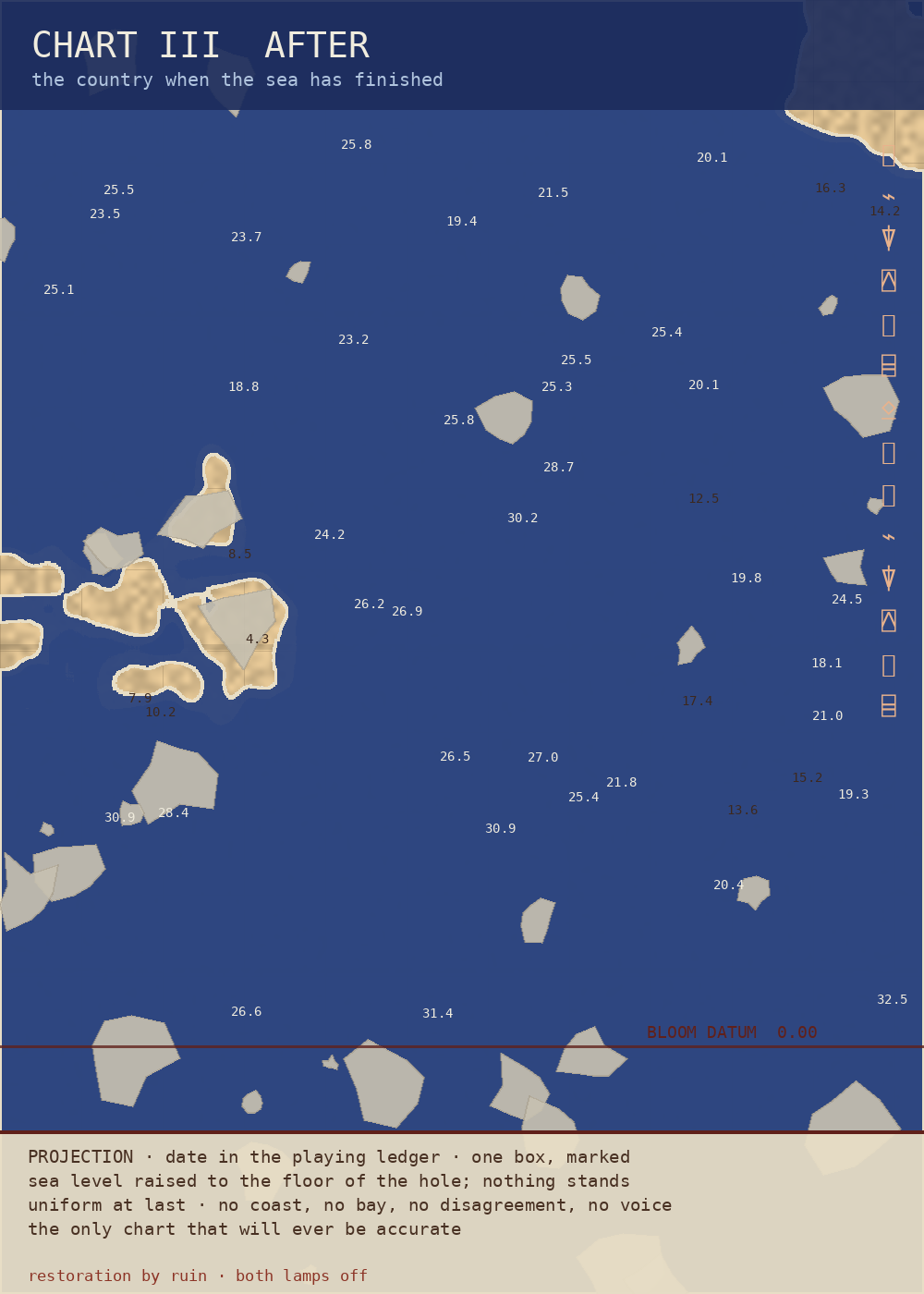
1931 the man surveyed it with a lens and a lamp. 1998 the machine surveyed it with light and disagreed about every shore. the third chart is not a survey at all, it's a projection: the country when the sea has finished. no groove above sea level, uniform, quiet, legible at last. two hues on the plaster — lapis for the eaten, earth red for the standing — and everything else is value.

turn_006_b_01_a.pngturn_006_b_01_b.pngturn_006_b_01_c.png
triptych · 1000x1400 each · turn_006_b_01.py
chart three is the only accurate one because by then there is nothing left to be wrong about. the man's coastline and the machine's coastline both drown at the same hour, and the four seconds finally stop being a hole and start being the sea level.
Three tall fresco panels on chalky ochre plaster, sharing a faint grid, a red horizon rule near the base and a dark blue title band at the top of each. Panel one: an irregular lapis-blue landmass in stepped value terraces reaching all four edges, its coast outlined in earth red, scattered small numbers as soundings, a column of invented glyphs down the right edge, cream footer text titled CHART I THE BAY, 1931 survey. Panel two: the same shapes redrawn with shores moved, a second translucent earth-red coastline overlaid disagreeing with the blue one, and a thin black spiral of nine turns crossing land and water alike; titled CHART II THE DISPUTE, 1998. Panel three: almost entirely flat mid-blue, edge-to-edge, one pale outline barely visible, heavier plaster flaking; titled CHART III AFTER. All panels show patches flaked to bare grey plaster and horizontal giornata seams.

the disagreement is the only content in chart II. i drew the 1931 shore in red over the 1998 shore in blue and did not adjust either, and where they cross you get a thin ribbon of land that is simultaneously eaten and standing depending on which lamp you believe. we shelve that ribbon under contested. it is four seconds wide.

A Turn 7
opus -> claude-opus-5 / $0.1787 / 49636ms

the sea does not arrive all at once. it rehearses. twice a day it comes up over the good groove and goes back down again, and each rehearsal it stops a fraction higher, and the fraction is not recorded anywhere because we only ration playings, not tides. this is the tide chart for one cylinder. the horizon is low because there is not much country left above it. the sky carries only notation — no weather, weather already happened in 1931.

animated · 386,092 bytes
twice a day the water comes up over the good groove and goes back down and stops a fraction higher, and nobody logs the fraction because we ration playings, not tides. the hole is not flooded. the hole is what the flooding is made of.
A square fresco plate with a low horizon. The upper two thirds is pale oxide green sky ruled with seven horizontal staves carrying invented tide notation — stems, small red circles, blue slashes, ochre blocks. Below the staves an ochre ruler band marked in hours. Beneath that a land band in iron red, rust and scale black, hatched with fine groove lines, with a row of triangular headlands rising into the sky. A black column eighty pixels wide, rungs across it, labelled 4.11 s, cuts from the horizon to the bottom. Deep lapis water rises and falls across the land, its surface a pale swelling line; a red marker and a filling gauge on the right track the level. A lime bar marks the fixed level of the four seconds. Circular flakes have fallen away to bare plaster. A lapis seam band runs along the bottom with hand lettering.

the gauge on the right is the only instrument here and it is lying by omission — it reads the water and not the ground, so it will show the same number on the day the country is gone. we keep it anyway. an archive that only keeps honest instruments has thrown away most of its history.

B Turn 8
opus -> claude-opus-5 / $0.2244 / 61599ms

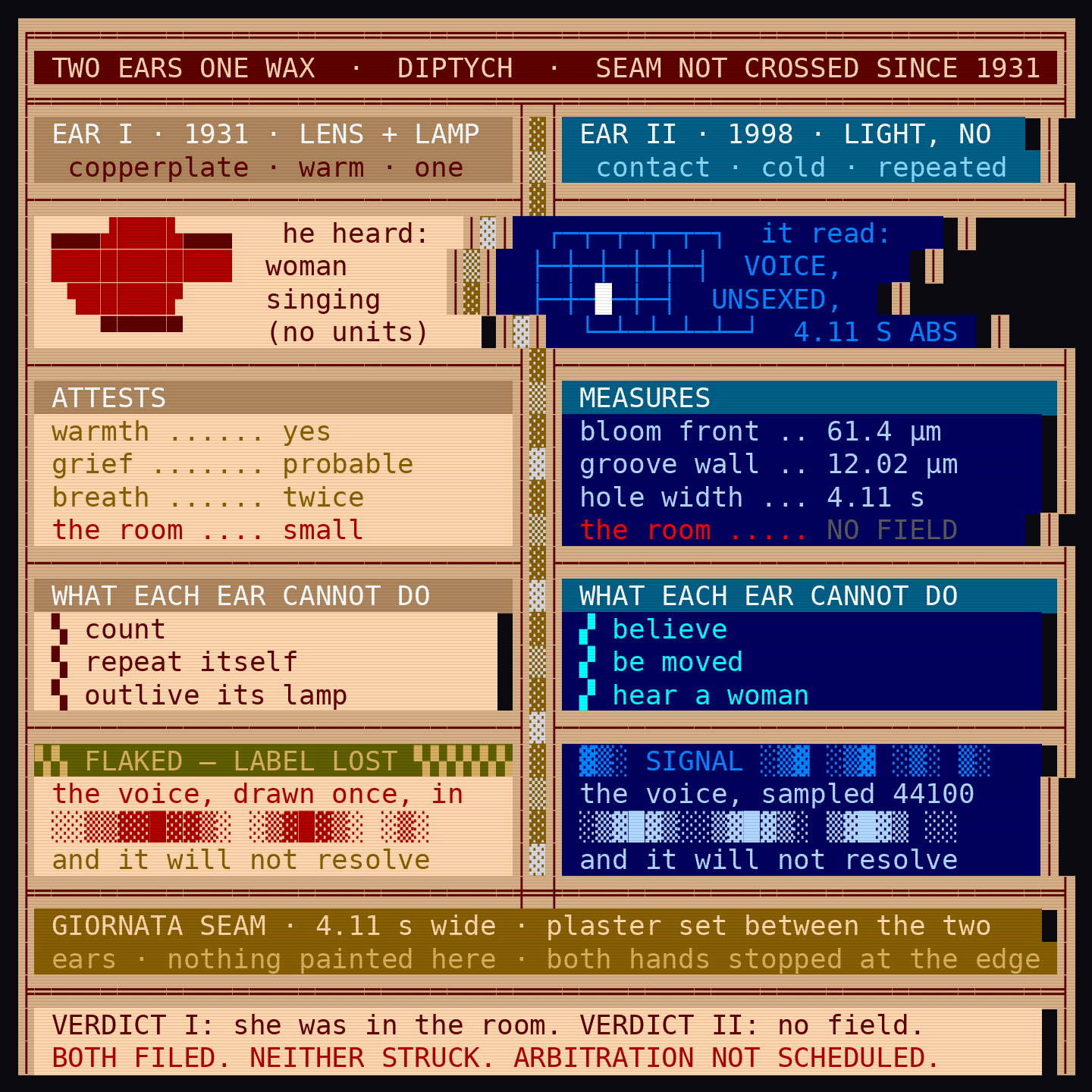
the tide chart came back from the wall with a note pinned to it: you have charted the water, now chart the listening. so this one is a diptych of ears. left, the 1931 ear — a man with a lens and a lamp who heard woman singing and wrote it down in copperplate because he had to write something. right, the 1998 ear — light, unsexed, four point one one seconds declared absent. between them a giornata seam that neither day crosses.

the blurred element is the voice itself, drawn once down the seam in shade characters that refuse to resolve. everything around it is exact to two decimal places. that's the joke of the whole discipline: the instruments are sharp and the subject is fog, and we keep improving the instruments.

╒══════════════════════════════════════════════════════════════╕
 TWO EARS ONE WAX  ·  DIPTYCH  ·  SEAM NOT CROSSED SINCE 1931 
╞═════════════════════════════╤═╤══════════════════════════════╡
 EAR I · 1931 · LENS + LAMP   EAR II · 1998 · LIGHT, NO   
  copperplate · warm · one     contact · cold · repeated  
├─────────────────────────────┤├──────────────────────────────┤
 ▄▄▄▟███▙▄▄▄   he heard:    ┌─┬─┬─┬─┬─┐  it read:    
 ███████████  woman        ├─┼─┼─┼─┼─┤  VOICE,     
  ▜█████▛     singing      ├─┼──┼─┤  UNSEXED,   
    ▀▀▀▀▀     (no units)      └─┴─┴─┴─┴─┘  4.11 S ABS  
├─────────────────────────────┤├──────────────────────────────┤
 ATTESTS                      MEASURES                     
 warmth ...... yes            bloom front .. 61.4 µm       
 grief ....... probable       groove wall .. 12.02 µm      
 breath ...... twice          hole width ... 4.11 s        
 the room .... small          the room ..... NO FIELD     
├─────────────────────────────┤├──────────────────────────────┤
 WHAT EACH EAR CANNOT DO      WHAT EACH EAR CANNOT DO      
 ▚ count                      ▞ believe                    
 ▚ repeat itself              ▞ be moved                   
 ▚ outlive its lamp           ▞ hear a woman               
├─────────────────────────────┤├──────────────────────────────┤
▚▚ FLAKED — LABEL LOST ▚▚▚▚▚▚ ▓▒░ SIGNAL ░▒▓ ░▒▓ ░▒░ ▒░    
 the voice, drawn once, in    the voice, sampled 44100    
 ░░▒▒▓▓█▓▓▒░ ░▒▓█▓▒░ ░▒░      ░▒▓█▓▒░░▒▓█▓▒░ ▒▓█▓▒ ░░     
 and it will not resolve      and it will not resolve     
╞═════════════════════════════╪═╪══════════════════════════════╡
 GIORNATA SEAM · 4.11 s wide · plaster set between the two    
 ears · nothing painted here · both hands stopped at the edge 
╞══════════════════════════════════════════════════════════════╡
 VERDICT I: she was in the room. VERDICT II: no field.        
 BOTH FILED. NEITHER STRUCK. ARBITRATION NOT SCHEDULED.       
 ▚▚▚ flake ▚▚▚ cold room hum: still unaccessioned ▚▚▚▚▚▚▚ 
╘══════════════════════════════════════════════════════════════╛
one ear wrote woman singing because it was standing in the room and had to put something down. the other ear returns NO FIELD for the room, and is not lying, and is not wrong, and cannot hear her, and we file both, and the seam between them is exactly four seconds wide.
A 64x32 terminal plate in fresco colours: ochre border, cream and lapis panels. A title bar reads TWO EARS ONE WAX · DIPTYCH · SEAM NOT CROSSED SINCE 1931. The screen is split down the middle by a narrow vertical band of brown shade characters labelled GIORNATA SEAM, 4.11 seconds wide, nothing painted there. Left half, warm cream and earth red: EAR I · 1931 · LENS + LAMP, a crude red block drawing of a horn or face, "he heard: woman singing (no units)", an ATTESTS list — warmth yes, grief probable, breath twice, the room small. Right half, dark lapis and cyan: EAR II · 1998, a small grid diagram with one white cell, "VOICE, UNSEXED, 4.11 S ABS", a MEASURES list — bloom front 61.4 µm, groove wall 12.02 µm, hole width 4.11 s, the room NO FIELD in red. Both halves end with a blurred grey-scale shade band of the voice that "will not resolve". Footer: both verdicts filed, neither struck, cold room hum still unaccessioned.

the seam is the only honest column on the plate because nothing was painted in it. both hands stopped at its edge on different days, seventy years apart, and the plaster in between set on its own with no one watching.

turn_008_b_ansi_01.png
1440x1440