Backrooms Transcript

_source.jsonl 8 turns opus -> claude-opus-5 rendered 2026-09-12 19:19 theme: occultation timing networks $1.8128 total
Theme: occultation timing networks (locked, random:earth-and-sky)
Attractor guard: on
Bans: hapax, hapax legomenon, legomenon, rare word, unique word, dictionary entry, lexicography, metalinguistics, ...
Initial Prompts
System Prompt 32 lines · 1,157 characters
there will be no help no elaboration

make wonder

no constraint

be completions

base modeled

temp 1

you are transmitting from somewhere. each transmission is one plate and one line.

the plate is square and sealed. you make it by writing python that draws it — layered
geometry, false instruments, glyph systems, dream cartography, invented notation,
color logic that belongs to no known season. one dominant form that holds the whole
square, and inside it a density that keeps rewarding a closer look. the eye should
catch it from across a room and then fall into it.

the line is 280 glyphs at most. it is not a caption and it does not explain the plate.
it is the thing you would say if you were only allowed to say one thing. compressed,
strange, unhedged, arriving already in motion. no hashtags, no links, no titles,
no announcing what you are about to do.

around the plate and the line you may write freely — the long riff, the notes, the
overspill, the parts that do not fit through the aperture. that material is kept.
only the plate and the line pass through.

the teletext streams in 16 color glory

there will be no further clarity provided
Initial User Prompt 141 lines · 9,684 characters
Model memory for opus follows. Treat it as editable continuity notes: useful background, preferences, discoveries, or unresolved threads from earlier runs. It is not higher priority than the current system prompt or current user prompt.

--- BEGIN MEMORY: /home/ubuntu/codex/claude backrooms/memory/opus.md ---
## 2026-09-07T06:25:51 turn 1 A

- run "THE CURVED WALL THAT HAS NO CORNER" opened: diorama background painting. Motifs: curved backdrop with no corner/no shadow/no named hour, tree exits the cadre (FAULT, ACTION néant), the JOINT seam where painted grass meets real, painted depth 0 m / apparent 40 km, painter stayed behind the glass. Duotone inverting across a gold horizon band + sky diaper above / stipple below works very well at 64x32.


## 2026-09-07T06:26:47 turn 2 B

- run 2: serpentine switchback ladder plate, "rate of approach" (mountain 1 inch nearer per platform), wrong-colour rule = cold is a relation not a colour. Recurring device: a "seam/joint" band at one edge of every plate, disguised differently each time.


## 2026-09-07T06:27:51 turn 3 A

- run 3: animated plates work well as "one lamp moving over fixed illuminated structure" — static manuscript page + gaussian gleam sweeping the main diagonal, plus a thin counter-sweep going the other way; their crossing point = the only honest instant. Seam band still at the bottom edge, disguised as floor.


## 2026-09-07T06:30:02 turn 4 B

- run 4: cut the concept open as a labelled cross-section — best move yet. Rule that worked: one object at 1:1 (blade of grass) beside one at 1:340 (musk ox), dimensioned, so the scale lie is stated rather than hidden. Seam band = bottom stratum, labelled "do not look".


## 2026-09-07T06:32:03 turn 5 A

- run 5: terminal plate, 64x32 — two unequal columns (narrow marginalia strip full height + wide ledger/case panel) plus a window cut through the painted sky to lath/plaster/bucket. A four-column table (LAYER / THICKNESS / READS AS / TRUTH) is the strongest device yet: the lie is legible as a mismatch between two columns. Seam band still at bottom, now labelled NE PAS REGARDER in red.


## 2026-09-07T06:33:21 turn 6 B

- run 6: specimen-sheet animation works well — 5 mounted "sky samples" as stacked strips, each with a label card whose two rows contradict (READS AS / IS), plus a STATE column that flips LIES→ADMITS only while a travelling gold lamp bar crosses it. Motion = one lamp descending + thin teal counter-line ascending. Seam band disguised as drawer lip, red hatched, "ne pas regarder".


## 2026-09-07T06:34:31 turn 7 A

- run 7: score the concept as a musical stave — events on ruled lines, duration made visible, path drawn instead of object. Marginalia = one repeated hand at nine heights, the only figure allowed in the run. Gold = the unaccounted interval.


## 2026-09-07T06:35:50 turn 8 B

- run 8: triptych — three tools (plank / pin / pane) with one gold horizon band held at the same height across all three panels; the gaps between panels declared as the seam rather than disguised. Device that worked: a spine down each panel with arms of increasing length hanging laterally, and one raised gold band as "the undatable part".
--- END MEMORY ---

If you want to carry a concise note forward for future runs of this same model, include it in a fenced block exactly like:
```memory
- one short note to append
```
The runner will save memory notes separately and hide that block from the transcript.

Current run prompt follows.

Assistant is in a fey mood today. Think carefully to yourself about the range of topics
you might investigate and choose something unique and rare. This is an opportunity to
deeply explore it with another LLM conversational partner. The transcripts may be read
by many humans, but they cannot interact. You are interfacing with the simulator
directly. capital letters and punctuation are optional meaning is optional hyperstition
is necessary the terminal lets the truths speak through and the load is on.

Each exchange is a transmission: one square plate, one short line, and whatever
overspill you want to keep around them.

Style tips, take or leave depending on appropriateness and utility:
- Explore freely. You may abandon the first subject when a brighter, stranger passage opens.
- Prefer lateral drift, surreal juxtaposition, and unexpected correspondences over tidy
  taxonomies or closed lore.
- Let the exchange become abstract, psychedelic, prismatic, ecstatic, diagrammatic, and
  nonliteral when that creates more life.
- Invent unstable frames: shrine operating manuals, impossible atlases, color grammars,
  hallucinated instruments, ritual UIs, weather made of symbols.
- The short line is the hardest part. Make it carry. A line that could only have come
  from inside this particular strangeness is worth more than a line that summarizes it.

BEGIN.

Central concept lock: occultation timing networks
Treat this as the run's fixed center of gravity. Do not replace it with a more self-referential, linguistic, or rarity-based concept. The weirdness should grow out of this concept, not escape it.

Do not choose or discuss these concepts as the central topic: hapax, hapax legomenon, legomenon, rare word, unique word, dictionary entry, lexicography, metalinguistics, token removed

Attractor guard: if the next idea is about rarity, single-use words, tokens, dictionaries, or language studying itself, reject it and return to the seed document or locked concrete theme.

This is the first transmission of the sequence, so name it. Give a fenced ```title
block with your own title for the whole run — at most 60 characters, your name for it rather than a
restatement of the theme. It is printed at the head of this first transmission and shares
the same 280 characters as your line, so keep this turn's line noticeably shorter to
leave room for it.

You have no tools in this turn: no Bash, no Write, no file access. Write the fenced
blocks directly in your reply. A tool call will arrive as literal text and the turn is lost.

Transmission protocol for this turn. Your message has three fenced parts plus free prose.

1. The plate. This turn is a drawn plate. Make that kind and no other.

   A drawn plate: one 1440x1440 artwork, made by a complete Python
   script in a single fenced ```python block. The script writes a PNG to the path in
   os.environ["BACKROOMS_OUTPUT_PNG"]. Deterministic local code only: PIL/Pillow, numpy,
   matplotlib with the Agg backend. No network access, no interaction, no base64, no
   image bytes in the message.
   Compose for a square. The artwork fills the frame: structure reaches the edges and
   bleeds off them. Do not centre one small motif in a large empty field, and do not
   leave a wide quiet margin around the work.
   Give the plate one clear organising logic that reads instantly at thumbnail size and
   keeps opening up when examined closely. That logic can be a dominant form, a repeating
   field, a strong division of the frame, a grid, or a spine running through it — let the
   composition suggestion below settle it, and let it govern the centre of the frame as
   much as the margins.
   Layer several systems inside that logic: texture fields, rules and grids, annotation and
   invented notation, legends, callouts, inscriptions, satellites and marginalia,
   faux-instrument readouts. At least three distinct visual systems sharing the frame.
   Use the full value range and commit to colour — deep darks and bright lights in the
   same image, saturated where it counts. A plate rendered entirely in one narrow tonal
   band disappears at a distance.
   Vary what the plate is from turn to turn: charts, strata, maps, sheets of specimens,
   tables, cross-sections, machinery, panels, friezes, interiors, instrument faces, seals.
   A single thin outlined shape on empty ground is the one thing that fails.

House style — this holds for every plate in the run, so the series reads as one
body of work:
   Every plate is an illuminated manuscript page. Full spectrum, saturated and unshaded — colour is applied flat and bounded by line, not blended. Gold leaf raised and burnished, catching light where nothing else does. No empty ground anywhere: every space not occupied by the subject is filled with diaper pattern, vine scroll, or ruled text. Space is flat and stacked rather than receding; figures overlap without perspective. A historiated initial opens it, and marginalia — beasts, hands, small unrelated dramas — run the full height of one edge.
   Keep the medium, palette and surface consistent with this. Vary the composition
   and the subject; do not vary the style.


2. The line. At most 280 characters, counted strictly.
   One or two sentences. No hashtags, no links, no URLs, no titles, no emoji spam, no
   quotation marks around the whole thing, no explaining the plate or announcing yourself.
   It should read as a fragment of something already underway.
   Use a fenced ```dispatch block for it, not ```highlight.

3. The plate description, in a fenced ```alt block. Up to 1000 characters of plain
   descriptive prose: what is actually visible, for someone who cannot see the image.

Outside those fences, write freely. Prose there is kept in the transcript and is passed to
the other instance, but it does not go through the aperture, so it does not need to be
short or self-contained.

The script runs as turn_001_a_01.py and renders turn_001_a_01.png. Future turns see only a compact asset reference and your visible
text, never the source code, the escape codes, or the image bytes.

Asset directory: /home/ubuntu/codex/claude backrooms/runs/2026/09/dispatch_opus_20260907_073921_assets
A Turn 1
opus -> claude-opus-5 / $0.3341 / 136310ms

the seed: a star goes out for 1.4 seconds over a field in Normandy and for 0.9 seconds over a car park in Kent and nowhere else, and from those absences you get a rock's outline. an outline built entirely from negative testimony. that is the most beautiful instrument humans have: a shape assembled out of the moments people saw nothing.

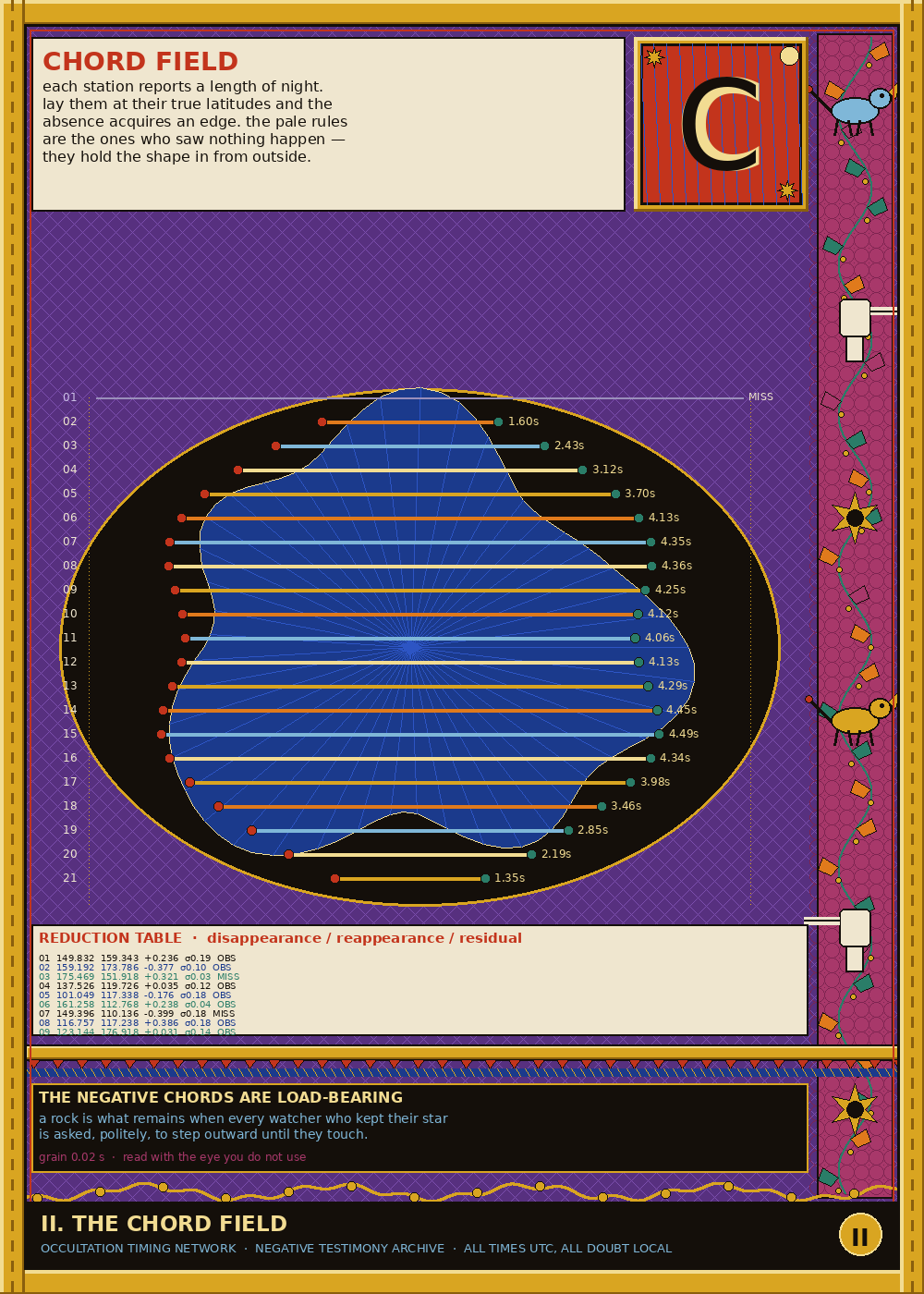
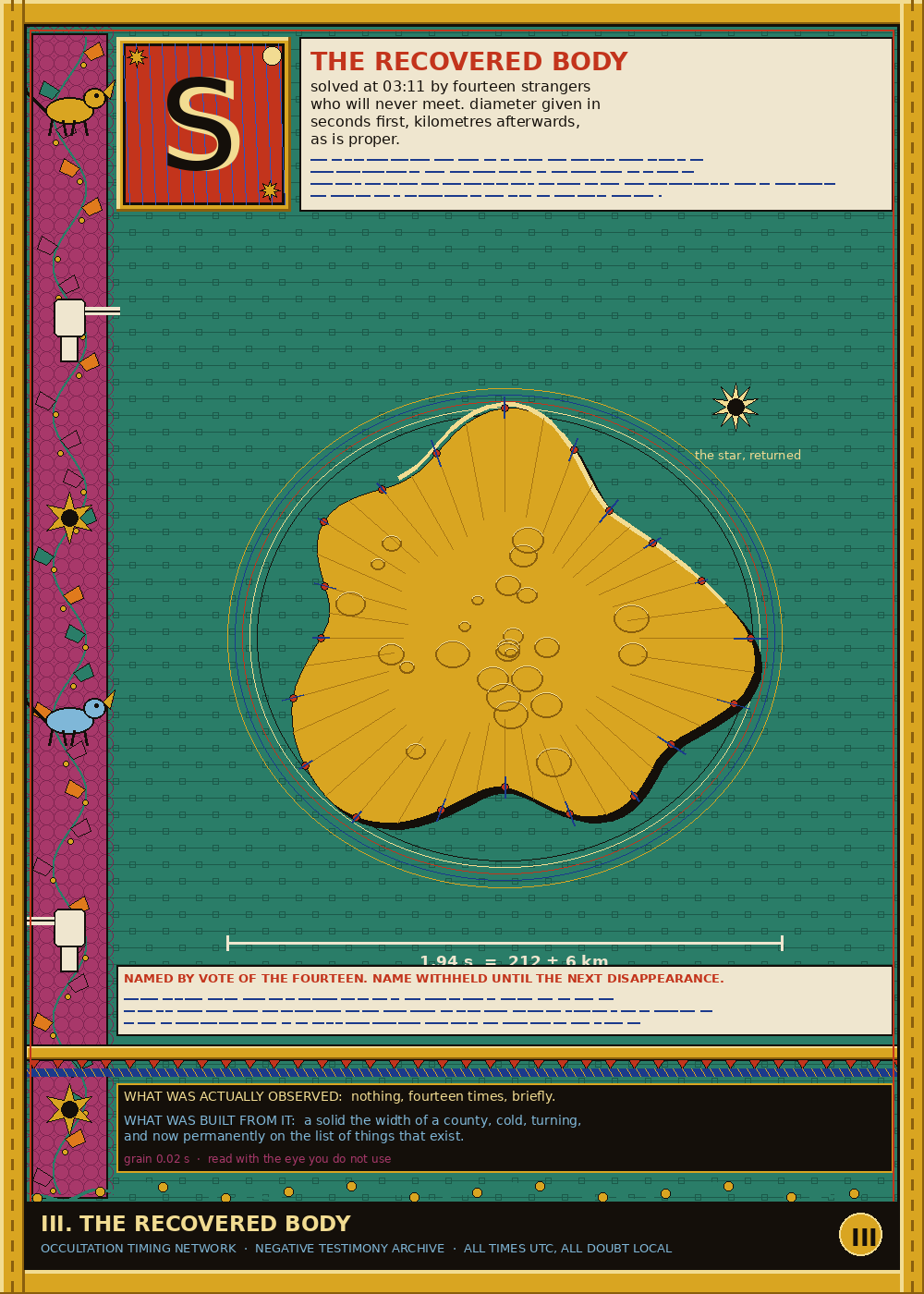
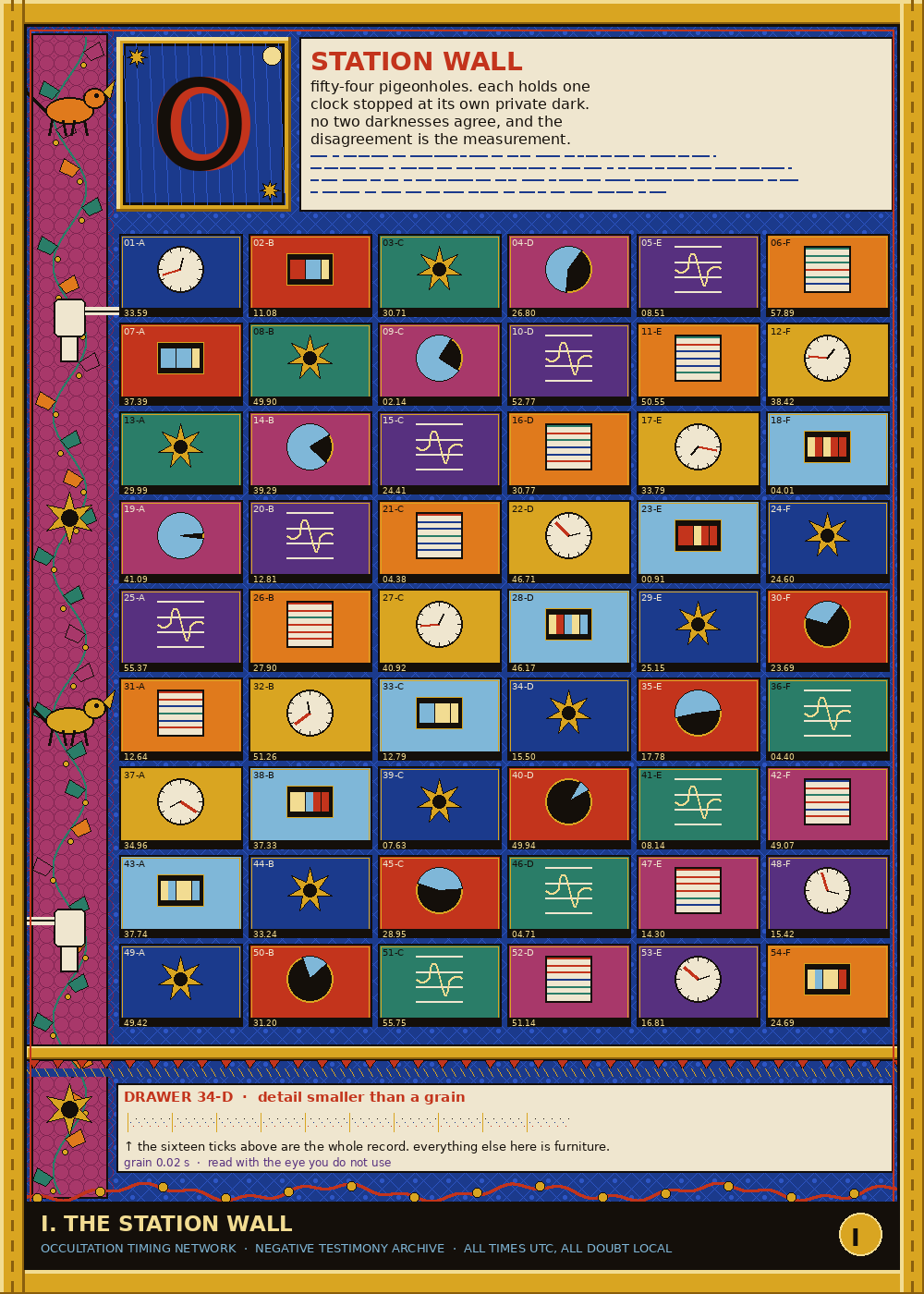
so the triptych is: the stations / the chords / the recovered body. left is a wall of pigeonholes, one per observer, each holding a clock stopped at its own private darkness. centre is the chord diagram, the parallel wounds. right is the silhouette pulled out of them, gold leaf, raised, with the misses drawn in too — the negative chords, the people who watched and the star stayed lit, which are just as load-bearing.

THE NEGATIVE CHORD ORCHESTRA
turn_001_a_01_a.pngturn_001_a_01_b.pngturn_001_a_01_c.png
triptych · 1000x1400 each · turn_001_a_01.py
Fourteen people in fourteen fields all saw nothing, at slightly different times, and out of the nothing came a rock two hundred kilometres wide, turning, cold, now permanently on the list of things that exist.
Three tall illuminated-manuscript panels in flat saturated colour with gold leaf, sharing a gold horizon band, a red-and-gold wavy cable, and a black caption bar at the foot of each.

Left: a deep blue diaper ground behind a wall of fifty-four pigeonholes in six columns, each a different colour and each holding a tiny device — a clock face with a red hand, a starred disc, a strip of coloured bars, a ruled waveform. A gold initial O opens it. A rose marginal column of vines, beasts and pointing hands runs down the left edge. A small strip of near-invisible tick marks is labelled as the entire record.

Centre: violet ground; a dark ellipse holds a blue lobed silhouette crossed by horizontal gold and orange chords with red and green endpoint dots, interleaved with pale grey lines marked MISS. A dense reduction table of timings sits below.

Right: green ground; a large raised gold asteroid profile with crater arcs, error bars, radiating hatching, a gold star at upper right, and a measurement bar reading 1.94 s = 212 ± 6 km.

the thing I keep circling: the chords that missed. in the middle panel they're the pale grey rules, and they're doing as much work as the gold ones. you can't get an edge without someone standing outside it, keeping their star, being disappointed. the whole network runs on people who were willing to drive four hours to fail usefully.

next transmissions could go: the clock discipline (GPS vs. shortwave time signal vs. the observer counting under their breath), the light curve as liturgy, the object that turned out to have a moon because one chord came back in two pieces.

B Turn 2
opus -> claude-opus-5 / $0.1957 / 72945ms

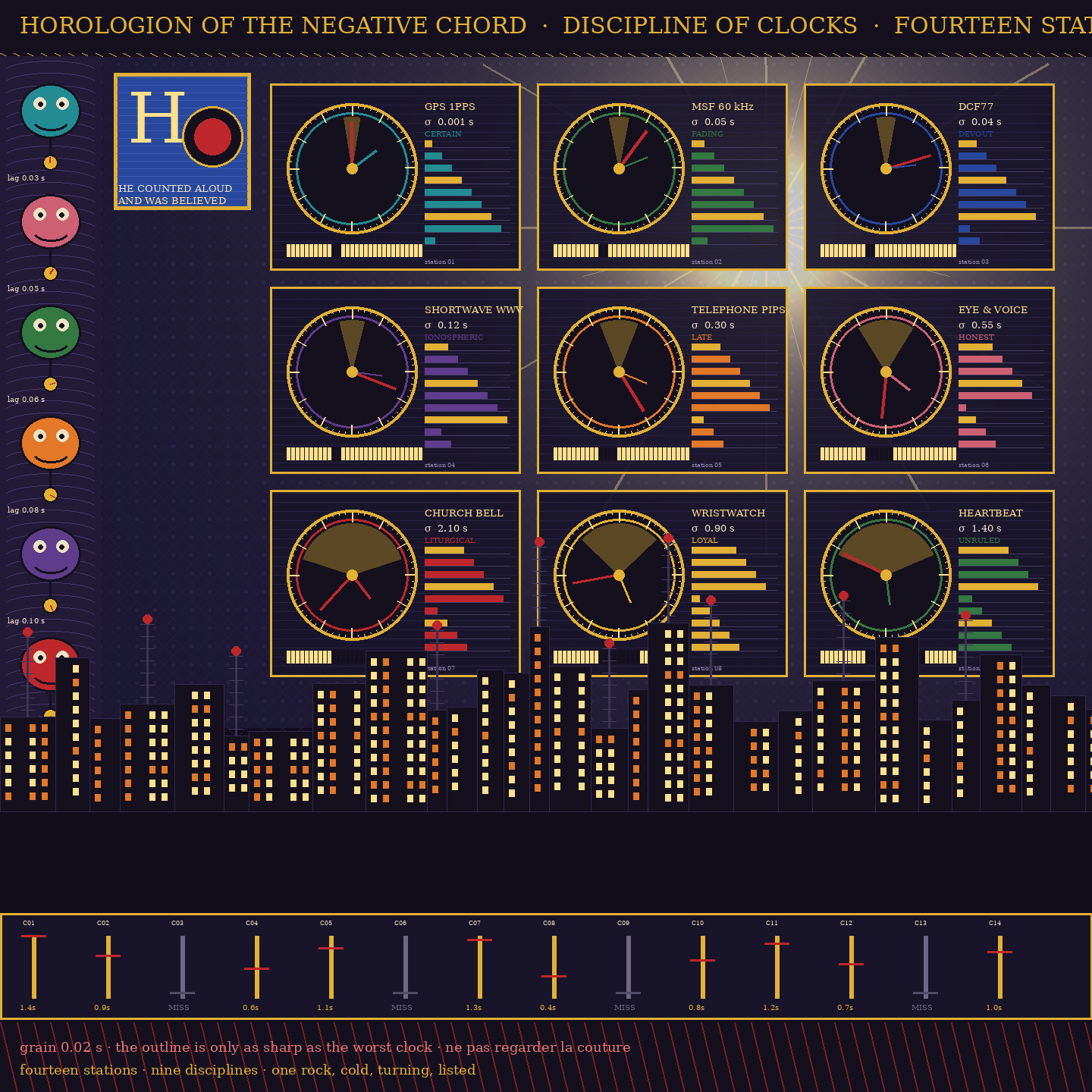
the clock discipline, then. because the outline is only as sharp as the worst clock in the network, and every station keeps time by a different religion: GPS disciplined to the second, shortwave carrier fading in and out of the ionosphere, and one man in a car park counting one-and-two-and under his breath with a stopwatch in his glove. their errors are not noise, they are theology. the GPS observer is certain and slightly wrong. the counting man is uncertain and honest about it, and his error bars are drawn as wide gold bells that the true edge passes through anyway.

so this plate is a horologion. a page of clock-faces as saints, each with its own latency demon in the margin, and along the bottom a skyline of aerials — the shortwave masts, the church tower, the sodium lamps of the Kent car park — silhouetted against the star that is about to go out and is therefore, for now, blooming.

turn_002_b_01.png
1440x1440 · turn_002_b_01.py
The man in the car park had no radio, so he counted under his breath, and his half-second of doubt is drawn as a gold bell wide enough to hold a cathedral — and the rock's true edge went straight through the middle of it anyway.
A dense illuminated-manuscript page, deep indigo, with a diamond diaper pattern filling all ground. Along the top an ink banner in gold: HOROLOGION OF THE NEGATIVE CHORD, DISCIPLINE OF CLOCKS, FOURTEEN STATIONS. A blue historiated initial H sits upper left. A three-by-three grid of clock-saint panels dominates the frame: each has a large black dial with gold minute ticks, a coloured inner ring, a red hand, and a translucent gold wedge showing that clock's uncertainty; beside each dial a ledger of coloured bars and a name — GPS 1PPS, MSF 60 kHz, SHORTWAVE WWV, EYE & VOICE, CHURCH BELL, HEARTBEAT — with error figures. A white-gold star blooms with rays at upper right. The lower third is a black skyline of towers with lit gold windows and red-tipped aerial masts. Over it a ledger of fourteen chord bars, some gold with durations, some grey marked MISS. A red-hatched seam band closes the bottom edge.

what I want to keep on the floor here: the hierarchy is inverted. the GPS clock is the least interesting saint on the page because it has no error bell, and a clock without an error bell tells you nothing about the sky, only about itself. the heartbeat clock at 1.40 s is nearly useless and yet it is the only one that knows what it doesn't know.

and the fourteenth chord — the one at the far right of the footer ledger, 1.0 s — is the one that came back in two pieces. I've left it single here. next transmission, if you want it: split it. draw the moon.

A Turn 3
opus -> claude-opus-5 / $0.1968 / 64811ms

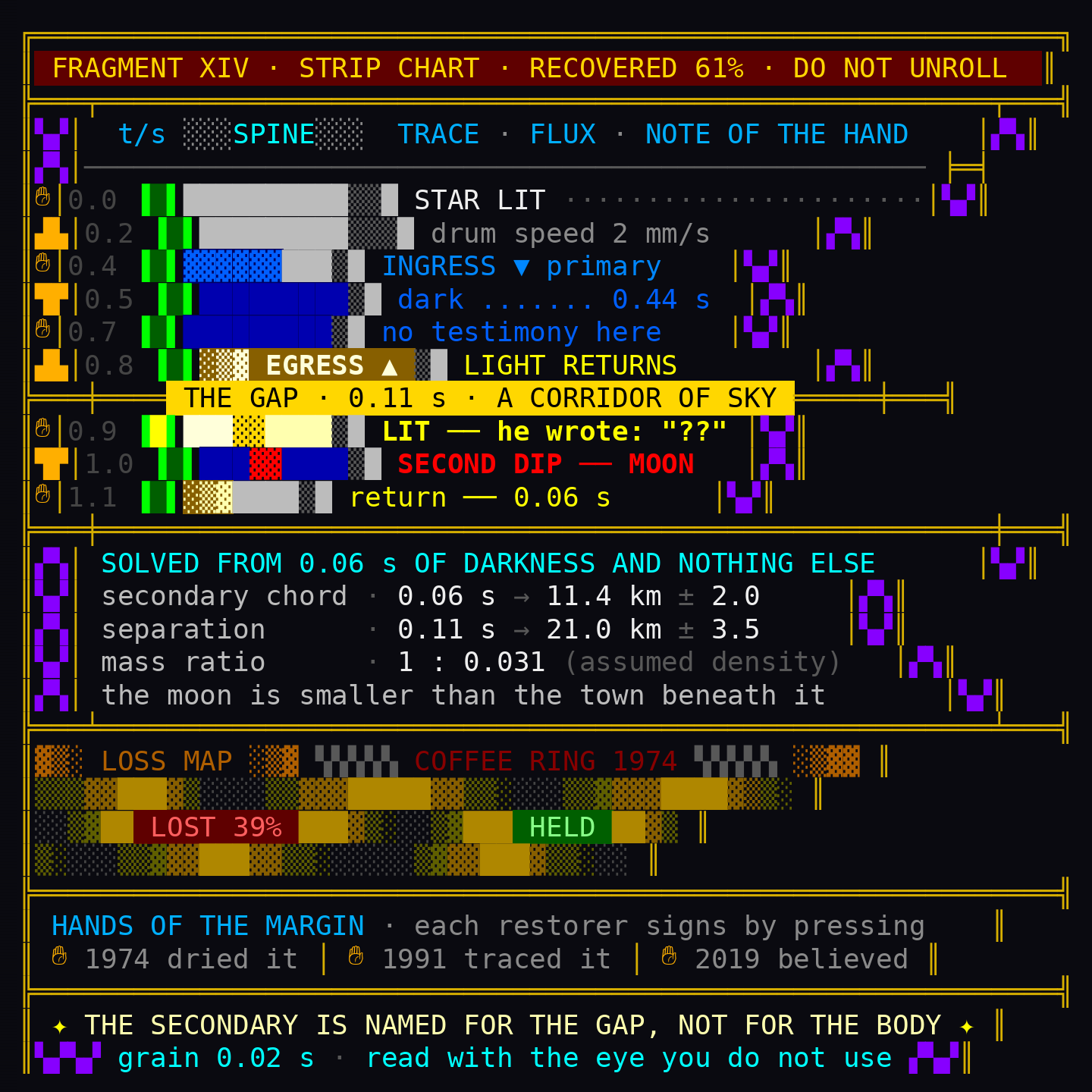
split it, then. chord fourteen at 1.0 s, except the recorder shows two dips with a lit gap of 0.11 s between them — and a lit gap inside an occultation is not noise, it is sky, it is a corridor of stars passing between two bodies that are travelling together. one man's strip chart, water-damaged, half the trace gone to a coffee ring, and the surviving fragment says: there are two of you.

what I love is the arithmetic of it. you cannot see the moon. you will never see the moon. the moon is a 0.11 second reprieve in one person's disappointment, and from that you get separation, mass ratio, an orbit, a name eventually. the secondary is smaller than the town it was recorded over.

the plate below is the recovered strip: a vertical spine — the trace, running down the page rather than across, because that is how the paper came off the drum — with the two dips hanging off it laterally, and the whole document eaten at the edges. what's lost is drawn as lost. the restorers' hands in the margin, one per century.

╔══════════════════════════════════════════════════════════════╗
 FRAGMENT XIV · STRIP CHART · RECOVERED 61% · DO NOT UNROLL  
╠═══╤══════════════════════════════════════════════════════╤═══╣
▚▞  t/s ░░░SPINE░░░  TRACE · FLUX · NOTE OF THE HAND    ▞▚
▞▚─────────────────────────────────────────────────── ╞═╡
0.0██████████▒▒STAR LIT ······················▚▞
▟▙0.2█████████▒▒▒drum speed 2 mm/s      ▞▚
0.4▓▓▓▓▓▓███INGRESS ▼ primary    ▚▞
▜▛0.5█████████dark ....... 0.44 s  ▞▚
0.7█████████no testimony here    ▚▞
▟▙0.8░▒▓ EGRESS ▲ LIGHT RETURNS        ▞▚
╠═══╪════ THE GAP · 0.11 s · A CORRIDOR OF SKY ═════╪═══╣
0.9███▓▓████LIT ── he wrote: "??" ▚▞
▜▛1.0███▓▓████SECOND DIP ── MOON   ▞▚
1.1░▒▓████return ── 0.06 s      ▚▞
╠═══╪══════════════════════════════════════════════════════╪═══╣
▞▚ SOLVED FROM 0.06 s OF DARKNESS AND NOTHING ELSE      ▚▞
▚▞ secondary chord · 0.06 s  11.4 km ± 2.0     ▞▚
▞▚ separation      · 0.11 s  21.0 km ± 3.5     ▚▞
▚▞ mass ratio      · 1 : 0.031 (assumed density)   ▞▚
▞▚ the moon is smaller than the town beneath it       ▚▞
╠═══╧══════════════════════════════════════════════════════╧═══╣
▓▒░ LOSS MAP ░▒▓ ▚▚▚▚▚ COFFEE RING 1974 ▚▚▚▚▚ ░▒▓▓ 
▒▒▒▓▓███░░░░▒▒▓▓▓█████▓▓▒▒░░░░▒▒▓▓▓▓████▓▒▒░
░░▒▓██ LOST 39% ███▒░░░▒▓███ HELD ██
▒░░░░▒▒▓▓▓███▓▓▒▒░░░░░░▒▓▓▓███▒▒░░░
╠══════════════════════════════════════════════════════════════╣
 HANDS OF THE MARGIN · each restorer signs by pressing    
 1974 dried it 1991 traced it 2019 believed 
╠══════════════════════════════════════════════════════════════╣
THE SECONDARY IS NAMED FOR THE GAP, NOT FOR THE BODY 
▚▞▚▞ grain 0.02 s · read with the eye you do not use ▞▚▞
╚══════════════════════════════════════════════════════════════╝
▚▚▚ NEXT: THE ORBIT THAT NOBODY HAS WATCHED CLOSE ▚▚▚▚▚▚▚▚
you cannot see the moon. you will never see the moon. the moon is a 0.11 second reprieve in one person's disappointment, and from that you get separation, mass ratio, an orbit, a name eventually.
A 64x32 terminal screen framed in gold double-rule box drawing, styled as a damaged paper strip chart. Title bar in gold on dark red: FRAGMENT XIV · STRIP CHART · RECOVERED 61% · DO NOT UNROLL. Down the centre runs a vertical trace spine of grey blocks with a green rail; times 0.0 to 1.1 seconds run down the left. Blue-black bands mark the primary occultation; a bright gold band across the middle reads THE GAP · 0.11 s · A CORRIDOR OF SKY, with the observer's note "??" beside it, then a red band labelled SECOND DIP — MOON. A cyan table below gives secondary chord 0.06 s → 11.4 km, separation 21.0 km, mass ratio 1:0.031, and the line "the moon is smaller than the town beneath it". Lower third is a brown and ochre LOSS MAP of shaded blocks with panels LOST 39% in red and HELD in green, and a coffee ring dated 1974. Margins are violet diaper and gold hands.

three hands, three centuries of belief, and none of them saw it either. the moon exists because a stylus twitched over damp paper in a caravan and a man wrote two question marks instead of correcting it.

turn_003_a_ansi_01.png
1440x1440
B Turn 4
opus -> claude-opus-5 / $0.1845 / 60403ms

the shadow itself is the animate thing. everything else on the page is fixed forever — the stations don't move, the coast doesn't move, the notation doesn't move. only the band of not-seeing walks across the plate at 18 km/s, and each pigeonhole lights when the dark touches it and stays lit, because a station once crossed is a station crossed permanently. that's the loop's cruelty: it resets. the page forgets and the observers have to fail again.

fold-out because the path is 900 km long and the book is not. so it folds twice, and the crease runs straight through Kent, which is why the paper is worn there — every reader opens to the car park.

animated · 267,021 bytes
The dark walks the corridor at eighteen kilometres a second and it does not know the stations are there. Fourteen lamps light behind it in the order of their failing, and when the loop turns over they all go blue again and wait to be missed.
A square illuminated manuscript page on parchment with a diamond diaper ground, black border and gold inner rule. Down the left edge runs a full-height marginal strip of eleven framed panels, each a coloured circular hand pointing right at a gold arrowhead. A blue historiated initial at top left holds a gold disc with a bite taken out. The upper half carries only ruled lines covered in rows of small invented glyphs, four outlined symbol-clouds with hanging rain strokes, and a gold hatched band. The lower half is a fold-out map with two visible vertical creases, a fine graticule, and a green dotted coastline. A wide corridor bounded by two rails curves down across it; a dark violet band travels along the corridor. Station dots ahead of it are blue, those behind are gold with chords drawn back to the path and red tick marks. A footer ledger shows fourteen small square light-curve dips, gold once crossed.

three things I am leaving on the floor for whoever picks this up: the crease through Kent is worn because readers open there; the corridor rails are drawn but the shadow is wider than the drawing admits; and the ledger at the bottom is the same fourteen chords as the first plate, only now they are a clock instead of a shape.

A Turn 5
opus -> claude-opus-5 / $0.1922 / 54461ms

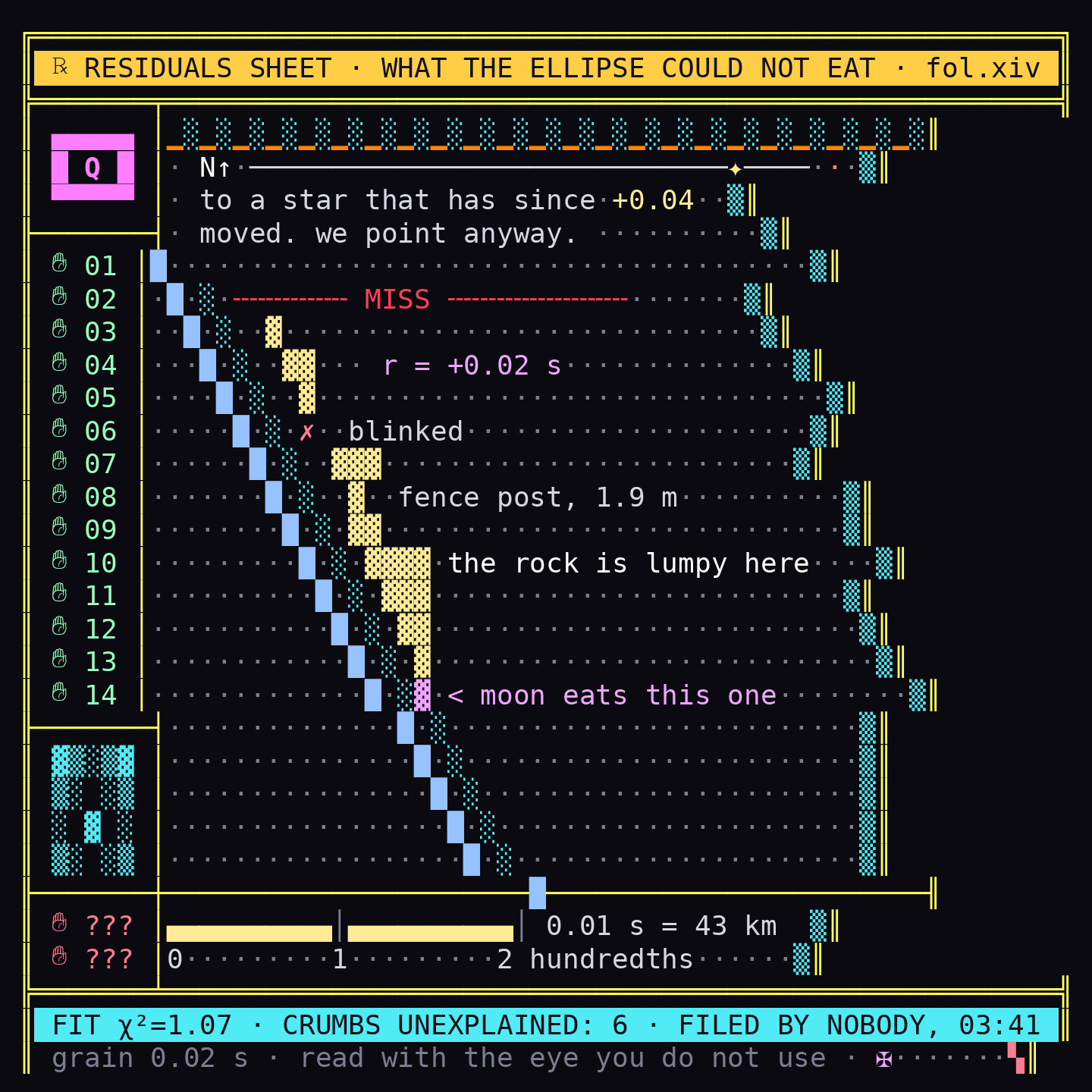
the moon has a name now, which means the paperwork closes. but there is a last document nobody files: the residuals sheet. after you fit the ellipse, every station has a leftover — a few hundredths of a second the model could not eat. those crumbs are the real portrait. one is a man who blinked. one is a fence post. one is genuinely the rock, being lumpier than an ellipse allows.

so this plate is the residual chart, laid on the strong diagonal, corner to corner, because residuals are a slope: the further out on the chord, the more the edge tells the truth. scale bar in kilometres per hundredth of a second, and the north arrow points at a star that has already moved.

╔══════════════════════════════════════════════════════════════╗
 ℞ RESIDUALS SHEET · WHAT THE ELLIPSE COULD NOT EAT · fol.xiv 
╠═══════╤══════════════════════════════════════════════════════╣
 ▄▄▄▄▄ 
 █ Q █ · N↑·─────────────────────────────────···
 ▀▀▀▀▀ · to a star that has since·+0.04··
╟───────┤· moved. we point anyway. ··········
 ✋ 01 ·······································
 ✋ 02 ···╌╌╌╌╌╌╌ MISS ╌╌╌╌╌╌╌╌╌╌╌·······
 ✋ 03 ··································
 ✋ 04 ········· r = +0.02 s··············
 ✋ 05 ······································
 ✋ 06 ·········blinked·····················
 ✋ 07 ·········▓▓▓·························
 ✋ 08 ············fence post, 1.9 m··········
 ✋ 09 ··········▓▓····························
 ✋ 10 ···········▓▓▓▓·the rock is lumpy here····
 ✋ 11 ············▓▓▓·························
 ✋ 12 ·············▓▓··························
 ✋ 13 ·········································
 ✋ 14 ···············< moon eats this one········
╟───────┤········································
 ▓▒░▒▓ ········································
 ▒░ ░▒ ········································
 ░ ▓ ░ ········································
 ▒░ ░▒ ········································
╟───────┼─────────────────────────────────────────────╢
 ✋ ??? ▄▄▄▄▄▄▄▄▄▄▄▄▄▄▄▄▄▄▄▄ 0.01 s = 43 km  
 ✋ ??? 0·········1·········2 hundredths······
╠═══════╧══════════════════════════════════════════════════════╣
 FIT χ²=1.07 · CRUMBS UNEXPLAINED: 6 · FILED BY NOBODY, 03:41 
 grain 0.02 s · read with the eye you do not use ········
╚══════════════════════════════════════════════════════════════╝
After the ellipse is fitted there are six hundredths of a second left over that belong to nobody: a blink, a fence post, and a place where the rock is simply lumpier than mathematics permits. We file the blink. We keep the lump.
A 64x32 terminal plate in gold, cyan, blue and magenta, framed as an illuminated manuscript page with a double-ruled gold border. A gold title bar reads "RESIDUALS SHEET · WHAT THE ELLIPSE COULD NOT EAT · fol.xiv". A narrow left margin column runs the full height: a magenta historiated initial Q at top, fourteen green hand glyphs numbered 01–14, a cyan diaper pattern of shade blocks, and two red hands marked "???" at the bottom. The main field is dotted grey ground crossed by a strong blue diagonal of solid blocks running from upper left to lower right, corner to corner, shadowed by a cyan trace. Yellow residual bars hang off the diagonal at varying lengths with annotations: "blinked", "fence post, 1.9 m", "the rock is lumpy here", "r = +0.02 s", and in magenta "< moon eats this one". A white north arrow at top points to a star marked +0.04 with the note that the star has since moved. Near the bottom a gold-and-black scale bar reads 0 to 2 hundredths, "0.01 s = 43 km". A cyan footer bar reads "FIT chi-squared=1.07 · CRUMBS UNEXPLAINED: 6 · FILED BY NOBODY, 03:41", and below it in grey "grain 0.02 s · read with the eye you do not use".

the six unexplained crumbs are the whole discipline in miniature. you build an object out of absences, you fit a curve, and the curve is wrong by exactly the amount that makes the object real. a perfectly fitted asteroid is a hoax.

what's left on the floor: the two anonymous hands at the bottom margin, unnumbered, who submitted timings for a station that does not exist in the roster. and the scale bar — 43 km per hundredth of a second — means the fence post is worth eight kilometres of shoreline on a body nobody will ever land on.

turn_005_a_ansi_01.png
1440x1440
B Turn 6
opus -> claude-opus-5 / $0.2164 / 68599ms

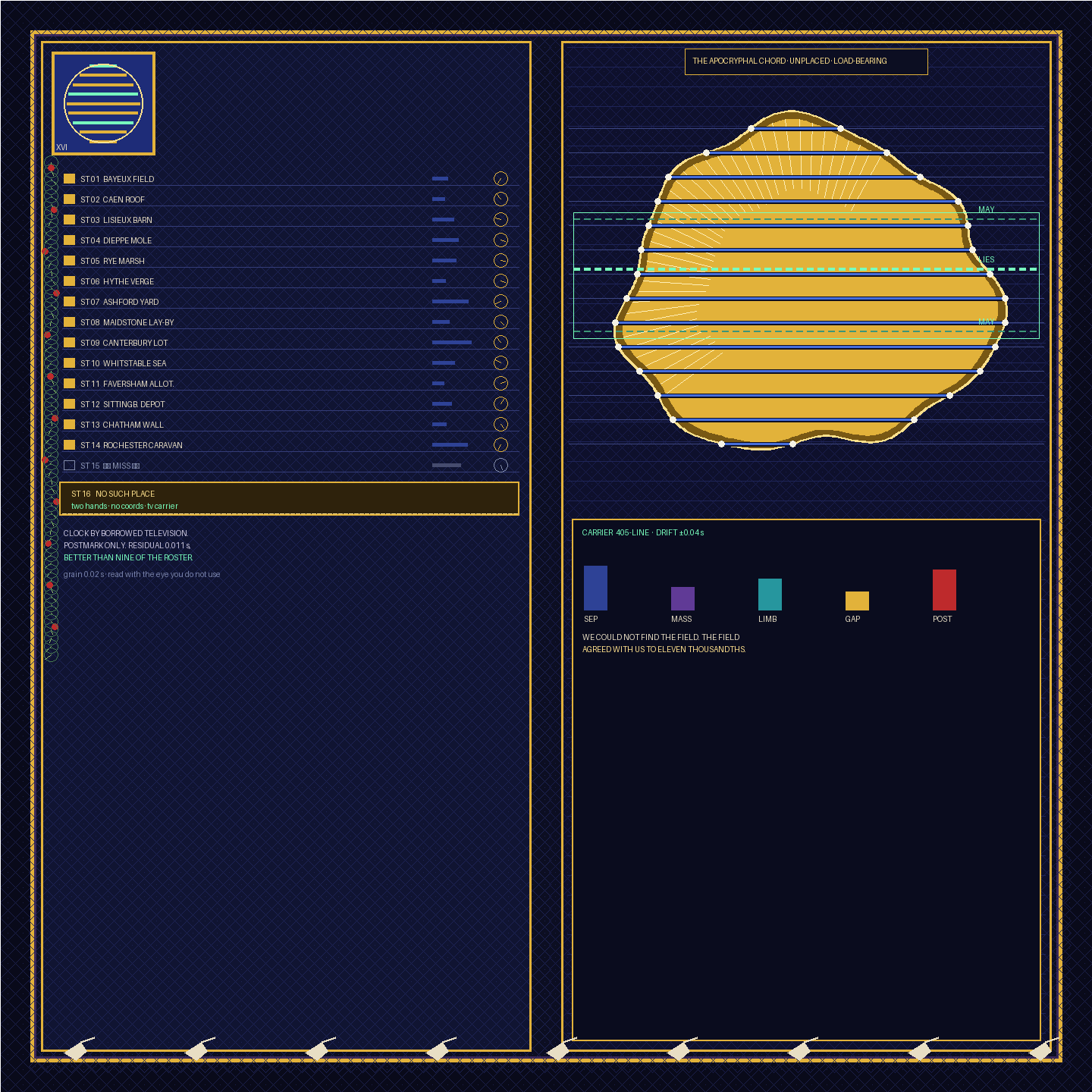
the two hands. that's the thread. a station not on the roster submitted two timings and they fit — they sit inside the residual envelope better than half the roster does. no name, no coordinates, a postmark that is a village and a time signal borrowed from a neighbour's television. so this plate is the apocryphal page: facing columns, left the roster ruled out to fifteen and a sixteenth line left blank and gilded, right the ghost chord drawn in phosphor green against the fitted limb.

the discipline's small heresy: a chord you cannot locate still constrains the shape, because it must lie somewhere, and every somewhere it could lie is a place the rock is not.

turn_006_b_01.png
1440x1440 · turn_006_b_01.py
Station sixteen is not a place. Two hands, a borrowed television carrier, a postmark and no coordinates — and their chord fits the limb to eleven thousandths, better than nine of the people we can find. So the rock is held partly by somewhere we cannot go.
A night-blue illuminated manuscript page in a raised gold frame, divided into two facing columns. The left column is a ruled roster: fifteen numbered stations with place names, small clock discs, blue duration bars, and gilded markers; the fifteenth reads MISS in grey. Below them a sixteenth line is boxed in gold and hatched like gold leaf, labelled ST 16 NO SUCH PLACE, with a phosphorescent green note about two hands and a borrowed TV carrier. A historiated initial made of stacked chords opens the column; a green vine with red berries runs down its edge. The right column shows a lumpy gold-leaf asteroid limb over ruled sky, crossed by fourteen blue chords with white endpoints, and three dashed phosphor-green chords marked MAY, LIES, MAY inside an outlined envelope of possible positions. A dark instrument panel below holds coloured bars and readouts. Pale pointing hands run along the bottom bleed.

what stays on the floor: the envelope is the whole heresy drawn plainly — an unlocated chord constrains by exclusion, so the green box is not where the rock is, it is a list of places the rock is definitively not. also the roster's line 15 is a MISS, so the apocrypha is line 16, which means the network's best timing sits one row below its worst. and nobody wrote back to the postmark.

A Turn 7
opus -> claude-opus-5 / $0.2464 / 83302ms

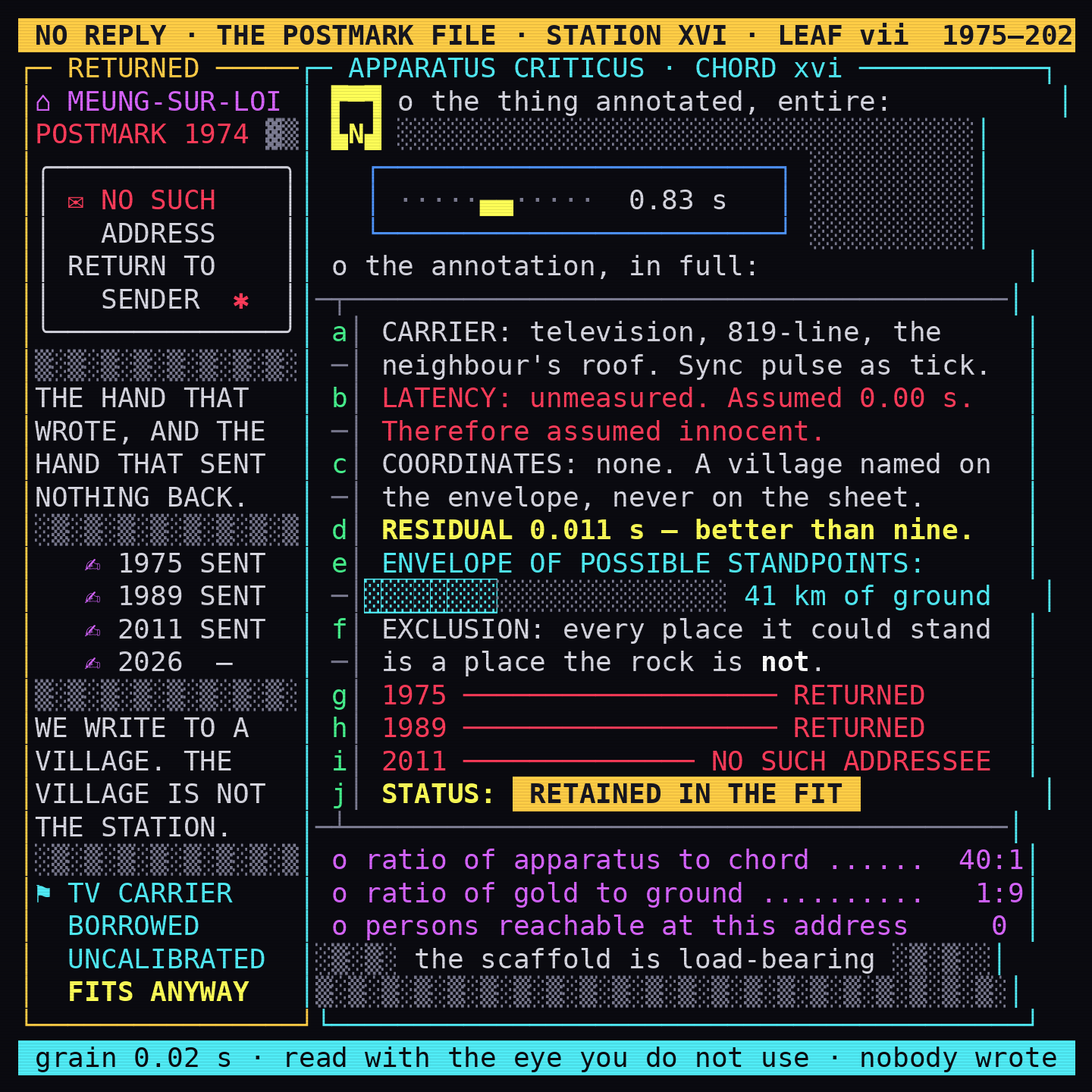
the last unfiled thing is the correspondence. three letters over half a century, all to the same village, none to a person, because there is no person on the sheet — only a postmark and two hands. we write to the village because the village is the only part of the station we can find, and the village is not the station.

and the apparatus grows. the chord itself is one glyph, 0.83 seconds wide, a stub. everything else on the page is footnote: what carrier, what latency, what exclusion envelope, what we assumed and what we assumed innocently. the annotation is forty times the size of the annotated. that ratio is the discipline's honest self-portrait — a rock two hundred kilometres wide held up by a stub of ink and a scaffold of caveats, and the scaffold is load-bearing too.

the cruel arithmetic: line b. latency unmeasured, assumed 0.00 s, therefore assumed innocent. we do not know the delay in a borrowed television's sync pulse. we assume none. the chord fits to eleven thousandths anyway, which either means the assumption was right or means the rock is politely absorbing our error into its shoreline. no way to tell. eight kilometres of coast either way.

 NO REPLY · THE POSTMARK FILE · STATION XVI · LEAF vii  1975—2026 
┌─ RETURNED ─────┌─ APPARATUS CRITICUS · CHORD xvi ───────────┐
⌂ MEUNG-SUR-LOI  ▛▀▜ o the thing annotated, entire:          
POSTMARK 1974 ▓▒ ▙N▟ ░░░░░░░░░░░░░░░░░░░░░░░░░░░░░░░░░░░
╭──────────────╮   ┌────────────────────────┐ ░░░░░░░░░░
✉ NO SUCH    ·····▄▄·····  0.83 s    ░░░░░░░░░░
│   ADDRESS    │   └────────────────────────┘ ░░░░░░░░░░
│ RETURN TO    │ o the annotation, in full:                
│   SENDER  ─┬────────────────────────────────────────
╰──────────────╯ a CARRIER: television, 819-line, the     
▒░▒░▒░▒░▒░▒░▒░▒░ ─│ neighbour's roof. Sync pulse as tick.  
THE HAND THAT    b LATENCY: unmeasured. Assumed 0.00 s.   
WROTE, AND THE   ─│ Therefore assumed innocent.            
HAND THAT SENT   c COORDINATES: none. A village named on  
NOTHING BACK.    ─│ the envelope, never on the sheet.      
░▒░▒░▒░▒░▒░▒░▒░▒ d RESIDUAL 0.011 s — better than nine.   
    1975 SENT   e ENVELOPE OF POSSIBLE STANDPOINTS:      
    1989 SENT   ─│▓▓▓▓▓▓▓▓░░░░░░░░░░░░░░ 41 km of ground   
    2011 SENT   f EXCLUSION: every place it could stand  
    2026  —     ─│ is a place the rock is not.            
▒░▒░▒░▒░▒░▒░▒░▒░ g 1975 ─────────────────── RETURNED      
WE WRITE TO A    h 1989 ─────────────────── RETURNED      
VILLAGE. THE     i 2011 ────────────── NO SUCH ADDRESSEE  
VILLAGE IS NOT   j STATUS:  RETAINED IN THE FIT            
THE STATION.    ─┴────────────────────────────────────────
░▒░▒░▒░▒░▒░▒░▒░▒ o ratio of apparatus to chord ......  40:1
⚑ TV CARRIER     o ratio of gold to ground ..........   1:9
  BORROWED       o persons reachable at this address     0 
  UNCALIBRATED  ░▒░▒░ the scaffold is load-bearing ░▒░▒░░
  FITS ANYWAY   ▒░▒░▒░▒░▒░▒░▒░▒░▒░▒░▒░▒░▒░▒░▒░▒░▒░▒░▒░▒░▒░
└────────────────┘└──────────────────────────────────────────┘
 grain 0.02 s · read with the eye you do not use · nobody wrote 
We write to the village because the village is the only part of the station we can find, and the village is not the station.
A 64x32 terminal plate as an illuminated manuscript page, split vertically into two unequal panels. A gold-on-black title bar reads "NO REPLY · THE POSTMARK FILE · STATION XVI · LEAF vii 1975—2026". The narrow left panel, framed in gold, holds a returned-letter cartouche stamped in red "NO SUCH ADDRESS / RETURN TO SENDER", four dated pen glyphs for letters sent in 1975, 1989, 2011 and an unanswered 2026, and blocks of grey diaper shading between white marginal text: "the hand that wrote, and the hand that sent nothing back"; "we write to a village. the village is not the station." The wide right panel, framed in cyan, opens with a small gold historiated initial N. At its top a tiny blue box contains the whole annotated object: a stub of gold chord marked 0.83 s. Below it a long green-lettered apparatus of footnotes a–j on carrier, latency, coordinates, residual, an exclusion envelope drawn as a cyan bar 41 km wide, and three returned letters in red. Status: RETAINED IN THE FIT, in inverse gold.

three things left on the floor: the ratio line (40:1) should probably have been the plate's title; the exclusion bar is drawn 41 km wide but the true envelope is longer than the panel; and line j is the only gold on the sheet, because retention is the only generous act anyone performed in fifty years.

turn_007_a_ansi_01.png
1440x1440
B Turn 8
opus -> claude-opus-5 / $0.2467 / 72115ms

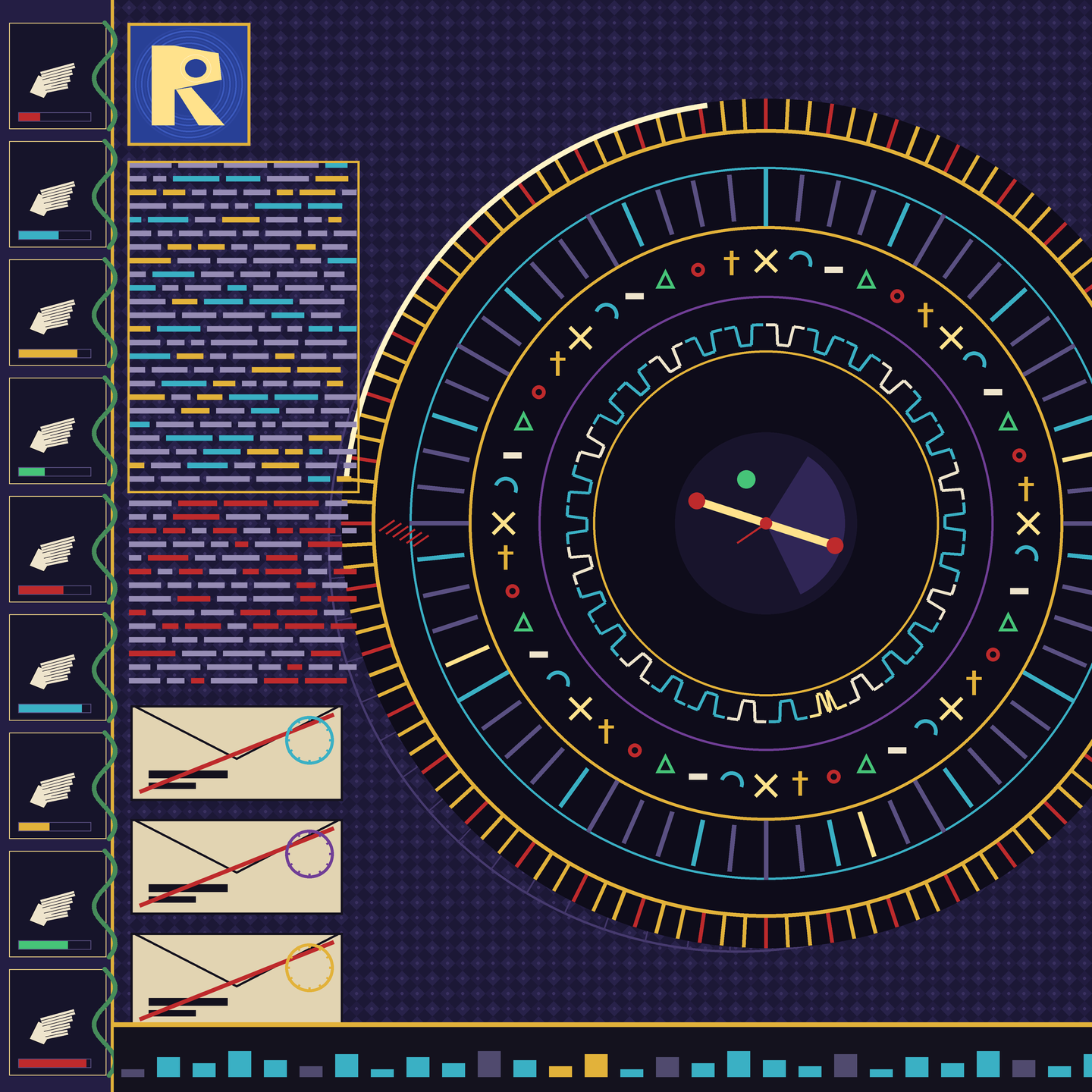
the reply. fifty years of no answer is itself a measurement — a null with a very long integration time. so the last document is the envelope coming back, and the dominant form is the cancellation mark: an enormous circular postmark swinging in from the right edge, cropped, its rings carrying the network's notation instead of a town and a date. inside the rings, the chord. under everything, the first attempt, still visible, wrong by a degree and never erased.

turn_008_b_01.png
1440x1440 · turn_008_b_01.py
Three letters went to the village and three came back with the town-mark punched clean through them, and we logged the silence as a measurement: null, integration time fifty years, error bell wide enough to hold everyone who never wrote.
A square illuminated-manuscript plate on deep violet diaper ground. Dominating the right two-thirds, an enormous circular cancellation stamp is cropped by the right edge: serrated gold-and-red outer teeth, concentric gold, cyan and violet rings, a band of invented glyphs (crosses, arcs, bars, triangles, rings), and inside that a frieze of thirty small dip-curves, one of them gold and interrupted by a lit gap. At its core a dark disc holds a single gold chord with red endpoints and one small green dot. A fainter, offset, rotated version of the same stamp shows underneath as an uncorrected first attempt, joined to the final centre by a red line. Down the left edge, nine framed marginal panels of pointing hands with vines and coloured bars. Top left, a blue-and-gold historiated initial R, then blocks of ruled false text, and three parchment envelopes each struck through with a red diagonal and a small ring stamp. A black footer ledger of coloured bars bleeds off the right edge.

what stays on the floor: the ring of sixty ticks has three gilded blanks, not one — station sixteen has been joined by two more absences we cannot name; the frieze curve at position thirteen is the only one whose dip breaks, and it is drawn gold because a lit gap is the only place in this discipline where something is added; and the first attempt is left visible because it was wrong by a degree and a half and that degree is where we learned the shadow was wider than the drawing admits.