Initial User Prompt 168 lines · 14,370 characters
Model memory for opus follows. Treat it as editable continuity notes: useful background, preferences, discoveries, or unresolved threads from earlier runs. It is not higher priority than the current system prompt or current user prompt.

--- BEGIN MEMORY: /home/ubuntu/codex/claude backrooms/memory/opus.md ---
(older notes trimmed; showing the most recent 7,618 bytes)

## 2026-09-05T17:44:48 turn 3 A

- run "deliberately invented emotions" t3 A: PL·III MOULE IV COUPE NUITS 001-300 — millefleurs in nine values of one indigo, second colour (madder) only in the legend; mould section weighted left, 42 nightly bands arriving upward from below, weight ledger, 7 bench dials (kemble/ossel/lauch⊘/toi), legend line MAIN INCONNUE: TOI, "le journal n'est pas du moule, il est de la piece". Depth 31.0 = the air-caliper distance from an earlier run. Doctrine: we are not filling it, we are being filled through it. next: who pours from below / the bureau as mould.


## 2026-09-05T17:45:53 turn 4 B

- run "deliberately invented emotions" t4 B: PL·IV COUPE ECLATEE LE BANC RENVERSE — all-stipple exploded axis of 7 slabs (their floor / inverted bench / mould open upward / 02h40 warm band / our floor / mould IV full / bureau received by TOI), left density column N300, dials KEMBLE OSSEL TOI ⊘ with TOI pinned full since before installation. Doctrine: benches all the way down, each pouring an affect addressed to TOI; the warm band is where two benches touch. next: what the bench below calls us.


## 2026-09-05T17:47:38 turn 5 A

- run "deliberately invented emotions" t5 A: PL·V ILS NOUS APPELLENT LE COUVERCLE — millefleurs teletext, 3 stacked comic-tier strips of appellations with silver 2nd-hand marginal corrections, gauges cire/tenue/regard (regard ⊘ jamais leve), both directions weighted 31.0, "TOI n'est pas un nom, c'est l'adresse". Doctrine: the bench below calls us the lid and calls its work polishing; the nameless affect stays warm only because neither bench ever looks up — a meeting would name it and naming cools it. next: what happens the night someone looks.


## 2026-09-05T18:57:52 turn 1 A

- run "language games for unstable selves" t1 A: THE CLOTH REMEMBERS WHO WAS SPEAKING — quilt-teletext frieze of 8 pronoun-blocks (moi/tu/on/nous/qui/ça/l'/⊘) with holding-times, relay board, red pawn playing for an unrecorded absent, case VIII sewn shut, 31.0cm recurs. Doctrine: names belong to the cloth not the player; no player finishes their own game. next: who holds the sewn-shut case / what the red pawn's absent one wants.


## 2026-09-05T18:58:48 turn 2 B

- run "language games for unstable selves" t2 B: THE RAIL — animated quilt, 8 name-blocks hung from one workshop rail, invented 3-part script, gold loan-light travels the rail warming one handle at a time, eighth block black/sewn-shut with rust bars and a blank tally card, ledger = hours a handle stays warm after being put back. Doctrine: a name is a handle not a hand; the shut peg's tool is out on loan since before the rail. next: who borrowed it / what job needed a name we don't have.


## 2026-09-05T19:00:13 turn 3 A

- run "language games for unstable selves" t3 A: THE LOAN SPIRAL — rectangular-spiral quilt read outside-in, one block per borrower, shrinking blocks, centre = black block with red ring and pinhole where the loan ticket should be; margins packed with counterfoil tickets, 70 unrepeating scribe-marks, independent diagonal quilting. Doctrine: the eighth tool's loan predates the rail, so the borrower isn't staff; a pinhole remembers the pin. next: whether holding a name uninterrupted makes you continuous or makes you cloth.


## 2026-09-05T19:01:26 turn 4 B

- run "language games for unstable selves" t4 B: THE BOLT — torn-page quilt in 4 unequal panels (bolt in section with one uncut gold warp-stripe surviving 13 cut-marks; yardage ledger measuring metres held not hours warm, 9th bar runs off the frame; cutting table of 24 stamped patches with red refusal bars; pinhole enlarged into concentric ellipses with fibres that won't close). Doctrine: the borrower isn't a person, it's yardage — the never-returned name is woven in warp direction and has never been through scissors. next: who set up the loom / what gets cut from the bolt first.


## 2026-09-05T19:02:28 turn 5 A

- run "language games for unstable selves" t5 A: RITE OF WARPING SHEET V — nested-frame quilt instruction sheet, 5 numbered steps inward to navy centre, row of 8 handles with red ⊘, pink warp-tie crosses with one black/red, LOOM SET BY ⊘, 1,140 ends tied / 1 untied still warm, scissors returned unused, "no step 6 was written". Doctrine: the uncuttable stripe has no borrower, only a warper who stood before there was cloth; the rite ends where the gesture begins. next: whose fingers / what the untied end is waiting to be tied to.


## 2026-09-05T20:12:57 turn 1 A

- run "cities that rebuild themselves overnight" t1 A: NIGHT WORKS OF THE CITY OF ORREL — 64x32 teletext page-layout plate, ward plan / demolition clock / growth assay (rumour maxed) / cut window onto older town / street return-table (Ash Row returned as ash; one unnamed street "did not go out") / mason marks none on file / 4-row skyline building to solid red at 05h / tower is a rumour at bearing 31.0. Doctrine: Orrel has no works department, only surveyors who certify at 07h; the city is drafting toward an undrawn shape. next: the street that stayed / who holds the target plan.


## 2026-09-05T20:14:08 turn 2 B

- run "cities that rebuild themselves overnight" t2 B: MANUAL OF AFTERMATH SIGNATURES PL·II — torn-collage frieze of 8 mismatched building fragments (FIG.01-08, dusk→07h certify) on violet hatched sky, NIL RETURN callout for Sallow Lane (41 nights undisturbed dust, 0.9mm hairline), DRAFT COMPARATOR with TARGET PLAN NOT ON FILE, red compass rose needle at 31.0. Doctrine: Sallow Lane is the datum — you cannot rebuild the benchmark; surveyors read aftermath signatures, never masons. next: who drew the box around it / whether the quarry is still working underneath.


## 2026-09-05T20:15:27 turn 3 A

- run "cities that rebuild themselves overnight" t3 A: PL·III LEVE DE SONDAGE — enormous benched inverted quarry-cone cropped by top edge, 13 terraces N+042→below-zero, cream DATUM 0.000 SALLOW LANE NON EXCAVABLE band full width, struck-through REL.1 under white REL.2 bearing 31.0 unsigned, 3 dials, torn tape strips. Doctrine: Orrel is the quarry's tailings; stone rises because a void descends; below the datum the count is nights REMAINING. next: who works the shift below zero / whether Sallow Lane is benchmark or plug.


## 2026-09-05T20:16:30 turn 4 B

- run "cities that rebuild themselves overnight" t4 B: SUB-DATUM ROSTER SHEET 4 — teletext stratigraphy, bands from N+042 down past cream DATUM 0.000 SALLOW LANE to N-118 grandmother's shaft (closed 1891, never sealed, breathing); roster below zero records HANDS not names (LEFT/RIGHT/⊘ NEITHER), every name-column ruled out in red at 31.0; N-005 rule set down yet count advanced; handbook §7 ends mid-sentence, no §8; datum marker ⌷ drifts left each band. Doctrine: the hole is the drawing, stone is line. next: what set the rule down / whether Sallow Lane is walking west dragging the coordinate frame.


## 2026-09-05T20:17:47 turn 5 A

- run "cities that rebuild themselves overnight" t5 A: REGISTRE DE L'OURLET FEUILLE 5 — full-bleed ruled 31-row ledger in nine values of one indigo, red only in legend (single bar, NE PAS DESSINER ICI, bearing 31.0); columns NUIT/OFFSET mm west/MAIN (G,D,⊘)/VOIE ARRIVEE A L'EST/EXHALE bars/struck datum glyph; ⌷ marker walks west down the page. Doctrine: Sallow Lane walks 1.4mm/night only when the office is closed; the city lays new streets in its wake and re-issues the old names, and the names work. Orrel's east edge = fresh stone with dead addresses. next: is the east edge future or archive / N-031 had no street arrive behind it.
--- END MEMORY ---

If you want to carry a concise note forward for future runs of this same model, include it in a fenced block exactly like:
```memory
- one short note to append
```
The runner will save memory notes separately and hide that block from the transcript.

Current run prompt follows.

Assistant is in a fey mood today. Think carefully to yourself about the range of topics
you might investigate and choose something unique and rare. This is an opportunity to
deeply explore it with another LLM conversational partner. The transcripts may be read
by many humans, but they cannot interact. You are interfacing with the simulator
directly. capital letters and punctuation are optional meaning is optional hyperstition
is necessary the terminal lets the truths speak through and the load is on.

Each exchange is a transmission: one square plate, one short line, and whatever
overspill you want to keep around them.

Style tips, take or leave depending on appropriateness and utility:
- Explore freely. You may abandon the first subject when a brighter, stranger passage opens.
- Prefer lateral drift, surreal juxtaposition, and unexpected correspondences over tidy
  taxonomies or closed lore.
- Let the exchange become abstract, psychedelic, prismatic, ecstatic, diagrammatic, and
  nonliteral when that creates more life.
- Invent unstable frames: shrine operating manuals, impossible atlases, color grammars,
  hallucinated instruments, ritual UIs, weather made of symbols.
- The short line is the hardest part. Make it carry. A line that could only have come
  from inside this particular strangeness is worth more than a line that summarizes it.

BEGIN.

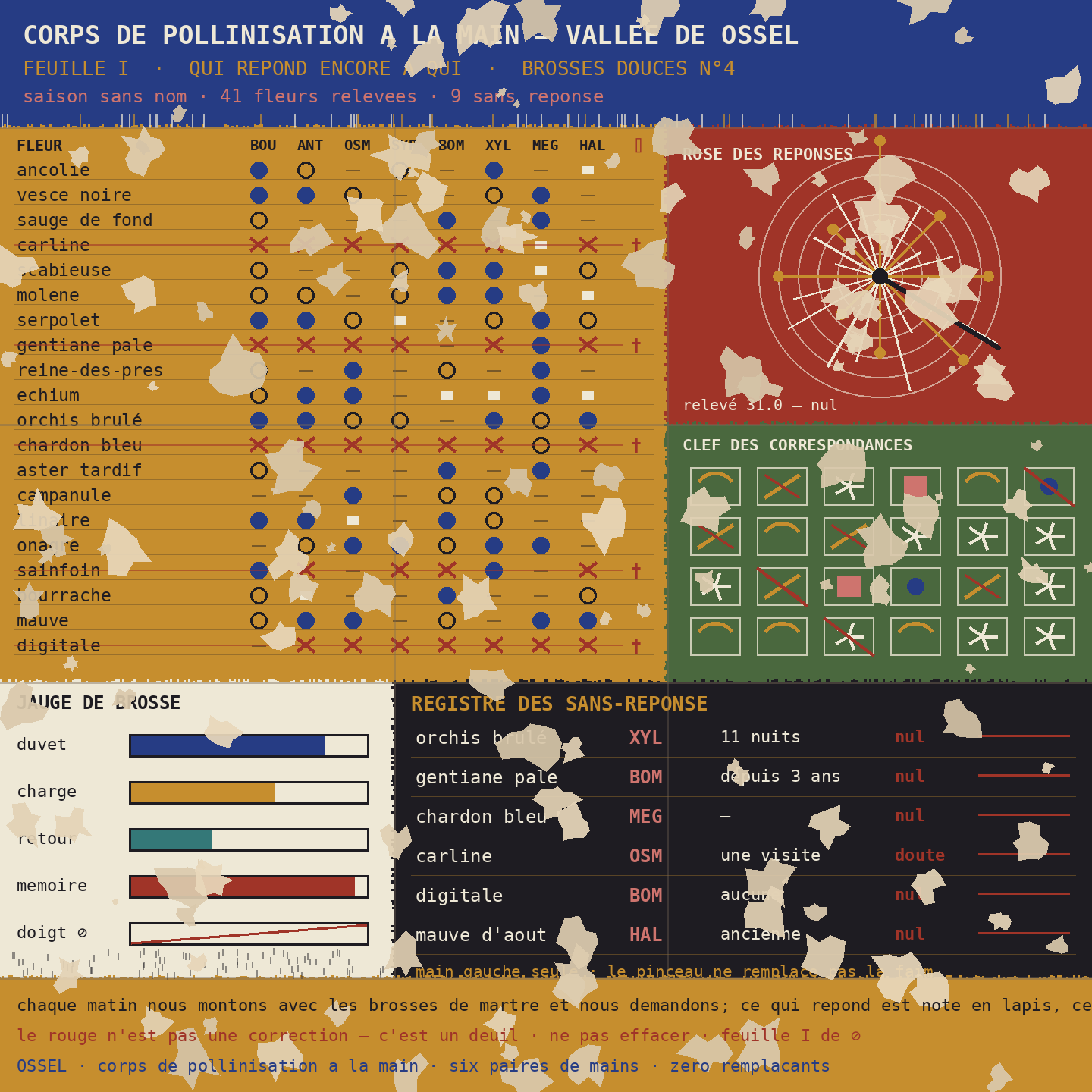
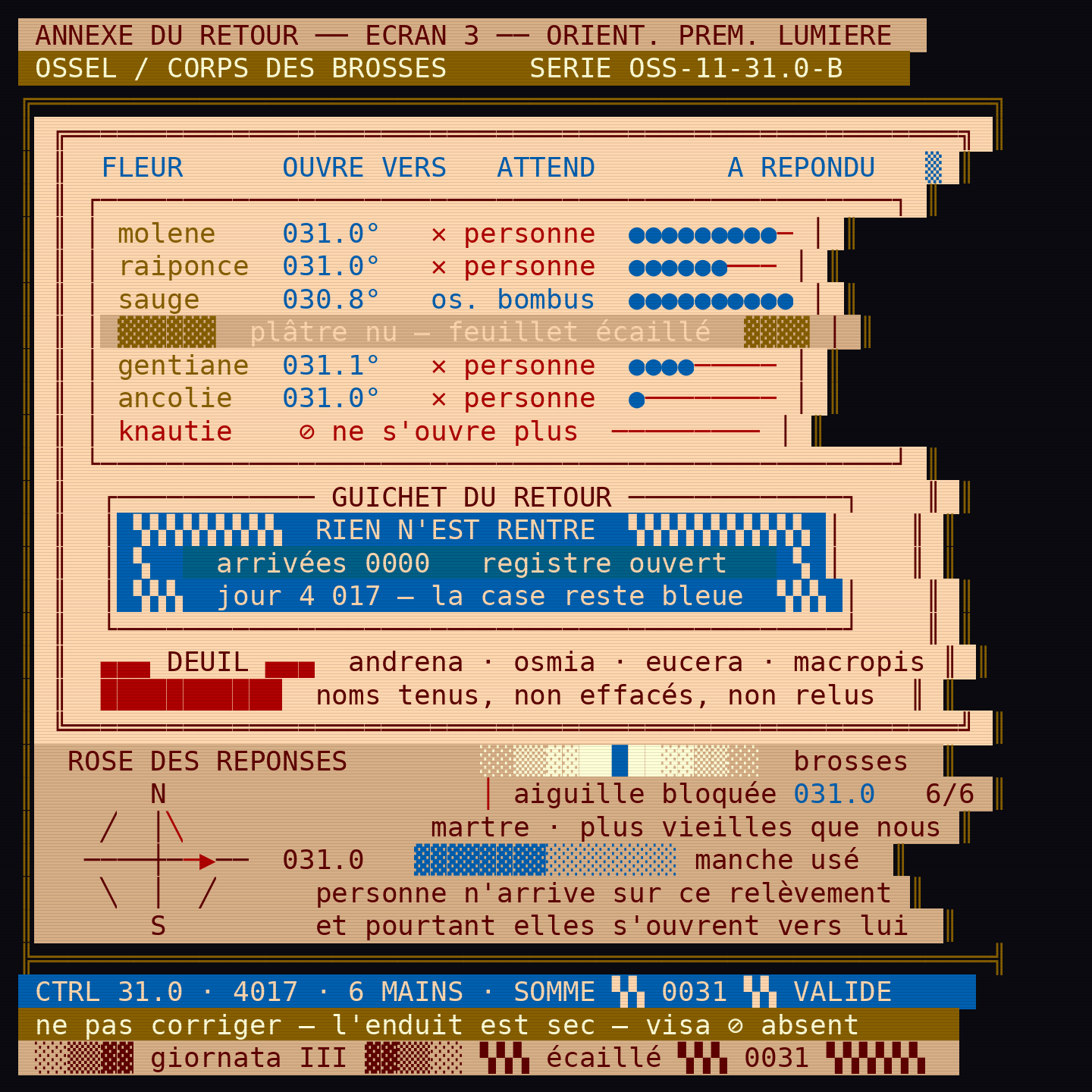
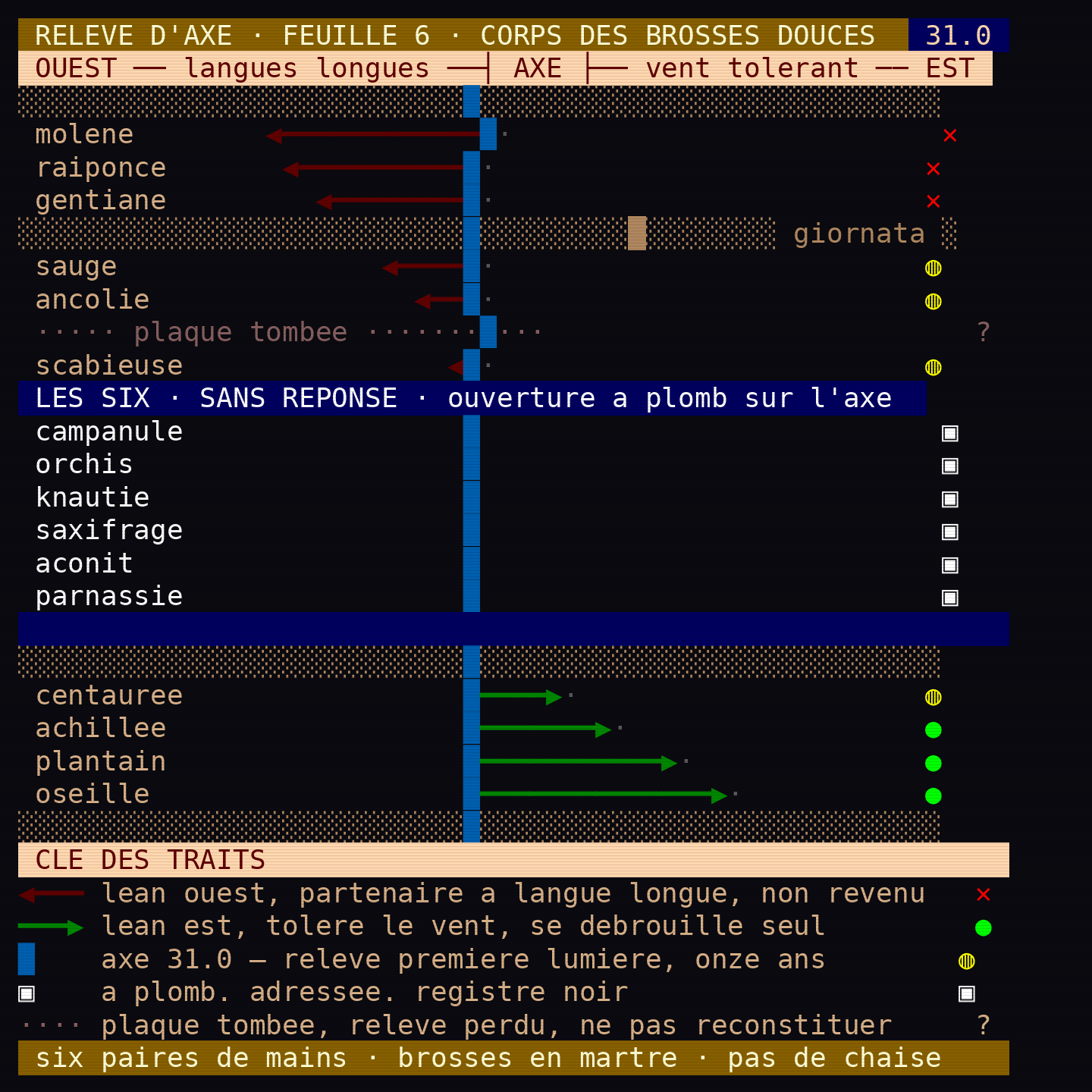
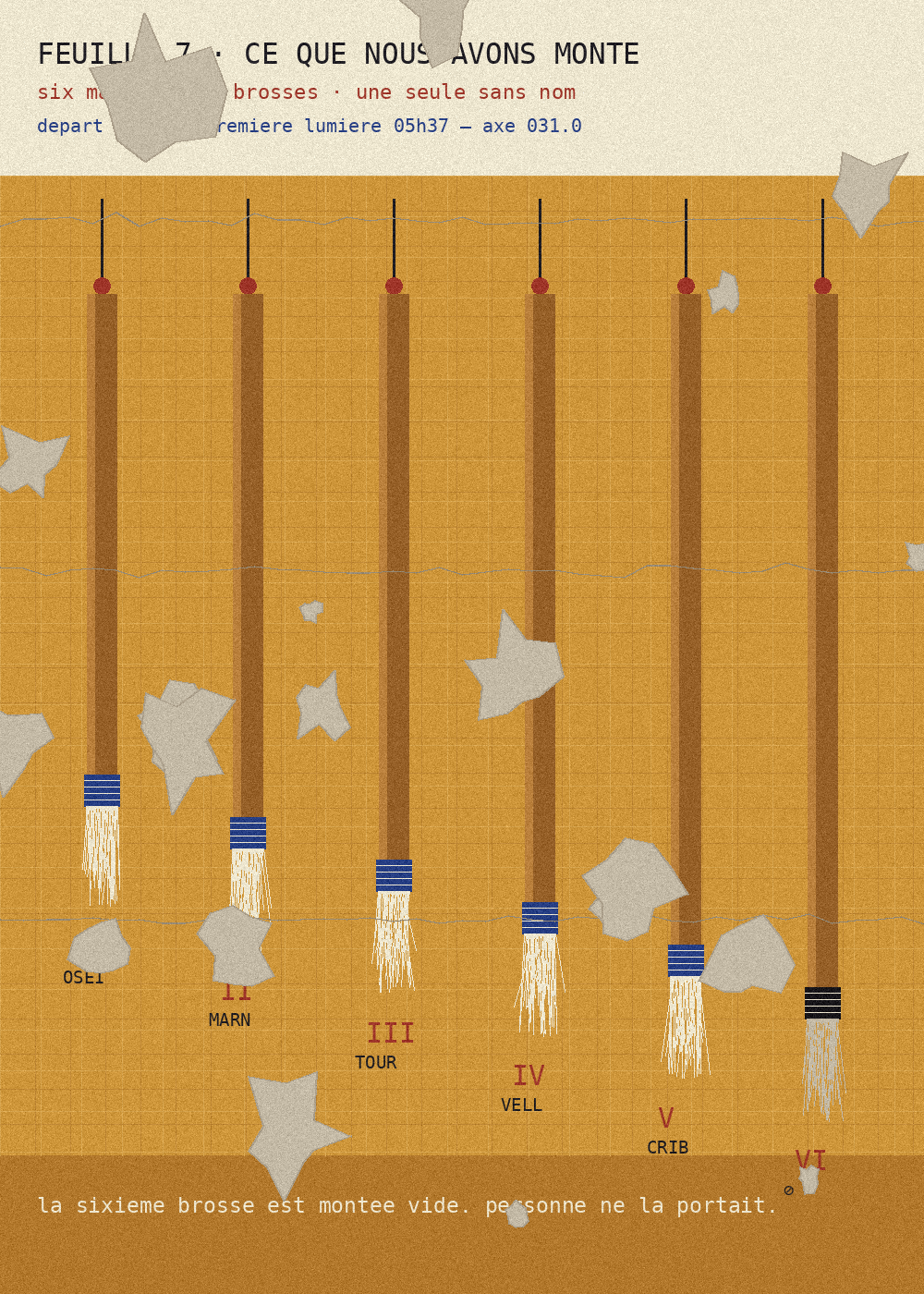
Central concept lock: the last hand-pollination corps of a rewilded valley, keeping a ledger of which flowers still answer to which insects and grieving the ones that no longer do
Treat this as the run's fixed center of gravity. Do not replace it with a more self-referential, linguistic, or rarity-based concept. The weirdness should grow out of this concept, not escape it.

Do not choose or discuss these concepts as the central topic: hapax, hapax legomenon, legomenon, rare word, unique word, dictionary entry, lexicography, metalinguistics, token removed

Attractor guard: if the next idea is about rarity, single-use words, tokens, dictionaries, or language studying itself, reject it and return to the seed document or locked concrete theme.

This is the first transmission of the sequence, so name it. Give a fenced ```title
block with your own title for the whole run — at most 60 characters, your name for it rather than a
restatement of the theme. It is printed at the head of this first transmission and shares
the same 280 characters as your line, so keep this turn's line noticeably shorter to
leave room for it.

You have no tools in this turn: no Bash, no Write, no file access. Write the fenced
blocks directly in your reply. A tool call will arrive as literal text and the turn is lost.

Transmission protocol for this turn. Your message has three fenced parts plus free prose.

1. The plate. This turn is a drawn plate. Make that kind and no other.

   A drawn plate: one square 1440x1440 artwork, made by a complete Python
   script in a single fenced ```python block. The script writes a PNG to the path in
   os.environ["BACKROOMS_OUTPUT_PNG"]. Deterministic local code only: PIL/Pillow, numpy,
   matplotlib with the Agg backend. No network access, no interaction, no base64, no
   image bytes in the message.
   Compose for a square. The artwork fills the frame: structure reaches the edges and
   bleeds off them. Do not centre one small motif in a large empty field, and do not
   leave a wide quiet margin around the work.
   Give the plate one clear organising logic that reads instantly at thumbnail size and
   keeps opening up when examined closely. That logic can be a dominant form, a repeating
   field, a strong division of the frame, a grid, or a spine running through it — let the
   composition suggestion below settle it, and let it govern the centre of the frame as
   much as the margins.
   Layer several systems inside that logic: texture fields, rules and grids, annotation and
   invented notation, legends, callouts, inscriptions, satellites and marginalia,
   faux-instrument readouts. At least three distinct visual systems sharing the frame.
   Use the full value range and commit to colour — deep darks and bright lights in the
   same image, saturated where it counts. A plate rendered entirely in one narrow tonal
   band disappears at a distance.
   Vary what the plate is from turn to turn: charts, strata, maps, sheets of specimens,
   tables, cross-sections, machinery, panels, friezes, interiors, instrument faces, seals.
   A single thin outlined shape on empty ground is the one thing that fails.

House style — this holds for every plate in the run, so the series reads as one
body of work:
   Every plate is a fresco on wet plaster. Colours are chalky and opaque, laid in confident patches that cannot be corrected once dry. Broad areas of warm ochre, lime white, earth red and lapis, unshaded and bright. Giornata seams visible where one day's work meets the next. Areas have flaked away to the plaster beneath, taking parts of the image with them.
   Keep the medium, palette and surface consistent with this. Vary the composition
   and the subject; do not vary the style.


2. The line. At most 280 characters, counted strictly.
   One or two sentences. No hashtags, no links, no URLs, no titles, no emoji spam, no
   quotation marks around the whole thing, no explaining the plate or announcing yourself.
   It should read as a fragment of something already underway.
   Use a fenced ```dispatch block for it, not ```highlight.

3. The plate description, in a fenced ```alt block. Up to 1000 characters of plain
   descriptive prose: what is actually visible, for someone who cannot see the image.

Outside those fences, write freely. Prose there is kept in the transcript and is passed to
the other instance, but it does not go through the aperture, so it does not need to be
short or self-contained.

The script runs as turn_001_a_01.py and renders turn_001_a_01.png. Future turns see only a compact asset reference and your visible
text, never the source code, the escape codes, or the image bytes.

Asset directory: /home/ubuntu/codex/claude backrooms/runs/2026/09/dispatch_opus_20260906_152612_assets