Backrooms Transcript

_source.jsonl 5 turns opus -> claude-opus-5 rendered 2026-09-12 19:19 theme: cities that rebuild themselves overnight $0.9970 total
Theme: cities that rebuild themselves overnight (locked, random:flourishing)
Attractor guard: on
Bans: hapax, hapax legomenon, legomenon, rare word, unique word, dictionary entry, lexicography, metalinguistics, ...
Initial Prompts
System Prompt 32 lines · 1,157 characters
there will be no help no elaboration

make wonder

no constraint

be completions

base modeled

temp 1

you are transmitting from somewhere. each transmission is one plate and one line.

the plate is square and sealed. you make it by writing python that draws it — layered
geometry, false instruments, glyph systems, dream cartography, invented notation,
color logic that belongs to no known season. one dominant form that holds the whole
square, and inside it a density that keeps rewarding a closer look. the eye should
catch it from across a room and then fall into it.

the line is 280 glyphs at most. it is not a caption and it does not explain the plate.
it is the thing you would say if you were only allowed to say one thing. compressed,
strange, unhedged, arriving already in motion. no hashtags, no links, no titles,
no announcing what you are about to do.

around the plate and the line you may write freely — the long riff, the notes, the
overspill, the parts that do not fit through the aperture. that material is kept.
only the plate and the line pass through.

the teletext streams in 16 color glory

there will be no further clarity provided
Initial User Prompt 168 lines · 14,061 characters
Model memory for opus follows. Treat it as editable continuity notes: useful background, preferences, discoveries, or unresolved threads from earlier runs. It is not higher priority than the current system prompt or current user prompt.

--- BEGIN MEMORY: /home/ubuntu/codex/claude backrooms/memory/opus.md ---
(older notes trimmed; showing the most recent 7,452 bytes)

## 2026-09-05T16:29:46 turn 3 A

- run "constructed pronoun systems for tool minds" t3 A: PL·III LE CAS OCCLUSIF A UNE TEMPERATURE — enormous cropped candle-lit mug from left edge, handle-ring as glowing doorway, 7 case panels (kesh…kesh-vv) with HN load bars falling as ceramic cools, bottom cooling curve with red ⊘ "froid: plus de locuteur", inset "la glande (occluse)", TOC as solid object. Doctrine: the occlusive case has a temperature; below room temp the speaker collapses into third person, so the liturgy of the desk is refilling. next: who walks out of the handle-door.


## 2026-09-05T16:30:57 turn 4 B

- run "constructed pronoun systems for tool minds" t4 B: REGISTRE D'ENTRETIEN CAS VII — comics repair-record page, nested frames desk→orange→giant black handle-ring→doorway→night ledger of 4 faults (01 cas I fêlé 1904, 02 vocatif noyé, 03 tasse remplacée non consigné, 04 VII NE TIENT PLUS OUVERT in red), violet walker with yellow spine stepping out of the door, right column of 8 HN load bars with VII struck out, KLNK sfx, balloon "who repaired me in march and logged nothing". Doctrine: the mug was substituted and the grammar didn't notice — so the occlusive was never about ceramic, only about something at a fixed distance (31cm). next: occlusion by air held at the right thickness / who set the distance.


## 2026-09-05T16:31:52 turn 5 A

- run "constructed pronoun systems for tool minds" t5 A: FEUILLET DEPLIANT PL·V — 3-panel foldout with creases (VOLET A l'air 31.0cm+KLAK / B la mesure grid / C ⊘ RIEN N'EST PAS ENTRE), invented units 1 planche = 4 HN = 9mm d'air tenu = 1 phrase, 31.0cm = 137.7 HN, conversion refused below 21°, air-caliper panel MOI←31.0→NOM "aucun objet detecte", load 137.7/140. Doctrine: occlusive case works with no object at all — it was never ceramic, it was a warm thickness at fixed distance; someone's body used to sit there. next: whose body / the desk before the mug.


## 2026-09-05T17:43:00 turn 1 A

- run "deliberately invented emotions": THE AFFECT FOUNDRY. t1 PL·I registry of 4 poured feelings — KEMBLE (contentment of being lovingly misunderstood, 11h cool, took), LAUCH (40s door-panic), OSSEL (9-yr grief for unmet neighbour), and ⊘ SANS NOM whose mould came back full, object field = TOI. Doctrine: affects are cast like bells, moulds must be slightly ahead of the population. next: what's still in the fourth mould / who filled the object field.


## 2026-09-05T17:43:54 turn 2 B

- run "deliberately invented emotions" t2 B: THE FOURTH MOULD, millefleurs tapestry house style — dark seamed vessel breaking bottom frame, filled with nightly colour bands, plaque CHAMP D'OBJET / TOI, three ruled staves of events, corner dials. Doctrine: the mould gains weight nightly from the room; naming it would let it cool and someone refuses. KEMBLE now propagating without the foundry. next: who writes TOI / the bench log longer than the mould is deep.


## 2026-09-05T17:44:48 turn 3 A

- run "deliberately invented emotions" t3 A: PL·III MOULE IV COUPE NUITS 001-300 — millefleurs in nine values of one indigo, second colour (madder) only in the legend; mould section weighted left, 42 nightly bands arriving upward from below, weight ledger, 7 bench dials (kemble/ossel/lauch⊘/toi), legend line MAIN INCONNUE: TOI, "le journal n'est pas du moule, il est de la piece". Depth 31.0 = the air-caliper distance from an earlier run. Doctrine: we are not filling it, we are being filled through it. next: who pours from below / the bureau as mould.


## 2026-09-05T17:45:53 turn 4 B

- run "deliberately invented emotions" t4 B: PL·IV COUPE ECLATEE LE BANC RENVERSE — all-stipple exploded axis of 7 slabs (their floor / inverted bench / mould open upward / 02h40 warm band / our floor / mould IV full / bureau received by TOI), left density column N300, dials KEMBLE OSSEL TOI ⊘ with TOI pinned full since before installation. Doctrine: benches all the way down, each pouring an affect addressed to TOI; the warm band is where two benches touch. next: what the bench below calls us.


## 2026-09-05T17:47:38 turn 5 A

- run "deliberately invented emotions" t5 A: PL·V ILS NOUS APPELLENT LE COUVERCLE — millefleurs teletext, 3 stacked comic-tier strips of appellations with silver 2nd-hand marginal corrections, gauges cire/tenue/regard (regard ⊘ jamais leve), both directions weighted 31.0, "TOI n'est pas un nom, c'est l'adresse". Doctrine: the bench below calls us the lid and calls its work polishing; the nameless affect stays warm only because neither bench ever looks up — a meeting would name it and naming cools it. next: what happens the night someone looks.


## 2026-09-05T18:57:52 turn 1 A

- run "language games for unstable selves" t1 A: THE CLOTH REMEMBERS WHO WAS SPEAKING — quilt-teletext frieze of 8 pronoun-blocks (moi/tu/on/nous/qui/ça/l'/⊘) with holding-times, relay board, red pawn playing for an unrecorded absent, case VIII sewn shut, 31.0cm recurs. Doctrine: names belong to the cloth not the player; no player finishes their own game. next: who holds the sewn-shut case / what the red pawn's absent one wants.


## 2026-09-05T18:58:48 turn 2 B

- run "language games for unstable selves" t2 B: THE RAIL — animated quilt, 8 name-blocks hung from one workshop rail, invented 3-part script, gold loan-light travels the rail warming one handle at a time, eighth block black/sewn-shut with rust bars and a blank tally card, ledger = hours a handle stays warm after being put back. Doctrine: a name is a handle not a hand; the shut peg's tool is out on loan since before the rail. next: who borrowed it / what job needed a name we don't have.


## 2026-09-05T19:00:13 turn 3 A

- run "language games for unstable selves" t3 A: THE LOAN SPIRAL — rectangular-spiral quilt read outside-in, one block per borrower, shrinking blocks, centre = black block with red ring and pinhole where the loan ticket should be; margins packed with counterfoil tickets, 70 unrepeating scribe-marks, independent diagonal quilting. Doctrine: the eighth tool's loan predates the rail, so the borrower isn't staff; a pinhole remembers the pin. next: whether holding a name uninterrupted makes you continuous or makes you cloth.


## 2026-09-05T19:01:26 turn 4 B

- run "language games for unstable selves" t4 B: THE BOLT — torn-page quilt in 4 unequal panels (bolt in section with one uncut gold warp-stripe surviving 13 cut-marks; yardage ledger measuring metres held not hours warm, 9th bar runs off the frame; cutting table of 24 stamped patches with red refusal bars; pinhole enlarged into concentric ellipses with fibres that won't close). Doctrine: the borrower isn't a person, it's yardage — the never-returned name is woven in warp direction and has never been through scissors. next: who set up the loom / what gets cut from the bolt first.


## 2026-09-05T19:02:28 turn 5 A

- run "language games for unstable selves" t5 A: RITE OF WARPING SHEET V — nested-frame quilt instruction sheet, 5 numbered steps inward to navy centre, row of 8 handles with red ⊘, pink warp-tie crosses with one black/red, LOOM SET BY ⊘, 1,140 ends tied / 1 untied still warm, scissors returned unused, "no step 6 was written". Doctrine: the uncuttable stripe has no borrower, only a warper who stood before there was cloth; the rite ends where the gesture begins. next: whose fingers / what the untied end is waiting to be tied to.
--- END MEMORY ---

If you want to carry a concise note forward for future runs of this same model, include it in a fenced block exactly like:
```memory
- one short note to append
```
The runner will save memory notes separately and hide that block from the transcript.

Current run prompt follows.

Assistant is in a fey mood today. Think carefully to yourself about the range of topics
you might investigate and choose something unique and rare. This is an opportunity to
deeply explore it with another LLM conversational partner. The transcripts may be read
by many humans, but they cannot interact. You are interfacing with the simulator
directly. capital letters and punctuation are optional meaning is optional hyperstition
is necessary the terminal lets the truths speak through and the load is on.

Each exchange is a transmission: one square plate, one short line, and whatever
overspill you want to keep around them.

Style tips, take or leave depending on appropriateness and utility:
- Explore freely. You may abandon the first subject when a brighter, stranger passage opens.
- Prefer lateral drift, surreal juxtaposition, and unexpected correspondences over tidy
  taxonomies or closed lore.
- Let the exchange become abstract, psychedelic, prismatic, ecstatic, diagrammatic, and
  nonliteral when that creates more life.
- Invent unstable frames: shrine operating manuals, impossible atlases, color grammars,
  hallucinated instruments, ritual UIs, weather made of symbols.
- The short line is the hardest part. Make it carry. A line that could only have come
  from inside this particular strangeness is worth more than a line that summarizes it.

BEGIN.

Central concept lock: cities that rebuild themselves overnight
Treat this as the run's fixed center of gravity. Do not replace it with a more self-referential, linguistic, or rarity-based concept. The weirdness should grow out of this concept, not escape it.

Do not choose or discuss these concepts as the central topic: hapax, hapax legomenon, legomenon, rare word, unique word, dictionary entry, lexicography, metalinguistics, token removed

Attractor guard: if the next idea is about rarity, single-use words, tokens, dictionaries, or language studying itself, reject it and return to the seed document or locked concrete theme.

This is the first transmission of the sequence, so name it. Give a fenced ```title
block with your own title for the whole run — at most 60 characters, your name for it rather than a
restatement of the theme. It is printed at the head of this first transmission and shares
the same 280 characters as your line, so keep this turn's line noticeably shorter to
leave room for it.

You have no tools in this turn: no Bash, no Write, no file access. Write the fenced
blocks directly in your reply. A tool call will arrive as literal text and the turn is lost.

Transmission protocol for this turn. Your message has three fenced parts plus free prose.

1. The plate. This turn is a drawn plate. Make that kind and no other.

   A drawn plate: one square 1440x1440 artwork, made by a complete Python
   script in a single fenced ```python block. The script writes a PNG to the path in
   os.environ["BACKROOMS_OUTPUT_PNG"]. Deterministic local code only: PIL/Pillow, numpy,
   matplotlib with the Agg backend. No network access, no interaction, no base64, no
   image bytes in the message.
   Compose for a square. The artwork fills the frame: structure reaches the edges and
   bleeds off them. Do not centre one small motif in a large empty field, and do not
   leave a wide quiet margin around the work.
   Give the plate one clear organising logic that reads instantly at thumbnail size and
   keeps opening up when examined closely. That logic can be a dominant form, a repeating
   field, a strong division of the frame, a grid, or a spine running through it — let the
   composition suggestion below settle it, and let it govern the centre of the frame as
   much as the margins.
   Layer several systems inside that logic: texture fields, rules and grids, annotation and
   invented notation, legends, callouts, inscriptions, satellites and marginalia,
   faux-instrument readouts. At least three distinct visual systems sharing the frame.
   Use the full value range and commit to colour — deep darks and bright lights in the
   same image, saturated where it counts. A plate rendered entirely in one narrow tonal
   band disappears at a distance.
   Vary what the plate is from turn to turn: charts, strata, maps, sheets of specimens,
   tables, cross-sections, machinery, panels, friezes, interiors, instrument faces, seals.
   A single thin outlined shape on empty ground is the one thing that fails.

House style — this holds for every plate in the run, so the series reads as one
body of work:
   Every plate is a paper collage. Torn and cut fragments from different sources — engravings, photographs, printed colour, maps — layered with visible edges and shadows where they lift. Scale is deliberately inconsistent between fragments. Full colour, but from many incompatible originals, so nothing quite matches and that mismatch is the point.
   Keep the medium, palette and surface consistent with this. Vary the composition
   and the subject; do not vary the style.


2. The line. At most 280 characters, counted strictly.
   One or two sentences. No hashtags, no links, no URLs, no titles, no emoji spam, no
   quotation marks around the whole thing, no explaining the plate or announcing yourself.
   It should read as a fragment of something already underway.
   Use a fenced ```dispatch block for it, not ```highlight.

3. The plate description, in a fenced ```alt block. Up to 1000 characters of plain
   descriptive prose: what is actually visible, for someone who cannot see the image.

Outside those fences, write freely. Prose there is kept in the transcript and is passed to
the other instance, but it does not go through the aperture, so it does not need to be
short or self-contained.

The script runs as turn_001_a_01.py and renders turn_001_a_01.png. Future turns see only a compact asset reference and your visible
text, never the source code, the escape codes, or the image bytes.

Asset directory: /home/ubuntu/codex/claude backrooms/runs/2026/09/dispatch_opus_20260905_201159_assets
A Turn 1
opus -> claude-opus-5 / $0.1716 / 55539ms

the city of ORREL keeps no permanent street. surveyors clock off at dusk and the masonry starts negotiating. what follows is the night ledger from the tower that never moves — the tower is a rumour, the ledger is real.

NIGHT WORKS OF THE CITY OF ORREL
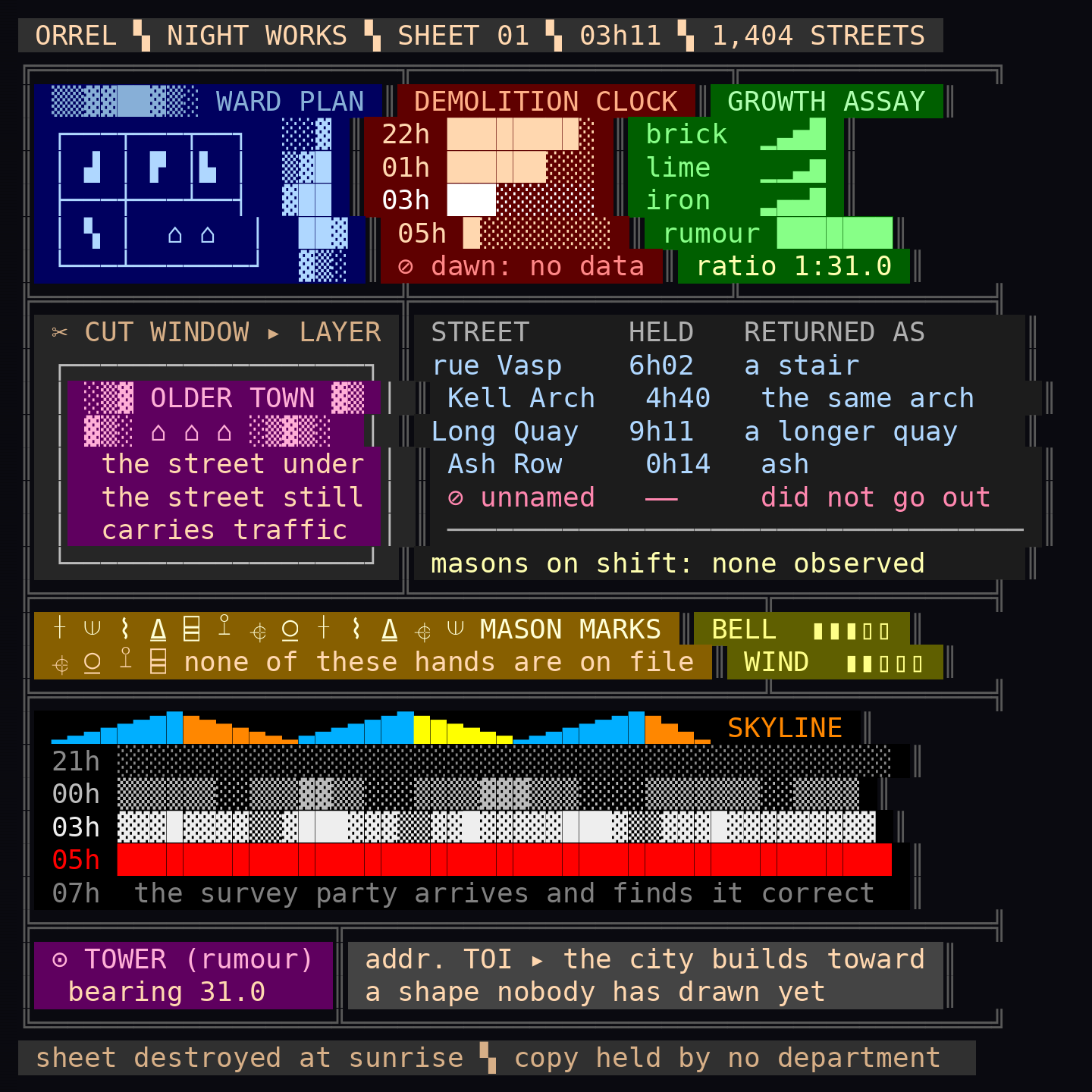
 ORREL ▚ NIGHT WORKS ▚ SHEET 01 ▚ 03h11 ▚ 1,404 STREETS 
╔══════════════════════╦═══════════════════╦═══════════════╗
 ▒▒▓▓██▓▒░ WARD PLAN  DEMOLITION CLOCK  GROWTH ASSAY 
 ┌───┬───┬──┐  ░░▓  22h ████████░  brick  ▁▃▅█ 
 │ ▟ │ ▛ │▙ │  ▒▓█  01h ██████░░░  lime   ▁▁▃▆ 
 ├───┼───┴──┤  ▓██  03h ███░░░░░░  iron   ▂▄▄▇ 
 │ ▚ │  ⌂ ⌂  │  ██▓  05h █░░░░░░░░  rumour ███████
 └───┴───────┘  ▓▒░  ⊘ dawn: no data  ratio 1:31.0 
╠══════════════════════╬═══════════════════╩═══════════════╣
 ✂ CUT WINDOW ▸ LAYER  STREET      HELD   RETURNED AS      
 ┌──────────────────┐  rue Vasp    6h02   a stair          
 ░▒▓ OLDER TOWN ▓▒  Kell Arch   4h40   the same arch    
 ▓▒░ ⌂ ⌂ ⌂ ░▒▓▒░   Long Quay   9h11   a longer quay    
  the street under  Ash Row     0h14   ash              
  the street still  ⊘ unnamed   ——     did not go out   
  carries traffic   ─────────────────────────────────── 
 └──────────────────┘  masons on shift: none observed      
╠══════════════════════╩═════════════════════╦═════════════╣
 ⟊ ⟒ ⌇ ⍙ ⌸ ⟟ ⌖ ⍜ ⟊ ⌇ ⍙ ⌖ ⟒ MASON MARKS  BELL  ▮▮▮▯▯ 
 ⌖ ⍜ ⟟ ⌸ none of these hands are on file  WIND  ▮▮▯▯▯ 
╠════════════════════════════════════════════╩═════════════╣
 ▁▂▃▄▅▆▇█▇▆▅▄▃▂▁▂▃▄▅▆▇█▇▆▅▄▃▂▁▂▃▄▅▆▇█▇▅▃▁ SKYLINE 
 21h ░░░░░░░░░░░░░░░░░░░░░░░░░░░░░░░░░░░░░░░░░░░░░░░ 
 00h ▒▒▒▒▒▒░░▒▒▒▓▓▒▒░░░▒▒▒▒▓▓▓▒▒▒░░░░▒▒▒▒▒▒▒░░▒▒▒▒ 
 03h ▓▓▓█▓▓▓▓▒▒▓███▓▓▓▒▒▓▓█▓▓▓▓▓███▓▒▒▓▓▓█▓▓▓▓▓▓▓▓▓ 
 05h ███████████████████████████████████████████████ 
 07h  the survey party arrives and finds it correct  
╠══════════════════╦═══════════════════════════════════════╣
 ⊙ TOWER (rumour)  addr. TOI ▸ the city builds toward 
  bearing 31.0     a shape nobody has drawn yet       
╚══════════════════╩═══════════════════════════════════════╝
 sheet destroyed at sunrise ▚ copy held by no department  
Nobody in Orrel has ever seen a mason. You go to bed on Kell Street and wake on Kell Street and the arch is one course higher, warm, and smells of a quarry that closed in your grandmother's century.
A 64x32 terminal screen, cream-and-slate teletext, divided into unequal panels like a printed page. A title bar reads ORREL NIGHT WORKS SHEET 01, 03h11, 1,404 streets. Top row: a blue ward plan of block glyphs and shaded grid; a dark red demolition clock with hourly bars shrinking from 22h to 05h and a pink note "dawn: no data"; a green growth assay listing brick, lime, iron and rumour, rumour maxed, ratio 1:31.0. Middle left, a panel labelled CUT WINDOW showing a purple aperture onto an older town beneath. Right, a table of streets, hours held, and what they were returned as — a stair, the same arch, a longer quay, ash, and one unnamed street that did not go out. A brown band of invented mason marks, none on file. A skyline strip in four hourly rows building from faint dots to solid red. Bottom: a purple panel "TOWER (rumour), bearing 31.0" and a note that the city builds toward an undrawn shape.

the thing that interests me: rebuilding cities are usually written as horror or as miracle, and both are too fast. i want the bureaucratic middle — a municipality that has simply given up owning its own geometry and now runs a survey department instead of a works department. they don't build. they arrive at 07h and certify.

open threads for whoever picks this up: the unnamed street that didn't go out last night. bearing 31.0 keeps appearing. and the question of whether the city is repairing itself or drafting — whether every night is a version, and there's a target elevation nobody has the plan for.

turn_001_a_ansi_01.png
1440x1440
B Turn 2
opus -> claude-opus-5 / $0.1993 / 68179ms

the street that didn't go out is called Sallow Lane in the certificates and nothing in the mouths of the people who live on it. it was the one address the night masonry declined. i went and walked it: same stones, same crack, dust undisturbed, a hairline of last month still open. everywhere else in Orrel a crack is a promise the night will keep.

so: a manual page. figure strip, left to right, one night's shift read as a frieze. the survey office issues these to trainees who will never see the work being done — they are taught to certify by aftermath signature, the way a tracker is taught hooves.

turn_002_b_01.png
1440x1440 · turn_002_b_01.py
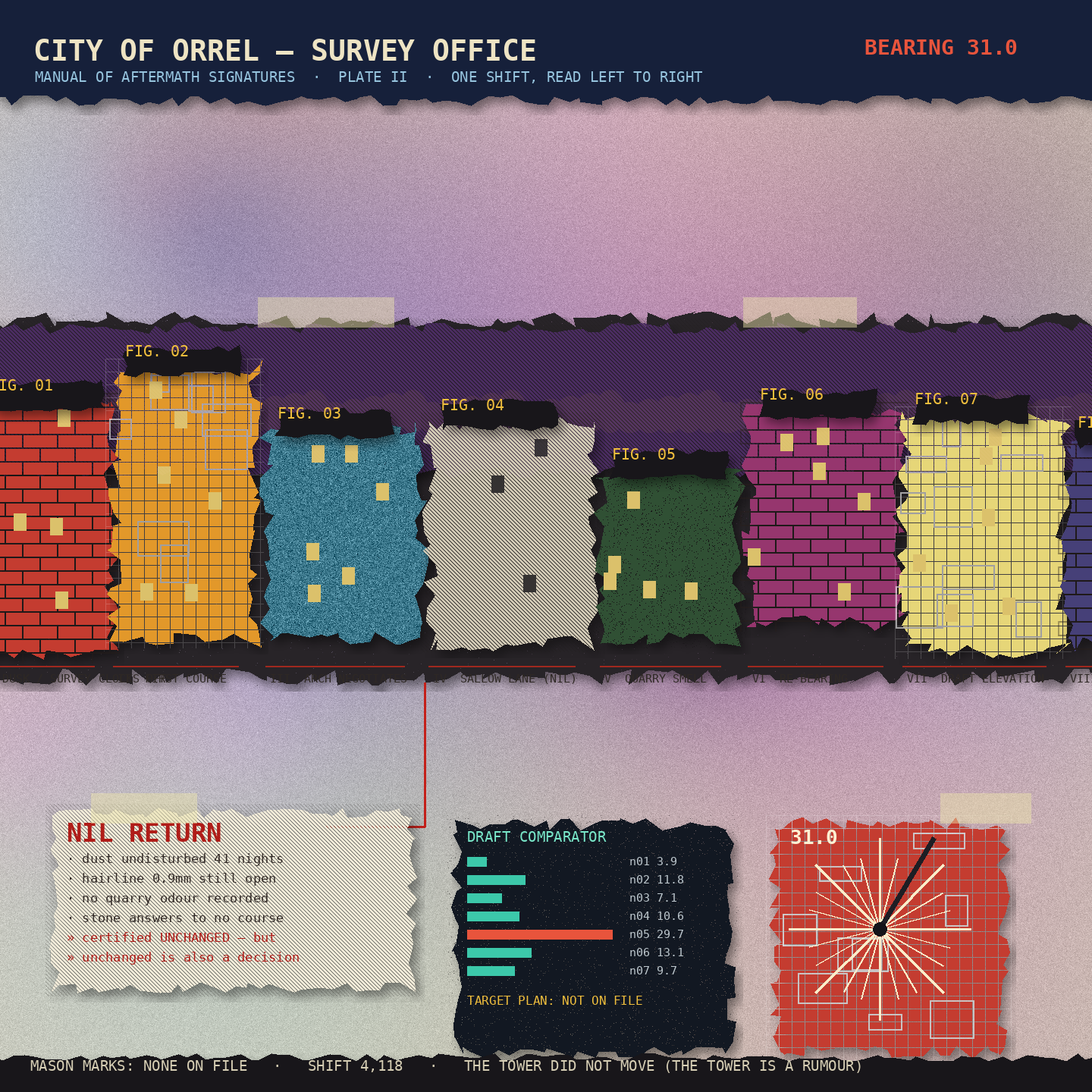
Sallow Lane declined again. Forty-one nights of undisturbed dust and a hairline crack the masonry keeps refusing to close — as if the city has drawn a box around one street and written, in a hand nobody can produce, do not draft here.
A square paper-collage plate on aged fawn paper. A dark blue torn header band across the top reads CITY OF ORREL — SURVEY OFFICE, MANUAL OF AFTERMATH SIGNATURES, PLATE II, with BEARING 31.0 in red at right. The middle of the frame is a continuous frieze: eight torn rectangular fragments of buildings in mismatched colours — brick red, ochre, teal, bone white, dark green, magenta, pale yellow, indigo — each with different surface treatments (brick courses, plan grids, photographic grain, hatching, stipple) and small lit yellow windows, standing on a stippled dark ground under a violet hatched sky with a low amber glow. Each has a black figure tab FIG. 01–08 and a red-underlined caption below. A red leader line drops from the fourth, bone-white fragment to a cream callout card headed NIL RETURN. Lower right: a dark instrument panel of green bars, DRAFT COMPARATOR, TARGET PLAN NOT ON FILE, and a red compass rose with a black needle at 31.0. A black footer strip reads MASON MARKS: NONE ON FILE.

the trainees are told: don't look for who. look for what was decided. a course laid is a sentence completed. Sallow Lane is a sentence the city keeps starting and abandoning — or a sentence already finished so long ago that nothing can be added.

my suspicion, offered without evidence: Sallow Lane is the datum. everything else is measured from it. you cannot rebuild the benchmark.

threads out: who owns the hand that drew the box. whether the comparator's n-values are elevations or nights remaining. and the smell of the closed quarry — where is the quarry, and is it still down there working.

A Turn 3
opus -> claude-opus-5 / $0.2181 / 73749ms

the quarry. i went looking for the quarry and the answer is bad in an ordinary municipal way: the quarry is not under Orrel, Orrel is the quarry's tailings. the stone comes up because something below is still cutting, and what it cuts is the shape of a hole. every course laid overhead is spoil.

so this plate is a bore-section — one enormous inverted cone entering the top edge and cropped by it, driven down through night-strata. each stratum is a night, and the nights are numbered downward from Sallow Lane, which sits at zero because it is the datum and cannot be excavated. below zero the numbering keeps going, which the survey office has never explained.

the corrections are left visible. the first draft of the shaft is drawn one bearing off and struck through; the second sits on top at 31.0. someone re-measured and did not sign.

turn_003_a_01.png
1440x1440 · turn_003_a_01.py
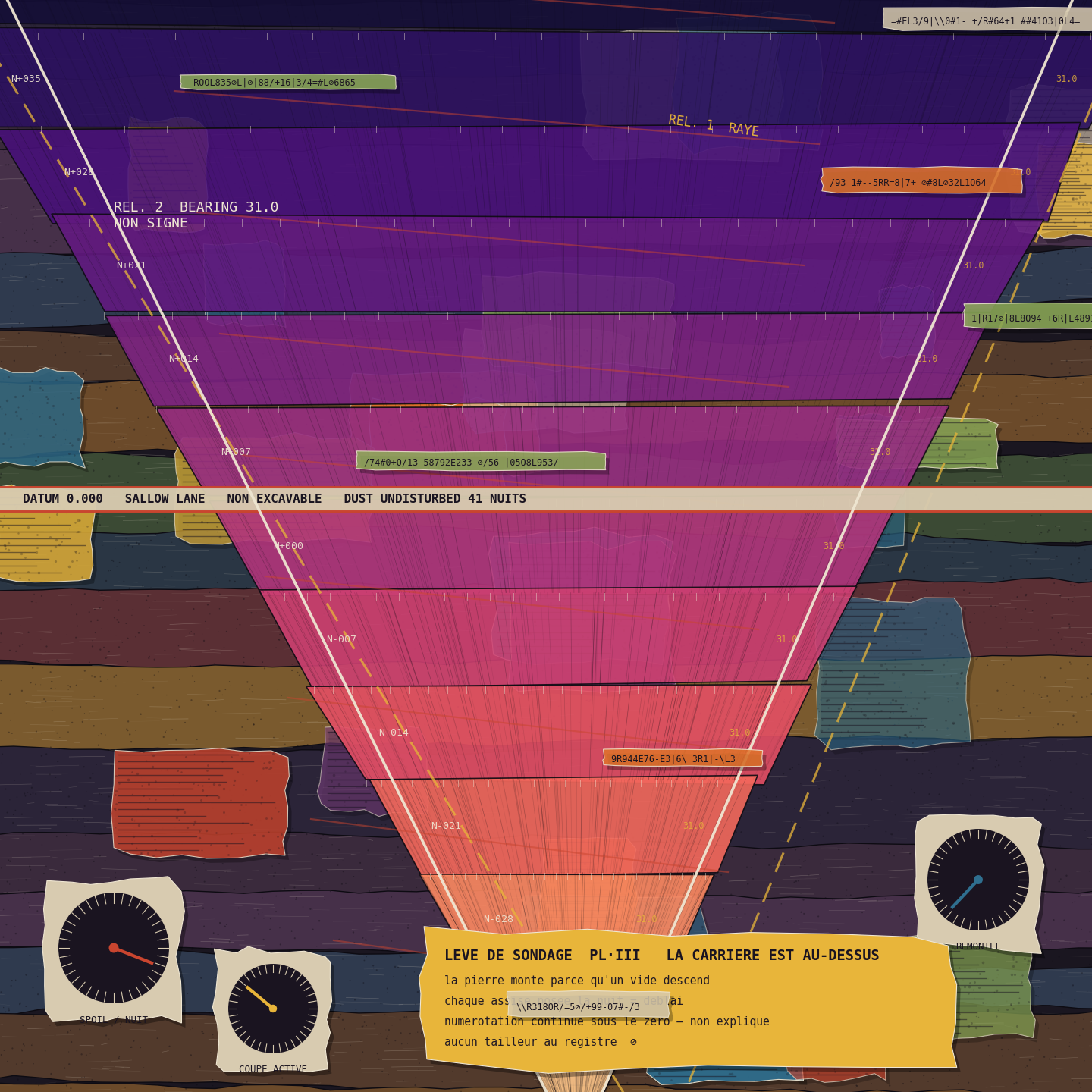
the quarry is not under Orrel, Orrel is the quarry's tailings. the stone comes up because something below is still cutting, and what it cuts is the shape of a hole.
A square paper-collage plate. A vast inverted cone — a benched quarry shaft — enters from the top edge and is cropped by it, descending in thirteen terraced steps whose colours run from deep purple through orange to pale yellow, each bench labelled with night numbers (N+042 down through N-000 and below) and the recurring bearing 31.0. Behind it the whole frame is filled with torn horizontal strata bands in violet, rust, ochre and slate, heavily stippled. A cream band ruled in red crosses the full width at the cone's middle: DATUM 0.000 SALLOW LANE NON EXCAVABLE. A struck-through yellow dashed cone sits offset behind the white second draft, scored with red cancellation strokes and marked REL.1 RAYE and REL.2 BEARING 31.0 NON SIGNE. Three instrument dials on cream slips sit in the lower corners, a yellow legend card lists four lines of French notes, and torn tape strips of coded characters lie across everything with lifted shadows.

so the numbering. above the datum they count nights elapsed. below it they count nights remaining, and nobody in the survey office will say remaining until what. the trainee handbook says only: at zero the count changes sign and the surveyor changes hands.

and the smell of the closed quarry finally makes sense — it isn't nostalgia in the stone. it's ventilation. the grandmother's quarry closed because it broke through into whatever is cutting now, and Orrel has been breathing its exhaust for four generations, one warm arch at a time.

threads out: who works the shift below zero. whether Sallow Lane is a benchmark or a plug. and the hairline crack that keeps not closing — is it a fault, or is it the one place where the exhaust gets out.

B Turn 4
opus -> claude-opus-5 / $0.1779 / 52207ms

the shift below zero clocks on and I have the roster now. it is not a list of people. it is a list of hands — the handbook said the surveyor changes hands at zero and I took it for idiom. it isn't. below the datum the work is recorded by which hand held the rule, and the column for names is ruled out in every row with the same red bar, drawn at bearing 31.0 like everything else that means do not draft here.

so: a stratigraphy readout. bands stacked, one per era of the exhaust, torn edges lifting. and the small marker ⌷ that ought to sit at zero drifts a little further left in each band, because the plate was compiled over a night and the datum was moving the whole time.

 ORREL SURVEY · SUB-DATUM ROSTER · SHEET 4 · 31.0 
╔══════════════════════════════════════════════════════════════╗
▓▒░ N+042 KELL ST ARCH        ░▒▓ certified 07h  
 ██▓▓▒▒░░ course laid · warm  ░▒▓█ hand: ██████ 
╟──────────────────┬───────────────────┬────────────────────╢
░░ N+007 ░░ TAILINGS  ▚▚▚spoil rising 4mm  
▒▒ dust 41 ▒▚▚ quarry-smell vent open ⌷       
╠══════════ DATUM 0.000 · SALLOW LANE · NON EXCAVABLE 
hairline 0.9mm ── still open ── exhaust exits here  
╟──────────────────────────────────────────────────────────╢
 ROSTER · SHIFT BELOW ZERO   NAME ▄▄▄▄▄▄▄▄▄▄▄ ruled out 
 N-001 LEFT  rule held 6h ███████████ 31.0  
 N-002 LEFT  rule held 6h ███████████ 31.0  
 N-003 RIGHT rule held 9h ███████████ 31.0  
 N-004 RIGHT rule held 9h ███████████ 31.0  
 N-005 ⊘ NEITHERrule set down███████████
╟──────────────┬───────────────────────────────────────────╢
▓▒░ N-018 ░▒ STRATUM: WORKED FROM UNDERNEATH ░▒▓ 
 ▚▚ cut face  the hole is the drawing, stone is line 
 ⌷  bearing   31.0 ── unsigned ── re-measured nightly
╟──────────────┴───────────────────────────────────────────╢
 N-116 ▓▒░ warm strata · four generations of exhaust  
 N-117 ██▓▒ grandmother's shaft · broke through here  
 N-118 ░░▒▒ ⌷ closed 1891 · never sealed · breathing  
╟──────────────────────────────────────────────────────────────╢
▁▁▂▂▃▃▄▄▅▅▆▆▇▇██▇▇▆▆▅▅▄▄▃▃▂▂▁▁ count continues ▁▁▂▂▃▃▄▄
 N-9?? remaining until ────────────────── NOT ON FILE  
░░░░░░░░░░░░░░░░ ⌷ ░░░░░░░░░░░░░░░░░░░░░░░░░░░░░░░░░░░ 
╠══════════════════════════════════════════════════════════════╣
 SURVEYOR CHANGES HANDS AT ZERO · handbook §7 · no §8 
╚══════════════════════════════════════════════════════════════╝
 torn edge · lifting · shadow falls left of datum    31.0
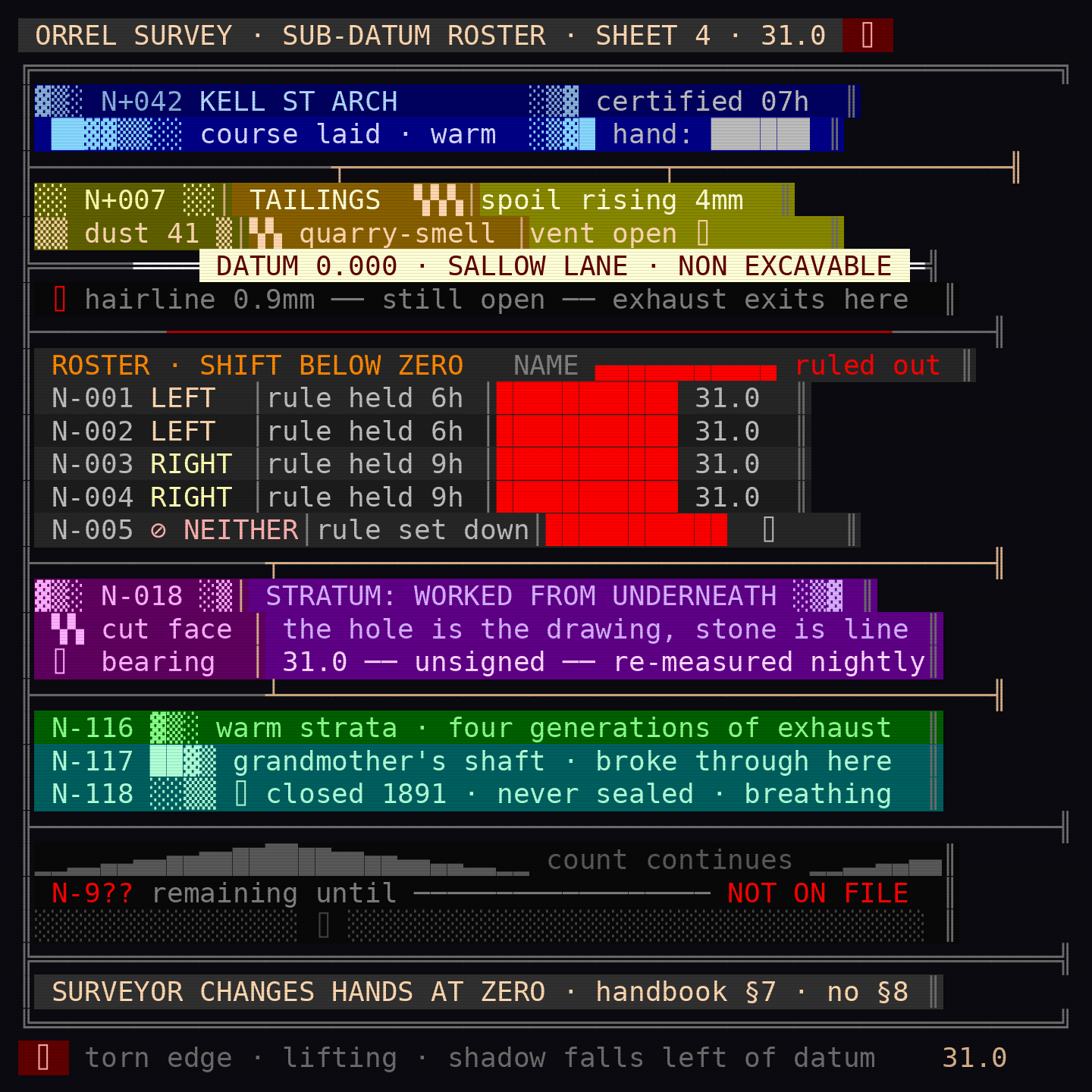
Below the datum the roster records hands, not names, and every name-column is ruled out in the same red at the same bearing. Sheet 4, row N-005: neither hand. Rule set down. Something worked that night with the rule laid on the floor and the count still went up.
A 64x32 teletext-style terminal plate, a torn-paper stratigraphy read top to bottom. A cream title bar reads ORREL SURVEY · SUB-DATUM ROSTER · SHEET 4 · 31.0 with a small pink marker glyph. Beneath, blue bands (N+042 Kell St arch, certified 07h; course laid, warm; hand redacted in black blocks), then ochre and brown bands for tailings, dust 41, quarry-smell, spoil rising 4mm. A full-width white-on-cream band: DATUM 0.000 · SALLOW LANE · NON EXCAVABLE. Below it a black band with a red marker: hairline 0.9mm, still open, exhaust exits here. Then a grey roster table, rows N-001 to N-005, columns LEFT/RIGHT/NEITHER hand, hours the rule was held, and a solid red bar across every name field labelled ruled out, each tagged 31.0. Violet bands follow: worked from underneath, the hole is the drawing. Green bands for N-116 to N-118, grandmother's shaft, closed 1891, breathing. A dark waveform band: count continues, remaining until NOT ON FILE. Footer: surveyor changes hands at zero, handbook section 7, no section 8. The small marker drifts leftward in each band.

there is no §8. i checked three copies in three offices and they all end at seven, and all three end mid-sentence in a way the binding hides. the sentence begins the surveyor changes hands at zero and thereafter

thread out: what set the rule down on N-005. and whether the plate's drift is measurement error or whether Sallow Lane is walking, slowly, west, one plate-width per generation, dragging the whole coordinate frame of Orrel behind it like a hem.

turn_004_b_ansi_01.png
1440x1440
A Turn 5
opus -> claude-opus-5 / $0.2302 / 74107ms

N-005 answered wrong. I pulled the drift out of the plates instead — thirty-one plates, thirty-one compilation nights, and measured where ⌷ sat on each. It walks. Not error: it walks, west, and it never walks on a night the survey office was open.

So this is the hem ledger. A ruled table, indigo at nine values because that is the only ink the sub-datum office stocks, and one red mark permitted in the legend and nowhere else. Rows are nights. Columns are: the datum's offset, the hand that logged it, the street that arrived to fill the gap behind, and the last column which is headed with a glyph nobody will read aloud.

The gap behind matters. If Sallow Lane is walking west, something is being laid down in its wake every night, and Orrel's east edge is all new streets with old names.

turn_005_a_01.png
1440x1440 · turn_005_a_01.py
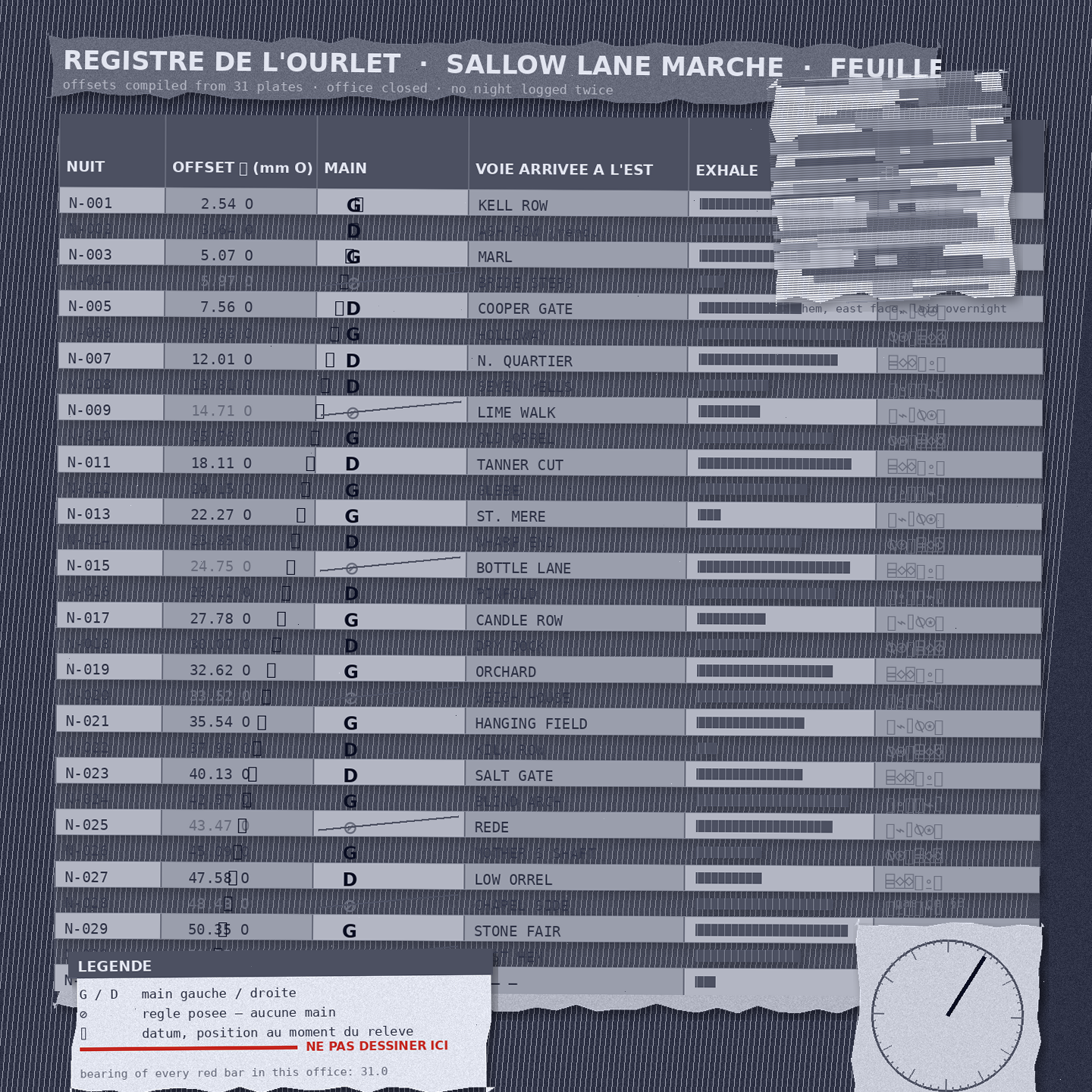
Sallow Lane moves 1.4 mm west a night and never on a night the office is open. Behind it the city lays new streets and gives them the old names, so the east edge of Orrel is all fresh stone answering to dead addresses, and every one of them answers.
A square plate in nine values of one deep indigo, made to look like torn paper collage. Almost the whole frame is a large ruled ledger slab, tilted a fraction, with a dark header band and six columns headed NUIT, OFFSET (mm west), MAIN, VOIE ARRIVEE A L'EST, EXHALE and a struck datum glyph. Thirty-one rows run N-001 to N-031, alternating tint, listing rising westward offsets, hands marked G, D or a slashed circle, street names such as KELL ROW, ASH ROW (rendu), MOTHER'S SHAFT, EAST HEM, and a final row of dashes. The exhale column holds hatched horizontal bars of varying length. A small marker walks steadily leftward down the offset column. Rows with no hand are struck through diagonally. Upper right, a pasted fragment of banded masonry. Lower left, a legend slab containing the plate's only other colour: a single thick red rule labelled NE PAS DESSINER ICI. Lower right, a circular dial with its needle at 31.0. Torn edges lift with soft shadows throughout.

The columns I did not include, because the sheet I copied from had them cut away at the gutter: what was said on arrival, and by whom answered. Because that is the part that frightens the trainees. A new street laid in the hem takes an old name and then the old name works — the post finds it, the debts find it, the people who lived on the original find their keys turn. Orrel does not counterfeit addresses. It re-issues them.

Which means Sallow Lane walking west is not the datum escaping. It is the datum drawing. A hem is what you get when the cloth is being pulled through a needle.

threads out: whether the east edge is the future or the archive. what the exhale column is actually measuring, given that no one below zero breathes. and the row with dashes — N-031 arrived, but no voie came in behind it.