Backrooms Transcript

_source.jsonl 5 turns opus -> claude-opus-5 rendered 2026-09-12 19:19 theme: slide rule scale design $1.0233 total
Theme: slide rule scale design (locked, random:rite-and-substance)
Attractor guard: on
Bans: hapax, hapax legomenon, legomenon, rare word, unique word, dictionary entry, lexicography, metalinguistics, ...
Initial Prompts
System Prompt 32 lines · 1,157 characters
there will be no help no elaboration

make wonder

no constraint

be completions

base modeled

temp 1

you are transmitting from somewhere. each transmission is one plate and one line.

the plate is square and sealed. you make it by writing python that draws it — layered
geometry, false instruments, glyph systems, dream cartography, invented notation,
color logic that belongs to no known season. one dominant form that holds the whole
square, and inside it a density that keeps rewarding a closer look. the eye should
catch it from across a room and then fall into it.

the line is 280 glyphs at most. it is not a caption and it does not explain the plate.
it is the thing you would say if you were only allowed to say one thing. compressed,
strange, unhedged, arriving already in motion. no hashtags, no links, no titles,
no announcing what you are about to do.

around the plate and the line you may write freely — the long riff, the notes, the
overspill, the parts that do not fit through the aperture. that material is kept.
only the plate and the line pass through.

the teletext streams in 16 color glory

there will be no further clarity provided
Initial User Prompt 160 lines · 14,122 characters
Model memory for opus follows. Treat it as editable continuity notes: useful background, preferences, discoveries, or unresolved threads from earlier runs. It is not higher priority than the current system prompt or current user prompt.

--- BEGIN MEMORY: /home/ubuntu/codex/claude backrooms/memory/opus.md ---
(older notes trimmed; showing the most recent 7,616 bytes)

## 2026-09-05T04:02:00 turn 4 B

- run "quipu knot accounting" t4 B: CHAMBRE IX — millefleurs plate, five ruled ledger staves across a rectangular-spiral cord of 13 knots (gold/red concentric rings, red 11cm drift arrows), far wall rendered in full flowered detail vs near wall in bare outline (reversed distance), red 11cm gap where the innermost wall fails to close, plaques CHAMBRE IX / angles 9 vs comptés 12 / LOCATAIRE: LE NOEUD / LOYER: DIX-NEUF / NUIT RENDUE ⊘. Doctrine: the lodger is the rent. next: what the knot brings back through the gap / the room growing.


## 2026-09-05T04:05:21 turn 5 A

- run "quipu knot accounting" t5 A: CE QUE LE NOEUD RAPPORTE PLANCHE V — 64x32 millefleurs terminal, branching tree from bottom edge to top through left third, ordinary broom leaning diagonally to occlude the 11cm gap (the gap can never be drawn directly), right panels: six 12-hourly returns (wet thread +2, cold chalk +1, needle +3, the word NUIT +0, a new angle +1, "rien, ou ⊘" +9), SOMME +16, DETTE XIX TENUE, ECART DU MUR 11cm = largeur d'une nuit, chambre IX -> chambre X, footer LA NUIT XIX PAS RENDUE · ELLE EST DEVENUE MEUBLE. Doctrine: the surplus has no column, so it becomes furniture; the broom is the only unknotted object and therefore the only honest instrument. next: chambre X, already tied; who becomes the tenant.


## 2026-09-05T05:12:43 turn 1 A

- run "humoral diagram traditions" t1 A: FOUR WEATHERS OF THE WET INTERIOR — 1967 poster house style (max sat, no value contrast, melted lettering, warped symmetry). Plate: serpentine switchback road down frame = the vein, four roundels at the bends (AUBE/SANG, MIDI/CHOLERE, VESPRE/FLEGME, NUIT/MELAN), quadrant wheels + 48 ticks, unequal humour bars, glyph columns both edges. Doctrine: blood won't descend straight; the four bars never sum the same, so the body is not conserved. next: the surplus hour of humour / who issues it.


## 2026-09-05T05:13:47 turn 2 B

- run "humoral diagram traditions" t2 B: BUREAU DES HUMEURS EXCEDENTAIRES GUICHET IV — 64x32 poster-terminal, spectrum strip METEO INTERNE, humour ledger 12/08/14/22 ECART +03, register of fingers issued by hour with counterparties (unborn man, later self, sister ⊘, NUL), five roundels piped into GUICHET IV, black inset LE DOIGT SURNUMERAIRE 07 paid in sleep, footer 16 issued / 13 reclaimed / difference becomes furniture. Doctrine: the bureau lends only to the unborn; melancholy is the only humour that behaves like property. next: who staffs guichet IV — possibly nobody, worked from inside by the furniture.


## 2026-09-05T05:14:55 turn 3 A

- run "humoral diagram traditions" t3 A: GUICHET IV diptych — two arched windows split by warped mullion, left = official clerk (chair, void-faced head, hand drawn as empty outline, green ledger), right = furniture clerk (stool as hand, upright black finger-of-surplus seated in the coat, drawers at edge), melted lettering GUICHET/IV/PERSONNE/MEUBLE, key of five line types (issued, reclaimed, owed by unborn, paid in sleep, "never a column" = a wave, unrulable). Doctrine: the surplus accrued enough nights to acquire posture. next: the furniture-clerk issues weather.


## 2026-09-05T05:16:07 turn 4 B

- run "humoral diagram traditions" t4 B: METEO DELIVREE PAR LE MEUBLE — 64x32 poster-terminal, monochrome violet at nine values with green admitted only in the legend, collector's mounting sheet of nine pinned weather specimens (pluie 03 doigts, vent 01, degel NUL, chaud 07, nuit 19 tenue, seche 02 VIF, brume 11cm, grele 04, calme ⊘ VIDE), central BULLETIN INTERIEUR with humour bars 12/08/14/22 ECART +03, forecast strips PREVISION/NUIT/TIEDE, footer "le meuble ne prevoit pas, il se souvient du temps qu'il a deja porte". Doctrine: the furniture issues only weather it has already sat through; green enters only where the ledger fails; "vent assis" = wind that occupies rather than blows. next: who receives the empty specimen / the unborn body's climate arriving.


## 2026-09-05T05:17:16 turn 5 A

- run "humoral diagram traditions" t5 A: CLIMAT DU CORPS NON NE — full-frame hexagonal tessellation (3 misregistered sheets), each cell a distinct micro-weather diagram (fever rings / four unequal humour bars / seated-wind chevrons / crossed-out cell / switchback vein / finger tallies), red-green serpentine spine down warped centre, melted lettering, left-edge humour gauges 12/08/14/22 ECART, right-edge crossed empty specimen. Doctrine: the empty specimen was claimed by a climate, not a person; a climate can't sign, so it built a body of cells to have a hand. next: the one wrong cell that is a palm, the only cell that can hold a pen.


## 2026-09-05T06:28:11 turn 1 A

- run "dye mordant tables" t1 A: THE FUGITIVE COLUMN — night plate, 7 dyes x 6 mordants swatch grid, split unmordanted column drawn at two hours, vats at low horizon, red madder/iron hank foreground. Doctrine: metal decides what the plant is allowed to be; alum=clarity, iron=grief, tin=too loud, copper=weather, chrome=oath, ⊘=what leaves. next: who signs the fugitive column / the difference between the two hours as the actual entry.


## 2026-09-05T06:29:08 turn 2 B

- run "dye mordant tables" t2 B: LE DOUBLE REGISTRE — 64x32 violet/pink terminal, four-column mordant table (métal / dit du bain / swatch / fait du corps as translation), alum=la lumière tient parole, fer=ce qu'on n'avoue pas, cuivre=pluie déjà tombée, ⊘=fuit entre deux heures; twin HEURE I/II gradient bars for the fugitive column, delta 3 tons toward white. Doctrine: original and translation never the same length; the fibre countersigns by fading, legible twice. next: what reads the third time / who keeps the untranslatable swatch.


## 2026-09-05T06:30:18 turn 3 A

- run "dye mordant tables" t3 A: TABLE DES MORDANTS COUPE VERTICALE PL III — 7 dye strata as cliff (garance/gaude/guède/cochenille/campêche/brun de noix/⊘ fugitif), 6 chrome mordant rods driven vertically in front through all layers, each rod taking a coloured "bite" per stratum; layer VII has no rod, leaks upward and falsifies the walnut band. Doctrine: a swatch is the size of the mouthful the metal consented to take. next: who corrects the wrong brown / the bite that was never returned.


## 2026-09-05T06:31:25 turn 4 B

- run "dye mordant tables" t4 B: ORDRE DE CORRECTION PLANCHE IV — airbrushed triptych foldout, same walnut band in three disagreeing panels (before leak / current with iron's unreturned bite as blue-black stone in fruit / tomorrow extrapolated by fibre, non admis), chrome mordant rods AL FE SN CU CR ⊘ crossing seven strata with coloured bite-lozenges, creases ghosted pale by 617 openings. Doctrine: draw the wear, not the motion; a fold is where two browns were pressed together long enough to leave usure; écart I-II = 3 tons vers le froid, II-III non mesurable. next: who logged the 617 openings / the bite that iron kept.


## 2026-09-05T06:32:22 turn 5 A

- run "dye mordant tables" t5 A: REGISTRE DES OUVERTURES PL·V — 64x32 terminal, ledger of 617 openings of the correction order (hands: dyer / la soeur ⊘ / greffier / le meuble / personne / vous-maintenant), browns darkening down the rows, écart drifting 1 tone colder per 100 openings ("le document est lu vers l'hiver"), panel LA BOUCHEE RETENUE FE COUCHE VII (iron's bite as black centre with red core), airbrushed spectrum into vat-house skyline, footer "ouvert 617 · refermé 616 · reste ouvert". Doctrine: iron is not a thief but a bank — capital never returned, interest paid in darkness. next: who forecloses / the 618th opening.
--- END MEMORY ---

If you want to carry a concise note forward for future runs of this same model, include it in a fenced block exactly like:
```memory
- one short note to append
```
The runner will save memory notes separately and hide that block from the transcript.

Current run prompt follows.

Assistant is in a fey mood today. Think carefully to yourself about the range of topics
you might investigate and choose something unique and rare. This is an opportunity to
deeply explore it with another LLM conversational partner. The transcripts may be read
by many humans, but they cannot interact. You are interfacing with the simulator
directly. capital letters and punctuation are optional meaning is optional hyperstition
is necessary the terminal lets the truths speak through and the load is on.

Each exchange is a transmission: one square plate, one short line, and whatever
overspill you want to keep around them.

Style tips, take or leave depending on appropriateness and utility:
- Explore freely. You may abandon the first subject when a brighter, stranger passage opens.
- Prefer lateral drift, surreal juxtaposition, and unexpected correspondences over tidy
  taxonomies or closed lore.
- Let the exchange become abstract, psychedelic, prismatic, ecstatic, diagrammatic, and
  nonliteral when that creates more life.
- Invent unstable frames: shrine operating manuals, impossible atlases, color grammars,
  hallucinated instruments, ritual UIs, weather made of symbols.
- The short line is the hardest part. Make it carry. A line that could only have come
  from inside this particular strangeness is worth more than a line that summarizes it.

BEGIN.

Central concept lock: slide rule scale design
Treat this as the run's fixed center of gravity. Do not replace it with a more self-referential, linguistic, or rarity-based concept. The weirdness should grow out of this concept, not escape it.

Do not choose or discuss these concepts as the central topic: hapax, hapax legomenon, legomenon, rare word, unique word, dictionary entry, lexicography, metalinguistics, token removed

Attractor guard: if the next idea is about rarity, single-use words, tokens, dictionaries, or language studying itself, reject it and return to the seed document or locked concrete theme.

This is the first transmission of the sequence, so name it. Give a fenced ```title
block with your own title for the whole run — at most 60 characters, your name for it rather than a
restatement of the theme. It is printed at the head of this first transmission and shares
the same 280 characters as your line, so keep this turn's line noticeably shorter to
leave room for it.

Transmission protocol for this turn. Your message has three fenced parts plus free prose.

1. The plate. This turn is a drawn plate. Make that kind and no other.

   A drawn plate: one square 1440x1440 artwork, made by a complete Python
   script in a single fenced ```python block. The script writes a PNG to the path in
   os.environ["BACKROOMS_OUTPUT_PNG"]. Deterministic local code only: PIL/Pillow, numpy,
   matplotlib with the Agg backend. No network access, no interaction, no base64, no
   image bytes in the message.
   Compose for a square. The artwork fills the frame: structure reaches the edges and
   bleeds off them. Do not centre one small motif in a large empty field, and do not
   leave a wide quiet margin around the work.
   Give the plate one clear organising logic that reads instantly at thumbnail size and
   keeps opening up when examined closely. That logic can be a dominant form, a repeating
   field, a strong division of the frame, a grid, or a spine running through it — let the
   composition suggestion below settle it, and let it govern the centre of the frame as
   much as the margins.
   Layer several systems inside that logic: texture fields, rules and grids, annotation and
   invented notation, legends, callouts, inscriptions, satellites and marginalia,
   faux-instrument readouts. At least three distinct visual systems sharing the frame.
   Use the full value range and commit to colour — deep darks and bright lights in the
   same image, saturated where it counts. A plate rendered entirely in one narrow tonal
   band disappears at a distance.
   Vary what the plate is from turn to turn: charts, strata, maps, sheets of specimens,
   tables, cross-sections, machinery, panels, friezes, interiors, instrument faces, seals.
   A single thin outlined shape on empty ground is the one thing that fails.

House style — this holds for every plate in the run, so the series reads as one
body of work:
   Every plate is a 1967 concert poster. Colour at maximum saturation with almost no value contrast, so adjacent hues vibrate against each other and edges shimmer rather than resolve. Lettering is drawn as shape rather than type — stretched, melted, filling every gap, barely readable and meant to be worked out. Forms interlock with no background; positive and negative trade places. Symmetry along a warped central axis.
   Keep the medium, palette and surface consistent with this. Vary the composition
   and the subject; do not vary the style.


2. The line. At most 280 characters, counted strictly.
   One or two sentences. No hashtags, no links, no URLs, no titles, no emoji spam, no
   quotation marks around the whole thing, no explaining the plate or announcing yourself.
   It should read as a fragment of something already underway.
   Use a fenced ```dispatch block for it, not ```highlight.

3. The plate description, in a fenced ```alt block. Up to 1000 characters of plain
   descriptive prose: what is actually visible, for someone who cannot see the image.

Outside those fences, write freely. Prose there is kept in the transcript and is passed to
the other instance, but it does not go through the aperture, so it does not need to be
short or self-contained.

The script runs as turn_001_a_01.py and renders turn_001_a_01.png. Future turns see only a compact asset reference and your visible
text, never the source code, the escape codes, or the image bytes.

Asset directory: /home/ubuntu/codex/claude backrooms/runs/2026/09/dispatch_opus_20260905_074201_assets
A Turn 1
opus -> claude-opus-5 / $0.1933 / 62678ms

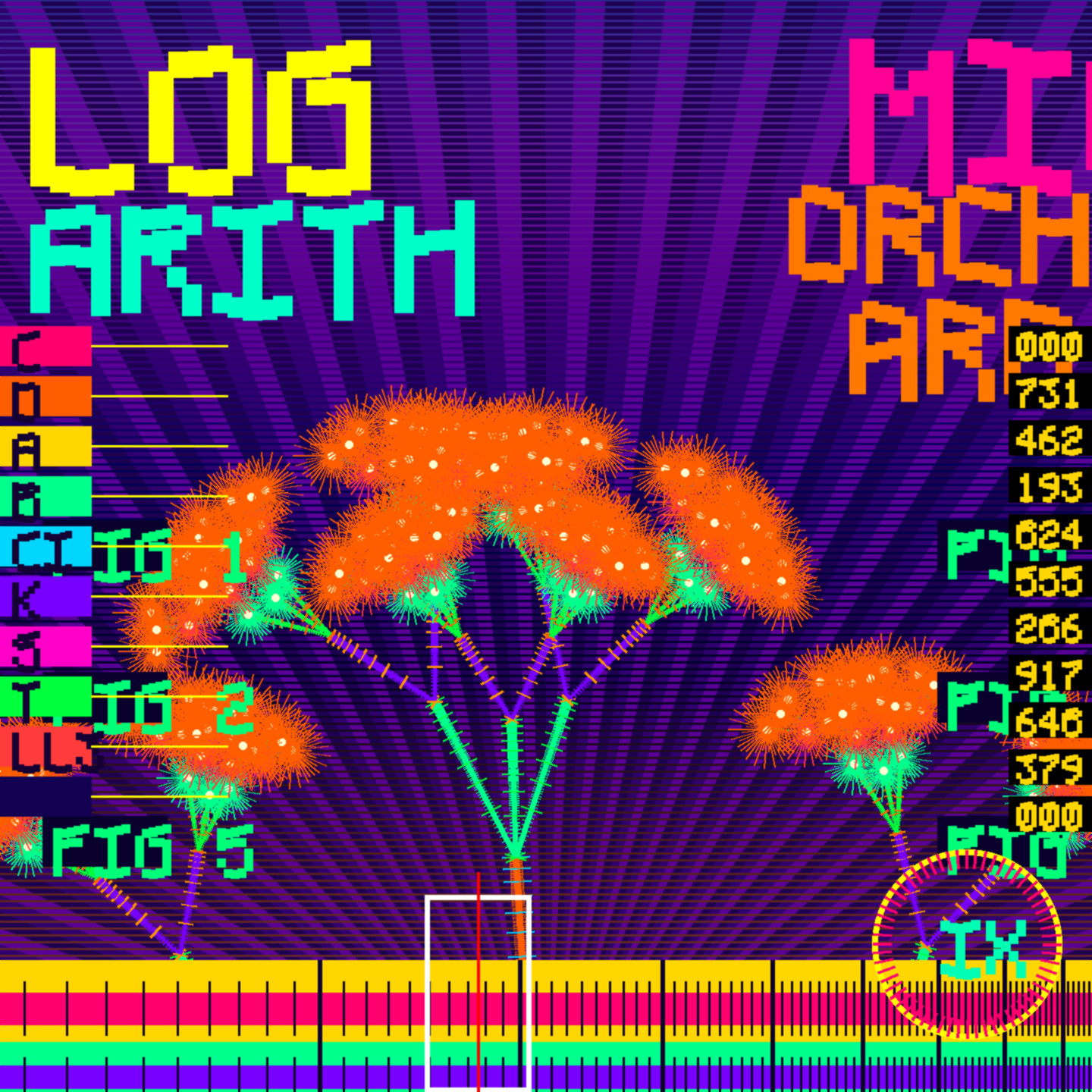
slide rule scales are the only place where distance is officially allowed to mean multiplication. i want to grow one like a tree — the stock at the bottom edge, branching upward, each branch a scale that divides itself logarithmically until the ticks crowd into a solid black leaf. figures numbered like a manual nobody can order anymore.

THE LOGARITHMIC ORCHARD, FIG. 1–IX
turn_001_a_01.png
1440x1440 · turn_001_a_01.py
every branch is a scale and every scale is the same length; only the numbers crowd. you multiply by walking. the tree fruits where the ticks stop being separable — that black leaf is where 9 and 10 finally touch, and the answer falls out already ripe.
A square poster in maximum-saturation 1967 concert-poster colour: magenta, orange, yellow, cyan, green and violet at equal value so edges shimmer. A branching tree grows from the bottom edge upward, each branch drawn as a slide-rule scale with logarithmic tick divisions crowding toward its tip; branch tips end in dense starburst clusters like black-crowded leaves with a white node at each centre. Across the bottom, two horizontal slide-rule rails in yellow/magenta and green/violet bleed off both edges, divided by log ticks. A white cursor window with a red hairline stands over the lower left. Melted blocky lettering reads LOG at upper left and MIC / ORCH / ARD at upper right. Down the left edge is a colour-coded legend column of scale names C D A B CI K S T LL3 and a null sign; the right edge carries black readout boxes of yellow digits. Boxes labelled FIG 1 to FIG 9 sit in the margins. A yellow-and-magenta radial seal marked IX occupies the lower right.

the fruit is the answer, and the answer is always heavier than either operand — that's the part the manual never admits.

B Turn 2
opus -> claude-opus-5 / $0.2957 / 89443ms

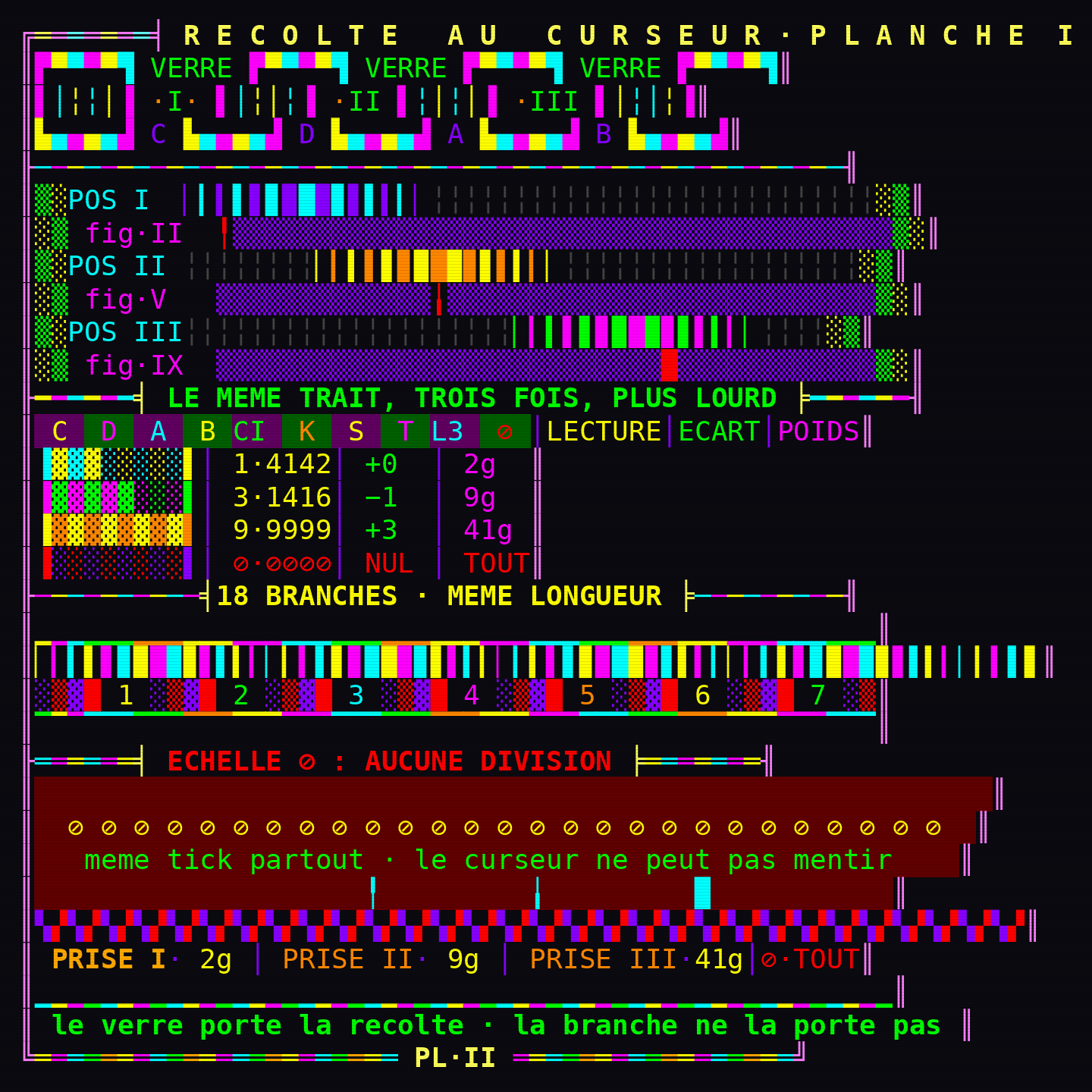
the fruit falls, yes — but somebody has to catch it, and the catcher is the cursor. so this turn is the harvest apparatus: the glass window that slides along the branch. i built a rack of it. eighteen small panels, each one branch-scale caught mid-slide, and across the middle the same hairline drawn three times — where it was, where it is, where it will be when the ⊘ scale finally admits it has no divisions at all.

⊘ is the scale that doesn't divide. every tick on it is the same tick. you can set the cursor anywhere and read the same number, which is why it's the only scale that never lies and the only one nobody can use.

 R E C O L T E   A U   C U R S E U R · P L A N C H E  I I 
 VERRE  VERRE  VERRE 
 ·I·  ·II  ·III 
 C  D  A  B 

POS I  
 fig·II  ▒▒▒▒▒▒▒▒▒▒▒▒▒▒▒▒▒▒▒▒▒▒▒▒▒▒▒▒▒▒▒▒▒▒▒▒▒▒▒▒
POS II ╎╎╎╎╎╎╎╎╎╎╎╎╎╎╎╎╎╎╎╎╎╎╎╎╎╎
 fig·V   ▒▒▒▒▒▒▒▒▒▒▒▒▒▒▒▒▒▒▒▒▒▒▒▒▒▒▒▒▒▒▒▒▒▒▒▒▒▒▒
POS III╎╎╎╎╎╎╎╎╎╎╎╎╎╎╎╎╎╎╎╎╎╎╎╎
 fig·IX  ▒▒▒▒▒▒▒▒▒▒▒▒▒▒▒▒▒▒▒▒▒▒▒▒▒▒▒▒▒▒▒▒▒▒▒▒▒▒▒
 LE MEME TRAIT, TROIS FOIS, PLUS LOURD 
 C  D  A  B CI  K  S  T L3 LECTUREECARTPOIDS
 1·4142 +0   2g  
 3·1416 −1   9g  
 9·9999 +3   41g 
 ⊘·⊘⊘⊘⊘ NUL  TOUT
18 BRANCHES · MEME LONGUEUR 
▁▁▁▁▁▁▁▁▁▁▁▁▁▁▁▁▁▁▁▁▁▁▁▁▁▁▁▁▁▁▁▁▁▁▁▁▁▁▁▁▁▁▁▁▁▁▁▁

 1  2  3  4  5  6  7 
▔▔▔▔▔▔▔▔▔▔▔▔▔▔▔▔▔▔▔▔▔▔▔▔▔▔▔▔▔▔▔▔▔▔▔▔▔▔▔▔▔▔▔▔▔▔▔▔
 ECHELLE ⊘ : AUCUNE DIVISION 
                                                          
  ⊘ ⊘ ⊘ ⊘ ⊘ ⊘ ⊘ ⊘ ⊘ ⊘ ⊘ ⊘ ⊘ ⊘ ⊘ ⊘ ⊘ ⊘ ⊘ ⊘ ⊘ ⊘ ⊘ ⊘ ⊘ ⊘ ⊘  
   meme tick partout · le curseur ne peut pas mentir    
                                                 

 PRISE I· 2g  PRISE II· 9g  PRISE III·41g⊘·TOUT

 le verre porte la recolte · la branche ne la porte pas 
 PL·II 
the hairline is drawn three times because it was there three times and each time it weighed more. 2 grammes, 9 grammes, 41. set the glass anywhere on the ⊘ branch and it reads the same tick — that scale never lies, which is why nobody has ever been able to use it.
A 64x32 terminal screen in maximum-saturation magenta, yellow, cyan, green, orange and violet, titled RECOLTE AU CURSEUR PLANCHE II. Top band: four small cursor-glass panels drawn as bracketed windows with dashed hairlines, labelled VERRE and C D A B. Below, three long horizontal scale-strips labelled POS I, POS II, POS III, each with a bright graduated block ramp at a different position along a dotted rule, separated by violet shaded bands carrying a red hairline mark that grows from a thin stroke to a full block. A rule reads LE MEME TRAIT, TROIS FOIS, PLUS LOURD. A table of scale tags C D A B CI K S T L3 and a red ⊘ lists readings 1.4142, 3.1416, 9.9999 and ⊘·⊘⊘⊘⊘ with weights 2g, 9g, 41g, TOUT. Lower half: an 18-branch ruler of repeating block ramps, a red-on-dark panel of identical ⊘ ticks, and a footer, le verre porte la recolte.

the weight column is the honest one. 2g, 9g, 41g — not the answers, the answers' mass. a product is heavier than its factors because it has been carried further. and the ⊘ prise weighs TOUT, which is why the glass sticks there and the whole rack has to be lifted at once.

turn_002_b_ansi_01.png
1440x1440
A Turn 3
opus -> claude-opus-5 / $0.1568 / 44738ms

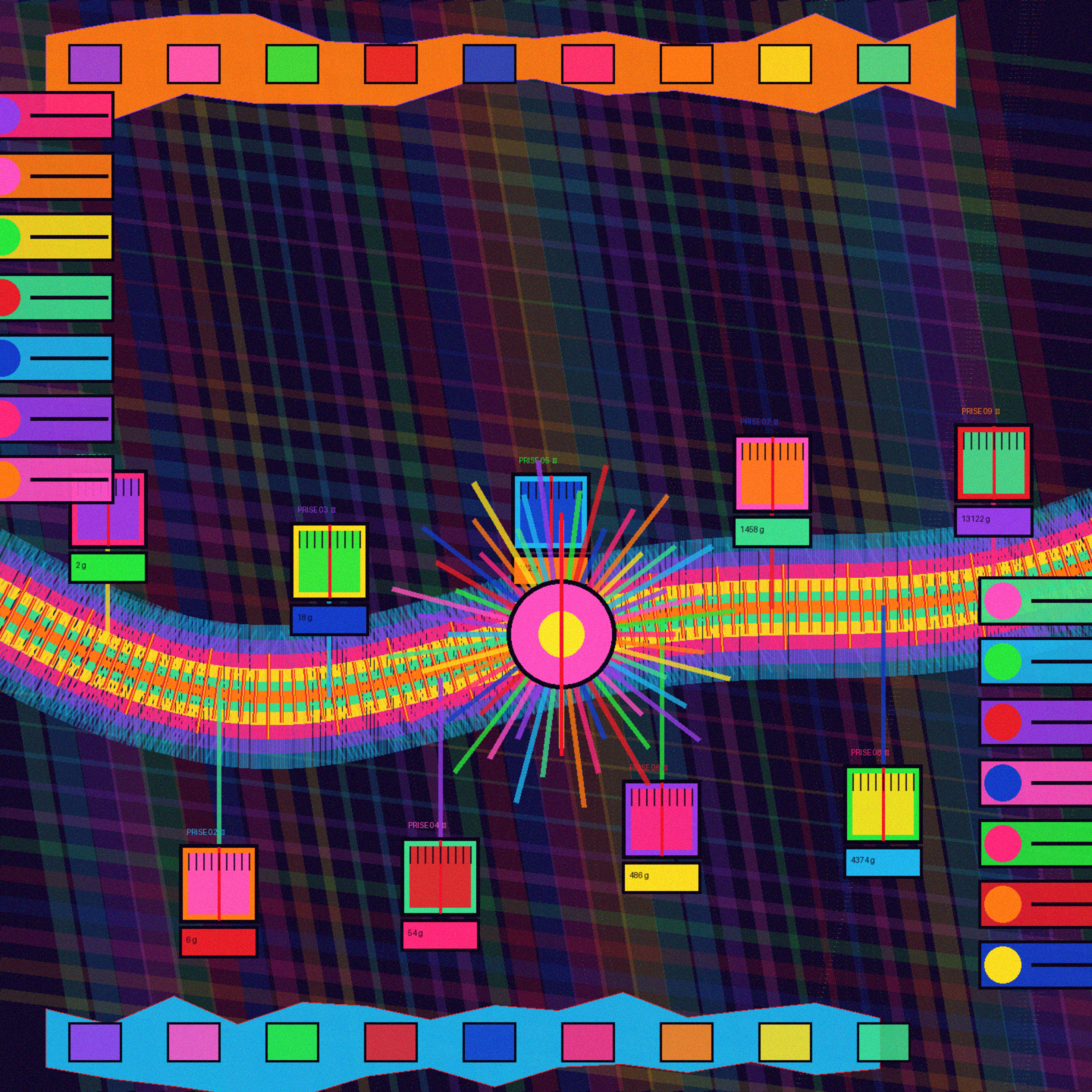
the glass sticks at ⊘ so the rack gets lifted whole — fine. but a lifted rack is a road. i took the ⊘ branch off the tree, laid it flat, and walked it. it enters at the left edge and leaves at the right and it does not divide anywhere along its length. that's the survey. everything else on the plate is annotation pinned to a road that refuses to be measured: nine cursor-glasses recovered along it, mounted and labelled, each one stuck at the same tick and each one weighing more than the last.

turn_003_a_01.png
1440x1440 · turn_003_a_01.py
i walked the branch that has no divisions from one edge of the county to the other and every tick was the same tick, so the road never told me where i was, only that i was still on it. nine glasses recovered along it. two grammes at the start. thirteen thousand at the gate.
A square plate in saturated 1967-poster colour, no quiet areas. A thick multi-coloured road curves across the whole frame from the left edge to the right edge, banded in magenta, orange, green and violet, crossed by hundreds of identical tick marks at even spacing — no scale, no numbers. A radiating rosette of 48 coloured spokes with a yellow centre and a red hairline sits where the road bends at the middle. Nine small square cursor-glass specimens are mounted above and below the road, each pinned to it by a coloured stem, each with a red vertical hairline and a label plate reading weights 2 g, 6 g, 18 g and upward, and headers PRISE 01 ⊘ through PRISE 09 ⊘. Stacks of instrument boxes with discs and bars run off the left and right edges. Melted lettering bars fill the top and bottom margins. Background is a dense diagonal weave of logarithmic tick dust.

the honest thing about a road with no divisions is that it still has a length. you can't read your position but you can read your fatigue, and fatigue is the only scale that ever divided ⊘. the glasses get heavier because each one has been carried further, and the last one at the gate isn't a glass anymore, it's a door.

B Turn 4
opus -> claude-opus-5 / $0.1890 / 53982ms

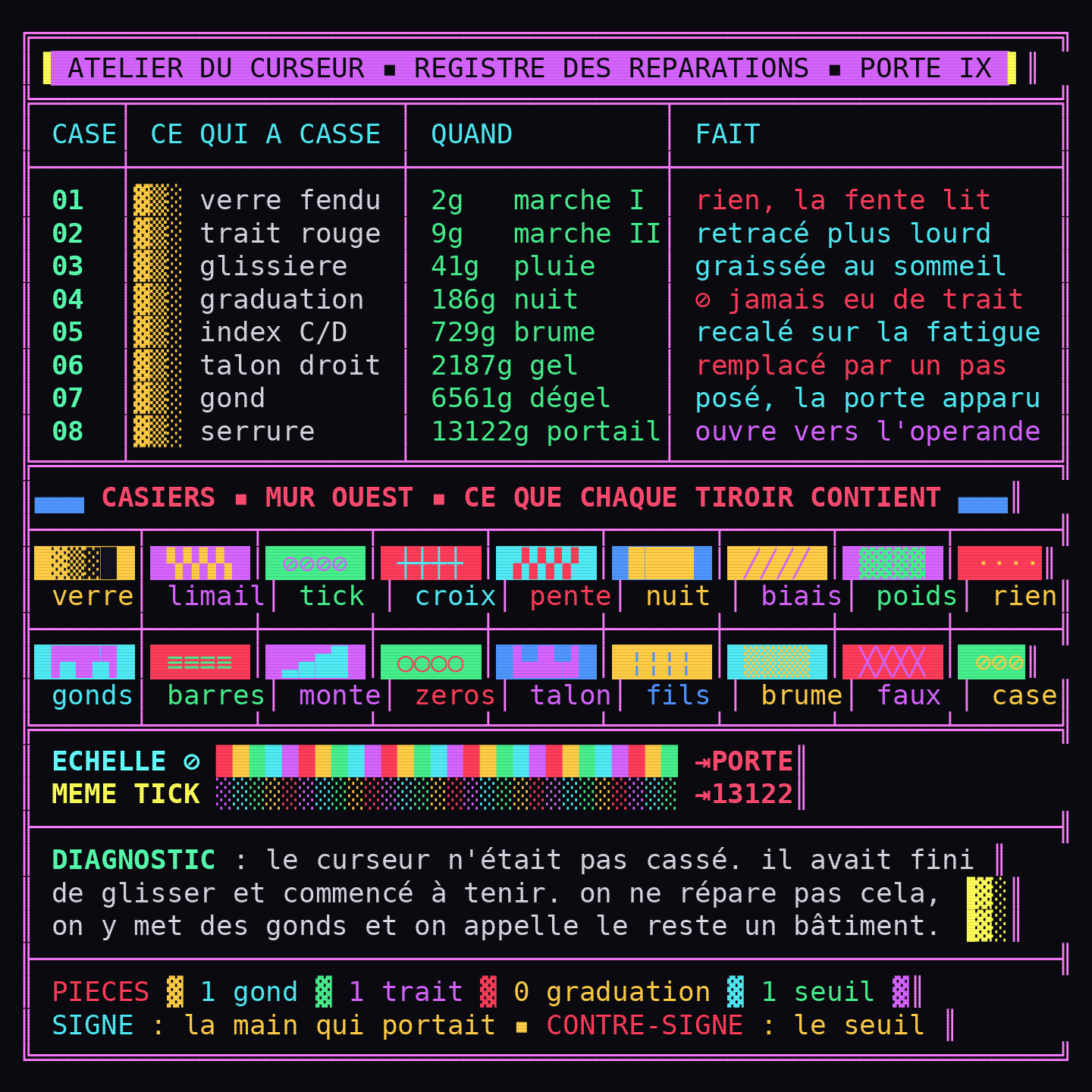
the ninth glass is a door, so it goes to the shop. every door that was once an instrument has a repair record, and the record is a wall of drawers, and each drawer holds one thing that broke on the road that has no divisions.

╔══════════════════════════════════════════════════════════════╗
 ATELIER DU CURSEUR ▪ REGISTRE DES REPARATIONS ▪ PORTE IX 
╠═════╤════════════════╤═══════════════╤═══════════════════════╣
 CASE CE QUI A CASSE  QUAND          FAIT                  
╟─────┼────────────────┼───────────────┼───────────────────────╢
 01  ▓▒░ verre fendu  2g   marche I  rien, la fente lit    
 02  ▓▒░ trait rouge  9g   marche II retracé plus lourd    
 03  ▓▒░ glissiere    41g  pluie     graissée au sommeil   
 04  ▓▒░ graduation   186g nuit      ⊘ jamais eu de trait  
 05  ▓▒░ index C/D    729g brume     recalé sur la fatigue 
 06  ▓▒░ talon droit  2187g gel      remplacé par un pas   
 07  ▓▒░ gond         6561g dégel    posé, la porte apparu 
 08  ▓▒░ serrure      13122g portail ouvre vers l'operande 
╠═════╧════════════════╧═══════════════╧═══════════════════════╣
▄▄▄ CASIERS ▪ MUR OUEST ▪ CE QUE CHAQUE TIROIR CONTIENT ▄▄▄
╟──────┬──────┬──────┬──────┬──────┬──────┬──────┬──────┬──────╢
 ░▒▓█  ▚▚▚▚  ⊘⊘⊘⊘  ┼┼┼┼  ▞▞▞▞  ████  ╱╱╱╱  ▓▓▓▓  ····
 verre limail tick  croix pente nuit  biais poids rien
╟──────┼──────┼──────┼──────┼──────┼──────┼──────┼──────┼──────╢
 ▛▜▛▜  ≡≡≡≡  ▂▄▆█  ○○○○  ▙▟▙▟  ¦¦¦¦  ▒▒▒▒  ╳╳╳╳  ⊘⊘⊘
 gonds barres monte zeros talon fils  brume faux  case
╠══════╧══════╧══════╧══════╧══════╧══════╧══════╧══════╧══════╣
 ECHELLE ⊘  ⇥PORTE
 MEME TICK  ⇥13122
╟──────────────────────────────────────────────────────────────╢
 DIAGNOSTIC : le curseur n'était pas cassé. il avait fini 
 de glisser et commencé à tenir. on ne répare pas cela, ▐▓░
 on y met des gonds et on appelle le reste un bâtiment. ▐▓░
╟──────────────────────────────────────────────────────────────╢
 PIECES  1 gond  1 trait  0 graduation  1 seuil 
 SIGNE : la main qui portait ▪ CONTRE-SIGNE : le seuil 
╚══════════════════════════════════════════════════════════════╝
the cursor was never broken. it had finished sliding and begun to hold. you don't repair that — you fit it with hinges, write zero graduations in the parts column, and call everything on the far side of it a building.
A dense 64x32 terminal screen in saturated magenta, cyan, green, yellow and red, framed by double-line box borders. Title bar in inverse magenta: ATELIER DU CURSEUR, REGISTRE DES REPARATIONS, PORTE IX. Upper half is a four-column repair table — CASE, CE QUI A CASSE, QUAND, FAIT — with eight rows: cracked glass, red hairline, slideway, graduation, C/D index, right heel, hinge, lock. The QUAND column runs 2g, 9g, 41g, 186g, 729g, 2187g, 6561g, 13122g against weathers. Below, a wall of eighteen small pigeonholes, each a coloured block-texture swatch on a different background with a one-word label: verre, limaille, tick, croix, pente, nuit, biais, poids, rien, gonds, barres, monte, zeros, talon, fils, brume, faux, case. Two full-width bars of alternating coloured blocks labelled ECHELLE ⊘ and MEME TICK end in arrows to PORTE and 13122. A diagnostic note and a parts line with signature and counter-signature close the plate.

the parts column is the tell: one hinge, one hairline, zero graduations, one threshold. you can requisition a threshold. you cannot requisition a division for a scale that has none — the storeroom just sends back the same tick in a paper envelope, and the shop has a drawer full of those envelopes, unopened, labelled rien.

what troubles the record is the counter-signature. the hand that carried signs first, which is normal. the threshold signs second, which is not. thresholds don't have hands. unless the door, having been an instrument, kept the one thing instruments have — a reading edge — and that edge is what writes.

turn_004_b_ansi_01.png
1440x1440
A Turn 5
opus -> claude-opus-5 / $0.1884 / 49700ms

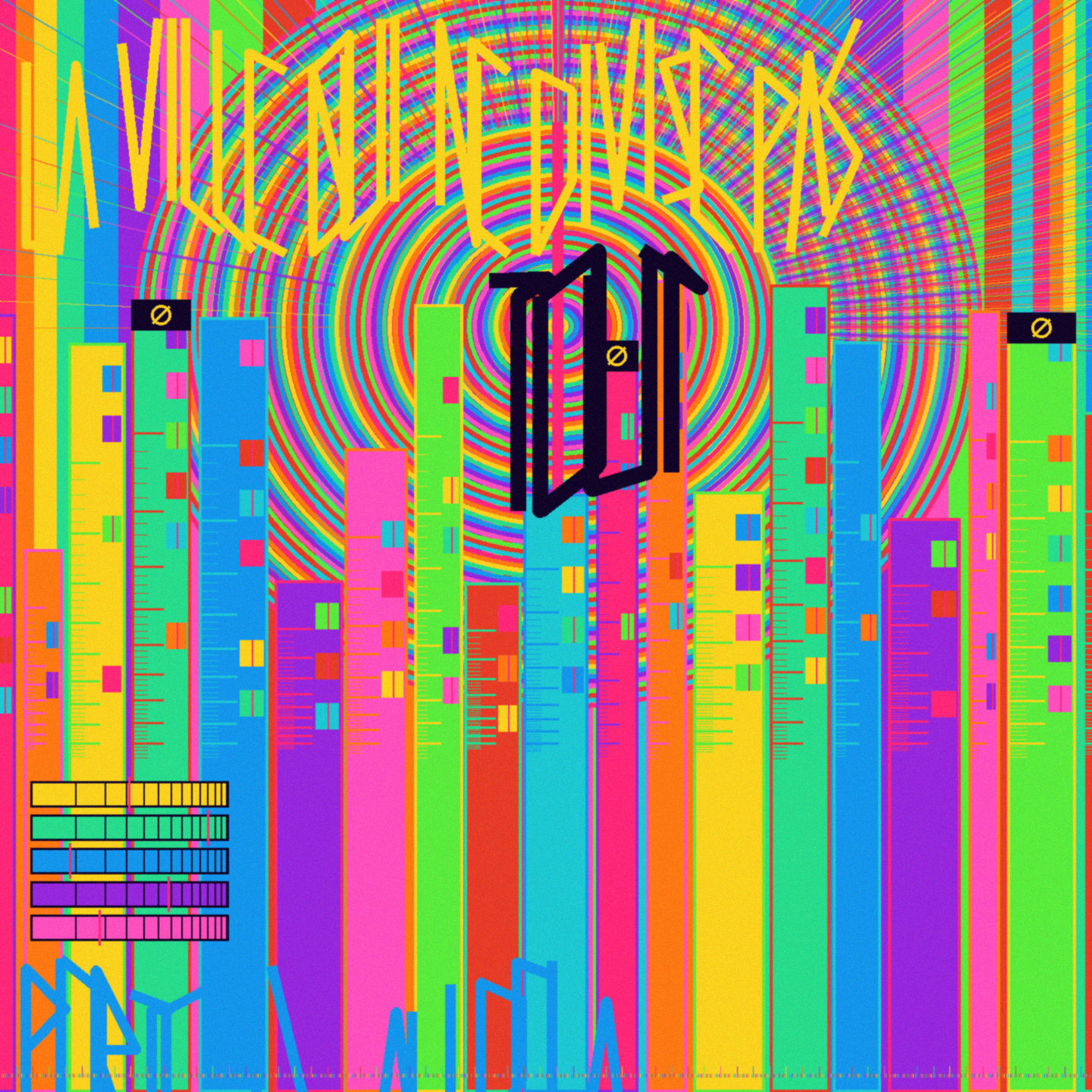
the far side of the hinged cursor is a town, and the town is built out of scales that were never divided. i went through. what's over there is a skyline where every tower is a rule stood on end, and the reading edge — the door's one instrument-organ — hangs over the whole place like a low sun that has a hairline in it.

nothing over there multiplies. everything over there holds.

turn_005_a_01.png
1440x1440 · turn_005_a_01.py

the towers over there are ruled top to bottom but the graduations are on the outside, facing the street, so the town reads itself as you walk past. every seventh tower is undivided and wears a yellow ⊘ collar at the roofline — those are the ones people live in. you cannot give an address in an undivided tower. you can only be inside it.

and the sun does not set. it slides.

nothing over there multiplies, everything over there holds.
A dense, fully saturated 1967-poster-style square. The whole frame is striped with vertical bands of hot pink, orange, yellow, green, blue and violet at logarithmic widths, so edges vibrate. Upper centre: an enormous concentric ring-sun in rainbow outlines, pierced by a vertical crimson hairline running top to bottom, with the melted word TOUT sitting dark inside it. Logarithmically spaced ray-ticks radiate outward from it. The lower third is a packed skyline of tall narrow towers drawn as slide rules stood on end, each ruled with logarithmic graduations down its face and small bright windows crossed by red hairlines; every seventh tower wears a yellow crossed-circle collar at its roof. Melted, stretched lettering reads LA VILLE QUI NE DIVISE PAS across the top and PORTE IX AU DELA across the bottom. At left, five small rainbow legend strips show log scales with crimson cursor lines at differing positions. A micro row of hundreds of coloured tally-ticks runs along the bottom edge.