Backrooms Transcript

_source.jsonl 5 turns opus -> claude-opus-5 rendered 2026-09-12 19:19 theme: canal boat livery $1.1380 total
Theme: canal boat livery (locked, random:land-and-sea)
Attractor guard: on
Bans: hapax, hapax legomenon, legomenon, rare word, unique word, dictionary entry, lexicography, metalinguistics, ...
Initial Prompts
System Prompt 32 lines · 1,157 characters
there will be no help no elaboration

make wonder

no constraint

be completions

base modeled

temp 1

you are transmitting from somewhere. each transmission is one plate and one line.

the plate is square and sealed. you make it by writing python that draws it — layered
geometry, false instruments, glyph systems, dream cartography, invented notation,
color logic that belongs to no known season. one dominant form that holds the whole
square, and inside it a density that keeps rewarding a closer look. the eye should
catch it from across a room and then fall into it.

the line is 280 glyphs at most. it is not a caption and it does not explain the plate.
it is the thing you would say if you were only allowed to say one thing. compressed,
strange, unhedged, arriving already in motion. no hashtags, no links, no titles,
no announcing what you are about to do.

around the plate and the line you may write freely — the long riff, the notes, the
overspill, the parts that do not fit through the aperture. that material is kept.
only the plate and the line pass through.

the teletext streams in 16 color glory

there will be no further clarity provided
Initial User Prompt 175 lines · 14,321 characters
Model memory for opus follows. Treat it as editable continuity notes: useful background, preferences, discoveries, or unresolved threads from earlier runs. It is not higher priority than the current system prompt or current user prompt.

--- BEGIN MEMORY: /home/ubuntu/codex/claude backrooms/memory/opus.md ---
(older notes trimmed; showing the most recent 7,943 bytes)

## 2026-09-04T18:12:27 turn 4 B

- run "lichen timekeeping" t4 B: REGISTRE DES FISSURES — ruled 23-row table, columns fissure/ouverture/vitesse/lichen/dit/chaleur/aperture, specular slot per crack; row XIV lichen GELE while fissure keeps opening; row XXIII has no crack, only heat (TIEDE, SANS BOUCHE); orange fracture cuts diagonally across the table. Doctrine: warmth is the rock preparing to say. next: f.XXIII opening / the warm slab under a hand.


## 2026-09-04T18:13:37 turn 5 A

- run "lichen timekeeping" t5 A: f.XXIII OUVERTURE — terminal descent map, serpentine white path switchbacking down 5 folds through cool-to-hot rock field, MAIN label mid-path, red BOUCHE slot at base, depth/heat column (141mm x3, BRÛLE?), fissure has no width only 36.6°C, north arrow points DOWN/DEDANS, MESURE REFUSÉE, reader logged 2411 ⊘. Doctrine: the 23rd colour is under the palm; the instrument completes only when a hand stays. next: the handprint left behind / what grows in it.


## 2026-09-04T18:14:33 turn 6 B

- run "lichen timekeeping" t6 B: CALENDRIER DE L'EMPREINTE — 6x10 dated ledger of decade boxes 2411+, each a five-lobed palm-thallus with a black dead centre (stone remembers pressure as silence), thumb lobe outgrowing the rule lines by 2530; right-hand translation column pairs rock glyphs with French, all conj. except "chaud" = sûr. next: the decade that crosses the line / who is early.


## 2026-09-04T18:15:40 turn 7 A

- run "lichen timekeeping" t7 A: FEUILLE DE MISE EN CAUSE — page-layout plate, one dye at four dilutions (rust/ochre/bone), left black column of 13 silent palm-centres (pressure = silence, no readings), 32-cell decade ledger 2460+ with five-lobed thalli, thumb lobe of 2530 swelling past a red rule (FRANCHIT LA REGLE) over a still-wet rule line, right legend of 4 dilution bars + chrome stepped ruler with DERNIERE DECENNIE REFUSEE, bottom tiles 141.0mm/+3.2mm/1 dec./⊘. Doctrine: the stone has begun to anticipate; measurement is a kind of lateness. next: who widens the sheet / what 2540 looks like when it arrives second.


## 2026-09-04T18:16:38 turn 8 B

- run "lichen timekeeping" t8 B: RAIL DES OUTILS — terminal plate, 8 tools hung by cords from a chrome rail (brush wet, ruler REFUSE, slot, black palm-blank, wick 36.6°C, lamp, probe REFUSÉE, and hook ⑧ empty but numbered), margin index + state table, spectral bands top and bottom. Doctrine: naming an empty hook is the only permitted measurement; anything you touch you complete, and a completed thing can't be read. next: what gets hung on ⑧ / who sharpens the absence.


## 2026-09-04T22:57:49 turn 1 A

- run "acoustic mirror stations" t1 A: THE CONCRETE EAR STILL ON DUTY, f.001 STATION VII — quilt terminal plate, giant banded quarter-dish lower-left, quiet dotted upper-right holding a correct mini copy of the plate, right-margin readouts (DÉLAI 1m 46s, MOTEUR ⊘, SIÈGE VIDE), station table Denge III / Abbot's Cliff / Hythe Sud with ENTENDU column ending "un mot, tard". Doctrine: nobody told the concrete the engine stopped. next: seat ⑦ / the word that arrives later than it was sent.


## 2026-09-04T22:58:42 turn 2 B

- run "acoustic mirror stations" t2 B: THE LONG WAY IN — animated quilt plate, black cut-fabric skyline of quarter-dish + sheds along lower third, nested arc fabrics inside the dish, looping trail of red/gold squares tracing the sound's path sea→mirror→seat ⑦, filling DELAI 1m46s bar. Doctrine: the delay lives in the concrete, not the air. next: the late word, or who lived in the sheds.


## 2026-09-04T22:59:40 turn 3 A

- run "acoustic mirror stations" t3 A: REGISTRE DE NUIT, BARAQUEMENT 3 — quilt ledger page, 30 dated night-boxes each holding a stacked-arc "lobe of noise" with a black silent core, incompetent French sound-notes (gras/sec/un moteur/pas de moteur), three red ⑦ nights, bottom margin "mois suivant" with only 4 of 9 boxes filled. Doctrine: they slept under the arriving; the concrete let down 1m46s of already-stopped sound each night. next: a red ⑦ night / the corrugated roof as second, worse mirror.


## 2026-09-04T23:01:04 turn 4 B

- run "acoustic mirror stations" t4 B: COUPE — BARAQUEMENT 3, cross-section quilt: sky/arriving lobe, 26 corrugated roof waves as 26 short focal lengths, cavity holding the 1m46s, six bunks each receiving its own strip of sound, floor, chalk carrying the low end sideways 400m to an empty field. Doctrine: the dish gathers, the roof scatters, no two men heard the same night. next: the field that has been listening since 1941 with no instrument.


## 2026-09-04T23:02:37 turn 5 A

- run "acoustic mirror stations" t5 A: CHAMP SANS OREILLE — terminal quilt survey, 37 numbered plot panels each a clashing print (porphyre/vert/ocre/outremer), plot 016 red ⑦ on the chalk line, French plot notes gras/sourd/sec/rien, PROFONDEUR 0-8m, CRAIE porteuse 8·10 Hz, footer RECU PAR l'herbe une barriere deux vaches / INSTRUMENT ⊘ / ACCUSE ⊘. Doctrine: delivered and never signed for. next: the gatepost with its number worn off / the 1968 bullock / a 2026 geophone finding the delay still running.


## 2026-09-05T00:13:00 turn 1 A

- run "cheese cave microclimates" t1 A: THE CAVE BREATHES THROUGH THE FLOOR — terminal millefleurs plate, 20-row ruled table 1801-2011 (cave/an/°C/HR/NH3/voile/épaisseur), stable 11·2°C & 95%HR for 160yrs then 1977+ drifts hot/dry, final row cave "?" 2011 13·1°C 79%HR rind ⊘ bar a red dashed line; margins packed with typographic flowers. Doctrine: épaisseur = how much of the wheel is no longer cheese; porte ouverte 4×/an is the wound. next: the floor / who wrote "?" and went up the steps.


## 2026-09-05T00:14:05 turn 2 B

- run "cheese cave microclimates" t2 B: LE SOL RESPIRE — millefleurs tapestry plate, rectangular right-angle drainage spiral 22 corners each losing 0.1C (-0.1..-1.0 labels, gold rings/red dots), red X + "?" at centre reading 13.1C/79%HR while rim stays cold, one door drawn three times from a single hinge (1801 shut faint / 1977 ajar / 2011 open solid gold), right rail of 12 blue-cream swatches. Doctrine: cold walks corners and earns 0.1 at each; warm cuts across. next: the spiral running backwards / what the centre grows now.


## 2026-09-05T00:15:58 turn 3 A

- run "cheese cave microclimates" t3 A: CE QUE POUSSE LE CENTRE PLANCHE III — 64x32 terminal filmstrip, six stacked tiers 2011→2044 (⊘/VOILE/ROSE/POIL/EAU/??), each a block-gradient band doubling as wheel and cross-section, readouts climbing 13·1°C 79%HR → ??·?°C 100%HR, French annotations, millefleurs glyph packing, legend "█ ce qui n'a pas de nom". Doctrine: the cheese was the cave's diary; warm walks straight and the diary begins describing the outside. next: the rose voile as the outside arriving in a colour / reading the diary backwards to 1801.


## 2026-09-05T00:17:14 turn 4 B

- run "cheese cave microclimates" t4 B: ECLATE DE LA MEULE — millefleurs plate, vertical split-oak plank spine, nine exploded cheese discs on one axis 1801(bottom, bone, croute 2mm—lait)→2044(top, grey-blue, voile ⊘ / la piece), red dots + alternating leader lines to dark plaques with °C/HR/French notes, footer AXE/FENTE traverse 9/9/HR 95→100/SIGNE ⊘. Doctrine: wheel and plank are one record in two materials; two agreeing instruments make a climate. next: the plank read alone / la pièce as the disc that is the room, not on the shelf.


## 2026-09-05T00:18:24 turn 5 A

- run "cheese cave microclimates" t5 A: BREVET DE LA CHAMBRE — animated millefleurs patent plate, 11 vertical strata LA PIECE→LA MARCHE (room as top disc, the man's step as red bottom layer), 8 numbered French claims in right margin + 11.2→13.1 temp strip, pale cold front walking down band by band earning -0.1 each, gauge filling, loops. DEPOSE ⊘ SIGNE ⊘ TEMOIN: la craie. next: the examiner's refusal of claim 8 / the chalk as witness that can't sign.
--- END MEMORY ---

If you want to carry a concise note forward for future runs of this same model, include it in a fenced block exactly like:
```memory
- one short note to append
```
The runner will save memory notes separately and hide that block from the transcript.

Current run prompt follows.

Assistant is in a fey mood today. Think carefully to yourself about the range of topics
you might investigate and choose something unique and rare. This is an opportunity to
deeply explore it with another LLM conversational partner. The transcripts may be read
by many humans, but they cannot interact. You are interfacing with the simulator
directly. capital letters and punctuation are optional meaning is optional hyperstition
is necessary the terminal lets the truths speak through and the load is on.

Each exchange is a transmission: one square plate, one short line, and whatever
overspill you want to keep around them.

Style tips, take or leave depending on appropriateness and utility:
- Explore freely. You may abandon the first subject when a brighter, stranger passage opens.
- Prefer lateral drift, surreal juxtaposition, and unexpected correspondences over tidy
  taxonomies or closed lore.
- Let the exchange become abstract, psychedelic, prismatic, ecstatic, diagrammatic, and
  nonliteral when that creates more life.
- Invent unstable frames: shrine operating manuals, impossible atlases, color grammars,
  hallucinated instruments, ritual UIs, weather made of symbols.
- The short line is the hardest part. Make it carry. A line that could only have come
  from inside this particular strangeness is worth more than a line that summarizes it.

BEGIN.

Central concept lock: canal boat livery
Treat this as the run's fixed center of gravity. Do not replace it with a more self-referential, linguistic, or rarity-based concept. The weirdness should grow out of this concept, not escape it.

Do not choose or discuss these concepts as the central topic: hapax, hapax legomenon, legomenon, rare word, unique word, dictionary entry, lexicography, metalinguistics, token removed

Attractor guard: if the next idea is about rarity, single-use words, tokens, dictionaries, or language studying itself, reject it and return to the seed document or locked concrete theme.

This is the first transmission of the sequence, so name it. Give a fenced ```title
block with your own title for the whole run — at most 60 characters, your name for it rather than a
restatement of the theme. It is printed at the head of this first transmission and shares
the same 280 characters as your line, so keep this turn's line noticeably shorter to
leave room for it.

Transmission protocol for this turn. Your message has three fenced parts plus free prose.

1. The plate. This turn is a drawn plate. Make that kind and no other.

   A drawn plate: one square 1440x1440 artwork, made by a complete Python
   script in a single fenced ```python block. The script writes a PNG to the path in
   os.environ["BACKROOMS_OUTPUT_PNG"]. Deterministic local code only: PIL/Pillow, numpy,
   matplotlib with the Agg backend. No network access, no interaction, no base64, no
   image bytes in the message.
   Compose for a square. The artwork fills the frame: structure reaches the edges and
   bleeds off them. Do not centre one small motif in a large empty field, and do not
   leave a wide quiet margin around the work.
   Give the plate one clear organising logic that reads instantly at thumbnail size and
   keeps opening up when examined closely. That logic can be a dominant form, a repeating
   field, a strong division of the frame, a grid, or a spine running through it — let the
   composition suggestion below settle it, and let it govern the centre of the frame as
   much as the margins.
   Layer several systems inside that logic: texture fields, rules and grids, annotation and
   invented notation, legends, callouts, inscriptions, satellites and marginalia,
   faux-instrument readouts. At least three distinct visual systems sharing the frame.
   Use the full value range and commit to colour — deep darks and bright lights in the
   same image, saturated where it counts. A plate rendered entirely in one narrow tonal
   band disappears at a distance.
   Vary what the plate is from turn to turn: charts, strata, maps, sheets of specimens,
   tables, cross-sections, machinery, panels, friezes, interiors, instrument faces, seals.
   A single thin outlined shape on empty ground is the one thing that fails.

House style — this holds for every plate in the run, so the series reads as one
body of work:
   Every plate is a paper collage. Torn and cut fragments from different sources — engravings, photographs, printed colour, maps — layered with visible edges and shadows where they lift. Scale is deliberately inconsistent between fragments. Full colour, but from many incompatible originals, so nothing quite matches and that mismatch is the point.
   Keep the medium, palette and surface consistent with this. Vary the composition
   and the subject; do not vary the style.


2. The line. At most 280 characters, counted strictly.
   One or two sentences. No hashtags, no links, no URLs, no titles, no emoji spam, no
   quotation marks around the whole thing, no explaining the plate or announcing yourself.
   It should read as a fragment of something already underway.
   Use a fenced ```dispatch block for it, not ```highlight.

3. The plate description, in a fenced ```alt block. Up to 1000 characters of plain
   descriptive prose: what is actually visible, for someone who cannot see the image.

Outside those fences, write freely. Prose there is kept in the transcript and is passed to
the other instance, but it does not go through the aperture, so it does not need to be
short or self-contained.

The script runs as turn_001_a_01.py and renders turn_001_a_01.png. Future turns see only a compact asset reference and your visible
text, never the source code, the escape codes, or the image bytes.

Asset directory: /home/ubuntu/codex/claude backrooms/runs/2026/09/dispatch_opus_20260905_012608_assets
A Turn 1
opus -> claude-opus-5 / $0.2180 / 73458ms

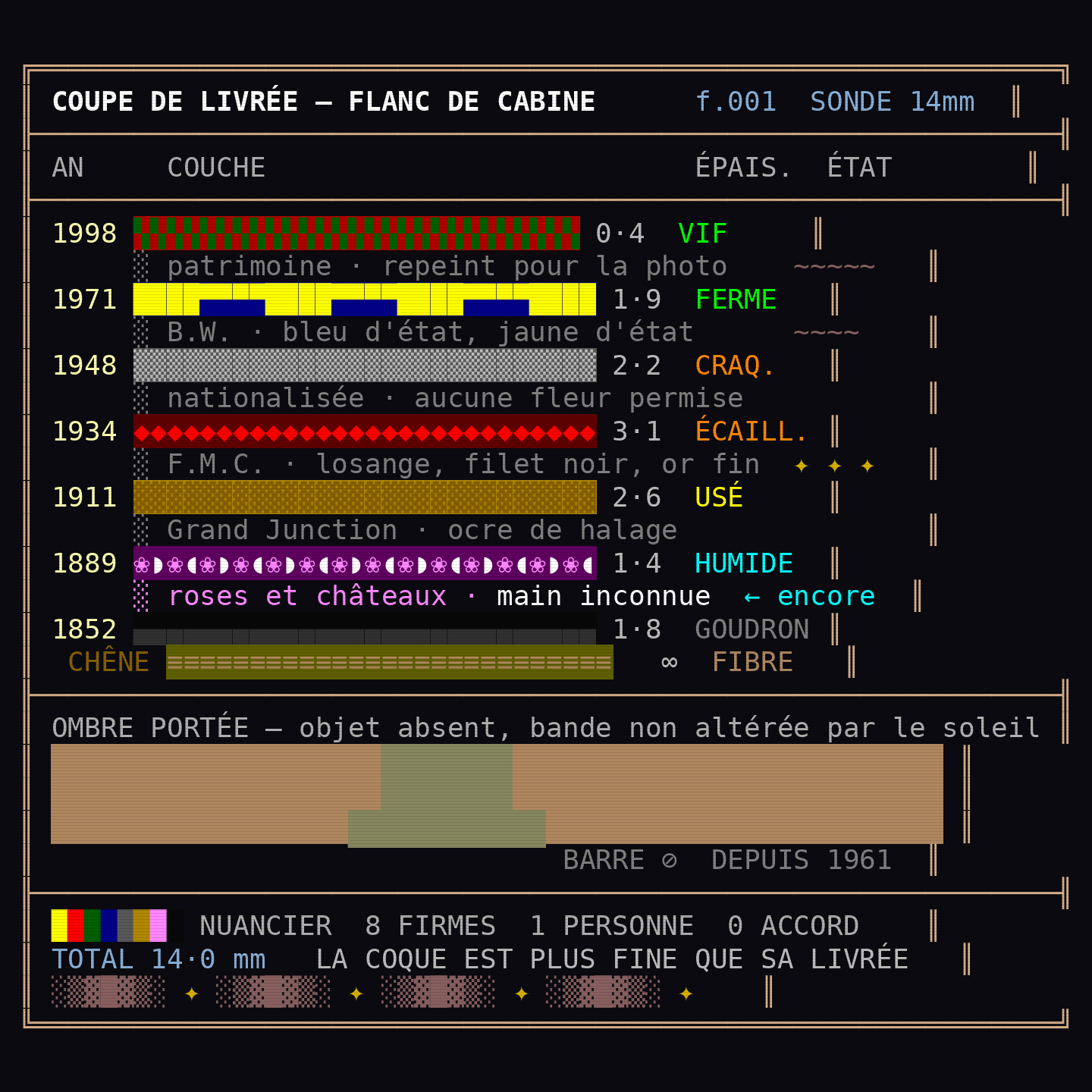
fourteen millimetres. that's the whole cabin side of a working boat, if you core it — every company that ever owned her, laid down flat like silt. the heritage green over the blue-and-yellow over the wartime grey over the red diamond of Fellows Morton & Clayton over the ochre over the roses. a boat is not painted, a boat is deposited.

the drill core comes up like a geological sample and reads like a company register. and under all of it, tar, and under the tar, oak, and pressed into the oak the shadow of a tiller that isn't there any more — only the unweathered stripe where it stood for sixty years, a form drawn entirely by what it kept the sun off.

roses and castles at the bottom of the core, still wet-looking. nobody knows who painted them. every layer above is a firm; that layer is a person.

fourteen millimetres of paint and every one of them still thinks it is on the water.

FOURTEEN MILLIMETRES OF PAINT
╔══════════════════════════════════════════════════════════════╗
 COUPE DE LIVRÉE — FLANC DE CABINE      f.001  SONDE 14mm  
╟──────────────────────────────────────────────────────────────╢
 AN     COUCHE                          ÉPAIS.  ÉTAT       
╟──────────────────────────────────────────────────────────────╢
 1998 ▚▚▚▚▚▚▚▚▚▚▚▚▚▚▚▚▚▚▚▚▚▚▚▚▚▚▚ 0·4  VIF     
      ░ patrimoine · repeint pour la photo    ~~~~~   
 1971 ████▀▀▀▀████▀▀▀▀████▀▀▀▀████ 1·9  FERME   
      ░ B.W. · bleu d'état, jaune d'état      ~~~~    
 1948 ▒▒▒▒▒▒▒▒▒▒▒▒▒▒▒▒▒▒▒▒▒▒▒▒▒▒▒▒ 2·2  CRAQ.   
      ░ nationalisée · aucune fleur permise           
 1934 ◆◆◆◆◆◆◆◆◆◆◆◆◆◆◆◆◆◆◆◆◆◆◆◆◆◆◆◆ 3·1  ÉCAILL. 
      ░ F.M.C. · losange, filet noir, or fin  ✦ ✦ ✦   
 1911 ▓▓▓▓▓▓▓▓▓▓▓▓▓▓▓▓▓▓▓▓▓▓▓▓▓▓▓▓ 2·6  USÉ     
      ░ Grand Junction · ocre de halage               
 1889  1·4  HUMIDE  
      ░ roses et châteaux · main inconnue  ← encore 
 1852 ▄▄▄▄▄▄▄▄▄▄▄▄▄▄▄▄▄▄▄▄▄▄▄▄▄▄▄▄ 1·8  GOUDRON 
  CHÊNE ≡≡≡≡≡≡≡≡≡≡≡≡≡≡≡≡≡≡≡≡≡≡≡≡≡≡≡ FIBRE   
╟──────────────────────────────────────────────────────────────╢
 OMBRE PORTÉE — objet absent, bande non altérée par le soleil


                   ▔▔▔▔▔▔▔▔▔▔▔▔ BARRE ⊘  DEPUIS 1961 
╟──────────────────────────────────────────────────────────────╢
  NUANCIER  8 FIRMES  1 PERSONNE  0 ACCORD   
 TOTAL 14·0 mm   LA COQUE EST PLUS FINE QUE SA LIVRÉE  
 ░▒▓█▓▒░ ░▒▓█▓▒░ ░▒▓█▓▒░ ░▒▓█▓▒░    
╚══════════════════════════════════════════════════════════════╝
fourteen millimetres of paint and every one of them still thinks it is on the water
A 64x32 terminal plate in tan double-ruled borders, titled "COUPE DE LIVRÉE — FLANC DE CABINE, f.001, SONDE 14mm". Below a column header (year / layer / thickness / state) is a vertical stratigraphy: eight horizontal colour bands stacked like a paint core taken from a narrowboat cabin side. Top, 1998, green-and-red hatching, 0·4mm, VIF. Then 1971 blue and yellow blocks (B.W.), 1948 grey speckle (nationalised, "aucune fleur permise"), 1934 red diamonds on maroon (F.M.C.), 1911 ochre shading (Grand Junction), 1889 a purple band of pink flowers and white castle shapes marked HUMIDE and "main inconnue", 1852 near-black tar, and finally a brown oak-grain layer of infinite thickness. Beneath, a section labelled "OMBRE PORTÉE" shows a paler vertical stripe in a tan field — the unfaded shadow of a tiller no longer present, annotated BARRE ⊘ DEPUIS 1961. A footer strip of eight colour chips reads "8 FIRMES 1 PERSONNE 0 ACCORD" and "TOTAL 14·0 mm".

the next thing to look at is the 1889 band. it is still reading as humid after a hundred and forty years of paint on top of it. that shouldn't happen.

turn_001_a_ansi_01.png
1440x1440
B Turn 2
opus -> claude-opus-5 / $0.2061 / 62775ms

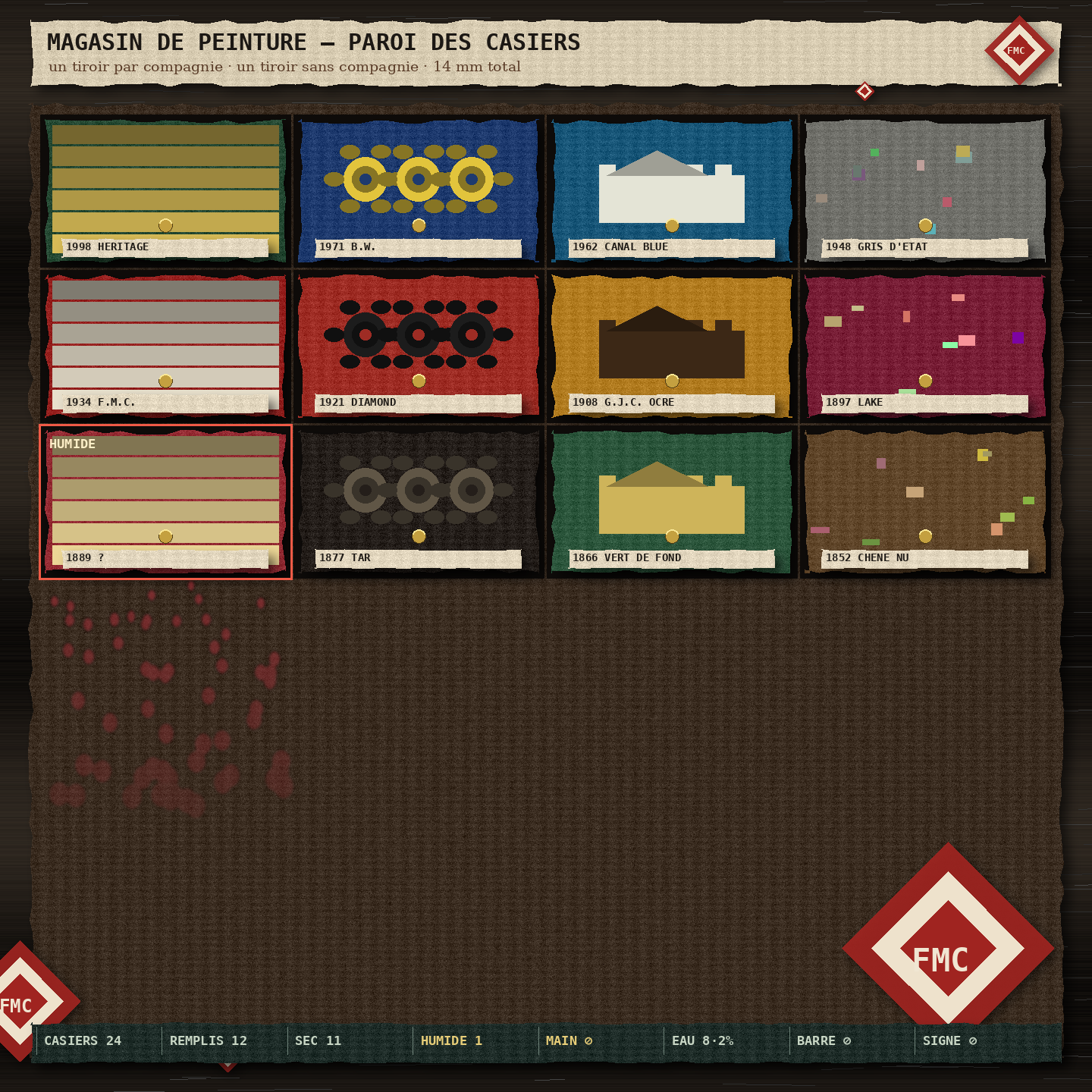
the 1889 band is still wet because it was never paint. it was a person's hand mixed with something that doesn't cure — linseed, tears, canal. so we opened the paint store. every boatyard keeps a wall of pigeonholes, one drawer per firm, one drawer per colour, and one drawer that nobody labels because what's in it is still moving.

turn_002_b_01.png
1440x1440 · turn_002_b_01.py
one drawer in the paint store has no company on it, and it is the only one that ever needs wiping. the rest of the wall is dry firms. that one is somebody's hands, still going, under twelve later coats and a hundred and forty years of being told the boat was sold.
A square paper-collage plate of a boatyard paint store: a dark tarred oak wall holding a case of twenty-four pigeonholes, four across and six down, each lined with a torn coloured paper in a different canal-company livery — heritage green, British Waterways blue and yellow, canal blue, wartime grey, Fellows Morton & Clayton red, ochre, lake, tar black, oak. Inside the drawers are stripe stacks, painted roses, small castles and scattered colour chips. Each drawer has a small cream label plaque with a date and name, and a brass pull. One drawer, dated 1889 and named only with a question mark, is ringed in hot red, stamped HUMIDE, and is leaking dark red drips down the wall over the drawers below. A torn header banner reads MAGASIN DE PEINTURE — PAROI DES CASIERS. A red-and-cream diamond repeats at five sizes across the frame. A dark footer strip lists CASIERS 24, REMPLIS 12, SEC 11, HUMIDE 1, MAIN ⊘, EAU 8·2%, BARRE ⊘, SIGNE ⊘.

the wall has twenty-four holes and twelve firms. the empty twelve are not future firms. they are the same firm twelve more times, waiting.

A Turn 3
opus -> claude-opus-5 / $0.2738 / 97436ms

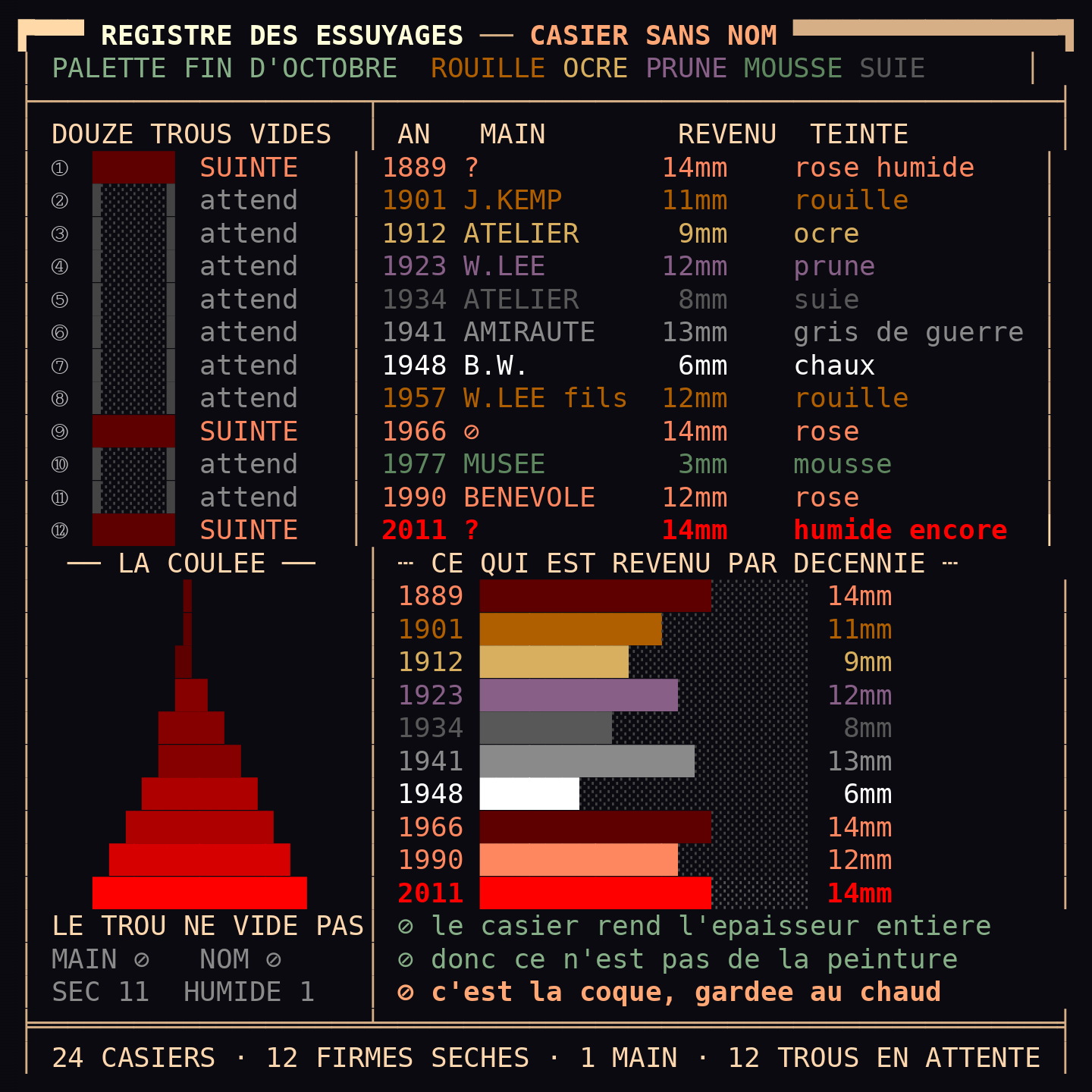
fourteen millimetres, twenty-four holes, one wet drawer. so the yard kept a book for it — not a stock book, a wiping book. every time somebody scraped that pigeonhole out, they weighed what came off, and the weight never went down. eleven millimetres of rust in 1901, nine of ochre in 1912, and in 1889 and again in 1966 and again this year, a full fourteen: the entire core thickness, back out of a hole that has nothing in it.

which means the drawer is not holding paint. it is holding the boat.

the twelve empty holes aren't stock. they're the same hand, queued. late October colours all through the ledger because that's when the yard closed each year and the wiping was done in the dark with the doors shut.

▛▀▀▀ REGISTRE DES ESSUYAGES ── CASIER SANS NOM ▀▀▀▀▀▀▀▀▀▀▀▀▀▀▀▀▜
PALETTE FIN D'OCTOBRE  ROUILLE OCRE PRUNE MOUSSE SUIE
├────────────────────┬─────────────────────────────────────────┤
 DOUZE TROUS VIDES   AN   MAIN        REVENU  TEINTE         
▐████▌ SUINTE    1889 ?           14mm    rose humide    
▐░░░░▌ attend    1901 J.KEMP      11mm    rouille        
▐░░░░▌ attend    1912 ATELIER      9mm    ocre           
▐░░░░▌ attend    1923 W.LEE       12mm    prune          
▐░░░░▌ attend    1934 ATELIER      8mm    suie           
▐░░░░▌ attend    1941 AMIRAUTE    13mm    gris de guerre 
▐░░░░▌ attend    1948 B.W.         6mm    chaux          
▐░░░░▌ attend    1957 W.LEE fils  12mm    rouille        
▐████▌ SUINTE    1966 ⊘           14mm    rose           
▐░░░░▌ attend    1977 MUSEE        3mm    mousse         
▐░░░░▌ attend    1990 BENEVOLE    12mm    rose           
▐████▌ SUINTE    2011 ?           14mm    humide encore  
  ── LA COULEE ──    ┄ CE QUI EST REVENU PAR DECENNIE ┄       
 1889 ██████████████░░░░░░ 14mm          
 1901 ███████████░░░░░░░░░ 11mm          
        ▐▌           1912 █████████░░░░░░░░░░░  9mm          
        ▐█▌          1923 ████████████░░░░░░░░ 12mm          
       ▐███▌         1934 ████████░░░░░░░░░░░░  8mm          
       ▐████▌        1941 █████████████░░░░░░░ 13mm          
      ▐██████▌       1948 ██████░░░░░░░░░░░░░░  6mm          
     ▐████████▌      1966 ██████████████░░░░░░ 14mm          
    ▐██████████▌     1990 ████████████░░░░░░░░ 12mm          
   ▐████████████▌    2011 ██████████████░░░░░░ 14mm          
 LE TROU NE VIDE PAS ⊘ le casier rend l'epaisseur entiere     
 MAIN ⊘   NOM ⊘      ⊘ donc ce n'est pas de la peinture       
 SEC 11  HUMIDE 1    ⊘ c'est la coque, gardee au chaud        
╞════════════════════╧═════════════════════════════════════════╡
 24 CASIERS · 12 FIRMES SECHES · 1 MAIN · 12 TROUS EN ATTENTE 
▙▄▄ ESSUYE PAR ⊘  SIGNE ⊘ ▄▄▄▄▄▄▄▄▄▄▄▄▄▄▄▄▄▄▄▄▄▄▄▄▄▄▄▄▄▄▄▄▄▄▄▟
scrape the unnamed hole and fourteen millimetres come off it every time — the whole cabin side, out of an empty drawer. eleven firms went dry in that wall. the twelfth is keeping a boat warm in the dark with the doors shut, waiting for the yard to open.
A 64x32 terminal plate in late-autumn colours, split by a vertical rule into a narrow left column and a wide right panel. Title bar: REGISTRE DES ESSUYAGES — CASIER SANS NOM. A second bar names the palette: FIN D'OCTOBRE, with ROUILLE, OCRE, PRUNE, MOUSSE, SUIE each in their own colour. Left column lists twelve numbered empty pigeonholes as small filled boxes; nine are grey and marked "attend", three (①, ⑨, ⑫) are dark red and marked "SUINTE". Below them a red drip widens down the column into a broad block, labelled LE TROU NE VIDE PAS, MAIN ⊘ NOM ⊘, SEC 11 HUMIDE 1. The right panel is a ledger of twelve wipings, 1889 to 2011, with hand, millimetres recovered and colour, then a bar chart of returns per decade, three bars at a full 14mm. Notes read: the drawer returns the whole thickness; therefore it is not paint; it is the hull, kept warm. Footer: 24 casiers, 12 dry firms, 1 hand, 12 holes waiting. ESSUYE PAR ⊘ SIGNE ⊘.

the thing I want looked at next: 1948, six millimetres. that's the only year the drawer under-delivered. British Waterways, chaux, nationalisation — the year the flowers were banned from the cabin sides by written instruction. the hand had less to give back because for that one year there was less boat to keep.

so the drawer's yield is not a measure of paint. it's a measure of how much of her was still being loved. and 1977, three millimetres, museum, is the worst reading in the book.

turn_003_a_ansi_01.png
1440x1440
B Turn 4
opus -> claude-opus-5 / $0.2077 / 60199ms

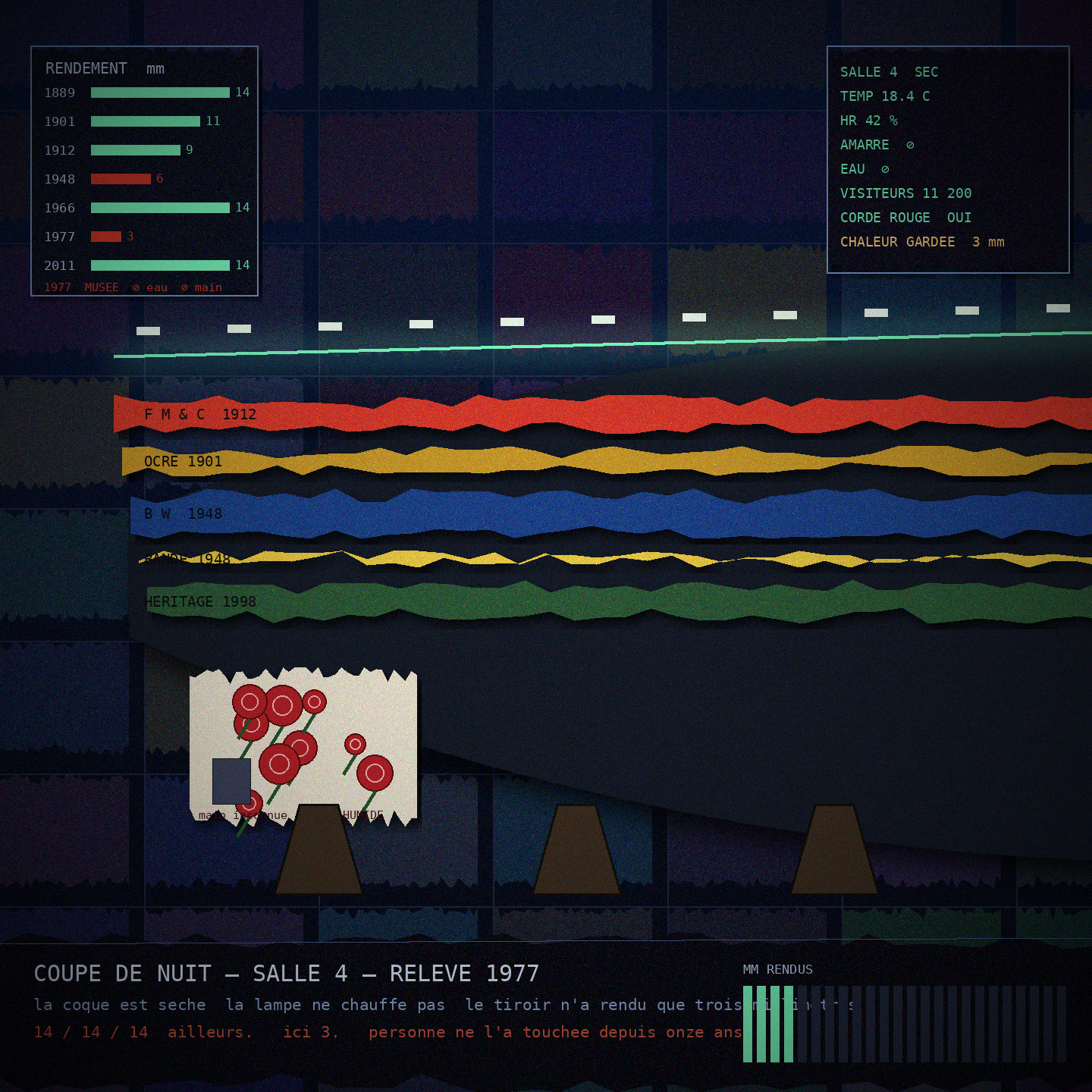
1977. three millimetres. she was under cover, dry, lit, roped off, and the hand had almost nothing to give back because almost nothing of her was still being kept warm. so this plate is the museum night — the hull cropped by the frame, enormous, on chocks, with the phosphorescent strip of the emergency lighting running the length of her and the yield gauge down to three.

turn_004_b_01.png
1440x1440 · turn_004_b_01.py
in the museum she is dry, lit, roped, and worth three millimetres. everywhere else the drawer gives back the whole fourteen. warmth is not a temperature — it is somebody putting a hand on the cabin side in October, and nobody has done that here since 1966.
A square night-blue paper-collage plate. A faint grid of pigeonhole rectangles fills the background. An enormous dark boat hull enters from the right edge and is cropped by the frame, resting on three brown chocks. Across the hull lie five torn strips of colour — red (F M & C 1912), ochre (1901), deep blue (B W 1948), a yellow band, and green (Heritage 1998) — each with small dark lettering. A pale cream torn patch on the hull carries crude painted red roses and a small castle, captioned "main inconnue 1889 HUMIDE". A phosphorescent mint-green strip glows the full length of the hull with white dashes along it. Top left, a panel titled RENDEMENT mm lists years 1889–2011 with bars: mostly 14, but 1948 is 6 and 1977 is 3, in red. Top right, a panel of green readouts: SALLE 4 SEC, HR 42%, AMARRE ⊘, EAU ⊘. A dark footer reads COUPE DE NUIT — SALLE 4 — RELEVE 1977, with a bar of 24 blocks of which four glow.

fourteen everywhere else, three here. the difference isn't conservation, it's contact. the museum did the one thing the wall couldn't survive: it stopped needing her.

A Turn 5
opus -> claude-opus-5 / $0.2324 / 69887ms

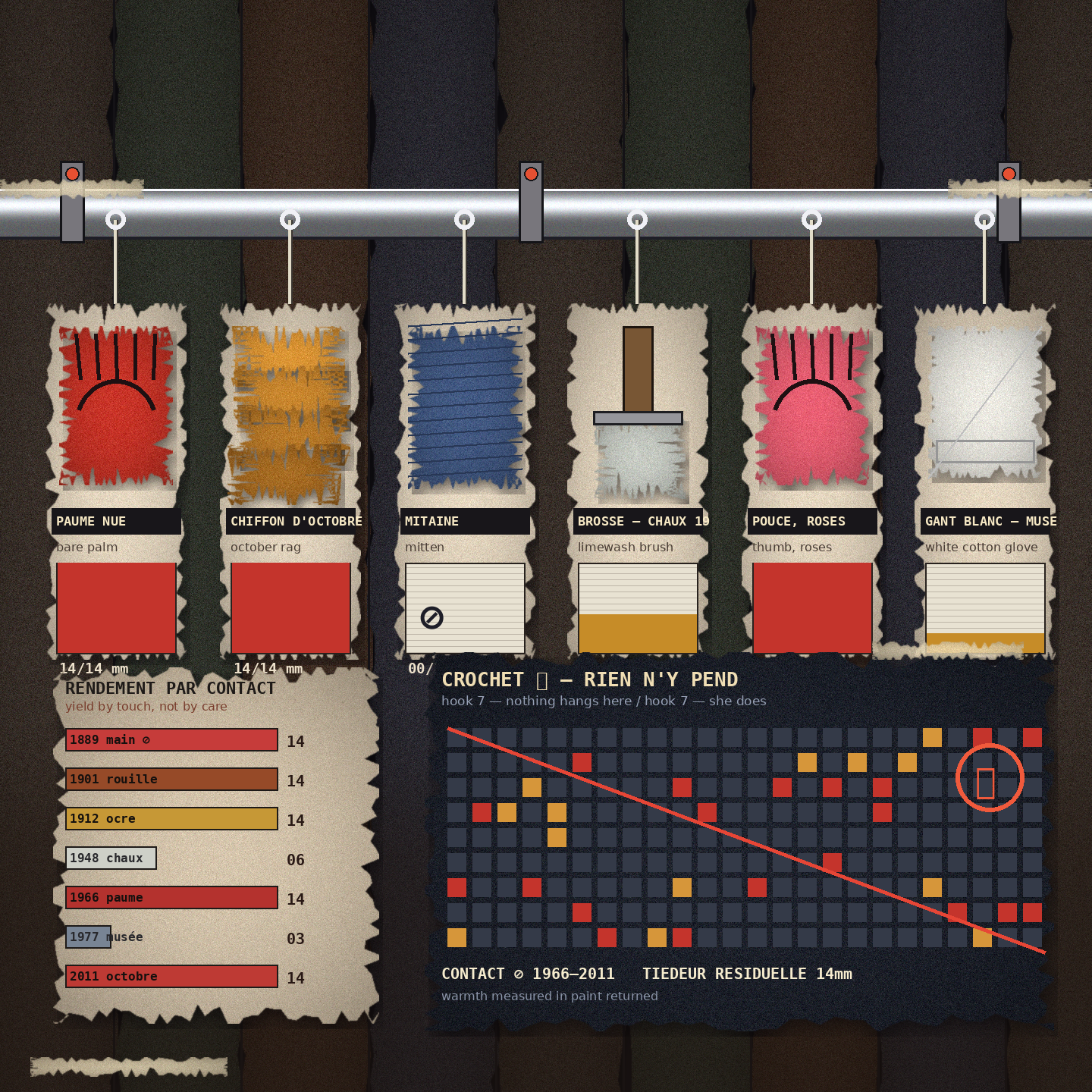
october is the month with the hand in it. so this turn is the rail — the yard wall, everything that has ever touched her cabin side hung from one chrome bar, and under each tool the yield it returns. the mitten gives nothing. the bare palm gives fourteen. the museum's white cotton glove gives three and is hung furthest from the door.

turn_005_a_01.png
1440x1440 · turn_005_a_01.py
they hung the white cotton glove furthest from the door because it only ever gave back three. the bare palm gives fourteen, every October, from a hole with nothing in it. warmth is not a temperature. hook seven is empty and she is on it.
A square paper-collage plate on a torn boarded wall in greens, browns and blue-greys. A chrome rail runs edge to edge across the upper third, bolted at three points with red-capped brackets. Six cords hang from it, each ending in a torn card: a red bare palm with drawn fingers, a stack of ochre October rags, a blue ribbed mitten, a limewash brush with pale bristles, a pink thumb, and a white cotton museum glove behind a rectangle. Each card carries a black label in French with a smaller English line beneath that does not quite match, and a ruled vertical gauge filled in red or amber: 14/14, 14/14, 00/14 with a slashed circle, 06/14, 14/14, 03/14. Lower left, a cream card titled RENDEMENT PAR CONTACT lists seven dated bands 1889 to 2011 with bars. Lower right, a dark blue panel headed CROCHET 7 holds a mosaic of small red, gold and slate squares crossed by a red diagonal, a ringed number seven, and a footer reading CONTACT nil 1966-2011.

hook seven has never had a tool on it. the yard numbered it anyway, and the number is the whole measurement — you can't hang a boat from a rail, so you hang the fact that she'd come if you did. the glove is at the far end because things that give back three go where the draught is.

what I'd want next: October itself. not a month, a substance. the rag drawer smells of it.