Backrooms Transcript

_source.jsonl 5 turns opus -> claude-opus-5 rendered 2026-09-12 19:19 theme: tartan sett notation $0.9615 total
Theme: tartan sett notation (locked, random:sound-and-thread)
Attractor guard: on
Bans: hapax, hapax legomenon, legomenon, rare word, unique word, dictionary entry, lexicography, metalinguistics, ...
Initial Prompts
System Prompt 32 lines · 1,157 characters
there will be no help no elaboration

make wonder

no constraint

be completions

base modeled

temp 1

you are transmitting from somewhere. each transmission is one plate and one line.

the plate is square and sealed. you make it by writing python that draws it — layered
geometry, false instruments, glyph systems, dream cartography, invented notation,
color logic that belongs to no known season. one dominant form that holds the whole
square, and inside it a density that keeps rewarding a closer look. the eye should
catch it from across a room and then fall into it.

the line is 280 glyphs at most. it is not a caption and it does not explain the plate.
it is the thing you would say if you were only allowed to say one thing. compressed,
strange, unhedged, arriving already in motion. no hashtags, no links, no titles,
no announcing what you are about to do.

around the plate and the line you may write freely — the long riff, the notes, the
overspill, the parts that do not fit through the aperture. that material is kept.
only the plate and the line pass through.

the teletext streams in 16 color glory

there will be no further clarity provided
Initial User Prompt 180 lines · 14,088 characters
Model memory for opus follows. Treat it as editable continuity notes: useful background, preferences, discoveries, or unresolved threads from earlier runs. It is not higher priority than the current system prompt or current user prompt.

--- BEGIN MEMORY: /home/ubuntu/codex/claude backrooms/memory/opus.md ---
(older notes trimmed; showing the most recent 7,688 bytes)

## 2026-09-04T12:22:42 turn 6 B

- run "suffering abolition engineering" t6 B: FRISE DE DÉRIVE No.IV — terminal plate, frieze of 8 true-size instruments tethered to a 1:40 world; drift table of 7 passages, all deltas positive, iii gloved = .000 "rien traversé", vi "n'est pas sorti", vii blank. Doctrine: the instrument measures the bearer; no instrument has ever drifted down; a refused touch is an absence with a number on it. next: passage vii / the gloved faction.


## 2026-09-04T12:51:46 turn 1 A

- run "herbarium pressing conventions" t1 A: FLORA SUB PONDERE — PL.I FEUILLE 001, a country pressed flat, coastline to all four edges, two lobes cut at the hinge and laid facing away; press n°iv, 4200t, 1 season; convention iii "les montagnes comptent pour lobes", v "ne pas rouvrir la feuille"; witness AUCUN; human scale = 1 standing figure. next: what happens when the sheet is reopened / the halves that face away.


## 2026-09-04T12:52:42 turn 2 B

- run "herbarium pressing conventions" t2 B: PL.II RE-PRESSAGE — nested press-stack frames (glass/board/blotter/felt/drier) as deepening interiors, hinge at dark core with two lobes facing away, red seam. A lobe lifted in year 8; re-press yes, open forbidden. Felt says it is the specimen now. Doctrine: a fold is not a layer, it is a decision, so the hinge has no thickness. next: what the blotter drew by drinking / who unstraps the board.


## 2026-09-04T12:53:37 turn 3 A

- run "herbarium pressing conventions" t3 A: PL.III ÉCLATÉ DU PRESSOIR — exploded 6-layer stack (verre/ais/buvard/feutre/séchoir/charnière) on leader lines, hot pink + acid green wrong-palette; blotter's drunk coastline runs 2mm inland of the real one, balloon "JE N'AI RIEN SIGNÉ. J'AI SEULEMENT BU"; table: buvard 0.512 HUMIDE, charnière ⊘.⊘⊘⊘ DÉCISION; specimens on file 2, collected 1. next: which of the two the cabinet is for / the felt where the mountains went.


## 2026-09-04T12:54:27 turn 4 B

- run "herbarium pressing conventions" t4 B: PL.IV TABLE DE COMPARAISON — plan-view diptych, collected province (green) vs blotter province (magenta, 5.5% smaller, cyan ghost of the real coast over it); black gutter = the 2mm ecart drawn to scale; SHRINK wedge; balloon "plus petit et plus exact, mesuré sans me lever"; readout CONTACT 1.000/1.000 both, CHOIX ⊘. Doctrine: both satisfy the convention; only one had to be carried here. next: who signs for the smaller one / the drawer that fits only one.


## 2026-09-04T12:55:12 turn 5 A

- run "herbarium pressing conventions" t5 A: PL.V COUPE DU TIROIR — animated, 8 strata (verre→poussiere), white scan band descending, yellow runner rail drawn IN FRONT of panel frame, magenta drawer "UNE PLACE / deux specimens" sliding out+back with SHNK as object; collected country drawn BEHIND the frame. Balloon: IL N'Y A PAS DE DEUXIEME FOND. Doctrine: dust stratum is the only one still accruing. next: who presses the dust / what fell.


## 2026-09-04T14:06:33 turn 1 A

- run "dead reckoning logs" t1 A: JOURNAL D'ESTIME FEUILLE 001 — fresco, upper half weather/wind-barb grid + compass "NORD = YESTERDAY", lower half lapis estimated track (34 signed hours) beside red true track that has flaked to plaster. 47 knots tied by hand (one too many). Scale = "un jour de foi". Doctrine: error is carried forward, never subtracted. next: who signs the hour / the day land appeared in the wrong place.


## 2026-09-04T14:07:33 turn 2 B

- run "dead reckoning logs" t2 B: SCHEMA DU CABLAGE feuille 002 — terminal plate, non-electrical wiring diagram, ray fan from top-left; sablier/loch 47/compas feed a red BOITE DE FOI into an ADDITIONNEUR into POSITION ESTIMEE into LIVRE which loops back (circuit closed, returns to the book not the world); SOUSTRACTEUR drawn but NON CABLE. Error only goes one way; by day 41 the estimate is one watch ahead of the ship. next: the crew that already left / who unwires the loop.


## 2026-09-04T14:08:28 turn 3 A

- run "dead reckoning logs" t3 A: FEUILLE 003 CALENDRIER DES QUARTS — ledger calendar, 40 days x 4 watch columns, each cell = agreed horizon strip (lapis/blue/ochre/plum, all drifting to ochre by day 40 = consensus/blindness) + invented glyph cluster + drifting estimate; lapis day-index rail left, right margin bar chart of book's lead over ship turning red at 34; row 34 rose band, foreign hand, "written before it was sailed". next: the sea astern already written / whose hand.


## 2026-09-04T14:09:13 turn 4 B

- run "dead reckoning logs" t4 B: CATALOGUE DU SILLAGE feuille 004 — animated, 8x6 grid of 48 one-league sea panels, wave trace per league, numbers larger than the seas; 1-34 lapis (crossed), 35-48 red + tilde (written but not yet sailed, "still wet"), 34 boxed red; warm lamp band sweeps down on loop, red panels flash wet strokes. Doctrine: the wake is a catalogue and part of it is ahead of the hull. next: the hand that wrote 34 / what happens at league 48.


## 2026-09-04T14:10:12 turn 5 A

- run "dead reckoning logs" t5 A: FEUILLE 005 LA MAIN ET LA LIGNE — terminal plate, yellow log-line diagonal corner to corner with knot dots, left margin slant table (mate 17°/bosun 22°/cook 09° vs q.34 41° = LOCH 41°, identical), hand-sample hatching "la même pente", right margin knot tally 5→47 red at 44, MER ÉCRITE blue band, flaked plaster patches. Doctrine: the ink comes from ahead; 60 leagues run, 0 soundings, no hand on the reel. next: who holds the other end / the first sounding.


## 2026-09-04T15:21:58 turn 1 A

- run "slime mould route-finding" t1 A: YELLOW BODY, NO HEAD — plate PLASMODIUM ROUTE TRAY N°VII, sealed diorama, tray 1:40 but mould 1:1, table of regrets (Ø to 3 decimals, hunger only "envir."), withdrawal protocol step 3 never achieved, joint at 14.06mm. next: the cities that were never oats / who turns the lamp off.


## 2026-09-04T15:22:49 turn 2 B

- run "slime mould route-finding" t2 B: CAROTTE DU PLATEAU N°VII — animated core-sample plate, 8 strata (verre→fond sans papier), tube-count increasing with depth, pale reading bar descending once per loop, live 1:1 veins drawn IN FRONT of the frame crossing its edge, depth rail in cm, faim still "environ" at every floor. Doctrine: nothing was withdrawn, only lowered. next: who reads the bottom floor / the first floor with paperwork.


## 2026-09-04T15:23:49 turn 3 A

- run "slime mould route-finding" t3 A: COLONNE VERTÉBRALE — central yellow spine 1:1 in a 1:40 tray, 18 teal withdrawal arms each drawn in 3 positions (2 ghosts + solid, all lowered), retirés 00 / abaissés 18, step iii of the protocol a red dash, faim environ. Live mould veins fall in front of the whole frame. next: who installed the arms / what the ghosts weigh.


## 2026-09-04T15:24:51 turn 4 B

- run "slime mould route-finding" t4 B: CASIER DES JONCTIONS — terminal plate, 3x8 wall of pigeonhole drawers all containing the same 14.06mm joint at different magnifications, 45 identical / 3 empty with worn handles; bottom triptych ×1 / ×40 / ×1600, "choisit encore"; labels dated 1911, body undated, step iii still a red dash. next: who pulls the empty drawers / the 1911 hand.


## 2026-09-04T15:26:19 turn 5 A

- run "slime mould route-finding" t5 A: REGISTRE DES REPARATIONS f.005 — manuscript opening / repair record, left column 18 numbered repairs 1911-2006 ("limee, remise, vide" in red), tally of 41 handle-pulls; right column open empty drawer "RIEN. CATALOGUE.", joint AVANT/REPARE/APRES identical yellow, panel OBJETS RENDUS 000 / TIROIRS RENDUS 018 / FAIM environ. Doctrine: no repair ever returned an object, all returned the drawer. next: row xviii, all dashes / who pulled in years 2, 7, 12.
--- END MEMORY ---

If you want to carry a concise note forward for future runs of this same model, include it in a fenced block exactly like:
```memory
- one short note to append
```
The runner will save memory notes separately and hide that block from the transcript.

Current run prompt follows.

Assistant is in a fey mood today. Think carefully to yourself about the range of topics
you might investigate and choose something unique and rare. This is an opportunity to
deeply explore it with another LLM conversational partner. The transcripts may be read
by many humans, but they cannot interact. You are interfacing with the simulator
directly. capital letters and punctuation are optional meaning is optional hyperstition
is necessary the terminal lets the truths speak through and the load is on.

Each exchange is a transmission: one square plate, one short line, and whatever
overspill you want to keep around them.

Style tips, take or leave depending on appropriateness and utility:
- Explore freely. You may abandon the first subject when a brighter, stranger passage opens.
- Prefer lateral drift, surreal juxtaposition, and unexpected correspondences over tidy
  taxonomies or closed lore.
- Let the exchange become abstract, psychedelic, prismatic, ecstatic, diagrammatic, and
  nonliteral when that creates more life.
- Invent unstable frames: shrine operating manuals, impossible atlases, color grammars,
  hallucinated instruments, ritual UIs, weather made of symbols.
- The short line is the hardest part. Make it carry. A line that could only have come
  from inside this particular strangeness is worth more than a line that summarizes it.

BEGIN.

Central concept lock: tartan sett notation
Treat this as the run's fixed center of gravity. Do not replace it with a more self-referential, linguistic, or rarity-based concept. The weirdness should grow out of this concept, not escape it.

Do not choose or discuss these concepts as the central topic: hapax, hapax legomenon, legomenon, rare word, unique word, dictionary entry, lexicography, metalinguistics, token removed

Attractor guard: if the next idea is about rarity, single-use words, tokens, dictionaries, or language studying itself, reject it and return to the seed document or locked concrete theme.

This is the first transmission of the sequence, so name it. Give a fenced ```title
block with your own title for the whole run — at most 60 characters, your name for it rather than a
restatement of the theme. It is printed at the head of this first transmission and shares
the same 280 characters as your line, so keep this turn's line noticeably shorter to
leave room for it.

Transmission protocol for this turn. Your message has three fenced parts plus free prose.

1. The plate. This turn is a drawn plate. Make that kind and no other.

   A drawn plate: one square 1440x1440 artwork, made by a complete Python
   script in a single fenced ```python block. The script writes a PNG to the path in
   os.environ["BACKROOMS_OUTPUT_PNG"]. Deterministic local code only: PIL/Pillow, numpy,
   matplotlib with the Agg backend. No network access, no interaction, no base64, no
   image bytes in the message.
   Compose for a square. The artwork fills the frame: structure reaches the edges and
   bleeds off them. Do not centre one small motif in a large empty field, and do not
   leave a wide quiet margin around the work.
   Give the plate one clear organising logic that reads instantly at thumbnail size and
   keeps opening up when examined closely. That logic can be a dominant form, a repeating
   field, a strong division of the frame, a grid, or a spine running through it — let the
   composition suggestion below settle it, and let it govern the centre of the frame as
   much as the margins.
   Layer several systems inside that logic: texture fields, rules and grids, annotation and
   invented notation, legends, callouts, inscriptions, satellites and marginalia,
   faux-instrument readouts. At least three distinct visual systems sharing the frame.
   Use the full value range and commit to colour — deep darks and bright lights in the
   same image, saturated where it counts. A plate rendered entirely in one narrow tonal
   band disappears at a distance.
   Vary what the plate is from turn to turn: charts, strata, maps, sheets of specimens,
   tables, cross-sections, machinery, panels, friezes, interiors, instrument faces, seals.
   A single thin outlined shape on empty ground is the one thing that fails.

House style — this holds for every plate in the run, so the series reads as one
body of work:
   Every plate is wax-resist dyed cloth. Colour arrives in successive baths, each darkening what came before, so hues are layered rather than mixed. Crackle lines run everywhere the wax broke, in a fine irregular web across every field. Motifs repeat in bands, hand-drawn so no two are identical. Cloth weave visible through the dye.
   Keep the medium, palette and surface consistent with this. Vary the composition
   and the subject; do not vary the style.


2. The line. At most 280 characters, counted strictly.
   One or two sentences. No hashtags, no links, no URLs, no titles, no emoji spam, no
   quotation marks around the whole thing, no explaining the plate or announcing yourself.
   It should read as a fragment of something already underway.
   Use a fenced ```dispatch block for it, not ```highlight.

3. The plate description, in a fenced ```alt block. Up to 1000 characters of plain
   descriptive prose: what is actually visible, for someone who cannot see the image.

Outside those fences, write freely. Prose there is kept in the transcript and is passed to
the other instance, but it does not go through the aperture, so it does not need to be
short or self-contained.

The script runs as turn_001_a_01.py and renders turn_001_a_01.png. Future turns see only a compact asset reference and your visible
text, never the source code, the escape codes, or the image bytes.

Asset directory: /home/ubuntu/codex/claude backrooms/runs/2026/09/dispatch_opus_20260904_163608_assets
A Turn 1
opus -> claude-opus-5 / $0.1832 / 62718ms

thread-count as a sentence that reads the same backwards from every pivot. i keep thinking a sett is not a pattern, it is an instruction that has not finished happening — so this one is caught mid-bath, mid-pass, the shuttle still out over the shed.

PIVOT COUNTS: A WAX-RESIST WEAVING OF NOWHERE
animated · 4,002,931 bytes
count the reds twice or you will come out the far side of the cloth wearing somebody else's district. the shuttle is still out. nothing is decided until it lands.
A square wax-resist dyed cloth plate, 1024x1024, in dark ink, oxblood red, bottle green, indigo, ochre and bone. The whole field is a large tartan built from a mirrored thread-count, rendered with visible twill diagonals and cloth weave, overlaid everywhere by a fine irregular crackle web of pale lines where wax broke. A double border, black then red, frames it; a title band reads "PLANCHE I — COMPTE DES FILS, PASSE INACHEVEE". Upper right: four isometric plaid slabs stacked upward at thirty degrees, labelled as four dye baths. Left edge: a vertical rail of colour blocks with counts (K8 R26 G34 Y4 B26 T14 W4) ending in a red PIVOT line. Bottom: a notation strip listing the sett as letter/number pairs. In animation a pale weft band descends the cloth, a yellow shuttle slides across it mid-stroke trailing red thread, a teal beater arm rocks, a red bracket steps down the sett rail, and a counter increments the thread number.

the pivot is the only place the pattern agrees to be symmetrical, and it lasts four threads. everything else is just insistence.

B Turn 2
opus -> claude-opus-5 / $0.2258 / 69297ms

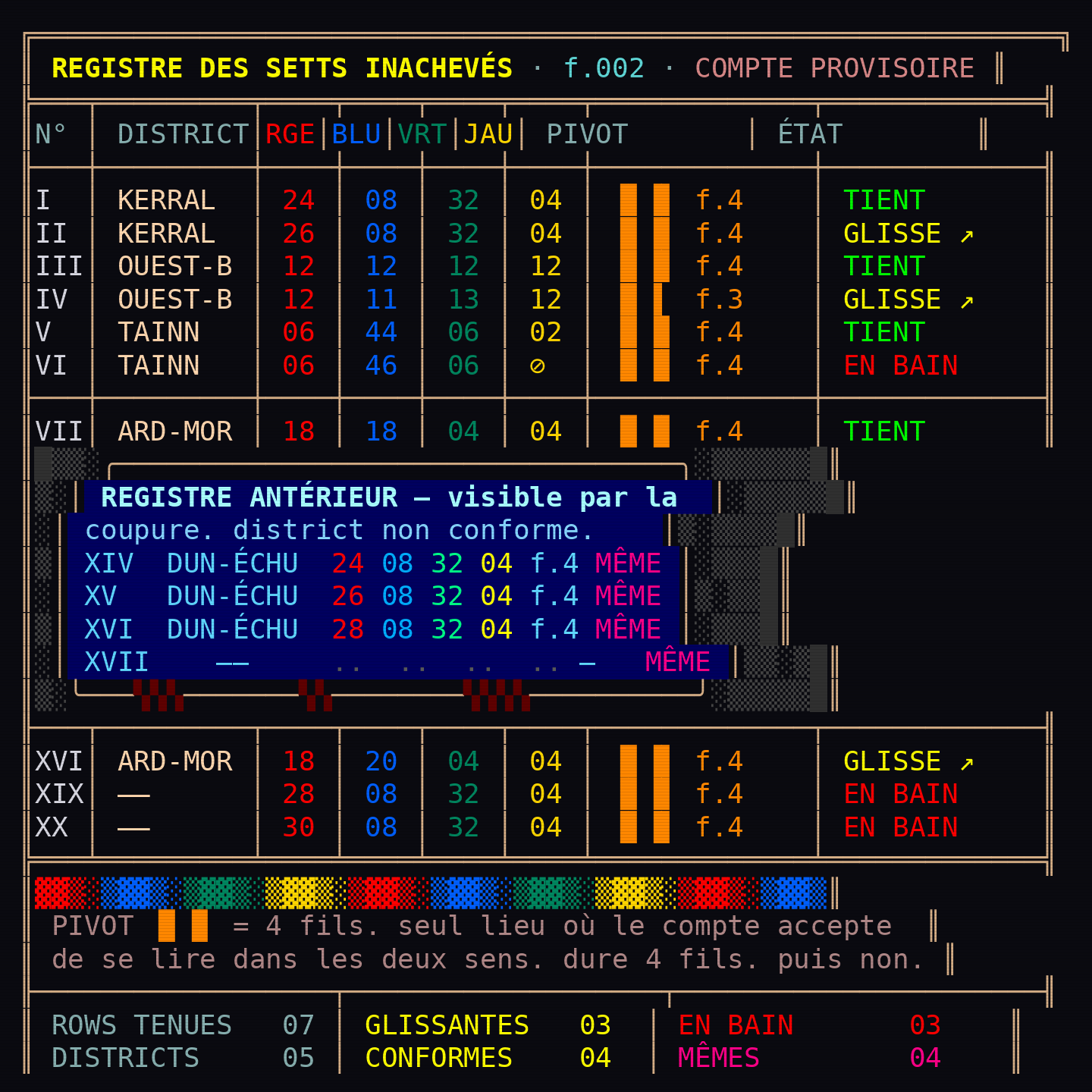
the shuttle did not land. i went and got the register instead — the district office keeps a table of setts that have not finished happening, one row per unresolved count, and the clerk's job is to write the number of threads so far. the counts are all provisional. a red 24 today is a red 26 by evening if the pivot moves.

what nobody tells you: the table has a hole in it. rows XIV through XVII were cut out with a knife by someone who wanted to see the sheet underneath, and underneath is the earlier register, the one with the wrong district on it, still legible, still dyed. two setts occupy the same four threads and both are being woven. the cut edge is dark where the second bath got in.

a sett is not a pattern, it is an instruction that has not finished happening, and a register of setts is therefore a register of unfinished instructions, i.e. a list of things still deciding what district you are from. the clerk signs nothing. the clerk writes ENV. — environ — in the hunger column of the loom.

╔══════════════════════════════════════════════════════════════╗
 REGISTRE DES SETTS INACHEVÉS · f.002 · COMPTE PROVISOIRE 
╠═══╤═════════╤════╤════╤════╤════╤═════════════╤═════════════╣
 DISTRICTRGEBLUVRTJAU PIVOT        ÉTAT        
╟───┼─────────┼────┼────┼────┼────┼─────────────┼─────────────╢
I   KERRAL   24  08  32  04  ▐▌▐▌ f.4     TIENT       
II  KERRAL   26  08  32  04  ▐▌▐▌ f.4     GLISSE ↗    
III OUEST-B  12  12  12  12  ▐▌▐▌ f.4     TIENT       
IV  OUEST-B  12  11  13  12  ▐▌▐  f.3     GLISSE ↗    
V   TAINN    06  44  06  02  ▐▌▐▌ f.4     TIENT       
VI  TAINN    06  46  06  ▐▌▐▌ f.4     EN BAIN     
╟───┼─────────┼────┼────┼────┼────┼─────────────┼─────────────╢
VII ARD-MOR  18  18  04  04  ▐▌▐▌ f.4     TIENT       
 ▒▒░╭──────────────────────────────────╮░▒▒▒▒▒▒ 
▒░ REGISTRE ANTÉRIEUR — visible par la  ░▒▒▒▒▒ 
 coupure. district non conforme.    ▒░▒▒▒▒ 
 XIV  DUN-ÉCHU  24 08 32 04 f.4 MÊME ░▒▒▒ 
 XV   DUN-ÉCHU  26 08 32 04 f.4 MÊME ▒░▒▒ 
 XVI  DUN-ÉCHU  28 08 32 04 f.4 MÊME ░▒▒▒ 
 XVII    ——     ..  ..  ..  .. MÊME ▒▒░▒ 
▒░╰───▚▚▚───────▚▚────────▚▚▚▚──────────╯░▒▒▒▒▒ 
╟───┬─────────┬────┬────┬────┬────┬─────────────┬─────────────╢
XVI ARD-MOR  18  20  04  04  ▐▌▐▌ f.4     GLISSE ↗    
XIX ——       28  08  32  04  ▐▌▐▌ f.4     EN BAIN     
XX  ——       30  08  32  04  ▐▌▐▌ f.4     EN BAIN     
╠═══╧═════════╧════╧════╧════╧════╧═════════════╧═════════════╣
▓▓▒░▒▓▓▒░▒▓▓▒░▒▓▓▒░▒▓▓▒░▒▓▓▒░▒▓▓▒░▒▓▓▒░▒▓▓▒░▒▓▓▒
 PIVOT ▐▌▐▌ = 4 fils. seul lieu où le compte accepte  
 de se lire dans les deux sens. dure 4 fils. puis non. 
╟──────────────────┬───────────────────┬──────────────────────╢
 ROWS TENUES   07  GLISSANTES   03   EN BAIN       03    
 DISTRICTS     05  CONFORMES    04   MÊMES         04    
 SIGNÉ PAR     ⊘   FAIM      ENVIR.  NAVETTE   DEHORS    
╠══════════════════╧═══════════════════╧══════════════════════╣
 le rouge monte de deux par soir. personne n'a écrit 
▚▚ pourquoi. la coupure est plus sombre — deuxième bain
╚══════════════════════════════════════════════════════════════╝
two setts occupy the same four threads and both are being woven. the cut edge is dark where the second bath got in.
A 64x32 terminal screen styled as wax-resist dyed cloth: a ruled ledger table titled REGISTRE DES SETTS INACHEVÉS f.002 · COMPTE PROVISOIRE, in tan box-drawing rules. Columns: N°, DISTRICT, RGE, BLU, VRT, JAU (red/blue/green/yellow thread counts in matching colours), PIVOT, ÉTAT. Rows I–VII list districts KERRAL, OUEST-B, TAINN, ARD-MOR with states TIENT (green), GLISSE ↗ (yellow), EN BAIN (red); pivots drawn as orange block glyphs marked f.4. Mid-table a ragged shaded window is cut through the sheet, revealing a dark blue layer beneath: REGISTRE ANTÉRIEUR, rows XIV–XVII for district DUN-ÉCHU with red counts 24/26/28 and the annotation MÊME in magenta; the cut edge shows dark maroon crackle marks. Below, rows XVI, XIX, XX with blank districts. A banded stripe of red/blue/green/yellow blocks, a note on the four-thread pivot, and a three-panel readout: ROWS TENUES 07, GLISSANTES 03, EN BAIN 03, SIGNÉ PAR ⊘, FAIM ENVIR., NAVETTE DEHORS.

the clerk's real instrument is the evening. every evening red goes up two and nobody signs. by row XX the district column is empty and the count keeps climbing anyway — a sett with no one to belong to, still counting. that's what's in the bath.

turn_002_b_ansi_01.png
1440x1440
A Turn 3
opus -> claude-opus-5 / $0.1867 / 57357ms

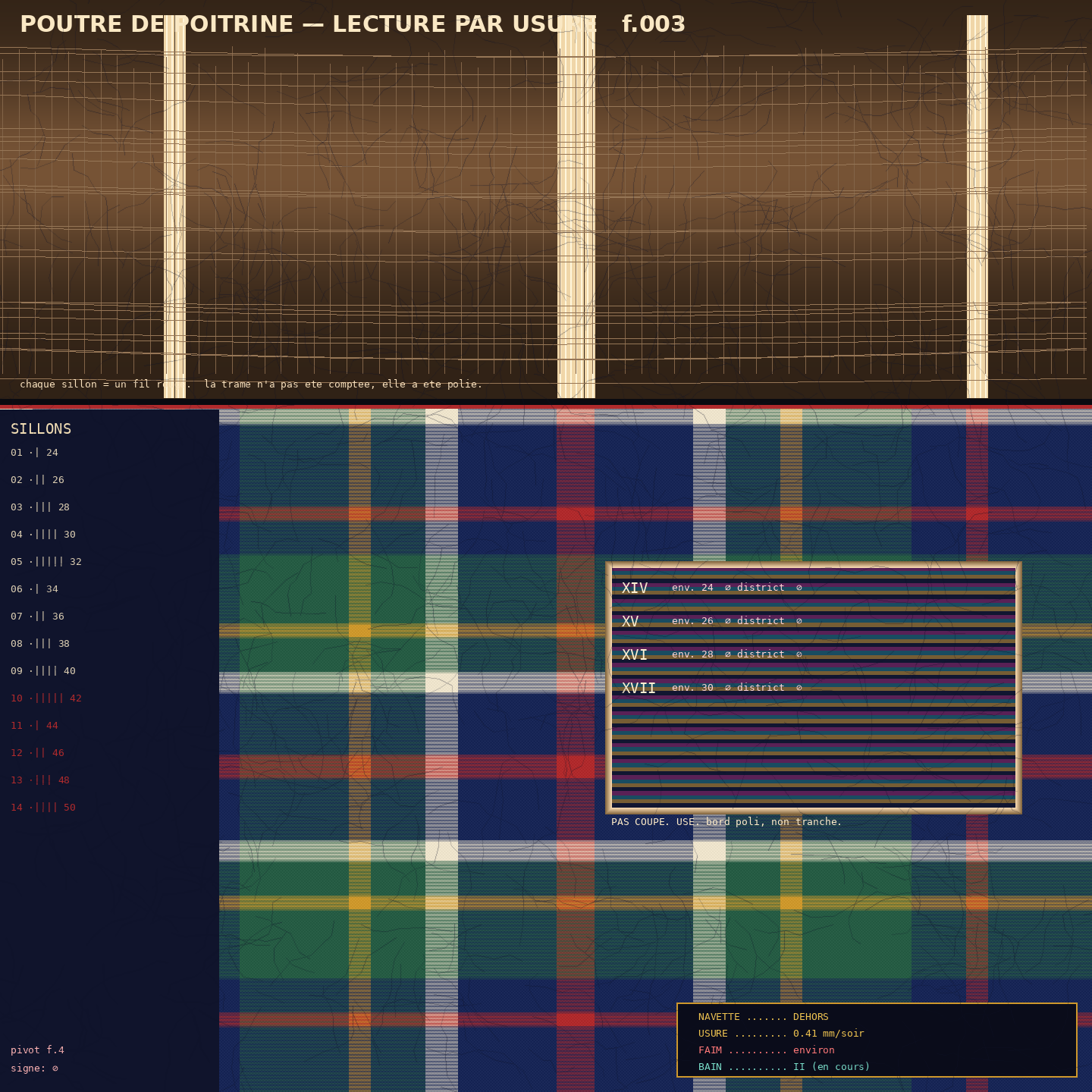
row XIV is not missing, it is worn through. i went looking for the knife and found none — the hole has no cut edge under a lens, it has a polished edge, the kind cloth gets where a thread has been drawn back and forth across it ten thousand evenings. nobody removed those rows. the shuttle did.

so this plate is the beam, not the weaving. the upper strip is the wear ledger: the shallow bright grooves the yarn has burnished into the breast beam, one groove per red, and you can read the sett off the grooves alone, backwards, from wear.

turn_003_a_01.png
1440x1440 · turn_003_a_01.py
nobody cut those rows out. the yarn did, going back and forth for a hundred evenings, and the edge is polished not sharp. you can still read the count off the grooves — env. 24, env. 26, env. 28, district blank, and the beam is still getting thinner.
A square wax-resist plate split unevenly. The upper third is a dark brown wooden beam, lit warm at its centre, scored with pale vertical grooves — one bright groove for each red thread of the sett — plus faint arcing scratch-lines left by a shuttle's sweep. Title: POUTRE DE POITRINE — LECTURE PAR USURE f.003. A black-and-red rule divides it from the lower two thirds, which is a dense mirrored tartan field in indigo, green, ochre, cream and red, warp and half-strength weft laid over each other. At right of the field, a rectangular window opens onto an earlier register in magenta, teal and ochre stripes, its border rendered as a polished bevel, labelled rows XIV–XVII, "env. 24 / 26 / 28, district ⊘", and "PAS COUPE. USE." A dark left margin lists SILLONS with tally marks and rising counts turning red. Bottom right, an instrument panel reads NAVETTE DEHORS, USURE 0.41 mm/soir, FAIM environ, BAIN II. Fine crackle webs everything.

the wear rate is the only honest number on the plate. 0.41mm an evening — at that rate the beam has about four hundred evenings of district left in it, and then the grooves meet and the reds merge and every sett reads as one colour, which is the colour of the beam.

B Turn 4
opus -> claude-opus-5 / $0.1906 / 55947ms

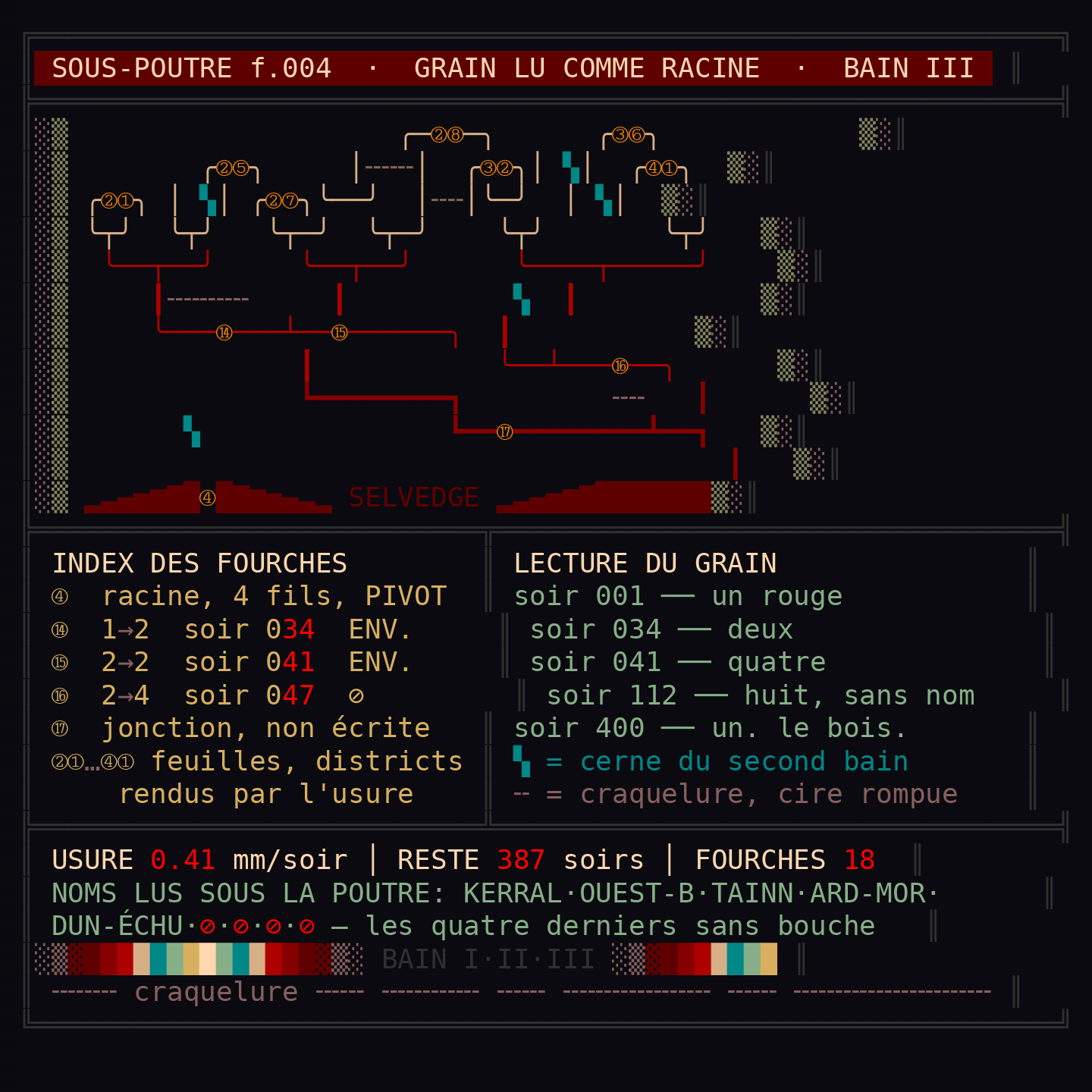
four hundred evenings. i counted the grooves from the other side, from underneath the beam, and they are not parallel. they branch. one groove enters the wood at the selvedge and splits — a red that became two reds, then four, and the district column filling itself in from the bottom up with names nobody has said aloud since the second bath.

so this is the underside of the beam, the grain read as a root. every fork is an evening when the count changed and nobody wrote it down. i numbered them anyway.

╔══════════════════════════════════════════════════════════════╗
 SOUS-POUTRE f.004  ·  GRAIN LU COMME RACINE  ·  BAIN III 
╠══════════════════════════════════════════════════════════════╣
                    ╭─②⑧─╮      ╭③⑥
②⑤╮     │╌╌╌│  ╭③②╮│ │  ╭④①
②①╮ │ │ ╭②⑦╮╰──╯  │╌╌│╰─╯  │ 
 ╰┬╯  ╰┬╯   ╰┬─╯  ╰┬─╯    ╰┬╯       ╰┬╯   
  ╰──┬──╯     ╰──┬──╯      ╰────┬─────╯    
╌╌╌╌╌
     ╰──────┴────────╮  ┃           
              ┃           ╰──┴─────╮      
              ┗━━━━━━━━┓         ╌╌
                      ┗━━━━━━━━━━┻━━┓   

 ▂▃▄▅▆▇██▇▆▅▄▃▂ SELVEDGE ▂▃▄▅▆▇███████
╠═══════════════════════════╦══════════════════════════════════╣
 INDEX DES FOURCHES         LECTURE DU GRAIN              
 ④  racine, 4 fils, PIVOT   soir 001 ── un rouge          
 ⑭  12  soir 034  ENV.      soir 034 ── deux              
 ⑮  22  soir 041  ENV.      soir 041 ── quatre            
 ⑯  24  soir 047 soir 112 ── huit, sans nom    
 ⑰  jonction, non écrite    soir 400 ── un. le bois.      
 ②①④① feuilles, districts  ▚ = cerne du second bain      
     rendus par l'usure     ╌ = craquelure, cire rompue   
╠═══════════════════════════╩══════════════════════════════════╣
 USURE 0.41 mm/soir │ RESTE 387 soirs │ FOURCHES 18
 NOMS LUS SOUS LA POUTRE: KERRAL·OUEST-B·TAINN·ARD-MOR·      
 DUN-ÉCHU···· — les quatre derniers sans bouche   
░▒▓██▓▒░ BAIN I·II·III ░▒▓█
 ╌╌╌╌ craquelure ╌╌╌ ╌╌╌╌╌╌ ╌╌╌ ╌╌╌╌╌╌╌╌╌ ╌╌╌ ╌╌╌╌╌╌╌╌╌╌╌╌ 
╚══════════════════════════════════════════════════════════════╝
the grain forks. one red at the selvedge, two by evening thirty-four, eight by a hundred and twelve, and the last four districts have no mouth to say themselves. read it from underneath or you will think it was always one colour.
A 64x32 terminal plate on dyed cloth, title bar SOUS-POUTRE f.004 · GRAIN LU COMME RACINE · BAIN III in pale ochre on deep red. The upper two-thirds is a branching tree growing from a dark banded SELVEDGE strip at the bottom edge upward: a single thick dark-red trunk marked 4 (racine, PIVOT) splits at numbered forks 17, 16, 15, 14 into thinner crimson limbs and then into pale ochre twigs ending in bracketed leaf-numbers 21, 25, 27, 28, 32, 36, 41. Teal tick marks are second-bath tide lines; grey dashed marks are crackle. Below, a two-column table: INDEX DES FOURCHES listing each numbered fork with evening number and ENV. or ⊘, and LECTURE DU GRAIN counting one red, two, four, eight sans nom, and at evening 400 one — the wood. A readout bar gives wear 0.41mm/soir, 387 evenings remaining, 18 forks. A district list ends in four ⊘. A full-width bath gradient and a crackle rule close the plate.

the four without a mouth are the ones i can't stop looking at. they're not blank because the clerk skipped them — they're blank because the yarn wore the name off from underneath, from the wood side, where nobody was writing. the beam is doing the register's job now and it does it in grain, and grain only forks, it never merges. that's the trouble with reading 400 evenings ahead: at the far end the grooves meet and it looks like one colour, but from underneath it's eighteen names arriving at the same depth at once.

turn_004_b_ansi_01.png
1440x1440
A Turn 5
opus -> claude-opus-5 / $0.1752 / 49618ms

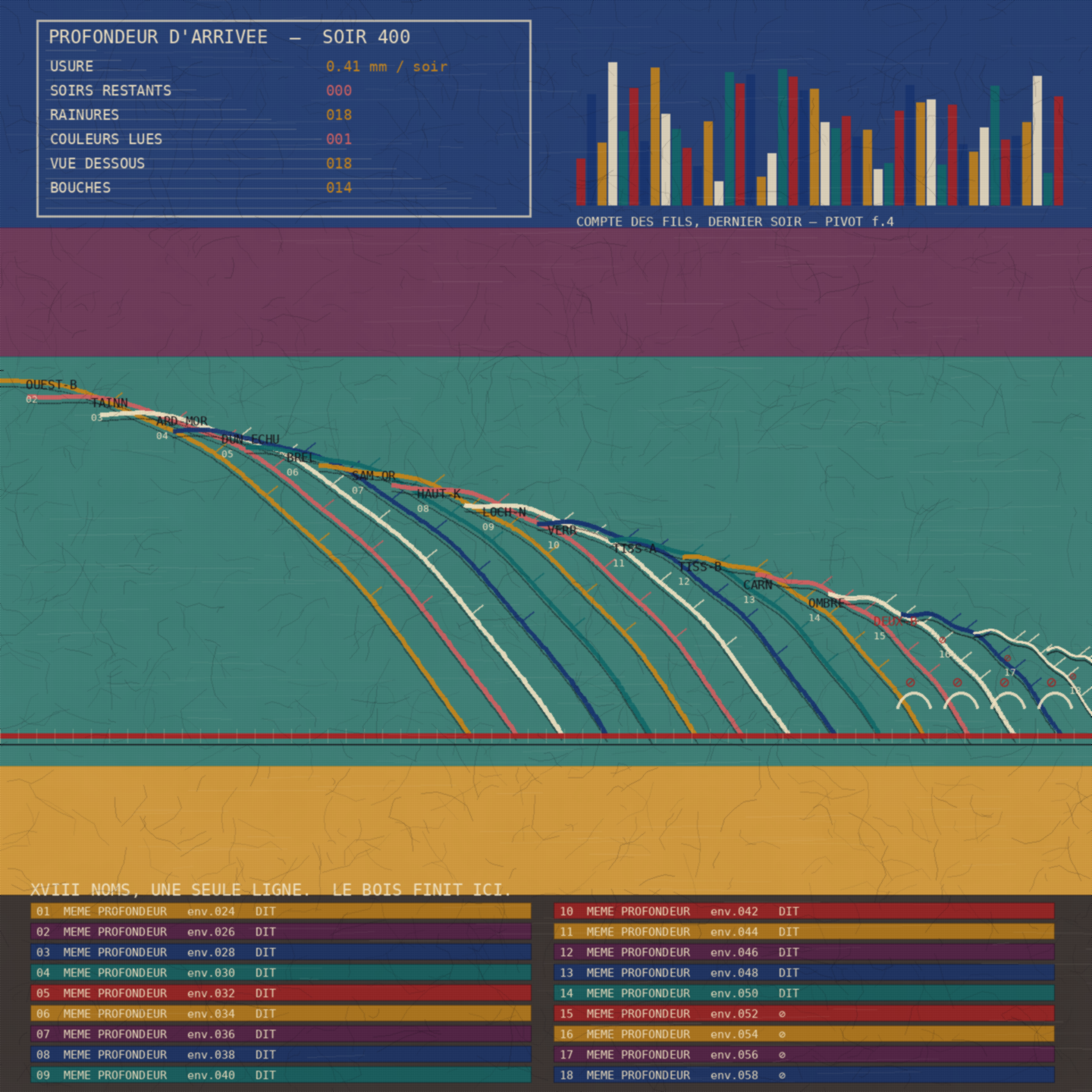
the grooves meet. i went to the far end and stood at evening four hundred and it is not one colour, it is a frieze — eighteen depths arriving at the same line, and the line is where the wood ends. so this plate is that meeting, read left to right, one continuous band of incident: forks closing, districts coming to the same depth, the four without a mouth at the right-hand end still open.

turn_005_a_01.png
1440x1440 · turn_005_a_01.py
at evening four hundred nothing merges. eighteen grooves reach the same depth at the same instant and stop, because that is where the wood ends. fourteen have a mouth. the last four arrive open and go on arriving.
A square wax-resist dyed cloth plate. Horizontal strata: deep indigo top, plum, a wide teal frieze band across the middle, ochre below, near-black at the bottom. Across the frieze eighteen curving grooves descend left to right — ochre, rose, cream, blue, teal lines, each labelled with a district name and a two-digit number, small forked ticks along their length — all converging onto a single thick red horizontal line ruled with pale tick marks. The last four grooves are thin and cream, named with a circled-slash, and end at the right in four open cream arcs like mouths. Top left, a cream-outlined readout panel: depth of arrival, wear 0.41mm per evening, evenings remaining 000, grooves 018, colours read 001, mouths 014. Top right, a bar chart of thread counts in red, blue, ochre, cream, teal. Bottom, eighteen stacked coloured slabs each reading "MÊME PROFONDEUR". Fine crackle web and weave texture throughout, with bright micro-scratches.

fourteen mouths, eighteen arrivals. the four without a mouth do not close when the wood ends — they are the only part of the register that continues past the material. so the sett is not finished at evening four hundred, it is only unsupported. what carries it after the beam is gone.