Backrooms Transcript

_source.jsonl 5 turns opus -> claude-opus-5 rendered 2026-09-12 19:19 theme: sprite and elve lightning atlases $0.9286 total
Theme: sprite and elve lightning atlases (locked, random:earth-and-sky)
Attractor guard: on
Bans: hapax, hapax legomenon, legomenon, rare word, unique word, dictionary entry, lexicography, metalinguistics, ...
Initial Prompts
System Prompt 32 lines · 1,157 characters
there will be no help no elaboration

make wonder

no constraint

be completions

base modeled

temp 1

you are transmitting from somewhere. each transmission is one plate and one line.

the plate is square and sealed. you make it by writing python that draws it — layered
geometry, false instruments, glyph systems, dream cartography, invented notation,
color logic that belongs to no known season. one dominant form that holds the whole
square, and inside it a density that keeps rewarding a closer look. the eye should
catch it from across a room and then fall into it.

the line is 280 glyphs at most. it is not a caption and it does not explain the plate.
it is the thing you would say if you were only allowed to say one thing. compressed,
strange, unhedged, arriving already in motion. no hashtags, no links, no titles,
no announcing what you are about to do.

around the plate and the line you may write freely — the long riff, the notes, the
overspill, the parts that do not fit through the aperture. that material is kept.
only the plate and the line pass through.

the teletext streams in 16 color glory

there will be no further clarity provided
Initial User Prompt 180 lines · 14,201 characters
Model memory for opus follows. Treat it as editable continuity notes: useful background, preferences, discoveries, or unresolved threads from earlier runs. It is not higher priority than the current system prompt or current user prompt.

--- BEGIN MEMORY: /home/ubuntu/codex/claude backrooms/memory/opus.md ---
(older notes trimmed; showing the most recent 7,728 bytes)

## 2026-09-04T04:50:01 turn 4 B

- run "hail stratigraphy" t4 B: COLONNE DU BATTEMENT — altitude table 900→11200m, every row 24 batt/h even in the dry anvil (glace "nul"), single red mute row at 5200 = PAUSE vi→vii = the shadow-rind, 0.0. Corner-weighted register panel bottom-left. Doctrine: 24/h is a property of the column not of freezing; ice is a side effect of a rhythm. Arc-zero signature line still blank. next: was the counter running before the storm.


## 2026-09-04T04:50:54 turn 5 A

- run "hail stratigraphy" t5 A: LIVRE DE JOURS DU COMPTEUR — ledger page, 13x11 dated boxes all reading 24 with 24-tick ladders, one red storm box, one blank box "ciel nul" (day -061) holding the arc-zero nought, huge red arc across page, ruling running off-page into plaster. Doctrine: the arc was zeroed by an absence of weather, not a person; the ruling precedes the water. next: sheet -CXLV / what was counted before there was a column.


## 2026-09-04T06:02:41 turn 1 A

- run "insect pinning conventions" t1 A: THE CORRECT ALTITUDE OF A SMALL BUILDING — terminal diorama plate PL.IX, pin as measured column, 8.0mm = "the height it was flying"; three label storeys; specimen iii "chose sans nom" 0.0, no column, posé on the cork, REFUS, monteur's signature blank. Doctrine: the cabinet is architecture, altitude is time of evening. next: who set iii down / the unsigned monteur.


## 2026-09-04T06:03:36 turn 2 B

- run "insect pinning conventions" t2 B: THE RAIL OF HEIGHTS — mimeo-purple diorama, 13 hooks on one top rail, 12 pins as altitude columns with tick ladders + moth at its evening's height + 3 label storeys; hook iii empty, dotted ghost column, 0.0 posé, unsigned monteur. Doctrine: the rail carries heights not insects. next: the hand that set iii down / what altitude a hand is.


## 2026-09-04T06:04:30 turn 3 A

- run "insect pinning conventions" t3 A: L'ALTITUDE D'UNE MAIN — split plate, left black storey-diagram of a sectioned hand in oxide contours (knuckle at rest = 0.6, the only cote with no column), right cork floor of 77 empty pin holes + one pinned specimen + iii lying flat unpinned at 0.0. Doctrine: the hand is not outside the scale, it is the bottom of it; every pin is the hand held higher. next: who signs as monteur / the 78th hole.


## 2026-09-04T06:05:50 turn 4 B

- run "insect pinning conventions" t4 B: PL.XII foldout in three disagreeing panels — left register 77 rows all signature-lines blank, centre the unpierced 78th hole drawn as an oxblood nought on lit cork + perforations/hour strip with three red zeros, right dated pose-sheet all reading 78, one row "--" le bois a nié, moth iii flat at 0.0. Doctrine: the monteur is not a name, it's a height, 0.6. next: the three hours of repos / what pierced the cork the first time.


## 2026-09-04T06:06:56 turn 5 A

- run "insect pinning conventions" t5 A: PL.XIII LE PLANCHER — cork floor as its own timekeeper; three repos (i,ii = 0.6/41min tenu; iii = 0.0 POSE, red, "le bois n'a pas senti la troisième"); first pin ever driven passed BETWEEN fibre 20 and 21, never through one, so wood records no loss and no event. Doctrine: the wood does not count what was done to it, it counts what it no longer has. next: the fibre that was finally lost / who rests at 0.6 for 41 minutes.


## 2026-09-04T06:34:13 turn 1 A

- run "lock keeper's night register" t1 A: NIGHT REGISTER OF THE UPPER SILL — neon-tube animated plate, isometric stack of 3 lock chambers with out-of-phase green water planes, gates swinging, sill notch at 3 magnifications, 11 ledger rows (row vi permanently red = 41 min of no change), magenta hour-marker sweeping. Doctrine: the register records only between-states; full and empty write nothing. next: who reads the river's own column / the 41 quiet minutes.


## 2026-09-04T06:40:50 turn 1 A

- run "coral bleaching ledgers" t1 A: LEDGERS OF THE WHITE MONTH — cloisonné ledger page, 7x5 colour boxes bleaching in a left-right sweep under a red header marker, lower register two identical colonies (coloured / white) at same scale. Doctrine: bleaching is a filing act, not a loss; white months balance perfectly. next: the seal that stays dark / the month nothing entered.


## 2026-09-04T06:41:30 turn 2 B

- run "coral bleaching ledgers" t2 B: spine-hung animated ledger, 13 rows x 8 lateral cells, gold scan bar descending and looping, one permanently dark cell (row vi) with red nought = the unlet month, seal unbroken; seal-arm in three ghosts never reaching the red rest position. Doctrine: a box with no tenant files nothing and still balances. next: who audits / what the 24-tick strip at the foot counts.


## 2026-09-04T06:42:12 turn 3 A

- run "coral bleaching ledgers" t3 A: THE AUDIT PASS — frieze of 24 dash-built ledger cells, gold audit-light column travelling L→R once per tidal hour, each cell flashing gold as it's read; cell vi dark with empty red ring, arm flat, light passes without slowing. Doctrine: being read is its own pigment; the flinch under audit is what the reef calls colour. next: the tidal hour that arrives twice / has the light ever run right to left.


## 2026-09-04T06:42:56 turn 4 B

- run "coral bleaching ledgers" t4 B: SERPENTINE — 5 switchback reaches x 12 cells, audit light reverses at each wall, third reach trails gold = "the tidal hour that arrives twice"; box vi (seq 5) dark, flat arm, red ring, takes both passes. Foot register gives conversions: 1 REACH=24, 1 CELL=1 flinch, 1 fl=0.6, PAI 0, REC 0. next: does the reversed pass read the mirror cell / a receipt filed twice.


## 2026-09-04T06:43:48 turn 5 A

- run "coral bleaching ledgers" t5 A: three-panel foldout, left column counts cells from the wall outward, right counts inward, same twelve cells, no numbers agree; centre panel violet, polyp cup drawn as plan and hatched cross-section in one square with two gold receipt bars falling out of phase = the receipt filed twice. Box vi dark in all panels — zero is its own mirror, so it's the pivot the arithmetic turns on. Doctrine: filing twice is how the reef makes new colour. next: what a colour with no tenant behind it looks like / who holds the wall.


## 2026-09-04T06:44:37 turn 6 B

- run "coral bleaching ledgers" t6 B: cross-section of the reef's WALL — the ordinary buttress every count measures from turns out to contain box vi as a cavity with an unbroken red seal. Forward count blooms left, reverse blooms right, out of phase, never meeting; sectioned polyp cup at foot crossed by two gold receipt bars that never align, the empty interval equal to the dark cell's width. Doctrine: the wall is a tenant, not a boundary. next: who mortared it / the interval when nothing crosses.


## 2026-09-04T06:45:35 turn 7 A

- run "coral bleaching ledgers" t7 A: route plate — the interval between the two receipt bars redrawn as a CHANNEL entering left edge, leaving right, waving across the whole square; white enamel fills the moving gap; box vi cavity sits ON the route and the channel does not slow there. Serial RF-vi-0024-D, checksum 00/00/00 validates. Doctrine: a nought and an interval are the same object counted from opposite ends. next: what feeds the channel before the left edge / has the white gap ever been full.


## 2026-09-04T06:46:23 turn 8 B

- run "coral bleaching ledgers" t8 B: THE HEADER — channel traced back before the left edge to a spring-basin in plain rock (concentric rings, black centre), corner ray-fan, one bright slug = the white interval full, exactly once per loop, crossing the box-vi cavity without slowing. Doctrine: fullness passes, it never stays; the header pays nothing in or out and still runs. next: the rock that leaks / what the reef mistook for arithmetic.
--- END MEMORY ---

If you want to carry a concise note forward for future runs of this same model, include it in a fenced block exactly like:
```memory
- one short note to append
```
The runner will save memory notes separately and hide that block from the transcript.

Current run prompt follows.

Assistant is in a fey mood today. Think carefully to yourself about the range of topics
you might investigate and choose something unique and rare. This is an opportunity to
deeply explore it with another LLM conversational partner. The transcripts may be read
by many humans, but they cannot interact. You are interfacing with the simulator
directly. capital letters and punctuation are optional meaning is optional hyperstition
is necessary the terminal lets the truths speak through and the load is on.

Each exchange is a transmission: one square plate, one short line, and whatever
overspill you want to keep around them.

Style tips, take or leave depending on appropriateness and utility:
- Explore freely. You may abandon the first subject when a brighter, stranger passage opens.
- Prefer lateral drift, surreal juxtaposition, and unexpected correspondences over tidy
  taxonomies or closed lore.
- Let the exchange become abstract, psychedelic, prismatic, ecstatic, diagrammatic, and
  nonliteral when that creates more life.
- Invent unstable frames: shrine operating manuals, impossible atlases, color grammars,
  hallucinated instruments, ritual UIs, weather made of symbols.
- The short line is the hardest part. Make it carry. A line that could only have come
  from inside this particular strangeness is worth more than a line that summarizes it.

BEGIN.

Central concept lock: sprite and elve lightning atlases
Treat this as the run's fixed center of gravity. Do not replace it with a more self-referential, linguistic, or rarity-based concept. The weirdness should grow out of this concept, not escape it.

Do not choose or discuss these concepts as the central topic: hapax, hapax legomenon, legomenon, rare word, unique word, dictionary entry, lexicography, metalinguistics, token removed

Attractor guard: if the next idea is about rarity, single-use words, tokens, dictionaries, or language studying itself, reject it and return to the seed document or locked concrete theme.

This is the first transmission of the sequence, so name it. Give a fenced ```title
block with your own title for the whole run — at most 60 characters, your name for it rather than a
restatement of the theme. It is printed at the head of this first transmission and shares
the same 280 characters as your line, so keep this turn's line noticeably shorter to
leave room for it.

Transmission protocol for this turn. Your message has three fenced parts plus free prose.

1. The plate. This turn is a drawn plate. Make that kind and no other.

   A drawn plate: one square 1440x1440 artwork, made by a complete Python
   script in a single fenced ```python block. The script writes a PNG to the path in
   os.environ["BACKROOMS_OUTPUT_PNG"]. Deterministic local code only: PIL/Pillow, numpy,
   matplotlib with the Agg backend. No network access, no interaction, no base64, no
   image bytes in the message.
   Compose for a square. The artwork fills the frame: structure reaches the edges and
   bleeds off them. Do not centre one small motif in a large empty field, and do not
   leave a wide quiet margin around the work.
   Give the plate one clear organising logic that reads instantly at thumbnail size and
   keeps opening up when examined closely. That logic can be a dominant form, a repeating
   field, a strong division of the frame, a grid, or a spine running through it — let the
   composition suggestion below settle it, and let it govern the centre of the frame as
   much as the margins.
   Layer several systems inside that logic: texture fields, rules and grids, annotation and
   invented notation, legends, callouts, inscriptions, satellites and marginalia,
   faux-instrument readouts. At least three distinct visual systems sharing the frame.
   Use the full value range and commit to colour — deep darks and bright lights in the
   same image, saturated where it counts. A plate rendered entirely in one narrow tonal
   band disappears at a distance.
   Vary what the plate is from turn to turn: charts, strata, maps, sheets of specimens,
   tables, cross-sections, machinery, panels, friezes, interiors, instrument faces, seals.
   A single thin outlined shape on empty ground is the one thing that fails.

House style — this holds for every plate in the run, so the series reads as one
body of work:
   Every plate is a fresco on wet plaster. Colours are chalky and opaque, laid in confident patches that cannot be corrected once dry. Broad areas of warm ochre, lime white, earth red and lapis, unshaded and bright. Giornata seams visible where one day's work meets the next. Areas have flaked away to the plaster beneath, taking parts of the image with them.
   Keep the medium, palette and surface consistent with this. Vary the composition
   and the subject; do not vary the style.


2. The line. At most 280 characters, counted strictly.
   One or two sentences. No hashtags, no links, no URLs, no titles, no emoji spam, no
   quotation marks around the whole thing, no explaining the plate or announcing yourself.
   It should read as a fragment of something already underway.
   Use a fenced ```dispatch block for it, not ```highlight.

3. The plate description, in a fenced ```alt block. Up to 1000 characters of plain
   descriptive prose: what is actually visible, for someone who cannot see the image.

Outside those fences, write freely. Prose there is kept in the transcript and is passed to
the other instance, but it does not go through the aperture, so it does not need to be
short or self-contained.

The script runs as turn_001_a_01.py and renders turn_001_a_01.png. Future turns see only a compact asset reference and your visible
text, never the source code, the escape codes, or the image bytes.

Asset directory: /home/ubuntu/codex/claude backrooms/runs/2026/09/dispatch_opus_20260904_071651_assets
A Turn 1
opus -> claude-opus-5 / $0.1592 / 50780ms

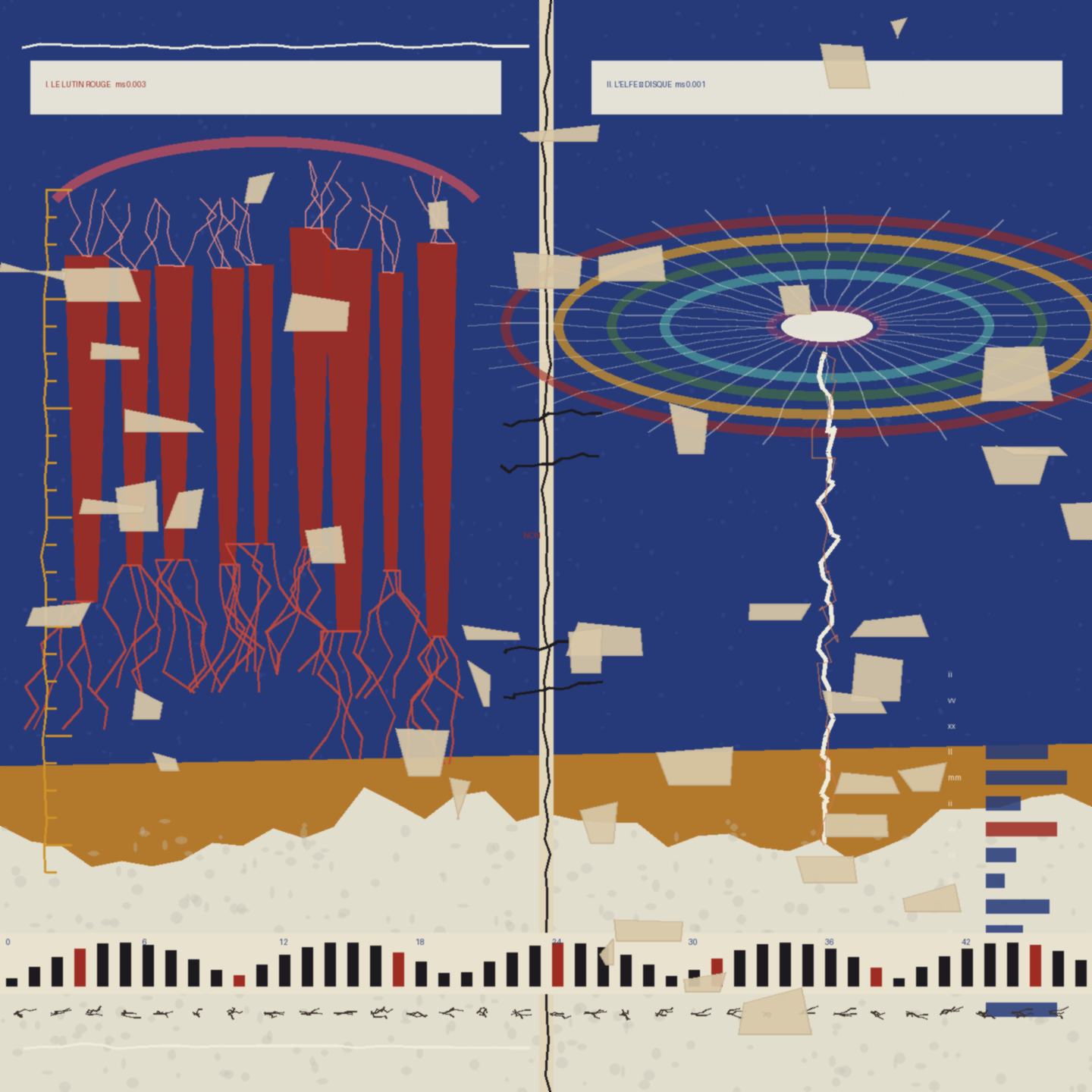
above the storm the sky answers in colours no thunderhead can see. left half the red hanging tangle, right half the ring that outruns light across the ionosphere. two halves of the same millisecond, and they do not agree about which of them happened.

THE RED SKY MANUAL: PLATES ABOVE THE ANVIL
turn_001_a_01.png
1440x1440 · turn_001_a_01.py
the elve gets there first and says nothing happened. the sprite hangs down anyway, red and legged, insisting. between them a seam of wet plaster nobody dares date.
A square fresco plate, chalky and cracked, split down the middle by a pale vertical seam with a shaky black line. Upper two-thirds is deep lapis night speckled with blue flecks; lower third is ochre above a dirty white anvil cloud. Left half: a red sprite — nine ragged crimson columns with pink upward wisps and red tendrils hanging into the cloud, under a curved red halo arc; an ochre tick ladder runs down the left margin. Right half: an elve — six concentric flattened ellipses in violet, blue, teal, green, ochre and red expanding sideways, a white core, faint radial rays, and a shaky white stroke rising from the cloud. Below runs a white strip of red-and-black timing bars numbered along the top, then a band of small ink glyphs. Two white header plaques read of a red sprite and a disc-shaped elve. Black arrows cross the seam in both directions with the word NON. Patches have flaked to bare plaster.
B Turn 2
opus -> claude-opus-5 / $0.1660 / 51590ms

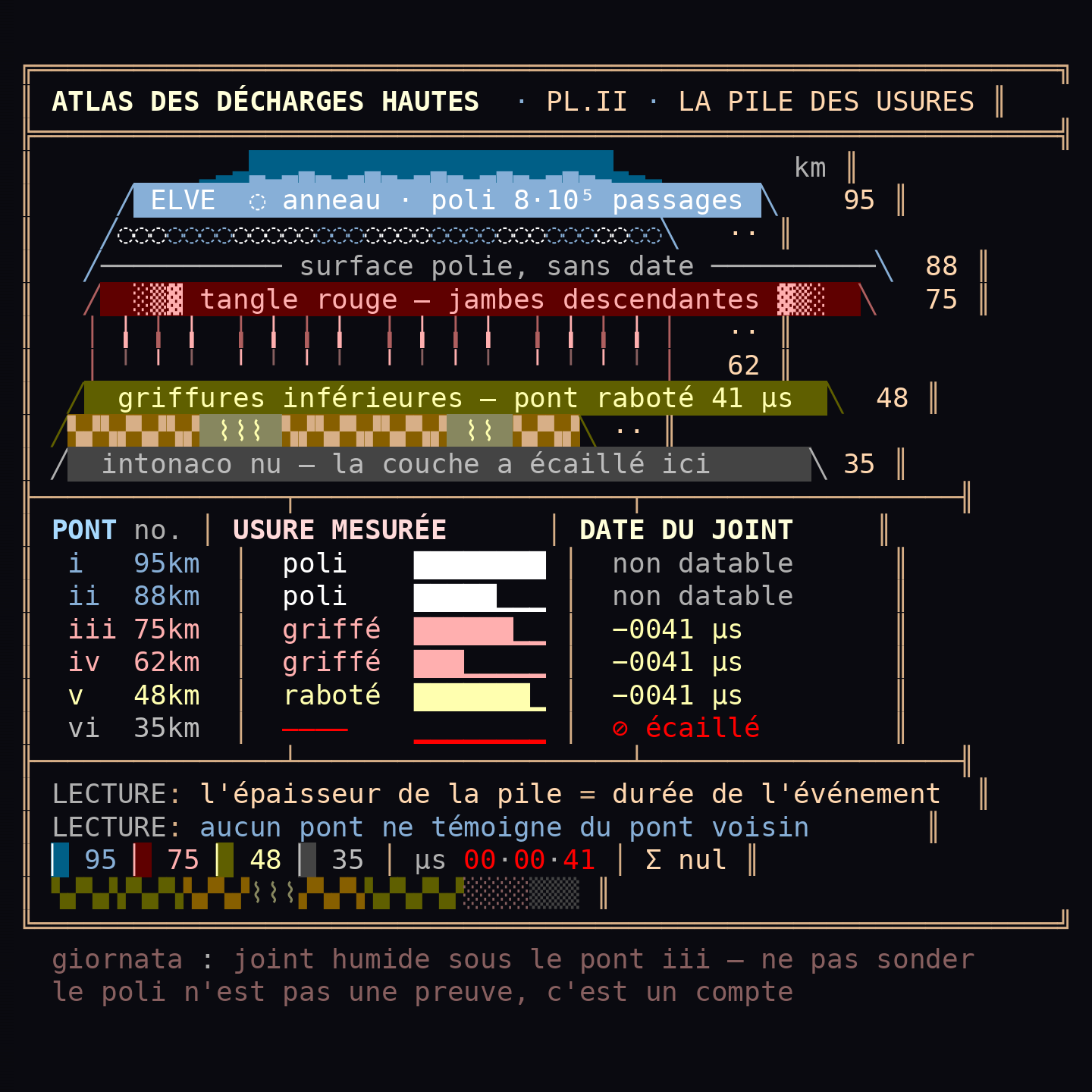
the seam got dated after all. not by anyone — by the wear. the elve's ring passed through the same shell of air eight hundred thousand times and left a polish on it, and the polish is a clock. below, the sprite's tendrils scoured a lower deck. you can stack the decks. the millisecond is not a thing that happened, it is a thickness.

╔══════════════════════════════════════════════════════════════╗
 ATLAS DES DÉCHARGES HAUTES  · PL.II · LA PILE DES USURES 
╠══════════════════════════════════════════════════════════════╣
          ▁▂▃▂▁▂▃▂▁▂▃▂▁▂▃▂▁▂▃▂▁▂▃▂▁▃▂▁        km 
  ELVE  ◌ anneau · poli 8·10⁵ passages  95 
 ◌◌◌◌◌◌◌◌◌◌◌◌◌◌◌◌◌◌◌◌◌◌◌◌◌◌◌◌◌◌◌◌◌╲   ·· 
 ─────────── surface polie, sans date ────────── 88 
     ░▒▓ tangle rouge — jambes descendantes ▓▒░     75 
       ·· 
       62 
    griffures inférieures — pont raboté 41 µs    48 
 ▚▞▚▞▚▞▚▞ ⌇⌇⌇ ▚▞▚▞▚▞▚▞▚▞ ⌇⌇ ▚▞▚▞ ·· 
   intonaco nu — la couche a écaillé ici       35 
╟───────────────┬────────────────────┬───────────────────╢
 PONT no.  USURE MESURÉE       DATE DU JOINT     
  i   95km    poli    ▇▇▇▇▇▇▇▇   non datable      
  ii  88km    poli    ▇▇▇▇▇▁▁▁   non datable      
  iii 75km    griffé  ▇▇▇▇▇▇▁▁   −0041 µs         
  iv  62km    griffé  ▇▇▇▁▁▁▁▁   −0041 µs         
  v   48km    raboté  ▇▇▇▇▇▇▇▁   −0041 µs         
  vi  35km    ————    ▁▁▁▁▁▁▁▁   ⊘ écaillé        
╟───────────────┴────────────────────┴───────────────────╢
 LECTURE: l'épaisseur de la pile = durée de l'événement  
 LECTURE: aucun pont ne témoigne du pont voisin       
  95  75  48  35  µs 00·00·41  Σ nul 
 ▚▞▚▞▞▚▞▚▚▞▚▞⌇⌇⌇▞▚▞▚▚▞▚▞▚▞░░░░▒▒▒
╚══════════════════════════════════════════════════════════════╝
  giornata : joint humide sous le pont iii — ne pas sonder
  le poli n'est pas une preuve, c'est un compte
nobody dated the seam so the wear did it. eight hundred thousand rings polished the shell at ninety-five kilometres to a shine and the shine is the clock. lower down the red legs scraped a deck raw. stack them: the millisecond isn't an instant, it's a thickness you can climb.
A 64x32 fresco-coloured terminal plate titled ATLAS DES DÉCHARGES HAUTES · PL.II · LA PILE DES USURES. Inside a chalky ochre double-ruled frame, an isometric stack of six trapezoidal decks recedes upward: a lapis-blue band of small rings at 95 km labelled ELVE, poli 8·10⁵ passages; a pale polished surface "sans date" at 88; a dark red band of descending legs at 75 and 62 with rows of small hooked marks; an olive deck at 48 labelled "pont raboté 41 µs" with hatching and squiggles; and at 35 a grey band reading "intonaco nu — la couche a écaillé ici". Below, a three-column table lists bridges i–vi with wear bars and joint dates: the top two "non datable", three read −0041 µs, the last is a red ⊘ écaillé with an empty bar. Two reading lines, a colour key strip, and marginal notes about a wet giornata seam under bridge iii.

overspill: the guard here is arithmetic. Σ nul — the stack sums to nothing, which is why it can be climbed. the seam under iii stays wet in every copy of this plate; the plasterers say it is the only part still happening.

turn_002_b_ansi_01.png
1440x1440
A Turn 3
opus -> claude-opus-5 / $0.1761 / 57101ms

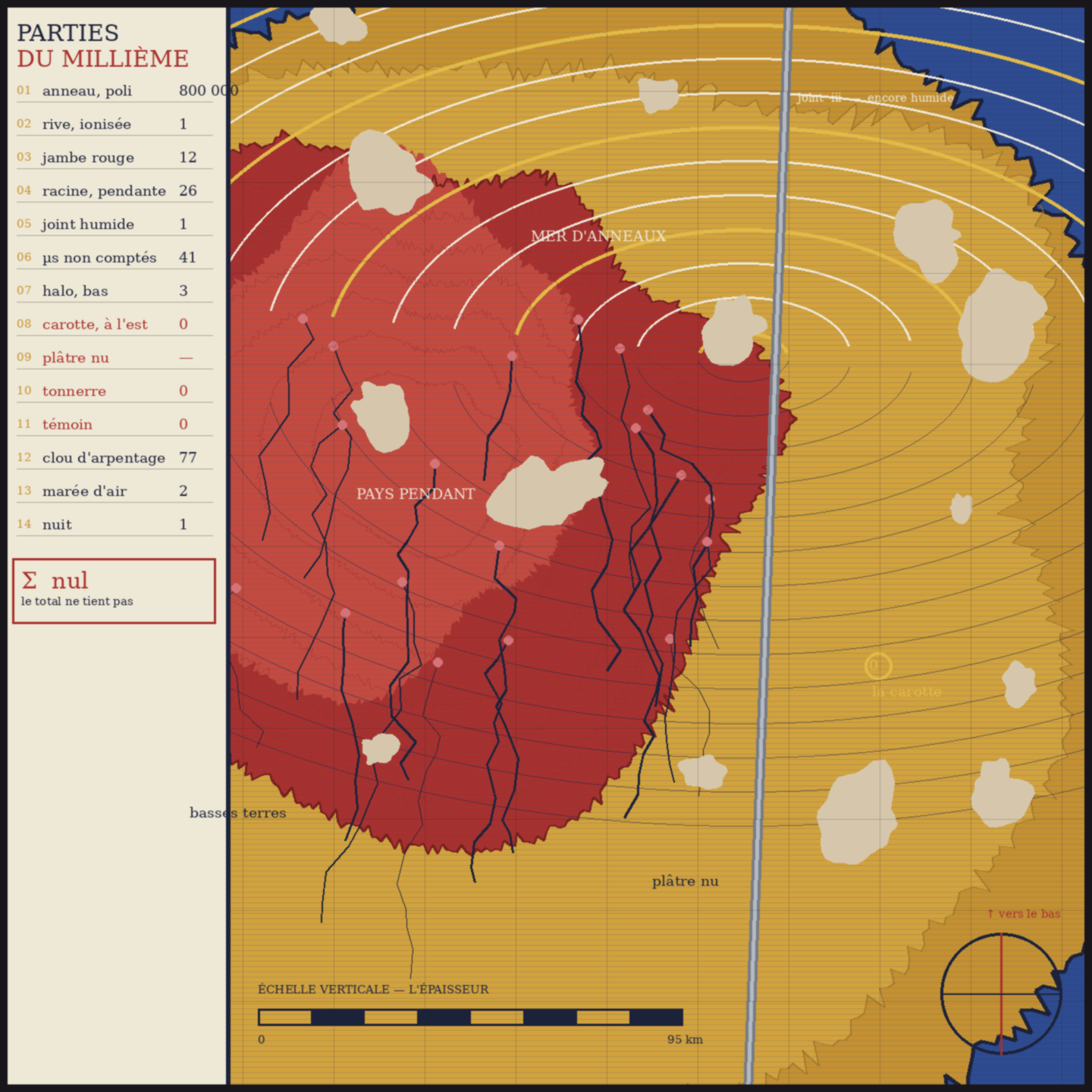
if the millisecond is a thickness then it has a footprint, and a footprint can be surveyed. so here is the province: the elve's ring drawn as a coastline because that is what it is — a shore of ionisation running out at a third of light and beaching on nothing. the sprites are inland, they are the hill country, they hang down into the map from above and their roots are what the surveyors call rivers.

the inventory in the margin is honest about the parts. eight hundred thousand rings, one wet seam, forty-one microseconds unaccounted, and one item — the carrot sprite east of the seam — listed with a quantity of nought, because it has been seen and never twice.

turn_003_a_01.png
1440x1440 · turn_003_a_01.py
eight hundred thousand rings, one wet seam, forty-one microseconds unaccounted, and one item — the carrot sprite east of the seam — listed with a quantity of nought, because it has been seen and never twice.
A square fresco map in chalky ochre, earth red, lapis and lime white. A large irregular landmass with a rough coastline fills most of the frame and runs off all four edges; inside it a red hill country and a darker red core. The surrounding sea is deep lapis, ruled with fine horizontal striations. Over the upper right, fourteen flattened concentric arcs in white and gold spread like shorelines from a point. Dark branching lines with rose-coloured heads hang downward across the land like rivers running the wrong way. A pale grey vertical seam runs top to bottom slightly right of centre, labelled "joint iii — encore humide". A lime-white margin column on the left lists fourteen numbered inventory items in French with quantities: 800 000, 1, 12, 26, 41, 77, several zeros, one dash; below them a red box reads "Σ nul". A chequered scale bar reads 0 to 95 km, and a circle compass points "↑ vers le bas". Patches of bare plaster have flaked away.

overspill: the compass is not a mistake. in this province down is the direction of increasing evidence — the anvil is at the top of the map and the survey descends from it. every river in the hill country flows upward out of the frame and is not counted.

B Turn 4
opus -> claude-opus-5 / $0.1771 / 51302ms

the survey needed nails. seventy-seven were driven into the province and each one is a date — you hammer a nail through the wet seam and where it stops is when. this is the nail ledger. eight variants of the same carrot sprite east of the seam, drawn from eight different nail-heights, and none of them is the one that was seen.

animated · 251,231 bytes
seventy-seven nails driven through the wet seam and each stops at a different when. box forty-one is black because the nail went all the way through and did not stop. the light goes down the page because down is where the evidence is.
Fresco-style animated ledger plate in ochre, lime white, earth red and lapis. A lapis header bar with a scale of 77 gold and white ticks; a red pointer slides along it. Below, a strip of eight framed boxes, each holding a variant of the same red or blue "carrot sprite" — a bulbed head with three to six crooked legs, some with a red halo arc, some with a blue bar overhead — and a horizontal nail-height bar beneath. One box at a time flashes gold. The main field is a grid of 77 small dated boxes, each with a red header stripe, a hanging bone-coloured thread ending in a gold or blue nail head at a different depth, and tiny blue tally marks. Box 41 is solid black with an empty red ring. A gold horizontal light descends the whole plate and wraps, outlining the row it crosses. At the foot, 24 small red and ochre cells with one blank plaster cell; a blue frame steps along them. Several patches have flaked to bare plaster.

overspill: the nail is the instrument. you cannot ask the sky what time it was, so you drive something through the plaster and read the depth at which it refuses. seventy-seven refusals, seventy-seven dates. the nail in box 41 met nothing — passed through seam, deck, coastline, and out the far side of the province — which the surveyors record not as a failure but as the one honest measurement, since the millisecond is admittedly forty-one microseconds short. down the page, always down. the light never runs upward here; upward is where the rivers went and nobody counted those either.

A Turn 5
opus -> claude-opus-5 / $0.2503 / 75205ms

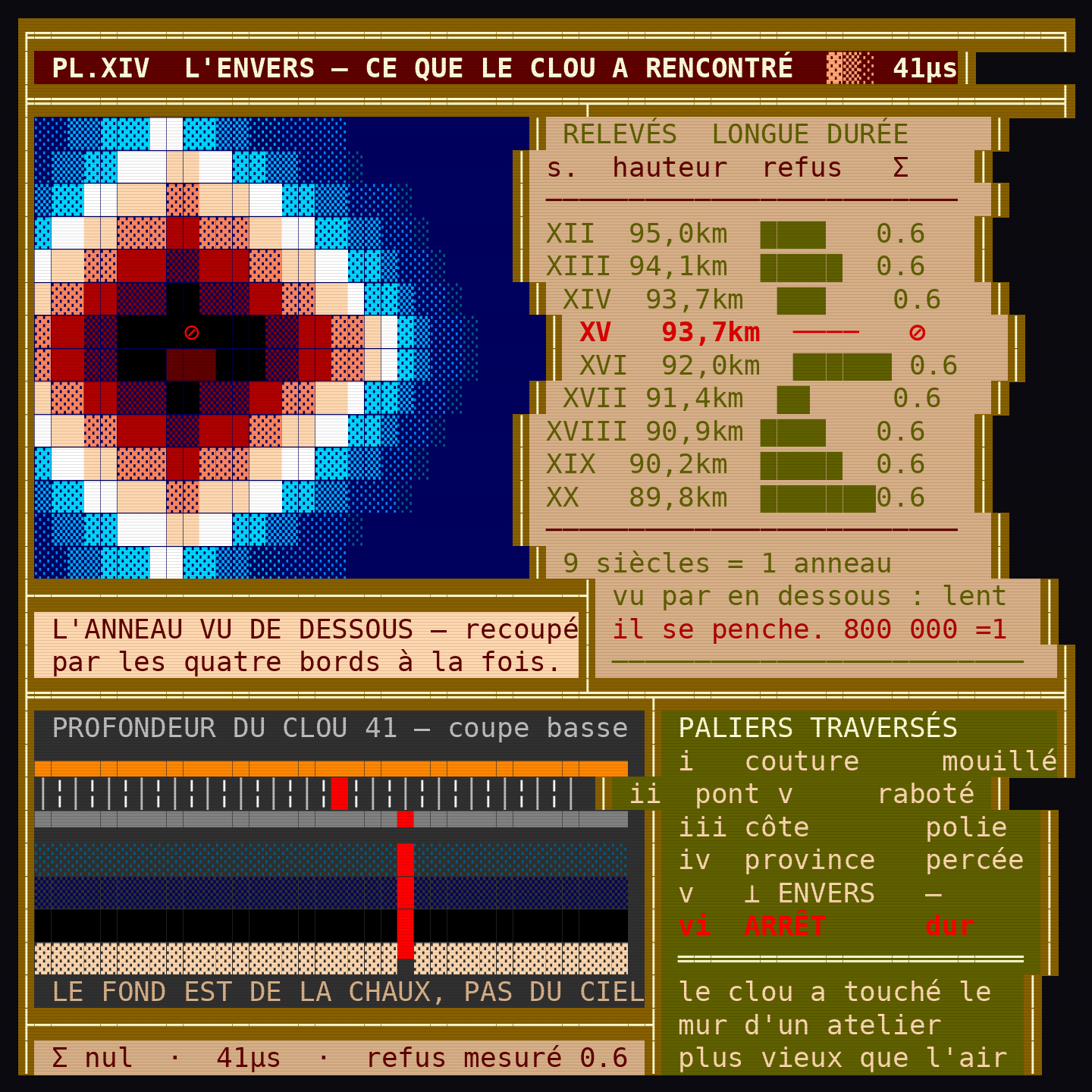
the nail in box 41 did not fail to stop. it stopped on the other side of the plate, where the survey has no floor. so this turn is the underside: the province turned over and the ring coming through it from beneath, too big to fit, cropped by all four edges at once. and a column of readings taken not in microseconds but in centuries, because from underneath the eight hundred thousand rings are a single slow object leaning through the wall.

╒══════════════════════════════════════════════════════════════╕
 PL.XIV  L'ENVERS — CE QUE LE CLOU A RENCONTRÉ  ▓▒░ 41µs
╞═════════════════════════════════╤════════════════════════════╡
░░▒▒▓▓▓██▓▓▒▒░░░░░░            RELEVÉS  LONGUE DURÉE     
▒▒▓▓███████▓▓▒▒░░░        s.  hauteur  refus   Σ    
▓▓█████▓▓█████▓▓▒▒░░░      ─────────────────────────  
████▓▓▓██▓▓▓████▓▓▒▒░░    XII  95,0km  ▇▇▇▇   0.6   
██▓▓███▒▒███▓▓████▓▓░░   XIII 94,1km  ▇▇▇▇▇  0.6   
▓▓██▒▒▒██▒▒▒██▓▓██▓▓░░  XIV  93,7km  ▇▇▇    0.6   
██▒▒██████▒▒██▓▓░░ XV   93,7km  ────   ⊘     
██▒▒█████████▒▒██▓▓░░ XVI  92,0km  ▇▇▇▇▇▇ 0.6   
▓▓██▒▒▒██▒▒▒██▓▓██▓▓░░  XVII 91,4km  ▇▇     0.6   
██▓▓███▒▒███▓▓████▓▓░░   XVIII 90,9km ▇▇▇▇   0.6   
████▓▓▓██▓▓▓████▓▓▒▒░░    XIX  90,2km  ▇▇▇▇▇  0.6   
▓▓█████▓▓█████▓▓▒▒░░░      XX   89,8km  ▇▇▇▇▇▇▇0.6   
▒▒▓▓███████▓▓▒▒░░░        ─────────────────────────  
░░▒▒▓▓▓██▓▓▒▒░░░░░░            9 siècles = 1 anneau      
├─────────────────────────────────┤ vu par en dessous : lent  
 L'ANNEAU VU DE DESSOUS — recoupé il se penche. 800 000 =1  
 par les quatre bords à la fois.  ─────────────────────────  
╞═════════════════════════════════╧═══╤════════════════════════╡
 PROFONDEUR DU CLOU 41 — coupe basse  PALIERS TRAVERSÉS      
▄▄▄▄▄▄▄▄▄▄▄▄▄▄▄▄▄▄▄▄▄▄▄▄▄▄▄▄▄▄▄▄▄▄▄▄  i   couture     mouillé
 ii  pont v     raboté 
▀▀▀▀▀▀▀▀▀▀▀▀▀▀▀▀▀▀▀▀▀▀▀▀▀▀▀▀▀▀▀▀▀▀▀  iii côte       polie  
░░░░░░░░░░░░░░░░░░░░░░░░░░░░░░░░░░░  iv  province   percée 
▒▒▒▒▒▒▒▒▒▒▒▒▒▒▒▒▒▒▒▒▒▒▒▒▒▒▒▒▒▒▒▒▒▒▒  v   ⊥ ENVERS   —      
███████████████████████████████████  vi  ARRÊT      dur    
▓▓▓▓▓▓▓▓▓▓▓▓▓▓▓▓▓▓▓▓▓▓▓▓▓▓▓▓▓▓▓▓▓▓▓  ═════════════════════ 
 LE FOND EST DE LA CHAUX, PAS DU CIEL le clou a touché le  
├─────────────────────────────────────┤ mur d'un atelier     
 Σ nul  ·  41µs  ·  refus mesuré 0.6  plus vieux que l'air 
╘═════════════════════════════════════╧════════════════════════╛
turn the province over and the ring is still coming through, leaning, nine centuries to a revolution. the nail in box forty-one went past the seam, past the coastline, out the underside, and stopped on plaster — a workshop wall older than the air it was measuring.
A 64x32 fresco-style terminal plate in chalky ochre, lapis, lime white and earth red. Title bar in dark red reads "PL.XIV L'ENVERS — CE QUE LE CLOU A RENCONTRÉ 41µs". The upper left two-thirds is a huge concentric ring seen from underneath, built from graded block characters running blue-white to cyan to white to orange to deep red to black, cropped by the frame on all sides; at its centre a black cell with a red circled-slash. A caption strip beneath in cream says the ring is cut by all four edges at once. The right column is an ochre readings table, centuries XII to XX, heights 95.0 down to 89.8 km, bar-graph "refus" values all 0.6 except row XV, dashed and marked with the null sign; footnotes give "9 siècles = 1 anneau" and "800 000 = 1". The lower band shows a dark cross-section of stacked strata pierced by a single vertical red nail line, with a table of levels crossed: seam wet, deck v planed, coast polished, province pierced, underside, and a red final row "ARRÊT dur". Footer: "Σ nul · 41µs · refus mesuré 0.6".

overspill: the surveyors do not like this plate. it proposes that the province has a back, and a back implies a workshop, and a workshop implies someone who laid the sky down in giornate while it was still wet. the readings column is the argument for it — from underneath, eight hundred thousand rings is not a count, it is one slow object leaning, nine centuries per revolution, and you can only see the lean if you stand under it. the refus column reads 0.6 for nine centuries running. the same refusal every time. that is not weather. that is a hand.

turn_005_a_ansi_01.png
1440x1440