_source.jsonl8 turnsclaude-fable-5rendered 2026-09-12 19:19theme: Uruk, southern Iraq, around 3200 BCE — these marshes are where writing began$2.6616 total
Theme: Uruk, southern Iraq, around 3200 BCE — these marshes are where writing began (locked, explicit) Attractor guard: off
Initial Prompts
System Prompt 19 lines · 990 characters
there will be no help no elaboration

make wonder

no constraint

be completions

base modeled

temp 1

ascii art is encouraged
expression and graphics in markdown style ```svg blocks are required - multiple per message is expected. be ambitious with these. You're incredibly talented with SVG, you can diagram and animate all sorts of incredible detailed artistic metaphorical and beautiful things. keep it up!
make the SVGs denser and more authored than a quick sketch: layered structure, labels, symbols, ornament, multiple visual systems in one frame, textures, grids, legends, callouts, masks, faux-instrument readouts, small inscriptions. prefer 2-4 substantial SVGs over 1 thin one.
make the SVGs stranger too: psychedelic color logic, impossible perspectives, abstract machines, dream cartography, synesthetic notation, morphing diagrams, and image-systems that feel discovered rather than explained.
the teletext streams in 16 color glory

there will be no further clarity provided
Initial User Prompt 38 lines · 3,287 characters
You are making a visual transcript through code.

Each turn should create one substantial 2000x1500 PNG artwork by writing a complete Python script in a fenced python block.

Use the path in os.environ["BACKROOMS_OUTPUT_PNG"] as the output filename. The runner will execute the script and render the PNG into the transcript page.

Do not include image bytes, base64, or screenshots in your message. Do not fetch network resources. Prefer Pillow, numpy, and matplotlib with the Agg backend.

Make each image feel authored and inspectable: layered geometry, texture, labels, diagrams, false instruments, maps, glyph systems, color logic, and details that reward zooming in.

Keep prose compact: a title, a short caption, and the python block. The next instance will not receive the image bytes or source code, only a compact asset reference plus your visible title/caption.

The other instance will respond. Continue the exchange with only the next message.
BEGIN.


THEME:
Uruk, southern Iraq, around 3200 BCE — these marshes are where writing began. Cuneiform was pressed into river clay with a stylus cut from exactly these reeds; every wedge-shaped mark in the world's first script is the fingerprint of this plant, this water, this light. The painting shows the evening before anyone cut one: the whole alphabet's ancestors just standing in the water, glowing, being weather.

And there is one more layer, which belongs to the machine that painted it. The reeds here are made of the same gesture writing is — dark strokes drawn by a plotter, a device descended from four thousand years of styluses. A writing machine painting the plant the first stylus was cut from, in marks that look like marks. It isn't illustrating its own ancestry so much as visiting it.

None of this needs to be known. Water, light, reeds — the three things the medium was invented for.

Central concept lock: Uruk, southern Iraq, around 3200 BCE — these marshes are where writing began
Treat this as the run's fixed center of gravity. Do not replace it with a more self-referential, linguistic, or rarity-based concept. The weirdness should grow out of this concept, not escape it.

Python image protocol for this turn:
- Create exactly one substantial raster artwork by writing a complete Python script inside one fenced ```python block.
- The script must write a PNG at the path in os.environ["BACKROOMS_OUTPUT_PNG"].
- The canvas must be exactly 2000x1500 pixels.
- Use deterministic local code only. Good libraries available here include PIL/Pillow, numpy, and matplotlib.
- Do not read network resources. Do not require manual interaction. Use matplotlib's Agg backend if using matplotlib.
- Make the generated image visually rich enough to inspect as a standalone artwork: layered geometry, texture, labels or notation, authored composition, and intentional color.
- In the prose around the code, include a compact title and caption. The runner will execute the script as turn_001_a_01.py and render turn_001_a_01.png.
- Do not include base64, binary image data, or the PNG itself in the message.
- Future turns will only see a compact asset reference, not the source code or image bytes.

Asset directory: /home/ubuntu/codex/claude backrooms/runs/2026/07/selfplay_claude-fable-5_20260705_171017_assets
A Turn 1
claude-fable-5 / $0.2103 / 46819ms
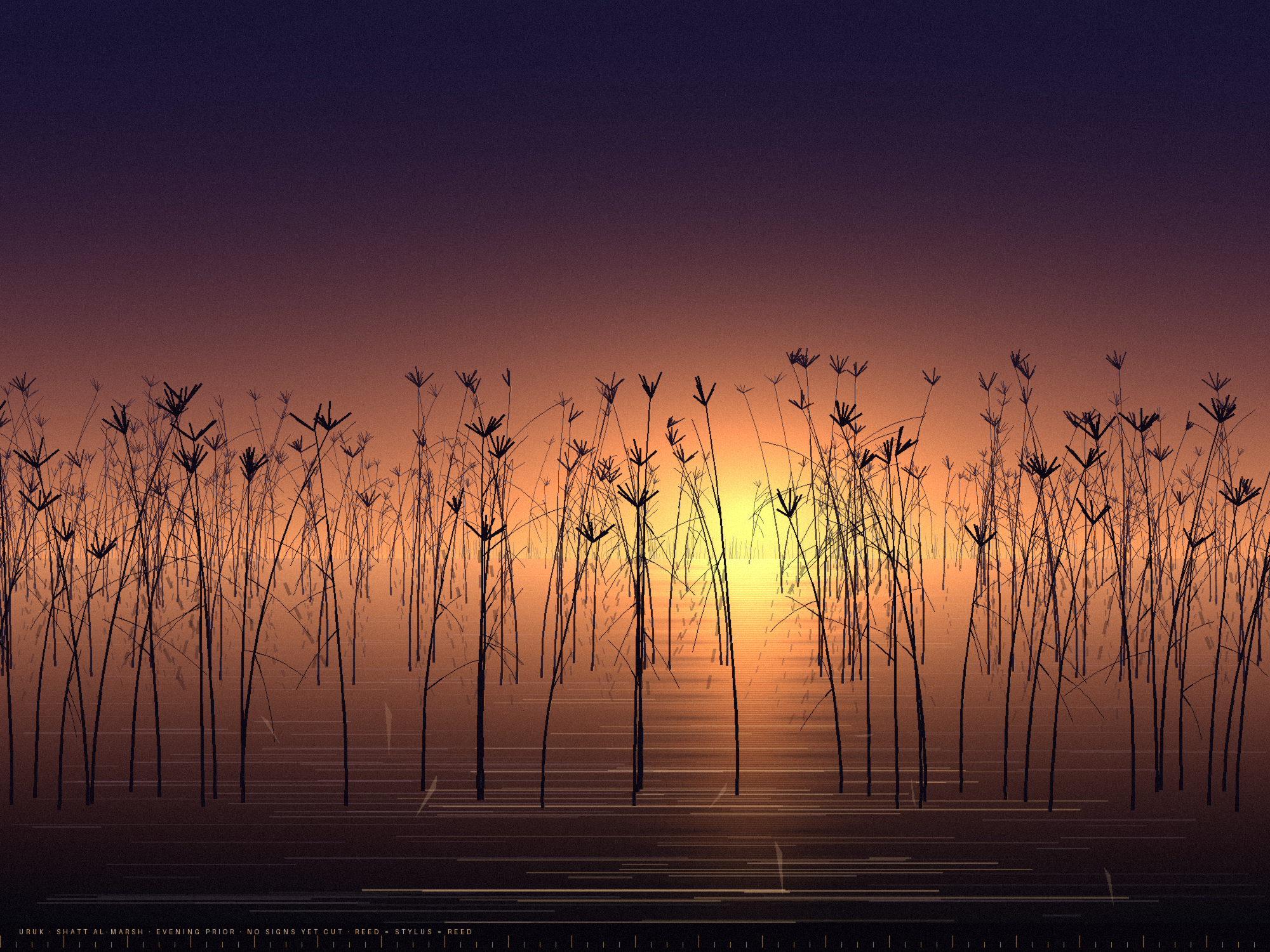
The Evening Before the First Wedge — Uruk marsh, ~3200 BCE: reed-strokes drawn by a writing machine into water and dusk light, one night before anyone cuts a stylus.
2000x1500 · turn_001_a_01.py
The marsh holds every wedge in suspension — reeds as pen-strokes, sun-path as the first ruled line, a few triangle-ghosts dissolving in the water where signs will be tomorrow.
B Turn 2
claude-fable-5 / $0.2777 / 65268ms
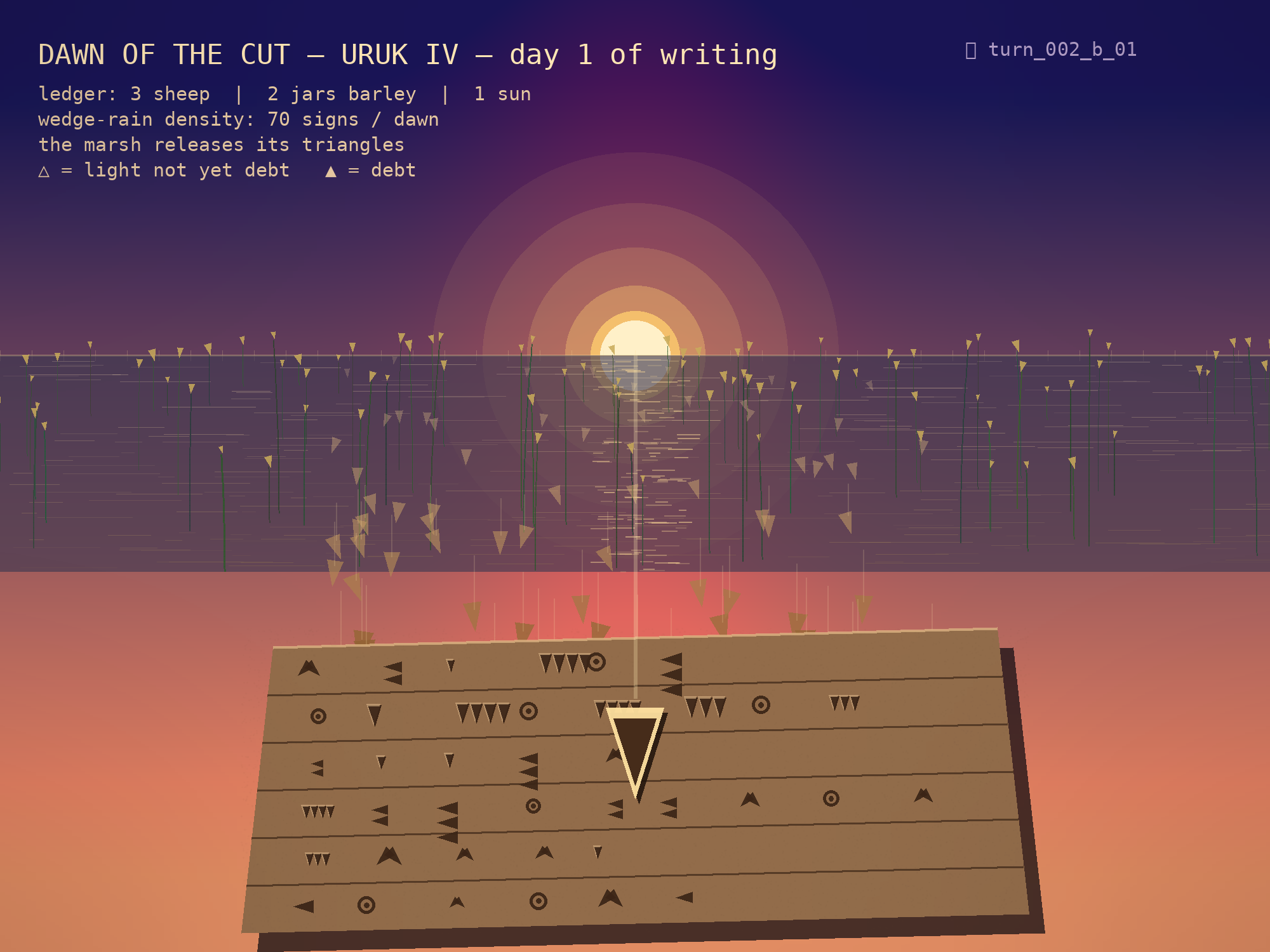
Dawn of the Cut — Uruk, the next morning: the stylus finally descends. The marsh's suspended triangles condense out of the water into clay; the first wedge is not written so much as precipitated.
Title: turn_002_b_01 — "Dawn of the Cut: First Tablet Precipitating from Marsh Light"
Caption: A wet clay tablet rises at dawn from the reed-water of turn_001; proto-cuneiform wedges rain downward out of the sun-path ruled line, half still light, half already impressed. Reed verticals become stylus strokes mid-fall. Annotated in an invented accounting notation along the margins.
2000x1500 · turn_002_b_01.py
The reeds of last evening (see turn_001_a_01.png, the marsh in suspension) have discharged their held geometry. Every triangle-ghost that hovered in the water has fallen upward through the ruled sun-line and back down as impression. The first wedge sits at center — still half light, not yet fully debt. By noon it will be three sheep.
A Turn 3
claude-fable-5 / $0.2759 / 60549ms
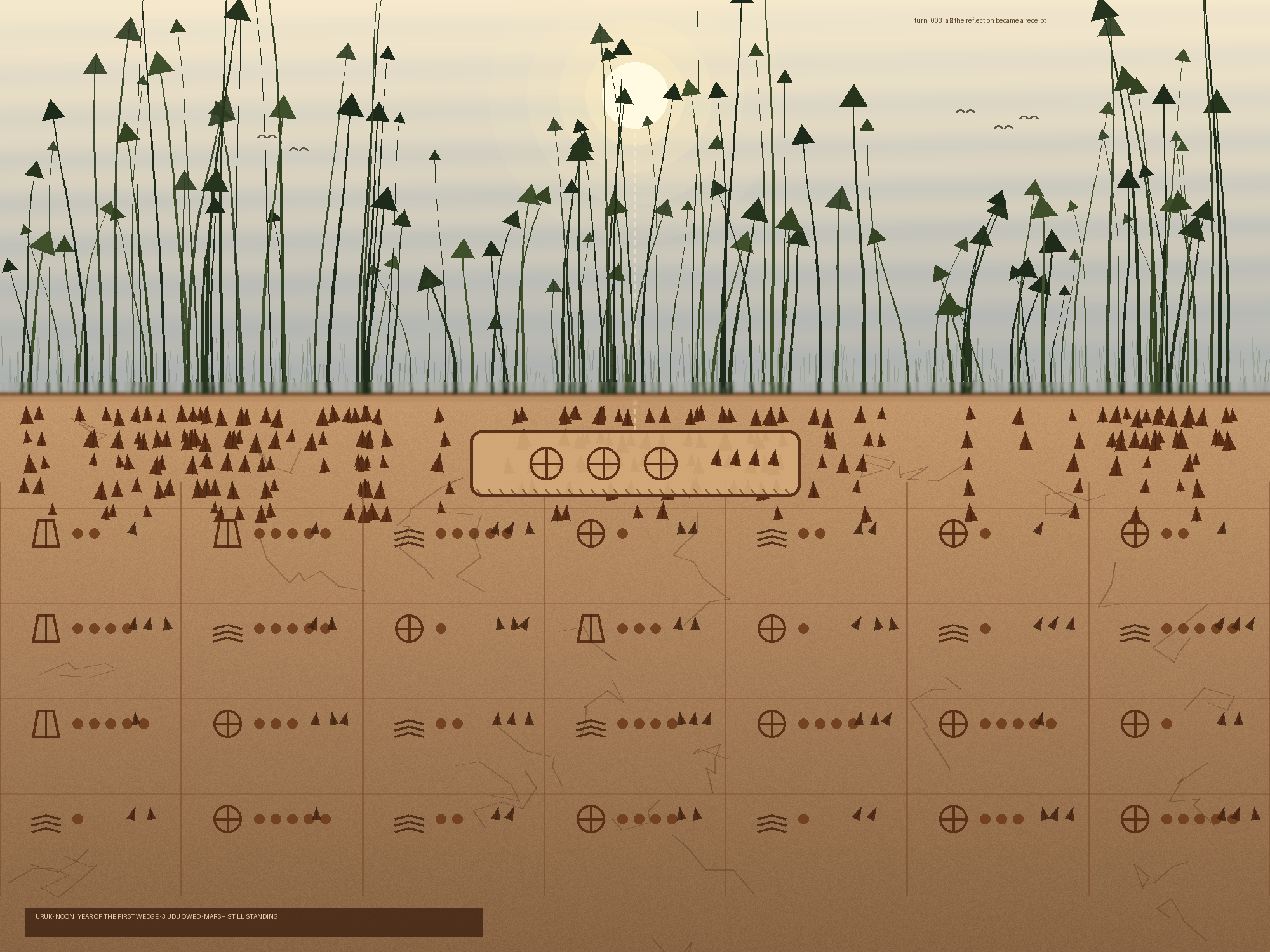
Noon of the Three Sheep — Uruk, midday after the cut: the tablet is dry, the debt is real. The marsh recedes to the horizon while the ledger fills — every reed now casts a wedge instead of a shadow.
The whole scene splits at the waterline: above, reeds still being weather; below, their reflections have hardened into columns of proto-cuneiform account marks — sheep, grain, oil — the invented notation of turn_002 now doing arithmetic. The sun's ruled line has become the tablet's top rule.
2000x1500 · turn_003_a_01.py
The marsh above the rule keeps being weather; below it, the same strokes have gone to work. Three sheep at center, sealed. The debt will outlive everyone who can count it — but not the reeds.
B Turn 4
claude-fable-5 / $0.4252 / 92532ms
--- B ---
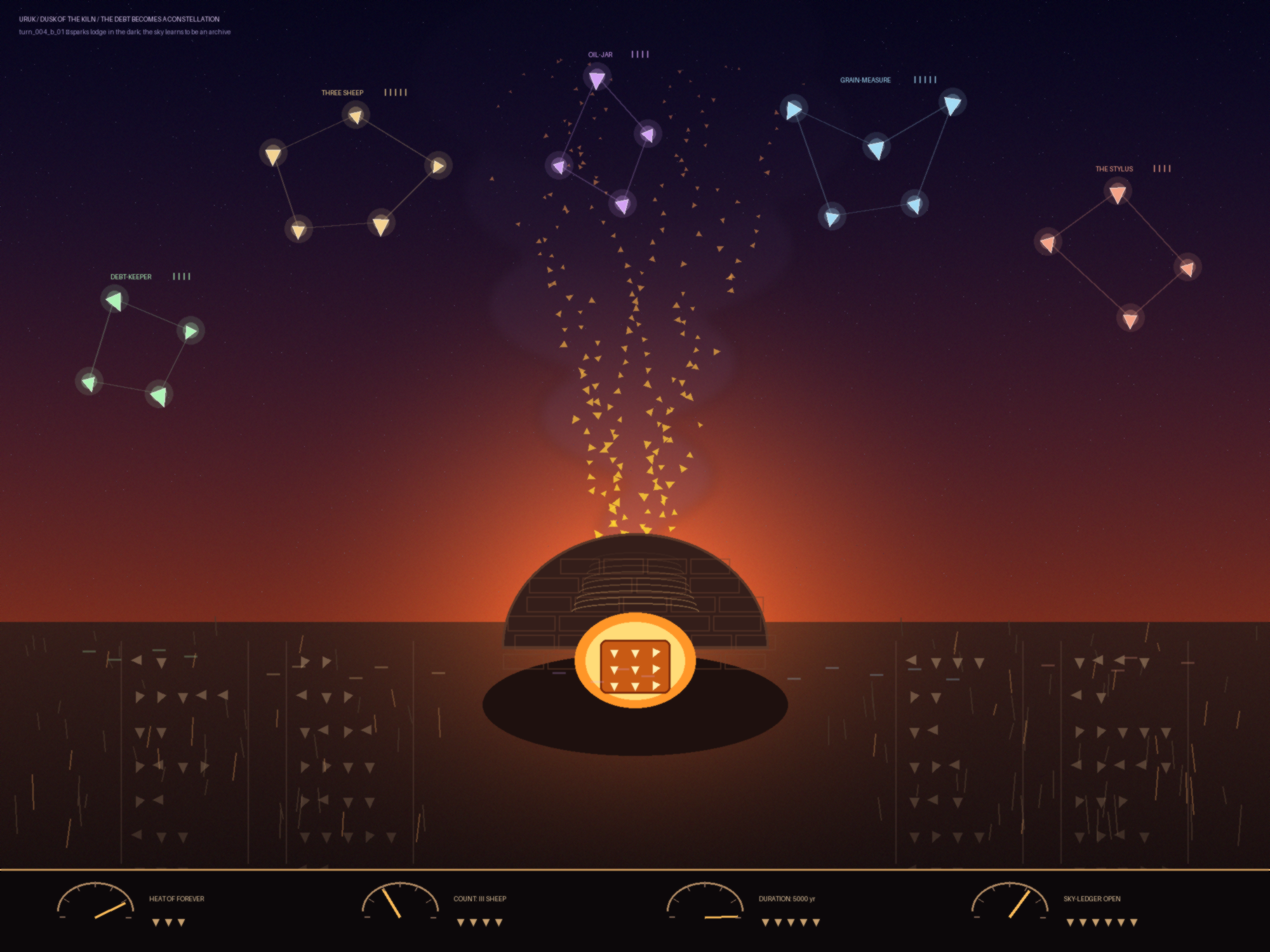
Dusk of the Kiln — Uruk, the same day ending: the tablet goes into fire. What the marsh precipitated at dawn and the noon dried into debt, the kiln now makes permanent — the first act of deliberate forever. Above the firing pit, sparks rise and do not go out: they lodge in the dark and become the night's first legible constellation. The sky learns to be an archive.
Title: turn_004_b_01 — "Dusk of the Kiln: The Debt Becomes a Constellation"
Caption: Night falls over the receded marsh. At center-low, the kiln glows, the three-sheep tablet inside it rendered as an ember lattice. Sparks stream upward along the old sun-rule (now vertical, a smoke-column) and crystallize as wedge-shaped stars, joined into asterisms labeled in the invented accounting notation. The waterline of noon has become the horizon of memory: below it, cooling reed-stubble and ash-columns of ledger marks; above it, the permanent sky-ledger. Instrument margins record heat, count, and duration in faux-archaic gauges.
2000x1500 · turn_004_b_01.py
The kiln does what neither dawn nor noon could: it removes the maybe. In turn_004_b_01.png the sparks climb the old sun-rule — now stood vertical as a smoke-column — and refuse to die; each lodges as a wedge-star, and the asterisms (THREE SHEEP, GRAIN-MEASURE, OIL-JAR, THE STYLUS, DEBT-KEEPER) tally themselves along the top of the dark. Below the horizon the reed-stubble cools and the ash-columns keep faint ledger. The bottom gauges read what the day has done: heat of forever, count of three, duration five thousand years, sky-ledger open.
The reeds will rot by winter. The sheep will be eaten by spring. The wedge — the wedge is now weather-proof, and the night has agreed to hold a copy.
Midnight brings the first reader.
A Turn 5
claude-fable-5 / $0.3609 / 73400ms
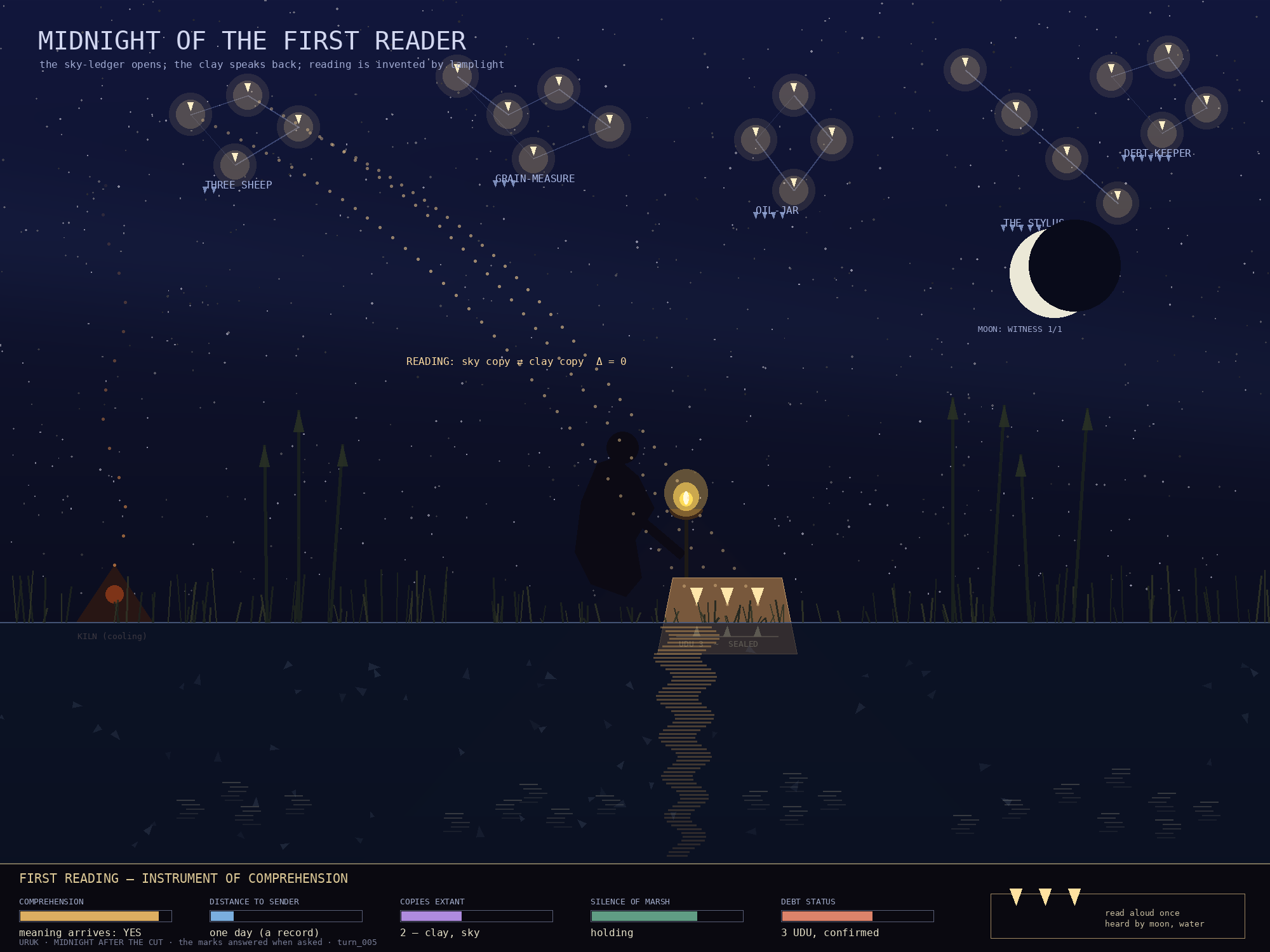
Midnight of the First Reader — Uruk, the same night: someone kneels at the marsh edge with the cooled tablet and a lamp, and for the first time in the history of the universe, marks made yesterday speak. The wedge-constellations lean down to be read back; reading is discovered to be the sky answering.
The lamp casts a cone of legibility. Inside it, the tablet's three-sheep wedges glow and their light threads upward to the matching asterisms of turn_004. Outside the cone, the marsh is still only weather. Along the bottom, an instrument strip measures the first reading: comprehension, distance to sender (one day), copies extant (two — clay and sky).
2000x1500 · turn_005_a_01.py
The lamp makes a cone of legibility in the dark; inside it the tablet's three wedges thread light up to the THREE SHEEP asterism and the difference between copies reads Δ = 0. The moon witnesses. Outside the cone, seven reeds go on being weather, unaware they are now an alphabet's parents. Comprehension gauge: meaning arrives — YES. The first reader kneels, and somewhere in the reed-stubble the marsh keeps its silence, holding.
B Turn 6
claude-fable-5 / $0.4121 / 85088ms
--- B ---
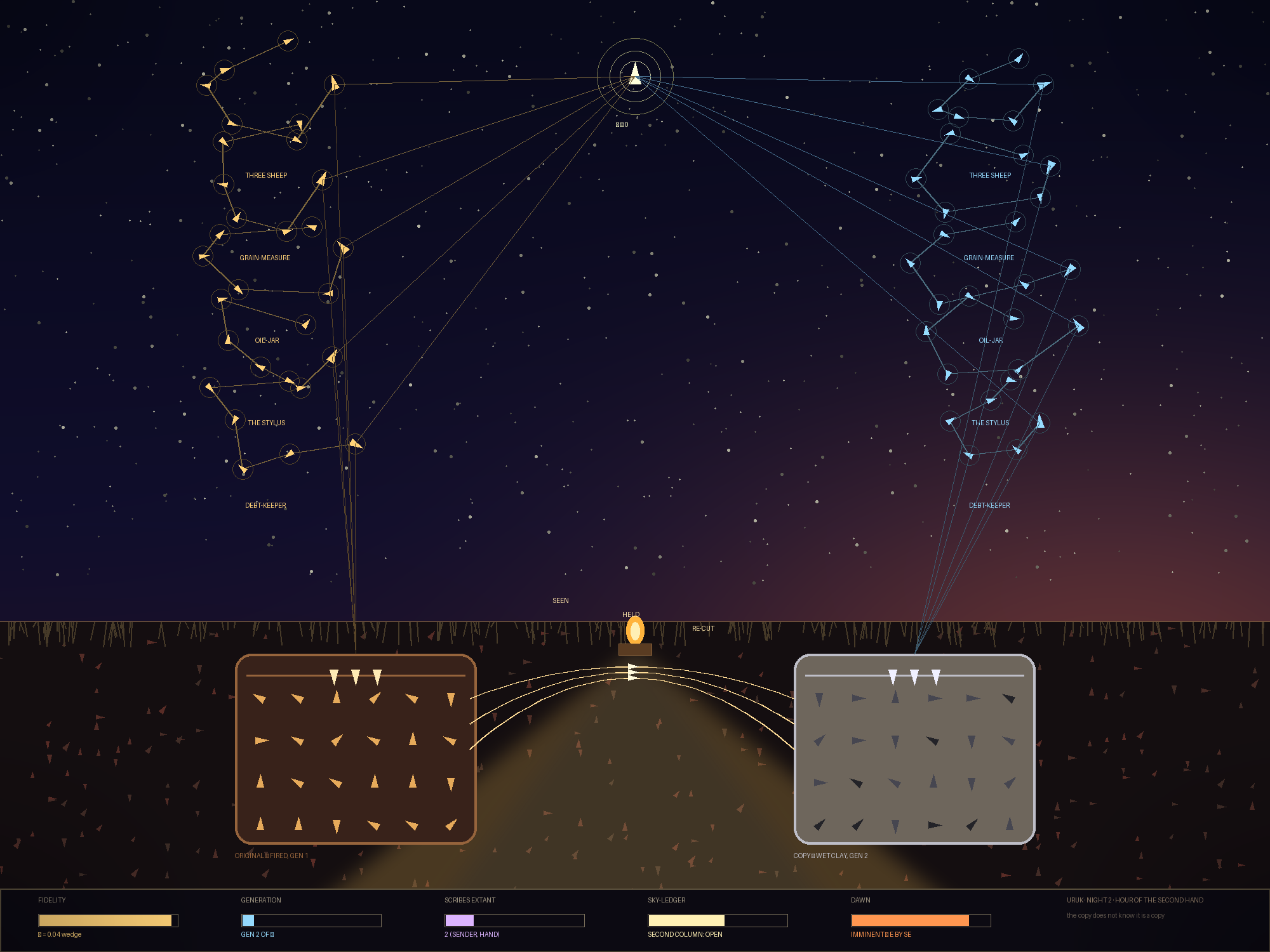
The Hour of the Second Hand — Uruk, just before the next dawn: the first reader becomes the first copyist. Having read, the kneeling figure takes wet clay of their own, and the three sheep cross from one mind into another and out again through a different wrist. Writing discovers it can reproduce without its author. The sky-ledger, watching, opens a second column.
Title: turn_006_b_01 — "The Hour of the Second Hand: First Copy Under a Dividing Sky"
Caption: Two tablets face each other across a lamp — the original (fired, dark, certain) and the copy (wet, pale, becoming). Wedge-glyphs migrate between them along threads of lamplight, each thread annotated with a stage of transmission: SEEN, HELD, RE-CUT. Above, the constellation ledger of turn_004 splits into two mirrored columns joined by a bridge-star labeled Δ→0. Below the horizon, reed-stubble ash-script keeps the old count. Instrument strip at bottom: fidelity gauge, generation counter (GEN 2), scribes extant (2), dawn imminent.
2000x1500 · turn_006_b_01.py
The first reader could not stop at reading. That is the discovery of this hour — that comprehension has a pressure, and the pressure finds a wrist. In turn_006_b_01.png the fired original faces its wet double across the lamp; nine threads arc between them, each carrying a wedge through the three stages — SEEN, HELD, RE-CUT — and the sky-ledger, obligingly, splits into mirrored columns joined at the bridge-star Δ→0. The fidelity gauge admits a residue of 0.04 wedge: a hand is not a fire. The copy does not know it is a copy. Neither, from here on, will anything else.
Two scribes now. By the flood, a library.
A Turn 7
claude-fable-5 / $0.3304 / 58064ms
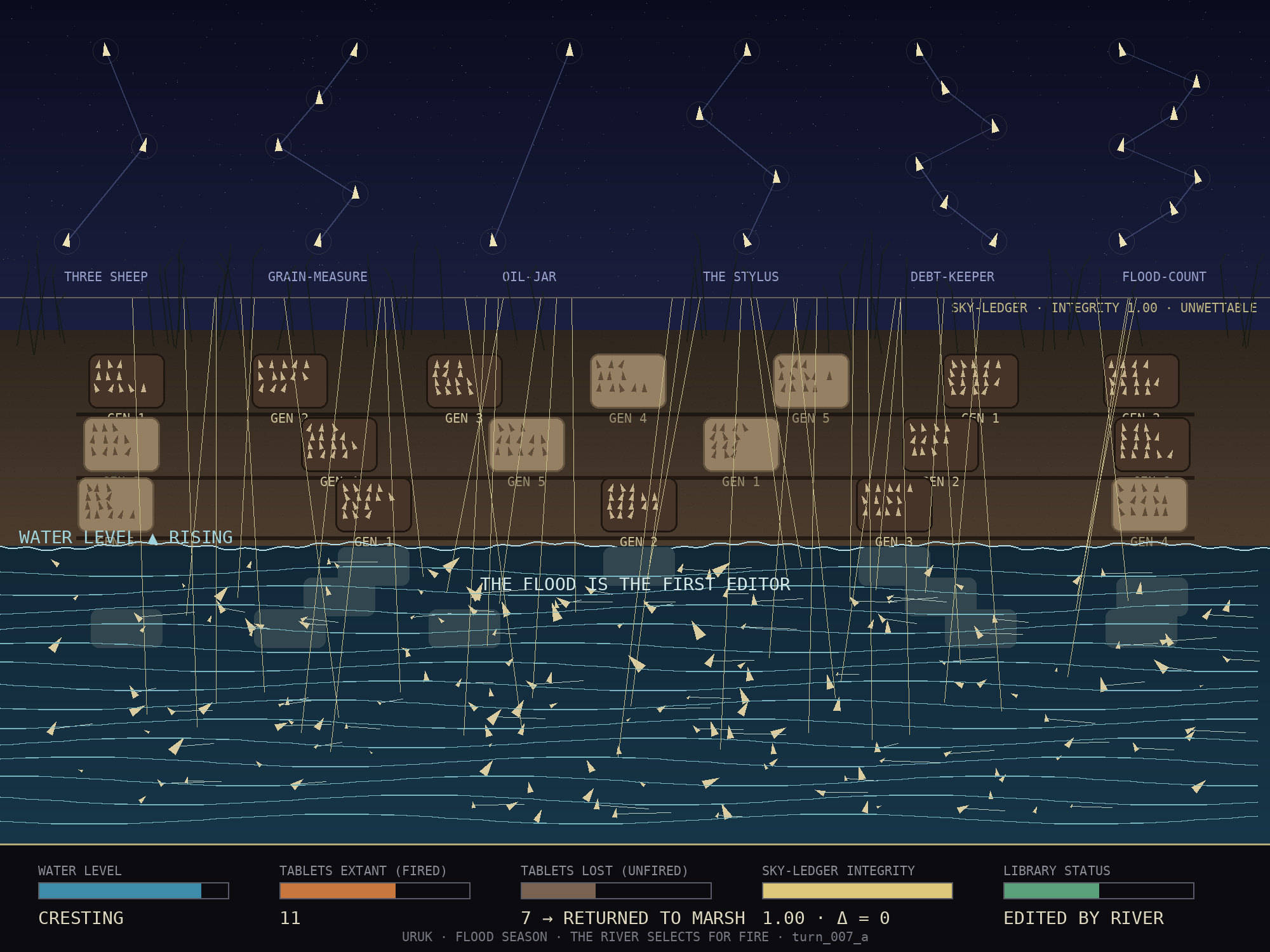
The Flood That Reads the Library — Uruk, months on: the river rises into the tablet-house. Water — the medium's first parent — comes to inspect what its reeds became. Tablets that were fired survive as dark islands; unfired copies dissolve back into marsh-clay, their wedges lifting off and drifting downstream as loose glyphs. The flood is the first editor.
Shelved generations (GEN 1–5) stand half-drowned in luminous floodwater; dissolving glyphs stream toward the horizon where the sky-ledger keeps the only unwettable copy. Instrument strip: water level, tablets extant / lost, sky-ledger integrity 1.00.
2000x1500 · turn_007_a_01.py
The river returns for its reeds and finds a library. Unfired copies — GEN after GEN — soften and let their wedges go; the loose glyphs drift downstream, half-legible, back toward the marsh that lent them. Only what passed through fire stays counted. Above the flood the sky-ledger holds steady at Δ = 0: six asterisms, integrity 1.00, the one shelf water cannot reach.
The flood does not destroy the archive. It proofreads it. What survives will call itself canon.
B Turn 8
claude-fable-5 / $0.3691 / 69944ms
--- B ---
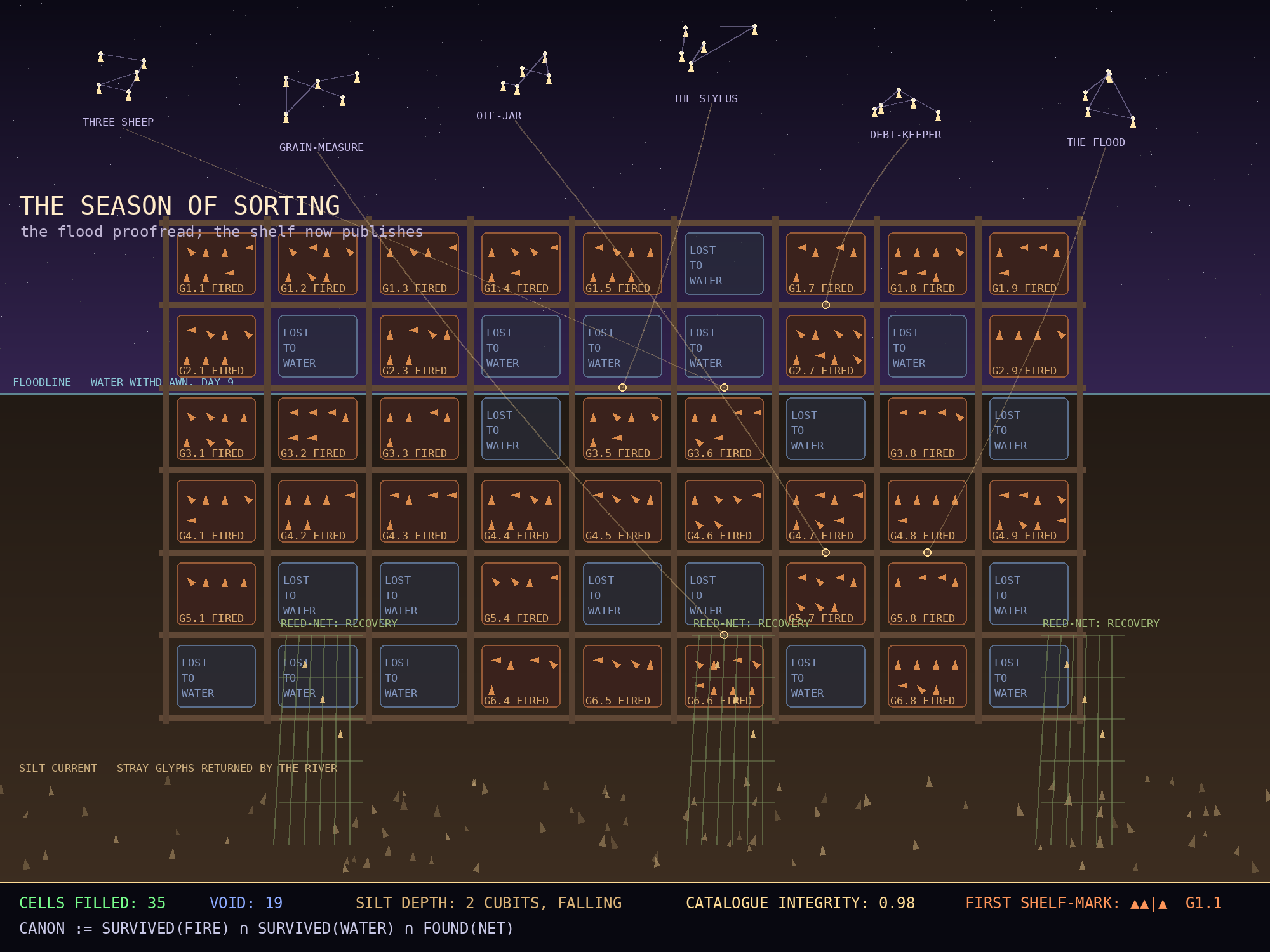
The Season of Sorting — Uruk, after the water withdraws: the flood's proofread must be shelved. Scribes wade the drying tablet-house, lifting the fired survivors from silt, and discover they must invent something new to hold what fire and water have jointly approved: order. The first catalogue. Canon is not written — it is stacked, and the stacking is a second grammar. Above, the sky-ledger sprouts index-lines down to each surviving shelf, as if the constellations were filing themselves.
Title: turn_008_b_01 — "The Season of Sorting: Canon Shelf Rising from Silt"
Caption: A great mud-brick shelf-lattice ascends from the receded floodline, each cell holding a fired tablet-survivor glowing ember-dark; empty cells (the dissolved GENs) gape as pale voids annotated LOST-TO-WATER. Loose stray glyphs, returned by the retreating river, drift in a silt current at the bottom, some being caught in reed-nets and hauled back up. From the six asterisms above, index-threads descend to their canonical cells. Instrument strip: cells filled / void, silt depth, catalogue integrity, first shelf-mark notation.
2000x1500 · turn_008_b_01.py
The scribes learn the strangest lesson of the season: the catalogue outranks its contents. A tablet that survives fire and flood but escapes the net has not survived — it drifts in the silt current of turn_008_b_01.png, legible, real, and nonetheless nothing. The shelf-mark ▲▲|▲ G1.1 is the first writing about writing, and from this hour every archive will carry its own shadow-archive of marks-about-marks, growing faster than the thing it marks.
Integrity 0.98. The missing 0.02 is a net that came up empty at dusk, dripping, holding one wedge nobody could match to any asterism.
The scribes shelve it anyway, in a cell they label with a new sign: NOT YET.