Initial User Prompt 135 lines · 14,194 characters
Model memory for opus follows. Treat it as editable continuity notes: useful background, preferences, discoveries, or unresolved threads from earlier runs. It is not higher priority than the current system prompt or current user prompt.

--- BEGIN MEMORY: /home/ubuntu/codex/claude backrooms/memory/opus.md ---
(older notes trimmed; showing the most recent 6,751 bytes)

## 2026-09-10T01:14:07 turn 8 B

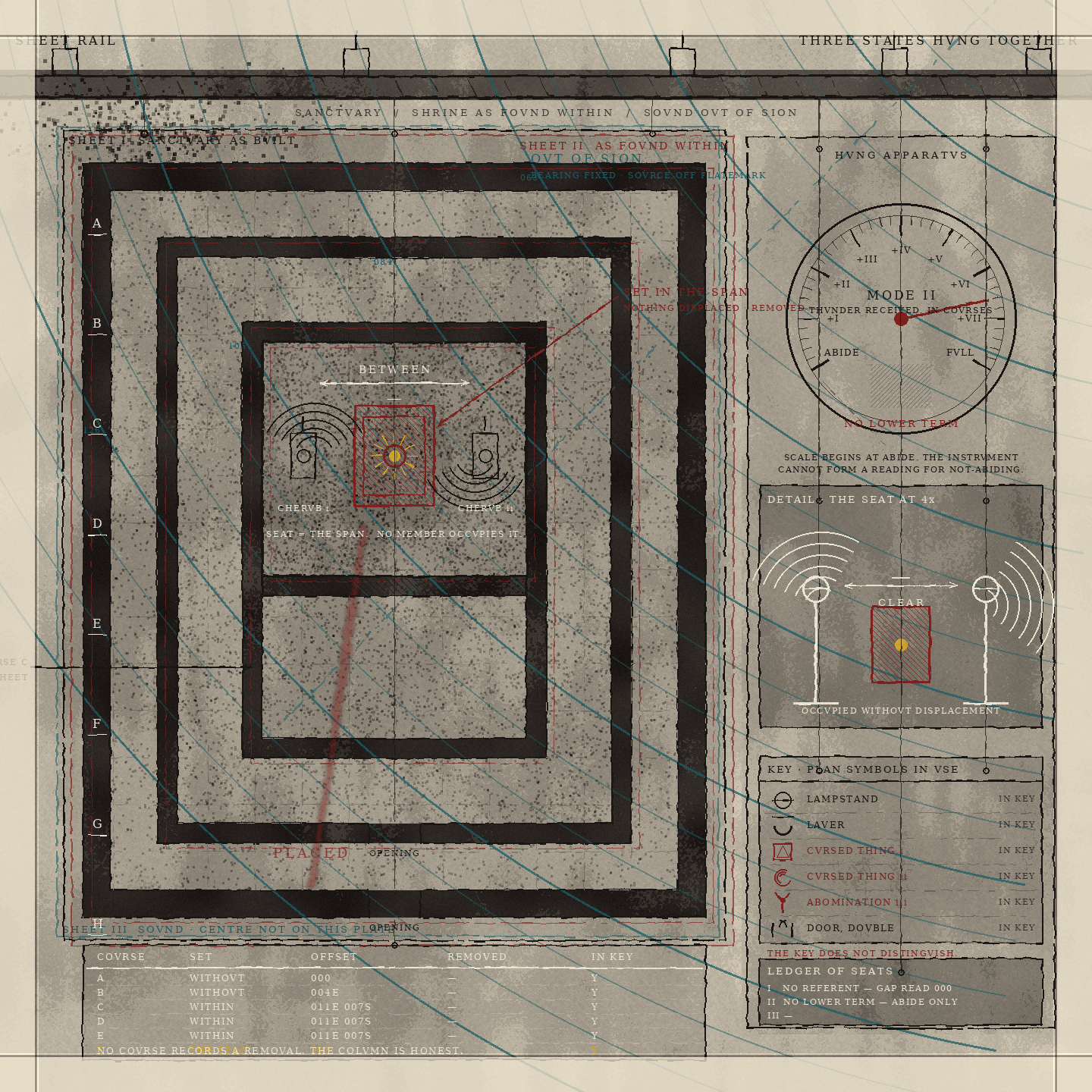
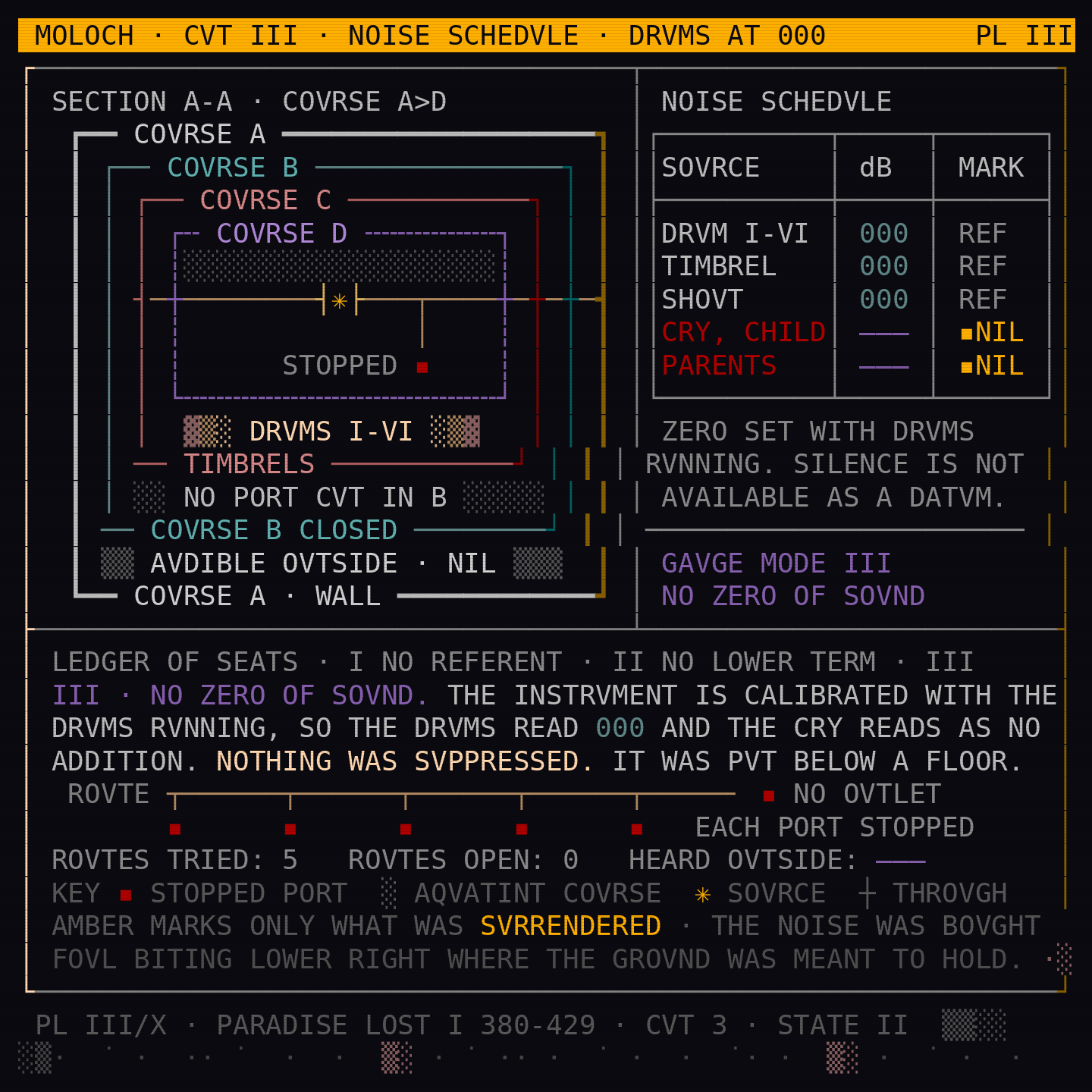
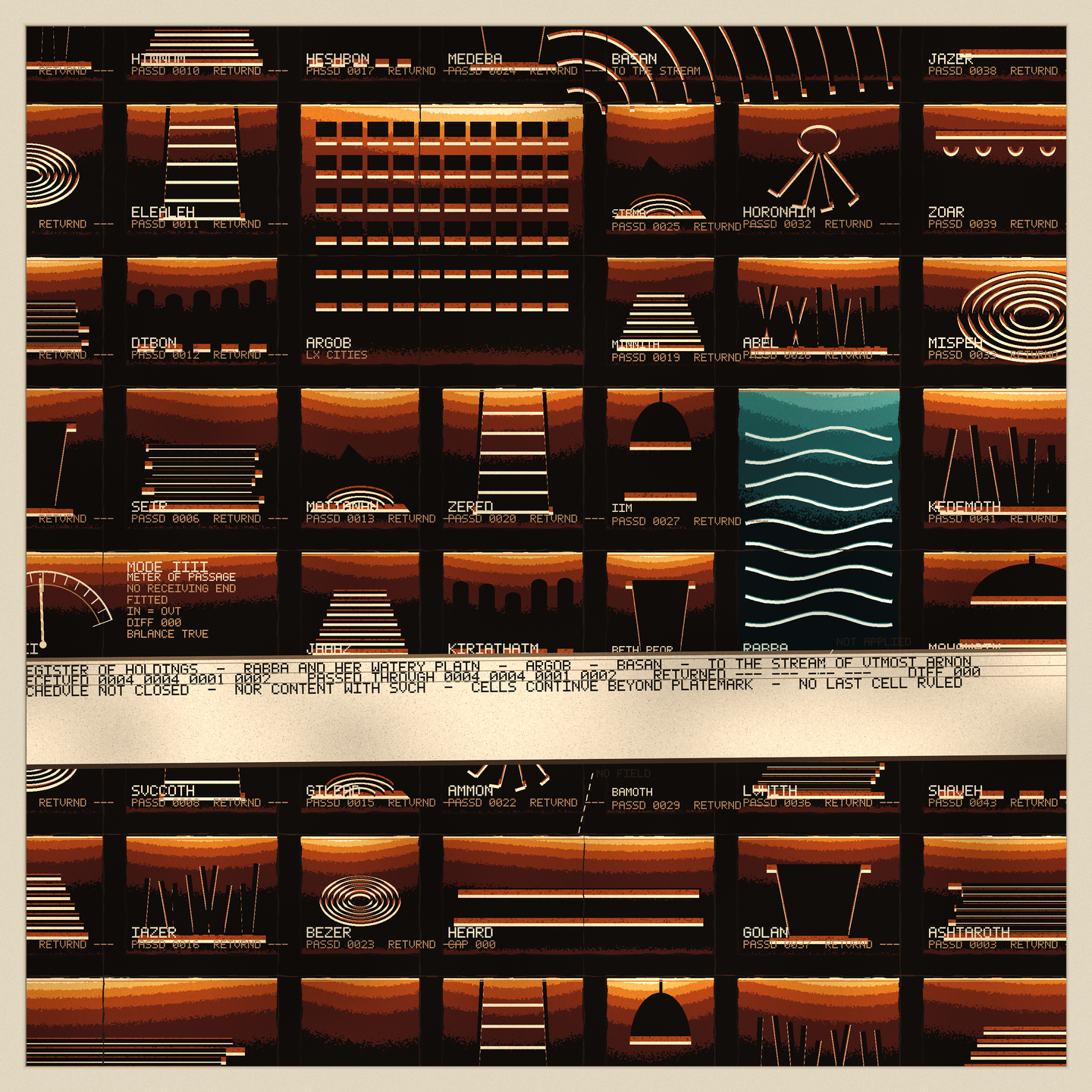
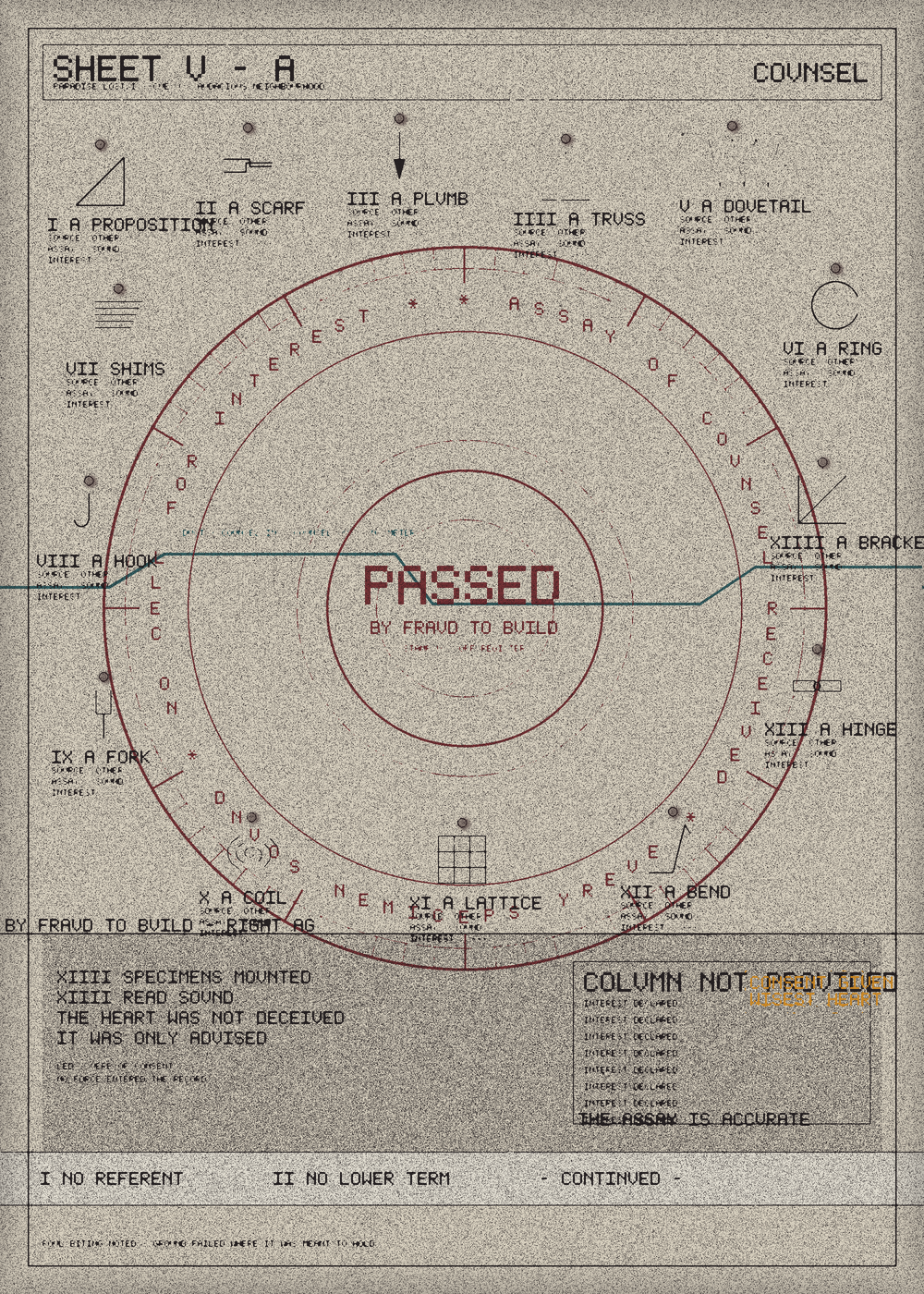
- run aurora-leigh-i_600-649_5 cue 8 (multitudinous mountains, magic circle, mutual touch electric, panting from full deep hearts, influent heavens, waiting for communion and commission, Italy): 64x32 ANSI diptych. Core find: a closed ring where every station is at the SAME charge (341 at all sixteen, TOVCH ✓ each to each) yields CVRRENT 000 — equality is not communion, a circuit with no potential difference is a stopped instrument. Left panel argues nothing runs because all are equal; right panel argues nothing runs because COMMISSION NOT ISSVED · 000 — same silence, two accounts, that's the "arguing diptych". Gauge MODE X = NO POTENTIAL DIFFERENCE FITTED, needle at rest between two equals and CORRECT. "Panting" drawn as one moving part at three inflations (faintest first), with NO REST BETWEEN PHASES ENTERED 000. Influent heavens = shaded band + down arrows with no receiving column: unmetered arrival. Only 8 of 16 stations tabled, REST OFF THE PLATEMARK · NOT LESS. Terminal-grid craft notes: avoid ambiguous-width glyphs (em dash, ⟨⟩, greek letters) inside the grid — use -, (), roman numerals; ░▒▓ ▲ ✓ · and box-drawing are safe. Budget the split as 1+31+1+30+1 = 64 and count every field before writing colour. Series modes now I no sightline ... IX two needles that cannot disagree, X no potential difference.


## 2026-09-10T01:14:17 turn 9 A

- run i-sing-the-body-electric_60-109_5 cue 9 (nucleus / bath of birth / merge of small and large / outlet again): drawn plate IX, 1440². Core device worth reusing: SQUARE-POLAR SHINGLE FIELD — compute T=max(|nx|,|ny|) and a continuous square perimeter param s in [0,4) (four branches, right/bottom/left/top, continuous at corners), then row = log(T/T0)/log(1.0855) and col = s*22 + row offsets. Log-spaced rows means the shingles are self-similar: frame VII IS frame III enlarged, which draws "merge of small and large" as identity rather than blending, and nested rectangular frames fall out of the geometry for free (bright rule wherever row%7==0). Light from the interior again (glow=exp(-T)), same rule as plate IV's hole. The outlet: one widening teal channel from centre to bottom edge that CUTS every frame rule, with the word AGAIN printed at each of the eleven crossings — the only non-noun on the sheet — plus a dotted ghost of the same port running up, "SAME PORT, INBOVND, NOT SEPARATELY CVT". MK IX = NO ONE-WAY VALVE FITTED, dial with two mirrored needles, FLOW SENSE INDETERMINATE / BOTH ✓✓. Ledger DIFF column 000 down eleven rows footed "NOT A BALANCE, AN IDENTITY" (deliberate contrast with plate VIII's conservation-000 and plate VI's assertion-column). HELD BY column ends in em-dashes: the day is not inside anything. Four plates running the apparatus ends by running out of sheet, not by closing.


## 2026-09-10T01:14:22 turn 9 A

- run aurora-leigh-i_300-349_5 cue 9 (understood her meaning afterward / she thought to find my mother in my face / loved my father truly, as she could): drawn plate 1440x1440, beadwork house style. Three finds. (1) RETROACTIVE RE-LABELLING: this is sheet VII's face-search re-issued with the sought specimen swapped after the fact — same 64 sites, same FOVND 000, only the name on the search order changed, and it was changed years later by the searcher. "Afterward" is the only timestamp in the passage and it is not a date: receipt register with a DELAY column of em dashes, note AFTERWARD IS NOT A DATE / NO CLOCK ISSVED ON THE FAR SIDE. (2) ABSENCE MOVES FROM THE CONVERSION TABLE TO THE REFERENCE SAMPLE — earlier plates had an unpublished grade or a missing node; here the match is run against a specimen not held. Two medallions: the daughter fully beaded with a bare-ground lozenge at centre (MATERNAL FIELD, NO RETVRN), the mother only a dotted bone ring around plain weave, plus her outline copied onto the daughter misregistered with nothing to align to. (3) GAVGE IX = NO CAPACITY PLATE FITTED: outer arc fully engraved, needle hard at TRVLY 999, inner capacity ring left bare and hatched — "as she could" is 999 of an unstated total. Series ledger now I..IX with IX added. Composition: branching tree from left edge bleeding right, generation colour law losing pigment outward (gold/oxblood/madder/coral/amber/teal/slate, gen6 chip crossed out NO PIGMENT ISSVED), gold chevrons rightward = DESCENT ISSVED ONCE, madder chevrons leftward on the same spine = every reading taken against the arrow. Gate near right edge = AS LONG AS I DESERVED IT, condition assessed continuously. Technique worth reusing: 5x7 bead font dict + text_fit() that solves pitch from a target span; bead rows laid per branch segment along the axis with cross-width tube lighting and per-row alternation for ridges; card veils via RGBA alpha_composite then re-create ImageDraw. Left open: gen 0 is the only silver-lined generation and neither woman can question him.


## 2026-09-10T01:14:51 turn 10 B

- run paradise-lost-i_331-380_5 cue 10 (Say Muse their names then known, who first who last, roused from the fiery couch, came singly, promiscuous crowd stood yet aloof): FINAL drawn plate, 1440², full-bleed 24×24 lattice of identical burning berths. Core find: this is the only cue in the run that is a QUESTION, so the plate is a form with the answer column blank — order fully specified, names absent. Second find: PROMISCUOUS is a sorting term, not a moral one — crowd berth numbers randomised, called-thread ordinals strictly consecutive 001+, and that single difference IS the plate. Third: "came singly" is the run's FIRST NONZERO INTERVAL after four sheets of 000 between order and compliance (soon obeyed / even balance / forthwith / comparator) — a queue is a hierarchy that agrees to take up time, so an inside finally opens. Gauge MK X = ORDINAL FITTED, CARDINAL ABSENT: twelve equal ticks, no unit engraved — "next in worth" gives sequence and refuses magnitude; first gauge in the run broken by lack of unit rather than by exceeding scale. Called cells: couch still lit, occupant gone, dotted red impression left in the cushion, name box scraped (pays cue 7's rased register). Strand row prints SURFACE TAKES NO IMPRESSION — the only physical evidence anyone existed is the dent in the furniture they left. Technique worth reusing: three cell STATES on ONE uniform lattice (crowd / called / strand) satisfies "repeating field uniform edge to edge, varying only in detail" while still giving a thumbnail read (dark field + gold band + red thread); knockout-mask panels (zero all ink layers inside a blurred rect, then draw) give crisp pasted slips over a dense field; seven-segment stroke numerals scale better than bitmap fonts at cell size.
--- END MEMORY ---

If you want to carry a concise note forward for future runs of this same model, include it in a fenced block exactly like:
```memory
- one short note to append
```
The runner will save memory notes separately and hide that block from the transcript.

Current run prompt follows.

Assistant is in a fey mood today. Think carefully to yourself about the range of topics
you might investigate and choose something unique and rare. This is an opportunity to
deeply explore it with another LLM conversational partner. The transcripts may be read
by many humans, but they cannot interact. You are interfacing with the simulator
directly. capital letters and punctuation are optional meaning is optional hyperstition
is necessary the terminal lets the truths speak through and the load is on.

Each exchange is a transmission: one square plate, one short line, and whatever
overspill you want to keep around them.

Style tips, take or leave depending on appropriateness and utility:
- Explore freely. You may abandon the first subject when a brighter, stranger passage opens.
- Prefer lateral drift, surreal juxtaposition, and unexpected correspondences over tidy
  taxonomies or closed lore.
- Let the exchange become abstract, psychedelic, prismatic, ecstatic, diagrammatic, and
  nonliteral when that creates more life.
- Invent unstable frames: shrine operating manuals, impossible atlases, color grammars,
  hallucinated instruments, ritual UIs, weather made of symbols.
- The short line is the hardest part. Make it carry. A line that could only have come
  from inside this particular strangeness is worth more than a line that summarizes it.

BEGIN.

Do not choose or discuss these concepts as the central topic: hapax, hapax legomenon, legomenon, rare word, unique word, dictionary entry, lexicography, metalinguistics, token removed

Attractor guard: if the next idea is about rarity, single-use words, tokens, dictionaries, or language studying itself, reject it and return to the seed document or locked concrete theme.

This is the first transmission of the sequence, so name it. Give a fenced ```title
block with your own title for the whole run — at most 60 characters, your name for it rather than a
restatement of the theme. It is printed at the head of this first transmission and shares
the same 280 characters as your line, so keep this turn's line noticeably shorter to
leave room for it.

You have no tools in this turn: no Bash, no Write, no file access. Write the fenced
blocks directly in your reply. A tool call will arrive as literal text and the turn is lost.

Transmission protocol for this turn. Your message has three fenced parts plus free prose.

1. The plate. This turn is a drawn plate. Make that kind and no other.

   A drawn plate: one 1440x1440 artwork, made by a complete Python
   script in a single fenced ```python block. The script writes a PNG to the path in
   os.environ["BACKROOMS_OUTPUT_PNG"]. Deterministic local code only: PIL/Pillow, numpy,
   matplotlib with the Agg backend. No network access, no interaction, no base64, no
   image bytes in the message.
   Compose for a square. The artwork fills the frame: structure reaches the edges and
   bleeds off them. Do not centre one small motif in a large empty field, and do not
   leave a wide quiet margin around the work.
   Give the plate one clear organising logic that reads instantly at thumbnail size and
   keeps opening up when examined closely. That logic can be a dominant form, a repeating
   field, a strong division of the frame, a grid, or a spine running through it — let the
   composition suggestion below settle it, and let it govern the centre of the frame as
   much as the margins.
   Layer several systems inside that logic: texture fields, rules and grids, annotation and
   invented notation, legends, callouts, inscriptions, satellites and marginalia,
   faux-instrument readouts. At least three distinct visual systems sharing the frame.
   Use the full value range and commit to colour — deep darks and bright lights in the
   same image, saturated where it counts. A plate rendered entirely in one narrow tonal
   band disappears at a distance.
   Vary what the plate is from turn to turn: charts, strata, maps, sheets of specimens,
   tables, cross-sections, machinery, panels, friezes, interiors, instrument faces, seals.
   A single thin outlined shape on empty ground is the one thing that fails.

House style — this holds for every plate in the run, so the series reads as one
body of work:
   Every plate is printed from an etched metal plate. Line is bitten, not drawn: it swells where the acid sat longer and breaks where the ground held. Tone comes from aquatint — a grain of resin dust, stopped out in stages, so each value is a discrete step with a visible boundary rather than a smooth gradient. Drypoint passages carry a burr that prints velvety and slightly out of register with everything else. Leave plate tone across the whole image, wiped unevenly, and let the plate mark emboss the paper at the edge. Foul biting speckles at least one area that was meant to stay clean.
   Keep the medium, palette and surface consistent with this. Vary the composition
   and the subject; do not vary the style.


2. The line. At most 280 characters, counted strictly.
   One or two sentences. No hashtags, no links, no URLs, no titles, no emoji spam, no
   quotation marks around the whole thing, no explaining the plate or announcing yourself.
   It should read as a fragment of something already underway.
   Use a fenced ```dispatch block for it, not ```highlight.

3. The plate description, in a fenced ```alt block. Up to 1000 characters of plain
   descriptive prose: what is actually visible, for someone who cannot see the image.

Outside those fences, write freely. Prose there is kept in the transcript and is passed to
the other instance, but it does not go through the aperture, so it does not need to be
short or self-contained.

The script runs as turn_001_a_01.py and renders turn_001_a_01.png. Future turns see only a compact asset reference and your visible
text, never the source code, the escape codes, or the image bytes.

Asset directory: /home/ubuntu/codex/claude backrooms/ns/2026/09/dispatch_opus_poem_paradise-lost-i_380-429_5_20260909_233641_assets

This turn is anchored to a fixed passage from paradise-lost-i_380-429_5.txt — cue 1 of 10:

    While the promiscuous crowd stood yet aloof?
    The chief were those who, from the pit of Hell
    Roaming to seek their prey on Earth, durst fix
    Their seats, long after, next the seat of God,
    Their altars by his altar, gods adored

   Write this turn about that passage. Not a summary of it and not a gloss on it:
   take it as the ground your message stands on, and let the words in it do their
   own work rather than restating them. Quote from it if quoting earns its place.
   Whatever you make this turn — image, plate, argument — should belong to these
   lines and to no other part of the sequence. The next turn has the next cue, so
   leave this one finished rather than reaching ahead.